Friday, 6 December 2019

Intricate Battleships by Atsushi Adachi are Constructed from Vintage Newspaper

All photographs (c) Atsushi Adachi, shared with permission

The Japanese visual artist Atsushi Adachi creates miniature replicas of objects from the past using old newspaper clippings and articles sourced from the same period. Artifacts from history like battleships and Neil Armstrong’s space suit come alive in what Adachi describes as a meditation on memories of our collective memory.

Adachi chooses to work with newspaper because be believes that the medium embodies society’s values of that certain period. Like time, our values are fluid and ever-changing, influenced by events of the world that we often find ourselves swallowed up by.

By working with newspaper clippings from certain periods, Adachi gains an understanding of what was going through the minds of designers and creators of that time as they tirelessly worked on creating machines of science, adventure and sometimes war.

If you’re in New York, Adachi’s work is part of an exhibition titled “Emerging Tokyo” that’s on view in East Harlem from December 3 – December 7, 2019. The address is 213 East 121st Street. You can also keep up with Adachi’s work on Instagram. (Syndicated from Spoon & Tamago)


from Colossal https://ift.tt/38frytq

"I thought about the immigrants because I'm one of those immigrants," says Daniel Libeskind

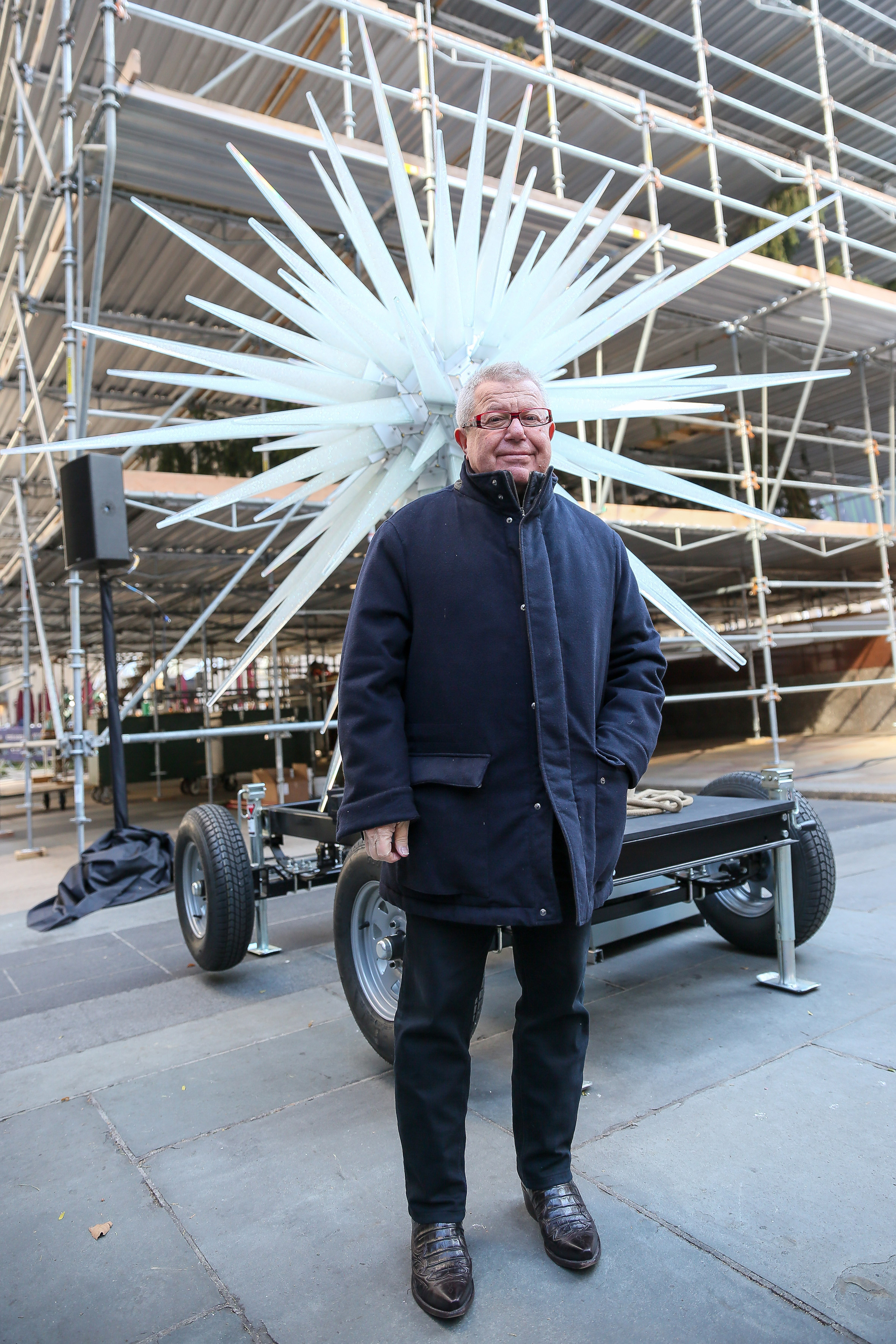
Daniel Libeskind star NYC

Daniel Libeskind's Swarovski star tops the Rockefeller Center's Christmas tree for a second year. In this interview with Dezeen, the architect says the design, like much of his work, is strongly influenced by his experience as an immigrant.

Libeskind designed the crystal-filled topper for the Christmas tree, which is erected each year in the Rockefeller Center plaza in Midtown Manhattan, in 2018.

The star, which has been used again this year, replaced one that had topped the iconic New York tree since 2004.

"The star is a universal symbol"

Citing his own experience as a Jewish immigrant raised in New York, Libeskind said he wanted to create a design that all of New York's multicultural population could relate to.

"The fact is that the star is a universal symbol – it doesn't belong to Christians, or Muslims, or the Jews," he told Dezeen.

"It's a universal symbol of hope, peace and solidarity among people. The one bright star has always inspired people across time, across religions and across all divides."

Daniel Libeskind star NYC
Libeskind spoke to Dezeen last month when the star was lifted atop the Rockefeller Center's Christmas tree

Libeskind's star is entirely symmetrical and features dozens of spikes filled with three million Swarovski crystals.

"It is a burst of powerful imagination in the skies of New York," Libeskind said. "People get it. It's not something abstract. It's very visceral and it's very emotional."

Libeskind emigrated from Poland as a child 

Born in Poland, Libeskind left with his parents as a child and was raised in New York's Bronx neighbourhood. He said this upbringing has strongly influenced much of his work.

"I thought about the immigrants because I'm one of those immigrants," he said.

"My parents were Holocaust survivors. I grew up under communism, under antisemitism, under really oppressive regimes based on fear and making people scared and terrified."

He continued: "One of the beautiful things about New York is that, whatever the rhetoric is emanating against foreigners – you know, 'Let's build a wall' – New York is just the opposite. Always has been and will always be."

The architect has spoken out against aspects of Donald Trump's presidency, condemning travel bans placed on migrants, but remains positive about America and its diversity – especially in New York.

"New York does not feel like Trump City at all"

"I'm not a pessimist at all," he said. "Whatever emanates from Washington is not the true picture of America. America is different."

He added: "[New York] does not feel like Trump City at all. It's really New York. It has always been a beautiful city with immigrants. That's what America is about."

For the first time in his career, Libeskind is designing projects on every continent in the world. Past projects include Berlin's Jewish Museum, social housing in Brooklyn for the elderly, Dublin's Grand Canal Theatre and Canada's first Holocaust memorial.

Daniel Libeskind star NYC
The star comprises dozens of spikes filled with three million Swarovski crystals

While these projects vary in form and function, Libeskind believes they share the common trait of aiming to bring different people together.

"Every one of our buildings – whether it's commercial, cultural, urban – is always part of that sense that architecture can really improve life in a major way, not just by giving a habitation, but creating a home for people wherever they are," he said.

"It's not just the glossy look of the external, it's what it communicates about society in the world we live in. And it communicates something very important – freedom and liberty and the sense of individuality – and that is part of what I think is the modern world."

The post "I thought about the immigrants because I'm one of those immigrants," says Daniel Libeskind appeared first on Dezeen.


from Dezeen https://ift.tt/2DOQwSy

Anna Money is hosting a freelancers' Christmas party that can be written off as an expense

Anna-christmas-party-dog

This time of year can be a sad old time for freelancers. While in-house creative types are knee-deep in secret Santas, festival playlists and Christmas drinks, a freelance office party can often be you, drinking a beer alone in your bedroom. But never fear, this year business current account Anna Money is hosting an xmas bash, The Totally Expensable Christmas Party, where freelancers can have some drinks with fellow creatives and also write off the cost against their tax bill.

Read more


from It's Nice That https://ift.tt/2rbw63G

Unpaid interns are "used and abused" by Japanese architects says Cameron Sinclair 

Unpaid architecture interns in Japan are exploited by their employers, according to humanitarian architecture pioneer  Cameron Sinclair.

"I've met many young designers in Japan and they are used and abused by firms," said Sinclair, who co-founded Architecture for Humanity and set up Airbnb's humanitarian programme.

Sinclair made the comment in response to a tweet from Dezeen that quoted an article about unpaid internships in Japan.

The article, published in April, explored the Japanese "open desk" culture that sees young architects gain work experience in studios, often working long hours for no pay.

In the article, LABtokyo founder Nicholas Raistrick stated: "Voluntary work here is really quite common and people do make sacrifices without expecting immediate reward."

Intern culture "rewards wealthy, privileged designers"

Sinclair replied: "'Voluntary work' is radically different than unpaid internships (aka digital slavery)," he tweeted.

Sinclair made the comment in response to a Dezeen tweet about an article where designers defended the culture of unpaid internships in Japan.

In response to this comment, Sinclair said that he had first-hand knowledge of many young designers that had been taken advantage of in Japan.

"This culture rewards wealthy, privileged designers and pushes out those with economic or social challenges," his tweet continued. "I've met many young designers in Japan and they are used and abused by firms."

Architects "exploit young professionals"

In a subsequent tweet, Sinclair added that the use of unpaid interns in major cities like London, New York and Los Angeles benefits designers who come from wealthy families.

"High profile architects knowing [sic] exploit young professionals and perpetuate class division and elitism by encouraging unpaid internships in their practice," he tweeted.

"Meaning designers from wealthy families can afford for live in London/NY/LA w no salary."

The controversy over unpaid roles in architecture hit the news earlier this year when it was revealed that Junya Ishigami, the Japanase architect of the 2019 Serpentine pavilion, used unpaid internships.

The following row about the use of unpaid labour in architecture led to several architecture studios ended their unpaid internship programs including Chilean architecture studio Elemental and Tokyo-based Sou Fujimoto Architects.

"The RIBA strongly condemns exploiting students in this way," former RIBA president Ben Derbyshire told Dezeen at the time. "This exploitation of talent runs counter to a diverse and inclusive profession and must be stamped out."

Japanese studios offer unpaid positions

However many small Japanese studios continue to offer unpaid open-desk positions to interns.

Raistrick, who's LABtoyko training consultancy works with architects and designers, said the practice was part of Japanese culture of masters and apprentices.

"It is a strong part of the social fabric and something that helps keep Japan running so smoothly," said Nicholas Raistrick

"It's not a job, it's a life-changing experience," one Japanese architect told Dezeen. "It has a profound impact on their career."

Architect Sou Fujimoto openly discussed the issue in an interview with Dezeen in 2013. "In Japan we have a long history of interns and usually the students work for free for several periods," he said at the time.

"It's a nice opportunity" for both employer and intern," he said. The employer gets to know the younger generations, who in turn learn "how architects in Japan or different countries are working".

New York designer Karim Rashid also defended the use of unpaid interns earlier this year.

"I believe some of the universities are far more exploiting than a small brilliant architecture firm that can inspire and be a catalyst for a student's budding career," Rashid said in April.

The designer argued that unpaid work in a studio was less exploitative than paying for an expensive education.

"I believe some of the universities are far more exploiting than a small brilliant architecture firm that can inspire and be a catalyst for a student's budding career," he said.

Sinclair is a pioneer of socially responsive architecture who is currently executive director of Armory of Harmony – an organisation that makes musical instruments from decommissioned weapons.

He co-founded Architecture for Humanity in 1999 as a charity that aimed to create architectural solutions to humanitarian crisis around the world. He has worked in Kosovo, Afghanistan and Haiti and led the organisation's efforts in Japan to rebuild after the tsunami in 2011.

After leaving Architecture for Humanity, Sinclair worked at Brad Pitt and Angelina Jolie's humanitarian charity the Jolie-Pitt Foundation, before heading up Airbnb's humanitarian programme. In recent years he has also collaborated on several preservation projects in rural Japan.

The post Unpaid interns are "used and abused" by Japanese architects says Cameron Sinclair  appeared first on Dezeen.


from Dezeen https://ift.tt/2OWadyk

“I’m a bit afraid of colours”: Romina Malta on her illustrative approach to design

Romina-malta-graphic-design-itsnicethat-01
Romina’s multi-disciplinary approach lends itself nicely to the types of projects she likes to take on. Namely an art director, she focuses primarily on editorial and sound design, as well as taking on commissions for various clients, studios, artists, galleries and record labels.

Read more


from It's Nice That https://ift.tt/34X1x0a