Directed by Bat and produced by Not to Scale, The Creative Journey illustrates the creative process in a relatable way.

from It's Nice That https://ift.tt/3d6nqPb
Directed by Bat and produced by Not to Scale, The Creative Journey illustrates the creative process in a relatable way.
You may have had to cancel your spring vacation, but you still can (virtually) visit the aquatic animals housed at the Monterey Bay Aquarium. Peek at the groups of jellyfish and sharks, do some bird watching in the Aviary, follow the African penguins as they waddle around, and catch a glimpse at the pulsing moon jellies all through the institutions’ free live streams. And for close-ups of the species, head to Instagram. (via Laughing Squid)
Do stories and artists like this matter to you? Become a Colossal Member and support independent arts publishing. Join a community of like-minded readers who are passionate about contemporary art, apply for our annual grant, and get exclusive access to interviews, partner discounts, and event tickets.

Comprised of married couple Elizabeth Dilk and Garret Morin, the New York-based studio produces playful and sophisticated brand identities.

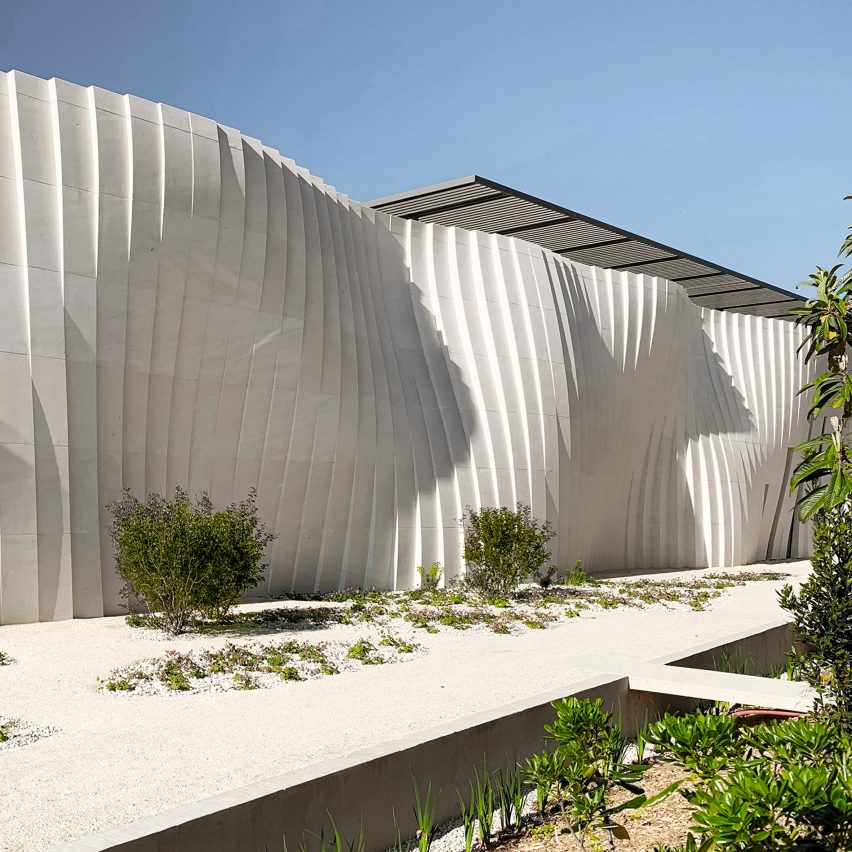
New Stone Age at London's Building Centre shows the potential of stone as a modern construction material. Curator Steve Webb picks five projects from the exhibition that use it in innovative, practical and sustainable ways.
The exhibition demonstrates how stone can be used as a structural material to create contemporary buildings.
"We want to show people that modern methods of fabrication and design can unlock the huge potential of one of our most abundant natural resources," Webb told Dezeen.
"This exhibition sheds light on a number of recent international projects from around the world in an attempt to show that there is a nascent if disparate movement towards stone and postulates what a dawning new Stone Age might bring."
"Stone is beautiful, strong and abundant," he continued. "Its extraction does't require huge amounts of energy, while modern improvements in design and analysis techniques mean that it can be used in ways not thought possible before; playing a major role in building structures."
"We are advocating its use as structure"
Structural engineer Webb, who co-founded Webb Yates, curated the exhibition alongside architect Amin Taha, founder of studio Groupwork, and Pierre Bidaud from The Stonemasonry Company.
The three previous worked together to build 15 Clerkenwell Close, a six-storey housing block in London that has a stone structure. The exhibition aims to widen the discussion about stone as a structural alternative to concrete and steel.
"We are advocating its use as structure and inherent in that is the reductive idea that buildings could be elegant structures built with noble materials, not ugly structures covered in plastic-coated decoration," explained Webb.
Alongside historic and modern uses of stone, the exhibition includes a theoretical design of a 30-storey skyscraper with a stone structure.
The project is an example of using stone can be used to create more sustainable commercial buildings. The curators calculate that the building would have approximately a 60 per cent reduction in embed carbon compared to a steel frame structure, and around an 80 per cent reduction compared to concrete.
"This has the potential to revolutionise construction"
"Steel and concrete are quarried materials themselves that require huge amounts of energy in their production, whereas stone is just sitting there in the ground ready to use," explained Webb.
"Average stones are much stronger than even high-strength concretes, are more durable than many other materials," he continued.
"Although timber is a great way of cutting carbon and can replace many concrete and steel elements, in certain applications such as high rise or underground infrastructure, its use is impractical and stone would be better."
The exhibition also includes an example of a floor slab made from stone that would be much more sustainable than a concrete equivalent.
"The reciprocating stone floor is a thin, un-reinforced stone slabs doing the job of concrete in half the depth and 10 per cent of the carbon," said Webb. "We've never seen this anywhere else!"
"This has the potential to revolutionise construction," he added. "Imagine getting rid of the paraphernalia of concrete construction and replacing it with a standard reusable stone slab, like a paving slab."
Below are five contemporary projects that use stone in interesting ways:
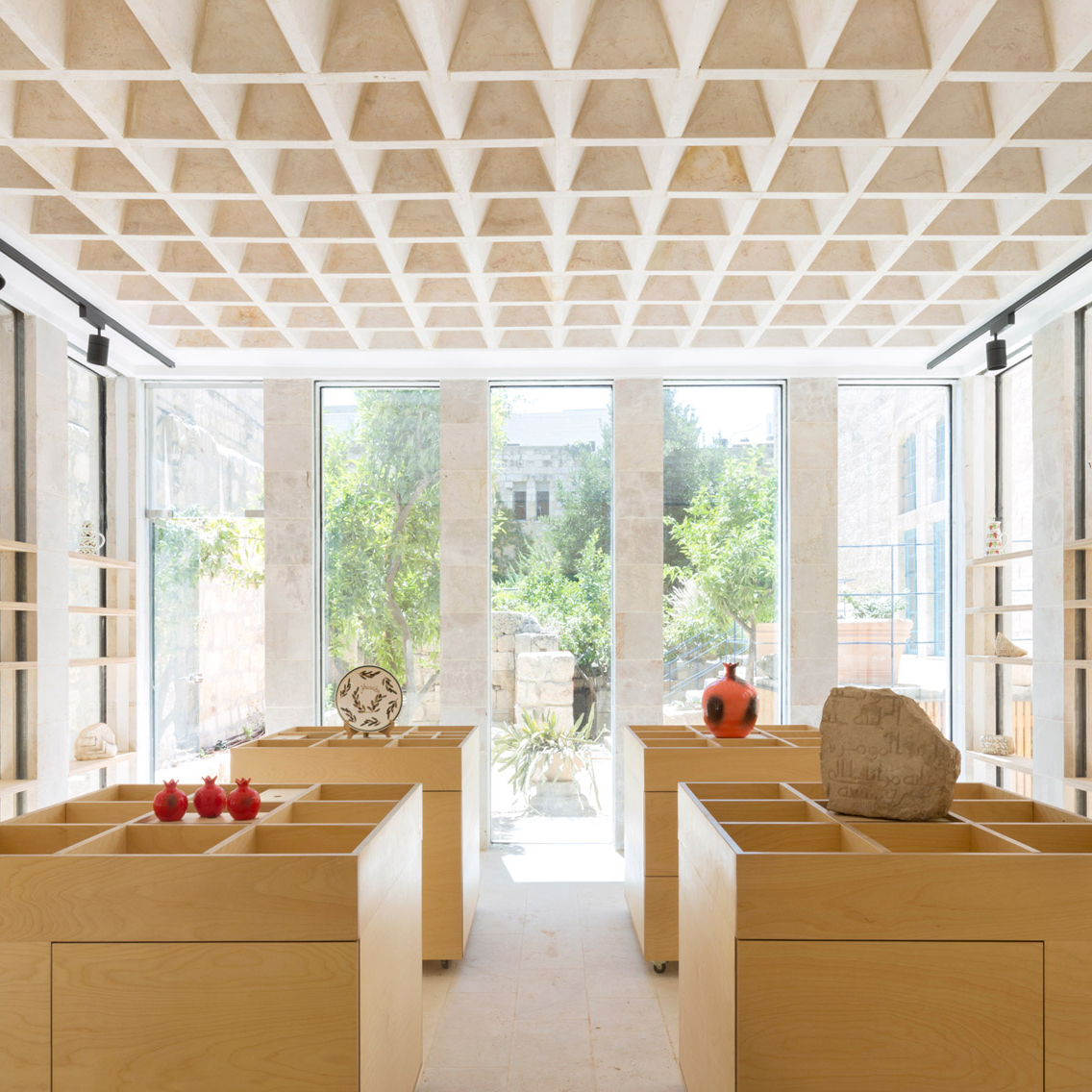
Crusaders monastery gift shop, Jerusalem, by AAU Anastas, 2018
The roof that Crusaders monastery Bethlehem-based architecture studio AAU Anastas created at this gift shop demonstrates the potential of stone to be used to create flat structures.
"This is a really elegant roof," said Webb. "Arch and shell structures are perfect for stone and perfect for statics, but they are of limited use in real buildings, developing flat floor ideas unlocks a lot of possibilities."
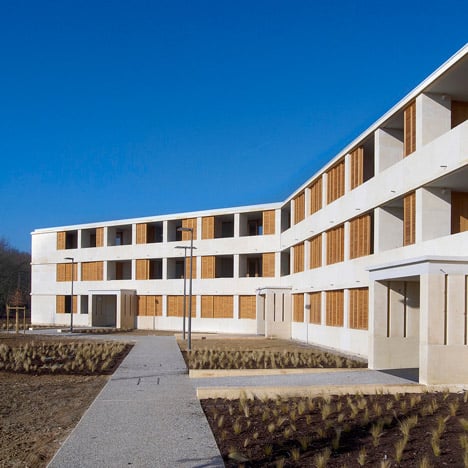
Logements Collectifs, Plan-les- Ouates, Switzerland, by Atelier Architecture Perraudin, 2013
The Logements Collectifs social housing complex near Toulouse was built with load-bearing stone walls, which were left bare to show traces of the quarrying process.
"Yes! Simple, logical," said Webb. "Less a statement more a staple."
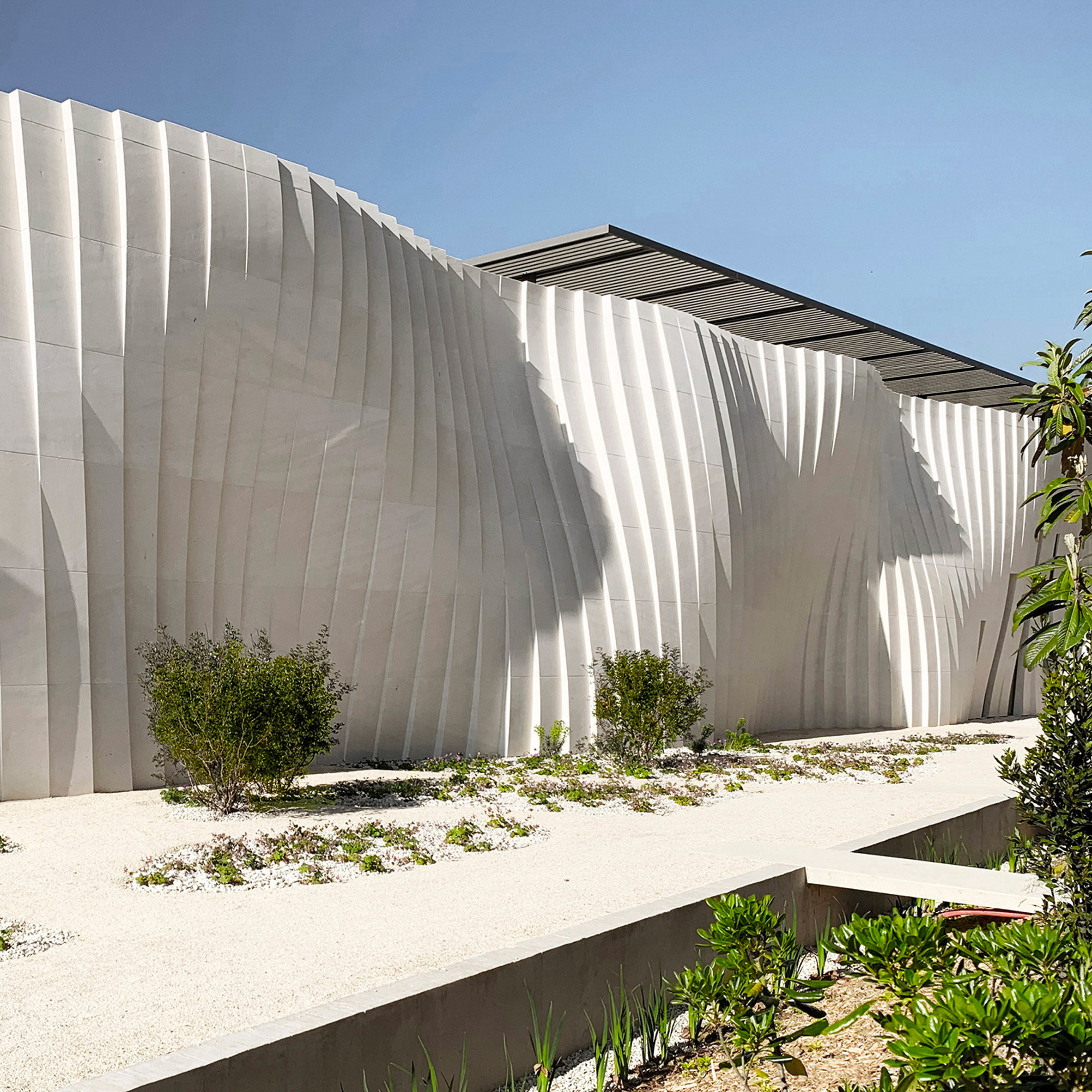
Delas Frères Winery Tain l'Hermitage, France, by Carl Fredrik Svenstedt Architect, 2019
Carl Fredrik Svenstedt Architect used CNC techniques to create the walls at this winery in France to give the stone an unusual form.
"The winery, shows the possibilities of combining stone with CNC techniques to produce fluid forms that we don't normally associate with stone," explains Webb.
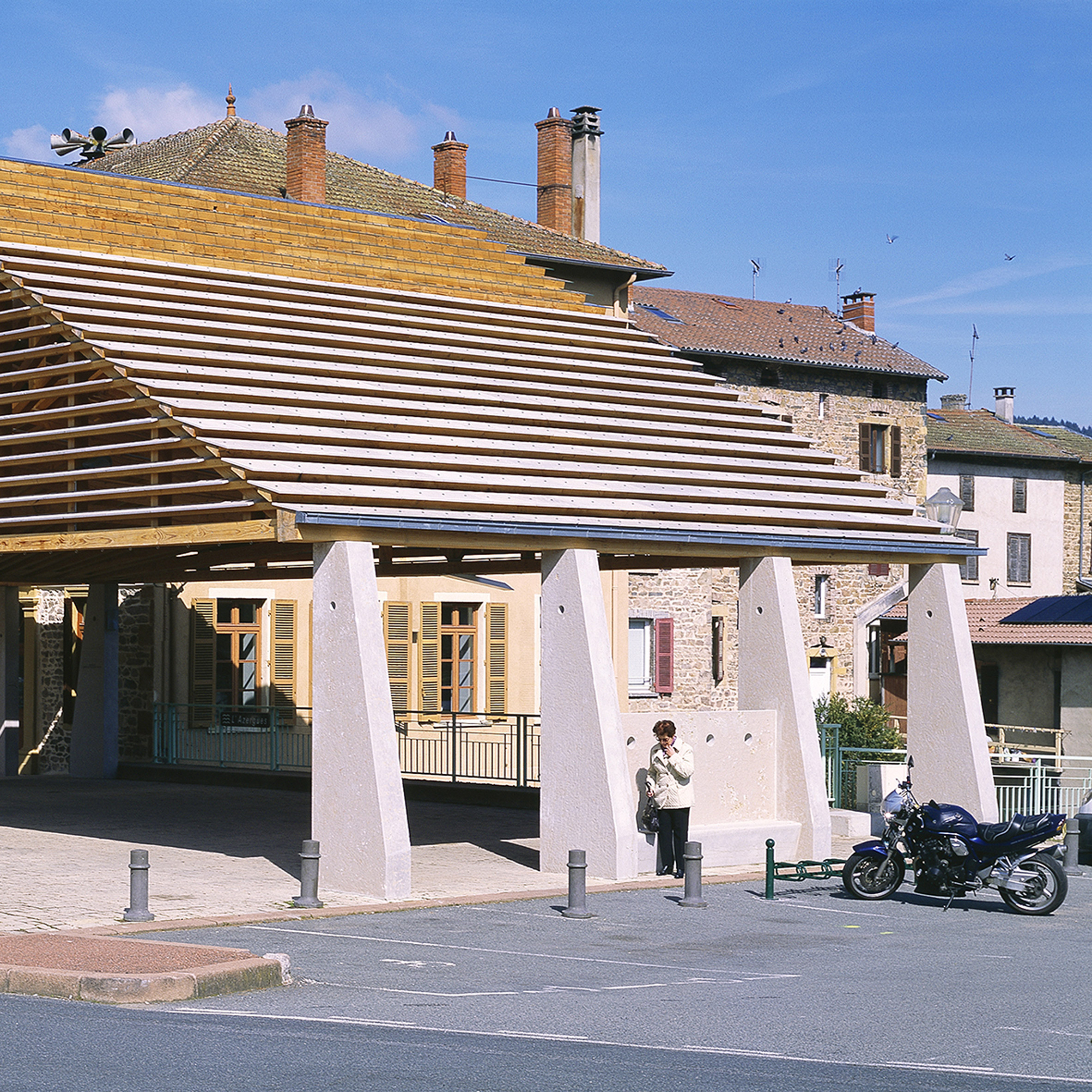
Municipal Halls, Lamure-Sur-Azergues, France, by Elisabeth Polzella, 2017
Elisabeth Polzella's public hall in the of town Lamure-Sur-Azergues combines stone supports with a timber roof.
"Stone and timber is a great combination," said Webb. "At Webb Yates Engineers, we are investigating a number of stone and timber hybrid typologies and we think this is a really interesting area.
"Vertical stone in compression timber, lighter spanning on top."
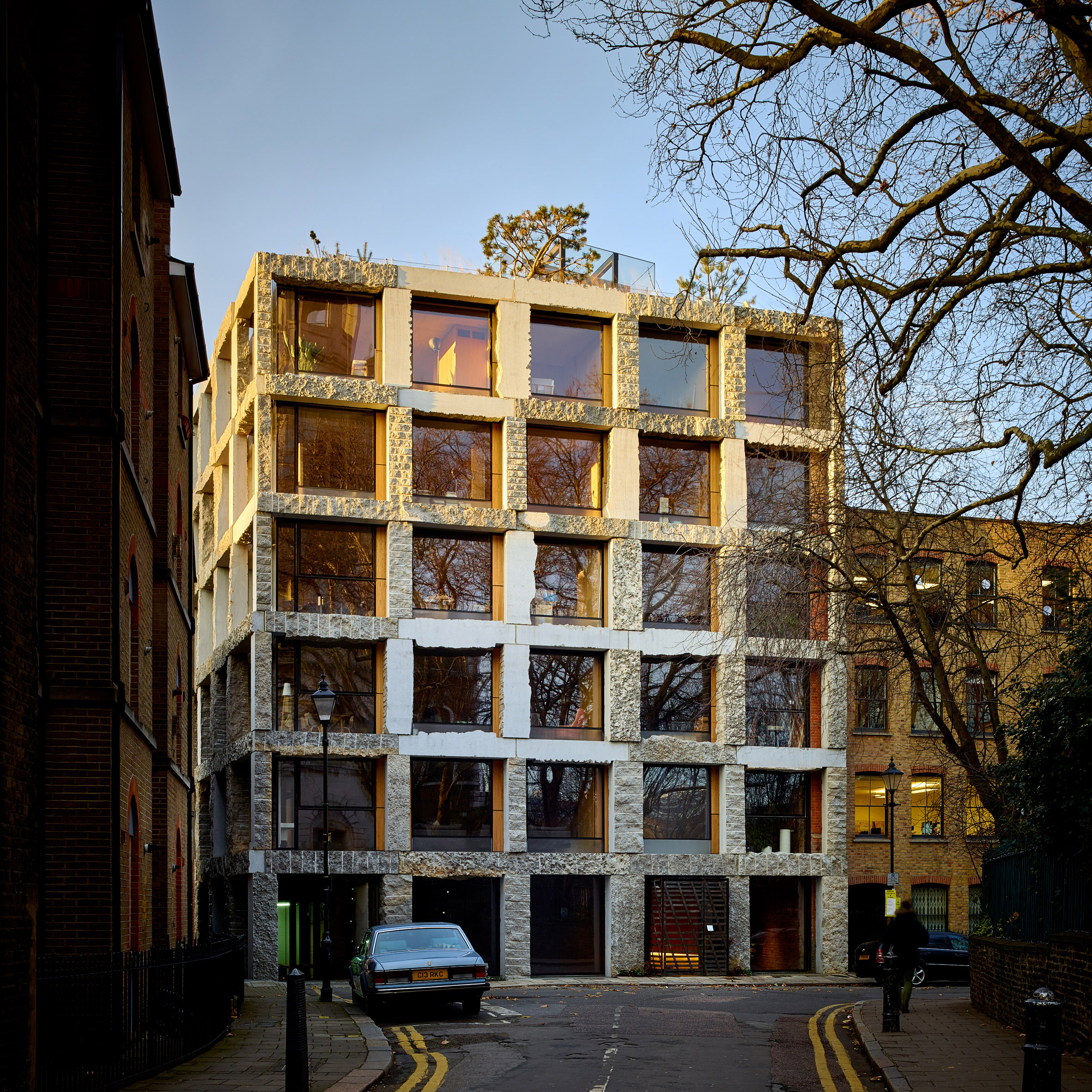
15 Clerkenwell Close by Amin Taha + Groupwork, London, UK, 2018
The six-storey block at 15 Clerkenwell Close has a structural stone exoskeleton, meaning that the material is immediately visible.
"All of our collaborations with Amin involve some kind of technological adventure and this is no different," said Webb.
"Stone columns support concrete slabs. I've been very interested to see how people respond to the fact of the stone facade being structural."
The post New Stone Age exhibition demonstrates material's "potential to revolutionise construction" appeared first on Dezeen.
Artists and designers have grabbed their pens, pencils and digital styluses to create images of support and informative illustrations to help distribute advice on how to slow the spread of coronavirus.
As the virus continues to spread, creatives have used their online platforms to urge people to make the necessary life changes in order to minimise the chances of catching or spreading coronavirus Covid-19.
At the time of publication, infected people have been detected in at least 143 countries, according to the New York Times. There are currently more than 194,000 people with the virus, and at least 7,000 people have died.
"We artists can help by creating something useful that can make a difference"
While hand-washing has been identified as one of the key ways people can avoid spreading Covid-19, other actions people can take include social distancing to minimise contact with others, and self-isolating if you develop symptoms.
"Even though we are not doctors or nurses, besides staying at home in self quarantine, we artists can help by creating something useful that can make a difference," artist Juan Delcan told Dezeen.
"We need to make people understand that staying home can save many people's lives," he continued. "Through powerful and telegraphic images we can convey the sense of being responsible in a global crisis."
Its "about changing our mindset"
Graphic designers and illustrators have created powerful images and animations to try and spread the message, including visual representations of symptoms and comic representations of self-quarantine.
"The best advice I read about #corona today was about changing our mindset: instead of trying not to get infected, we should assume we ARE infected and do everything so we don't transmit it to somebody else," wrote Graphic designer Christoph Niemann in an Instagram post.
"Stay safe and when you need to be out, try to have a kind word for all the people who are working under a huge amount of pressure (nurses, bus drivers, police officers, supermarket cashiers)," he added.
Here are 10 examples of creatives using their talents to circulate helpful advice:
View this post on Instagram
British data journalist Mona Chalabi has published a series of sketchy illustrations on her Instagram page sharing advice on social distancing, self-isolation and not stockpiling supplies.
This includes a graphic outlining some of the symptoms of coronavirus, from the more common signs of a fever and dry cough to those less ordinary of muscle pain and vomiting.
Do your part and stay home. It's all we can do. pic.twitter.com/dLOkV3znNe
— juan delcan (@juan_delcan) March 16, 2020
Juan Delcan and Valentina Izaguirre
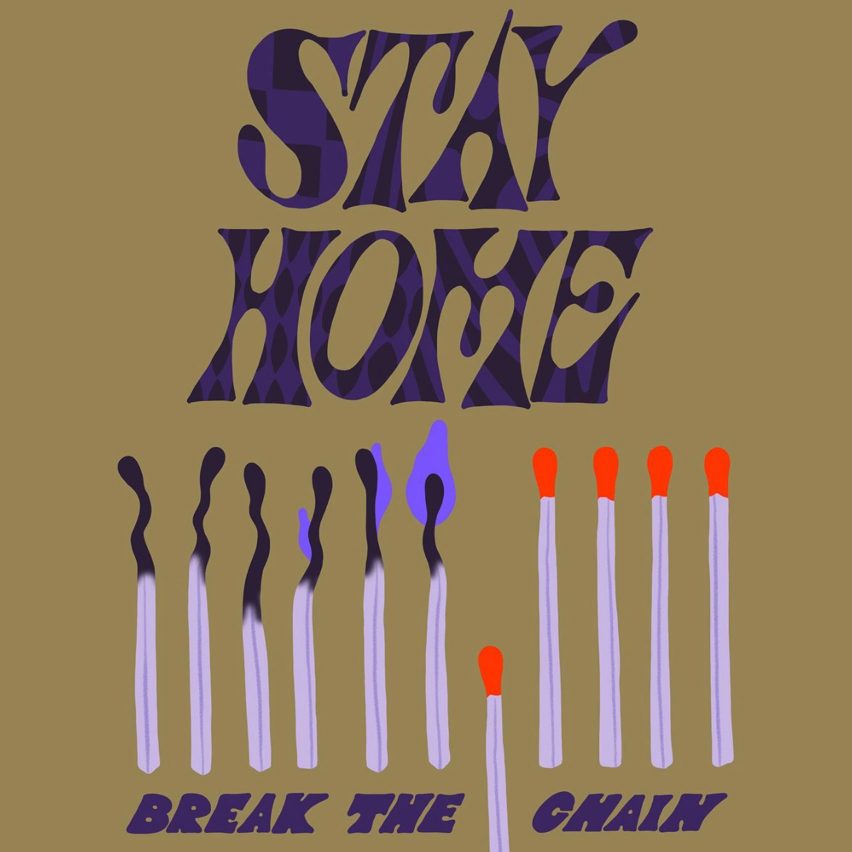
Director and artist Juan Delcan and Valentina Izaguirre visualised the positive impact of social distancing in an animation of matchsticks catching fire. Stood next to each other in a row, the first alight matchstick sets the next one on fire, and so on.
The duo anthropomorphised one of the matchsticks, giving it legs to allow it to step out of the line to prevent the rest of the matches setting on fire – representing the importance of staying at home to avoid the virus spreading.
View this post on Instagram
Swedish illustrator Sara Andreasson continued the lit-matchstick analogy in a bid to encourage people to stay home. Her graphic design features a broken line of matchsticks, half burnt out and the other half kept unlit with the words "break the chain" written beneath.
"We all need to make an effort to help protect the more vulnerable people in our communities and try and break the chain of infection," the caption reads.
"I'm hopeful that when all this is over, we will have learned something valuable about working together as a community."
View this post on Instagram
Graphic designer Christoph Niemann used his typically ironic and playful illustrative style to get a message across to his Instagram followers to wash their hands and stay at home.
This comprised a simple yet effective image of a girl, with the red pencil used to draw her positioned strategically above her hand like a megaphone, with the girl's open mouth shouting down the pencil tip.
View this post on Instagram
French illustrator Jean Jullien applied his characteristically tongue-in-cheek approach to bring some light humour to the current crisis via Instagram.
His drawing asks viewers to spot the difference between two images of a man lying on a sofa "before quarantine" and "after quarantine", surrounded by his laptop, tissues and clothes.
View this post on Instagram
Spanish artist Petra Eriksson aims to shine a light on the positives in getting some more time to yourself during quarantine and self-isolation, as represented in her Silencio illustration.
"One good thing with spending so much time at home by yourself is that you really get the chance to set into a slow and more simple way of living, giving your head some extra peace and quiet so that you can dig a little bit deeper into certain things going on inside you," reads the caption.
"Even though I miss having more face-to-face social interaction it's interesting to see what happens when you completely need to let go of most of the things you would normally do."
View this post on Instagram
Artist Sara Shakeel aimed to bring a more positive outlook to our hygiene habits, encouraging people to wash their hands more by turning water and soap into crystals in this series of glittery collages.
"I am truly happy to see how a simple piece of art can bring such a positive impact on people's lives, especially in these tough times," she wrote. "As an artist it fulfils my purpose and the very reason why I create art!"
View this post on Instagram
Brooklyn-based visual artist and author Oliver Jeffers stressed the importance of helping each other during the Covid-19 pandemic. In his illustration, the globe wears a surgical mask as it floats above the words "now more than ever think 'we' not 'me'".
"This virus doesn't care about your passport or your bank balance," he captioned the post. "It can affect any of us. But hopefully not all of us if we act in unison to defeat it. Be safe. Be sensible. Be sensitive. One in, all in."
Some no-touch greetings for @SiouxsieW's latest piece. Stay safe and stay friendly
https://t.co/0bQ1U4ZAXU pic.twitter.com/irGfmtU9Cg— Toby Morris (@XTOTL) March 15, 2020
Toby Morris and Siouxsie Wiles
New Zealand-based cartoonist teamed up with microbiologist Siouxsie Wiles to create a series of illustrations advising people on how to stop the spread of the Covid-19 virus and "flatten the curve" to ease the strain on health workers.
This includes an animation showing alternatives to handshakes, hugs and high fives when greeting people amid the Covid-19 outbreak – from a wave or a "namaste" gesture to using sign language or "the 'all good' nod".
View this post on Instagram
British illustrator Gemma Correll created "coronavirus reward stickers" to digitally praise her social media followers for things like washing their hands, not hoarding toilet paper, checking in with loved ones and maintaining social distancing.
The hand-drawn stickers feature friendly faces and bright colours, in the artist's signature cartoonish style that has also seen her post comical drawings of self-isolation posed as "Couchella" instead of Coachella – the California music festival that was postponed in light of the epidemic.
The post Graphic designers get creative to circulate helpful advice during coronavirus outbreak appeared first on Dezeen.


