Monday, 23 March 2020

SHED creates Alley Cat dwelling for Seattle backyard

Alley Cat by SHED Architecture and Design

Seattle architecture firm SHED has designed this compact home for a couple who wanted to live in a smaller dwelling on their own property.

The project, called Alley Cat, was created for a couple who reside in a craftsman-style house in Seattle's Ballard neighbourhood.
Alley Cat by SHED Architecture and Design

Because the clients travel frequently, they decided to rent out their main residence and create a "compact home base" for themselves in the backyard.

They turned to local firm SHED Architecture and Design to create what is known as a detached version of an auxiliary dwelling unit (ADU).

The clients had several requests for their small abode. They wanted it to have a separate identity from their primary home, as well as a strong relationship to the existing garden and easy access to an alley. Moreover, they requested that it be low-maintenance and able to accommodate photovoltaic panels.
Alley Cat by SHED Architecture and Design

"In addition, the client was hoping for an interior space open to the sun, and with primary rooms on one level for aging-in-place," SHED said.

The team conceived a modern dwelling that totals 800 square feet (74 square metres). The building is located on the eastern side of the clients' property, between the garden and an ADU parking space that is required by law.

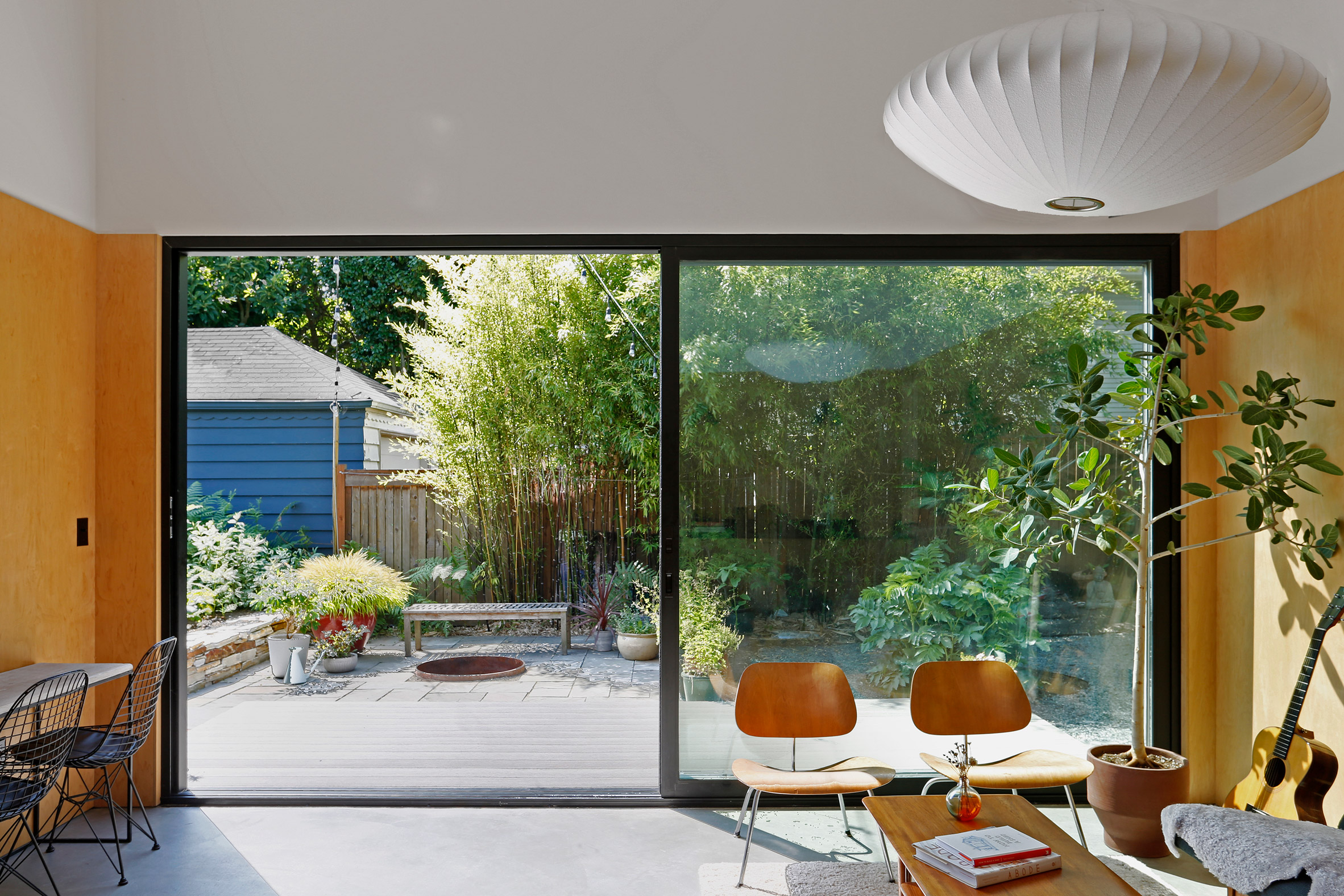
Rectangular in plan, the building has an asymmetrical, gabled form that is scaled in accordance with neighbouring homes.
Alley Cat by SHED Architecture and Design

"In appearance the building is reminiscent of a cat whose back is flattening to the ground, ready to pounce," the studio said.

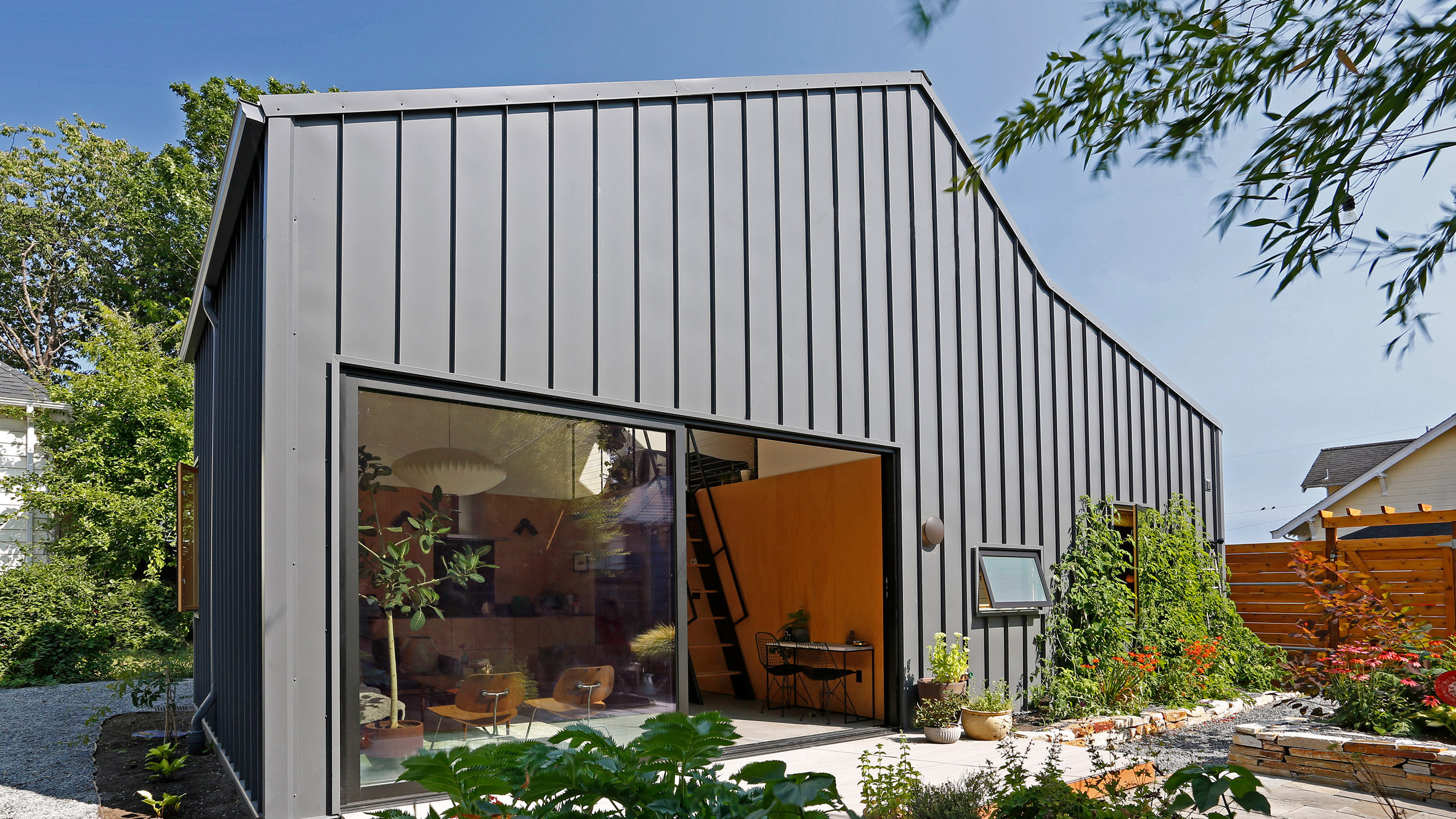
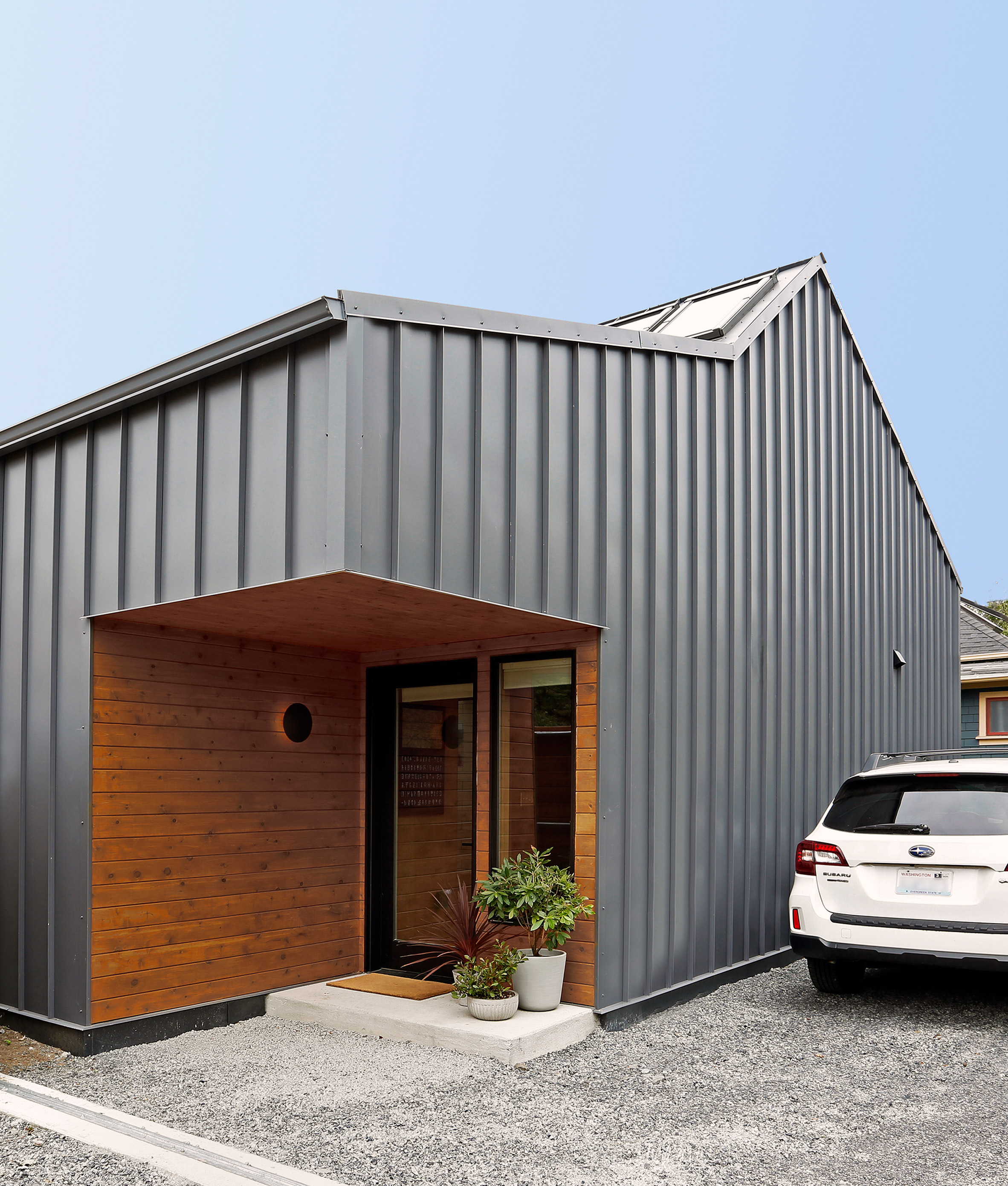
Exterior walls are clad in standing-seam, aluminium panels in a dark grey hue, which the studio chose to create a "durable, maintenance-free skin".

The front door is located on the building's southeast corner. This is carved away to form a sheltered space featuring caramel-toned cedar and potted plants.

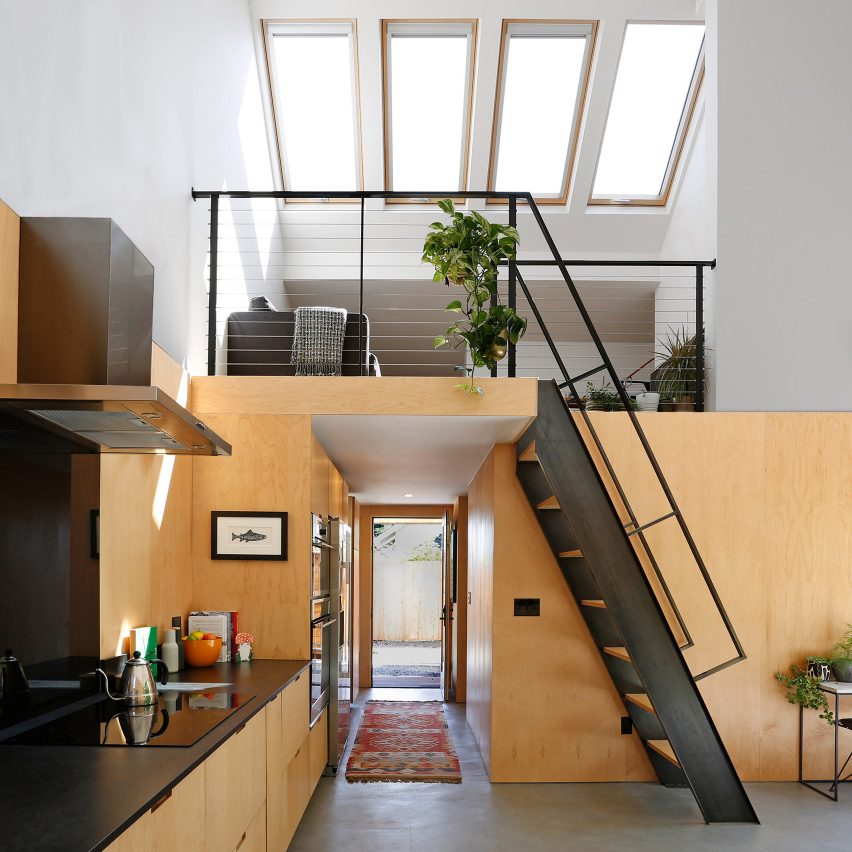
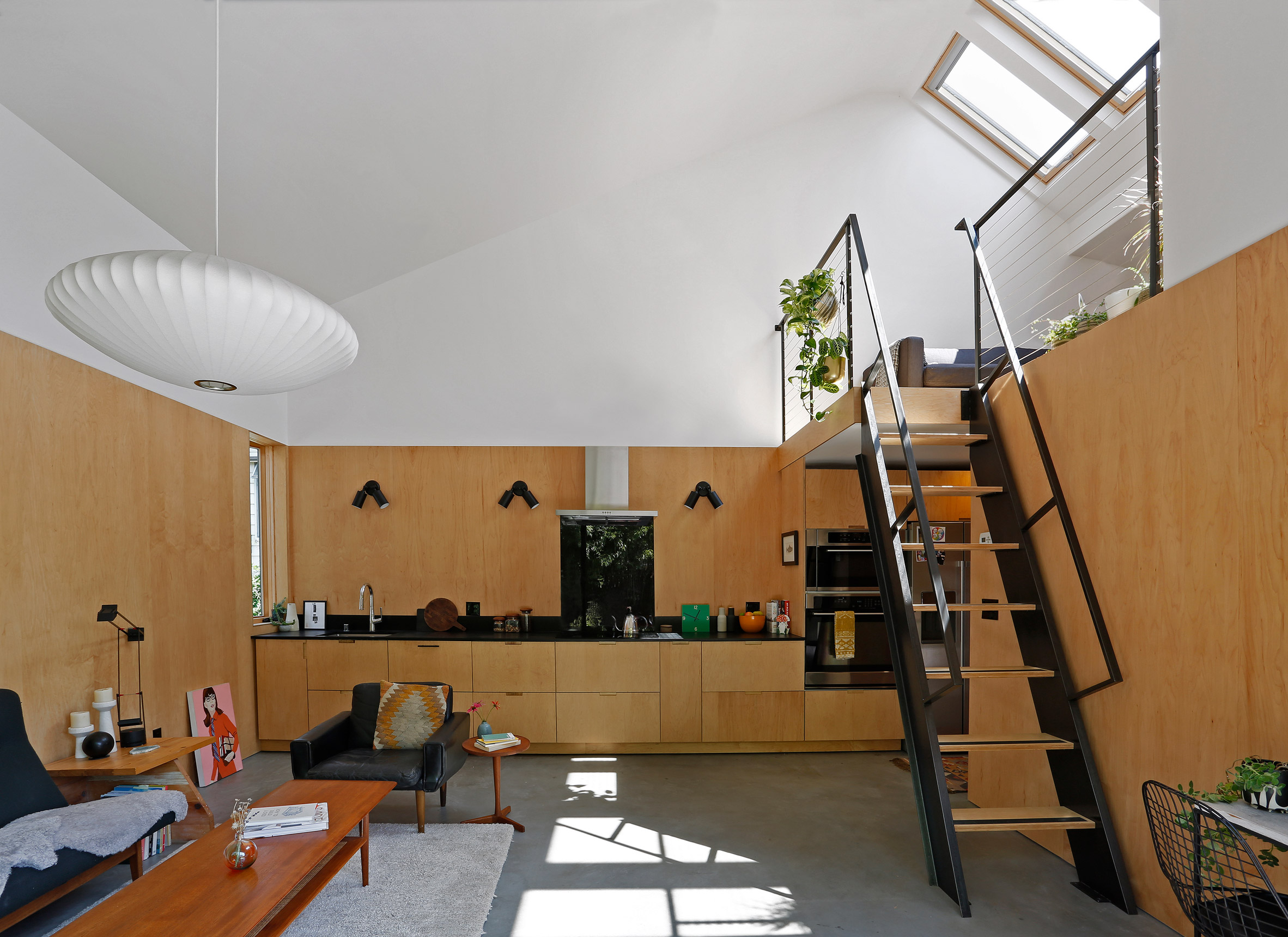
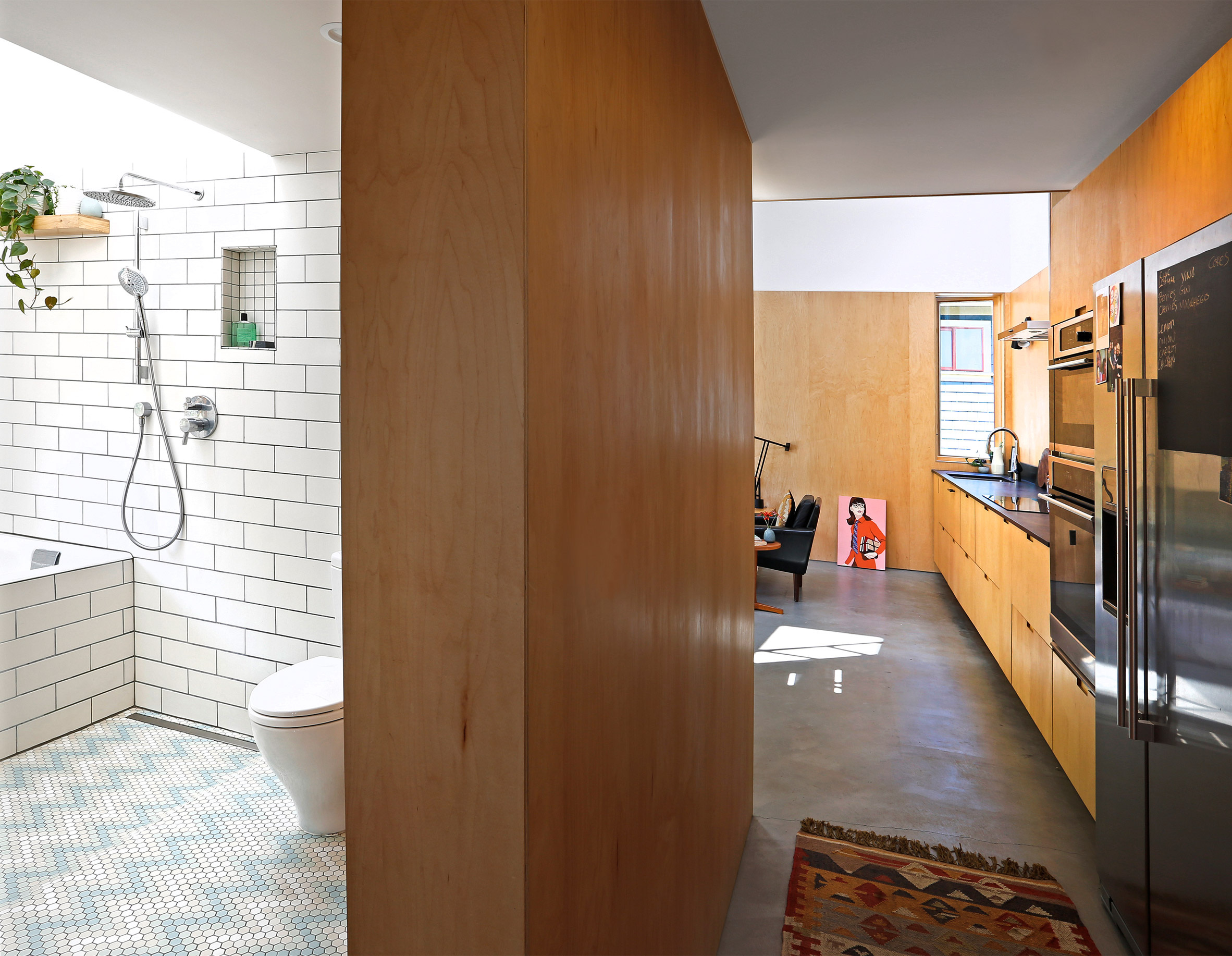
Inside the home, the ground level holds a living room, kitchen, bathroom and bedroom. Overlooking the double-height living area is a loft used as a den. A steel ladder accesses the space and is bordered by a steel-and-cable handrail.
Alley Cat by SHED Architecture and Design

Windows were carefully placed based on natural lighting and privacy needs. In the kitchen, a vertical "peek-a-boo window" allows light to trickle in.

The main living space has a sliding glass door that brings in ample daylight and enables the home to merge with a patio. Skylights provide additional illumination in the compact dwelling.

"Four parallel skylights in the lofted space provide daylight from above, while allowing for nighttime stargazing," SHED said.
Alley Cat by SHED Architecture and Design

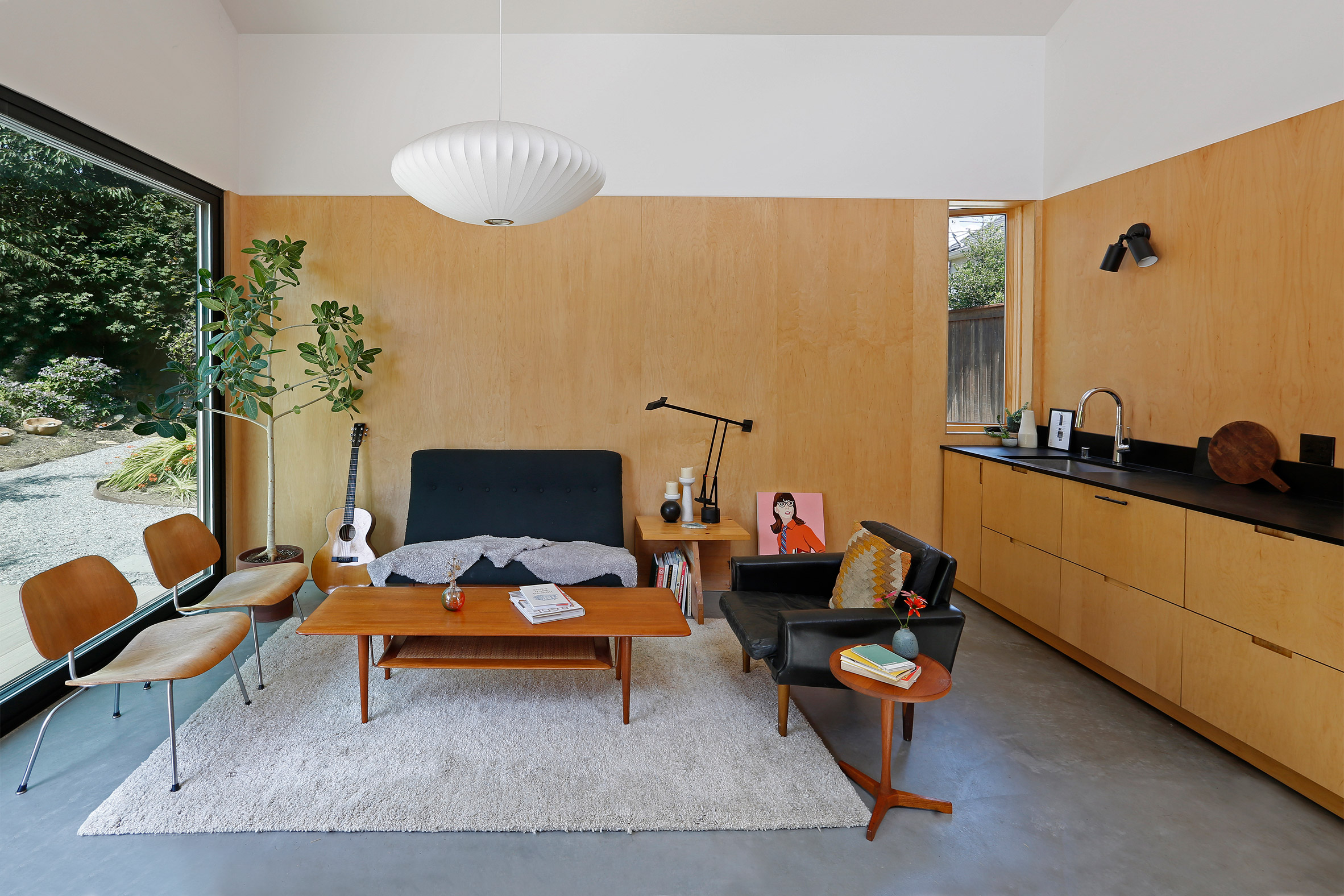
Pine plywood was used for wall cladding and cabinets. A radiant concrete slab provides heat and visual uniformity.

The home's material palette is meant to be "elemental and purposeful", added the studio.

Rooms are fitted with mid-century and contemporary decor such as a black futon, wooden coffee table, salvaged chairs and a saucer-shaped pendant by American industrial designer George Nelson. A slender desk is lined with a pair of Eames Wire Chairs.
Alley Cat by SHED Architecture and Design

The home is intended to have a cosy interior and a tough exterior. "Hard on the outside, warm on the inside, Alley Cat is a street-smart modern dwelling curled up in the corner of the city," the studio added.

ADUs have become increasingly popular in cities that face housing shortages. Also in Seattle, Best Practice Architecture converted an unused garage into a small black cottage for an elderly family member, while Wittman Estes and NODE have created a prefabricated unit that runs on solar power.

Founded in 1998, SHED has completed a number of residential projects in Seattle, including a refurbished 1950s dwelling that was originally built for cartoonist Irwin Caplan and the conversion of a horse stable into an art studio and guest house.

Photography is by Mark Woods.


Project credits:

Architect: SHED Architecture & Design
Structural engineer: Todd Perbix
Metal siding: Nu-Ray
Windows: Anderson, Fakro
Sliding door: La Cantina
Lighting and furniture: Modern Forms, Herman Miller
Kitchen countertops: IKEA
Fixtures: Hansgrohe
Soaking tub: Kohler
Fan: Big Ass Fan

The post SHED creates Alley Cat dwelling for Seattle backyard appeared first on Dezeen.


from Dezeen https://ift.tt/2UuHNgr

An Animated Documentary Recounts the History Behind an Undergarment Business

Consumers are paying closer attention to the ethics and business practices behind the products they buy, and animated documentarian Samantha Moore is shining a light on one company creating everyday essentials. Last year, the Shropshire-based creator released “Bloomers,” a short film that chronicles the history of the Manchester-based lingerie company Ella and Me, which began production in the United Kingdom before moving abroad and back again.

From flowing silk to lace-trimmed underwear strung up only to be snipped apart, the detailed project colors mostly the garments, swaths of fabric, and spindles of string. The workers and machines remain black-and-white line drawings throughout the film as it walks through the manufacturing cycle from design to consumer purchases.

Moore helps illuminate the impacts rising production costs had on Ella and Me since its beginning as a mom-and-pop business. She documents its inception and even the employees’s familial connections to the textile industry. The animation is set to a diverse soundtrack that includes interviews with the company’s team, in addition to noises commonly found on the production room floor, like scissors slicing through soft cotton and the repetitive tick of sewing machines.

Since its release, “Bloomers” was nominated for the Best Short Film at the British Animation Awards 2020, was the winner of the Best British Film at London International Animation Festival 2019, and took home the top prize as the Best Documentary at ReAnima International Film Festival 2019. Keep up with Moore’s animated documentaries on Vimeo and Instagram.


Do stories and artists like this matter to you? Become a Colossal Member and support independent arts publishing. Join a community of like-minded readers who are passionate about contemporary art, apply for our annual grant, and get exclusive access to interviews, partner discounts, and event tickets.


from Colossal https://ift.tt/2UbuBhm

MIT develops low-cost smart diaper that notifies parents when wet

MIT develops low-cost smart diaper that notifies parents when wet

Researchers at MIT have invented a low-cost moisture sensor for disposable nappies that uses radio frequencies to alert caregivers when babies need changing.

The sensor is able to detect when a nappy is damp and send a notification to the caregiver via their phone or computer, ultimately cutting down on diaper rash and other problems that stem from late changing.

While typical sensors of this sort would need batteries and wireless or Bluetooth transmitters, the team from MIT's Auto-ID Lab achieved a similar outcome using a small, simple sensor that they estimate would cost less than two cents to manufacture.

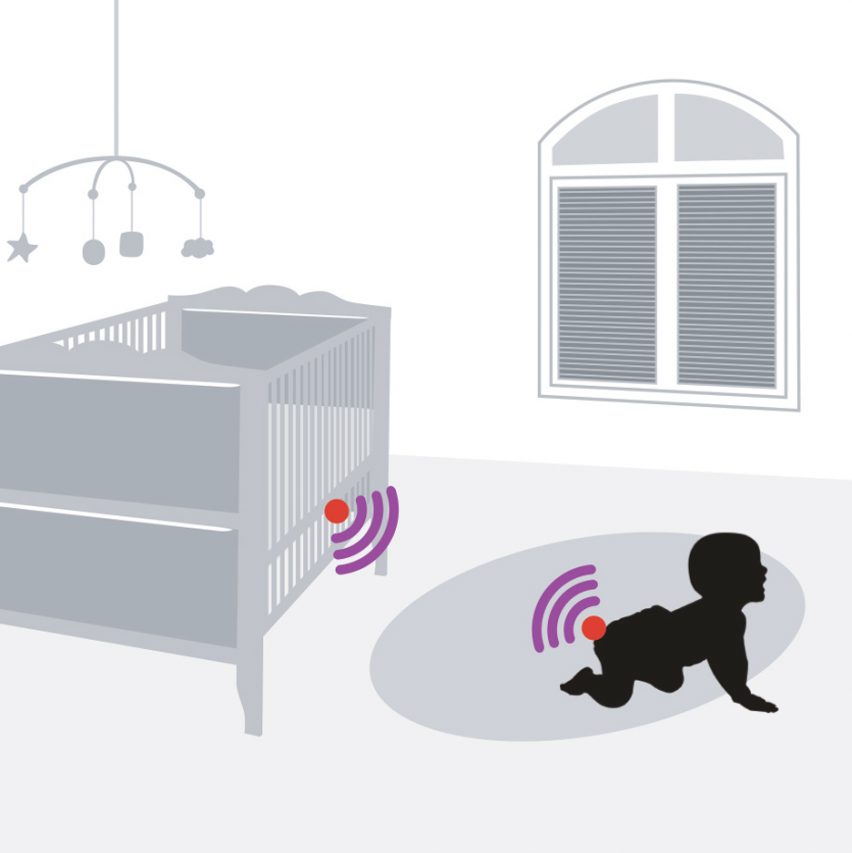
The system works using a passive radio frequency identification (RFID) tag, which sits in the bottom layer of the nappy and works in conjunction with a nearby RFID reader.

Diaper conditions communicated via radio waves

With RFID, the reader sends out radio waves, and the corresponding chip tweaks them and sends them back, relaying information about its current state.

The reader then interprets the information and sends notifications wirelessly.

By using passive RFID, no further energy source such as a battery is required, as enough energy is supplied from the radio waves.

The MIT team's nappy sensor gets an additional boost from the super-absorbent polymer material that diapers typically use to soak up moisture.

When wet, this material expands and becomes slightly conductive, turning it into an antenna for the RFID tag and allowing its signal to reach a reader up to one metre away.

While such sensors would obviously be useful for parents caring for a single infant, the MIT team points out that nurses in neonatal units caring for multiple babies could benefit even more.

Smart nappies also suitable for hospitals and care homes

The sensor would also be useful for adult diapers, because wearers are sometimes embarrassed to tell their carers when a change is needed.

"Diapers are used not just for babies, but for ageing populations, or patients who are bedridden and unable to take care of themselves," said engineer Pankhuri Sen, who was a research assistant in MIT's AutoID Laboratory.

"It would be convenient in these cases for a caregiver to be notified that a patient, particularly in a multi-bed hospital, needs changing," she added.

MIT's Auto-ID Lab is led by engineer Sanjay Sarma, and is where the term "Internet of Things" was first coined. Adapting RFID technology to work as sensors is a current focus for the lab.

Another group of MIT researchers came up with a battery-free sensor last year that also utilises RFID tags, this time designed for underwater use.

The almost-zero-energy sensor avoids a key problem with underwater electronics of pollution from the use of batteries, and instead operates using vibrations and wireless signals.

The post MIT develops low-cost smart diaper that notifies parents when wet appeared first on Dezeen.


from Dezeen https://ift.tt/2JlUwNn

Advice and updates for the creative community during this time of crisis

We have begun collating helpful information, support networks and creative initiatives to get involved with as a community. Updated daily, so please check back in.


from It's Nice That https://ift.tt/2Ub7jby

Italian design brands impacted as government orders factories to close

Italian design brand Moroso has prolonged the closure of its factory due to coronavirus

The government in Italy has closed all non-essential factories as the country has become the epicentre of the coronavirus pandemic.

Prime minister Giuseppe Conte announced that all factories that manufacture non-essential items would be closed on Saturday 21 March.

"The decision taken by the government is to close down all productive activity throughout the territory that is not strictly necessary, crucial, indispensable, to guarantee us essential goods and services," said Conte.

"We will slow down the country's productive engine, but we will not stop it."

Many globally renowned Italian design brands make their products in Italy, and will be affected by this temporary closure.

Italian designers close factories

Italian brands such as Alessi, Molteni&C, Cassina, Minotti, Pederali and Poliform will need to slow production, which will have a knock-on effect on the global design industry.

Furniture designer Moroso had already suspended activity at its factory. After the edict from the Italian government, the company announced it would keep its factory closed until 3 April.

Italy is now at the centre of the global coronavirus crisis.

As of 23 March, 5,476 have died of Covid-19 in Italy, with over 59,000 reported cases of infection. China, which reported the first cases of the new respiratory virus, has now managed to contain its outbreak after 3,270 people died.

Milan's Salone del Mobile has been delayed and the Venice Architecture Biennale has been postponed while the country fights the coronavirus outbreak. Italian architect Vittorio Gregotti is among the victims of Covid-19.

Manufacturing plants fall silent around the world

Factories across Europe are being temporarily closed due to coronavirus.

Tyre-maker Michelin has shut factories in Italy, France and Spain. Italian company FCA Chrysler has shut all eight of its plants, including six in Italy. All Peugeot, Citroën, Vauxhall and Opel plants in Europe have been closed.

In India, technology manufacturers Samsung has suspended production at factories to comply with the request of the Indian government.

Factories in China are beginning to re-open as the country emerges from its coronavirus lockdown.

Main image courtesy of Moroso.

The post Italian design brands impacted as government orders factories to close appeared first on Dezeen.


from Dezeen https://ift.tt/3dnHBIq