Monday, 30 March 2020

Monolithic plaster counter centres La Petite cafe in Abu Dhabi

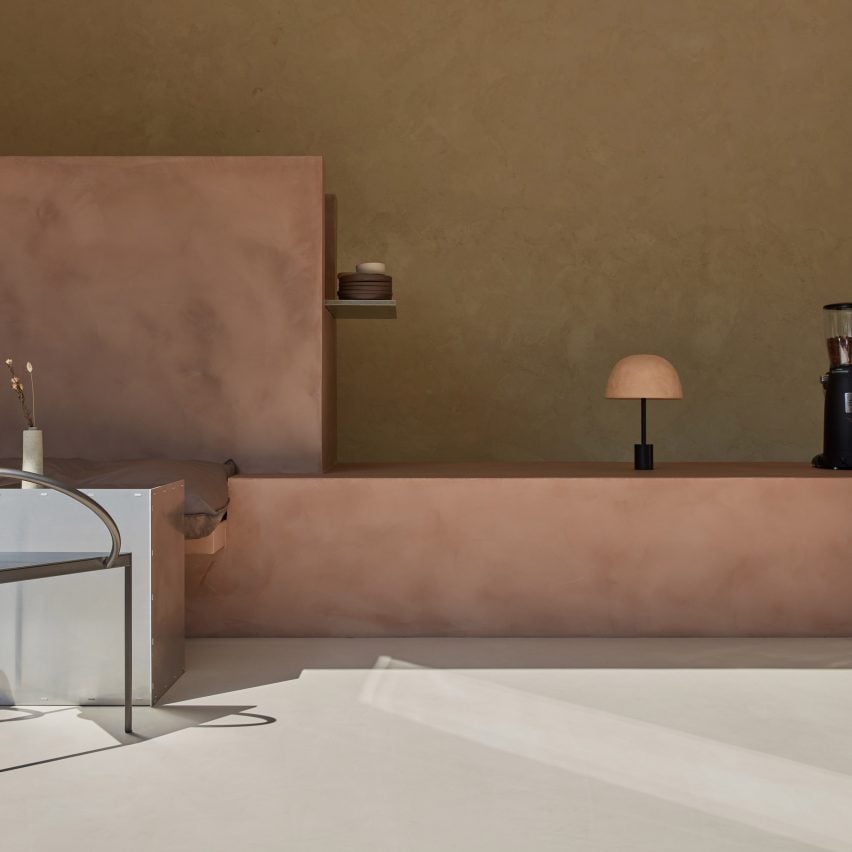
A chunky pink-plaster counter dominates the otherwise sparse interior of this cafe in Al Ain, Abu Dhabi, which has been revamped by design studio Bone.

La Petite is situated in Al Ain's Al Tiwayyah neighbourhood and has been a popular food and drink spot amongst locals for several years.

Over time it had grown tired in appearance, encouraging its owners to tweak its visual identity and menu. Design studio Bone was brought on board to completely overhaul the cafe's interiors.
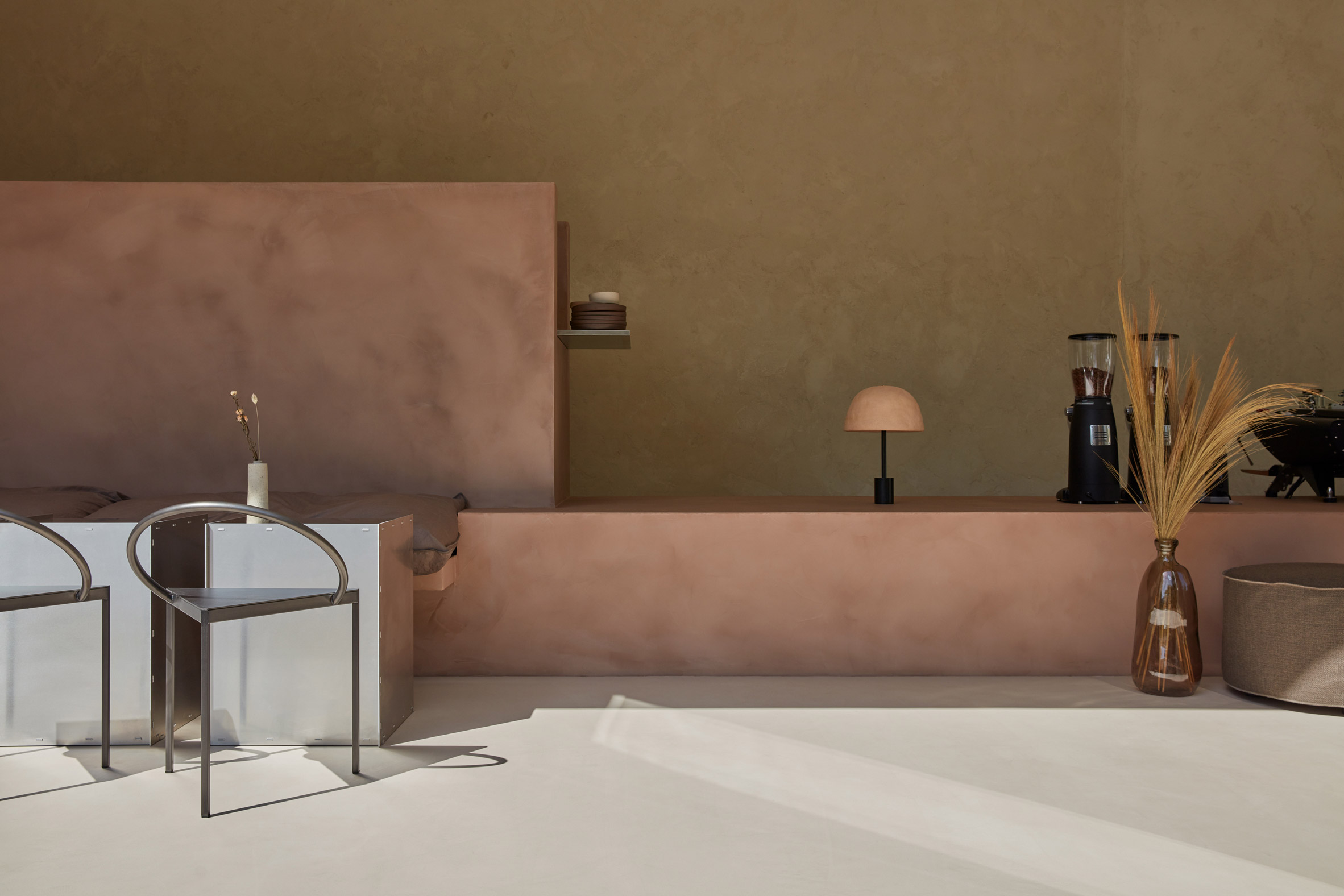
La Petite cafe in Al Ain, designed by Bone

The 85-square-metre space is now anchored by a huge service counter that's covered in dusty-pink plaster. It comprises two different-sized blocks – the taller one conceals back-of-house utilities, while the lower one is where staff prepare orders.

Directly in front is a row of earth-tone seating poufs, allowing the lower block to serve as a spot for customers to enjoy their drinks. A cushioned bench seat has also been integrated into the taller block.

La Petite cafe in Al Ain, designed by Bone

"We wanted to highlight the longitudinal nature of the space by designing a monolithic volume that functions as a working, serving, display, table, and seating surface - redefining the conventional coffee bar," the studio told Dezeen.

"In order to avoid the volume feeling invasive, the idea was to create a sunken block that serves both the barista and the customer," it continued.

"The goal was to achieve a fluid interaction between the customer seated in front of the bar and the barista at work behind the bar – where both eye levels meet."
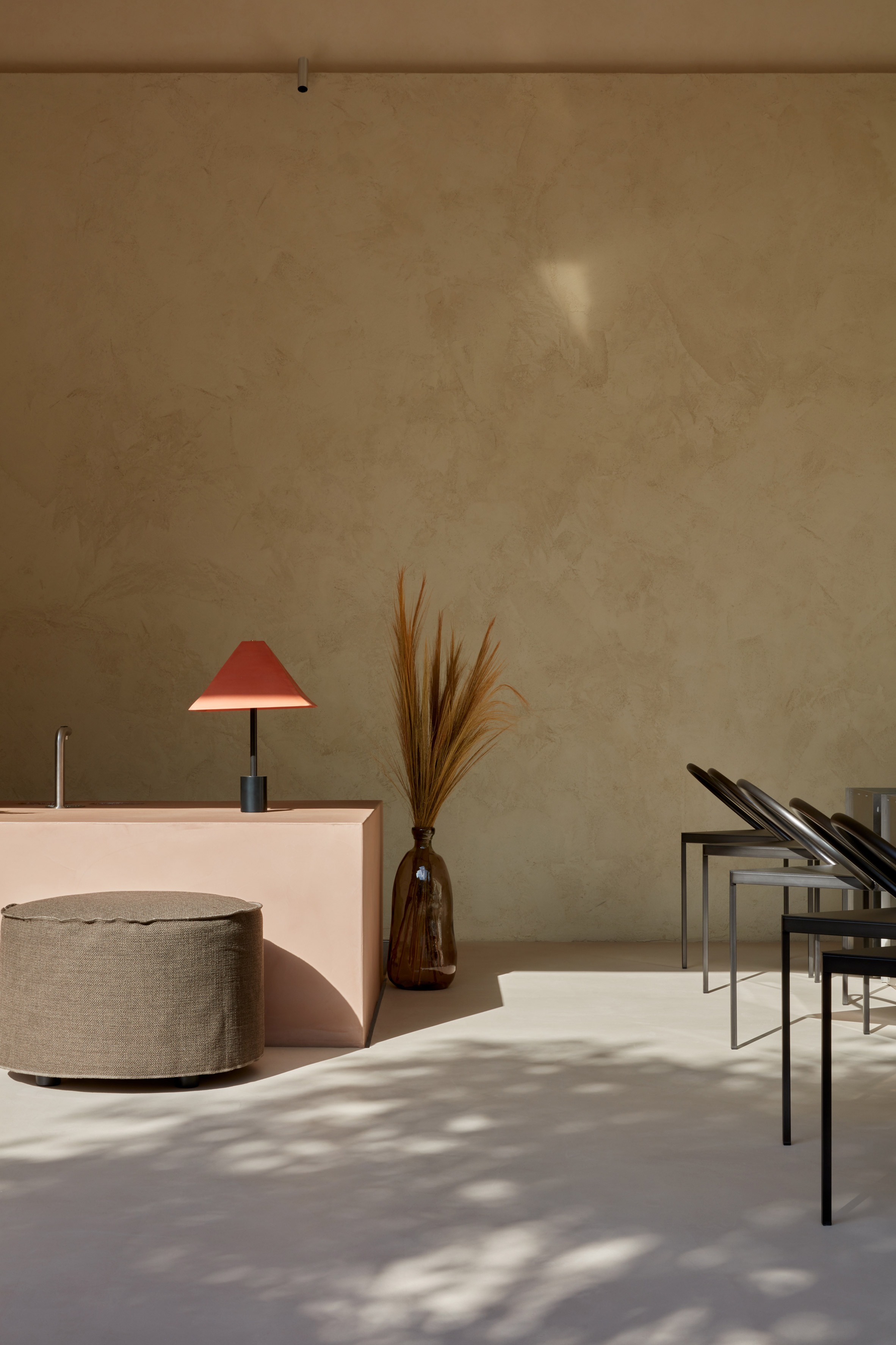
La Petite cafe in Al Ain, designed by Bone

More seating is available on the opposite side of the cafe, where a white communal sofa runs the length of an entire wall.

This takes cues from the Arabic term majlis – a private lounge or reception room where guests are entertained, typically sitting on floor cushions that are placed around the periphery of the room.
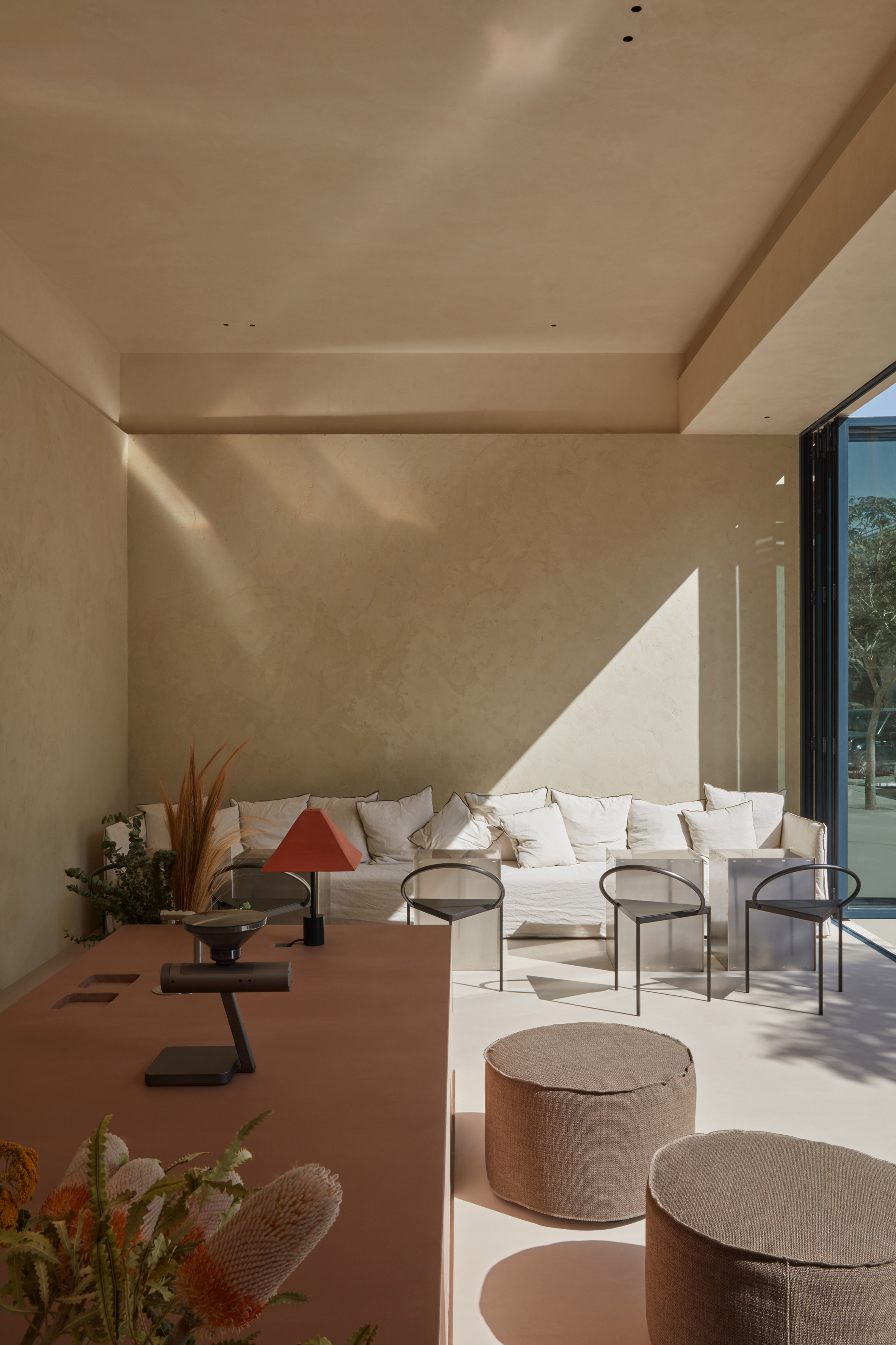
La Petite cafe in Al Ain, designed by Bone

Blocky steel side tables and black-frame chairs from multidisciplinary design studio Frama have also been used to decorate the space, as well as a handful of vases filled with wildflowers.

Surfaces throughout have been washed with sandy-beige plaster, the colour intended as a subtle nod to Al Ain's desert landscape.
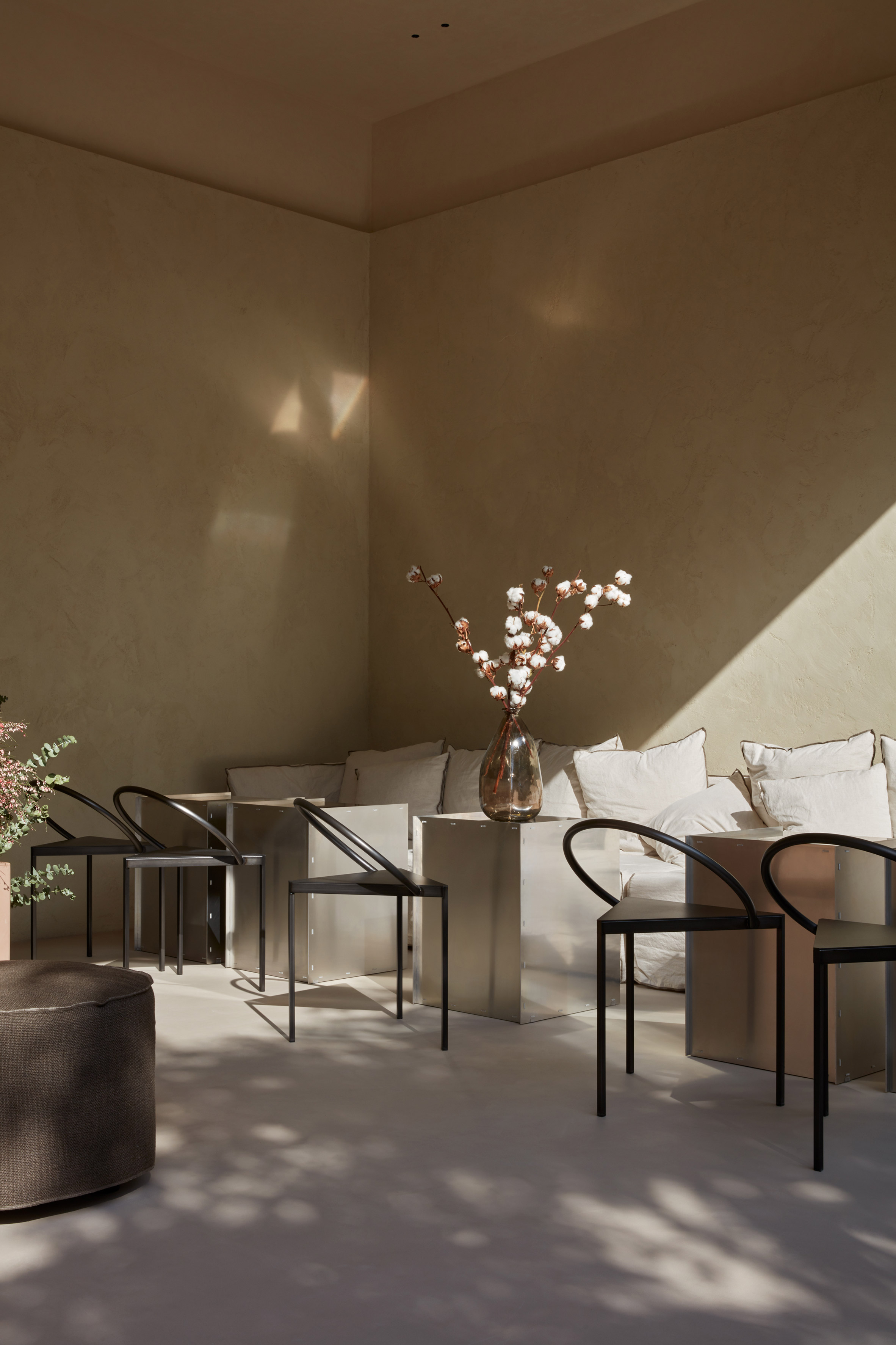
La Petite cafe in Al Ain, designed by Bone

The glass doors that previously fronted the cafe have been replaced by 2.6 metre-high glazed panels. These can be concertinaed to open up the space to a gravelled outdoor terrace that's dressed with casual fold-out timber chairs.

Customers can alternatively perch on the high-back cushions that have been placed on the cafe's steps.
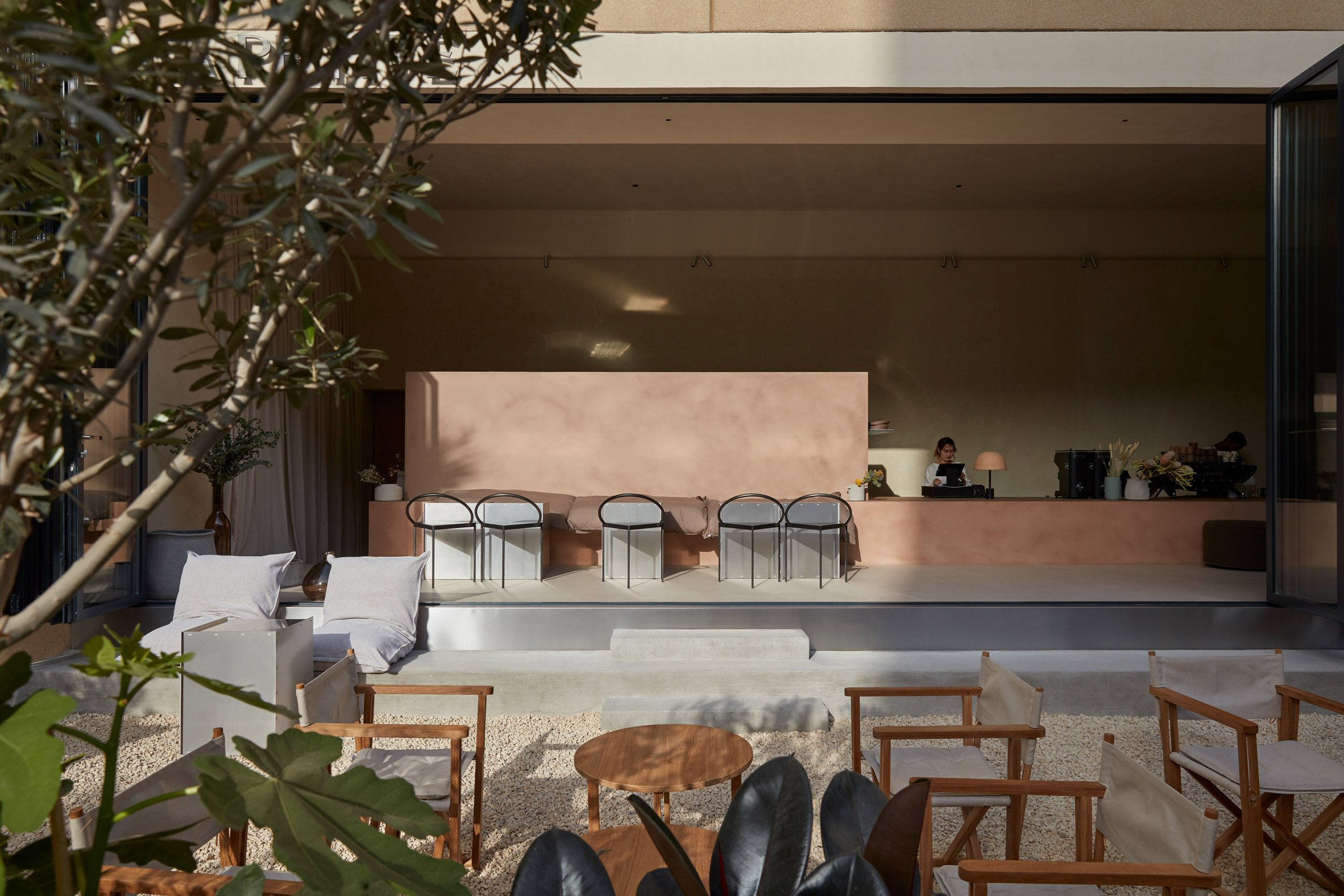
La Petite cafe in Al Ain, designed by Bone

La Petite is the latest cafe to be completed by Bone, which recently developed the interiors of the Hoof eatery in Ras Al Khaimah.

Designed to resemble horse stalls, the space boasts rough plaster walls and huge, trough-like metal sinks.

Photography is by Oculis Project.


Project credits:

Design: Bone
Contractor: Fusion
Custom mineral plaster finishes: Optimum Gulf
Interior architectural lighting: PSLab
Exterior lighting: Flos
Table lamps: In Common With
Door system: Oryx
Furniture: Gervasoni, Frama, Skargaarden, Ethnicraft

The post Monolithic plaster counter centres La Petite cafe in Abu Dhabi appeared first on Dezeen.


from Dezeen https://ift.tt/3dAQRsK

The United Nations issues an open brief to designers to help fight coronavirus

In its first open brief to the creative community, the United Nations is asking for designers to help produce concise and impactful visuals to help share life-saving information on Covid-19.


from It's Nice That https://ift.tt/3bEtgWu

Emily Graham photographs the longest running unsolved treasure hunt in the world

Over 25 years ago, golden treasure was buried somewhere in the landscape of France, and it is yet to be found. But Emily’s series is about much more than a trail gone cold.


from It's Nice That https://ift.tt/2WUWAnw

“We haven’t gone beyond tokenism”: Exploring diversity’s “now moment” with Liz Johnson Artur

In light of the renowned photographer’s work with the Southbank Centre exhibiting from December 2019 to January 2020, Liz explains why she doesn’t use labels and why some artists are introduced with a biography where others aren’t.


from It's Nice That https://ift.tt/3dDEsUN

Sunday, 29 March 2020

Coronavirus reveals "the shortcomings of the traditional supply chain" says Bjarke Ingels

BIG manufactures face shields for hospital workers

Decentralised local manufacturing could replace global supply chains as a result of the coronavirus pandemic, according to architects who collaborated on an open-source project to make face shields for hospital workers.

"Will this crisis reconfigure supply chains? I hope so," said Eric Höweler of Boston studio Höweler + Yoon, one of many US architecture firms that is using its 3D printers to make the face shields.

"We seem to have been caught by surprise, despite many experts warning of this exact scenario."

"We didn't realise how little we made domestically until we hit a crisis"

"It has also highlighted the fact that, in our global economy, we have outsourced and off-shored so much manufacturing of products," Höweler added. "We didn't realise how little we made domestically until we hit a crisis like this."

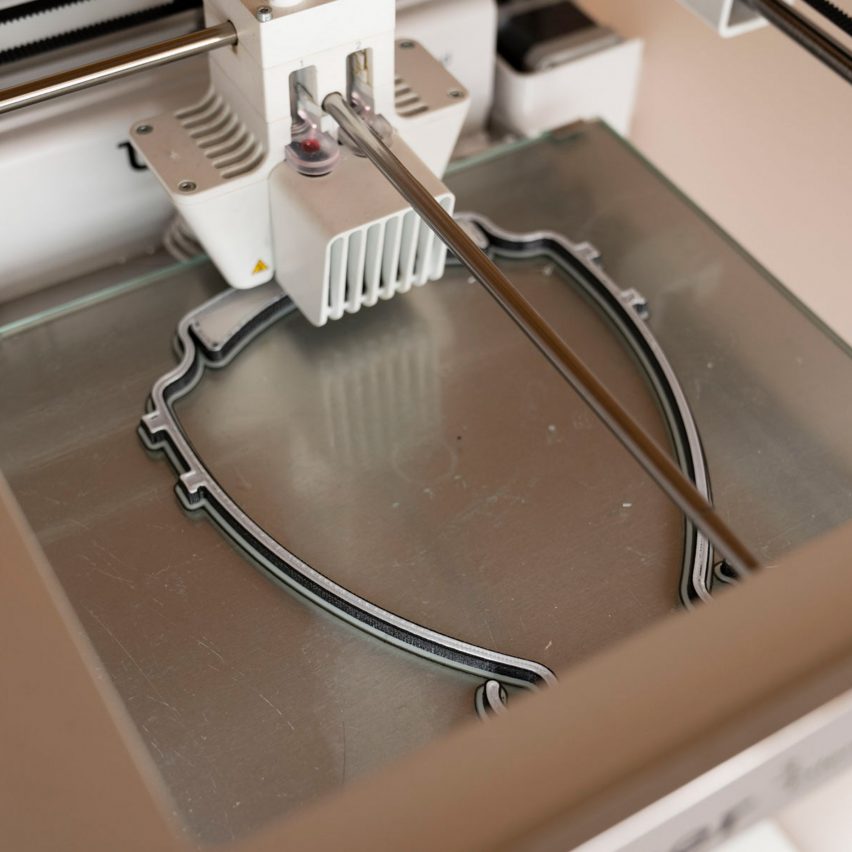
Höweler's firm is working alongside others to produce face shields from 3D-printed and laser-cut components, using an open-source design.

New York architect Bjarke Ingels Group has dedicated its model shop to make face-shield components and is tweaking the design to optimise production.

"This unprecedented event will most certainly also result in massive changes to current modes of thinking, making and distributing as well as showing the power of community empowered response when our city, national and institutions fail us," said BIG partner Kai-Uwe Bergmann, whose New York office is also manufacturing visors for hospital workers.

"Resiliency of all kinds will take on a new meaning."

BIG founder Bjarke Ingels said the pandemic reveals the "shortcomings" of existing supply chains, with products, components and materials shipped around the world on a "just-in-time" basis.

Pandemic reveals "flexible making capacity that resides in so many places"

With international travel disrupted and many populations in lockdown, local networks of small-scale manufacturers could offer a viable alternative in some cases, Ingels said.

"One thing that we find intriguing is the idea of distributed just-in-time manufacturing capabilities," Ingels told Dezeen.

"Just like computers went from business machines to PCs to handheld devices, the internet went from institutional to businesses and internet cafes to cable and wireless," he said. "Perhaps manufacturing is in the process of moving from purpose-built factories to general capability and eventually to the maker hub on the block or the personal fabricator."

American architects mobilise to make coronavirus face shields for hospital workers
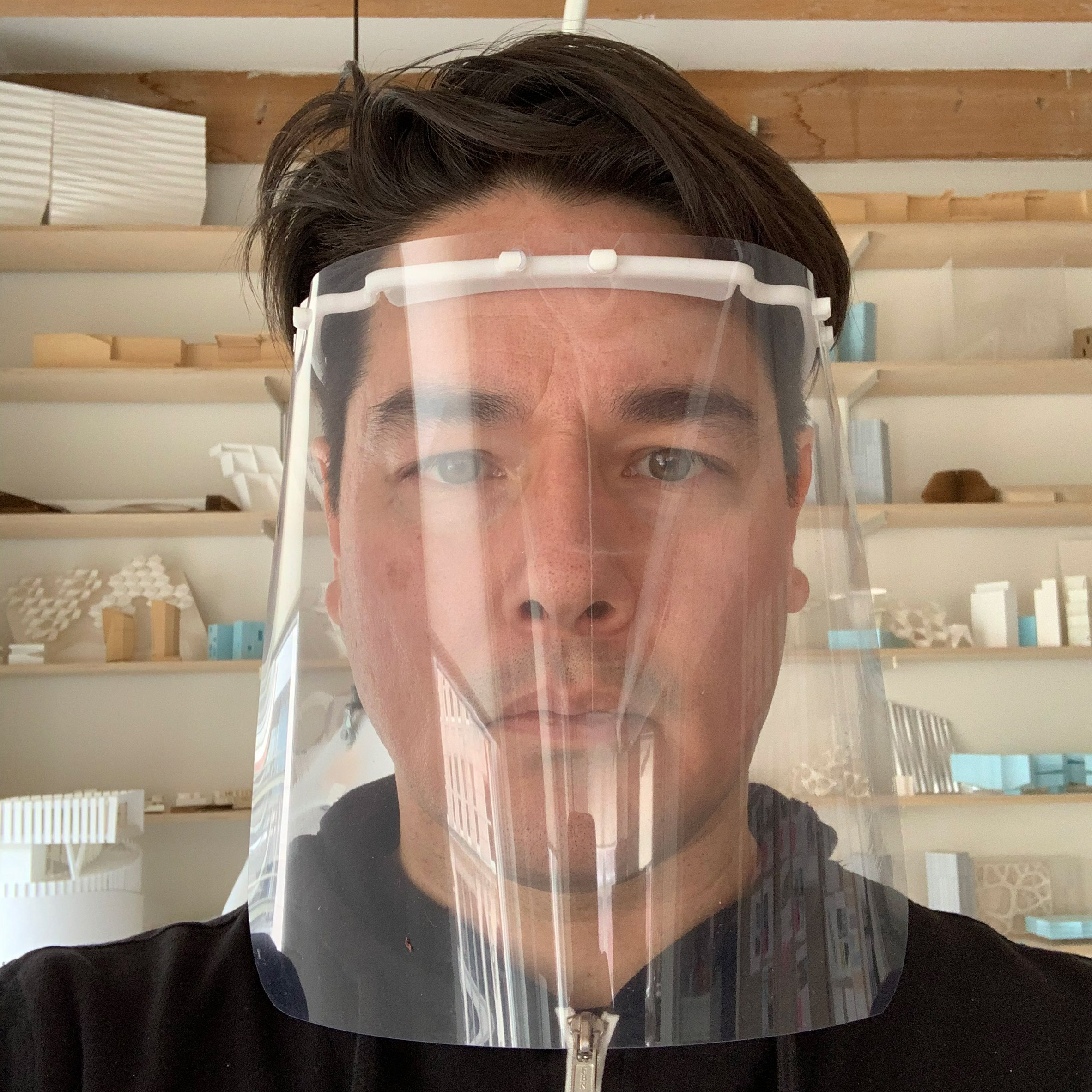
Eric Höweler wearing a face shield his studio produced using an open-source design. Top image: Part of a shield being 3D printed

The face-shields project has revealed the untapped potential of architecture studios as part of an alternative manufacturing capability, he added.

"At least the massive urgency and shortcomings of the traditional provisions and supply chain during the Covid outbreak has revealed the flexible making capacity that resides in so many places you don't normally associate with manufacturing, like architecture and design studios," Ingels said.

"As with distributed computing, perhaps distributed manufacturing has potentials we haven't even thought of yet: the cloud of the material world that allows instant and omnipresent translation from data to matter."

"Maker movement has created a decentralised rapid prototyping network"

Meejin Yoon, dean of Cornell University's Architecture, Art and Planning school, said the shortage of personal protective equipment (PPE) for hospital workers has revealed "a gap" in the way supply chains work.

"The just-in-time economics of our supply chain logistics has created a gap in our current urgent demand for PPEs that has caught the industry off guard," said Yoon, whose department coordinated the visor-making project.

"How can we as designers, makers and fabricators fill the gap by crowd-sourcing components through distributed networks of idle rapid prototyping resources, 3D printers in architecture schools and offices, and even desktop 3D printers?" added Yoon, who is also partner at architect Höweler + Yoon.

"While our 'rapid' prototyping machines are not meant for industrial-scale manufacturing, and by those standards are not 'rapid', as industry ramps up, our distributed maker capabilities can fill this essential gap to help those on the front lines of the Covid-19 health care crisis."

"Hopefully we learn from this crisis to think differently"

"Fortunately the maker movement has created a decentralised rapid prototyping network for small quantity production of components," said Eric Höweler. "Cornell's call to produce face shields mobilised hundreds of 3D printers that were sitting idle in offices and on desktops around the world. Social networks were able to rally resources and volunteers stepped up. It was remarkable to see a flood of people wanting to help."

"Will this bring large scale production manufacturing back to the US? Probably not," he added. "What it has showcased is a weakness in our current model, and hopefully we learn from this crisis to think differently. Someone said 'you can't let a good crisis go to waste'. We need to learn from this."

"This was the first pandemic of the jet age, but it's also the first pandemic of the digital fabrication age, where expertise and open-source content moves freely and individuals are networked for a common cause," Höweler concluded. "It may turn out to be the thing that brings us together in different ways."

The post Coronavirus reveals "the shortcomings of the traditional supply chain" says Bjarke Ingels appeared first on Dezeen.


from Dezeen https://ift.tt/2JqK9I4