Monday, 11 May 2020

MB Architecture stacks shipping containers to form Amagansett holiday home

Amagansett Modular House by MB Architecture

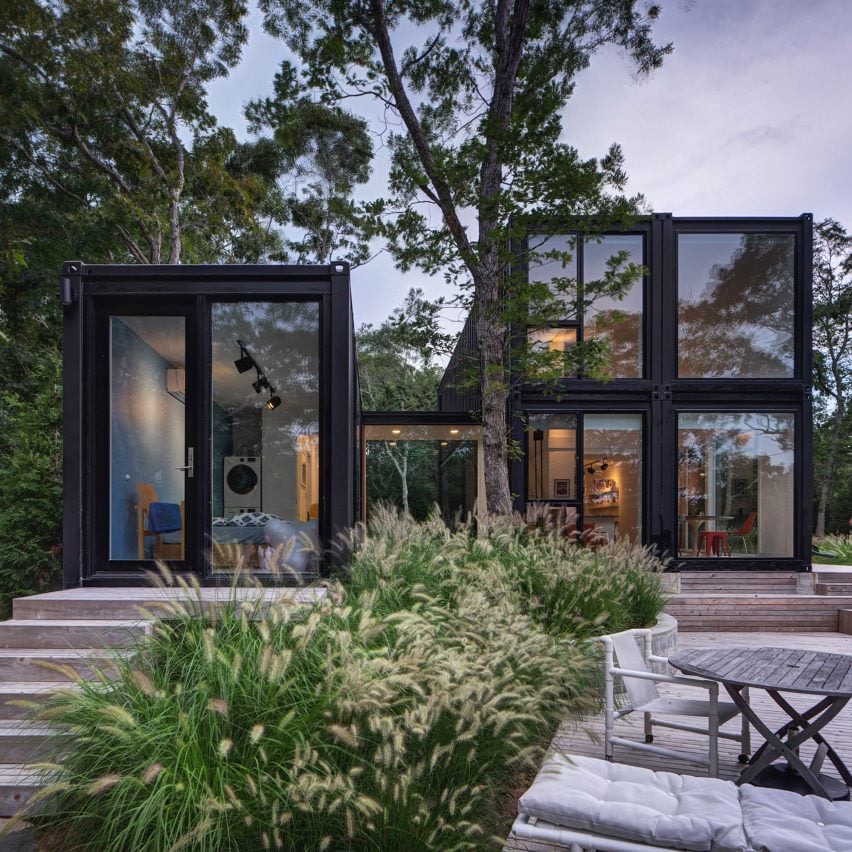
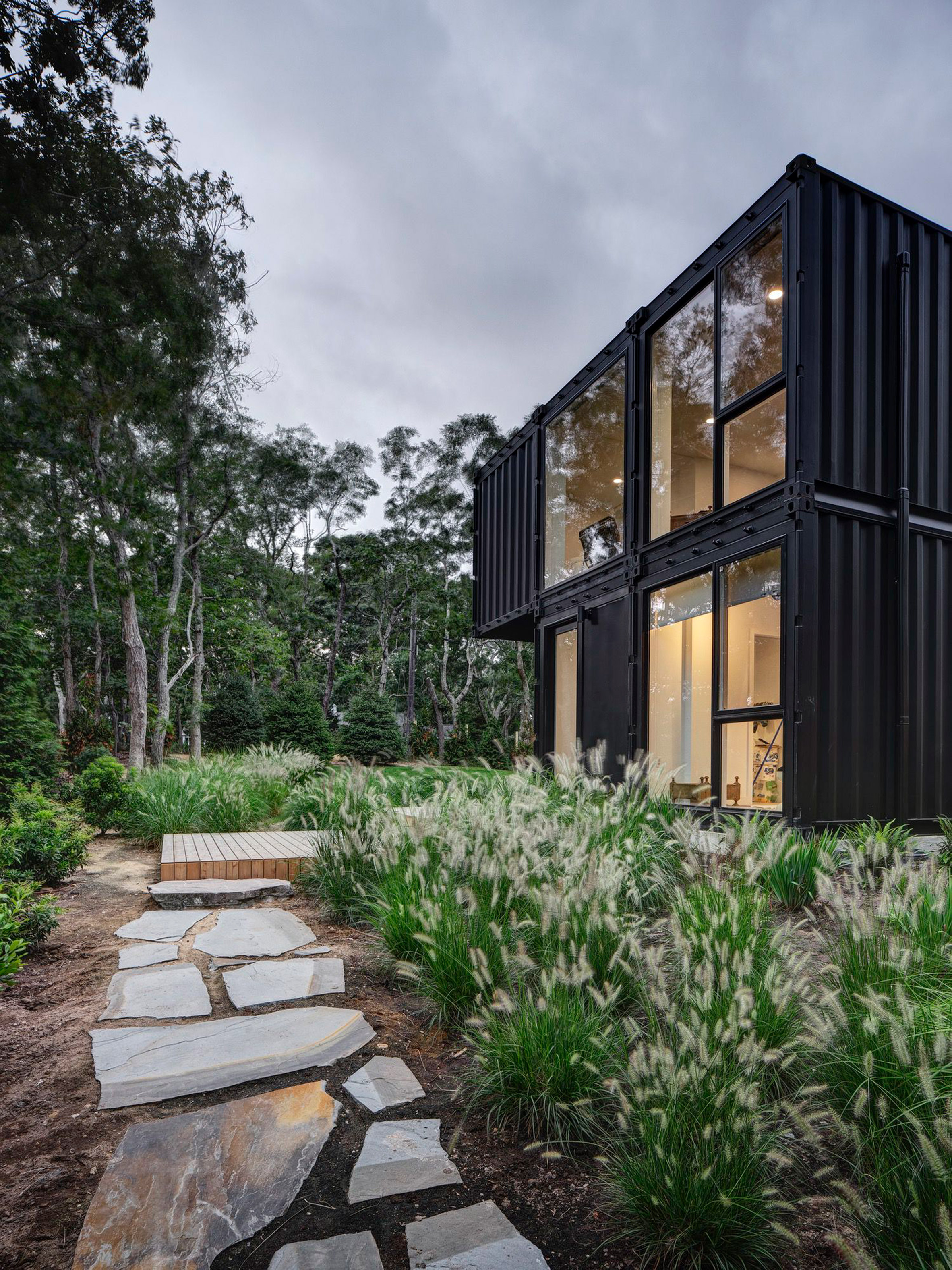
US studio MB Architecture has stacked shipping containers to construct this black holiday house in Amagansett, New York in a few days.

Amagansett Modular is a 1800-square-foot (167-square-metre) weekend residence on a small wooded site in the hamlet on Long Island's south shore.
Amagansett Modular House by MB Architecture

The clients, a family with three kids, had a limited budget, and were open to exploring unconventional building materials and methods.

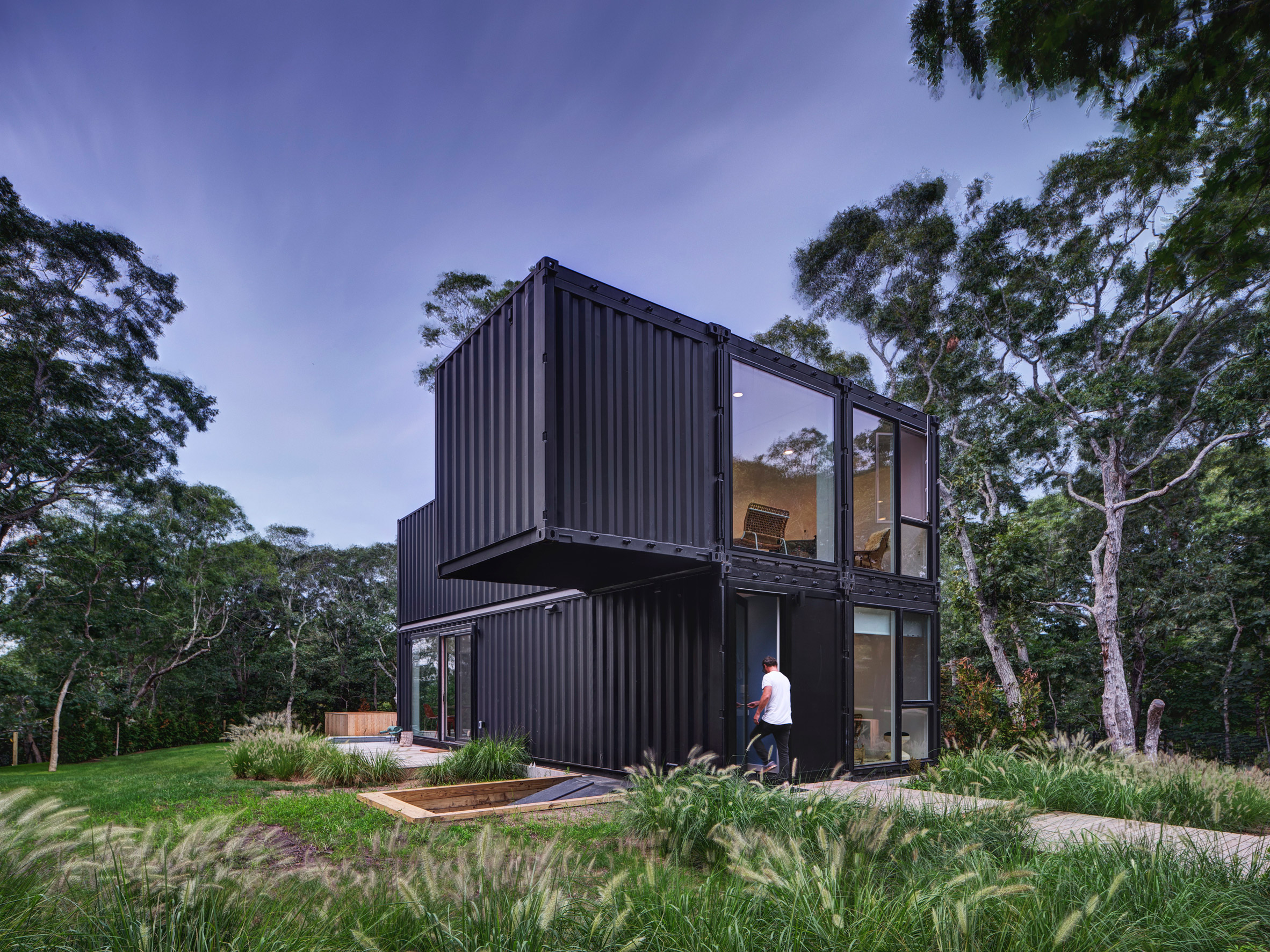
To cut costs MB Architecture used shipping containers to create the boxy, two-storey structure from volumes that were prefabricated off-site and then assembled in place in two days.
Amagansett Modular House by MB Architecture

"Simplicity of spatial layout and materials were sought to yield compelling and uncluttered rooms while achieving budget goals," the studio said.

"As such, we used the rectilinear geometry of containers, and their inherent structural strengths to guide room layout and structural requirements."
Amagansett Modular House by MB Architecture

The main body of the house comprises four volumes that measure 40 feet long (12 metres) and eight feet (2.4 metres) wide.

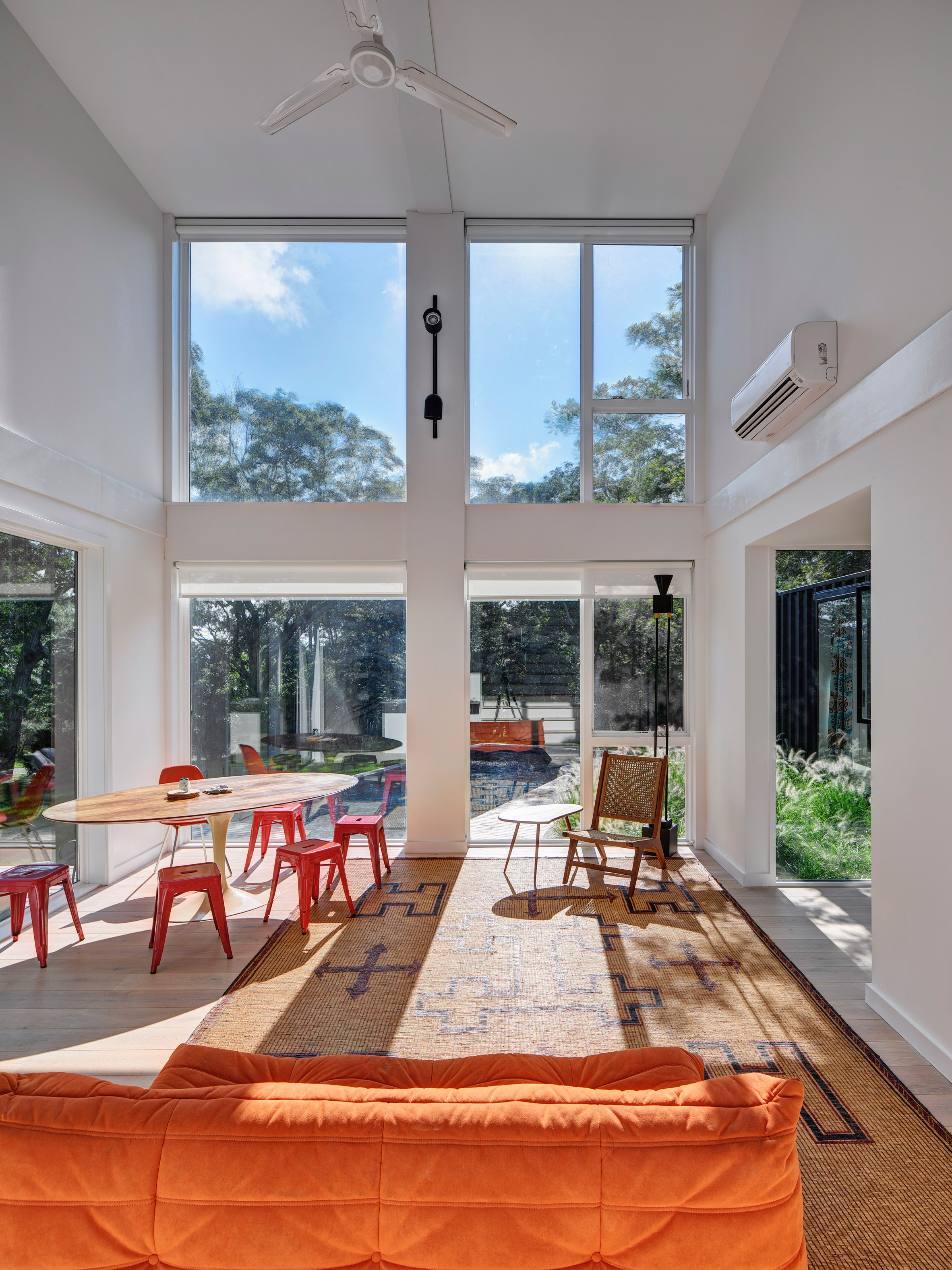
The studio stacked two of the units on top of one another and cut away a portion of the base and interior walls cut out to allow for 17-foot-hight (5.2 metre-high) ceilings and open-plan living inside. Tall windows front both ends to allow plenty of natural light.

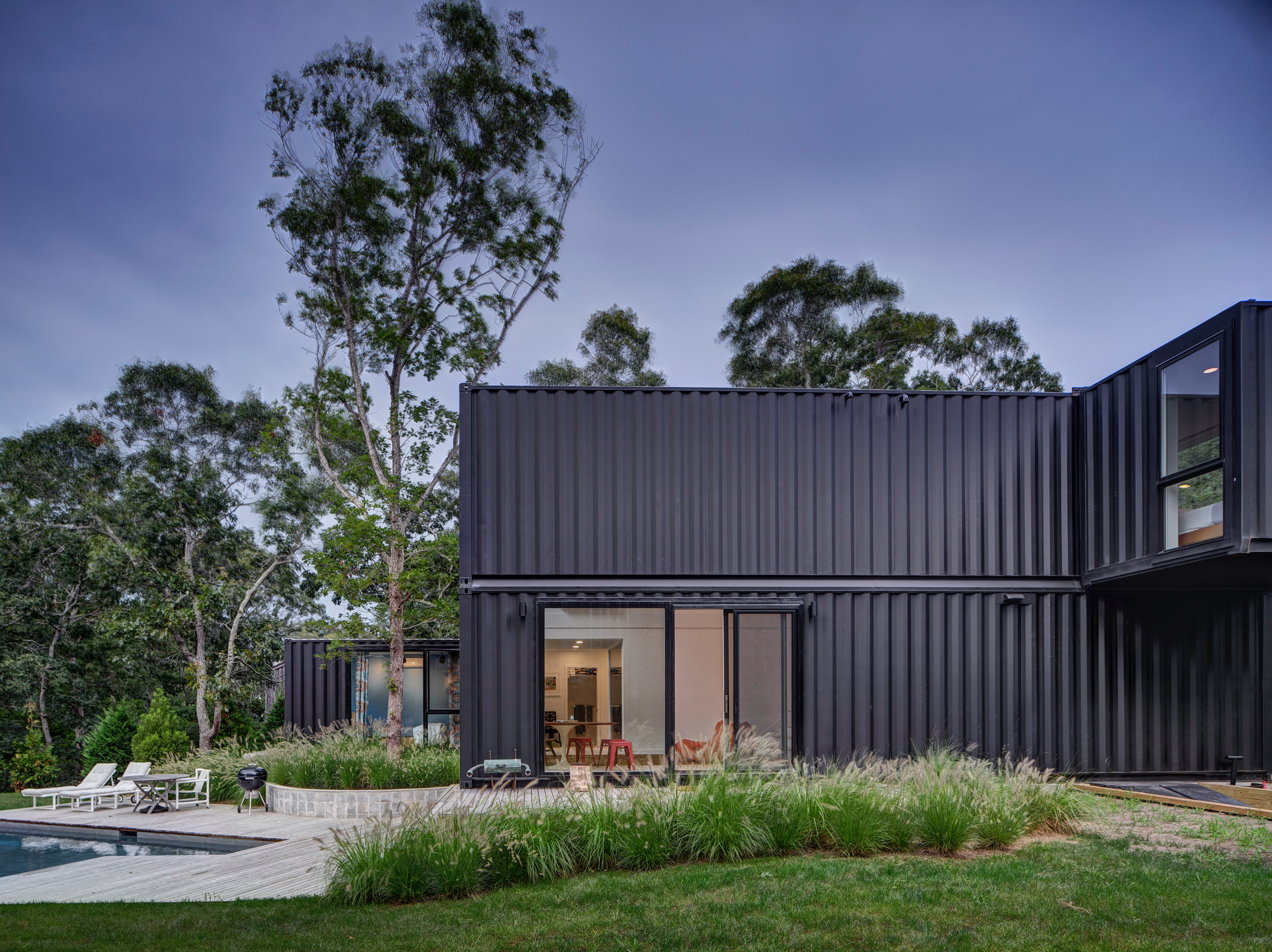
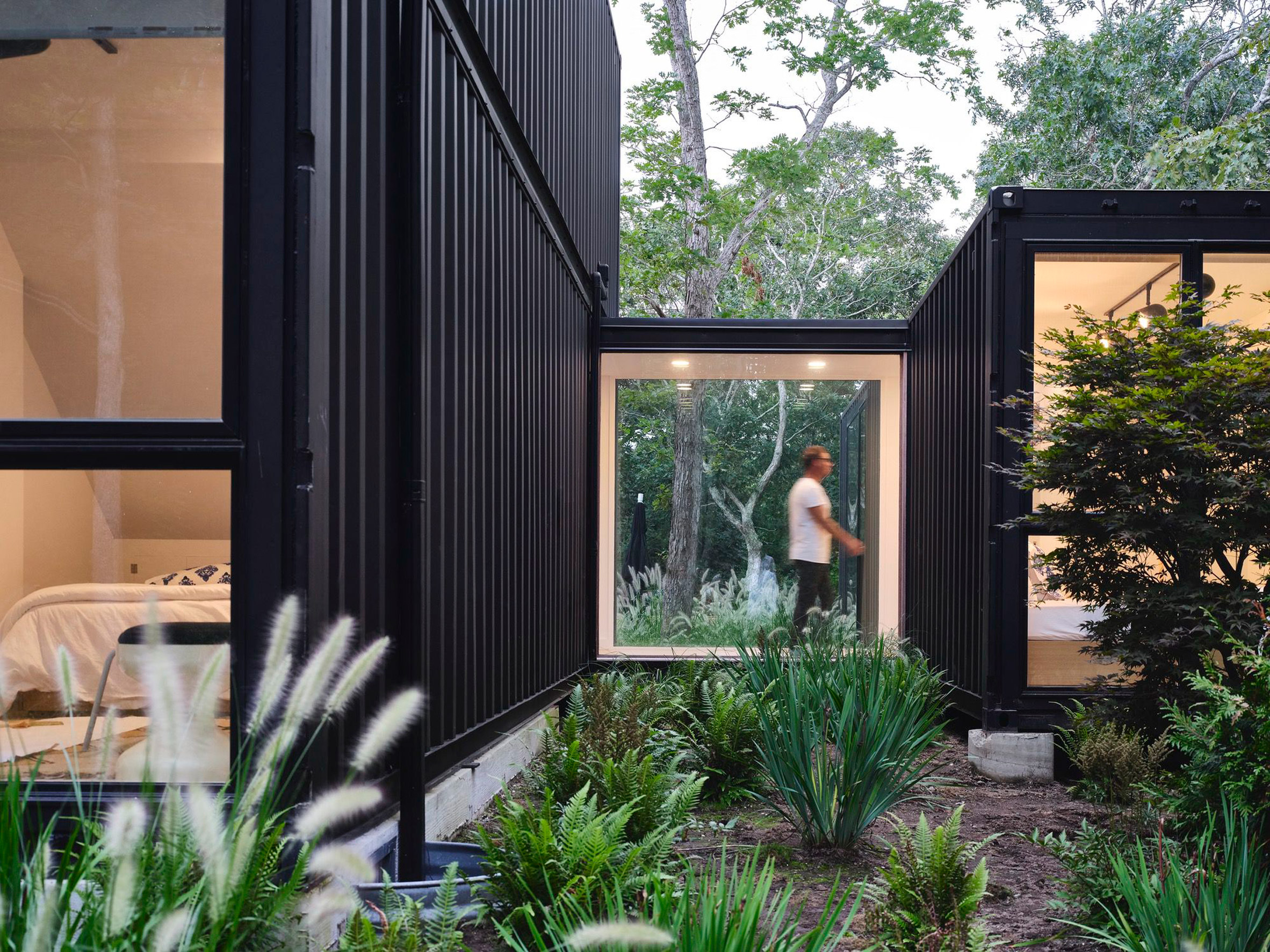
Bedrooms, meanwhile, are housed in two additional units, including a cantilevered volume bolted on to one of the upper containers and a skinny volume that extends from the lower portion. A walkway attaches between the main house and the latter.

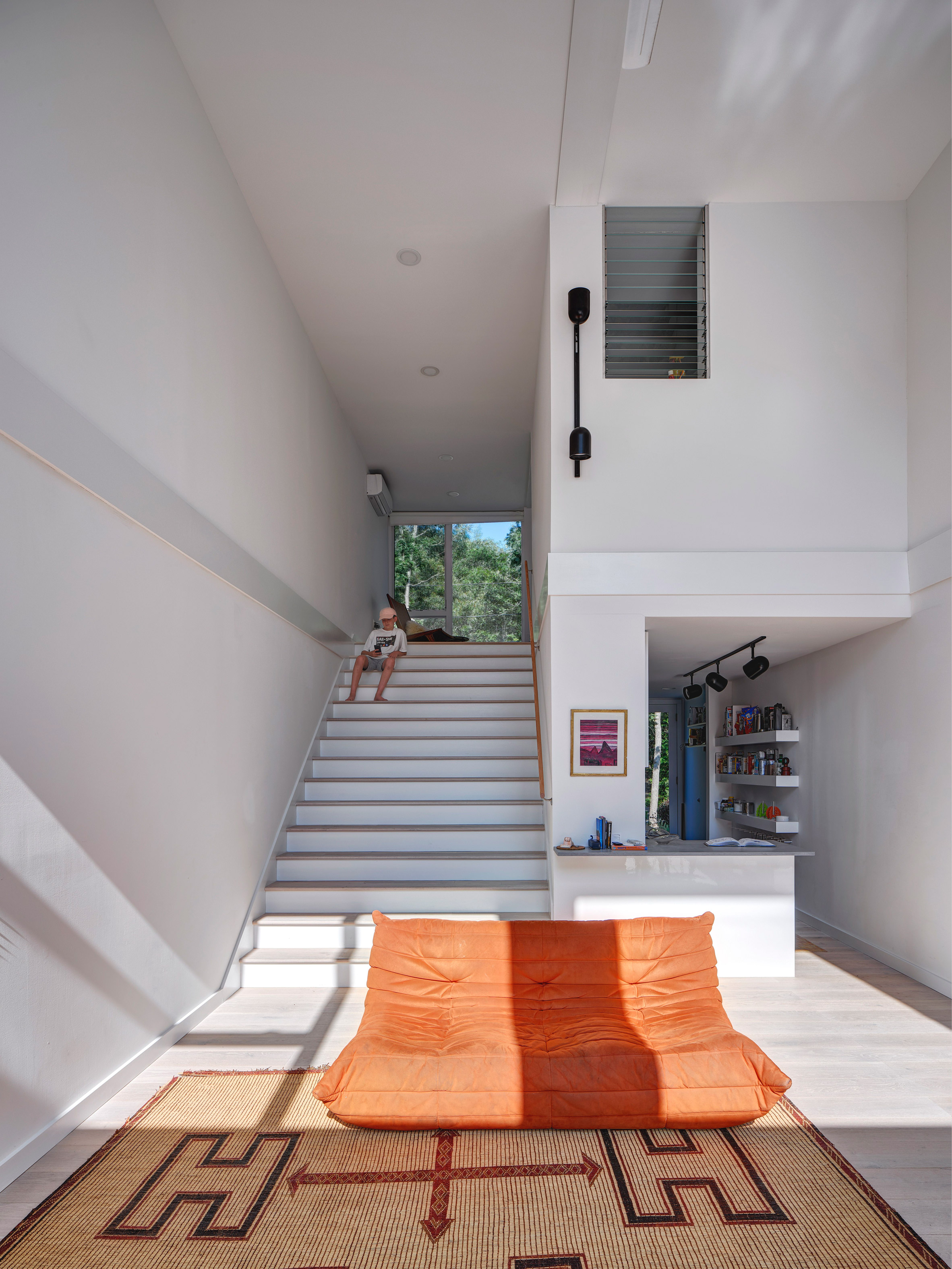
Inside, a wood staircase occupies the entire width of one container to form steps facing towards the backyard patio and pool. The studio describes it as an "amphitheatrical room".
Amagansett Modular House by MB Architecture

Wood steps leading down from the residence also form a series of benches that blend with the decking that edges the geometric pool. The small patio is outfitted with white lounge chairs and a round black grill.

All of the interior walls are painted white and paired with whitewashed hardwood floors. The ceilings on the front half of the structure are cut away opening the lower level to the floor above.
Amagansett Modular House by MB Architecture

Furnishings include a puffy orange Togo sofa from Ligne Roset, red stools designed by Tolix and a large reed mat made by the Tuareg tribe of North Africa.

MB Architecture is a New York studio with offices in East Hampton and Manhattan founded in 1996.
Amagansett Modular House by MB Architecture

It has completed a number of projects that use shipping containers, including a tiny art studio also in Amagansett and a media lab for Bard College in the Hudson Valley. In 2018 it completed a gabled residence clad with pale timber.

Photography is by Matthew Carbone.


Project credits:

Lead architect: Maziar Behrooz
Associate architect: Bruce Engel
Intern: Eudine Blancardi
Builder/general contractor: Charles Gallanti Inc
Structural engineer: Keith Ewing
Landscape design: MB Architecture

The post MB Architecture stacks shipping containers to form Amagansett holiday home appeared first on Dezeen.


from Dezeen https://ift.tt/2SWD8nn

Paper Figures and Objects by Bethany Bickley Spring From Book Pages

All images © Bethany Bickley

A measure of well-written fiction is its ability to provoke clear images in the minds of its readers. For Bethany Bickley, though, the joy of envisioning protagonists and scenery has a more literal element. The Savannah-based artist utilizes pages torn from classics, magazines, and contemporary works to fashion distinctive paper sculptures of clenched fists, a lounging reader, and a trio of masks. Each figurative work serves as a tangible representation of otherwise imagined visuals.

Among her bookish sculptures are the iconic pear tree from Zora Neale Hurston’s Their Eyes Were Watching God, a seated Esther Greenwood from Sylvia Plath’s The Bell Jar, and an amalgam of weapons and detective objects to symbolize the thriller genre. In a statement, Bickley said she merges narrative and imagery “to tell a story with impact and purpose. If there are no visuals, I create them.”

To see more of the artist’s illustrative projects and take a peek at her process, head to Instagram. (via designboom)


from Colossal https://ift.tt/2zqS3PN

Live interview with architect Stefan Behnisch

Architect Stefan Behnisch established Behnisch Architekten with his father in 1989

German architect Stefan Behnisch speaks to Dezeen in this Screentime conversation sponsored by Enscape as part of Virtual Design Festival today. Watch it live from 2:00pm UK time.

Behnisch established Behnisch Architekten in Stuttgart in 1989 with his late father Günter Behnisch. The firm now has additional offices in Los Angeles, Boston and Munich.

Behnisch Architekten has completed several educational and university projects including a renovation of the Portland State University School of Business, an energy laboratory clad in translucent polycarbonate at Karlsruhe Institute of Technology, and a timber-clad kindergarten in Heidelberg, Germany.

The firm also recently completed an office and reception building that looks like a sports arena at the Adidas headquarters in Herzogenaurach, Germany.

Architect Stefan Behnisch established Behnisch Architekten with his father in 1989
Architect Stefan Behnisch co-founded Behnisch Architekten in 1989

Other creatives featured in our Screentime series include trend forecaster Li Edelkoortarchitect Dong-Ping WongNew York architecture practice SO-ILThe World Around curator Beatrice Galileefilmmaker Gary Hustwit and British-Israeli architect Ron Arad.

This Screentime conversation is sponsored by Enscape, a virtual reality and real-time rendering plugin for architectural design programme Autodesk Revit.

Virtual Design Festival is the world's first online design festival, taking place from 15 April to 30 June. For more information, or to be added to the mailing list, contact us at virtualdesignfestival@dezeen.com.

The post Live interview with architect Stefan Behnisch appeared first on Dezeen.


from Dezeen https://ift.tt/3cmAhfj

Space Popular launches virtual reality art gallery

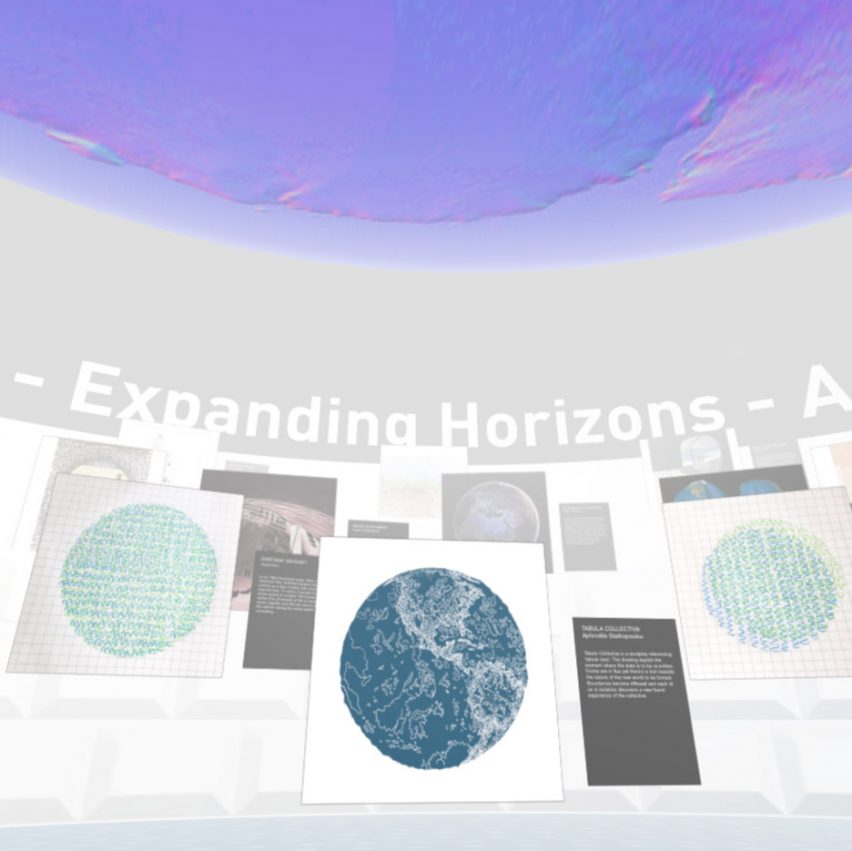
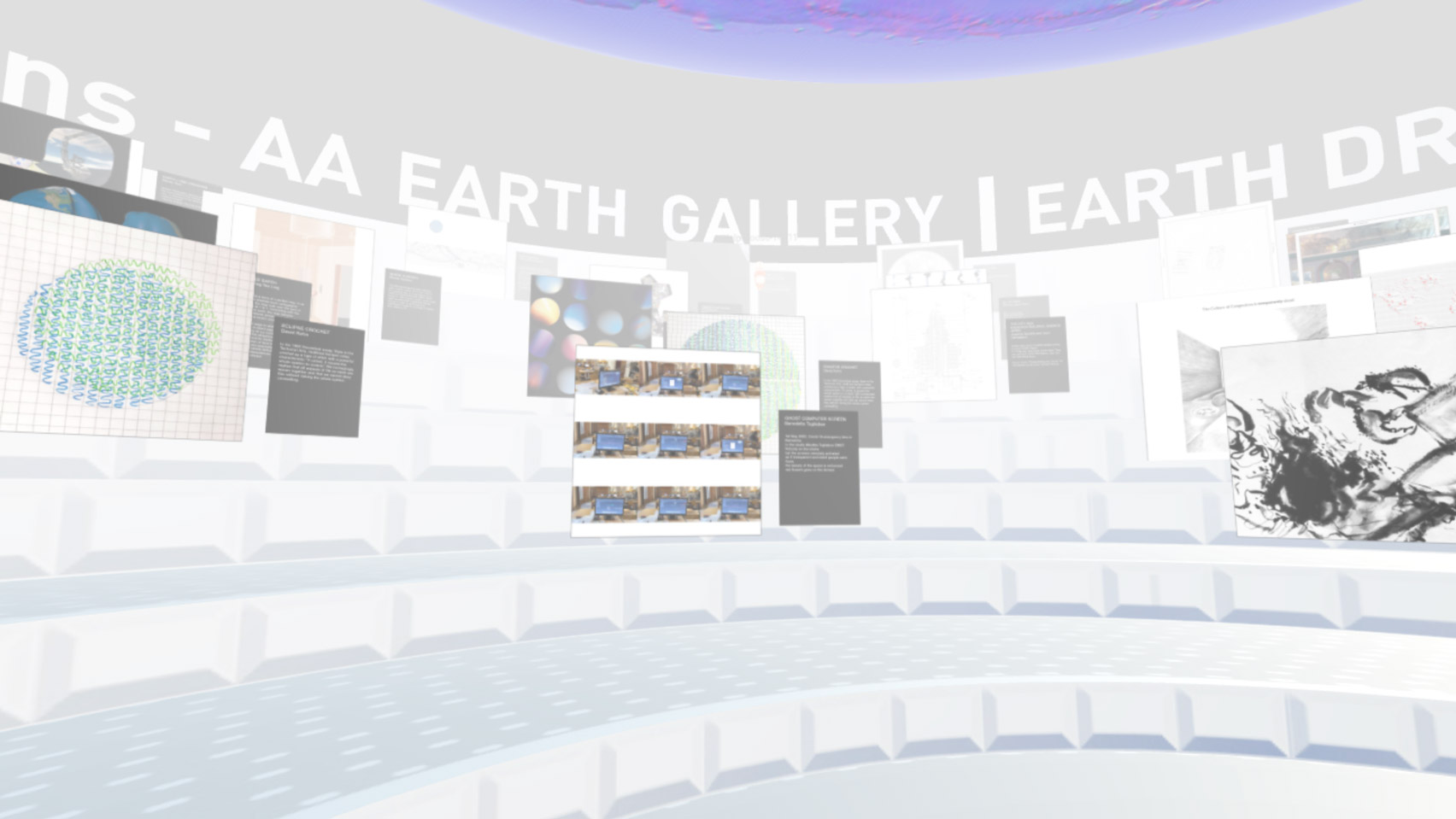
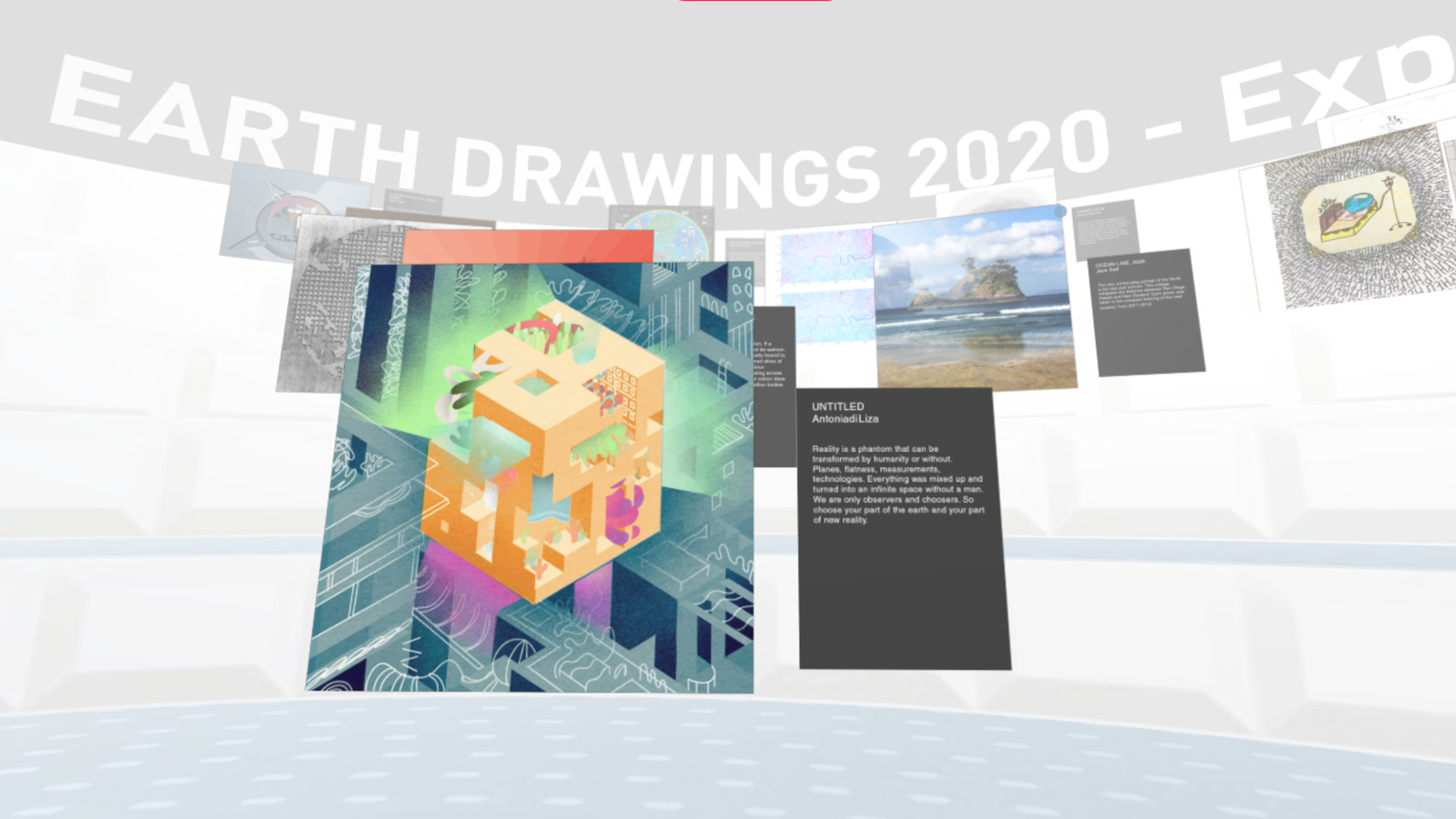
AA Earth Gallery by Space Popular

Design studio Space Popular has created a gallery in virtual reality for the Architectural Association, plus today's other design and architecture-related coronavirus news.

Called AA Earth Gallery, the project was made to mark 50 years of Earth Day, an annual event held in support of environmental protection. All the works on display respond to the theme of Earth and human relationships.

Normal galleries and exhibitions are closed due to the pandemic, so the Architectural Association (AA) commissioned a virtual gallery from Space Popular.

"At a time when the planet is united in the experience of combatting the Covid-19 pandemic, we are physically separated while digitally connected," said the AA. "How does this impact the way we visualise Earth as a whole?"

AA Earth Gallery by Space Popular
Space Popular created the virtual reality art gallery for the AA

Students at the architecture school, staff, alumni, and prospective students were invited to submit their proposals for Earth-themed drawings and models.

The final selection of 60 pieces are displayed in a virtual reality chatroom that Space Popular made on Hubs by Mozilla. Visitors can log in and select an avatar to use to explore the gallery, using a VR headset or on a normal computer screen. Up to 24 avatars can enter the chatroom at once.

AA Earth Gallery by Space Popular
In total 60 pieces of art are displayed

Navigating around the gallery, virtual visitors can look at the artworks displayed in a circular room arranged over multiple levels like an amphitheatre,

Artworks on display include Earth Drawing by Tatiana Bilbao, David Kohn's Crochet triptych, Dezeen columnist Sam Jacob's A house that is the whole world, and Earth = One Organism by Steven Holl. To visit the gallery click here, and browse the online catalogue here.

Here are nine more coronavirus-related architecture and design news stories from today:


Coronavirus daily briefing

Sidewalk Labs abandons Toronto smart city during pandemic

Alphabet subsidiary Sidewalk Labs has abandoned its ambition to create a smart neighbourhood in Toronto amid "unprecedented economic uncertainty" caused by the coronavirus pandemic (via Dezeen).

Milan Fashion Week announces new digital format

In July Italian designers will present womenswear and menswear collections in an online event. "It's something we thought of specially for the digital world," said president of the Camera della Moda Carlo Capasa (via Vogue).

AIA outlines how people can safely return to offices post pandemic

The American Institute of Architects has released a tool kit that provides strategies for limiting exposure to coronavirus in buildings as restrictions begin to ease (via Dezeen).

The Russian Federation is moving its 2020 Venice Biennale project online

Russia's submission to the Venice Architecture Biennale, which has been pushed back from May to August, will now be online-only. KASA Architects renovation of the country's pavilion in the Giardini will go ahead as planned (via the Russian Federation).

Milan calls on architects and designers to create social-distancing devices

Architects and designers are being asked to devise social-distancing devices to allow Milan's bars, shops and public spaces to reopen safely following the height of the coronavirus pandemic (via Dezeen).

Groninger Museum to open to the public again on 1 June

The art museum in Groningen, the Netherlands, has announced it will reopen soon. "We are very happy to be allowed to open the Groninger Museum and to be able to welcome visitors again," said museum director Andreas Blühm (via Groninger Museum).

Architecture, design and engineering activities for children in lockdown

Architects, designers and cultural institutions, including Foster + Partners, Dyson and the V&A, have created educational activities for children to ward off the boredom of coronavirus lockdown (via Dezeen).

UK to invest in cycle lanes and electric scooters

The UK government is expected to announce £250 million of funding for greener transport options to keep air pollution levels from rising again after the lockdown (via The Guardian).

Yinka Ilori has been making models and learning to play the Nigerian talking drum during lockdown

Designer Yinka Ilori shares what he's been doing to keep busy during the coronavirus lockdown in this video message recorded for Virtual Design Festival (via Dezeen).

The post Space Popular launches virtual reality art gallery appeared first on Dezeen.


from Dezeen https://ift.tt/2Wq985H

Carlo Ratti calls for redesign of "dinosaur" hospitals and universities for the post-coronavirus era

Carlo Ratti

Hospitals and universities are "dinosaurs" that need to be redesigned in the wake of coronavirus, according to architect Carlo Ratti.

"I think we got two kinds of dinosaurs in society today," Ratti told Dezeen in a live interview last week as part of Virtual Design Festival.

Hospitals are "this kind of centralised machine where you get out sicker than when you go in," he said. "Redesigning the interface with the medical system is going to be very, very important."

"We need to reinvent the university system"

"And the other dinosaurs are universities," said Ratti, who directs the Senseable City Lab at Massachusetts Institute of Technology and is founder of architecture studio Carlo Ratti Associati.

"I'm telling you this as someone who's been involved with universities all my life, but I think we need to reinvent the university system."

Shipping-container intensive care unit installed at Turin hospital
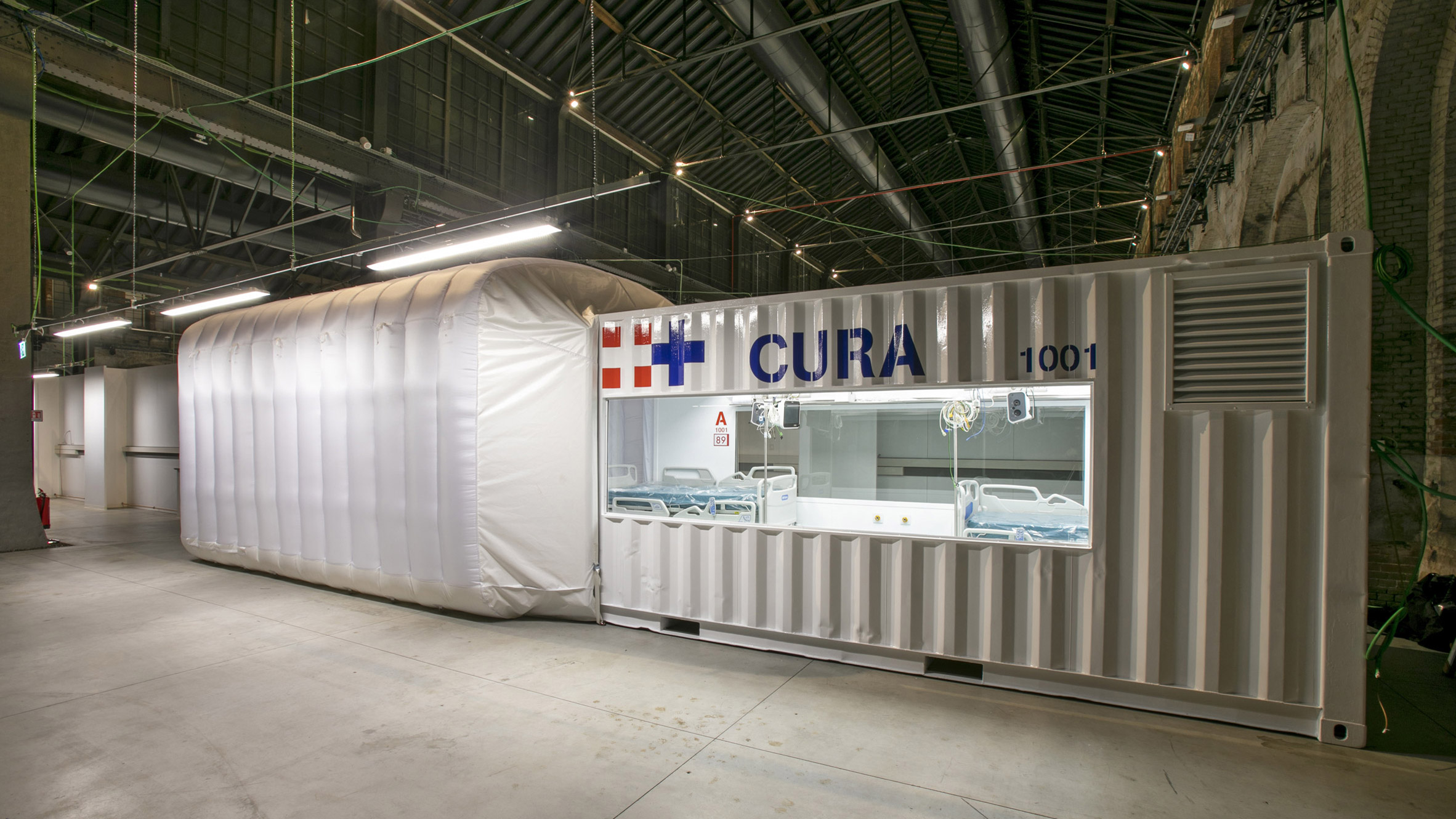
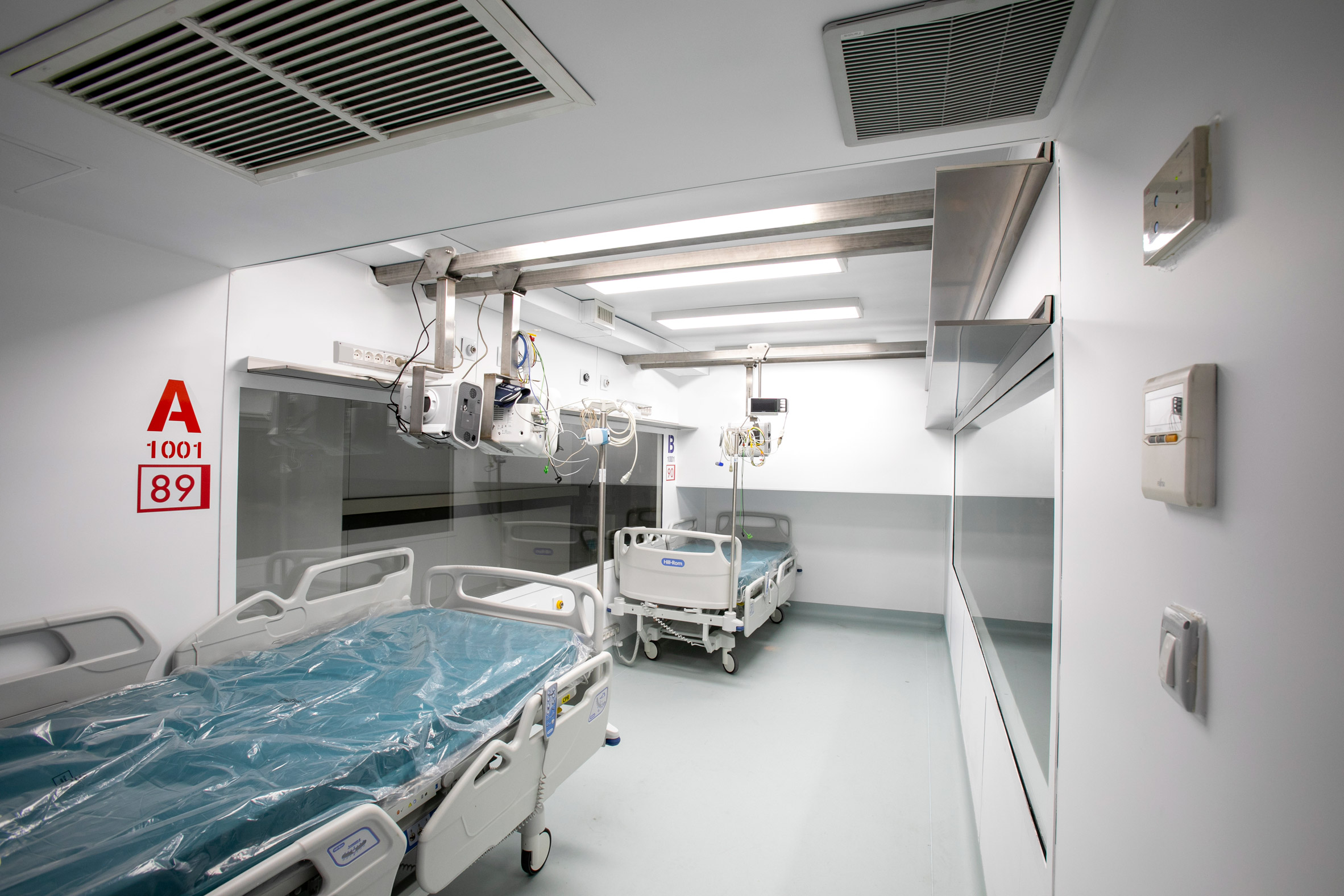
Carlo Ratti Associati's Cura project features intensive care units in shipping containers

Ratti made the comments after giving a short presentation of recent projects including Cura, a pop-up intensive care unit made of shipping containers. First unveiled in March, a prototype was installed at a hospital in Turin, Italy, last month.

Ratti claimed that Cura was a better solution than turning convention centres and other large buildings into temporary hospitals for coronavirus patients.

Ratti's intensive care unit controls air flow

Patients with infectious respiratory diseases such as coronavirus can be treated in negative-pressure environments, which prevent virus particles from escaping. However, this is hard to achieve in large, open-plan interiors.

"The way the people have been doing [temporary] intensive care units [for coronavirus patients] is mostly to take a big convention center and turn it into a makeshift hospital," Ratti said.

"However, one of the issues is that you get a lot of contamination of the air," he added. "You cannot do biocontainment. That's why we saw so many healthcare professionals who got sick. To do negative pressure you need a box."

A two-bed intensive care unit within a shipping container, designed by Italian architects Carlo Ratti and Italo Rota, has been built at a hospital in Turin and is being used to treat patients fighting the coronavirus. Named Connected Units for Respiratory Ailments – or CURA, which is the latin word for cure – the intensive care pod was installed to increase intensive care unit (ICU) capacity in northern Italy. Designed by Ratti and Rota to treat two patients requiring intensive care, the unit has been installed at a temporary hospital built within the Officine Grandi Riparazioni complex in central Turin. The first patient was admitted earlier this week on 19 April.   Connected Units for Respiratory Ailments (CURA) intensive care  shipping-container pod by Carlo Ratti and Italo Rota   Built within a 6.1-metre-long shipping container, the intensive care pod contains two beds along with ventilators, monitors, intravenous fluid stands and syringe drivers. According to Ratti the pods combine the benefits of tents with permanent isolation wards as it has a ventilation system that generates negative pressure – a common technique used in hospitals to prevent contaminated air from escaping. The designers say the unit has been designed to comply with Airborne Infection Isolation Rooms (AIIRs) standards. "CURA strives to be as fast to be mounted as a hospital tent, but as safe as a regular isolation ward to work in, thanks to the comprehensive biocontainment equipment," said the designers.   The pod  It is extractor creates indoor negative pressure to comply with the standards of Airborne Infection Isolation Rooms. Two glass windows carved on the opposite sides of the containers are meant for doctors to always get a sense of the status of patients both inside and outside the pods. Also, this would potentially allow external visitors to get closer to their relatives in a safer and more humane setting.   "CURA aims to improve the efficiency of the existing design solutions of field hospitals, producing a compact ICU pod that is quick-to-deploy and safe to work in for medical professionals." The pod in Turin is the first CURA pod to be built, but further units are already under construction in other parts of the world including the UAE and Canada. CURA has been developed as an open-source project, with its tech specs, drawings and design materials made accessible for everyone online on https://curapods.org/open-source-files.   The pods are designed to work as single units, as the one in Turin is set up, or combined to create larger field hospitals.   Photography is by Max Tomasinelli. Project credits: Design and innovation: CRA-Carlo Ratti Associati with Italo Rota Medical engineering: Humanitas Research Hospital Medical consultancy: Policlinico di Milano Master planning, design, construction and logistics support services: Jacobs Research: MIT Senseable City Lab Visual identity & graphic design: Studio FM milano Digital media: Squint/Opera Safety and certifications: IEC Engineering Logistics: Alex Neame of Team Rubicon UK MEP engineering: Ivan Pavanello of Projema Medical consultancy: Maurizio Lanfranco of Ospedale Cottolengo Medical equipment supply: Philips Painting products: Gruppo Boero Support: World Economic Forum Covid-19 Action Platform, and Cities, Infrastructure and Urban Services Platform
Shipping containers allow negative-pressure environments to be created around coronavirus patients, Ratti said

Ratti's Cura solution uses shipping containers to create individual intensive care units that can easily be sealed to create the negative pressure needed for biocontainment. The containers can then rapidly be moved to different locations according to need.

"Containers are all over the world, we can move them very quickly," said Ratti. "So we can fit them with negative pressure. They can be pre-assembled with all the medical things so we can move them from one city to another city."

Containers "ideally suited for this"

Ratti defended his decision to use containers, which have been getting a bad press recently due to their widespread use in architecture projects despite being ill-suited to many applications.

Containers are "almost like ideally suited for this," he said. "If you'd asked me last year if I would ever do a container project, I would say no. But in this case, it makes sense."

"People think this is another student project, you know, an architecture second-year architecture student project," he added. "But you know, even the most trite solution can sometimes also be the right one."

Last month Dr Sam Smith told Dezeen that hospitals "desperately need designers" to improve equipment and services. "We need designers at every turn, but they are so infrequently consulted," said Smith, a clinical physician at Massachusetts General Hospital in Boston.

"In the end, most physicians burn out early because, in part, we are lacking well designed cognitive and physical spaces to help process the information smoothly."

Universities are "too expensive"

Universities similarly need to be radically rethought, Ratti said. With campuses shut down due to the pandemic, teaching has moved online.

"This has forced a lot of people to fully embrace digital and it can even be better for giving feedback to students," the Italian architect said, adding that the traditional university campus could be replaced by smaller physical hubs for students and teachers to meet in person, with most lessons conducted digitally.

"The reason I'm saying that it's a dinosaur is that it's too expensive, especially in the United States," he said. "We cannot continue this way. We can find a better way to get maybe not a hundred per cent by 95 per cent of what an amazing Ivy League education is today, but for 10 per cent of the cost."

Universities have changed little since the first one was founded in Bologna in 1088, Ratti said. "I think there's something magic about campuses," Ratti added, saying they would never completely be replaced by digital solutions due to the importance of chance encounters that can only happen in the physical world.

"Serendipity will still need us to create these kinds of places where we can come up with new ideas that we're not looking for," he said. "But maybe not all the students and all the professors need to be in Cambridge [where MIT is based] all the same time."

"Maybe we'll be able to share knowledge in a different way."

The post Carlo Ratti calls for redesign of "dinosaur" hospitals and universities for the post-coronavirus era appeared first on Dezeen.


from Dezeen https://ift.tt/3cmvJFN