Wednesday, 13 May 2020

Zaha Hadid Architects reveals interiors of ME Dubai hotel at the Opus

ME Dubai hotel at the Opus by ZHA

The newly opened ME Dubai hotel at the Opus by Zaha Hadid Architects features furniture by Zaha Hadid Design and curving sculptural balconies.
ME Dubai hotel at the Opus by ZHA

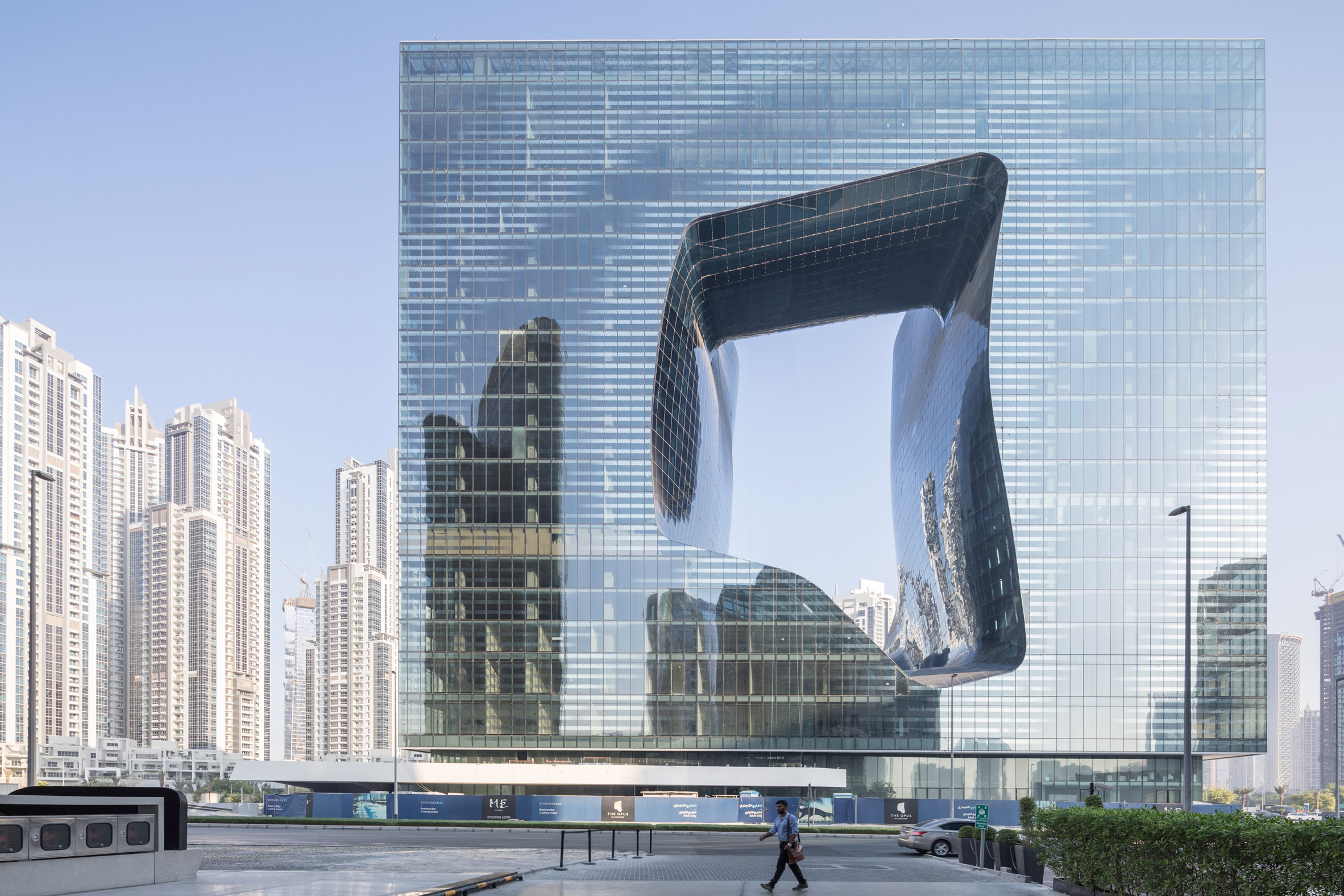
Set in Dubai's Burj Khalifa district, the Opus is a mirrored glass building occupied by a hotel, offices, serviced apartments and several restaurants.

Completed externally last year, the ME Dubai at the Opus is the only hotel in the world that can claim to have had both its exterior and interiors designed by the late Zaha Hadid.
ME Dubai hotel at the Opus by ZHA

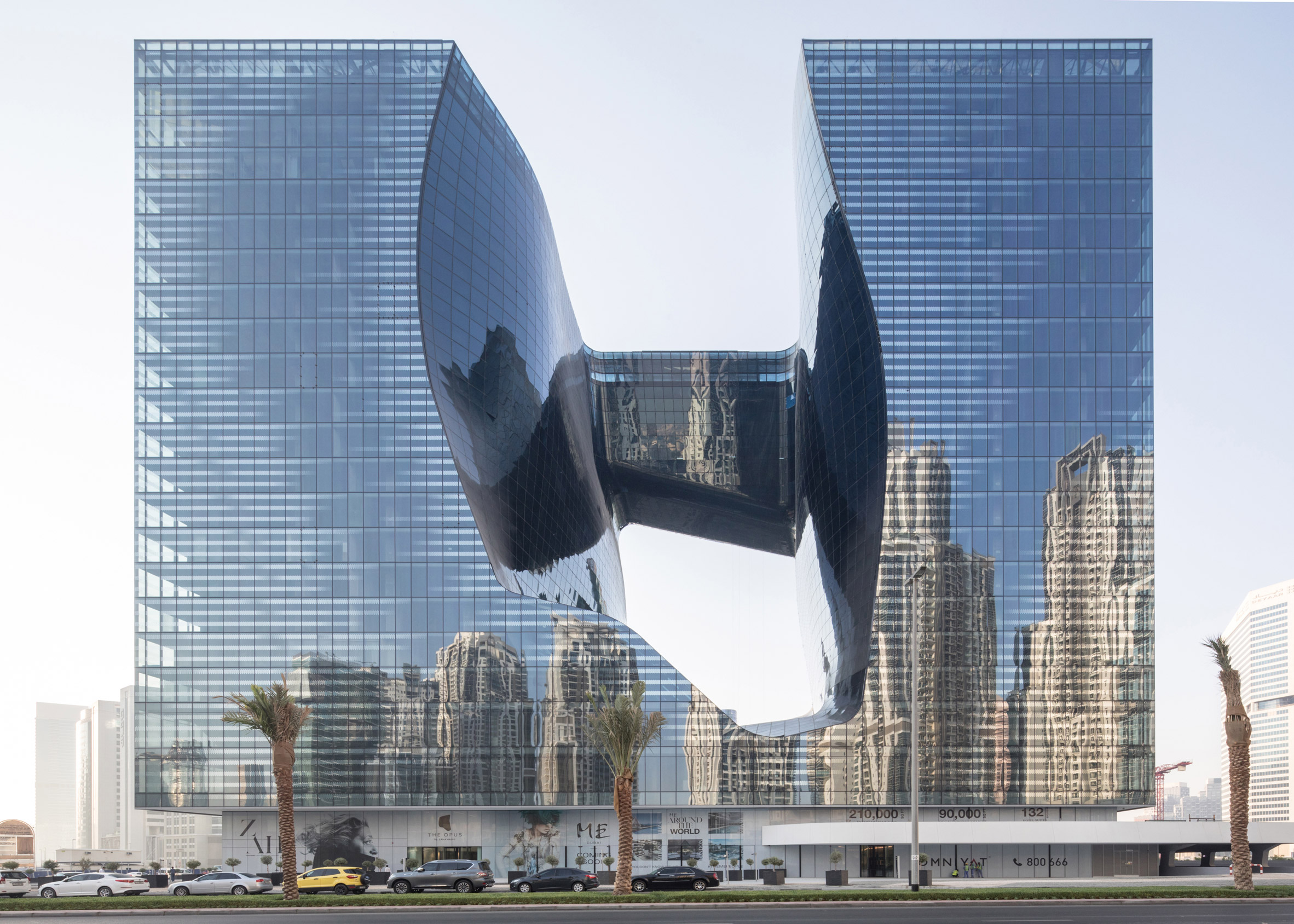
Externally the building appears to be a giant cube with an amorphous hole pushing through its centre, although it is in fact a pair of towers connected at the top and bottom to create the void effect.

"The precise orthogonal geometries of the Opus' elemental glass cube contrast dramatically with the fluidity of the eight-storey void at its centre," explained Zaha Hadid Architects (ZHA) project director Christos Passas.
ME Dubai hotel at the Opus by ZHA

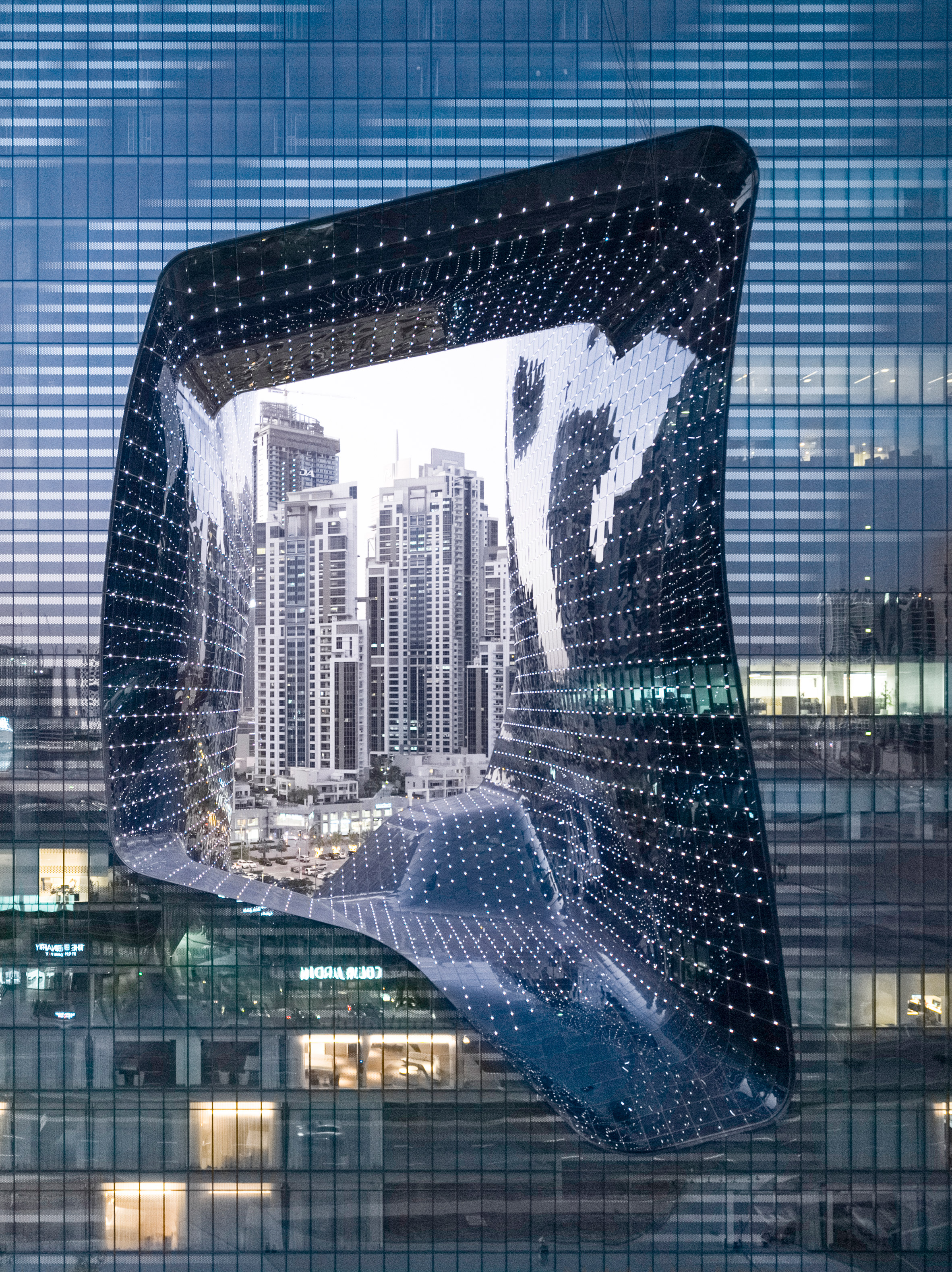
A four-storey atrium sits at the base of the two towers. Above the gap, a three-storey bridge starts 71 metres from the ground.

The inside of the void is lit up at night by a constellation of lights, each individually controllable, set into the undulating glass.
ME Dubai hotel at the Opus by ZHA

The ME Dubai hotel, which opened in March 2020, has 74 bedrooms and 19 suites.

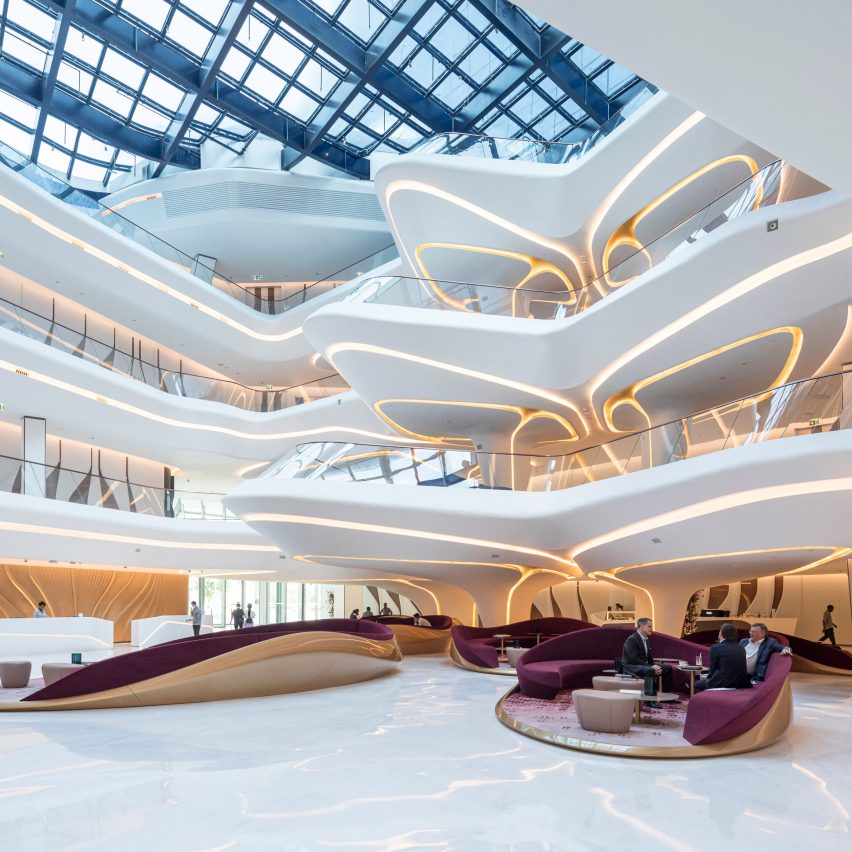
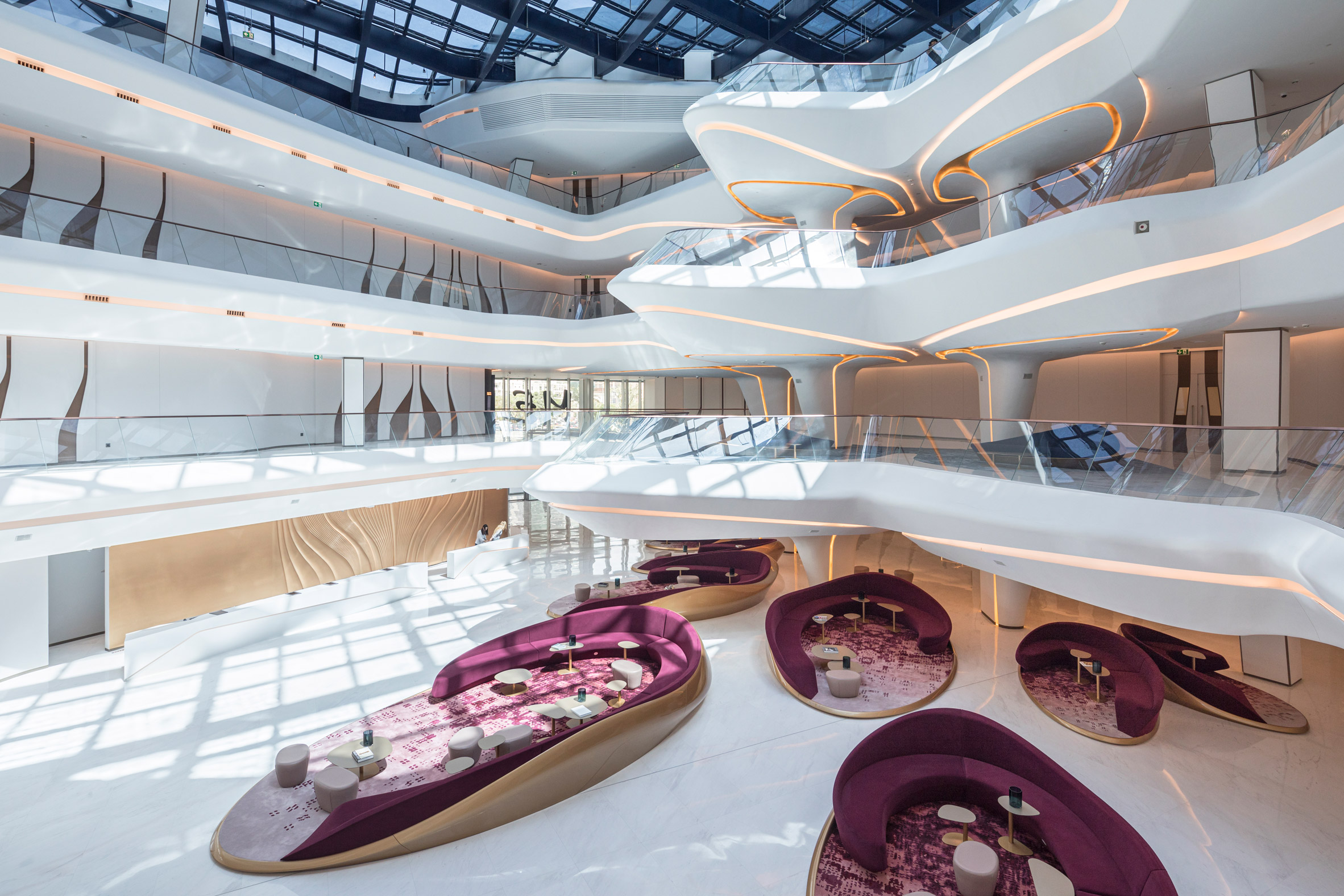
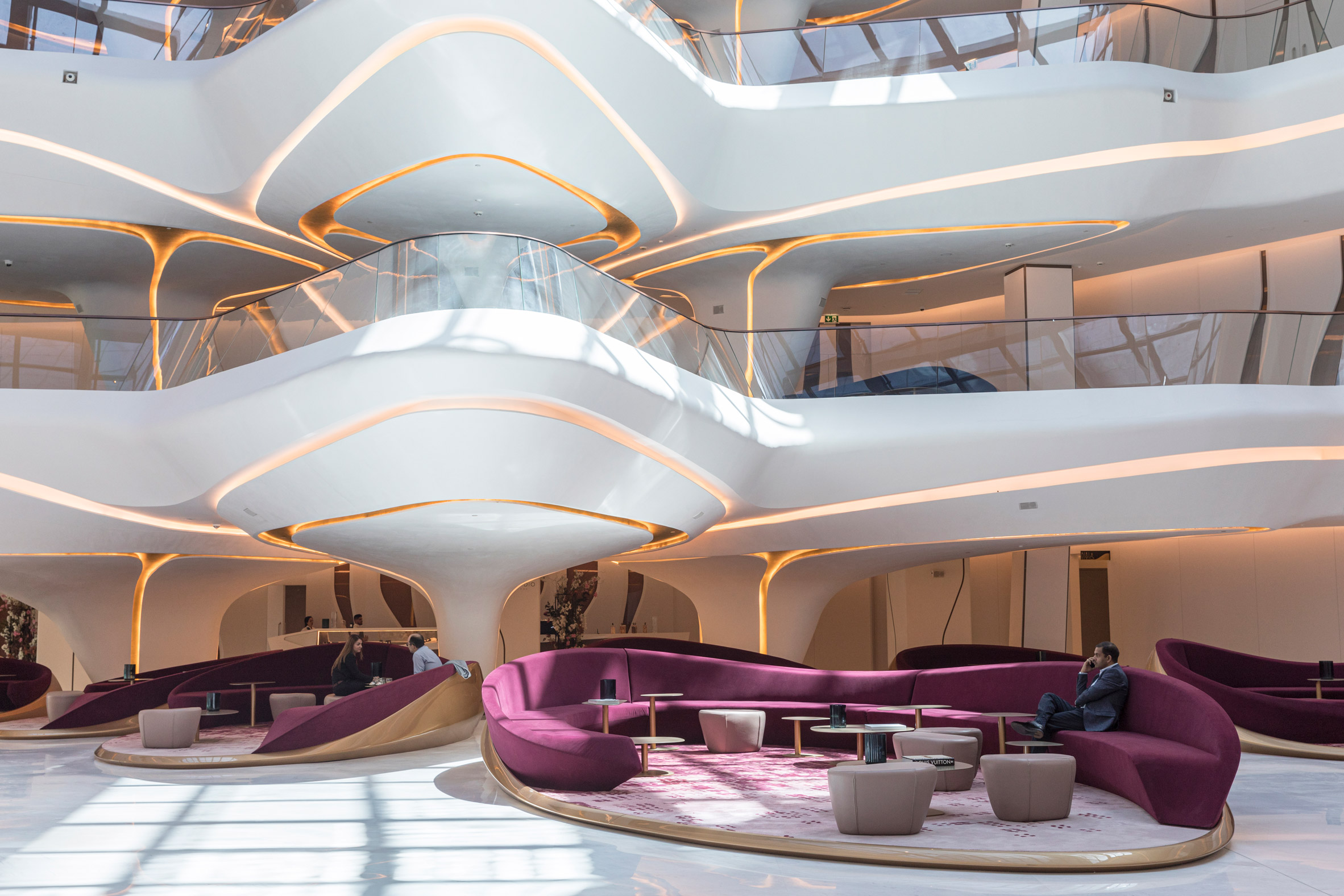
Its lobby sits directly under the Opus' signature void, which forms its glass ceiling. Three stories of galleries with projecting balconies ring the perimeter of the space.
ME Dubai hotel at the Opus by ZHA

Gleaming white marble floors are highlighted by the golden edges of plush curved seating areas, upholstered in a rich burgundy.

Called Ottomans, these seating pods are by Zaha Hadid Design, the design wing of ZHA.
ME Dubai hotel at the Opus by ZHA

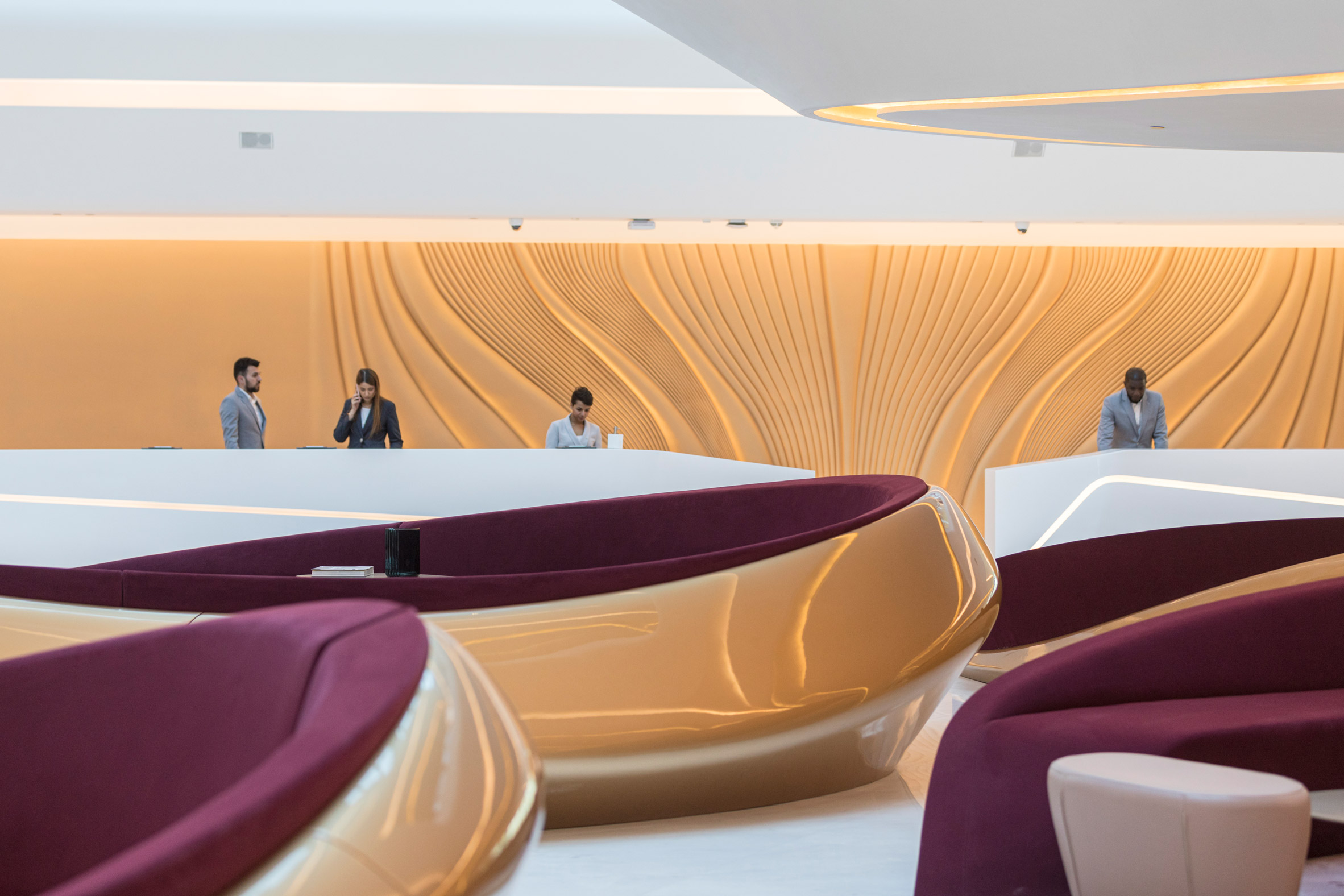
A golden wall curves behind the white hotel reception desks, which are angled and lit by strips of lighting that match the balconies above.

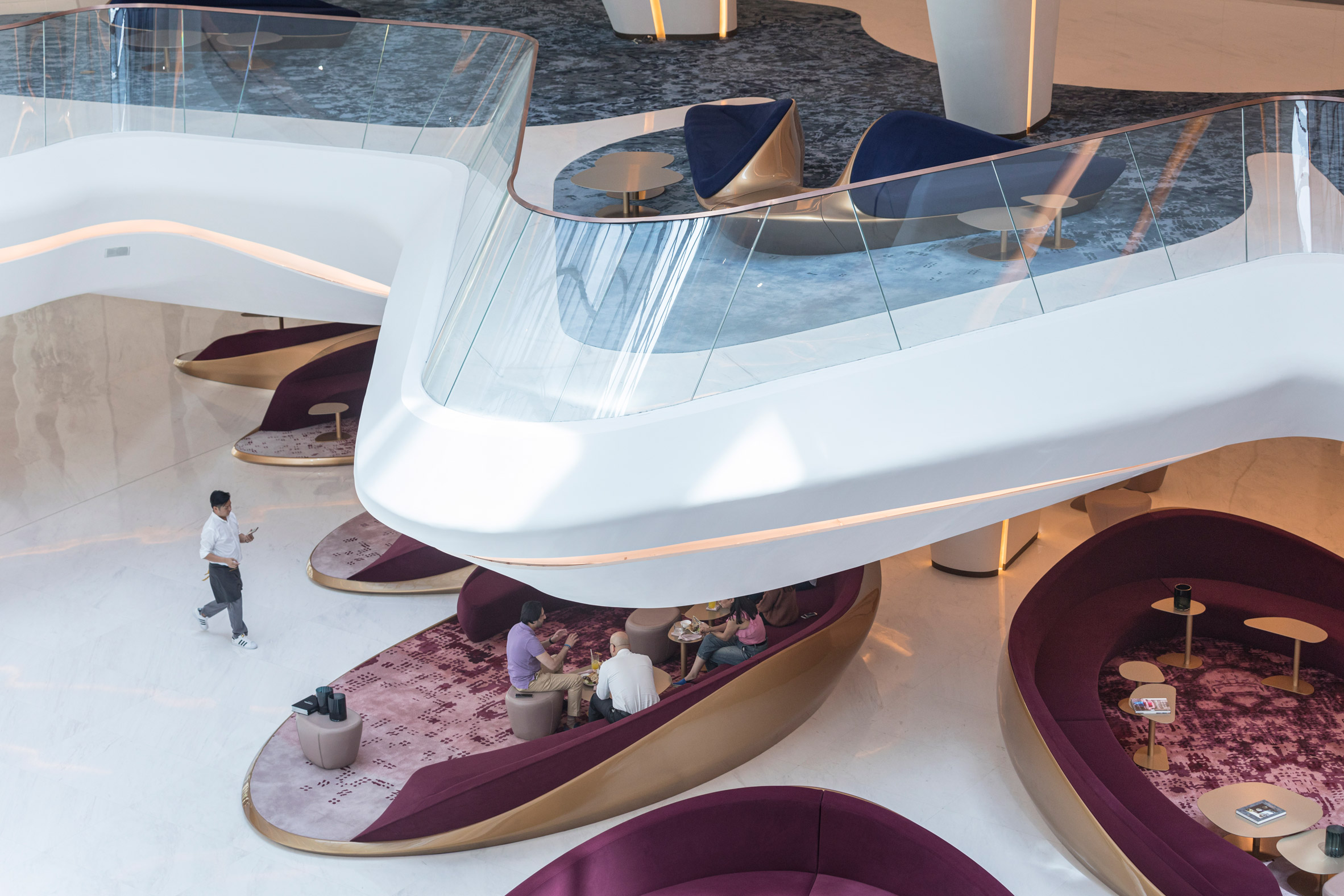
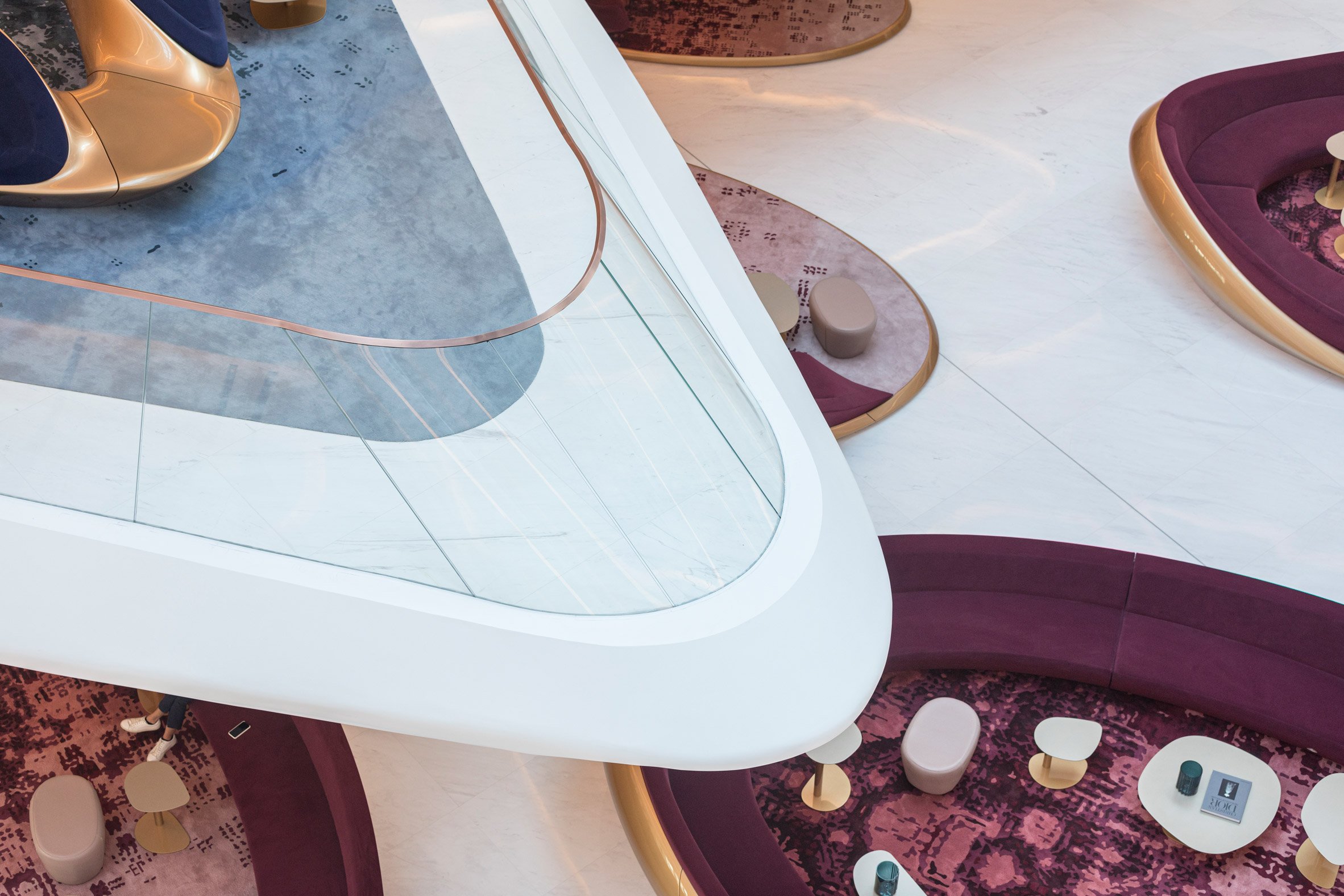
Slim golden edges top the glass balustrades of the balconies, which are set at an angle tilting back from the undulating edges.
ME Dubai hotel at the Opus by ZHA

Benches on the balconies, with deep navy cushions set in curving golden frames, are from Zaha Hadid Design's Petalinas collection.

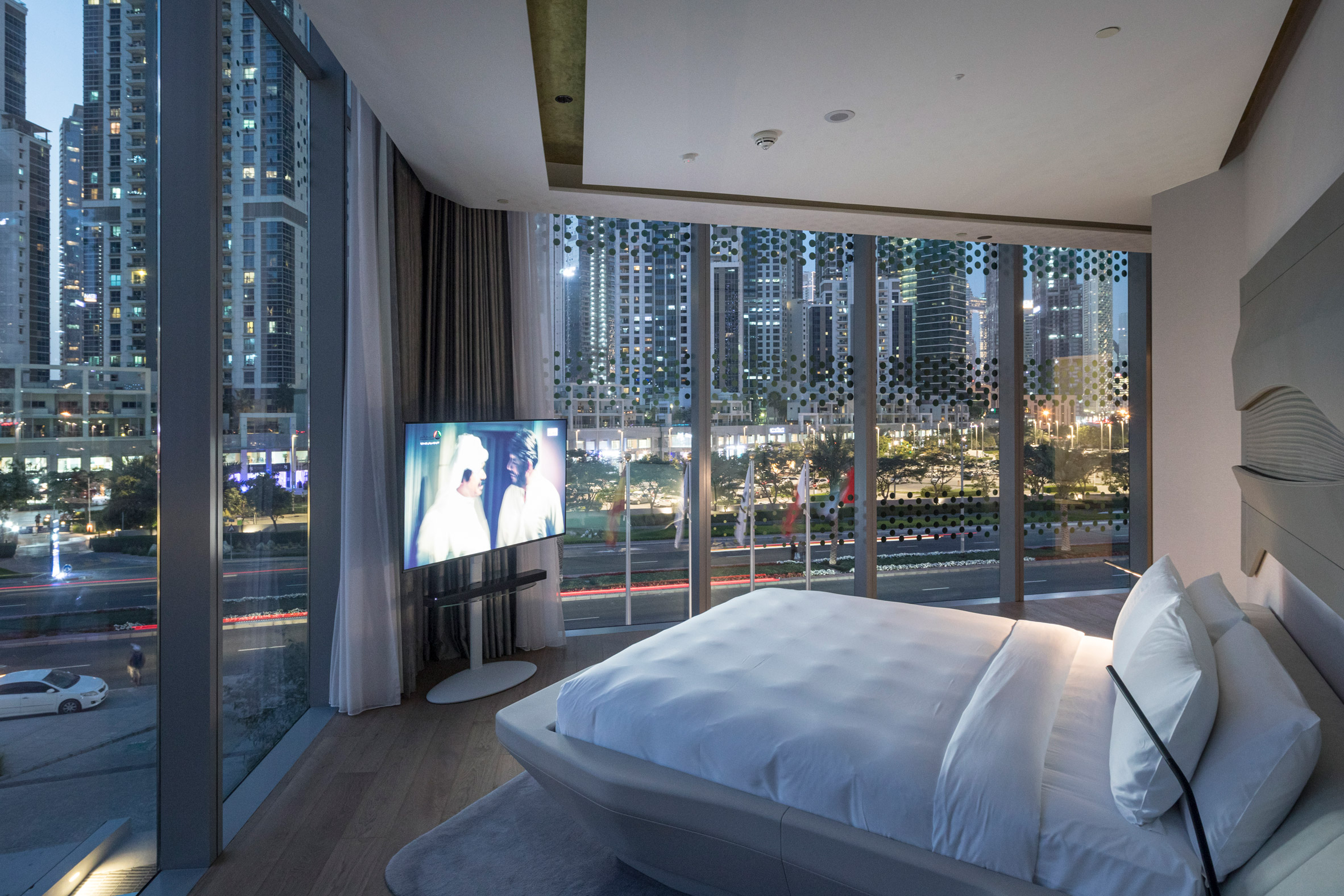
Each hotel bedroom features a Zaha Hadid-designed bed, with a mattress that sits on a sculptural frame projecting from the wall.
ME Dubai hotel at the Opus by ZHA

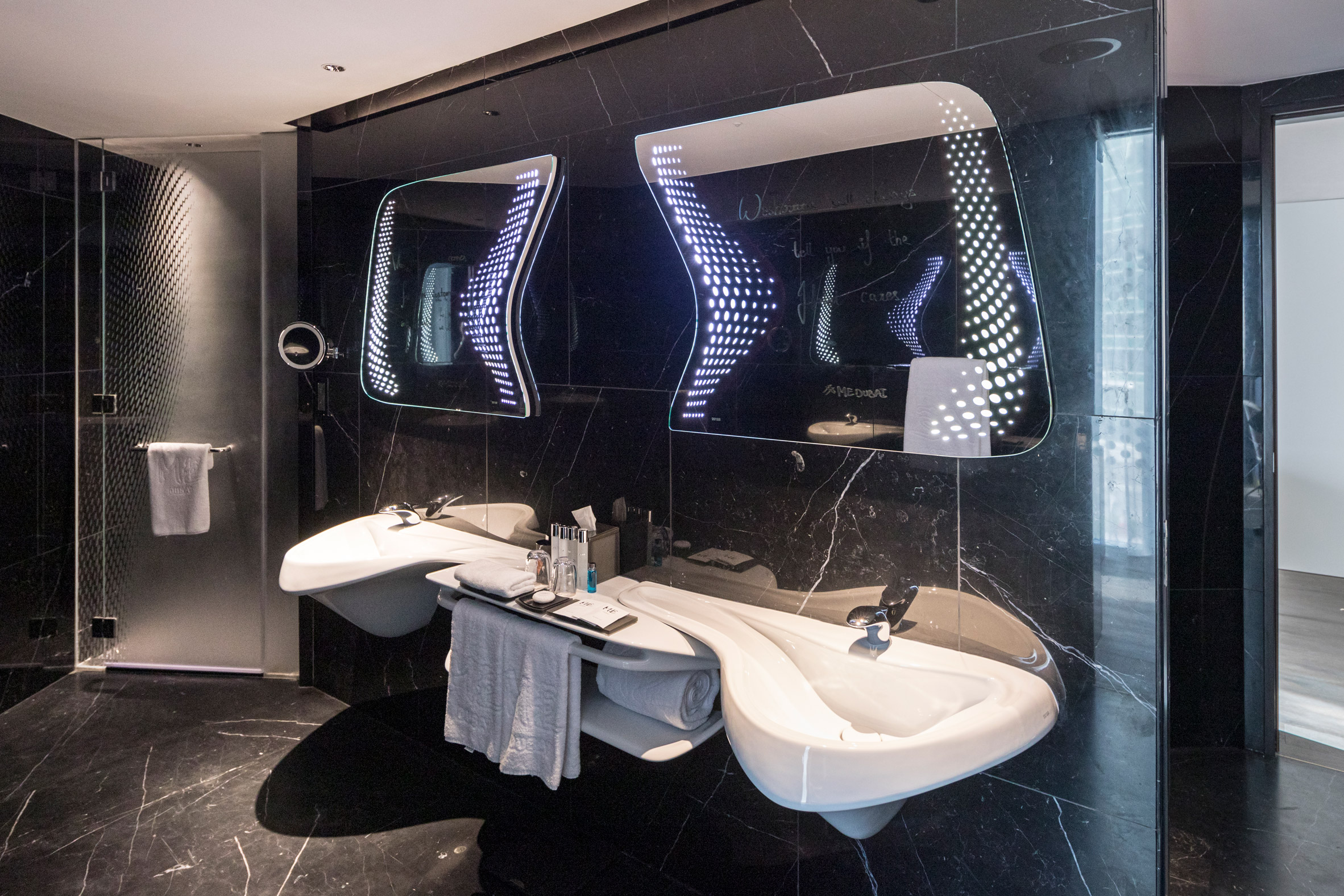
In the bathroom, the sinks and showers come from Zaha Hadid's 2015 Vitae collection for Noken Porcelanosa.

Above some of the double sinks hang twin mirrors with curves that seem to match the Opus' central void.
ME Dubai hotel at the Opus by ZHA

As part of a drive for sustainability, the ME Dubai hotel makes every room plastic bottle-free, issuing every guest with their own stainless steel water bottle. Water dispensers are located all around the hotel.

In the dining areas there are no buffets, to cut down on food waste, and onsite composters digest organic waste.
ME Dubai hotel at the Opus by ZHA

Designs for the Opus were first unveiled in 2007 by Hadid, who died in 2016. It was originally due to complete in 2018, but was pushed back due to construction delays.

A recent video from the practice revealed an exhibition centre currently under construction on Unicorn Island in Chengdu, China.

Photography is by Laurian Ghinitoiu.


Project credits:

Architect: Zaha Hadid Architects
Design: Zaha Hadid, Patrik Schumacher, Christos Passas
ZHA design director: Christos Passas
Competition team: Christos Passas (Lead Designer), Paul Peyrer-Heimstaett, Alvin Huang, Daniel Baerlecken, Gemma Douglas, Saleem Al-Jalil
Design team (shell and core): Vincent Nowak (Project Architect), Dimitris Akritopoulos, Javier Ernesto-Lebie, Paul Peyrer-Heimstaett, Sylvia Georgiadou, Phivos Skroumbelos, Marilena Sophocleous, Chiara Ferrari, Thomas Frings, Jesus Garate, Wenyuan Peng
Base built supervision team: Fabian Hecker (Team Leader), Barbara Bochnak (Team Leader), Tomasz Starczewski, Kwanphil Cho, Bruno Pereira, Dimitris Kolonis
Hotel and apartment interior design team 1: Reza Esmaeeli, Bozana Komljenovic (Project Leads), Laura Micalizzi, Emily Rohrer (Senior Interior Designers), Veronika Ilinskaya, Eider Fernandez Eibar, Stella Nikolakaki, Bruno Pereira, Raul Forsoni, Thomas Frings, Chrysi Fradellou, Spyridon Kaprinis, Alexandra Fischer, Hendrik Rupp, Vivian Pashiali, Sofia Papageorgiou, Carlos Luna, Christos Sazos, Kwanphil Cho, Andri Shalou, Ben Kikkawa, Melhem Sfeir, Faten el Meri, Eleni Mente (Landscape Designer)
Hotel and apartment interior design team 2: Alessio Constantino (Project Lead), Sonia Renehan (Senior Interior Designer), Afsoon Es Haghi, Zsuzsanna Barat, Ekaterina Smirnova, Chafic Zerrouki, Nessma Al Ghoussein, Christina Christodoulidou
Bespoke Furniture Team: Maha Kutay (Project Director), Margarita Valova, Reza Esmaeeli, Raul Forsoni, Bruno Pereira, Carine Posner, Filipa Gomes
Project management: Gleeds [London], Omniyat [Dubai]
Local architects: Arex Consultants [Dubai], BSBG [Dubai]
Structural engineers: Whitbybird [London], BG&E [Dubai]
MEP engineers: Clarke Samadin [Dubai]
Facade engineers: Whitbybird [London], Agnes Koltay Facades [Dubai]
Lift consultants: Adam Scott, Roger Preston Dynamics [London], Lerch Bates [Dubai] Fire Engineering: Safe [London], Design Confidence [Dubai]
Acoustic consultants: PMK [Dubai]
Traffic consultants: Cansult Limited [Dubai], Al Tourath [Dubai]
Lighting consultants: Tim Downey, Isometrix [London], DPA [Dubai], Illuminate [Dubai] Interior Consultants: HBA [Dubai]
Security consultants: Control Risks [Dubai]
Kitchen consultants: MCTS [Dubai], AV Consultants EntireTech [Dubai]
QS consultants: HQS [Dubai]
Facade contractors: Brookfield Multiplex [London], Alu-Nasa [Dubai]
Hotel operator: Melia Hotels

The post Zaha Hadid Architects reveals interiors of ME Dubai hotel at the Opus appeared first on Dezeen.


from Dezeen https://ift.tt/2WVPgGk

Wolff Olins rebrands Understood, with shape-shifting logo and dyslexic-friendly typeface

Accessibility and inclusivity were essential to the new identity for an important organisation that supports people with disabilities and learning or thinking differences across the US.


from It's Nice That https://ift.tt/3fK5GdK

A feast of creative projects, Palette is the essential designer’s guide to colour

Choosing colours is an essential part of any designer’s creative process. Palette, a recent re-release of a viction:ary classic, gathers essential references and categorises them by hue.


from It's Nice That https://ift.tt/3dMXtDP

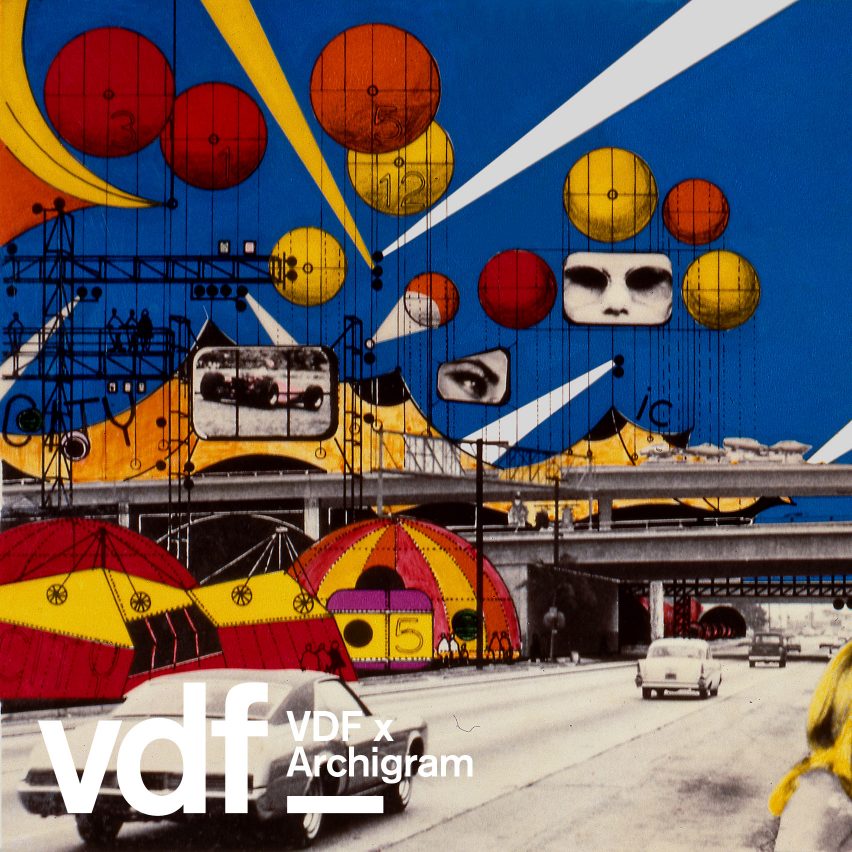
Archigram's Instant City concept enables "a village to become a kind of city for a week" says Peter Cook

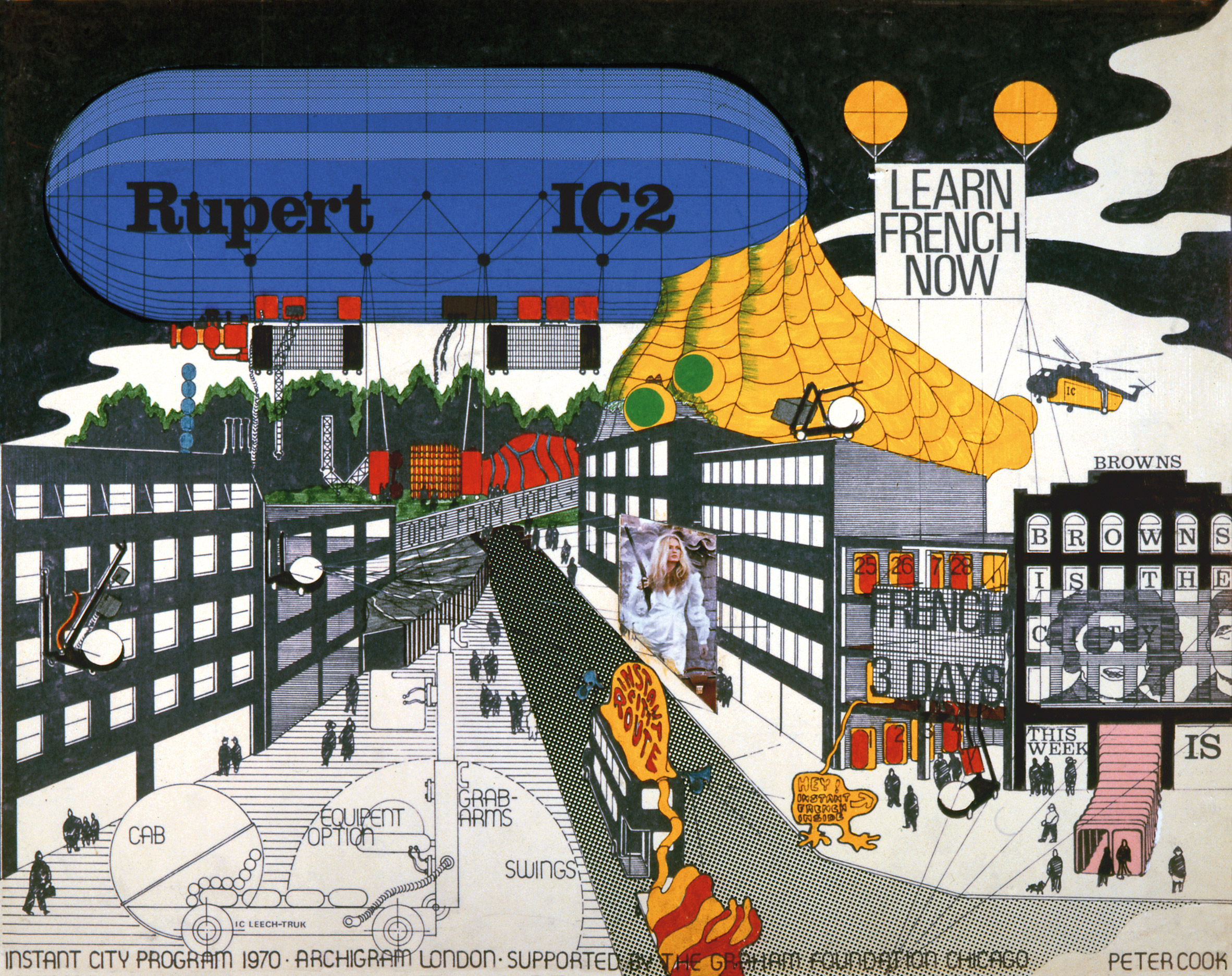
Instant City by Archigram

Architect Peter Cook explains Archigram's concept for a temporary city that can be set up overnight in the third instalment of our exclusive video series with the radical architecture group for VDF.

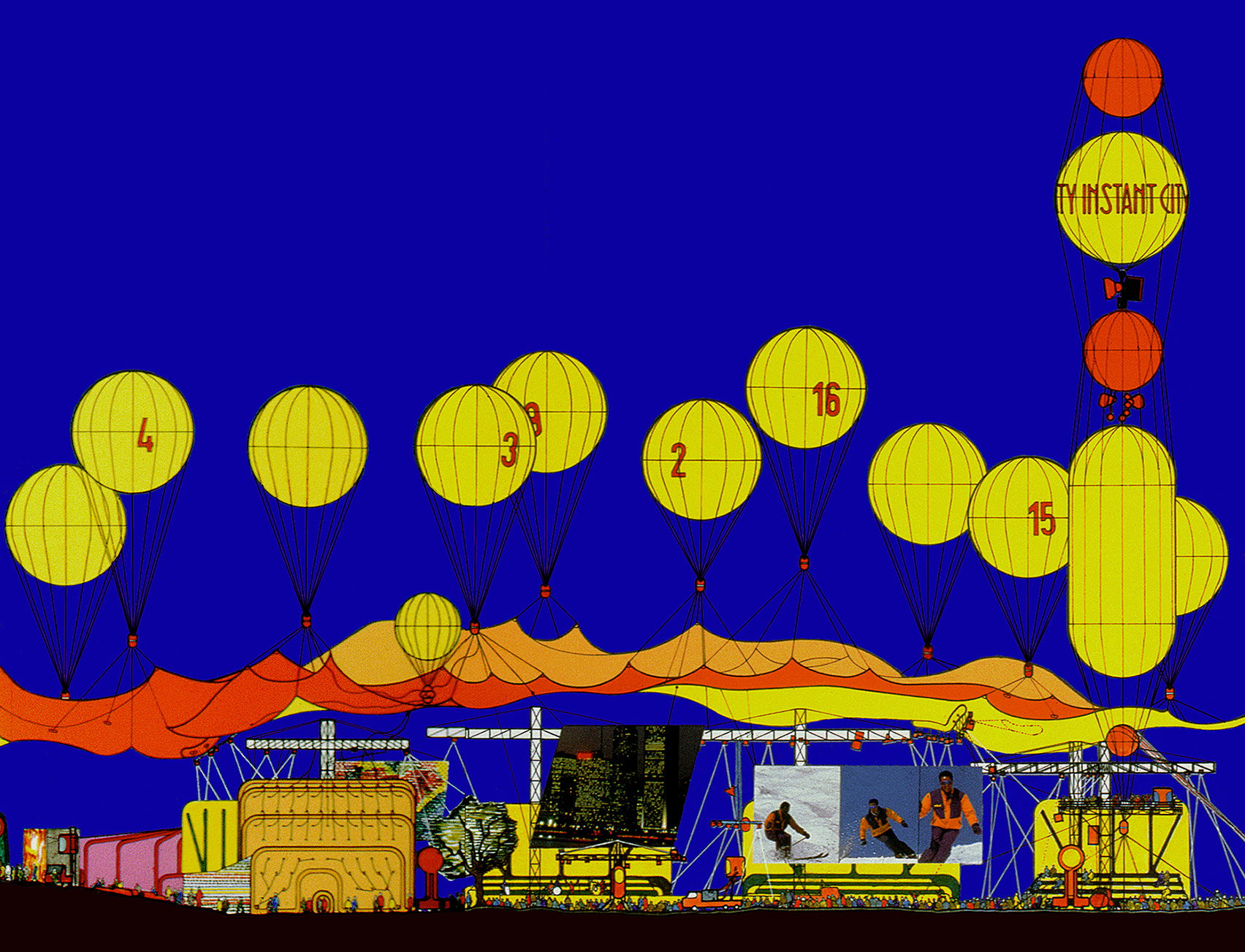
Developed in the late 1960s and early 1970s, Archigram's Instant City concept is a transportable kit of parts that can be quickly assembled to provide the inhabitants of small towns with access to the resources and cultural attractions of a large metropolis.

Instant City by Archigram
Archigram's Instant City concept aimed to provide small towns with access to the cultural attractions of a big city

"Instant City was, in very raw terms, like a cultural circus," Cook said in the video, which Dezeen filmed in London and is sponsored by Enscape.

"It takes the cultural essence of a metropolitan city and takes them around like a circus, so that a small town or a village could become a kind of city for a week."

Instant City inspired by the architecture of outdoor pop concerts

According to Cook, the concept developed from Archigram's own experience of giving lectures with a packable set of presentation materials and props.

"Instant City was really based on our own Archigram experience, because we'd started giving lectures, packaging the Archigram ideas and going round with lots of projectors," he explained.

"There was an intermediary project called Ideas Circus, which was much more specific, which was actually a set of teaching devices put on trucks with the odd inflatable."

"It was that, allied to the period of open-air pop concerts – I think that was all in the air at the same time," he added.

Instant City by Archigram
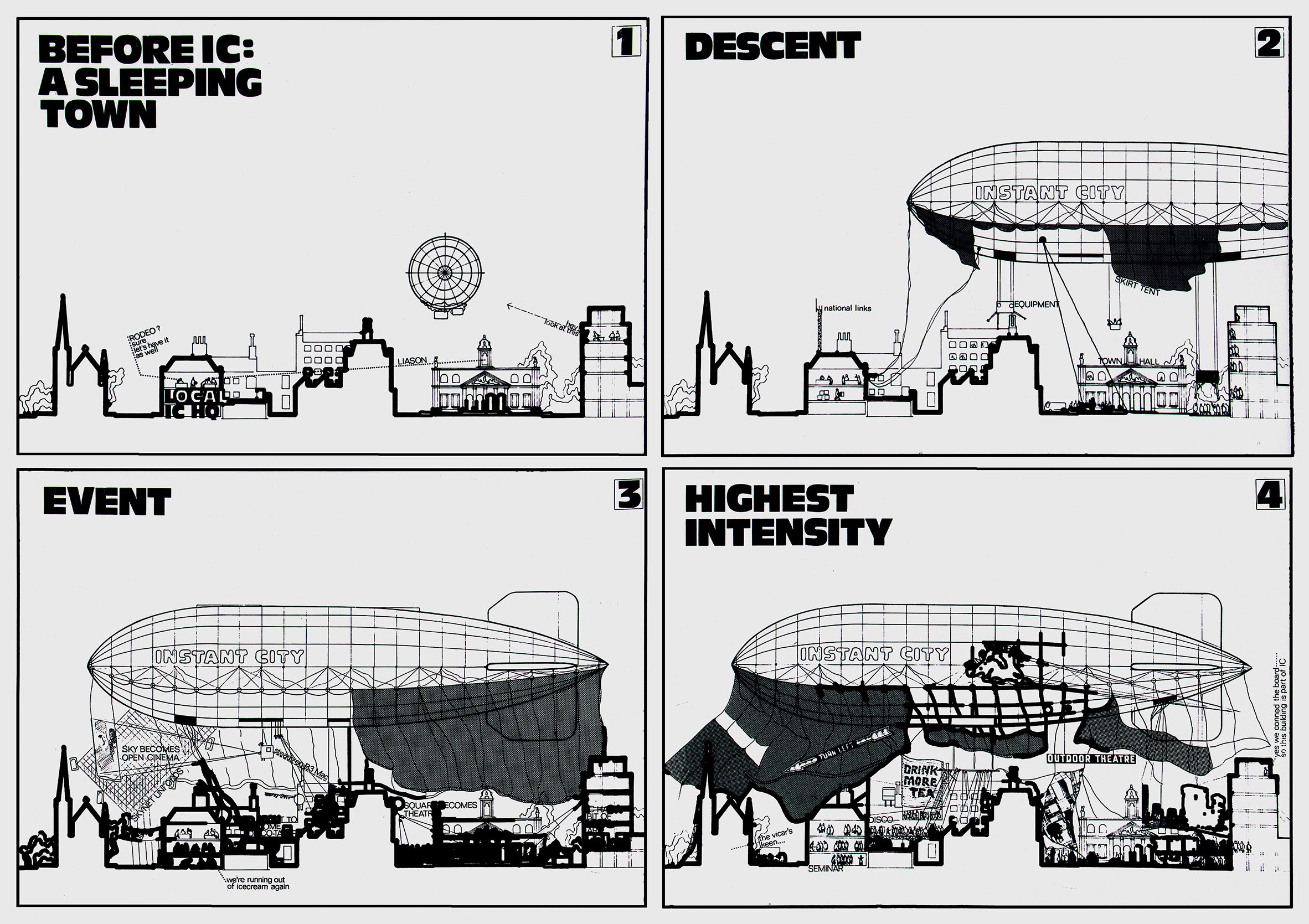
Many Instant City designs envisioned that the components would be delivered by airship

Like Plug-In City, another of Archigram's metropolitan concepts, which Cook and fellow Archgram member Dennis Crompton discussed in the previous video in the series, there were a number of different versions of Instant City.

Initially, the concept comprised a packable kit of parts that could be transported by road, but later versions introduced lighter elements that could be delivered by air.

"We started to speculate, instead of a city trundling around on trucks, maybe it could all hang off an airship and it would just silently come in the night and you'd open the bedroom curtains and there was the city in the field behind you," said Cook.

"And then, a week later, it would have carried on. It's kind of analogous to the contemporary thought that everybody could be famous for five minutes, the Marshall McLuhan thing."

Instant City by Archigram
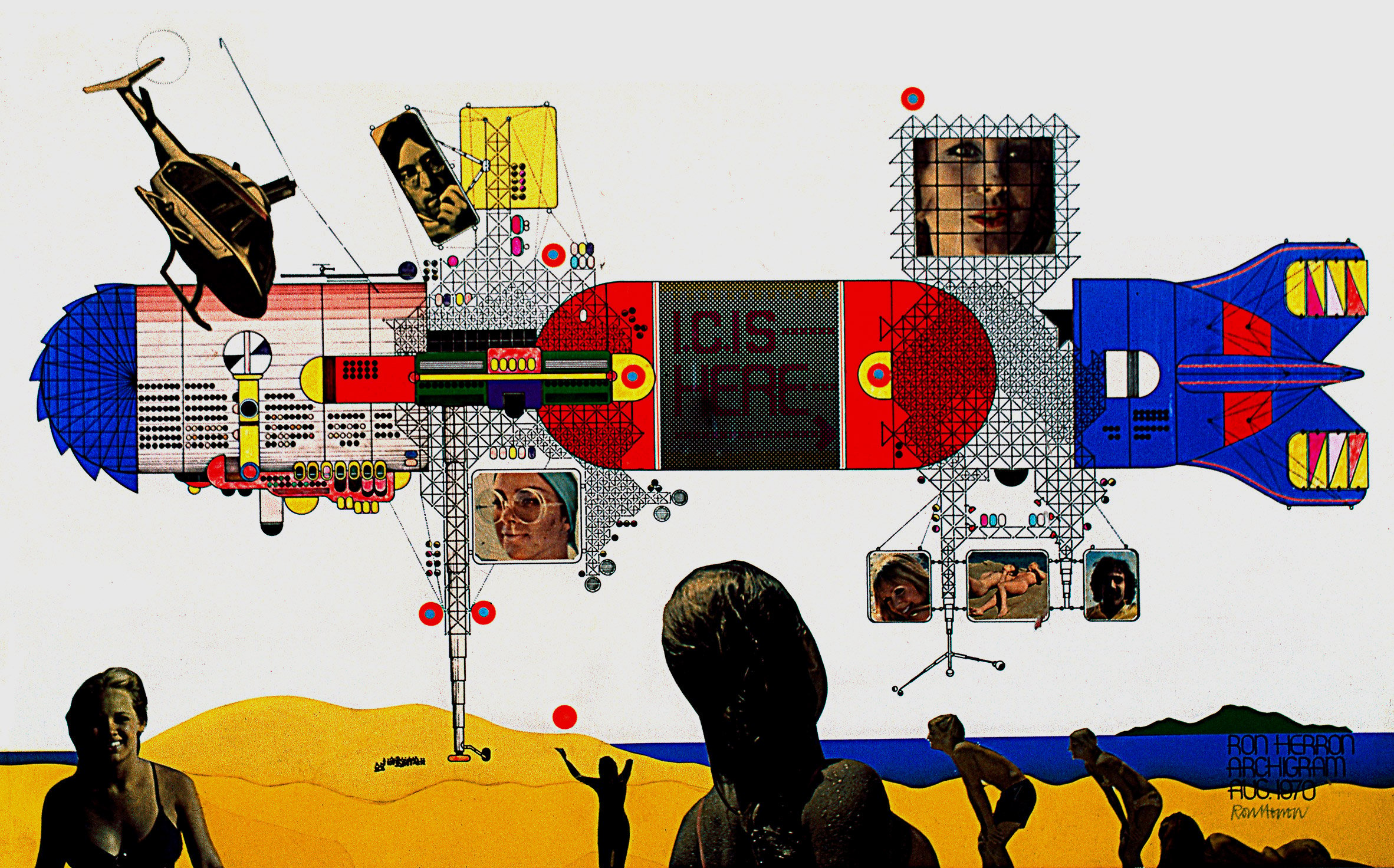
Ron Herron's version of the Instant City was envisioned for California, where he was working at the time

Archigram was a collective of six architects – Cook, Crompton, Michael Webb, David Greene, Warren Chalk and Ron Herron. Different Archigram members had different takes on the Instant City concept.

"There were various different versions of the Instant City – there was my version and there was Ron Herron's version," explained Cook.

"Funnily enough, we were both working on them in Los Angeles, but mine were still bedded in England and his was located in Los Angeles. There were only minor variants on an agreed set of parts."

Instant City by Archigram
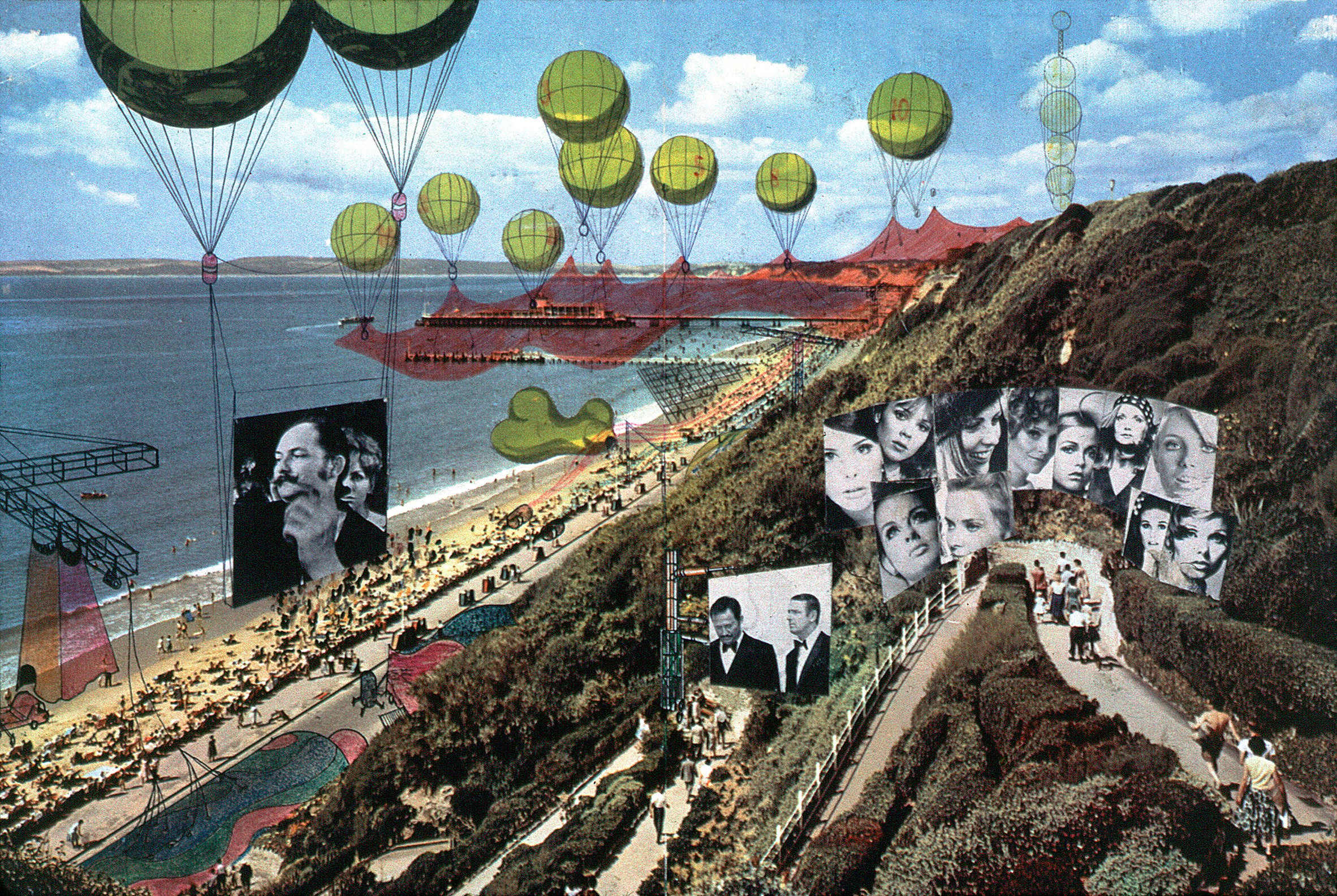
Peter Cook's version of the Instant City was imagined for towns in England

The group also started to extend the Instant City concept as a series of parasitic elements that could enhance existing buildings and structures, which Cook said could have been explored more thoroughly.

"There are odd drawings, such as what happens if an Instant City off an airship drops into a town, so that you then have a series of parasite elements that are actually attached to the town itself," he said.

"You infiltrate WH Smith or the top of a bus. You don't just leave it in a field, nice and separate. I mean there is a whole territory there that one could have moved into, which is a mixture between an organised, contrived set of parts and a sort of agitprop effect on a town."

"I've never pursued that, but there's a whole territory there that I think can send messages to the current generation."

Instant City by Archigram
Archigram's Instant City concept explored ideas about temporary parasite architecture

Founded in 1961, Archigram was an avant-garde collective of architects that became famous in the 1960s and 1970s for its radical architecture concepts.

As part of Virtual Design Festival, Dezeen is publishing a series of exclusive interviews with former Archigram members Cook and Crompton.

In the first instalment of the series, Cook explained the origins of the group and how it rose to prominence through a series of self-published magazines. In the second video, Cook and Crompton discussed its Plug-In City concept for an elevated city of capsule homes.

This video was filmed by Dezeen in London and sponsored by Enscape, a virtual reality and real-time rendering plugin for architectural design programme Autodesk Revit.

All images are courtesy of and copyright of Archigram. You can browse more images from Archigram's archive online at The Archigram Archival Project.

The post Archigram's Instant City concept enables "a village to become a kind of city for a week" says Peter Cook appeared first on Dezeen.


from Dezeen https://ift.tt/2LlAtj3

"Incredible things are happening" in virtual reality say architects in lockdown

Virtual Reality art gallery by Space Popular

Architects are turning to virtual worlds for both working and socialising during the coronavirus pandemic, with everything from site visits to social events happening in cyberspace.

"Incredible things are happening," said Lara Lesmes of Space Popular, an architecture studio that has pioneered the use of virtual reality in its projects.

"We spend a lot of time in VR," said the London studio's Fredrik Hellberg. "I think we probably both met more new people during the lockdown than we normally would."

"Normally, it'd be really difficult to get people to find a time when everyone can meet up but a lot of people have time to do meet ups in VR."

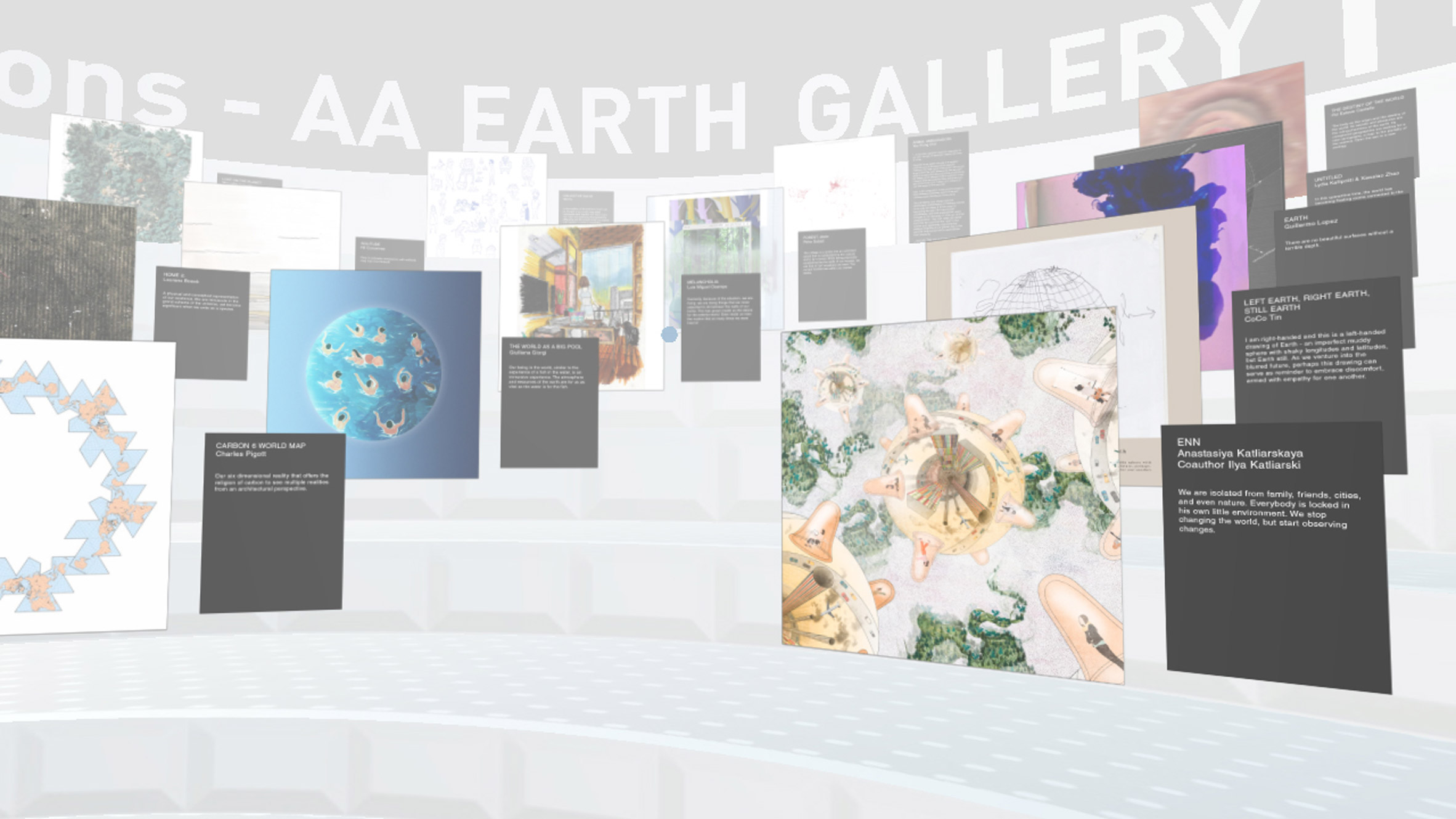
VR art gallery designed for AA

In the last few days, Space Popular has launched a series of VR environments including the AA Earth Gallery, a virtual showcase created for the Architectural Association school, and SquAAre, a virtual gathering place for unit meetings and socialising.

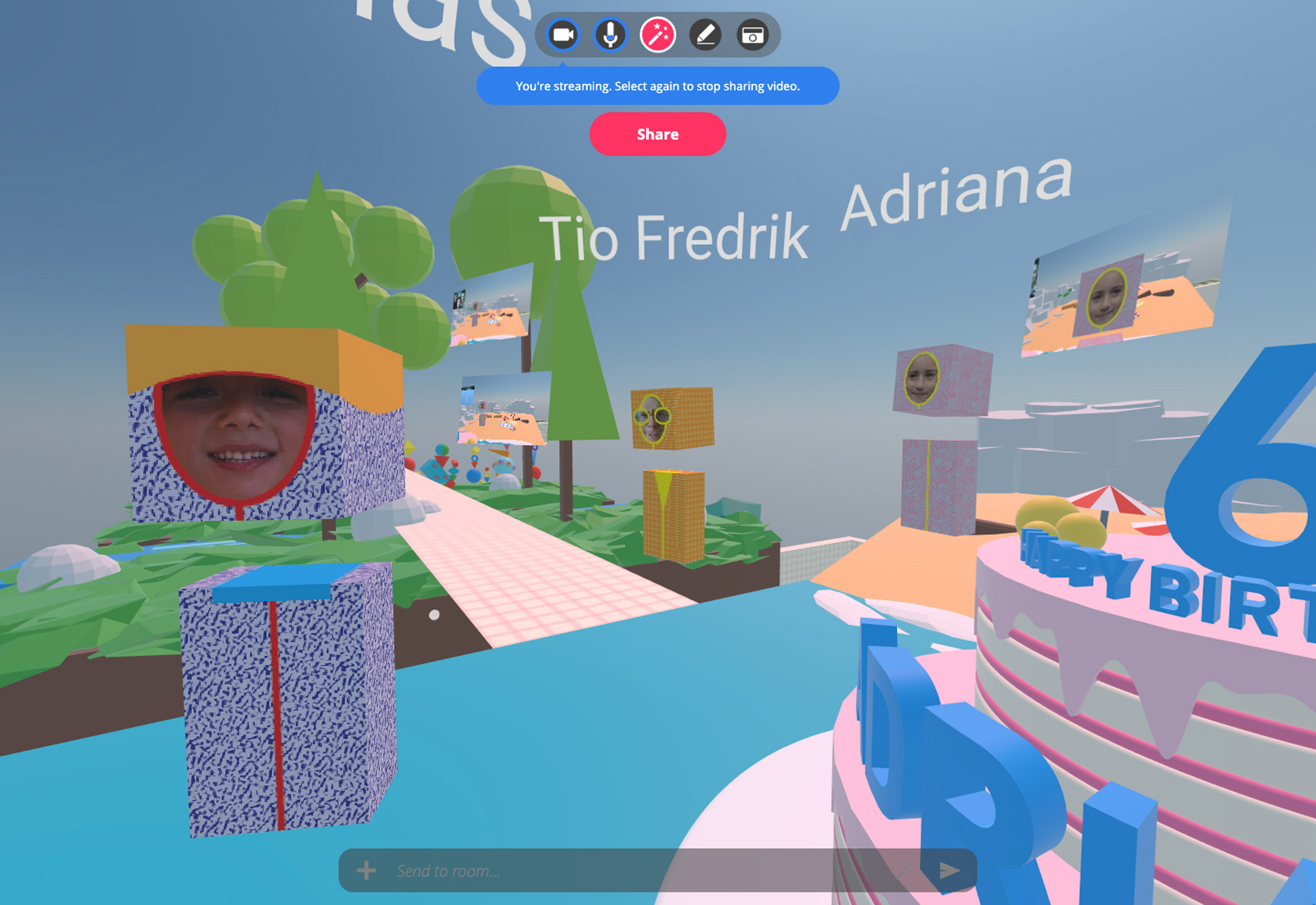
They have also launched El Laberinto de Pikachu y Badtz-Maru, a simple labyrinth for children to explore, as well as a private world created as a gift for Lesmes' young niece who celebrated her birthday under lockdown in Spain.

Virtual Reality art gallery by Space Popular
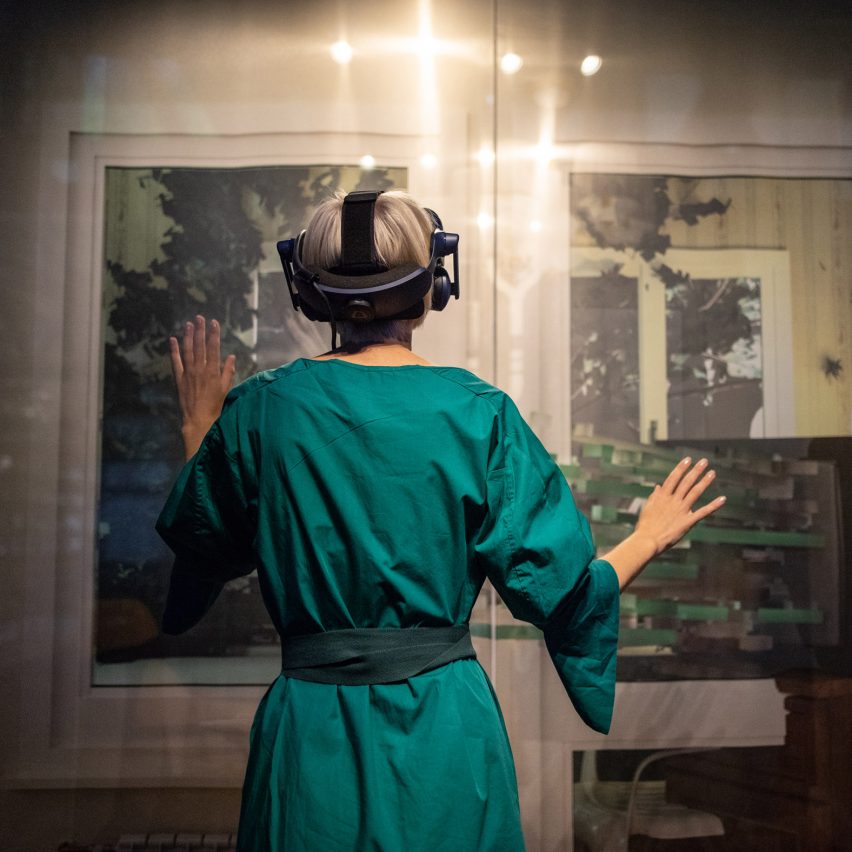
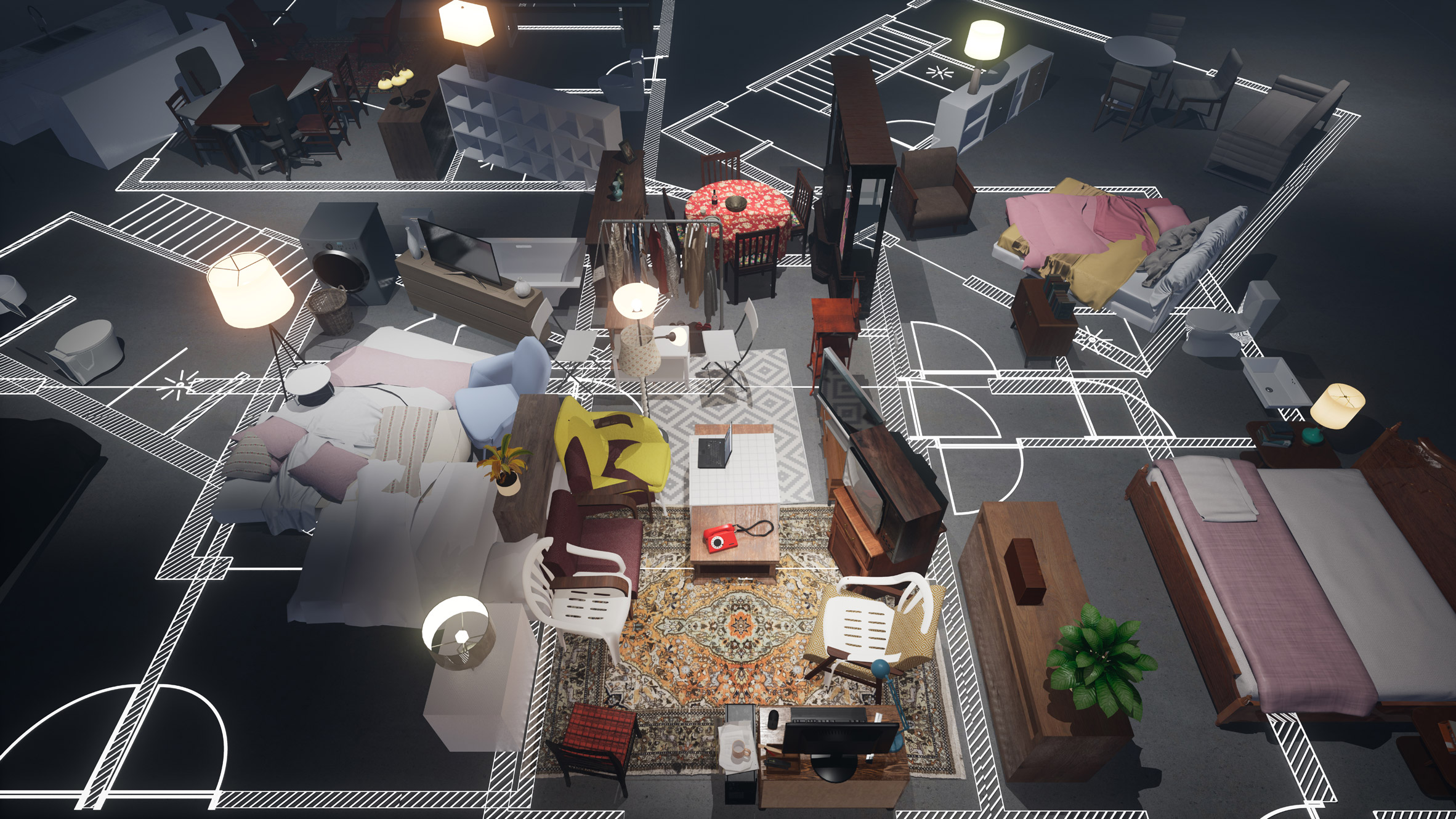
Top and above: Space Popular's The Venn Room images how two separate living spaces could overlap in VR. Top photo is by Evert Palmets

All these environments have been created inMozilla Hubs, one of the simplest VR environments and one that can be visited without a VR headset.

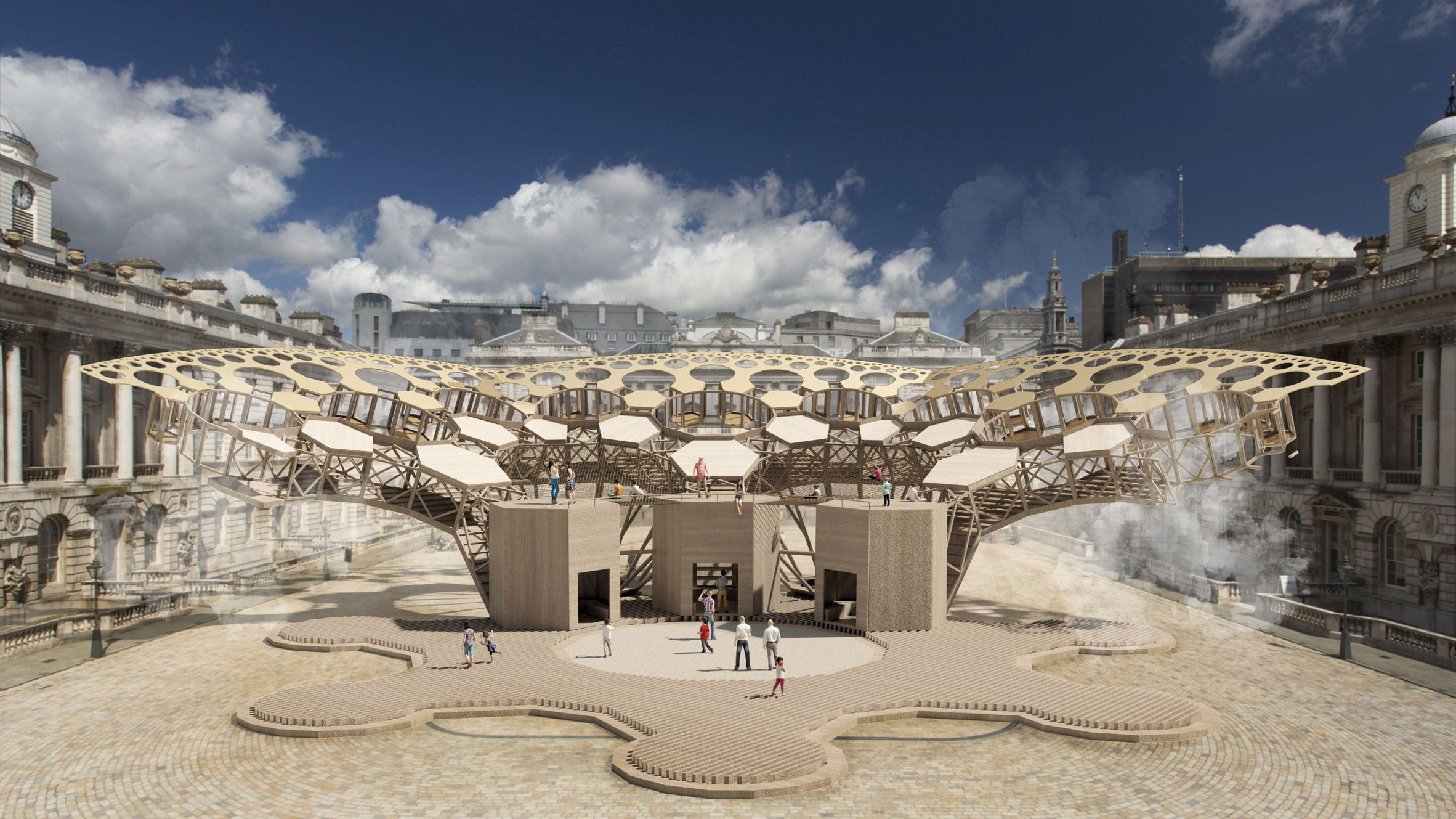
More complex VR projects created by the duo include The Venn Room, an installation that explores how virtual reality could create hybrid living spaces where people's lives intersect through the technology.

"VR offers really different kinds of experiences"

Besides work projects, Lesmes and Hellberg spend a lot of time in "social VR" environments.

"It's basically like social media but you wear a headset and you have an avatar and you're in the world together with other actual real human beings," said Hellberg.

"It's like a multiplayer game but it's purely for socializing," said Lesmes. "There is no aim. There is no mission other than being together."

Virtual Reality art gallery by Space Popular
Space Popular's El Laberinto de Pikachu y Badtz-Maru is a labyrinth for children

"VR offers really different kinds of experiences and interaction," said architect Arthur Mamou-Mani. "I'm very excited by it."

Last month, Mamou-Mani called on gaming designers to help him realise a VR version of an amphitheatre designed for this summer's now-cancelled Burning Man festival.

Mamou-Mani, who heads Mamou-Mani Architects, said he had received about 30 emails from game designers offering to help.

"They invited me to a virtual Burning Man online and then I went there and had a site meeting," Mamou-Mani said. "It was so surreal because I never really had a virtual site meeting. All the constraints, the physics of things falling down, you don't really have to think about that."

Mamou-Mani has been invited to several virtual festivals set up on different VR platforms. "I've experienced one virtual Burning Man inside something called AltspaceVR, which is a platform you can download," he said. "I'm experiencing other things in Second Life."

"You just suddenly feel space in a different way," Mamou-Mani added.

Arthur Mamou-Mani's Catharsis
Arthur Mamou-Mani has called on game designers to help him create his Burning Man project in VR

Space Popular spoke live to Dezeen last week as part of the Screentime series of live interviews set up as part of Virtual Design Festival, while Mamou-Mani took part in a live discussion with Dezeen Awards judges and winners.

Architect Sarah Izod, who was also part of the Dezeen Awards session, said her clients were now asking her to consider building virtual experiences to replace cancelled real-world events.

"That's something that I'm working on at the moment, said Izod. "There are so many brands who would have been launching new products that are looking for new opportunities in which to do that."

Virtual Reality art gallery by Space Popular
Space Popular has created a VR gallery for the Architectural Association

Dezeen Awards 2020 judge Talenia Phua Gajardo of Singapore art platform The Artling said galleries were turning to VR to allow clients to experience larger artworks.

"In terms of Virtual Reality within the art world, we're seeing it already," she said, citing the virtual museum set up by collectors Sylvain and Dominique Levy, a new virtual gallery by Hauser & Wirth and Frieze art fair, which has launched a virtual fair.

"One of the barriers when people are shopping online, whether it's for design pieces or artworks, is the sense of scale that's quite hard to get," said Phua Gajardo. "VR solves that problem."

"5G is gonna open a lot of doors"

Space Popular's Lesmes and Hellberg said that virtual reality had failed to live up to the early hype due to issues with uncomfortable headsets and slow internet connections.

"Technically it's an issue of hardware and software," said Lesmes, who said improvements to the experience were "just around the corner".

"5G is gonna open a lot of doors," she said. "At the same time, we now are seeing incredible improvements in real-time engines, so we don't have to wait for a render any more."

"The virtual is not going to replace anything physical"

"We're finding ourselves in that kind of fax machine moment," said Hellberg, referring to the way that facsimile technology was quickly replaced by superior digital tools.

However, Lesmes cautioned that VR was not about to solve issues created by the coronavirus pandemic.

"Everyone is rushing now to try to use the virtual as a bandaid for the problems that we have at the moment," she said. "It doesn't work like that. They complement each other but the virtual is not going to replace anything physical."

The post "Incredible things are happening" in virtual reality say architects in lockdown appeared first on Dezeen.


from Dezeen https://ift.tt/35UlLcd