Monday, 18 May 2020

Curved forms and beige tones pervade Penthouse M by CJH Studio

Penthouse M by CJH Studio

CJH Studio ditched gaudy 1980s fixtures to form the calming interiors of this penthouse apartment in Gold Coast, Australia.

Penthouse M's interior has been designed by CJH Studio to be a "complete juxtaposition" of the typically "ostentatious" homes seen around the city of Gold Coast.
Penthouse M by CJH Studio

As it had gone largely untouched since it was initially built, the two-floor apartment featured a number of dated, 80s-inspired decor details like gold swan-shaped taps and an apricot-coloured bathtub.

There were some elements deemed worth saving, particularly the travertine marble flooring that ran throughout the lower living spaces.
Penthouse M by CJH Studio

The studio worked out how to incorporate these into the more timeless fit-out that the new owners wanted.

It also wanted to reference other striking features of the apartment building like its curved facade and the glass-brick walls in the lobby.
Penthouse M by CJH Studio

"The project's design largely became a response to the beautiful existing space, the materiality of the original building and its curvaceous forms." said the studio's founder, Cassie James-Herrick.

"[The client] was also familiar with our minimal design approach, which aligned well with their own aesthetic preference," she told Dezeen.
Penthouse M by CJH Studio

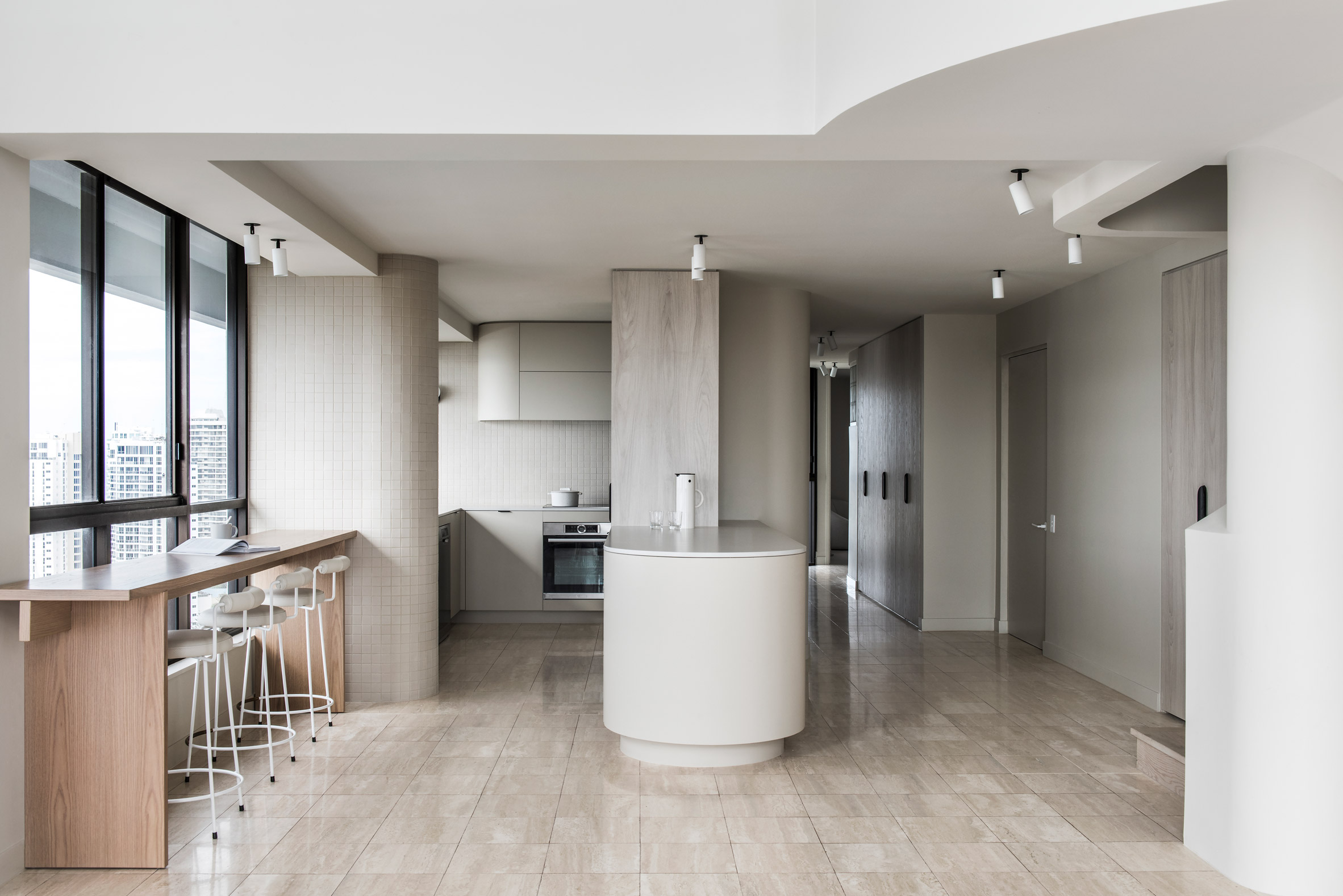
The previously awkward and angular kitchen has been made open-plan. It features a curved central island and extractor hood above the stove.

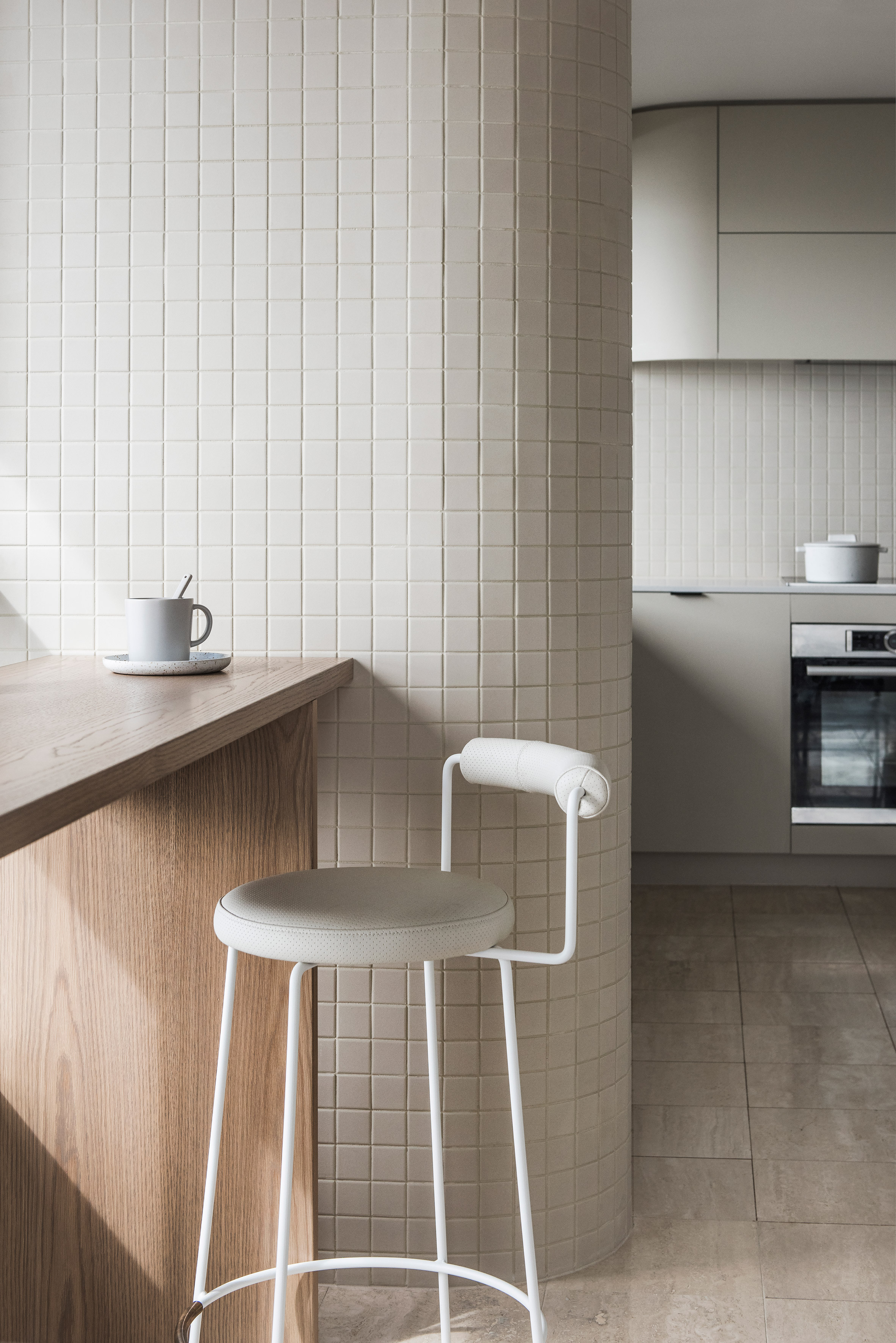
A rounded partition clad in light beige tiles has also been inserted to create some separation between the breakfast bar and the cabinetry.
Penthouse M by CJH Studio

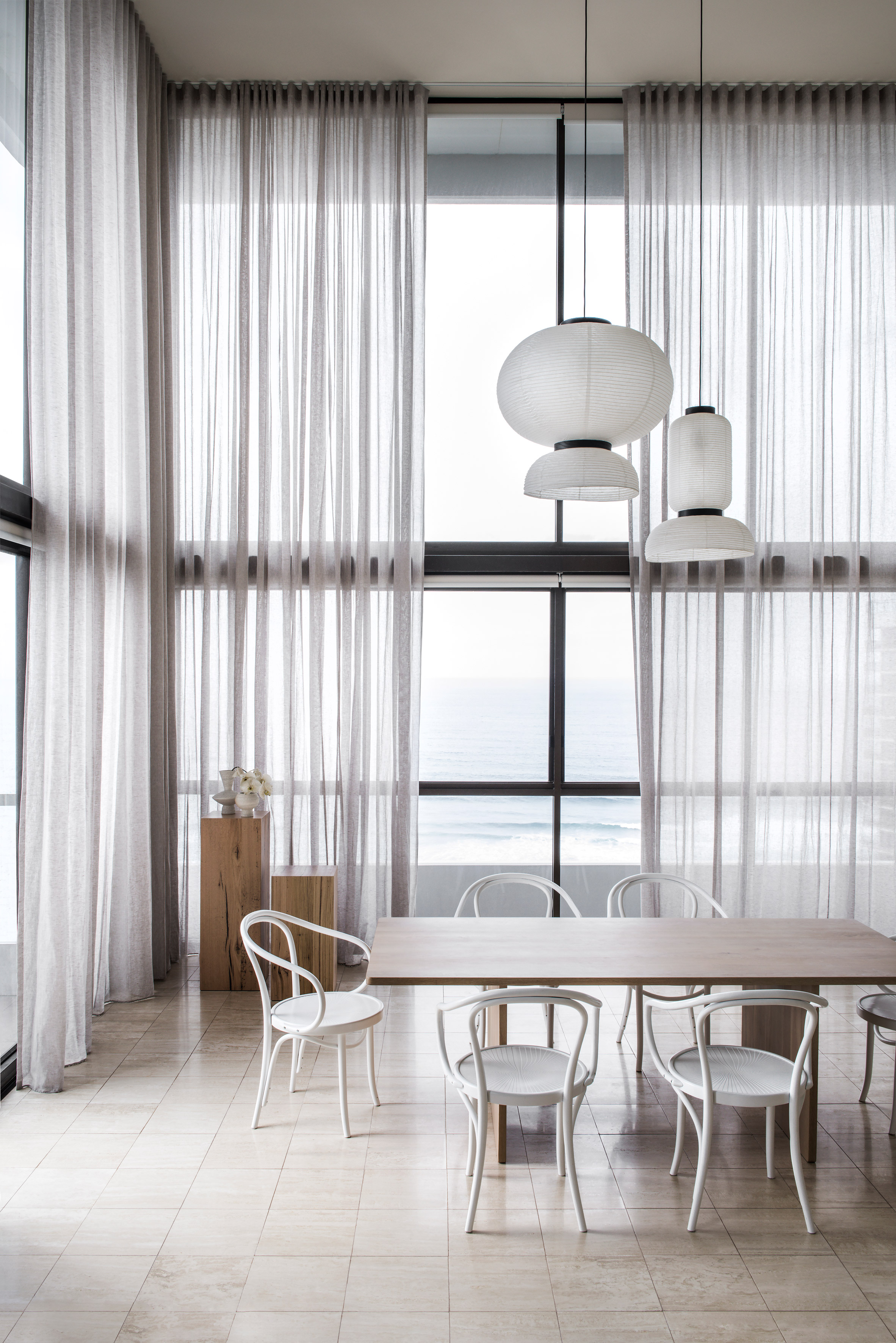
In the adjacent living area, there's a wooden dining table surrounded by white tubular-frame chairs. Gauzy curtains have been hung in front of the full-height windows to screen the sun that streams in from the beach outside.

As evening falls inhabitants can switch on the two oversized lanterns that dangle from the ceiling.
Penthouse M by CJH Studio

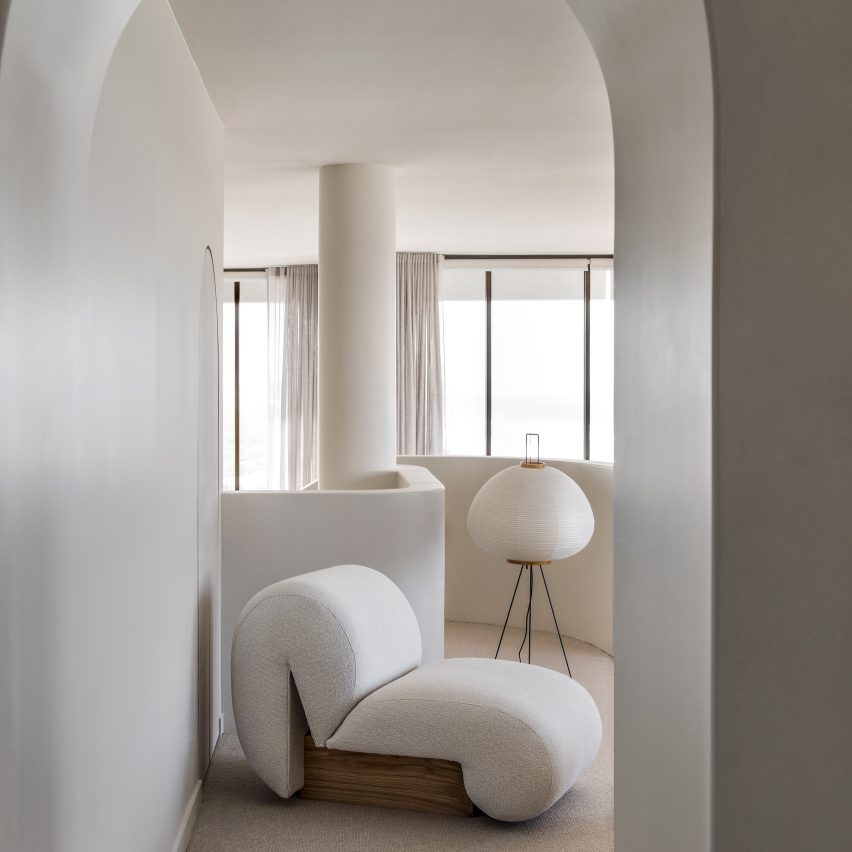
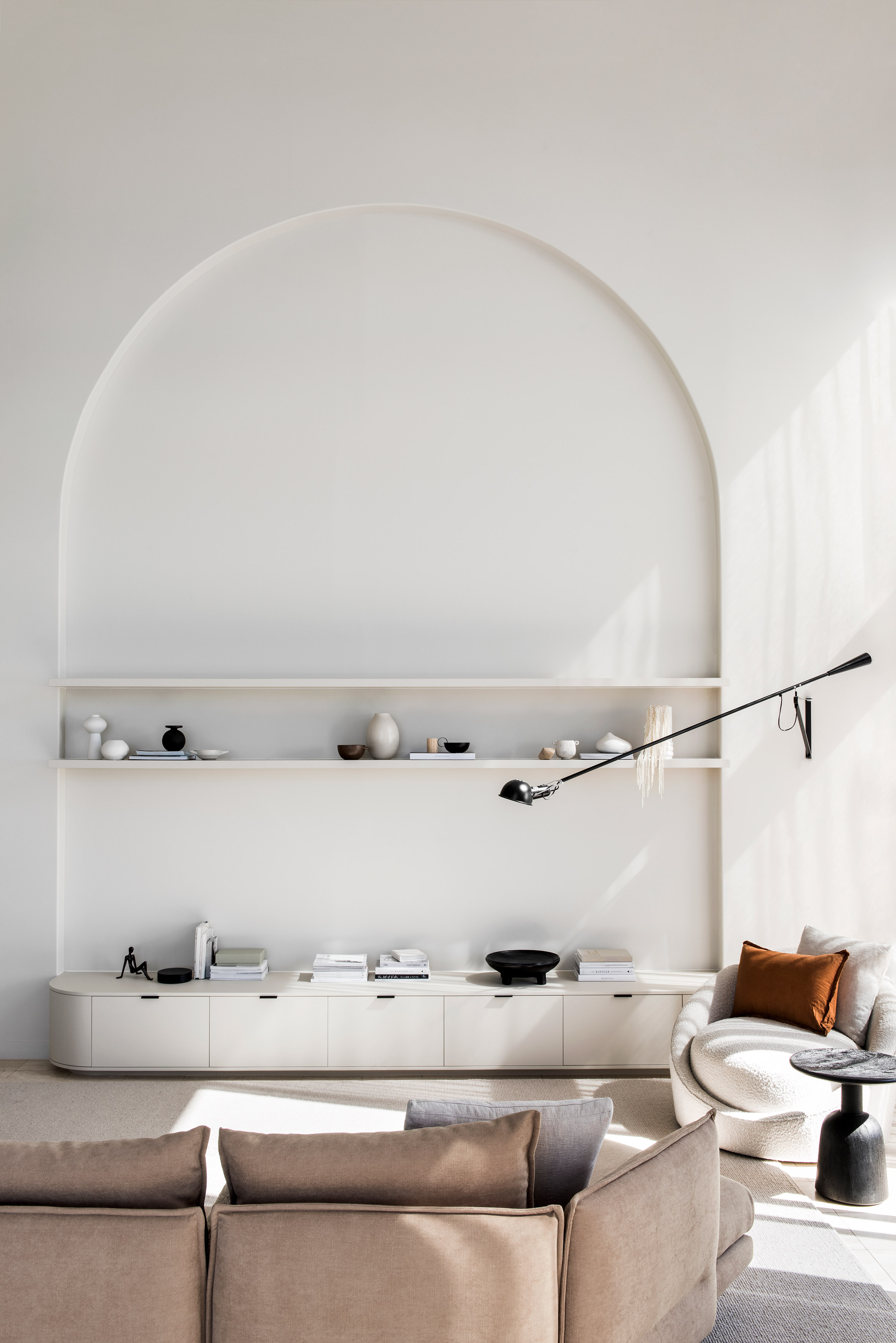
The rest of the space has been dressed with a couple of cosy armchairs upholstered in boucle and a long, taupe-coloured sofa.

It sits directly in front of an arched niche in the rear wall which accommodates a shelf and curved sideboard where ornaments can be displayed.
Penthouse M by CJH Studio

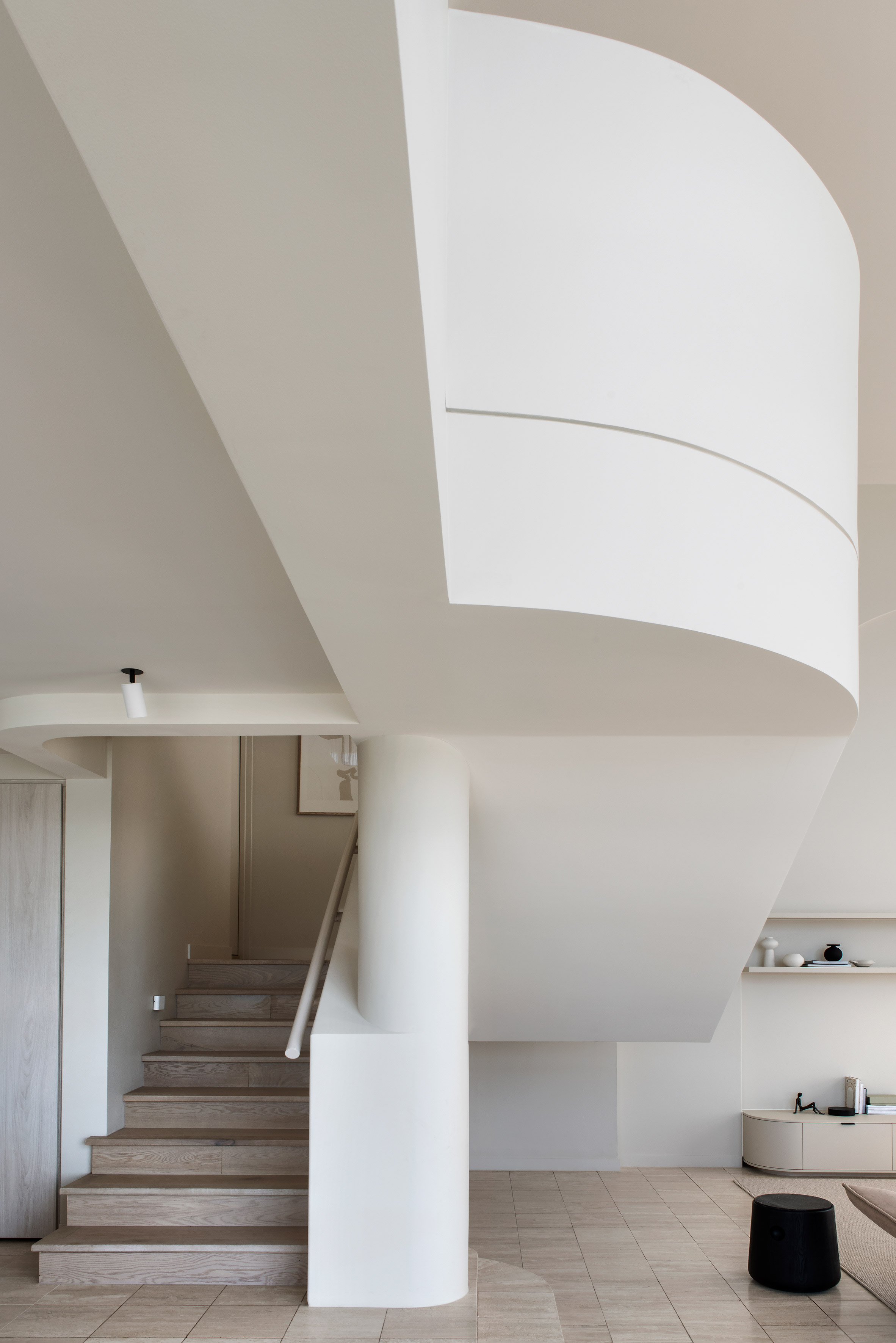
The travertine marble floor tiles in Penthouse M were carefully restored, but the original staircase has been given a major update.

To make it safer for the clients, who have a young child, the studio has boxed-in the previously open treads with American oakwood.

The old faceted glass balustrade has been replaced with a gently curving panel of creamy plaster.
Penthouse M by CJH Studio

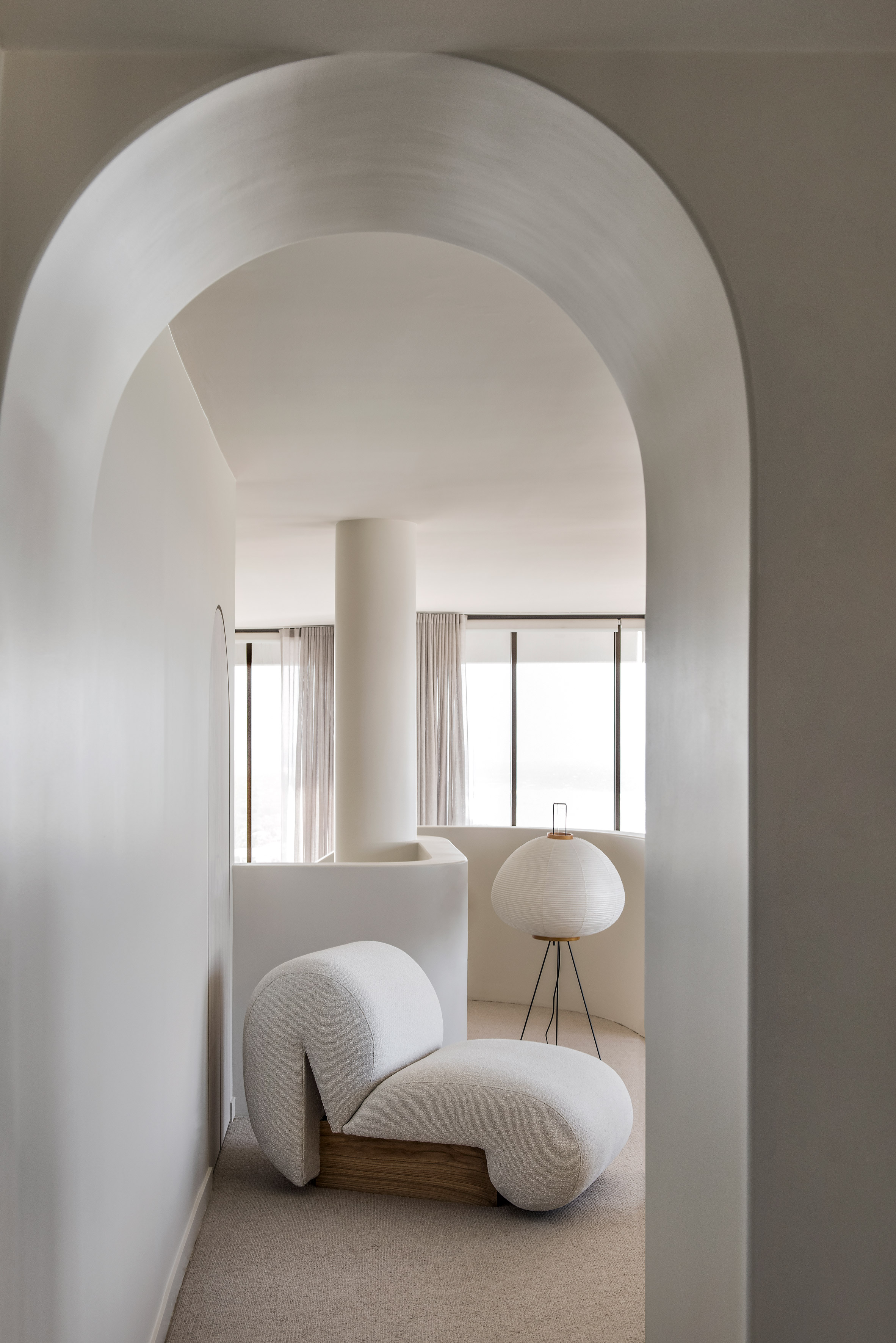
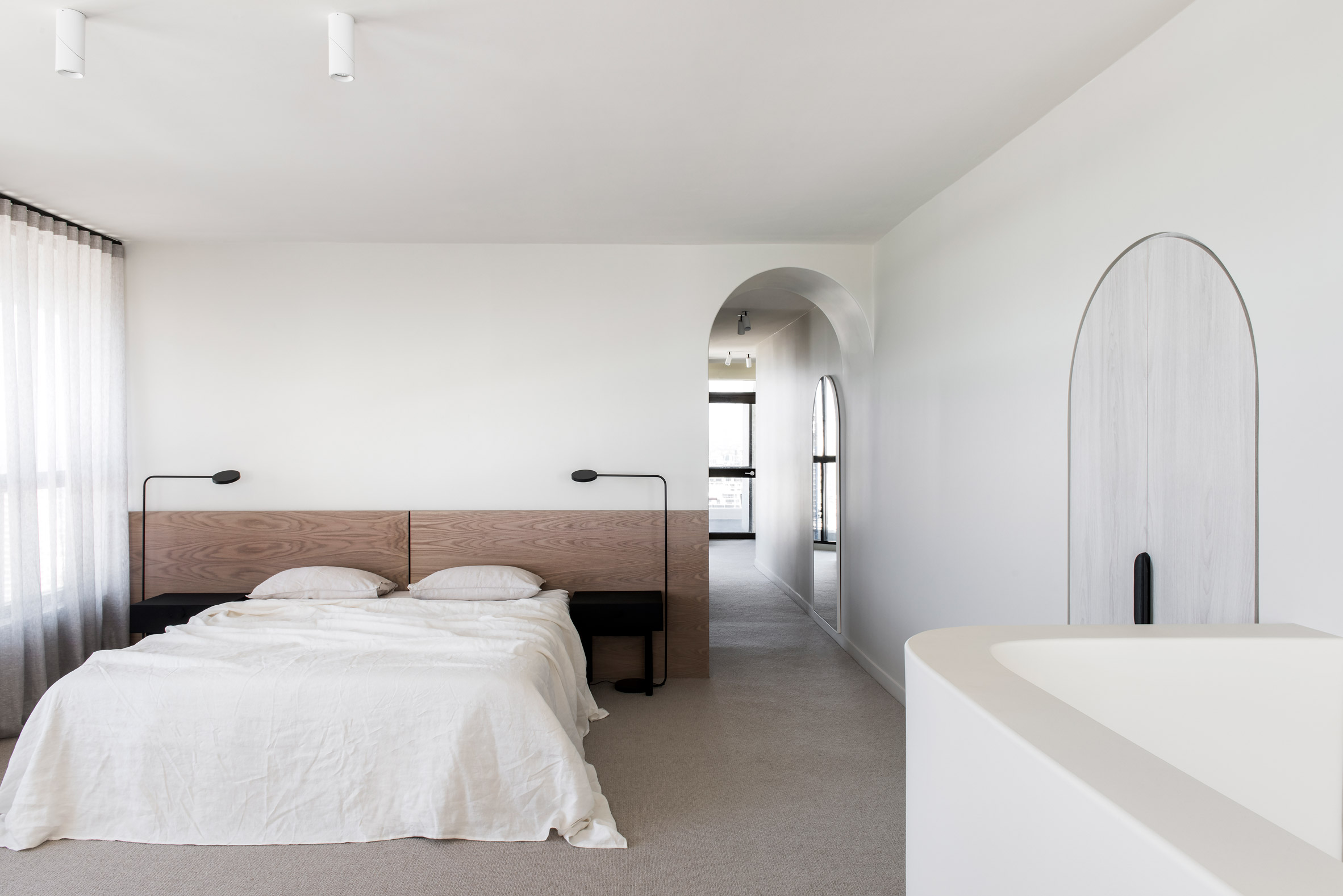
Curvy forms continue to appear in the living spaces upstairs – bedrooms are accessed via vaulted doorways and have arched full-length mirrors.

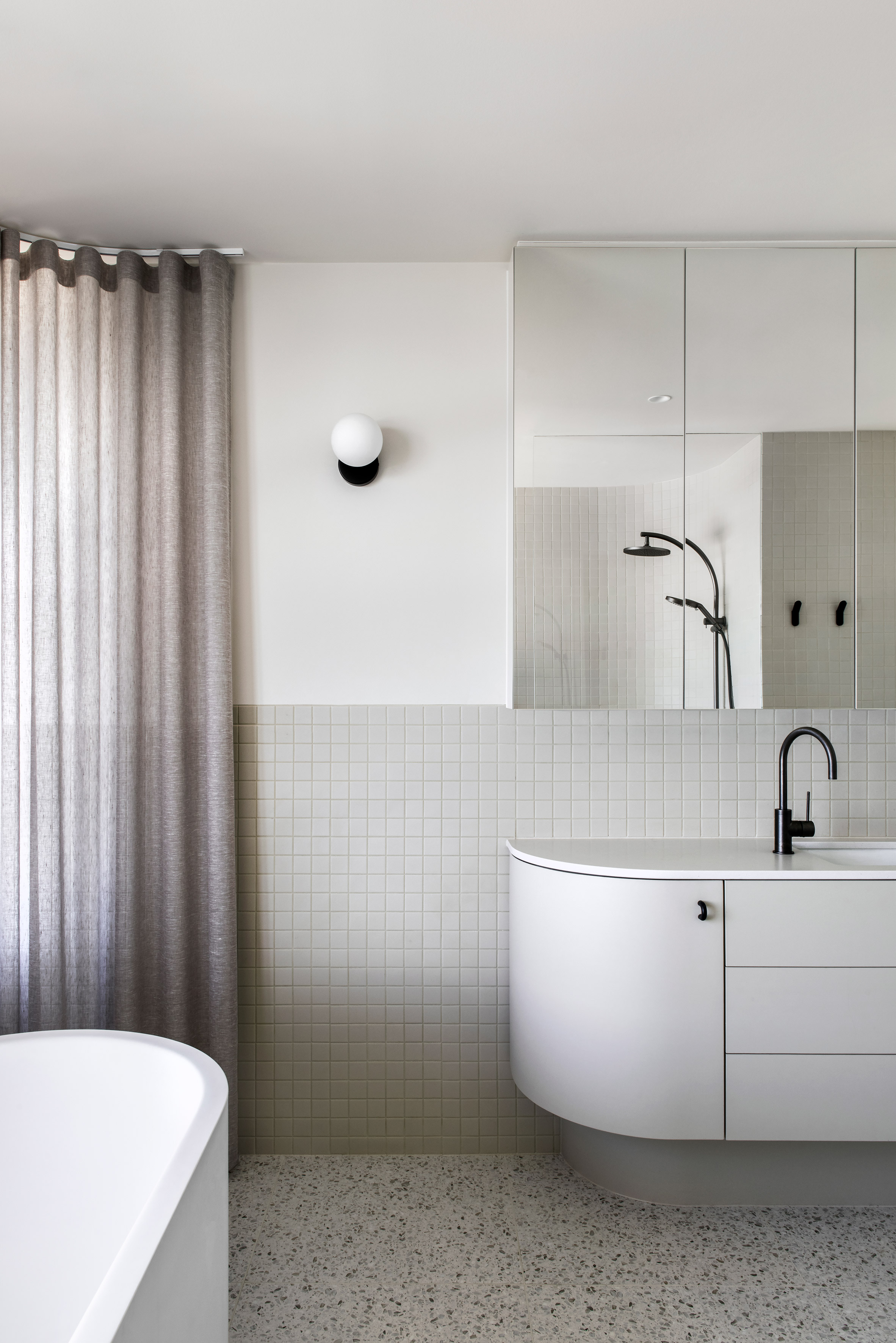
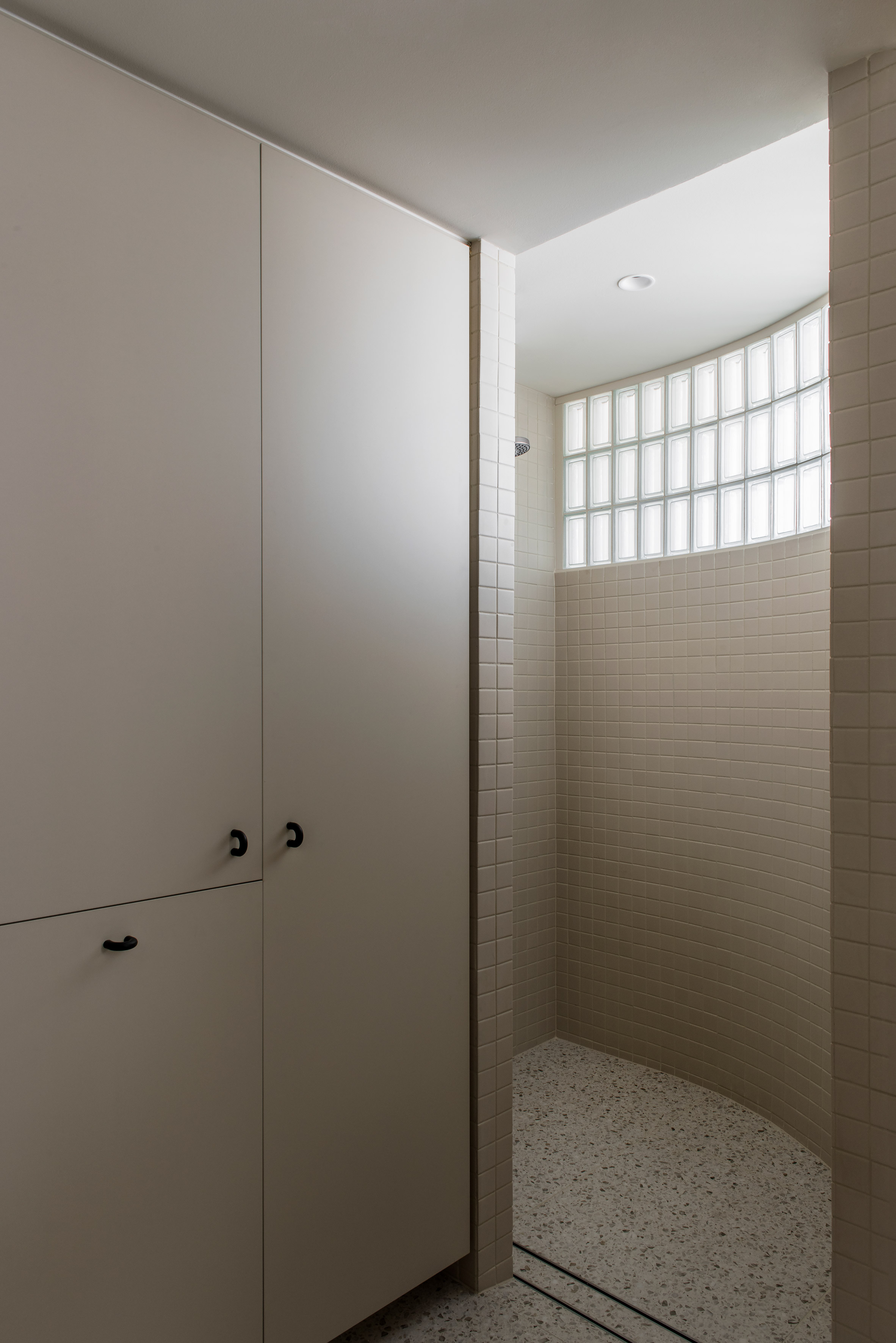
The same beige tiles used in the kitchen have been applied across walls in the home's wet areas, complemented by flecked terrazzo-style flooring.
Penthouse M by CJH Studio

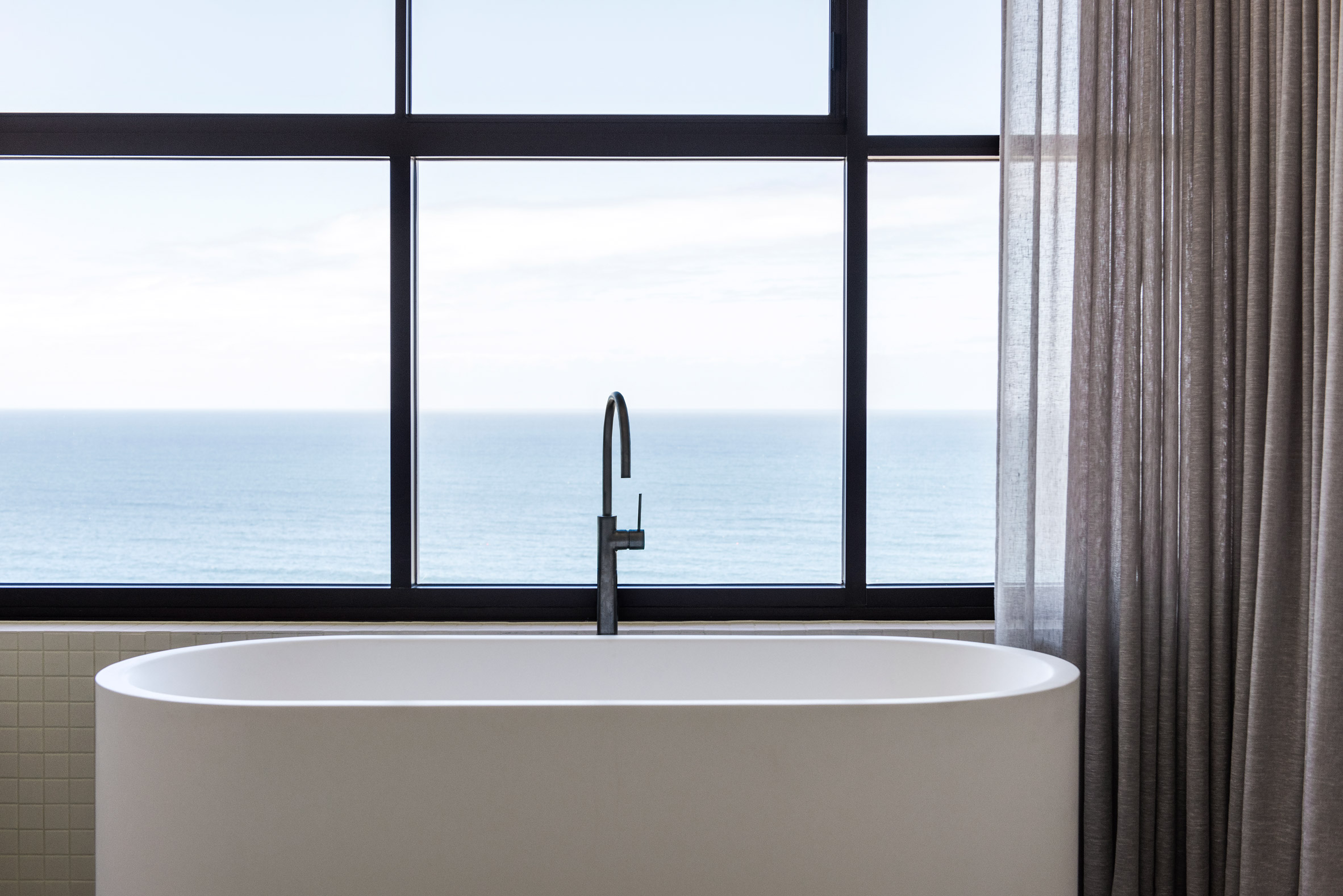
In one bathroom, a freestanding tub has been positioned directly beside an expansive window that overlooks the ocean waves, while in another the shower cubicle has been inset with glass bricks – a subtle nod to the building's lobby.
Penthouse M by CJH Studio

CJH Studio was established in 2017 and has an office on Melbourne's Mornington Peninsula. It isn't the only studio to forgo flashy glamour – last year, Worrell Yeung completed a minimal penthouse in Brooklyn that has all-white walls and pale marble fixtures.

A top-floor apartment in Antwerp designed by Hans Verstuyft Architects is also decked out in a restrained material palette of walnut wood and stone.

Photography is by Cathy Schusler.

The post Curved forms and beige tones pervade Penthouse M by CJH Studio appeared first on Dezeen.


from Dezeen https://ift.tt/2WFqXxo

Watch architect Kengo Kuma live from Japan for Virtual Design Festival and CAMP

Kengo Kuma for CAMP's Urban Talks

Today, Virtual Design Festival has teamed up with CAMP, Prague's centre for architecture and urban planning, to present a day of talks, starting with a live lecture by Japanese architect Kengo Kuma from 10:00am UK time. 

We will be publishing lectures from Prague's Center for Architecture and Metropolitan Planning's (CAMP) Urban Talks series all day. We kick things off with this lecture by Kuma live from his office in Tokyo.

Subsequent instalments of the series today will feature lectures by Snøhetta, COBE and Interboro. The schedule can be found at the bottom of this article.

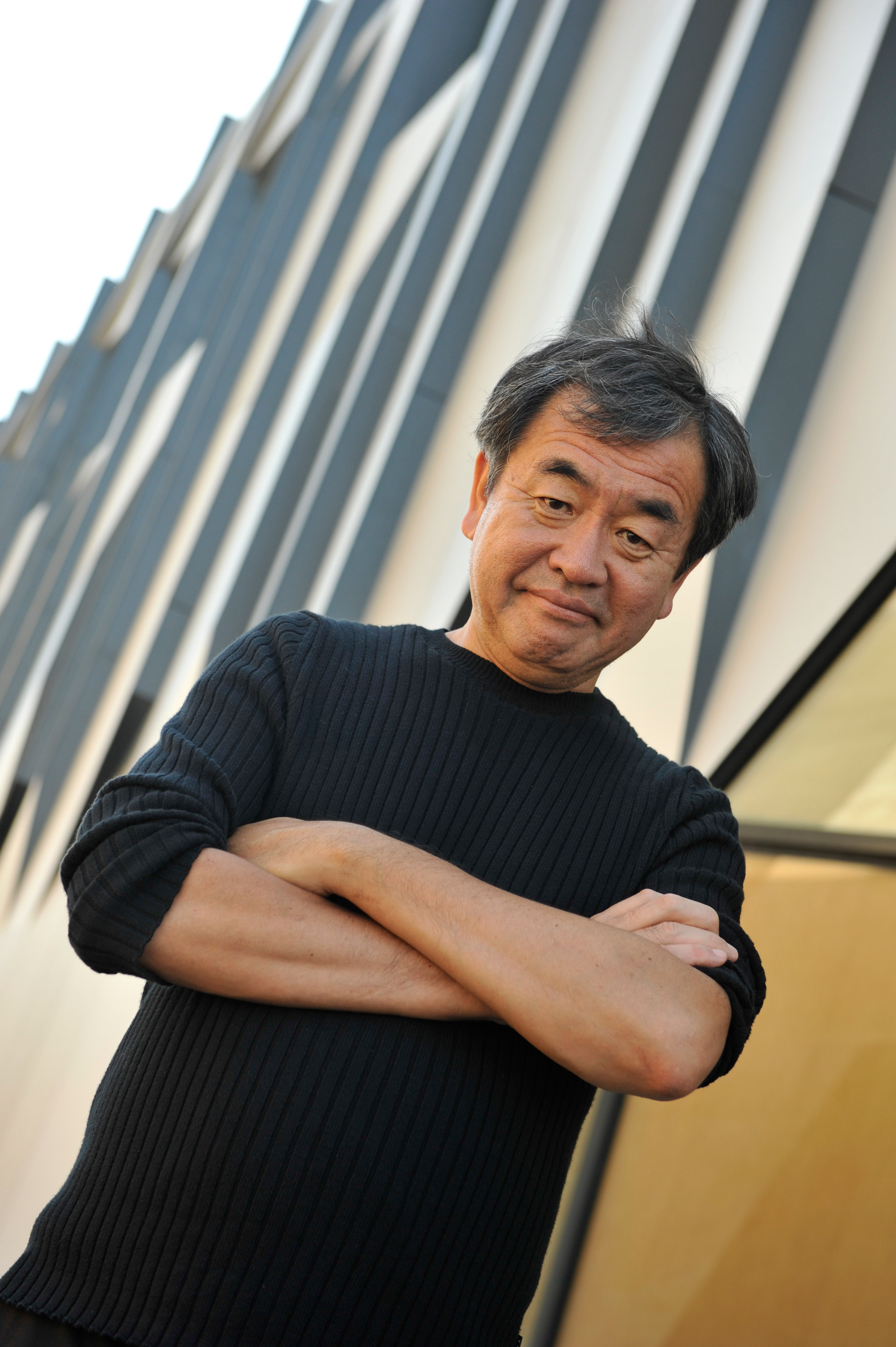
Architect Kengo Kuma
Kengo Kuma. Photo is by J.C. Carbonne.

Kuma, one of Japan's leading architects, won the competition to design the stadium for the 2020 Tokyo Olympics that have now been postponed due to coronavirus.

He recently created Ace Hotel's first hotel in Japan, in a building that was previously the Kyoto Central Telephone Company.

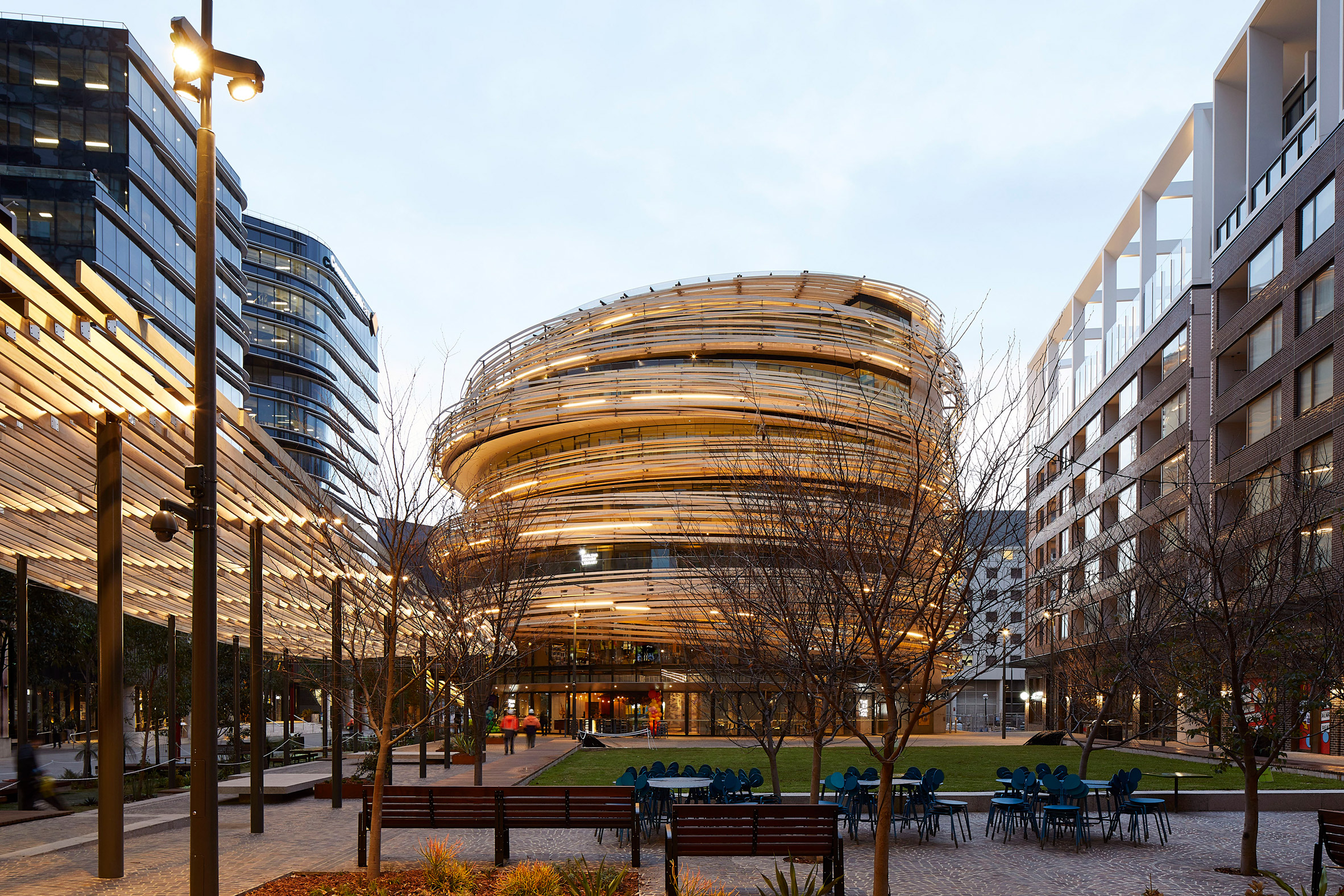
The architect also completed his first building in Australia this year, a six-storey civic centre in Sydney that, like many of Kuma's designs, features light-coloured wood in dynamic configurations.

The Exchange in Sydney by Kengo Kuma
Kuma's The Exchange, Darling Square, Sydney. Photo is by Martin Mischkulnig.

Among Kuma's other most well-known projects are the V&A Dundee Museum, Scotland's first design museum, which was designed to evoke the dramatic cliffs of Scotland's coastline, and his Asakusa Culture Tourist Information Centre, designed to look like a stack of smaller buildings with sloping roofs.

In a 2017 interview with Dezeen, Kuma said he feels embarrassed by some of his more experimental early buildings, adding: "I want to find a balance expressing form and material. The form of the building should be as subtle as possible, because then the material's character can reveal itself."

Viewers will be able to ask Kuma questions during this morning's live chat via Slido, using the #urbantalks hashtag.

About CAMP

CAMP, the Center for Architecture and Metropolitan Planning, is an urban planning hotspot in the heart of Prague. The gallery is housed in a modernist building designed by Czech architect Karel Prager and serves not only architects and planners, but mainly the citizens of Prague interested in the future of their city. CAMP also hosts an exhibition space with a 25m wide panoramic projection wall, enabling a unique simulation of the city.

Its monthly Urban Talks series offers lectures by world-renowned architects and urban planners.

Here's the schedule of talks we are publishing on VDF today:

10:00am Kengo Kuma live from Japan
1:00pm Snøhetta
3:00pm COBE
5:00pm Interboro

The post Watch architect Kengo Kuma live from Japan for Virtual Design Festival and CAMP appeared first on Dezeen.


from Dezeen https://ift.tt/2ZdUss4

“We’re innately creative because the world isn’t built for us”: Working in the creative industries with chronic illness

The founder and editor of Sick magazine, a publication by chronically ill and disabled people, calls for change in the creative industry.


from It's Nice That https://ift.tt/2ycFS99

There are only 15 days left to enter Dezeen Awards 2020

With only 15 days left to enter Dezeen Awards here are 15 reasons why you should enter your project now.

1. You're running out of time! The deadline is on 2 June at 23:59 BST. Complete your entry today so you don't miss out.

2. You can save 50 per cent on studio categories. Fancy being named studio of the year? Use 50STUDIO at the payment stage to enter at half price!

3. Dezeen Awards is affordable. Our low entry prices are designed to attract smaller studios and avoid categories being dominated by large companies that can afford to enter multiple categories.

4. Dezeen Awards is introducing a people's choice, meaning your work will be seen and voted for by Dezeen readers.

5. Have your work seen by our stellar lineup of judges including Norman Foster, Michelle Ogundehin, Jaime Hayon and Paola Antonelli.

6. Dezeen's editorial team will see your work. Dezeen's experienced editorial team are involved in the longlisting process and are always keen to come across good projects to publish.

7. All longlisted projects will get a dedicated page on the Dezeen Awards website. Shortlisted projects and winners will get further dedicated pages.

8. If you get shortlisted we will publish your project as a story on the main Dezeen website and you'll be mentioned in our newsletter, which reaches up to 160,000 people.

9. We'll promote your project on Dezeen's social media channels with five million followers if you are shortlisted or win. All longlisted, shortlisted and winning studios will receive a promotional Dezeen Awards badge to share with their own network.

10. If you win you may be asked to be a judge for Dezeen Awards 2021. This year, six of our judges are previous Dezeen Awards winners.

11. All entrants will be added to Dezeen's VIP mailing list, meaning you'll receive exclusive invitations to Dezeen events around the world.

12. You'll be part of something global. Dezeen Awards 2019 received more than 4,500 entries from 87 different countries. If you enter, you'll be part of a vibrant, international community.

13. It's easy to enter. Dezeen Awards has the simplest, most intuitive entry process of any awards programme.

14. There are eight new categories for you to enter across architecture, interiors and design including restaurant interior and exhibition design.

15. We're friendly. Our awards team are here to help you with any questions you might have. Drop us a line at awards@dezeen.com!

The post There are only 15 days left to enter Dezeen Awards 2020 appeared first on Dezeen.


from Dezeen https://ift.tt/2X9oLx9

Poimo is an inflatable electric-scooter that can be transported inside a backpack

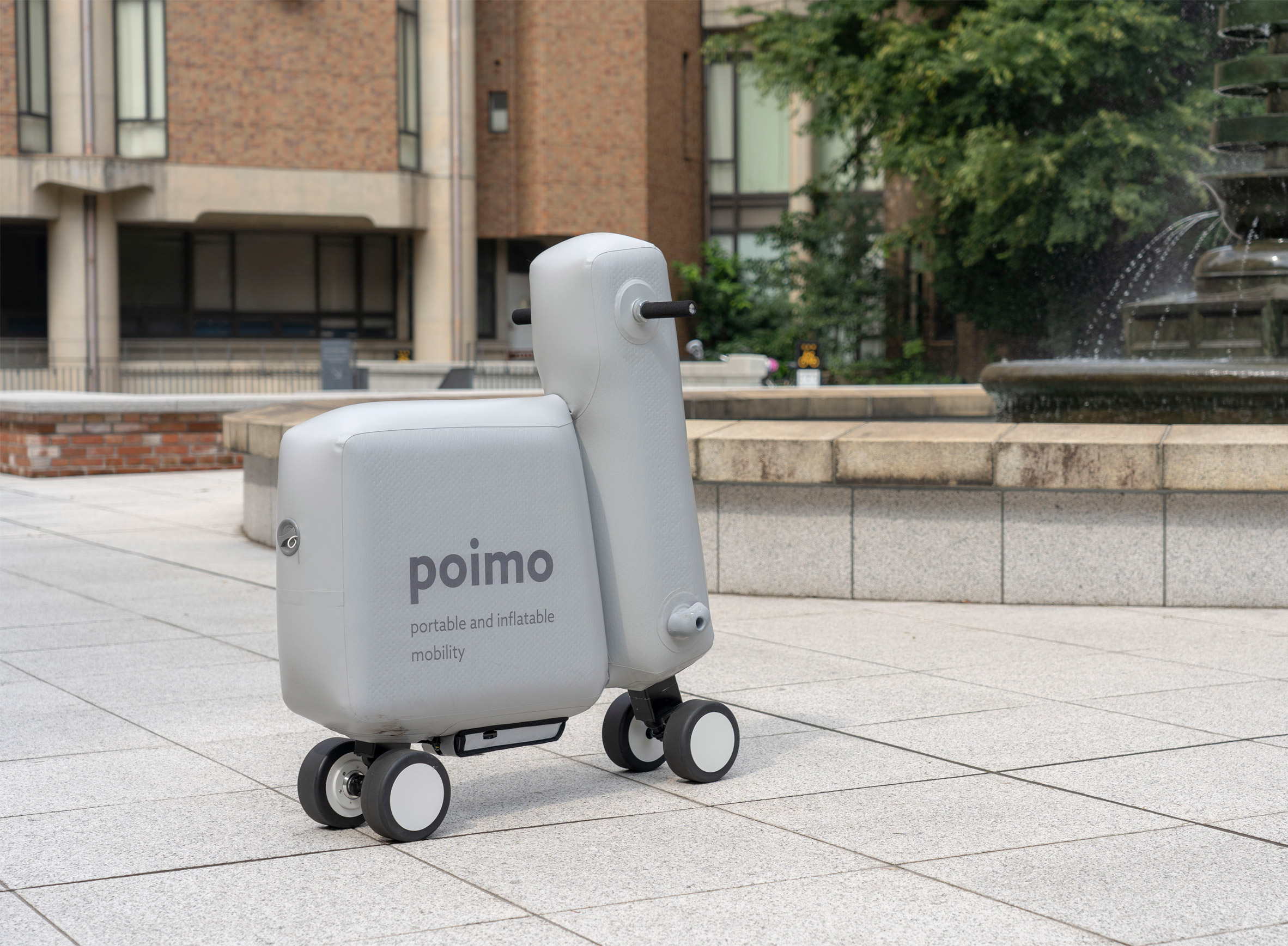
Poimo is an inflatable electric scooter that can be transported inside a backpack

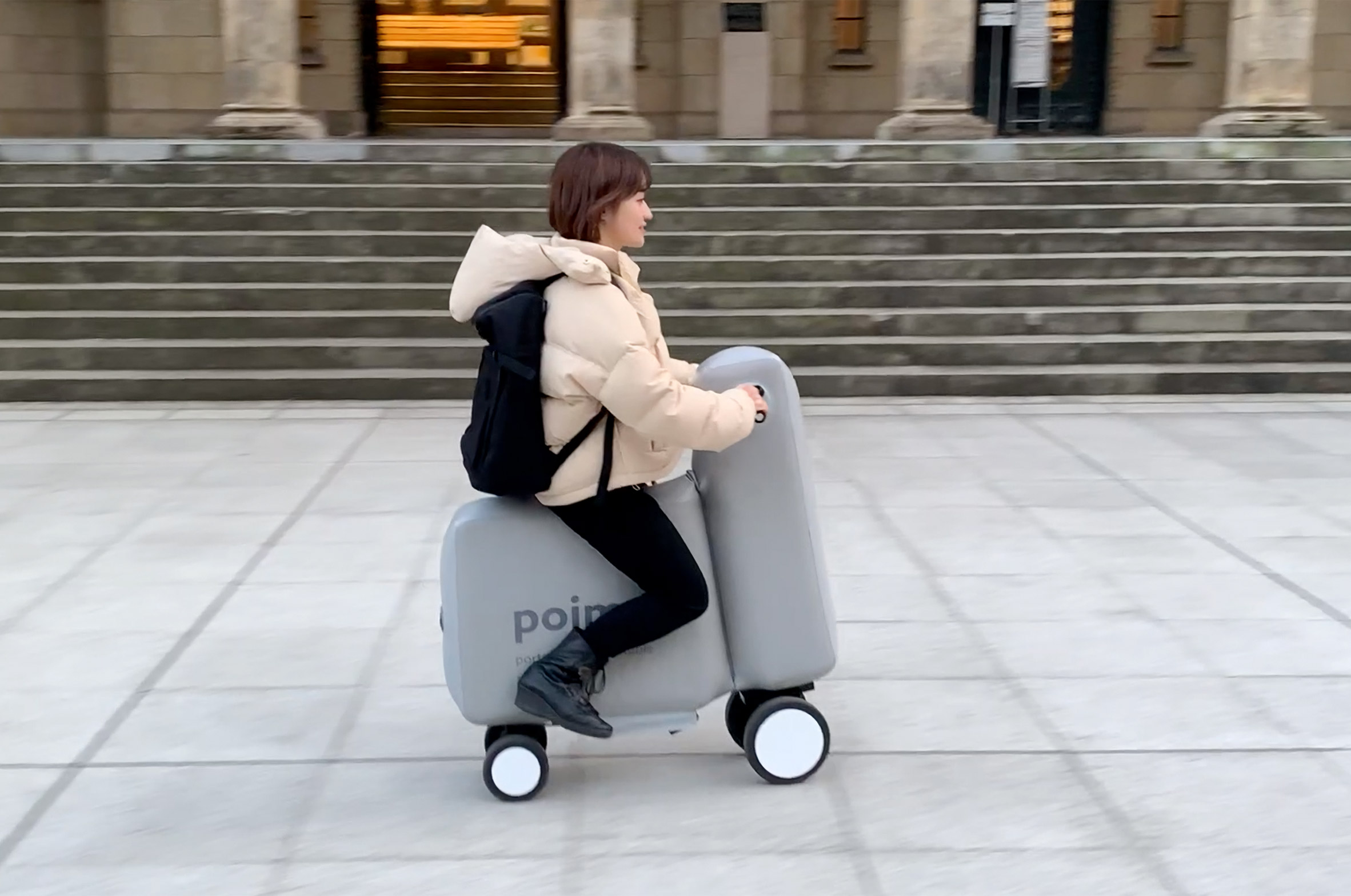
Research organisation Mercari R4D and students from the University of Tokyo have jointly developed an inflatable electric-scooter that riders can stash away inside their backpack.

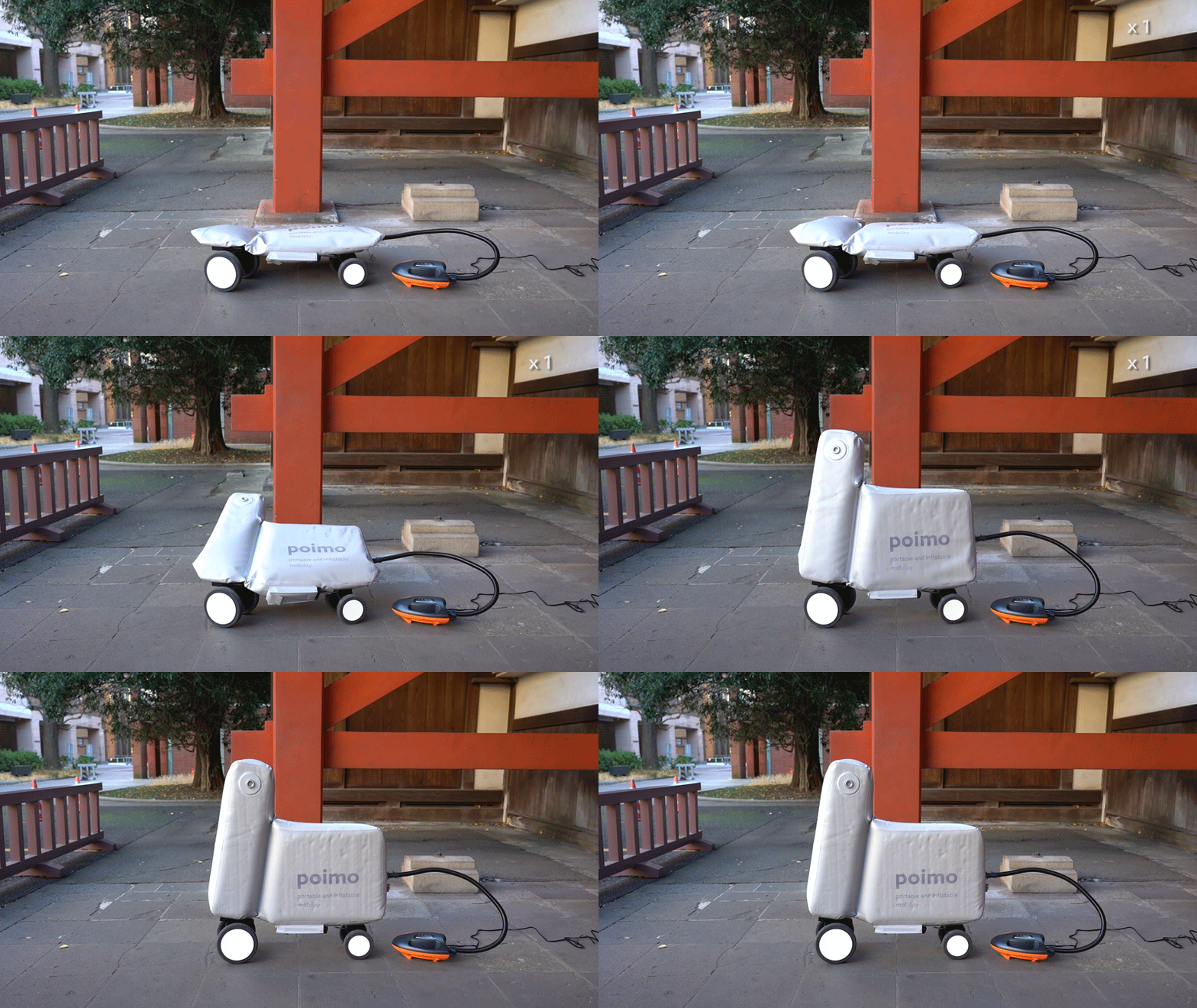
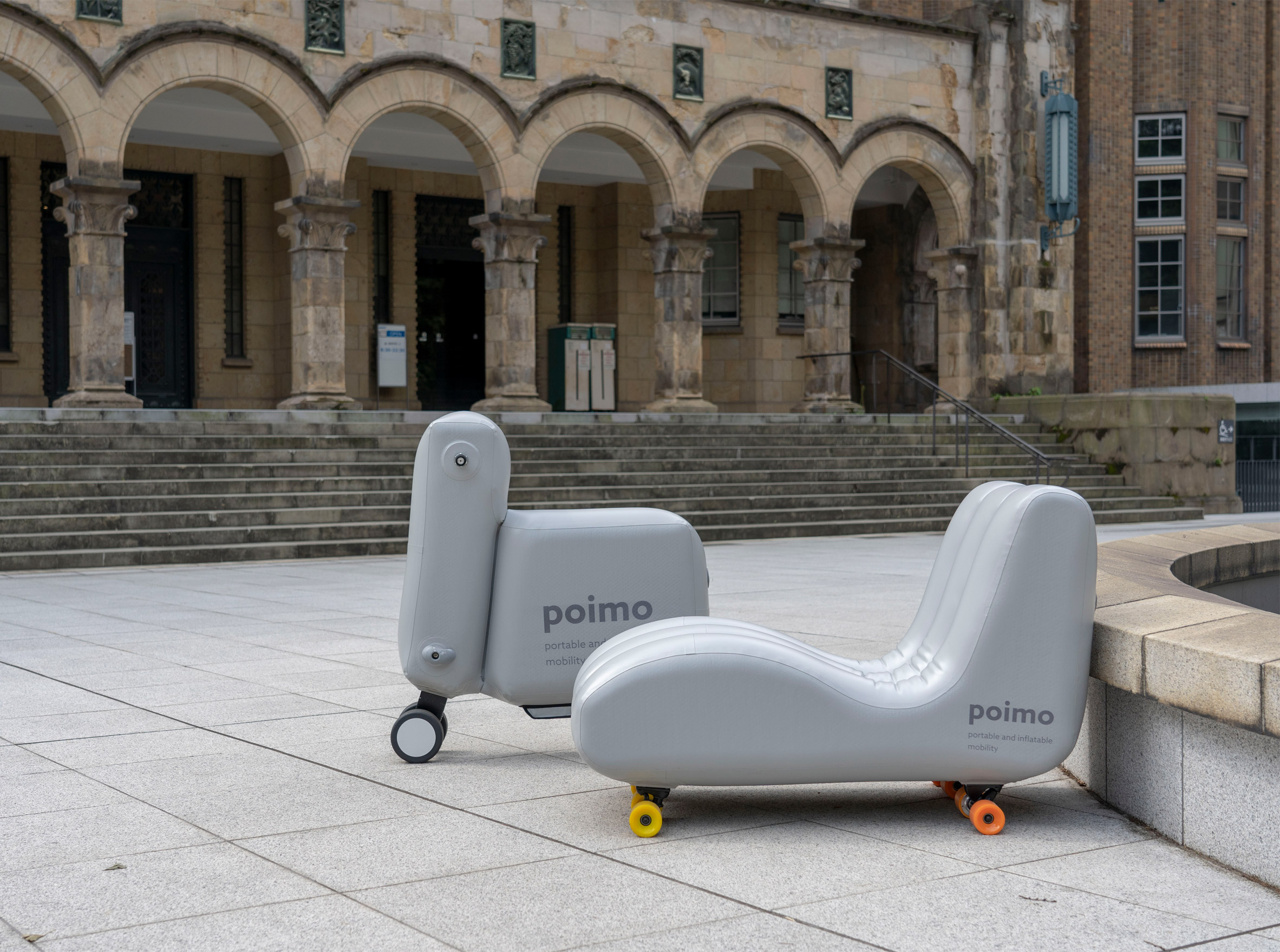
Called Poimo, which stands for portable and inflatable mobility, the scooter comprises a body made from thermoplastic polyurethane (TPU) and detachable components including handles, wheels, a battery and motor.

Poimo is an inflatable electric scooter that can be transported inside a backpack

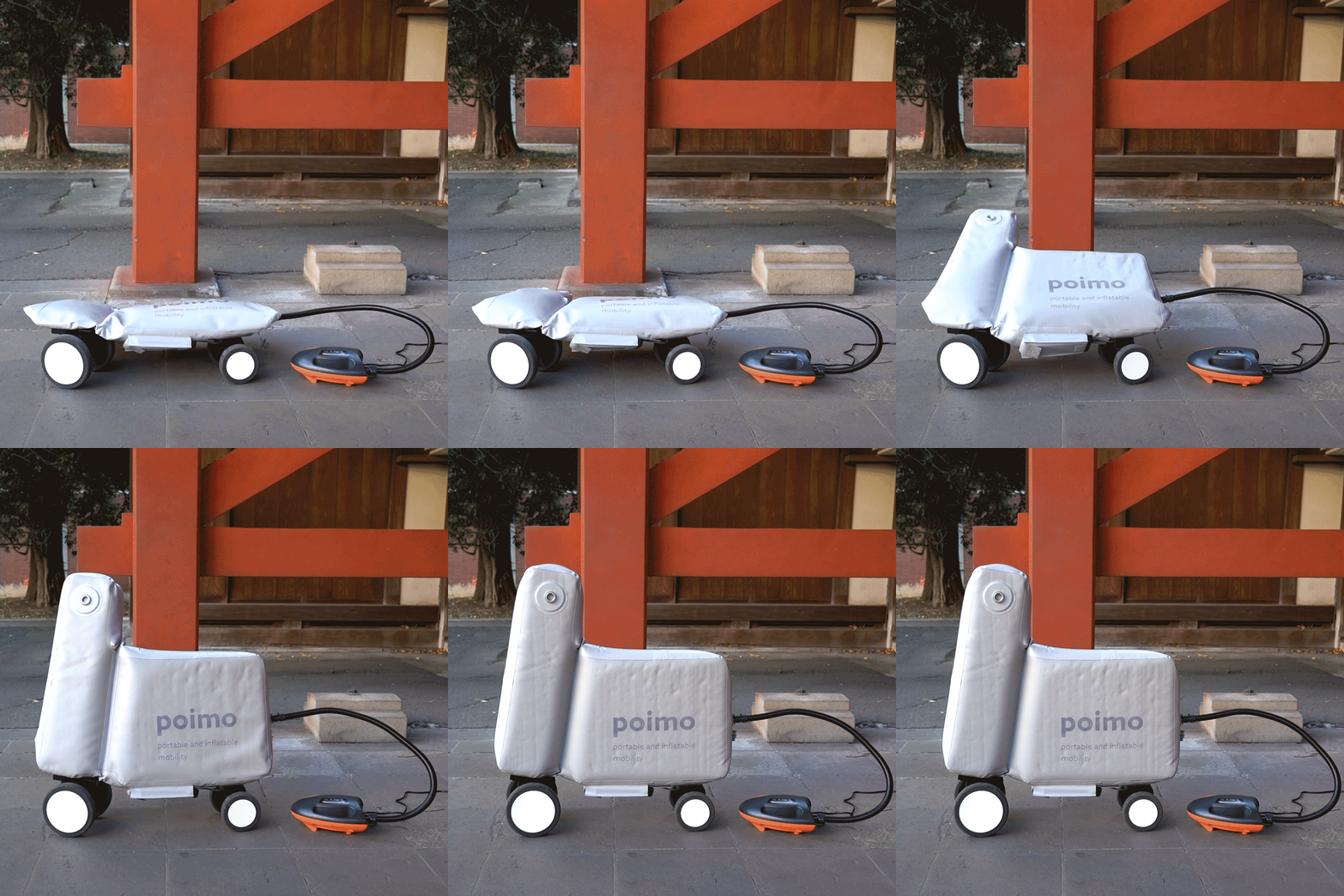
Likened by its creators to the inflatable robot Disney character Baymax, otherwise known as Big Hero 6, the body of the scooter can be inflated within minutes using a small pump.

Designed for short trips around the city or last-mile journeys, the Poimo is light enough to be deflated, folded down and carried around in the user's bag, allowing them to get on and off anywhere they wish.

Poimo is an inflatable electric scooter that can be transported inside a backpack

Researcher Ryosuke Yamamura from Mercari R4D developed the wireless scooter in collaboration with four students from the University of Tokyo and designer Hisato Ogata from Takram studio.

Poimo was the result of developments in soft robotics technology and personal mobility – something the researchers call "soft mobility", designed to be soft, lightweight and inflatable.

Poimo is an inflatable electric scooter that can be transported inside a backpack

While many other micro-mobility solutions such as electric bikes, scooters or skateboards are used for last-mile journeys from a train station or bus top to the user's final destination, these designs still encounter issues in regards to portability, safety, and price.

This is down to their "rigid, heavy, and bulky properties", explained the Poimo designers.

"About 60 per cent of car trips in Japan are short distances, which is not very good in terms of congestion and greenhouse gases," they continued. "This is a similar situation in other countries."

"We believe that new mobility like Poimo is needed to replace this with short-range-only personal mobility."

The rigid components of the scooter, which include two eight-inch front wheels, two six-inch rear wheels, a motor, a built-in wireless controller and a 70 by 110 millimetre-long battery, weigh around 5.5 kilograms in total.

Poimo is an inflatable electric scooter that can be transported inside a backpack

Poimo was born out of a discussion at a research camp attended by University of Tokyo students Hiroki Sato, Young Ah Seong, Ryuma Niiyama and Yoshihiro Kawahara.

Here they came up with the concept for an inflatable mobility solution that would be safe in a crash and portable when not in use.

According to the designers, the soft body would protect pedestrians as well as the rider in the event of an accident, creating a "new relationship between people and mobility".

Poimo is an inflatable electric scooter that can be transported inside a backpack

The inflatable characteristic of the scooter also means it can be easily customised, say the researchers. As the body is made from "pasted together" fabrics, the user can make it into whatever shape they desire.

While the scooter is currently just a prototype, Mercari R4D and the students claim that the final product will be lighter and even more portable than at present.

Electric scooters are becoming increasingly popular for city travel in a bid to alleviate the growing issue of congestion.

Layer teamed up with Chinese automotive company Nio to design its Pal e-scooter that uses artificial intelligence and machine-learning technology to autonomously take users on their preferred routes.

Hyundai also created a prototype scooter in September 2019 that folds down to the size of a backpack and weighs just 7.7 kilograms.

The post Poimo is an inflatable electric-scooter that can be transported inside a backpack appeared first on Dezeen.


from Dezeen https://ift.tt/3cHmvUp