
Viewing the medium as a tool for documentation, the Ghanian photographer discusses the reasons behind his practice.

from It's Nice That https://ift.tt/3bJb7WU
Viewing the medium as a tool for documentation, the Ghanian photographer discusses the reasons behind his practice.

As we count down the days to enter Dezeen Awards, interiors expert judge Michelle Ogundehin says she is looking forward to submissions that combine originality with sustainability.
"I'm looking for design motivated by an authentic wish to make something that looks better, functions better, contributes and pushes forward boundaries more than anything that currently exists," said the British writer, creative consultant and TV presenter.
"There is a surfeit of stuff in the world," continued Ogundehin, who is judging the interiors categories of Dezeen Awards 2020.
"There are too many things that no-one needs or that do little to improve the human condition; things made basically to satisfy only the desires of the designer."
Entry for Dezeen Awards closes 2 June. To help you with your finishing touches, we asked our judges to tell us what they're hoping to see from entrants.
Ogundehin describes herself as "an interiors obsessive, colour nut and detail queen". After training as an architect, she was editor-in-chief of interiors magazine Elle Decoration UK for 13 years.
Ogundehin is the lead judge on the BBC/Netflix series Interior Design Masters and co-presenter of Channel 4's Grand Designs: House of the year. Her first book, titled Happy Inside: How to Harness the Power of Home for Health and Happiness, was published in April 2020.
She is a regular contributor to Dezeen and numerous other international publications. She wrote Dezeen's 2020 interiors trend report, and she's hoping the entries will stand out from the crowd.
"I rather hope I don't detect any trends in aesthetic terms, it's too easy to just follow the pack,: she said. However, I would imagine that an element of ecological awareness, circular usage, and sustainability are inherent."
Enter Dezeen Awards 2020 now
To have your work seen by our stellar lineup of judges, complete your entry today to ensure that you don't miss the deadline on 2 June.
If you need help or have any questions, please contact our awards team at awards@dezeen.com.
The main image is by Ben Anders.
The post There is a "surfeit of stuff in the world" says Dezeen Awards judge Michelle Ogundehin appeared first on Dezeen.
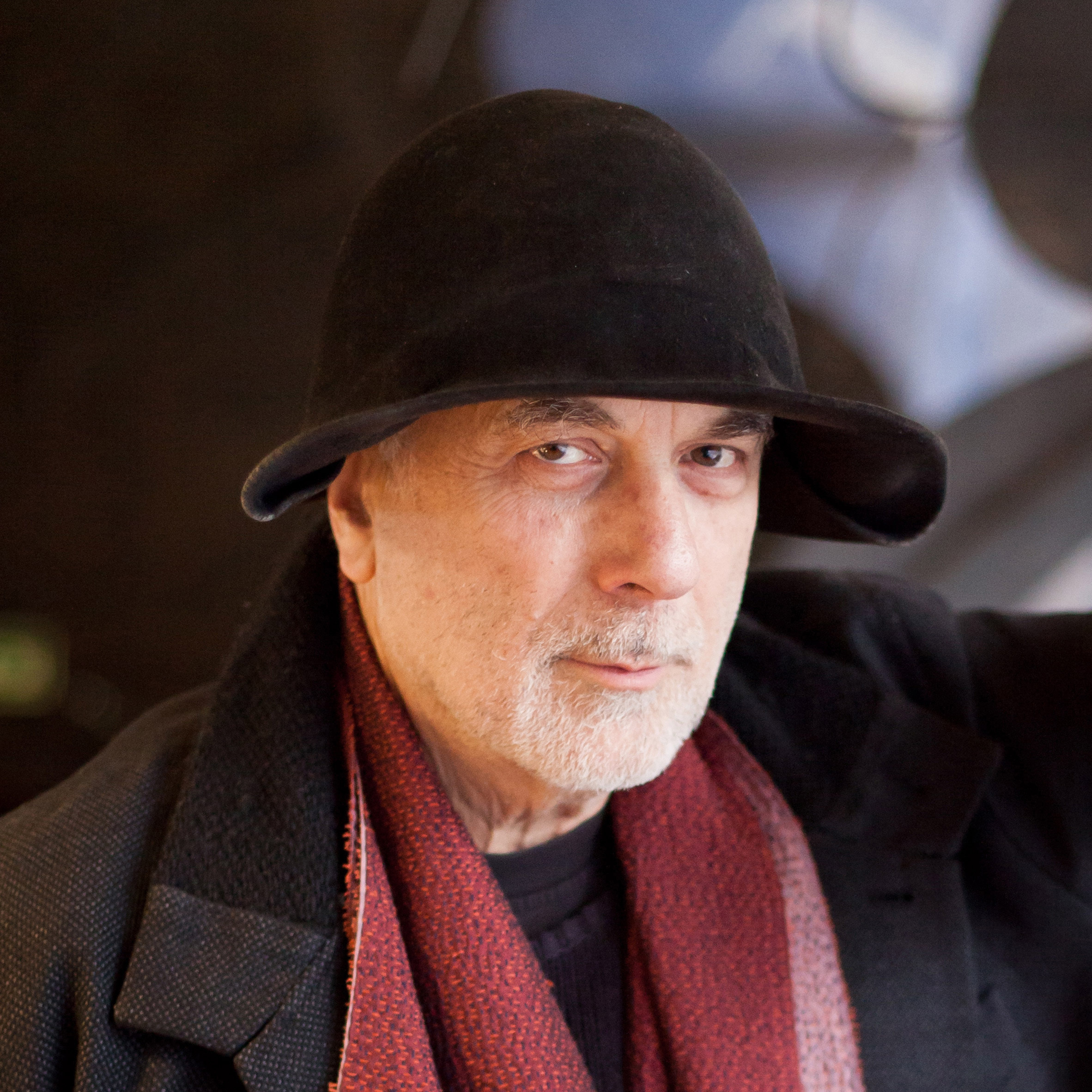
Despite creating highly collectable artworks and designing best-selling products, Ron Arad says he has never pursued commercial success in the latest talk as part of our ongoing partnership with Friedman Benda for VDF.
"People always say I'm a good entrepreneur, that I'm very good at PR," Arad told curator and historian Glenn Adamson in New York gallery Friedman Benda's Design in Dialogue interview. "On the contrary, I'm not interested in it."
Dezeen has partnered with Friedman Benda to broadcast a selection of the best conversations in its Design in Dialogue series as part of Virtual Design Festival, publishing one a week throughout May and June.
"We don't design for the business, the business is there to support our designs"
This interview features British-Israeli designer Arad, who rose to prominence in the 1980s by turning found objects into highly valuable collectors' pieces, such as his iconic Rover Chair.
He went on to design a number of extremely successful mass-produced products for major brands, such as the Tom Vac chair for Vitra and the Bookworm bookshelf for Kartell.
However, Arad rejected Adamson's suggestion that he was a shrewd businessman.
"I'm not entrepreneurial," he said. "For me, business was always a necessary evil. We don't design for the business, the business is there to support our designs."
"Ettore Sottsass has a really nice quote," Arad continued. "He said: 'Money is very jealous, if you ignore it, it will run up to you."
According to Arad, his prolific output and the range of his work is due to a lack of focus, rather than entrepreneurial ambition.
"It's because I'm lazy, it's because I'm not a methodical person," he said. "I jump from one thing to the other. I'm doing a lot because I'm lazy. I know it sounds silly."
"I made a living out of it before I knew what I was doing"
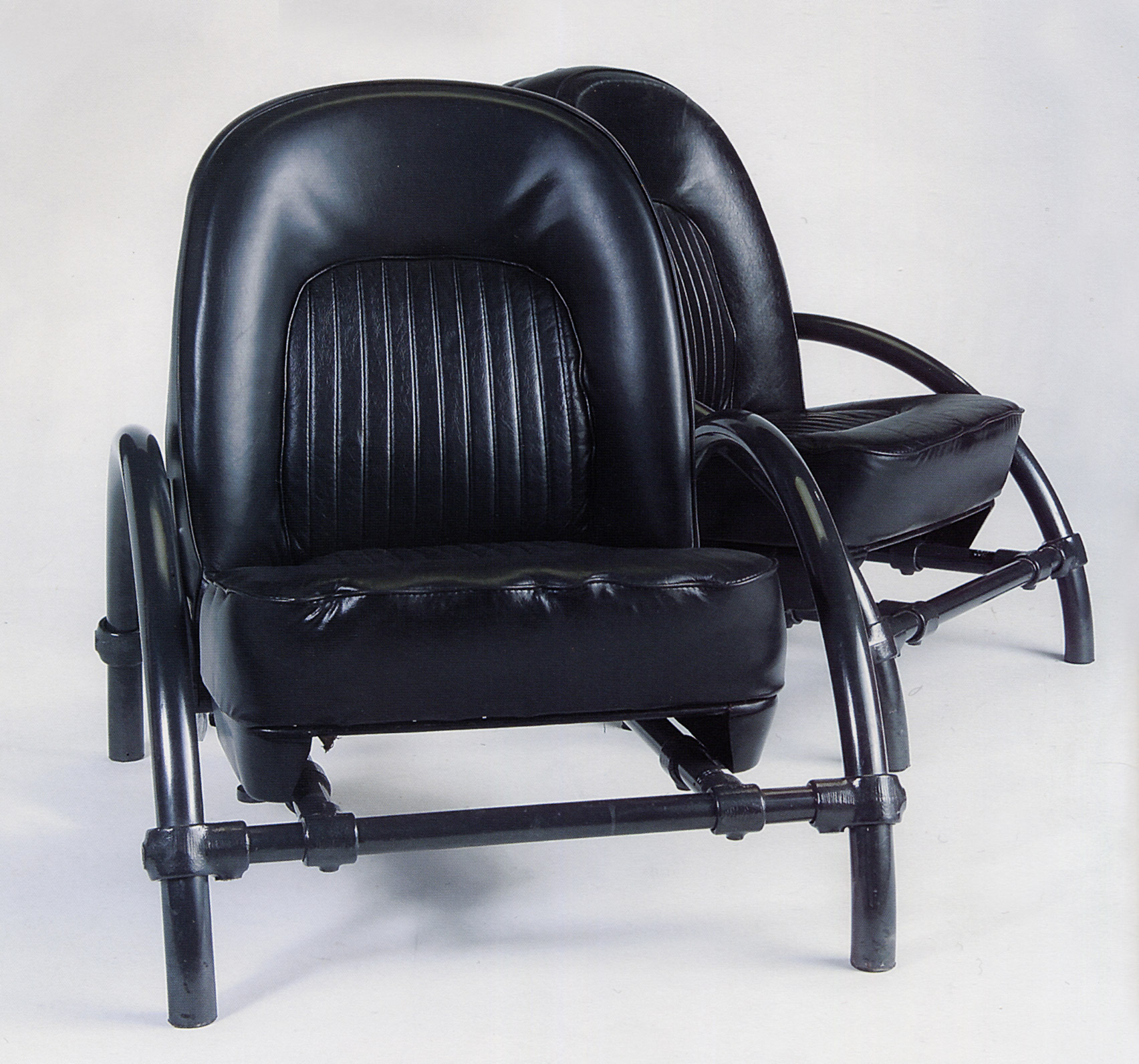
During the talk, Arad presented a number of key projects from throughout his career, including the Rover chair from 1981, which combines a car seat he found in scrapyard with a curved tubular steel frame made from a milking stall.
"It's scaffolding, slightly more refined," said Arad. "I took that and I made a living out of it before I knew what I was doing."
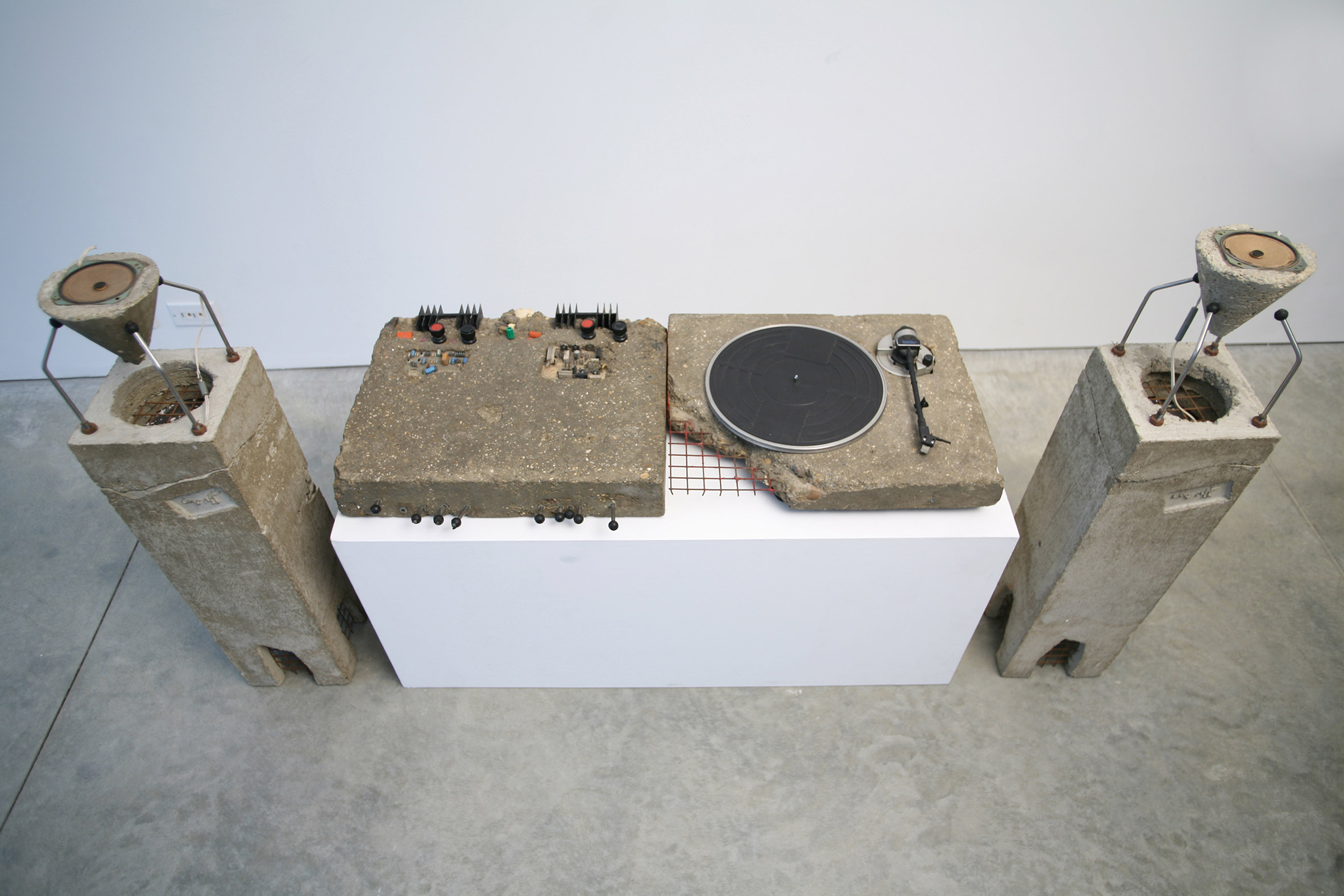
According to Arad, misinterpretations about him and his work have helped boost his career. He gives the example of his Concrete Stereo project from 1983, which features a cast concrete turntable, amplifier and speakers that have been chipped away to reveal the electronics inside.
"I thought I was showing beauty where it is normally hidden," he said. "I didn't think I was doing anything destructive, but the French called my style 'ruinism'."
Despite not being his intention, he says that the idea of him as a "ruinist" led to him being invited to take part in the Centre Pompidou's 10th-anniversary exhibition in 1986, titled Nouvelles Tendances.
"I don't mind these misinterpretations," he said. "That's an example of a misinterpretation that made them select me for something."
"They took it to be tortured by a digger"
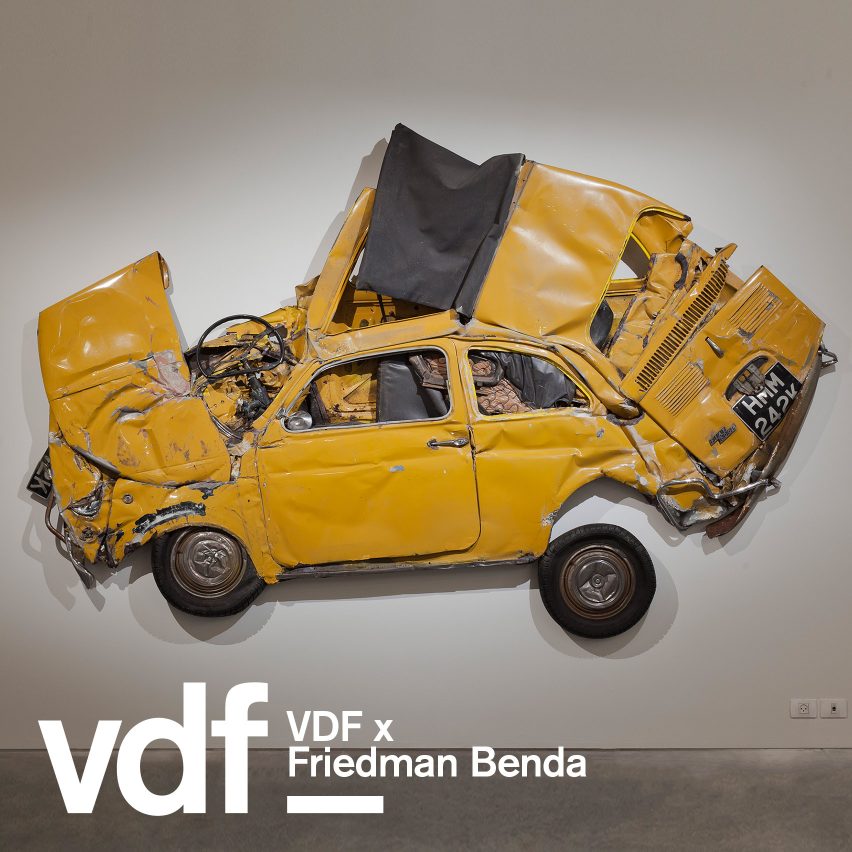
In the video, Arad also presented his 2013 project Pressed Flowers, which comprises a series of Fiat 500 cars that have been flattened by a pneumatic metal press. The pieces were presented at Design Museum Holon at an exhibition called In Reverse.
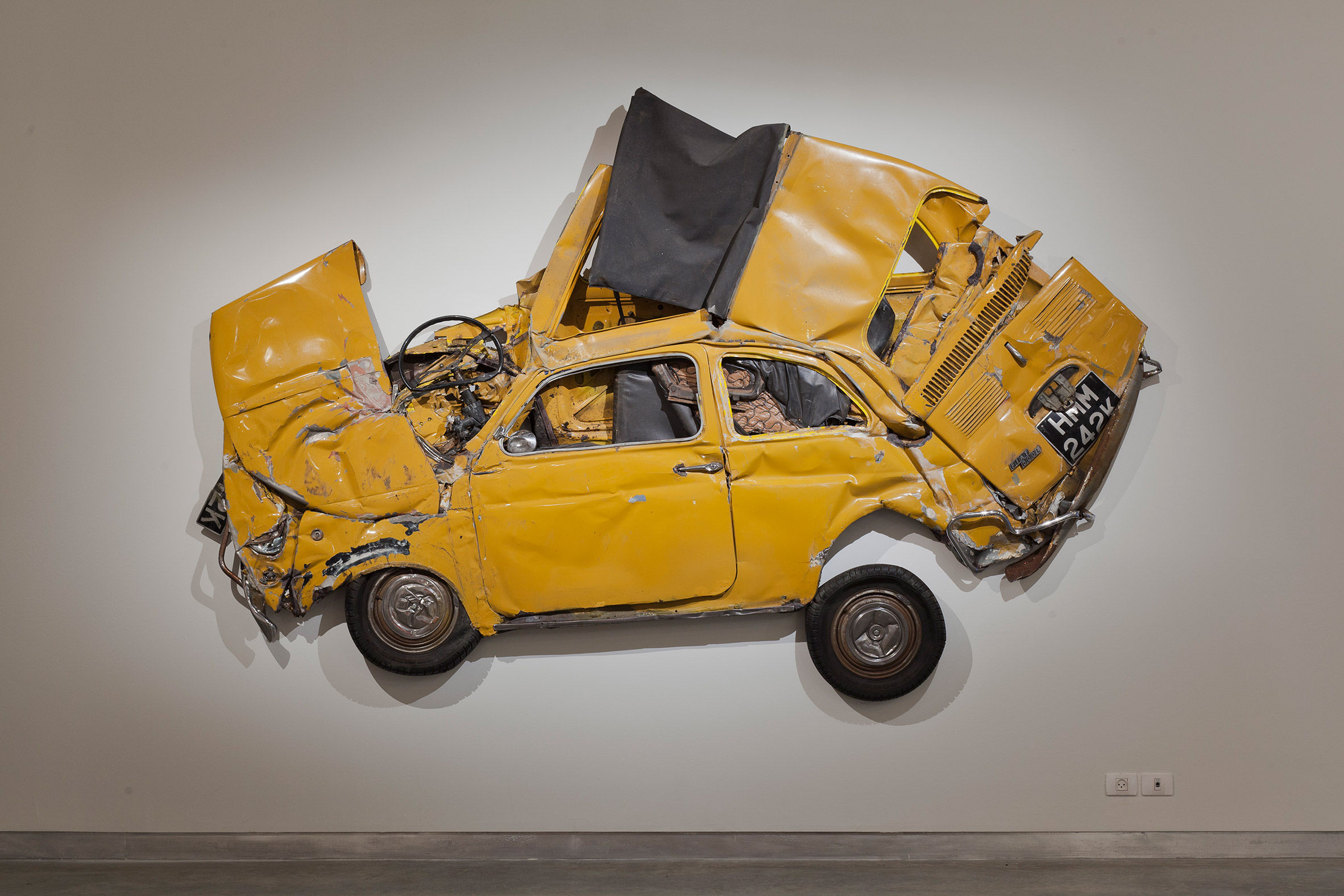
Arad insisted that he was not destroying the cars, but rather "immortalising them", showing a series of videos documenting numerous failed attempts to flatten the cars – including by running them over with a digger – which he rejected for being too destructive.
"Without even asking me, they [his fabricator] took it to be tortured by a digger," he said. "That's not what I wanted to do. I am not a ruinist!"
Eventually, Arad found a metal press at a shipyard in the Netherlands, which was strong enough to crush the cars smoothly and make them as flat as he envisioned.
"I went to my garage and told them what I wanted to do and they started crying," he recalled. "And I said: 'Listen, I am not destroying the cars, I am immortalising them'. And they understood and they prepared all these cars for me."
"We took them to Holland, to a shipbuilder. And we took them to a metal manipulating press. It took half a year to arrive there, but we pressed six cars in a day."
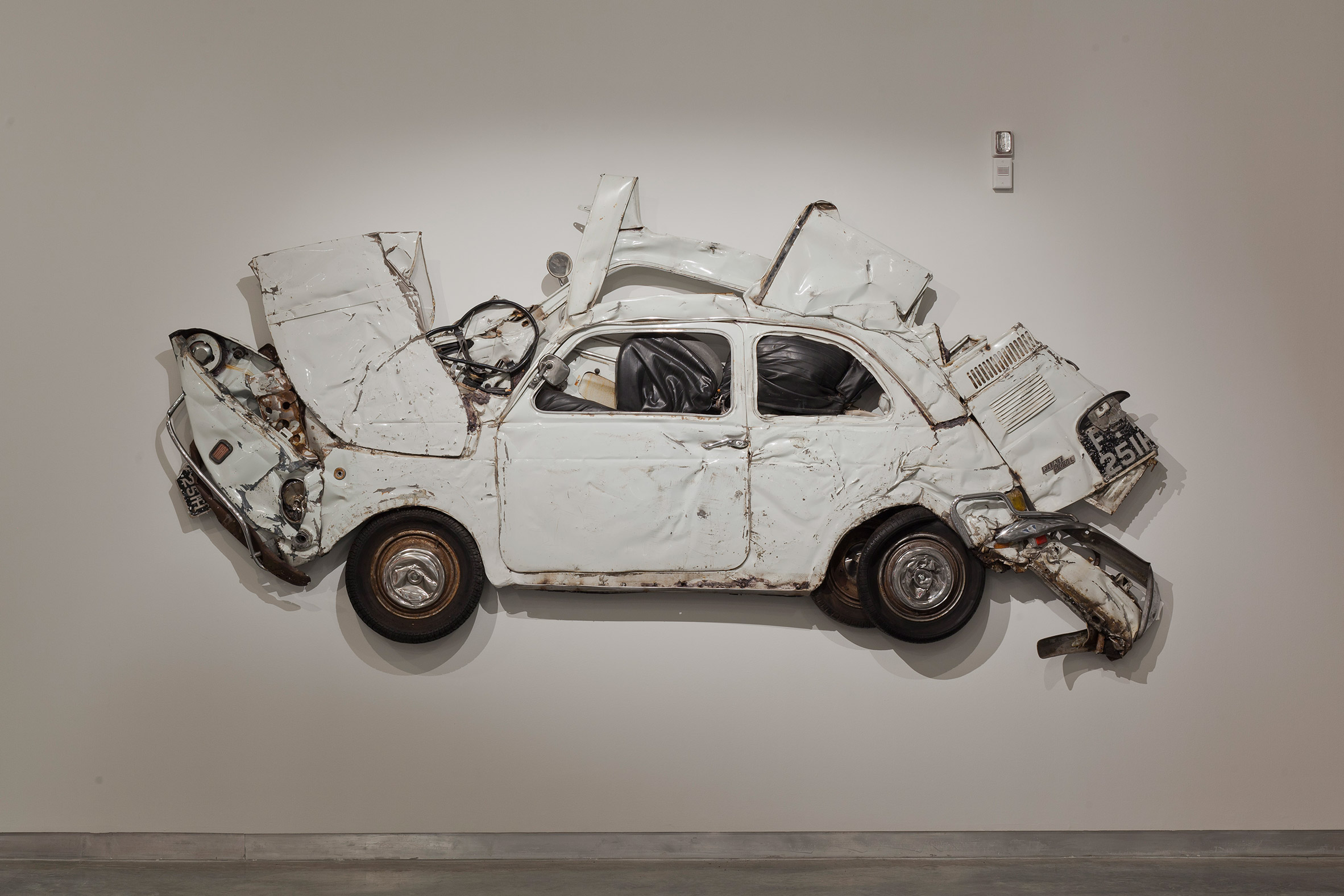
Arad also revealed that the project led to the Italian automotive giant approaching him to design its stand for the 2014 Paris Motor Show, another example of how he claims to have stumbled upon commercial success without looking for it.
"It's funny, Fiat was an amazing collaborator," Arad said. "I crushed the cars and later they asked me to design their motor show in Paris."
Design in Dialogue
Arad's conversation with Adamson is the third in a series of Friedman Benda's Design in Dialogue talks we are broadcasting as part of Virtual Design Festival.
Previous interviews in the series we have published include conversations with pioneering architect James Wines, who lamented the predominance of digitally created forms in architecture, and designer Faye Toogood, who revealed she suffers from imposter syndrome.
Last month, as part of VDF, Arad launched a new series of sculptural chairs, which were originally supposed to be exhibited at the OTI Gallery in Los Angeles before the show was cancelled due to the coronavirus pandemic.
Arad also took part in a live interview with Dezeen's editor-in-chief Marcus Fairs, in which he revealed a series of masks featuring portraits of famous artists that will be sold to raise money for the UK's National Health Service.
The post "I'm not entrepreneurial. For me, business was always a necessary evil," says Ron Arad appeared first on Dezeen.
For this month’s Double Click, we look at sites which have accomplished showing photography in aesthetically pleasing or technically apt ways.

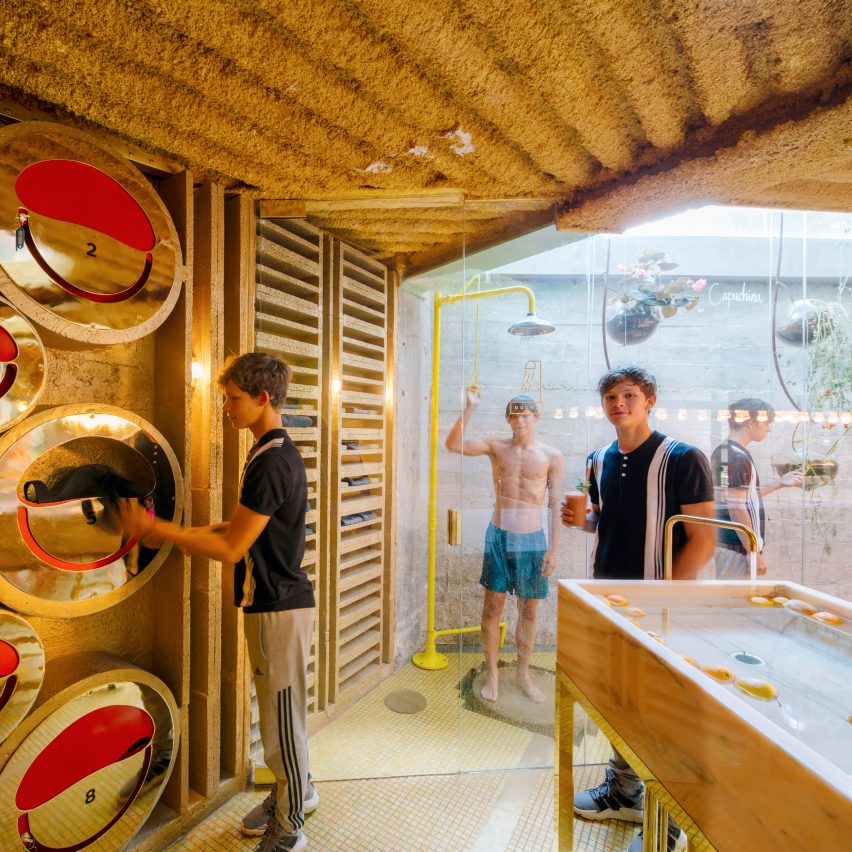
More than food and drink is offered inside this healthy cafe in Madrid, where architecture practice Office for Political Innovations has included a host of quirky facilities.
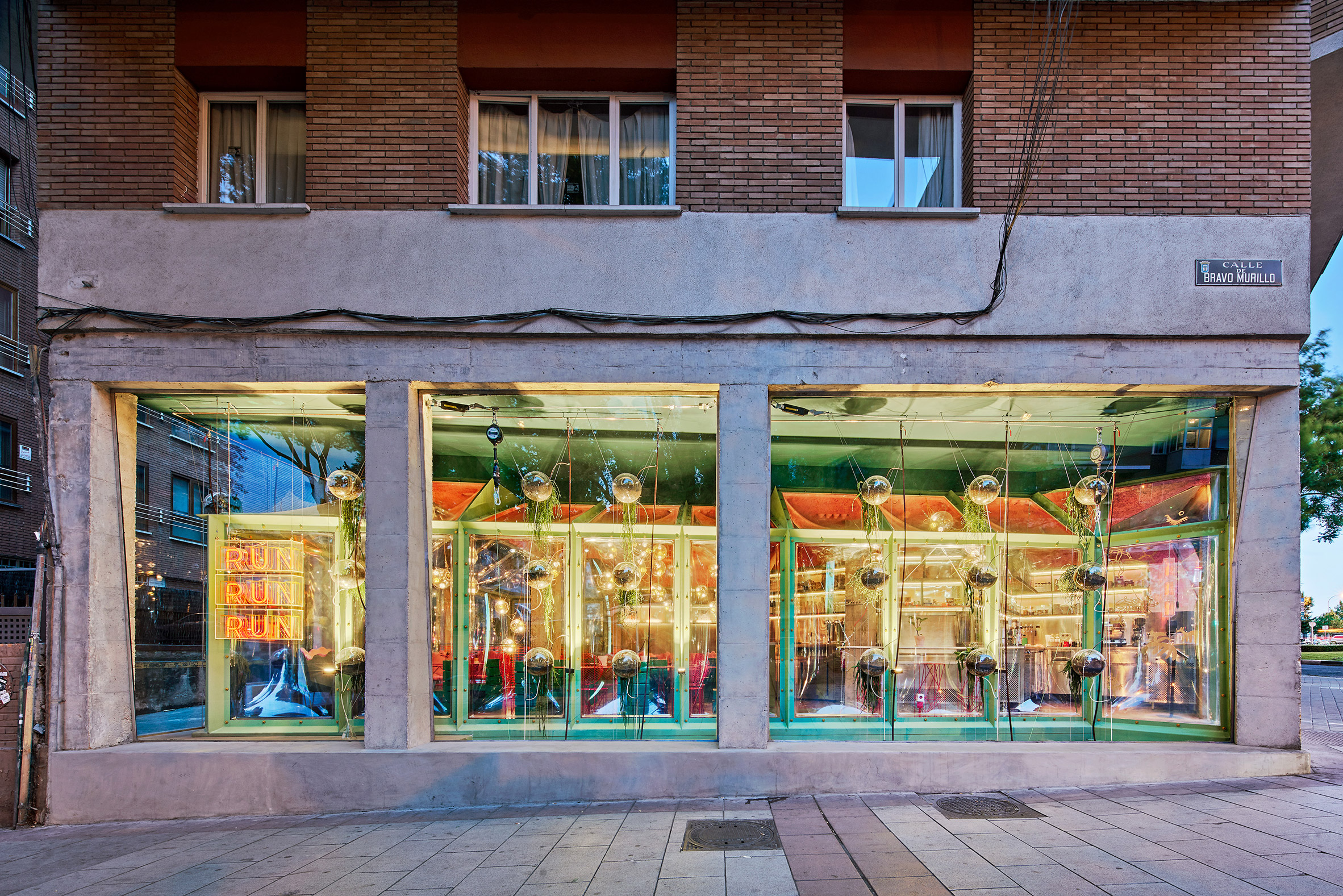
Run Run Run takes over a corner plot in Madrid's Rios Rosas neighbourhood.
The two-floor cafe, which also hosts a running club for locals, includes showers and lockers, as well as a vegetable garden that grows ingredients required for the dishes on the menu.
Locally based Office for Political Innovations hopes this clashing mix of facilities will encourage people to "use the city differently".
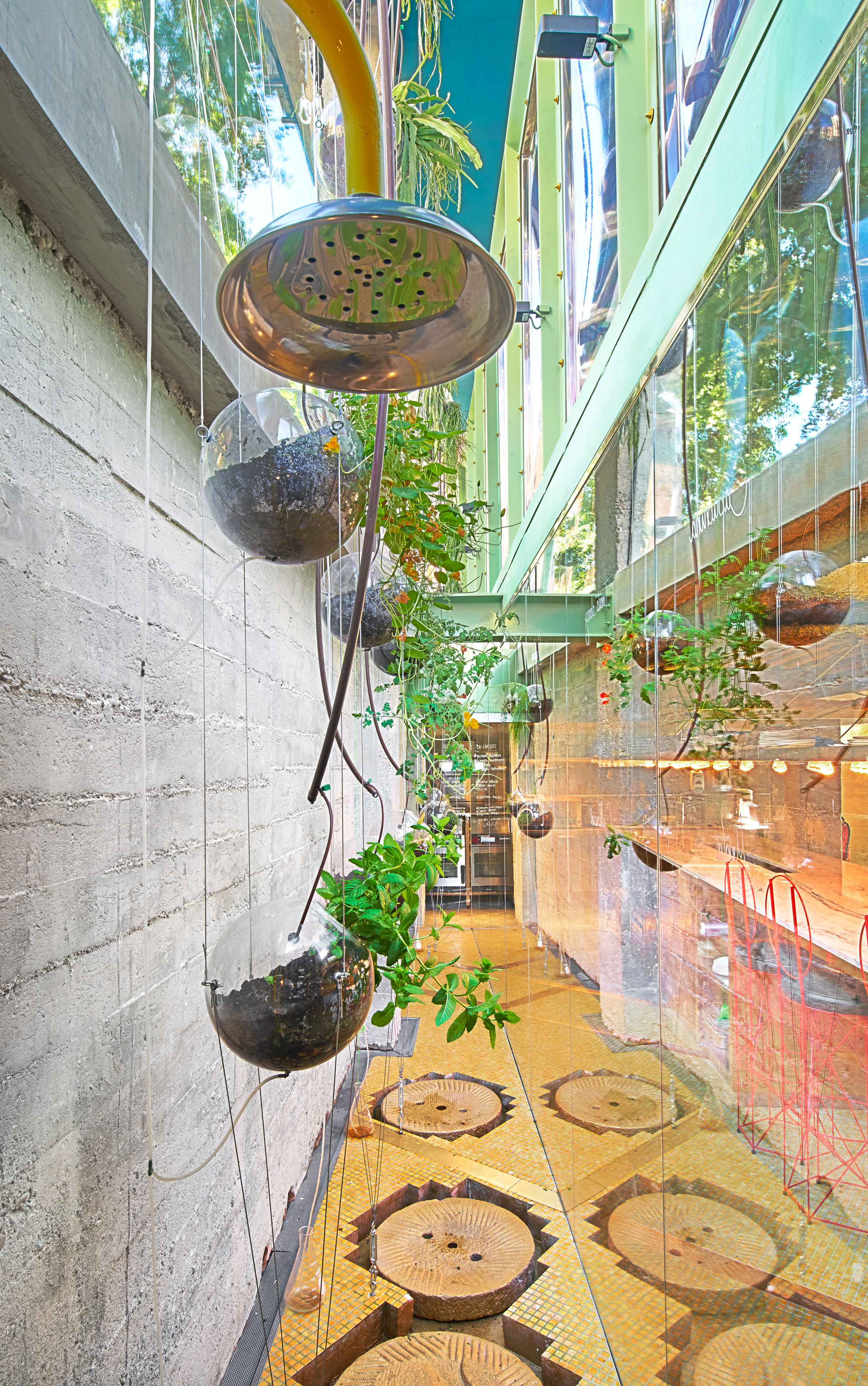
"Its an infrastructure that turns the city into a playground and a place for people to transform their bodies," said the practice.
"It supports emancipation from domestic spaces and provides opportunities for interhuman gathering through activities that usually promote individuality."
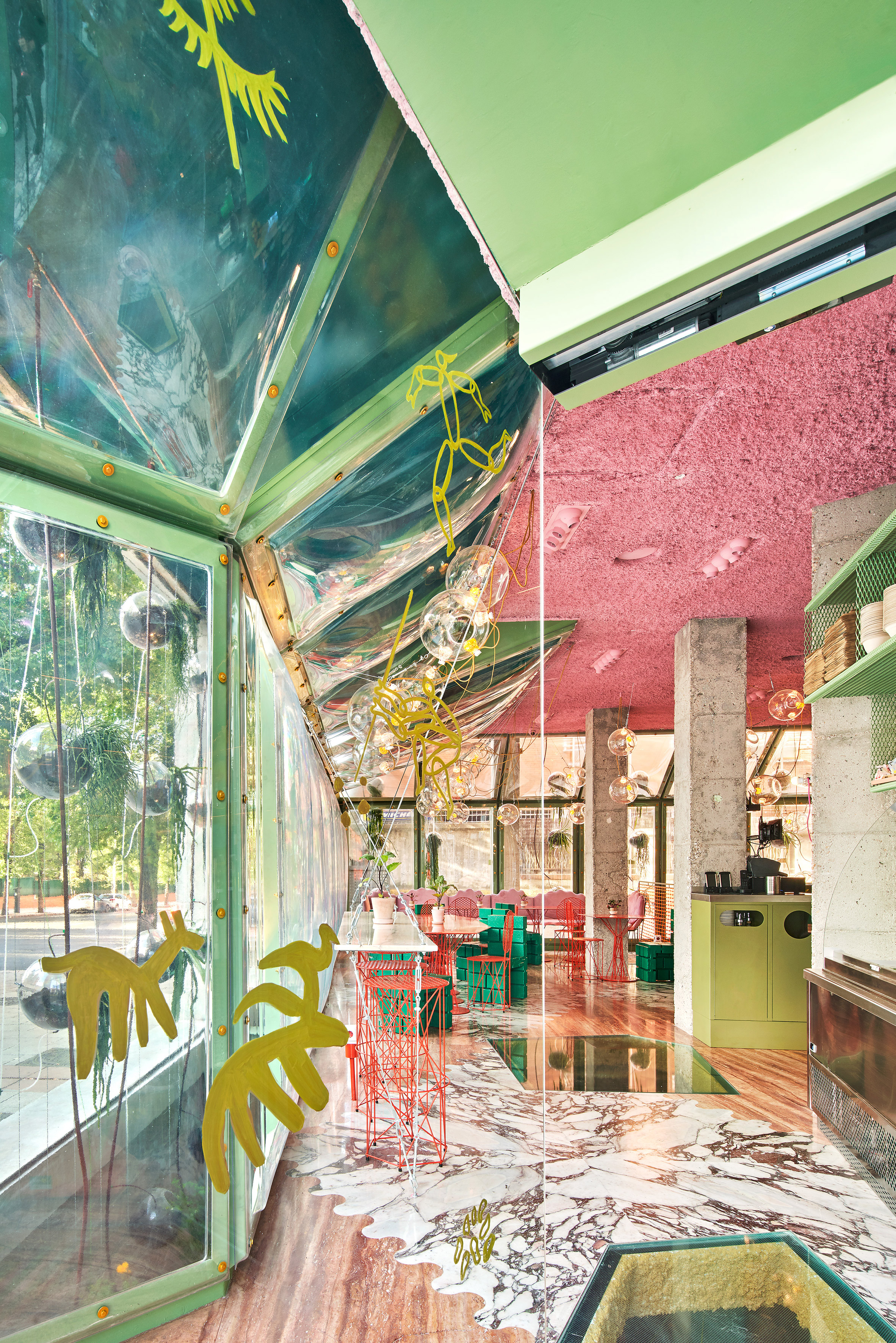
A social security office previously occupied the site of Run Run Run, but its fit-out was completely stripped back to leave behind just a handful of concrete columns.
The practice worked around these columns to erect an internal greenhouse-like structure, composed of mint-green steel beams and sheets of plastic.
Spherical glass orbs planted with soil and vegetables have been suspended in the narrow void between the greenhouse and the facade of the building, allowing passerby on the street to get an up-close glimpse of the produce being grown.
There's also a red neon sign denoting the cafe's name.
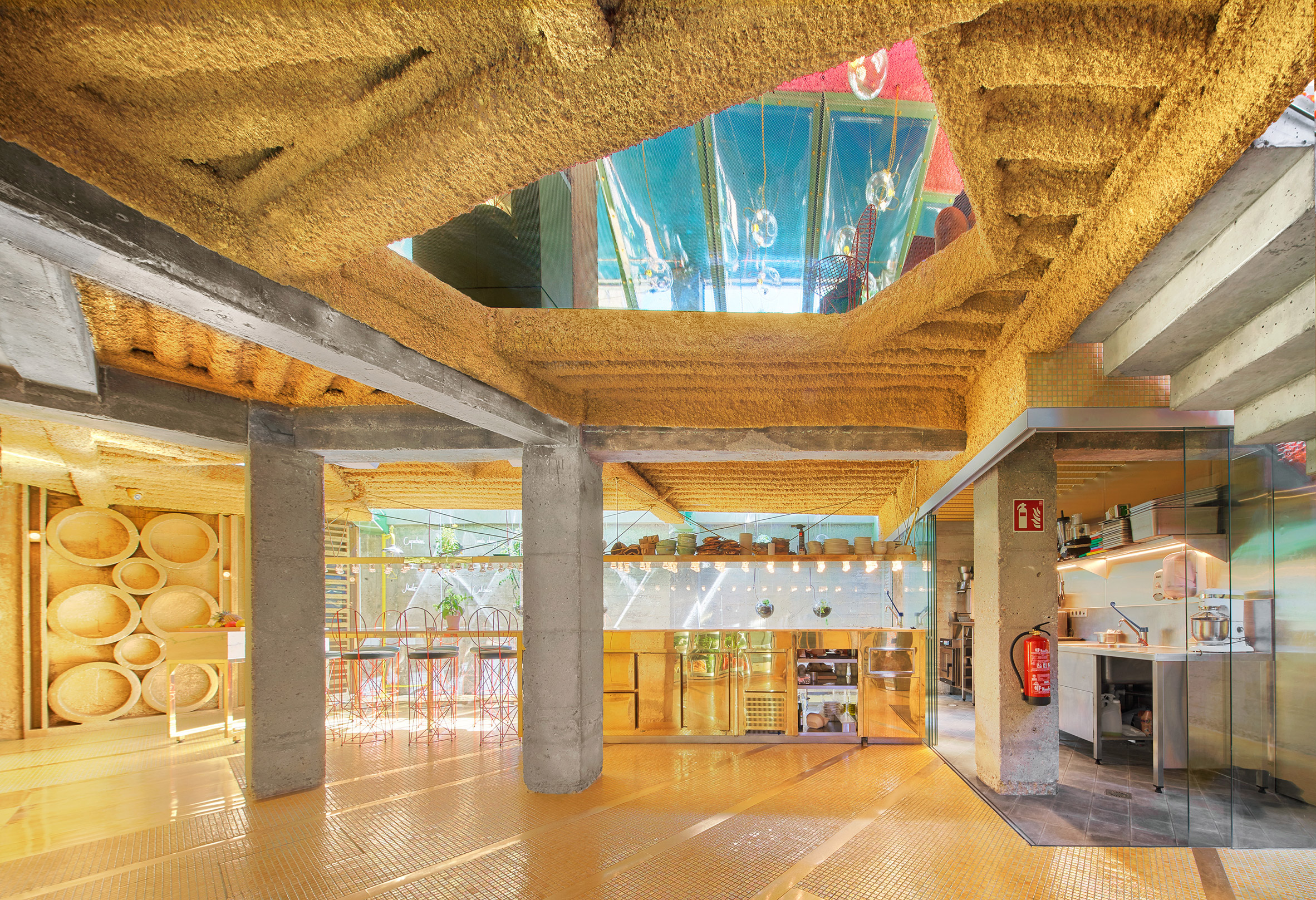
The practice has applied a vibrant mismatch of colours and materials inside on the ground floor, where the main cafe area lies.
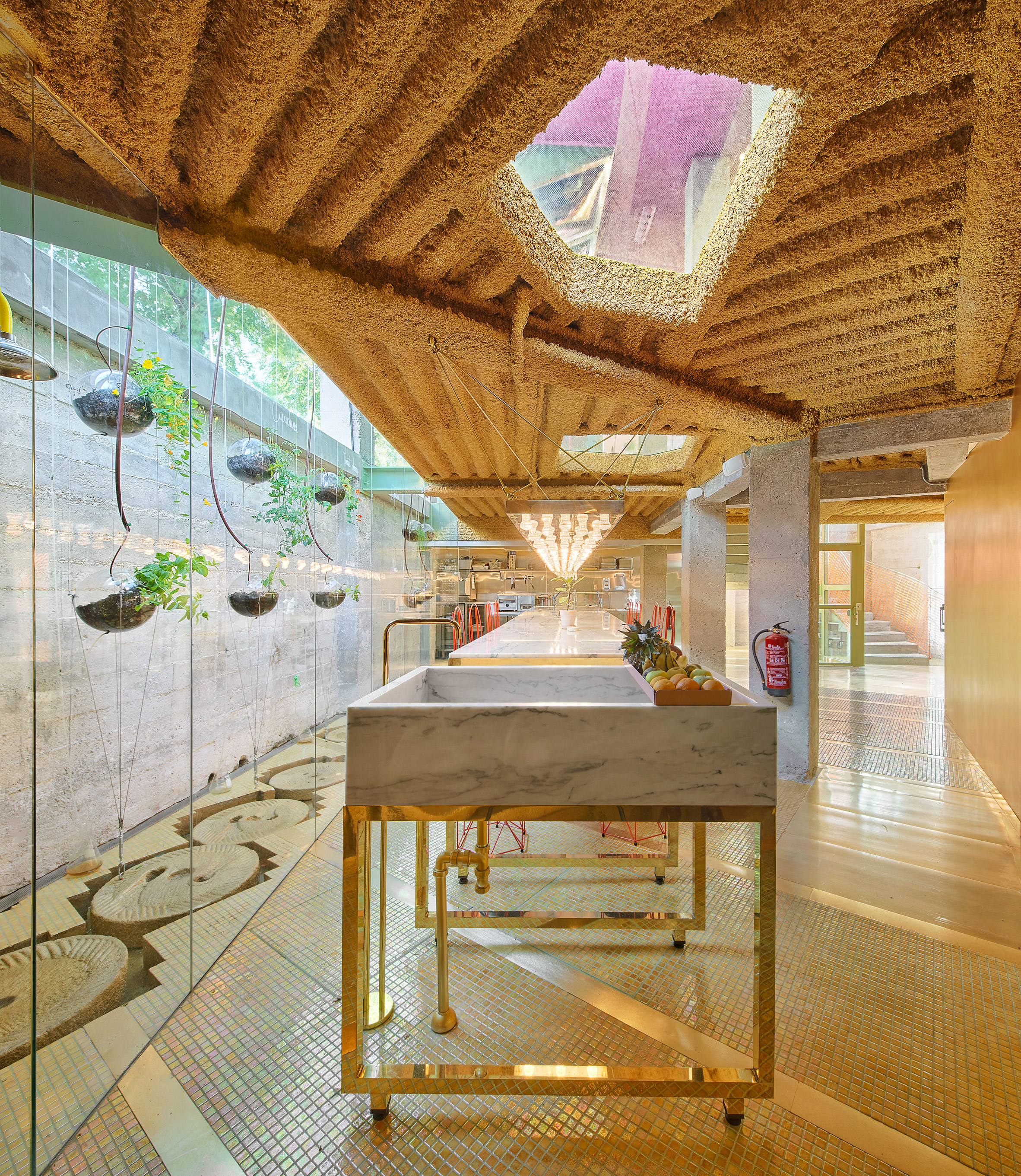
Organic cellulose was used to create a grainy surface texture across the ceiling, which has been painted pink. Wood and pale, veiny marble have then been spliced together to form a patchwork floor.
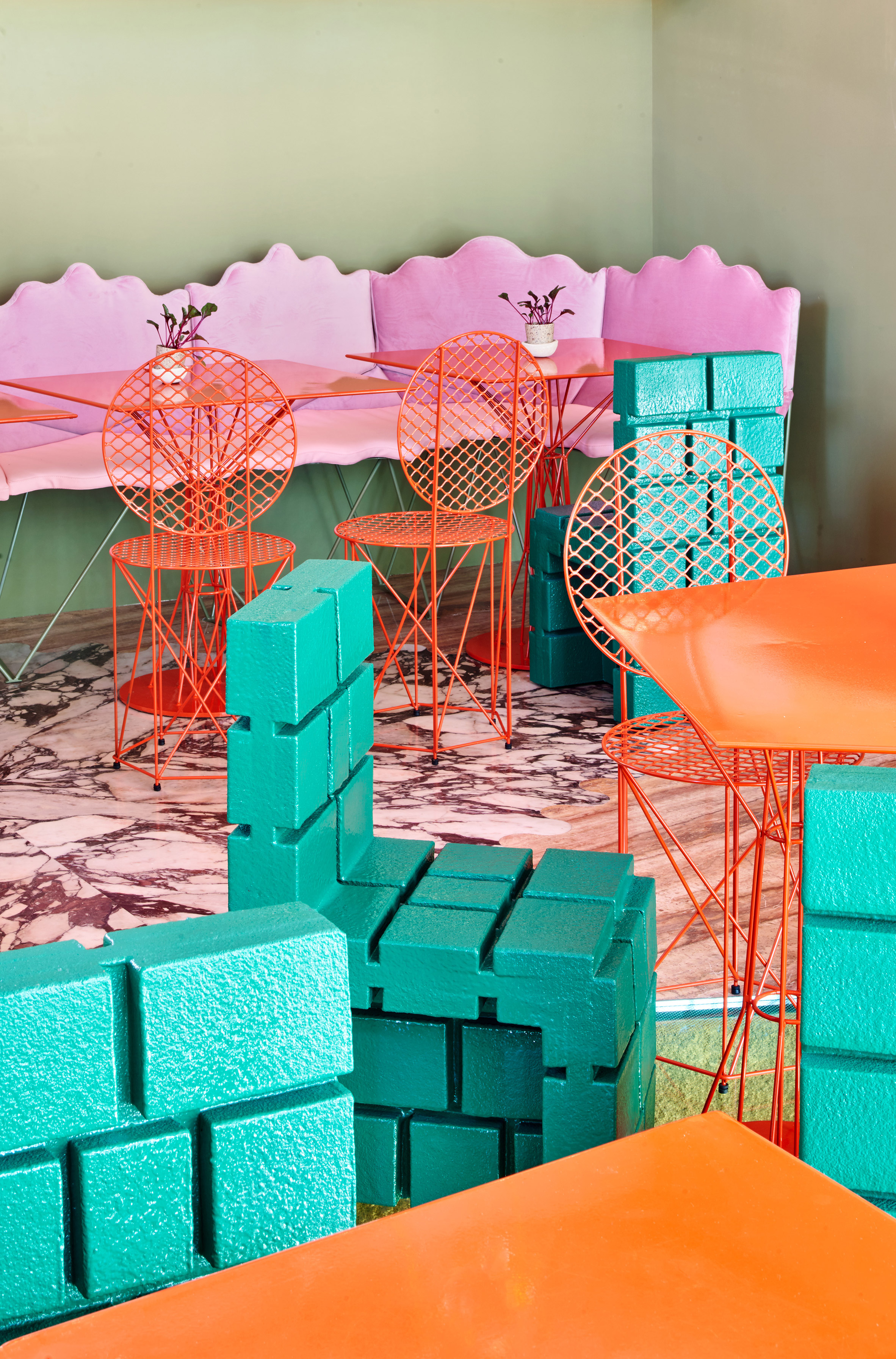
Bright orange dining tables have been dotted throughout. Some of them back onto bubblegum-pink seating booths with scalloped edges, while others are surrounded by bespoke chairs that the practice designed itself.
One model has a vermillion-red metal frame, with a criss-cross base and meshed circular backrest.
The other style of chair has a more blocky form and is composed of sea-green bricks made from wax and pine tree resin.
"[The chairs] look like quite stable architectural elements, as a way to underscore the mutability and lightness of the rest of the elements in Run Run Run's architecture," the practice's founder, Andrés Jaque, told Dezeen.
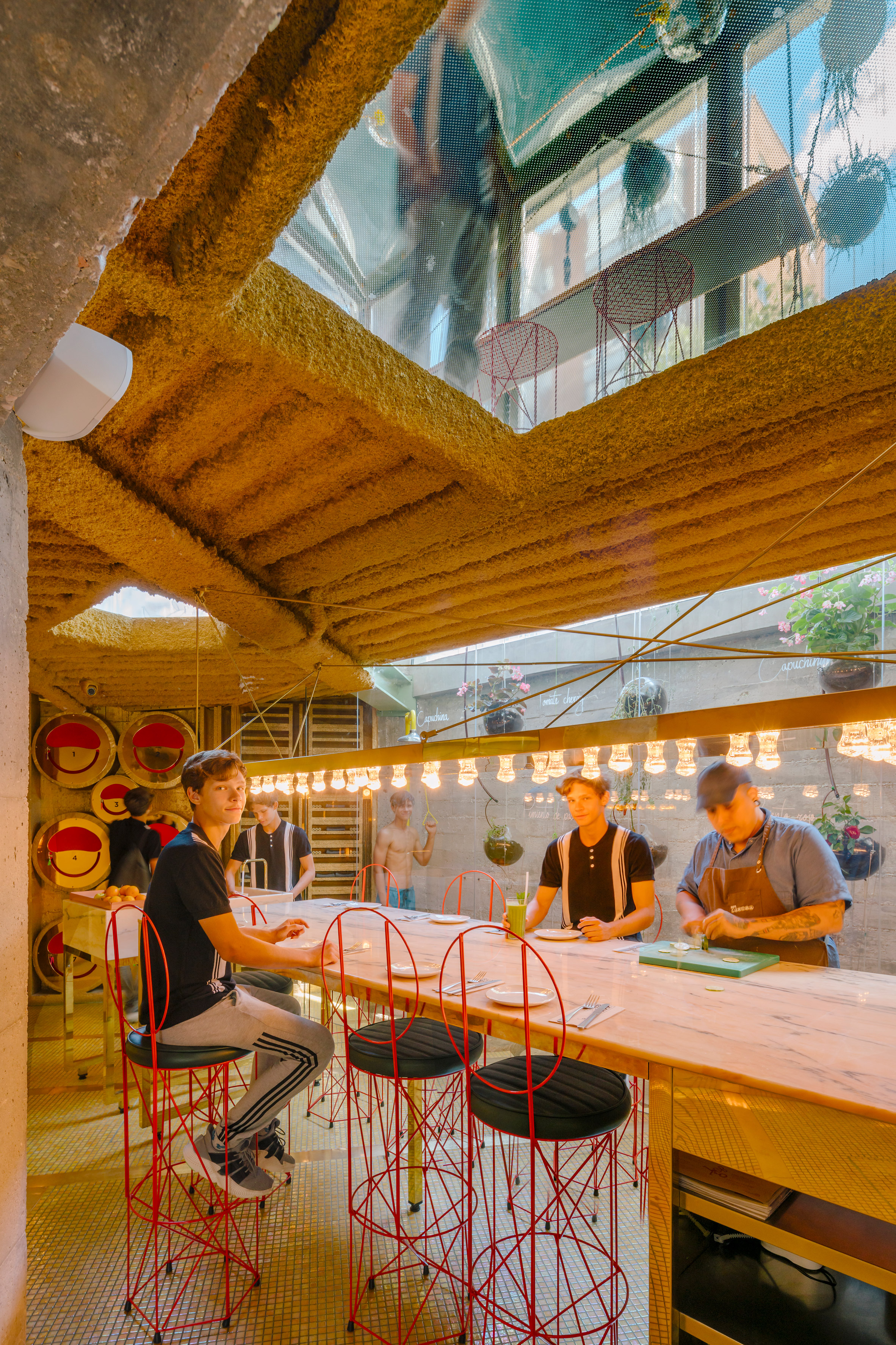
The practice's bold palette continues down on the lower-ground floor. Here there's a casual meeting area anchored by a long brass and marble table, illuminated by an exposed-bulb lamp that dangles above.
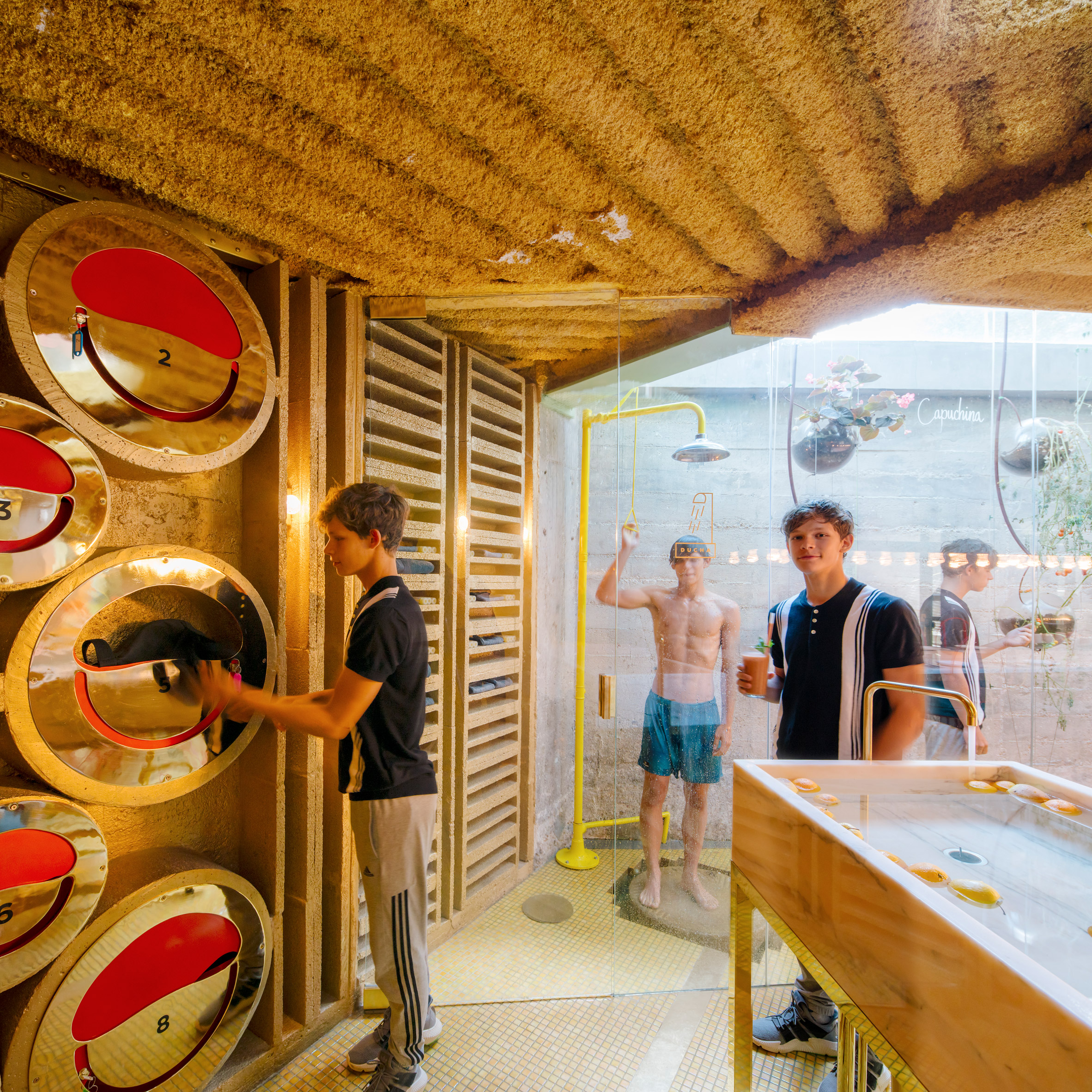
Behind are the showers, only separated by a pane of glass. If users dare to get bare, they can leave their belongings in the round silver-metal lockers that extend from the wall.
Office for Political Innovation was established in 2003 by Andrés Jaque. The architect has most recently collaborated with Ivan Munuera to create a short film on the impact of coronavirus, which premiered during Dezeen's Virtual Design Festival.
The film, titled The Transscalar Architecture of COVID-19, reveals how the pandemic has affected everything from the economy and the built environment, to pollution levels and wildlife habitats.
Photography is by José Hevia.
The post Run Run Run cafe has a hanging vegetable garden and see-through showers appeared first on Dezeen.


