Monday, 23 November 2020

Benjamin Fainlight puts streetwear spin on Pierre Jeanneret's Chandigarh Easy Chair

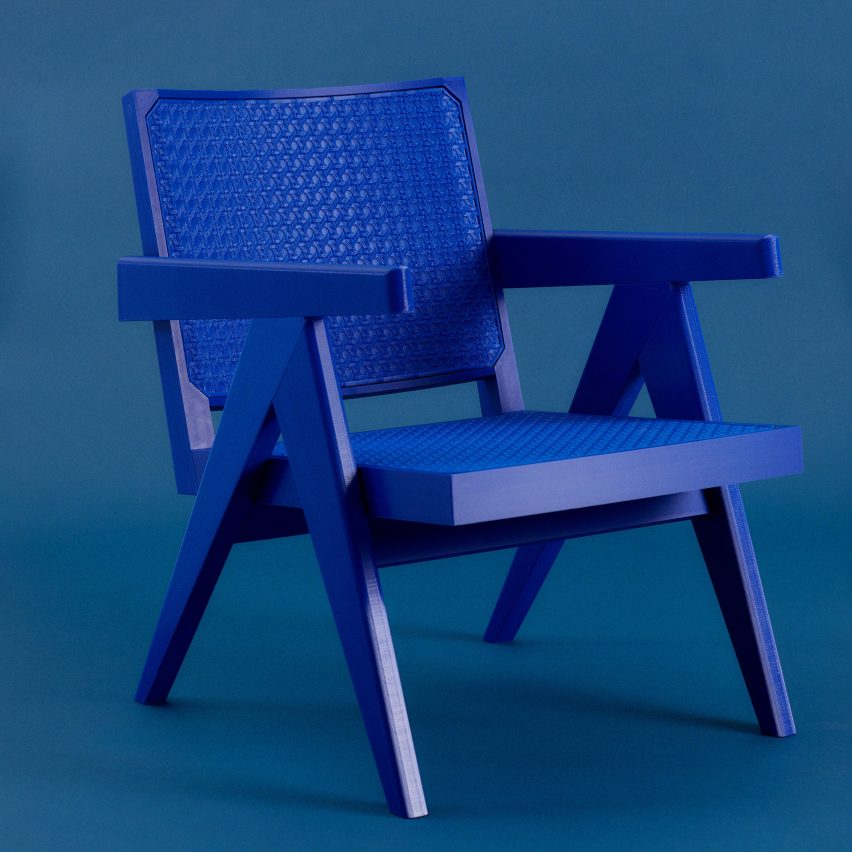
Streetwear version of Pierre Jeanneret's Chandigarh Easy Chair by Benjamin Fainlight

Designer Benjamin Fainlight has created a flat-packed, 3D-printed version of Pierre Jeanneret's Easy Chair that was originally created for the city of Chandigarh in India.

The designer decided to reimagine the Easy Chair to demonstrate how seminal furniture designs could be dissected and updated, much like streetwear has been doing with fashion.
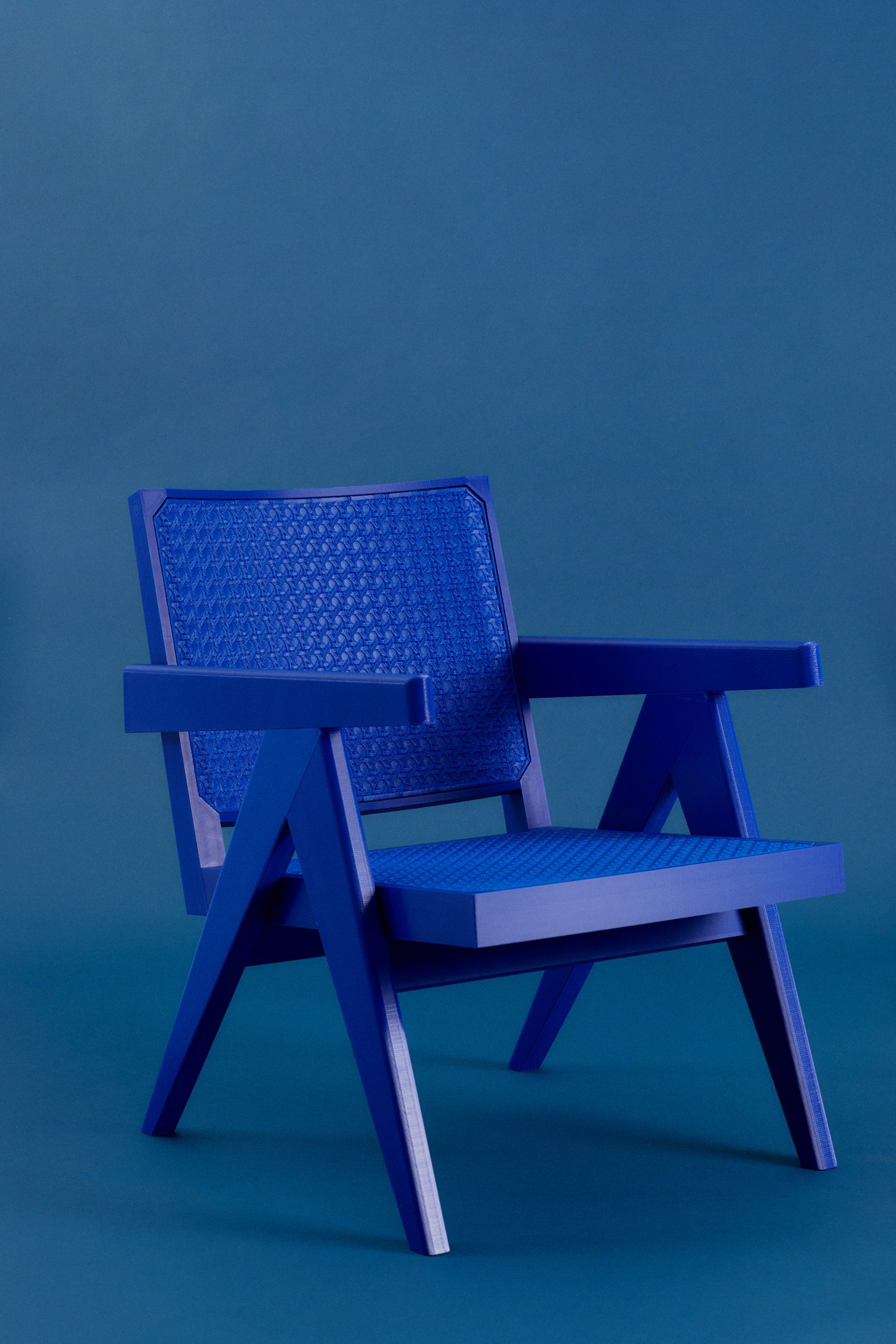
Streetwear version of Pierre Jeanneret's Chandigarh Easy Chair by Benjamin Fainlight
Benjamin Fainlight redesigned Pierre Jeanneret's Chandigarh Easy Chair

"I saw a lot of streetwear designers and brands seeping into the furniture world – Virgil Abloh x IKEA and Vitra, Supreme x Knoll and so on," explained Fainlight.

"But they were really just changing colourways, materials or upholstery, and not necessarily reimagining the furniture pieces in the way streetwear tends to subvert and recontextualise references," he told Dezeen.

"I wanted to challenge myself to apply a really direct streetwear methodology to furniture and create something totally new instead of just re-skinning something that already existed in some form."
Pierre Jeanneret's Chandigarh Easy Chair redesign
The reimagined chair was 3D-printed

Fainlight focused on reworking the Easy Chair, as it was a well-known historic piece that had the potential to be given a modern twist.

The wooden chair with a cane seat was originally designed by Pierre Jeanneret in the 1950s for civil servants working in the city of Chandigarh and developed largely in collaboration with his cousin Le Corbusier.
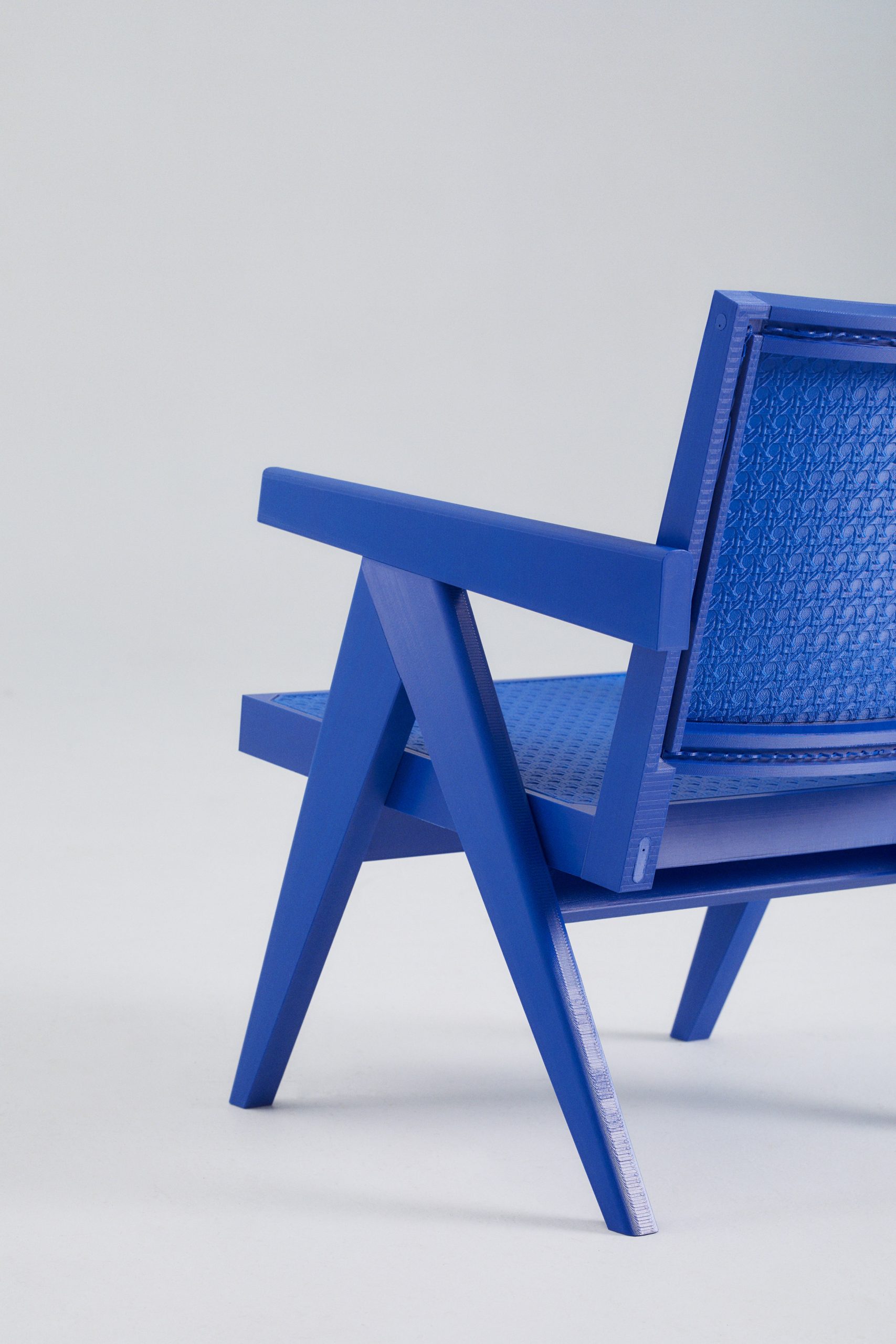
3D-printed chair
It was originally made from timber and cane

"I wanted to work with a design that was iconic, had a backstory to its existence and popularity, and most importantly was handcrafted, since my version would be the antithesis of handcraftsmanship," said Fainlight.

"The Easy Chair seemed to fit that brief perfectly – its wood fabrication made it easily translatable to plastic, the angularity of the chair made it doable – though not easy – for slicing into flat-pack pieces, and the caned panels for the back and seat gave it a texture and dimension to show what's feasible with 3D printing."
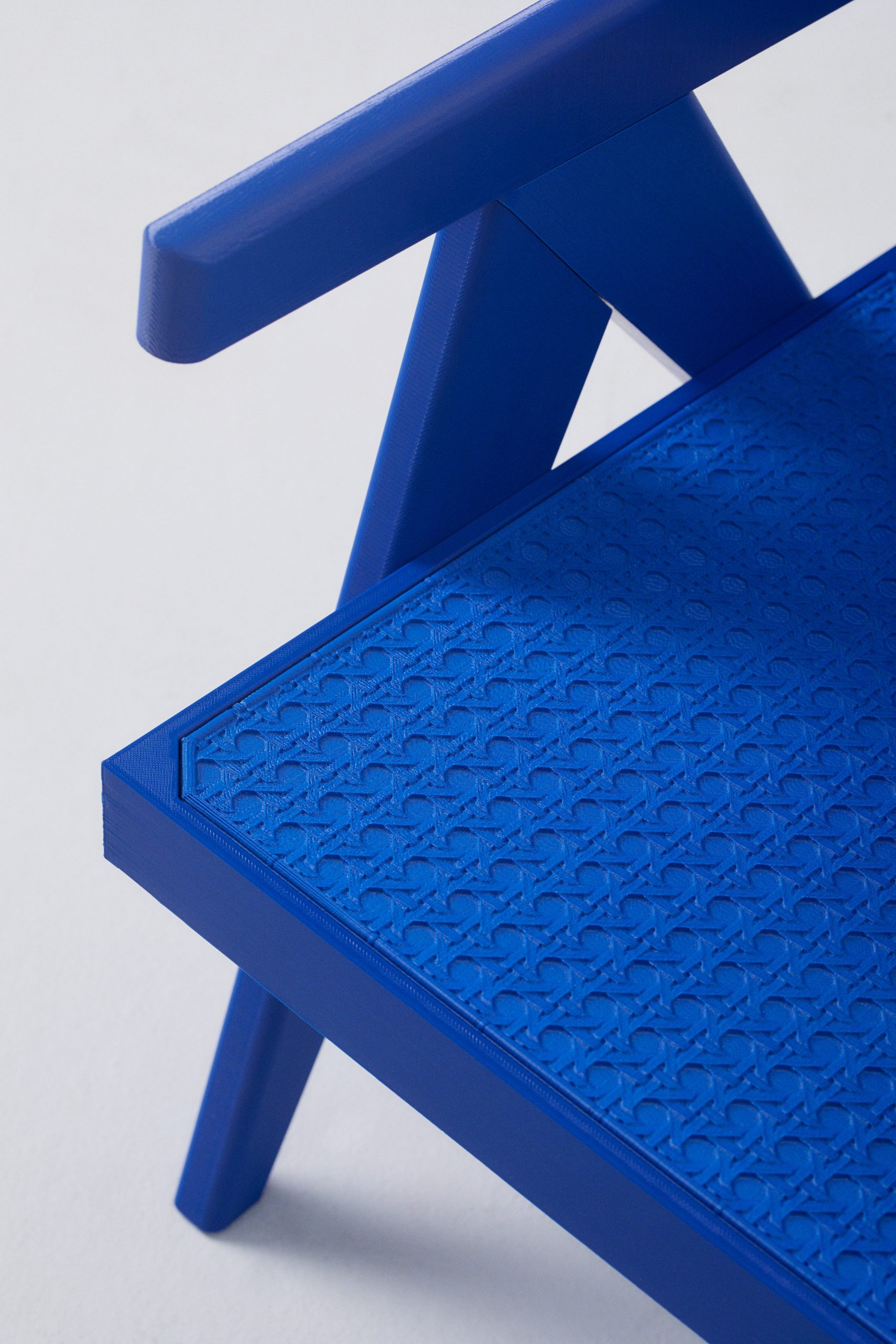
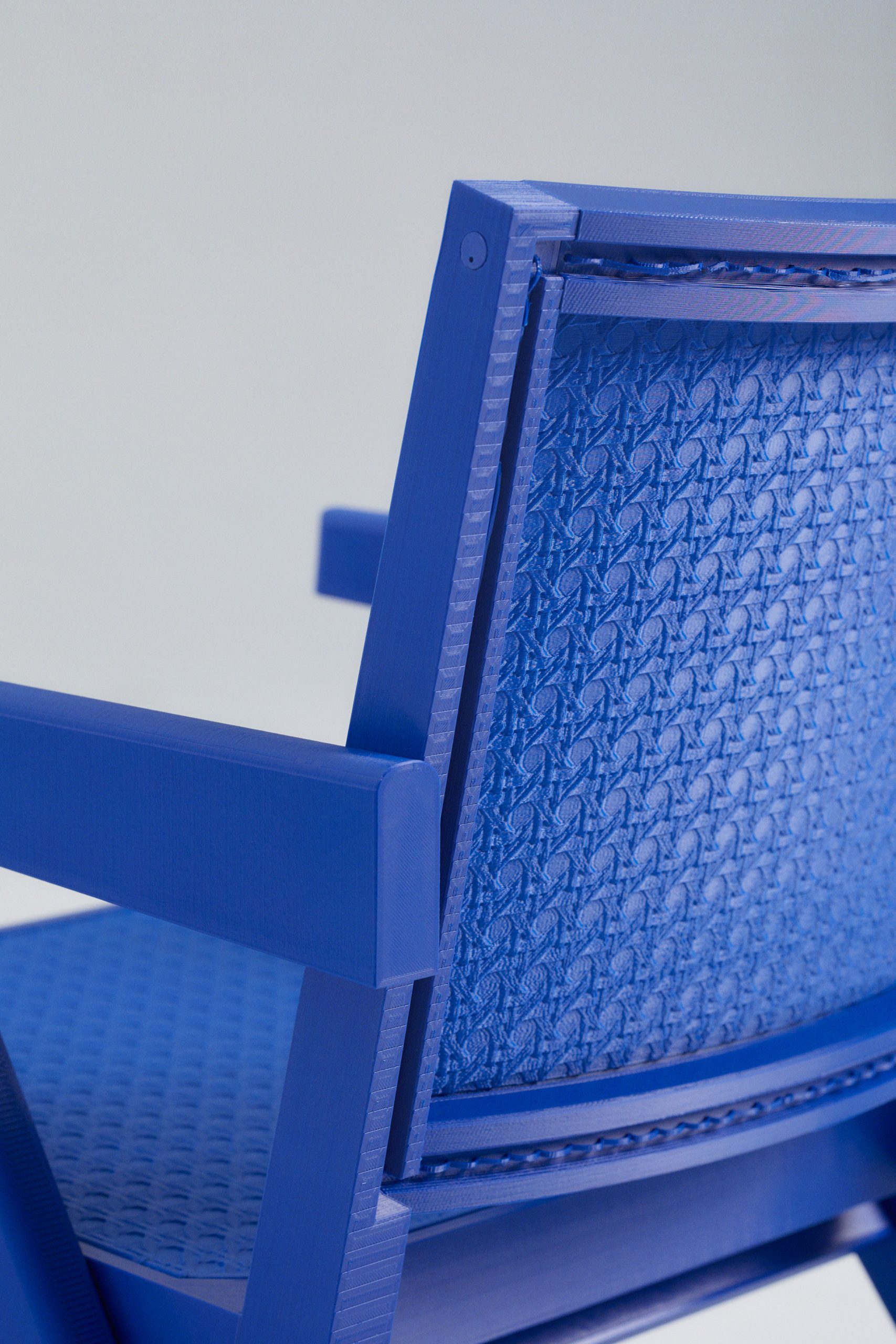
3D-printed chair
The printing captured the chair's original details

Fainlight wanted to transform not just the colour of the chair, but how it was constructed and shipped.

According to the designer, 3D-printing the updated Easy Chair and making it so that it can be flat-packed clearly marks the design as a modern piece, as does the choice of International Klein Blue (IKB) as its colour.
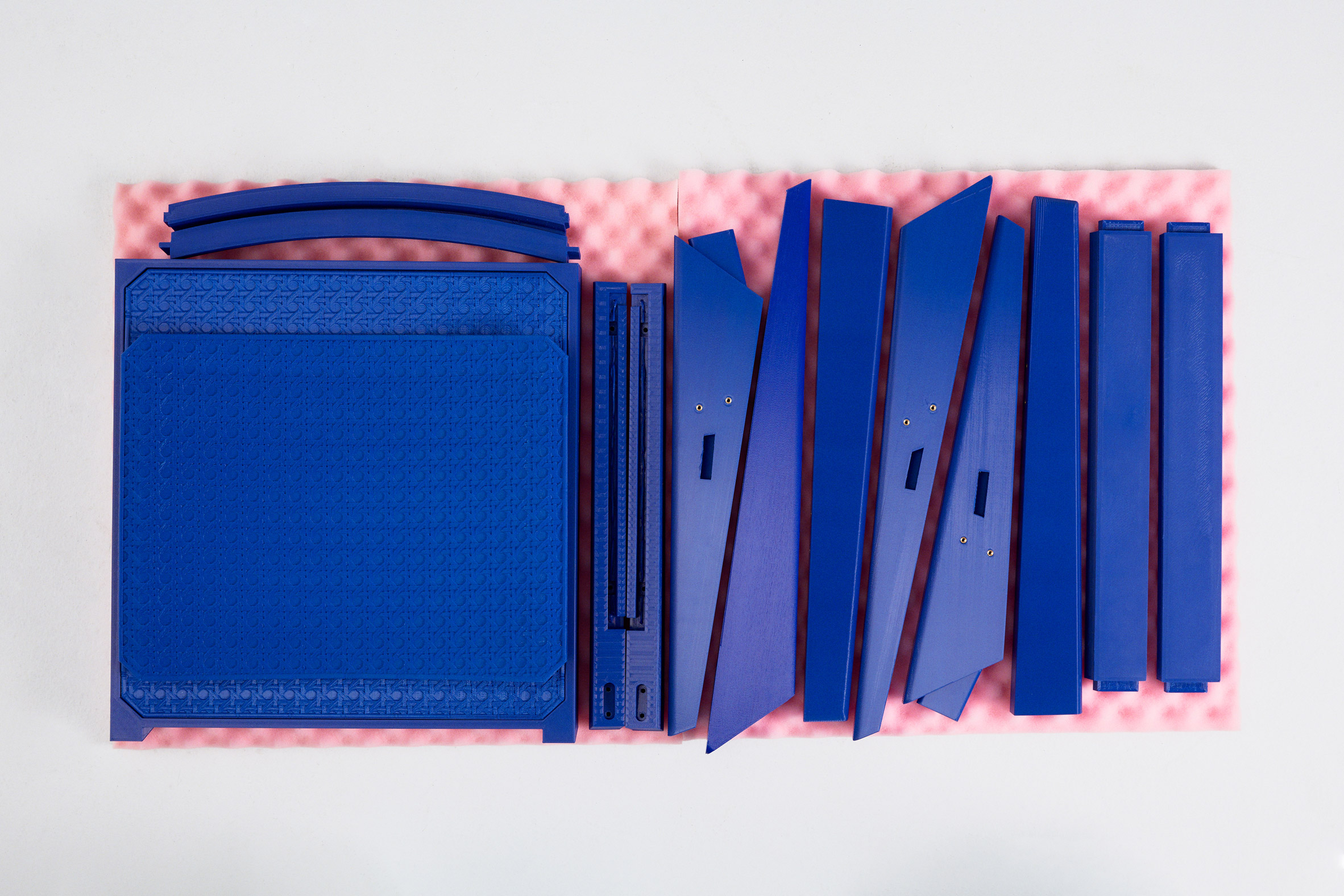
Flat-packed chair
It was designed to be flat-packed

"More than anything else I think flat-packing is the most modern way for furniture to exist. I wanted to show that flat-packing isn't necessarily a determining factor in the quality of design or importance of a piece, but can be a uniting factor since everyone is familiar with it – just like a T-shirt is to streetwear and clothing," said Fainlight.

"I wanted to use a colour that was so incredibly unnatural, the chair could never be mistaken for something handmade or using materials found in nature," he continued.

"IKB seemed like the perfect hue to strive for since there's a certain utopian consistency across everything in that colour."
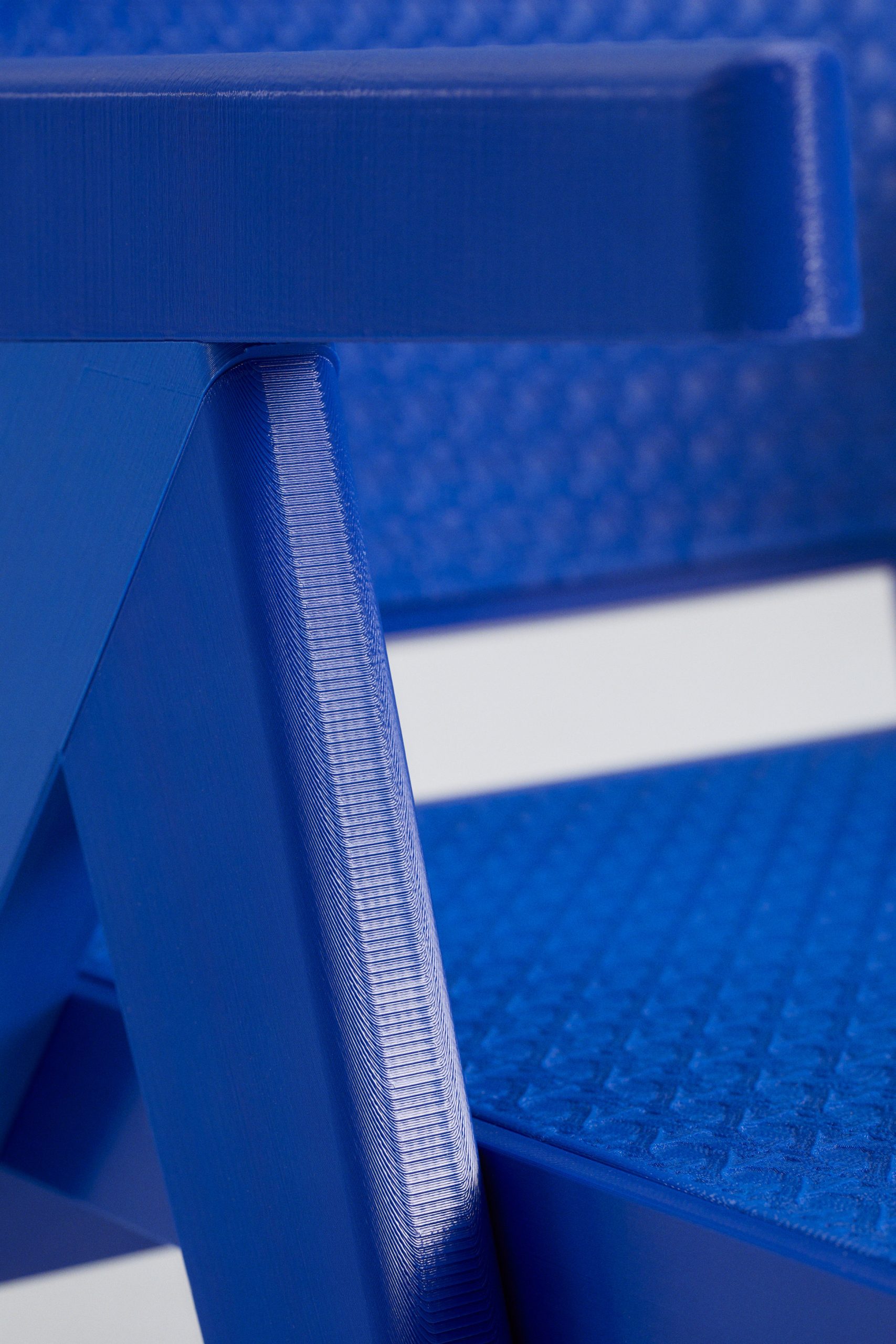
Streetwear version of Pierre Jeanneret's Chandigarh Easy Chair by Benjamin Fainlight
The chair was coloured International Klein Blue to express its artificial nature

Fainlight believes that the redesign and its method of construction provides a commentary on contemporary furniture design.

"I think it speaks to the world we live in today, where anyone with a 3D printer and enough time on their hands could take an icon and make something totally new from it, or something totally new as a whole," he explained.

"Design and fabrication aren't limited to people with degrees or years of experience in the field and can be democratised for everyone's involvement."
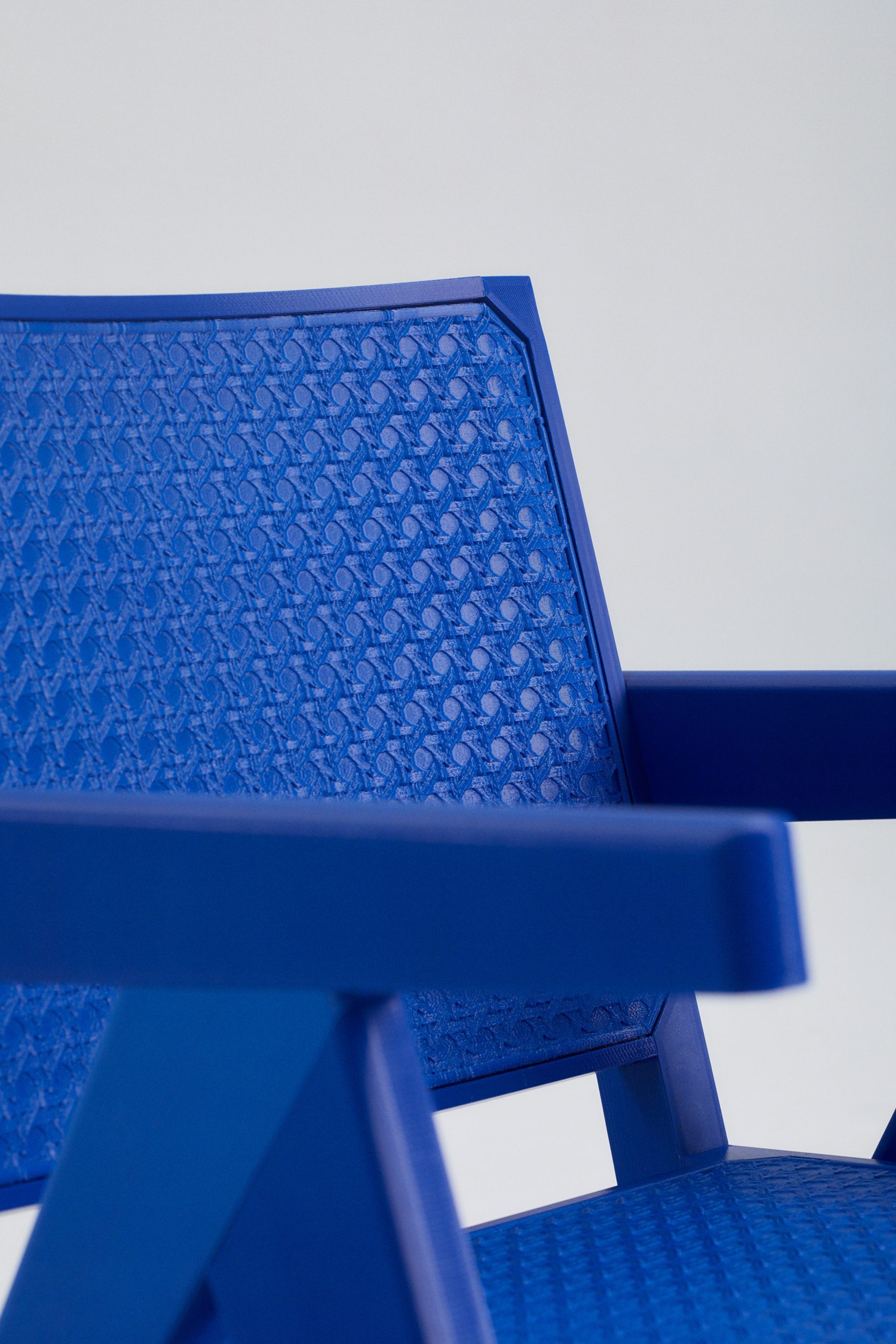
Streetwear version of Pierre Jeanneret's Chandigarh Easy Chair by Benjamin Fainlight
Pierre Jeanneret designed the Easy Chair for Chandigarh

Pierre Jeanneret worked extensively with his cousin Le Corbusier, whose real name was Charles-Édouard Jeanneret. At Chandigarh, Pierre Jeanneret master-planned large areas of housing and was given the title chief architect of the city.

He collaborated with Le Corbusier on the design and furnishings of many of the city's major public buildings including the Capitol Complex.

Photography is by Sam Sklar.

The post Benjamin Fainlight puts streetwear spin on Pierre Jeanneret's Chandigarh Easy Chair appeared first on Dezeen.


from Dezeen https://ift.tt/3ftSdqC

Foolscap Studio and Manapan design Gulnura Table informed by First Nations crafts

Manapan and Foolscap Studio's Gulnura Table

Foolscap Studio and Manapan have crafted a wooden table for Melbourne Airport, which references traditional First Nations ceremonial and battle shields.

The table, which is shortlisted in the workplace design category of Dezeen Awards 2020, was produced on Milingimbi Island by Manapan – a furniture brand is owned and operated by the Indigenous Australian YoIngu people.

Foolscap Studio worked closely with Manapan's senior craftsman Josiah Baker and Milingimbi Island elder Keith Lapulung on the project.

Foolscap Studio and Manapan Gulnura Table at Melbourne Airport
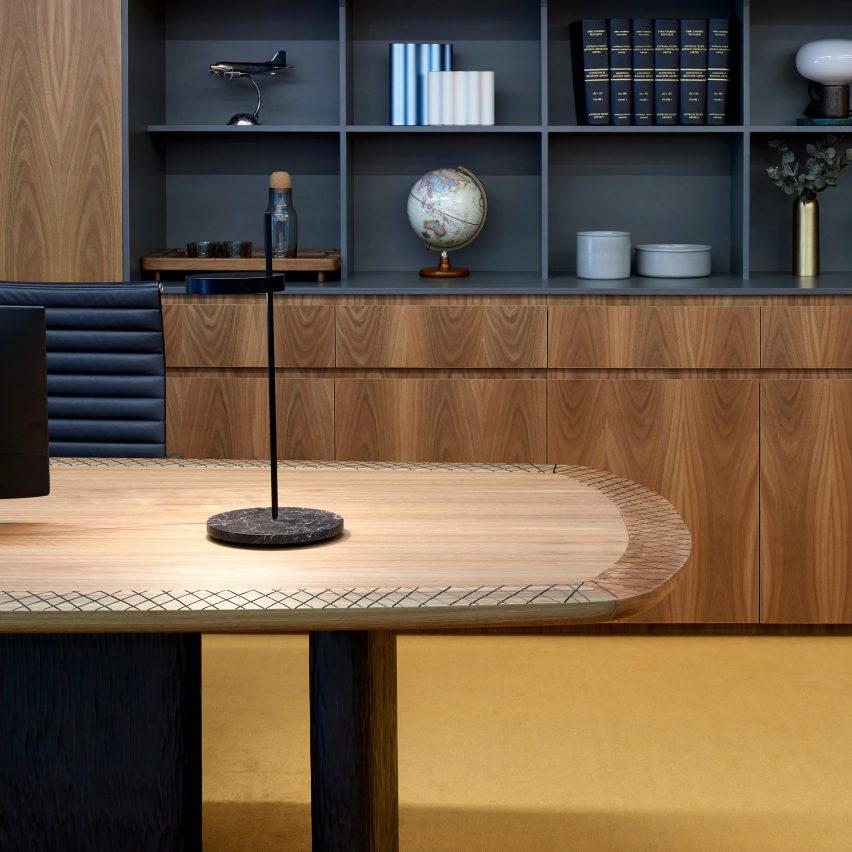
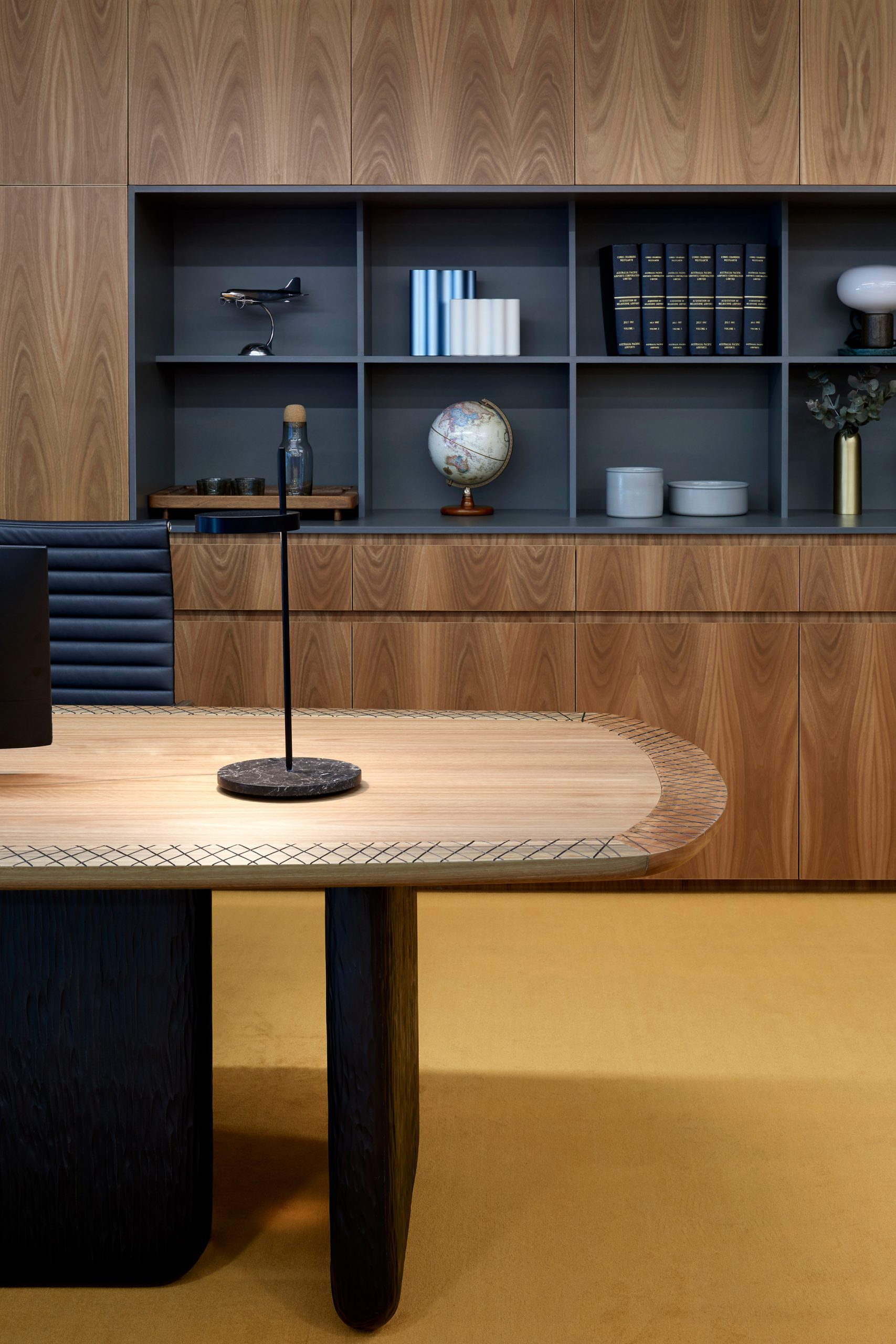
Top: the Gulnura Table in the executive area of Melbourne Airport. Above: cross-hatched carvings decorate the top

The Gulnura Table's form is reflective of traditional shields used in battle and for ceremonies, which were often highly decorated and featured intricate carvings.

It is named after the Gulnura, a lightning snake which is said to bring fresh water to Milingimbi Island every wet season.

"The representation of the serpent can be seen in the joinery of the tabletop, which references cultural meaning that is central to our First Nations collaborators," Foolscap Studio founding director Adèle Winteridge told Dezeen.

"Scaly, cross-hatched carvings — meticulously chiselled and hand-painted around the table's perimeter — reference natural and built lines found on an airport runway in Manapan's home on Milingimbi Island, while monolithic legs were hollowed out to house cable management, before being hand-chiselled and stained dark for dramatic contrast."

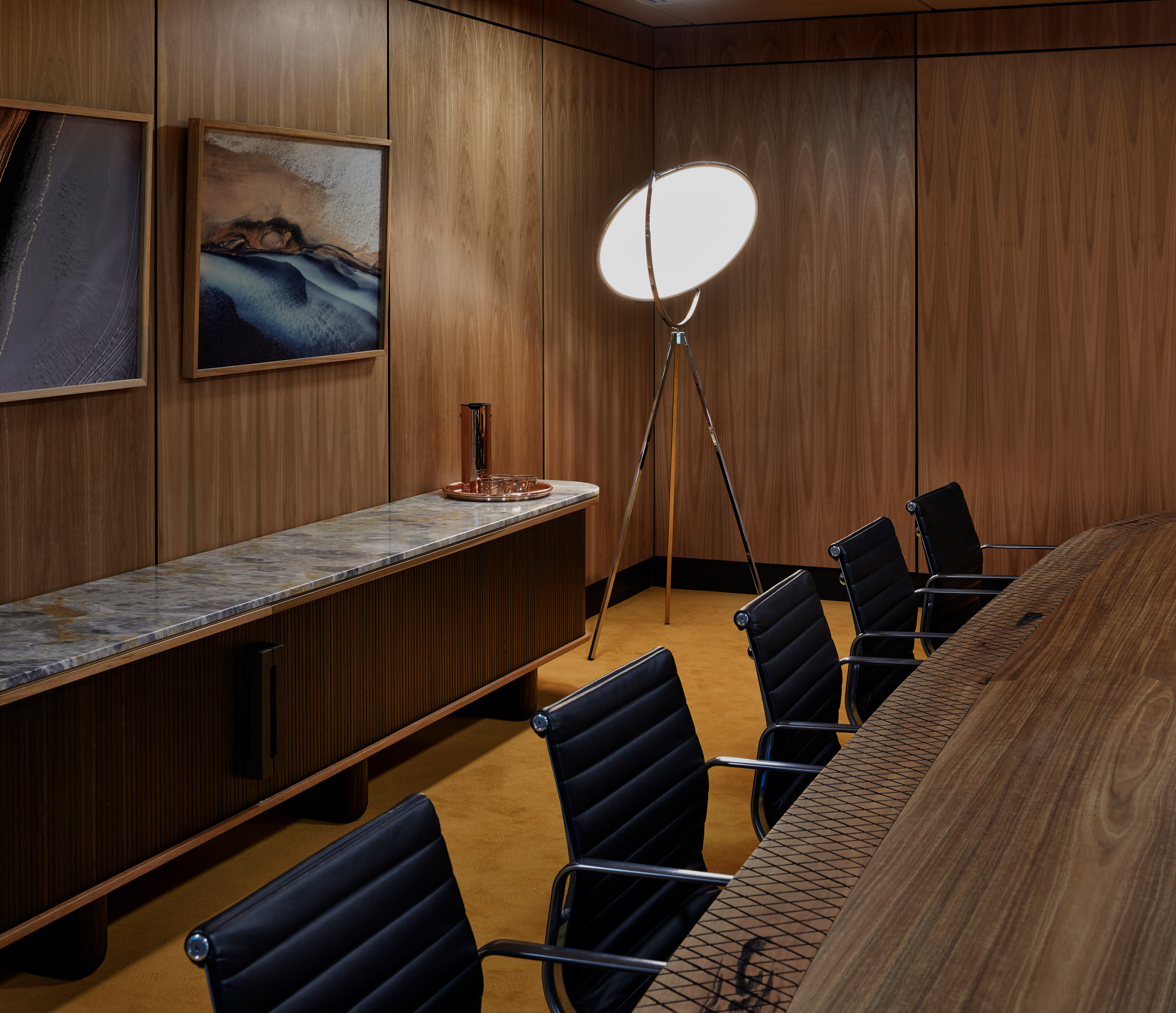
Chairs around Gulnura Table by Foolscap Studio and Manapan
The table was made from spotted gum timber

The Gulnura Table was crafted from locally-grown spotted gum, a native Australian timber, and has a durable matte sealant and finishing coat on top to bring out the natural grain, colour and tones of the wood.

"We chose spotted gum for a number of reasons; while it's robust, sustainable and relates to the finishes throughout the project, it importantly speaks to the Indigenous narrative that was imbued by the makers at Manapan," Winteridge said.

As well as being decorative, the fact that the Gulnura Table is made from hardwood means it is a solid piece, which makes it suitable for high-wear surroundings such as the airport.

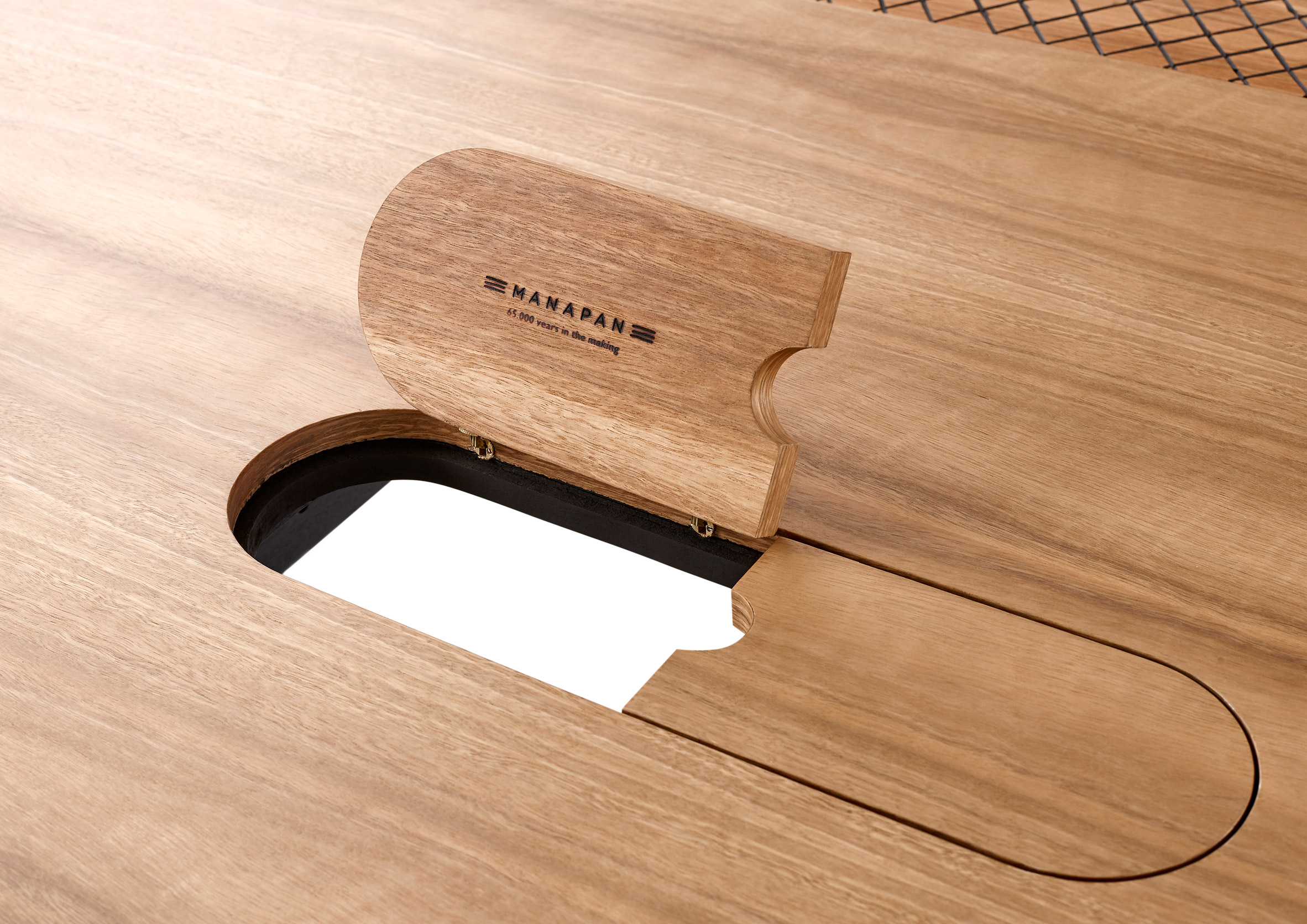
"Label" on Gulnura table by Foolscap Studio and Manapan
The table is branded "Manapan. 65,000 years in the making"

The table, which seats 16, will be used as the board table in the executive area – the boardroom, CEO's office and adjacent meeting room – of Melbourne Airport.

Foolscap Studio added concealed cable management, with reticulation through the table legs, to make the table workplace-friendly.

When the studio was commissioned for an extensive redesign of Melbourne Airport's mezzanine workspace, the potential of collaborating with First Peoples of Australia was discussed at an early stage in the project. A dialogue between Foolscap Studio and Manapan led to the finished product.

"Making and craft is an intrinsic part of First Nations culture," Winteridge said.

"We were privileged to work with and learn from the makers at Manapan, who use techniques which have been used by Indigenous Australians for thousands of years – such as sculpting, woodcarving and hand painting, to name just a few."

"These skills have been passed down through multiple generations."

The Gulnura Table is up against four other workplace designs in its category for Dezeen Awards 2020, including Andrea Ruggiero's noise-absorbing room dividers Soundsticks and March Gut's socially-distanced serving tray Alma.

Photography is by Tatjana Plitt and Peter Clarke.

The post Foolscap Studio and Manapan design Gulnura Table informed by First Nations crafts appeared first on Dezeen.


from Dezeen https://ift.tt/3kYTbvW

World's tallest Passivhaus building set to be built in Canada

A visual of the Passivhaus 1075 Nelson Street's exterior by WKK Architects in Vancouver

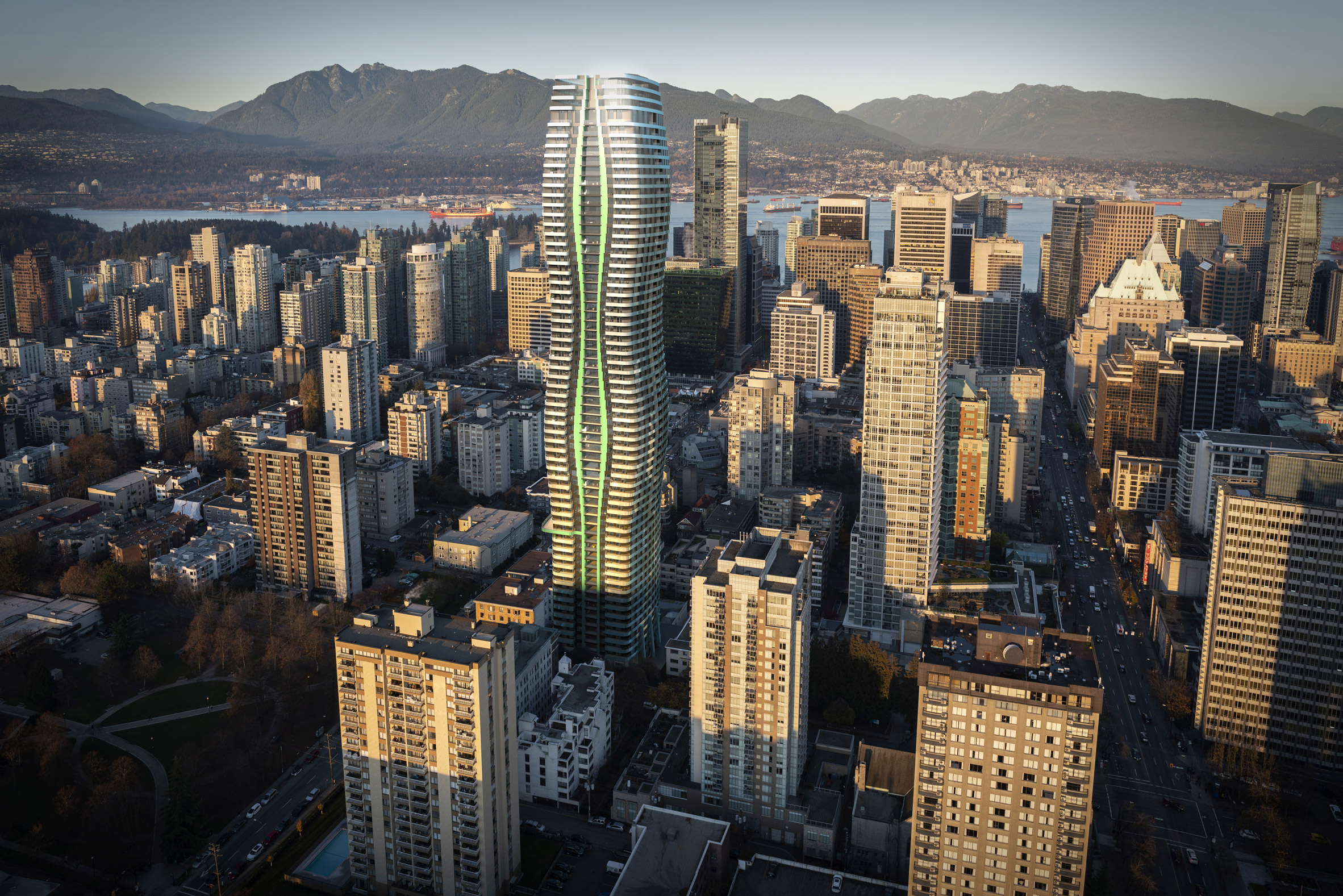
UK studio WKK Architects has revealed visuals of the undulating 1075 Nelson Street skyscraper in Vancouver, which is set to become the world's tallest Passivhaus building.

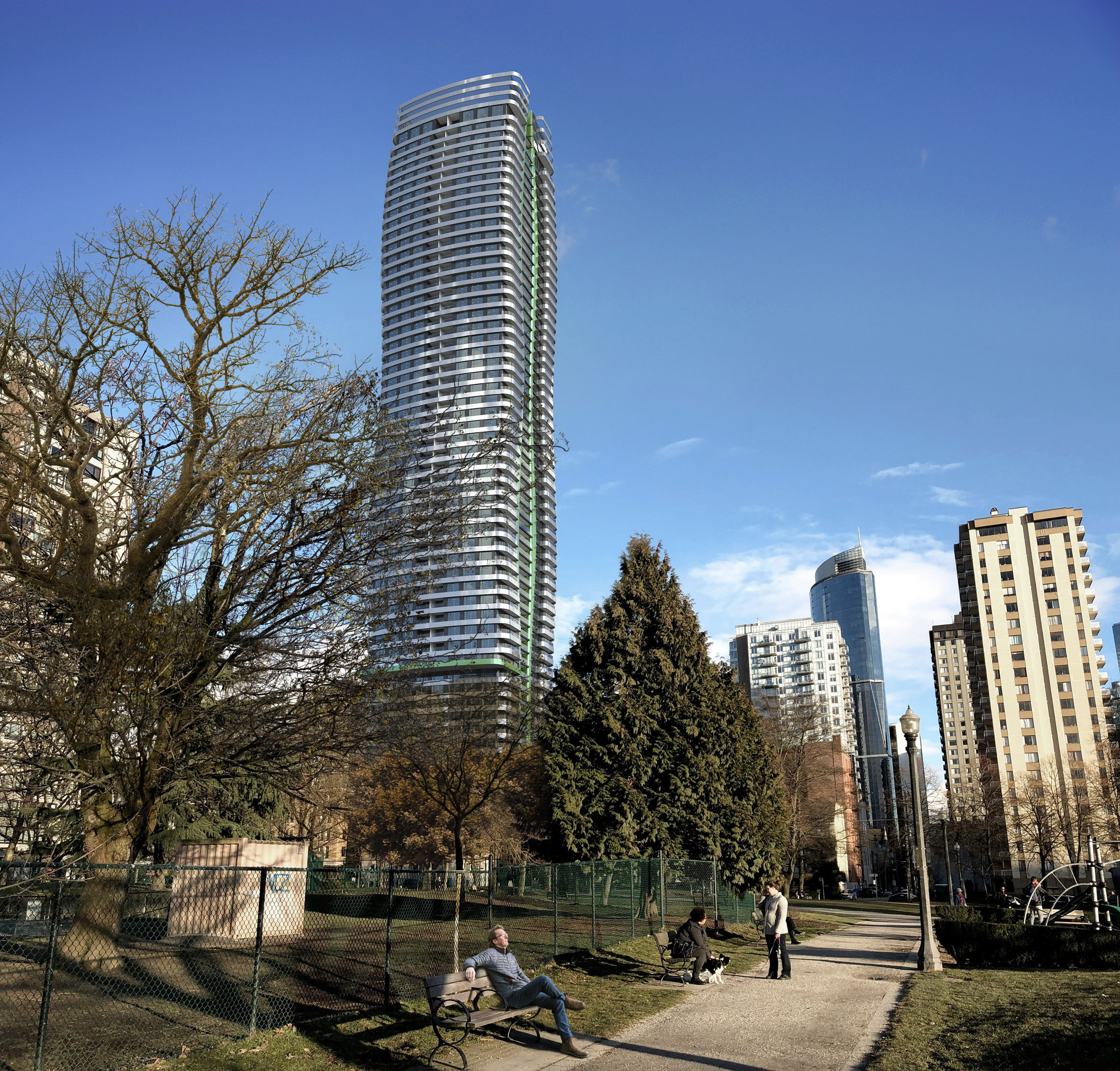
Designed for a site overlooking Nelson Park in the city's West End neighbourhood, the slender 178-metre-high skyscraper will contain 480 highly energy efficient residential units.

It is being developed by WKK Architects with IBI Group for Henson Developments with the goal of demonstrating that contemporary, high-rise architecture can be built more sustainably and achieve rigorous Passivhaus standards.

Passivhaus is an international energy performance standard that helps to dramatically reduce space heating and cooling requirements in a building, as well as its carbon emissions.

An aerial visual of the Passivhaus 1075 Nelson Street by WKK Architects in Vancouver
1075 Nelson Street will be built in Vancouver's West End

"Vancouver is already known to be one of the nicest places to live in the world," explained Tom Wright, co-founder of WKK Architects. "The city's leadership also has high aspirations to make it the most sustainable city on earth," he continued.

"We believe that the new tower will become the litmus test for high-rise developments for cities around the world, and as such we expect great interest in the project during its construction and later occupation."

A visual of the Passivhaus 1075 Nelson Street's exterior by WKK Architects in Vancouver
It will have a distinctive undulating form

Once complete, it will take the title of world's tallest Passivhaus building from the Bolueta tower – the 28-story residential high-rise in Bilbao, Spain, which measures 88 metres in height.

1075 Nelson Street will be distinguished by its billowing form wrapped by metallic horizontal bands and, on the main facade, two vertical strips of wavey green cladding.

The tower's distinctive form has been developed to evoke a shoot growing up from its concrete surroundings and challenge the perception that energy-efficient buildings have to have basic, boxy forms.

"It symbolises a fresh start and renewed hope that there is a way forward towards a sustainable future where architecturally interesting buildings are still viable," said Wright.

A visual of the Passivhaus 1075 Nelson Street's exterior by WKK Architects in Vancouver
The tower will have an airtight exterior to ensure energy efficiency

To achieve Passivhaus standard, its exterior will be made airtight using 40 per cent high-performance triple glazing and 60 per cent super-insulated wall. This keeps heat loss through the building's skin to a minimum and ensures very little heating is required.

It will also utilise two low-energy heat recovery ventilation systems that will deliver fresh air to all of the apartments while preventing unpleasant draughts and maintaining its airtight shell.

The same system will reclaim heat energy from the exhausted stale air, and reuse it to heat incoming fresh air.

A visual of the Passivhaus 1075 Nelson Street's exterior by WKK Architects in Vancouver
Its distinctive form is intended to evoke a shoot

Details of 1075 Nelson Street's interior design is yet to be disclosed, though it is expected the 480 residential units will include 102 social housing units, 50 rental units and 328 condo units.

Construction dates are yet to be disclosed, but plans were approved by Vancouver City Council at a public hearing in June 2020.

Other Passivhaus developments recently featured on Dezeen include Stirling Prize-winning studio Mikhail Riches' proposal for low-rise housing in York, UK. It is set to become the largest Passivhaus and net-zero carbon housing scheme in the country.

Elsewhere in Vancouver, Morphosis is developing a 13-storey office for Lululemon and Piero Lissoni is creating residences for the new Oakridge community.


Project credits:

Architect: WKK
Client: Henson Development
Architect of record: IBI Group

The post World's tallest Passivhaus building set to be built in Canada appeared first on Dezeen.


from Dezeen https://ift.tt/35Xmpan

Calla Chandelier by John Pomp

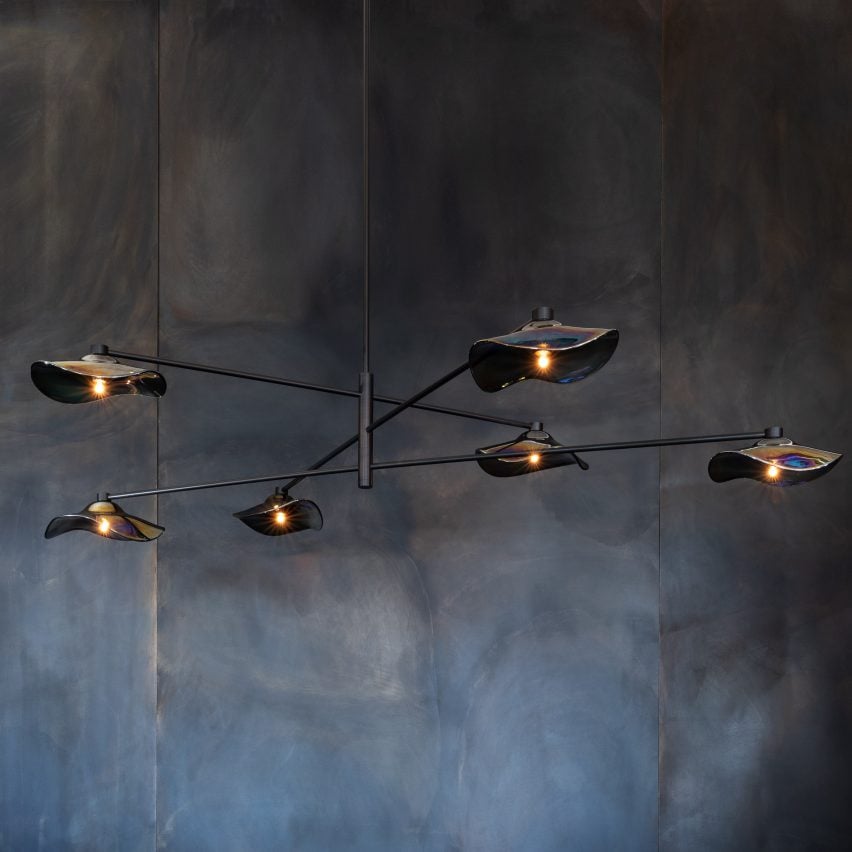
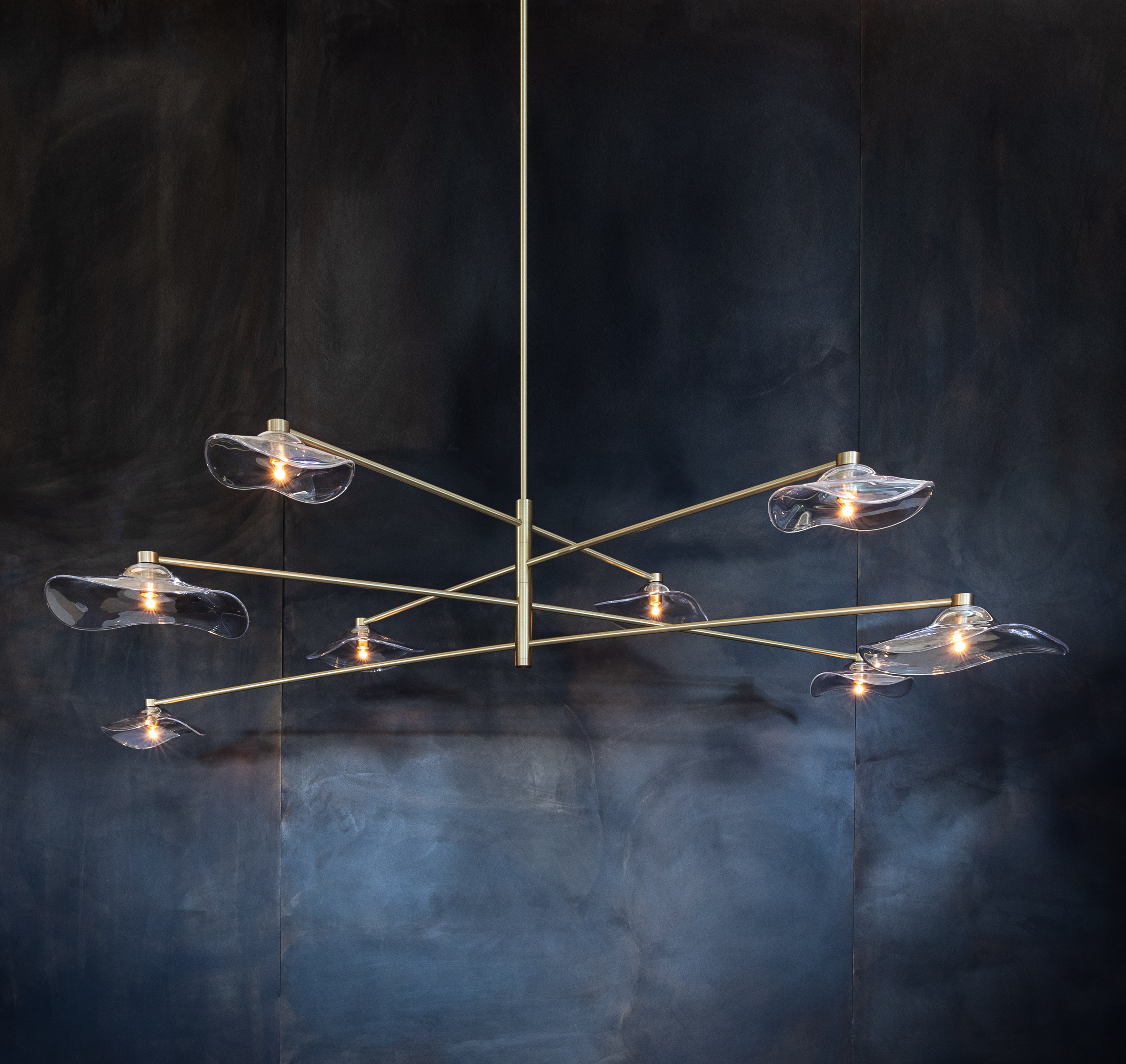
Calla Chandelier by John Pomp

Dezeen Showroom: the Calla Chandelier by Philadelphia-based designer John Pomp features six iridescent, disc-shaped lights informed by calla lilies.

The Calla Chandelier is made from hand-blown pieces of glass that are suspended from a three-tiered, adjustable solid-brass armature.

The combination of these two elements aims to create a blend of organic and geometric design.

"This piece reminds us of the precarious balance found in nature," said the brand. "The structural metal arms create beautifully articulated lines, balanced by falling glass petals."

Calla Chandelier by John Pomp
Top image: smoke glass with iridescent finish and oil-rubbed, blackened steel structure. Above image: clear glass with iridescent finish and satin brass structure

Each individual light is surrounded by a sculptural glass disc whose undulating shape takes cues from calla lily flowers. These six glass pieces are illuminated by their own six-watt incandescent bulb.

The glass comes in different finishes and colours, including transparent, gold leaf, iridescent, sepia-toned, topaz, olive, opaline and a grey-hued colour called smoke.

The metal armature also comes in various finishes including satin brass, satin nickel, oxidised brass, light oil-rubbed blackened steel and oil-rubbed blackened steel.

Product: Calla Chandelier
Designer: John Pomp
Contact: info@johnpomp.com

About Dezeen Showroom: Dezeen Showroom offers an affordable space for brands to launch new products and showcase their designers and projects to Dezeen’s huge global audience. For more details email showroom@dezeen.com.

The post Calla Chandelier by John Pomp appeared first on Dezeen.


from Dezeen https://ift.tt/3kS3sKw

Competition: win one of five €150 Sandqvist gift cards

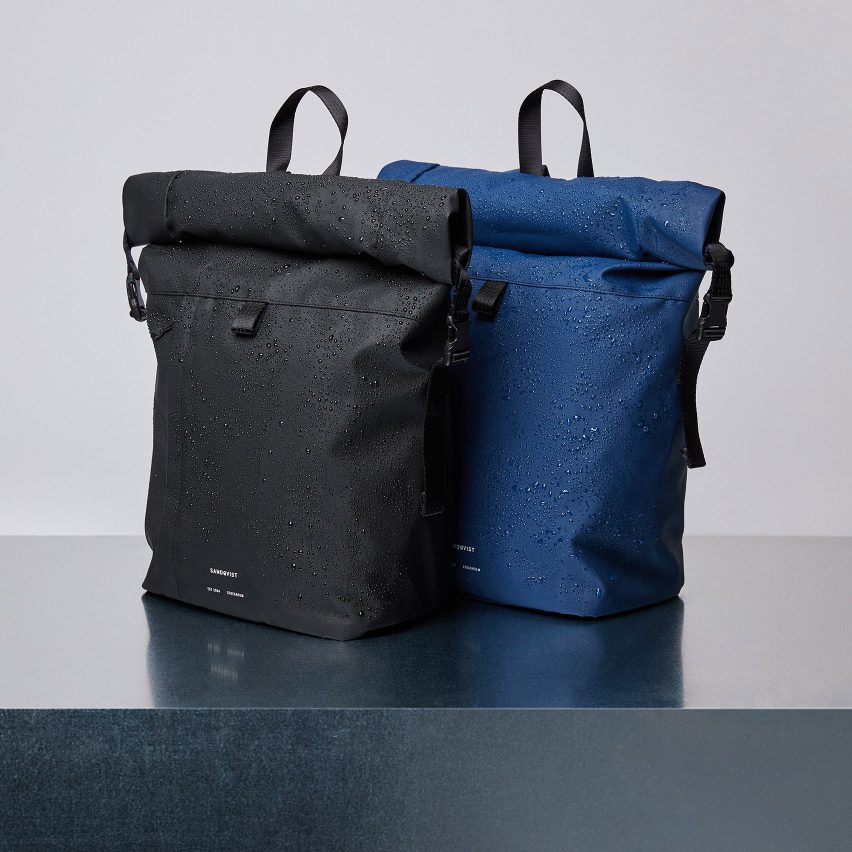
Sandqvist stream series

In our latest competition, we've teamed up with Scandinavian bag company Sandqvist to give five Dezeen readers a €150 gift card each to spend on the brand's website.

Sandqvist creates design-led, functional bags that are intended to be practical without aesthetics being compromised.

Winners will be able to choose from the brand's selection of bags and accessories with up to €150 to spend.

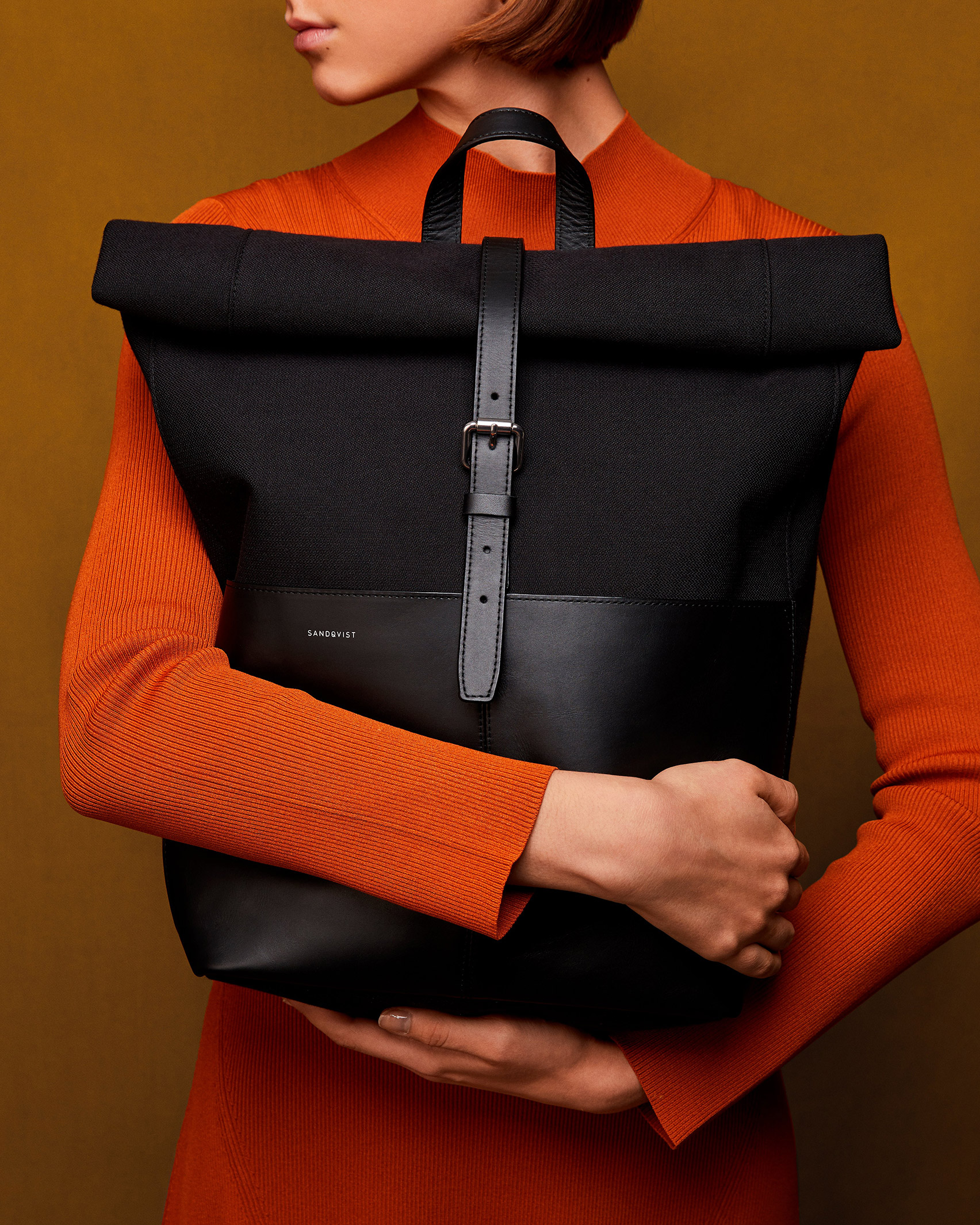
Sandqvist women classics bag
Sandqvist aims to become a leader when it comes to bags and accessories in the fashion industry

Founded in 2004, the Stockholm-based company aims to remain true to its Scandinavian roots by maintaining three Swedish values: sustainability and care for the environment, high-quality designs and an unbeatable approach to function.

Sandqvist has just released an updated water-resistant series of bags, Stream, which includes three new designs featuring minimalistic seams and fabric constructed from recycled polyester with a waterproof coating.

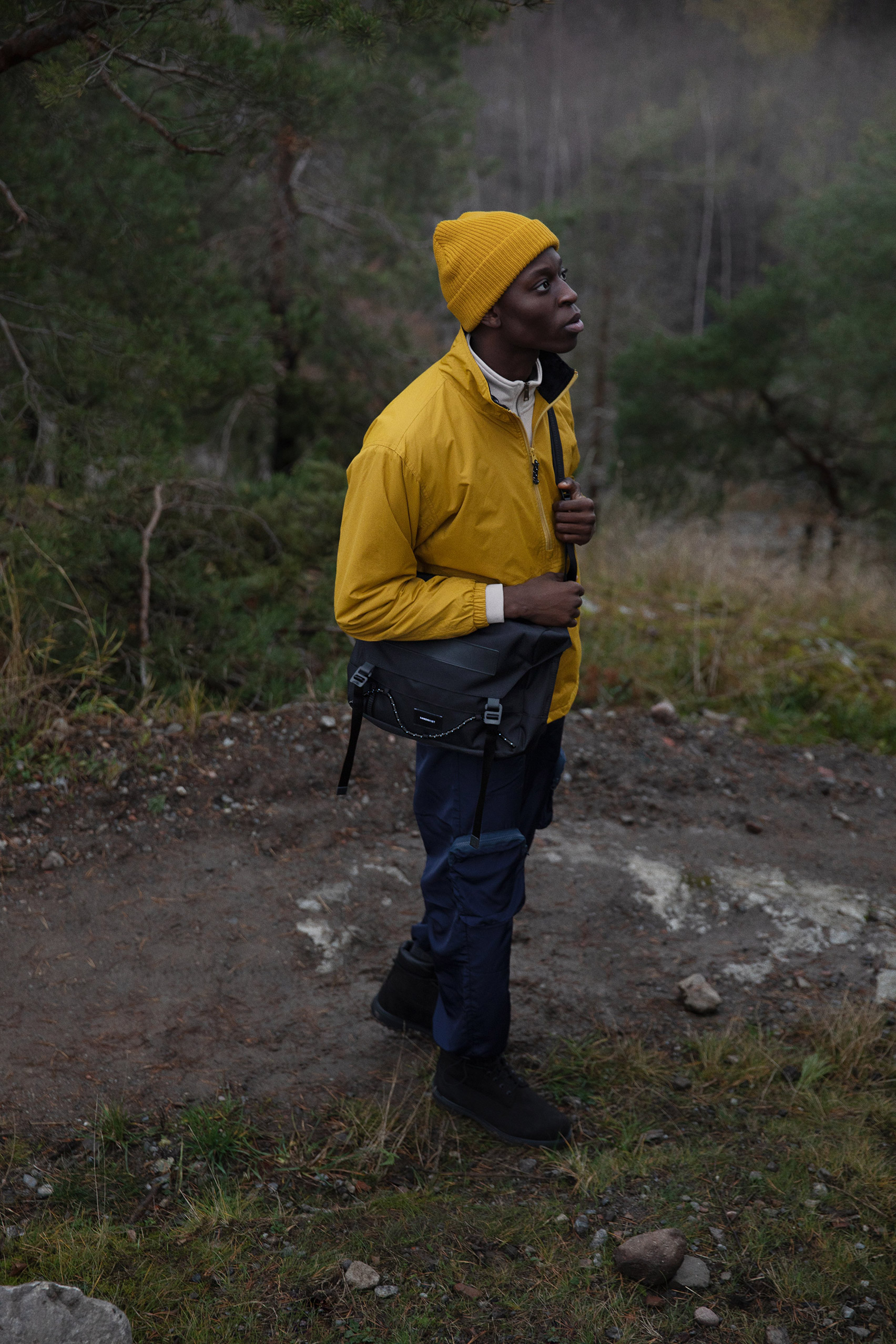
Sandqvist urban outdoor rang
Sandqvist's Urban Outdoor series will comprise four new contemporary additions

All the bags in the series feature reflective details designed for darker evenings.

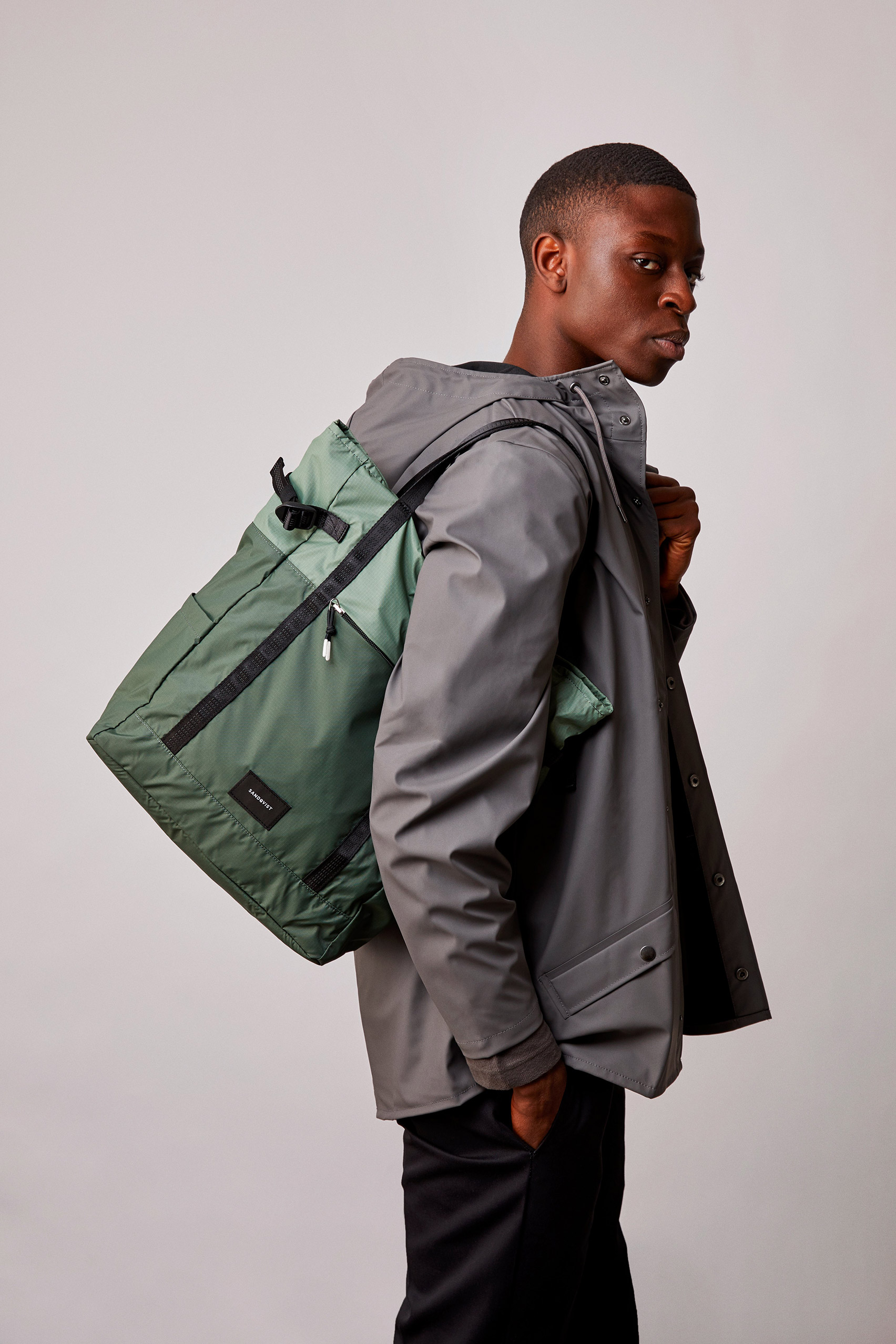
Sandqvist is also extending its light-weight series, which prioritises simplicity, function and comfort, with four new designs. The adventurous Urban Outdoor series is also gaining four new additions as part of the Fall/Winter 2020 collection.

Sandqvist urban outdoor series
The new collection features 12 new colours and two prints

The brand's latest additions all draw inspiration from nature, with colours based on sky blues, sunset pinks and classic fall-brown.

In this way, the bags are designed as a playful interpretation of Scandinavian seasonal change, while remaining true to the brand's heritage and core of sustainable, long-lasting fashion.

To be in with a chance to win on of five €150 gift cards, complete the form below.

Competition closes 21 December 2020. Terms and conditions apply. Winners will be chosen at random and will receive the gift card by email.

The post Competition: win one of five €150 Sandqvist gift cards appeared first on Dezeen.


from Dezeen https://ift.tt/3kY9YiP