Our Dezeen Weekly newsletter has hit a key landmark with over 350,000 people signed up to receive our curated highlights of the week's best stories and comments.
A huge thank you to all our subscribers! To celebrate this milestone, Stephen Mildwater has created this illustration.
Coronavirus lockdowns have taught us the importance of having wild areas for children. We should build on this and create a comprehensive strategy to rewild our cities, says architect Cristina Monteiro.
The lockdown has brought about a seismic shift in the way we think about space in the city. It became obvious that a lot of our urban environment is not green or accessible enough and we have seen the negative effects on our health and wellbeing, particularly in more deprived areas of our cities.
Learning from the lockdown and the struggles for public space and education that it led to should inspire us to rewild cities to better support our children.
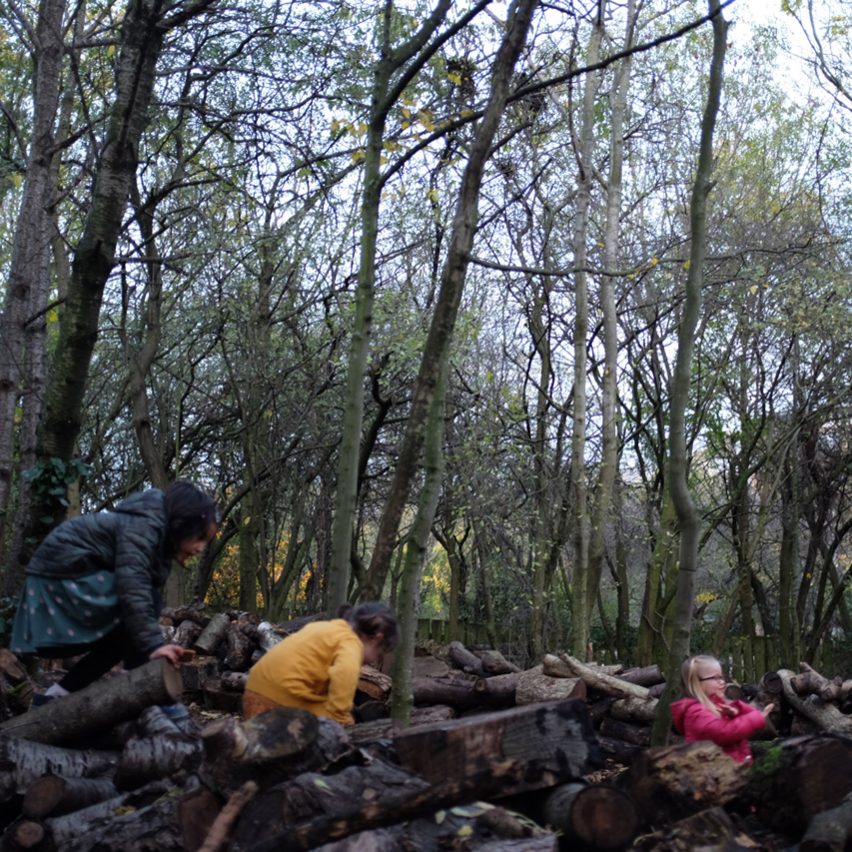
During the first UK lockdown, my family were lucky enough to have easy access to the countryside. The anxieties of the Covid-19 pandemic were alleviated to a huge degree by the ability to explore this environment with my five-year-old daughter. The woods around us provided a safe and exciting place of learning that was a welcome alternative to the kitchen table.
What would it take to retrofit our existing towns and cities to make access to woodland an easy, natural part of a child's education? We would need to create a 0.5-hectare area of woodland – the minimum size for a viable habitat according to the National Forest Inventory – within easy reach of every school. Creating this wild, green space would align directly with the "rewilding" agenda.
The woods around us provided a safe and exciting place of learning
Most communities want to be more sustainable, have access to clean air, clean energy, green spaces, and a natural world. Green Party MP Caroline Lucas has been campaigning for the UK government to set legally binding targets for access to nature for all, building on mountains of evidence linking contact with the natural world to our mental and physical health and wellbeing.
Environmental conservation practices in the 20th century were highly target-based, with projects that concentrated on particular species and monitoring and adjusting environments to achieve a target. Rewilding, as we can see in the work of Isabella Tree and George Monbiot among others, fundamentally challenges that approach and instead invites ecologists to create a framework on which nature is allowed to evolve and take its course.
This new approach is gaining popular traction, with books on rewilding and nature, in general, dominating the non-fiction lists at the moment, reflecting a long-term love for nature in European culture but also a popular moment where exploring wild places and achieving a sense of awe and freedom feel vitally important.
When we think of this concept in cities, we are not of course excluding people from the wild but making environments where human activity is not the dominant force.
The idea that learning "in the wild" is of value to a child is embodied in the Forest School movement. Though tested in diverse ways across Europe in the early twentieth century, the first formal Forest School was set up in the early 1950s by Ella Flautau in Denmark. Today, models based on hers are adopted across the world, often taking the form of occasional sessions in woodland locations as part of the mainstream curriculum. For urban children, this experience is often in nearby parks or nature reserves.
Children in urban areas – and particularly deprived areas – have limited access to real nature
Today, we understand that this aspect of education has huge psychological benefits, as explored by Richard Louv whose book Last Child in the Woods, which draws parallels between the rise of numbers of children with health conditions such as attention deficit hyperactivity disorder (ADHD) and limited access to nature in urban and even suburban contexts.
Children in urban areas – and particularly deprived areas – have limited access to real nature. East London, for example, has seen huge development in recent years that is eroding the amount of wasteland and slack spaces in favour of much-needed housing. Whilst the housing is certainly needed, we also need a more focussed audit on green infrastructure, wild spaces and green amenity than currently happens in urban places today.
Local authorities, schools, landowners and the wider community should be coming together to explore how nature can be intensified in their local area.
Whilst urban dwellers can enjoy a flourishing weed or a small piece of urban wildness in a verge or pocket park, and they have value to the ecological richness and environmental quality of the city, these spaces do not offer much in terms of a genuine experience of wildness and are often inaccessible or overly "maintained" by maintenance contractors with heavy machinery such that their natural diversity is limited.
By working collectively we could flip neglected spaces into ones that are loved and well-used by local children and which contribute far more to the ecology of the city
Arguably there are tensions between the rewilding of parks and open land and the anti-social behaviour that might thrive in "wilder" landscapes. My daughter reported a successful Forest School session recently where nobody found a syringe. It might be that the best places to enrich and wilden the city are pieces of currently inaccessible, under-accessed and unprogrammed space where the environmental and social benefits of this approach might be most profound and cause the least conflicts.
By working collectively, we could build relationships of care between schools and existing spaces and flip neglected spaces into ones that are loved and well-used by local children and which contribute far more to the ecology of the city. A precedent for this is Phytology in Bethnal Green, London: a wonderful example of a tiny slither of land becoming a much-loved intense nature reserve with a wonderful collision of programmes, mixing the arts and environmental education in an informal but curated way and where nature is the dominant quality. It is simultaneously an adventure in wildness for a child and very safe.
Design in this context can be important in various ways, from advocating for wild spaces and ecological richness at the strategic scale through to ensuring that the relationship between such spaces and the wider city is safe, welcoming, inspiring and beautiful.
The role for design is of profound importance if we are to change our current path toward climate disaster and build cities that are both more climate-resilient and which can contribute to a social transformation in our attitude to the environment. The architect Ros Diamond in the early 1990s worked with Arts Council England to advocate for a mainstream education programme with a strong environmental and spatial agenda. The need for this is more urgent than ever, combined with the need for spaces in which it can flourish.
Our collective experience with coronavirus should be the impetus to make this happen.
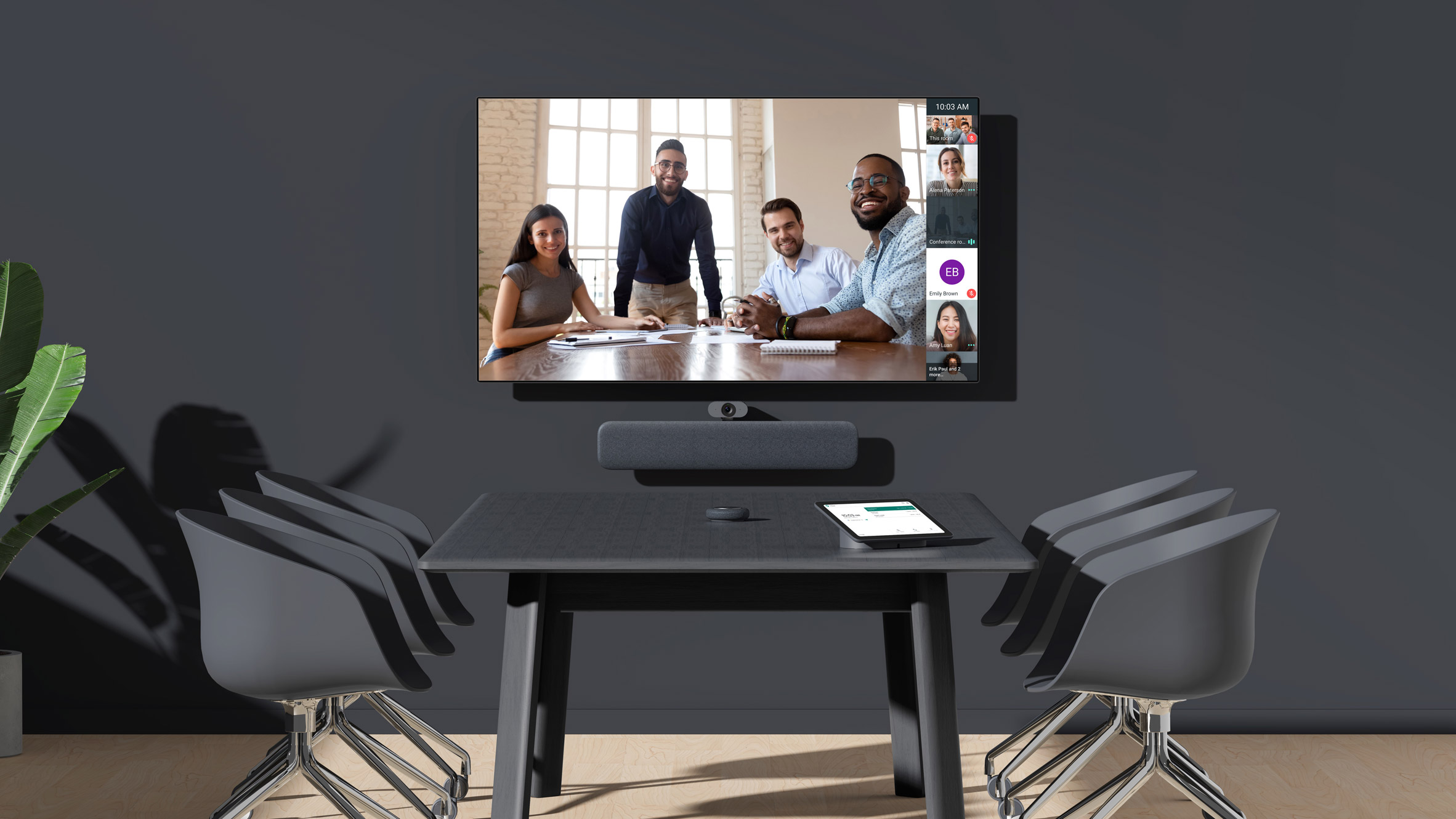
Design agency Aruliden has created an AI-enabled video-conferencing kit for Google that automatically senses the number of participants in a room and optimises sound quality and video framing for each.
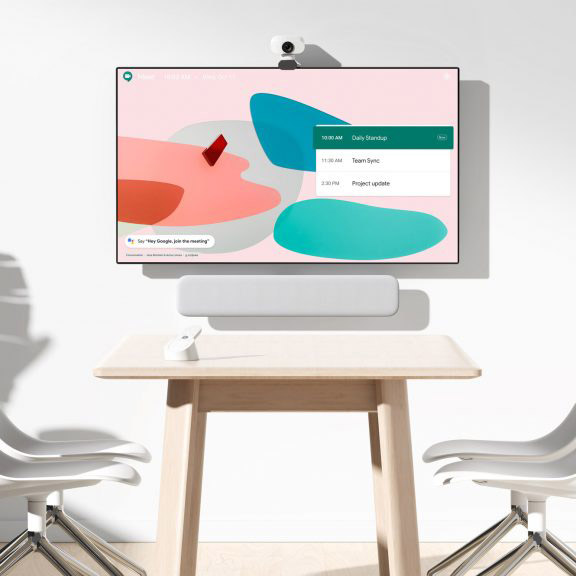
The Google Meet Series One system is designed to be set up and used without requiring technicians, while the touch-free system allows attendees to join and leave meetings by voice command.
The system is designed to be set up without requiring technicians
"The most important thing was this notion of creating an experience, both digital and physical, that is as close as possible to actually being in the same room," said Aruliden co-founder Johan Liden.
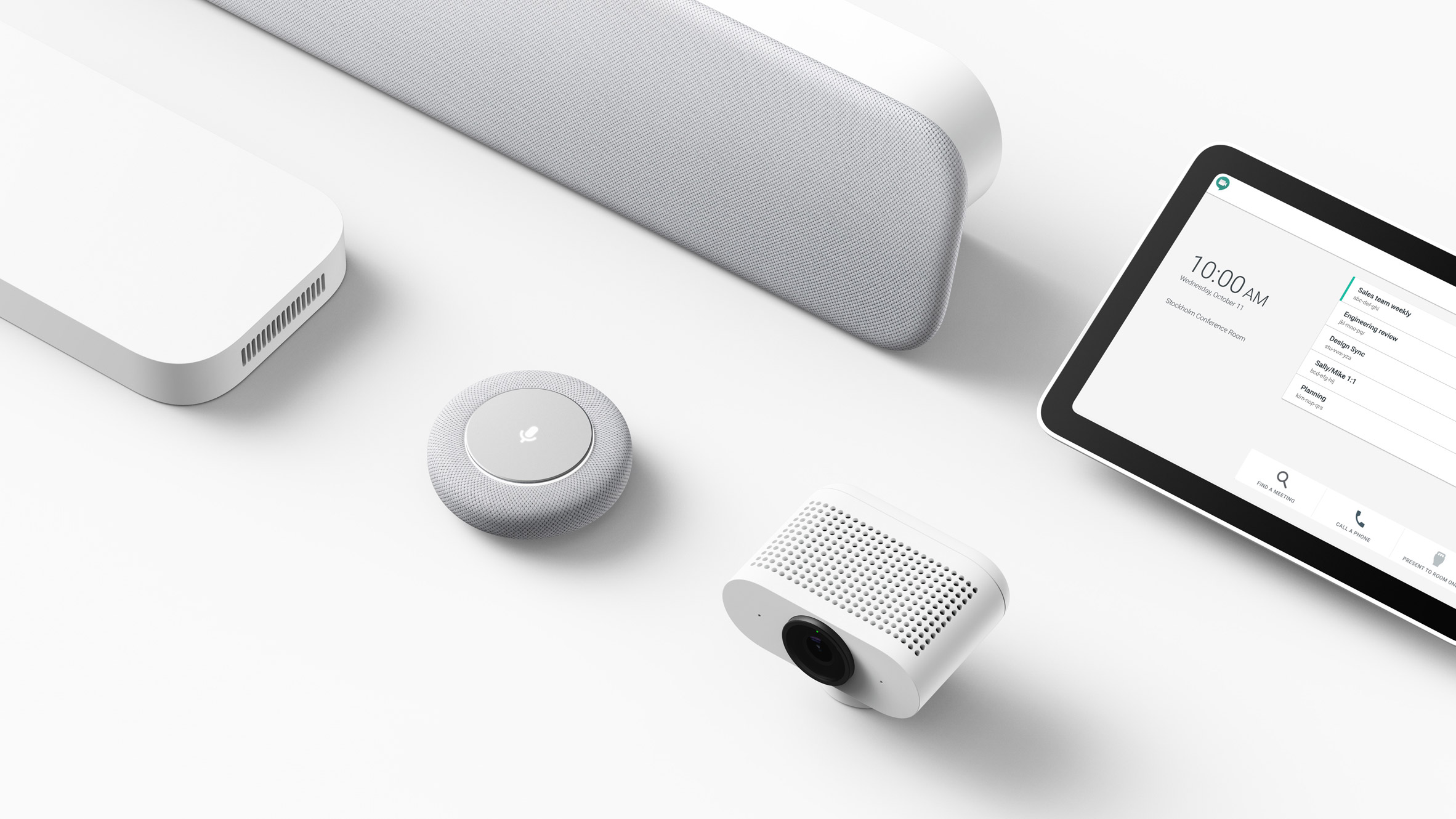
The system consists of a family of six products. Liden said the components share " a very reductive design language" that eliminates clutter and results in a system that can be set up and used by people without technical expertise.
"It's very easy to just pile on features and pile on buttons and make things a little bit too complicated," said Liden, whose company has offices in New York, Amsterdam and San Francisco.
"We wanted to make sure that that seamlessness and that simplicity is true from how you install it to how you use it," he added.
"I'm sure you've been in many conferences where they have to call the IT folks to get it up and running. Those are obviously the hurdles that we wanted to avoid."
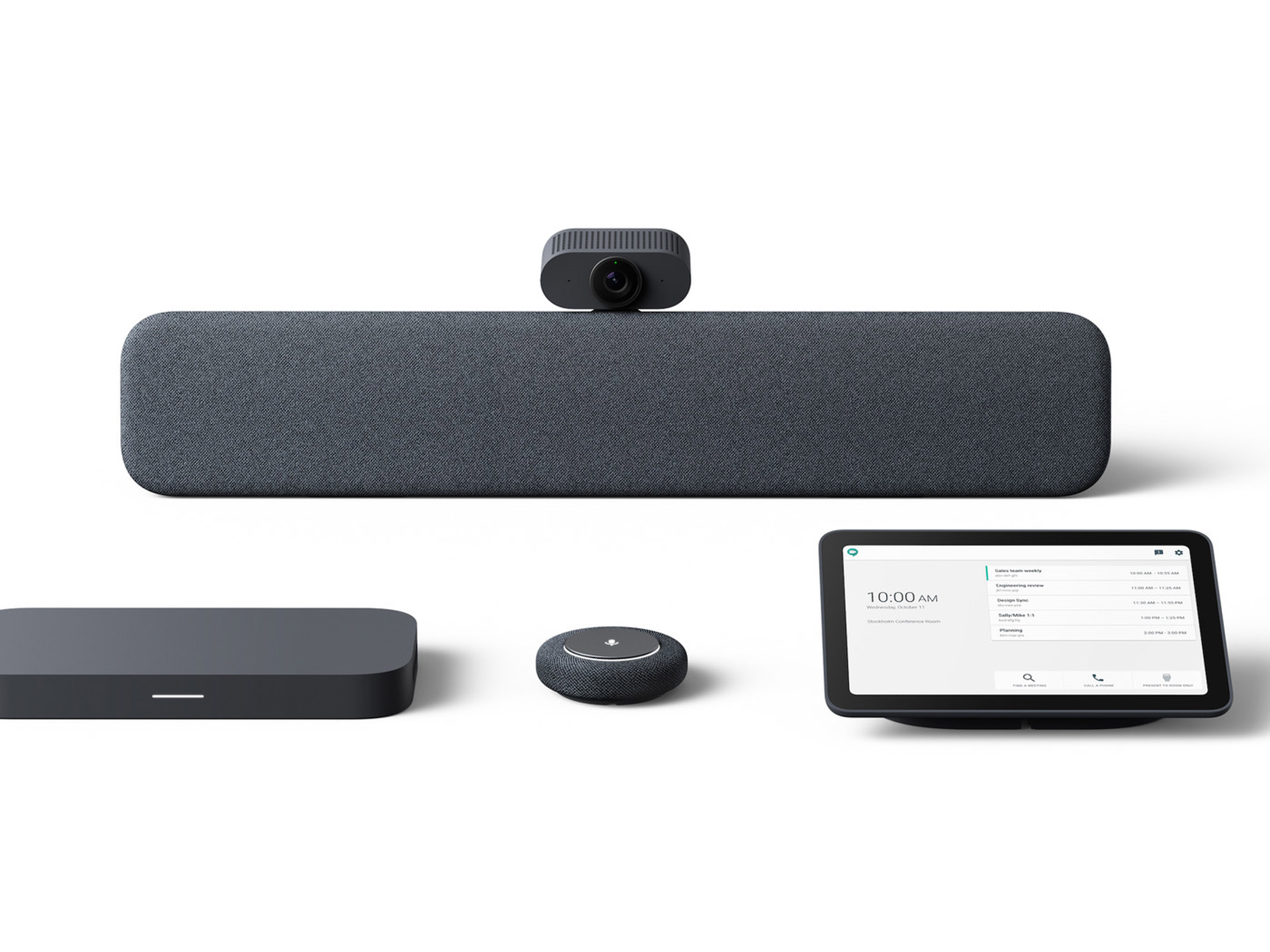
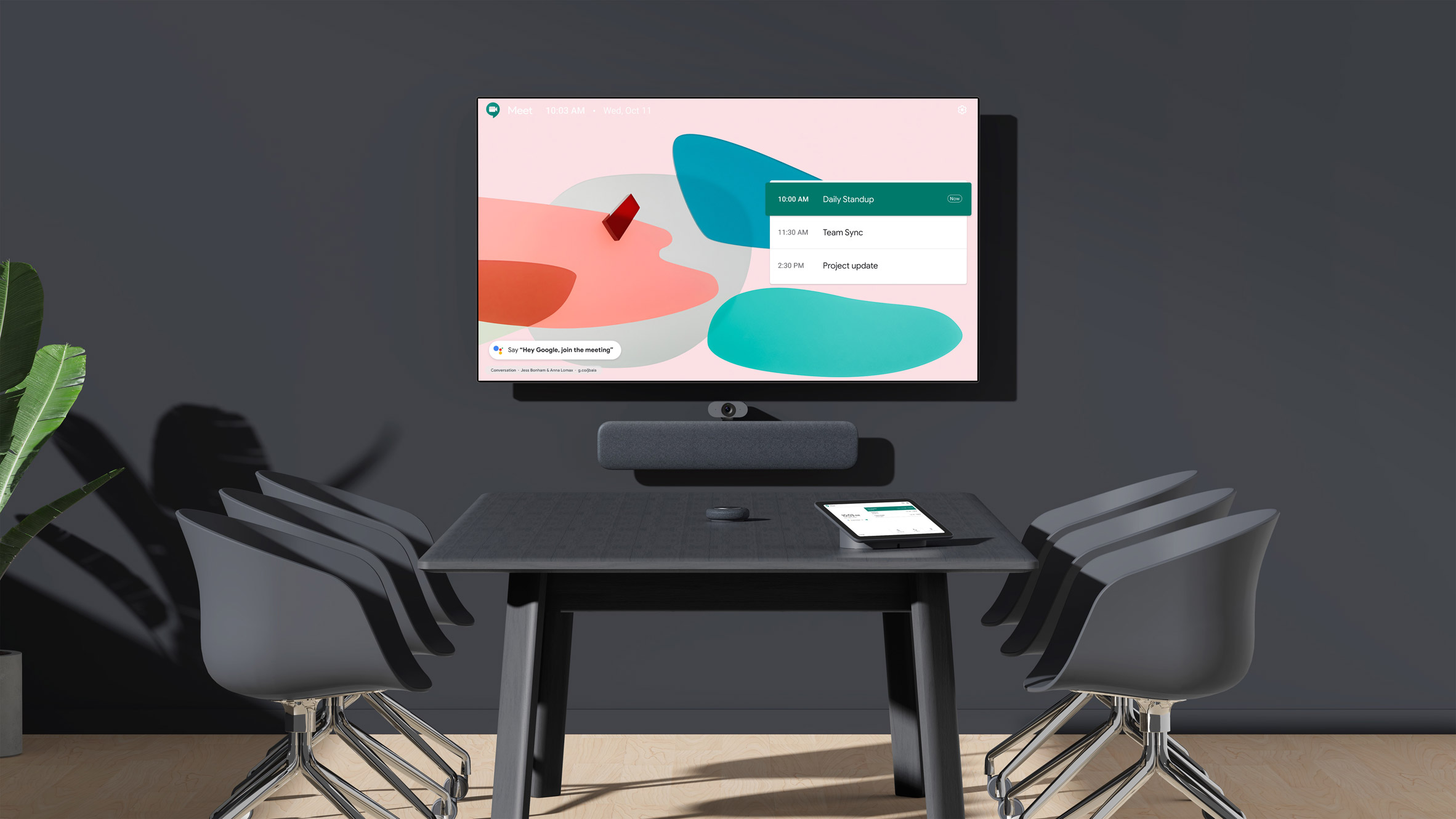
The expandable system includes a soundbar, a 4K camera, a hub, optional microphone pods and either a remote or a touch-screen controller
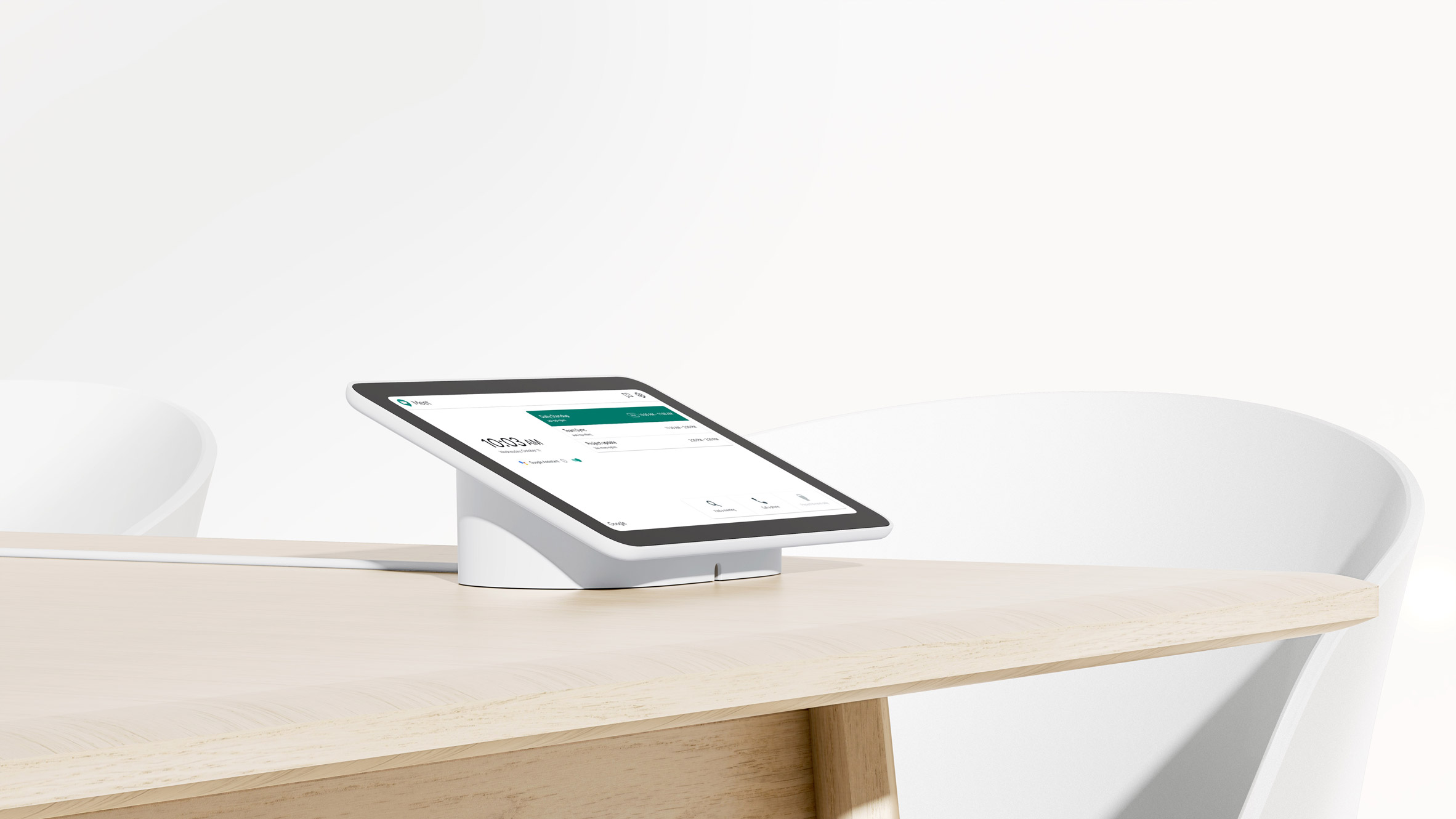
The expandable kit consists of a soundbar, a 4K camera and microphone pods connected to a hub via ethernet cables that also provide power to the components to minimise cabling. The system, which plugs into any TV screen, can be controlled either via remote control or by a touch-control tablet.
The components, which are available in charcoal grey or chalk white, follow the look and feel of other Google hardware products such as the Google Nest devices for the home.
Each element has rounded corners and a matt finish, with textured fabric used on the soundbar and microphones.
Google Meet Series One comes in charcoal grey or chalk white
TJ Varghese, group product manager at Google Workspace Hardware, claimed the Google Meet Series One is the first video-conferencing system where every component has been designed holistically rather than assembled from disparate products.
"If you look at what was launched prior to Series One, it was taking off-the-shelf components that were not necessarily designed to be put together. Whereas Series One really brought in that unification."
With video-conferencing becoming increasingly important due to the coronavirus pandemic, Varghese said that companies were looking for simpler, better-looking solutions.
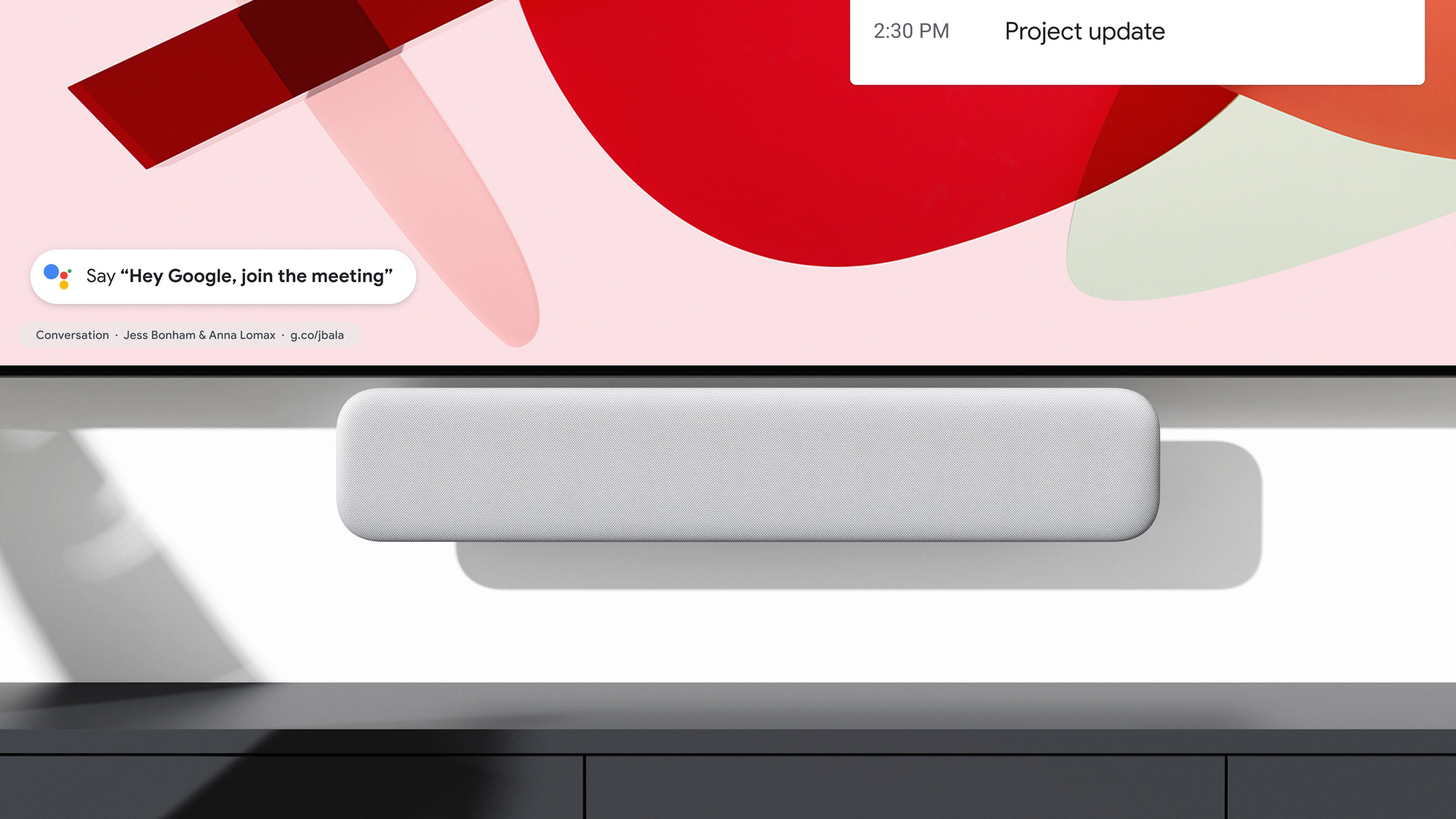
Attendees can join and leave meetings using voice commands
"We've heard from customers who spend several thousands of dollars in outfitting conference rooms," he said. "The research we did showed that a lot of companies' conference rooms is kind of their business card, whether they're bringing people into the office or whether they're video conferencing out."
"They spend a lot of time thinking about what furniture they're buying, what televisions and all of the lighting that goes into it. We had a lot of strong feedback saying that the products that we were selling functioned well but they were not looking great."
Liden and Varghese, who previously worked together on a digital whiteboard called Google Jamboard, started developing the video-conferencing product before the coronavirus pandemic caused a huge upswing in remote working around the world.
The latter stages of the product's development were done remotely: "To develop a video conferencing system over video conferencing is an interesting story in itself," said Liden.
The system can be controlled via a tablet
Varghese said that the experience of conducting video calls from home has led business leaders to demand the same seamless experience in the office.
"The consumerisation of technology has outpaced what is in the workplace," he said.
"We took photographs of conference rooms and all the cables and wires and just random stuff everywhere. We would have CEOs of large companies say, 'hey, why can't my conference room work like it does at home? Why can't it look as good?'"
Accordingly, the Google Meet Series One system has just one power cable "because that's what they're used to at home".
The Google Meet Series One system has just one power cable
The new system, launched in partnership with Lenovo, includes Google's TrueVoice technology that cancels unwanted noise such as typing and snacking while amplifying voices.
The system's hub, called the Meet Compute, attaches magnetically to its wall bracket so it can be removed easily from behind the TV without having to call the IT department.
The 4K cameras include digital PTZ (pan, tilt, zoom) capabilities and use AI to automatically frame participants so they are optimally centred and scaled.
"This system is really trying to make sure that no matter where you are, whether you're in the conference room or somewhere else, you can read micro-expressions as you would if you were in the room itself and get richer dialogue and collaboration," said Liden.
The January 2021 edition of furniture and interiors fair IMM Cologne has become the latest industry event to be cancelled due to the coronavirus pandemic.
The fair, held in the German city each January, will next take place from 19 January to 23 January 2022.
"We've had to face the reality, even though it's painful," said Gerald Böse, CEO of Koelnmesse, the Cologne fairground that hosts IMM Cologne.
"In the end, because of the very dynamic way things are developing right now, the uncertainty among our exhibitors and visitors was just too strong."
Hybrid edition was planned for January
The decision comes three months after the show, which is Germany's most important furniture show and the first major event in the annual calendar, announced that it would hold a hybrid edition this coming January, with a mixture of digital and physical activity.
"Because the concept for the special edition was based on the offline and online formats being closely interlinked and mutually dependent, not even a purely digital event made sense under these circumstances," Böse said.
After disrupting most of the major international design events in 2020, the coronavirus pandemic now looks set to wipe out the calendar for most of the first quarter of 2021.
For up-to-date details of more architecture and design events visit Dezeen Events Guide, which has a special page containing updates on events impacted by coronavirus.
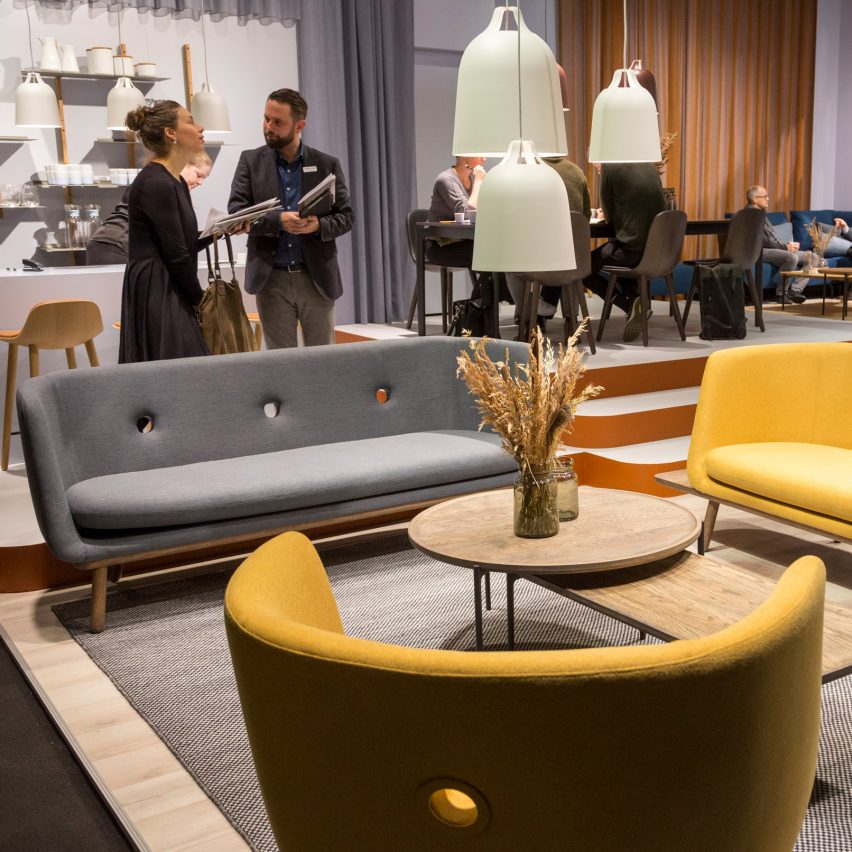
Main image of Pure Editions stand at IMM Cologne 2020 is courtesy of IMM Cologne.
Thirteen designers made products from a wide variety of metals – including bronze, steel and aluminium – but stayed away from brass for the Brassless: New Accords for the Metallic Wave exhibition at Nilufar Gallery in Milan.
According to the curators, brass' return to design was widely heralded in 2017. Studio Vedèt said this is usually a sign of the decline of a trend – something the studio intends to accelerate.
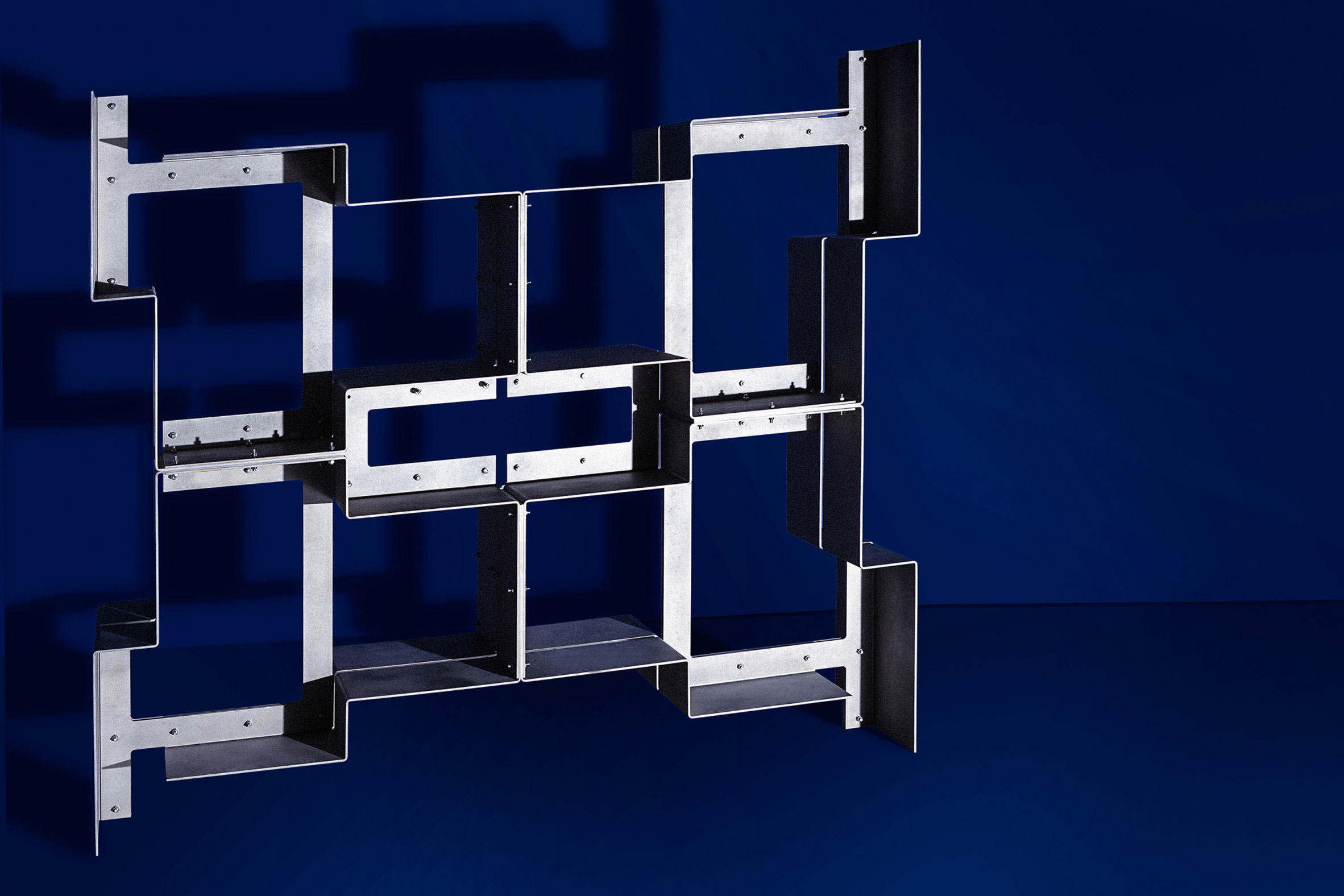
Top: Object of Common Interest's Daydream shelving. Above: a bronze lamp by Carlo Lorenzetti
"Just as in the previous episodes of FAR — the parasitic curatorial entity that lives within the spaces of Nilufar — Brassless marries a challenging accent to the characteristic language used in the established Milanese gallery," Studio Vedèt's Valentina Ciuffi, who curated the show for Nilufar's FAR, explained.
"With a light but decisive statement, it aims to accelerate the ending of the brass era, or rather, the ending of a phase in which contemporary design and architecture abused this alloy by using it randomly or needlessly."
The show was an attempt to move away from the design industry's preoccupation with brass to instead investigate the use of other metals. Designers taking part used steel, copper, gold, lead, aluminium, nickel, bronze and silver for their projects.
"Brassless is not a 'stop to brass' but rather a denunciation of the decade of trends and an effort to prevent the very thing we need the least – a new homogenous trend spreading designed matter at random over our tired world," Ciuffi added.
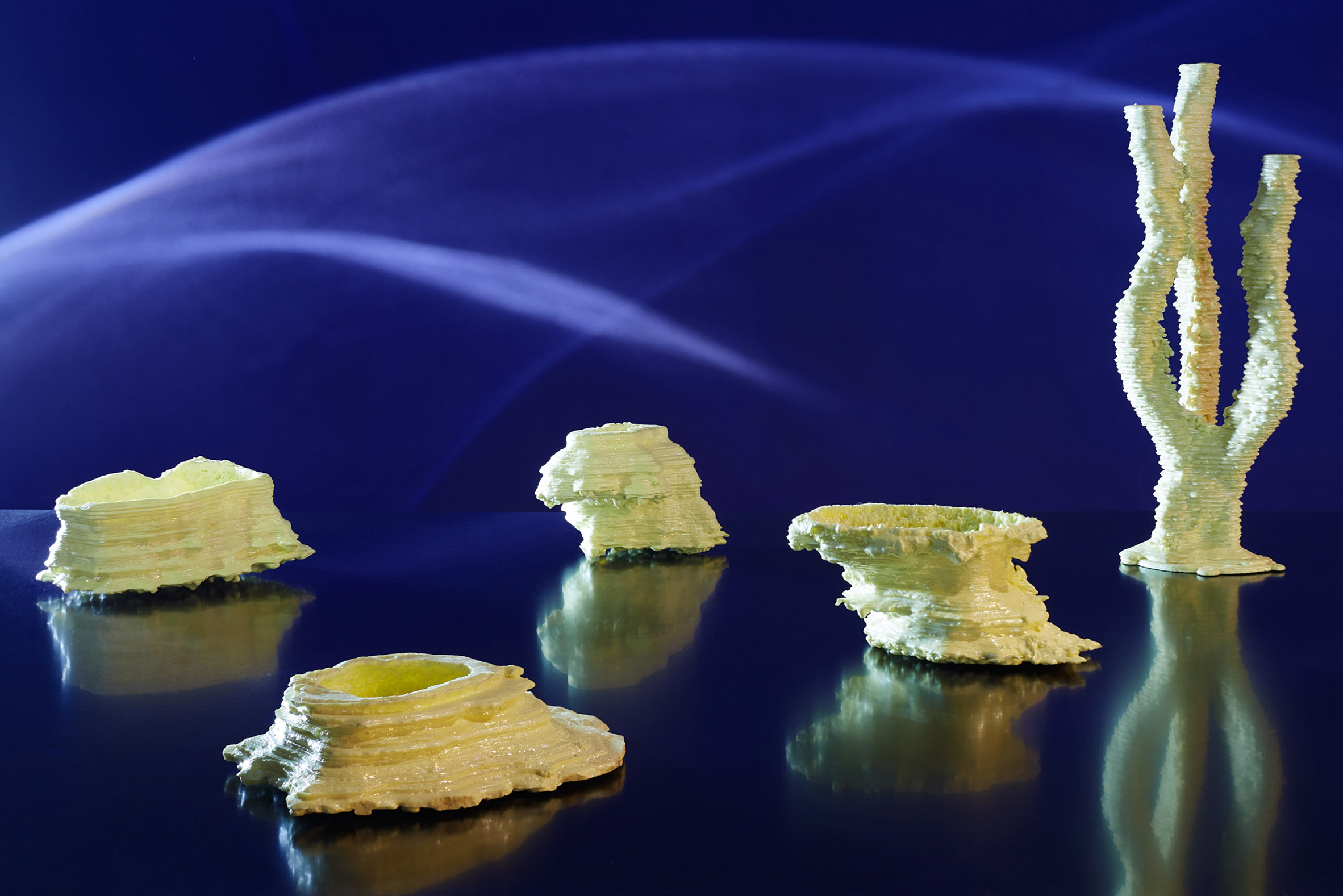
Diljá Sigurðardóttir's project made sculptures from sulfur
Most of the studios taking part in Brassless chose their own metal to work with, with one – Icelandic designer Anna Diljá Sigurðardóttir – even avoiding metal completely to instead use sulfur for her project.
Her Earthly Delights is a series of sculptures made from sulfur that has been shaped and solidified in water, and aims to display the "passing of time through an accelerated recreation of a slow, natural process," Studio Vedèt said.
Magnetic surfaces were used for the modular Daydream shelving system
Objects of Common Interest used chromed and painted metal with magnetic surfaces to create its Daydream freestanding shelving, which functions as a kit-of-parts that can be assembled and disassembled.
The playful shelves are silver-coloured or painted in warm red and orange hues and consist of a plate, an arch and a pole which can be combined in many ways to create unique shelving systems in different sizes.
The modules in the X Series can be both shelves and tables
Aluminium was chosen by Bram Vanderbeke and Wendy Andreu for their X series, which is also based on a modular system but uses folded metal sheets.
Each module is folded in two directions to create structural integrity, and can be connected to the others with bolts and screws to create shelves and side tables.
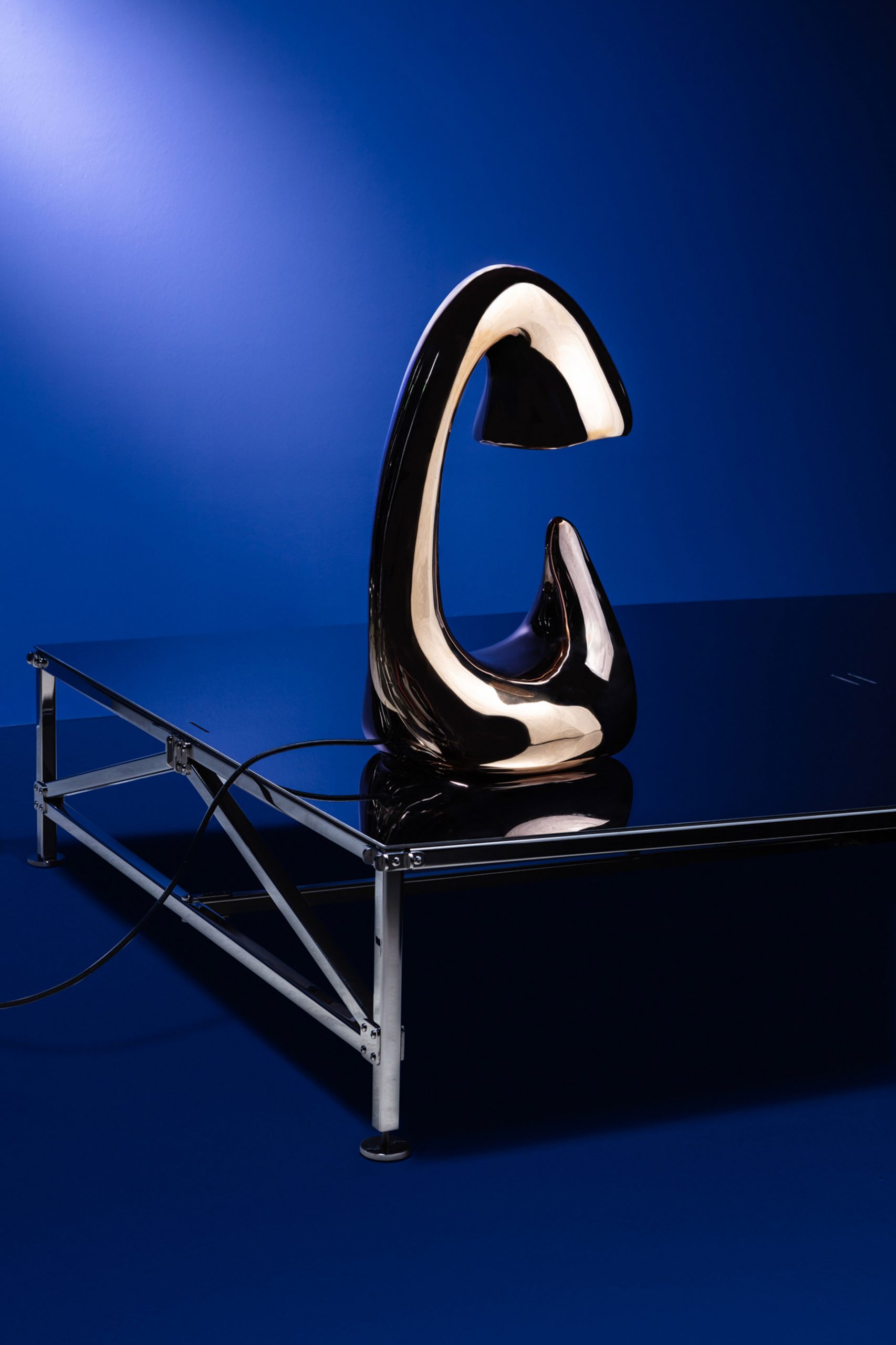
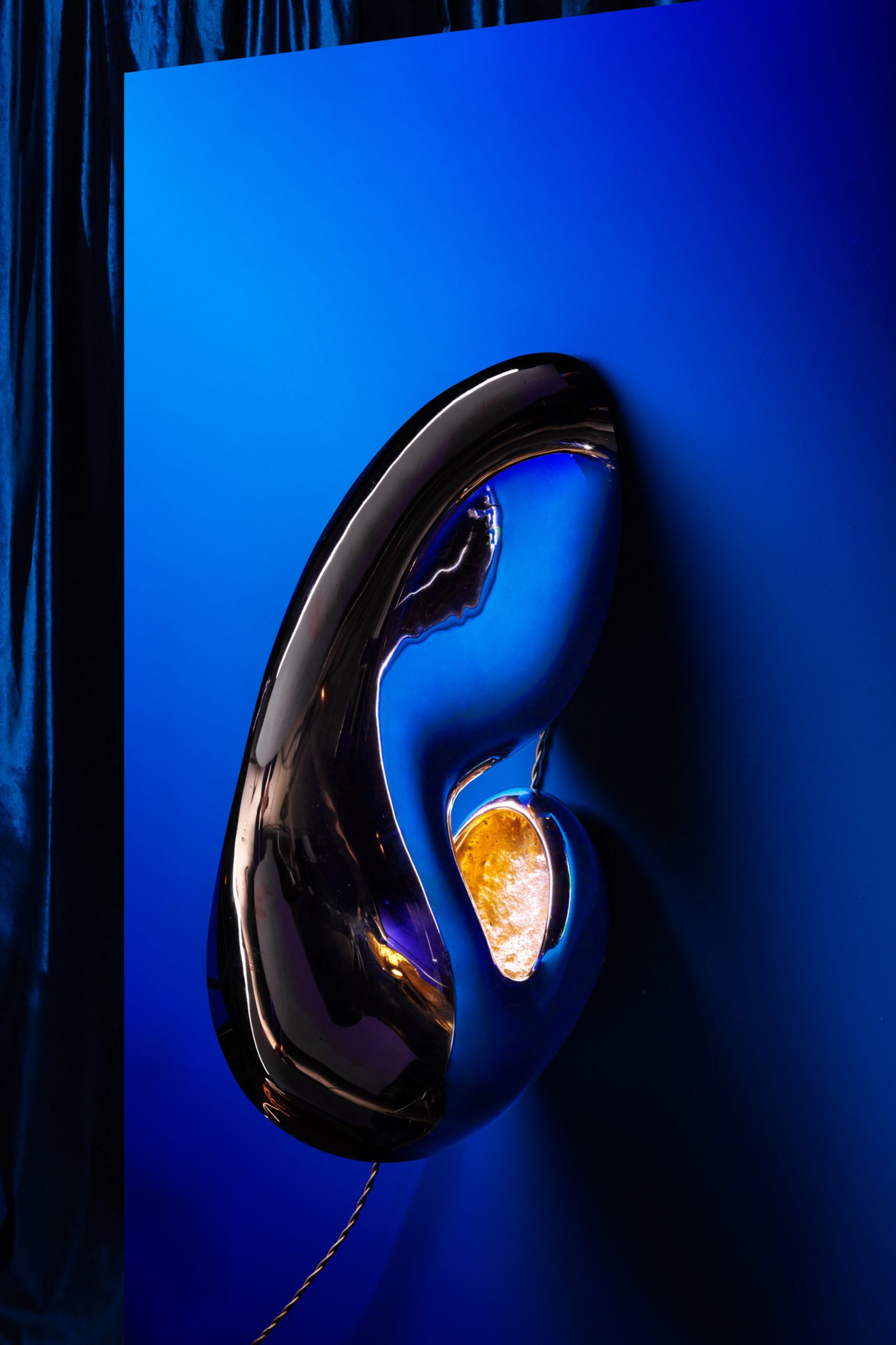
The designs that closest emulated brass were Carlo Lorenzetti's lamps, called Indoor Snail and Goosefish, which were made of bronze using wax casting.
Lorenzetti's bronze lamps were made using wax casting
"Both works were produced using a hybrid method of digital design and iteration in the initial stages, followed by the entirely old-world methods of lost wax casting and hand work for the finishing," Studio Vedèt said.
"The resulting forms combine contemporary methods of creative conception and ancient techniques that have existed for millennia."
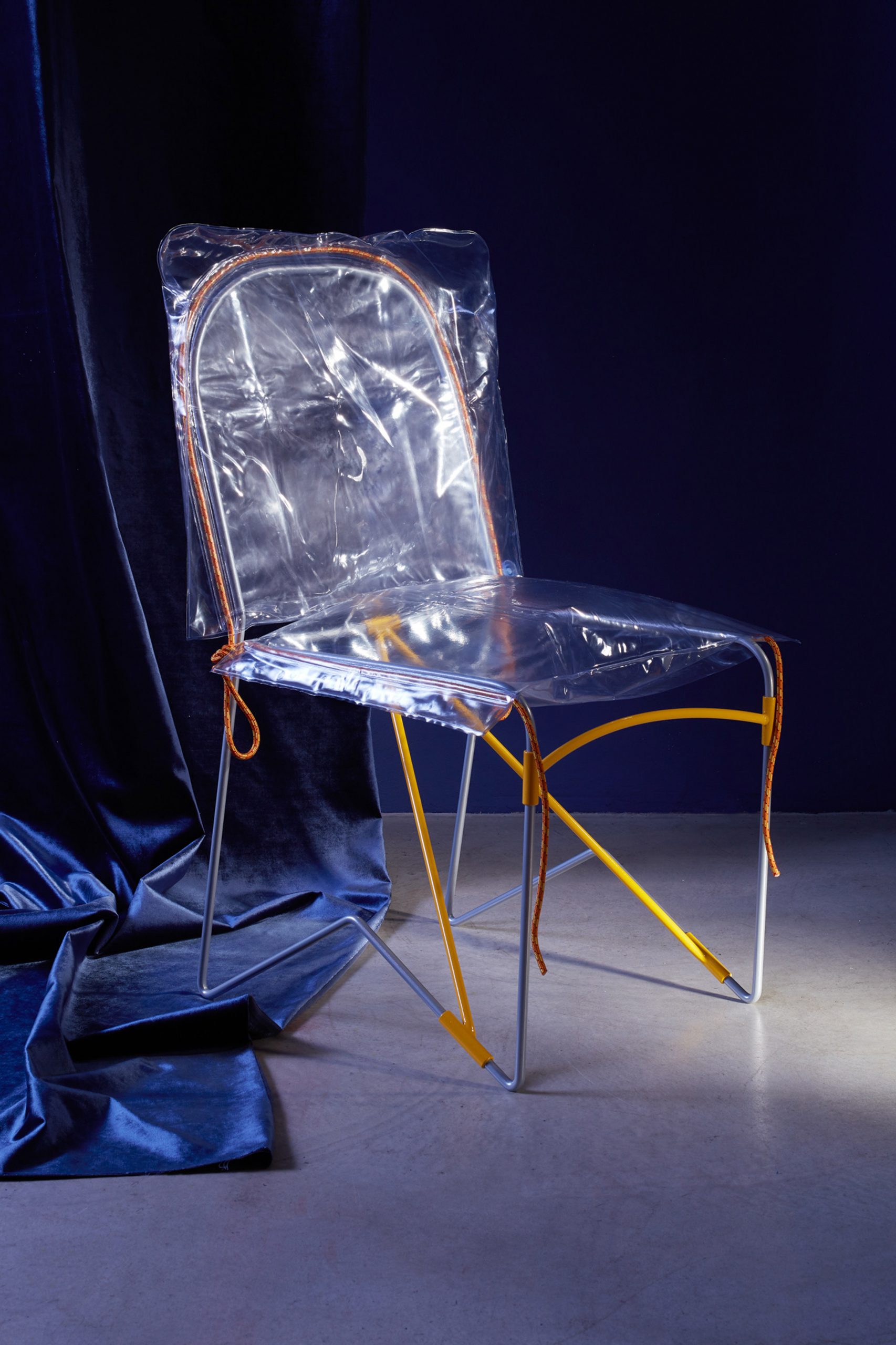
Pieces from the Older with Alexander Vinther show, which was also curated by Studio Vedet, were also showcased at Brassless. They included its minimal stainless-steel frame Zhora chair, which traces the outline of a figure on the run and is named for the replicant Zhora from Blade Runner.
Milano Design City saw showrooms, galleries and various other venues in Milan open their doors to visitors during two weeks in September and October. The initiative was organised by Fuorisalone and Design City Edition after Salone del Mobile had to be cancelled due to the coronavirus pandemic.
Fuorisalone also set up a virtual showroom during Milano Design City to enable "virtual visits" to the design showrooms.
Brassless took place from 29 September to 10 October during Milano Design City. See Dezeen Events Guide for an up-to-date list of architecture and design events taking place around the world.