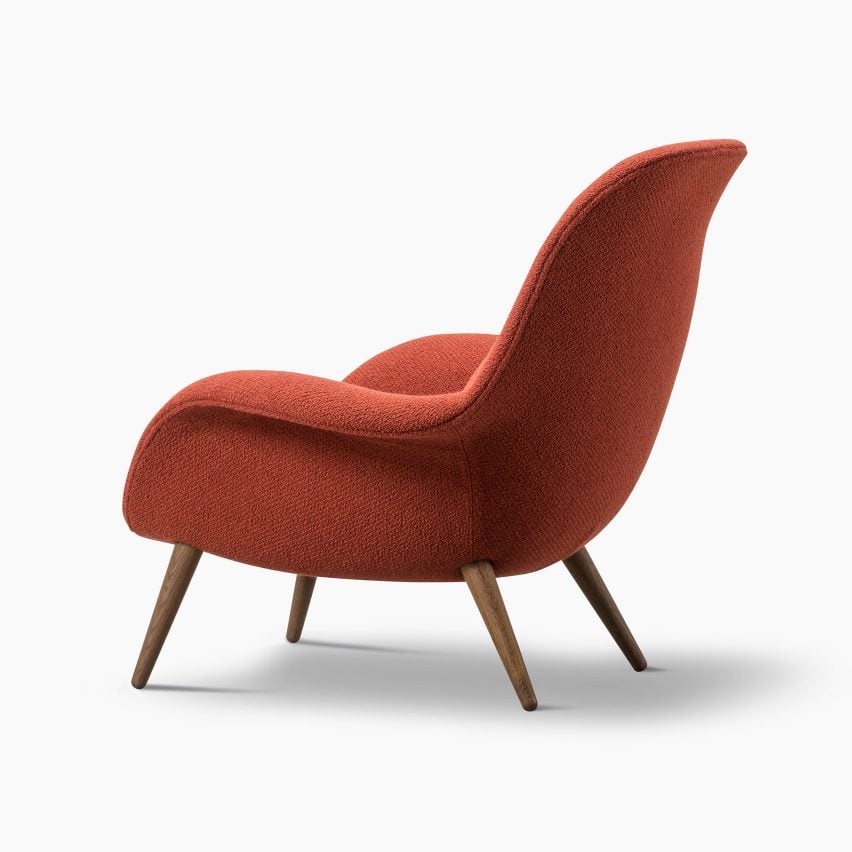
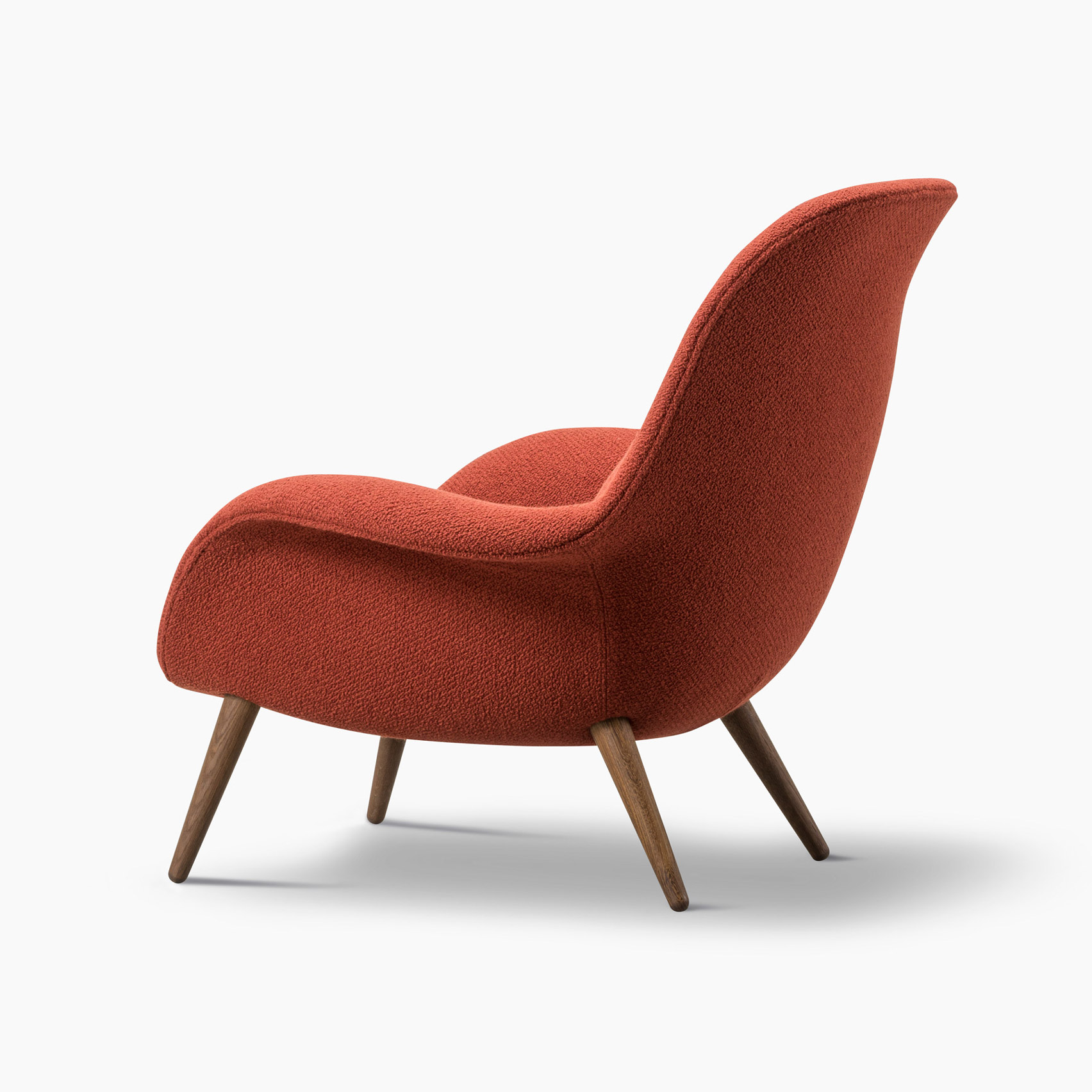
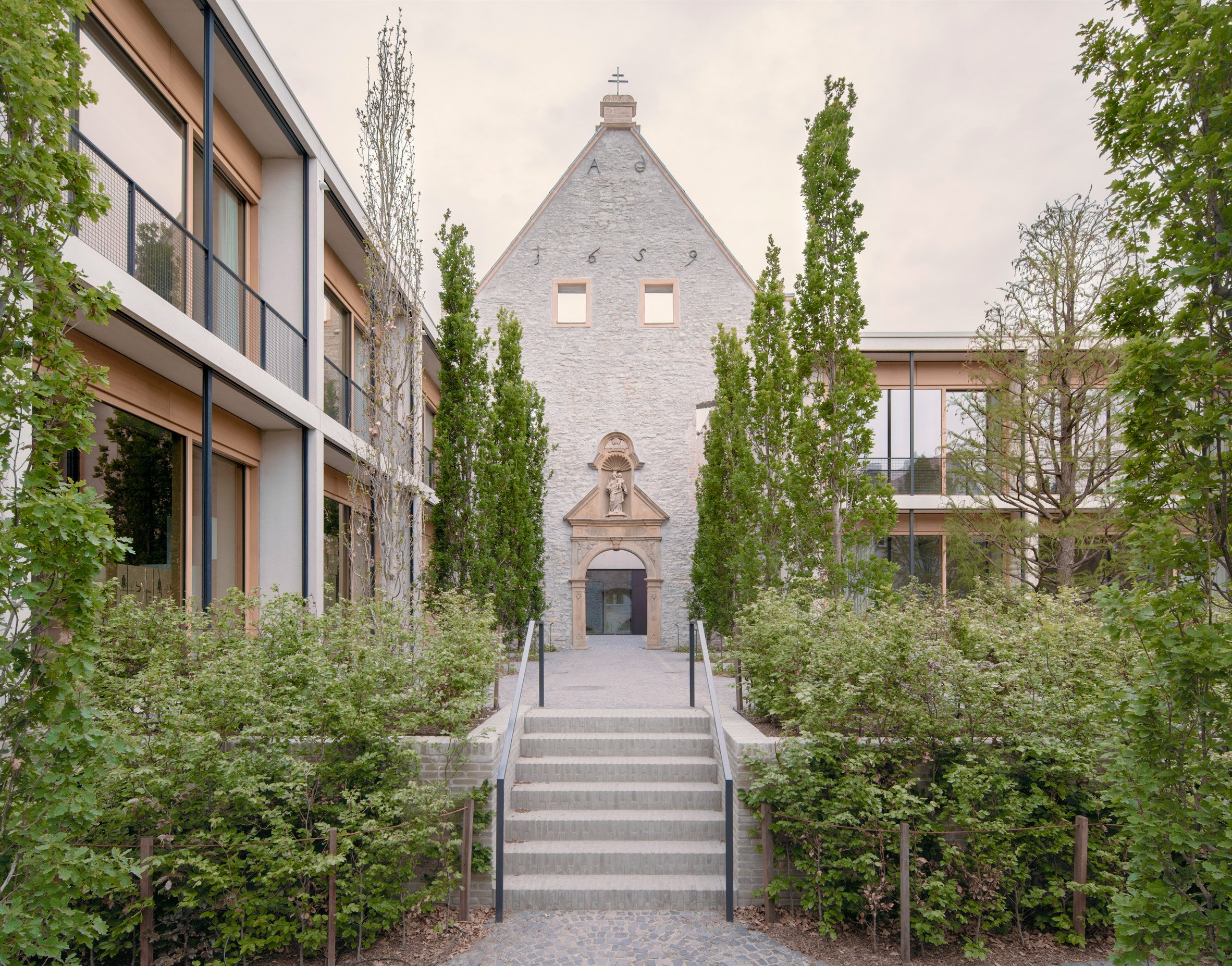
The collection is now produced by Fredericia with various different finishes, enabling it to be tailored for use in hotel lobbies, restaurant reception areas, bars, lounges and private homes.
Above: a swoon lounge chair with straight wooden legs. Top image: a swoon chair with a matching ottoman
"Based on their extensive experience designing high-end hotel interiors and Michelin-star restaurants, Space Copenhagen created Swoon to fill a gap missing in the market – a hybrid of a lounge chair and an armchair with the benefits of both," said Fredericia.
"With its continuous curves, lush look and sculptured shape, Swoon echoes Space Copenhagen's desire for you to enjoy life at a slow pace."
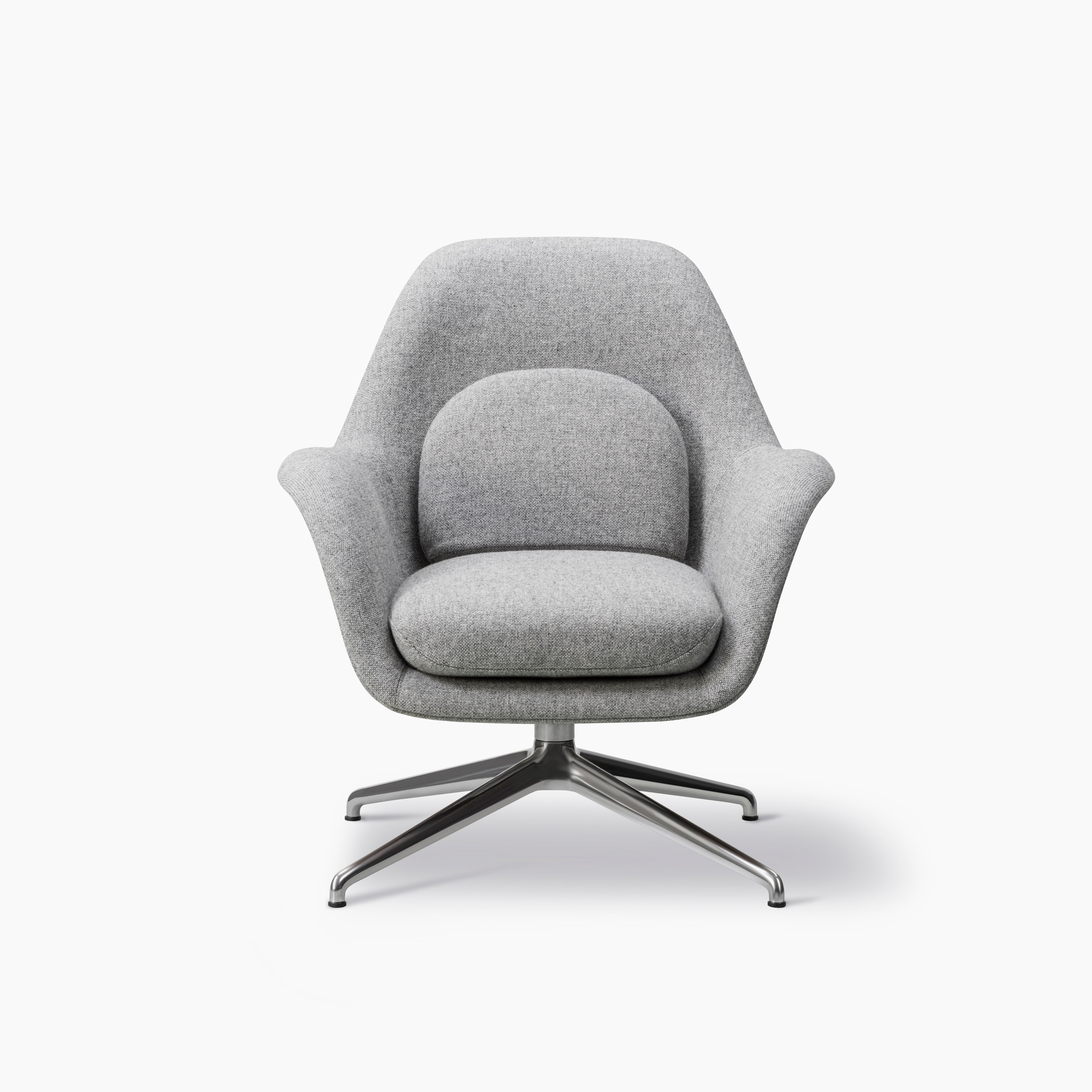
A grey Swoon chair with a swivel base
The Swoon lounge chairs are all distinguished by the same curved shells, which combine the back, seat and armrests as one piece. Two padded cushions are then attached to this shell.
The seats can be upholstered in various different materials and mounted on either slender wooden legs or a swivel base made of metal.
Swoon forms part of a wider collection that features a matching ottoman and the Swoon Lounge Petit – a smaller model of the lounge chair with higher and more upright backrest.
About Dezeen Showroom:Dezeen Showroom offers an affordable space for brands to launch new products and showcase their designers and projects to Dezeen's huge global audience. For more details email showroom@dezeen.com.
An abandoned hospital in western Germany, originally built as a monastery, has now become an office designed by David Chipperfield Architects.
David Chipperfield's Berlin studio transformed the former St Vincenz Hospital in Paderborn, to create a new headquarters for Tap Holding, a family-run company that owns several businesses in the DIY-craft market.
This involved removing various extensions added in the aftermath of the second world war, revealing the historic walls that were previously covered, and adding three new office wings.
The 17th-century chapel facade was preserved
Tap Holding called the project Jacoby Studios, after the family that runs the company.
"The Jacoby Studios create a new urbanistic whole out of fragments," said David Chipperfield. It is an approach he has become known for, on projects like the Neus Museum in Berlin and the Royal Academy renovation in London.
"The project combines a wide range of the practice's experience – reinterpreting historic buildings, combining the old with the new, balancing landscape and building – to provide a comfortable and stimulating workplace," he said.
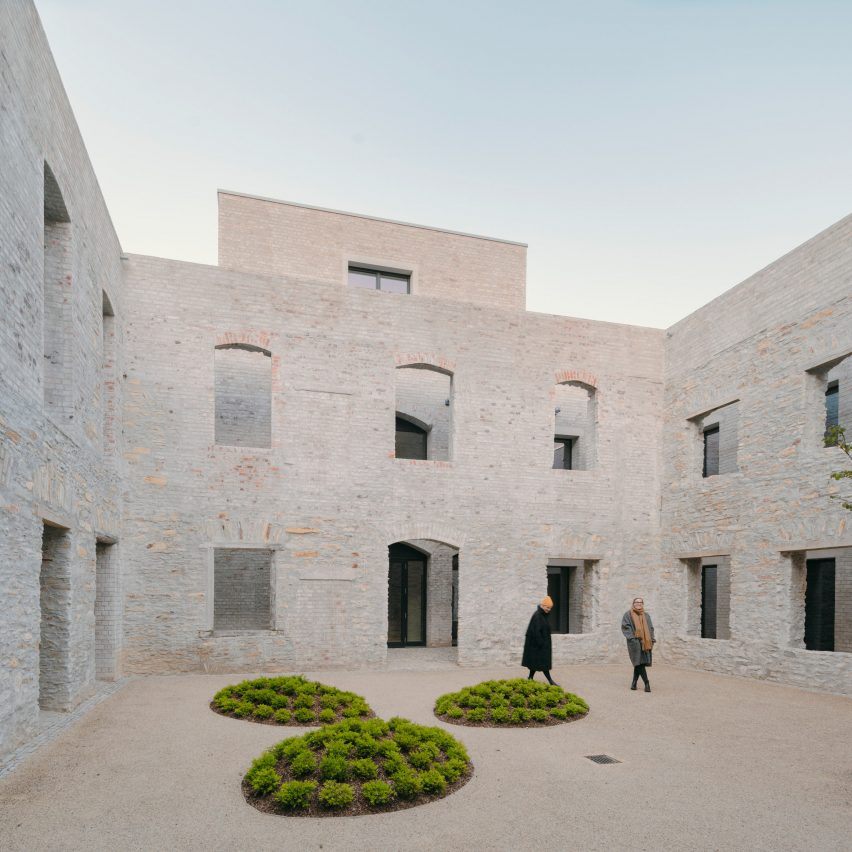
A historic cloister sits at the centre
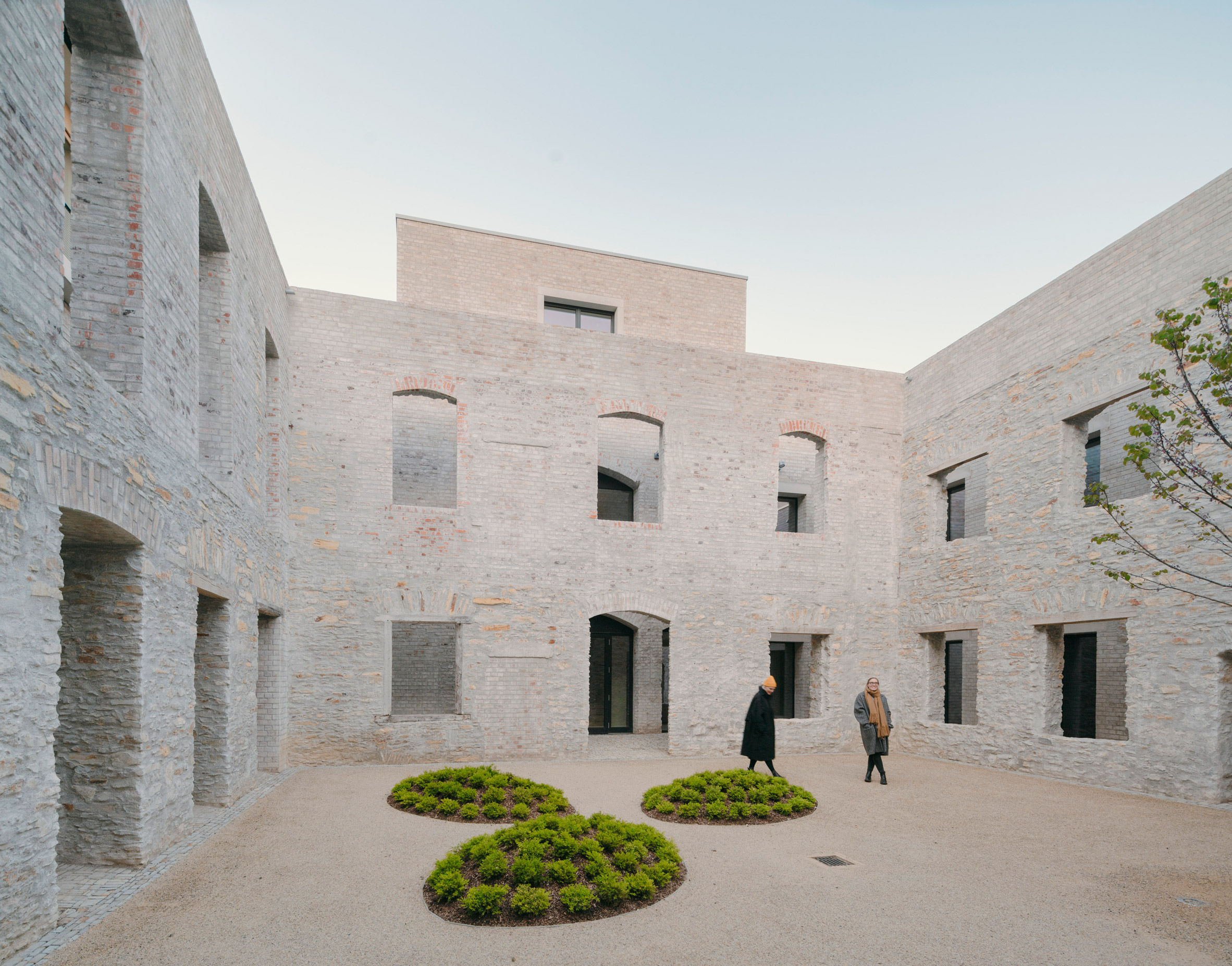
The design team focused their attention on the most historic parts of the 17th-century structure. Removing all of the 20th-century extensions and modifications, they were able to uncover the original quarry-stone masonry.
The best examples of this include the original chapel facade, with its steep gable profile, and the old cloister. In the new site layout, these elements become focal points.
Alexander Schwarz, who leads the Berlin studio, described it as a process of "almost sculptural demolition works".
"The ruins, both found and invented, form the picturesque and structural nucleus of the design," he said.
"The new, tectonic volumes adopt the orthogonal geometric order of the ruinous cloister, creating a structure that appears as a complex three-dimensional composition within the urban surroundings, similar to a monastery," he continued.
"It connects the historical traces and fabric of the old town with the typical post-war modernism idea of the urban landscape and forms a new architecture from it, in which both the sensual and structural aspects are immediately apparent."
Historic stone and brick walls feature inside and out
The new-build part of the project comprises a series of two- and three-storey volumes, arranged around the north, west and south sides of the existing structures.
These buildings feature modular concrete structure, which allows them to tonally match with the old stone. The glass facades are recessed within the frames, allowing a visual hierarchy while also creating balconies where staff can take a break from their work.
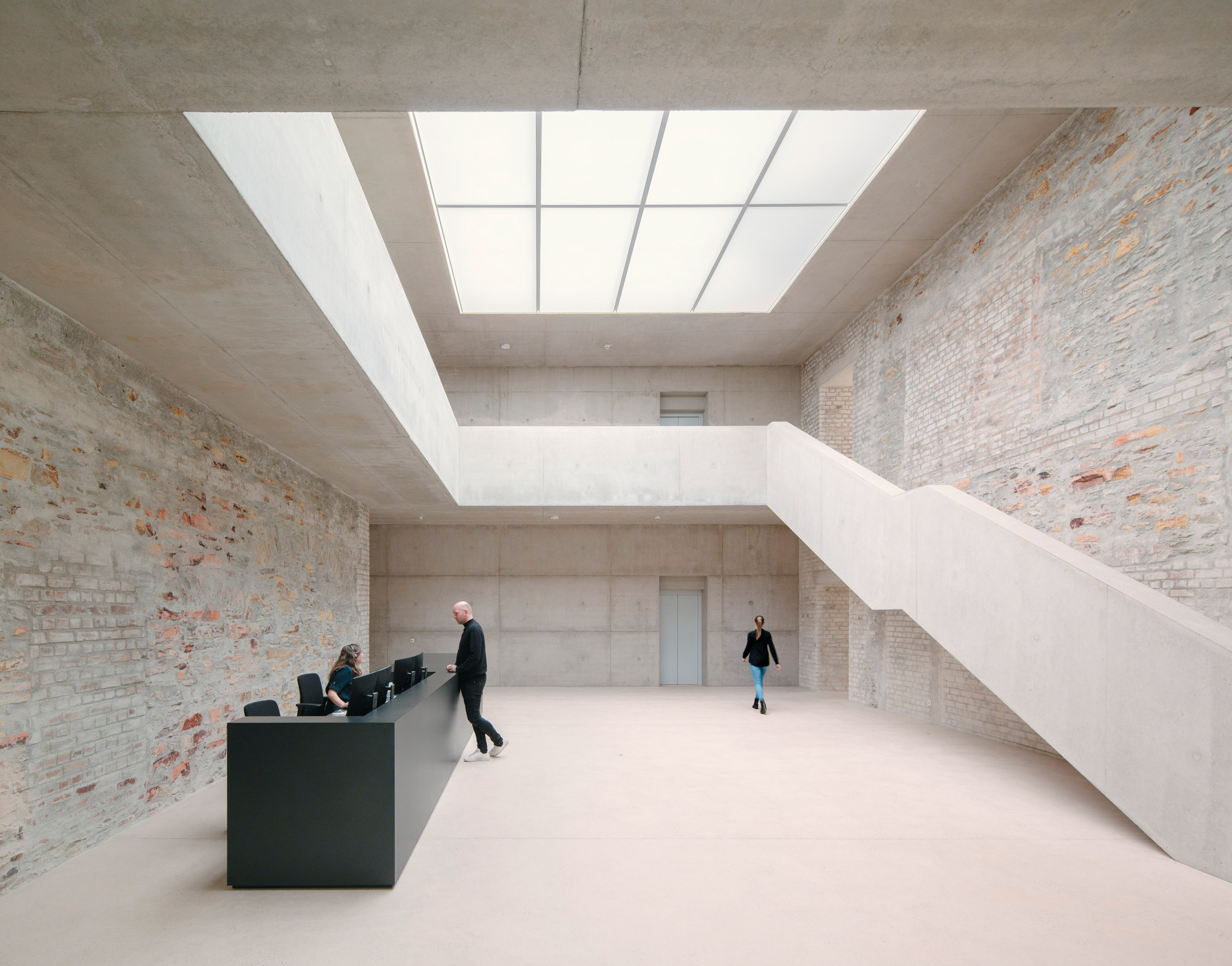
In some places, the stonework walls are now visible inside the building. In some areas, the stonework has been infilled with bricks, which further reveals the layers of history within the structure.
In total, the building contains 12,500 square metres of office space, which includes a staff canteen, a photography studio and a showroom.
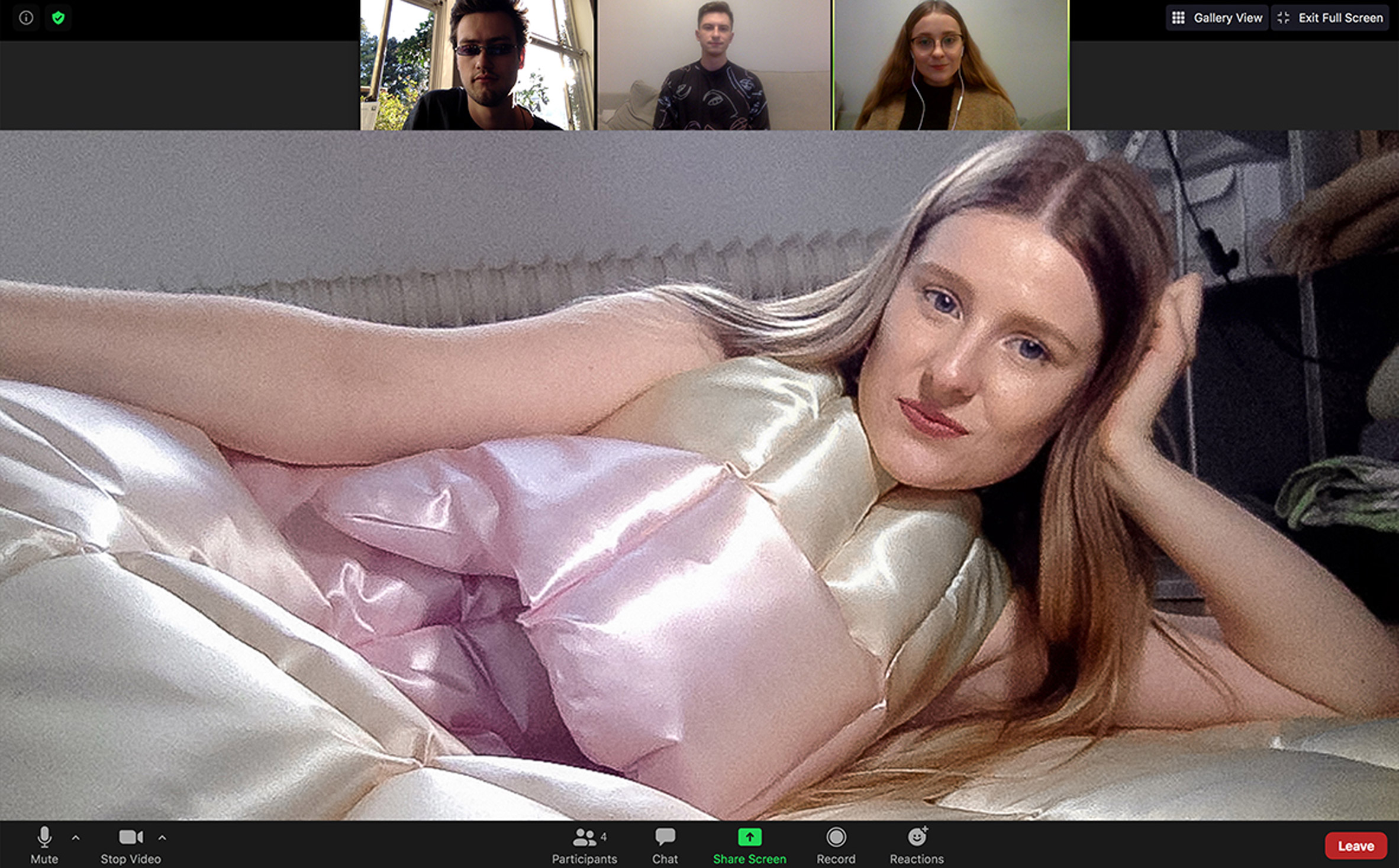
Design Academy Eindhoven graduate Santa Kupča's Stuck-at-Home Masquerade collection includes three pillowy garments that are designed to be worn during remote video calls in coronavirus isolation.
The collection contains three items of clothing that each represents a different "mundane" aspect of having to stay indoors during lockdown.
These "chapters", as the graduate refers to them, are called Hesitant to RSVP, Dolce Far Niente and Public Library. Each A-line garment boasts a tufted design that closely resembles a duvet.
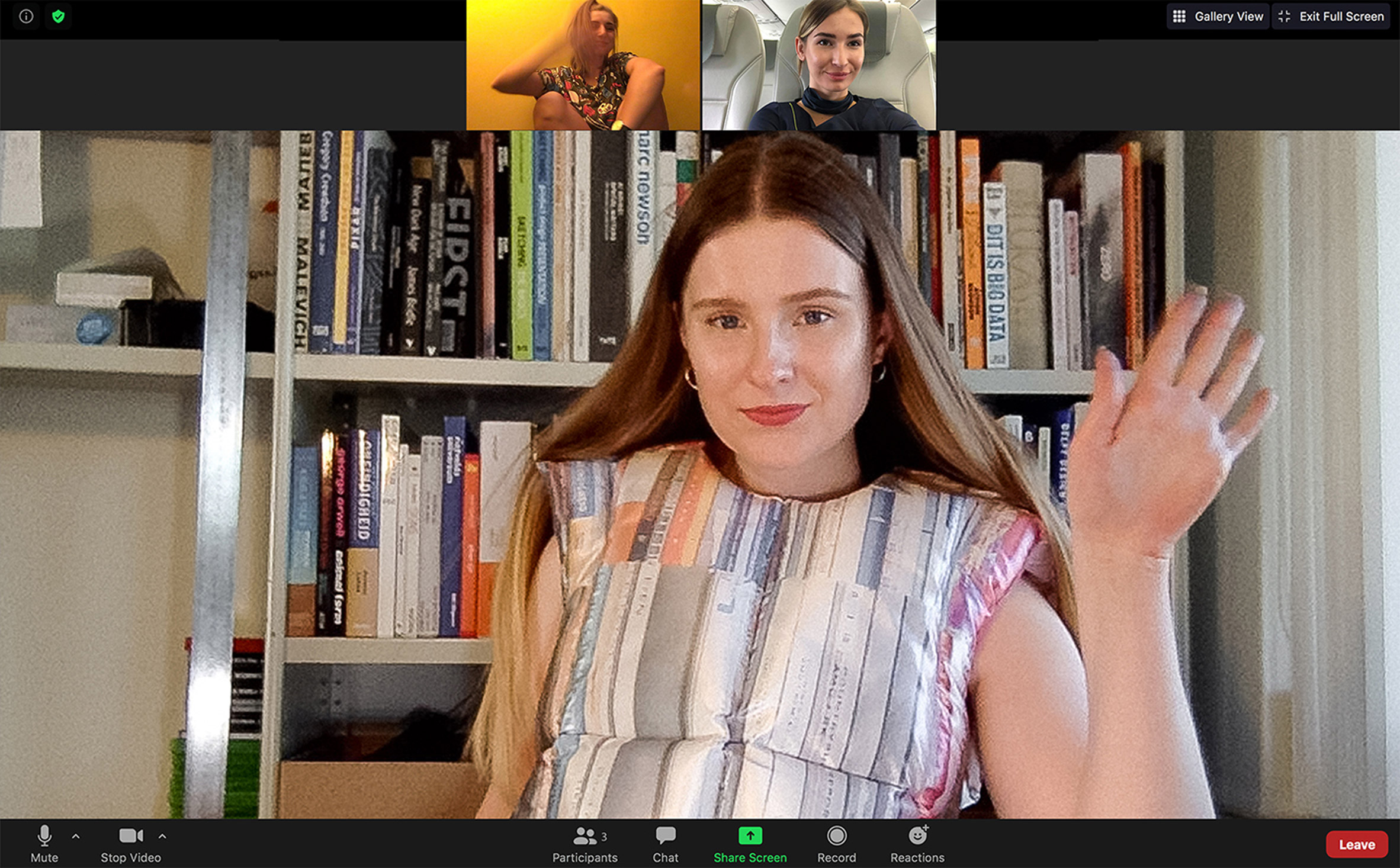
Santa Kupča's Stuck-at-Home Masquerade garments are designed to be worn during video calls
"Covid-19 and the lockdown impacted my graduation project dearly," said Kupča. "Talking on screens and in Zoom conversations became an everyday thing, which often made me confused – I felt like I was in an in-between place, not entirely at home, not entirely there in the conversation."
"I was distracted by wanting to see how I looked on the screen while talking to other people and if my background and the lights around me looked good enough," she added.
"I suddenly felt like I was trying to stage everything around me, which was the starting point of Stuck-at-Home Masquerade."
Each cushiony garment represents a different aspect of the coronavirus lockdown
As the graduate explains, the three pieces are designed to keep their wearer cosy during remote video calls. Each one aims to "romanticise the intimate state of what home symbolises" for her.
"During isolation, every day can seem mundane, but what if we could turn it more celebratory? Instead of feeling trapped at home, you could celebrate by being the queen/king of your castle," said the Latvian designer.
"The garments dwell in an exhibitionist masquerade where the wearer is the decor piece behind the screen," she added. "I think Stuck-at-Home Masquerade is more of fashion poetry, a fashion diary than an actual fashion collection."
Kupča used a regular home printer to create different patterns on the duvet dresses
Each piece was made using materials that the designer found around her home during lockdown, including the stuffing of an old duvet and leftover polyester fabric.
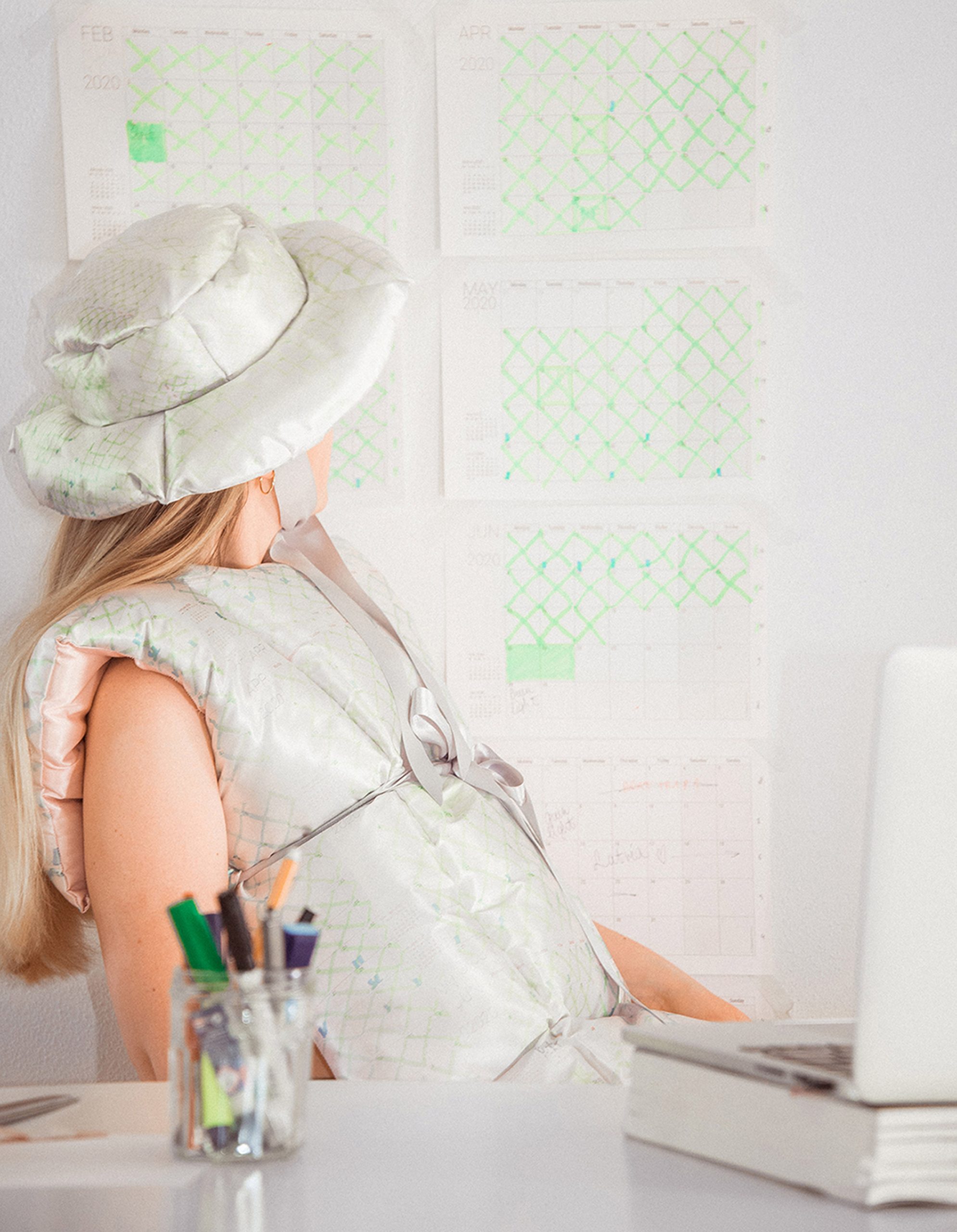
The Hesitant to RSVP garment and matching hat is printed with the pattern of a used calendar where each of the passing days has been crossed out with a green highlighter.
As the designer explains, this piece was about "dressing up while impatiently counting the days for the lockdown to be over."
The Hesitant to RSVP garment is printed with the pattern of crossed-out days on a calendar
"When isolated for months between the same walls and objects, they become everyday remedies," she said. "You become one with the environment. The clutter that surrounds me becomes a part of who I am."
"Hesitant to RSVP relates to postponed meetings, chaotic calendars and confused marker crosses," she continued. "The deadlines that were written on the wall as a reminder were changed to later ones. The idea of planning anything at all doesn't feel current anymore."
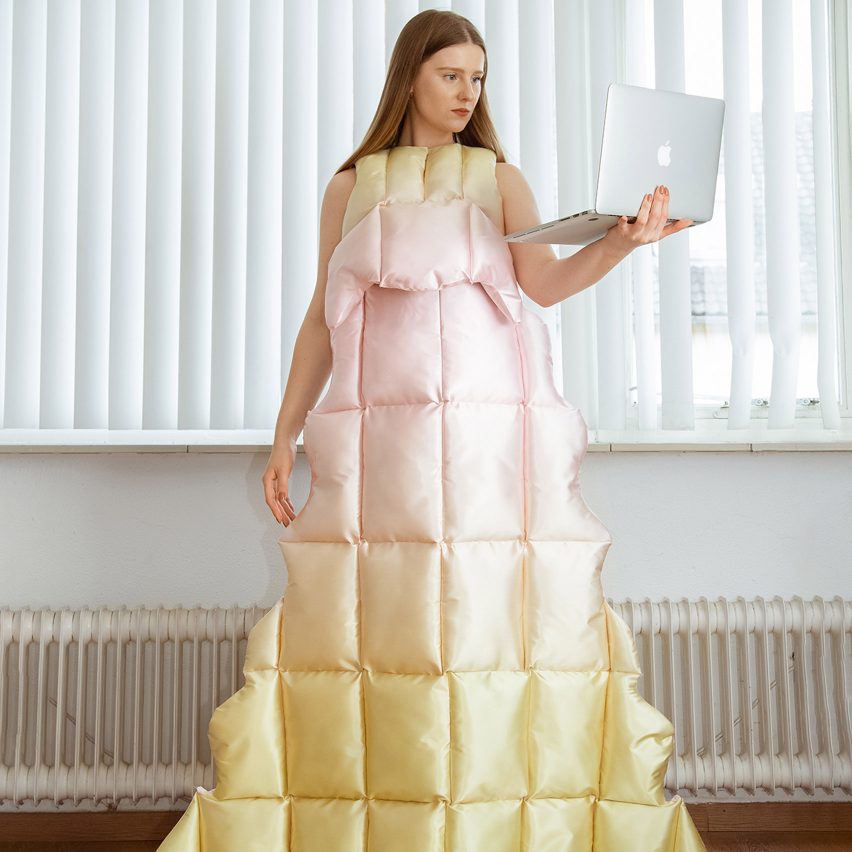
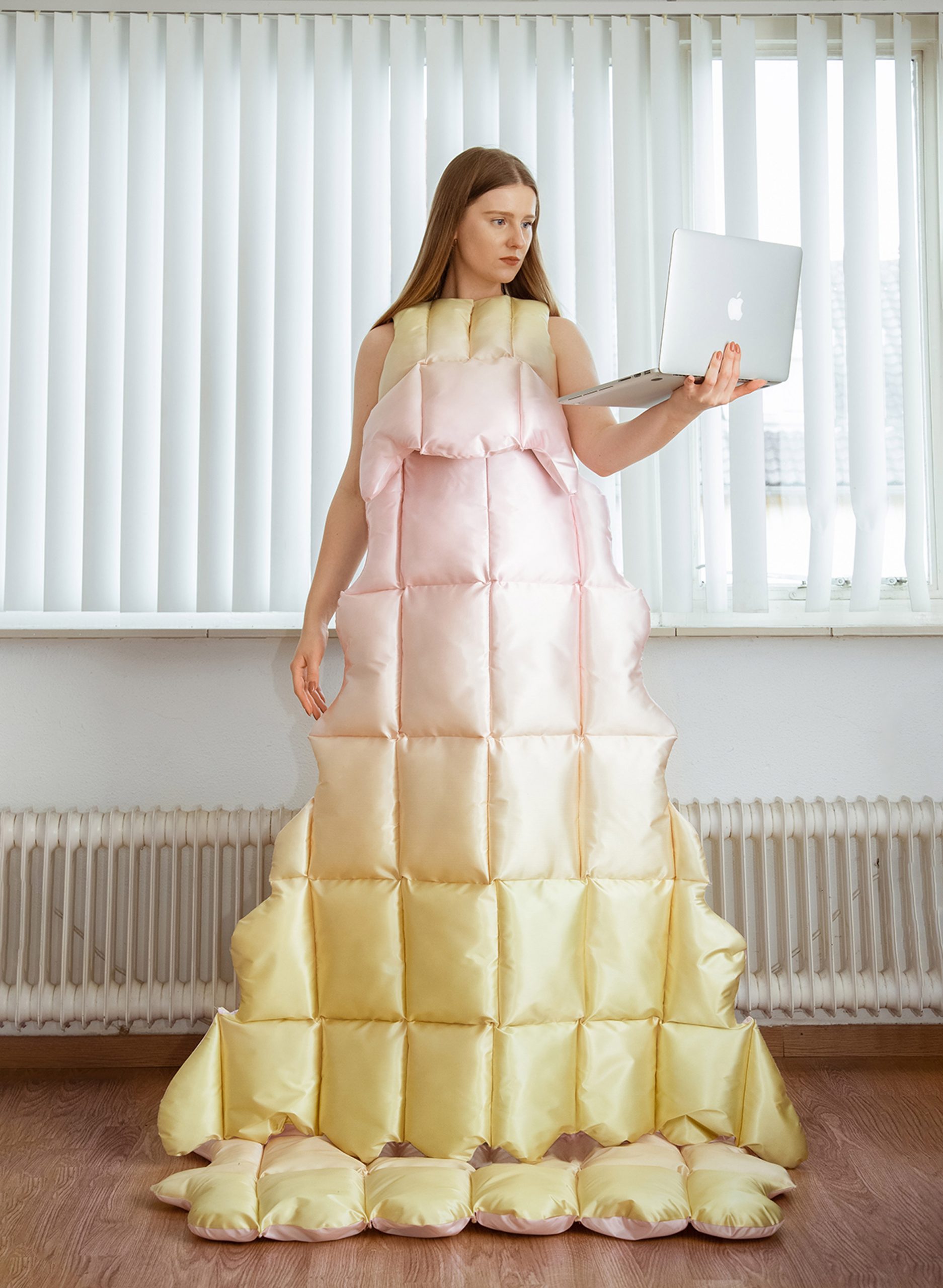
The Dolce Far Niente dress is designed to represent "pleasant idleness
Meanwhile, the Dolce Far Niente piece is a floor-length dress printed with a gradient design that softly changes in colour from pastel yellow to candy pink, with hints of orange created in the crossover.
"Home to me is dreamy, soft and cosy," she said. "The Dolce far Niente piece embraces the essence of doing nothing and enjoying it. Pleasant idleness."
"Though it's ironically difficult to be idle for too long, and I wanted to show that the fear of missing out creeps onto you," Kupča continued. "I designed a dress that illuminates a feeling of a princess who's prepared to go out and socialise."
"The colours of the garment connect to the rosy cheeks of awkwardness that arises from not knowing how to act around people anymore."
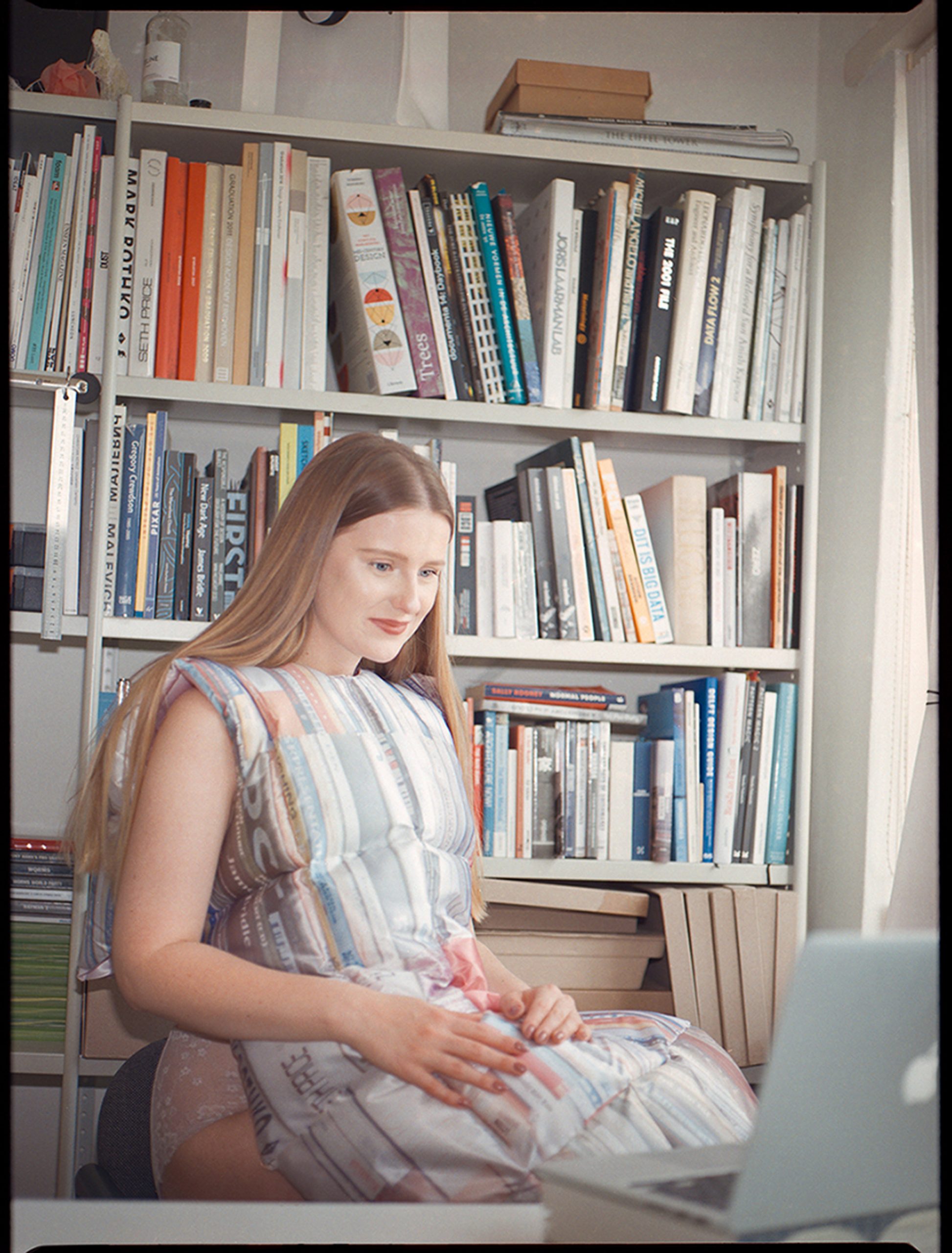
The Public Library garment is printed with images of shelves lined with books
The third Public Library garment is emblazoned with images of shelves lined with books, informed by the "literary" backgrounds people often choose for their work-related video meetings on apps like Zoom.
The first represents a sombre mood, while the second illustrates conflicted emotions and the third symbolises love. Examples include a silky nightgown emblazoned with emojis and coats covered in spikes and tubes.
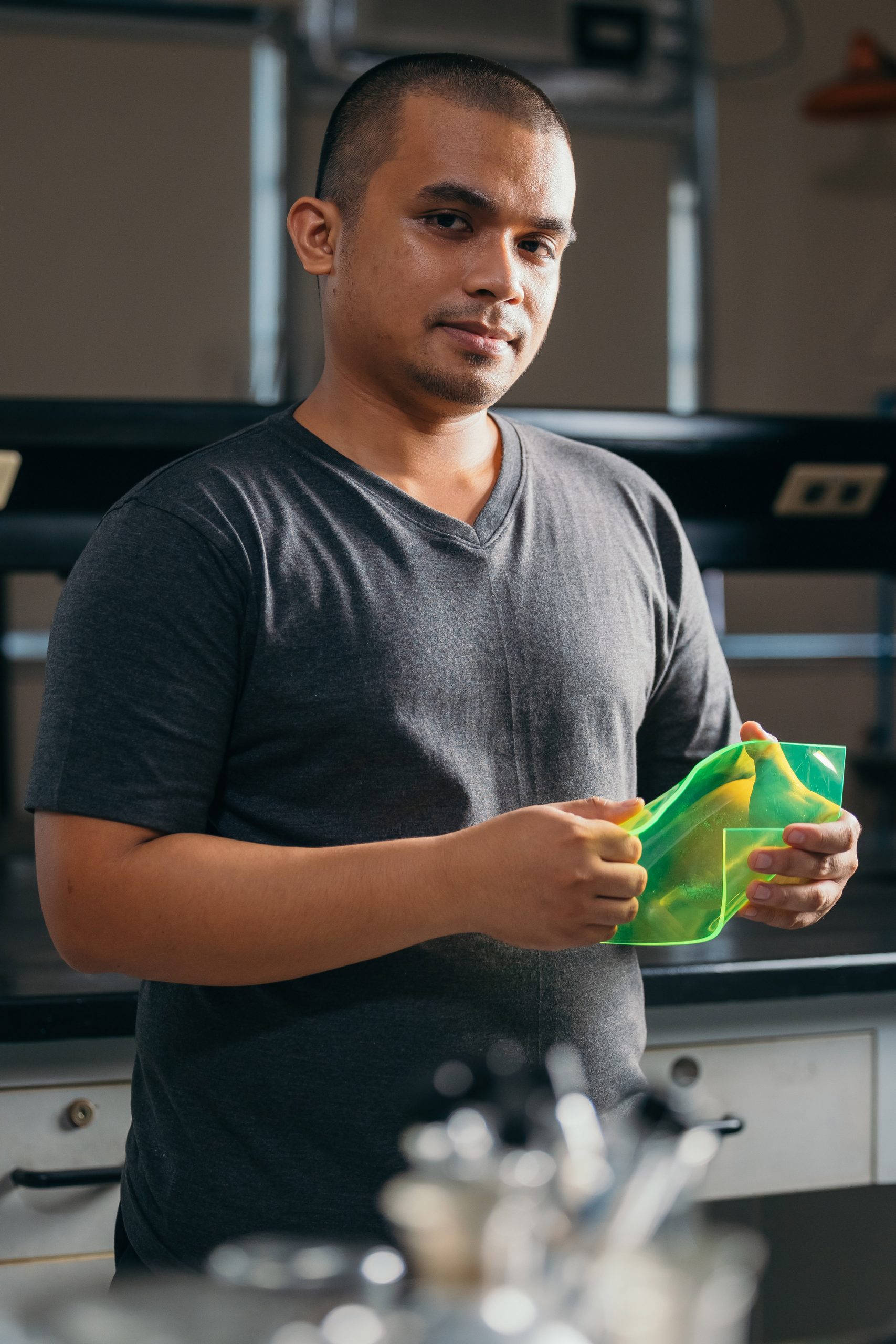
Engineering student Carvey Ehren Maigue has been named the James Dyson Awards first-ever global sustainability winner for his AuReus system, in which waste crops are turned into cladding that can generate clean energy from ultraviolet light.
Unlike traditional solar panels, which only work in clear conditions and must face the sun directly because they rely on visible light, the translucent AuReus material is able to harvest power from invisible UV rays that pass through clouds.
As a result, it is able to produce energy close to 50 per cent of the time according to preliminary testing, compared to 15 to 22 per cent in standard solar panels.
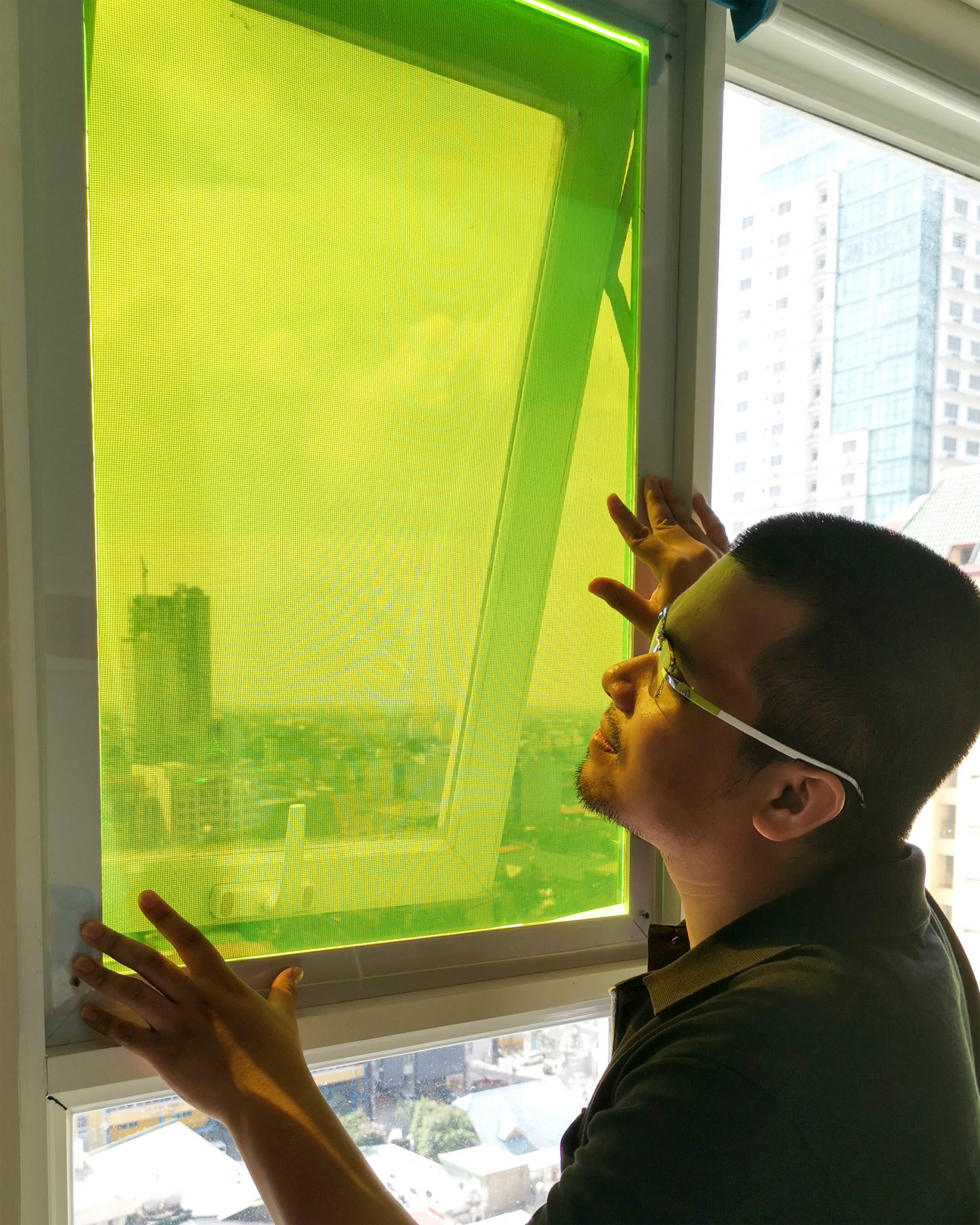
AuReus cladding can be applied to windows or walls
When applied as a kind of fluorescent covering to windows or facades, AuReus can capture UV rays bouncing off of pavements and the surrounding architecture, turning entire buildings into vertical solar farms.
This maximises the amount of energy that can be generated.
AuReus takes its name from the aurora borealis and is inspired by the physics that power the northern lights. Luminescent particles in the atmosphere absorb high energy particles like ultraviolet or gamma rays, before degrading and reemitting them as visible light.
The material is made using waste agricultural crops
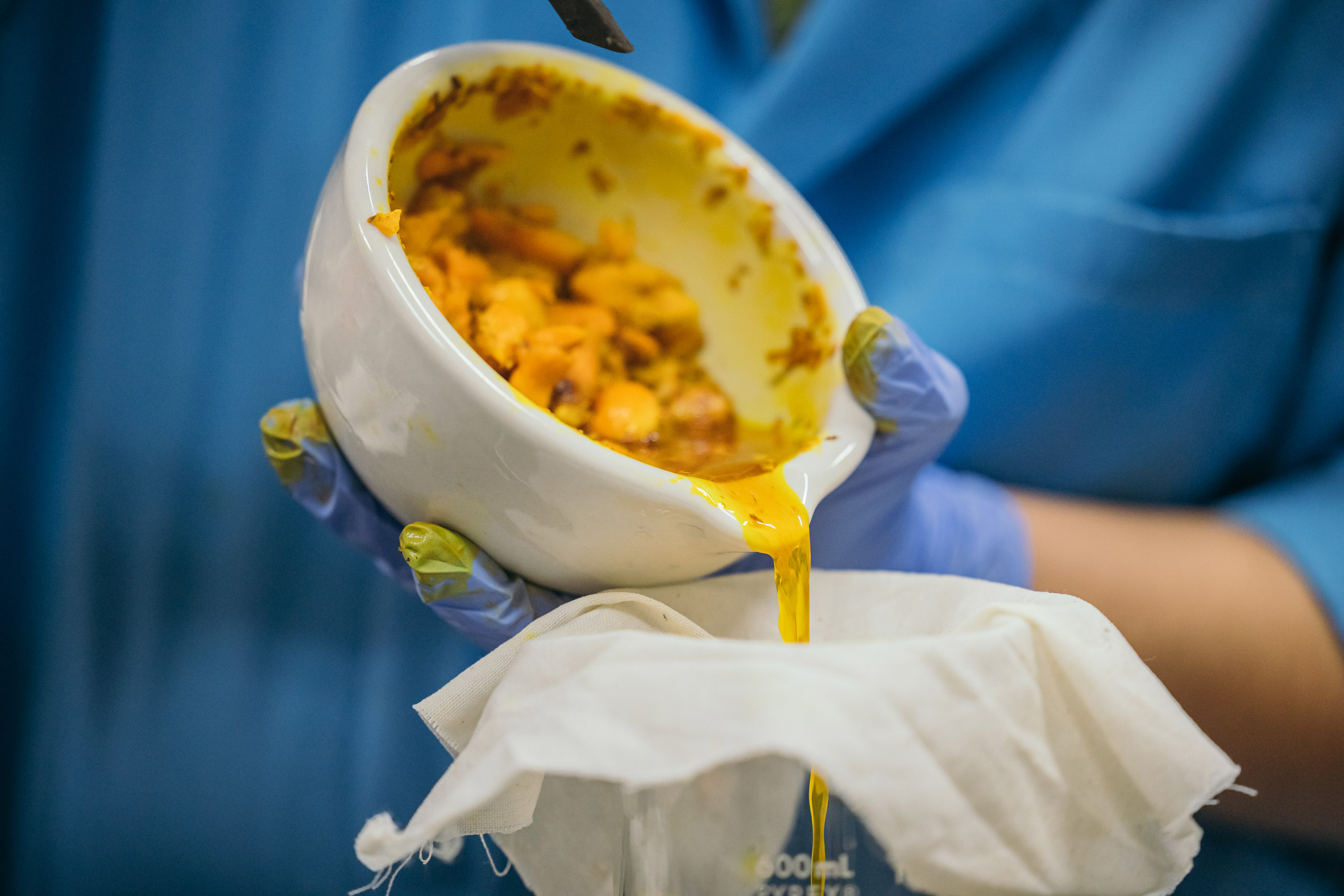
Similarly, Maigue's system uses luminescent particles derived from waste agricultural crops. To pull out the bioluminescent particles from specific fruits and vegetables, Maigue goes through a process of crushing them and extracting their juices, which are then filtered, distilled or steeped.
The particles are suspended in resin before the resulting substrate is moulded into cladding and clamped onto walls or sandwiched between the two panes of a double glazed window.
These particles convert UV light into visible light, which is reflected to the very edges of the panel.
"The light relies on internal reflectance of the material to self-correct and guide itself towards the emitting edge," said Maigue, who is a student at Mapua University in the Filipino capital of Manila. "This can be controlled by specific laser etching patterns
as well."
This visible light can then be captured and converted into electricity by a string of regular photovoltaic (PV) cells, like the ones found in regular solar panels, which fringe the outside of the cladding.
Maigue developed the system while a student at Mapua University in Manila
With the help of integrated regulating circuits, this electricity can then either be stored or used immediately.
"In that way, it can be directly used as a stand-alone or can be connected in groups to produce a higher output," he told Dezeen. "It can also be easily integrated into existing solar photovoltaic systems since its electrical output is suitable for such systems as well."
The fruits and vegetables are crushed and filtered to extract bioluminescent particles
The crops used are sourced from local farmers, who have been affected by severe, climate change-induced weather disruptions.
Around a quarter of people in the Philippines rely on the agricultural sector for their employment but due to global warming, the industry is being affected by more frequent and extreme weather events, which damaged more than six million hectares of crops between 2006 and 2013, worth an estimated $3.8 billion.
By repurposing some of the crops that were rotting on the fields, Maigue makes use of an untapped waste stream and gives farmers a way to monetise their lost yield.
"Combatting climate change is a journey that will need several generations to complete. This means great products alone would not suffice," the engineer said.
"In the conception of AuReus, I aimed to create a future-facing solution in the form of renewable energy and at the same time integrate a present-day value-creating solution for our farmers, who are being affected negatively by the present-day effects of climate change," he continued.
"In this way, we can show people that adapting sustainability to fight climate change is something that can benefit both the present and the future generation and in doing so, we can rally more people in this fight against climate change."
Moving forwards, Maigue plans to turn the AuReus substrate into threads to form fabrics and curved plates to be attached to vehicles and aircrafts.
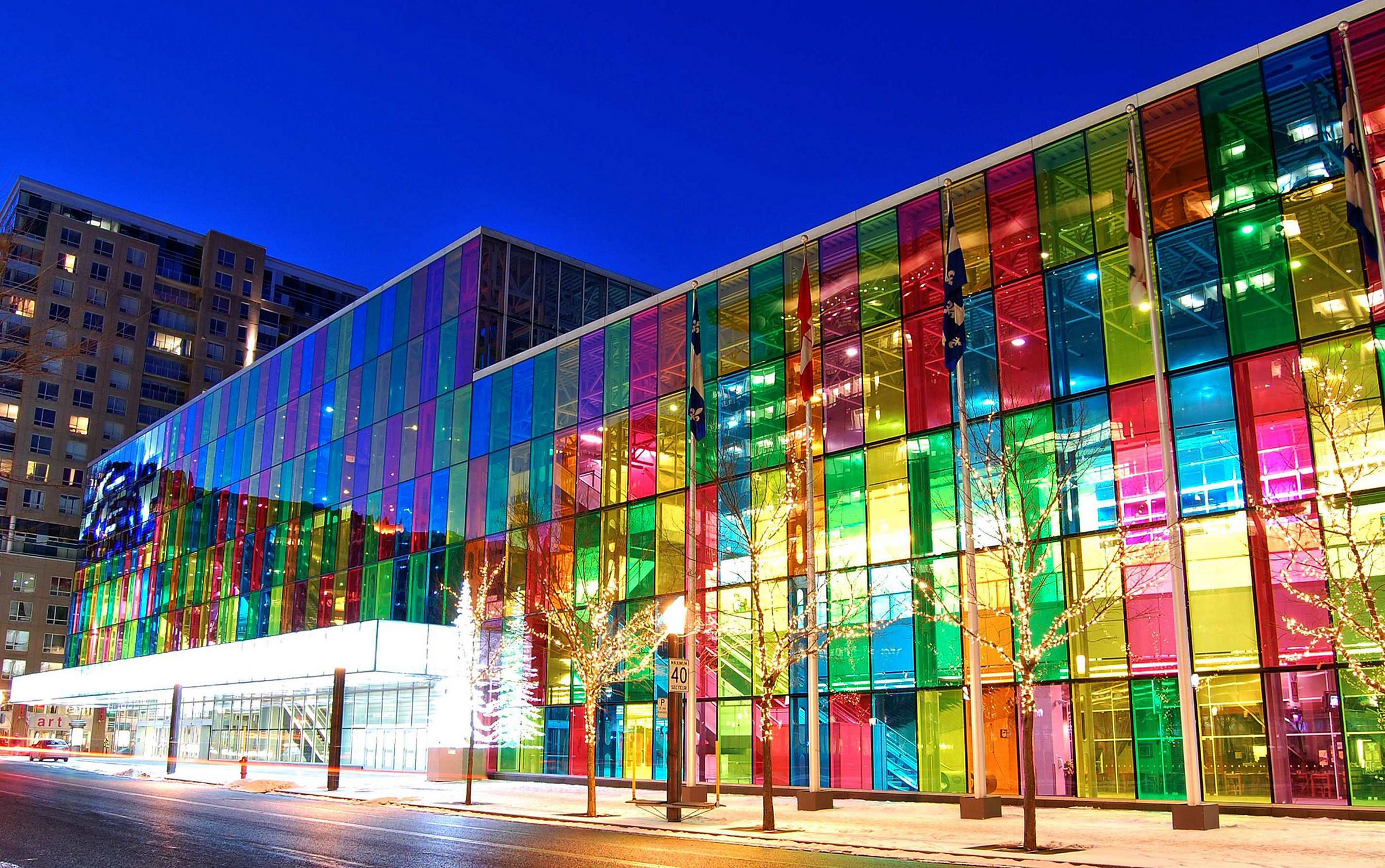
Maigue says the system could be applied to entire buildings such as the Montreal Convention Centre
The Sustainability Award is a new addition to the annual James Dyson Awards, equal to the competition's top prize.
Thierry Métroz explains how DS Automobiles is using virtual reality to design more sustainably in this video produced by Dezeen as part of our Design for Life collaboration with Dassault Systèmes.
Métroz is the fifth designer to feature in the Design for Life collaboration between Dezeen and French design software brand Dassault Systèmes, which highlights designers who are using technology and research to build a better world.
The French automobile designer worked as a design director at both Renault and Citroën before joining DS Automobiles, which began as a luxury offshoot of Citroën but is now an independent brand.
DS Automobiles is a luxury car brand based in Paris
DS Automobiles is a French luxury car brand based in Paris, which draws on the design legacy of the iconic Citroën DS released in 1955.
"The spirit of avant-garde is really at the centre of our DNA, and we've kept this spirit from the original DS," says Métroz in the video, which was filmed by Dezeen for Dassault Systèmes at the DS Automobiles headquarters in Paris.
"It was a car with a lot of technical innovation, and we keep this spirit when we design the future DS," he continued.
Alongside its range of production cars, DS Automobiles is known for futuristic concept cars.
Earlier this year, the brand unveiled its design for the DS Aero Sport Lounge, an aerodynamic concept car with a screen in place of a grille that communicates with pedestrians and other drivers, as well as gesture-controlled functions.
The DS Aero Sport Lounge was designed using Dassault Systèmes' software
"Our target was a very efficient car" explained Métroz of the vehicle's aerodynamic shape, which was designed using parametric modelling software in order to achieve the least possible wind resistance.
The DS Automobiles design team used Dassault Systèmes' software throughout the design process.
Dassault Systèmes offers a suite of 3D software for designers, architects and engineers called 3DExperience, which includes well-known CAD products such as Solidworks and Catia, as well as virtual reality tools that are used in a wide range of industries.
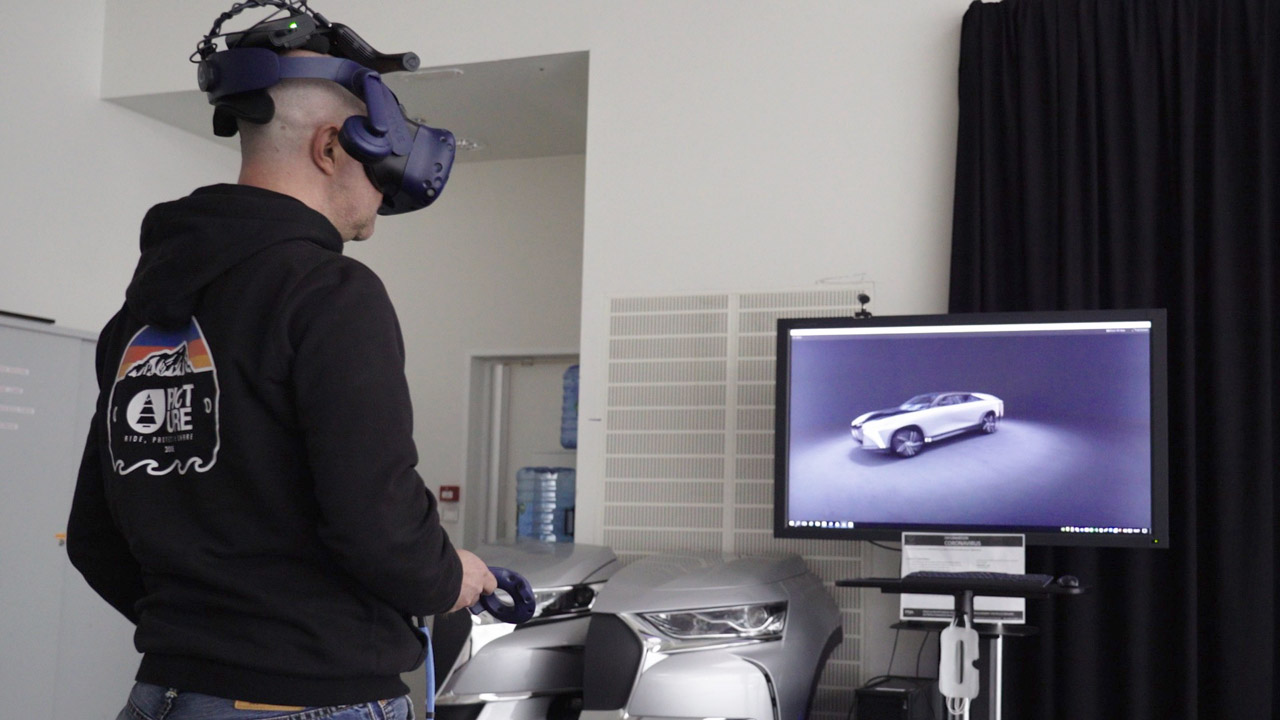
The DS Automobiles team use virtual reality tools to review their designs
"In our design process, we use 80 per cent digital tools, and they are really strategic in our design development," said Métroz.
"We use Dassault Systèmes' software from the beginning; tools for 3D modelling, virtual reality, parametric design and 3D printing."
After creating the initial shape of the car using CAD software and parametric tools, Métroz and his team refine the design in Dassault Systèmes' virtual reality software.
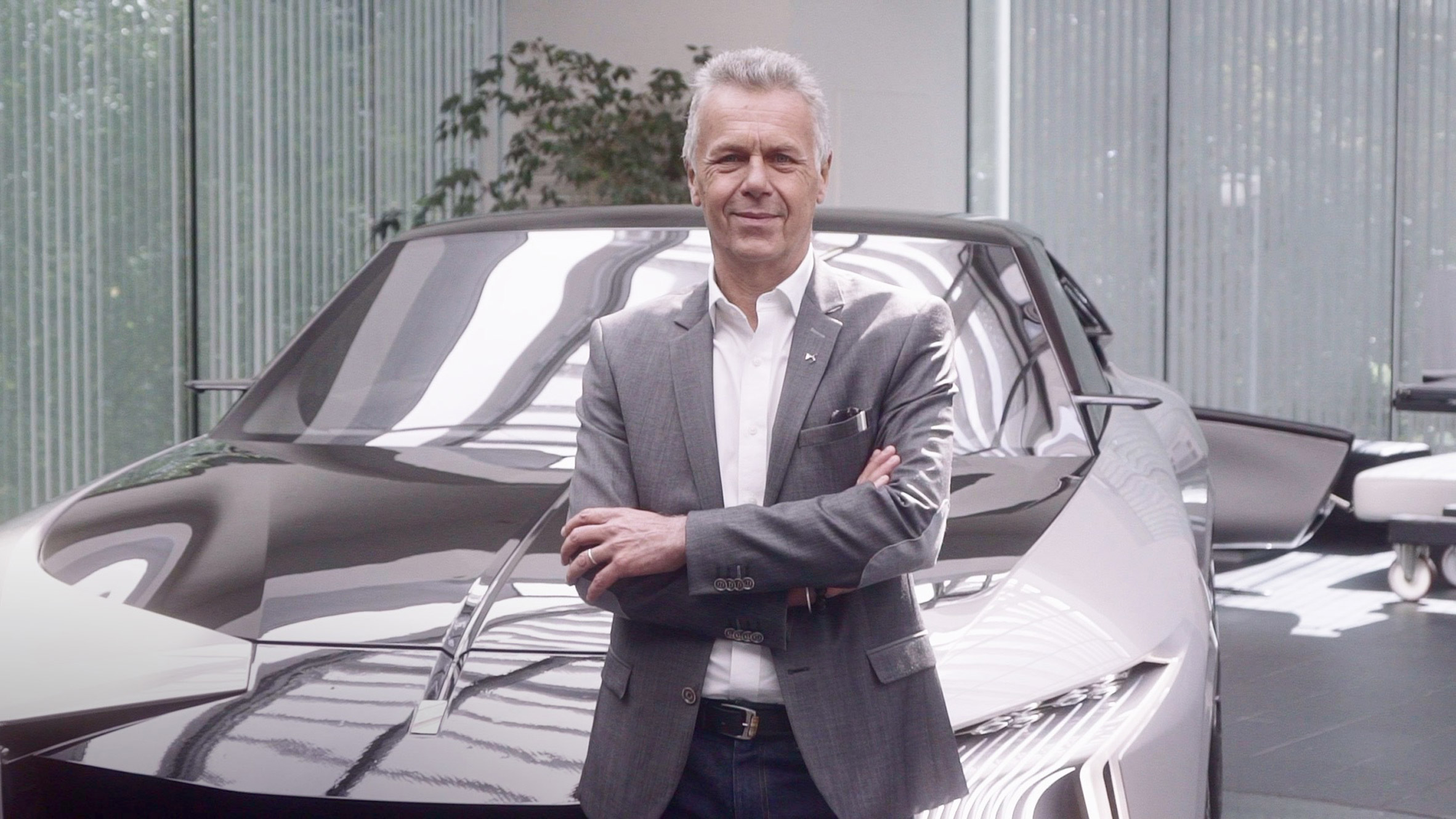
DS Automobiles design director Thierry Métroz says that virtual reality is the future of car design
According to Métroz, using virtual reality is a more sustainable way to design cars.
"The process is very sustainable because we don't need to do a full size mockup and we don't use raw materials," he said. "To be more sustainable is one of the most important challenges for all the automobile industry."
The designer predicts that virtual reality tools will become increasingly prevalent in the car design industry.
"In five to ten years, 80 per cent of all design development will be done with virtual reality," he claimed.
Design for Life
Design For Life is a content collaboration between Dezeen and Dassault Systèmes featuring talks and videos highlighting designers who are using technology and research to build a better world.