Saturday, 28 November 2020

3XN to add carbon-negative extension to Hotel GSH on Bornholm island

A visual of Hotel GSH that 3XN and GXN are developing in Denmark

Architecture studio 3XN is developing a carbon-negative extension for Hotel GSH on the Danish island of Bornholm that will be built almost entirely from wood.

Designed by 3XN in collaboration with its sustainability-focused sister studio GXN, the new eco-friendly wing will provide 24 rooms, a conference room and rooftop spa for the hotel.

It follows the studio's completion of Hotel GSH, which is an acronym for Hotel Green Solution House, in Rønne in 2015.

Hotel first of its kind in Denmark

The Danish studios' goal for the extension is for it to be carbon-negative over its lifespan, which they claim "has not been seen in a commercial building in Denmark before".

Carbon-negative buildings, also described as climate positive, are designed to absorb more carbon than they consume during their lifetime.

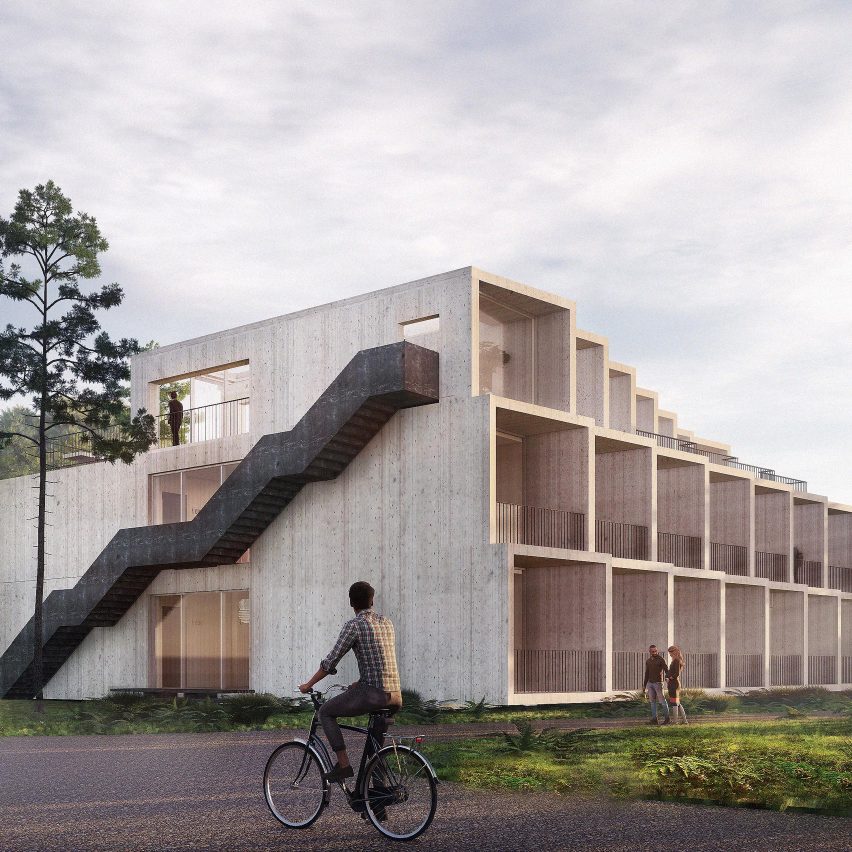
To achieve this, it will be built with a cross-laminated timber structure, insulated with wood fibres and clad with wooden panels. It will also utilise passive design and renewable energy technologies, and contain furnishings made from recycled materials.
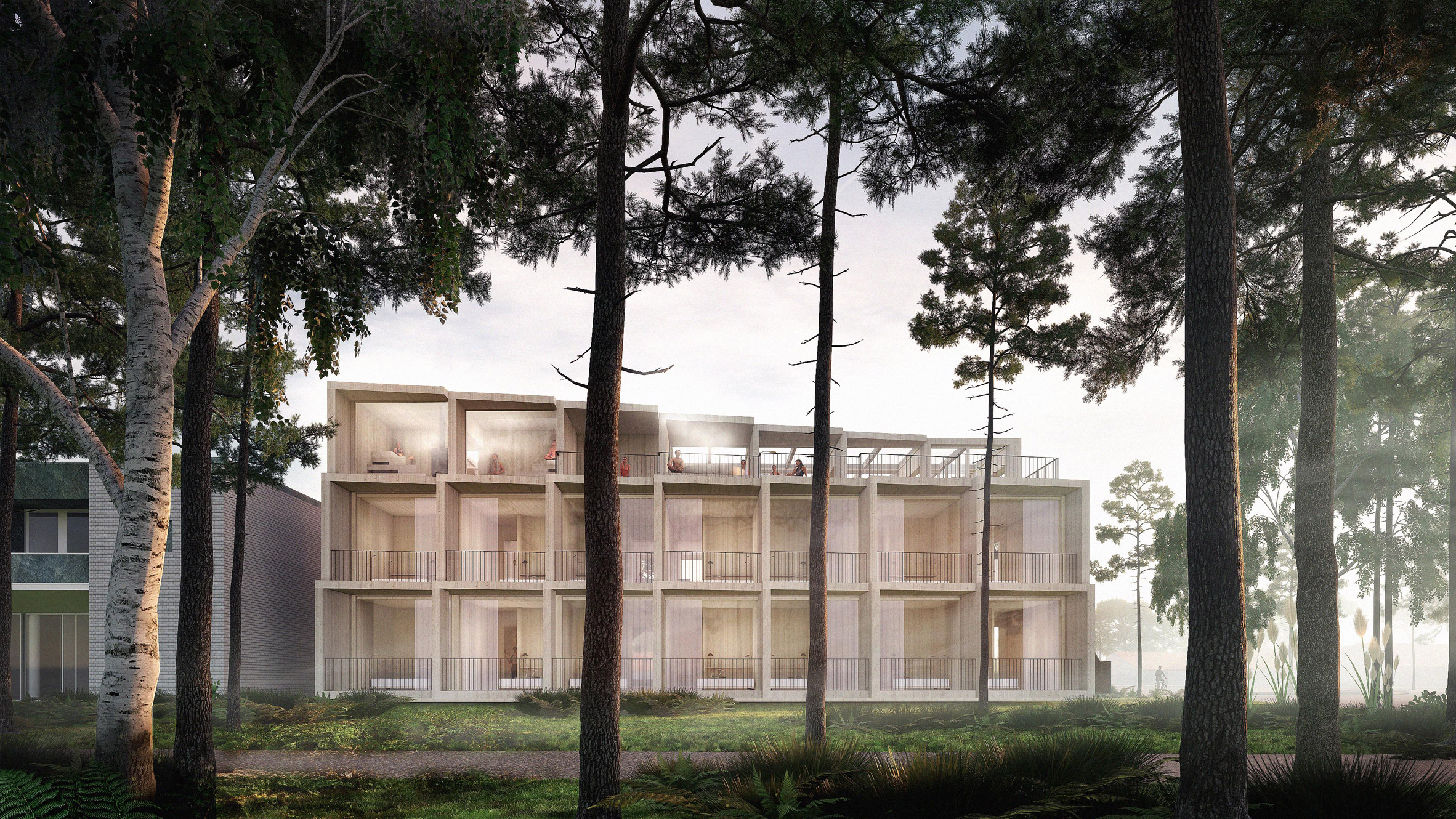
A exterior visual of the proposed Hotel GSH extension by 3XN and GXN
Hotel GSH's extension will have a cross-laminated timber structure

"If we in Denmark want to be able to achieve our climate goals, the construction industry needs to think and act differently, and there is, therefore, a great need for lighthouse projects like this," said Kasper Guldager Jensen, partner at 3XN.

"The idea is simple – we believe that climate positive architecture combines good design and good business," Jensen continued.

"Hotel GSH will provide a blueprint for a climate positive future and this experience is a destination worth travelling for, which ultimately makes it a good business for our client."

Sequestered carbon will offset carbon emissions

According to 3XN and GXN, the sequestered carbon contained in the wood used to build the new wing is expected to offset the carbon dioxide emitted by the building over its lifespan.

Sequestered carbon refers to the amount of carbon dioxide a tree removes from the atmosphere as it grows and subsequently stores as carbon. When a tree is logged for use as timber, it will continue to store it.
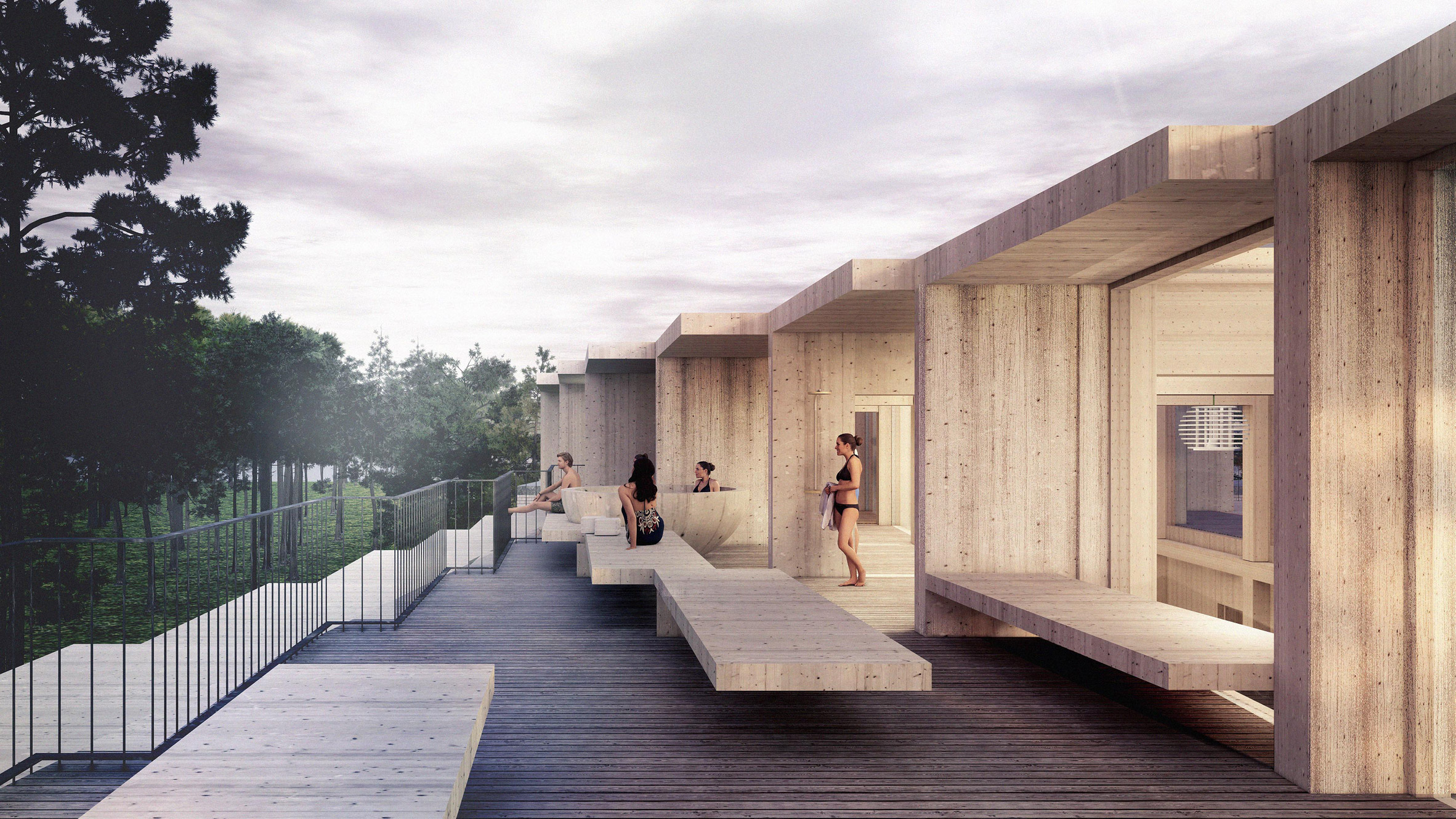
The rooftop spa in the proposed Hotel GSH extension by 3XN and GXN
The extension will incorporate a rootop spa

Once complete, the studios also intend to utilise renewable energy and passive design strategies to help reduce its carbon footprint further.

According to GXN, this will include harvesting solar energy to heat water, connecting to a local energy grid that relies on renewable energy technologies and using natural ventilation to negate dependence on mechanical systems.

All building materials will be reusable

3XN and GXN will use reversible joints throughout construction to ensure the extension and its components can be dismantled and reused at the end of its useful life.

Any offcuts from the structure will be transformed into furniture and furnishings for the wing's interiors, ensuring there is minimal demolition waste.

In the new conference room, 3XN and GXN plan to use some debris from local granite quarries in Bornholm as decoration. This stone will also help regulate the temperature of the conference space using thermal mass.

Hotel GSH also built with recyclable materials

3XN is a Copenhagen-based studio that was founded in 1986 by Nielsen alongside Lars Frank Nielsen and Hans Peter Svendler Nielsen. Its innovation arm GXN was established in 2007.

The studios' design of Hotel GSH in 2015 was intended to demonstrate how architecture can adopt the principles of the circular economy and utilise green building solutions. Like the proposed extension, it was built with materials that can be disassembled, recycled or are biodegradable, and utilises on-site energy production.

Elsewhere, the studios are collaborating on the 2 Finsbury Avenue office complex in central London, UK, which includes a 35-storey skyscraper.

It is being developed with the goal of being net-zero carbon in both its construction and operation through the use of low carbon materials, passive design strategies and possibly the re-use of elements from existing buildings on site.

Visuals are by 3XN.

The post 3XN to add carbon-negative extension to Hotel GSH on Bornholm island appeared first on Dezeen.


from Dezeen https://ift.tt/3o8R9LI

Teal-hued panels enclose timber beach retreat in Chile

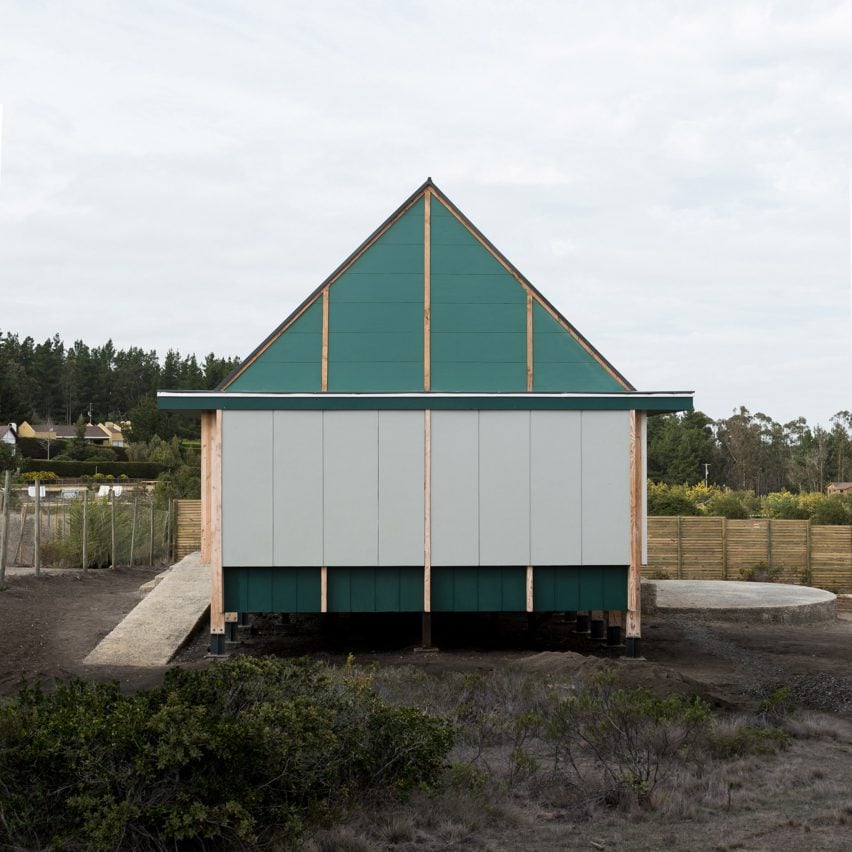
Short elevation of SP House by (E)StudioRO in Chile

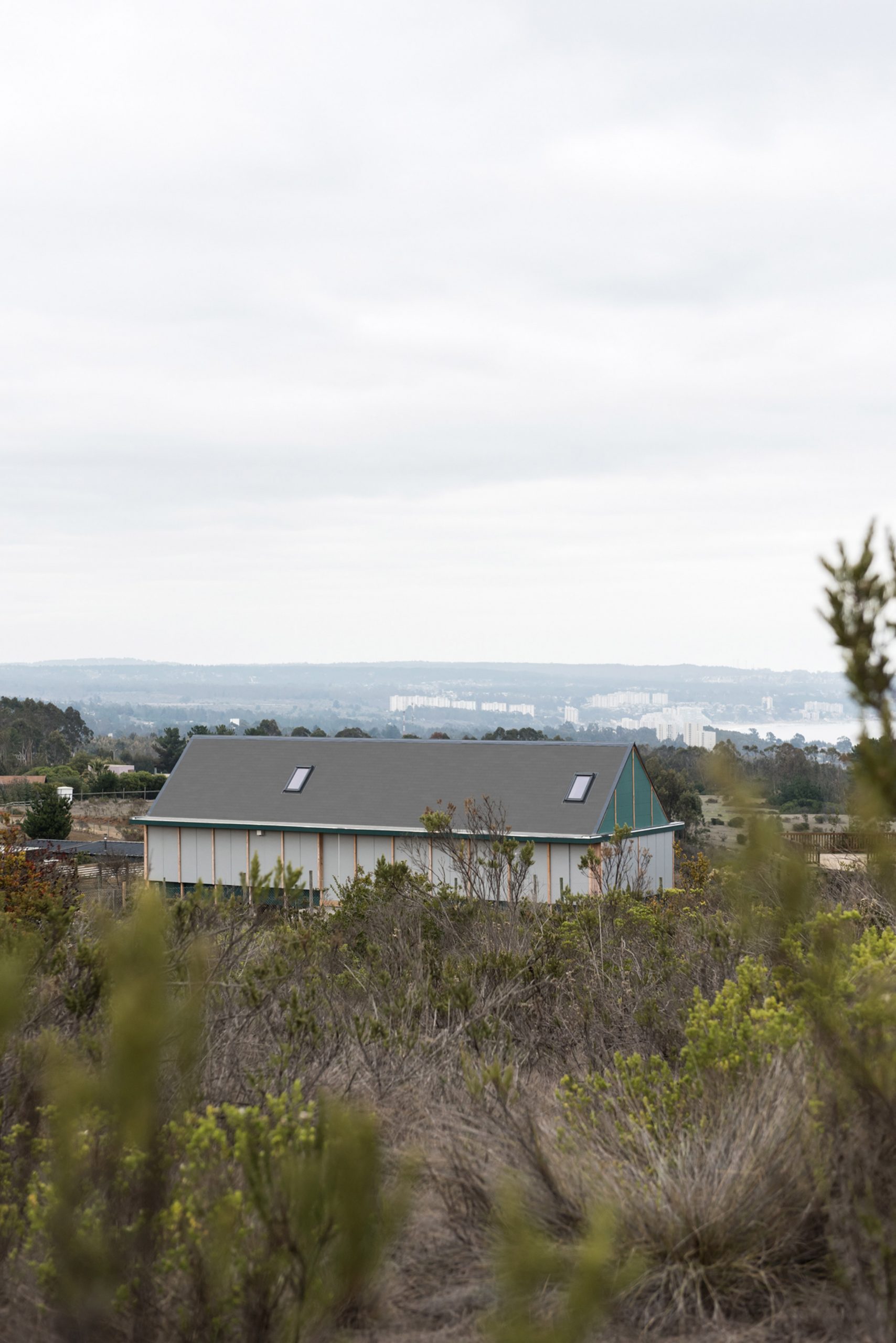
Painted fibre-cement panels enclose the warm, wooden interiors of the SP House that (E)StudioRO has completed overlooking Tunquén beach in Chile.

The dwelling was commissioned by a family living in Santiago, who desired a beachside getaway that could also function as their future home.

The brief given to local architect (E)StudioRO was open for interpretation, with the client's only desire for it to be "easy to build" and crowned by a distinctive triangular-shaped roof.

The exterior of SP House by (E)StudioRO in Chile
SP House overlooks Tunquén beach in Chile

"The brief was quite open, the owners literally wanted a weekend house that they could use as their permanent home in the future," (E)StudioRO said.

"Their idea was to spend weekends and vacations there, with an intent to possibly move there at some point in the future."

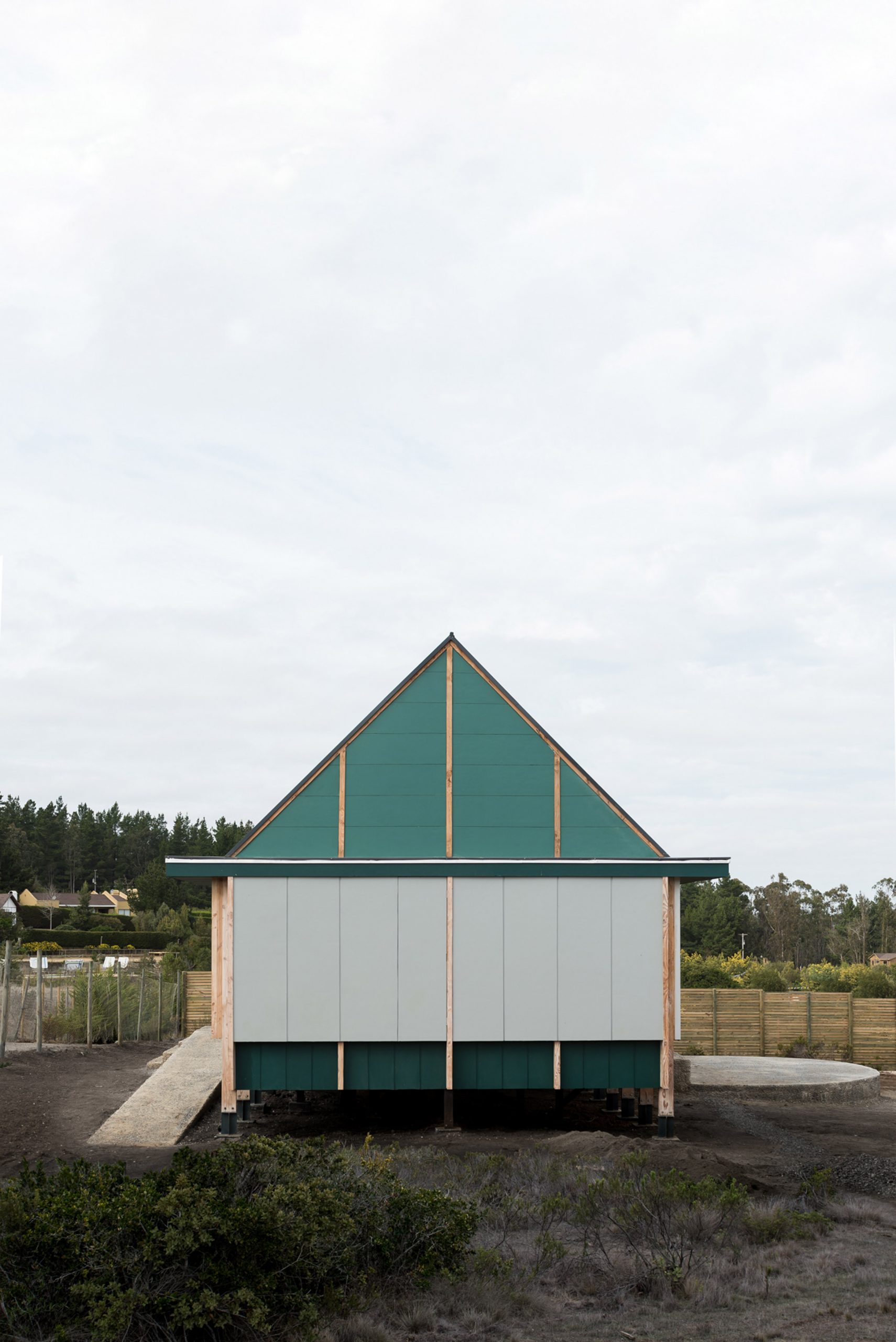
Short elevation of SP House by (E)StudioRO in Chile
It is clad in grey and teal-hued fibre-cement panels

To meet the client's request for an easy-to-build house, (E)StudioRO's design evolved from a material palette that was affordable and could be easily sourced.

The result is a timber structure wrapped by fibre-concrete panels and teamed with aluminium window frames and an asphalt membrane roof.

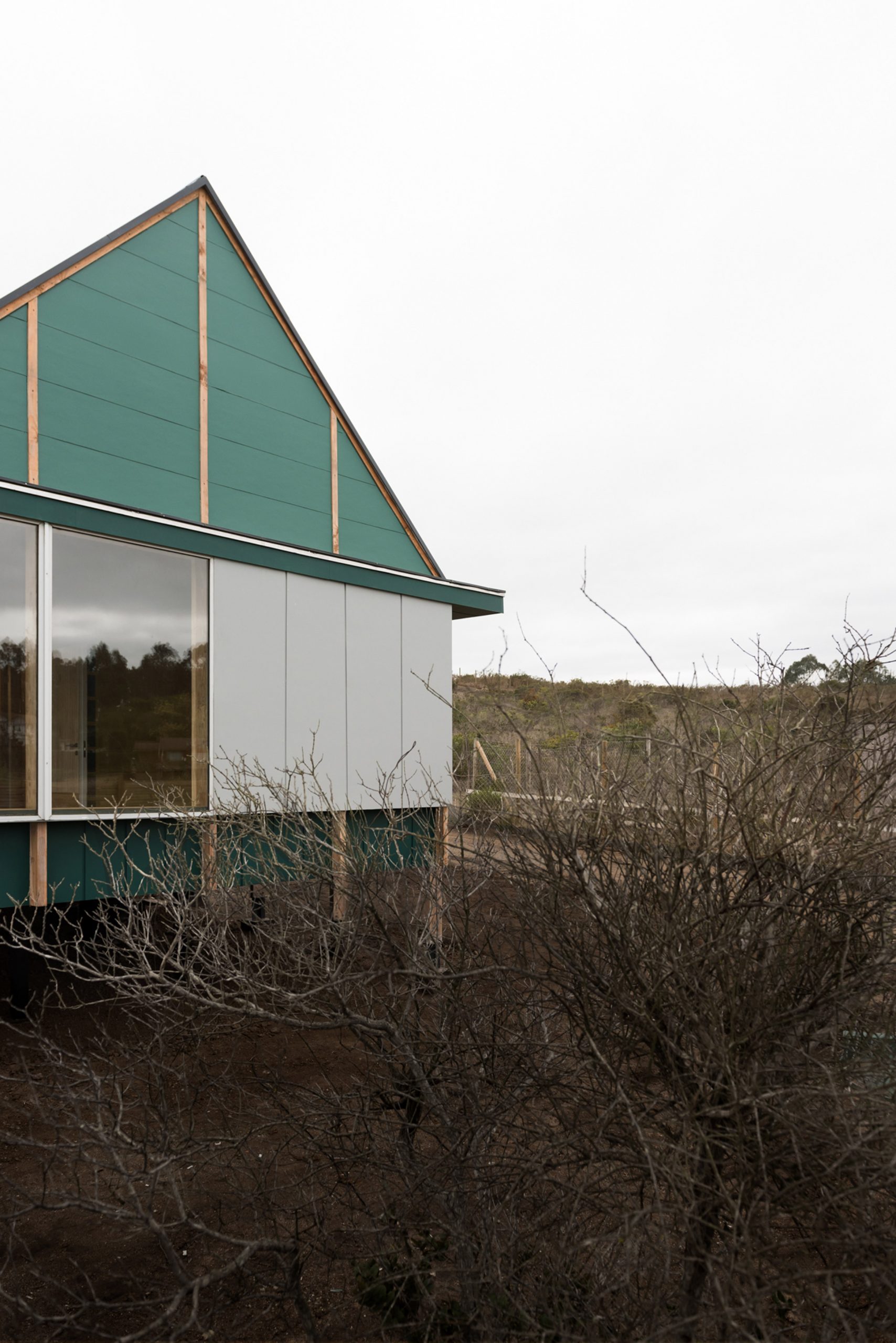
Short elevation of SP House by (E)StudioRO in Chile
The client's only request was that the house had a pitched roof

"The main idea was to use cheap and easy to find materials," founder Rodrigo Valenzuela Jerez told Dezeen. "A small group of skilled carpenters built the entire house."

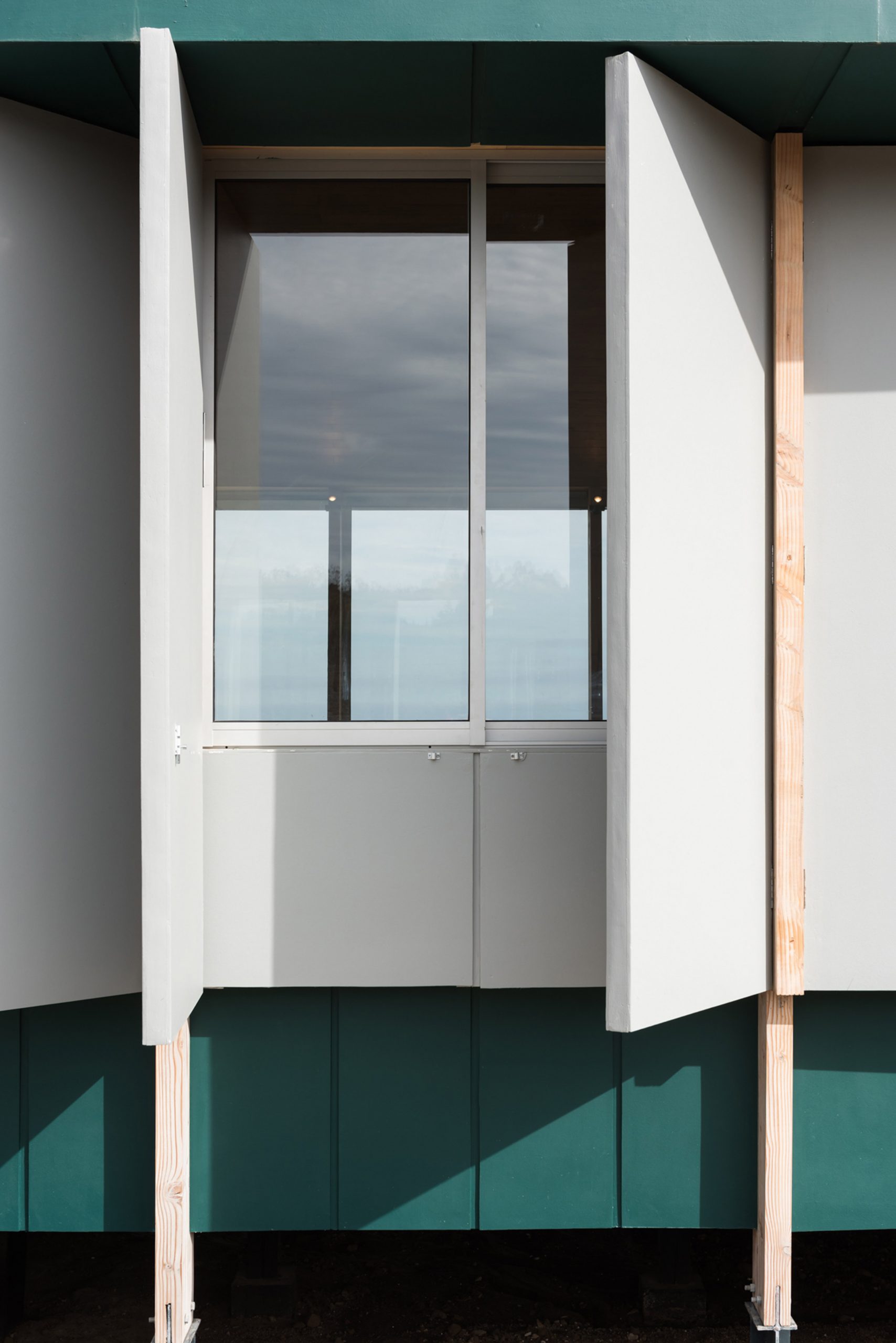
(E)StudioRO has painted some of the fibre-cement panels used to clad the house in teal to contrast with the timber structure that is exposed in some places. This includes small stilts that are used to elevate the house and maximise views of the ocean.

Some fibre-cement panels have been left unpainted and are used as window shutters to allow the family to block the views of a nearby road or close up the house when it is not in use.

Window shutters outside of SP House by (E)StudioRO in Chile
Some of the panels are used as window shutters

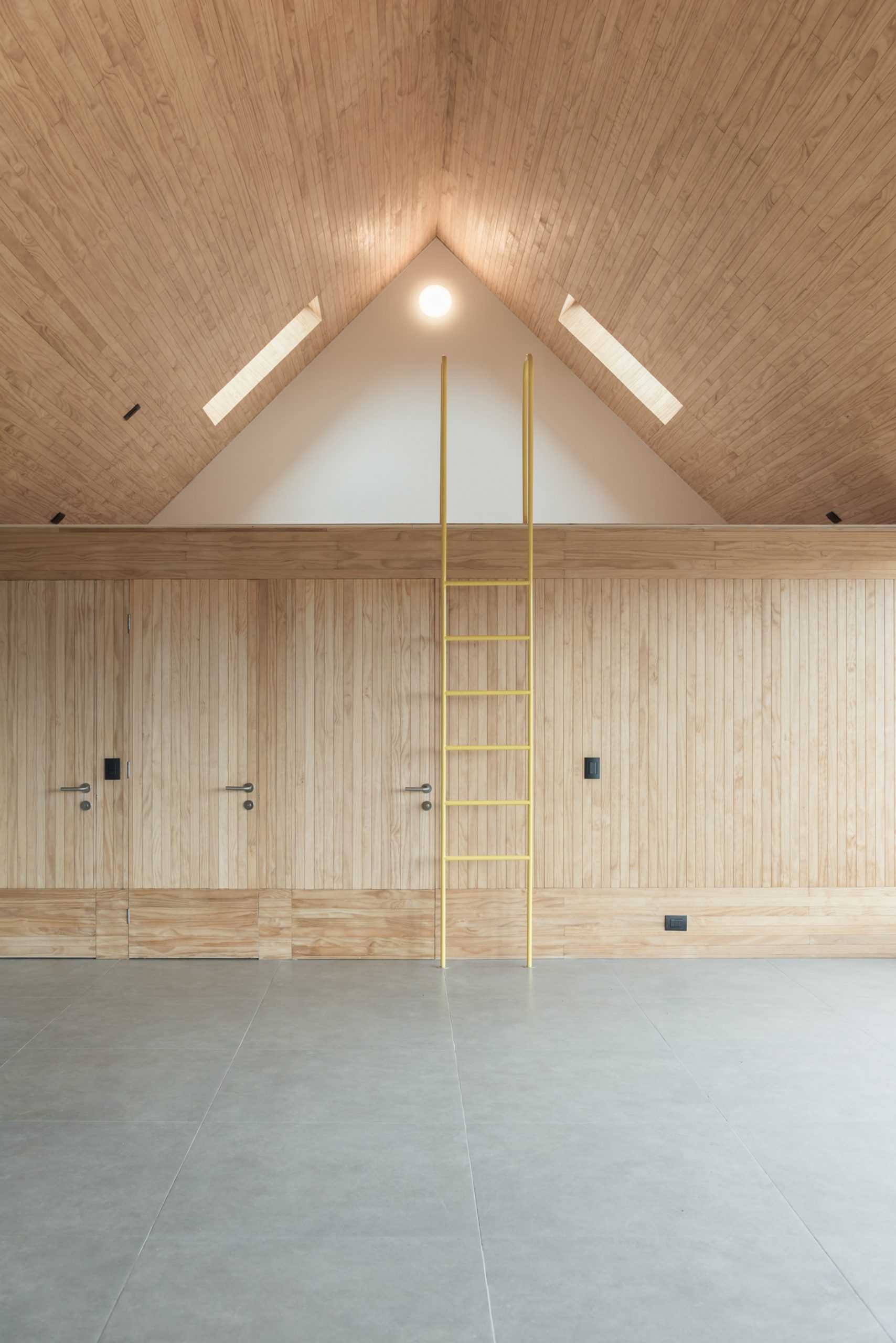
Inside, SP House comprises two large open-plan living areas and two boxy volumes that each contain small rooms and bathroom and a small mezzanine level on top.

Each space is column-free, which (E)StudioRO achieved with the use of two large beams placed externally along the long elevations that double as eaves for the pitched roof.

Pinewood interiors inside of SP House by (E)StudioRO in Chile
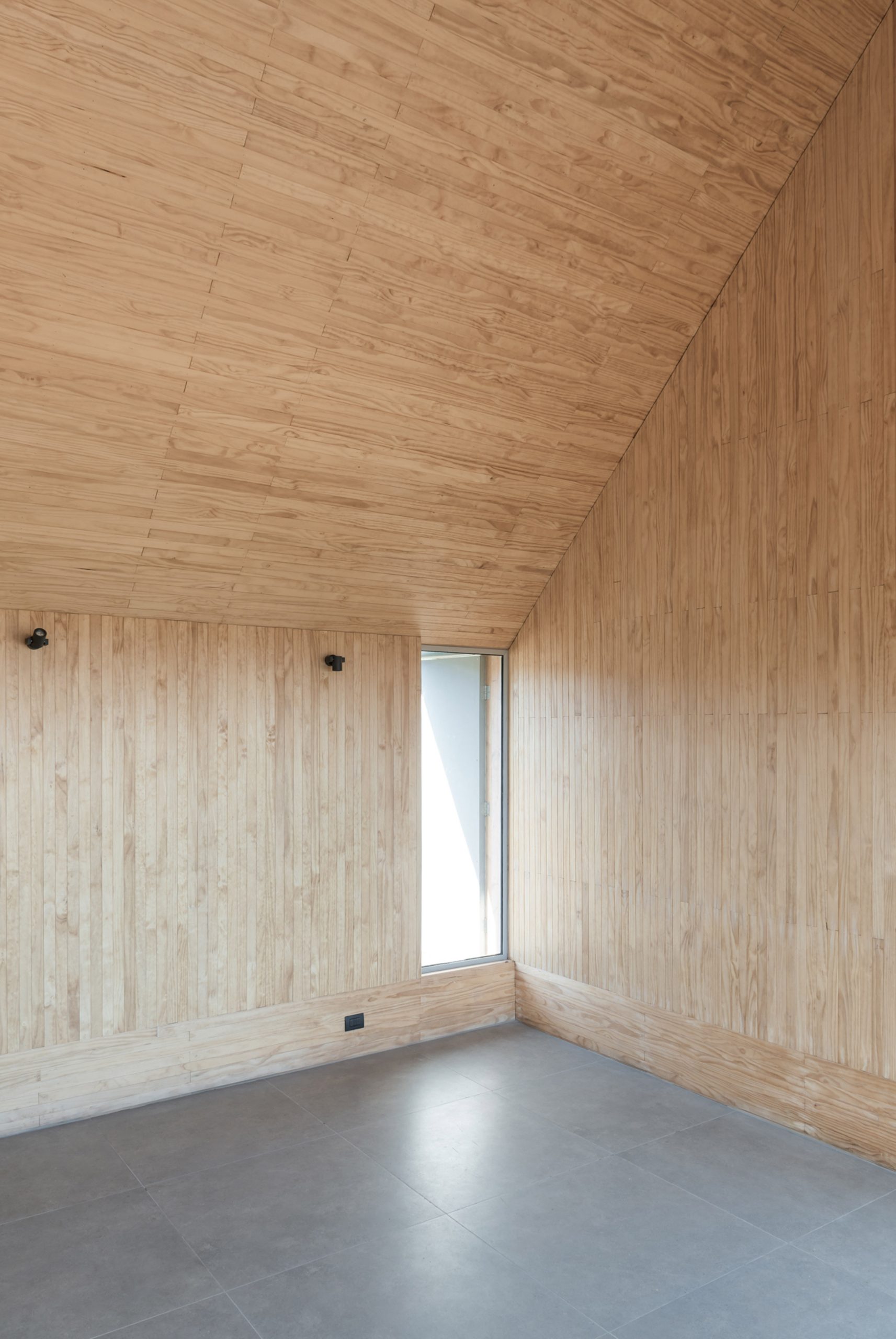
Both large rooms inside SP House are lined with warm pinewood

The layout of the house is designed for flexibility to meet the changing needs of the family, meaning the rooms can be used as bedrooms, offices, storage spaces or as a children's playroom."The hypothesis is that programs are primarily defined by objects, hence just by moving furniture and appliances they will be able to reprogram the different spaces," explained the studio.

A living area inside of SP House by (E)StudioRO in Chile
Bright yellow ladders lead to mezzanine levels

The interior finishes in the large living spaces are dominated by slats of pinewood teamed with bright yellow ladders to the mezzanine levels, creating a warm finish that contrasts the building's exterior.

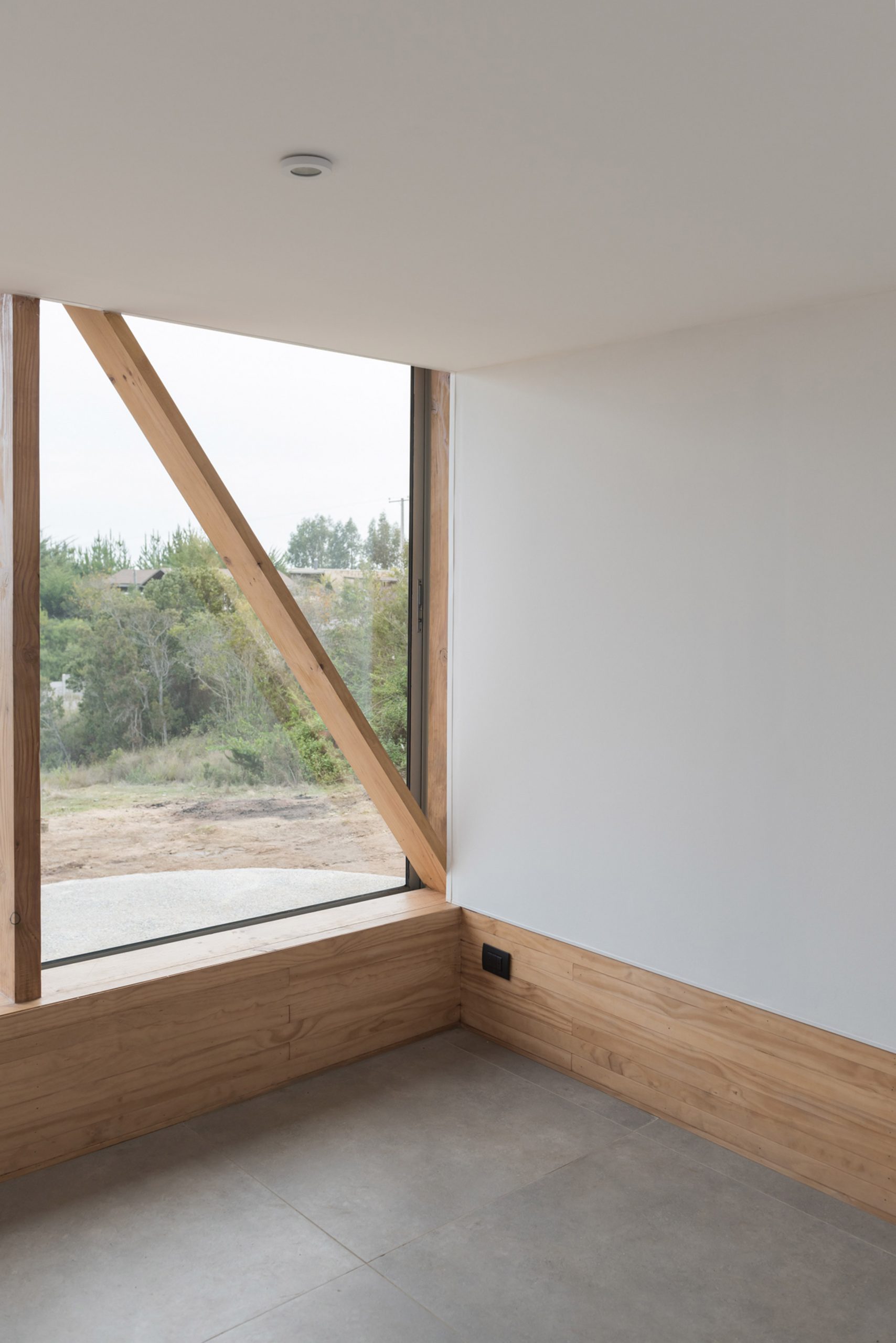
The smaller, hidden rooms are wrapped in plasterboard for a neutral backdrop, while classic porcelain tiles have been used to line bathrooms.

A small room inside of SP House by (E)StudioRO in Chile
The smaller boxy rooms are finished in plasterboard

Elsewhere in Chile, Guillermo Acuña Arquitectos Asociados recently completed a rural house near the ocean that comprises a pair of elevated structures topped with grooved-metal roofs, and Smiljan Radić designed a residence composed of two angular black volumes linked by a wooden deck.

Photographer Cristobal Palma captured the late Chilean architect Cristián Boza's cliffside retreat, which features a winding yellow wall and circular swimming pool.

Photography is by Macarena Alvarez.


Project credits:

Principal architect: Rodrigo Valenzuela Jerez – EstudioRO
Project architect: Juan Pablo Valenzuela Ardiles
Drawings: Valentina Varela
Consultants: DEC Ingenieros, Marcelo Sepúlveda, Ingeniería JM
General Contractor: UNIH Arquitectura & Construcción, Eduardo Hirose

The post Teal-hued panels enclose timber beach retreat in Chile appeared first on Dezeen.


from Dezeen https://ift.tt/33q38N6

Ten peaceful bedrooms designed by architects

Kawakawa House by Herbst Architects

A Shaker-style sleeping space and a bed chamber with a colour scheme informed by California deserts are among the ten serene, architect-designed bedrooms in this roundup.

This is the latest in a series providing visual inspiration for the home. Previous articles in the series showcased visually inspiring dining rooms, cosy living roomsdomestic bathrooms designed by architects and colourful kitchens.


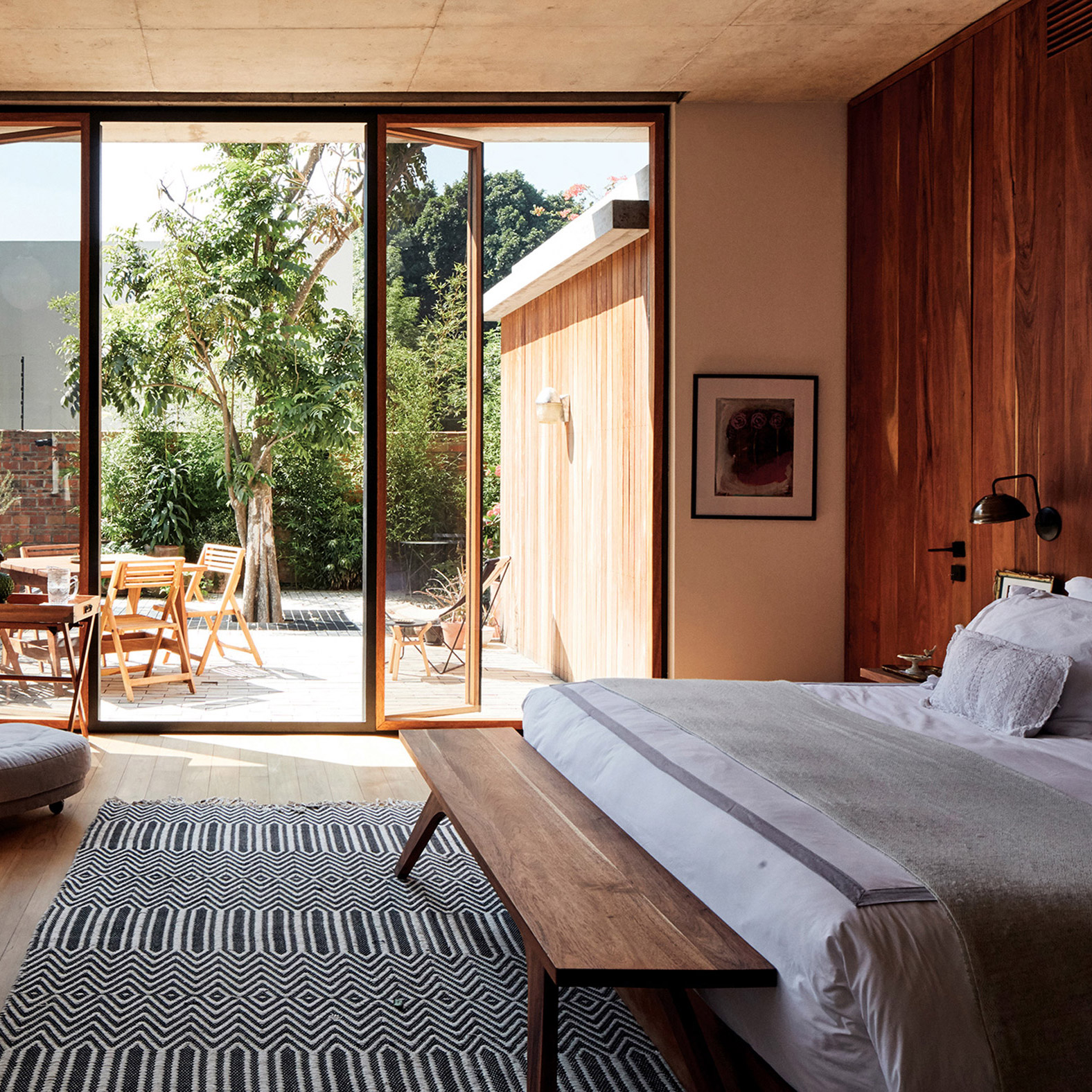
Bedroom in Guadalajara House, Mexico, by Alejandro Sticotti

Guadalajara House, Mexico, by Alejandro Sticotti

Architect Alejandro Sticotti designed Guadalajara House around two existing trees, and closeness to nature was an important aspect of its layout.

This can be seen in the master bedroom suite, which has large floor-to-ceiling glass doors that open up onto a private deck on the northern side of the house. Wooden panelling and a soft grey and white colour scheme create a relaxing place for sleep.

Find out more about Guadalajara House


Pound Ridge House bedroom by Tsao & McKown

Pound Ridge House, US, by Tsao & McKown

This house in upstate New York was designed with an open layout, but its master suite is separated from the more public areas by a private sitting area.

Here, the owners' bed sits up against a wall painted in dark, moody hues, close to a veranda that can be accessed through a set of sliding doors. A fireplace completes the bedroom.

Find out more about Pound Ridge House


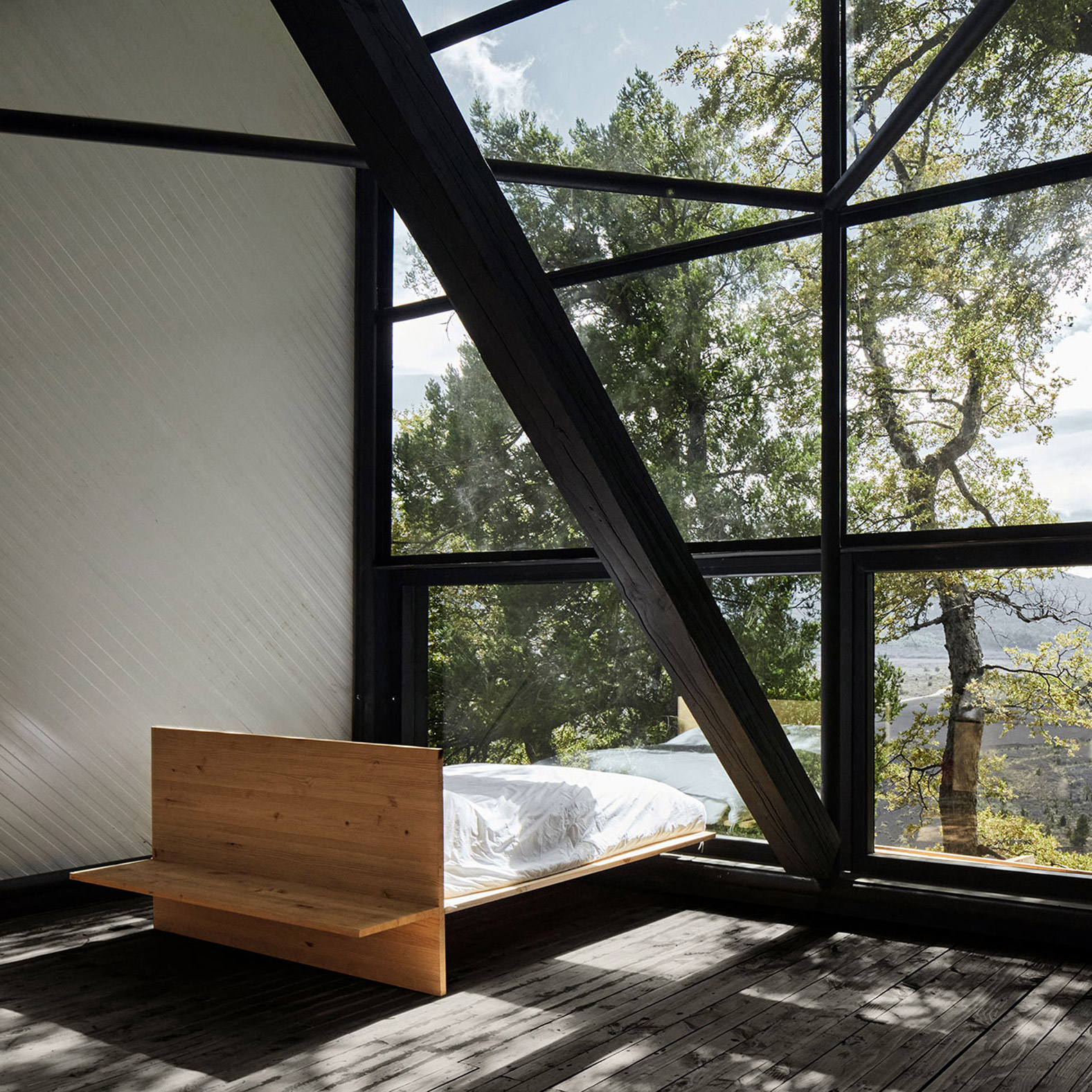
Bedroom in Prism House + Terrace Room, Chile, by Smiljan Radíc

Prism House + Terrace Room, Chile, by Smiljan Radíc

The main bedroom in Prism House by Chilean architect Smiljan Radíc overlooks a dead river of lava from a previous eruption of the nearby Llaima Volcano.

The dramatic view, seen through Prism House's glazed rear wall, is offset by a simple interior that features a blackened Oregon pine wood floor and a wooden bed that also functions as a seat or shelf.

Find out more about Prism House


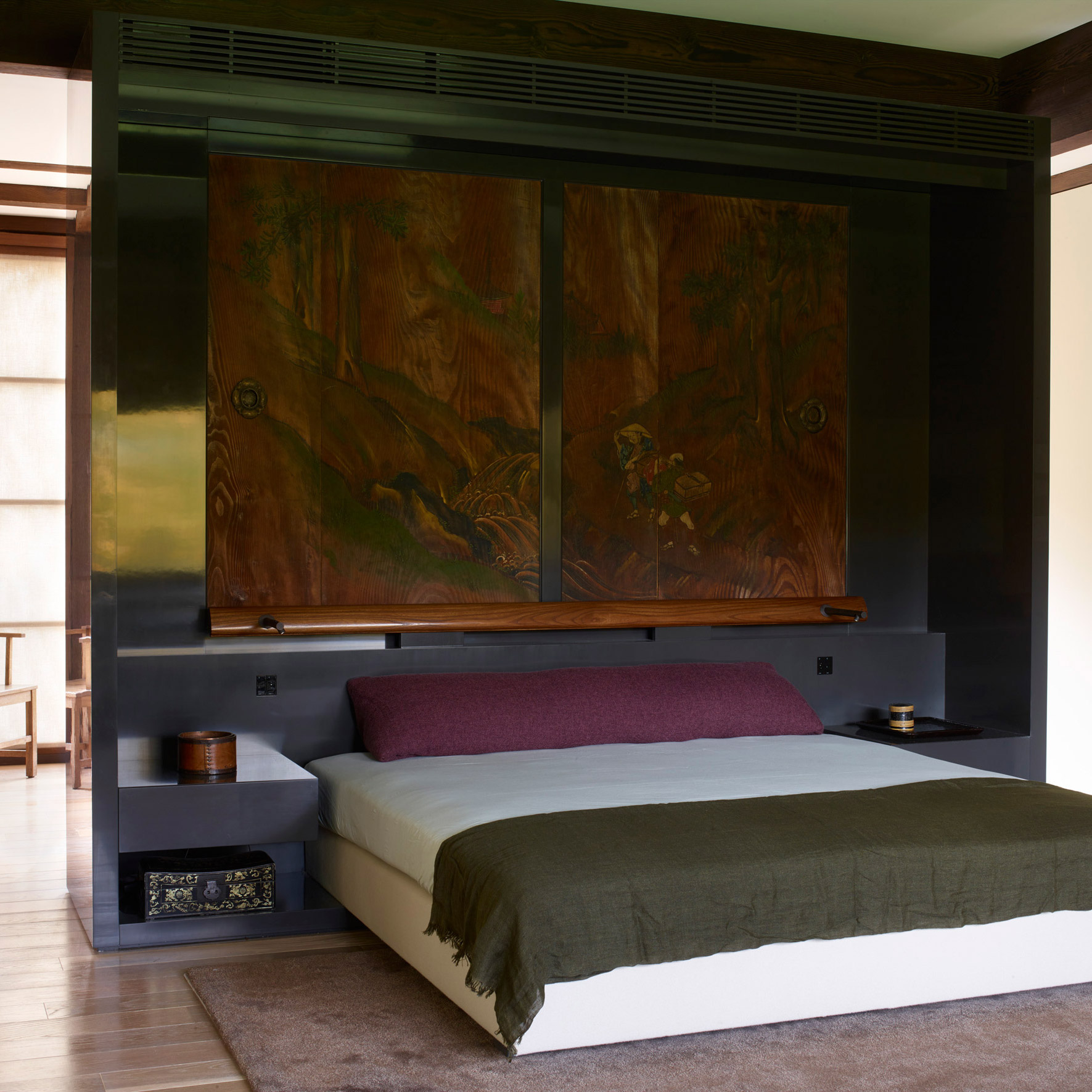
Bedroom in Xiang Jiang House, China, by Claesson Koivisto Rune

Xiang Jiang House, China, by Claesson Koivisto Rune

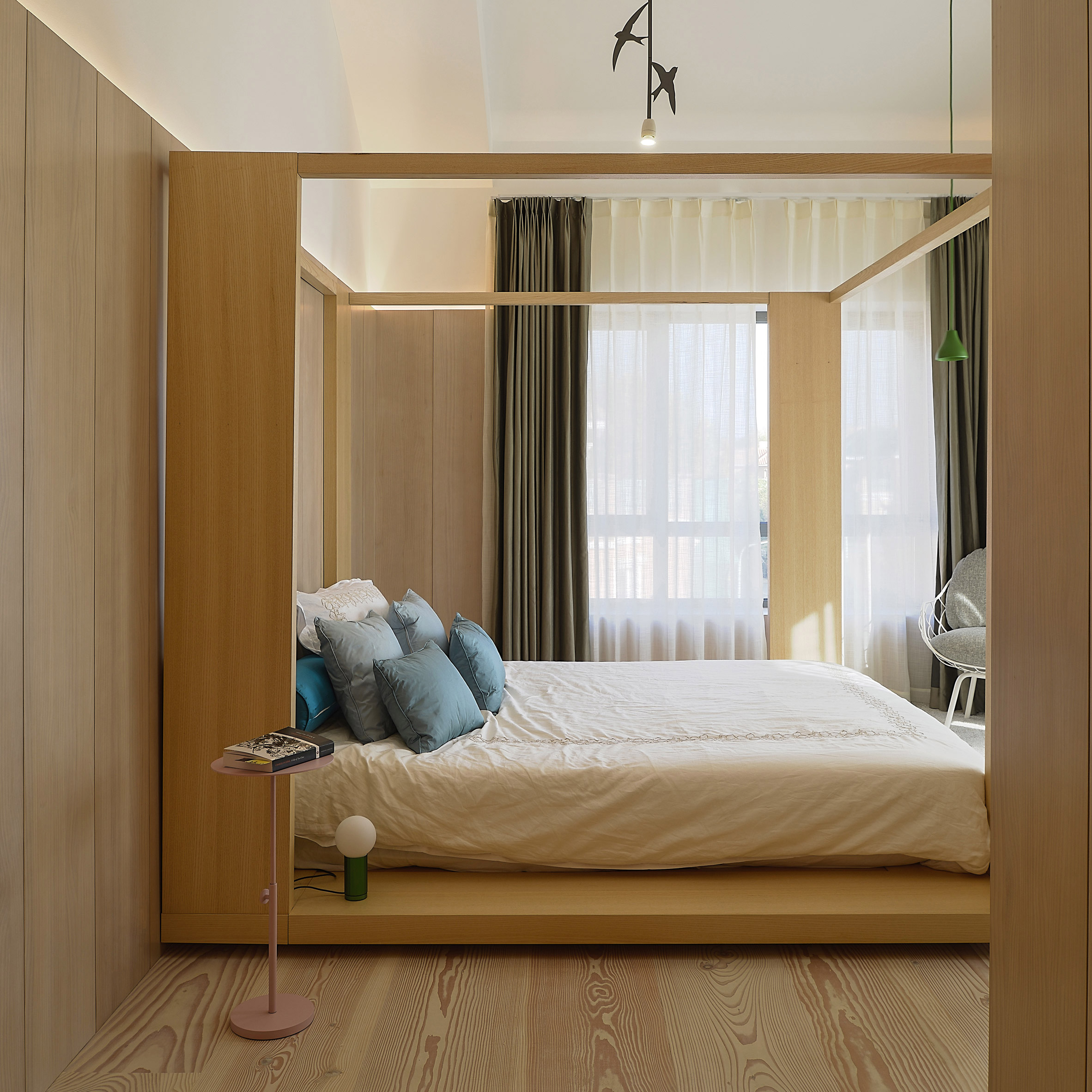
Swedish architecture and design studio Claesson Koivisto Rune went all-in on natural materials for this Beijing house, where a bedroom features timber panelling on both floor and walls as well as a large, four-poster wooden bed frame.

The pared-down colours are matched with contemporary design pieces from Scandinavia, Japan, China and Italy.

Find out more about Xiang Jiang House


Bedroom in holiday home by YLAB Arquitectos

Spanish holiday home, Spain, by YLAB Arquitectos

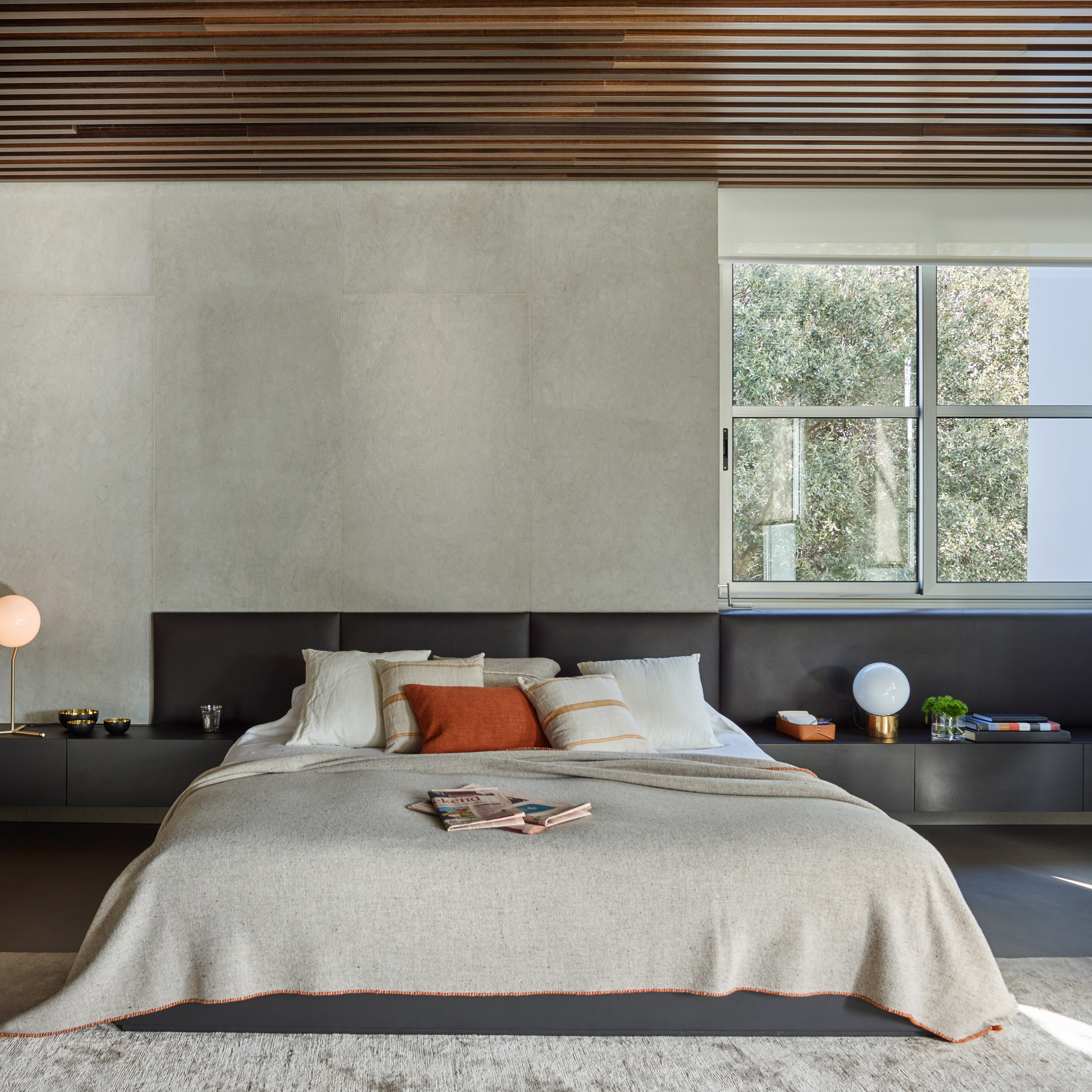
A walnut slatted ceiling decorates the master bedroom of this holiday home in southeast Spain with coastal mountain-range views.

Grey sandstone was used for the wall, and a contrasting headboard and storage unit in black behind the bed was decorated with brass accessories. "The interplay of materials and brass elements make it feel very luxurious, but it's also cosy, almost like a wooden holiday retreat," said the studio co-founder Yolanda Yuste López.

Find out more about the Spanish holiday home


Bedroom in Bermonds Locke hotel, UK, by Holloway Li

Bermonds Locke, UK, by Holloway Li

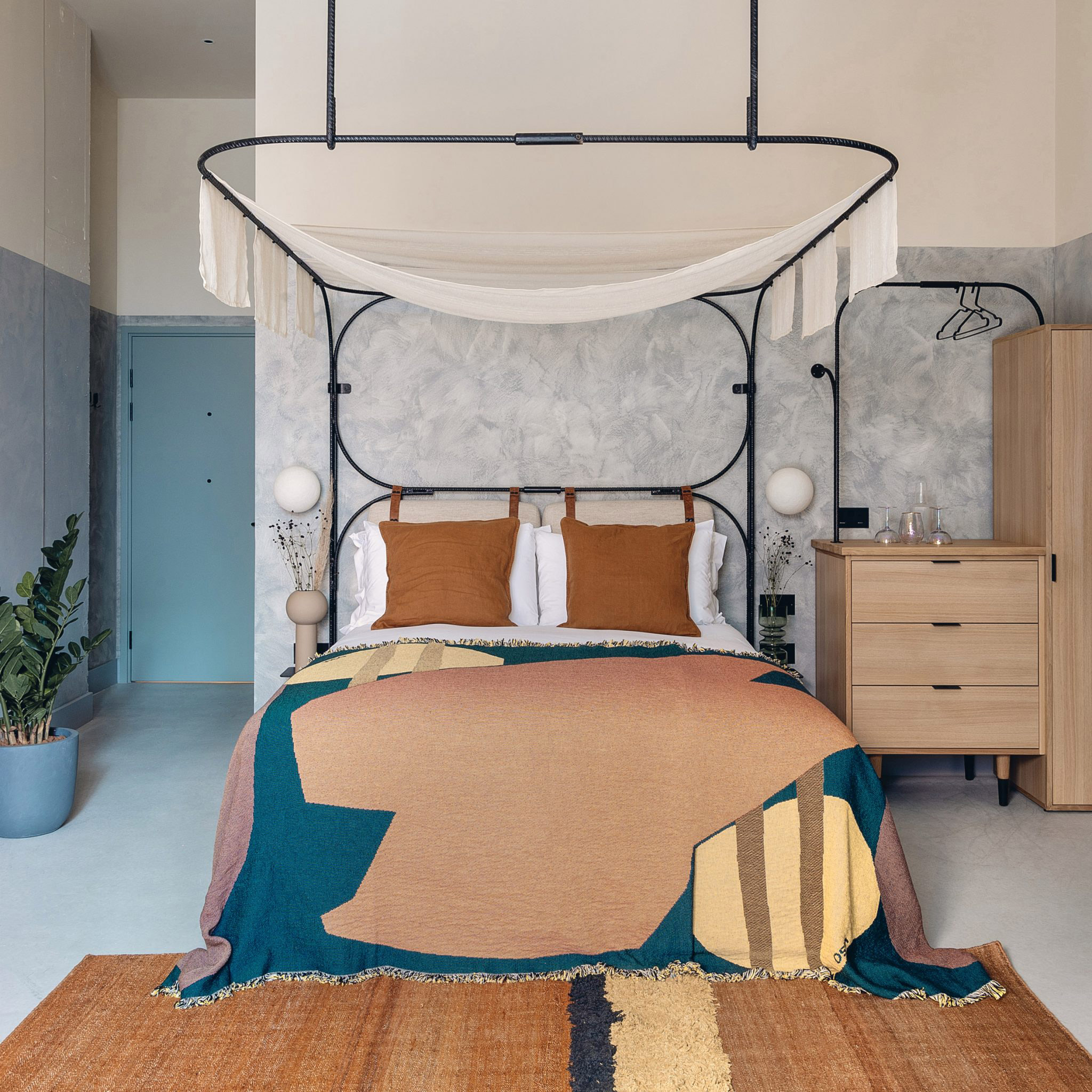
California deserts informed the design of Bermonds Locke, a hotel in London's Bermondsey area. Colours throughout its rooms were taken from desert sunsets, as seen on the warm terracotta-hued rug and multicoloured bedspread in the bedroom above.

Bermonds Locke rooms are used to sleep in but also for eating and working, so the studio separated the bed from the rest of the room by creating bespoke black bed frames that can be enclosed using linen drapes.

Find out more about Bermonds Locke hotel


Bedroom in Forest House, Thailand, by Shma Company

Forest House, Thailand, by Shma Company

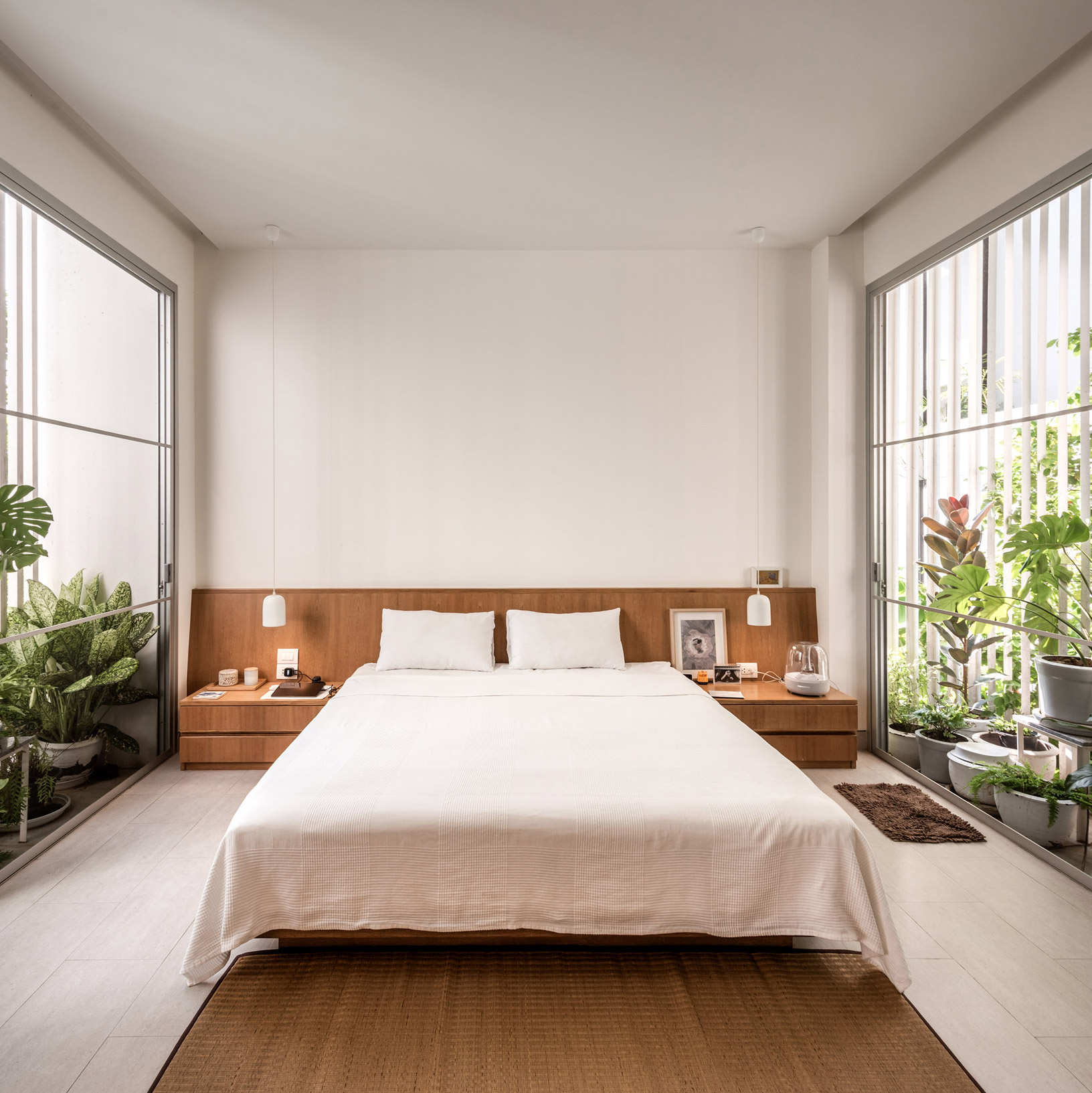
The plant-filled Forest House accommodates seven people and 120 trees on just 300 metres. In this peaceful bedroom, steel louvres cover the windows to create privacy, while two narrow balconies hold an assortment of potted plants.

A wooden headboard with built-in bedside tables adds practical storage space. Colours were kept to white, with brown rugs that match the wood detailing.

Find out more about Forest House


Bedroom in Klinker Apartment, Spain, by Colombo and Serboli Architecture

Klinker Apartment, Spain, by Colombo and Serboli Architecture

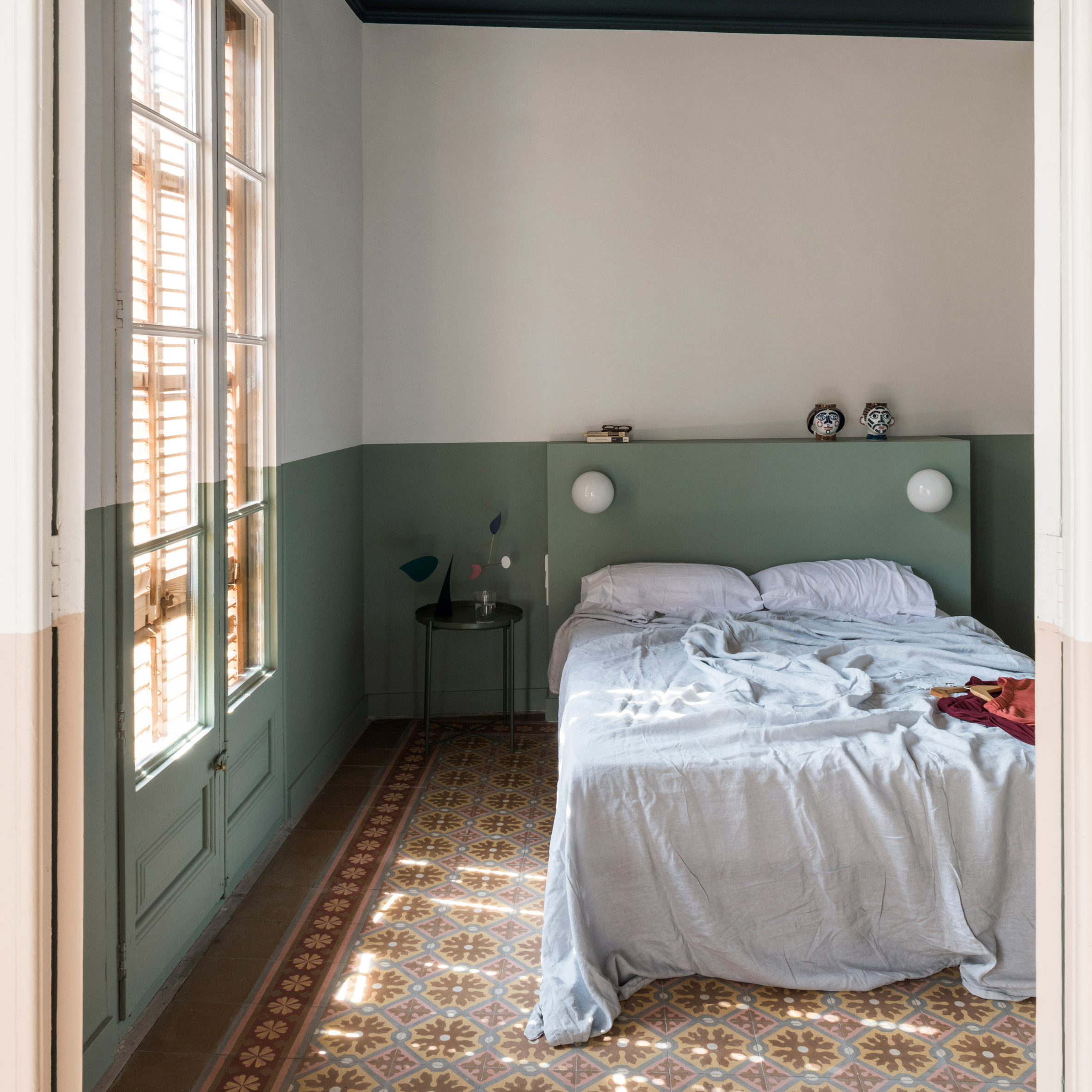
Colourful tiles create a vibrant floor decoration in this bedroom in Klinker Apartment in Barcelona, where a sage border warps around the room and even envelops the headboard.

The ceiling was painted a matching green hue, and decorations kept to a minimum to allow the colours to speak for themselves – two white spherical lamps illuminate the bed and a bedside table in a darker green holds Alexander Calder-style mobiles.

Find out more about Klinker Apartment


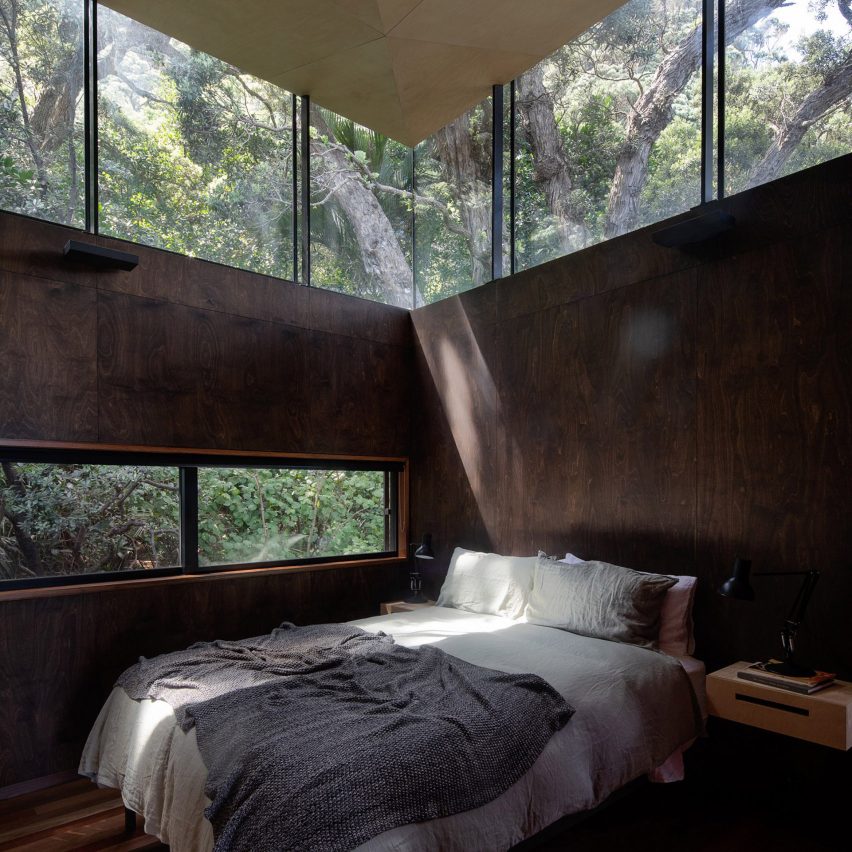
Bedroom in Kawakawa House, New Zealand, by Herbst Architects

Kawakawa House, New Zealand, by Herbst Architects

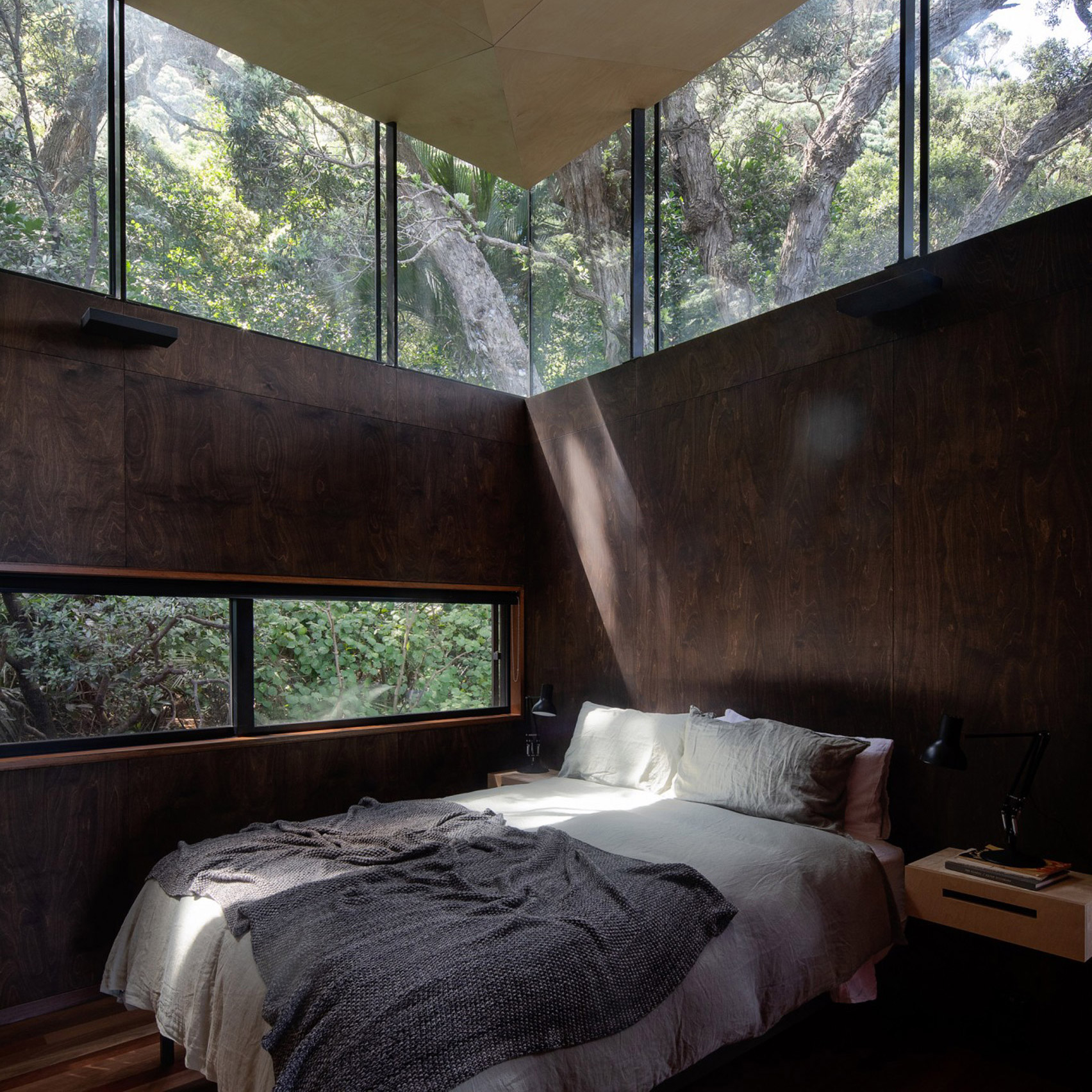
The dramatic bedroom of Kawakawa House is clad in dark birch panels. It features clerestory windows that let in the dappled sunlight from the canopy of pōhutukawa trees outside, as well as smaller windows next to the bed.

With such striking views, the walls could be kept empty of pictures and the only other details are hanging bedside tables in a lighter wood.

Find out more about Kawakawa House


Bedroom in Círculo Mexicano Hotel, Mexico, by Mabrosi Etchegaray

Círculo Mexicano Hotel, Mexico, by Mabrosi Etchegaray

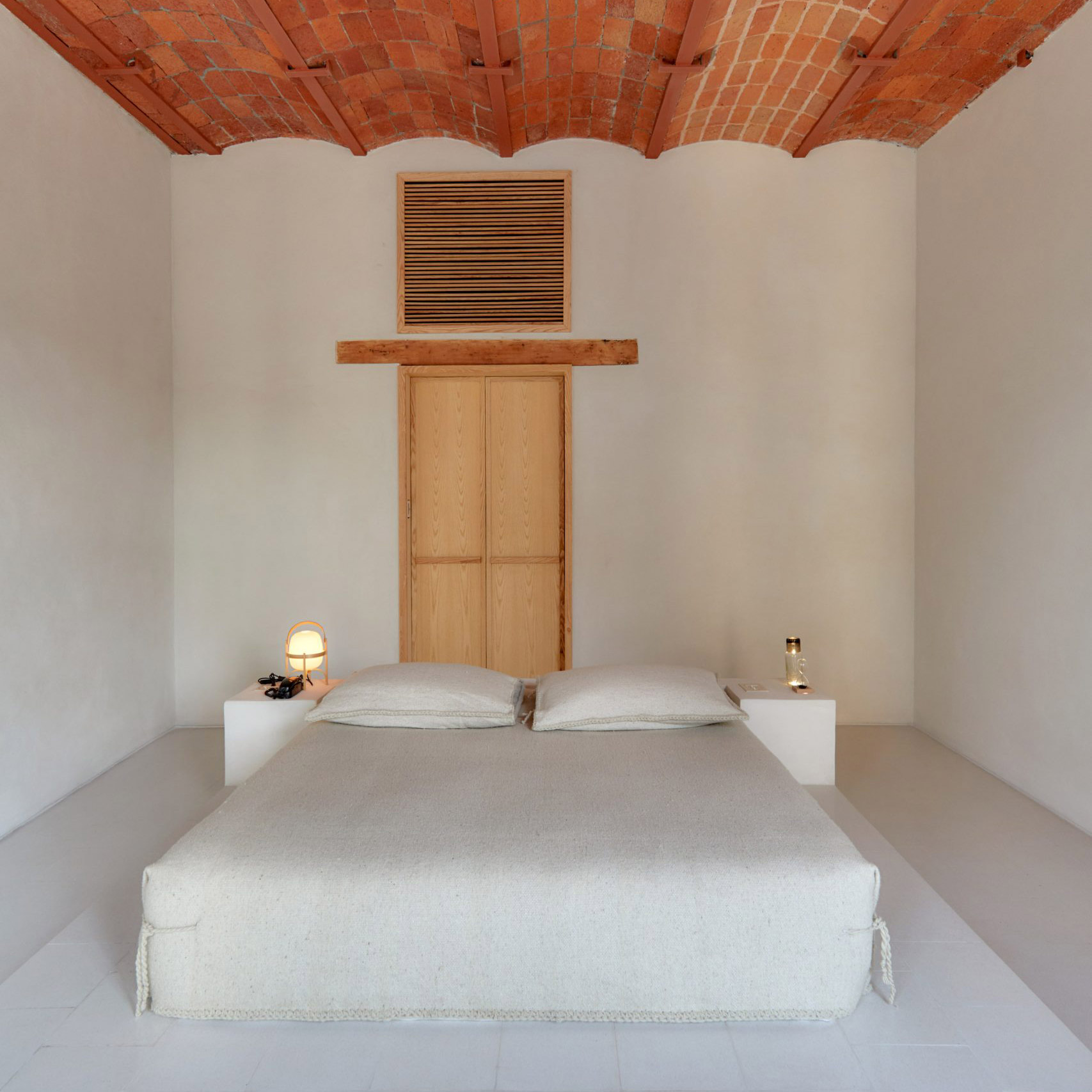
There's a monastic feel to the Shaker-inspired Círculo Mexicano Hotel, with its white-painted floors and beds covered in beige linens with exposed seams. Barrel-vaulted ceilings clad in red tiles add a touch of colour to the serene surroundings.

"Originally all the design process was inspired by an ecclesiastical aesthetics," architect Jorge Ambrosi told Dezeen. "With that premise, we imagined an architecture free of ornament, where the correct use of simple materials enhances the quality of the space."

Find out more about Círculo Mexicano Hotel

The post Ten peaceful bedrooms designed by architects appeared first on Dezeen.


from Dezeen https://ift.tt/36hwbEG

Sam Jacob Studio builds raised forest of pyramidal trees for Electric Nemeton Christmas display

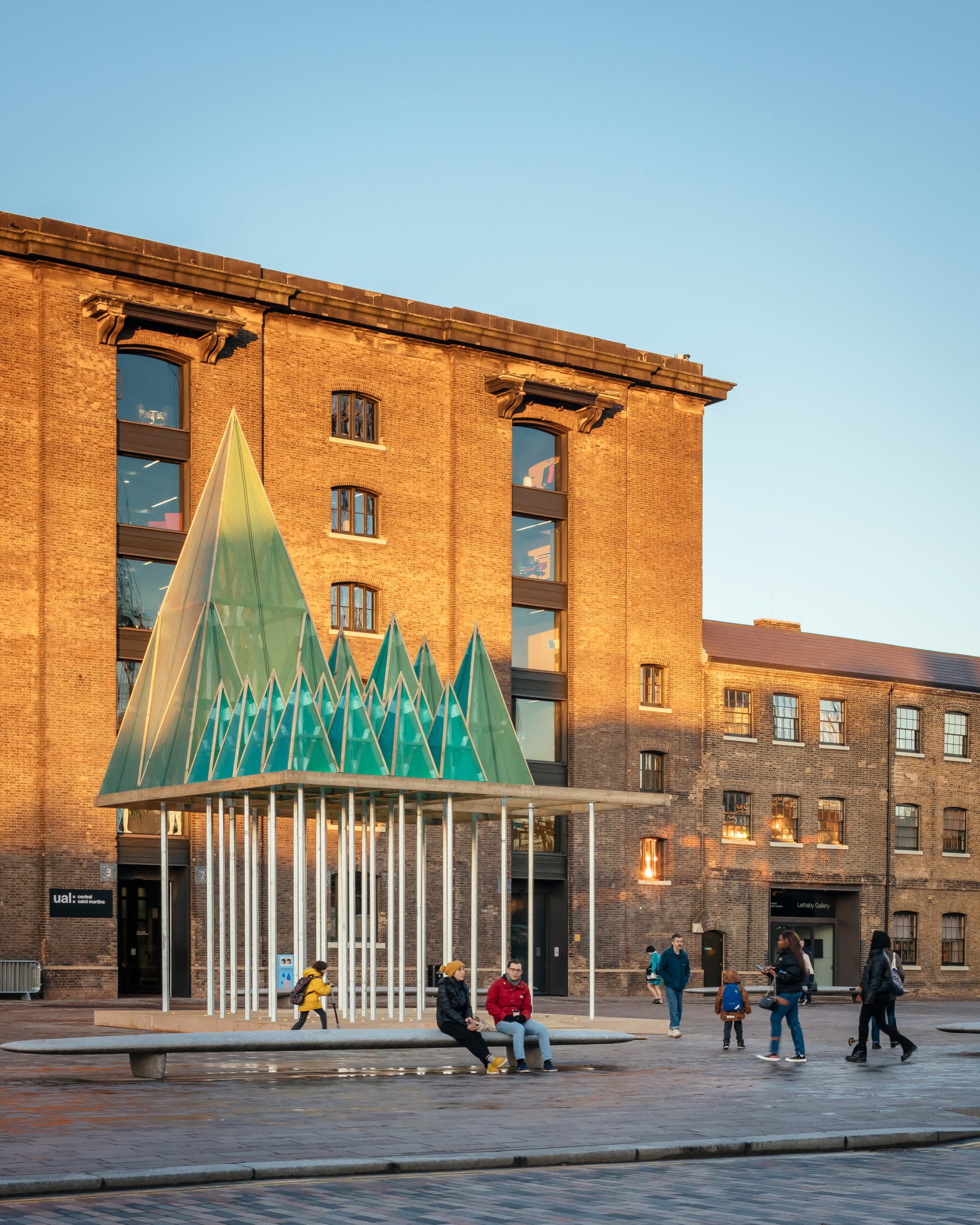
Elevated tree-like obelisks light up Granary Square in London's King's Cross as a socially distant Christmas celebration, designed by Sam Jacob Studio to be a crossover of "a fairy-tale forest with modern architecture".

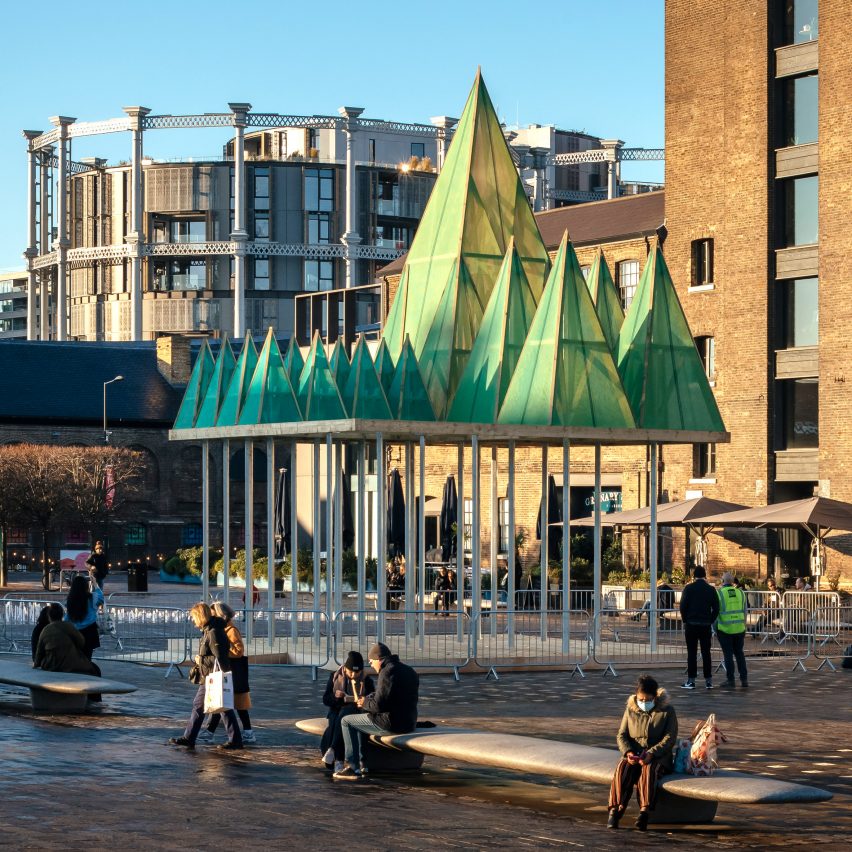
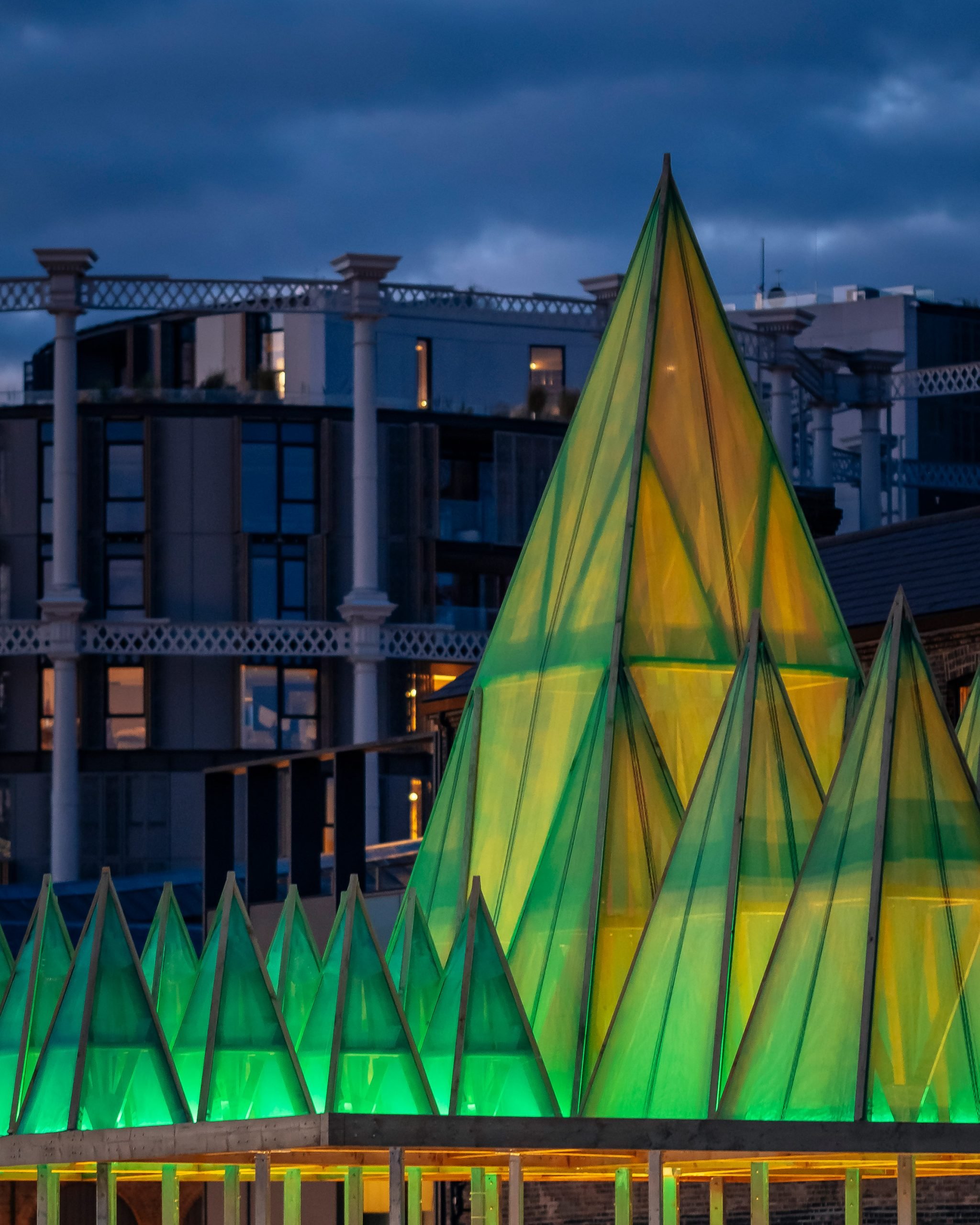
Dubbed the Electric Nemeton, the 11 metre-tall (36 feet) installation by London architecture practice Sam Jacob Studio comprises a group of green, pyramid-shaped structures of different sizes that emulate a forest of Christmas trees.

The Electric Nemeton Christmas installation by Sam Jacob Studio in King's Cross, London
Sam Jacob Studio designed the Electric Nemeton installation as part of the King's Cross Christmas display

The design aims to offer a futuristic take on the traditional Christmas tree, specifically the type that stood in ancient Celtic forest groves called Nemetons, which once served as sacred gathering places.

Visitors to Granary Square in King's Cross, London, can walk under the elevated, four metre-tall (13 feet) pergola that is held up by columnar galvanised steel trunks.

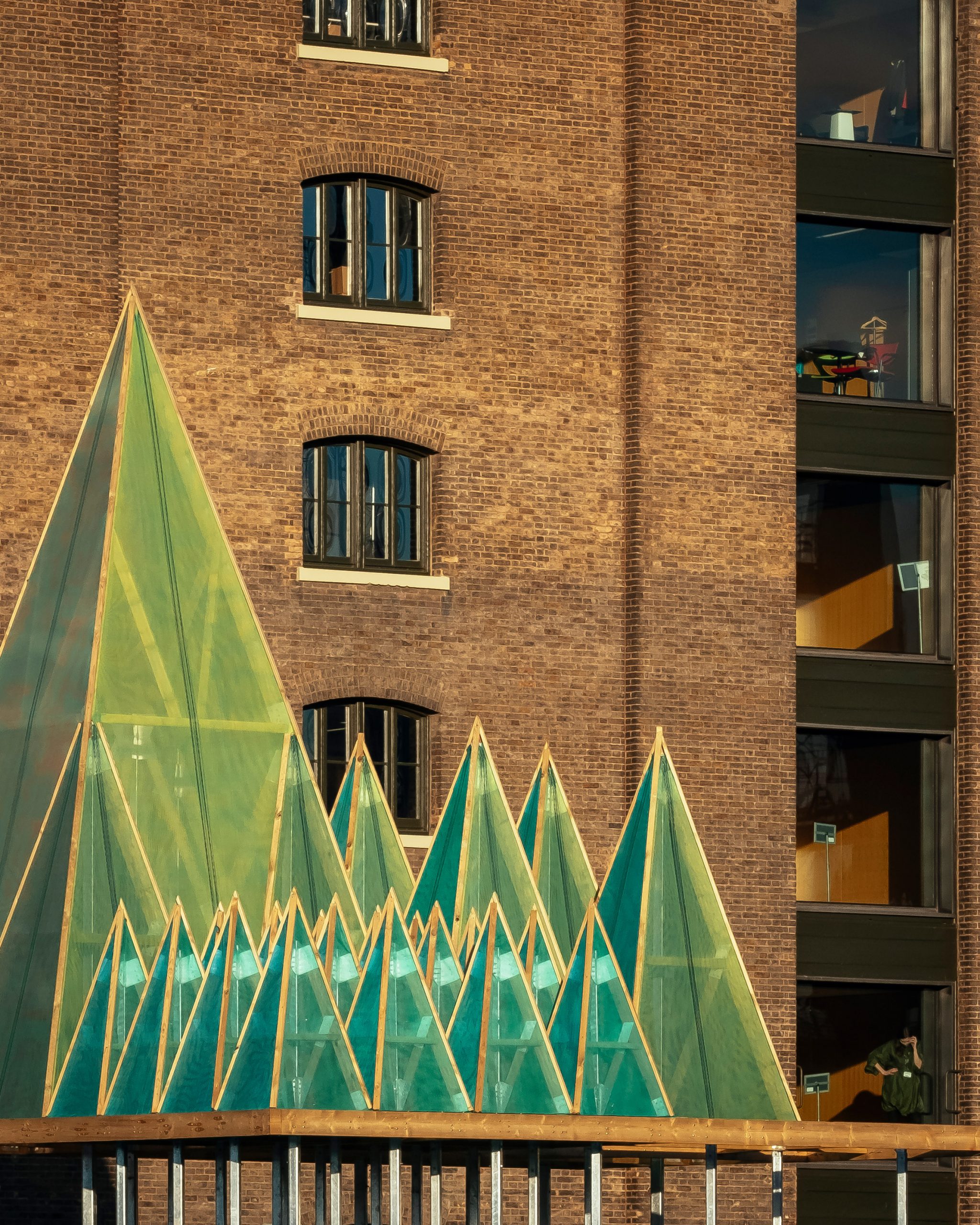
Close up of the Electric Nemeton Christmas installation by Sam Jacob Studio in King's Cross, London
The installation features a group of green pyramid-shaped trees

Timber joists have been used to create the skeleton of each pyramidal tree structure, while coloured scaffold netting has been stretched over these frames to give them body.

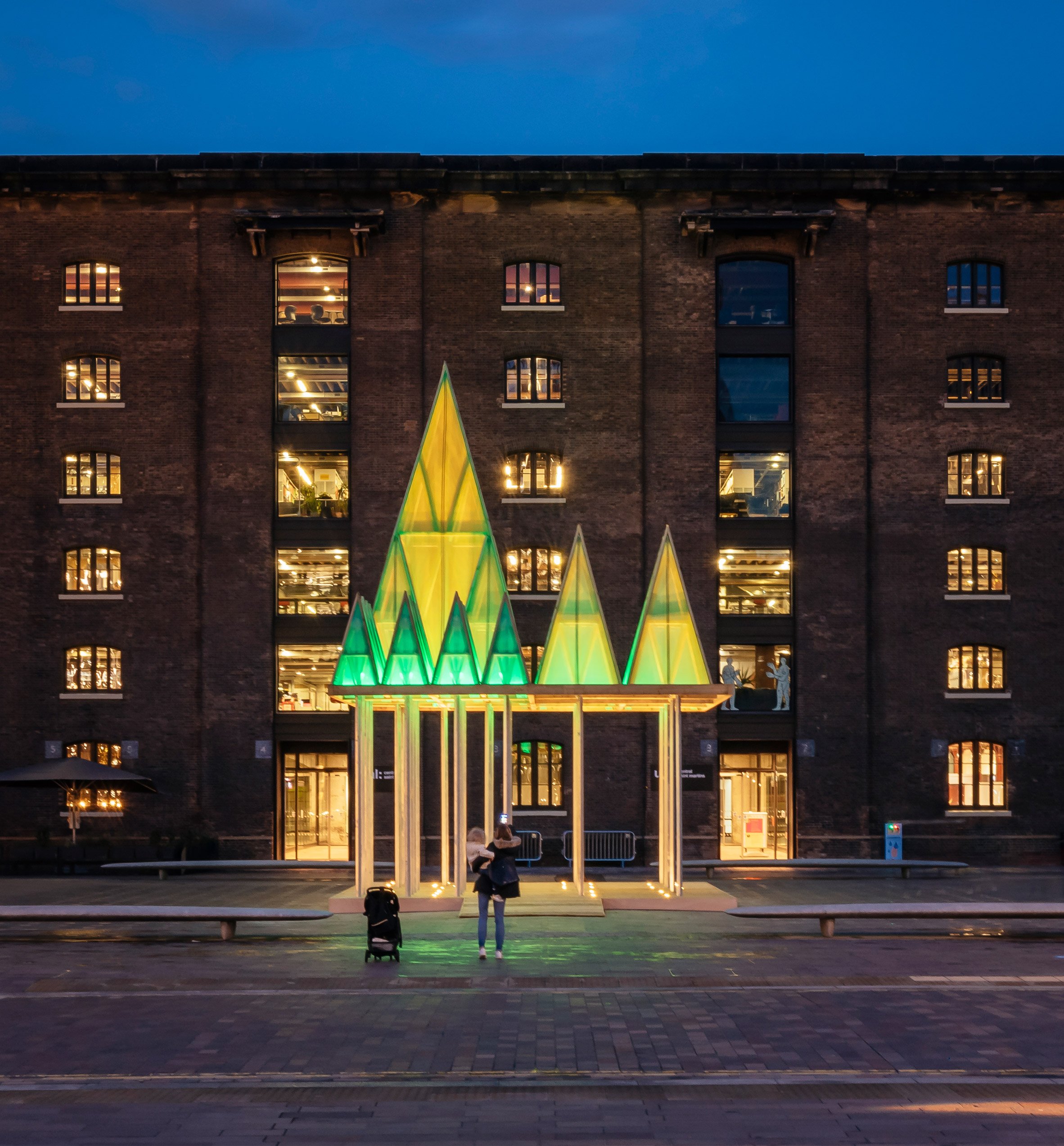
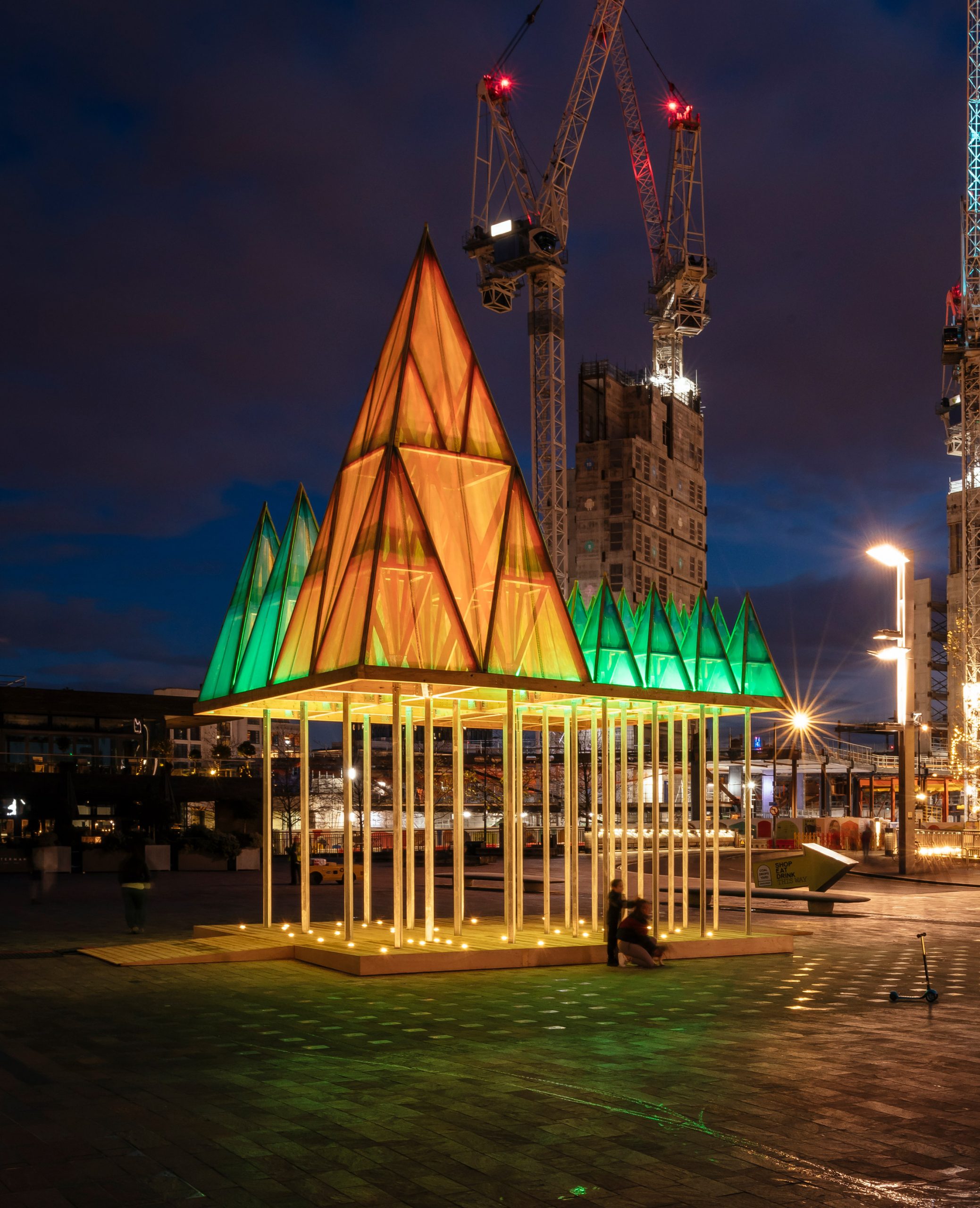
Lighting elements placed under the tree structures highlight their translucent quality at dark, illuminating the installation in hues of green with a few pops of orange and red towards the back of the group.

"These simple materials expose the construction process while their layering creates something more magical," said the studio. "As you move around, the structure is sometimes more see through, sometimes more solid. Its colours fade and bleed from one to another."

The Electric Nemeton Christmas installation by Sam Jacob Studio in King's Cross, London, at night
The trees are elevated by a galvanised steel and timber structure

Sam Jacob Studio wanted the installation to act as a "social gesture" by offering an open-air space that people could visit in a safe manner in light of the coronavirus pandemic.

"Part tree, part space frame, it creates a space to walk through, a stage for social life and a sculptural object in Granary Square," said Sam Jacob Studio.

The Electric Nemeton Christmas installation by Sam Jacob Studio in King's Cross, London, at night
The tree-like structures are brought to life with coloured netting

"As public space has taken on new significances during Covid-19, the Electric Nemoron contributes a little more to the possibilities of winter life outdoors," it continued. "A structure that itself is an event, somewhere to explore and a platform for open-ended use."

"Like all winter tree traditions whose symbolism is intended to ward off the darkness and act as a gesture of hope for the return of the sun, the Electric Nemeton also expresses an idea of hope for the return of our social and public lives," the studio added.

Close up of the Electric Nemeton Christmas installation by Sam Jacob Studio in King's Cross, London, at night
Lights embedded in the structure illuminate the Christmas tree forest

The Electric Nemeton installation was commissioned by King's Cross Central Limited Partnership, and brought to life in collaboration with engineering studio AKTII, lighting company DHA Designs and furniture manufacturer Jamps Studio.

Sam Jacob Studio was founded in 2014 by Sam Jacob, who was one of the three founders of influential architecture studio FAT.

More recently, the studio designed a shelter in the Yantian port district of Shenzhen, China, comprising a mixture of geometric and abstract shapes that take cues from municipal structures and neolithic monuments.

The post Sam Jacob Studio builds raised forest of pyramidal trees for Electric Nemeton Christmas display appeared first on Dezeen.


from Dezeen https://ift.tt/3mjTGm6

Mischer'Traxler and Perrier-Jouët present Curiosity Cloud installation for Dezeen x Miami Design Talks

Dezeen x Miami Design Talks

Austrian design studio Mischer'Traxler will speak to Dezeen in a live interview about its Curiosity Cloud installation, which features at Design Miami 2020. Watch here from 3pm London time on Saturday 28 November.

The live conversation, which is the penultimate instalment of Dezeen x Miami Design Talks, will be moderated by Dezeen's founder and editor-in-chief Marcus Fairs.

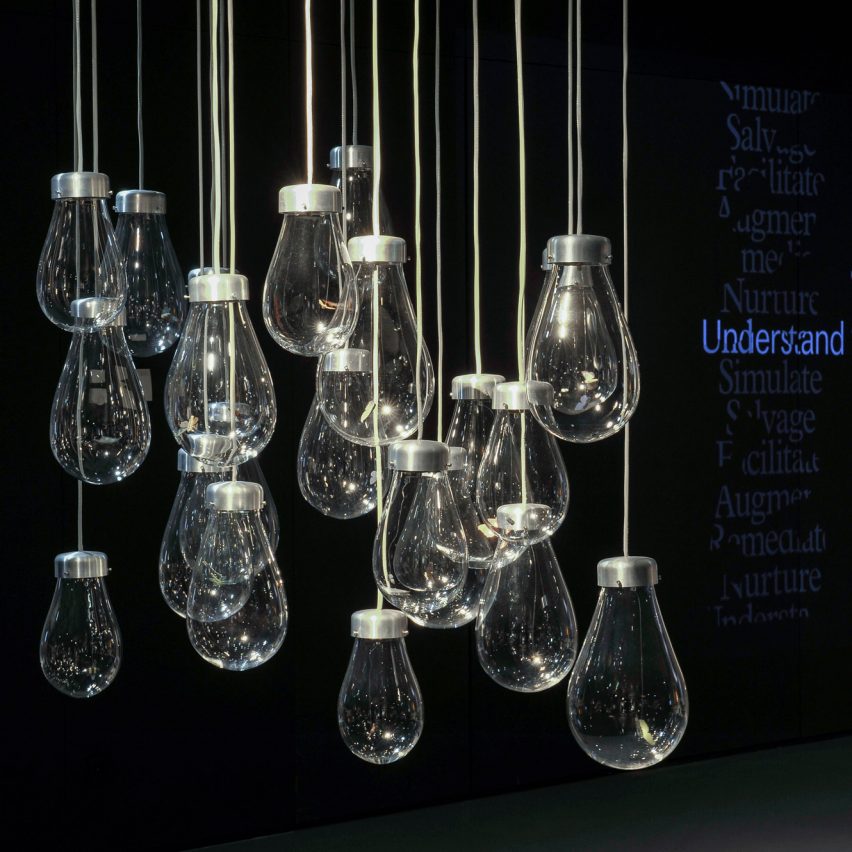
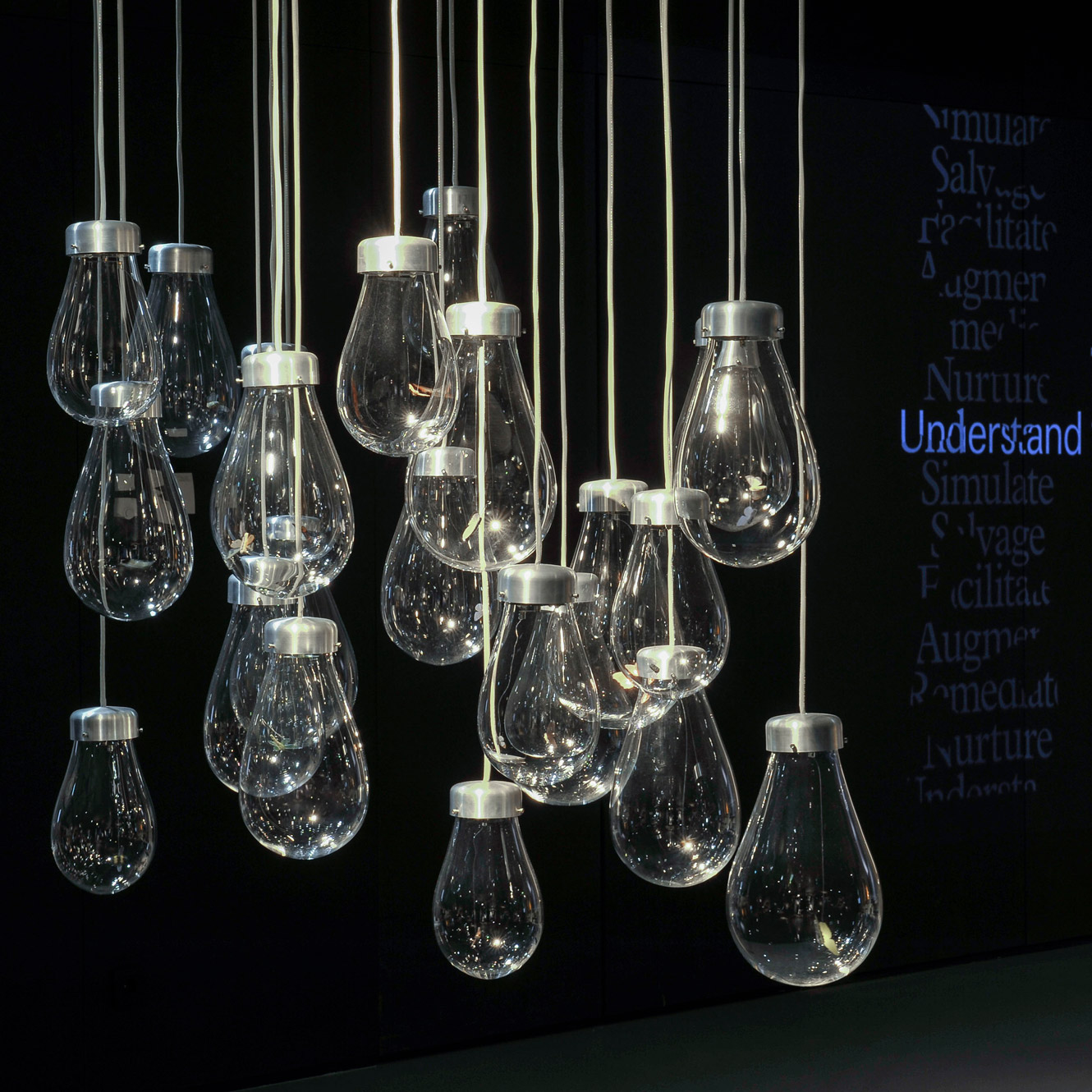
Created in collaboration with 200-year-old champagne house Perrier-Jouët, Curiosity Cloud is a chandelier-like installation comprising 22 suspended blown-glass bulbs.

Dezeen x Miami Design Talks

The bulbs come in three different sizes and were blown individually by Viennese glassware company Lobmeyr.

Each of the bulbs contains a hand-made model of a species of insect that is commonly found in the United States, which is intended to speak to Design Miami 2020's theme of America(s).

The work lies dormant when there is nobody around but the bulbs light up and the insects inside start fluttering when visitors move closer to the piece.

Curiosity Cloud aims to reflect upon the relationship between man and nature, with a particular focus on the impact of human activity and the importance of biodiversity.

Portrait of Katharina Mischer and Thomas Traxler from Mischer‘traxler studio
Katharina Mischer and Thomas Traxler from Austrian design studio Mischer'Traxler

The insects are also a nod to Art Nouveau, a style of architecture and design characterised by its references to nature, which gained popularity in Europe and the US at the end of the nineteenth century until the beginning of the first world war.

The style is central to Perrier-Jouët's brand, as the design for its Belle Epoque prestige cuvee was created by Art Nouveau pioneer Emile Gallé in 1902.

"With its reinvention of nature and combination of traditional craft and modern technology, Curiosity Cloud clearly echoes the ethos of the Art Nouveau movement, which profoundly influenced the cultural heritage of Maison Perrier-Jouët," said the brand's style director Axelle de Buffévent.

Mischer'Traxler is a Vienna-based design studio, which was founded in 2009 by Katharina Mischer and Thomas Traxler. This year's collaboration with Perrier-Jouët honours a longstanding partnership between the design studio and the champagne house.

Previous works to come out of the partnership include a Mischer'Traxler-designed champagne flute that causes bubbles to stream from a small engraved moth, as well as an interactive installation featuring plants made of paper that sprout in reaction to a visitor's presence.

The full programme for the Dezeen x Miami Design Talks collaboration can be found here.

The post Mischer'Traxler and Perrier-Jouët present Curiosity Cloud installation for Dezeen x Miami Design Talks appeared first on Dezeen.


from Dezeen https://ift.tt/3fHO4PX