Friday, 16 July 2021

Unit9 creates Lotus Aeroad tensegrity structure at Goodwood Festival of Speed

lotus aeroad structure at goodwood

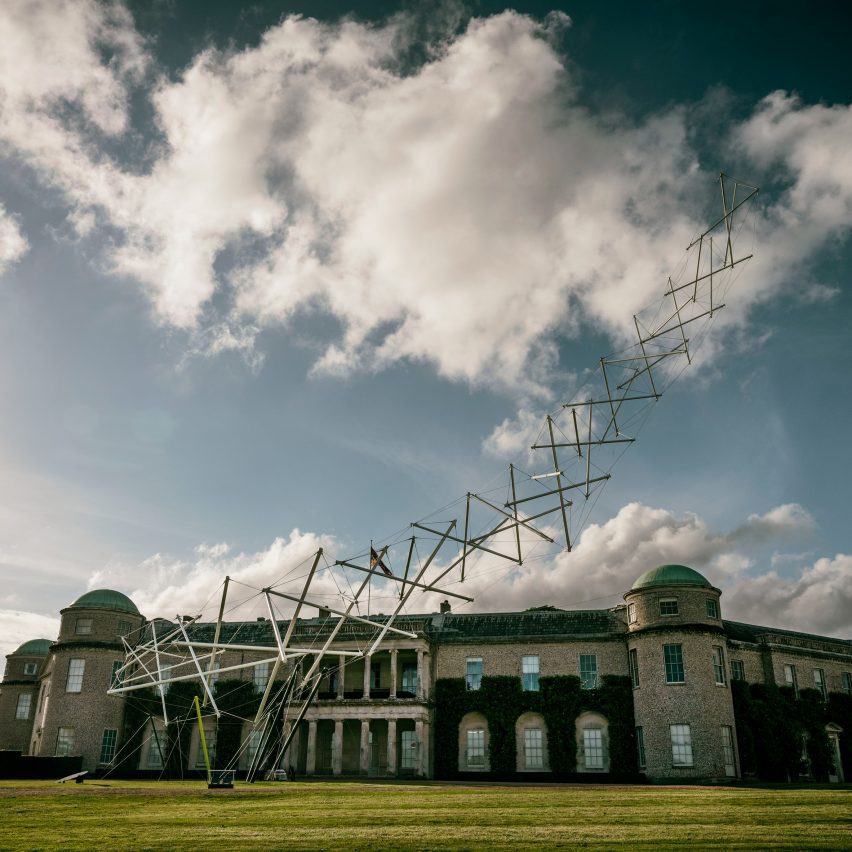
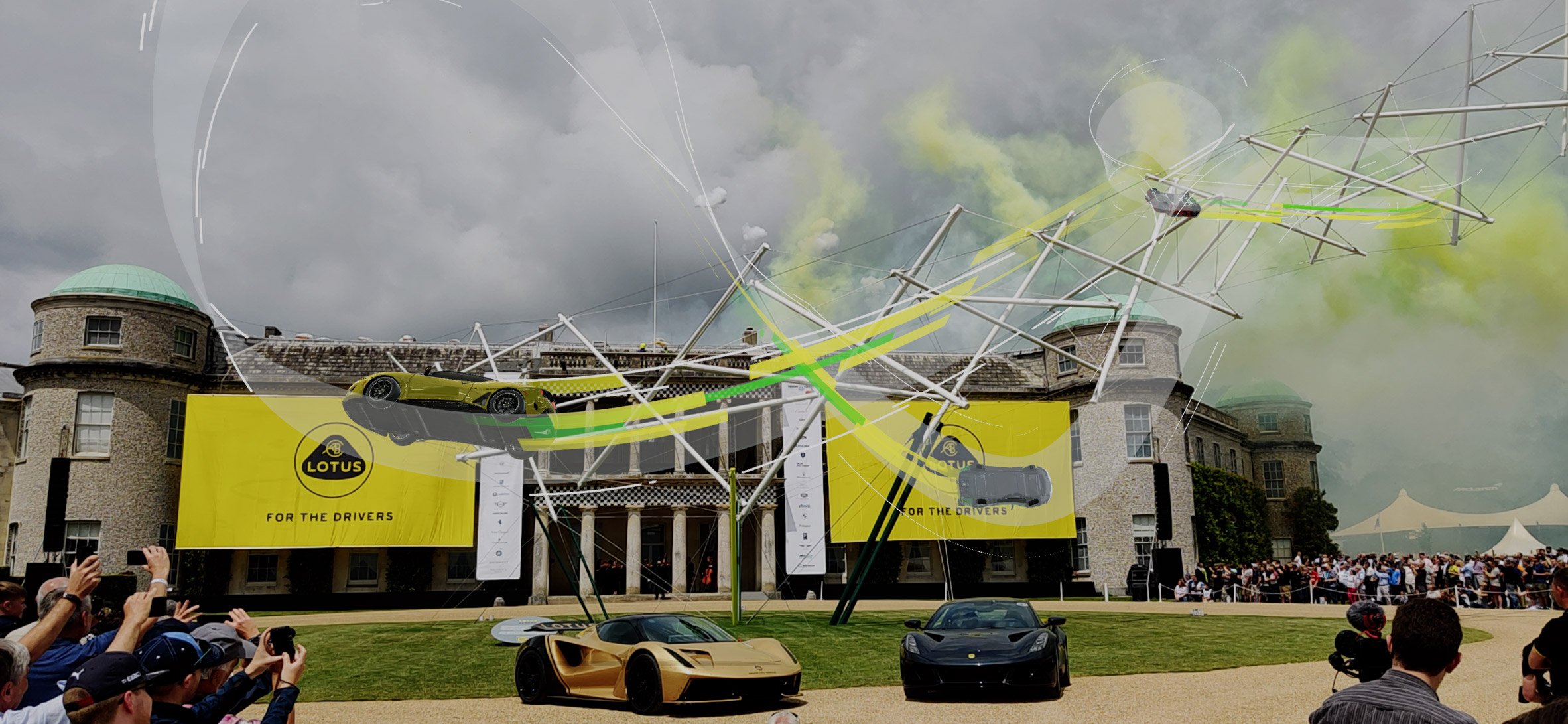
London-based production studio Unit9 has created a tensegrity structure at this year's Goodwood Festival of Speed that can be transformed into a race track using an augmented reality app.

Named Lotus Aeroad, the 50-metre-long sculpture was built outside Goodwood House as the centrepiece for the motorsport festival, which took place from 8-11 July.
lotus aeroad structure at goodwood
Top: the Lotus Aeroad was designed to showcase the new Lotus Emira. Above: the structure can be enhanced using augmented reality

The lightweight tensegrity structure was informed by the design philosophy of British car brand Lotus, which sponsored the structure.

"Lotus Aeroad is inspired by Lotus founder Colin Chapman's philosophy of 'simplify, then add lightness', which led us to use tensegrity as a design and engineering principle," Unit9's creative director Kate Lynham told Dezeen.
lotus aeroad structure at goodwood
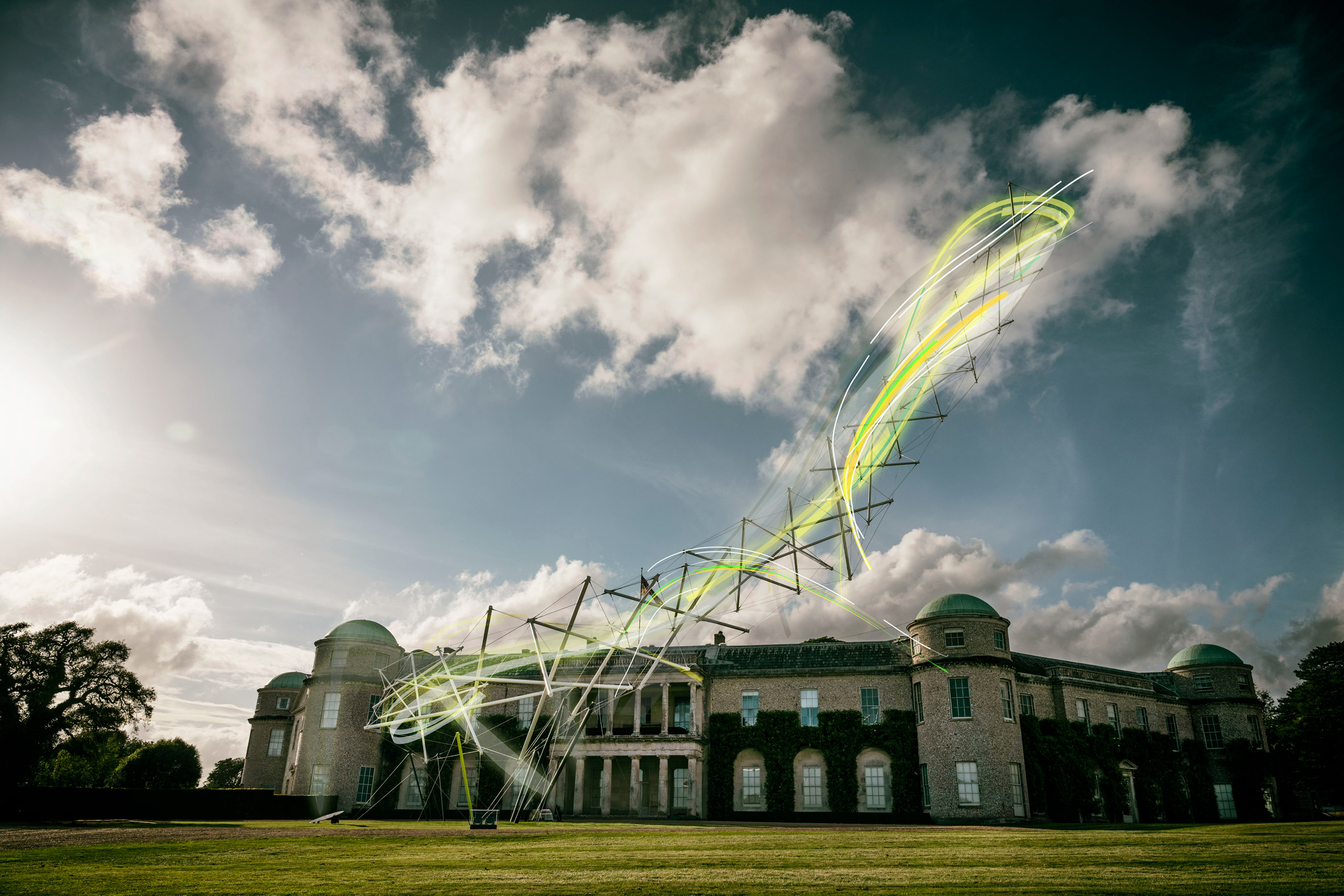
Lotus Aeroad is made from steel tubes and cables

Balanced on a supporting frame, the structure was made from a small number of steel tubes and stainless steel cables.

According to the designers, it forms a cantilever that mimics the "rooster tail" shape of the Lotus Evija, which was the brand's first electric hypercar.

"The sculpture employs the engineering concept of tensegrity – a structural principle where tension and opposing forces create exceptionally strong and rigid structures with minimal mass," said Lynham.

"We wanted the structure to be made more from air than any other material."

lotus aeroad structure at goodwood
The designers used a computer script to make sure the structure could support itself

The team developed the structure using computer-based form-finding techniques. The designers decided on the direction and form of each component, and then a computer programme was used to create a structure that would be able to stand on its own.

"In order to follow the correct shape and hence ensure each member carries the anticipated force, the erection has to be extremely accurate," said Stephen Melville, the founding director of Format Engineers.

"This has to be carried out in empty space, akin to an unstable 3D jigsaw puzzle that needs many of the elements to be in place before it stands under its own weight," he continued.

lotus aeroad structure at goodwoodf
A 3D modelling system was used to place the structure in the grounds of Goodwood

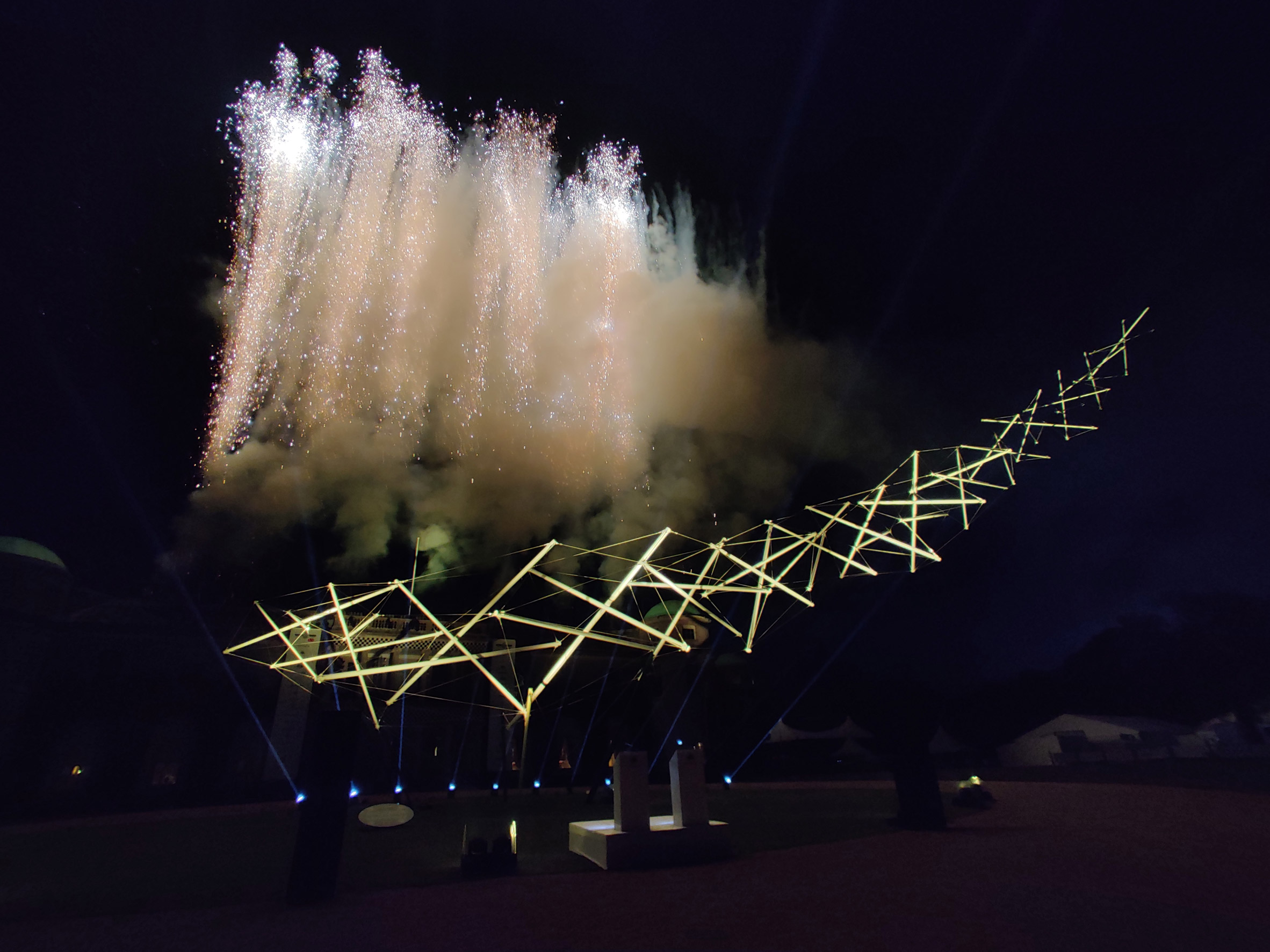
Visitors to the Goodwood Festival of Speed could download the Lotus Aeroad app to transform the structure into two race tracks using augmented reality.

Unit9 believes that this created "a richer experience and bring additional elements to the sculpture, without increasing the weight or load".

"In-person attendees can use the AR app to transform the sculpture into a dramatically curved race track that brings to life the Lotus Elise, Evore, Exige and, most excitingly, the brand-new Lotus Emira as it zooms around the feature," said Lynham.

Virtual attendees at the Goodwood Festival of Speed were also able to download the app and watch the cars race around the structure from their phones.

"At-home digital viewers can view the entire structure in AR, scaling it to fit their environment wherever they are in the world," explained Lynham.
lotus aeroad structure at goodwood
Visitors can use an augmented reality app to watch cars race across the structure

The Goodwood Festival of Speed is a motorsports festival that takes place once a year at Goodwood House in West Sussex, England. Previous installations at the motorsports festival included Gerry Judah's Aston Martin's structure which was designed to celebrate the Aston Martin DBR1 car.

Another tensegrity structure that has made news headlines recently is Project Bunny Rabbit's All Along the Watchtower. The bamboo structure is one of two winners of the Antepavilion architecture competition, which happens every year.

In June, police threatened to remove the structure from its location on the roof of the Hoxton Docks. Police raided the building on the hunt for members of climate activist group Extinction Rebellion. The group is known for its tensegrity structures and supporters of Extinction Rebellion had attended workshops at Antepavilion to help build All Along the Watchtower.


Project credits:

Client: Goodwood Festival of Speed
Brand partner: Lotus Cars
Digital innovation and production partner: Unit9
Construction: Format Engineers
Fabrication and installation: Littlehampton Welding

The post Unit9 creates Lotus Aeroad tensegrity structure at Goodwood Festival of Speed appeared first on Dezeen.


from Dezeen https://ift.tt/3kD3bij

Thursday, 15 July 2021

Former Parisian railway station turned into housing and live work units

A mixed-use development in Paris by Moussafir Architectes and Nicolas Hugoo Architecture

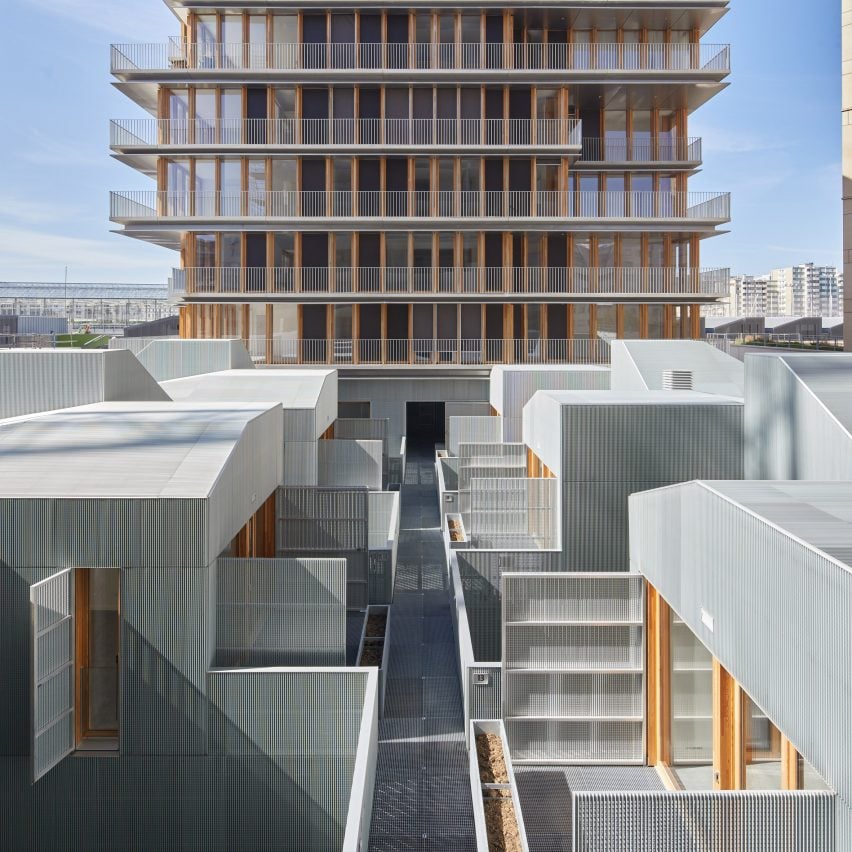
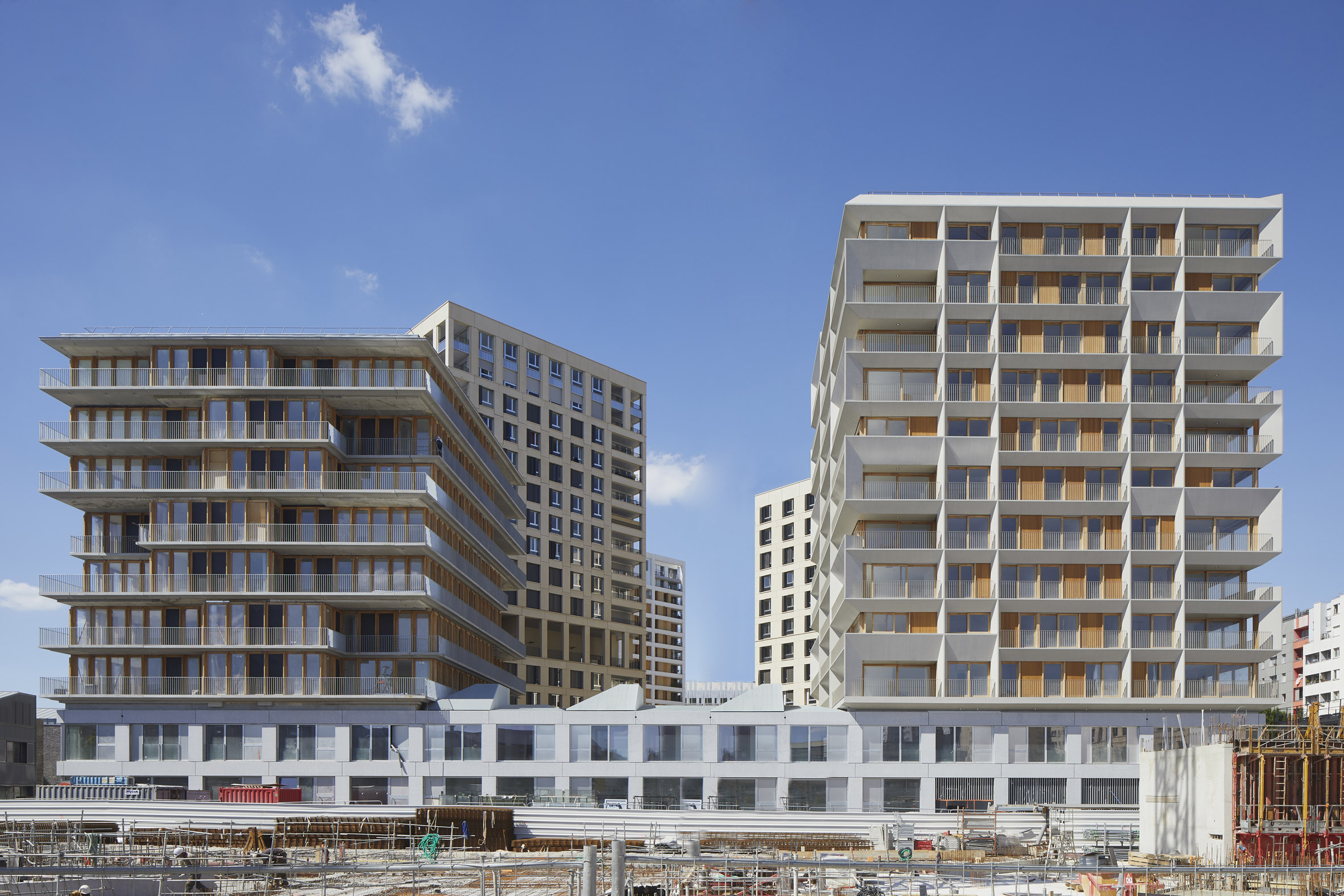
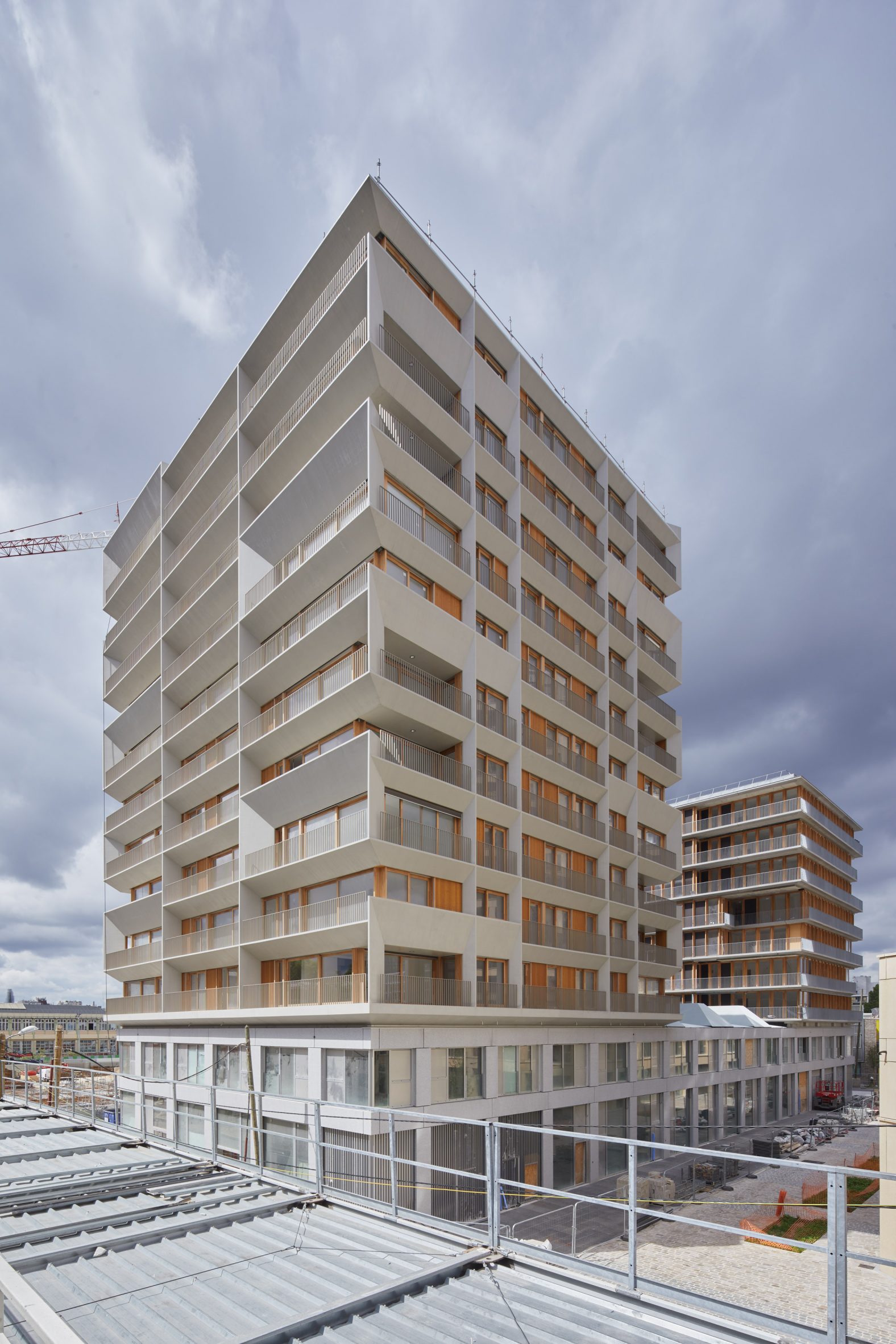
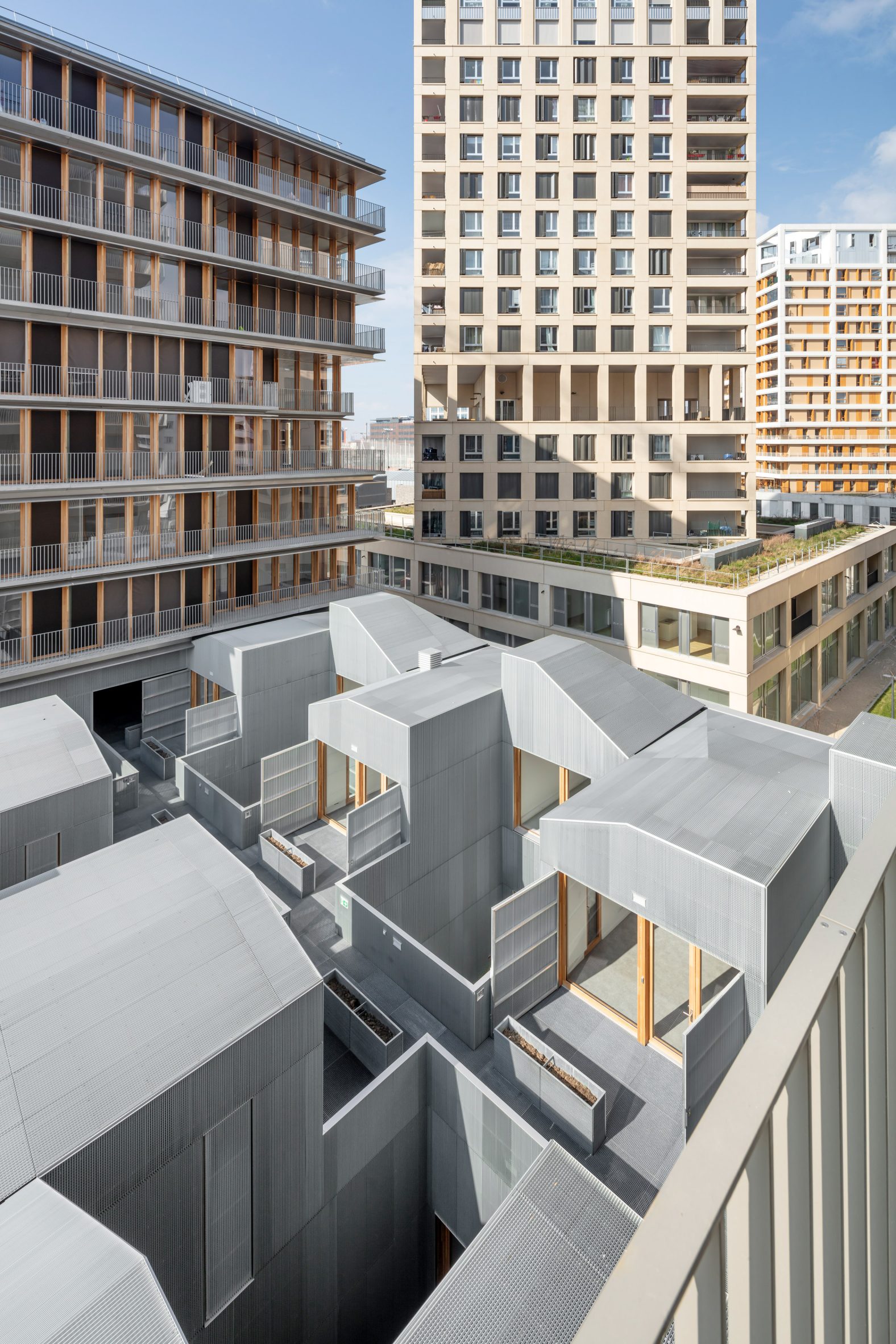
Moussafir Architectes and Nicolas Hugoo Architecture have created two residential towers connected by a podium containing live/work units as part of the La Chapelle International development in northern Paris.

Built on a former railway station in Paris's 18th arrondissement in the northeast of the city, the development occupies a city block.

Two housing blocks in Paris
Moussafir Architectes and Nicolas Hugoo Architecture have completed a housing development in Paris

Moussafir Architectes and Nicolas Hugoo Architecture each designed a timber, glass and concrete tower containing 105 townhouse-style apartments at either end of the development.

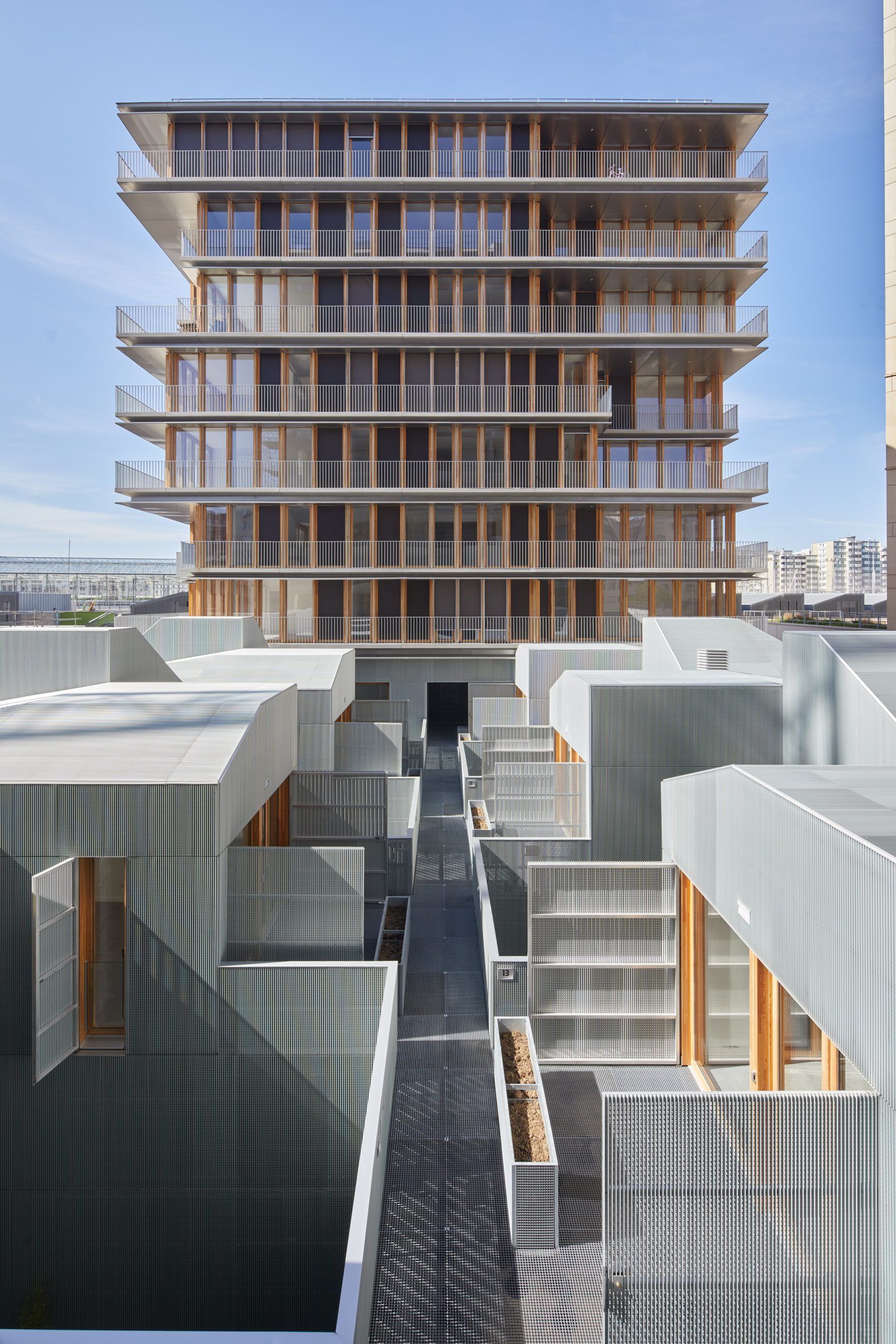
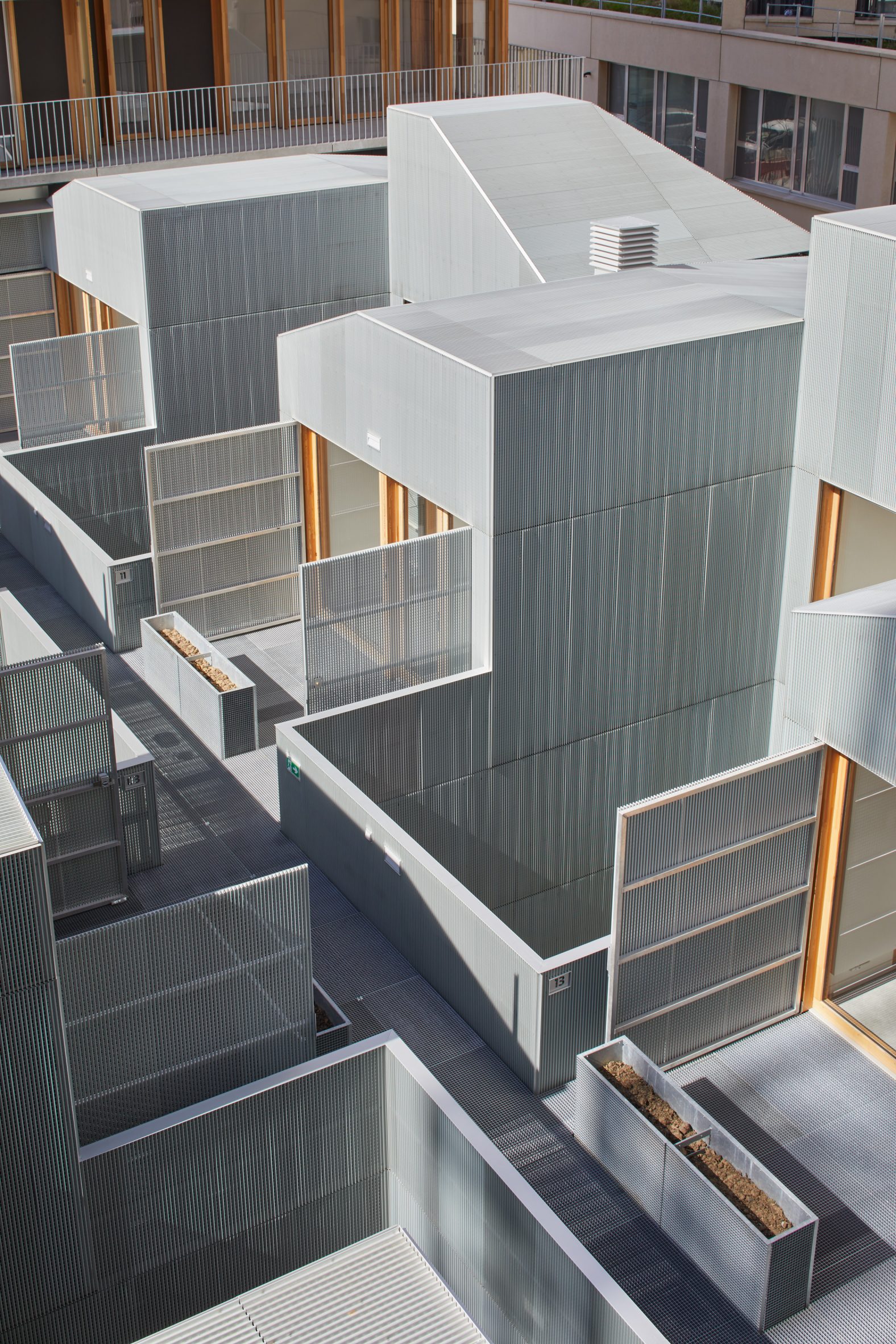
In response to the masterplan for the seven-hectare La Chapelle International development, which called for a uniform podium forming a base for two towers, 18 small live-work spaces clad in gridded-metal cladding were placed between the two towers.

A timber-clad apartment block in Paris
It comprises two towers connected by a podium

The street-level podium, which also contains common areas for the towers and two shops, displays the same orthogonal facade structure across the entire city block.

The residential towers present greater aesthetic variation while maintaining overall consistency with the rest of the scheme.

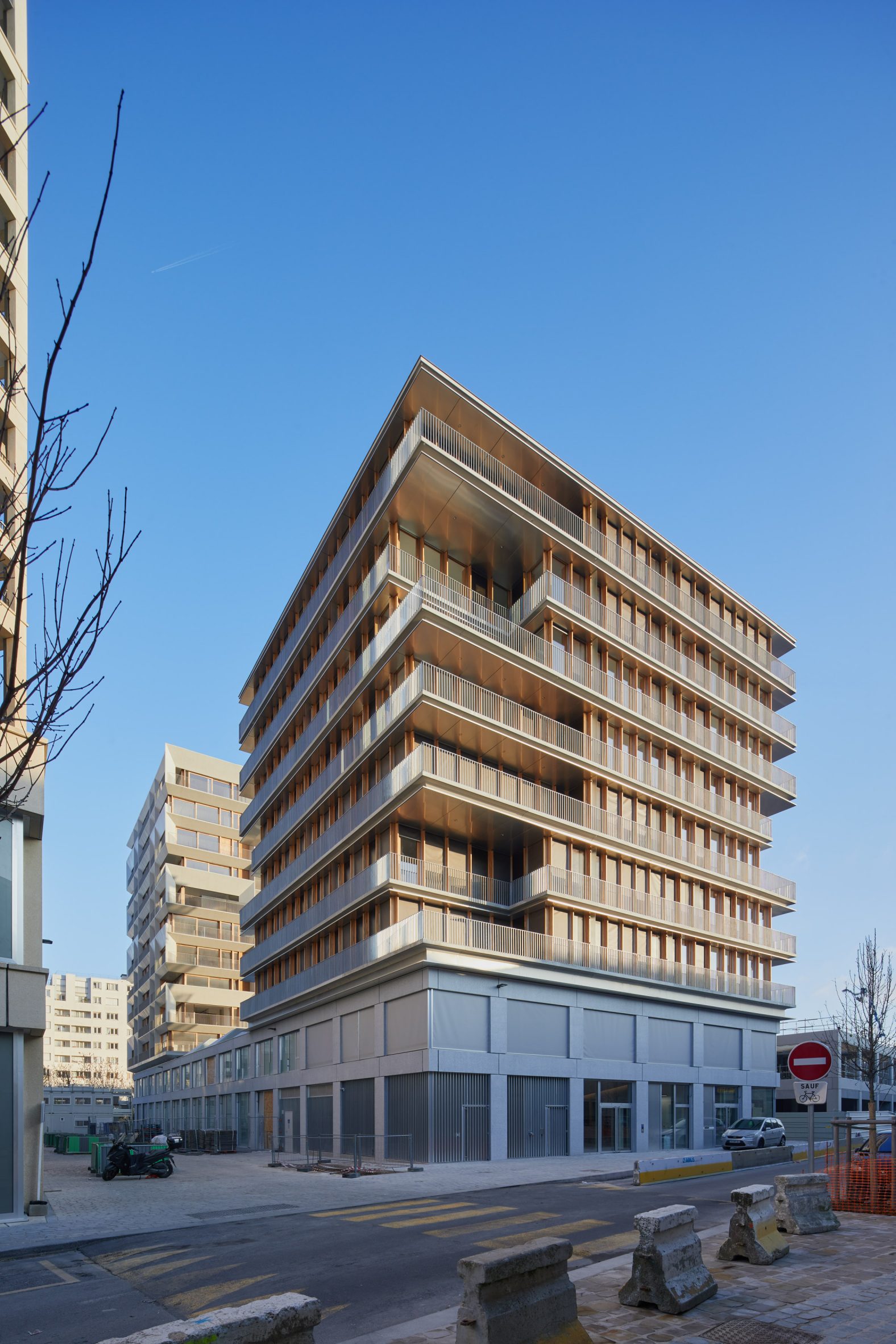
The taller G2 tower was developed by Jacques Moussafir's firm, while Nicolas Hugoo's studio designed the G1 tower to complement the facade it created for the concrete podium.

A timber-clad apartment block in Paris
The G1 tower is clad in larch joinery

The hybrid premises containing housing and small workspaces are called Small Office Home Office (SOHO) units and are intended for use by artisans, small businesses and self-employed workers.

The SOHOs aim to merge professional and residential spaces by applying a uniform material palette throughout the interiors. Each unit has a business entrance facing the street and private access from the communal area at the centre of the block.

A concrete-clad apartment block in Paris
The G2 tower was designed by Jacques Moussafi

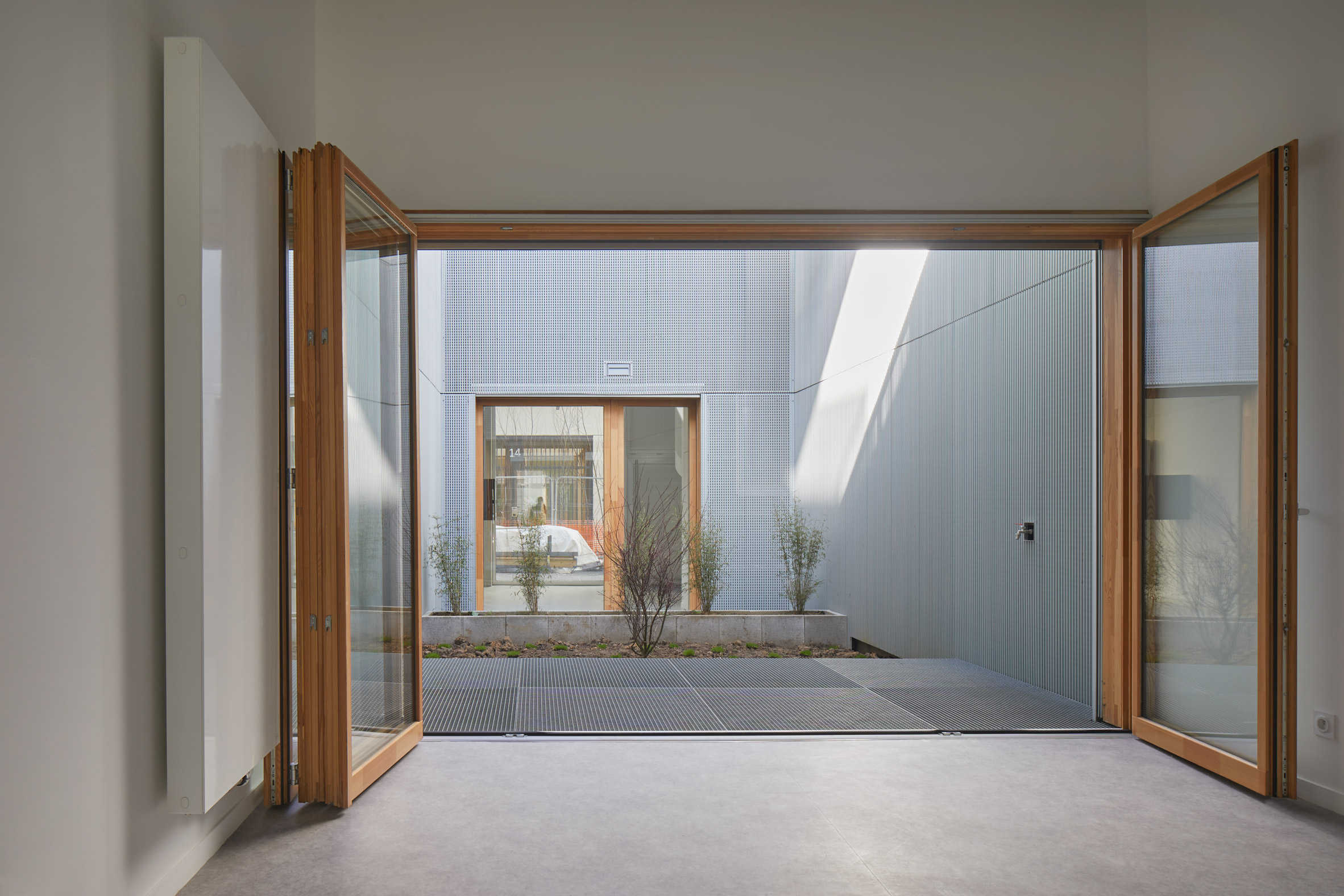
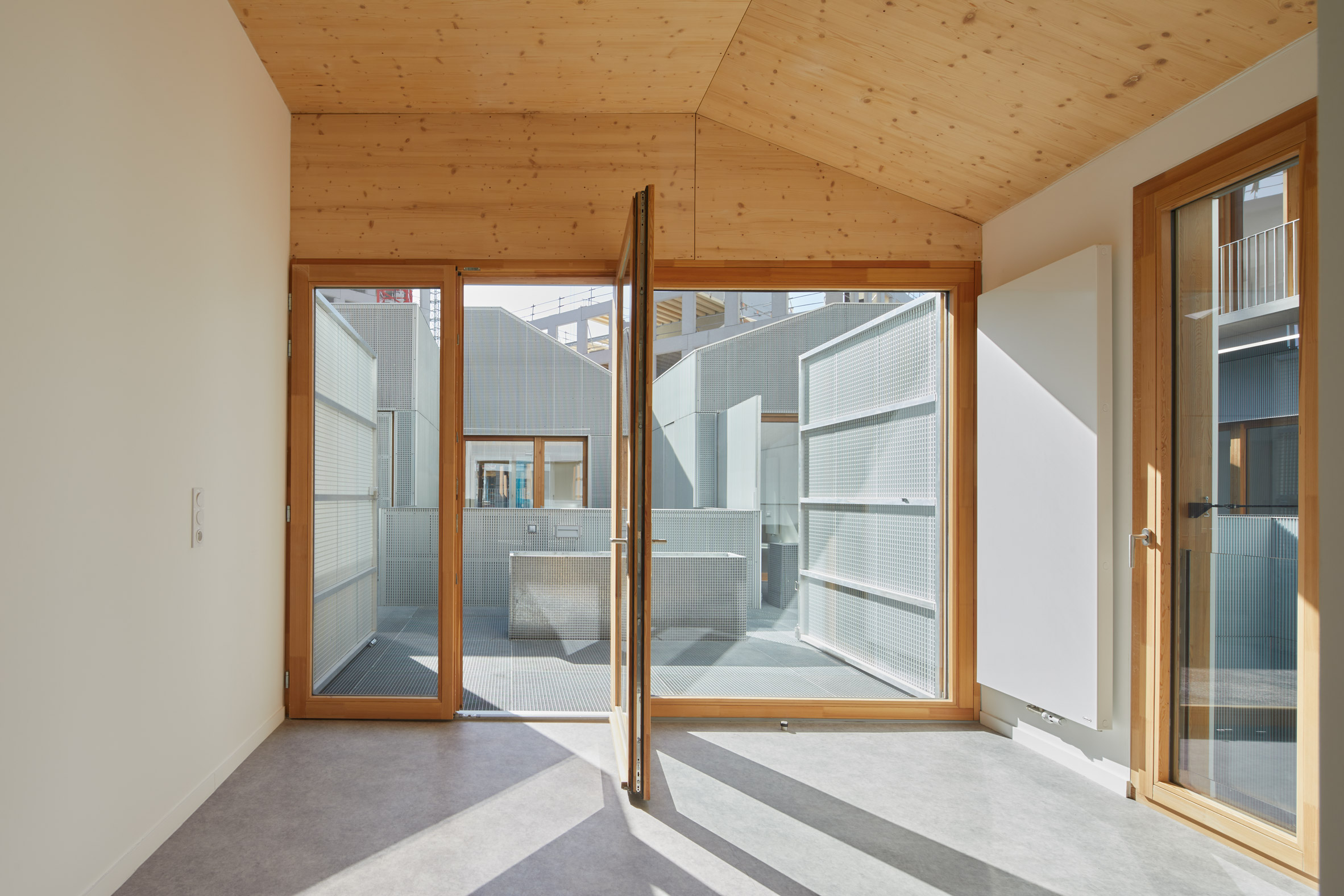
The upper levels of the SOHOs are arranged around six staggered semi-private terraces. The terraces slot in around six compact patios that allow daylight to reach living areas on the ground floor.

The densely packed accommodation is intended to reference the traditional Parisian streetscape, while the sloping roofs evoke nearby train sheds.

An aerial view of a mixed-use development in Paris
Small Office Home Office (SOHO) units sit between the towers. Photo is by Luc Boegly

A material palette featuring steel and aluminium surfaces creates a cohesive, industrial aesthetic across the inward-facing elevations.

"We imagined the fifth facade as a new 'metal blanket' made of perforated and ribbed aluminium that seems alternately to be either extruded to form hipped roofs or stamped to generate patios and terraces clad with galvanised steel grating," added Jacques Moussafir, whose firm designed the SOHOs.

Metallic apartment blocks
They are built with steel and aluminium surfaces

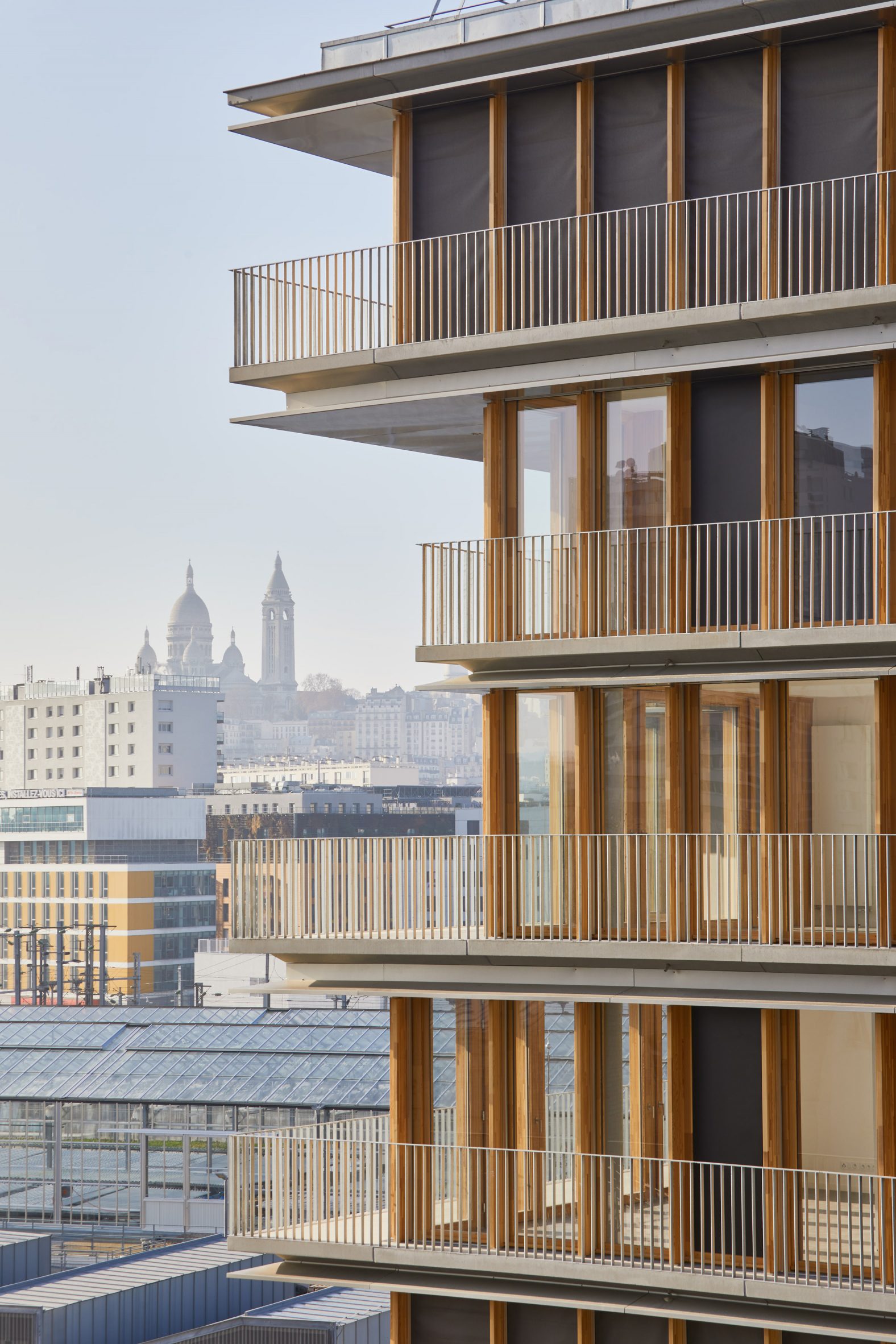
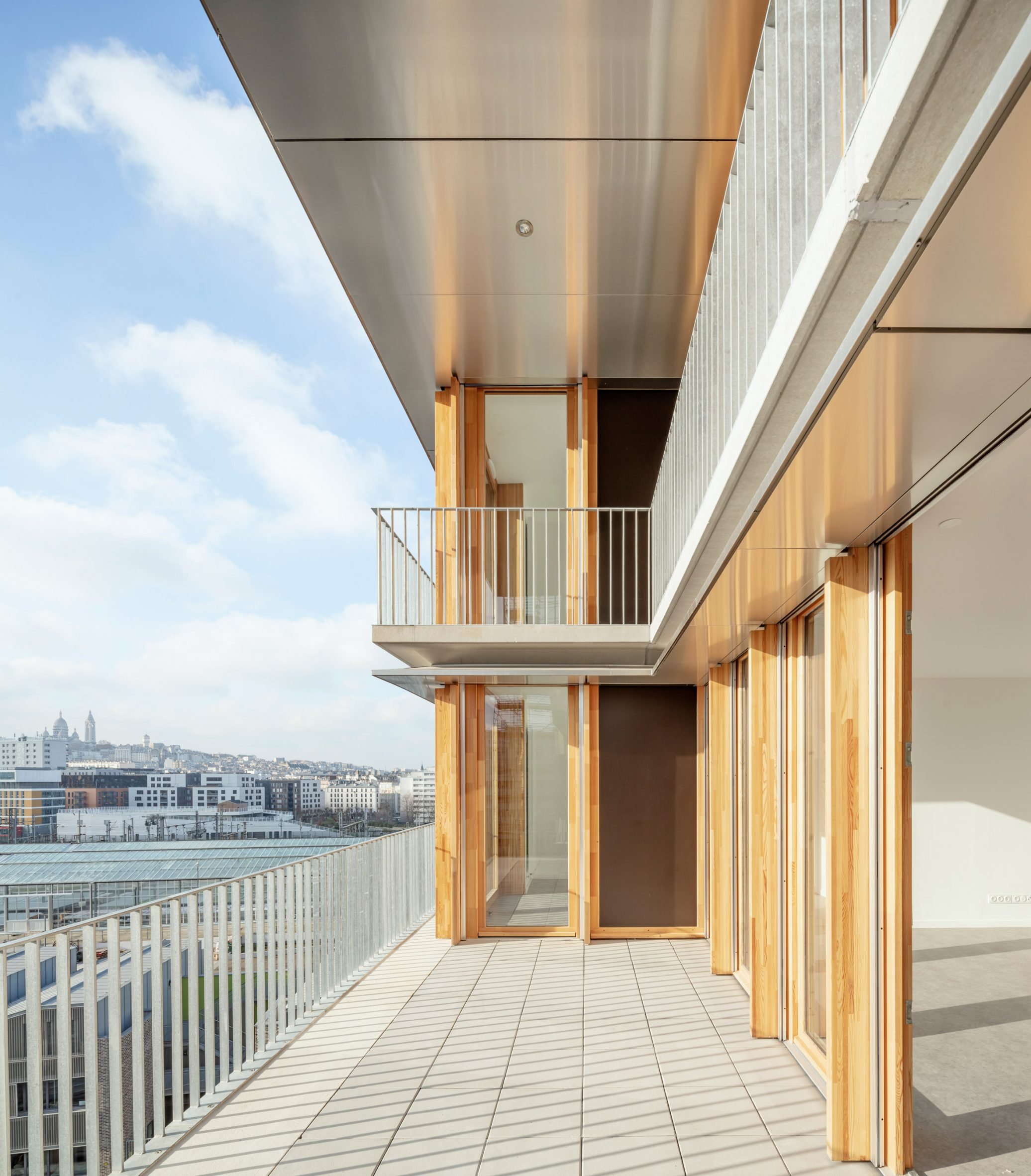
The G1 apartment building, which was designed by Nicolas Hugoo Architecture, was designed to feel light and open to the surrounding city, with projecting balconies providing views in all directions.

Larch joinery brings rhythm and organisation to the facades, which incorporate fixed and opening windows interspersed with anodised aluminium panels.

A timber-clad tower
G1 is designed to feel light and open

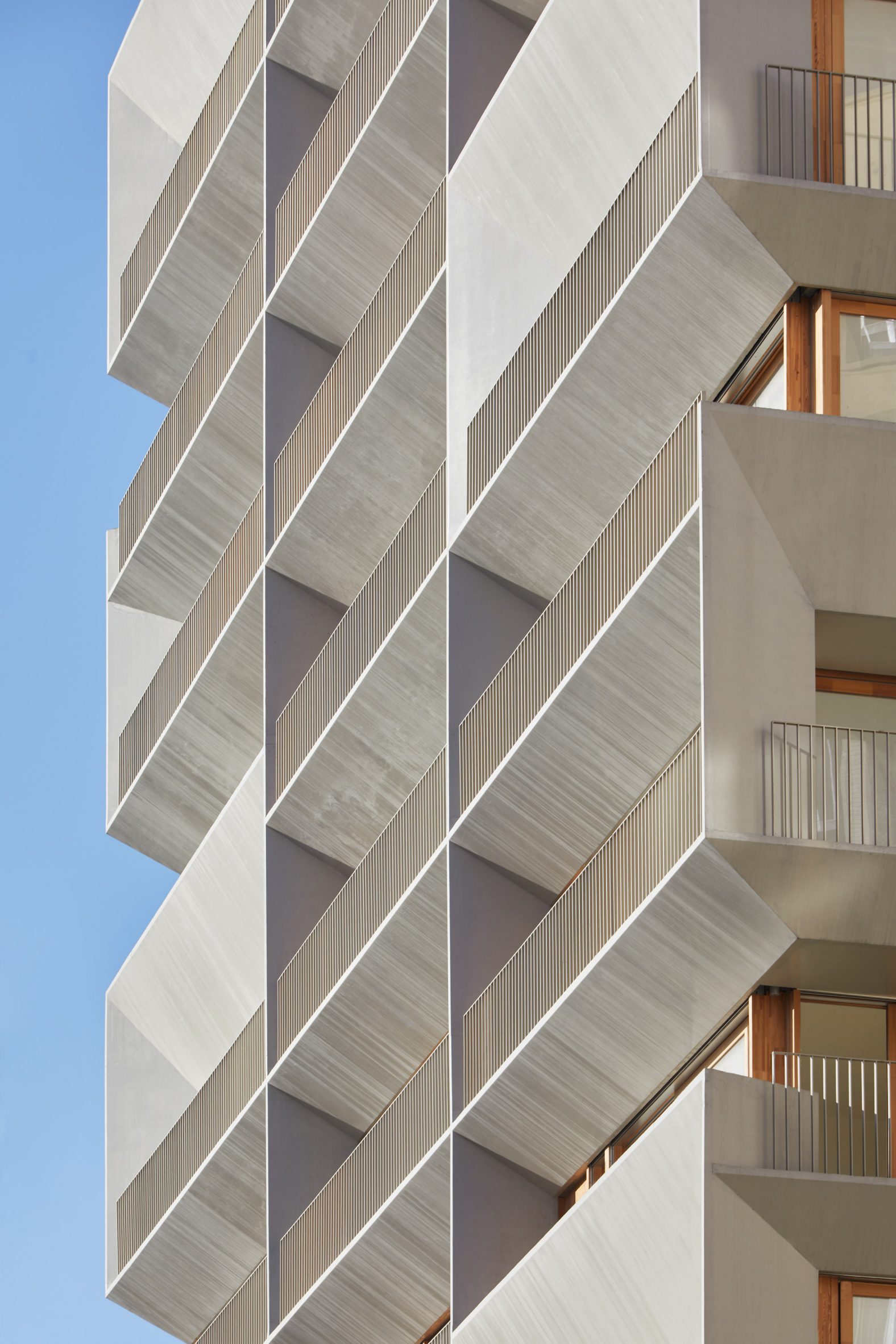
The lightweight aesthetic is enhanced by the lack of visible structure on the building's exterior, along with the prefabricated concrete balconies that narrow at the edges.

The building is organised around a compact circulation core, with functional spaces situated closest to the centre to free up the outer areas for the living spaces and bedrooms.

An apartment balcony
It has prefabricated concrete balconies. Photo is by Luc Boegly

The second tower, known as G2, was designed by Jacques Moussafir. It features cubic proportions and accommodates six apartments on each floor.

As with G1, the apartments are arranged with living areas towards the edges to optimise the available light and views.

A tower with concrete cladding
G2 has sculptural concrete facades

The building's structure is provided both by the central core and by the waffle design of the concrete facades. This configuration means that long spans are not required and frees up some of the corners.

"Borrowing more from civil engineering than other current construction techniques, this expressive structure is built with concrete poured onsite with large dimension metal formworks," said the project team.

An apartment with a central courtyard
The SOHOs are arranged around courtyards

Varying the orientation of the terraces allowed for the creation of four different floor plans across the ten levels. This arrangement also helps to break up the facades into a non-uniform pattern that expresses the positioning of each apartment.

Jacques Moussafir founded his eponymous studio in 1993 and now works across various fields including cultural and residential projects.

An apartment interior
Apartments are arranged to maximise light

The studio's previous work includes a Parisian home with a staircase that can be glimpsed through patterned shutters and a concert hall in Tours, France, covered with a synthetic material that resembles a quilt.

Nicolas Hugoo worked as a project manager at Moussafir's firm for five years before co-founding the Bang Architectes collective and eventually setting up his own agency focused on managing urban architecture projects.

The photography is by Herve Abbadie unless stated.

The post Former Parisian railway station turned into housing and live work units appeared first on Dezeen.


from Dezeen https://ift.tt/3ksuuvo

Sweden faces "very serious" economic impacts as environmental ruling closes cement plant

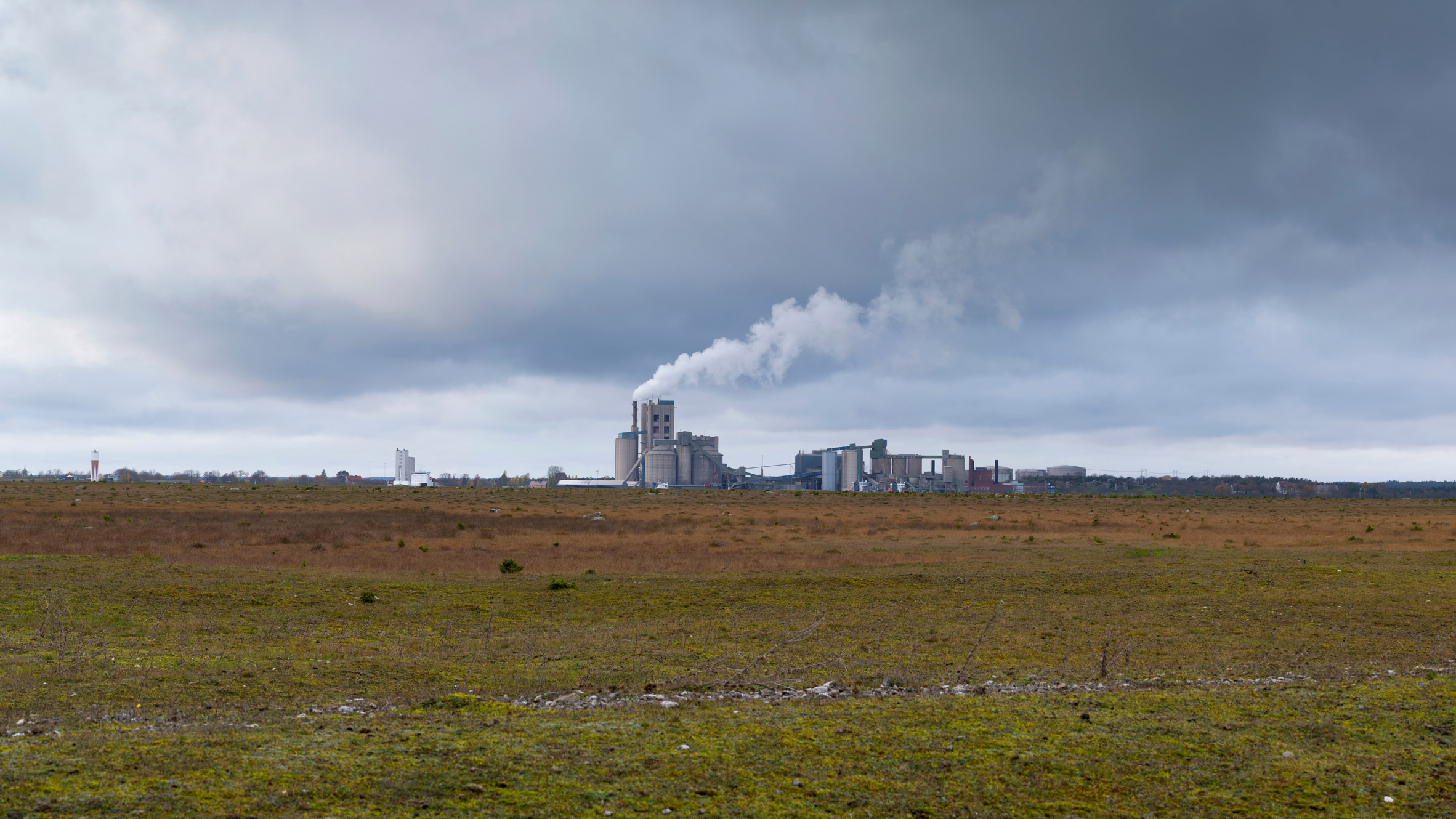
Slite cement plant in Gotland, Sweden

The closure of Sweden's biggest cement factory on environmental grounds could cause up to 400,000 job losses and wipe out the country's GDP growth, according to an alliance of construction bodies.

Work could grind to a halt on three-quarters of all house-building projects and the construction sector could lose more than 20 billion Swedish Kronor (SEK) per month.

Work on infrastructure projects including Foster + Partners' Slussen masterplan in Stockholm could also be impacted.

The warning came from Byggföretagen, a body that represents construction firms in Sweden.

"Sweden is facing an extensive construction halt," it said. "By November, three out of four new homes will not be able to start construction. Several major infrastructure projects are stopped or delayed. Between 200,000 and 400,000 jobs are threatened."

Cement plant license rejected on environmental grounds

Byggföretagen based its figures on an impact assessment prepared in the wake of a decision by Sweden's Supreme Land and Environmental Court last week to reject a new licence for the Cementa cement plant at Slite in Gotland.

"The construction industry's share of GDP is about 11 per cent," Byggföretagen said. "The industry contributes almost SEK 40 billion in tax revenue to health care, schools and care. The construction halt thus risks displacing the entire GDP growth in 2022."

Slite cement plant
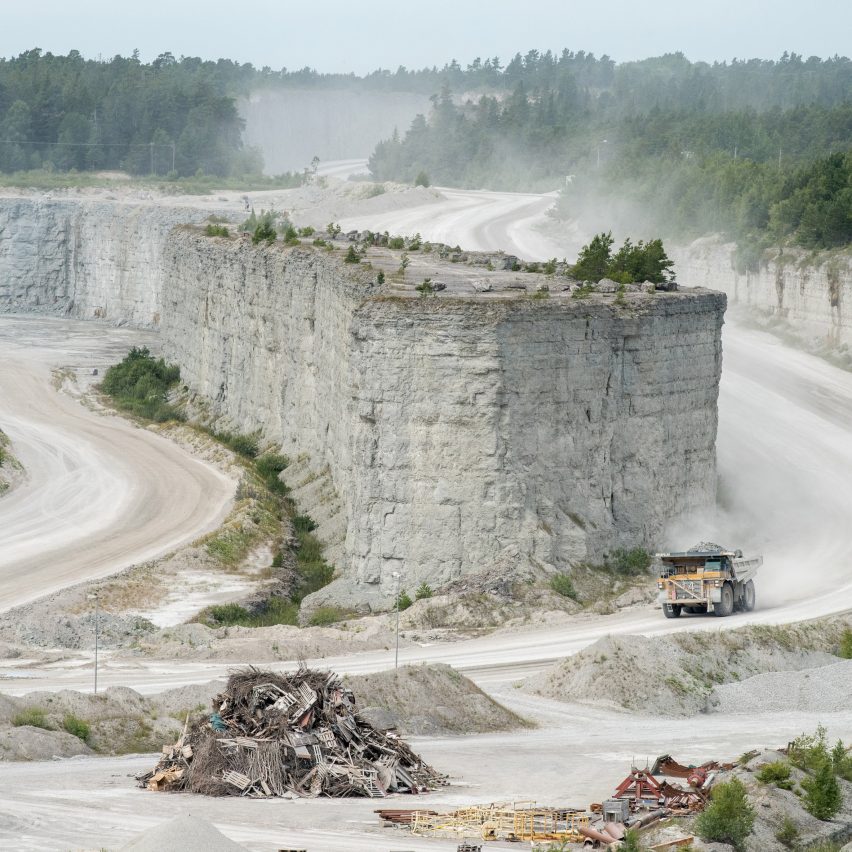
Top image: the limestone quarry on Gotland. Above: the Cementa plant is set to close

The plant, which is the second-largest source of greenhouse gas emissions in the country and responsible for three per cent of all Sweden's CO2 emissions, will no longer be able to mine limestone as a result of the ruling.

The licence was refused due to concerns over the plant's environmental impact assessment, particularly in relation to the impact on groundwater. Greenpeace has also accused the plant of using its kilns to incinerate toxic waste without a permit.

The court was concerned about high levels of chloride pollution in groundwater samples taken near the site, according to Swedish news organisation Dagens PS.

"The fact that environmental problems at one cement factory can send the whole construction industry of a country into a panic puts a light on both the climate crisis and critical supply chain and infrastructure problems in Sweden," Dagens PS journalist Daniel Jacobs told Dezeen.

Slite plant to be converted into carbon-neutral factory

The ruling means that the plant, which produces three-quarters of all the cement used in Sweden, will have to cease production on 31 October. Byggföretagen has demanded an urgent meeting with the government to discuss the ruling.

"The situation is very serious," said Byggföretagen's CEO Catharina Elmsäter-Svärd. "Sweden is facing an extensive construction halt. The cement shortage will have extensive consequences for the Swedish economy and employment."

Cement production is responsible for an estimated eight per cent of global carbon emissions. The Slite plant has been earmarked for conversion into an experimental carbon-neutral factory by 2030 but parent company HeidelbergCement told Dezeen the court ruling could impact the timetable of the project.


Carbon revolution logo

Carbon revolution

This article is part of Dezeen's carbon revolution series, which explores how this miracle material could be removed from the atmosphere and put to use on earth. Read all the content at: www.dezeen.com/carbon.

The sky photograph used in the carbon revolution graphic is by Taylor van Riper via Unsplash.

The post Sweden faces "very serious" economic impacts as environmental ruling closes cement plant appeared first on Dezeen.


from Dezeen https://ift.tt/3rfbWA1

KOS+A designs waterfront Hamptons home for watching the sunset

Sag Harbor 2 by KOSA

New York practice Kevin O'Sullivan + Associates has completed a waterfront house in the Hamptons with balconies for looking out at the sunset.

The practice was approached after the clients had discovered the site in a small cove in the Hamptons village of Sag Harbor.

Exterior of Sag Harbor 2 by KOS+A in the Hamptons
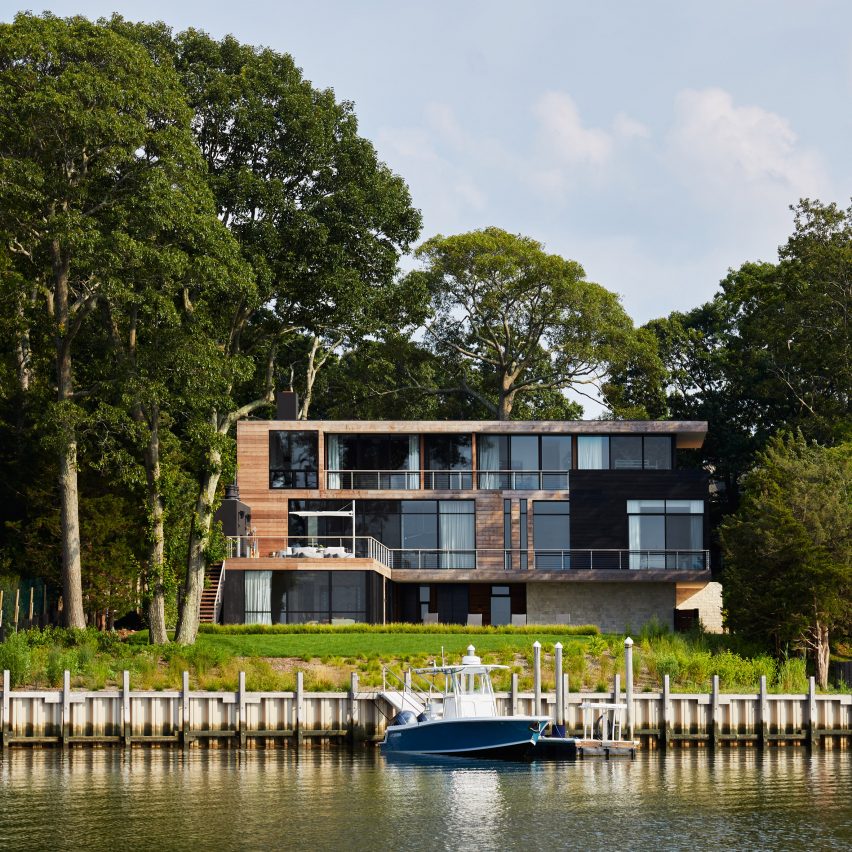
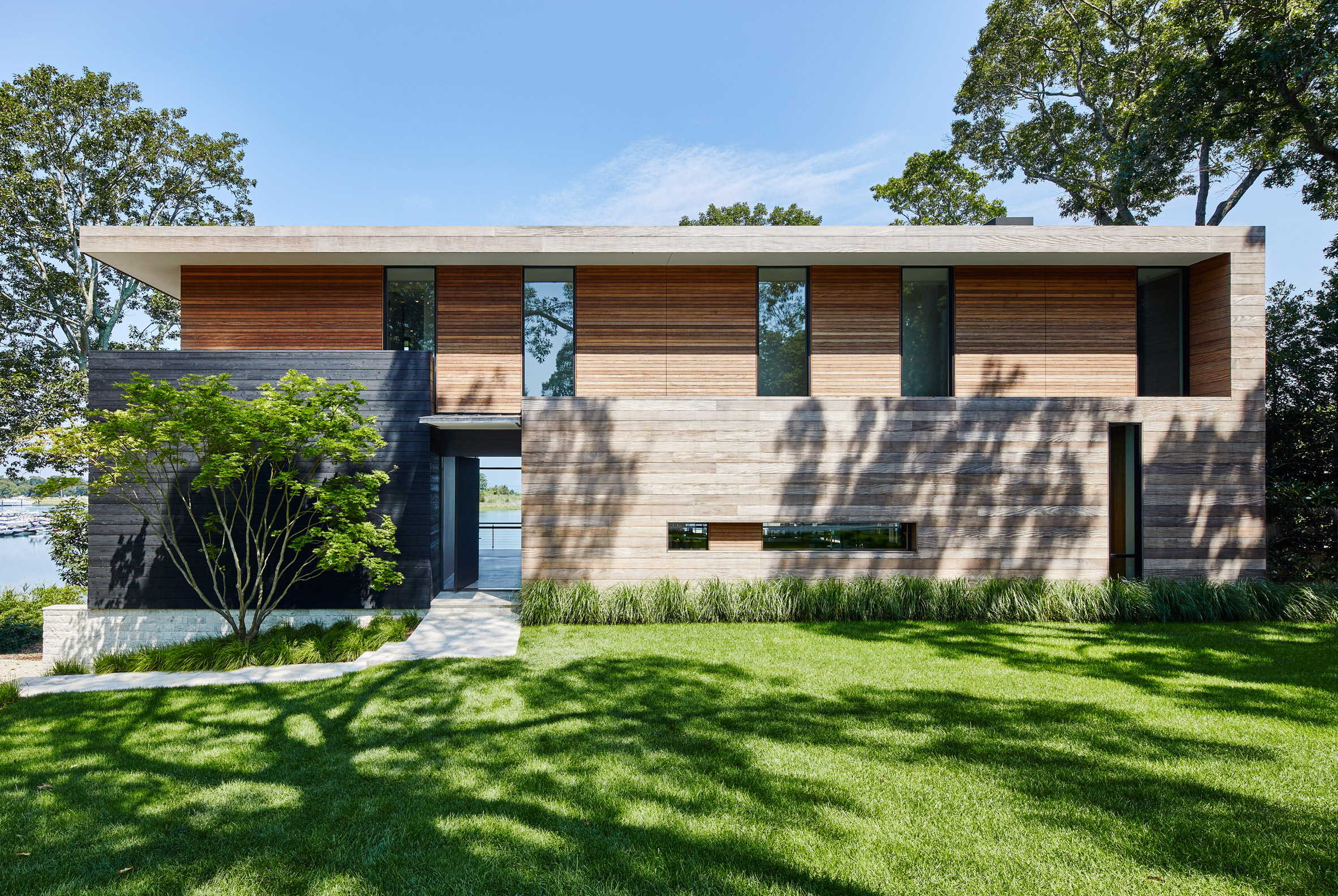
The upper levels of Sag Harbor 2 are clad in teak and charred cedar

Called Sag Harbor 2, the design prioritises northwest views of the water and sunsets, combining communal spaces with unique areas for each family member.

"Our aim was to create a home that had a place for everything and to create individual moments of joy for all four members of the family," said Kevin O'Sullivan + Associates (KOS+A).

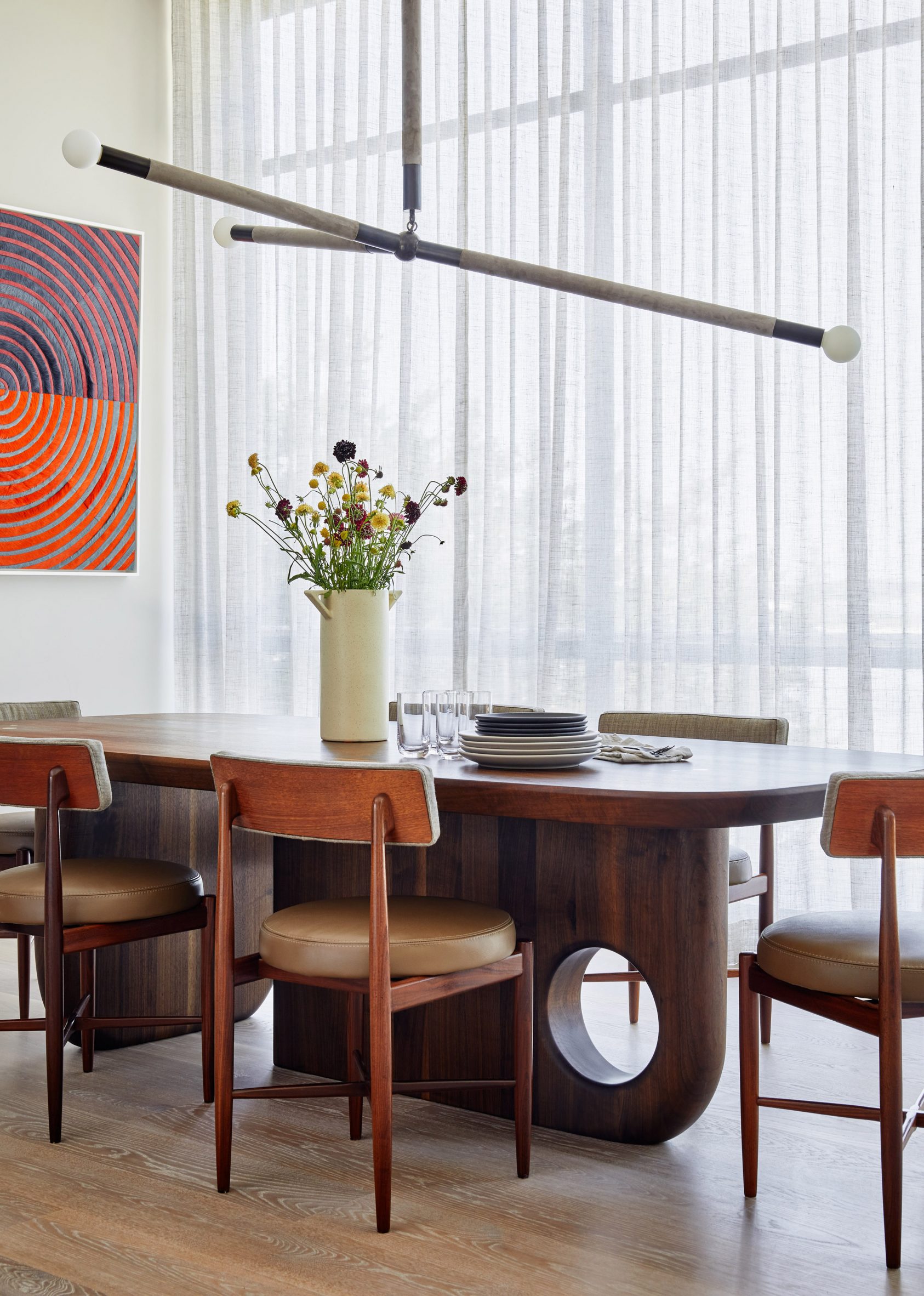
Dining area of Sag Harbor 2 in the Hamptons
Living spaces are on the ground floor

The site is sheltered by trees on either side and gently slopes down towards the water.

To maximise views, the family's bedrooms have been raised to the first floor. Where it faces the water the home is almost entirely glazed. On the opposite side tall, thin windows provide more carefully controlled views.

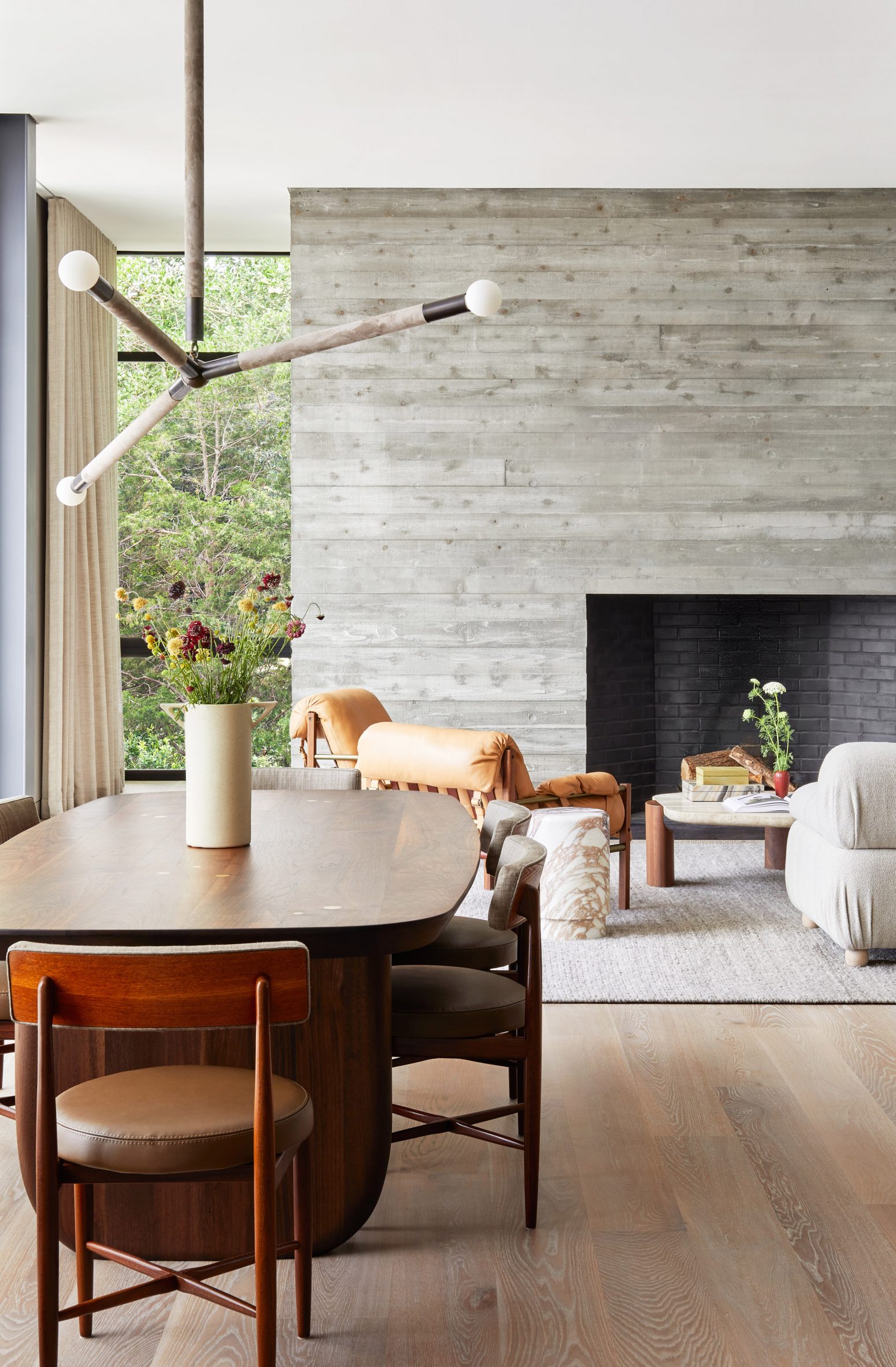
Board-marked concrete fireplace in the interior of a house in the Hamptons
The fireplace is made of board-marked concrete

These bedrooms are surrounded by a balcony that wraps around the first floor, accessible via full-height sliding doors and sheltered by an overhanging roof.

On the ground floor below are two guest bedrooms and the main living spaces.

A large kitchen, dining and living area is arranged around a shuttered concrete fireplace that also conceals the staircase.

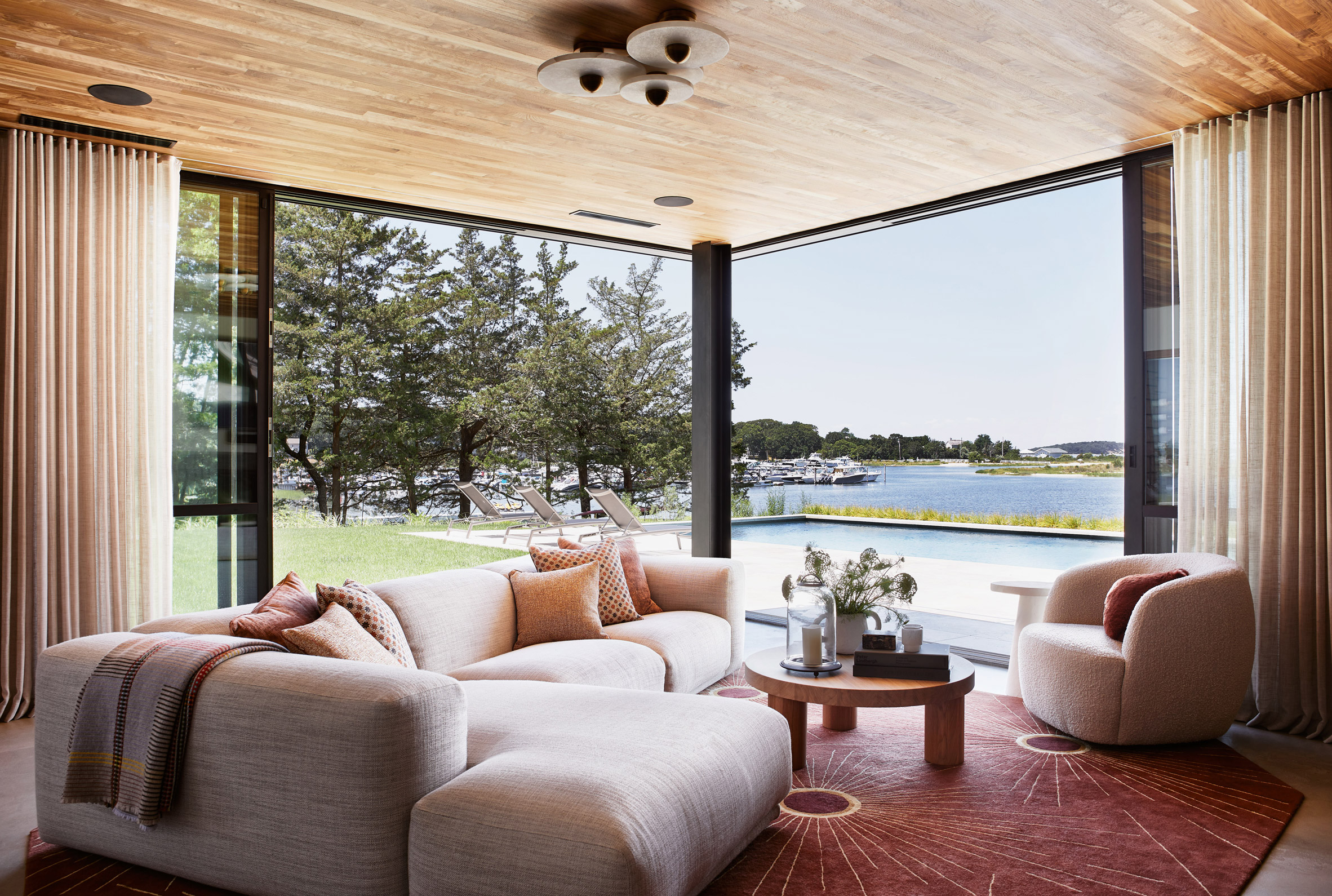
Sliding doors in this living area open onto an area of decking with dedicated cooking spaces for outdoor dining and a staircase leading down to a swimming pool.

Living areas of house look out over Sag Harbor
Views over the waterfront are maximised

The darker areas of the basement of Sag Harbor 2 houses a garage, utility and mechanical spaces as well also a sauna room, gym and a dedicated room for the client's fishing equipment.

This lower level has been finished externally with tumbled limestone to give the home a strong base.

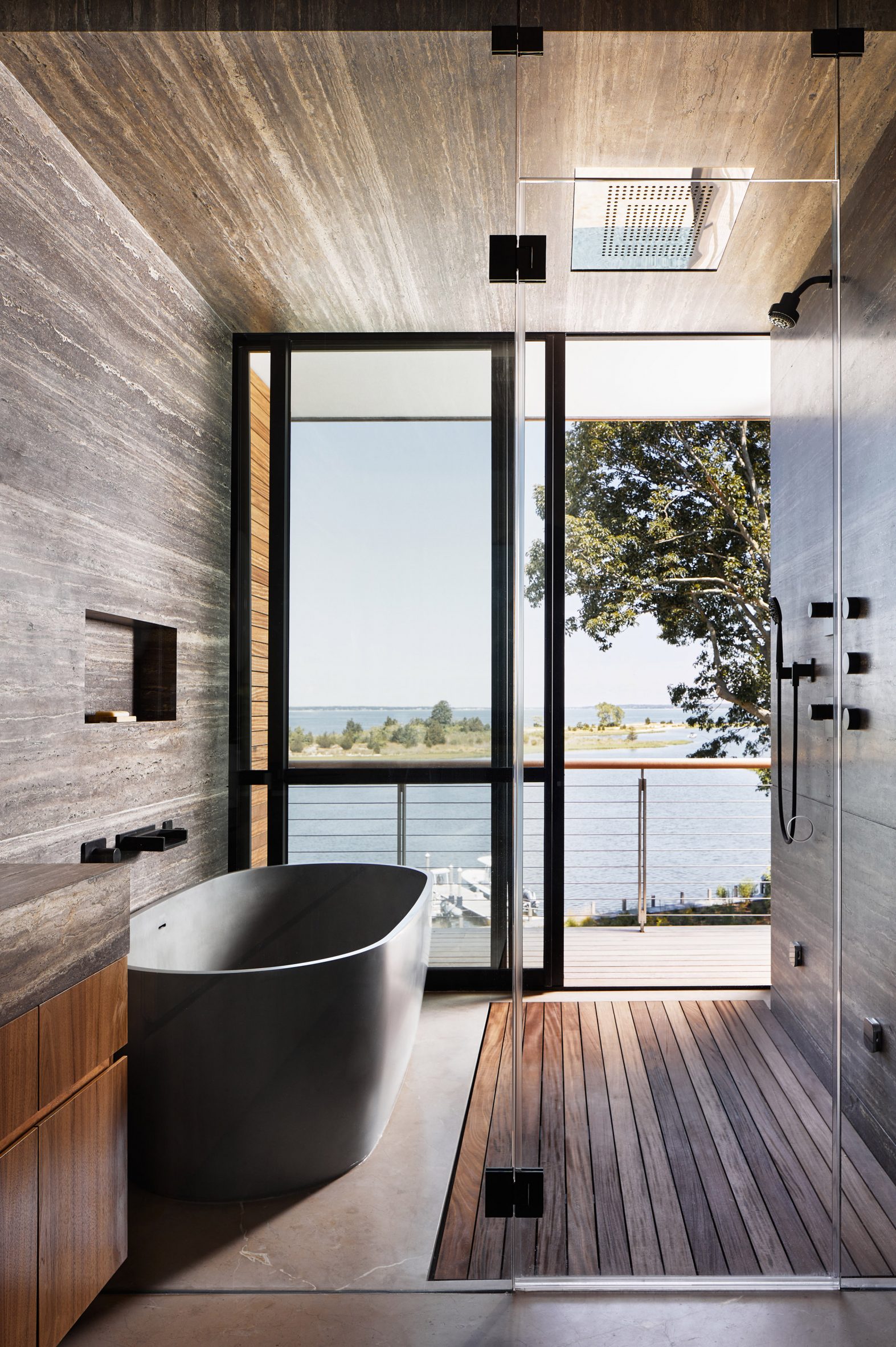
Bathroom with tub and shower that opens onto a balcony
Balconies are orientated towards the sunset

The upper levels of Sag Harbor 2 are clad with teak and contrasting charred cedar for the guest bedroom block, which projects slightly from the main house.

In the interiors, dark wood has been used in areas of the walls, floors, ceilings and furniture, contrasting with areas of lighter colour, stone in the bathrooms and the board-marked concrete in the living room.

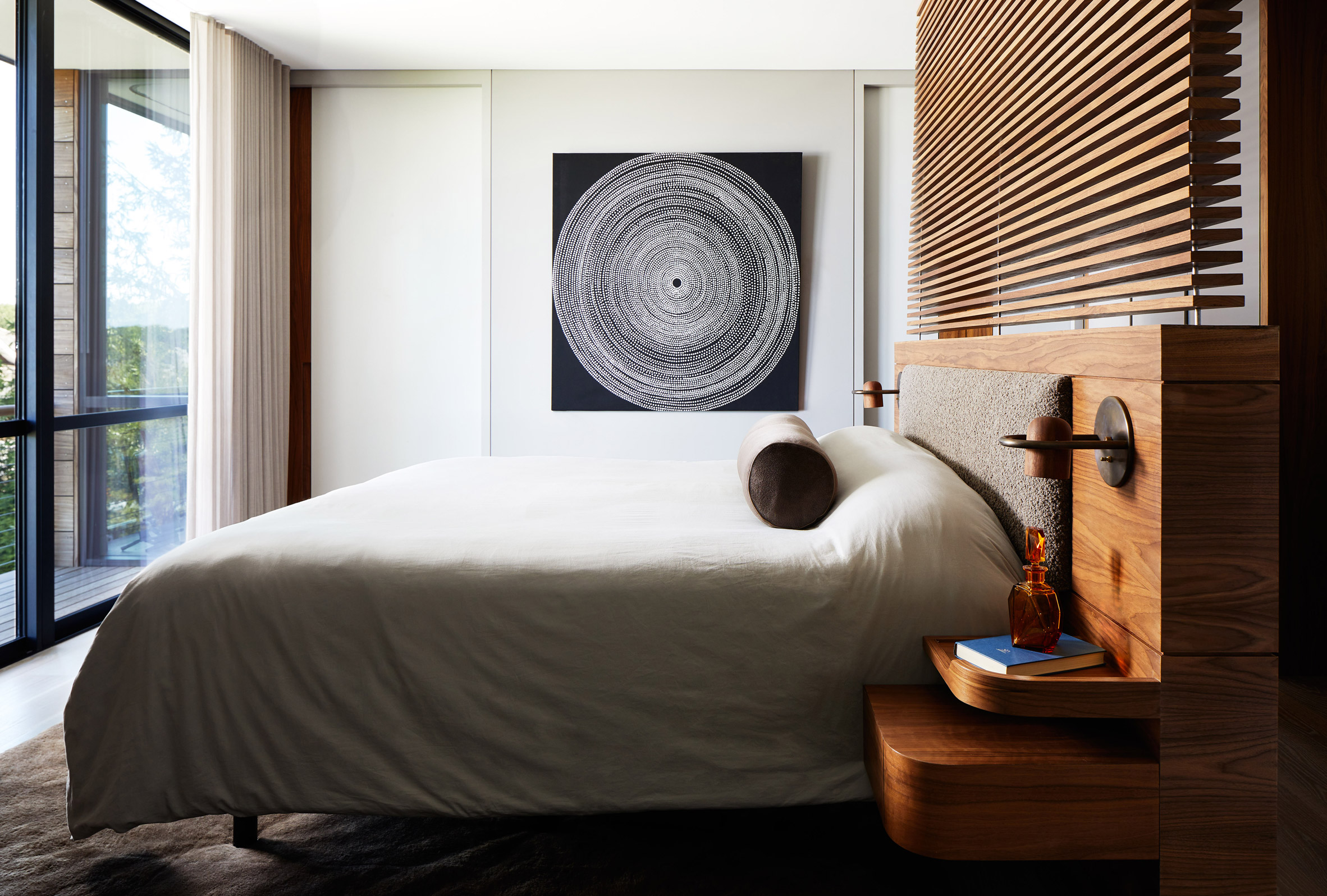
Bedroom of Sag Harbor 2 by KOS+A
KOS+A used a natural pallette for the rooms of Sag Harbor 2

"We strive to keep the materials natural and the palette calming," said  KOS+A.

"Tried and true materials lend a timeless quality to any style of architecture."

KOS+A have completed numerous projects in the East End of Long Island, including a house in Amagansett clad entirely in cedar shingles.

The photography is by Read McKendree.

The post KOS+A designs waterfront Hamptons home for watching the sunset appeared first on Dezeen.


from Dezeen https://ift.tt/3wGCbAD

A "respectful" coastal home features in today's Dezeen Weekly newsletter

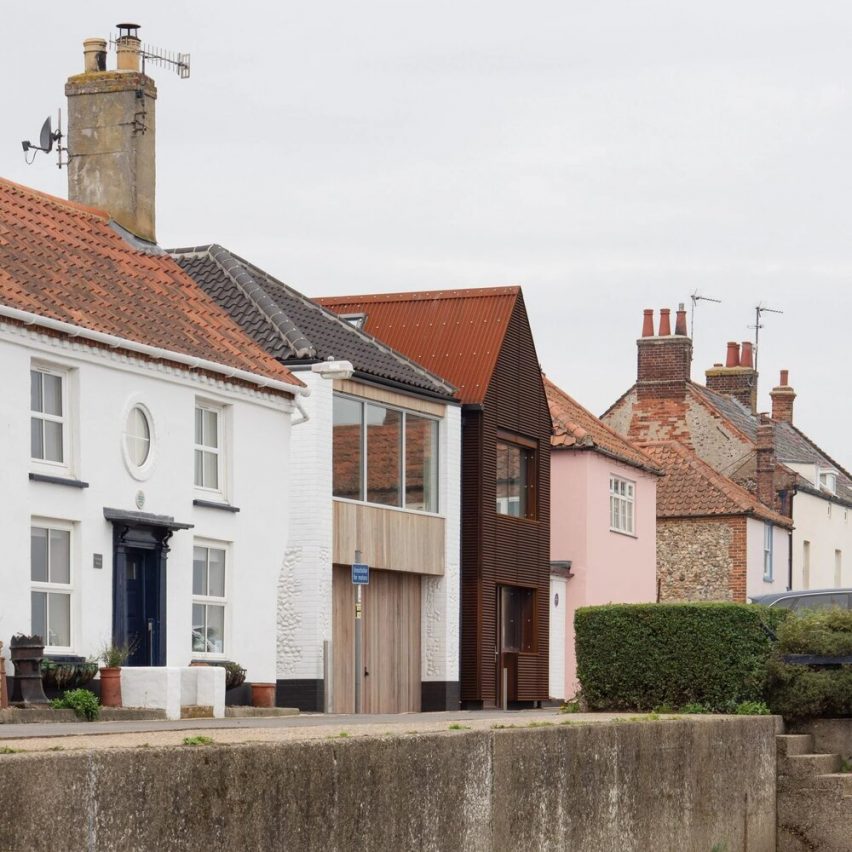
The latest edition of our Dezeen Weekly newsletter features a home at Wells-next-the-Sea in Norfolk that looks like an ad hoc cluster of buildings.

UK studio Mole Architects has created a house named Freeholders formed of three contrasting volumes on the coast at Wells-next-the-Sea, UK.

The studio designed the two-bedroom house to mimic the irregular clusters of cottages and terraces that characterise the conservation area in the north Norfolk seaside town.

Readers are impressed. One commenter said: "A new building that respects its surroundings"

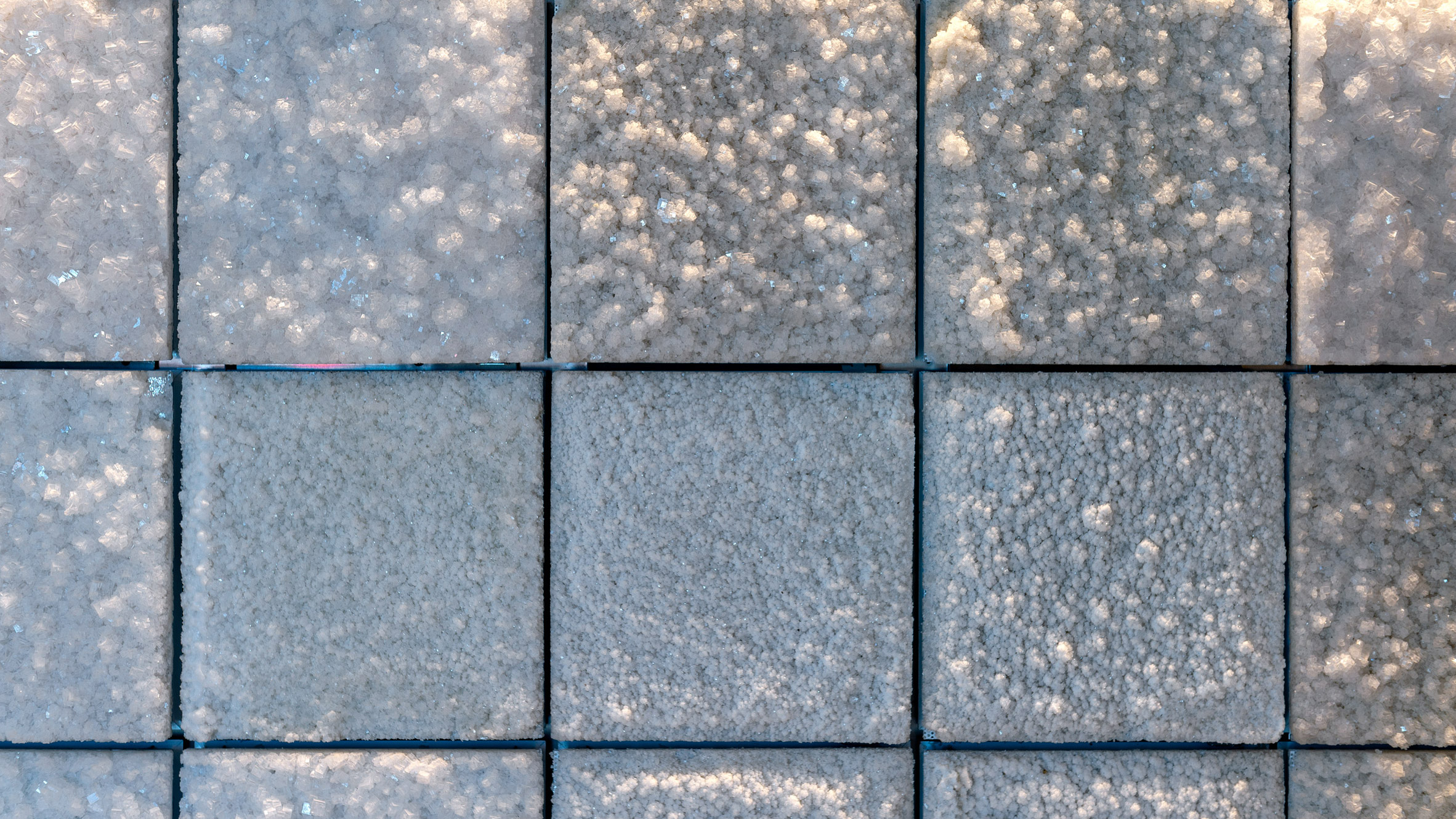
Salt panels in The Tower
Salt panels made using "only sun and wind" used to clad interior of Frank Gehry's Arles tower

Other stories in this week's newsletter include salt panels made using "only sun and wind", OMA's proposal for a mixed-use high-rise on Billionaire's Row in New York, and our roundup of ten homes in the Hamptons.

Subscribe to Dezeen Weekly

Dezeen Weekly is a curated newsletter that is sent every Thursday, containing highlights from Dezeen. Dezeen Weekly subscribers will also receive occasional updates about events, competitions and breaking news.

Read the latest edition of Dezeen Weekly. You can also subscribe to Dezeen Daily, our daily bulletin that contains every story published in the preceding 24 hours.

Subscribe to Dezeen Weekly ›

The post A "respectful" coastal home features in today's Dezeen Weekly newsletter appeared first on Dezeen.


from Dezeen https://ift.tt/3wCUKWx