Sunday, 25 July 2021

Estudio Herreros's Munch museum rises above Oslo’s waterfront

The building has a sloping form

Architecture firm Estudio Herreros has completed a 13-storey museum building dedicated to the work of artist Edvard Munch, which the studio claimed provides "a new reference point in Oslo's skyline".

Estudio Herreros building on the Oslo waterfront houses the world's largest collection of works by the artist best known for painting The Scream.
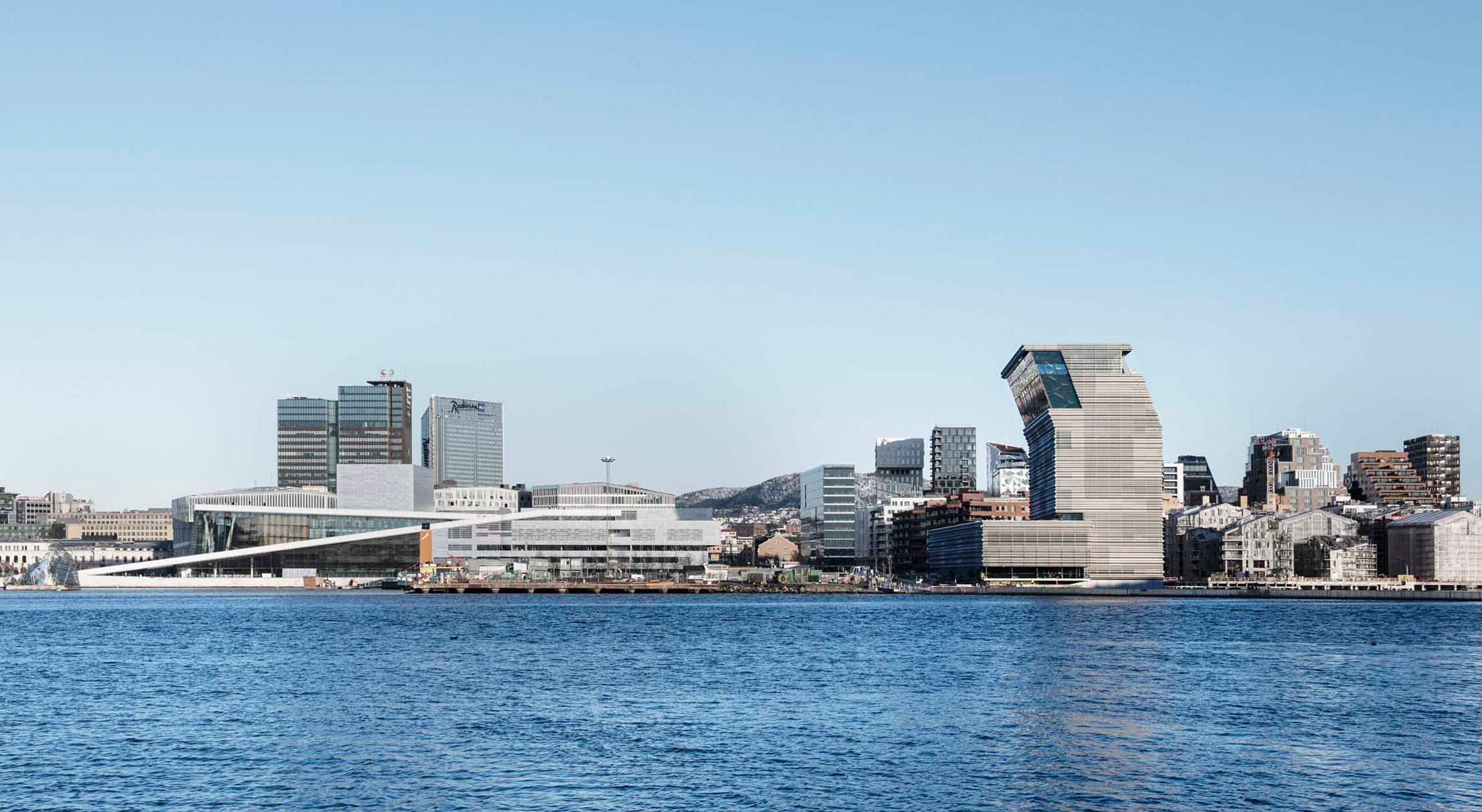
The munch museum is located on the water front
The museum occupies a prominent location on Oslo's waterfront

The Munch museum occupies a prominent site on the waterfront adjacent to the Oslo Opera House completed by Norwegian firm Snøhetta in 2008.

The building rises to a height of 57.4 metres above the shore and is five times larger than the original museum located in the Norwegian capital's Tøyen area.
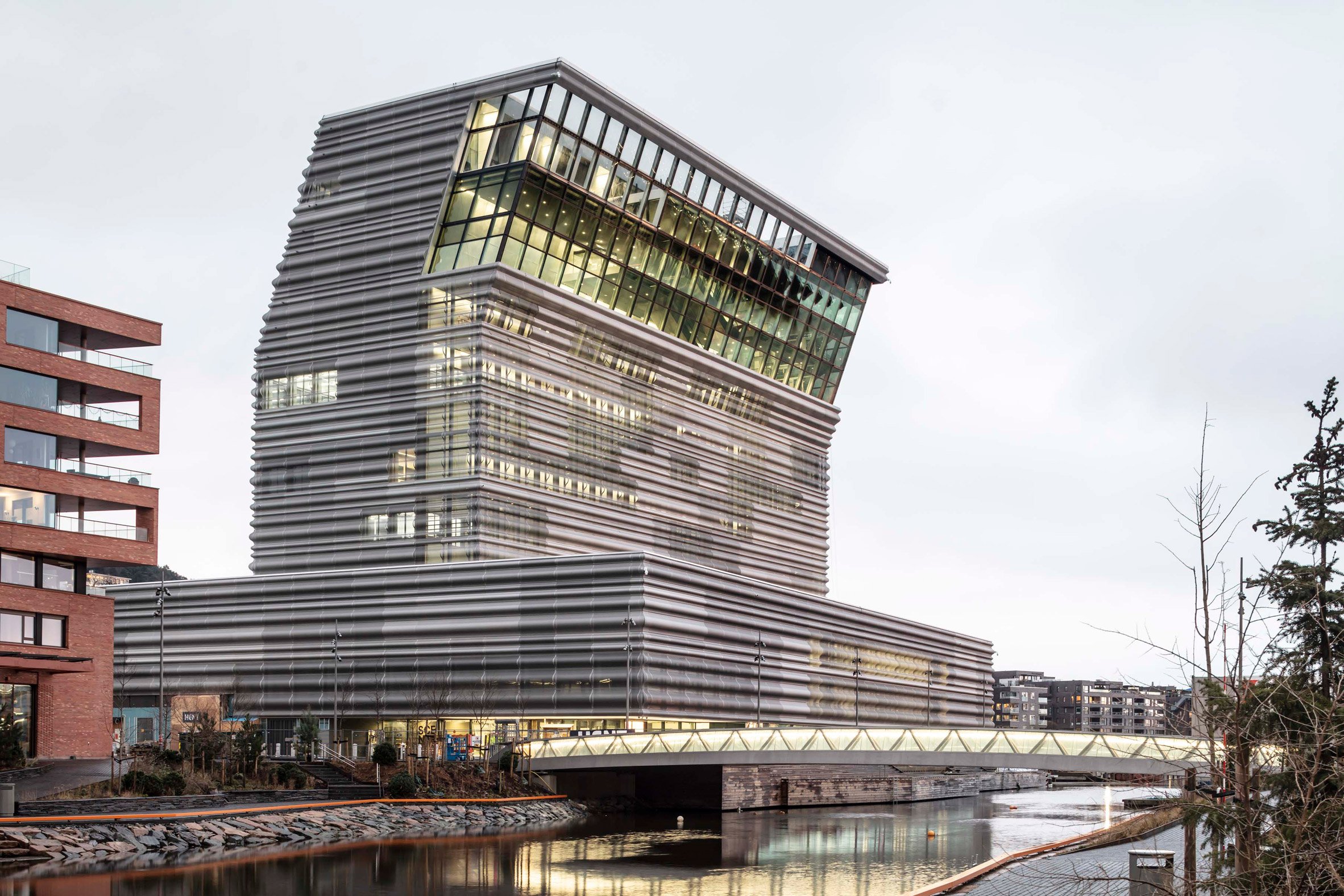
the munch museum has a square podium base
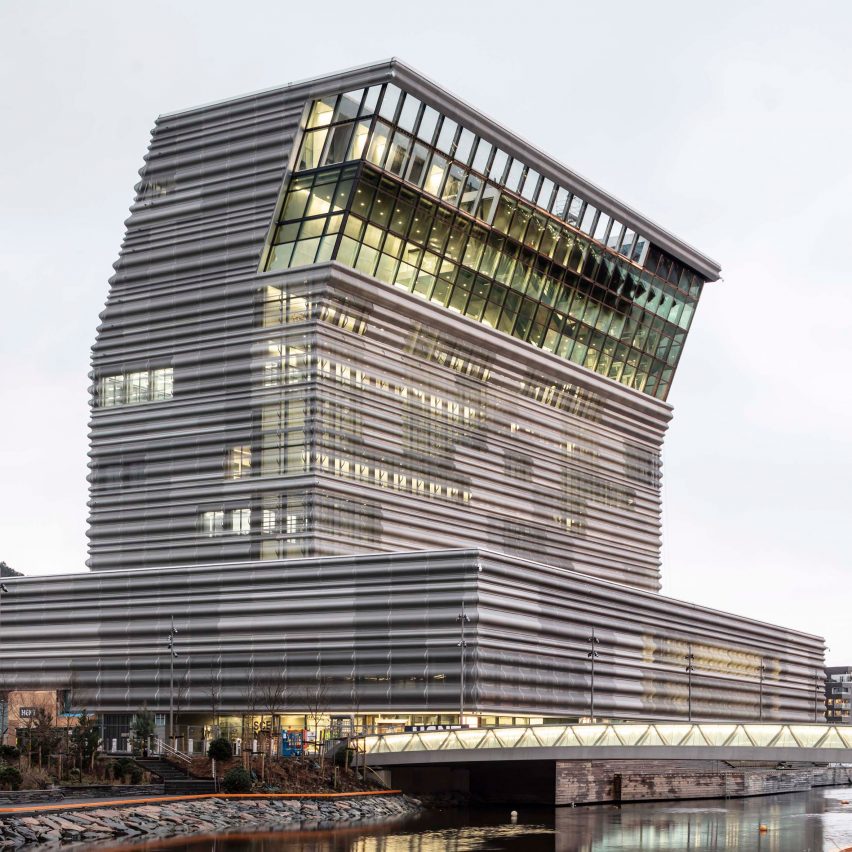
The museum has an angular form

The museum provides over 26,000 square metres of exhibition spaces across its 13 storeys, with the top floor containing an observation deck overlooking the city.

"Greeting people both day and night, Munch is a new reference point in Oslo's skyline that gives locals and visitors an overview and orientation within the city, the surrounding mountains and the Oslo fjord," said lead architect Juan Herreros.

The building's angular form appears to lean towards the nearby opera house and the historical city centre. The form is intended to present a welcoming gesture that invites visitors to enter at all times of the day.

A podium structure at the base contains a lobby that merges with the surrounding public space and anchors the building in the new Bjørvika neighbourhood.
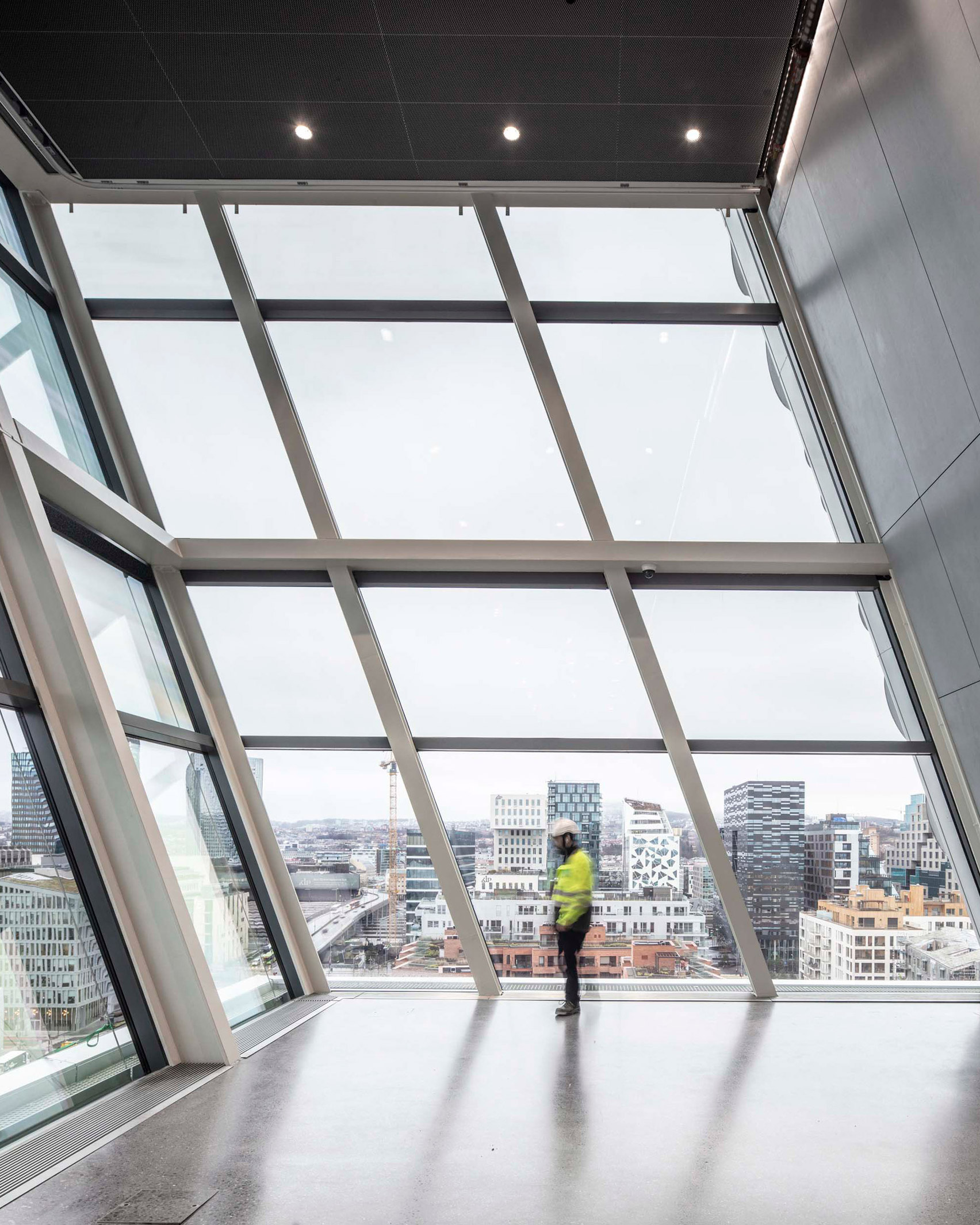
Windows are slanted at the munch museum
It has views across the city from the upper floors

The lobby contains recreational, commercial and cultural spaces that will be used for hosting events such as concerts, lectures or workshops for children.

The museum's main functions are organised by height, with vertical circulation guiding visitors from the lobby through the exhibition spaces and on towards the terraces, observation deck and restaurant on the top floor.

"The new Munch proposes to experience art within a broader set of public spaces and social experiences," said Estudio Herreros.

"It will be an extension of the public urban space in Bjørvika, inviting everybody to enter and transforming the museum into an everyday life facility."
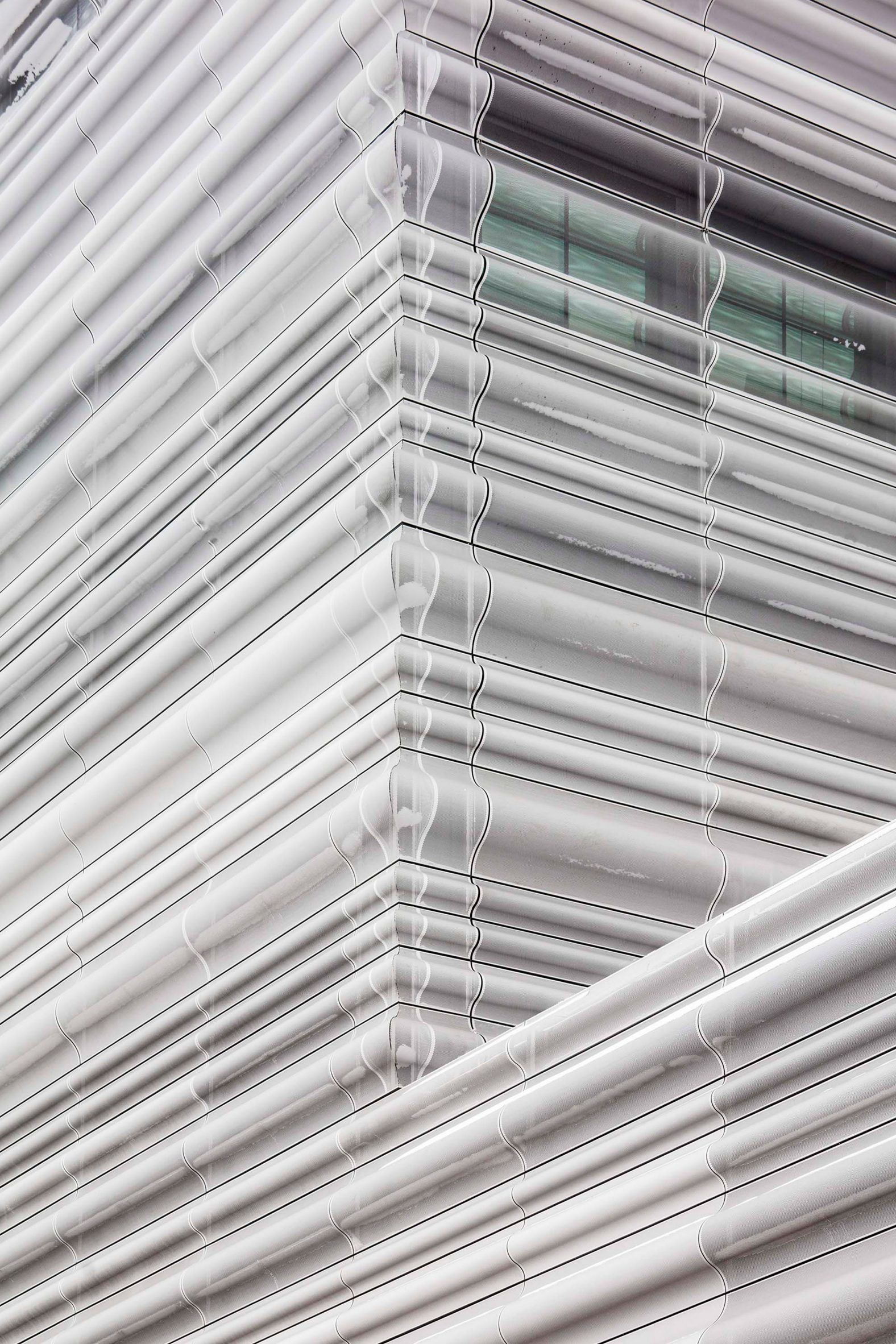
The munch museum is clad in a translucent material
The facade has a rippled effect

Alongside the extensive exhibits dedicated to Munch's oeuvre, the museum will contain spaces outlining the history of Oslo throughout the centuries. Different viewpoints on each level will express the connection between the artist and his native city.

Gallery spaces are designed to display artworks of vastly different scales. The 11 exhibition halls include intimate rooms for presenting smaller works on paper, while enormous paintings such as the 11.5-metre-wide Alma Mater mural will be exhibited in galleries with ceiling heights of up to seven metres.

"The diversity of gallery spaces distributed over an even larger number of storeys allows for wide variations in ceiling heights and room sizes," the architecture studio added.

"The neutrality of the galleries and their integrated design enables optimum facilities to be allocated for both permanent and temporary exhibitions, giving all protagonism to the art."
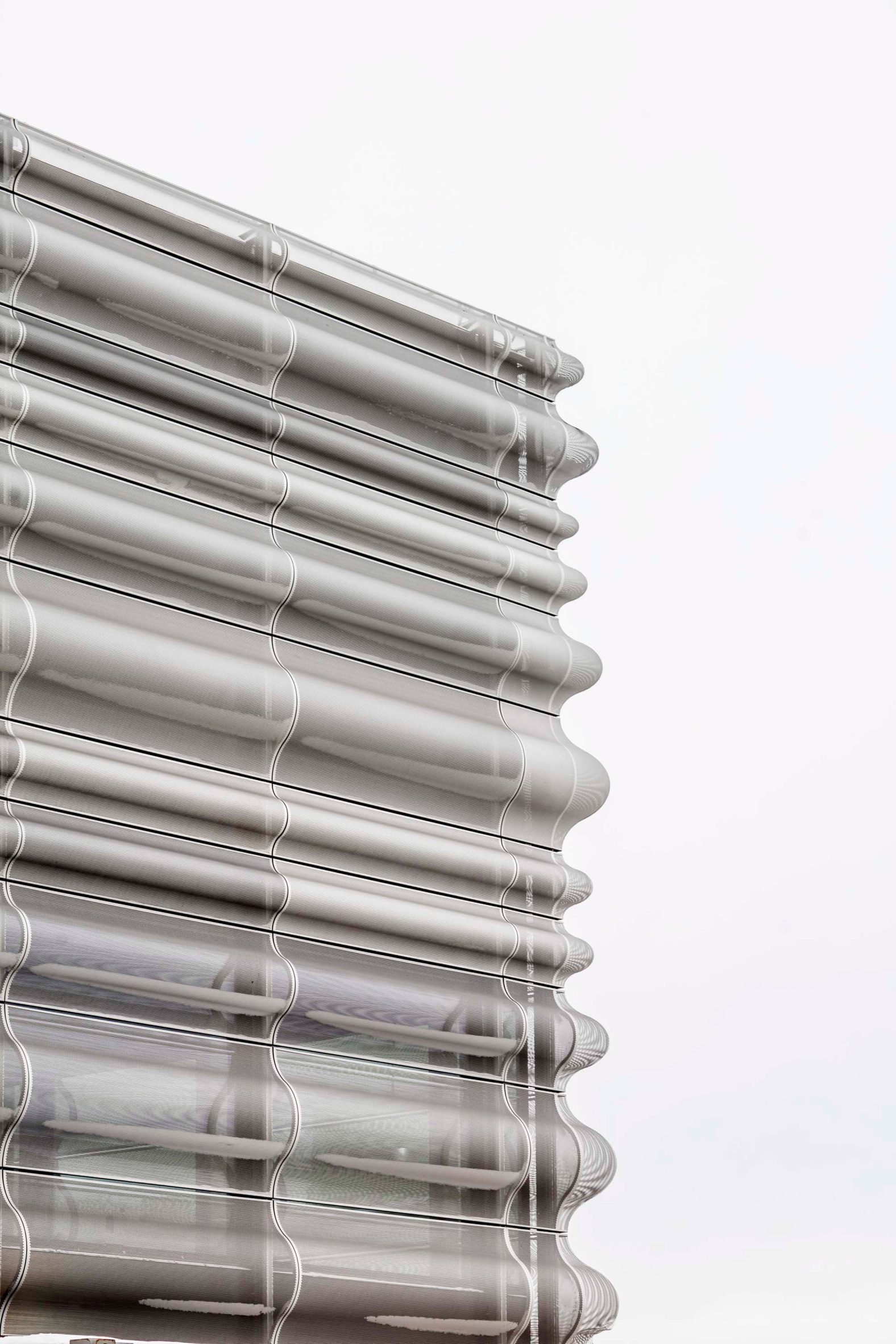
It has a grey hue
Undulating aluminium panels cover the building

The building is wrapped in a skin made from recycled, perforated aluminium panels with varying levels of transparency.

The metal surfaces reflect the shifting quality of light throughout the days and seasons, whilst allowing artificial light to filter through at night.

Recycled materials are used throughout the building, which is designed to meet Passivhaus standards for environmentally friendly construction along with low-energy heating and cooling.
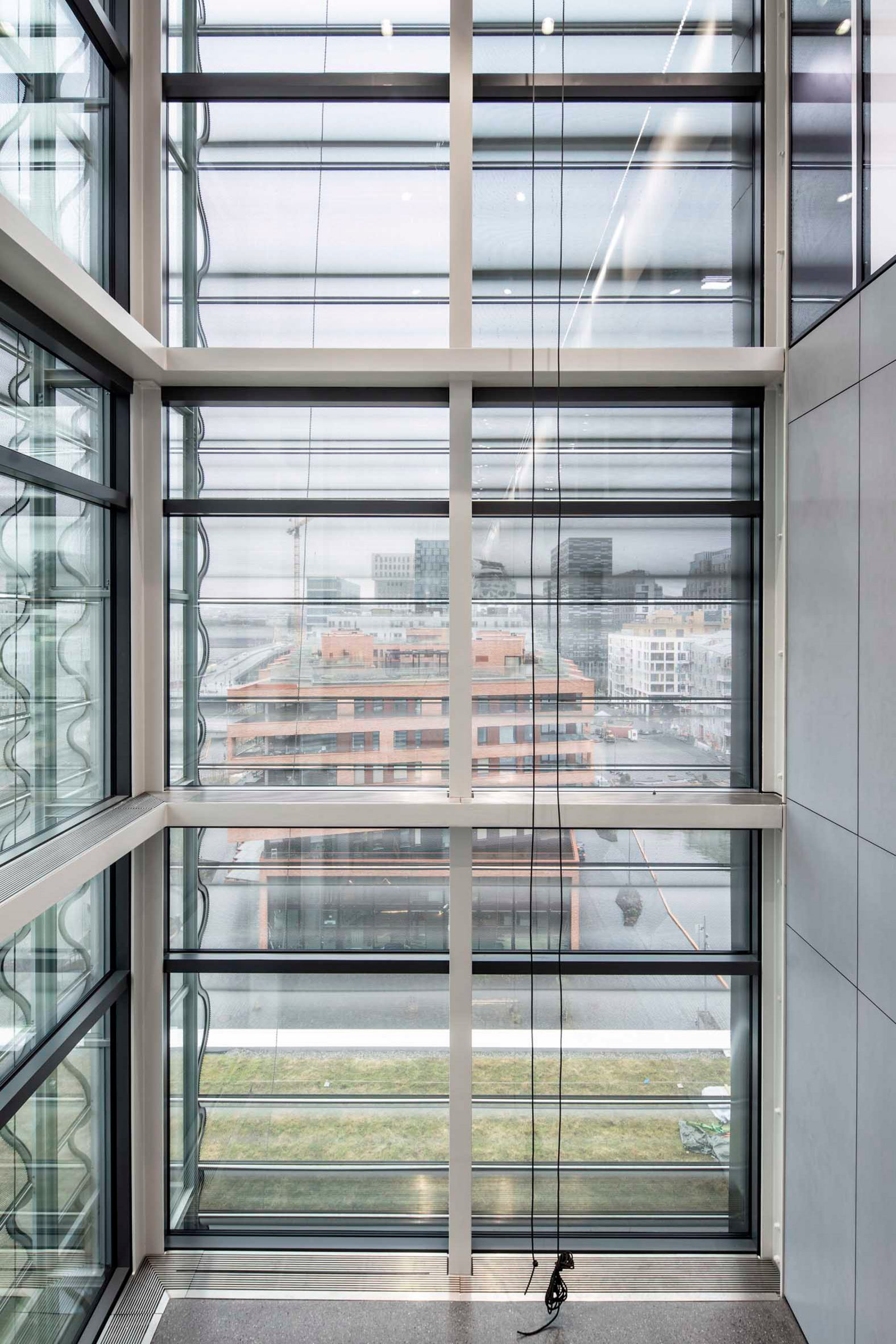
A view from the interior to the surroundings
From the interior the mesh is transparent

The Munch museum is scheduled to open to the public on 22 October 2021. Alongside Munch's artworks, it will host temporary exhibitions by both Norwegian and international artists influenced by Munch's work.

Estudio Herreros has offices in Madrid, New York City and Mexico City. Its founder, Juan Herreros, originally worked alongside Inaki Abalos in the 1980s before setting up Herreros Arquitectos. Herreros now runs the studio with partner Jens Richter.

Elsewhere in Oslo, Snøhetta recently unveiled plans to redesign and extend a museum dedicated to Norwegian explorer Thor Heyerdahl.

The post Estudio Herreros's Munch museum rises above Oslo’s waterfront appeared first on Dezeen.


from Dezeen https://ift.tt/3eToIPW

Ten cosy cabin bedrooms that are immersed in nature

Wood lined cabin bedroom

A bedroom built around a living tree and a sleeping area placed beside an openable polycarbonate wall are among ten cabin bedrooms selected from the Dezeen archive for our latest lookbook.

As cabins tend to have small footprints, their bedrooms have to be smartly designed to offer solutions to smaller and often open-plan spaces – without compromising on comfort.

These ten examples all make the most of the existing space while taking advantage of the surrounding views.

This is the latest roundup in our Dezeen Lookbooks series providing visual inspiration for the home. Previous lookbooks include verdant office interiors, mezzanines and interiors that use biomaterials.


Interior by the way we build

Forest cabin retreat, The Netherlands, by The Way We Build 

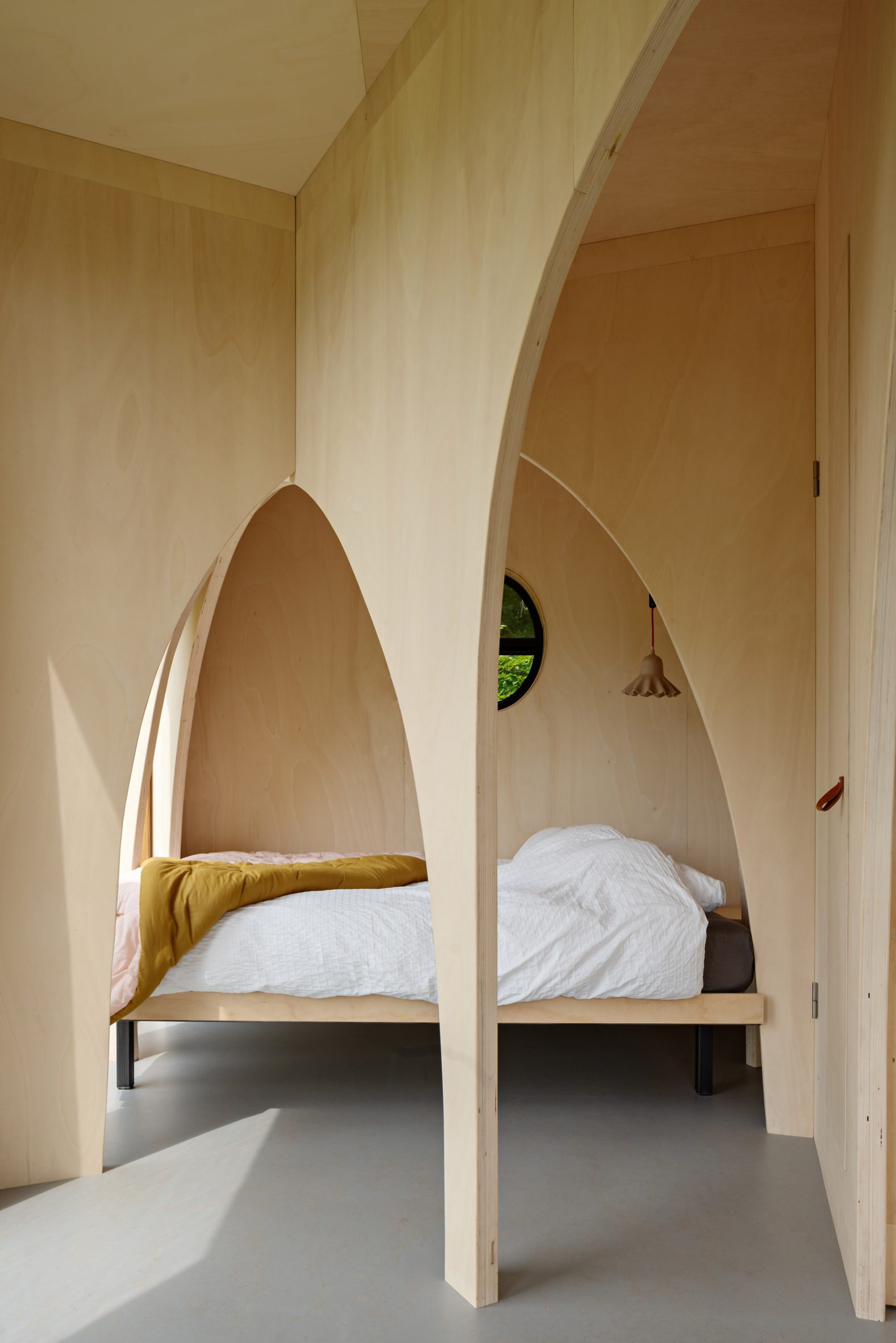
The interior of this Dutch cabin was constructed using a collection of poplar wooden arches that support the roof and add a playful domed look to the living space.

It has an open-plan living arrangement with a bed area nestled beneath an arched nook that forms an intimate, enclosed sleeping space.

Floor-to-ceiling windows line the walls of the structure and provide views out to the surrounding landscape between the arched cutouts.

Find out more about Forest cabin retreat ›


Barrel vaulted room by Valbæk Brørup Architects 

Vibo Tværveh, Denmark, by Valbæk Brørup Architects

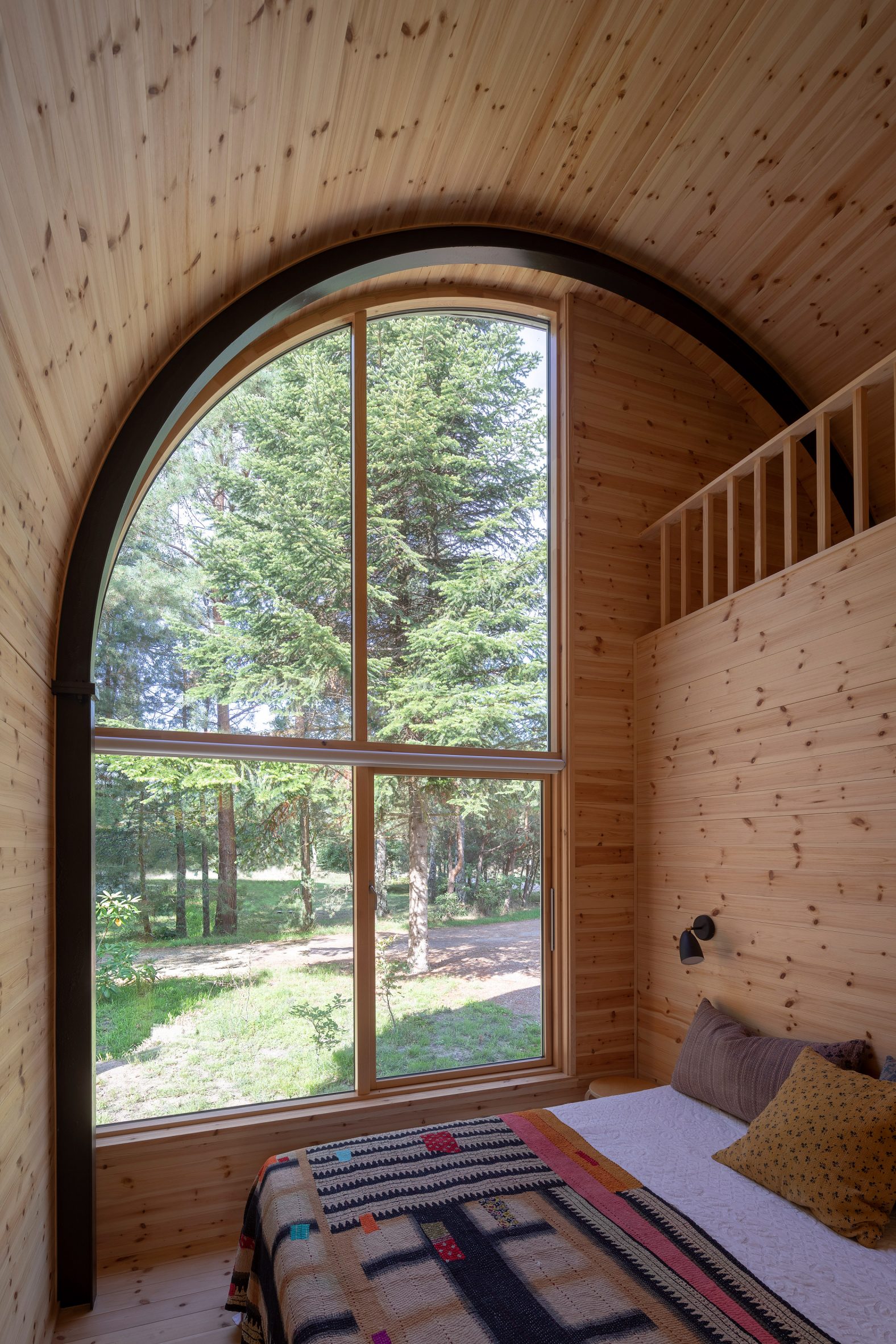
Valbæk Brørup Architects designed this cabin to echo an agricultural building. The interior is clad in pine and features three bedrooms – two built inside a wooden volume within the central space and the third at the rear of the cabin.

The primary bedroom sits beneath the cabin's barrel-vaulted ceiling and benefits from a full-height window that provides views out to the surrounding forest.

Find out more about Vibo Tværveh ›


Gable ended bedroom by studio puisto

Niliaitta, Finland, by Studio Puisto

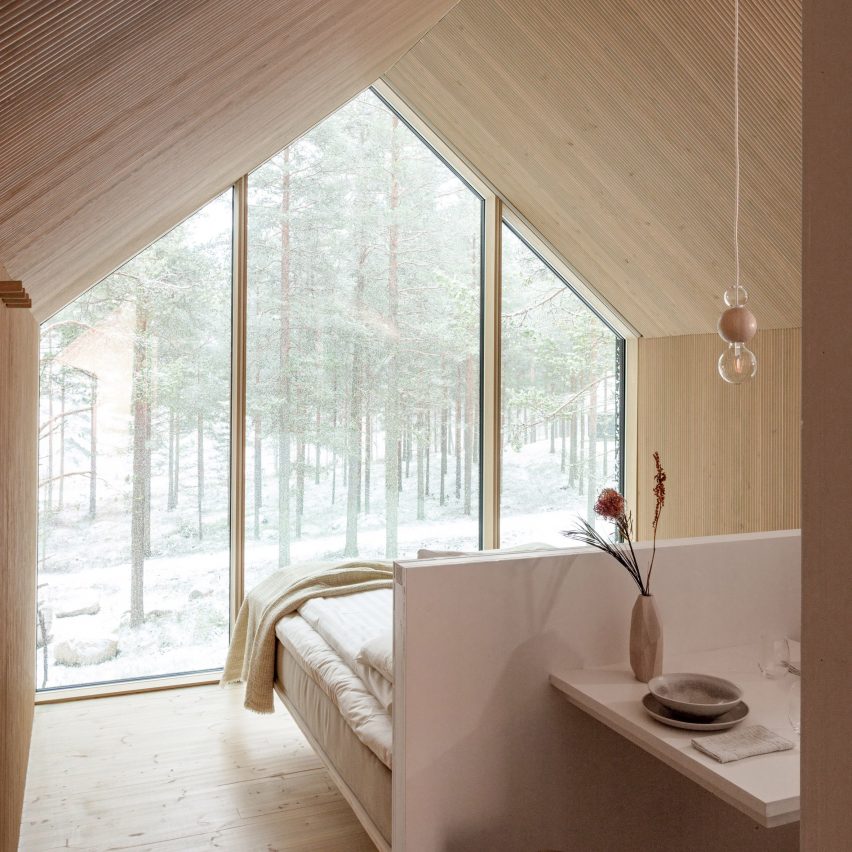
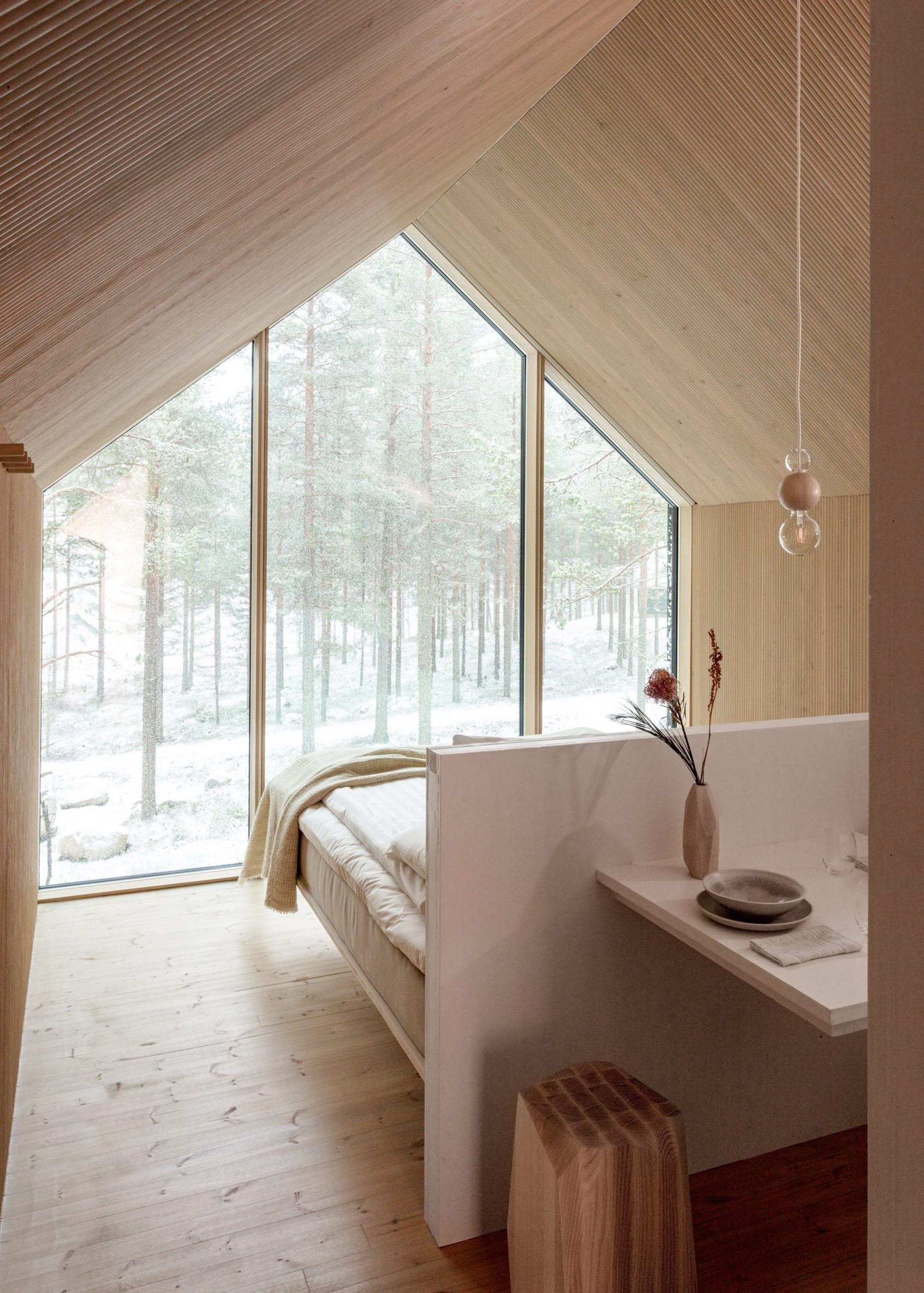
The bedroom at Niliaitta by Studio Puisto forms part of the open-plan living space. It occupies the largest floor area within the cabin and is positioned at the rear, facing a glazed gabled wall.

The interior boasts a high symmetry with amenities and the bed placed at the centre of the space. Its headboard doubles as a practical divider between the bed and a space-saving dining table for two.

Find out more about Niliaitta ›


room with moveable pegs by studio puisto

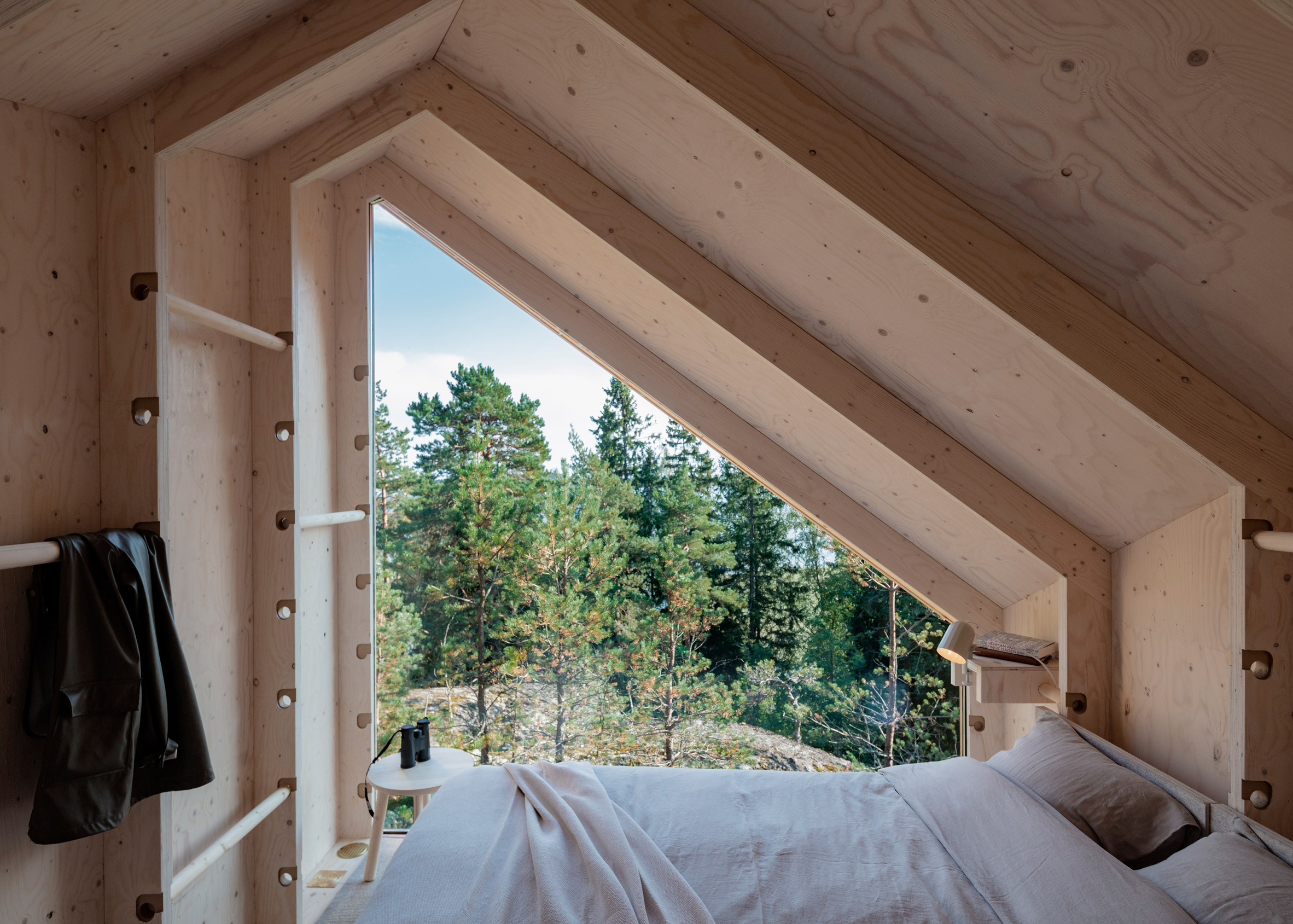
Space of Mind, Finland, by Studio Puisto

Built primarily to serve as an off-grid cabin hideout, this cabin was organised as a small studio. The sleeping area is arranged below the sloping roof in order to maximise the use of its tall ceiling height.

A large floor-to-ceiling window reflects the silhouette of the structure and forms an irregular quadrilateral across the side of the cabin, framing the exterior views. Wooden pegs line the walls and lock the furniture into place, allowing the space to be reorganised with ease.

Find out more about Space of Mind ›


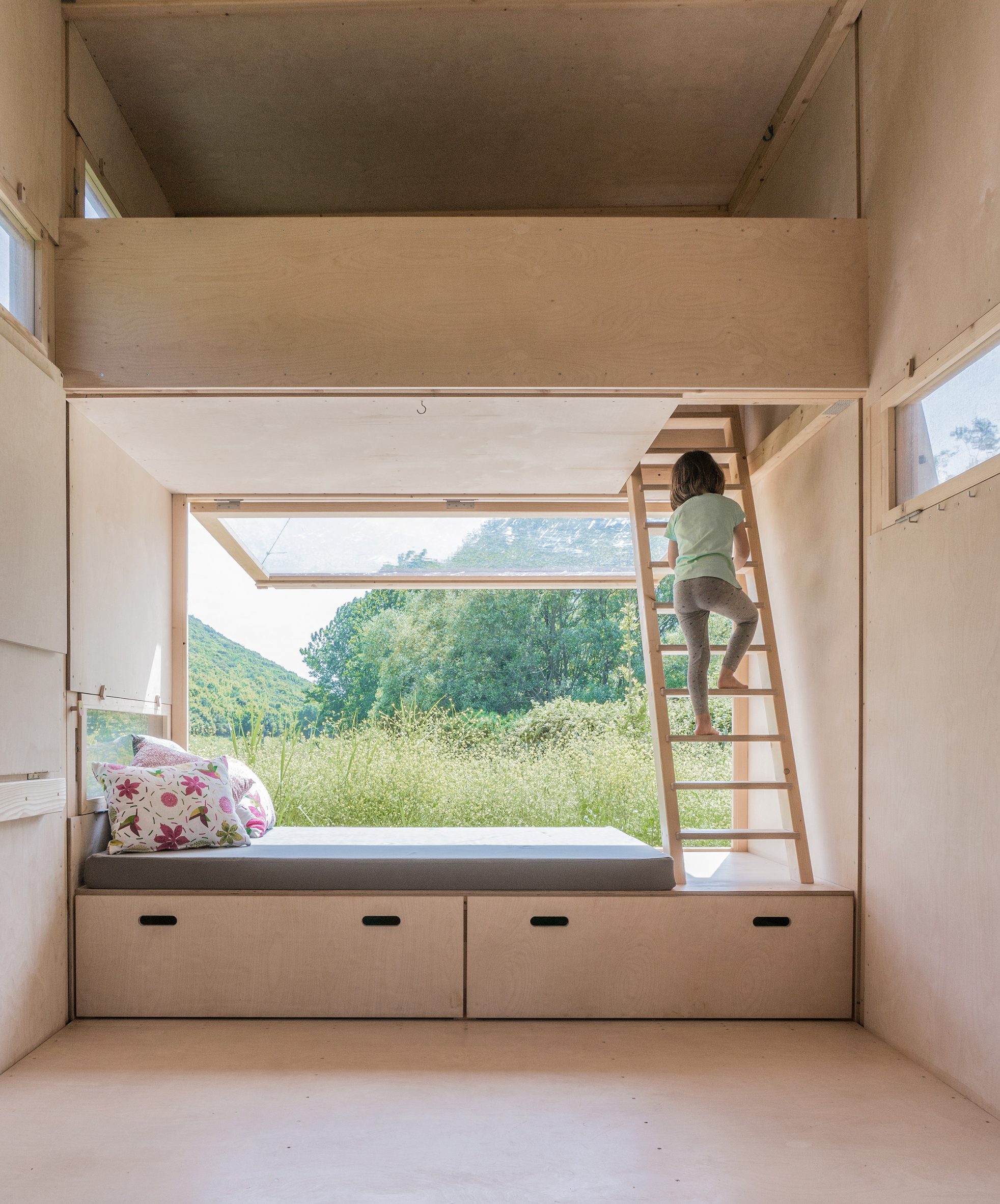
cabin bedroom with polycarbonate wall by so?

Cabin on the Border, Turkey, by SO?

Plywood covers the interior of Cabin on the Border, where a platform bed beside a polycarbonate window at one end of the space looks out to the surrounding meadow.

The polycarbonate panel can be raised and propped up using a pulley to let fresh air enter the space and create a sheltered extension of the living space.

Storage was fitted below the platform bed and a ladder beside it leads up to a mezzanine level containing a bed nestled beneath the ceiling.

Find out more about Cabin on the Border ›


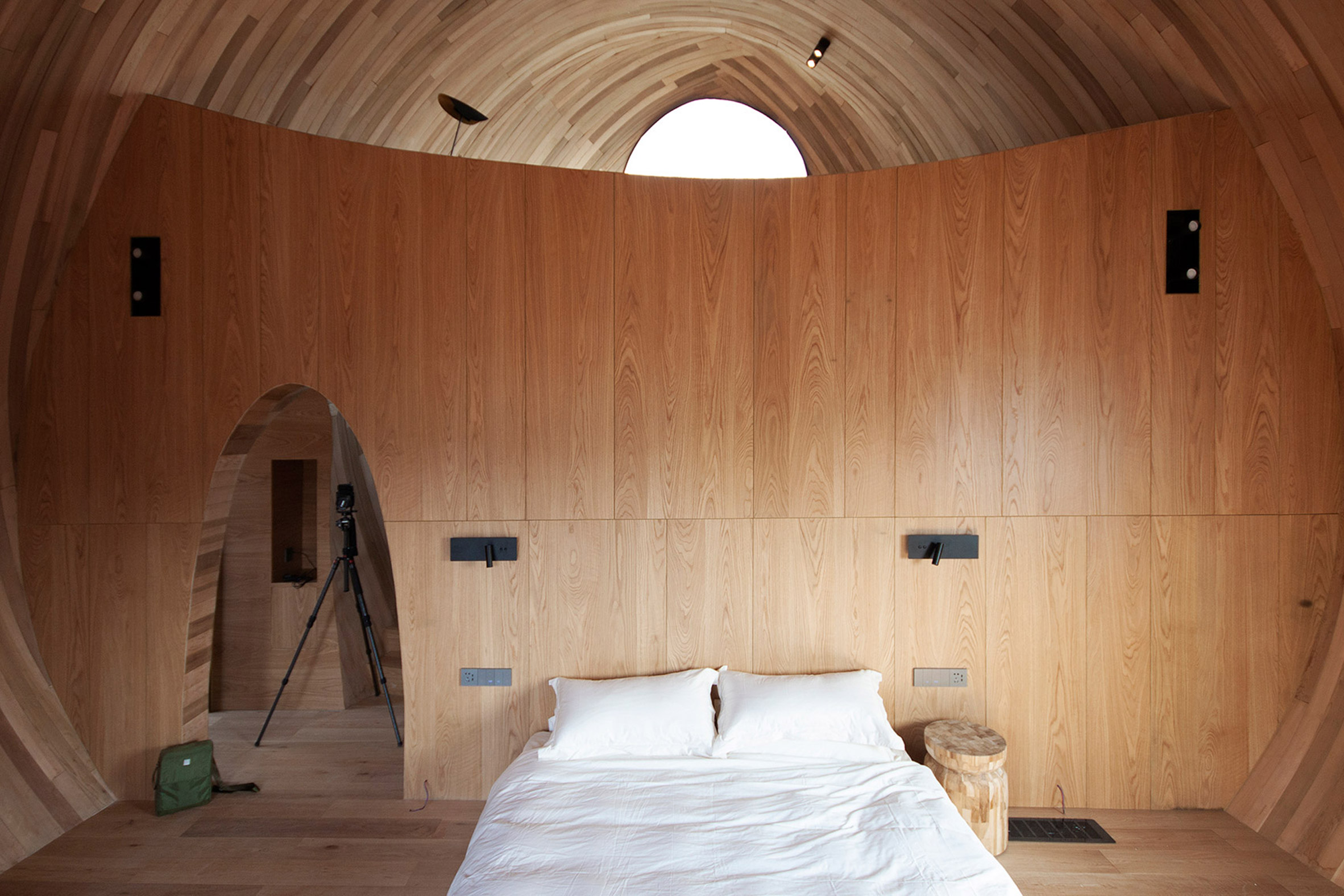
domed interior by ZJJZ Atelier

The Seeds, China, by ZJJZ Atelier

The Seeds are a collection of pods that were designed as individual hotel rooms and feature wood-clad domed interiors. A large curved wall divides the sweeping interior in two, with a sleeping area occupying half of the cabin.

A tapered arch leads between the two spaces and to the bedroom. The bed was placed against the curved wood wall and looks out to the surrounding forest through a large circular window.

Find out more about The Seeds ›


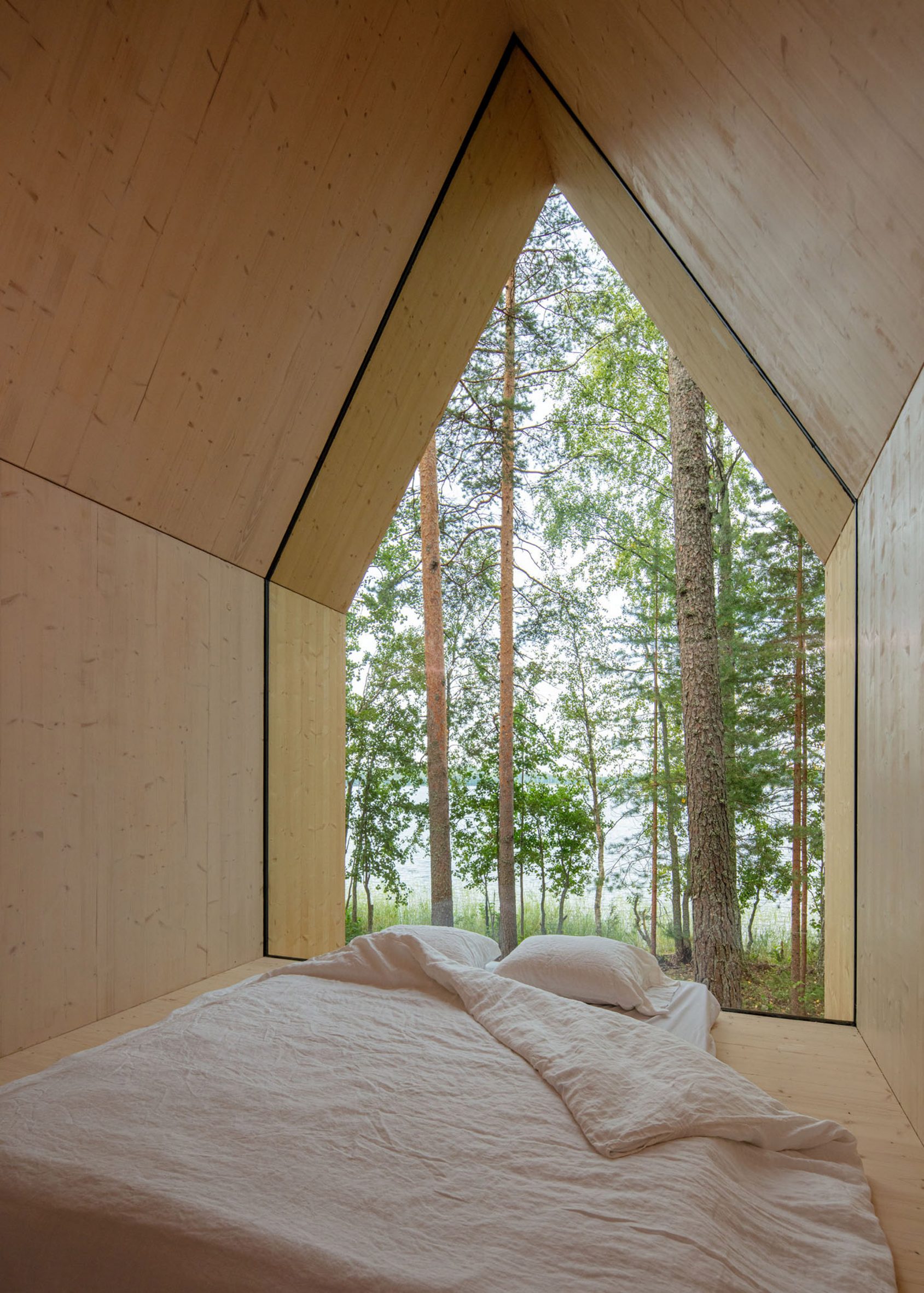
Glazed wall in the cabin bedroom by Ortraum Architects

Kynttilä, Finland, by Ortraum Architects

Set on Lake Saimaa in Finland, this woodland cabin built from cross-laminated timber (CLT) features a large glazed gabled end that looks out over the nearby water.

The sleeping area was placed at the rear of the cabin, with the bed set against the glazed wall and facing the interior of the cabin. An overhang at the end of the structure provides the interior with shade.

Find out more about Kynttilä ›


open plan bedroom by sigurd larsen

Løvtag cabin, Denmark, by Sigurd Larsen

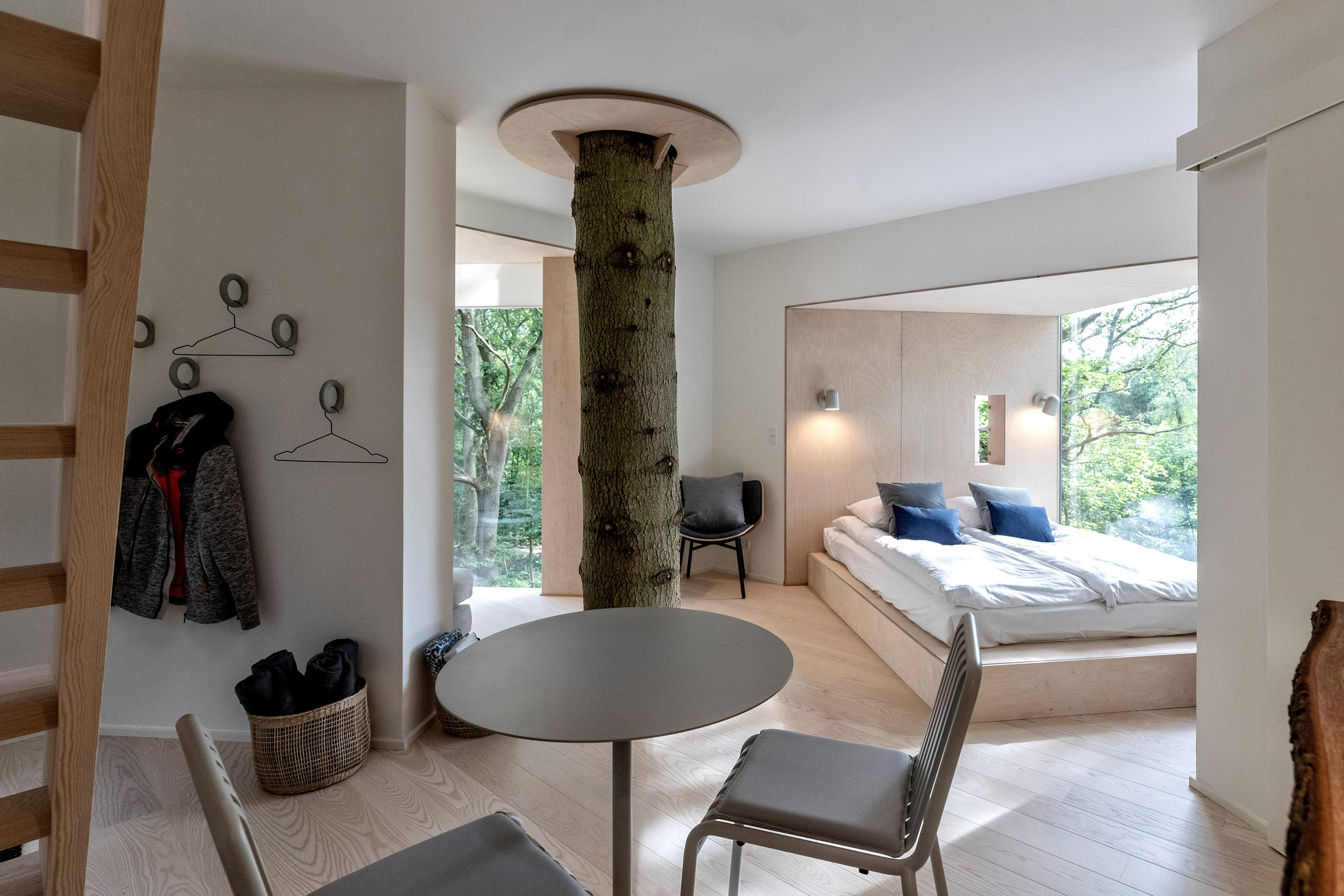
Built around an existing living tree, this tree-top cabin is one of nine structures designed by Sigurd Larsen for hotelier Løvtag.

The space offers an open-plan living arrangement, with a sleeping area that is arranged along one of its many angled walls.

Positioned beside full-height windows, the bed was built to fit the space and has a boxy, podium-like design. It is framed by large plywood panels that form a light-wood feature wall.

Find out more about Løvtag cabin ›


recycled cabin bedroom by studio les eerkes

Scavenger cabin, US, by Studio Les Eerkes

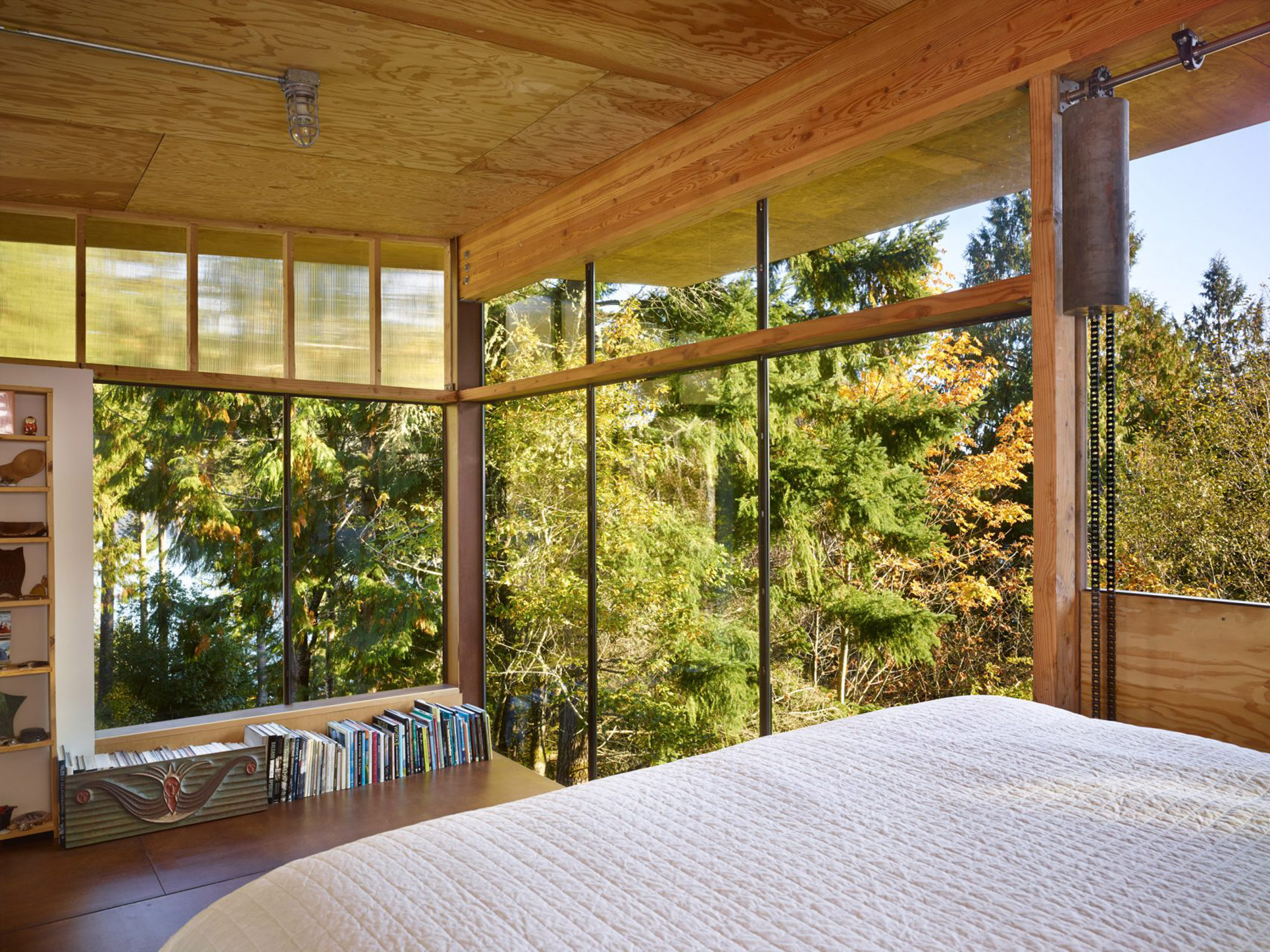
The Scavenger cabin was built by architecture practice Studio Les Eerkes, which used rescued plywood cladding from houses set to be bulldozed across its interior.

The bedroom is located on the upper floor of the cabin and is accessed by a steel staircase. Clerestory windows surround the top of the space and are joined by two glazed walls beneath. Wood panels and joinery fill the space and contrast against metal fixtures.

Find out more about Scavenger cabin ›


cabin overlooking the sea by Croxatto and Opazo Architects

La Loica and La Tagua, Chile, by Croxatto and Opazo Architects 

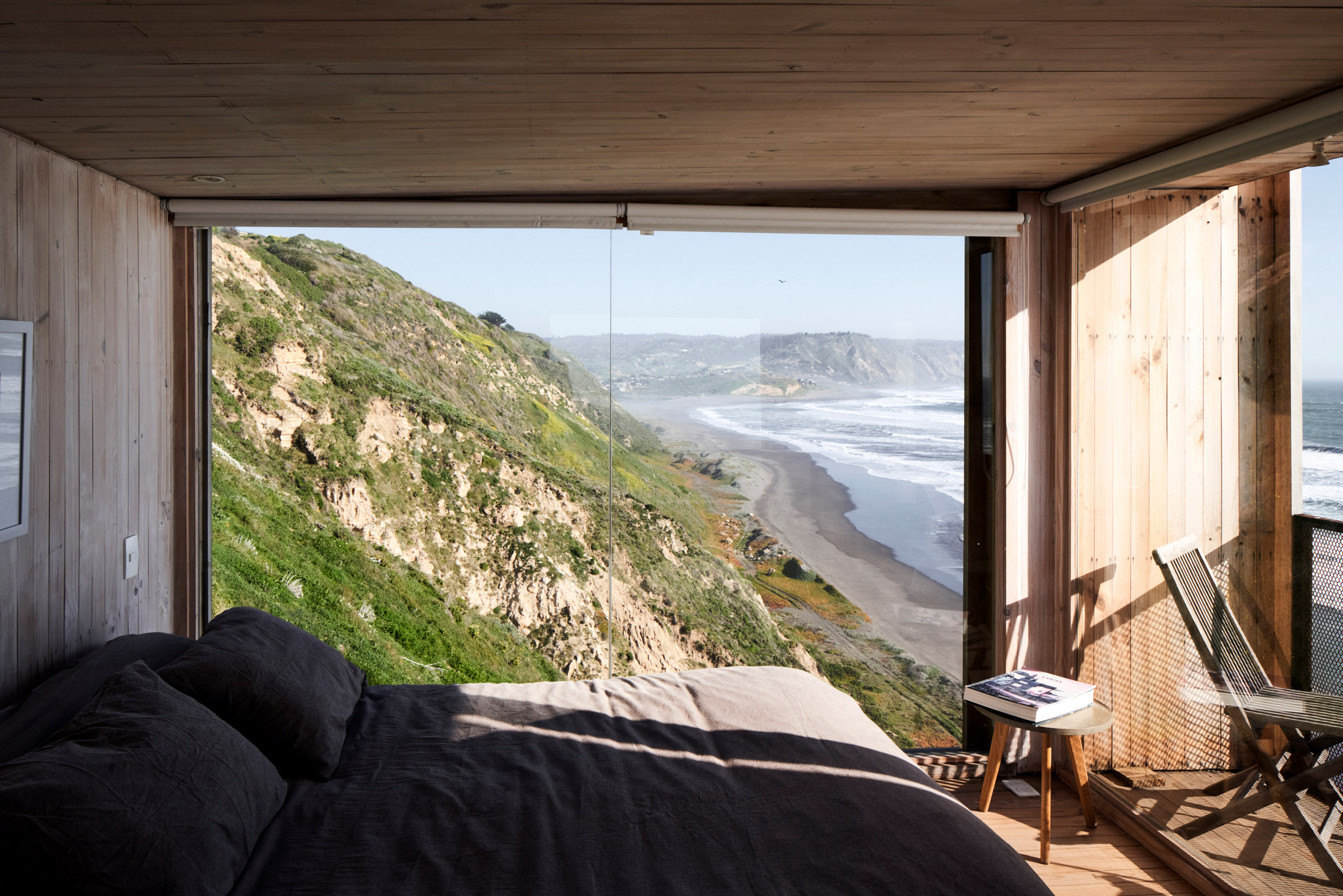
The bedroom in the La Tagua cabin in Chile is located on the upper levels of its double-height room, with sleeping areas accessed via a wooden ladder above the kitchen and bathroom.

A black perforated metal railing lines the edge of the mezzanine allowing light to dapple into the space below. Wood panels line the walls and ceiling of the bedroom, which also features glazed walls and a terrace that overlooks the cliffs and sea.

Find out more about La Loica and La Tagua ›


This is the latest in our series of lookbooks providing curated visual inspiration from Dezeen's image archive. For more inspiration see previous lookbooks showcasing U-shaped kitchenscalm living rooms and home working spaces.

The post Ten cosy cabin bedrooms that are immersed in nature appeared first on Dezeen.


from Dezeen https://ift.tt/2Vcc9s5

Saturday, 24 July 2021

Will Gamble Architects puts modern spin on Victorian details with T-House in London

Kitchen and dining room extension with skylight in T-House by Will Gamble Architects

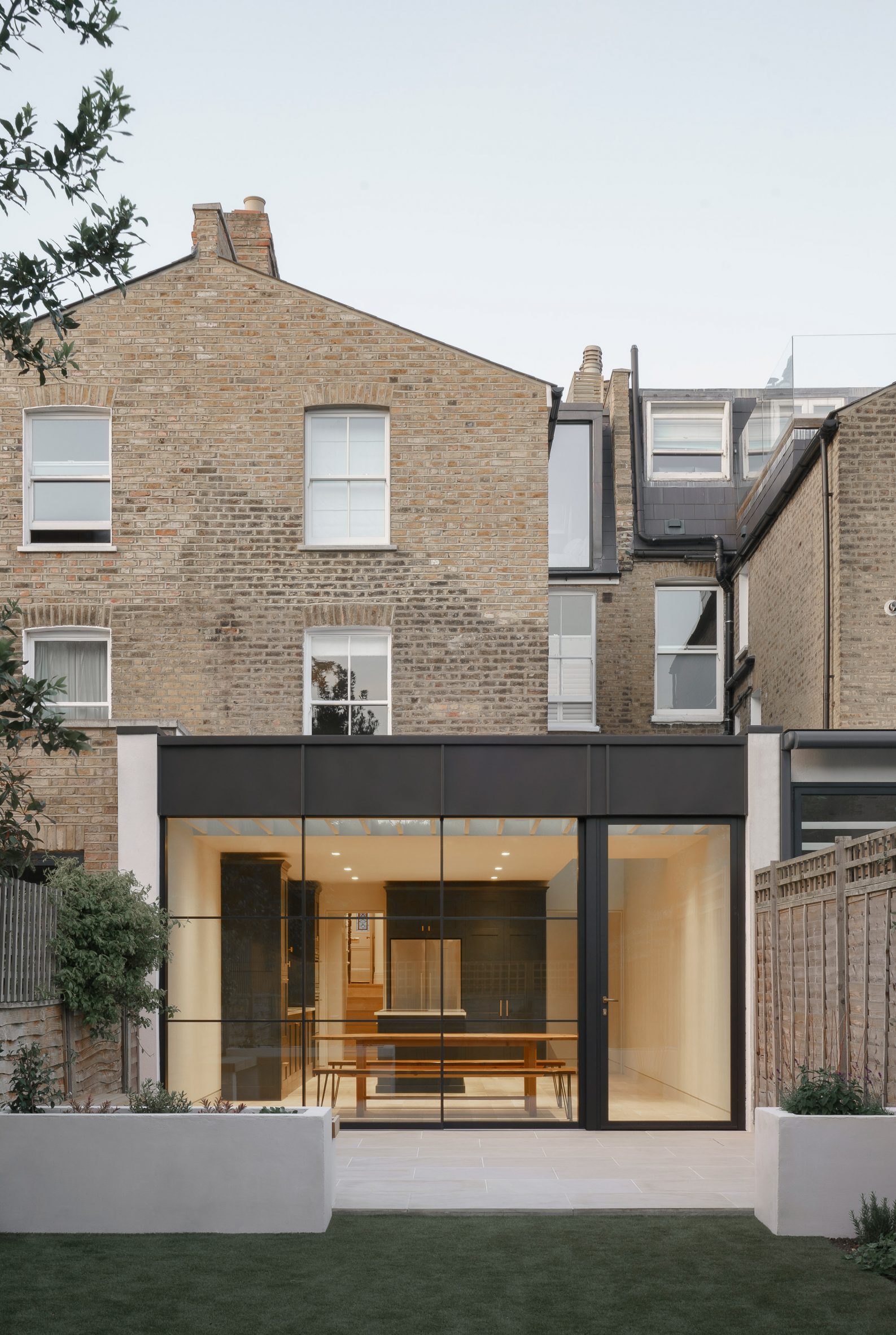
Will Gamble Architects has renovated and extended a Victorian house in south London, with details including casement-style glazing, skylights and a big pivoting door.

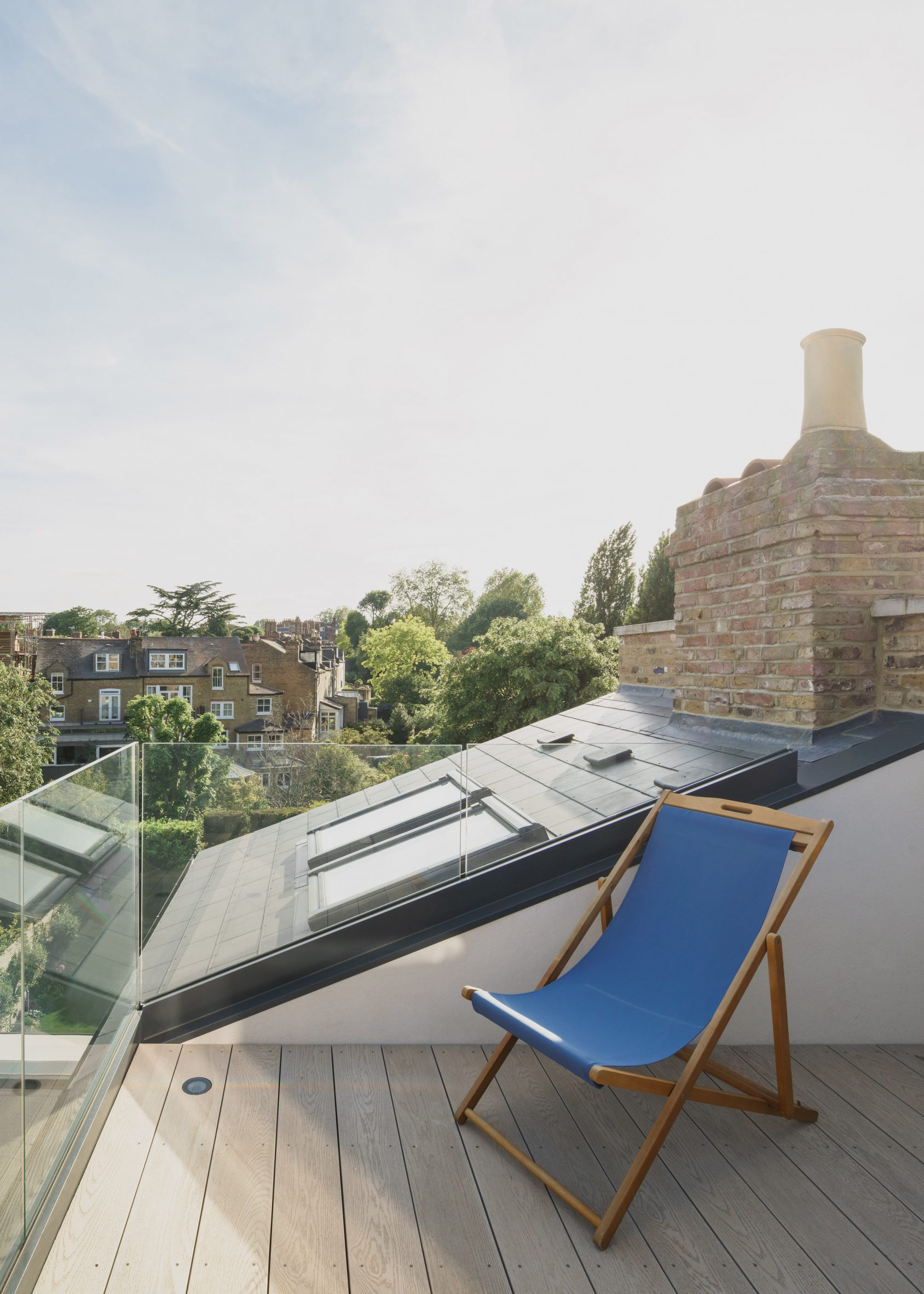
Called T-House, the renovation project involved expanding the ground floor of the Victorian terrace to create a more modern kitchen and dining room, adding a new second storey by converting the loft and extending over the rear first-floor bedroom, and adding a small roof terrace.

Rear facade and garden of T-House by Will Gamble Architects
The project involved extensions on the ground floor and second storey

While the clients had originally envisioned a fairly traditional period renovation, studio founder Will Gamble persuaded the young couple to be more adventurous.

"We felt that this aesthetic didn't maximise the potential of the house," Gamble told Dezeen, "so we tried to convince the clients to embrace a more contemporary aesthetic, while still respecting the existing architecture."

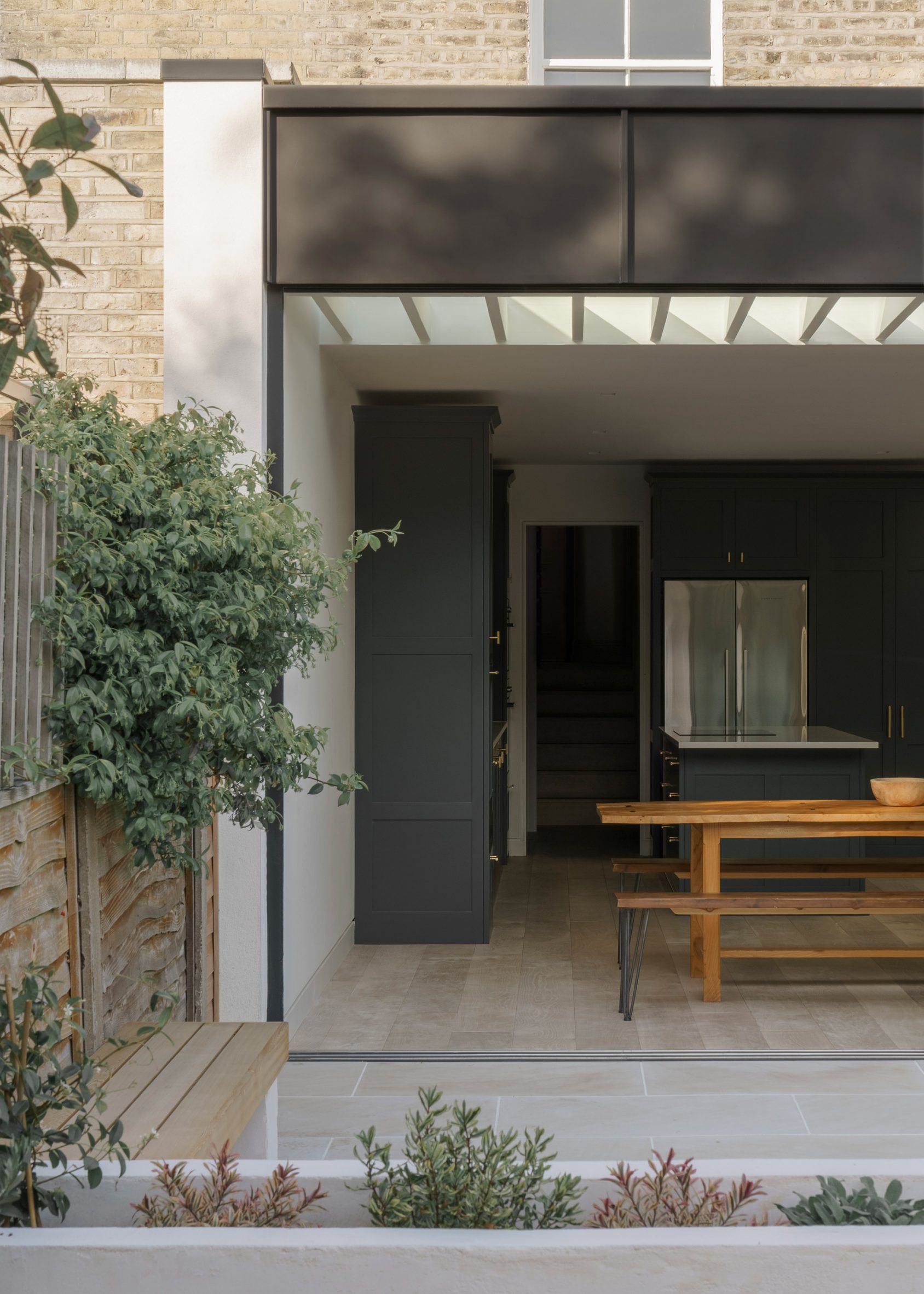
Elevation detail looking into kitchen, T-House by Will Gamble Architects
Victorian and contemporary details are blended throughout T-House

"Eventually the clients embraced this principle and it became the driving force behind the entire design process, a fusion of contemporary and traditional design that complement one another," he said.

The result is a scheme that combines Victorian period details with more minimalist elements, and also features a range of sophisticated colour tones.

Kitchen and dining room extension with skylight in T-House by Will Gamble Architects
The glazed rear elevation takes its cues from traditional casement windows

The ground floor extension is the most noticeable of the new additions, with its monochrome tones standing out against the building's original brickwork.

While the side walls are rendered in plaster, the garden elevation is defined by black zinc panels and a wall of gridded glazing. With its slender glazing bars, this window wall is designed as a contemporary version of a Victorian casement window.

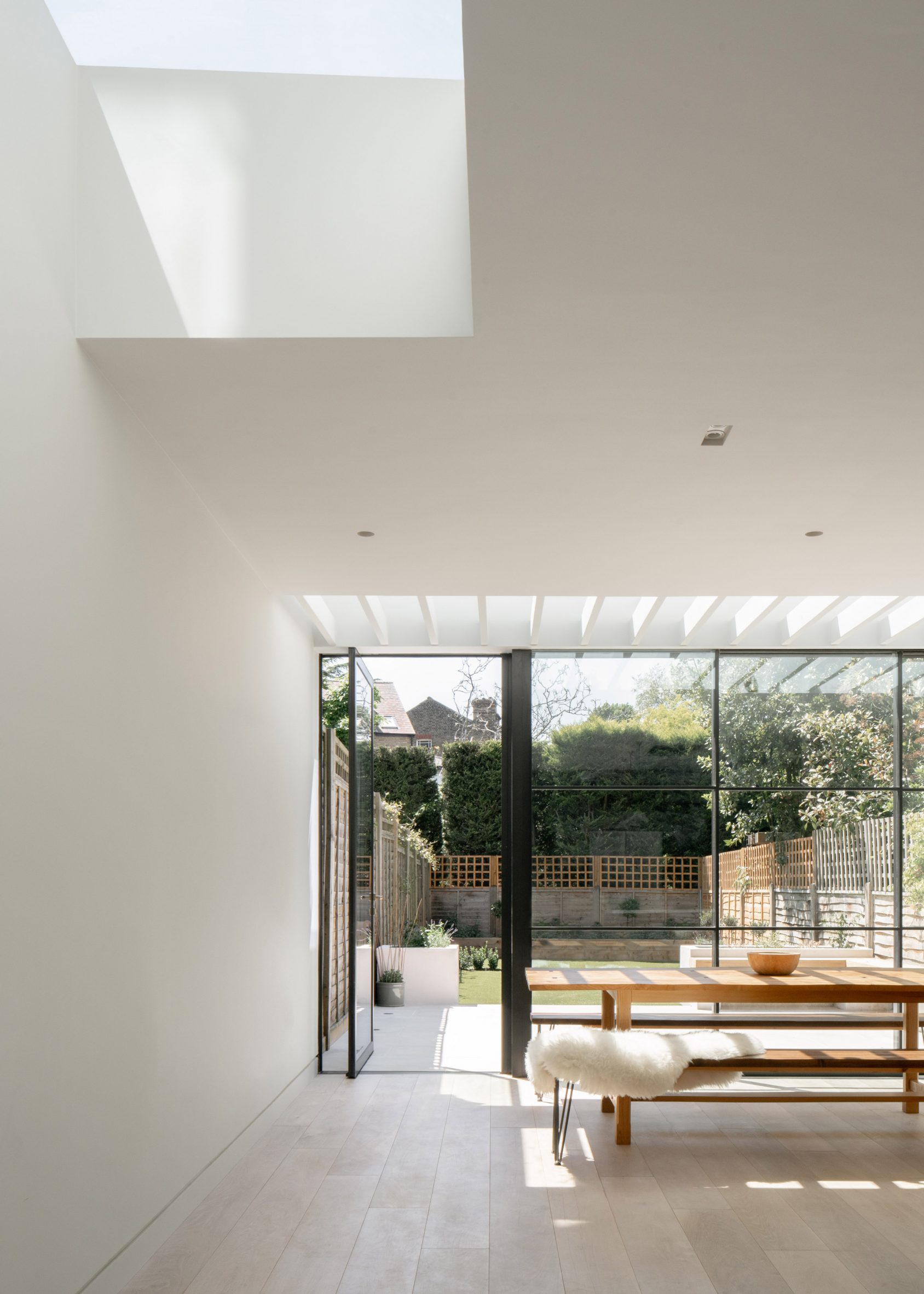
Skylights in T-House by Will Gamble Architects
Two skylights ensure plenty of light penetrates the kitchen and dining room

A large pivoting glass door is located on one side, to break up the uniformity of the glazing and provide access to the garden.

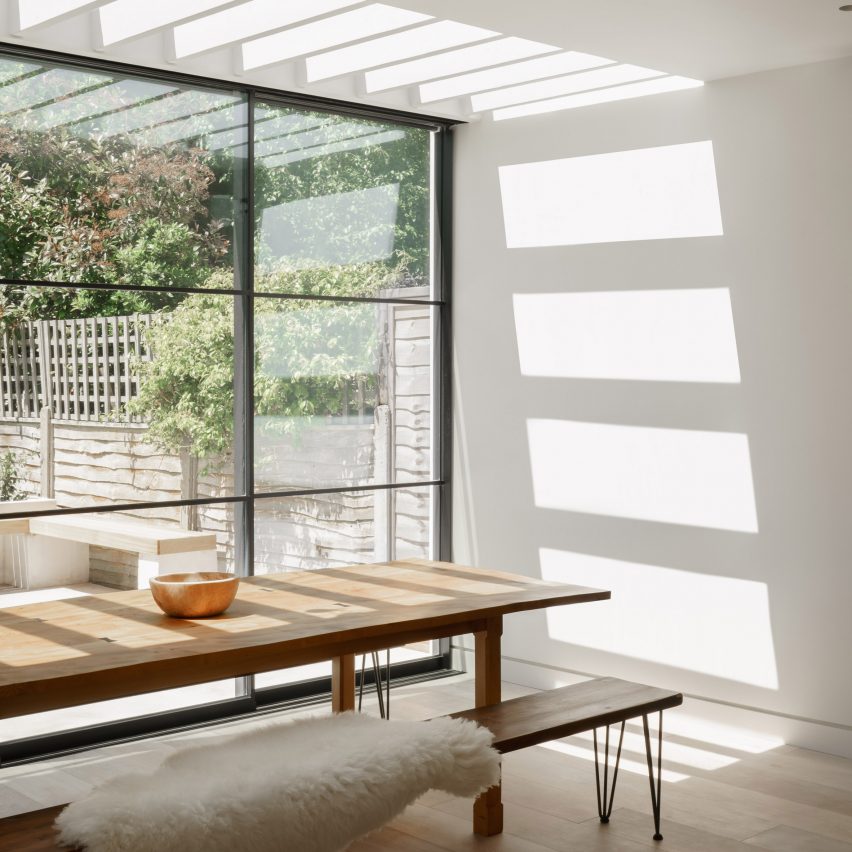
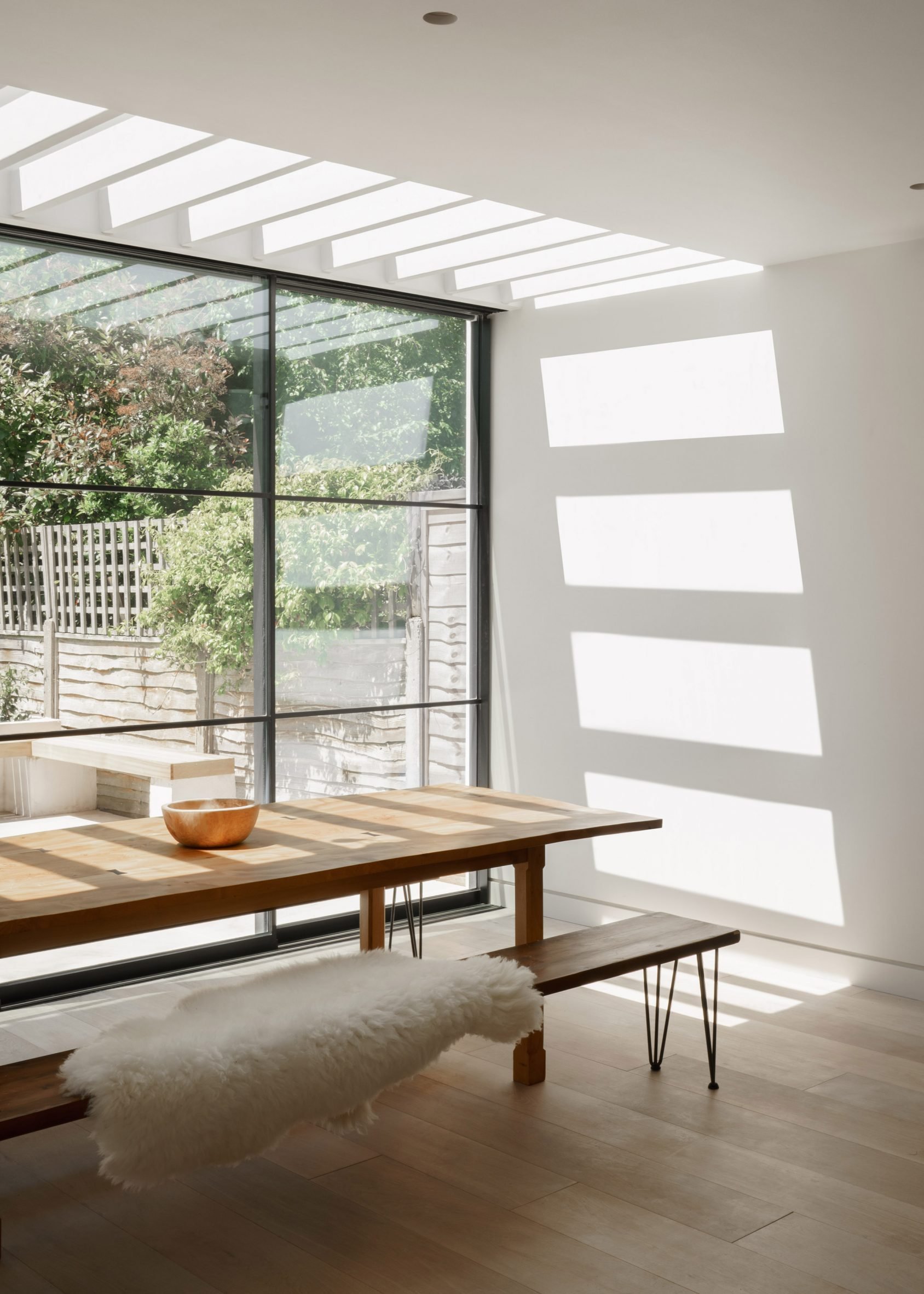
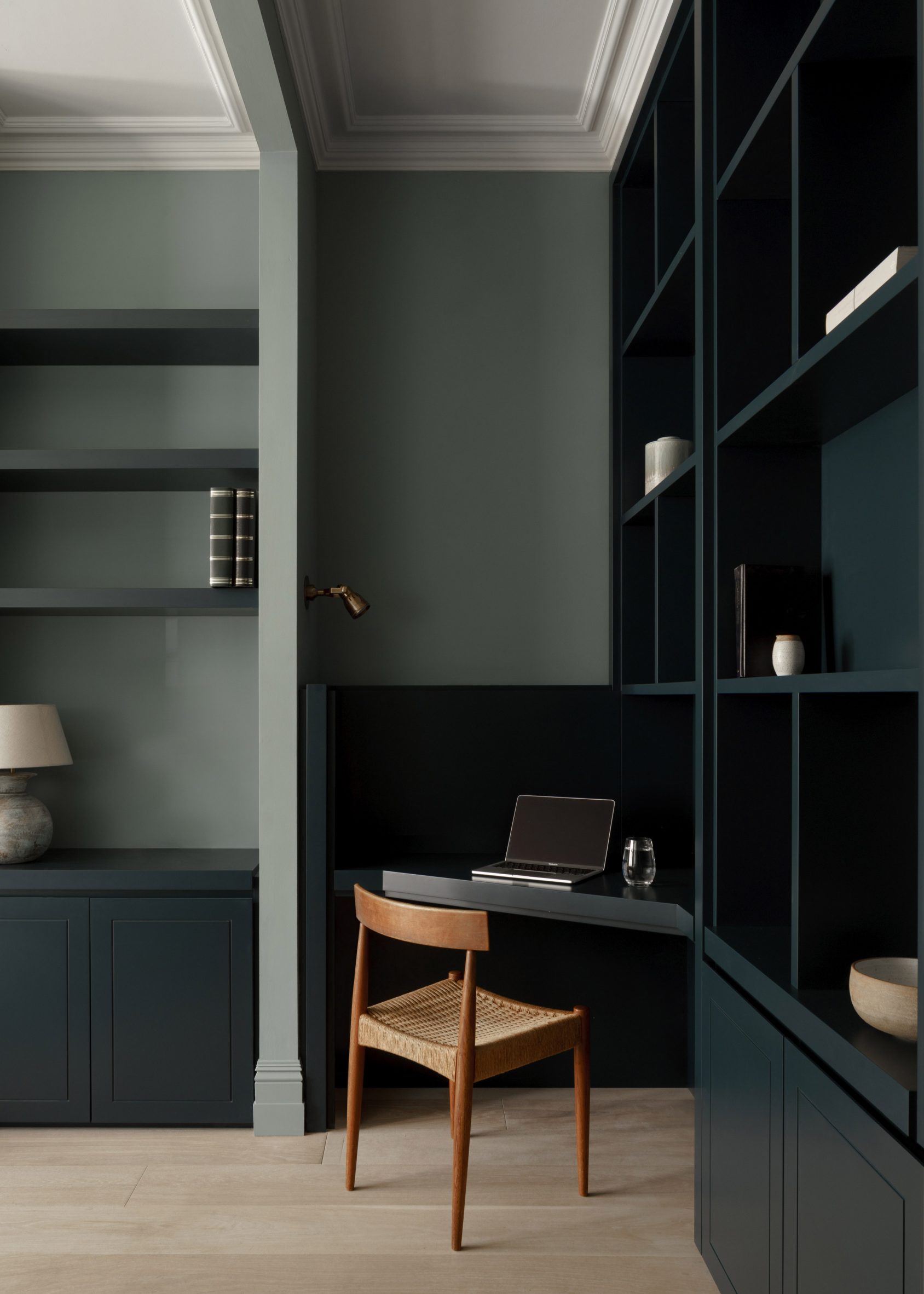
Inside, traditional-style kitchen cabinets are painted in a dark shade, yet the room feels open and bright as a result of two large skylights.

One of these skylights sits above a series of exposed roof beams, which creates dynamic patterns of light and shadow over the walls.

"As a result, the interior space is in a constant state of flux throughout the day," said Gamble.

Living room, T-House by Will Gamble Architects
Victorian mouldings were reinstated throughout the existing rooms

For the rest of the house, Victorian mouldings such as cornices were "painstakingly" reintroduced throughout as a mark of respect to the building's history.

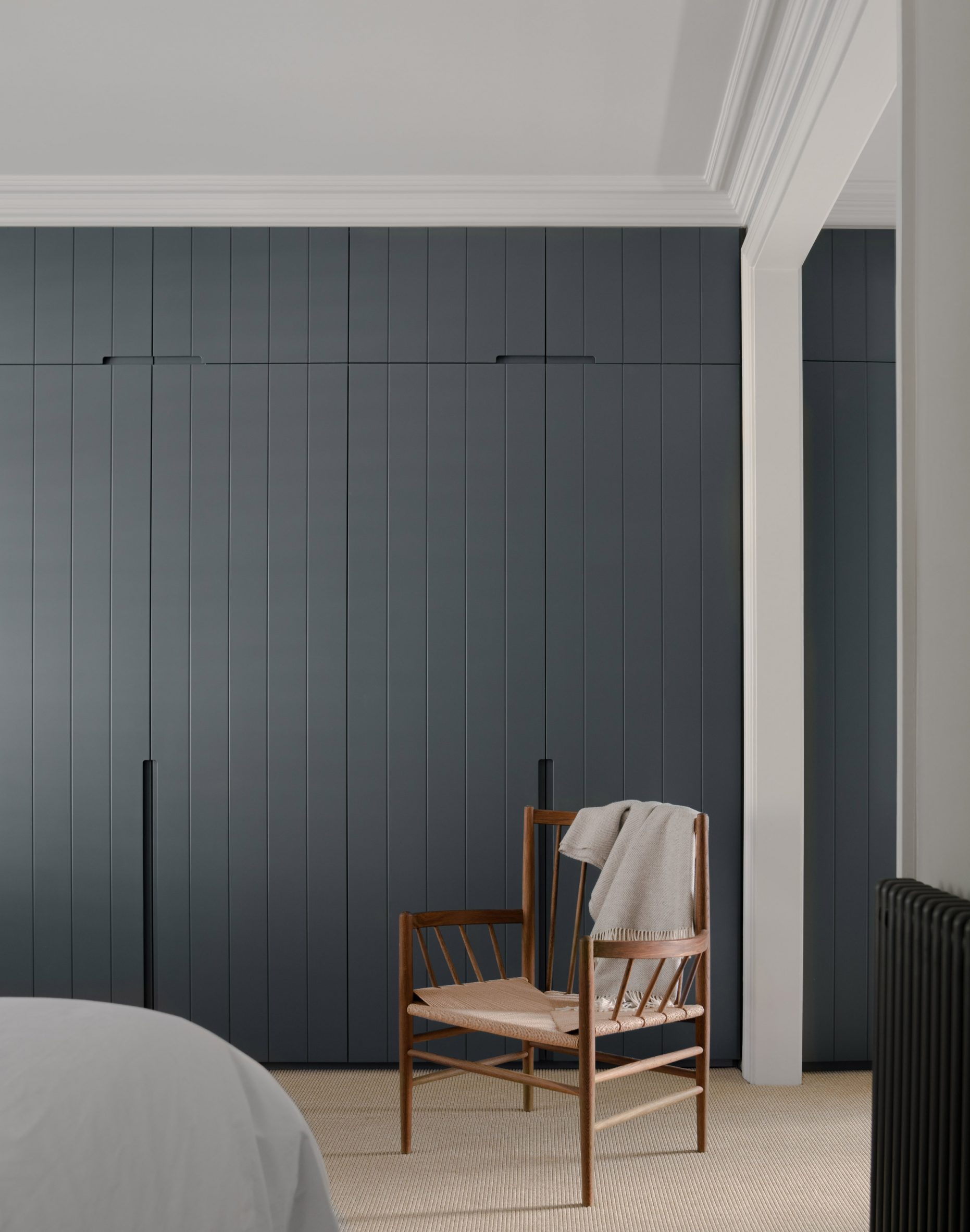
These are countered by modern joinery details, such as the built-in wardrobes that line the bedrooms and a storage bench installed in one of the bay windows.

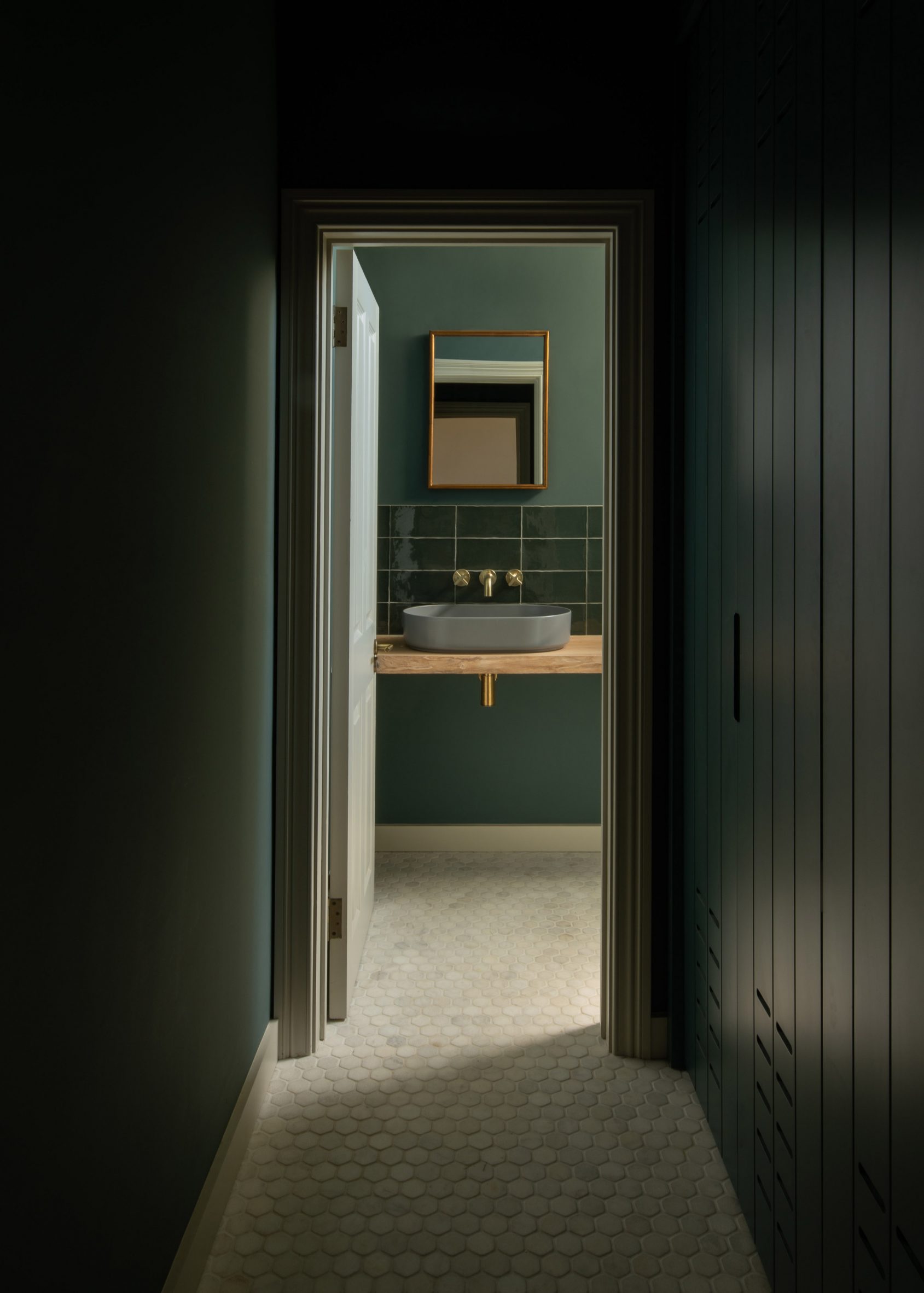
Hallway and bathroom, T-House by Will Gamble Architects
The colour scheme progresses from dark to light for different spaces

The colour scheme was also designed to emphasise the fusion of traditional and contemporary, with a mix of dark blues and greens, as well as lighter tones.

"We opted for darker colours in the original parts of the house and a more neutral, light-filled palette in the new parts," said Gamble.

Bedroom with built-in cabinets, T-House by Will Gamble Architects
Bedrooms feature bespoke modern cabinetry

"The depth of the green and blues tones just increases or decreases, depending on where you are in the house," he added.

"As a result, there is constant colour theme that runs through the entire project, which blends old and new seamlessly."

Roof terrace, T-House by Will Gamble Architects
A terrace with glazed balustrades has been created on the roof

T-House is among a handful of projects completed by Gamble since founding his studio in 2018. Others include The Parchment Works, a home created within the ruins of a 17th-century factory, and Burnt House, an extension modelled on a Japanese tea house.

Photography is by Nick Dearden of Building Narratives.

The post Will Gamble Architects puts modern spin on Victorian details with T-House in London appeared first on Dezeen.


from Dezeen https://ift.tt/3zsi76O

Marshalls Landscape Protection creates protective design-led street furniture

Colourful street furniture

Dezeen promotion: Marshalls Landscape Protection's RhinoGuard decorative and protective street furniture, including planters and seating, has been crash-tested to the latest standards in Hostile Vehicle Mitigation to help create safe outdoor spaces without sacrificing design.

UK-based Marshalls Landscape Protection has a wide selection of products that can be used to ensure safety while blending in with the existing landscape.

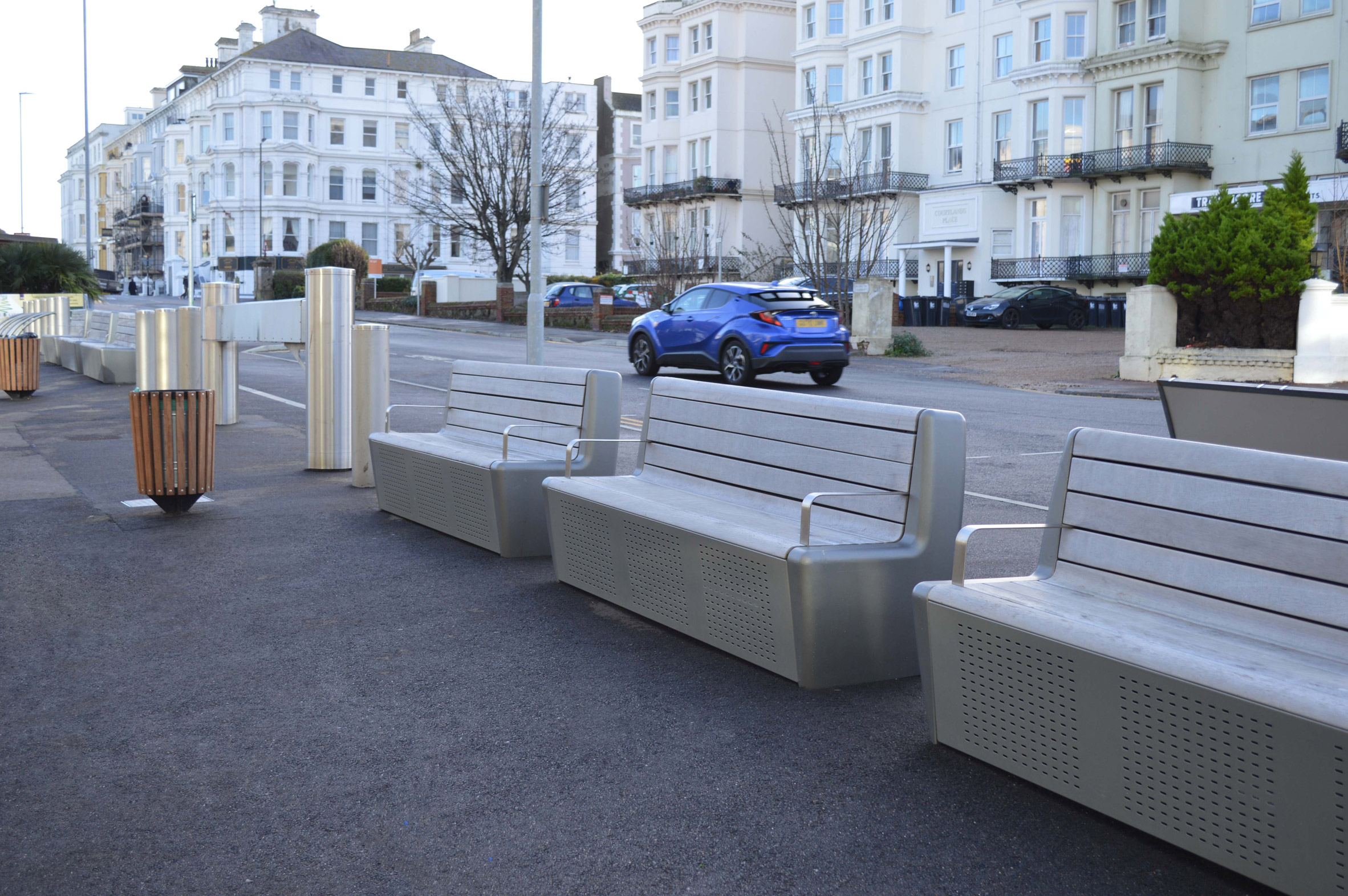
Protective street furniture
Benches can be used to create protected areas

The products aim to make public areas feel less fortified while opening spaces to increase footfall in town centres and cities.

Specifically, Marshalls Landscape Protection's protective street furniture is designed to be a decorative addition to urban environments and to prevent hostile or errant vehicles from entering an area.

Bollards, cycle stands, benches and litter bins can all be used to help keep public spaces safer from vehicles, something that Marshalls Landscape Protection believes will become even more important as people start returning to city centres for work and leisure post-pandemic.

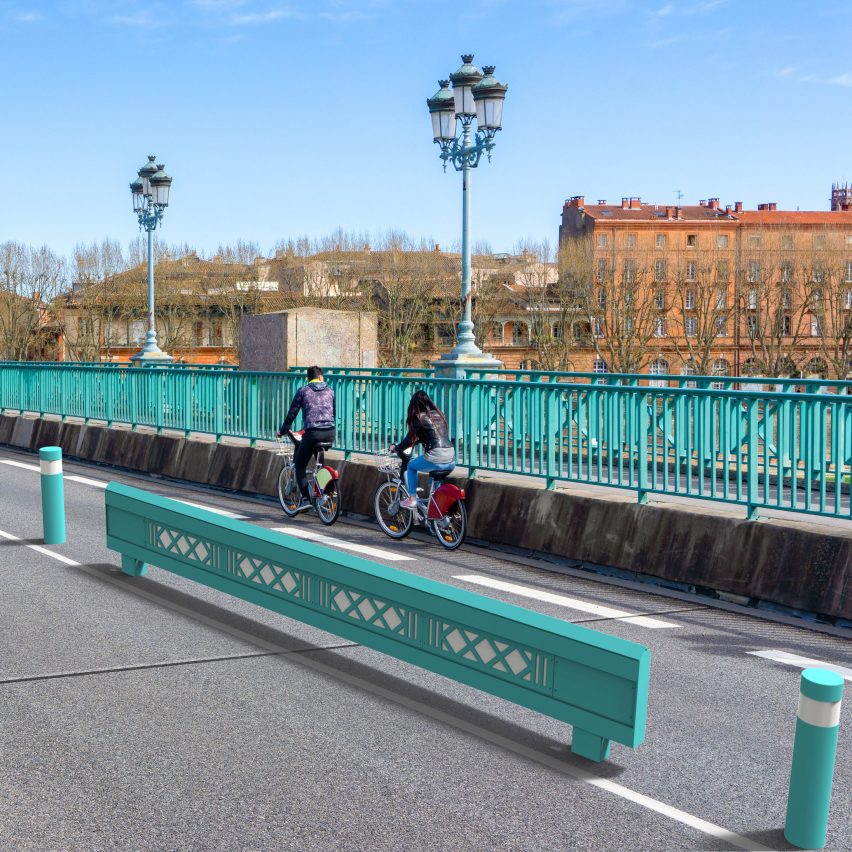
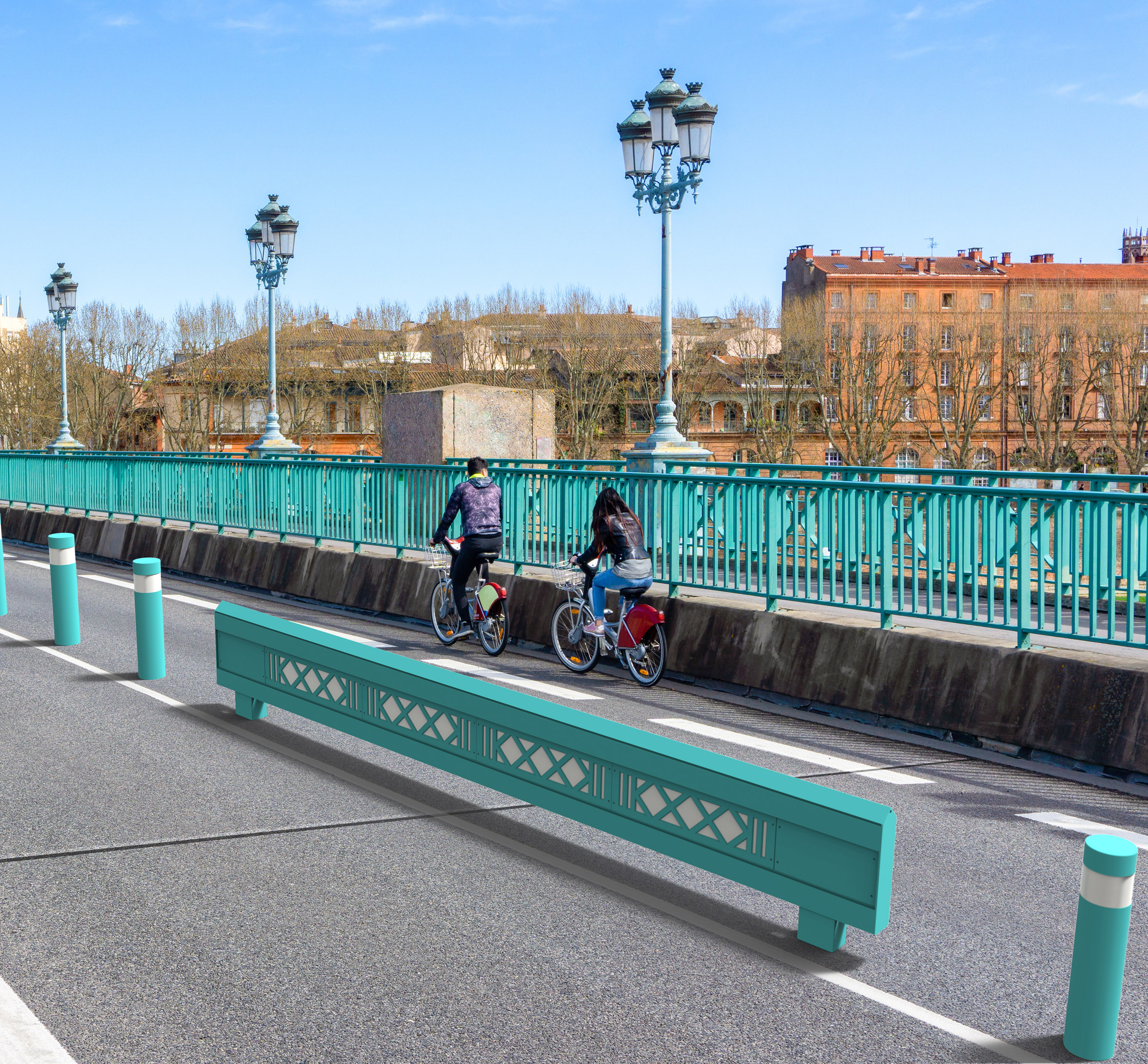
Turquoise protective barriers
They are designed to have minimal visual impact 

The company's products are designed to have a minimal visual impact on the environment while negating the need for harsh measures such as metal barriers or concrete blocks.

Instead, its RhinoGuard street furniture aims to combine safety and aesthetics and can be tailor-made to suit the needs of individual projects.

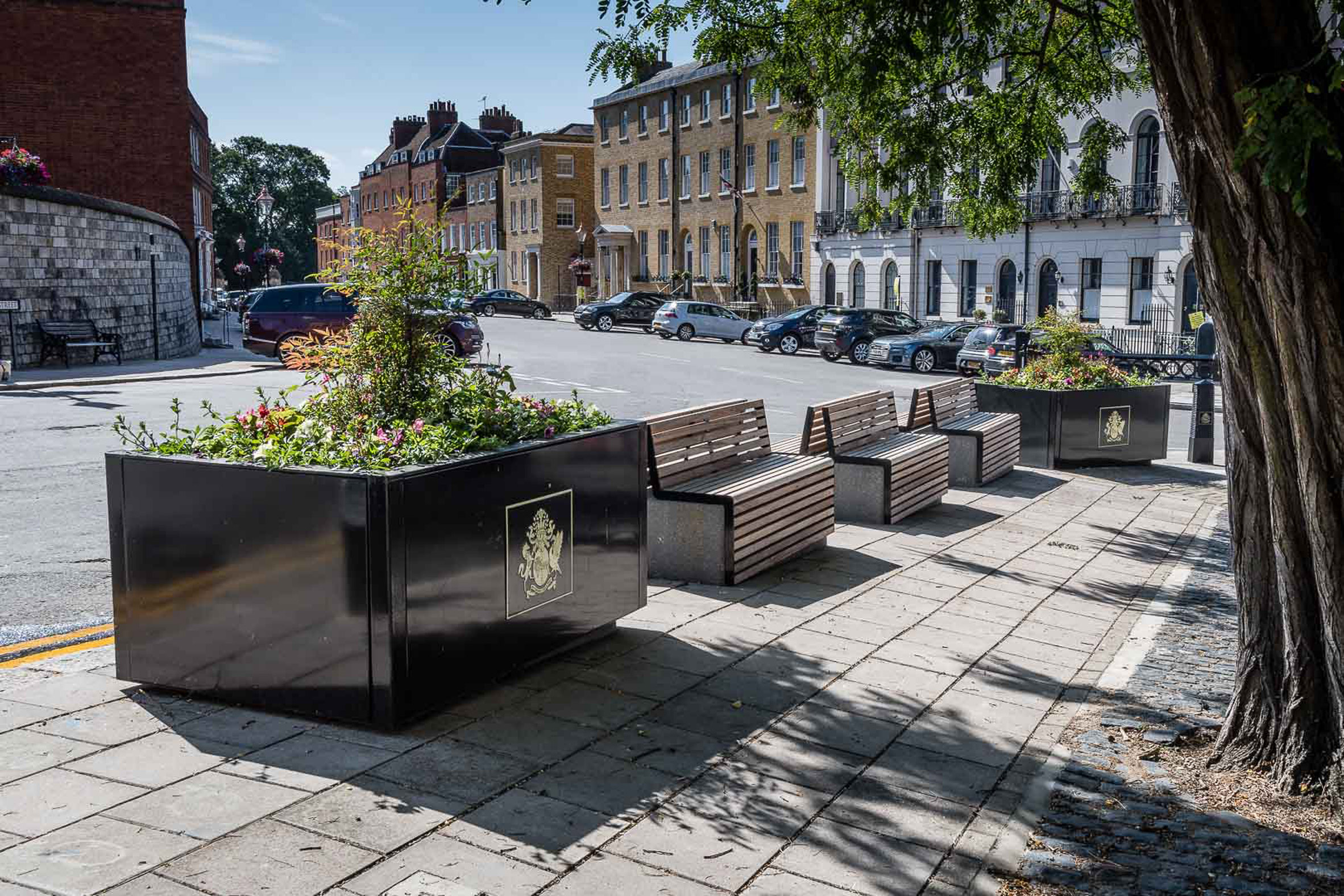
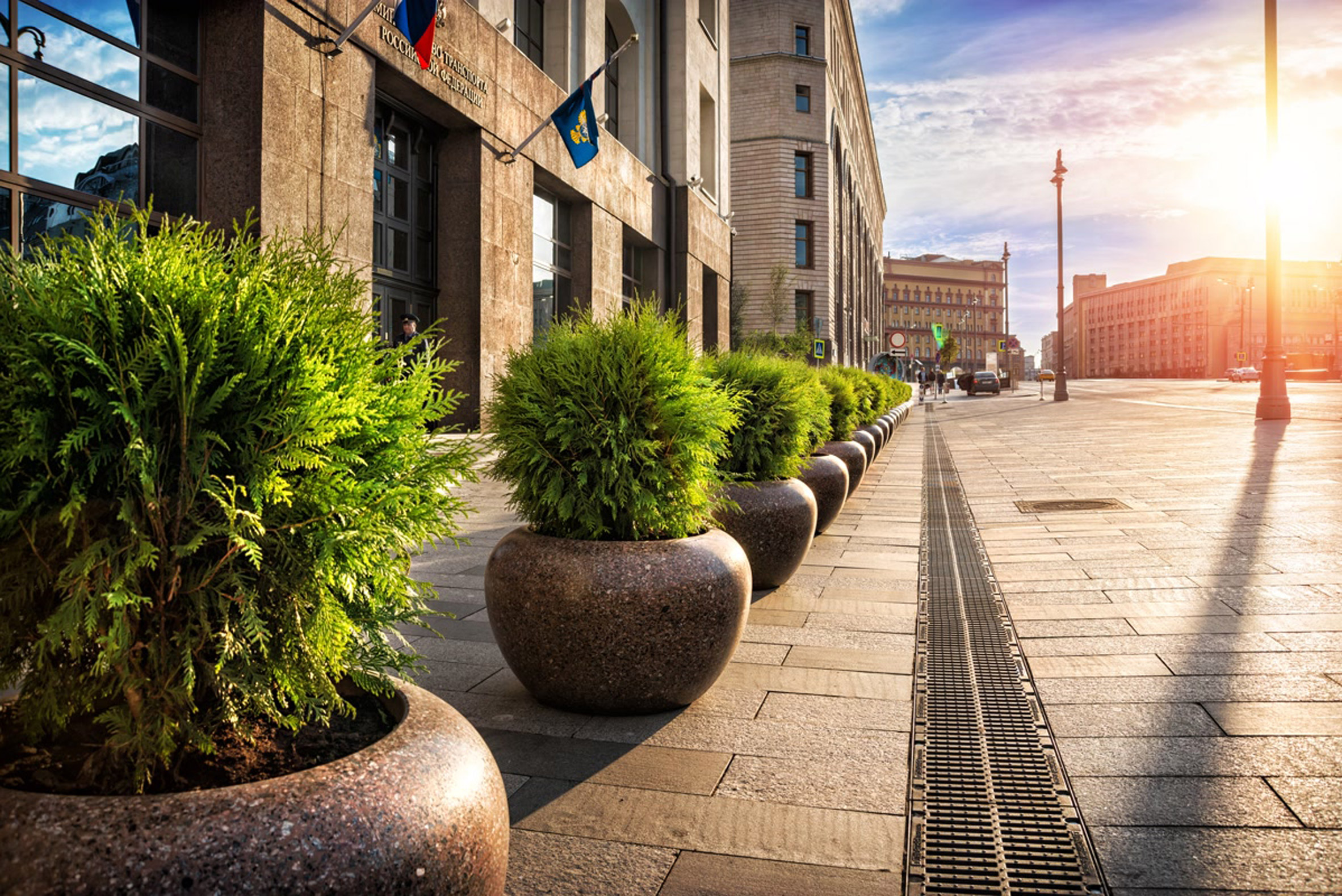
Large planters that function as vehicle protection
Large planters function as vehicle protection

Marshalls Landscape Protection offers a flexible portfolio of crash-tested street furniture products.

From the top levels of Hostile Vehicle Mitigation (HVM) certification, PAS 68/IWA 14.1, which are capable of stopping a 7.5 tonne vehicle travelling at 50 miles per hour, to the PAS 170 accreditation at the other end of the scale.

This protects against vehicles weighing up to 2.5 tonnes travelling up to 10 or 20 miles per hour.

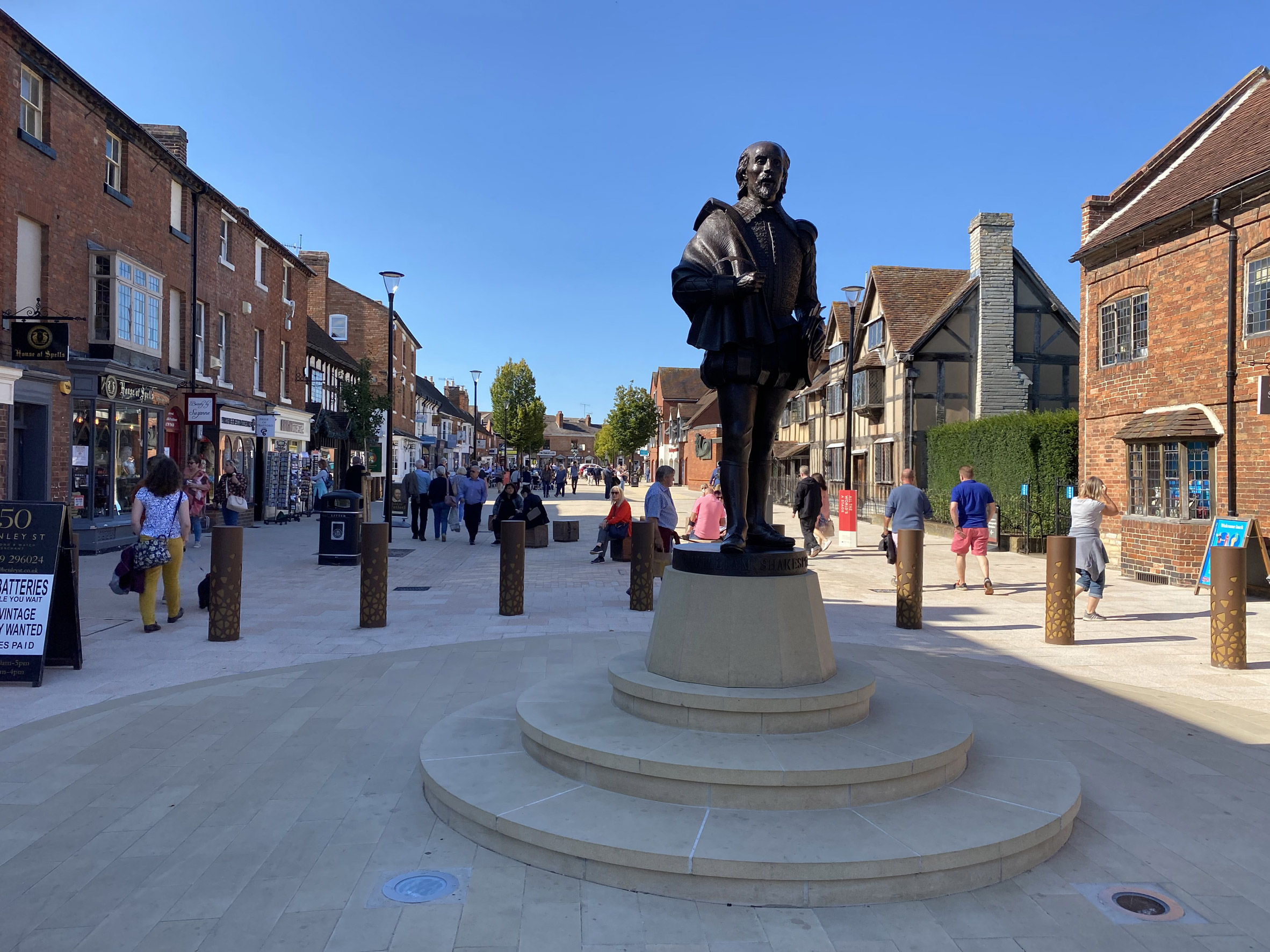
Bollards surrounding a statue
Marshalls Decorative bollards protect a historical site in Stratford upon Avon

The majority of Marshalls Landscape Protection's products are manufactured in the UK, and the company uses ethically sourced materials.

It has also signed up to the Carbon Trust Standard to reduce the carbon footprint in its product manufacturing processes.


Stone benches
Discreet benches offer protection and a place to rest

The company believes its products will be helpful as pandemic restrictions start to lift and urban areas get busier.

"Architects and landscape designers are in a strong position to create safe and attractive urban spaces that will be crucial for attracting people back into towns and city centres," the brand explained.

"By implementing protective street furniture products and taking a design-led approach to security, our public spaces can be future-proofed in a way, keeping people safe, not scared for years to come."

To learn more about the products on the brand's website.


Partnership content

This article was written by Dezeen for Marshalls Landscape Protection as part of a partnership. Find out more about Dezeen partnership content here.

The post Marshalls Landscape Protection creates protective design-led street furniture appeared first on Dezeen.


from Dezeen https://ift.tt/3wXKc4n

Perkins&Will designs interiors with "sense of connectivity" for healthcare office in Texas

Signify office interior by Perkins&Will

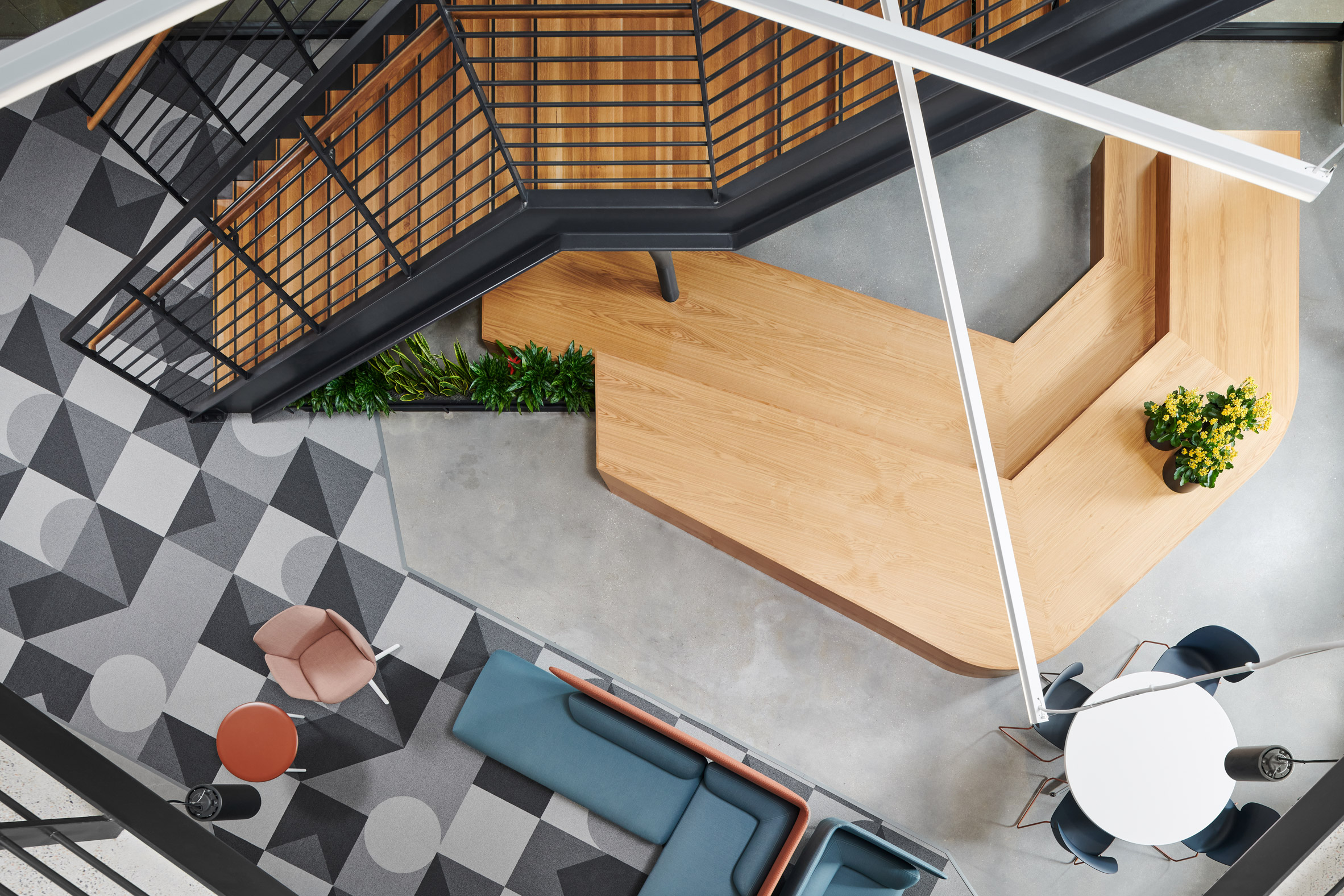
Architecture firm Perkins&Will has completed an office interior in Dallas, Texas for healthcare provider Signify, centred around a large steel staircase and tiered wooden platform for meetings.

The global practice, which has an office in Dallas, was approached to create a 13,700-square-metre workplace that would emphasise collaboration, connectivity and transparency while catering to a wide variety of workspace requirements.

Signify healthcare has offices in Dallas
The office design is for Signify healthcare

To achieve this, the office's six floors have been divided into a series of "workplace neighbourhoods" around a central core housing the lifts and storage spaces.

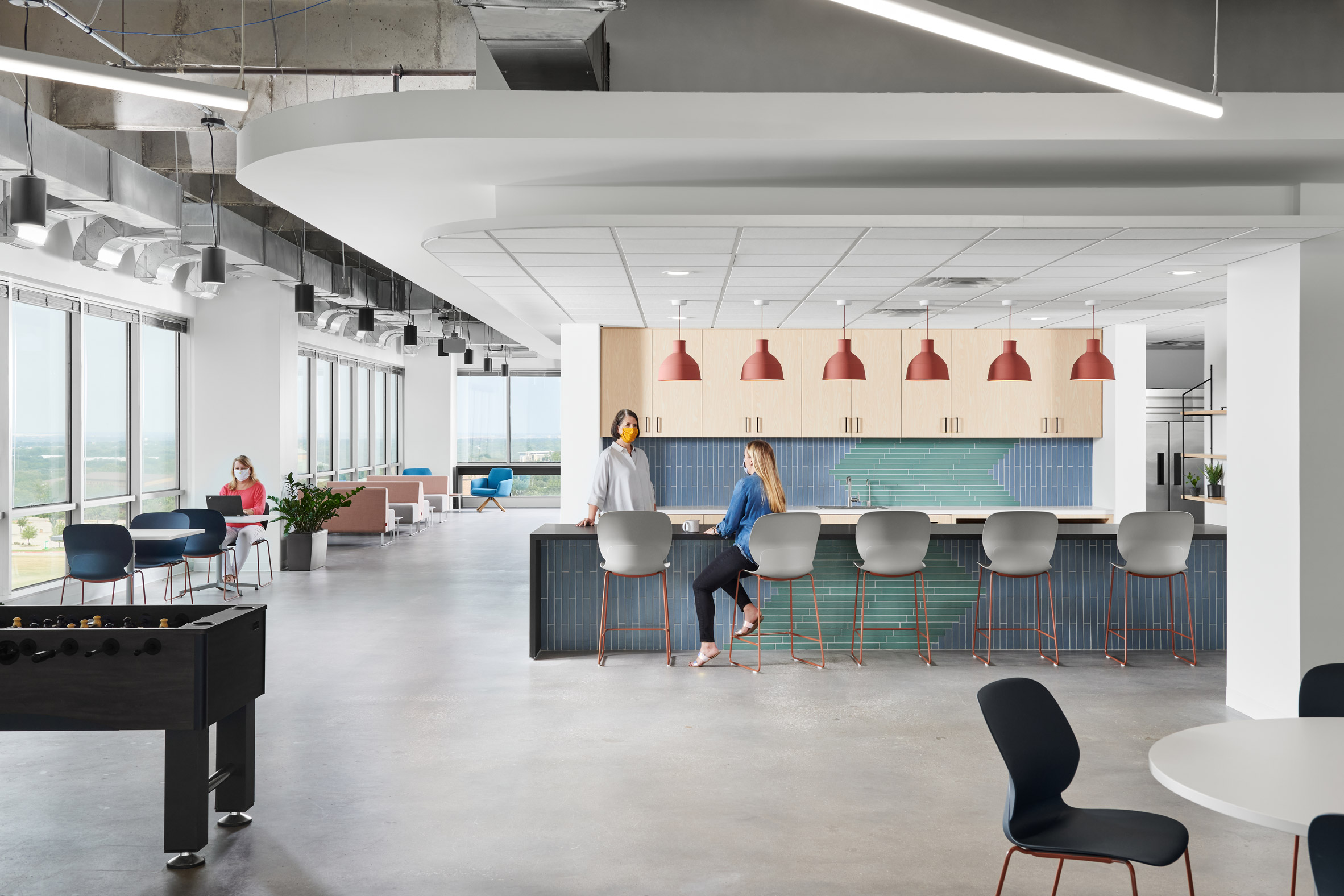
This arrangement provides everything from private meeting rooms, boardrooms and impromptu meeting areas to more communal spaces, including a large area on the seventh floor with a tiled kitchenette, games, projection screen and sofas.

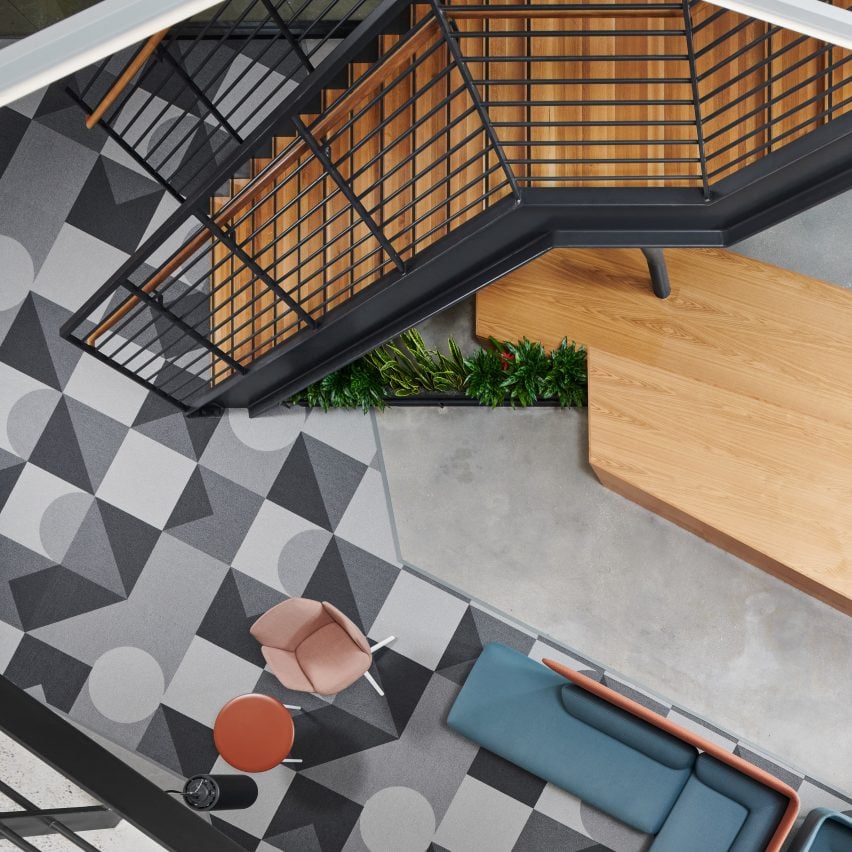
Perkins&Will designed the large metal staircase
A metal staircase creates a focal point for the office

"The intention was to create transparency and accessibility, similar to a 'living organism', thereby tying the design theme back to healthcare and the company's dedication to well-being," said the studio.

Alongside this communal area is a large metal staircase created in collaboration with Dallas metalworking firm Big D Metalworks, wrapped at its base by a tiered seating to create a focal point not only for the floor but for the entire office.

"A must-have feature for the renovation was the monumental staircase, conceptualised in collaboration with Big D Metalworks, to physically and metaphorically represent connectivity throughout the firm," said the practice.

"The staircase promotes access to the executive team, while the tiered wooden platform at the foot of the stairway serves as additional seating space, thereby enabling large town hall meetings."

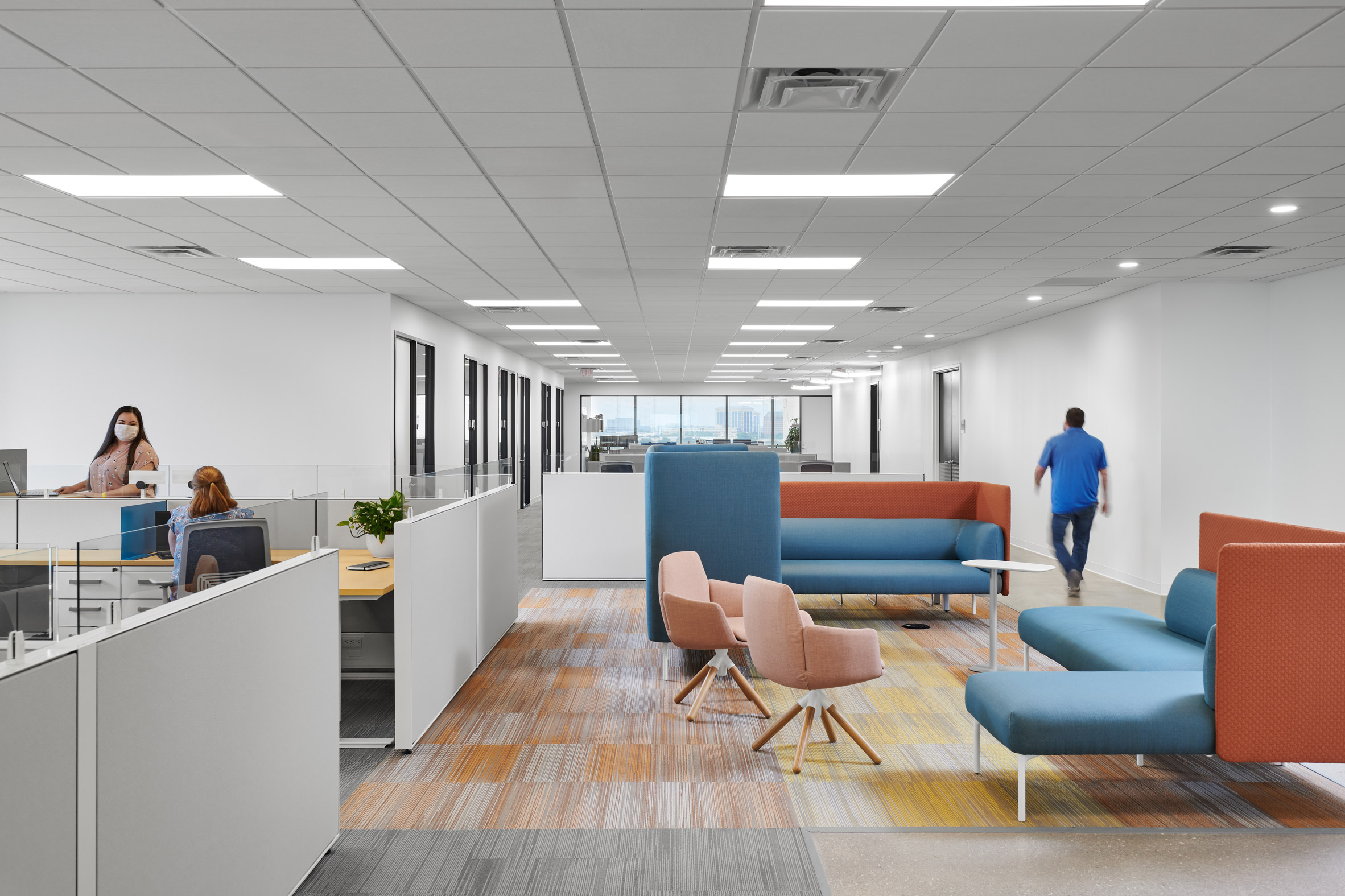
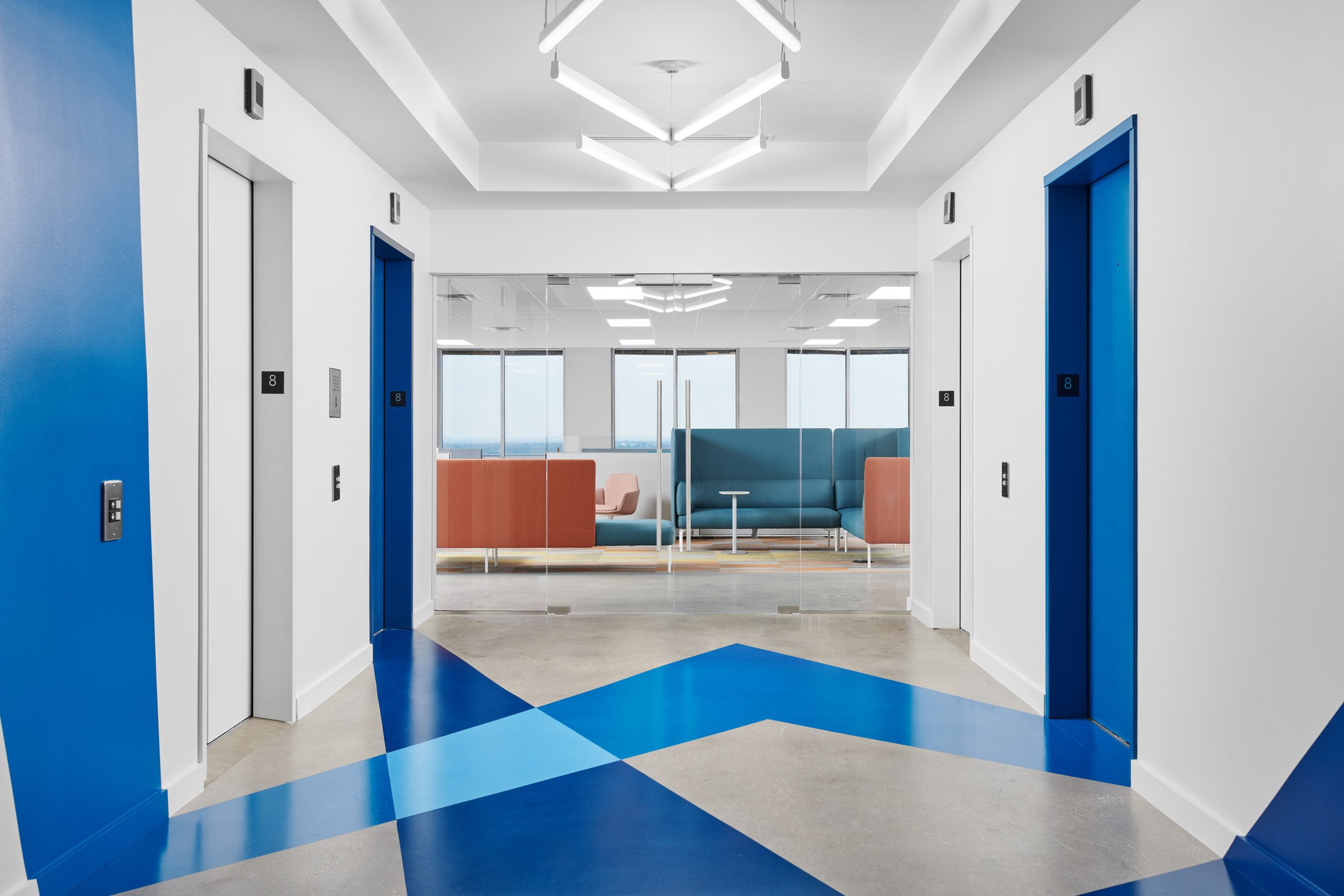
Perkins&Will used Signify's brand colours in the space
Blue and orange colours dominate the office design

A range of furniture types is provided across the more open office areas, designed to be adaptable depending on the type of meeting – from cafe-style seating and bar stools to softer armchairs and more private booths.

Each level of the office is unified by wayfinding in orange and blue – Signify's brand colours – that has been applied to the walls and extends onto the sealed concrete floors in the lift core area and fire escapes.

All of the materials used were vetted by Perkins&Will
Bars and booths create meeting spaces

All of the materials used in the interiors were vetted by Perkins&Will's material health programme, which aims to reduce and eliminate "substances of concern" in the built environment that have a negative impact on health.

The London office of Perkins&Will has recently developed the Now Database – a directory specifying products that support the studio's pledge to make all of its interior fit-outs net-zero embodied carbon by 2030.

The firm also recently revealed plans to revive a vacant 1970s office building in Alaska, re-cladding it with a glazed facade to mimic a glacier.

The photography is by Peter Molick.

The post Perkins&Will designs interiors with "sense of connectivity" for healthcare office in Texas appeared first on Dezeen.


from Dezeen https://ift.tt/3rz1TWT