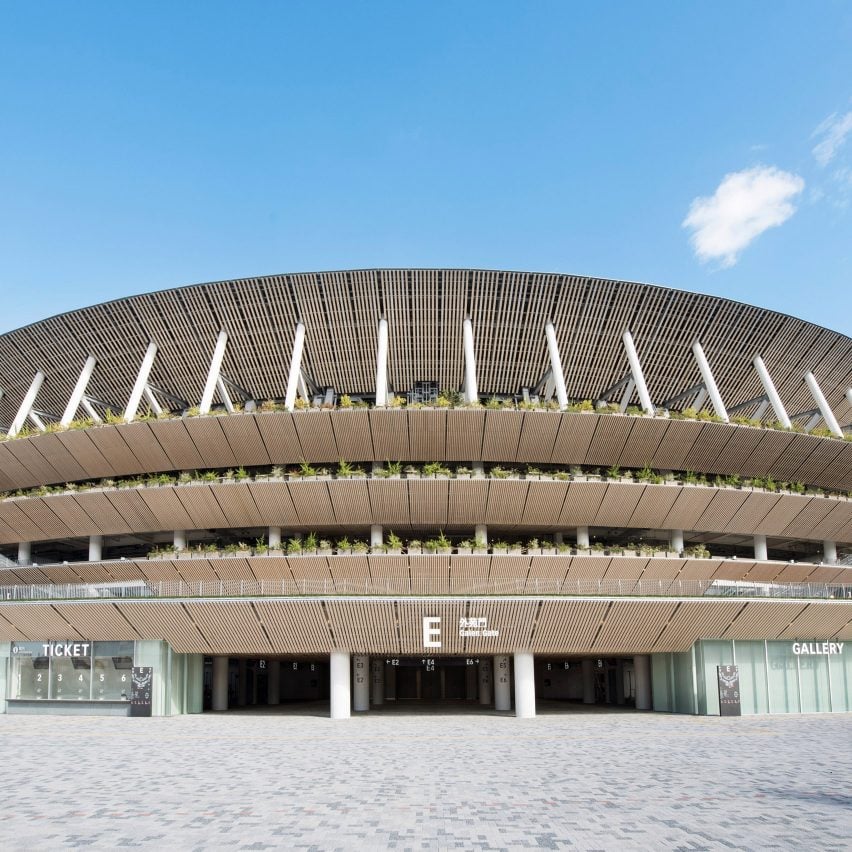
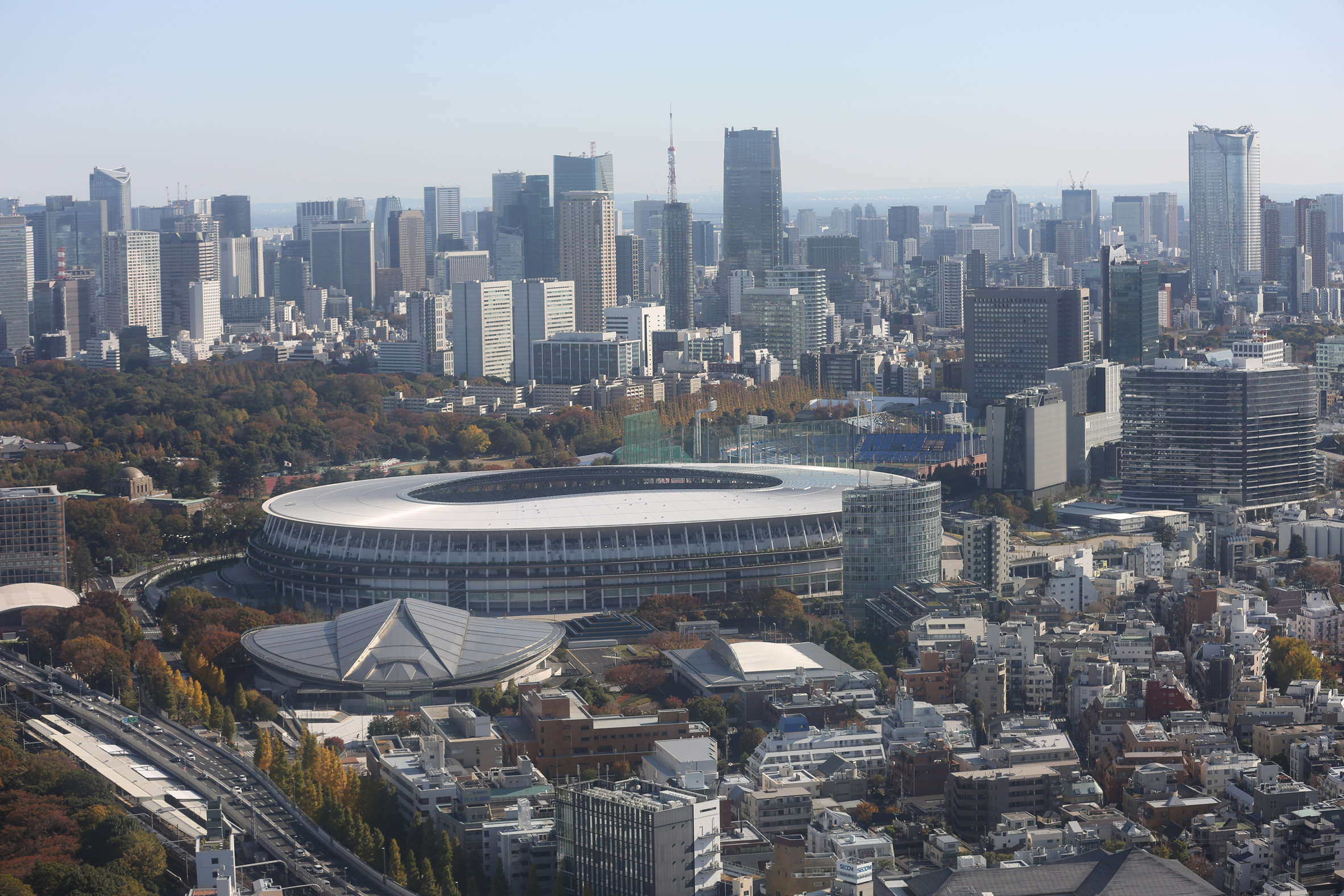
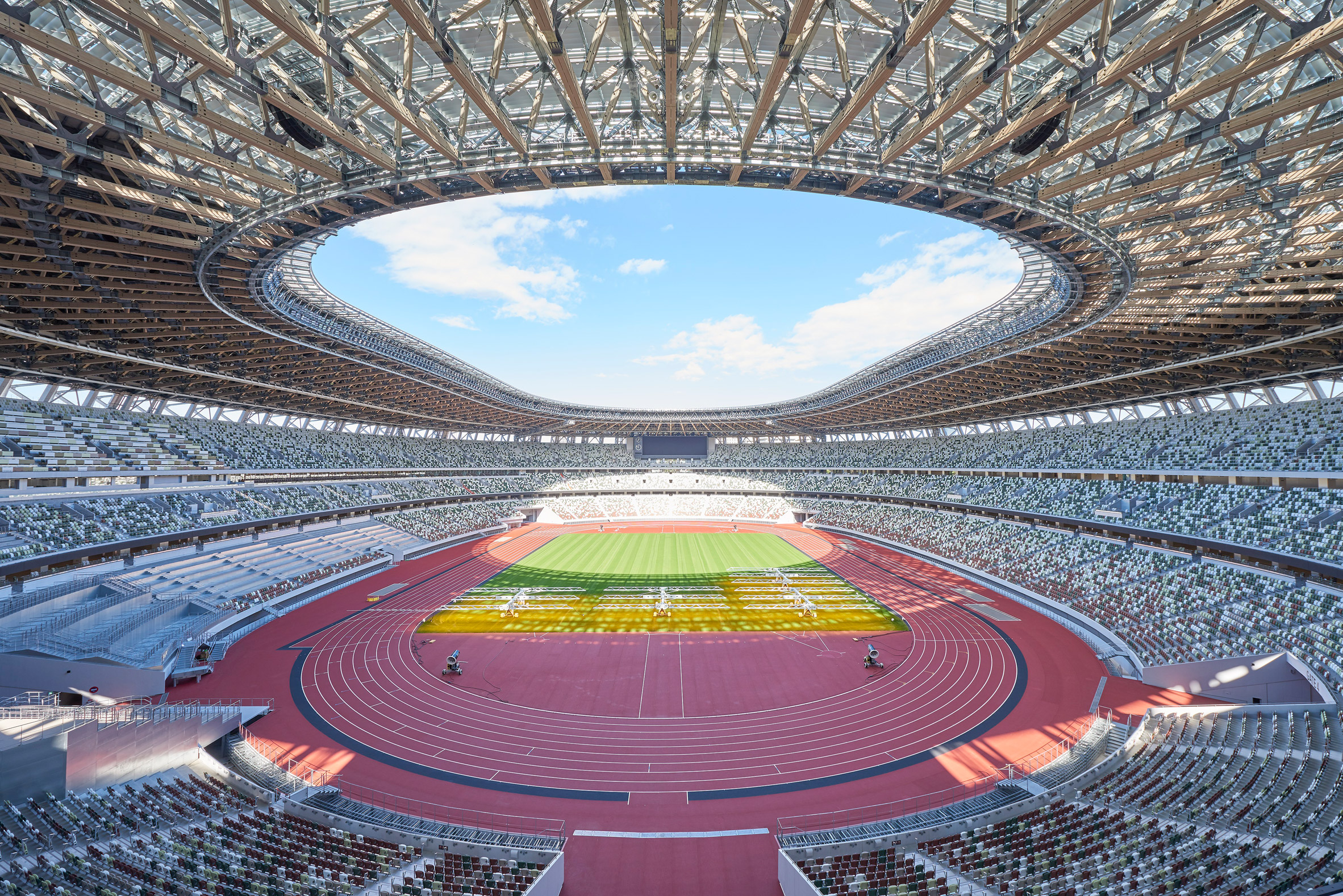
The structure in Tokyo's Meiji-Jingu Park by Kengo Kuma and Associates with Taisei Corporation and Azusa Sekkei Co hosted the games' opening ceremony last week and is set to host the track and field athletics events at both the Olympics and Paralympics.
Above: Japan National Stadium is located in Tokyo. Top image: it is surrounded by wooden eaves
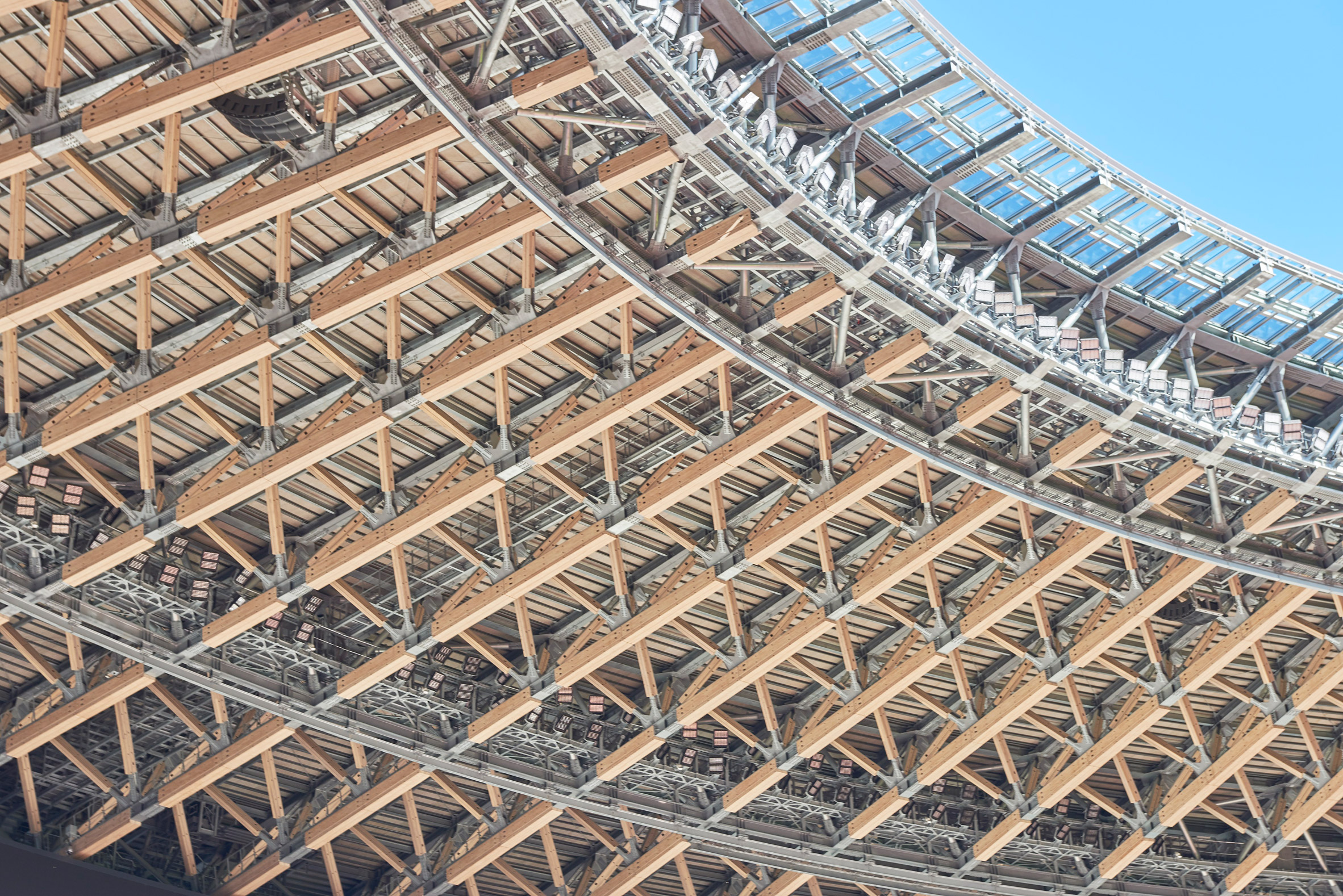
Its main structure is made from reinforced concrete and steel, sheltered by a roof structure made of steel with laminated larch and cedar trusses.
The eaves nod to traditional Japanese architecture
The roof is punctured with a huge oculus above the track but cantilevered to shelter three tiers of spectators seats.
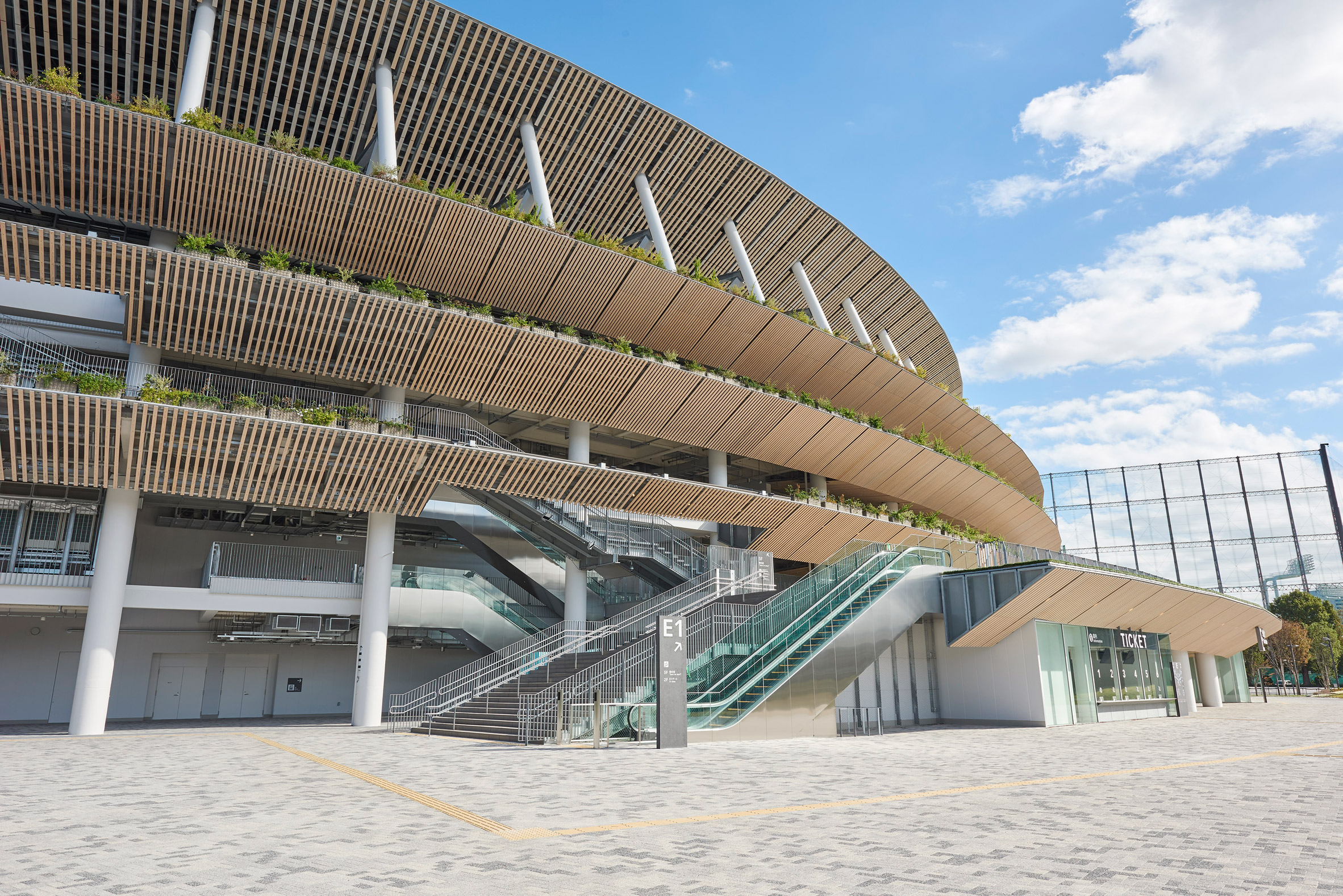
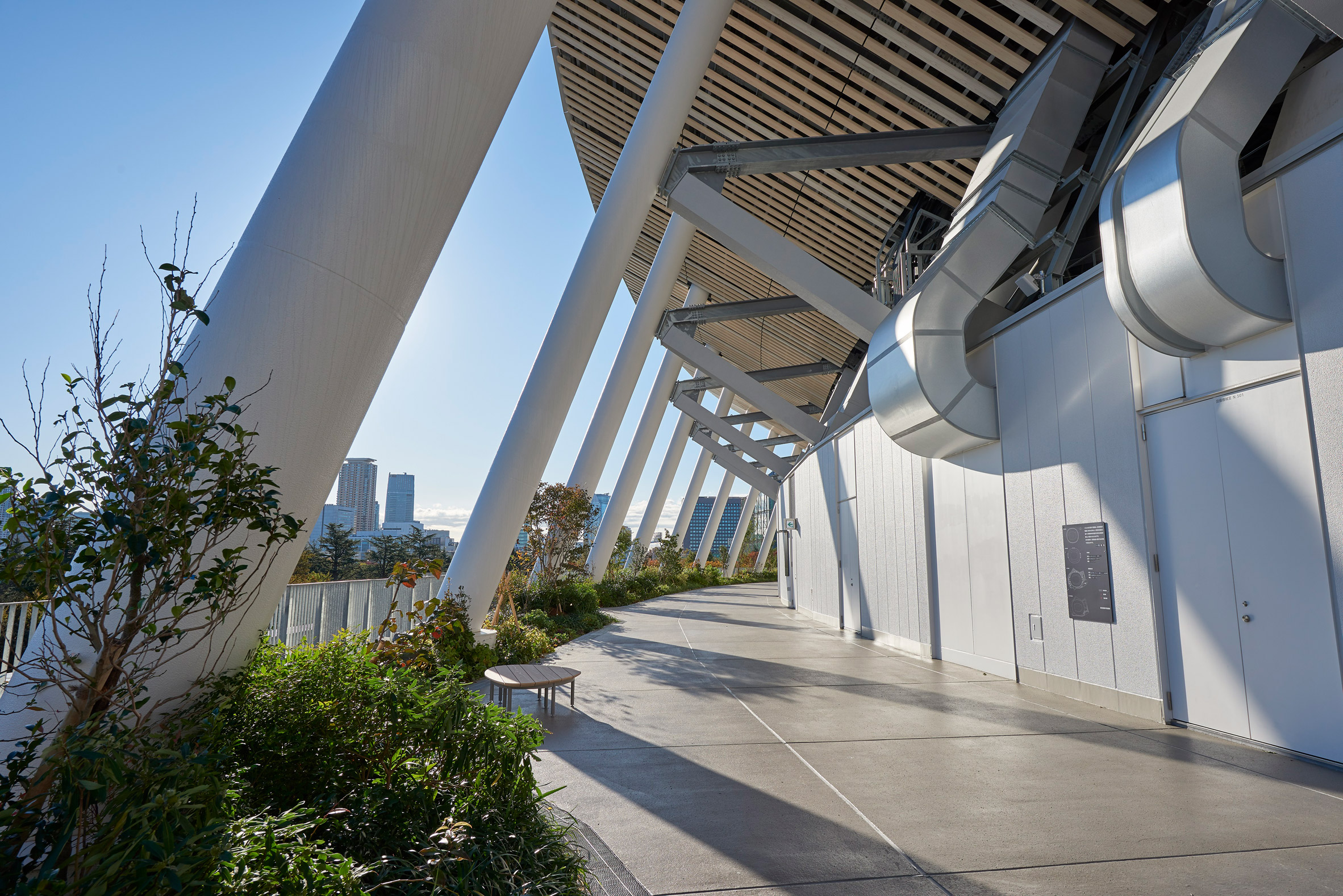
Behind the seating are the circulation areas, which wrap the edges of each level and contain 47,000 plants. This greenery is visible externally and was designed to help the stadium blend in with the surrounding green environment.
The eaves are positioned below the tree-lined circulation spaces
To reduce the visual impact on the site, the stadium height was minimised by combining a flat roof and a compact arrangement of seats.
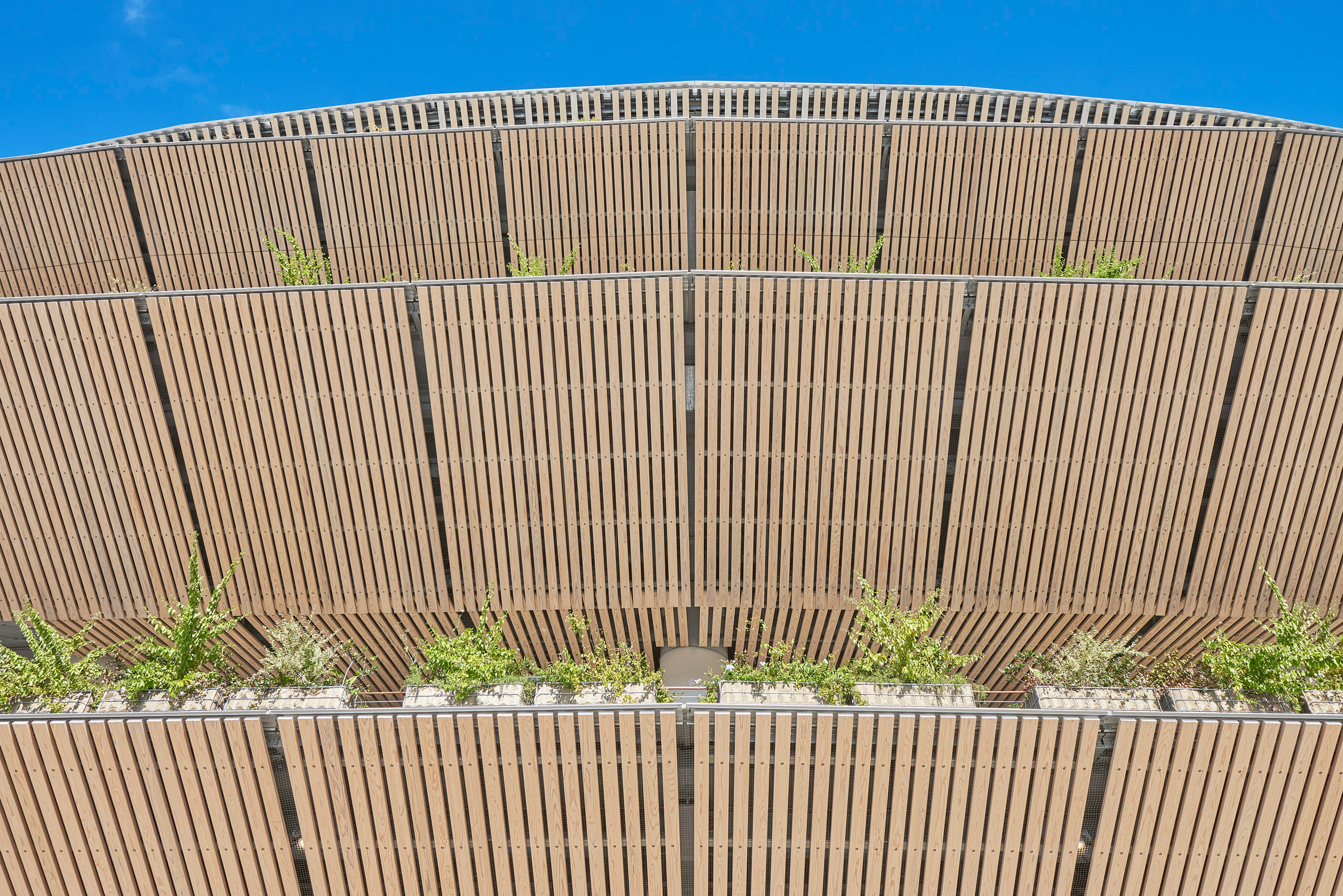
Externally, the structure is distinguished by a series of eaves that are clad in cedar collected from each of Japan's 47 prefectures.
Seating is covered by a roof
The eaves were designed by Kengo Kuma and Associates as a contemporary interpretation of the overhanging eaves of traditional wooden Japanese buildings.
They also offer functional benefits, keeping out the sunlight and rain while encouraging air to circulate and prevailing wind to enter. This helps to cool the building in hot weather in tandem with airflow-creating fans and a mist-cooling system.
Wood also features inside the Japan National Stadium, where it lines the interior spaces to help create a warm and tactile environment. It has also been used to furnish the athletes' dressing rooms and to create benches in recreation spaces.
The stadium is complete with more than 450 places for wheelchair users, solar panels on the roof that generate electricity and rainwater collection points in underground cisterns that are used to irrigate the arena's greenery.
The roof structure was built from laminated timber and steel
We also featured the stadium during Dezeen's Virtual Design Festival last year, when architecture video blogger Martin van der Linden described it as "quite simple, and definitely not iconic".
Environmental certification schemes for buildings overlook embodied carbon and encourage architects to add unnecessary "systems and gizmos" to achieve high ratings, according to architect Andrew Waugh.
Schemes such as BREEAM and LEED focus overwhelmingly on operational emissions rather than emissions from the construction supply chain, Waugh argued.
However, embodied carbon emissions make up around half of all emissions from buildings. The percentage is rising as buildings become more energy-efficient and renewable energy becomes more prevalent.
"The certification systems still focus on operational carbon," said Waugh, who is founding director of London architecture studio Waugh Thistleton Architects and a member of the steering committee of climate action network Architects Declare.
"They're meaningless. They are awards that prop up the existing systems."
BREEAM and LEED don't focus on embodied carbon
To achieve BREEAM's highest Outstanding rating, a building needs 85 credits, Waugh said. But only nine or ten credits are available for approaches that tackle embodied carbon, he claimed.
To achieve Platinum under the LEED system, a building needs 80 points. But only three are available for embodied carbon, according to Waugh.
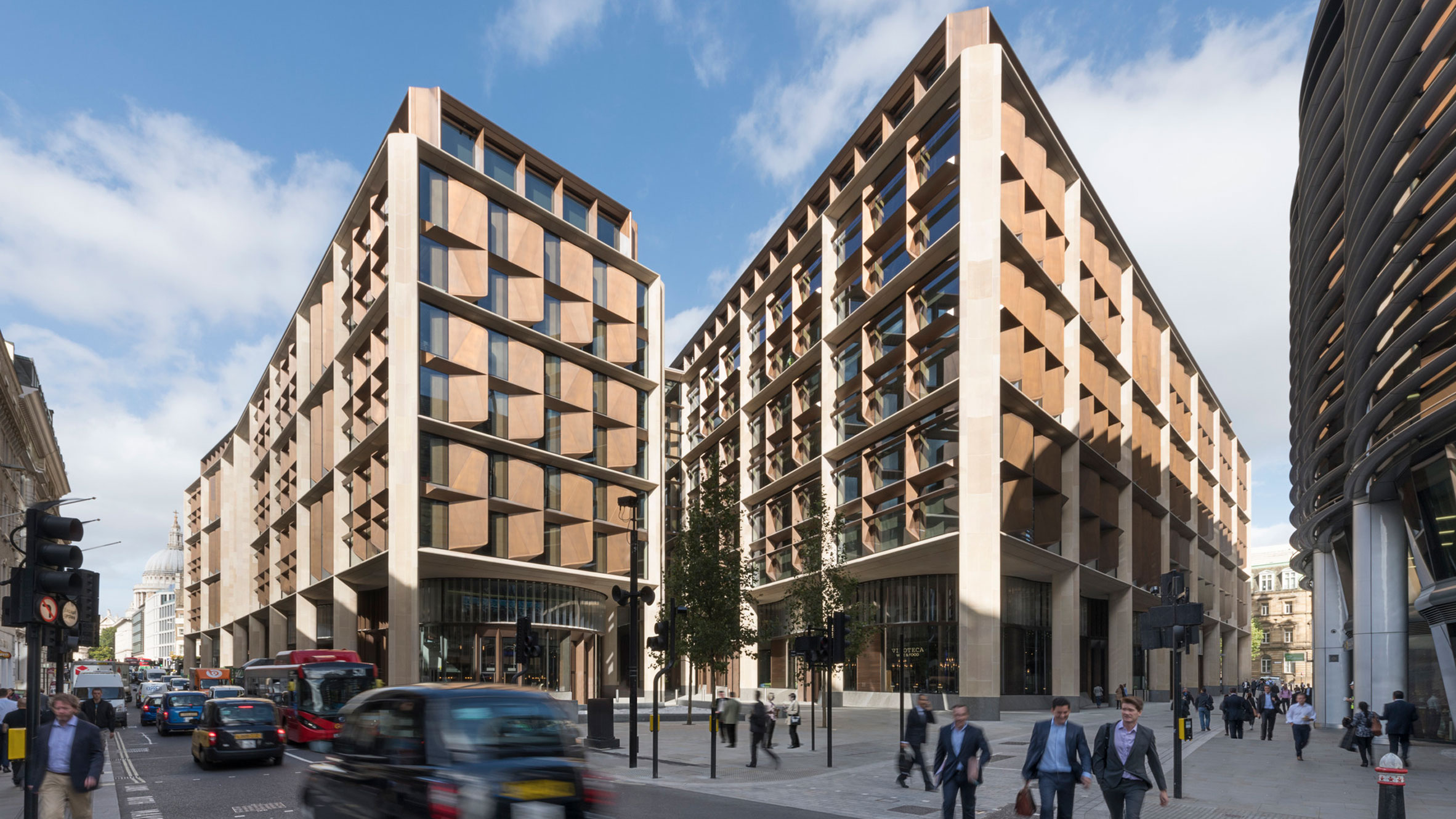
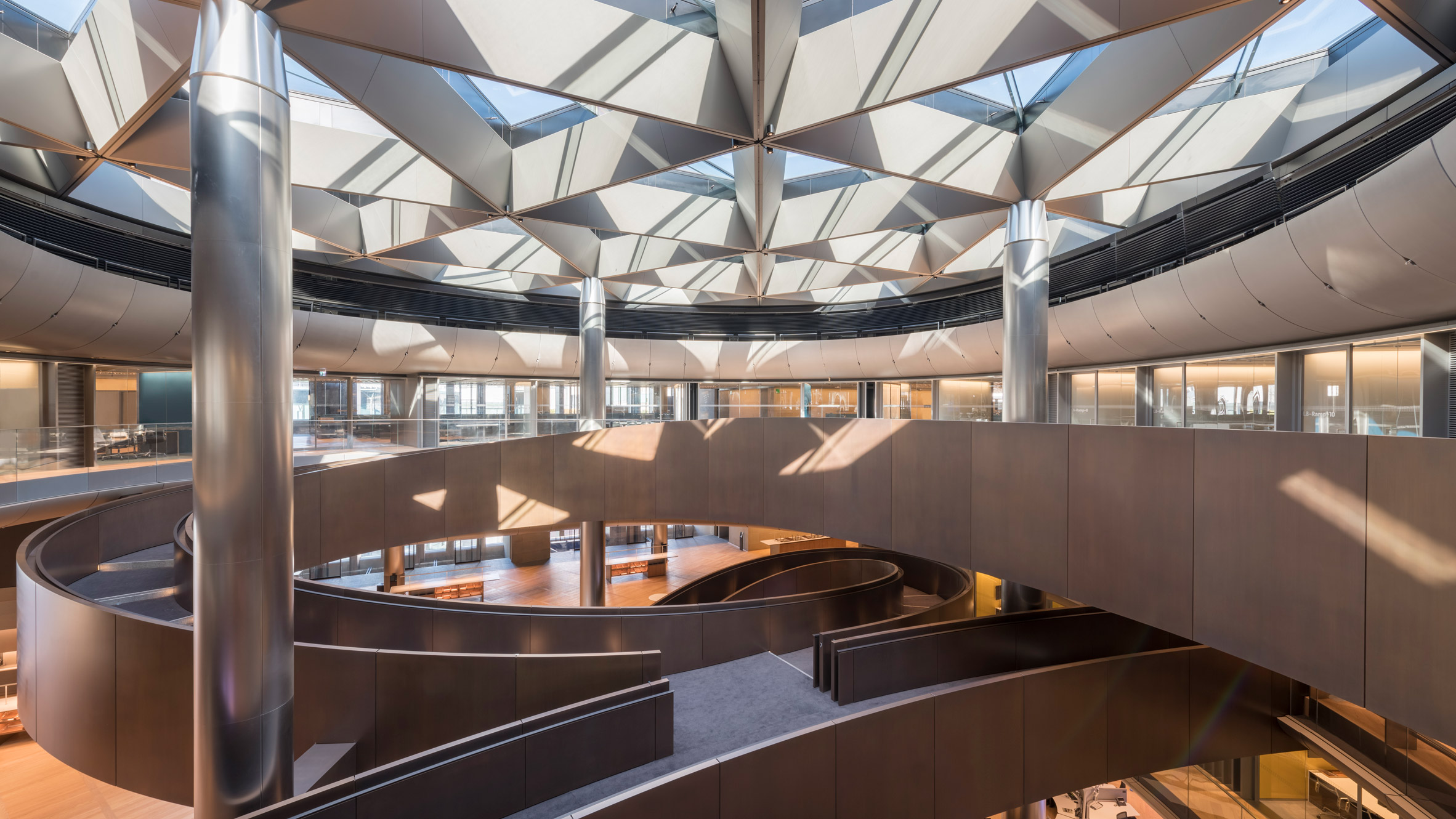
Above: Foster + Partners Bloomberg building is an example of a project that prioritises operational carbon over embedded carbon. Top: Andrew Waugh Architects founder Andrew Waugh
Waugh said that UK regulations covering operational carbon are already "pretty good" in the UK and achieving zero operational emissions is achievable, particularly since the electricity grid is rapidly switching to renewable sources.
"For heating, lighting and air conditioning, building regulations are pretty good," he said. 'They drive pretty hard targets and the more we green our energy systems, the less of an issue it becomes."
"There's no accounting for future decarbonising of power"
But he said "there's no accounting for future decarbonising of power" in the certification schemes.
This means that schemes such as BREEAM and LEED are misguided, he said, since they encourage architects to focus too much on adding unnecessary energy-saving technologies in order to increase their certification ratings. "The return is so incremental," he argued.
Completed in 2017, the office building was dubbed "the world's most sustainable office" and achieved the highest-ever BREEAM rating for an office building. It claims to require 35 per cent less energy than a standard office building and won the 2018 Stirling Prize for the best building by a British architect.
The Bloomberg achieved the highest ever BREEAM rating for an office building
However, the £1 billion building was criticised at the time for its extravagance and its reliance on complex systems which include hundreds of moveable bronze fins to regulate solar gain and ceilings covered in 2.5 million bespoke aluminium petals that reflect light and help regulate acoustics and temperate.
"The embodied carbon footprint of the finished building is going to be a significant multiple of a standard high-quality office building, even taking longevity into account," he said.
Foster + Partners itself admits that certification systems overlook embodied carbon.
"The existing certification systems focus on the operational energy which is expended by a building in use, but do not fully address the implications of embodied carbon emissions resulting from the energy required to construct a building and during manufacture," it writes in its sustainability manifesto.
"The Bloomberg building is a great example," Waugh said. "They've reduced operational carbon over and above building regulations to meet BREEAM targets with all these systems and gizmos, layering more and more stuff onto an existing architecture."
BREEAM and LEED are two of the top certification schemes
BREEAM and LEED are two of the world's leading certification schemes, with both claiming to be the world's most-used green building certification system.
BREEAM (Building Research Establishment Environmental Assessment Method) was launched by UK research institute the Building Research Establishment in 1990.
LEED (Leadership in Energy and Environmental Design) was launched in 1993 and is administered by the US Green Building Council.
Both BREEAM and LEED have made modest changes recently to take embodied carbon into account.
In 2019, BREEAM introduced credits for architects that carry out lifecycle assessments (LCA) to establish emissions over both the construction and use phases of a building.
Conducting an LCA and choosing low-impact materials can now earn half the available credits in the materials category, according to a blog post on the BREEAM website. In addition, the weighting of materials in the overall scoring system has been increased to 15 per cent.
Version 4.1 of LEED, which was introduced in 2019, includes new credits for LCAs, building reuse and environmental product declarations (EPDs), all of which can help lower embodied carbon.
"These credits incentivize real reductions in embodied carbon at multiple scales throughout the building lifecycle," said a LEED blog post announcing the changes.
BREEAM said the schemes help projects achieve net-zero
Dezeen approached BREEAM and LEED to respond to Waugh's claims but had not heard back by the time of publication.
However, a spokesperson for BREEAM said that the scheme "does help projects to achieve net-zero".
"BREEAM building schemes have credits promoting operational energy efficiency. There are also credits encouraging low embodied carbon."
But the spokesperson admitted: "At the moment these aren't pulled out into a single carbon metric and BREEAM doesn't capture all the potential “net” options of net-zero carbon.
A future update "will provide a more comprehensive assessment of net-zero carbon."
But Waugh argued that buildings were assessed "as designed, not in use. So there's no telling if the carbon savings are even made."
"These certification systems encourage a 'keep digging' mentality to get us out of this very man-made hole," he added. "It's very much business as usual, just with more stuff and systems. And all those systems can be ruined if you open a window, or if you take your jacket off."
"What's required is a complete paradigm shift to predominantly passive, resource-conscious design," he concluded.
The built environment is said to be responsible for 40 per cent of global CO2 emissions
"Regulating embodied carbon is vital for the construction industry in tackling the climate crisis," the group said. "The industry is ready for this."
In total, the built environment is thought to be responsible for around 40 per cent of global CO2 emissions, with embodied carbon accounting for around half of this.
This article is part of Dezeen's carbon revolution series, which explores how this miracle material could be removed from the atmosphere and put to use on earth. Read all the content at: www.dezeen.com/carbon.
Dezeen has teamed up with Epic Games to launch Redesign the World, the ultimate design competition that calls for new ideas to rethink planet Earth.
The competition is free to enter for people over the age of 18 of any profession and from any country in the world. It is open for entries until 15 September 2021.
The 15 best proposals will be published on Dezeen in November during our Dezeen 15 online festival celebrating Dezeen's 15th anniversary.
The contest has a top prize of £5,000 and total prize money of £15,000.
Click here for more information about how to enter, including the full brief and submission requirements.
Redesign the World is "ultimate design challenge"
We are looking for radical new solutions to ensure that planet Earth remains habitable for hundreds of years to come.
"The problems the world faces are huge in scale and they demand equally epic solutions," said Dezeen editor-in-chief and CEO Marcus Fairs.
"So we have set the ultimate design challenge and asked architects and designers to redesign the world. We're looking for big, bold ideas that show visionary thinking."
"We firmly believe that design can make the world a better place. We're challenging creatives to come up with ideas that will generate debate, optimism and excitement around the greatest design problem of our time."
Competition powered by Twinmotion
Entrants are required to present their concepts using Twinmotion, an architectural visualisation tool powered by Unreal Engine, which is a game engine developed by Epic Games.
"We're thrilled to be part of Redesign the World, a competition which seeks to explore creative solutions for the future of life on our planet," said Belinda Ercan, Twinmotion product marketing and strategy at Epic Games.
"I can't wait to see how our entrants will use Twinmotion's intuitive capabilities to unleash their creative thinking and convey their imaginations in the form of compelling digital stories."
Ercan and Sam Anderson, technical marketing manager at Epic Games, will be leading an online workshop at 2:00pm London time on 5 August providing an overview of Twinmotion, giving practical advice on how to use it and sharing tips and tricks for getting the best out of it. Click here to register for the workshop.
Brief and judging criteria
Entrants must submit a video animation and still image created using Twinmotion, along with up to 500 words of text about their proposal.
Entries will be assessed by a judging panel comprising Fairs and Ercan alongside a selection of industry experts that will be announced in August.
Redesign the World is primarily an ideas competition. Judges will be looking for visionary concepts and are less concerned with technical mastery of the Twinmotion software. However, the quality of the execution of the idea will also be considered.
Architects and designers turning their attention to planet Earth
Architects and designers are already turning their attention to planet Earth as the ultimate design project. In an interview with Dezeen last year, Winy Maas of MVRDV called on architects to design new planets to help understand how to solve problems on Earth.
"It would be wonderful to design more planets and to compare them because there are different dreams," said the Dutch architect.
Architect Bjarke Ingels has proposed Masterplanet, a planet-wide design approach that will "prove that a sustainable human presence on planet Earth is attainable with existing technologies".
Meanwhile, speculative architect Liam Young has proposed housing the entire population of the Earth in a single metropolis called Planet City. This would free up the rest of the Earth's surface for rewilding and the return of stolen lands.
Designer Jalila Essaïdi called on designers to propose audacious solutions to global problems in a talk with Dezeen in 2018. "I would say yes please, more science fiction," said Essaïdi. "Let's keep dreaming big and doing the impossible."
Competition closes on 15 September
Entries for Redesign the World close at midnight on 15 September 2021.
The 15 finalists will be announced as part of Dezeen 15 from 1 to 19 November.
First place will receive prize money of £5,000, with £2,500 for second place, £1,000 for third place and £500 each for 12 remaining finalists.
For more information about how to enter, including the brief and rules, entry form and full terms and conditions, go to www.dezeen.com/redesigntheworld.
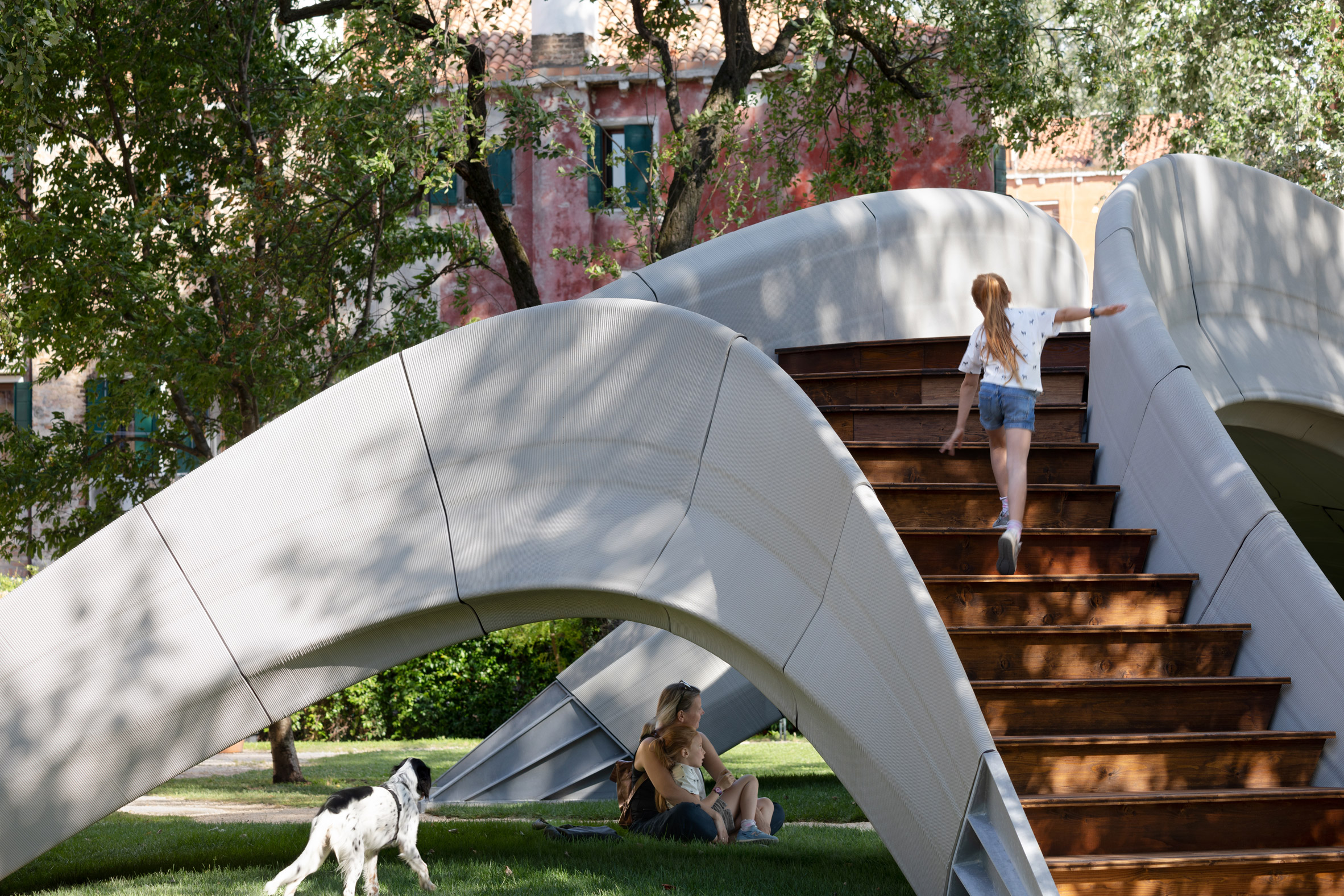
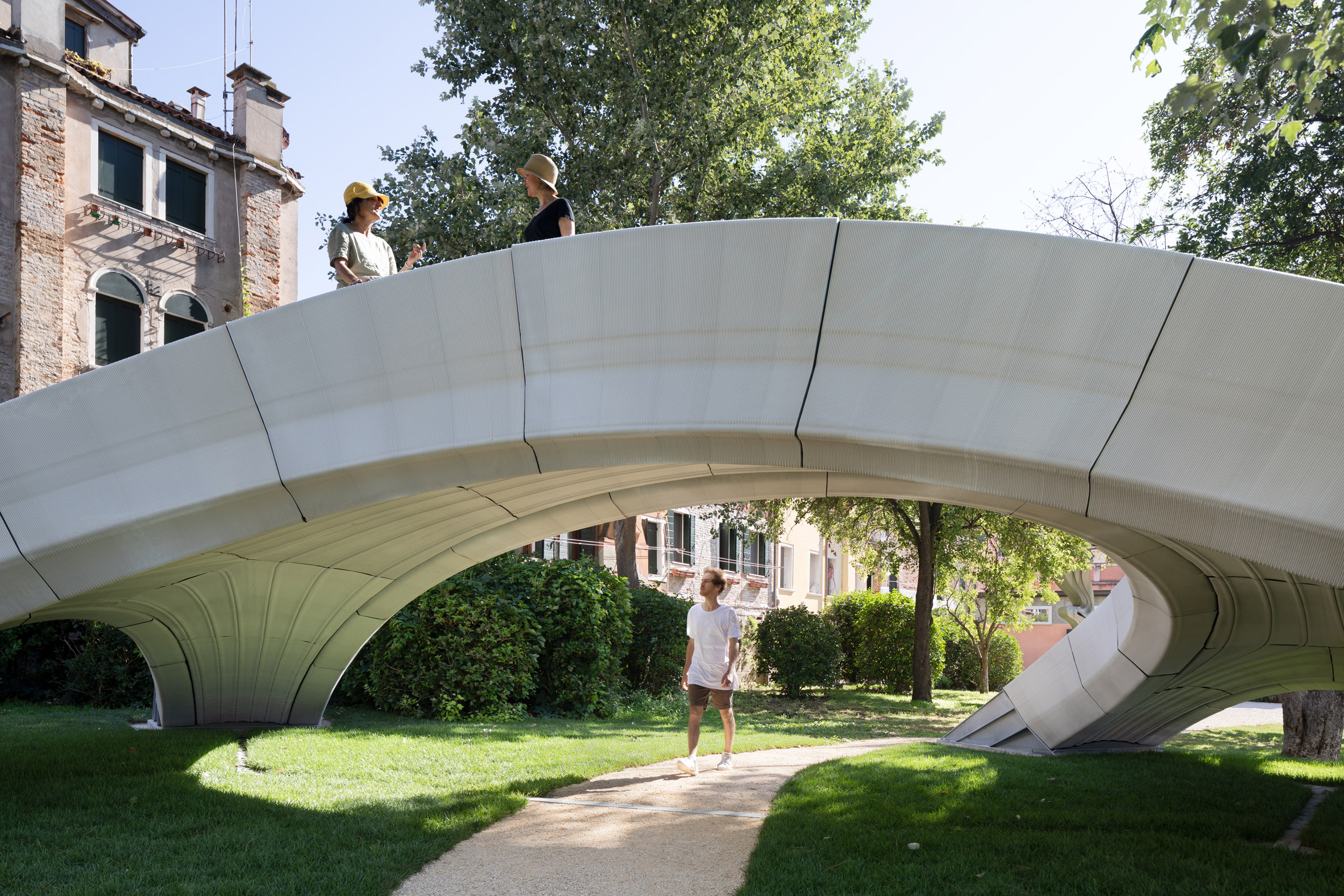
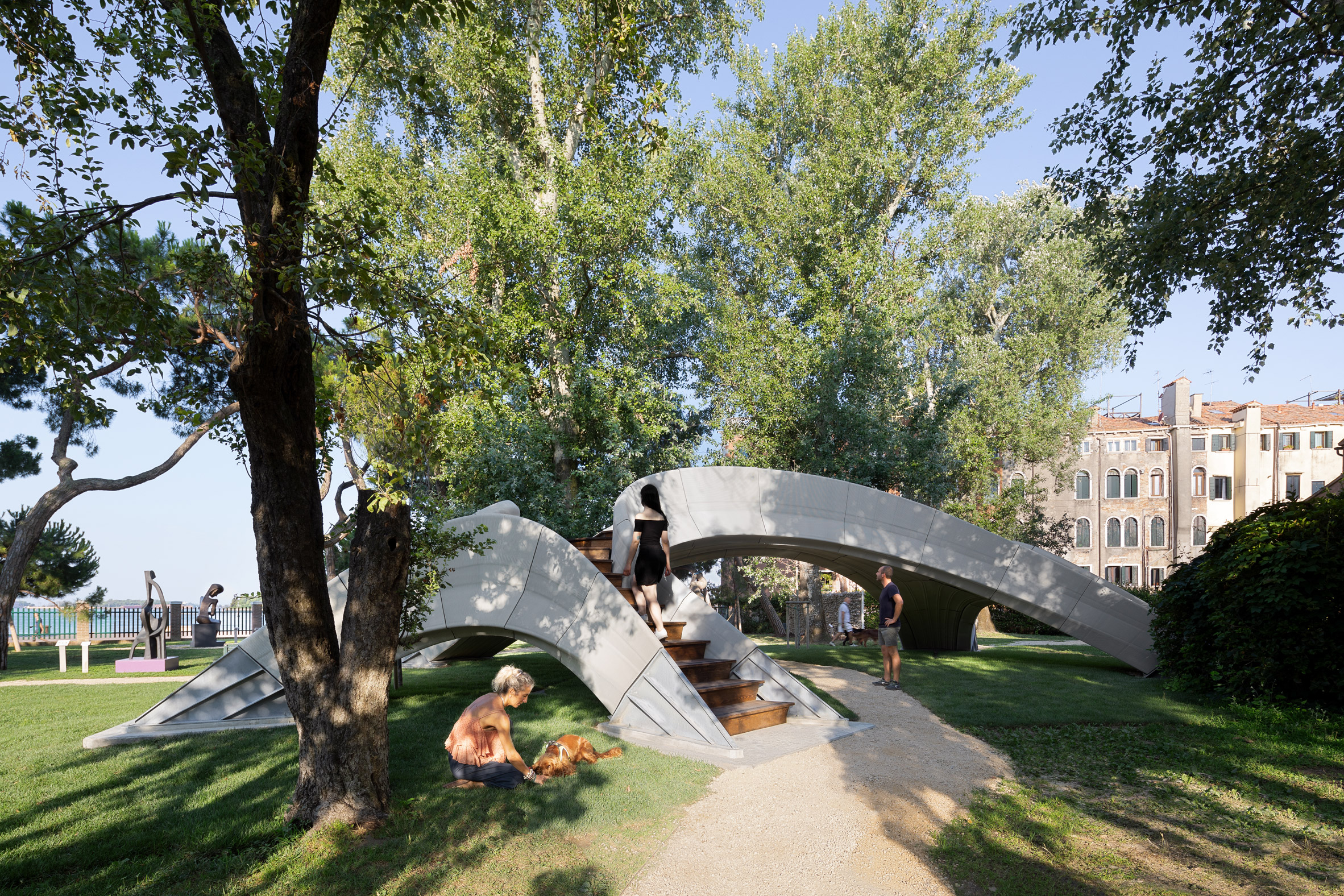
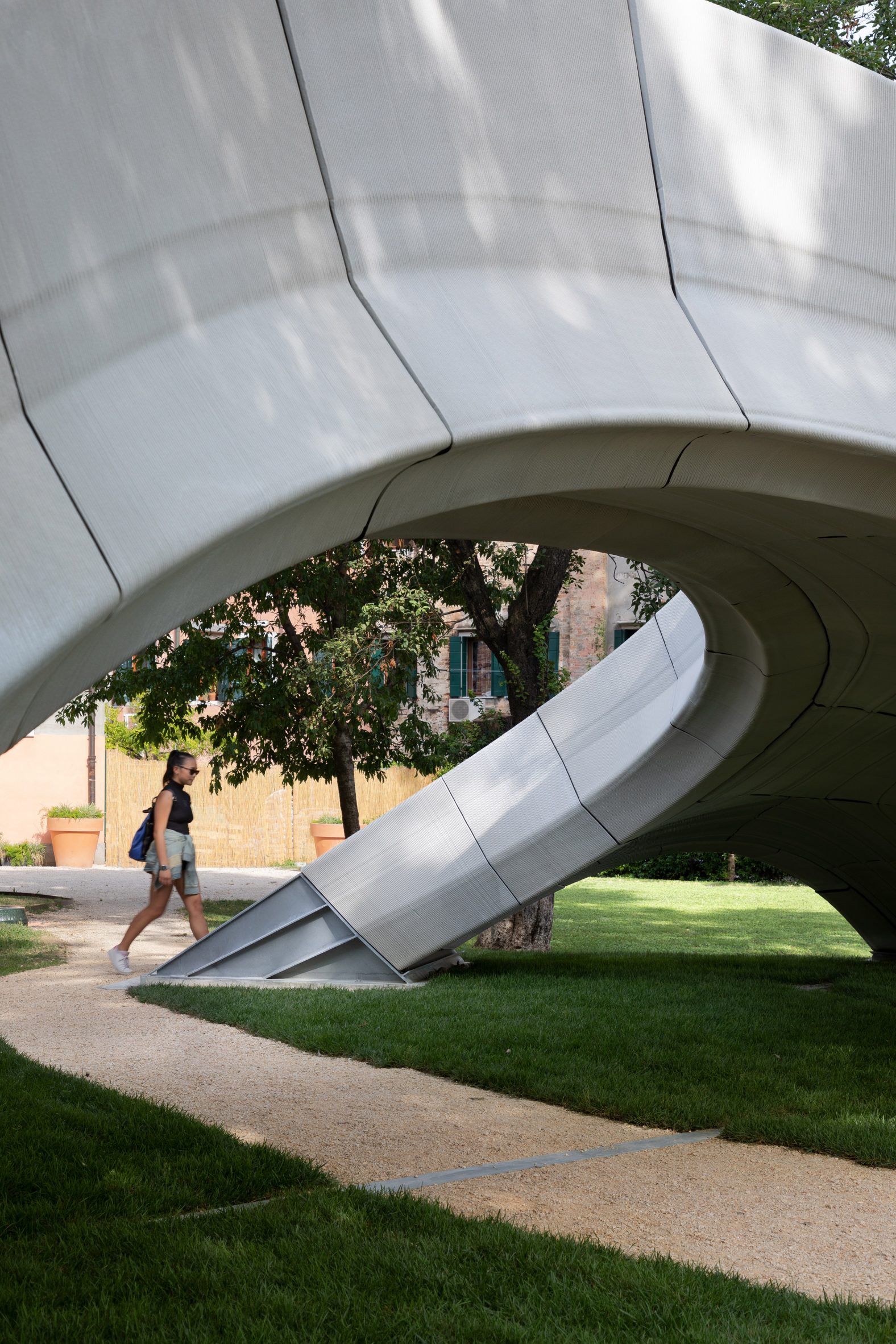
Named Striatus, the 16-metre-long bridge was built by the computation and design team at Zaha Hadid Architects, known as ZHACODE, in collaboration with the Block Research Group (BRG) at Swiss university ETH Zurich. It was constructed from 53 hollow blocks each printed from 500 layers of printed concrete.
The structure is an unreinforced arched bridge that uses compression and gravity to hold its form. The studios arranged the 3D-printed wedge-shaped elements, known as voussoirs, to form arches and vaults.
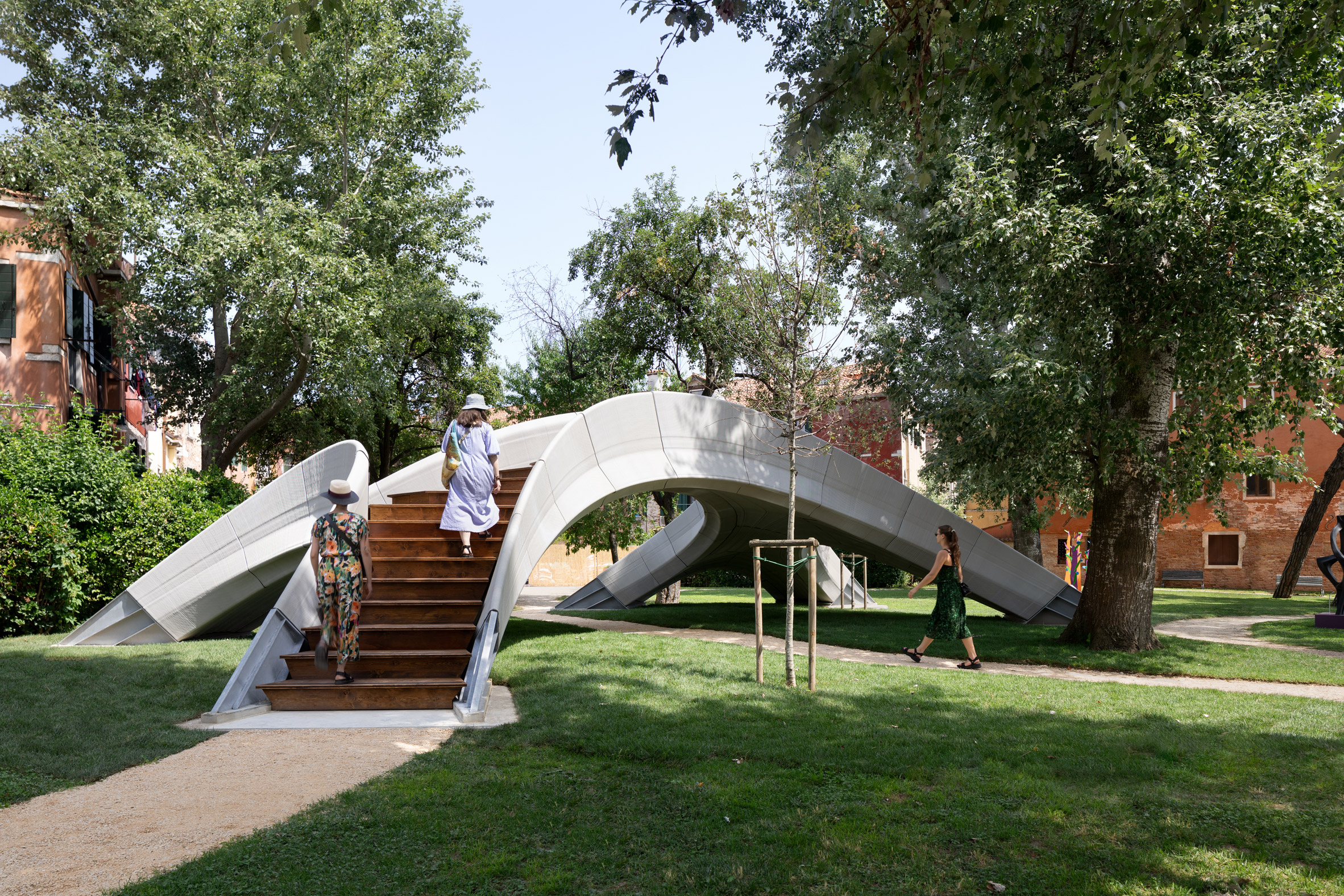
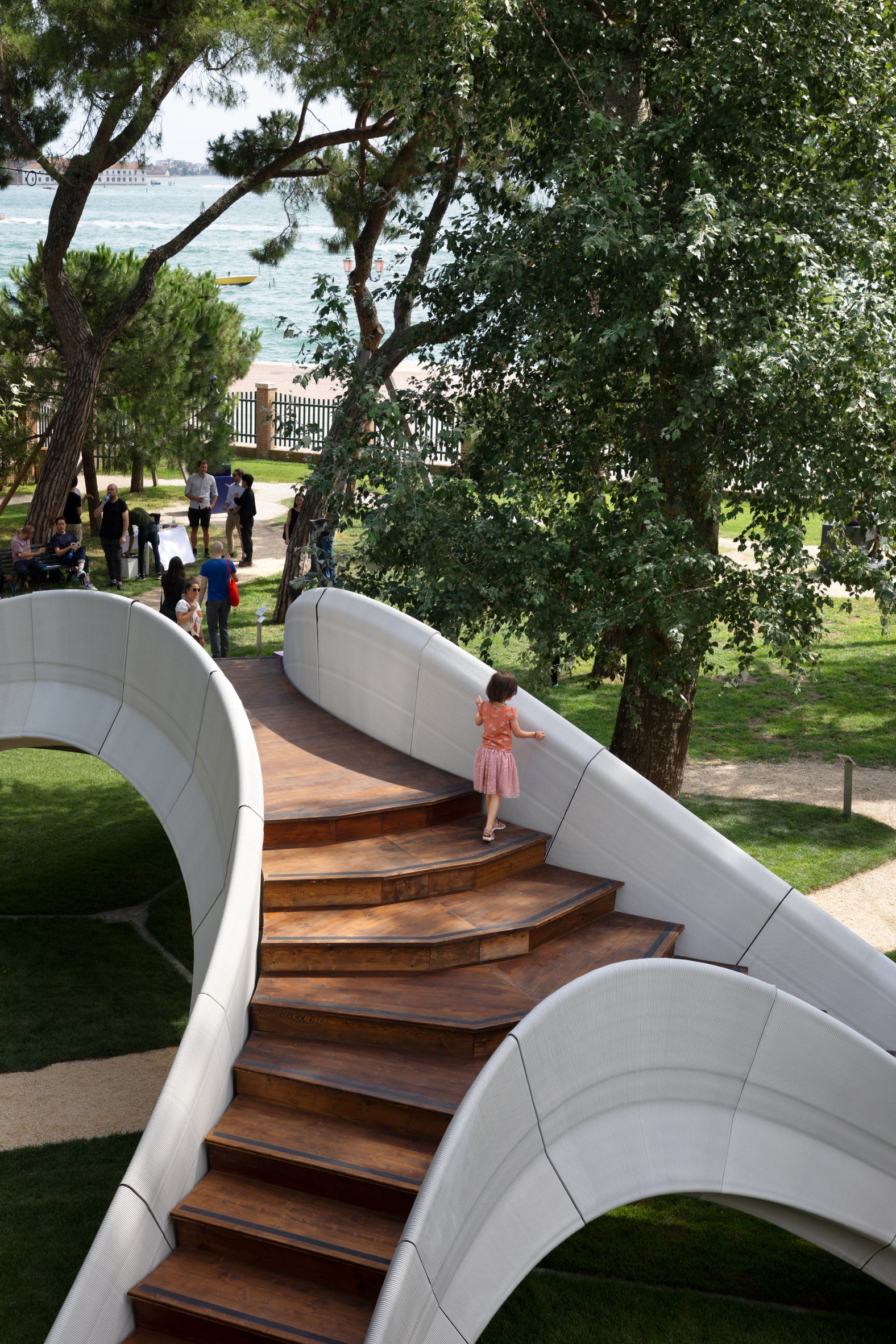
The bridge has a double-curved deck with swooping stepped entry points placed at either end of the bridge, leading up the structure from its footings.
The bridge has multiple entry points
"The intention was to meet the challenges facing the architecture, engineering and construction industry by demonstrating a responsible way to design with one of its most widely-used and enduring materials - concrete," ZHACODE co-founder Shajay Bhooshan and BRG co-director Philippe Block told Dezeen.
"To do so, we draw from and computationally enhance one of its most ancient wisdoms – masonry construction."
Printed blocks transfer the load to the footings
The studio looked to historic masonry vaulting to inform its design, placing the printed pieces in a way that allows the load of the structure to be distributed its foundations without the need for internal ancillary support such as post-tension cables.
No glue or adhesives were used during the construction, instead, neoprene pads were placed between each of the printed blocks during assembly to control the levels of friction and stress concentration. External ties were added to the bridge to absorb the thrust tension.
The bridge is on display at the Venice Architecture Biennale
"The discrete blocks of the funicular structure are held together only by gravity in compression, so, all blocks remain compressed together along with the individual print layers, using the same principles as Gothic cathedrals or structures like Armadillo Vault," said Bhooshan and Block.
"Striatus could literally stand happily for centuries as historic masonry construction has done, because forces are transferred in a way that is very natural for concrete, through compression only, and with very low stresses, i.e. not demanding much from the material."
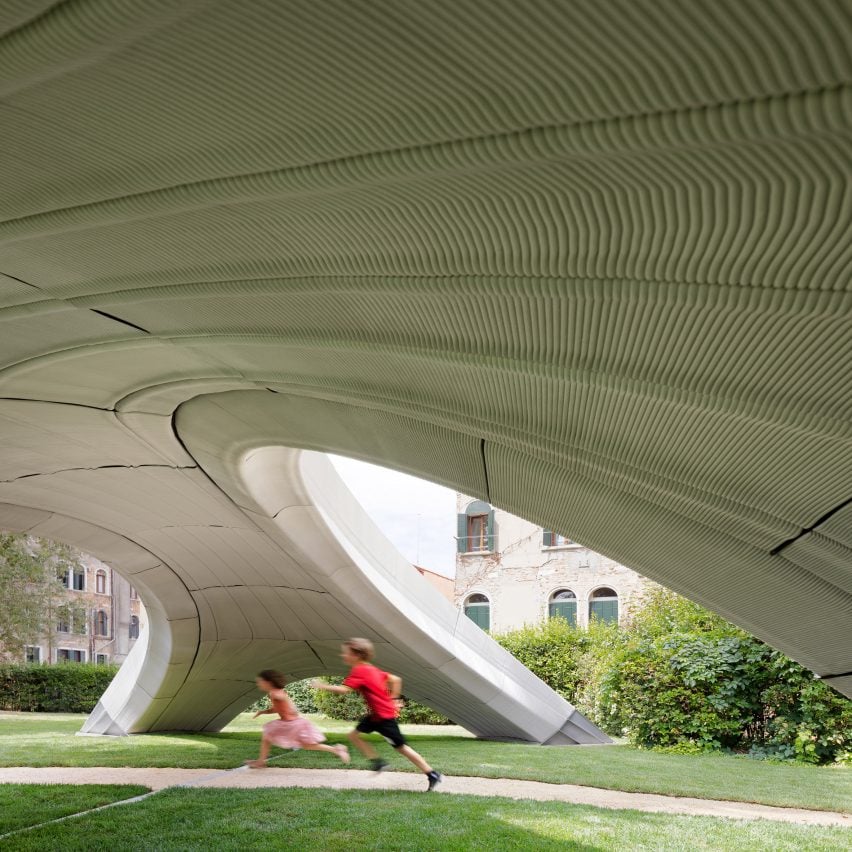
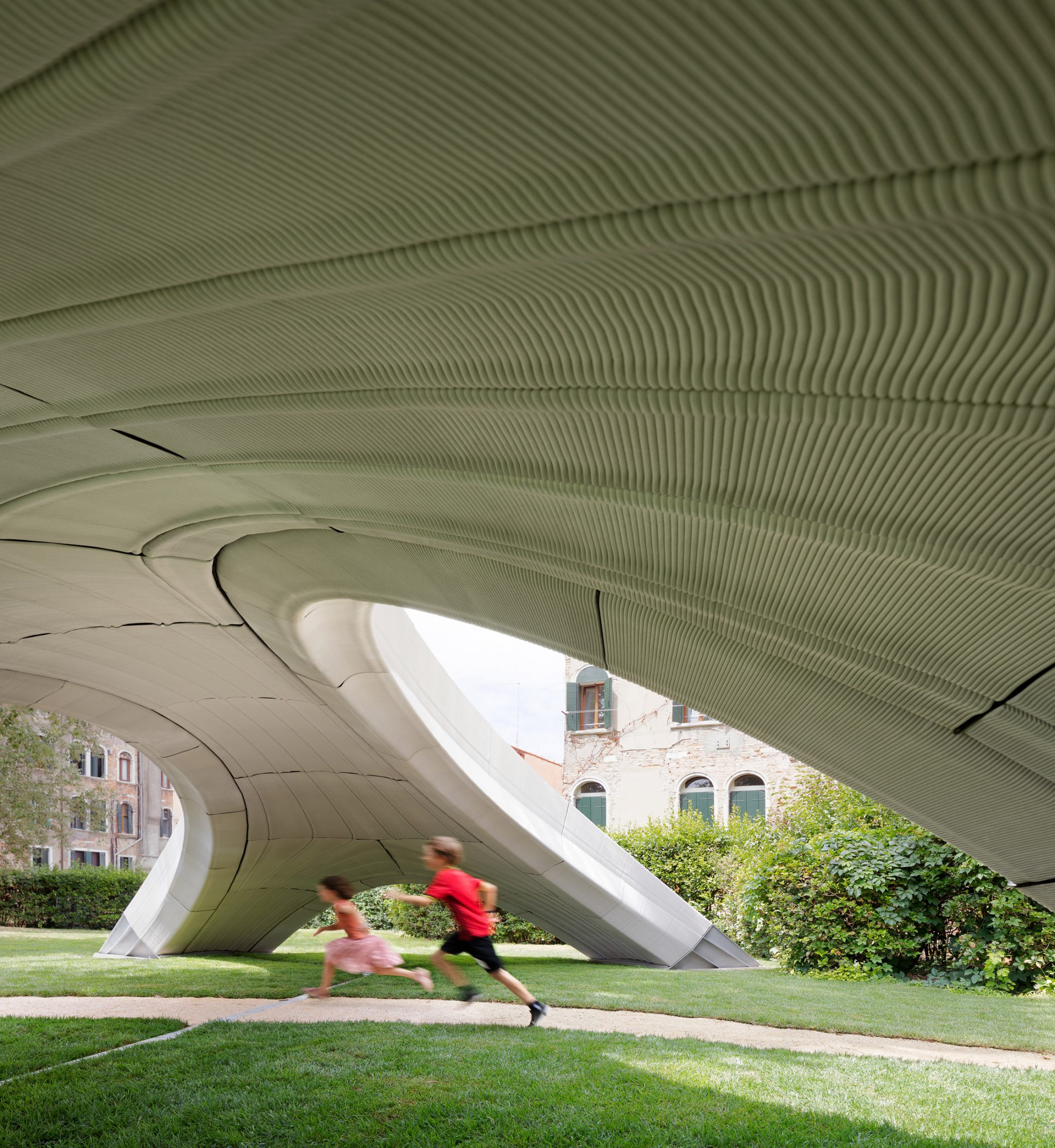
Contrasting to typical 3D-printing methods, which use horizontally layered extrusion techniques, the bridge used a single six-axis robotic arm to print non-uniform and non-parallel layers across its 53 blocks.
The 53 blocks took 84 hours each to print while its construction, including foundation casting, assembly and stair and deck installation, took 35 days.
The bridge has a wooden deck
By creating hollow 3D-printed blocks, the structure aims to reduce typical material use and consumption. While its voussoir-style construction and lack of internal structural reinforcement means that the bridge to be easily disassembled and reused.
The bridge was installed at the Giardini della Marinaressa at the Venice Architecture Biennale as an opportunity to exhibit the capabilities of unreinforced concrete and computational design.
Each block was printed with over 500 layers of concrete
"We wanted to demonstrate that 3D-printed concrete elements can be used directly as structural components when designed as an unreinforced masonry system," said Bhooshan and Block.
"Not only for a straightforward vertical, like a wall or moderately corbelling structure but for the more challenging structures that span space."
Printed layers form a ridged texture
Although the structure was produced using concrete, Bhooshan and Block explained that they hope materials such as low-embodied-carbon concrete or earthen concrete can be developed for such printing techniques.
"The challenge now is for material scientists to make [low-embodied-carbon concrete] 3D printable," explained Bhooshan and Block.
"These materials and manufacturing improvements are being actively developed and point to positive prospects of improving on the benefits of 3D concrete printed masonry demonstrated in Striatus."
The bridge's material use came under fire with architect Philip Oldfield calculating that the stainless steel used in the structure has an estimated 27.7 tonnes of embodied carbon.
The studio stated that Heatherwick isn't currently working on the project and was only asked to advise the government on the commemoration.
"Despite recent reporting, we'd like to confirm that Heatherwick Studio isn't involved in designing a national Covid memorial," the studio told Dezeen.
"As designers who have experience creating moments of national significance, we were approached in an advisory capacity."
According to the studio, the meeting was solely "about exploring appropriate ideas" rather than any plans for a memorial.
"Covid has affected us all and finding the best way to commemorate those who lost their lives and those who gave so much to save lives is a huge and serious matter requiring the thoughts of many," it continued.
"Unlikely that the studio would be the right choice"
British prime minister Boris Johnson has established a UK Commission on Covid Commemoration, to develop ideas and a timeline for a future memorial.
"I also know that communities across our whole country will want to find ways of commemorating what we have all been through," he said.
"This national endeavour – above party politics – will remember the loved ones we have lost."
Heatherwick Studio confirmed that there are no plans for the studio to be involved in designing a coronavirus memorial in the future.
When asked whether the studio would consider being involved in the project, the studio replied that "it feels unlikely that the studio would be the right choice".