Friday, 6 August 2021

Volkan Alkanoglu designs cedar bridge to resemble a driftwood branch

Pedestrian bridge spanning a creek in Fort Worth

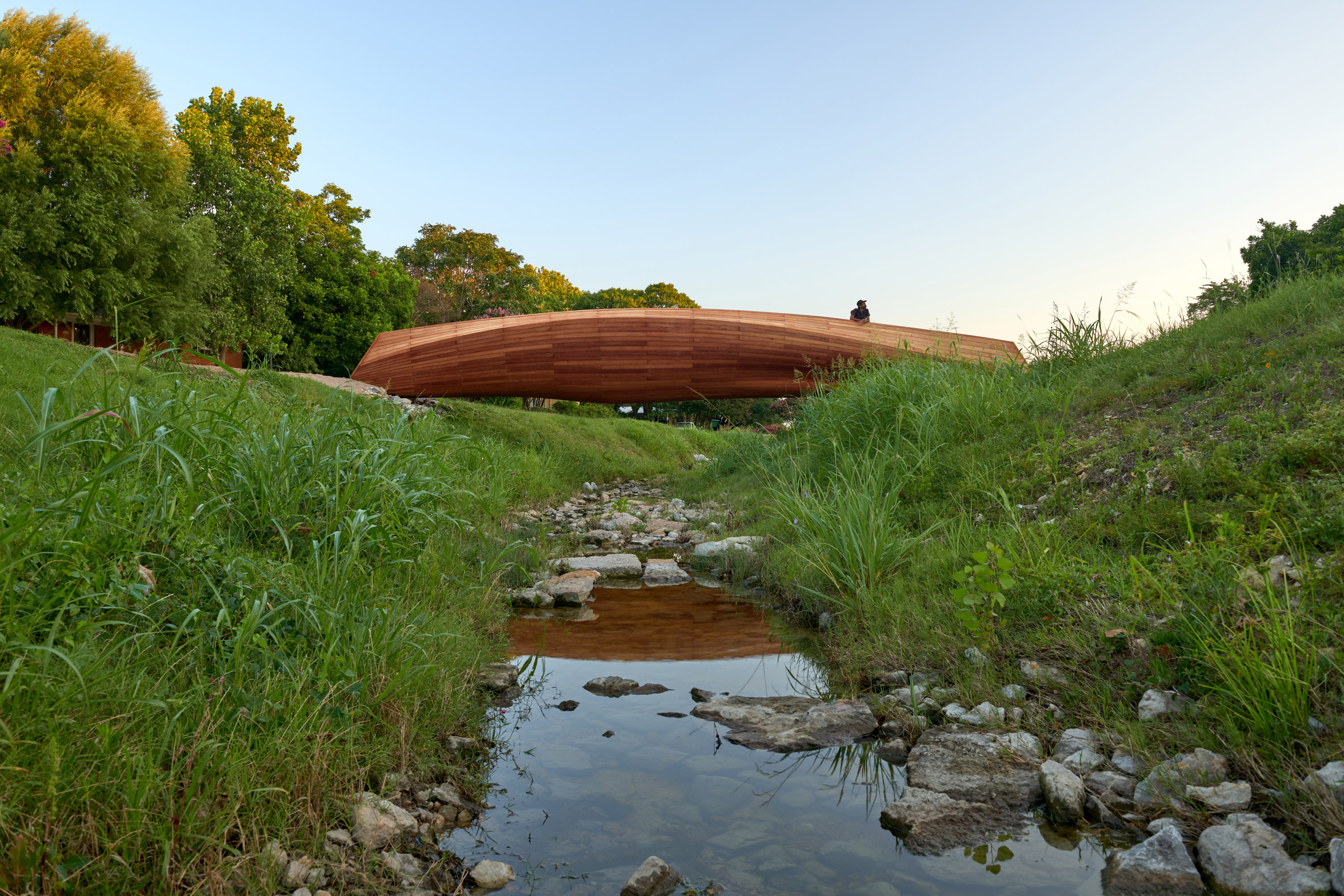
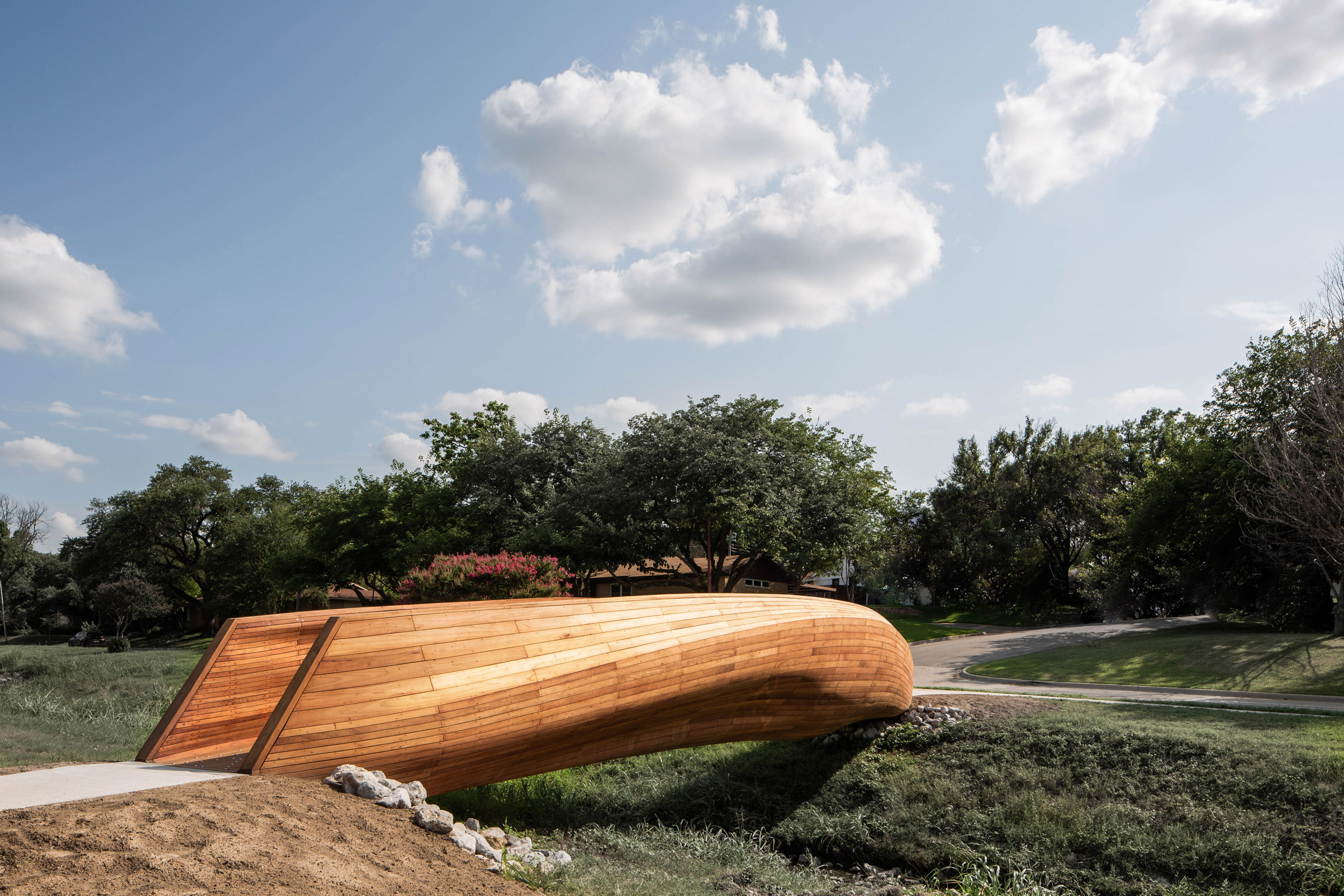
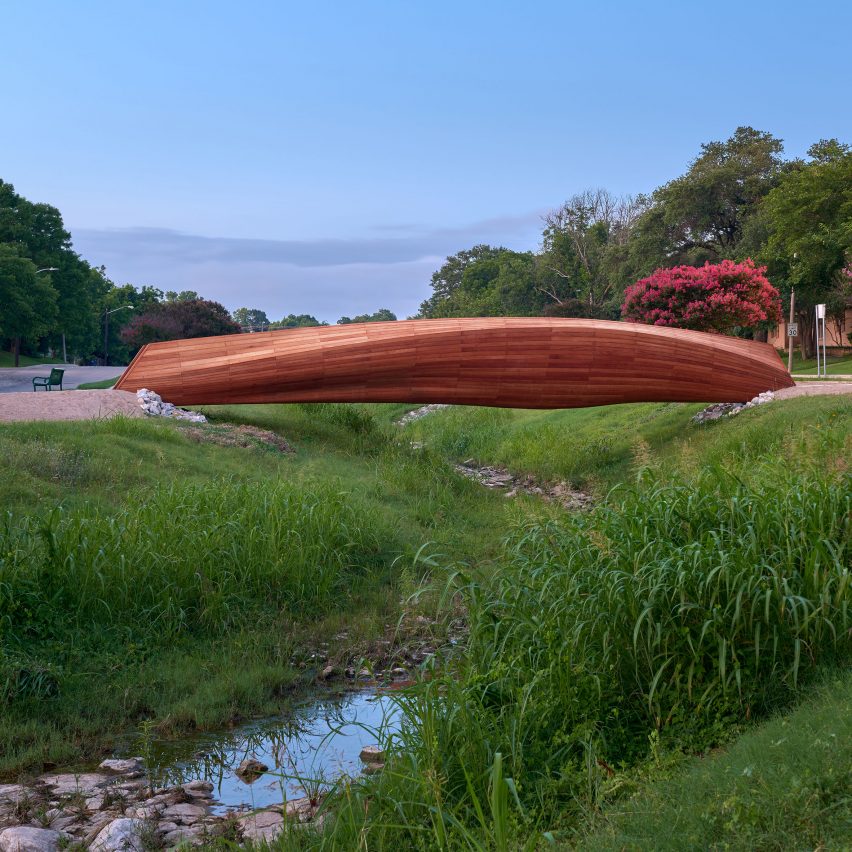
Portland designer Volkan Alkanoglu has spanned a creek in Fort Worth, Texas, with a sculptural timber bridge named Drift.

The timber and steel bridge was built over a gully in the city's South Hills residential area to form a connection between two parks and communities along the Trinity River Trail system.

Bridge resembling driftwood
The Drift bridge was commissioned by Fort Worth Public Art

With no route across the waterway for seven blocks, the Fort Worth Public Art programme commissioned Alkanoglu to design a structure that could act as both infrastructure and sculpture.

His response to the brief was a bridge that used sustainable materials and aimed to have minimal impact on the site while keeping within the $375,000 (£270,000) budget.

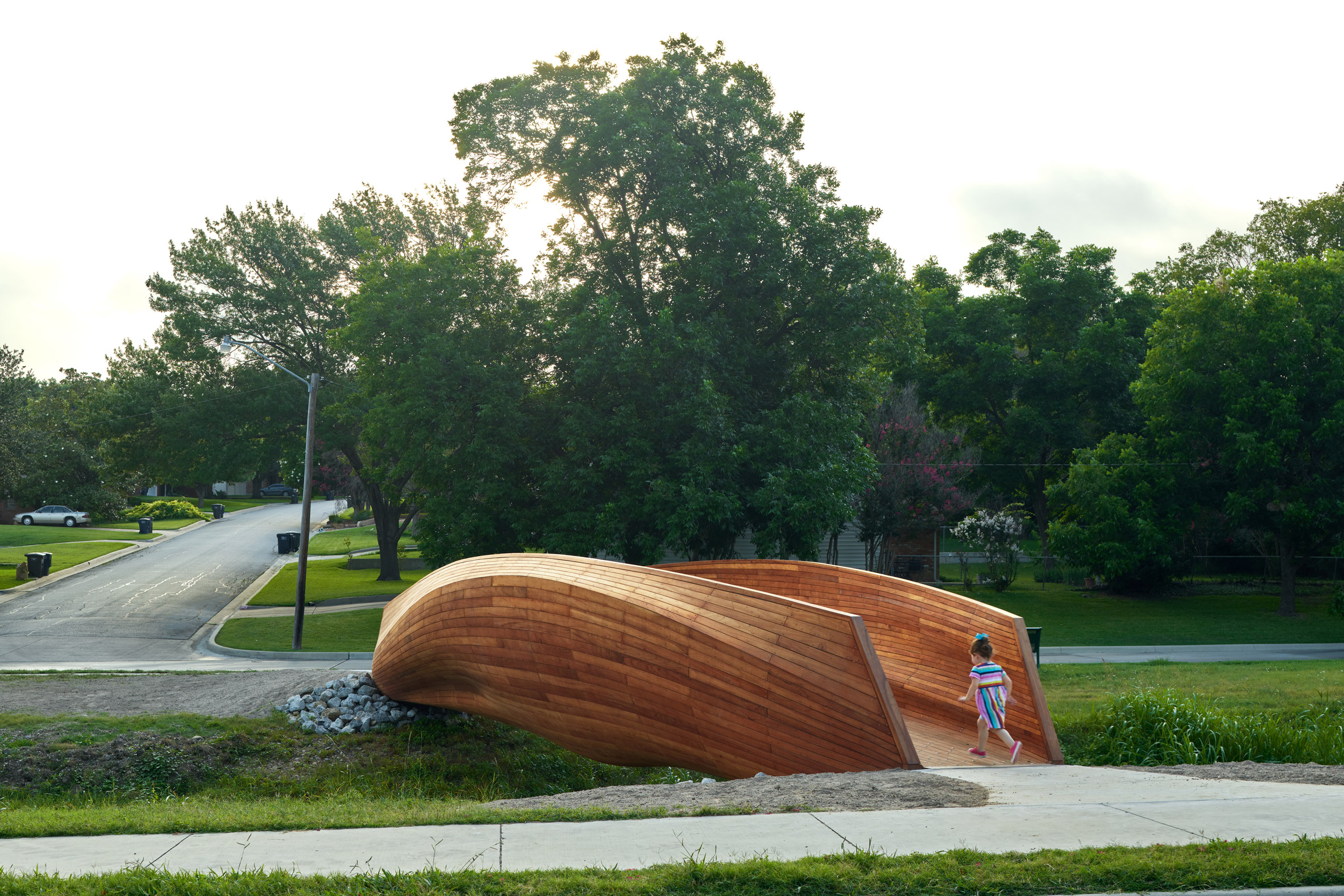
Girl running onto pedestrian bridge
The pedestrian bridge spans a creek, connecting a trail and two neighbourhoods

The design was informed by the creek's seasonal transformation from a flowing stream to a dry, driftwood-filled basin.

Another point of reference was the innovative plywood leg splint designed by Ray and Charles Eames for soldiers wounded in the second world war, which dates back to the same era as the neighbourhood's midcentury houses.

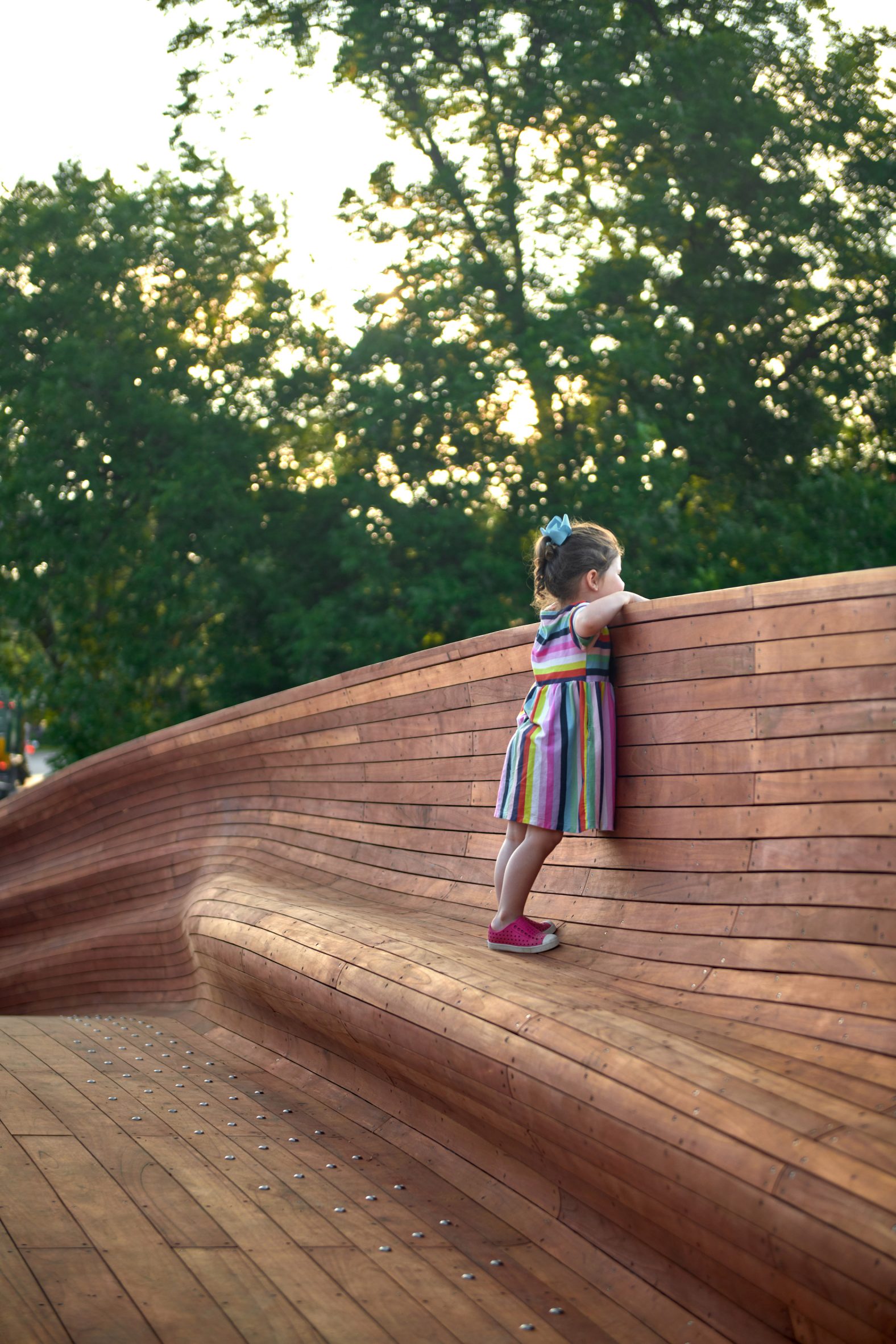
Girl standing on wooden bridge
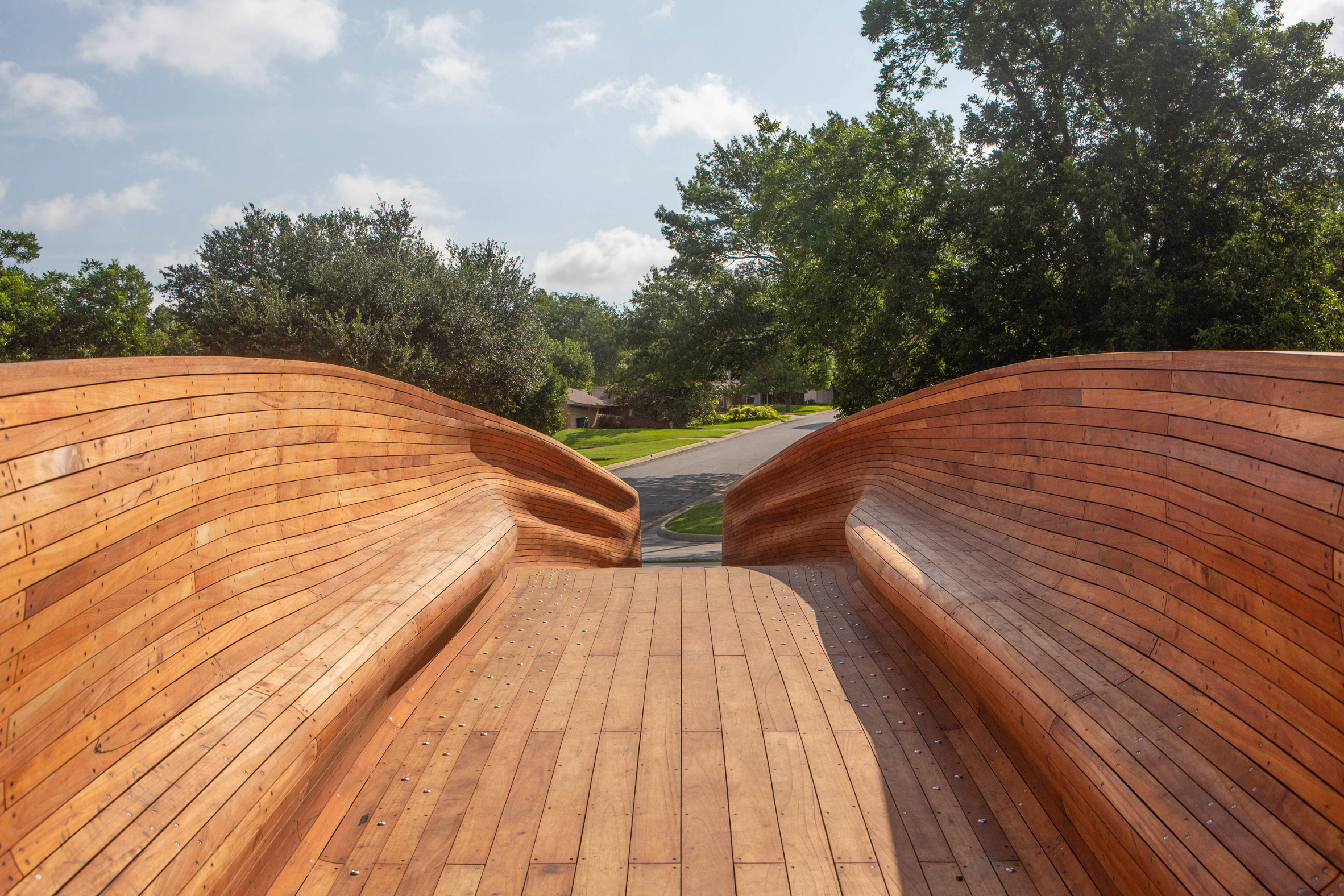
Benches and railings are integrated into the curved wooden form

Originally intended to be made entirely of cross-laminated timber (CLT), but constrained by the budget, the final bridge structure was built around a steel armature clad in CNC- and flip-milled planks of Spanish cedar.

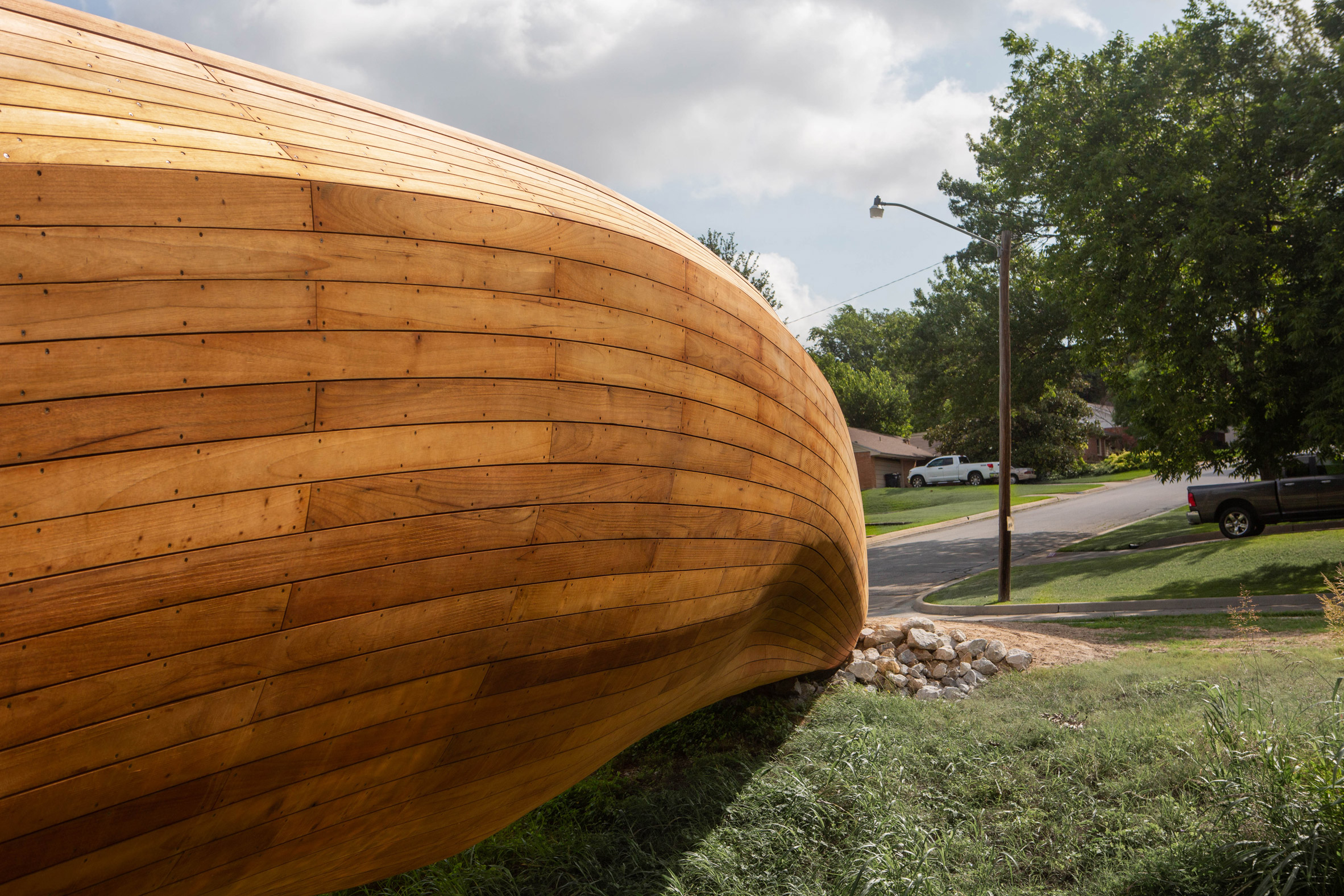
"Each plank was custom cut, then stack-laminated into one large, volumetric, undulating form," said the studio.

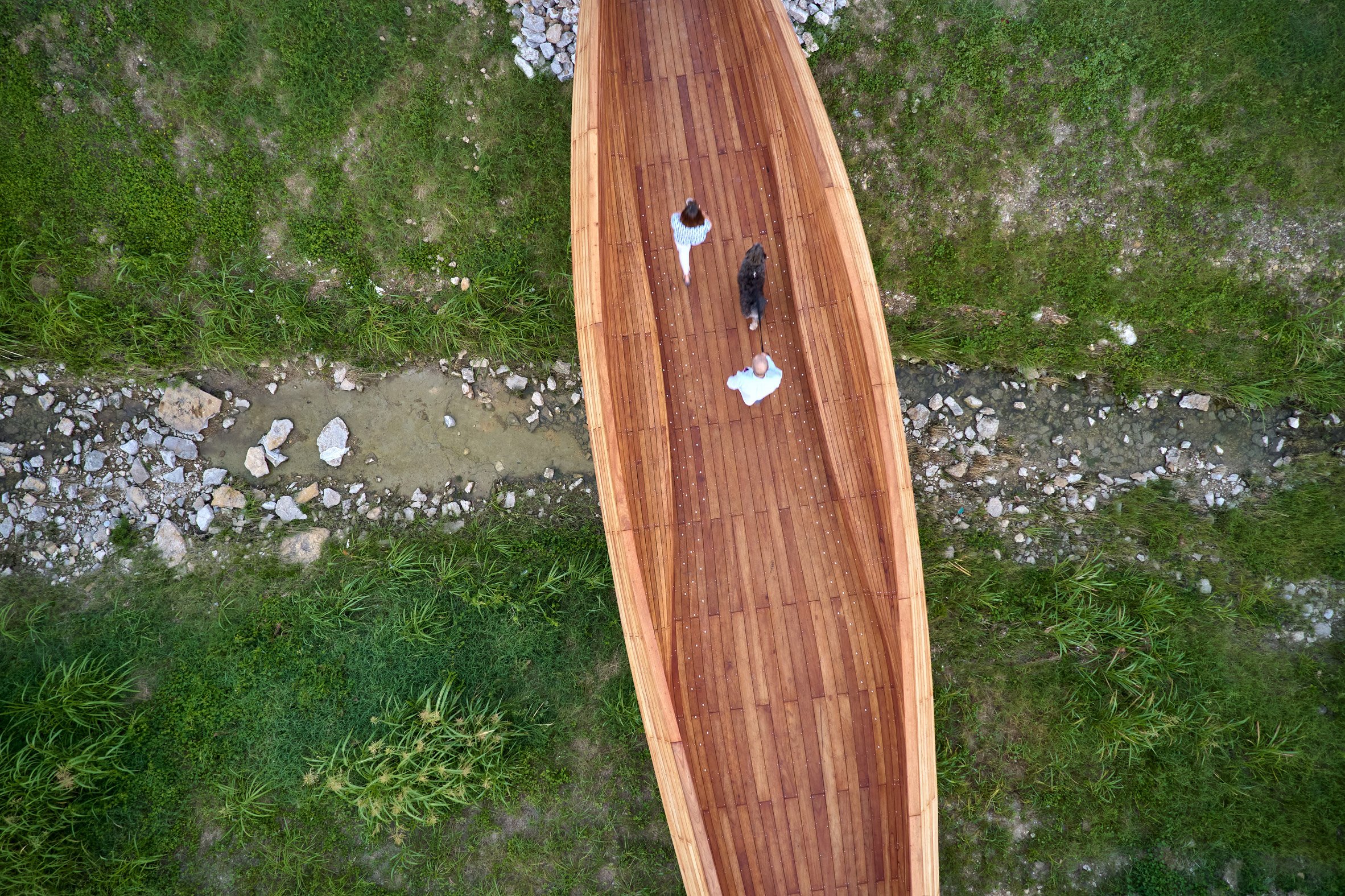
Aerial view of Drift bridge
The bridge was constructed off-site and craned into place in one piece

"In this way, the bridge could be fabricated off-site, transported to the location by an oversize truck as one piece and lifted into place with a crane," explained Alkanoglu, who added that installation took no longer than a couple of hours.

Measuring 62 feet (19 metres) long, the bridge is reminiscent of a hollowed log or canoe.

Railings and benches are embedded along the length of its curved sides, allowing pedestrians to pause and take in the scenery.

The wooden form is balanced on piers, which act as foundations on either bank and include a rip-rap drainage system to minimise the structure's footprint.

View across bridge showing integrated benches
Designer Volkan Alkanoglu referenced shipbuilding techniques to create the sculptural form. Photo by Jennifer Boomer

"While stitching the urban neighborhood fabric back together, Drift also offers social and ecological opportunities for the local community through the use of sustainable principles, which can alter our collective understanding of the built environment," added the designer.

Drift is the first infrastructure project by Alkanoglu, who runs his studio VA Design out of Portland, Oregon.

Close up of curved bridge underside
Foundations and drainage on either bank are designed to have a minimal footprint. Photo by Jennifer Boomer

He describes the bridge as an example of "plug-and-play urbanism", an "economically feasible way to produce mid-scale infrastructure offsite and deliver it to its urban context".

Alkanoglu's previous work includes a number of sculptural interventions intended to transform the built environment through inventive material explorations.

Bridge connecting to neighbourhood pathways
The bridge is an example of what Alkanoglu describes as "plug-and-play urbanism". Photo by Jennifer Boomer

As a typology, the pedestrian bridge has allowed many architects and designers to experiment with unusual shapes and materials.

A crossing that was 3D-printed in stainless steel recently opened in Amsterdam while students in California completed a bridge with the help of industrial robotic arms earlier this year.

The photography is by Peter Molick unless stated otherwise.


Project credits:

Design: Volkan Alkanoglu
Client: City of Fort Worth, Fort Worth Public Art Program
Public art manager: Anne Allen
Fabrication: Ignition Arts, Brownsmith Studios
Structural engineering: CMID Engineers
Geotechnical engineering: Alpha Testing
Material testing: Simpson, Gumpertz & Heger
Concept engineering: AKT II

The post Volkan Alkanoglu designs cedar bridge to resemble a driftwood branch appeared first on Dezeen.


from Dezeen https://ift.tt/37m7feV

Ten architecture projects from National University of Singapore master's students

The Water Parliament – Bangkok City 2100

A floating fish farm and a water-based Parliament for Bangkok in 2100 are included in Dezeen's latest school show by students at National University of Singapore.

Also included is a project to repurpose telephone exchange buildings as infrastructures of counter-surveillance and a park with architectural inventions added to recreate the spatial language of cruising.


National University of Singapore

School: Department of Architecture, School of Design and Environment
Course: Masters of Architecture

School statement:

"The NUS M.Arch Show 2021 showcases the thesis projects of the graduating Master of Architecture students from the National University of Singapore; a collection of bold questions and propositions displaying the expertise obtained in architectural education. A year-long undertaking, the thesis is an arduous yet joyful journey, where conversations, critiques and references gently nudge students towards certain contemporary and relevant trajectories, organically converging into communities of practice where the works collectively resonate with one another.

"Convergence occurs along five discursive threads, which form the five clusters of the show: Critical Architecture, History & Heritage, Sociopolitics & Geopolitics, Technologies and Urbanism & Environments. Each cluster is uniquely positioned to probe the limits of the discipline, and to respond to the demands of wider society.

"Critical Architecture interrogates the discipline itself. The thesis work in this cluster seeks to identify and challenge architectural convention, forming propositions of design that provoke, satirize, or gently disturb the expectations of architecture and what the field encompasses.

"History & Heritage gathers sites and stories that were lost in the pursuit of rapid development and urban progress. The theses of this cluster anchor onto overshadowed historical and cultural artefacts; through this they consider a spectrum of strategies and positions that navigate the tricky entanglement between the oft-conflicting demands of the past and present.

"Sociopolitics & Geopolitics deliberates on architecture's capacity to contribute to the public good, at the crossroads of policy, ideology and society. Fieldwork and research bring to light fissures in the built environment that emerge from manifold agendas. The theses take aim at these socio-spatial injustices. Alternative hierarchies, boundaries, notions of work, welfare, and education are imagined – potential futures in which these status quo might be destabilised through optimism and design.

"Technologies argues that architecture, entwined with making, doing and craft, cannot be divorced from the techie which influences it. Thus, technology, no longer mere device for representation, has become a tool for thinking, optimising and materialising ideas into form. The theses featured in this cluster capitalize on these advancements, offering a window into architecture's future.

"Urbanism & Environments takes the position that architecture is inherently ecological, mediating an extensive network of relationships beyond our immediate, perceptible senses. The cluster recognises the need for new economies to emerge; its propositions suggest new ways of living amidst large scale forces such as increasing urbanisation, the pandemic and global warming.

"Moving through the five exhibitions of our show, the five threads intersect and overlap, creating a hazy cloud of interrelationships and connections that we find as interesting as the individual work themselves. As thesis projects turn into continuous research embarked by the authors, it is also paramount that these ideas flow and are made public, to be reinterpreted and to exist in the future work of others. Our show will gather people and audiences through several events for this purpose, and we hope that the conversations that avail will appeal and excite the community."


How To Live With Another

How To Live With Another

"This thesis begins at home, with my grandmother and her helper Asri. It ends by testing the potentials of architecture – its epistemological and professional capacities to address the production of space speaking to social and class-based proximities.

"Three devices are conceptualized through household materials – bamboo laundry poles, used teabags, recycled magazines, and methods – knotting, weaving, sewing, crossing over from domestic chores into the architecture studio.

"Presented from occupants' perspectives through photography and ethnographic videography, how to live with another is politically gendered in its concerns for architecture's intersection with, and manifestation of, equity and voice."

Student name: Anthea Phua Yi Xuan
Course: Masters of Architecture
Tutor: Assoc Prof Lilian Chee

Normal Architecture

Normal Architecture

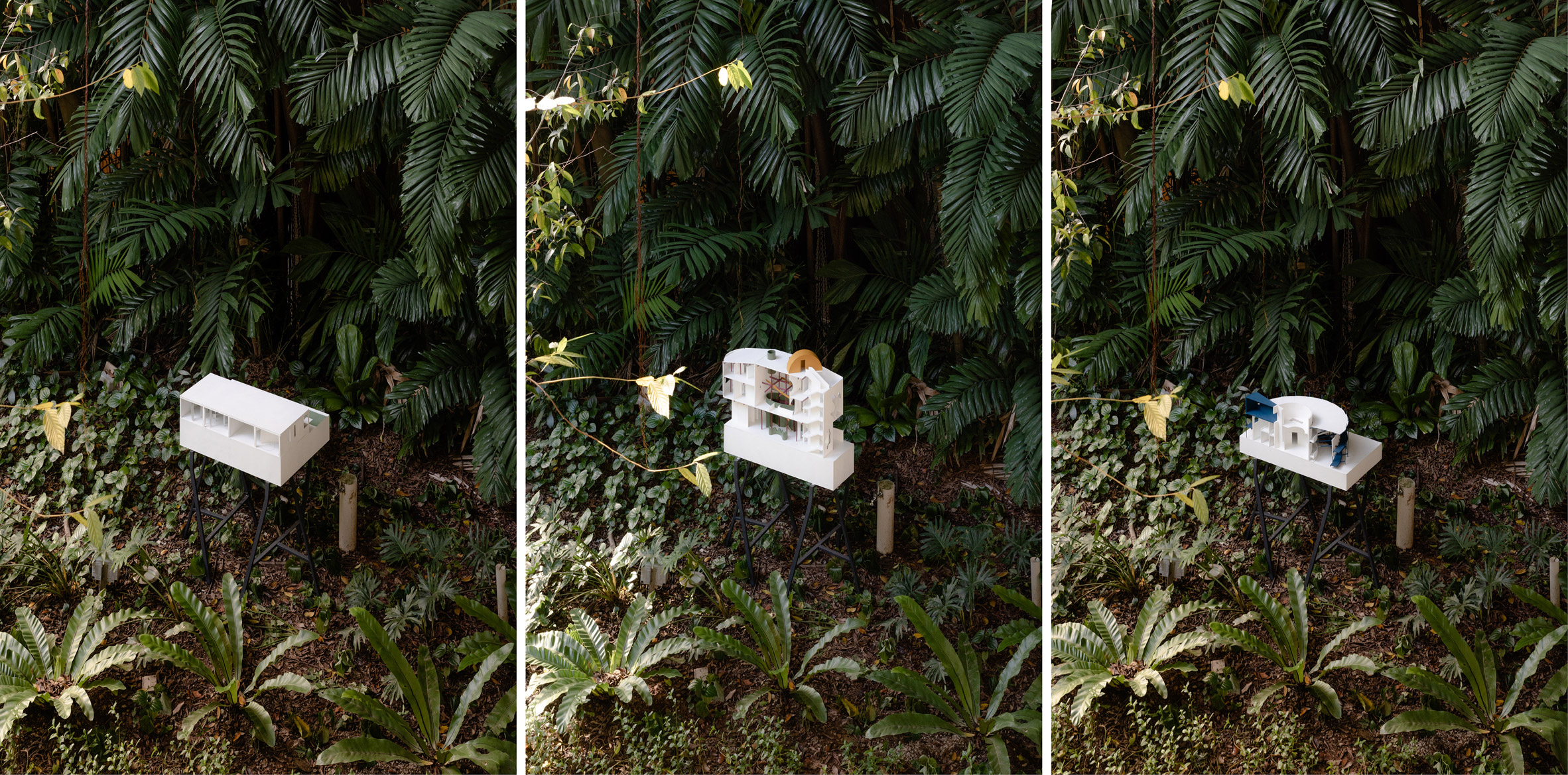
"This thesis treats the banal practice of architecture as an aesthetic project. Through the simple set-up of a game, three scenarios in practice are played out, mainly focusing on the performance of client and architect in the design of a residential programme.

"Normal Architecture reveals the compromise, friction and fighting activity hidden behind the perfect facade of architecture. This performance is a simulation of practice, a team sport rather than an artistic activity, taking shape directly to impact form and aesthetics. By exaggerating these moments into strange details, the entangled stories of architects, clients, and engineers are told."

Student name: Ong Chan Hao
Course: Masters of Architecture
Tutor: Prof Erik G L'Heureux

A Higher Calling

A Higher Calling

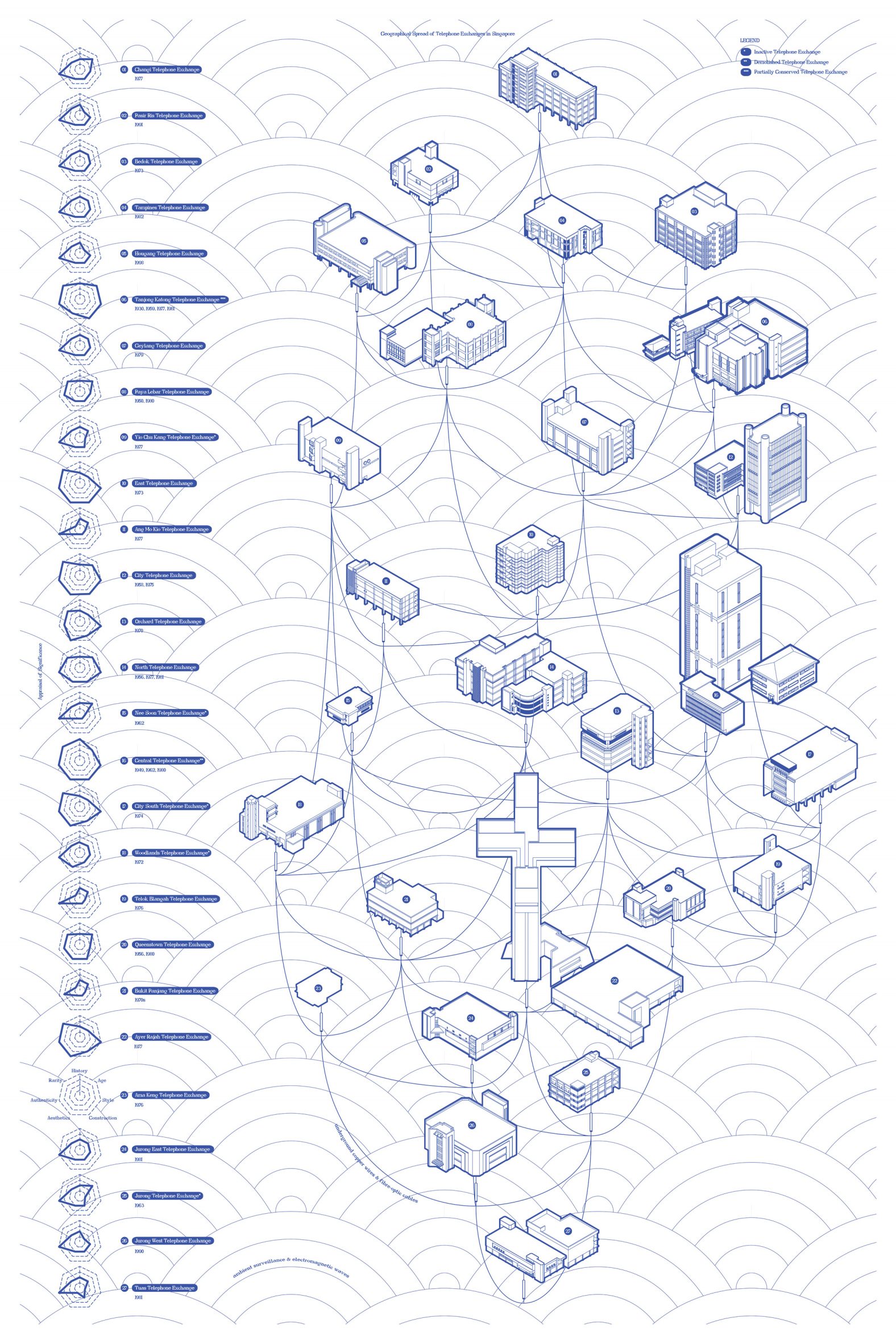
"A Higher Calling is an attempt to repurpose telephone exchange buildings as infrastructures of counter-surveillance. The improvement of telecommunication technology has led to the demolition of telephone exchanges despite their architectural rarity and heritage significance.

"While these infrastructures heralded in a new era of mass communications, they also expedited the onslaught of unwarranted and widespread surveillance. Building upon their characteristic architecture – island-wide geographical placement, visual inconspicuity, underground inter-connectivity, and windowless disposition – the thesis argues that networks of telephone exchange buildings should be conserved and repurposed as spaces of refuge and avenues for recourse, against an increasingly inevitable surveillance climate."

Student name: Jonathan Yee Chenxin
Course: Masters of Architecture
Tutor: Adj Asst Prof. Ho Weng Hin

To Food, With Love: Architecture of an Intangible Culture

To Food, With Love: Architecture of an Intangible Culture

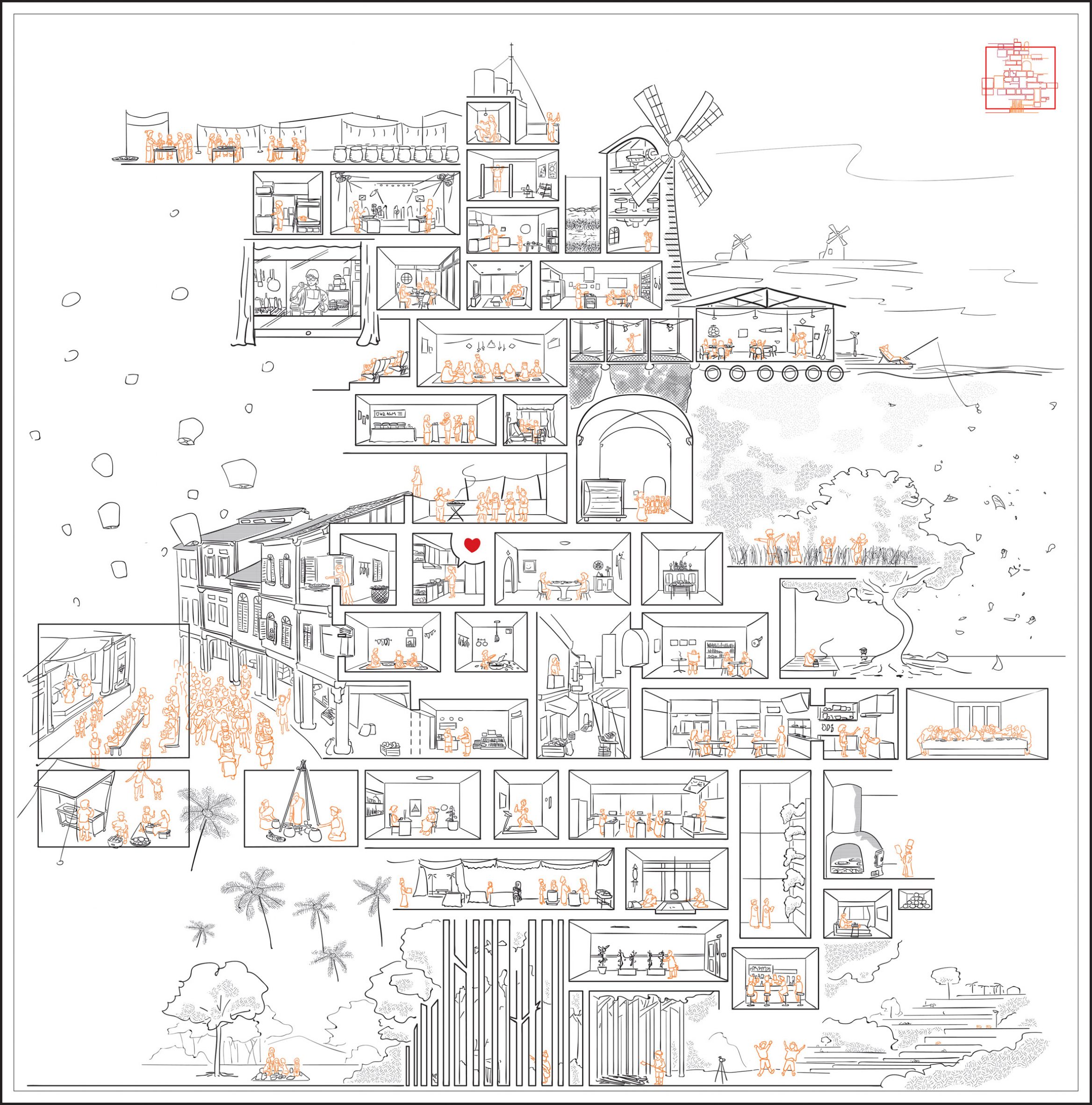
"Despite being intangible, hawker culture is indeed very much dependent on the spaces used to produce, distribute, prepare, and consume food. But what does it mean for the architecture when what is deemed as important heritage is not the building, but the activities contained within?

"Culture is not static, and neither is our culinary landscape made from just kitchens and dining tables. Yet we remain fixated on an idealised physical manifestation, the hawker centre, as the sole space of hawker culture, disregarding other spaces and processes. What then, is the scope and role of architectural design in conserving hawker culture?"

Student name: Sim Wen Wei
Course: Masters of Architecture
Tutor: Assoc Prof Chang Jiat Hwee

Transient Dormitories in Singapore Water

Transient Dormitories in Singapore Water

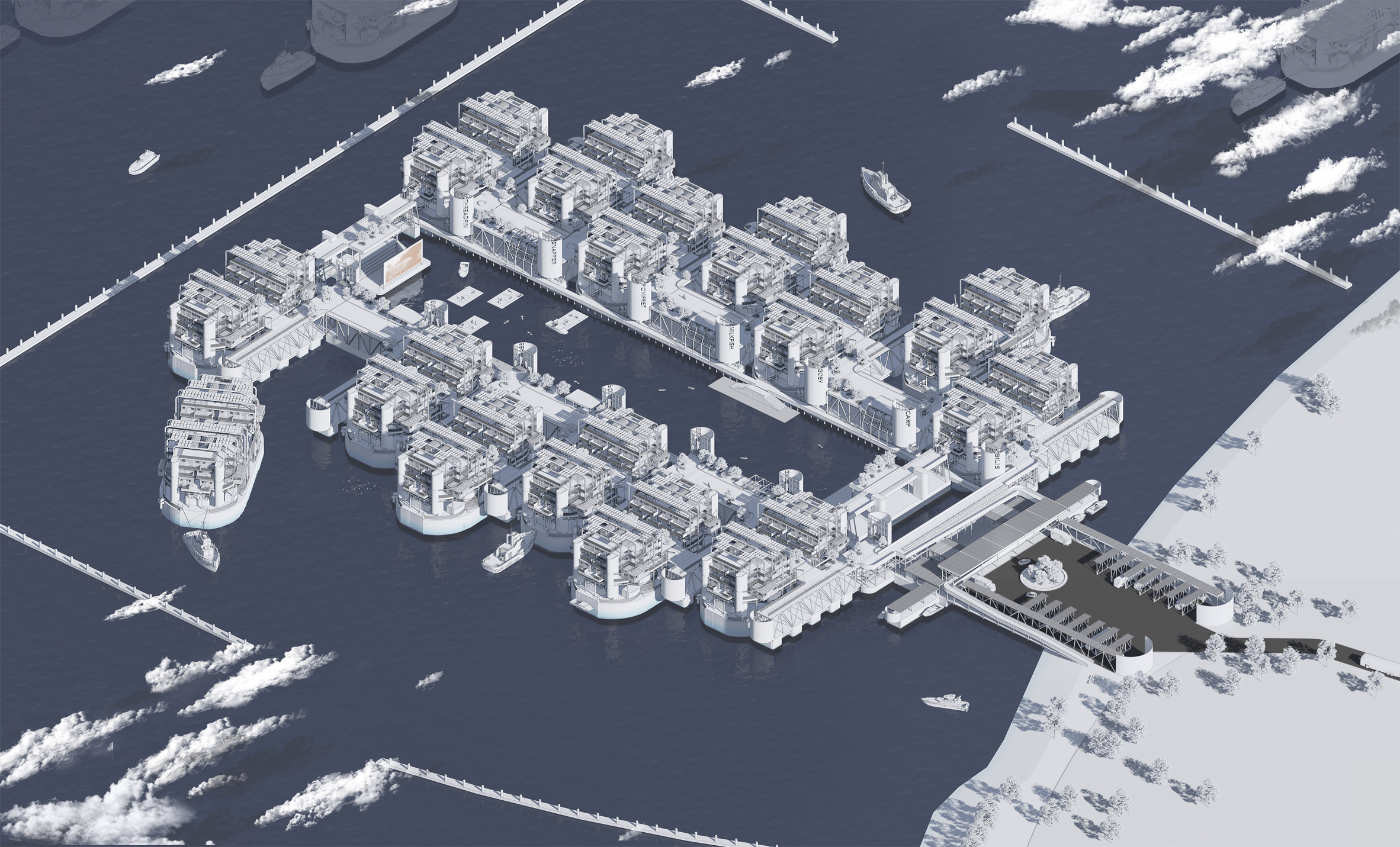
"The transient nature of workers housing and the growing demand for locally farmed fishes in Singapore provide temporal considerations to this architectural exploration. The co-location of worker dormitory and a fish farm on a floating platform is a hybrid architecture that capitalized on the coastal environment, mutualism as well as time-sharing arrangement of space to rethink better dwelling for the workers.

"As the demand for migrant workers in Singapore decreases in the future, spaces in these floating platforms can be transformed for fish farming or redeployed for other sea-based economic opportunities."

Student name: Loo Quan Le
Course: Masters of Architecture
Tutor: Assoc Prof Cheah Kok Ming

Pleasure Fields: Negotiating Queer Space and Time

Pleasure Fields: Negotiating Queer Space and Time

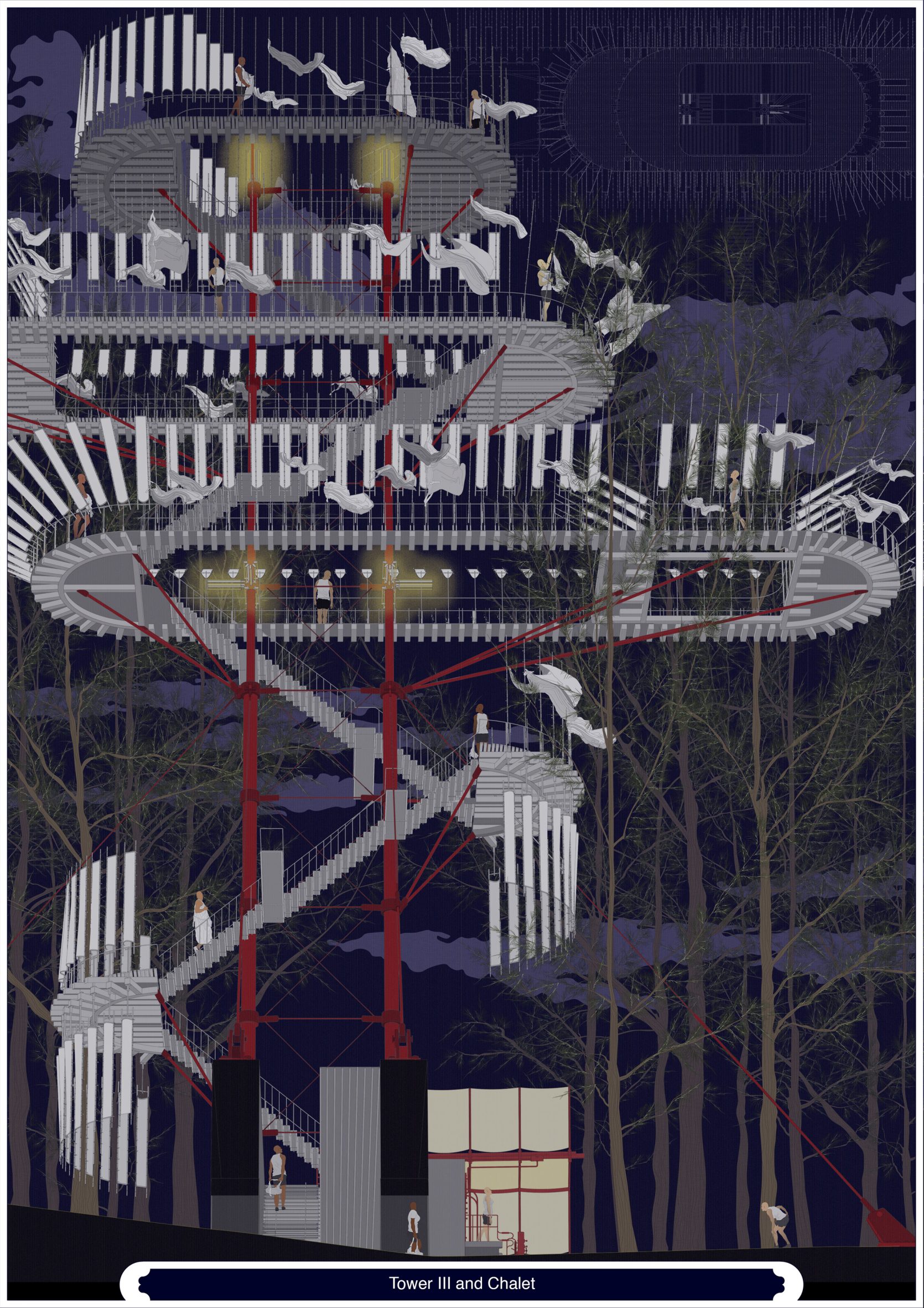
"The Pleasure Fields is a park that negotiates queer space and time in Singapore. Research into local cruising spaces concludes that the queer body's existence depends on its spatial and temporal context. Thus, the project proposes a counterpoint to how the body is state-programmed to reproduce future citizens via the heteronormative family unit.

"On an urban scale, the proposal experiments with how architectural interventions could ally with the site's trees and topography to gradually de-closet the queer body. Five architectural typologies then illuminate the spatial language of cruising through layering and appropriating spatial configurations previously known only to the cruiser."

Student name:  Ahmad Nazaruddin bin Abdul Rahim
Course: Masters of Architecture
Tutor: Assoc Prof Tsuto Sakamoto
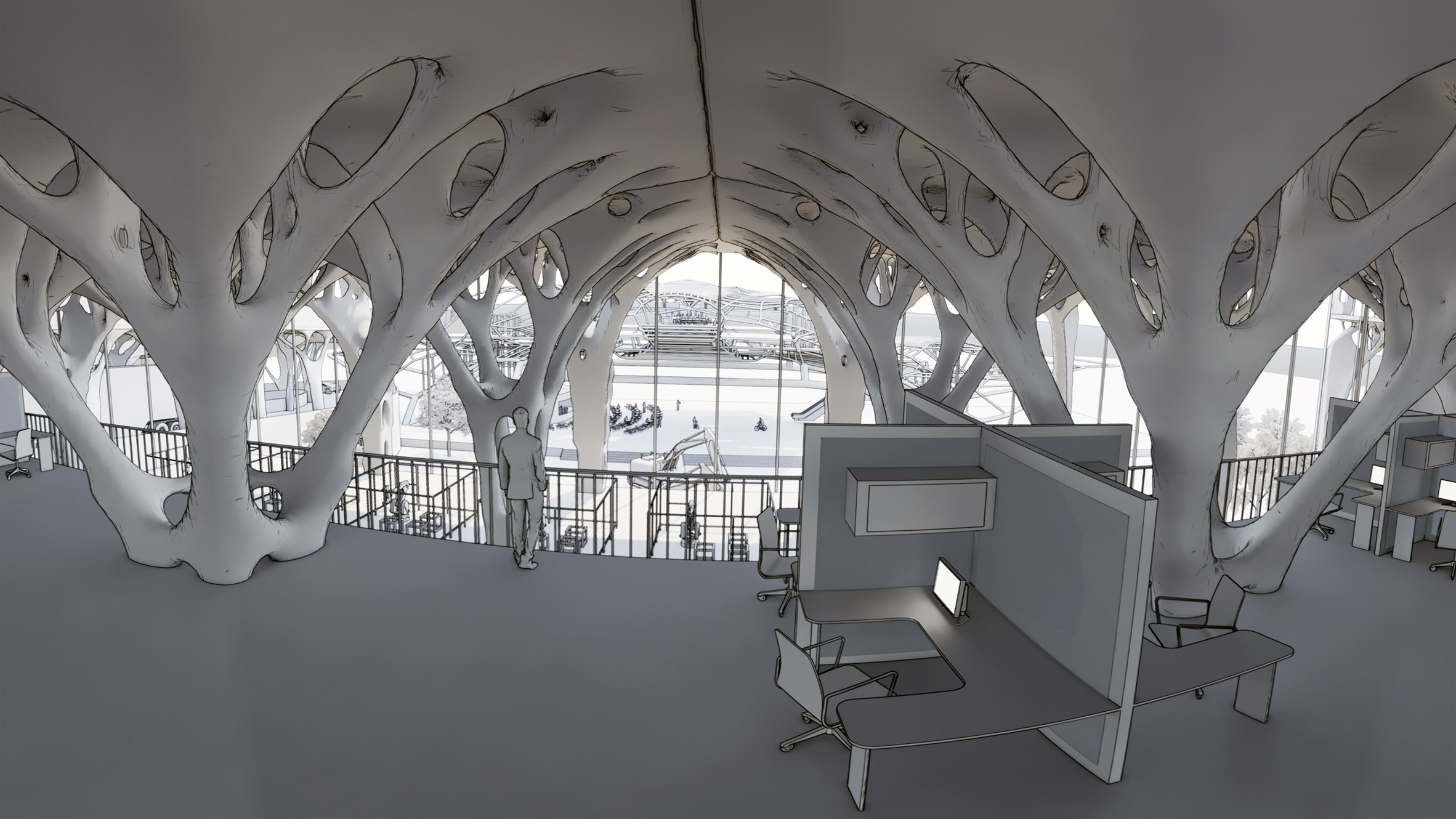

Deconstruction / Reconstruction : An analysis of architecture through the lens of Structural Optimisation

Deconstruction / Reconstruction : An analysis of architecture through the lens of Structural Optimisation

"Deconstruction / Reconstruction is a thesis that attempts to relook at architecture through the lens of structural optimization and digital fabrication. Reacting to the zeitgeist of the Fourth Industrial Revolution and Carpo's Second Digital Turn – the thesis deconstructs architecture into its elements, applying breakthrough structural optimization methods to the process of their design.

"Through a study of Topology Optimisation, Evolutionary Structural Optimisation (ESO), Graphic Statics, and Stress Line Analysis through recent work by Block, Xie and Akbarzadeh – the thesis studies how current design processes could be augmented with these structural toolkits and fabricated using digital fabrication methods such as 3D printing with the aim of reducing the material utilized in construction."

Student name: Lee Lip Jiang
Course: Masters of Architecture
Tutor: Assoc Prof Rudi Stouffs
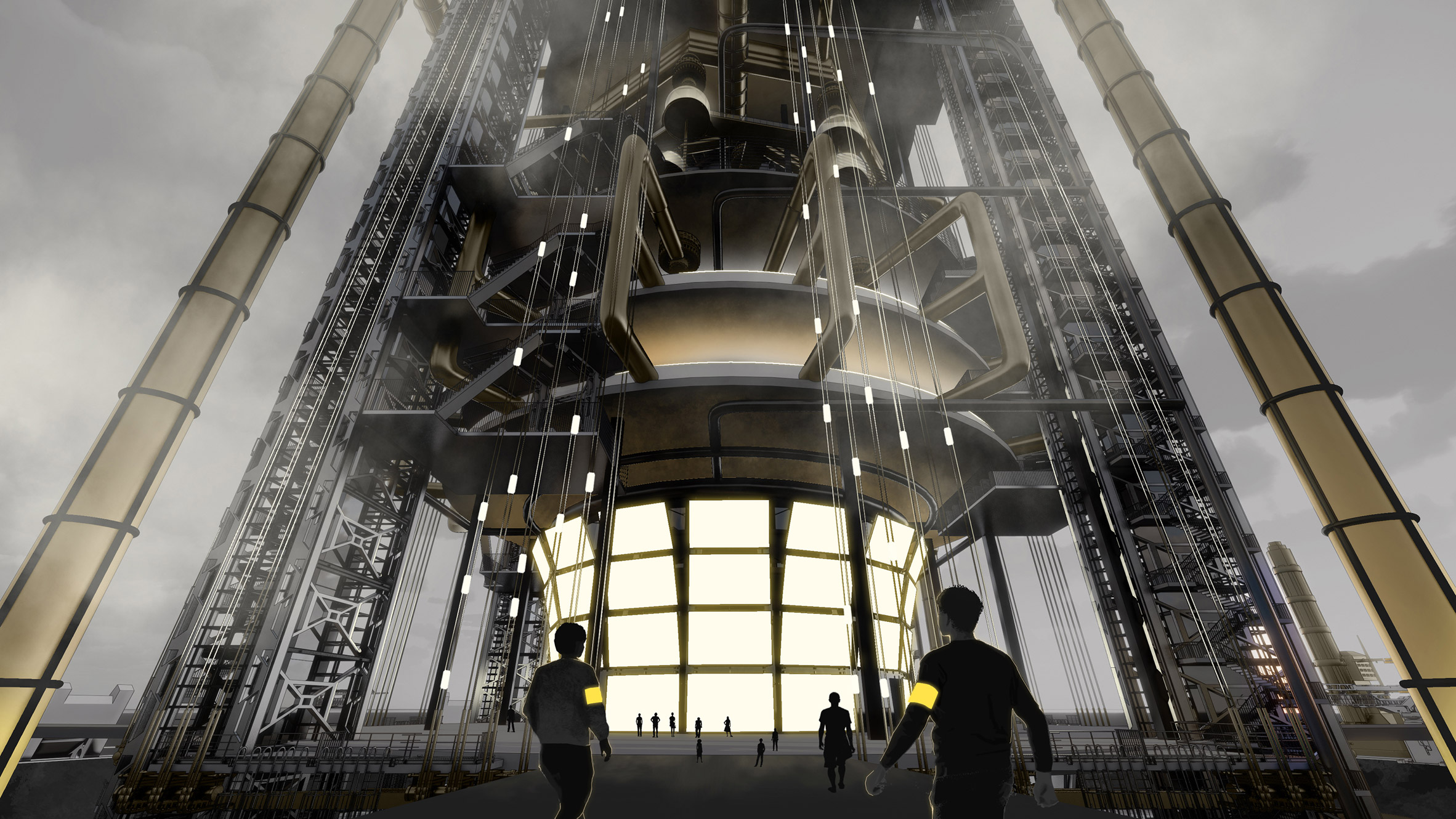

Rebirth 重生计划

Rebirth 重生计划

"The project tackles the issue of the emerging 'Useless Class' in China. The Useless Class, coined by Yuval Harrari, are low-skilled factory laborers that are being replaced by robots and AI. The project proposes a new way of spatial and social design approaches that helps the 'Useless class' to embark on a new beginning in life.

"Instead of monetary gains, the residents accumulate social credit through participating in game-like e-waste recycling quests which gradually help them to rebuild their sense of purpose and fosters community bonding."

Student name: April Zhu Weijie
Course: Masters of Architecture
Tutor: Ar Chaw Chih Wen
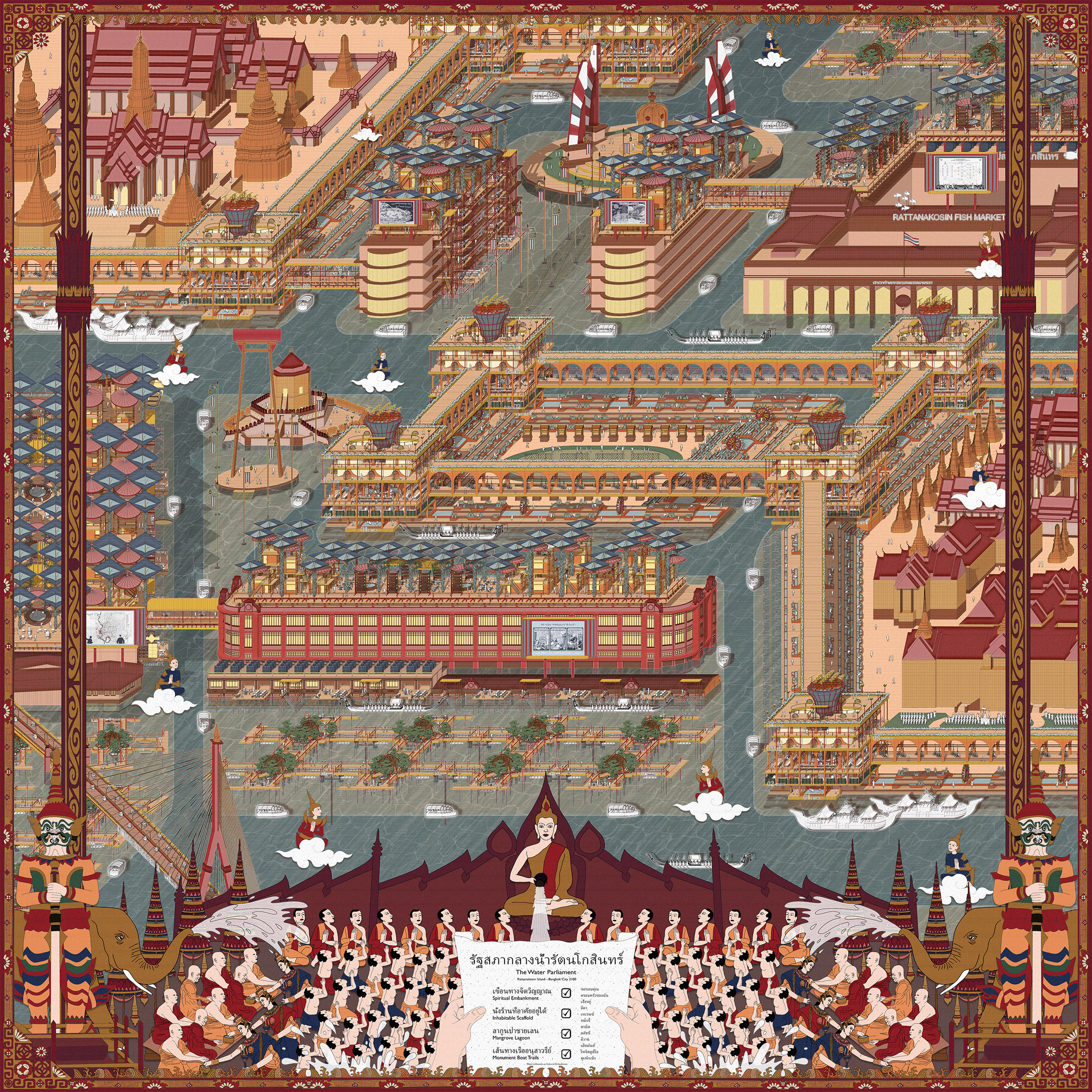

The Water Parliament – Bangkok City 2100

The Water Parliament – Bangkok City 2100

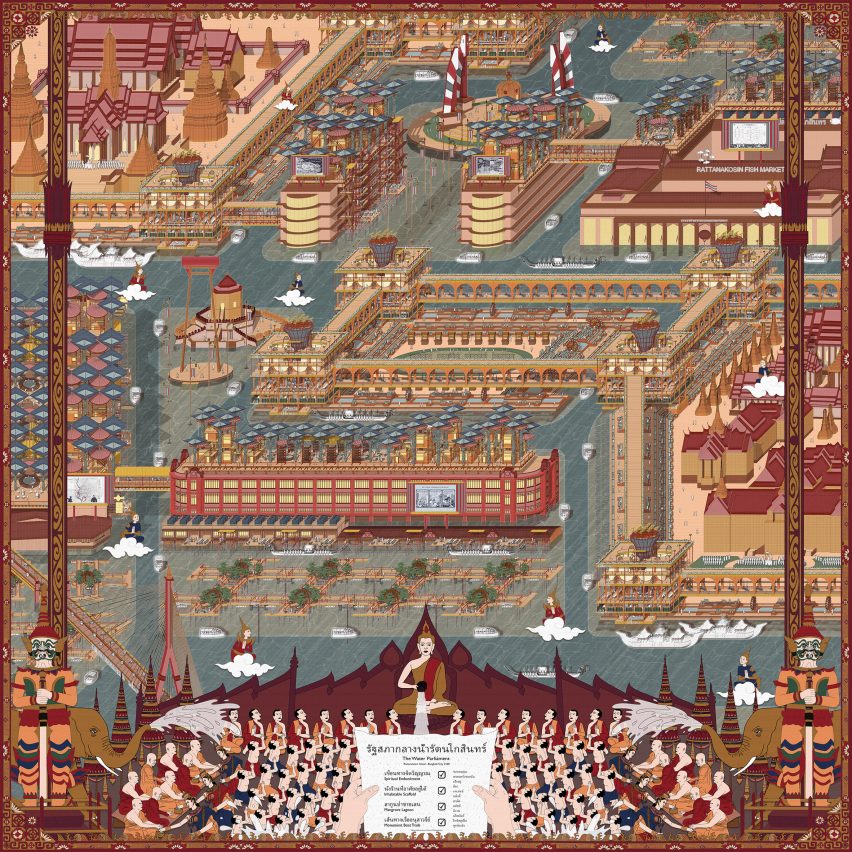
"The thesis is built around a fictional realm of the inhabitable landscape of Bangkok city in the year 2100 where a new Water Parliament is situated at the ancient Rattanakosin Island that pertained to the commons of water and subjected to the groups of people living on the island that represents the culture and people of the Thai city.

"It celebrates a different aspect of water and engages the traditional water culture with more advanced technology and infrastructures. It demonstrates that the environmental crisis of sea-level rise is potentially a new opportunity for them to reshape the city through participation."

Student name: Tyler Lim
Course: Master of Architecture
Tutor: Adj Assoc Prof Khoo Peng Beng
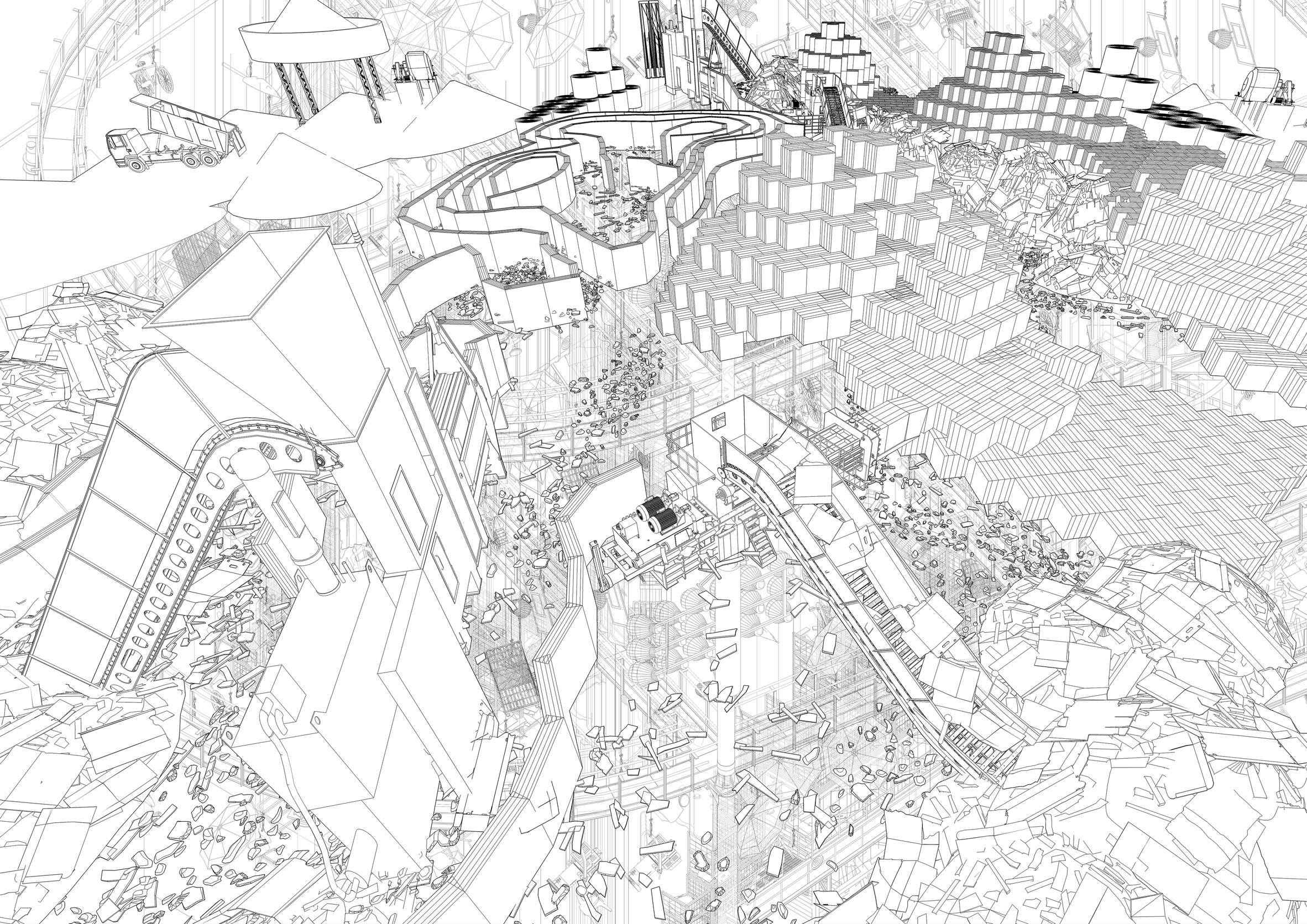

The Material Field: Recycling Infrastructure for Indeterminate and Emergent Material Practices

The Material Field: Recycling Infrastructure for Indeterminate and Emergent Material Practices

"This thesis originated from an investigation of assemblages in informal cardboard collecting – culminating in a study of how material assemblages gradually reconstituted themselves across different scales. Expressed architecturally as a recycling centre, the thesis seeks new emancipatory findings and possibilities for man, architecture and informal recycling through object-oriented perspectives.

"Specifically, studying how these objects exist, aggregate and affect the body across different scales yields new understandings and approaches to architecture as a mediator between body and object. It suggests a direction to look at architecture from the material itself first, rather than asking first how it serves us."

Student name: Valarie Yap
Course: Master of Architecture
Tutor: Assoc Prof Tsuto Sakamoto


Partnership content

This school show is a partnership between Dezeen and the National University of Singapore. Find out more about Dezeen partnership content here.

The post Ten architecture projects from National University of Singapore master's students appeared first on Dezeen.


from Dezeen https://ift.tt/3xoRBK5
Five architecture and design controversies that rocked the Tokyo Olympics

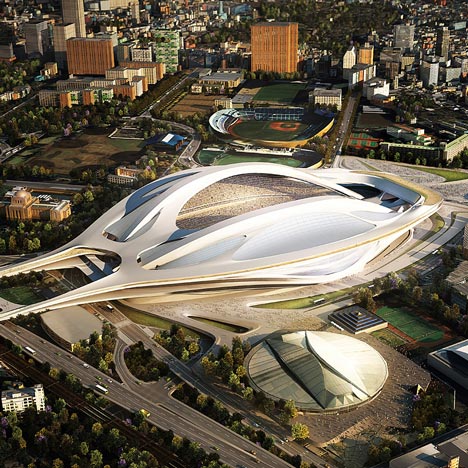
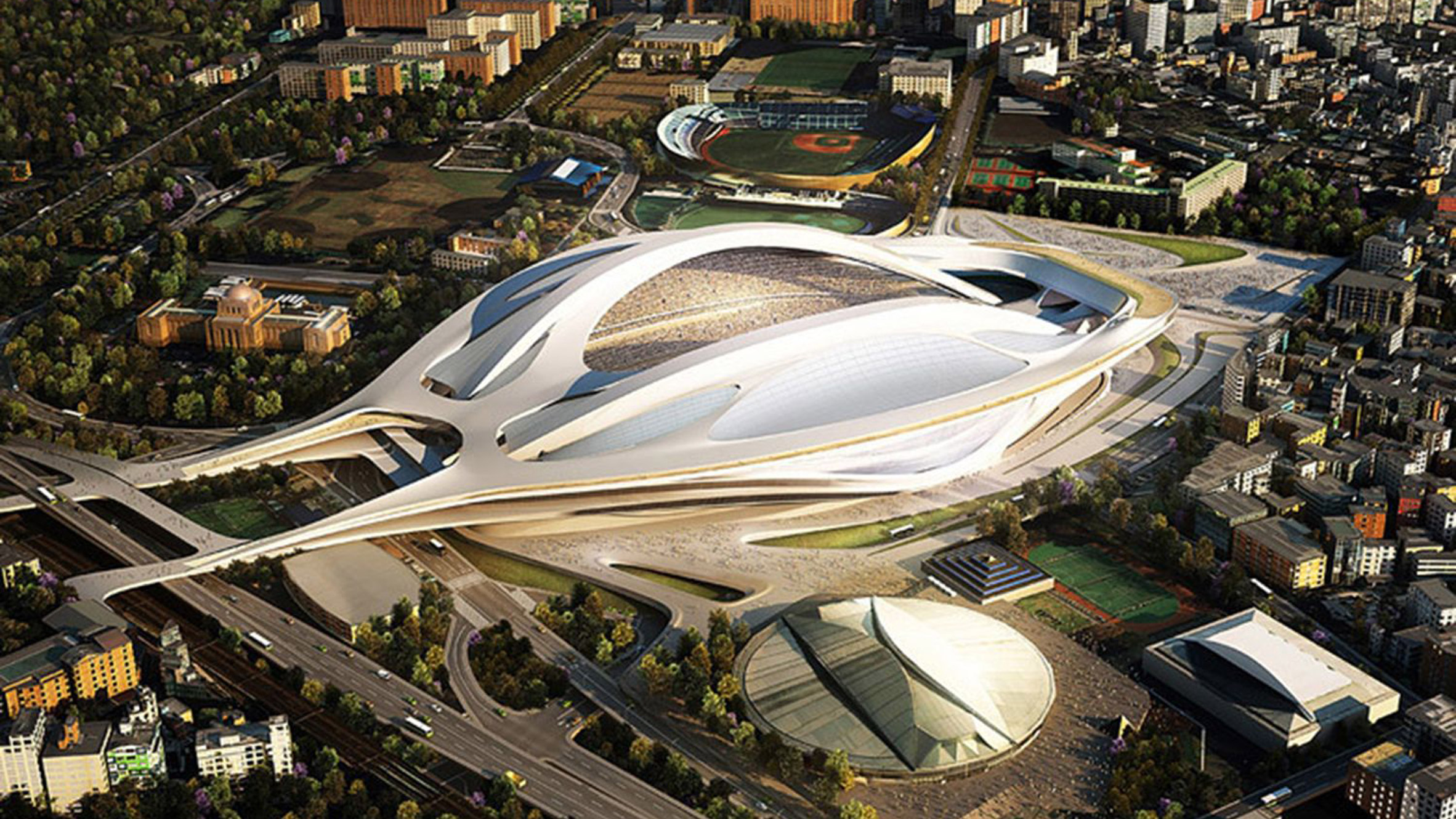
Zaha Hadid's Tokyo Olympic stadium

The Tokyo 2020 Olympic Games went ahead successfully despite a series of controversies in the run-up, including accusations of plagiarism and greenwashing. Here are five architecture and design scandals that threatened to derail the games.


Zaha Hadid's Tokyo Olympic stadium design

Zaha Hadid's Olympic Stadium scraped

Perhaps the biggest controversy in the run-up to the games was the hiring and firing of architect Zaha Hadid as the architect of the Olympic stadium.

Zaha Hadid Architects won the competition to design the stadium in 2012. However, the proposed design (top and above) was criticised by a group of leading Japanese architects including Fumihiko Maki, Toyo Ito, Sou Fujimoto and Kengo Kuma due to its scale.

Hadid described these architects as "hypocrites". "They don't want a foreigner to build in Tokyo for a national stadium," Hadid told Dezeen at the time. "On the other hand, they all have work abroad."

Following the criticism and a budget cut, Zaha Hadid Architects submitted a proposal for a scaled-back "refined" stadium in 2014.

Despite the redesign, the controversial stadium was scrapped in 2015, with Japanese prime minister Shinzo Abe stating that he had listened "to the voices of the people" and had decided to "start over from zero" with the stadium.

A new competition was launched with designs by Kuma and Ito, who were both critical of Hadid's original stadium chosen as the two finalists. Kuma's design was chosen as the eventual winner.


Tokyo 2020 Olympic logo by Kenjiro Sano

Olympic logo plagiarism claims

The original logos for the 2020 Olympic and Paralympic Games also proved contentious and, like the stadium, were eventually scrapped.

Designs by Japanese graphic designer Kenjiro Sano (above) were unveiled by the event organisers in 2015 but were quickly embroiled in scandal after Belgian designer Olivier Debie accused Sano of copying his logo for the Théâtre de Liège.

Despite Sano insisting there was "absolutely no truth" in the claims, the plagiarism allegations and a lawsuit led to the organisers withdrawing the design.

A public competition was launched to source a replacement logo, which Japanese artist Asao Tokolo won with a pair of chequerboard designs.


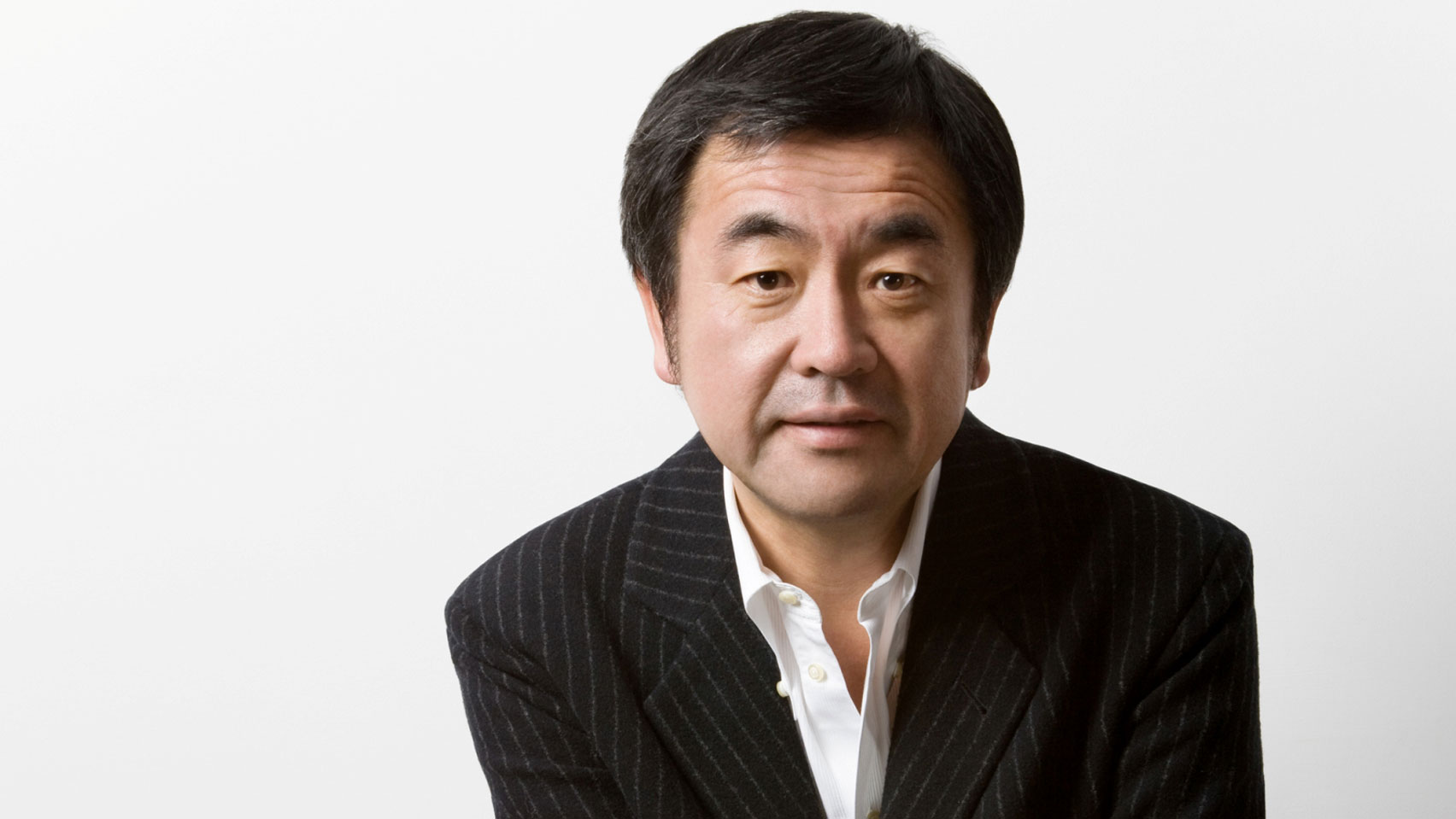
Kengo Kuma portrait

Kengo Kuma accused of plagiarism

Following his victory in the competition to replace Hadid's controversial stadium, Kuma was accused of plagiarising the original design.

According to Hadid, the new stadium had "remarkable similarities" to her own proposal with a similar shape and layout.

"In fact, much of our two years of detailed design work and the cost savings we recommended have been validated by the remarkable similarities of our original detailed stadium layout and our seating bowl configuration with those of the design announced today," she said.

However, Kuma rubbished the claims, telling The Japan Times: "I believe if you take a look at Zaha Hadid's design and mine, you can see very different impressions of the building."


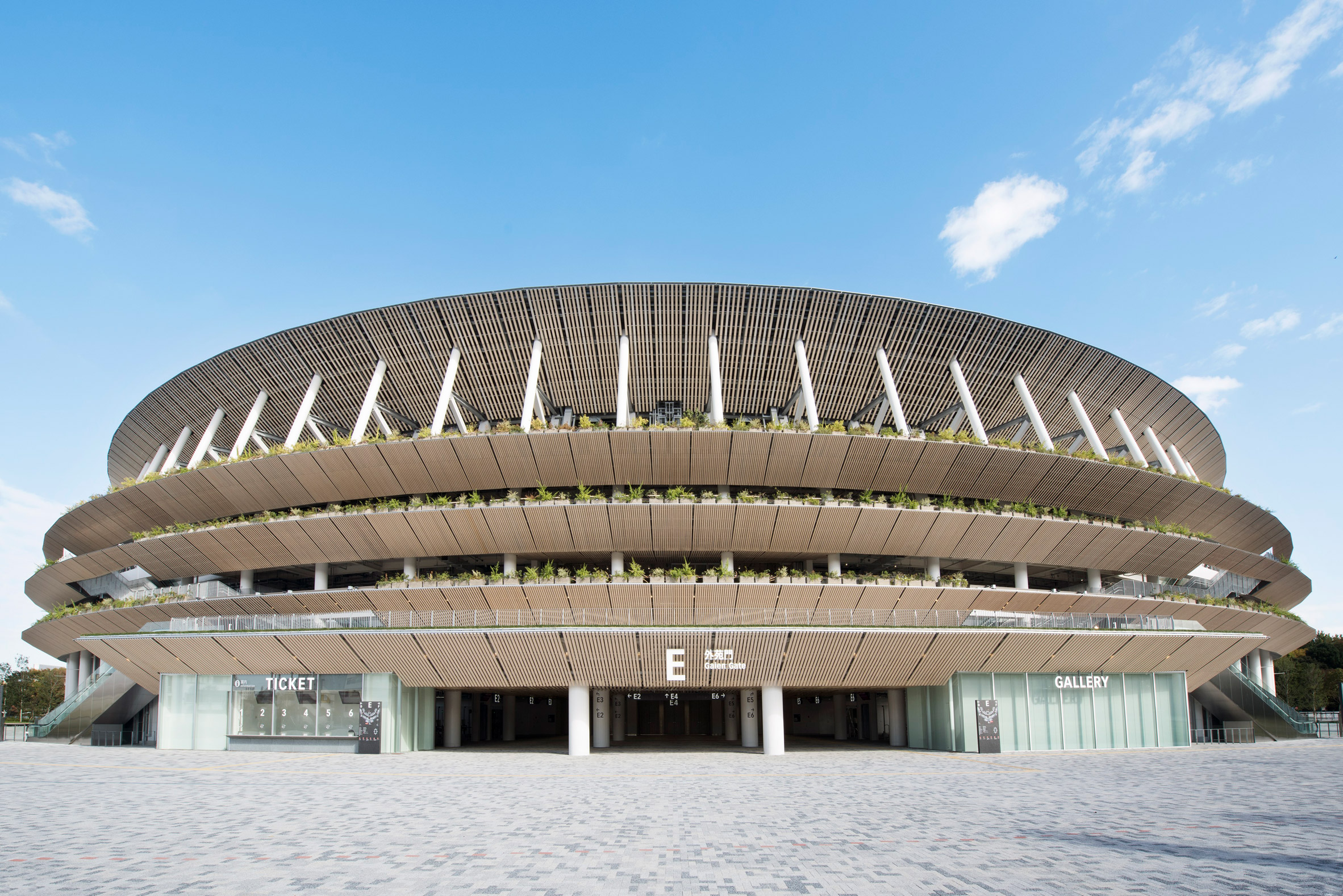
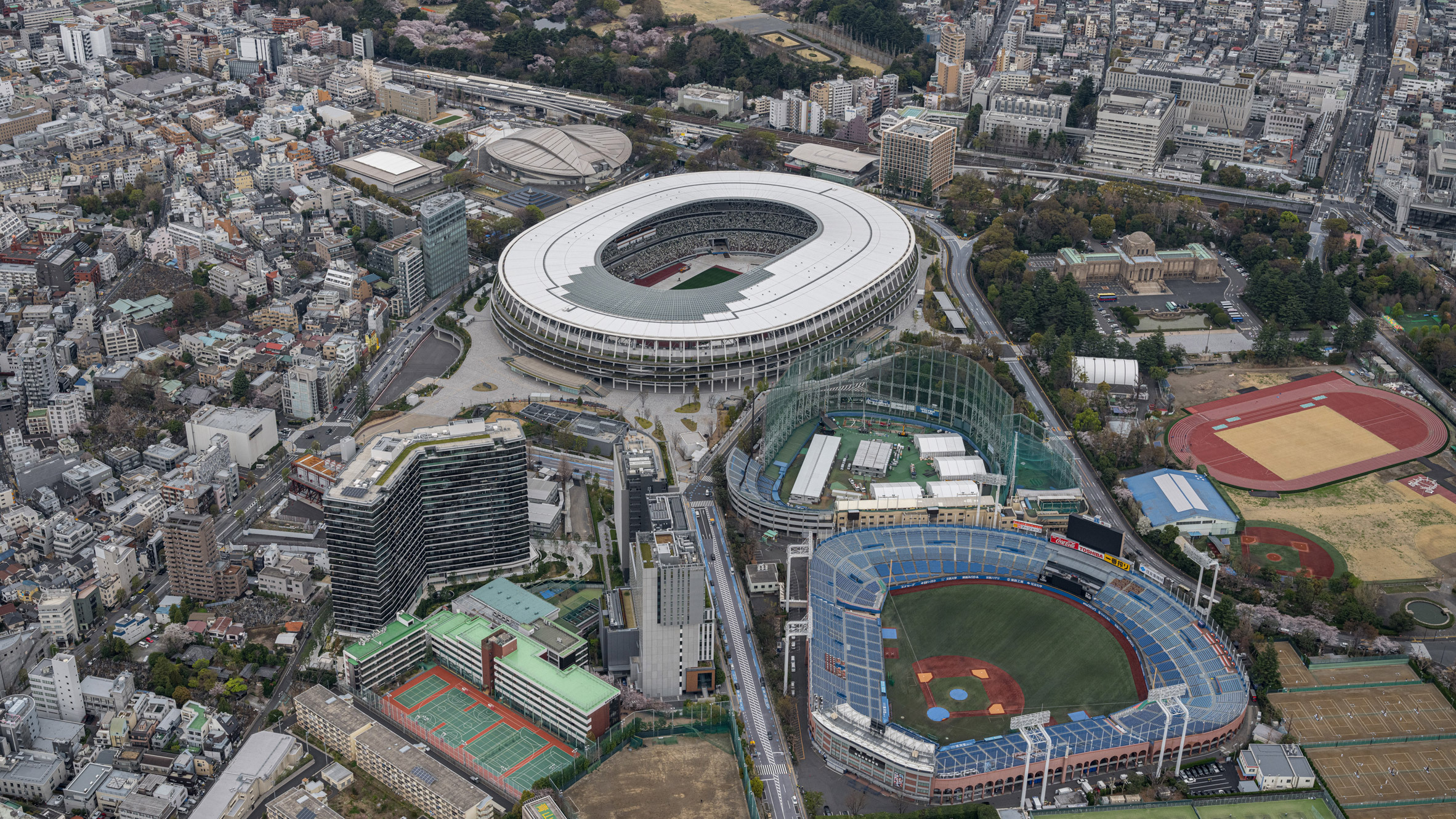
Kengo Kuma's Tokyo 2020 Olympic stadium

Stadium linked to deforestation

Much has been made of the use of timber in the roof and cladding of Kengo Kuma's 68,000-seat Japan National Stadium, which was built to host the athletic events as well as the opening and closing ceremonies.

However, the Japanese government was criticised for the timber used as a mould for the concrete structure. An investigation by more than 40 charities found that the tropical hardwood being used was linked to deforestation and human rights violations.

A petition signed by over 140,000 people demanded that the government rethink its use of tropical hardwood at the stadium.

"The Olympics is supposed to be all about 'fair play' and 'the youth of the world coming together'. In reality, the human rights of Sarawak's indigenous people and the environment are being threatened by the Olympics," said Mathias Rittgerott of charity Rainforest Rescue, who delivered the petition in Germany.

"The use of tropical timber from Sarawak on Olympic construction sites is nothing to celebrate," she added.


Tokyo Olympic Stadium from above

Sustainability efforts branded "greenwashing"

The Tokyo 2020 Olympic Games aimed to be the greenest in recent history, with a host of initiatives from recycled cardboard beds to podiums made of donated plastic designed to help the games move "towards zero-carbon".

According to the organisers, these are the first Olympics to be carbon neutral and run entirely on renewable energy. However, a peer-reviewed study conducted by the University of Lausanne found that the Tokyo event is the third-least sustainable Olympics since 1992.

"The majority of the measures that have been included in this particular Olympics, and the ones that were particularly mediatised, have a more or less superficial effect," said the report's co-author David Gogishvili.

"The efforts the International Olympic Committee is making are important but they are limited and not enough. From my perspective, unless they heavily limit the construction aspect and the overall size of the event, they will always be criticised for greenwashing."

The post Five architecture and design controversies that rocked the Tokyo Olympics appeared first on Dezeen.


from Dezeen https://ift.tt/3CnBDDN

BIG's spiralling double helix viewing tower revealed

Marsk Watchtower by BIG

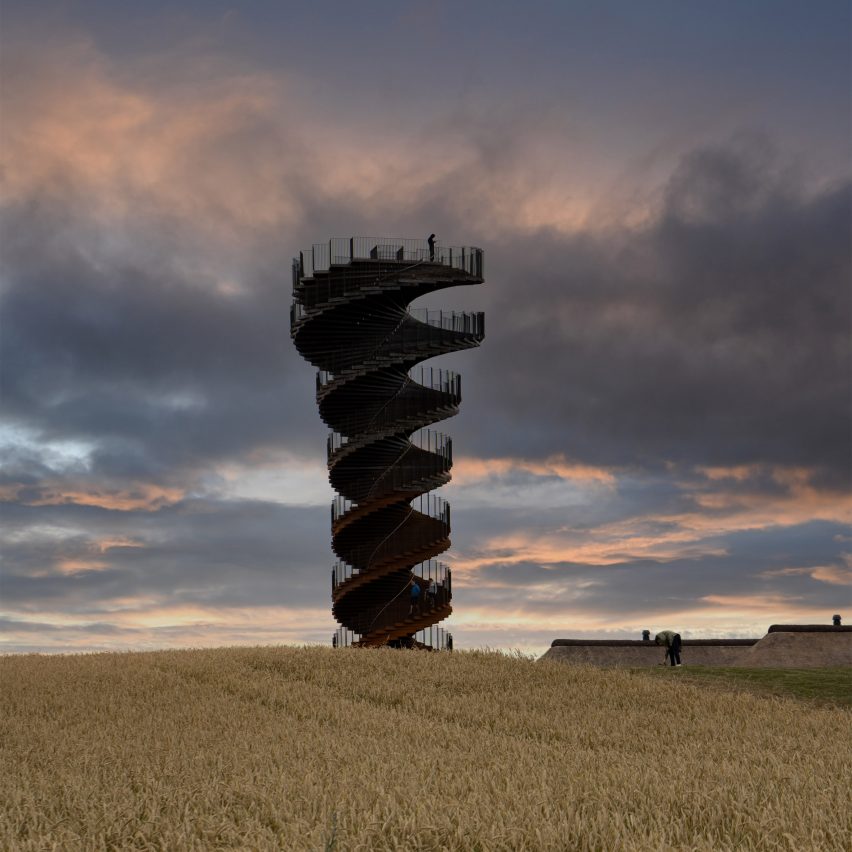
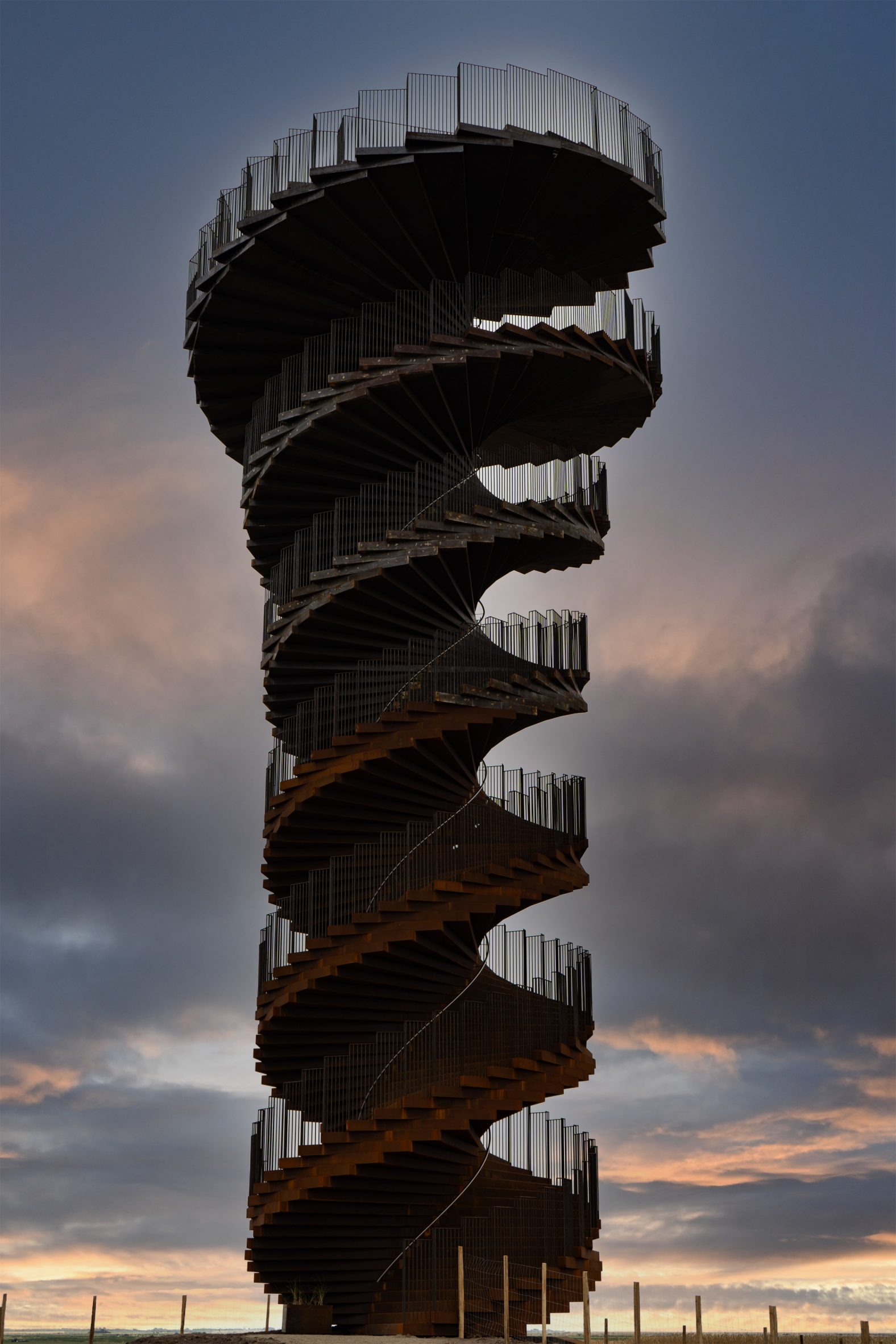
The first photos of the recently opened Marsk Watchtower in Denmark designed by architecture studio BIG have been unveiled.

Created to attract tourists to the area, the 25-metre-high viewing tower within the Wadden Sea National Park has a double helix structure.

Marsk Watchtower by BIG
Marsk Watchtower recently opened in Denmark

It recently opened at the Marsk Camp, which is surrounded by UNESCO World Heritage-listed marshland in southwestern Denmark.

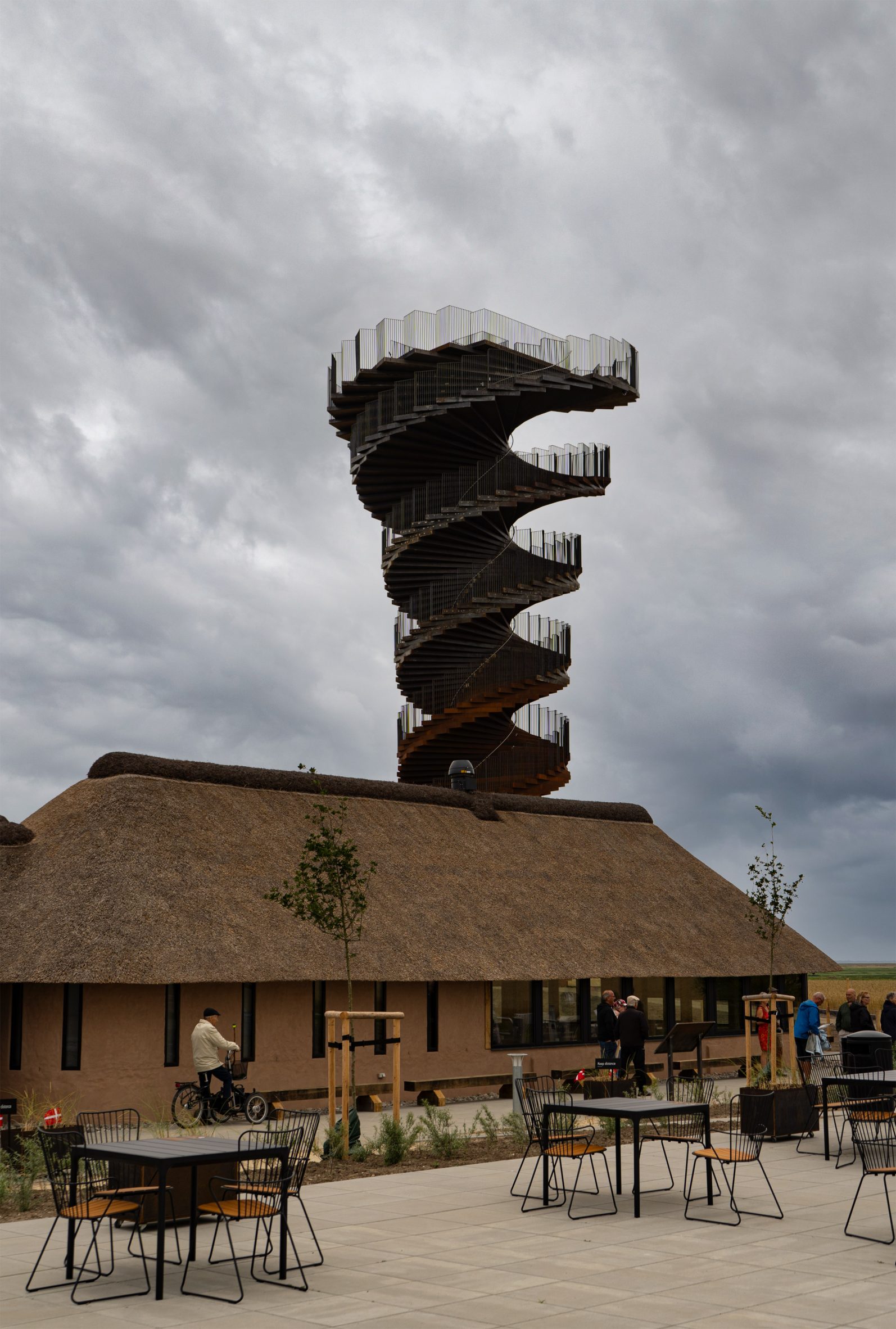
Standing alongside the campsite's restaurant and cafe, the tower rises 25 metres to give views across the national park and out towards the North Sea.

Viewing tower at Marsk Camp
It stands next to the Marsk Camp restaurant

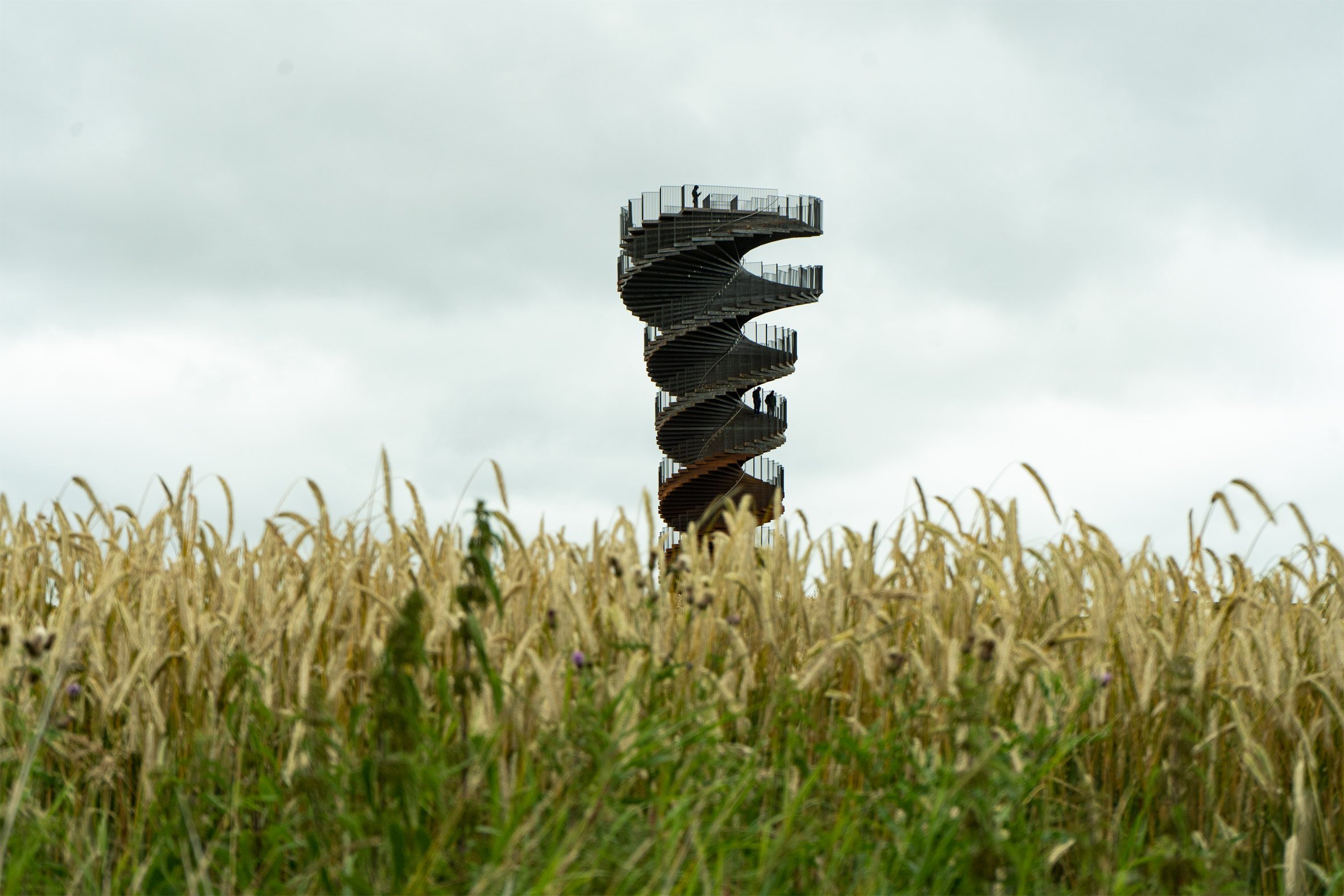
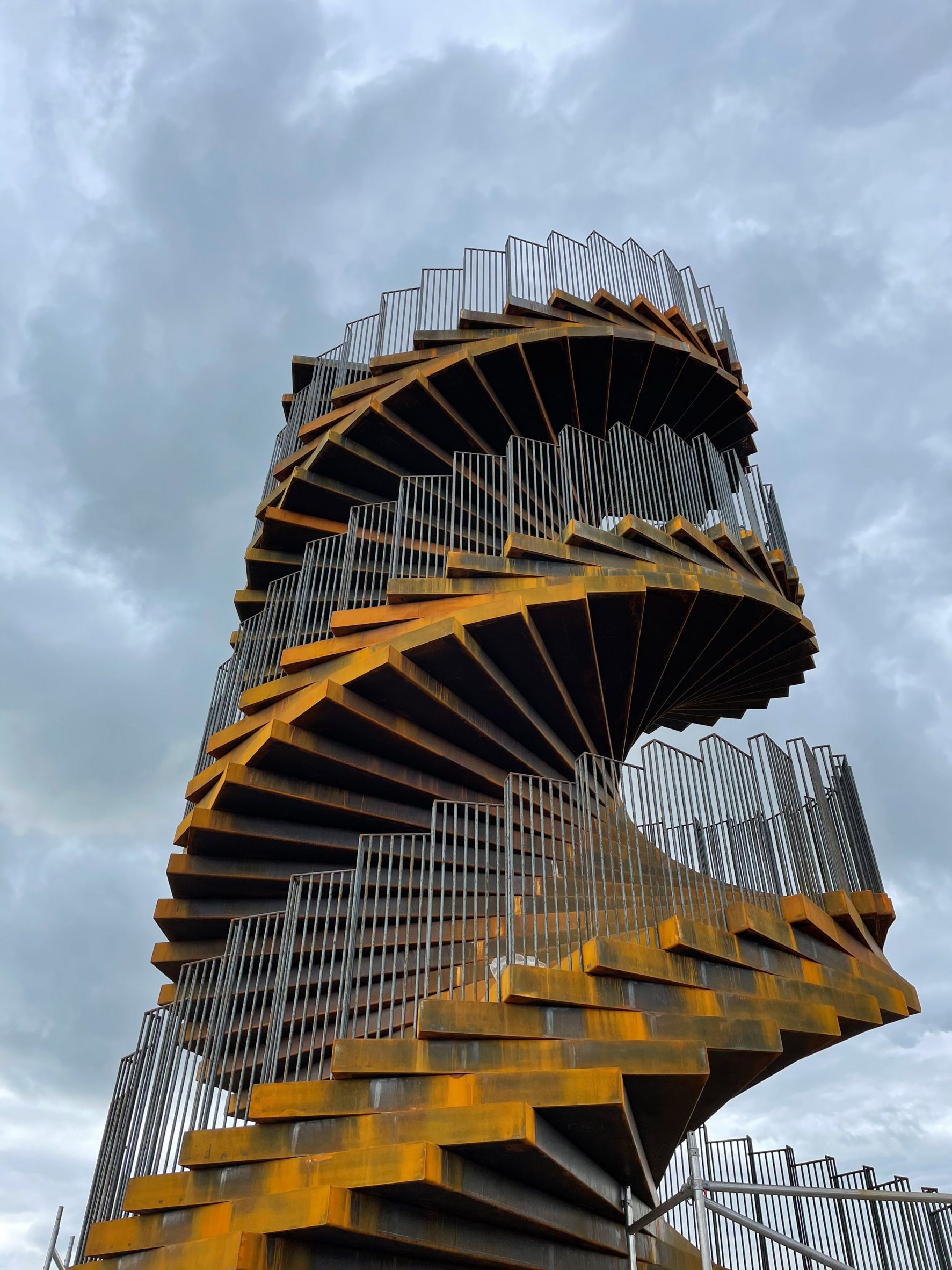
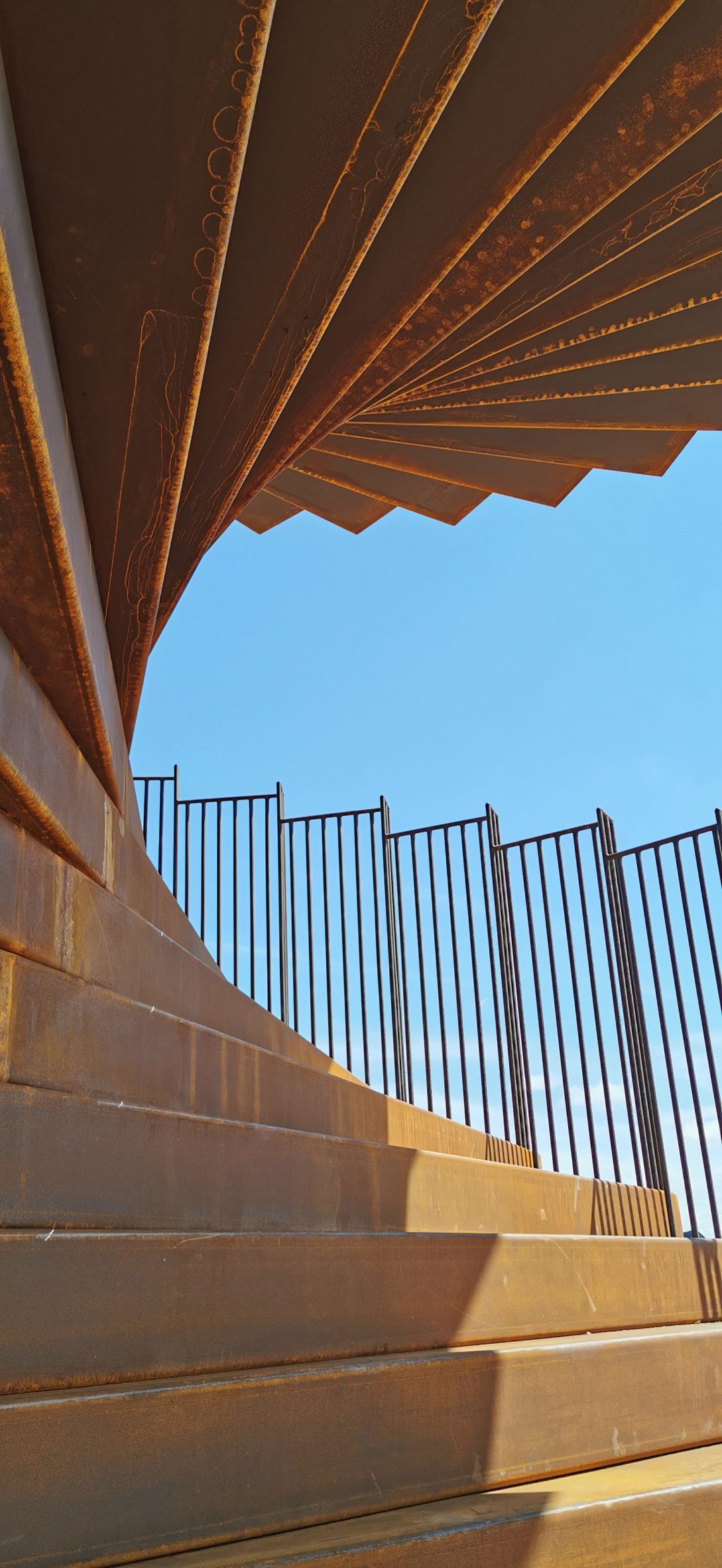
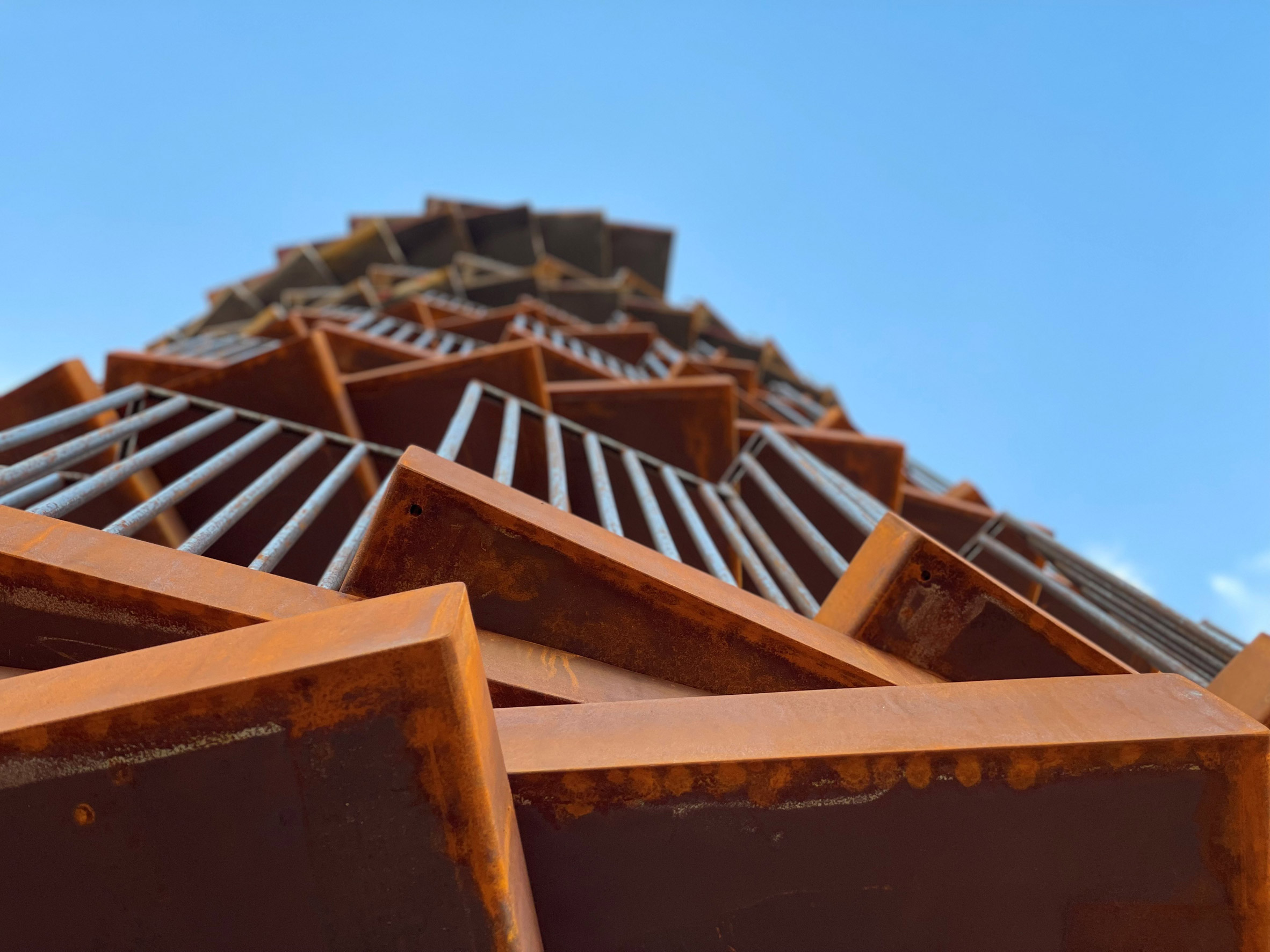
Made from Corten steel, the tower appears to be formed almost entirely from stacked steps.

BIG designed the structure to have a double helix formation similar to that of DNA, with 146 steps on the way up and 131 on the way down.

Double helix-shaped viewing tower
The tower has a double helix arrangement

"Marsk tower consists of a unique construction, where the design is based on nature's twisted structure and human DNA strand," explained Marsk Camp.

"It is both a sculpture and an observation tower and is shaped like a double helix and designed in such a way that there is only one way up and another way down."

Corten tower in Denmark
It appears to be made from steps

The tower slowly expands outwards from a seven-metre base wide to a 12-metre-wide viewing platform at its top.

A small elevator runs through the structure's core to provide accessible access.

"When you have climbed the 146 steps and landed on the observation platform, you are standing 36 metres above sea level," said Marsk Camp.

"This gives a completely unique perspective on the otherwise flat marsh and a fantastic view over the Wadden Sea National Park."

Steps in Camp Marsk viewing tower
There are 146 steps up to the viewing platform

Fabricated by local company Schack Trapper, the structure was made from around 300 tonnes of Corten steel.

It stands on a plinth constructed using 250 tonnes of concrete.

Stepped viewing tower
It was built from Corten steel steps

The tower is the latest attraction to be built in Denmark. Architecture studio EFFEKT recently designed a 45-metre-high helical tower in the Gisselfeld Klosters Forest.

Led by architect Bjarke Ingles, Danish studio BIG is one of the world's best-known architecture studios. Other spiral informed buildings designed by the firm include The Twist art gallery in Norway and a supertall skyscraper in New York called the Spiral.

The photography is courtesy of Marsk Camp.

The post BIG's spiralling double helix viewing tower revealed appeared first on Dezeen.


from Dezeen https://ift.tt/2X148ai

Taste Studio pays tribute to the art of coffee roasting with Paga cafe

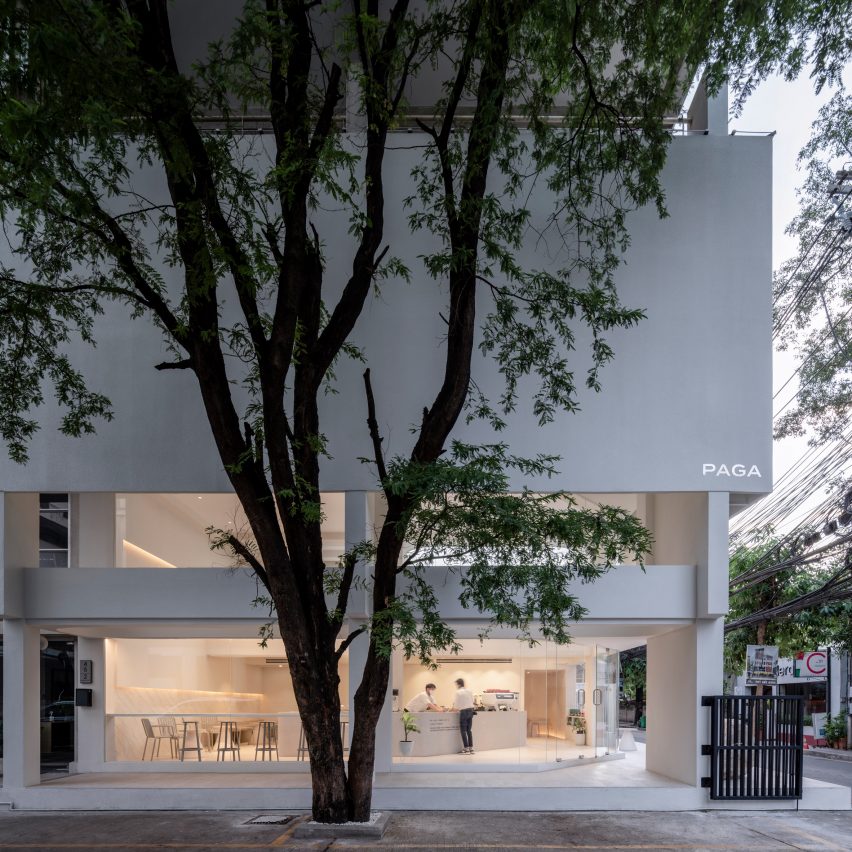
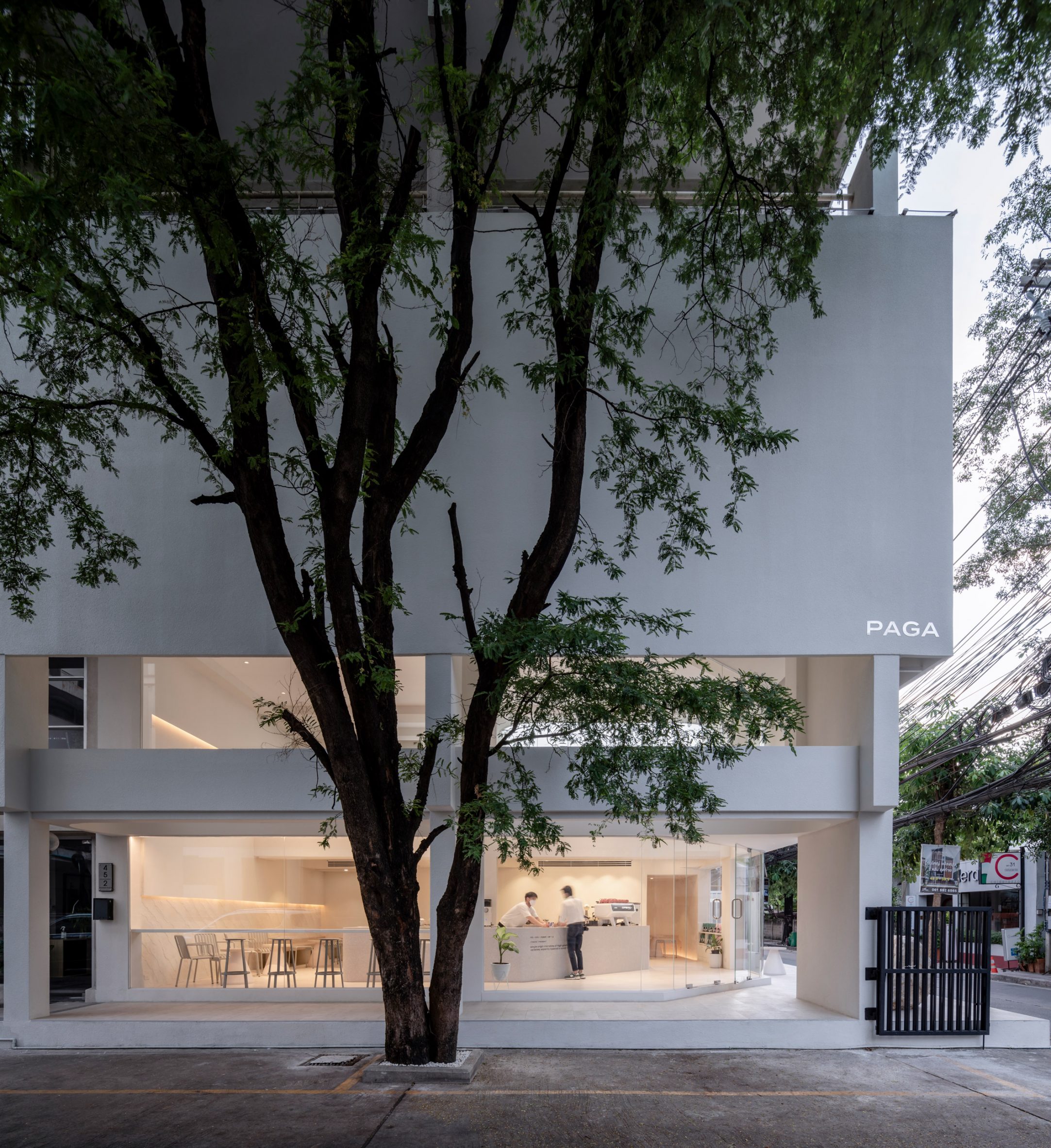
A white building behind a tree

Interior design studio Taste Space designed this roastery and cafe in Bangkok to take customers on a journey from coffee bean roasting to cup. 

The Bangkok-based studio drew on the process of coffee roasting to inform its design of the three-storey roastery in the Watthana district of Thailand's capital.

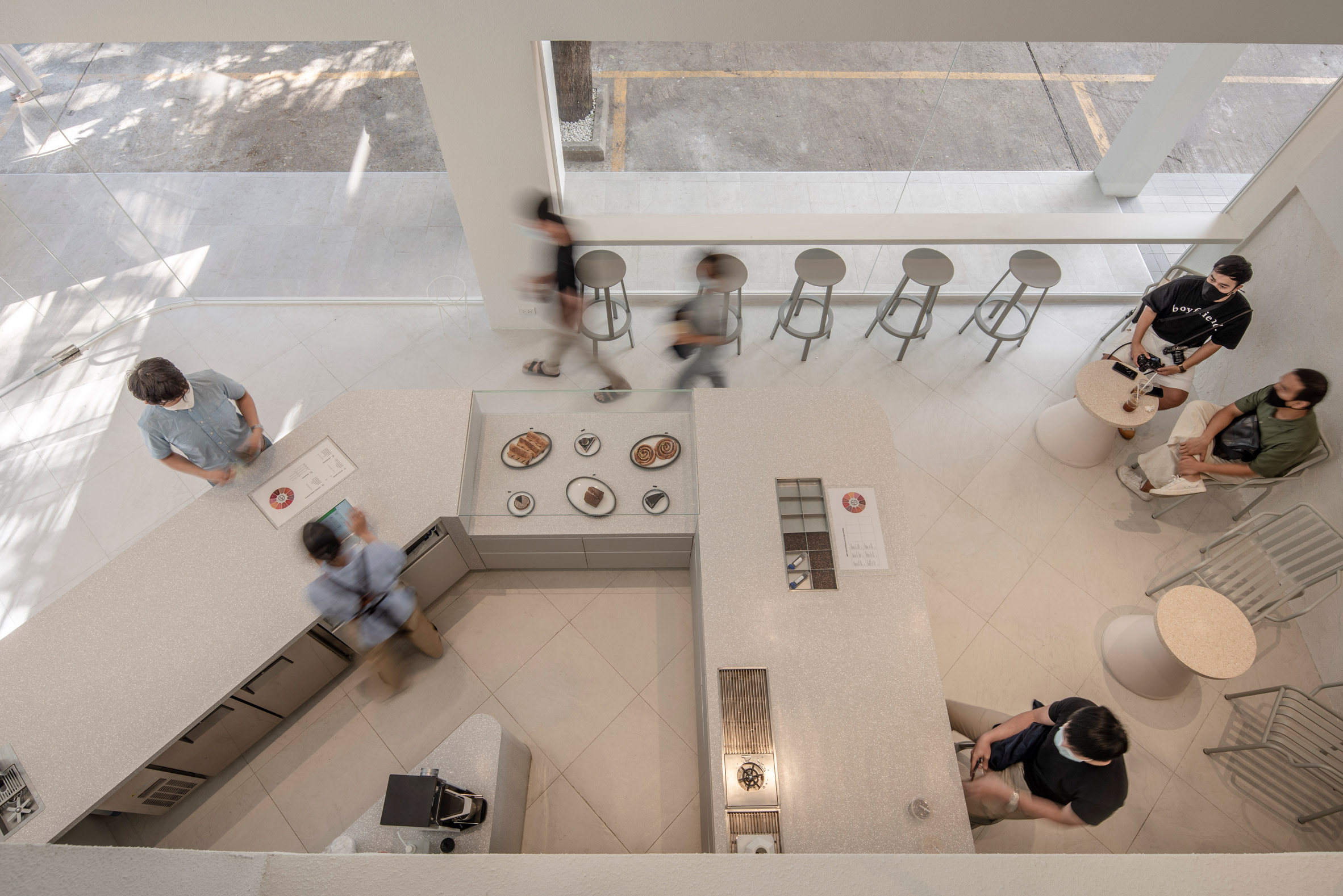
People sitting in a white cafe
Top: Paga is located on the corner of a busy street in Bangkok. Above: the roastery is spread over three floors

Spread out over three floors on the corner of a tree-lined street, Paga  takes cues from the mountains where coffee originates from.

"Paga micro-roastery is inspired by 'the mountain' where coffee beans are cultivated, in order to pay tribute and advocate the long and fascinating process of micro speciality coffee," said Taste Space founder Kijtanes Kajornrattanadech.

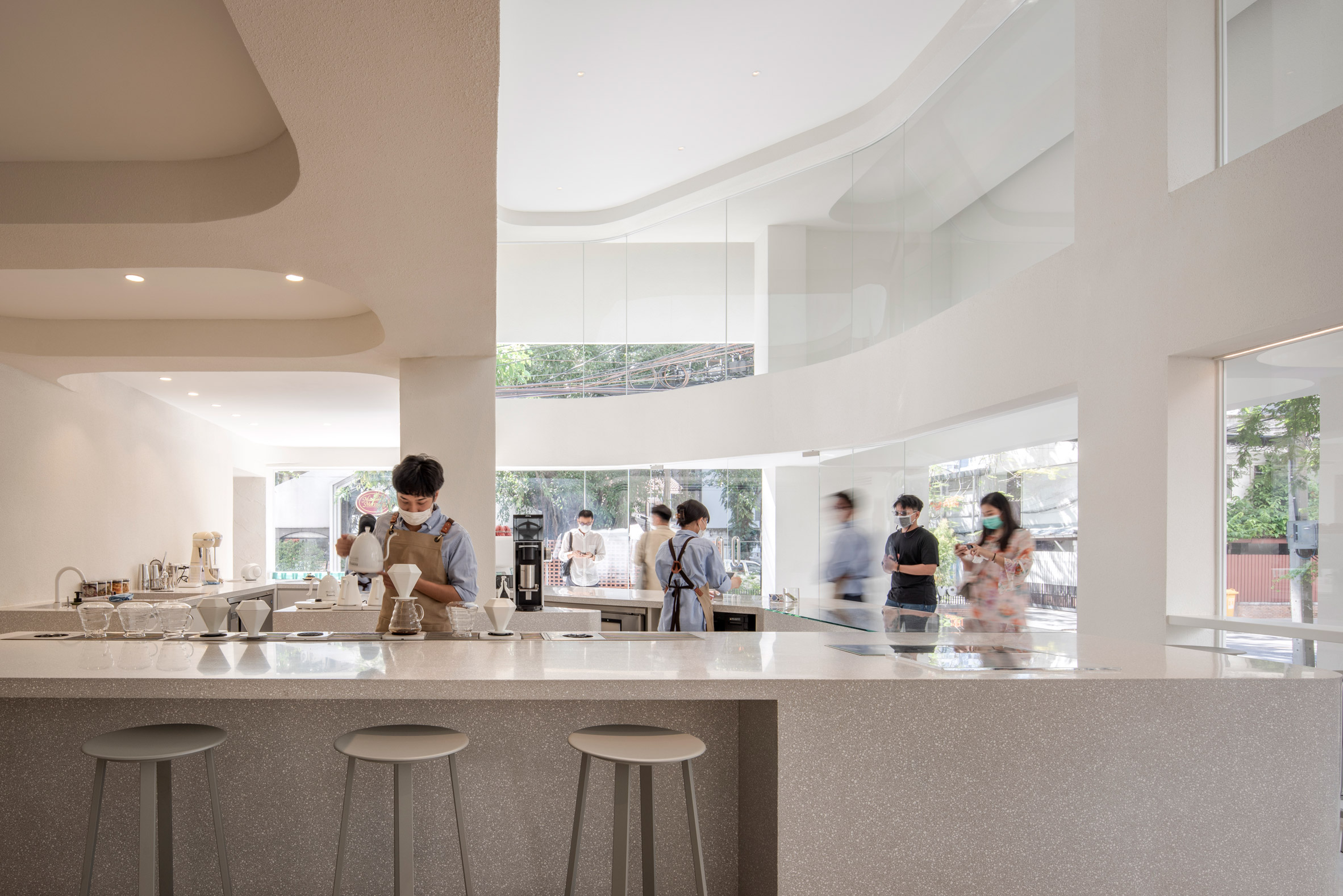
Barrista pours coffee at Paga roastery
Baristas and customers are encouraged to interact with each other over the large counter

The top floor, which is meant to represent the mountain's peak, is reserved for coffee bean storage and a space to hold coffee workshops.

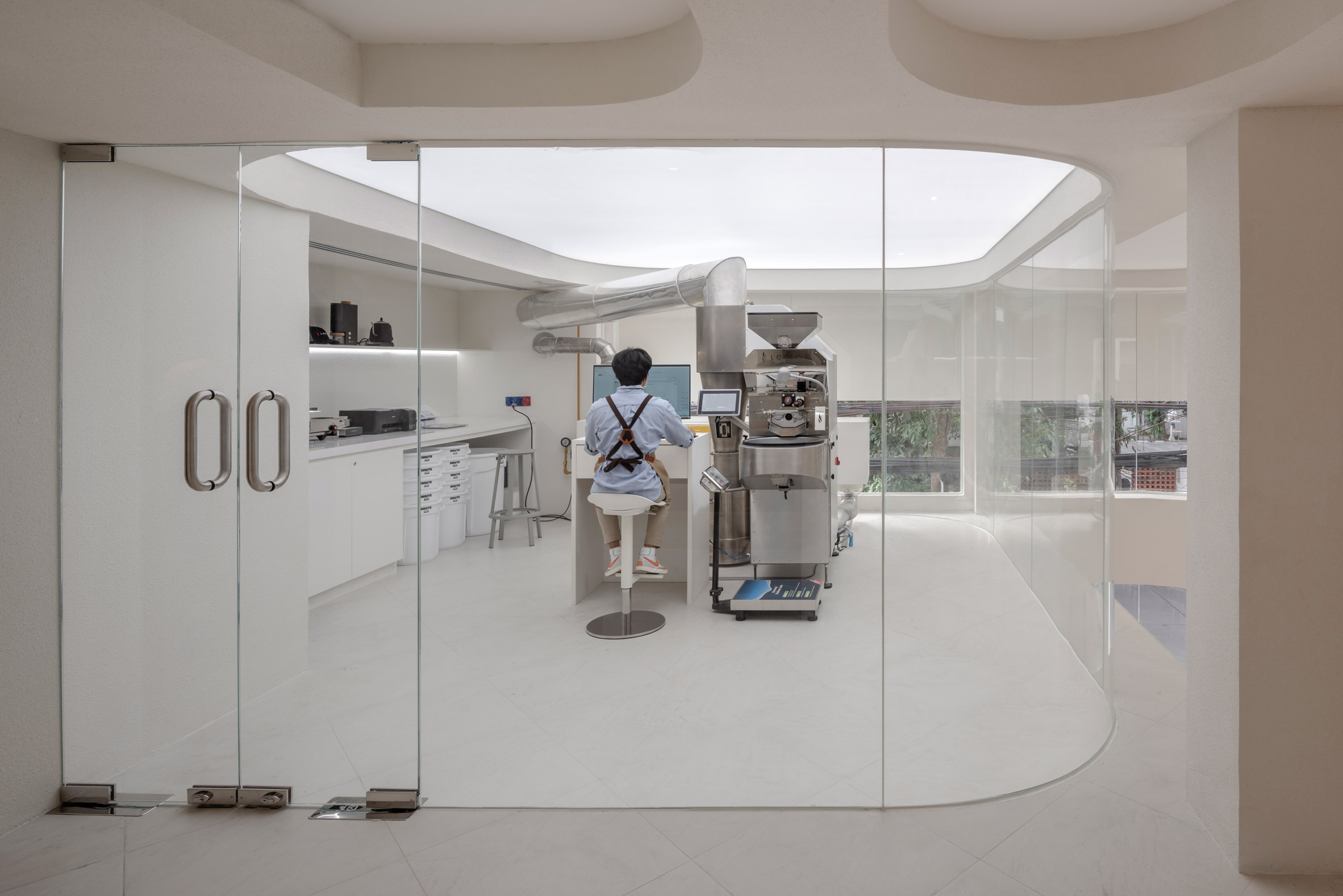
The floor below is split into two rooms: one features grey chairs and tables for customers, while the other has a machine for coffee roasting.

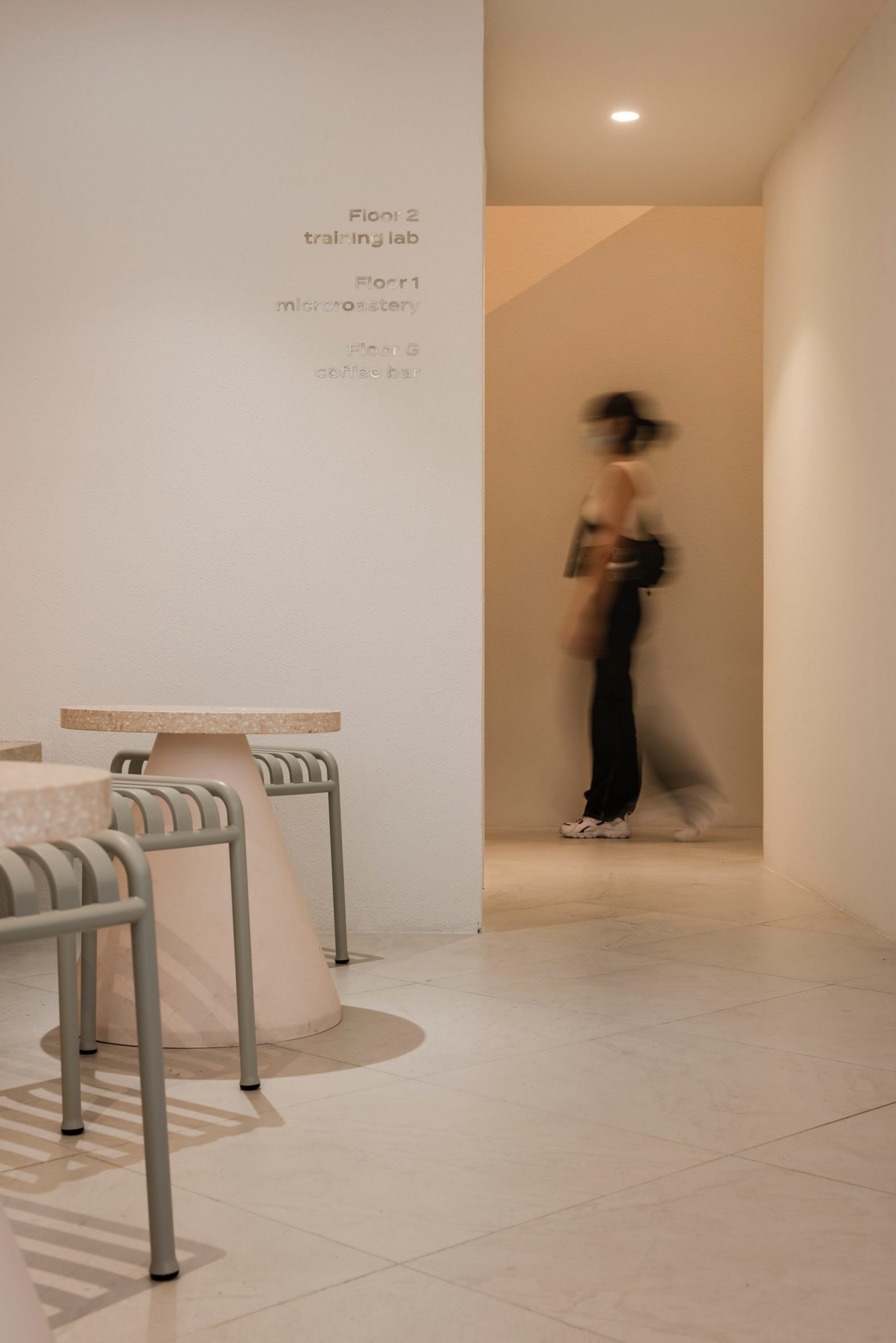
Woman walking through Paga cafe
Paga is covered in a neutral, off-white colour

Thanks to the double-height levels, customers are able to see through the glass windows into the roastery room from every vantage point in the cafe.

"The roastery is an important process of making coffee, therefore we designed this part to be seen from every corner of the cafe,"  Kajornrattanadech told Dezeen.

"We designed the roastery room with an all-glass wall to make it visible but prevent people interrupting while the roasters make coffee," he explained.

Taste Space paid close attention to the technical requirements needed for roasting coffee here. To control the level of direct sunlight in the room, the designers chose to keep the room windowless.

A bright white light was added to help employees check the colour of the coffee beans while natural light enters from the windows on the ground floor.

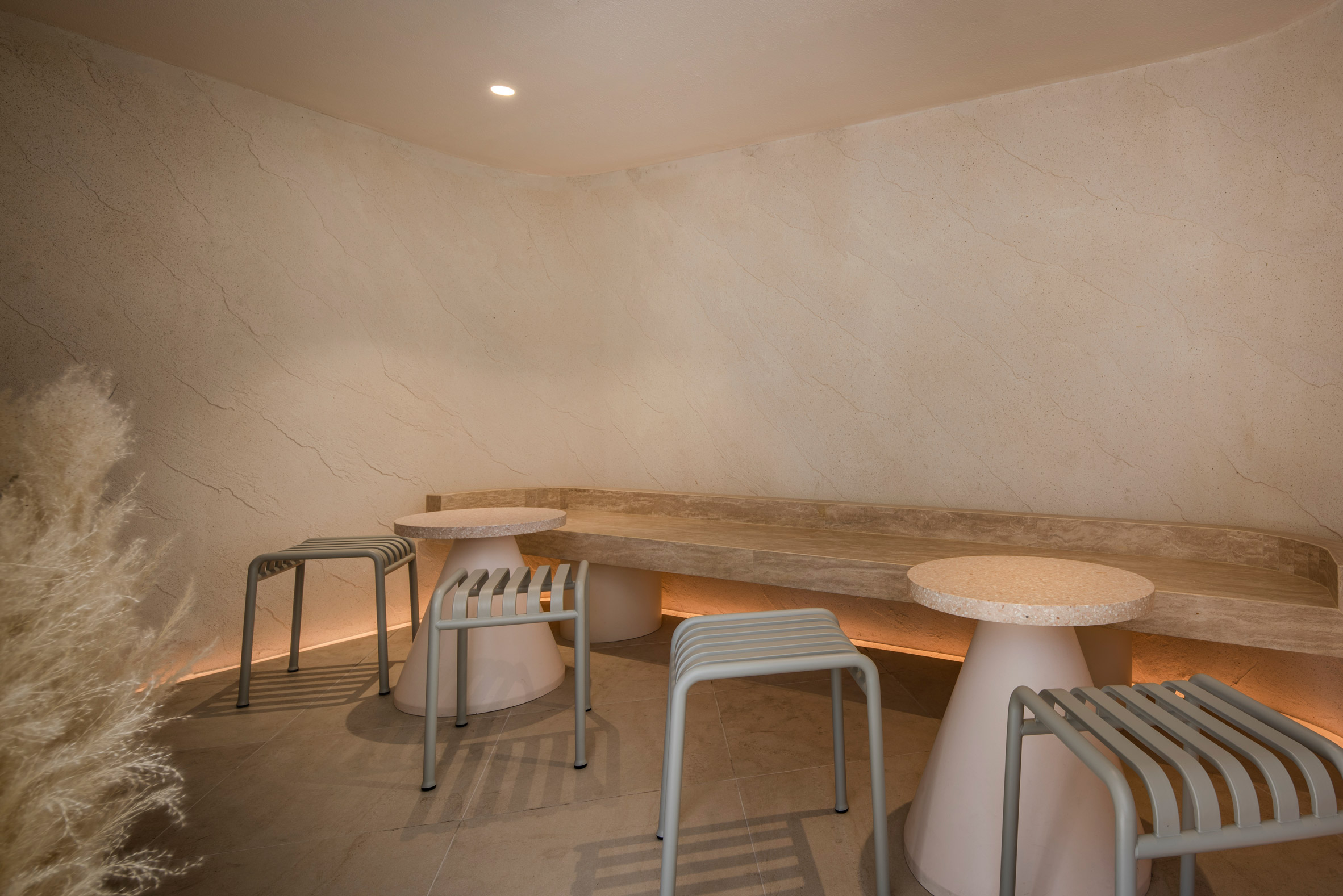
Seats, tables and a bench inside the cafe
The first floor features additional for customers to enjoy coffees

The spacious, off-white ground floor is arranged around a large, curved counter. The designers enlisted the help of the local baristas to design this counter bar.

"The highlight is a solid triangular coffee bar that gives lots of space for baristas to perform and communicate micro coffee culture with customers in friendly proximity," said Kajornrattanadech.

"We worked closely with the barristers to design the counter bar," he continued. "We wanted to help the barristers work smoothly and perform well while the customer who is sitting at the counter bar can enjoy the performance of dripping coffee."

Coffee roastery in Bangkok
A roasting room can be seen from all corners of the cafe

An array of stools and small tables around the edges of the building provide customers with places to sit and enjoy their coffees. Vast floor to ceiling windows provides drinkers with views onto the bustling Bangkok street outside.

"We designed the peaceful environment in an off-white colour to encourage customers to enjoy and focus on their cups without other distractions," said Kajornrattanadech.

Paga cafe in Bangkok
Paga mirrors the structure of a mountain

Further touches are designed to allude to the coffee mountain such as a rough-textured paint which was used on the walls and the curvy ceiling design.

Other coffee shops in Bangkok include % Arabica cafe by Austrian architecture studio Precht. Situated in the largest shopping centre in the Thai capital, the cafe houses 7,000 handmade bricks which are used on the floors, walls and stepped seating.

Photography is by Jinnawat Borihankijanan.

The post Taste Studio pays tribute to the art of coffee roasting with Paga cafe appeared first on Dezeen.


from Dezeen https://ift.tt/3lDQ0Oq