Friday, 13 August 2021

Foster + Partners wraps aluminium screens around university laboratory in Jerusalem

A building clad with metal screens

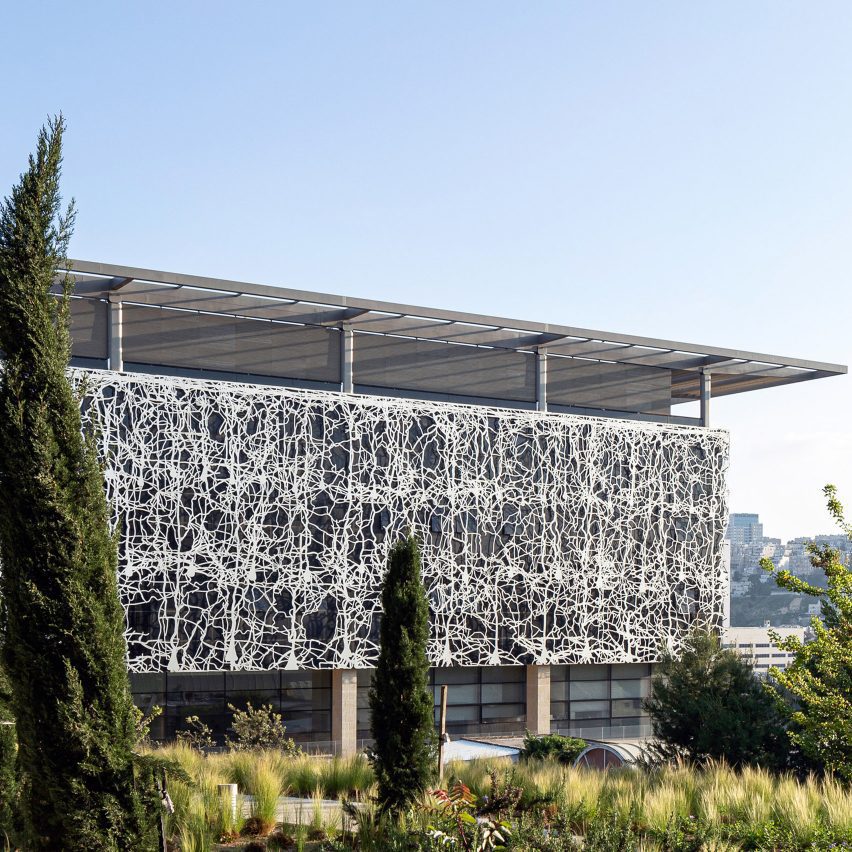
Decorative aluminium screens designed to evoke neurons surround the Edmond and Lily Safra Center for Brain Sciences, completed by architecture studio Foster + Partners in Jerusalem, Israel.

The centre, which sits at the heart of the Hebrew University of Jerusalem, contains social spaces and laboratories dedicated to the scientific exploration of the brain.

The exterior of the Edmond and Lily Safra Center for Brain Sciences
Foster + Partners has completed the Edmond and Lily Safra Center for Brain Sciences

It is distinguished by its three upper levels, which are shrouded by screens that Foster + Partners modelled on Spanish neuroscientist Santiago Ramon y Cajal's drawings of the brain's neurological structure.

According to the studio, the aim of the building is to "attract exceptional scientists, as well as to foster an interest in the centre's research activities within the wider community".
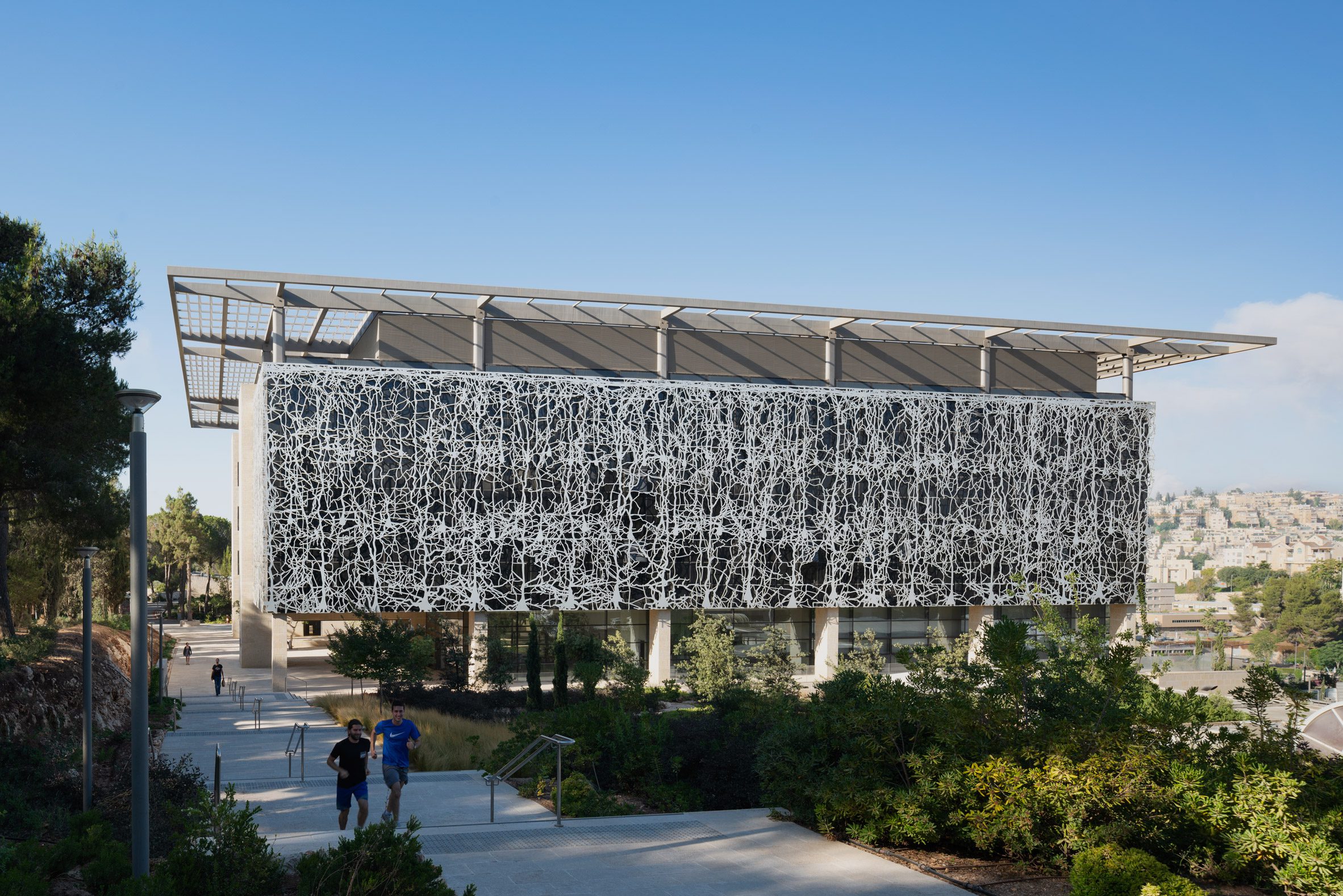
The exterior of the Edmond and Lily Safra Center for Brain Sciences
It is surrounded by decorative metal screens

"The project has a progressive social agenda that has been applied at an urban scale, creating a center for research and learning that is truly inclusive," said partner Darron Haylock.

"The new building is located just off the main pedestrian spine of the university and its facade invites exploration, drawing people inside to learn about the research activities."

A facade covered in aluminium screens
The screens are modelled on drawings of neurons

The Edmond and Lily Safra Center for Brain Sciences comprises two wings, positioned on either side of a central courtyard.

It has a reinforced and post-tensioned concrete structure topped by an overhanging steel roof. The aluminium screens are teamed with locally sourced Jerusalem stone cladding, which continues inside the building.
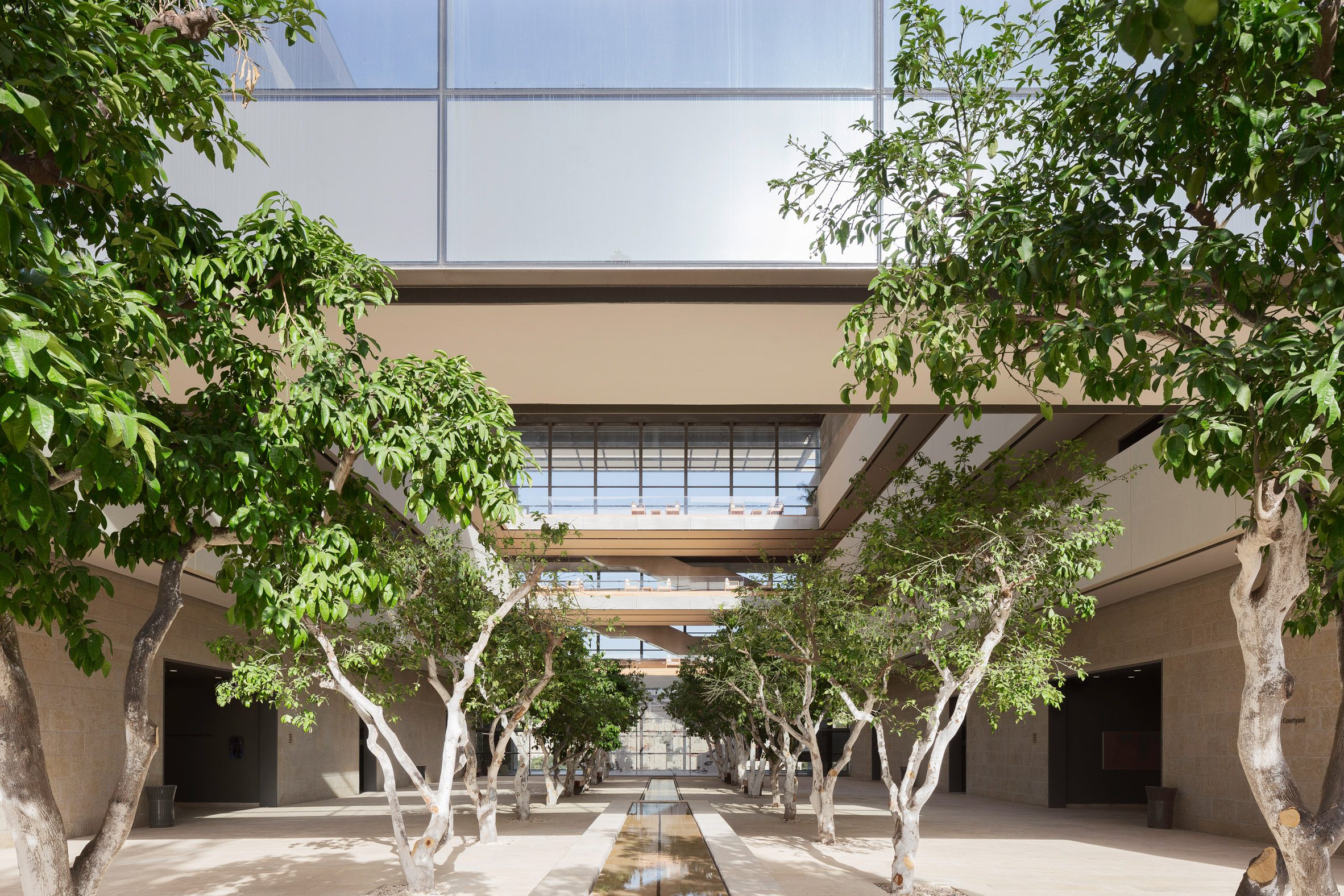
A courtyard with grapefruit trees
A courtyard sits at the heart of the building

On the ground floor, the centre houses a mix of teaching facilities, alongside a 200-seat auditorium, library, cafe and gallery to display artwork related to the brain.

The upper levels contain twenty-eight laboratories linked by bridges that double as social hubs, introduced by Foster + Partners to "encourage informal interaction and the exchange of ideas".
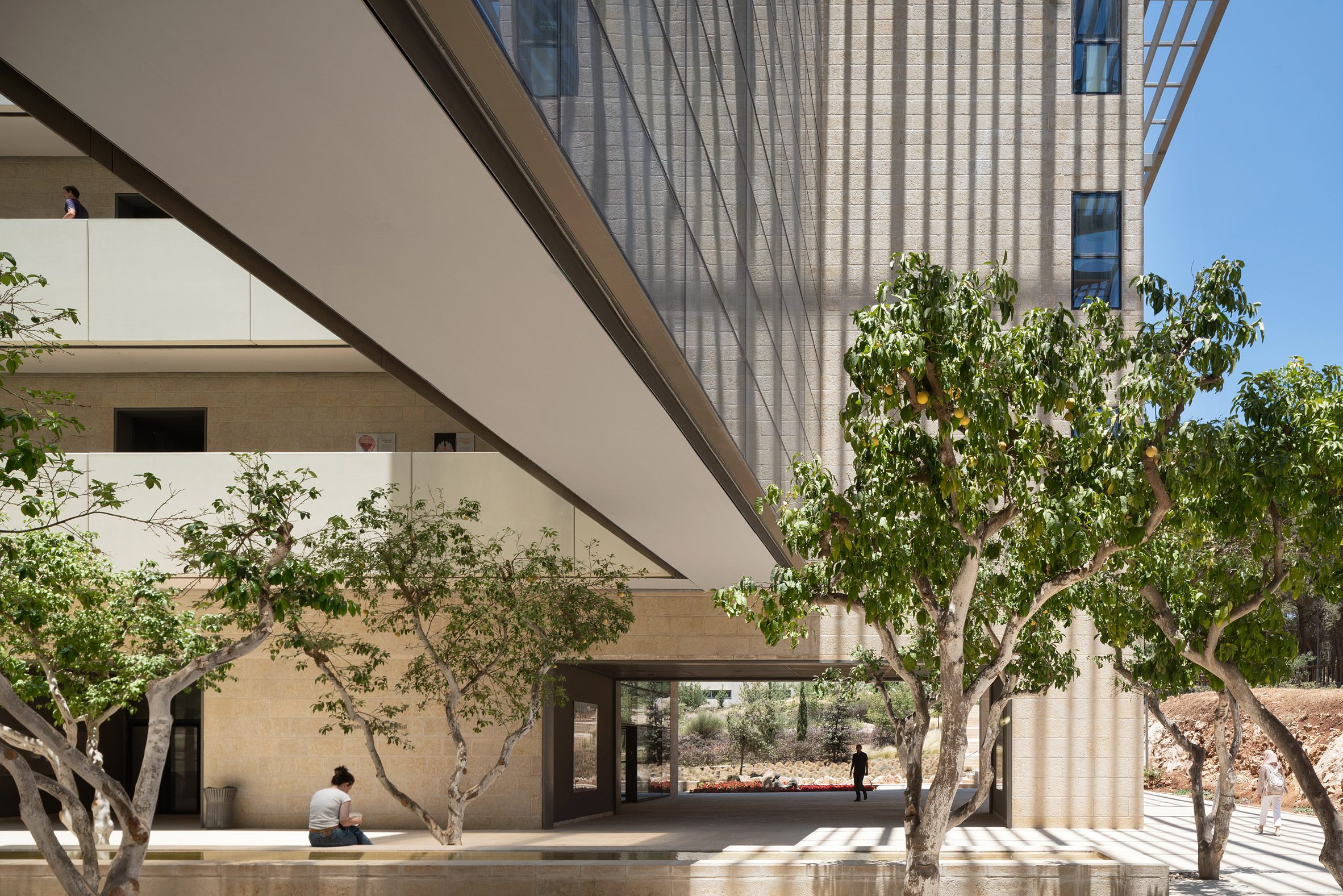
A courtyard with grapefruit trees
It is lined with grapefruit trees

A key part of Edmond and Lily Safra Center for Brain Sciences' design is the flexibility of its laboratories, which are column-free thanks to the post-tensioned structure.

This ensures that they can be easily expanded or closed off to meet the needs of evolving research projects or changing research techniques in the future.

"Understanding the enigma of the brain is the most challenging endeavour of the twenty-first century and research in this area is vital to the quality of life for millions of people," said the studio's head of design Spencer de Grey.

"This is one of the most innovative projects of its kind at an Israeli university, with several laboratory complexes that are highly flexible to anticipate and accommodate future change, arranged around an open central courtyard that is at the heart of the scheme."
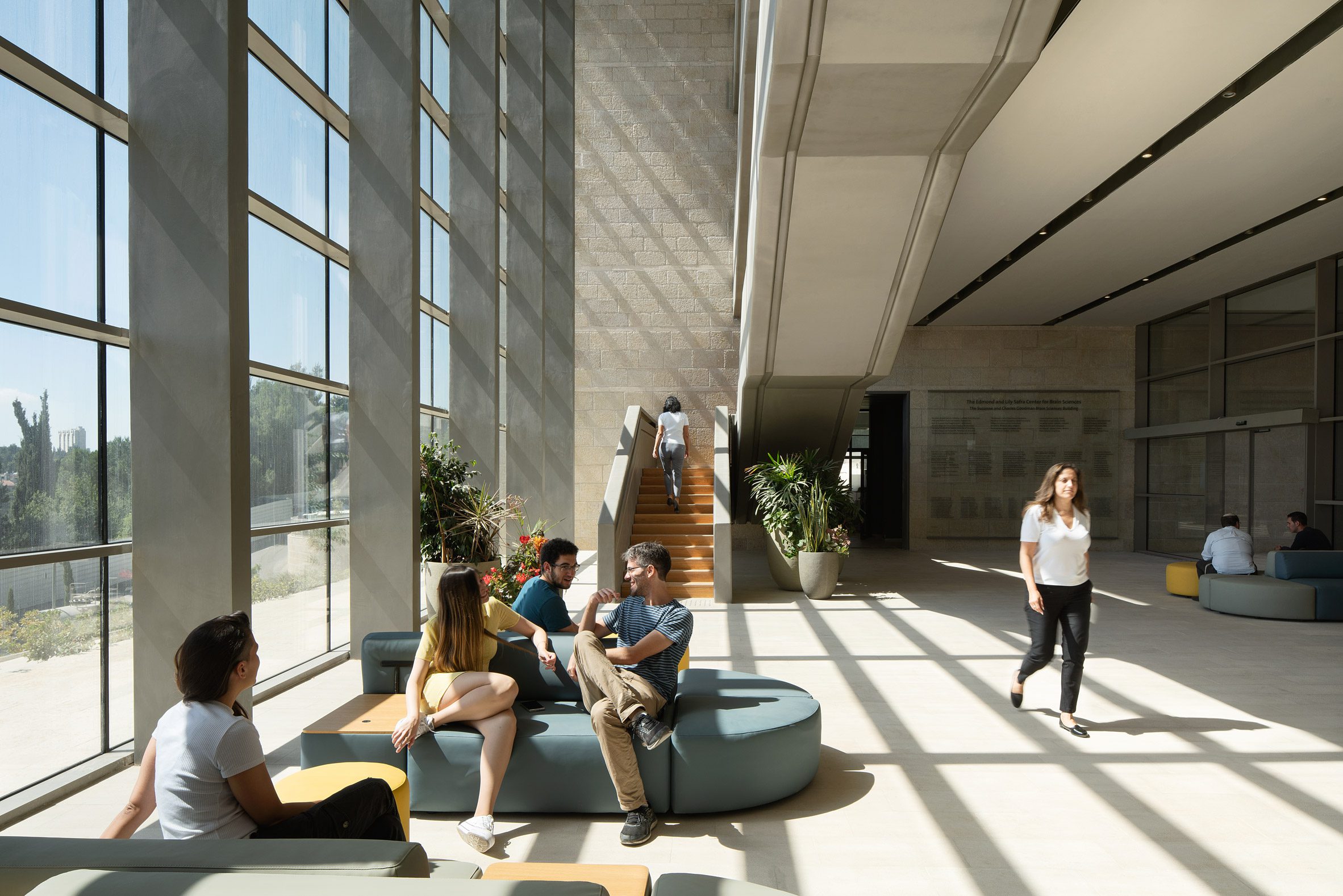
A social space inside Edmond and Lily Safra Center for Brain Sciences
Social spaces feature throughout the building

The Edmond and Lily Safra Center for Brain Sciences' central courtyard is lined with 24 grapefruit trees and a stream that runs its length, intended to offer visitors a quiet and reflective space.

It is topped by a retractable roof made from Ethylene Tetrafluoroethylene (ETFE), which will be used to reduce the heating load in winter and maximise natural ventilation in summer.
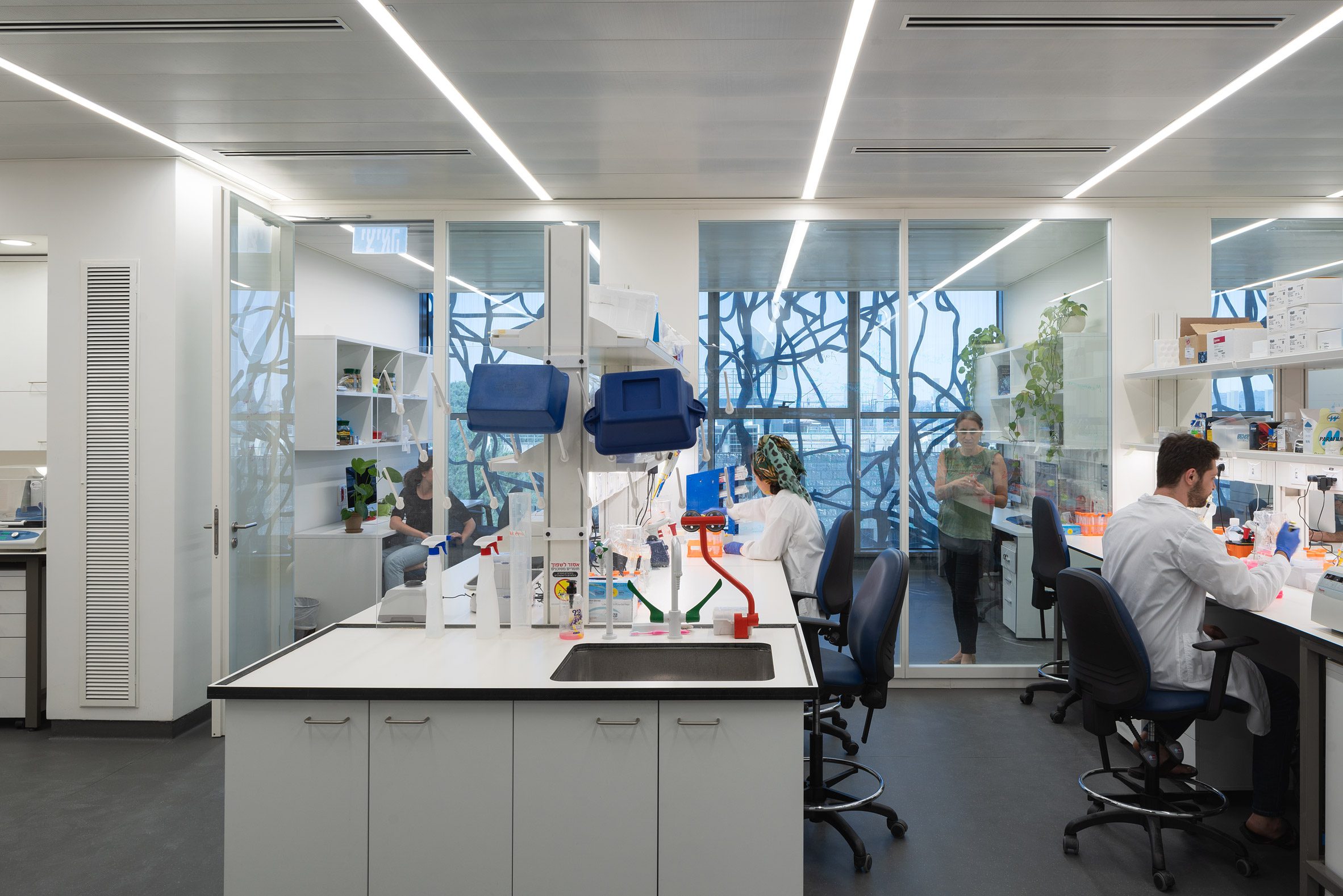
A laboratory interior
Laboratories are designed to be easily expanded

Decorative metal screens are often used in architecture to help animate a facade, such as at the Bunhill 2 Energy Centre in London, where Cullinan Studio used them to reflect the activity inside the heat network.

However, they can also be used to help control the flow of light, air and views throughout a building, such as in the AB House by Israeli architect Pitsou Kedem.

Foster + Partners was founded by Norman Foster in London in 1967. The studio also recently completed the PGA Tour HQ in Florida with an oversized roof and opened an Apple in Los Angeles' historic Tower Theatre.

The photography is by Harel Gilboa

The post Foster + Partners wraps aluminium screens around university laboratory in Jerusalem appeared first on Dezeen.


from Dezeen https://ift.tt/2VNjm1V

Council deputy leader resigns due to "unacceptable" rise in Marble Arch Mound costs

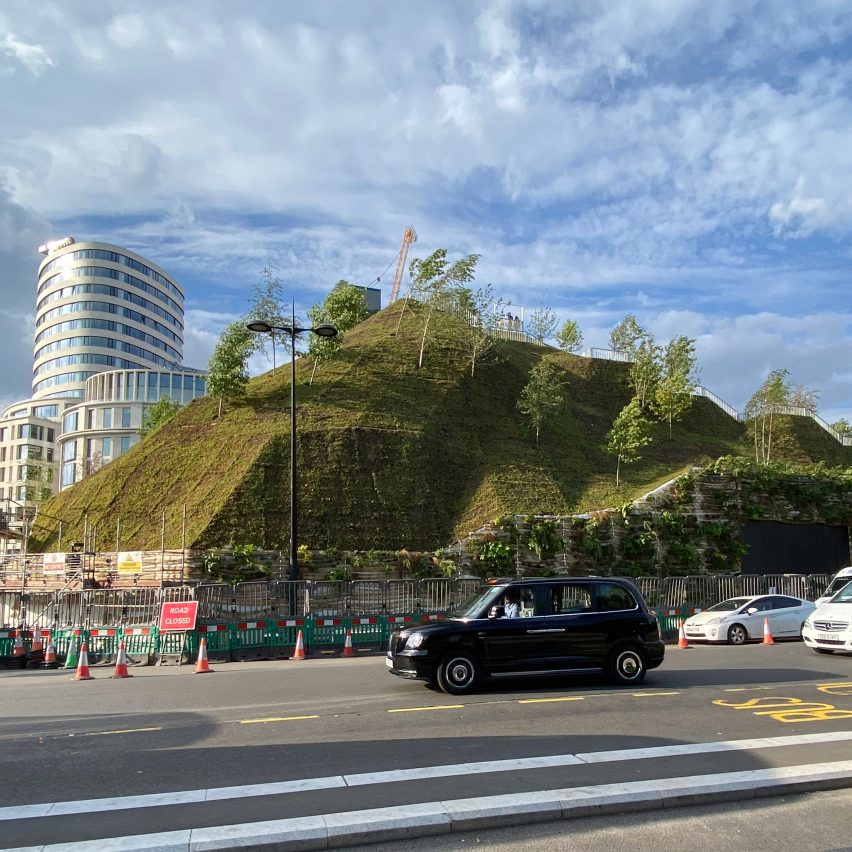
Marble Arch Mound by MVRDV

Westminster City Council's deputy leader Melvyn Caplan has resigned with immediate effect after costs for London's Marble Arch Mound project spiralled from £3.3 million to £6 million.

In a statement, Westminster City Council leader Rachael Robathan called the increase in costs "unacceptable" and said the Mound – a temporary landscaped viewpoint designed by Dutch studio MVRDV – opened too early.

"The Mound opened too early, and we have apologised for that," Robathan said.

"It has become clear that costs have risen more than anticipated and that is totally unacceptable. Our original forecast cost was £3.3 million. Total costs are now £6 million, covering every aspect of the project: construction, operation and eventual removal."

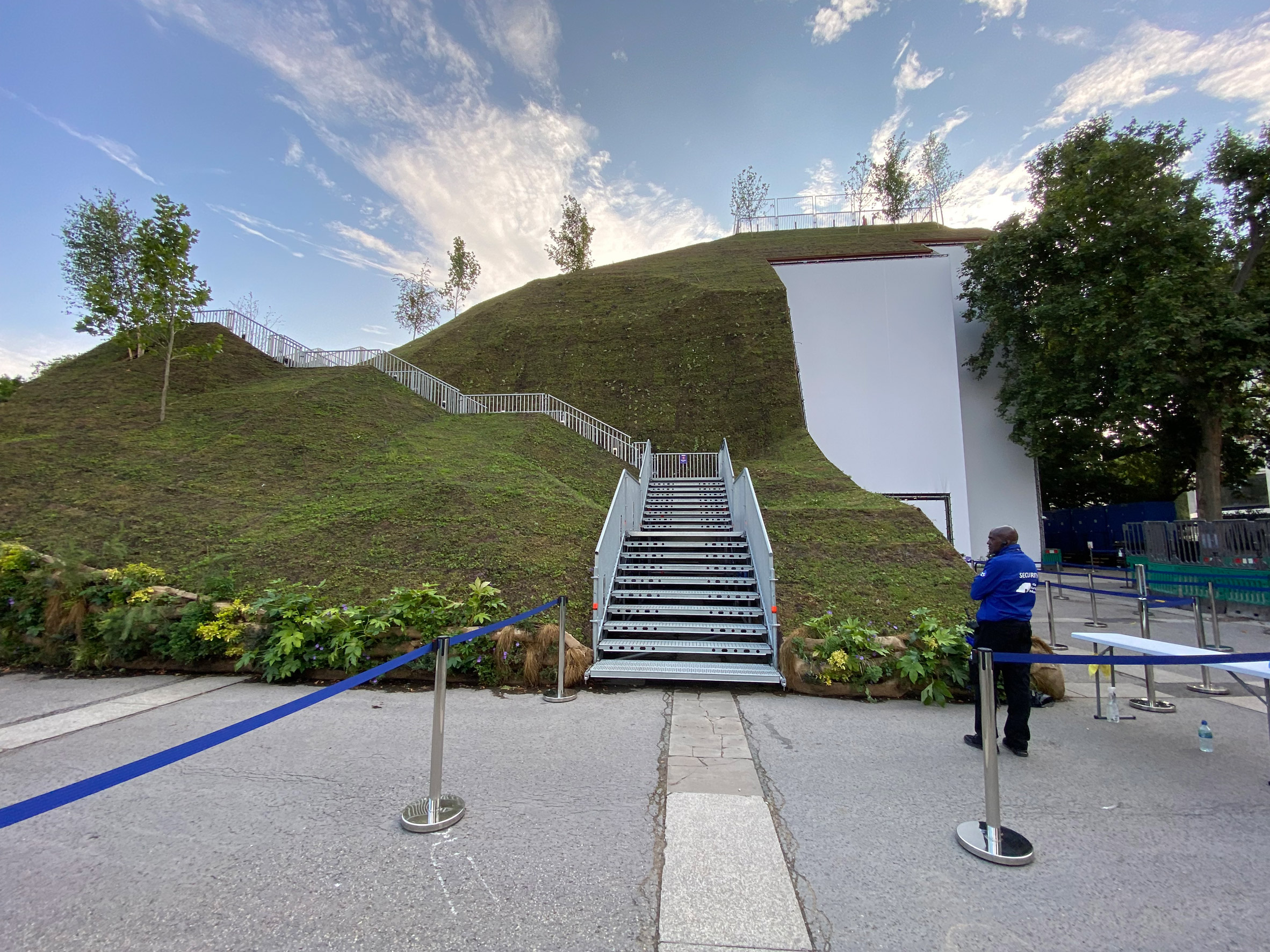
Marble Arch Mound entrance
The Marble Arch Mound designed by MVRDV went over budget by almost £3 million

The project, which was led by Caplan, was originally projected to cost £2.5 million, with additional operating costs of £0.8 million.

While operating costs have remained at £0.8 million, the total design, build and removal costs for the structure have snowballed to £5.2 million.

Internal review launched

The council has also launched an internal review to look into the problems that have beset the project, which drew criticism due to its unfinished appearance when it opened in July.

"With regret, I have accepted the resignation of my deputy leader, Melvyn Caplan, who led the Mound project," Robathan said. "We have also instigated a thorough internal review to understand what went wrong and ensure it never happens again."

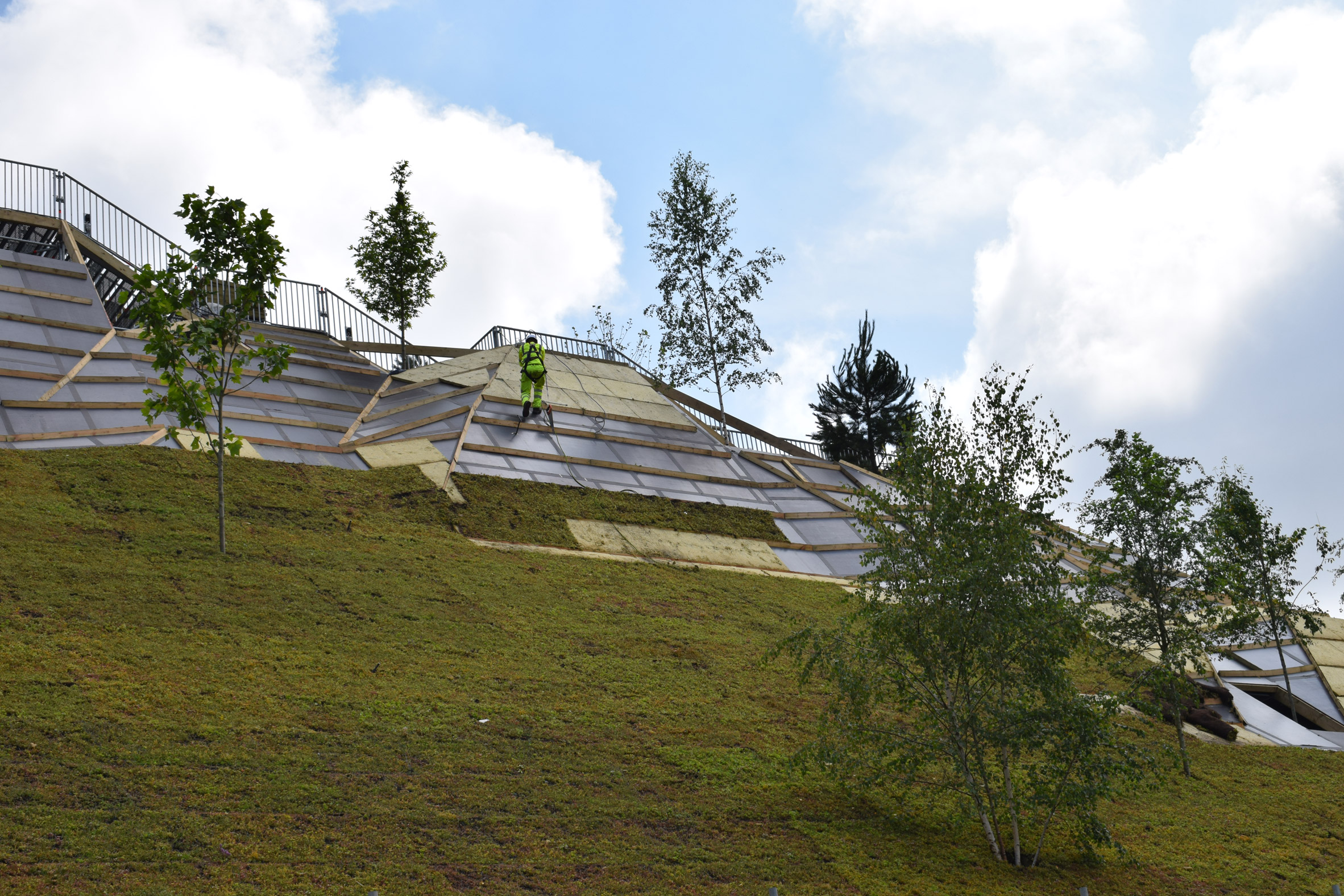
Marble Arch Mound under construction
Westminster Council admitted Marble Arch Mound "opened before it was ready"

The Marble Arch Mound, which is located by Marble Arch close to the central London shopping area of Oxford Street, was forced to close for visitors just days after opening to allow more time for the greenery to bed in.

The fake hill, which originally cost £4.50 to visit, will now be free to visit in August.

"We are working hard to deliver a new exhibition space and make sure the 130-step climb to the top is the best experience it can be, with a café for a drink and snack at the bottom," Robathan said.

Mound criticised from launch

Marble Arch Mound was widely criticised after its opening. "While the CGI plans depicted a lush landscape of thick vegetation, dotted with mature trees, the reality is thin sedum matting clinging desperately to the sheer walls of the structure, punctuated by occasional spindly trees," The Guardian architecture critic Oliver Wainwright wrote.

"The Marble Arch Mound shows signs of struggle," wrote Observer critic Rowan Moore, who visited ahead of the opening.

MVRDV has previously defended the project, saying it opened before it was fully complete. "Some elements were not ready, and it would have been better to wait until the greenery looked better," MVRDV told Dezeen. "But let's give nature a chance."

The design is part of a wider project to bring back visitors to the central London area, which was hit hard by the coronavirus pandemic.

Footfall in the area is still down 50 per cent on pre-pandemic levels in Westminster as a whole, and 54 per cent on Oxford Street itself, according to Westminster City Council.

Councillor Matthew Green will replace Caplan to take responsibility for the council's investment in Oxford Street.

Photography is by Dezeen.

The post Council deputy leader resigns due to "unacceptable" rise in Marble Arch Mound costs appeared first on Dezeen.


from Dezeen https://ift.tt/3AHOD5p

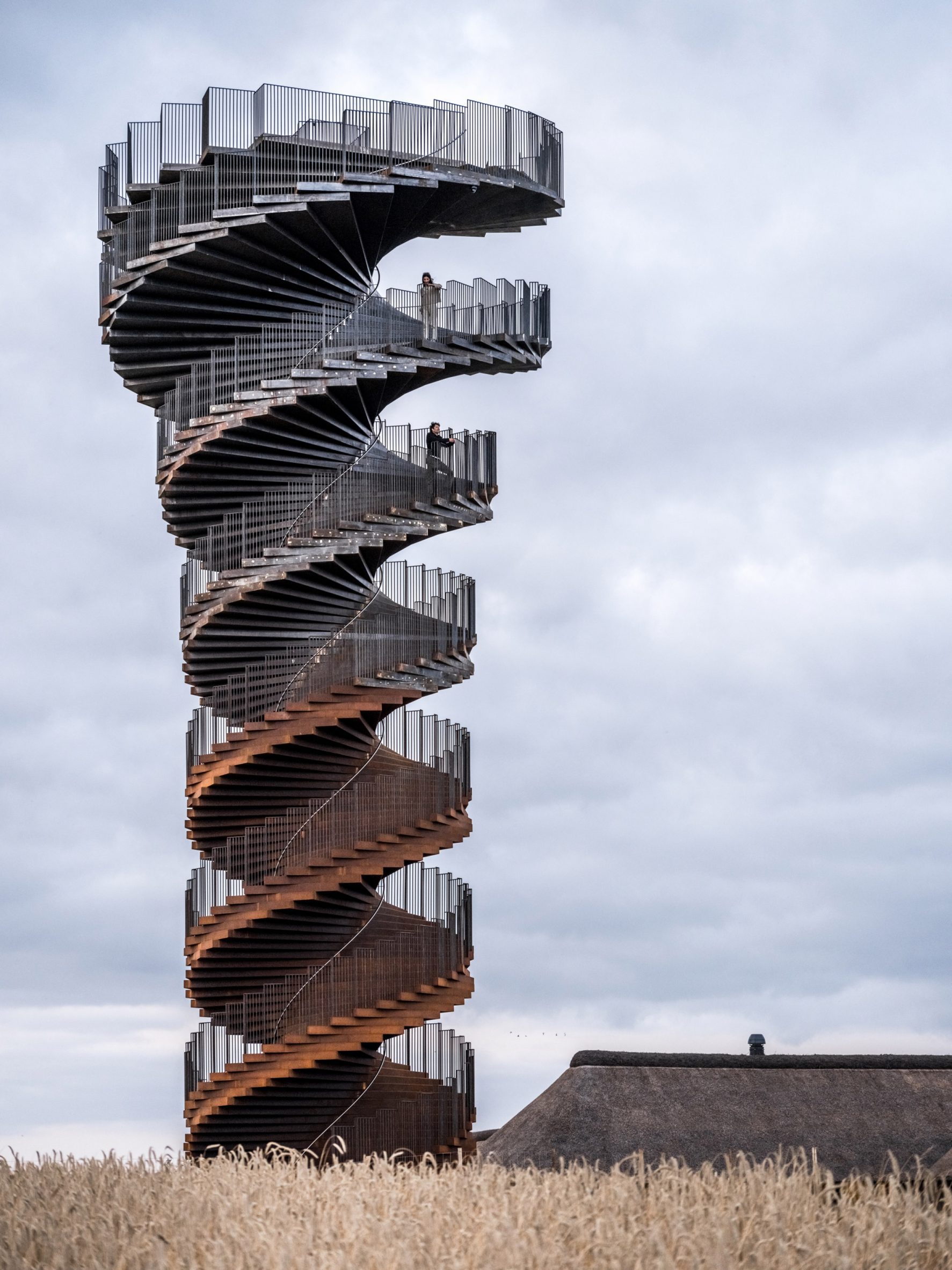
New photos show BIG's twisting Marsk Tower

BIG Marsk Tower

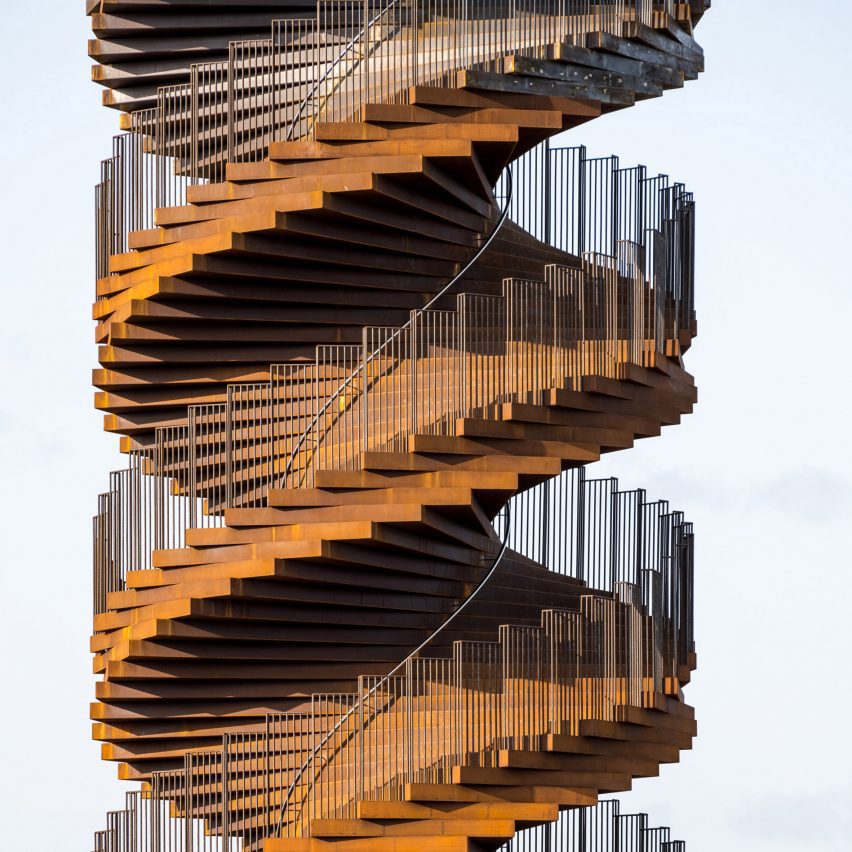
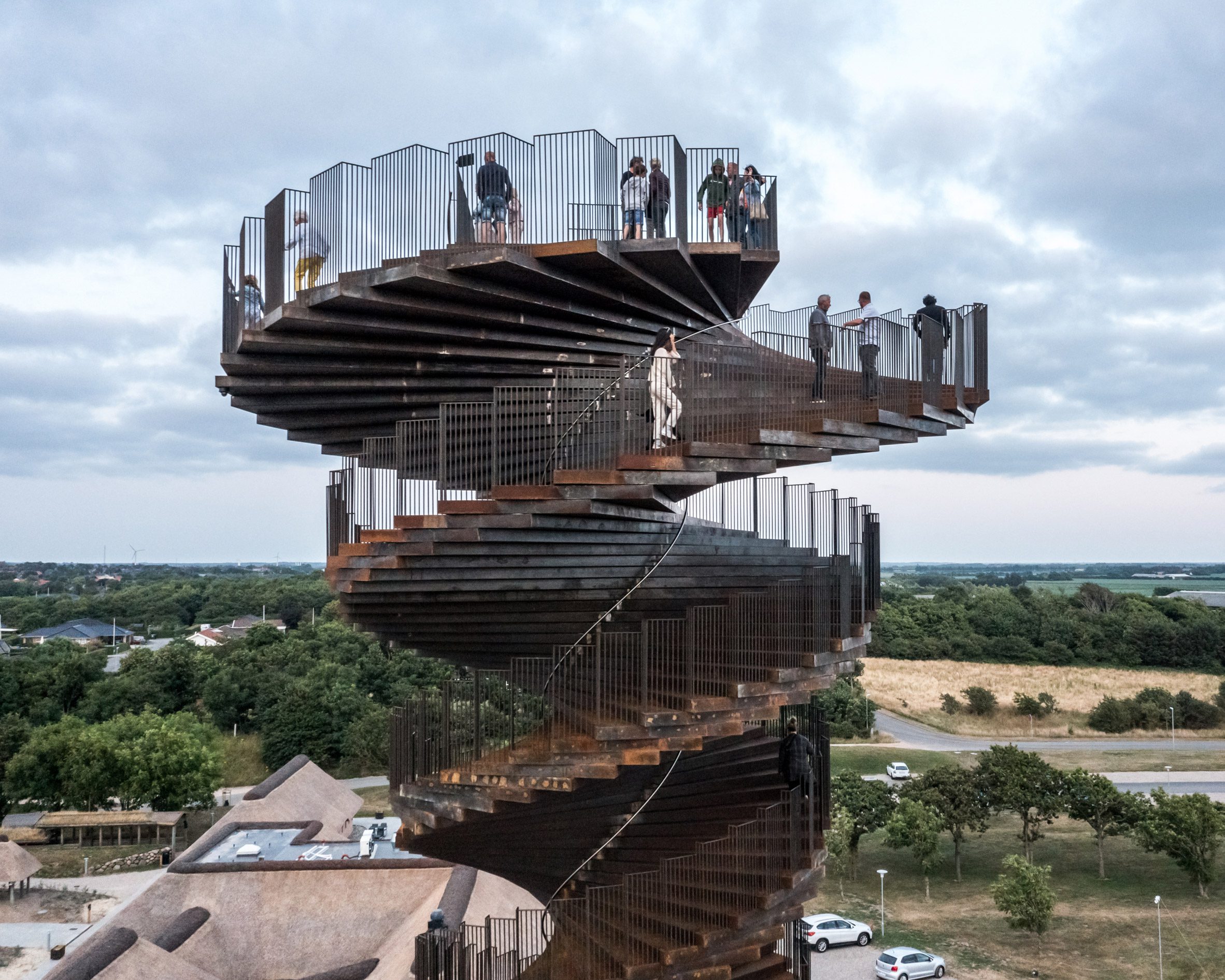
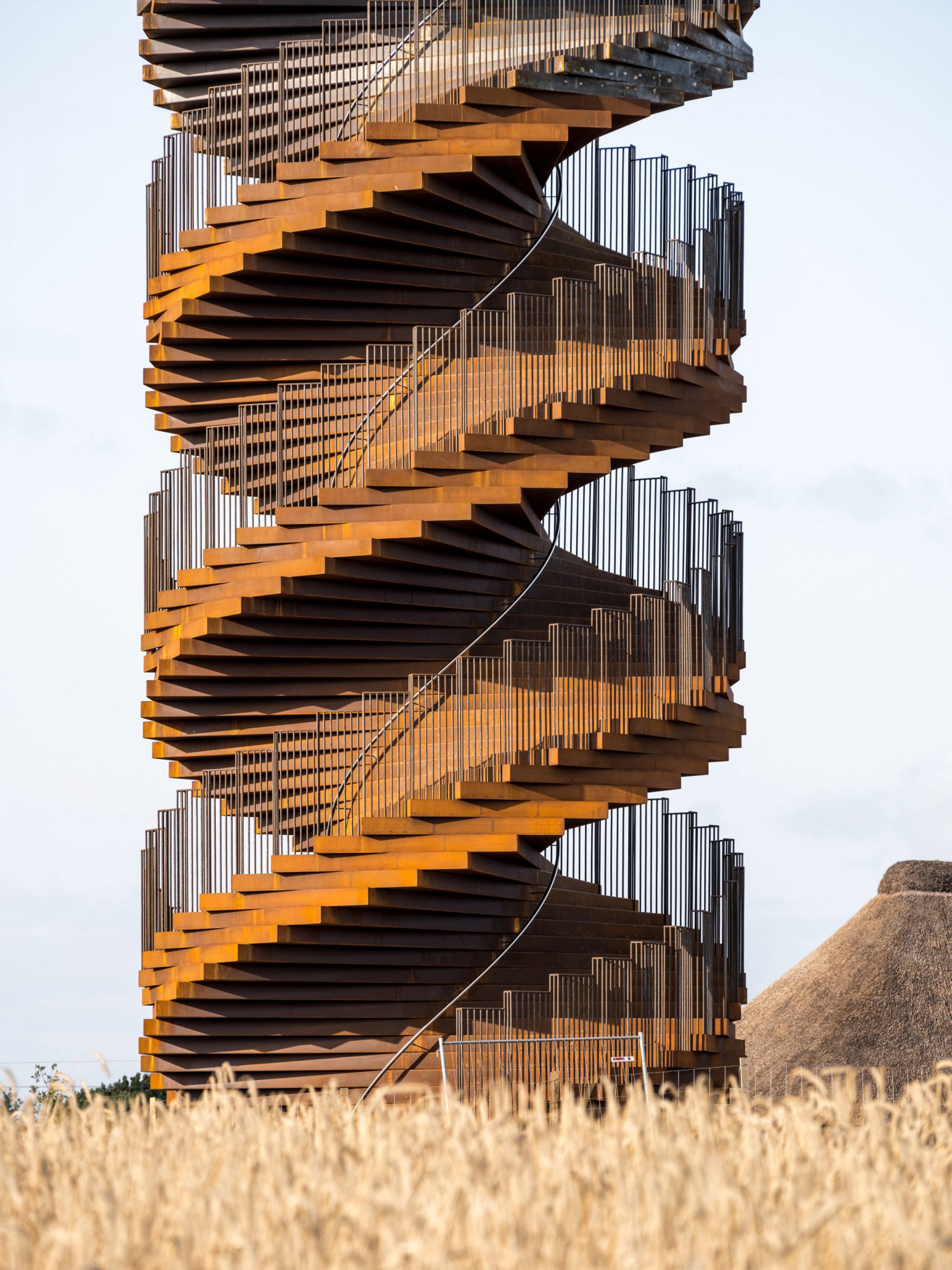
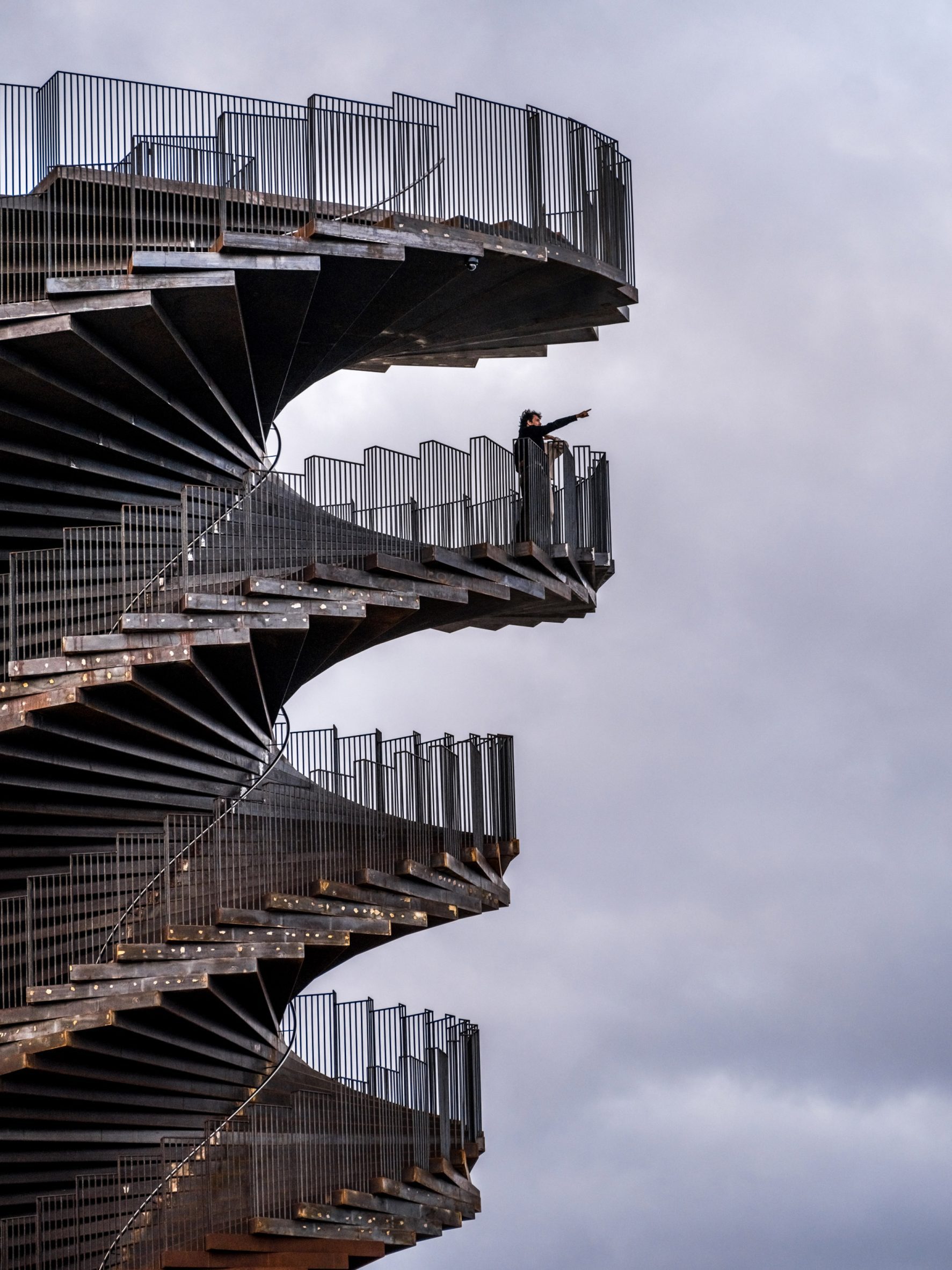
Danish architecture studio BIG has revealed new images by Rasmus Hjortshøj of Marsk Tower, its spiralling double-helix viewing tower that recently opened to the public in southwestern Denmark.

The 25-metre-tower is located in the UNESCO world heritage site of Wadden Sea National Park and was constructed from Corten steel.

Marsk Tower viewing point in Denmark
BIG's Corten-steel Marsk Tower overlooks marshes

"Marsk tower is a testament to our two-decades-long friendship and collaboration with the blacksmiths of Schacks Trapper," said BIG founder Bjarke Ingels.

"The double helix provides two stairs and an elevator with a single stack of rotating steel steps, allowing visitors to ascend and descend in a single spiraling loop from the sand to the sky – connecting the marshland to the Wadden Sea.”

Viewing platform at the top of Marsk Tower
Marsk Tower widens at the top to form a viewing platform

The tower is topped by a viewing platform and will provide 360-degree views across the marshland from which it is named – "marsk" is Danish for marsh.

"Because of the earth curvature, visitors will gradually expand their view of the horizon while walking to the top of the tower," BIG partner Jakob Lange said.

"On the foot of the tower, you will be able to see four kilometres into the distance, but from the top of the tower the view is expanded to an 18-kilometre view into the horizon."

The twisting staircase that forms Marsk Tower
The tower was designed to blend in with its surroundings

As well as a lookout tower, the building was designed to function as a tourist landmark. Reaching a height of 36 metres above sea level in the flat landscape, Marsk Tower will be visible from afar.

An elevator at the core of the 146-step tower provides access for wheelchair users.

The structure was created for Marsk Camp, a tourist destination that aims to showcase the unique landscape of southern Jutland.

The Wadden Sea area where the building is located was given UNESCO world heritage status as the largest unbroken system of intertidal sand and mudflats in the world.

View from Marsk Tower
Visitors have a 360-degree view from the top of the tower

The tower was designed to have a "natural aesthetic" that would blend in with these surroundings.

"Our ambition is to elevate Southern Jutland’s tourism experience to a new level and present this unique landscape from a new perspective to tourists from all over the world," said Marsk Camp's Jørgen Hansen.

Detail looking up at Marsk Tower
Visitors climb 146 steps to the top

BIG, founded by Bjarke Ingels, is one of the world's best-known architecture studios and has designed numerous sculptural buildings.

The studio recently unveiled visuals for a Swedish travel center with a curved timber ceiling, and chose a looping design for the O-Tower skyscraper in Hangzhou, China.

Photography is by Rasmus Hjortshøj.

The post New photos show BIG's twisting Marsk Tower appeared first on Dezeen.


from Dezeen https://ift.tt/37L0EdT

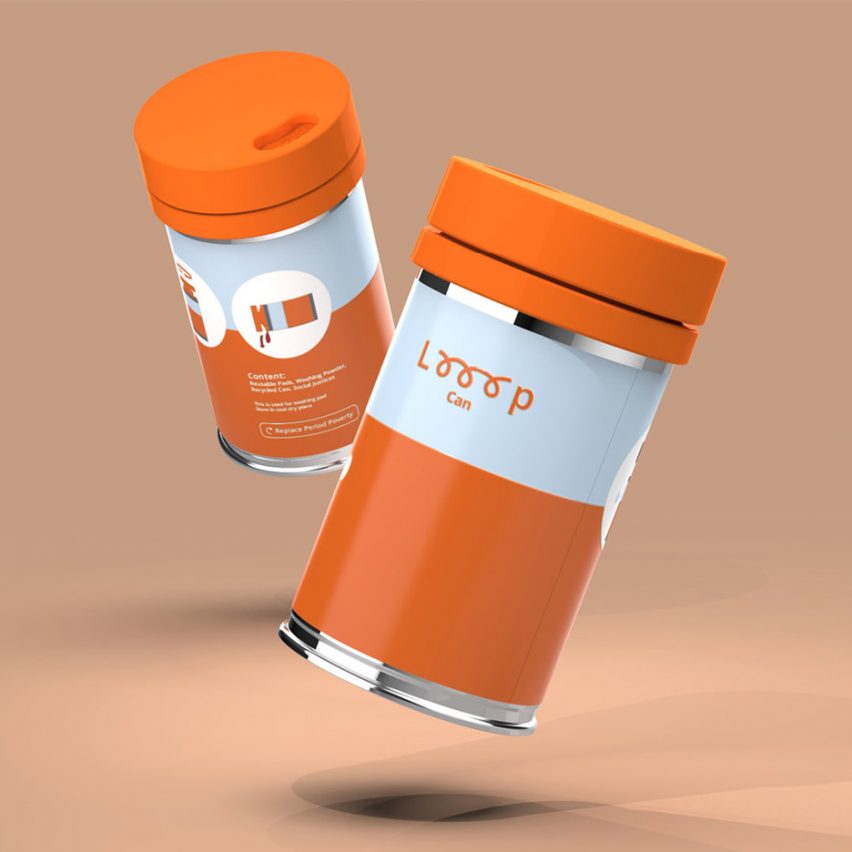
Looop Can is a sanitary pad washing device for refugees

Two orange Looop Cans by Cheuk Laam Wong

Product design student Cheuk Laam Wong has created Looop Can, a concept for a portable kit to clean menstruation pads that aims to reduce period poverty among refugees.

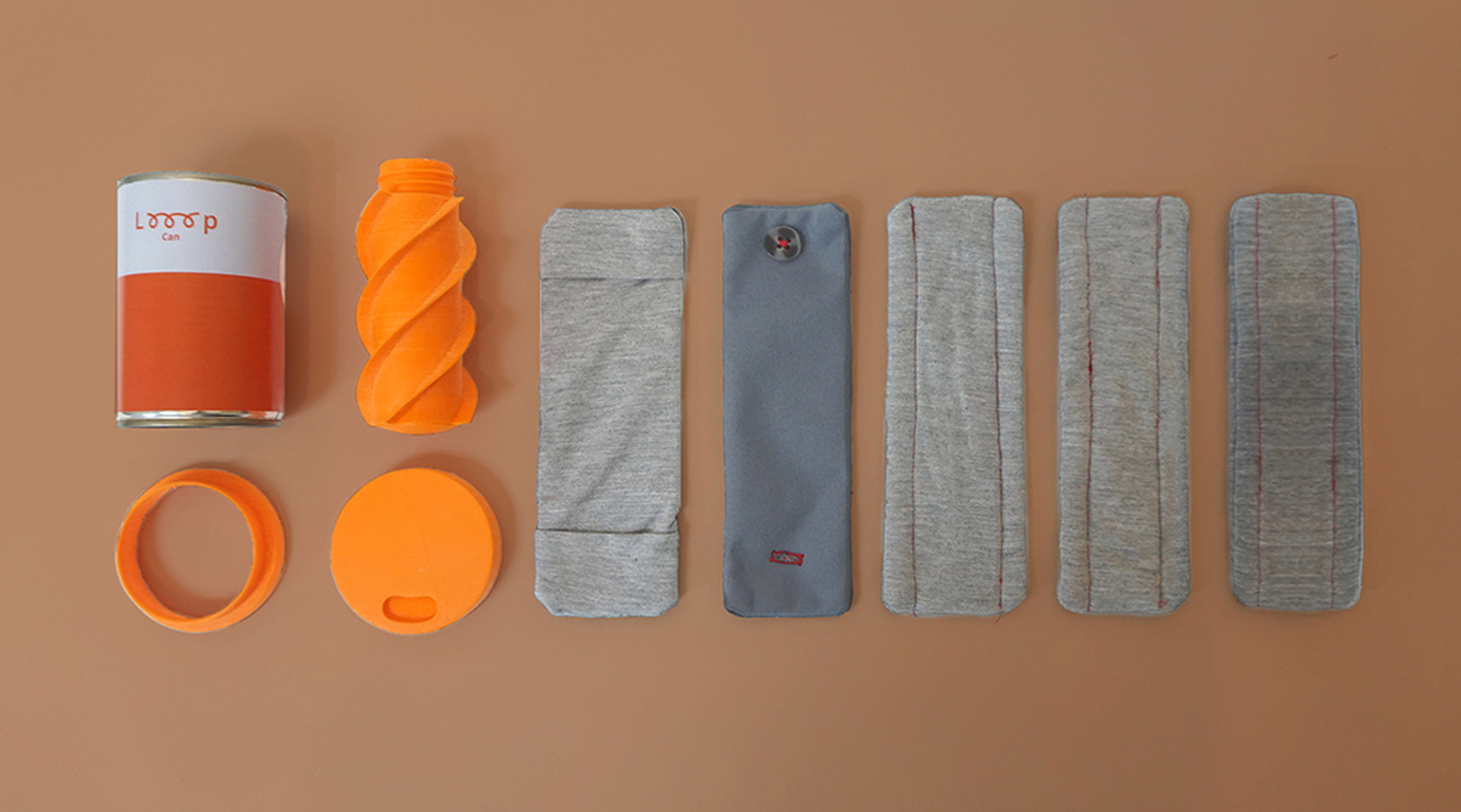
Each Looop Can kit includes a container for cleaning, 70 grams of baking soda and a reusable sanitary pad made from bamboo terry fabric called the Looop Pad.

Looop Can and bamboo menstrual pads
Above: Looop Can kits include a container, baking soda and sanitary pad. Top image: they are designed for women living in refugee camps

Made from a recycled steel can, the washing device can be used to clean sanitary pads with just baking soda and 500 millilitres of water.

The kit has been designed so that women living in refugee camps can easily and discretely wash and dry their sanitary pads.

"Almost 60 per cent of female refugees suffer period-poverty problems as they spend their limited funds on food or nappies for their babies," Cheuk told Dezeen.

"A washing kit for reusable sanitary pads will benefit not only refugees and asylum seekers, but also people who have limited finances and insufficient education about menstrual health management," she continued.

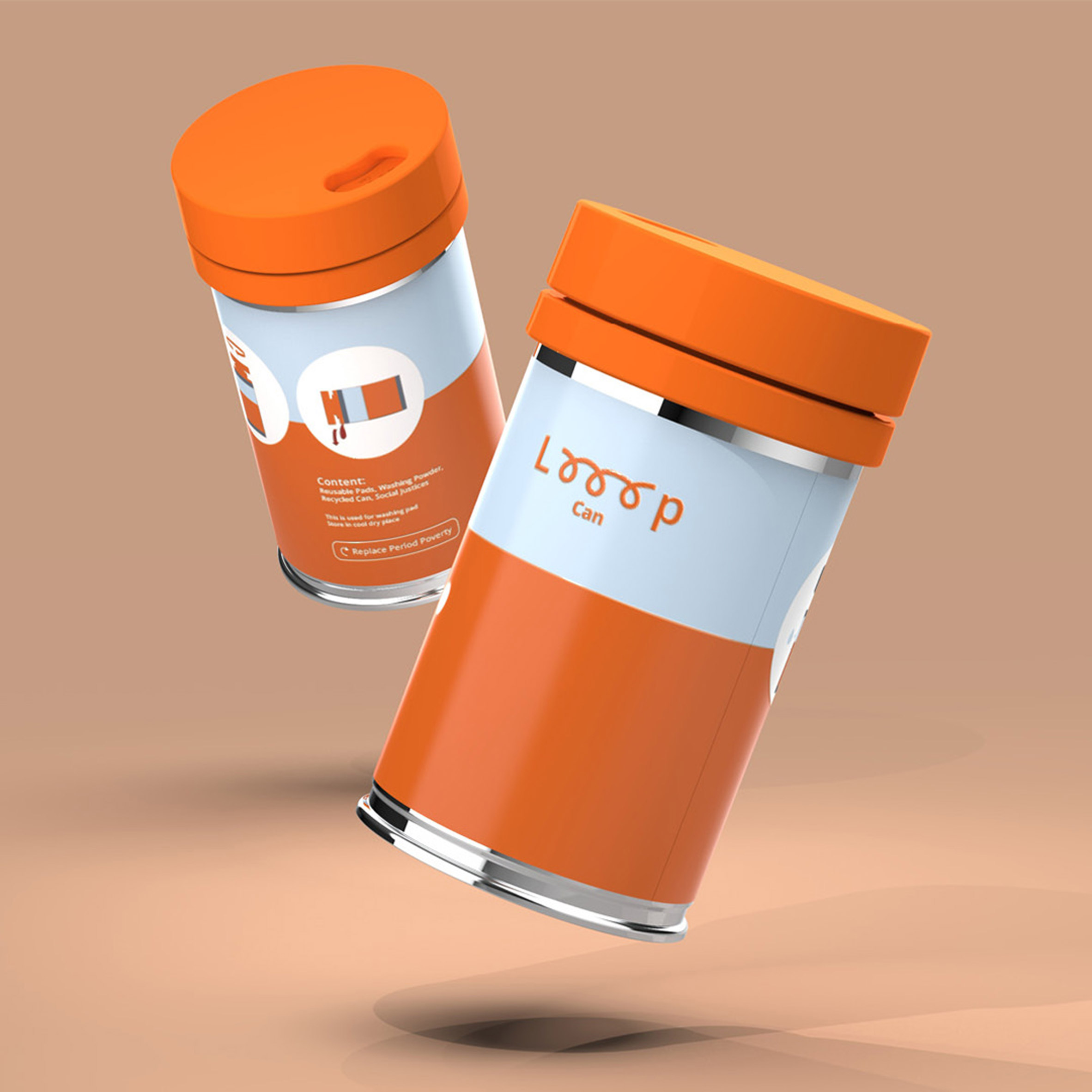
Two orange Looop Cans
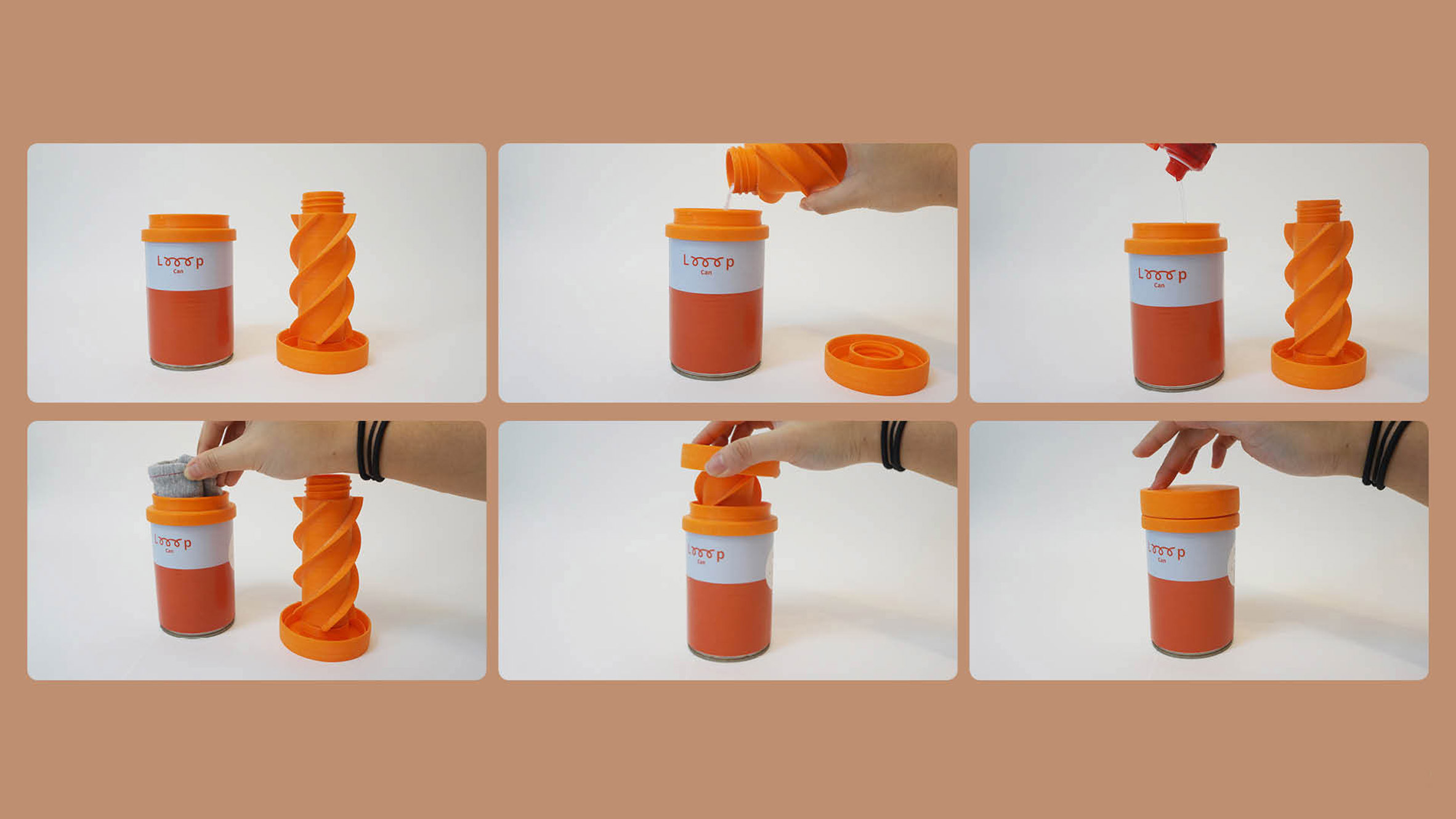
Users insert their pad, add water and baking soda and then spin the container to remove blood

The Looop Can comprises a main cylindrical body with a screw-top lid and a hollow spinning device that can also be used to store the baking soda.

When the sanitary pad requires cleaning, the user places the pad inside the can before immersing it in water and baking soda, a natural cleaning detergent that helps to remove blood stains.

Once the cap has been screwed on, users can spin the device with their finger which requires "minimal human effort so that people who have period cramps can wash easily," the designer explained.

The spinning motion helps the baking soda and water to clean the pad. The user must then wait at least 30 minutes until the blood dissolves, before rinsing the pad three times.

Looop Can being used to clean a sanitary pad
The kits are an alternative to single-use plastic sanitary pads

After interviewing NGOs in Greece refugee camps, Cheuk realised that there was a need for a cheaper, longer-term solution to plastic pads.

"Plastic pads can’t work as they rely on NGOs' constant donation and lack culturally sensitive disposable methods," the designer said.

Although reusable pads are a slightly better alternative, Cheuk found that shared washing machines in refugee camps aren't always available for everyone.

"It means that people need to dry the laundry in their shelter and everyone can see," she explained.

By contrast, the reusable Looop Pads can be hung up to dry indoors and, if cared for properly, can last for up to five years.

According to Cheuk, "this covers the minimum time a refugee is likely to stay in a camp waiting for identity approval".

Each Looop Pad comes in three modular parts: a base made from bamboo terry, a bamboo fleece wing and the pad itself. This is made from a polyester-laminated material – a waterproof fabric used in nappies, diaper bags and mattress covers.

"Through researching the material used in reusable pads, I designed the pad to have separable layers so that they dry quicker regardless of the weather. The quick-drying bamboo fabric became an ideal option," the student explained.

An illustration of a woman using Looop Can
Cheuk wanted the design to be discreet so that women would feel comfortable using the kit

The pads are cut into a rectangular shape so that they don't resemble sanitary pads, something that can help minimise embarrassment and stigma associated with menstrual products.

"When the pad is hung up to dry, it isn’t obvious that it’s a menstruation product, and it only takes half a day to dry indoors," Cheuk said.

With injection moulding, Cheuk believes that the expected total cost for the product – which is currently at a conceptual stage – should be around £3 for the whole set, including the washing parts and pads.

Other designs for refugees include portable kitchens by graduate collective Soup International, which were designed to be used by Southwark Day Centre for Asylum Seekers (SDCAS) for cooking purposes.

The post Looop Can is a sanitary pad washing device for refugees appeared first on Dezeen.


from Dezeen https://ift.tt/37FqKza

Squire and Partners uses mass timber to add co-working facility to its London office

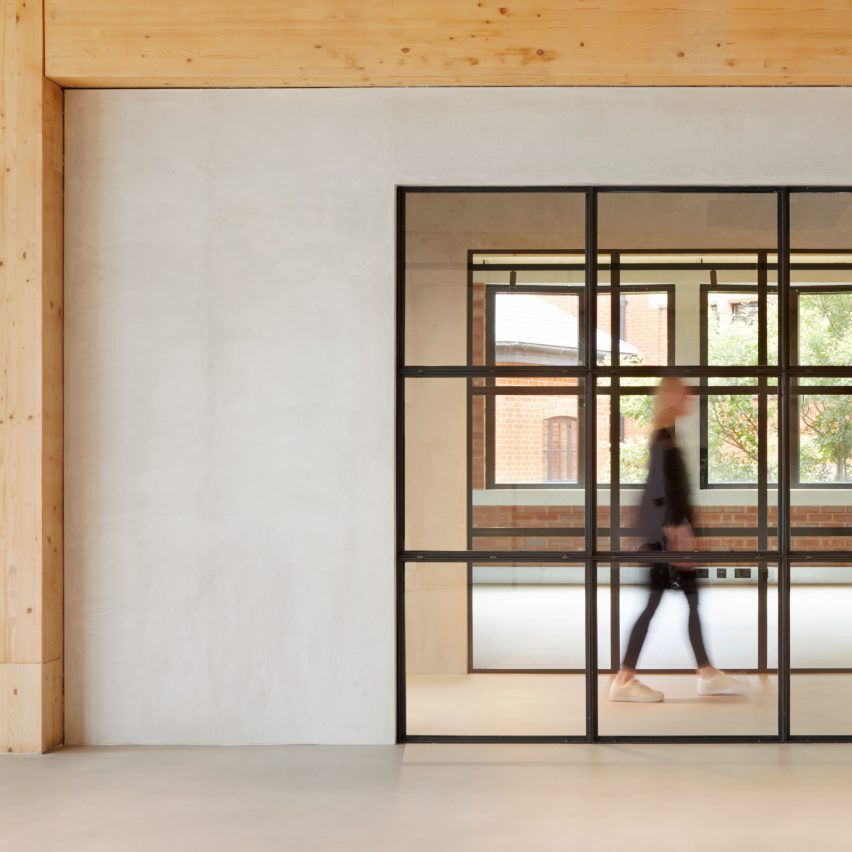
Crittal-style windows in The Department Store Studios by Squire and Partners

Architecture studio Squire and Partners has added a co-working facility to its own London office, in a new building framed by cross-laminated timber.

The Department Store Studios is a five-storey building offering flexible workspace along with facilities that include a movie screening room, a bar and a restaurant.

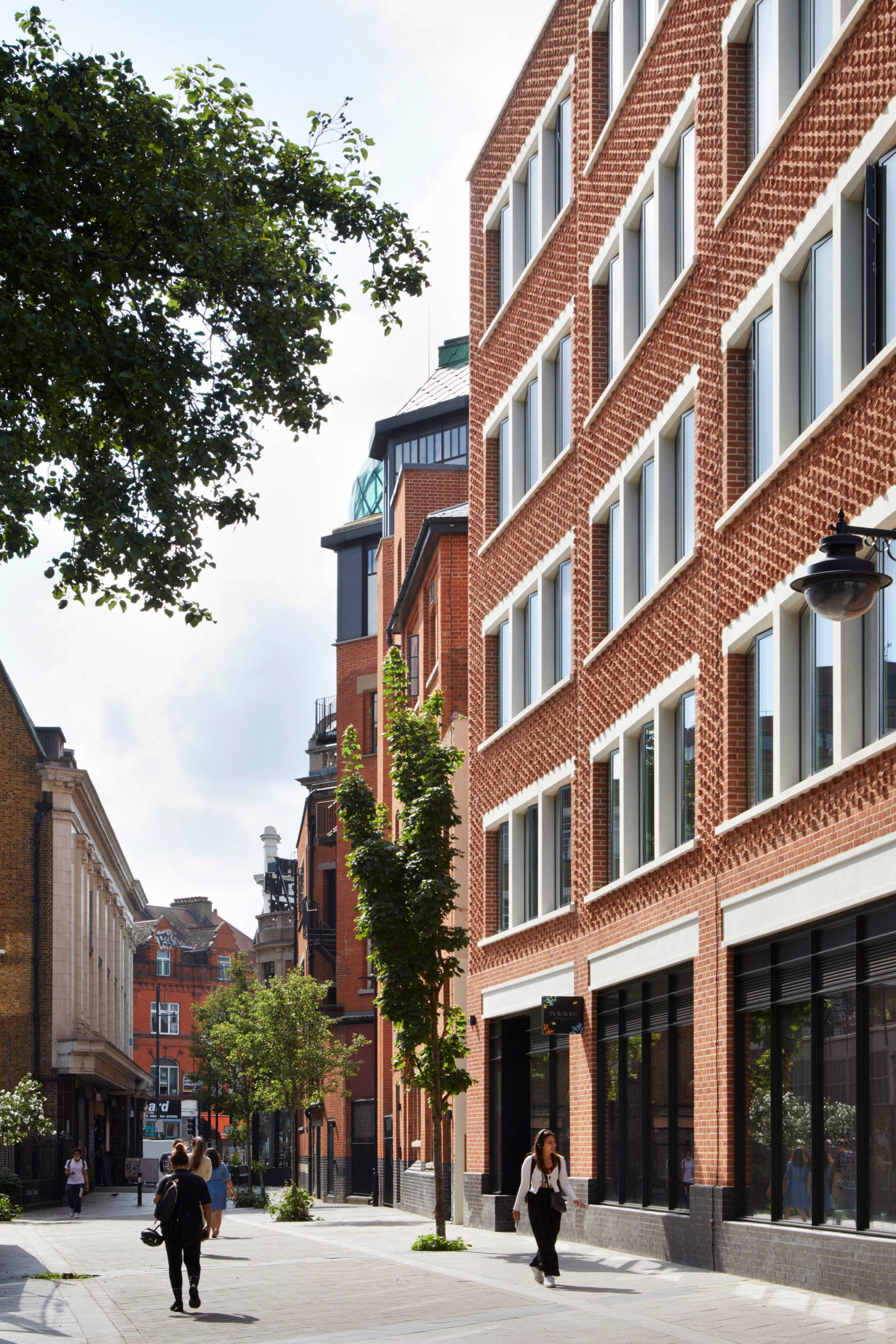
Brick facade and entrance to The Department Store Studios by Squire and Partners
The Department Store Studios is located in Brixton

It adjoins the former Bon Marche department store in Brixton, a previously abandoned building that Squire and Partners converted into its own workspace back in 2017.

With this new addition, the architecture firm hopes to support the burgeoning local creative scene. Co-working residents can potentially make use of facilities in both this new building and the converted department store.

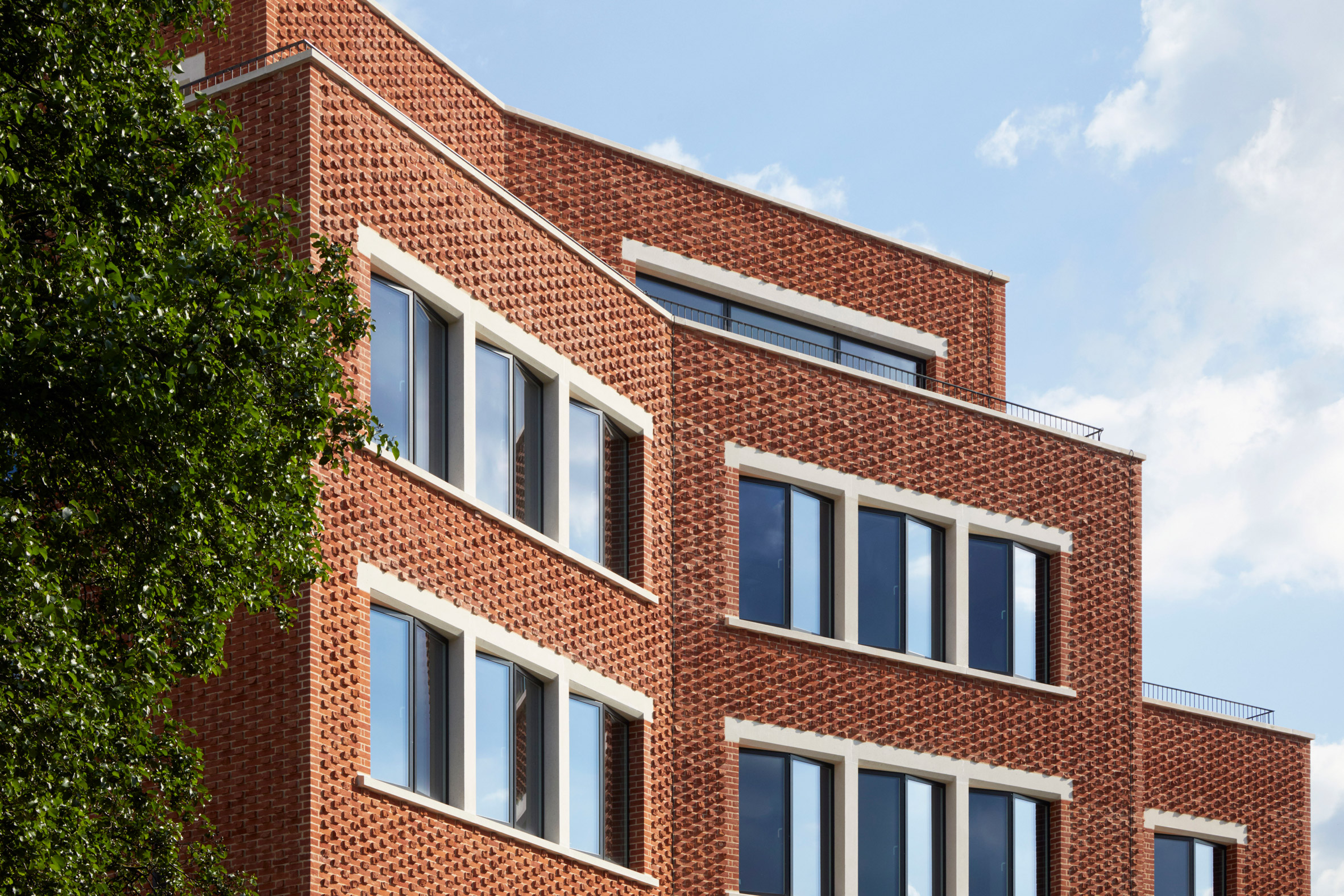
Brick facade of The Department Store Studios by Squire and Partners
Hand-snapped bricks give texture to the facade

According to Tim Gledstone, partner at Squire and Partners, the intention from the outset was to create a culture of cross-collaboration between the firm's employees and other artists and designers based in the area. The company will operate the entire facility itself.

"We've created a whole business here," he told Dezeen during a tour of the building. "In many ways, it was just building on what we already had with The Department Store."

"As soon as we opened The Department Store, people started asking if they could have some desk space," added Maria Cheung, the studio's head of interior design. "So we knew the demand was there".

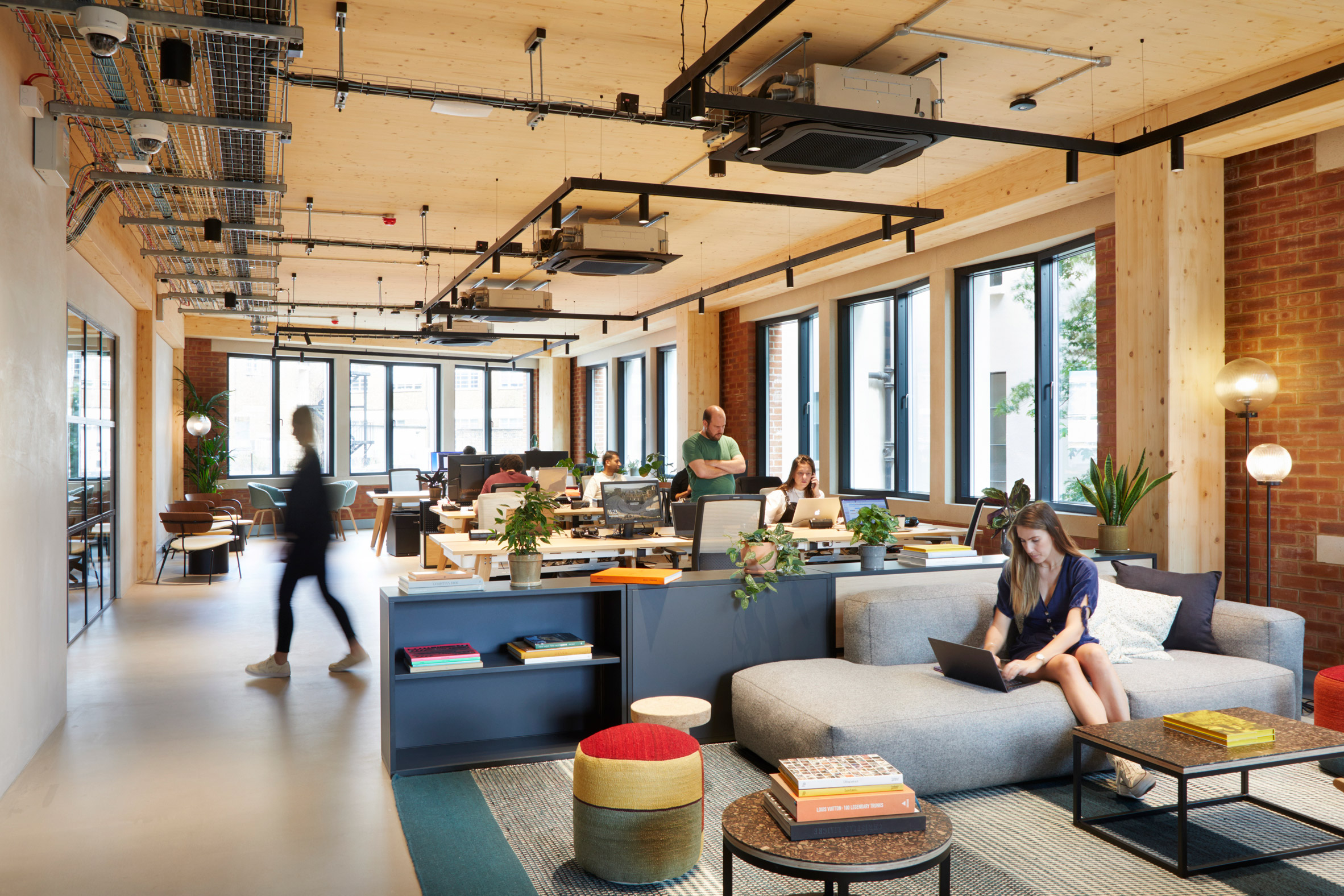
Work and lounge spaces in The Department Store Studios by Squire and Partners
The building offers workspace facilities for individuals and small businesses

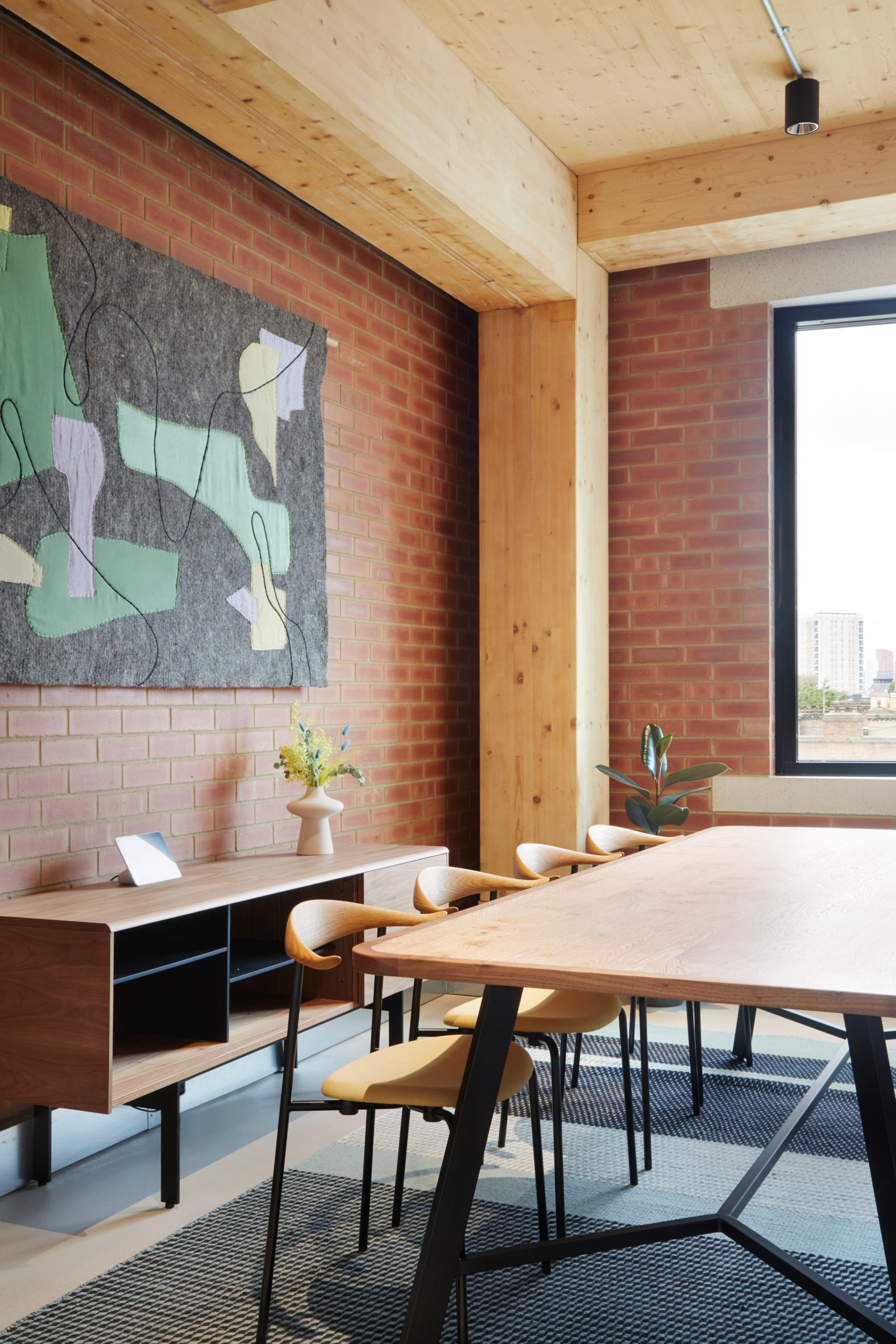
Conscious of the environmental impact of a new-build structure, the architects chose to use mass timber for the building's primary structure. The building boasts a cross-laminated timber (CLT) frame that offers natural soundproofing and airtightness.

The design challenge was finding a way for this material to feel at home alongside the raw and characterful aesthetic of the old Bon Marche building.

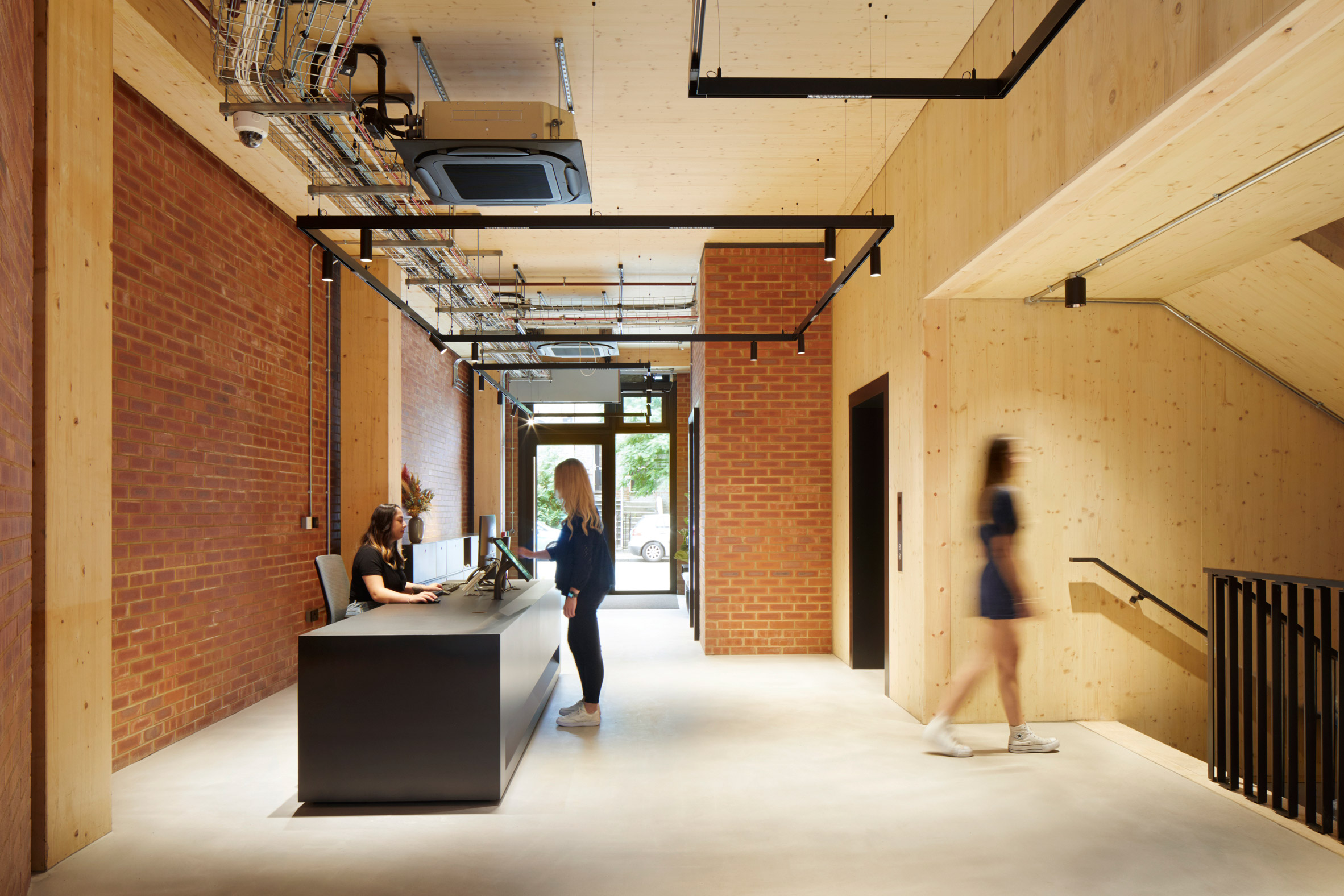
Entrance lobby for The Department Store Studios by Squire and Partners
A CLT structure was chosen to help reduce the building's carbon footprint

"Our clients who would come to The Department Store would almost invariably say, this is a pretty fabulous place, but you could never do this with a new building," said senior partner Michael Squire. "Because really, the magic you've got is what you've revealed."

One tactic that the designers employed was using textured brickwork for the building's facade. Some of the bricks were snapped by hand and laid to face outwards, giving an uneven quality to the building's exterior.

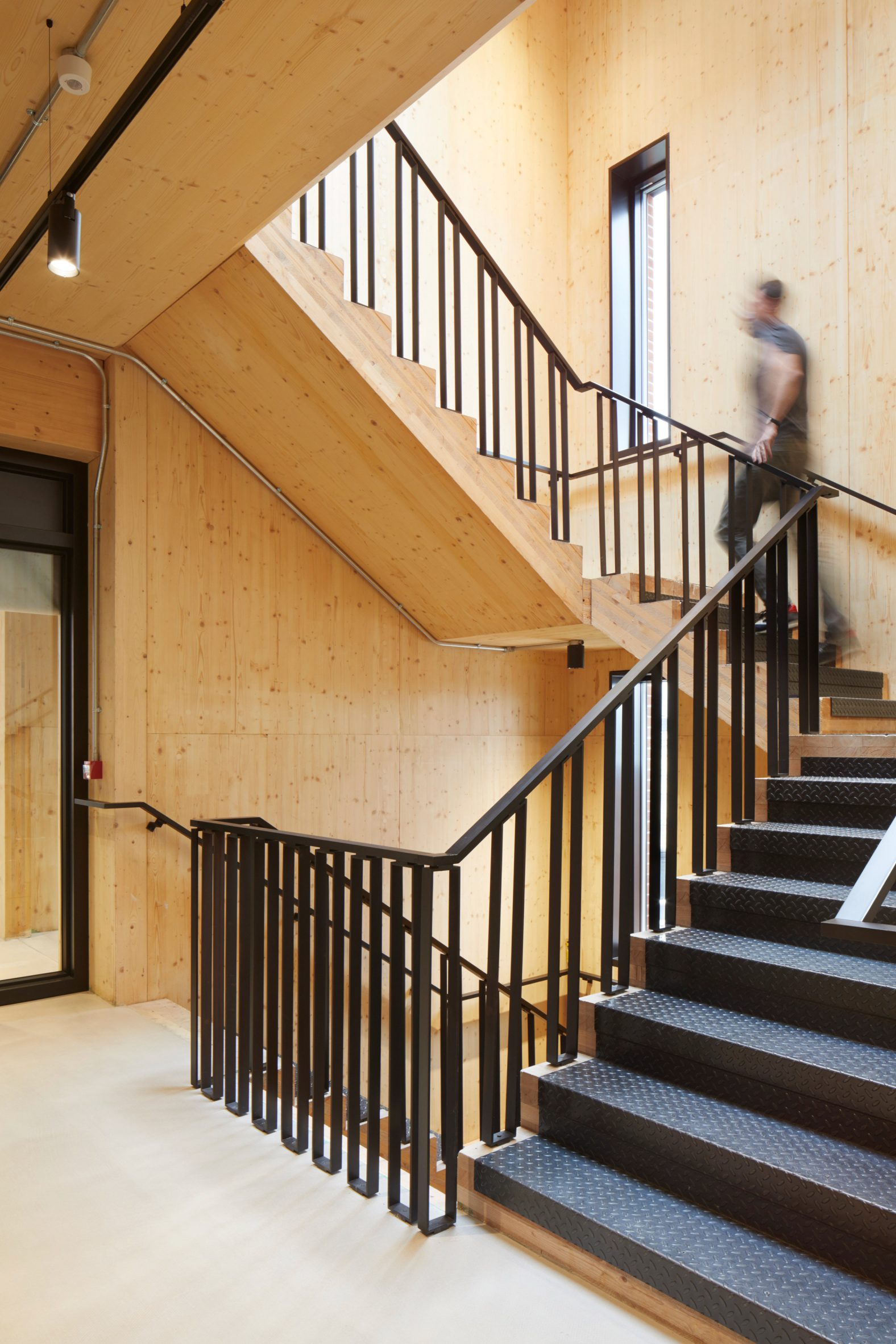
CLT structure on staircase of The Department Store Studios by Squire and Partners
This CLT is left exposed inside, giving a natural warmth to the interiors

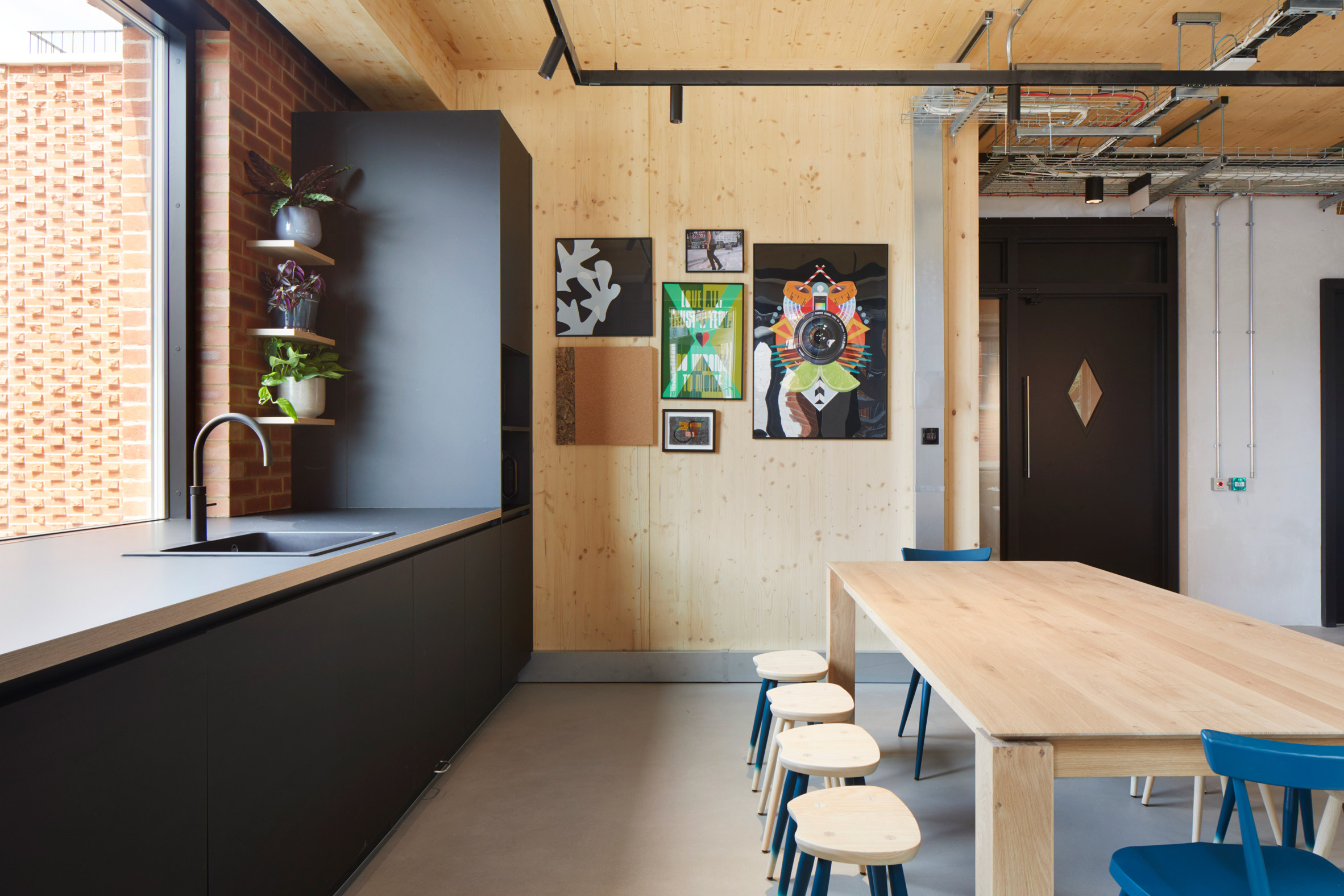
Inside, the CLT structure was left exposed wherever possible and pared with industrial finishes like screed flooring. Faceted bay windows with dark frames echo the style of the Crittall windows in The Department Store, while lighting and electrical fixtures are left on show.

"CLT was the best technical choice, and with that came immediate soul, warmth and nature," said Gledstone. "We're celebrating this structure inside the building."

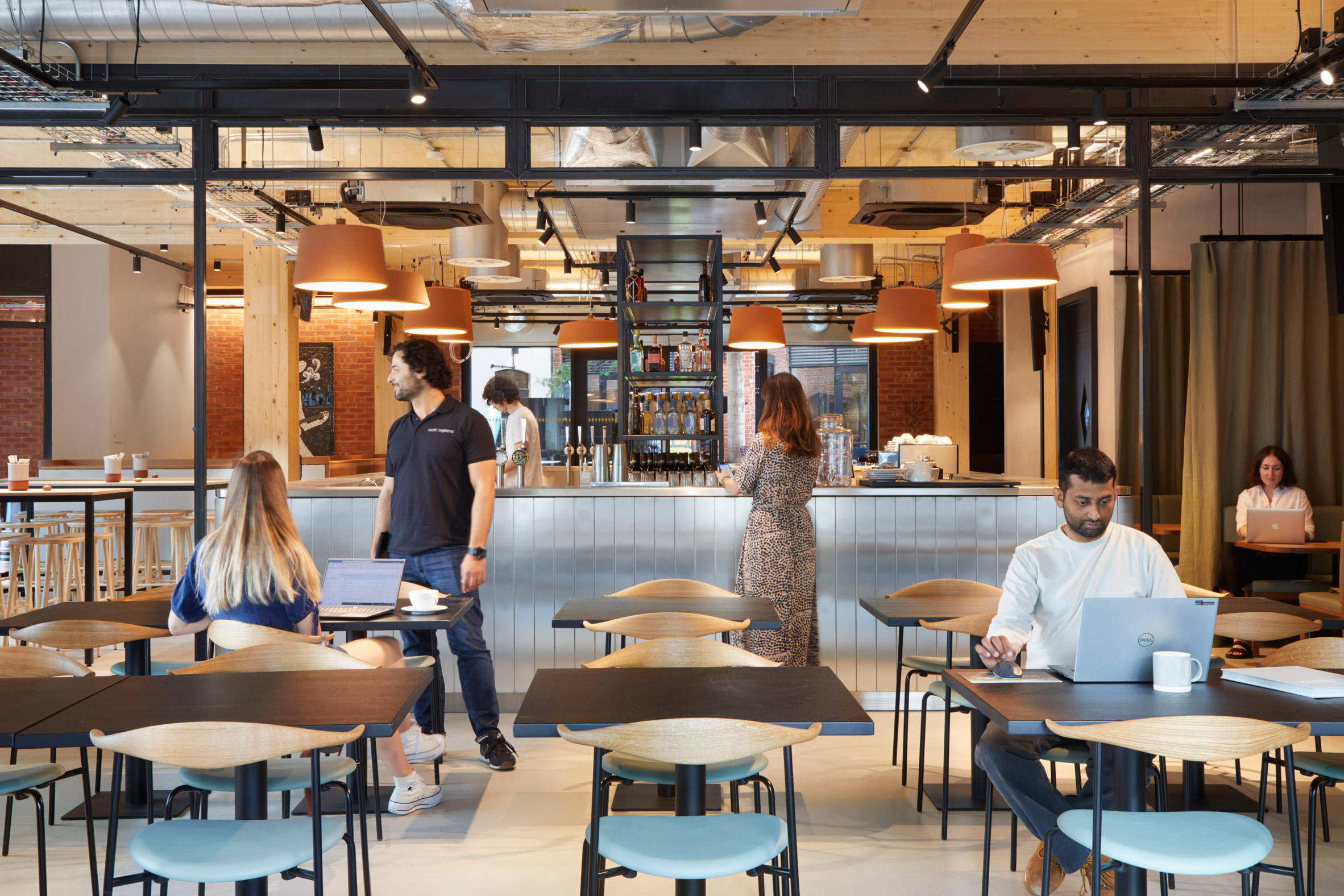
Bellefields restaurant and bar in The Department Store Studios by Squire and Partners
Bellefields bar and restaurant can be found on the ground floor

The Department Store Studios is located on the north side of the original building, with access via Bellefields Road. The two buildings don't join, although they share a courtyard where an established oak tree was recently planted.

The ground floor of the building accommodates a members' lounge and the Bellefields bar and restaurant, where terracotta pendant lights, marble-topped tables and wooden dining chairs help to create a Mediterranean-inspired feel.

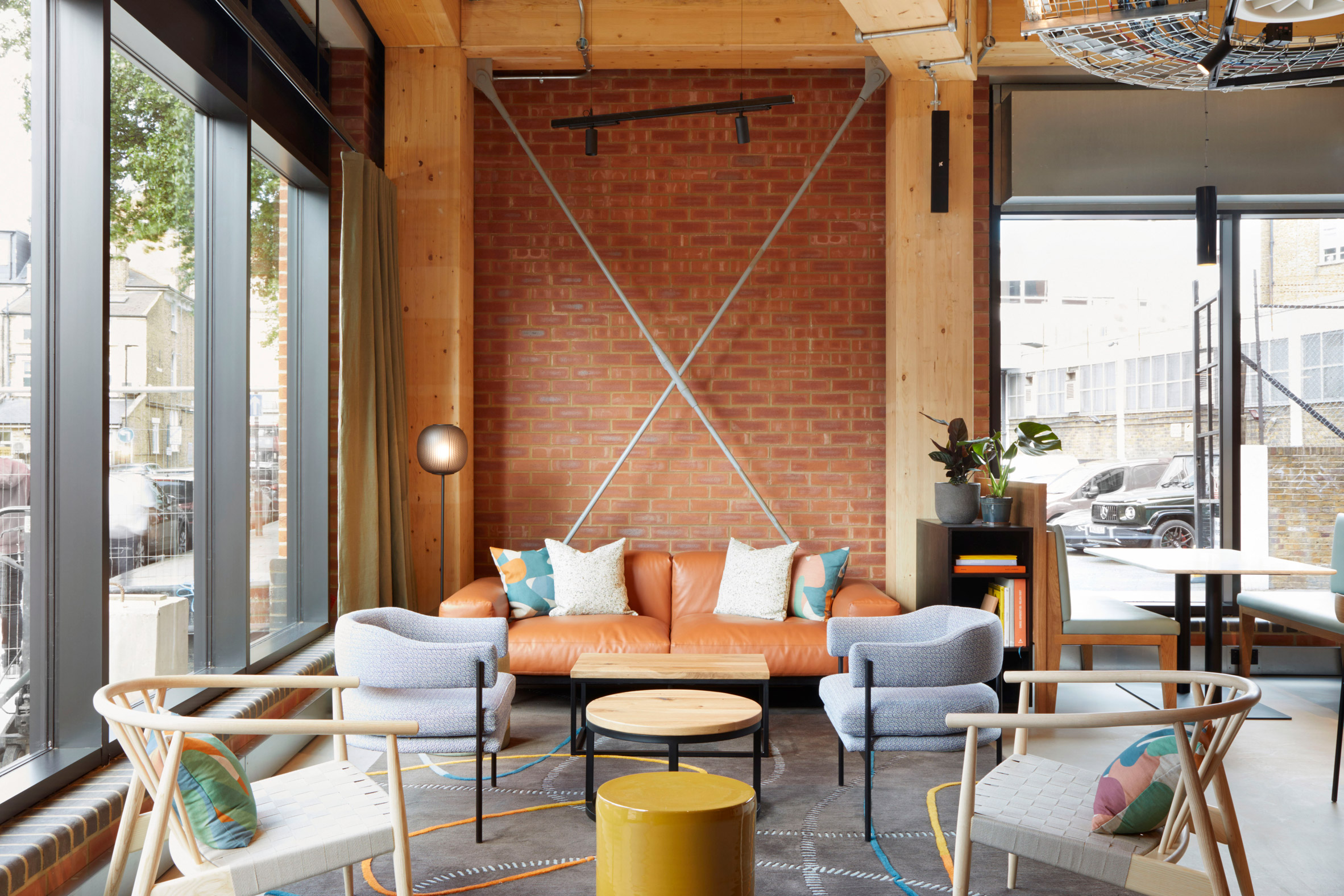
Co-working-lounge in The Department Store Studios by Squire and Partners
There's also a co-working lounge that is exclusive to members

The four floors above contain a mix of different workspaces, including open-plan co-working for individuals and private studios for between six and 72 people.

Phone booths and bookable meeting rooms are dotted throughout, along with kitchen spaces and lounge areas. The aim was to create spaces that facilitate different types of working, inspired by the way that spaces are used in The Department Store and other Squire & Partners projects like the Ministry of Sound co-working.

This thinking extends to the interior design, where the colour palette and furniture choices reflect different times of day and different moods.

"One thing we've learned from our workspace experience is to design for moments in time and states of mind," said Gledstone.

Meeting room in The Department Store Studios by Squire and Partners
Meeting rooms feature assorted colour palettes to offer different moods

"We're using colour for its psychosomatic energy, either to calm or excite, and we're linking it to seasons or moments in the days in different rooms," he continued.

"So even though some meeting rooms sit in the same place above each other, some are muted with calm evening tones and relaxed furniture, others are designed for breakfast."

Kitchen in The Department Store Studios by Squire and Partners
Residents have access to social kitchens and other shared facilities

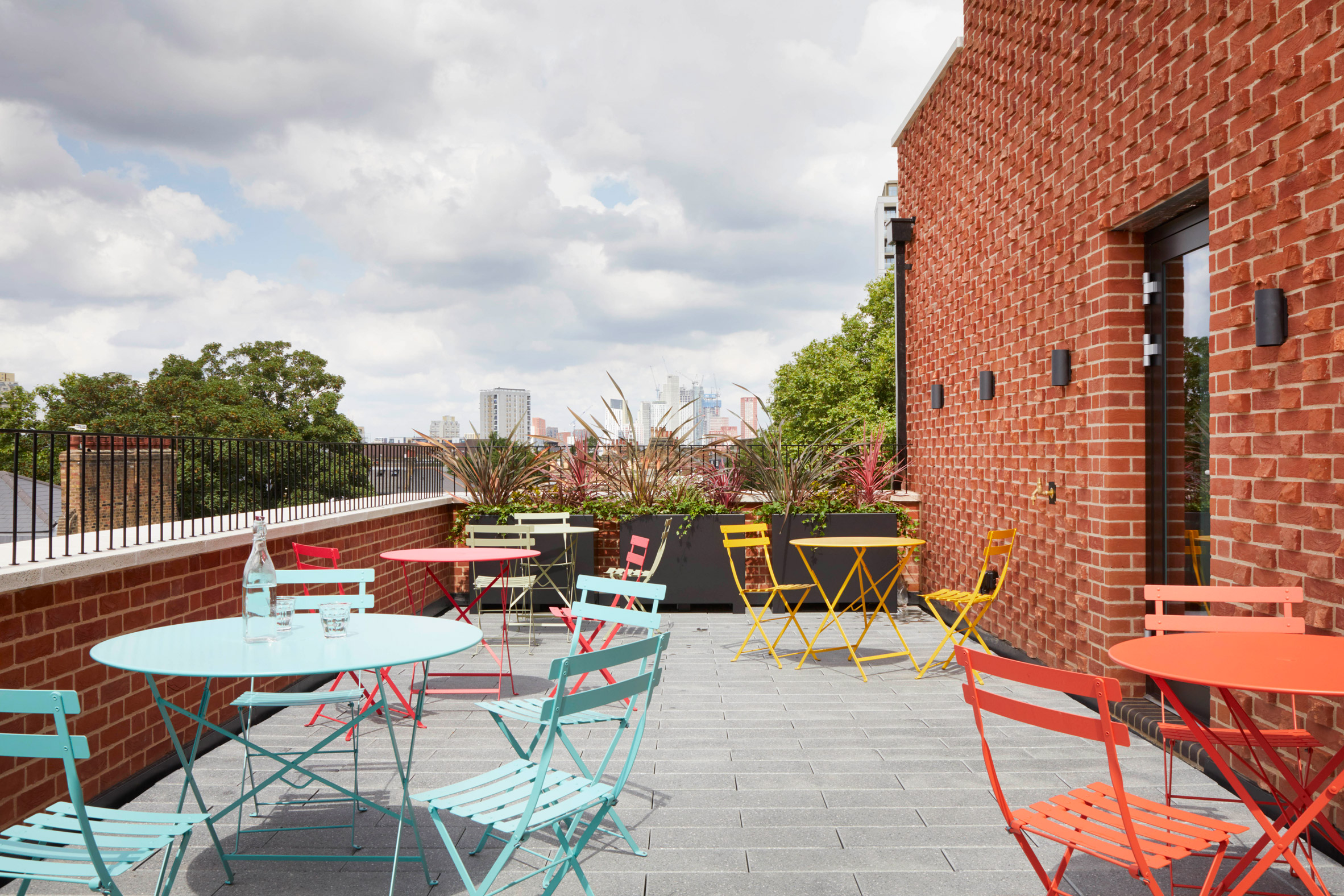
A communal terrace can be found on the third floor, while the fourth floor – expected to be let to a single tenant – has its own roof terrace.

The screening room can be found in the basement, allowing the space to be used as a mini cinema. This floor also includes bike storage, lockers, showers and changing areas.

Roof terrace in The Department Store Studios by Squire and Partners
The third floor opens out onto a roof terrace

As well as the paying members, Squire and Partners has created a residency programme offering 12 month of free workspace to two local entrepreneurs. The first residents are Gabriella Lafor, who helps find media careers for Black British talent, and textile designer Coco Cripps.

"It's really a place where people can work in their own space, but also be part of a community," said Cheung, "and that's a sense that we really want to amplify and encourage."

Movie is by Jim Stephenson. Photography is by Jack Hobhouse and Jim Stephenson.

The post Squire and Partners uses mass timber to add co-working facility to its London office appeared first on Dezeen.


from Dezeen https://ift.tt/3jQkYQR