Monday, 16 August 2021

Esperance Bridge creates new walking route into London's Coal Drops Yard

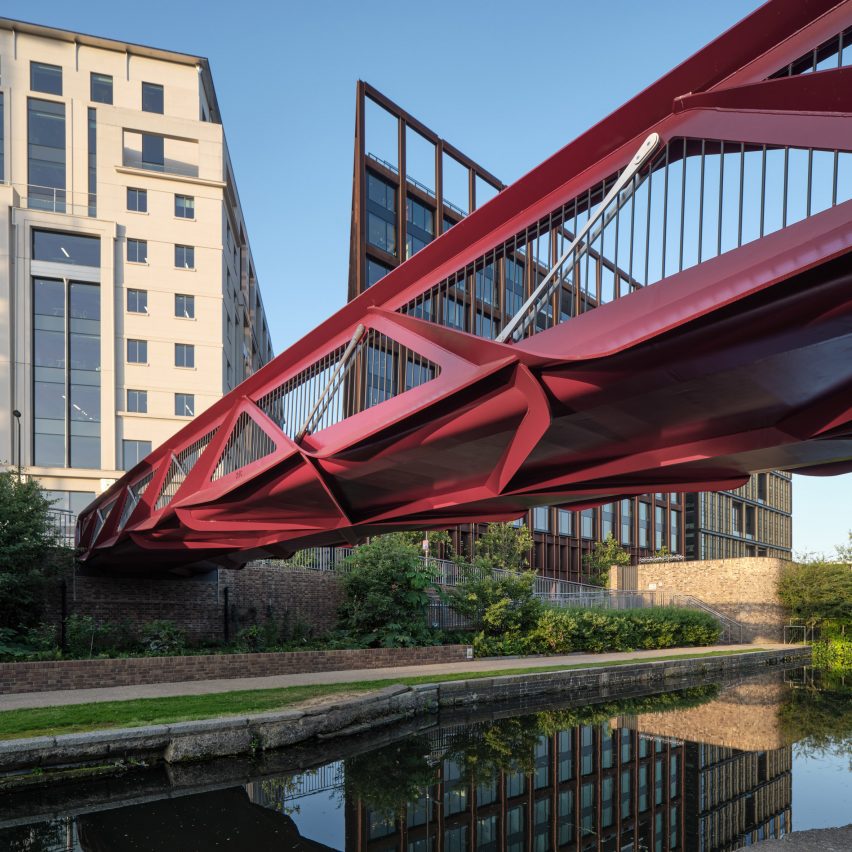
View across water of Esperance Bridge by Moxon Architects and Arup

Moxon Architects has teamed up with engineering firm Arup to install a bright red bridge across Regent's Canal in London, forming a new route into the Thomas Heatherwick-designed Coal Drops Yard.

Esperance Bridge is a pedestrian-only crossing, positioned to line up with the natural walking route from King's Cross and St Pancras stations towards Granary Square and areas to the north.
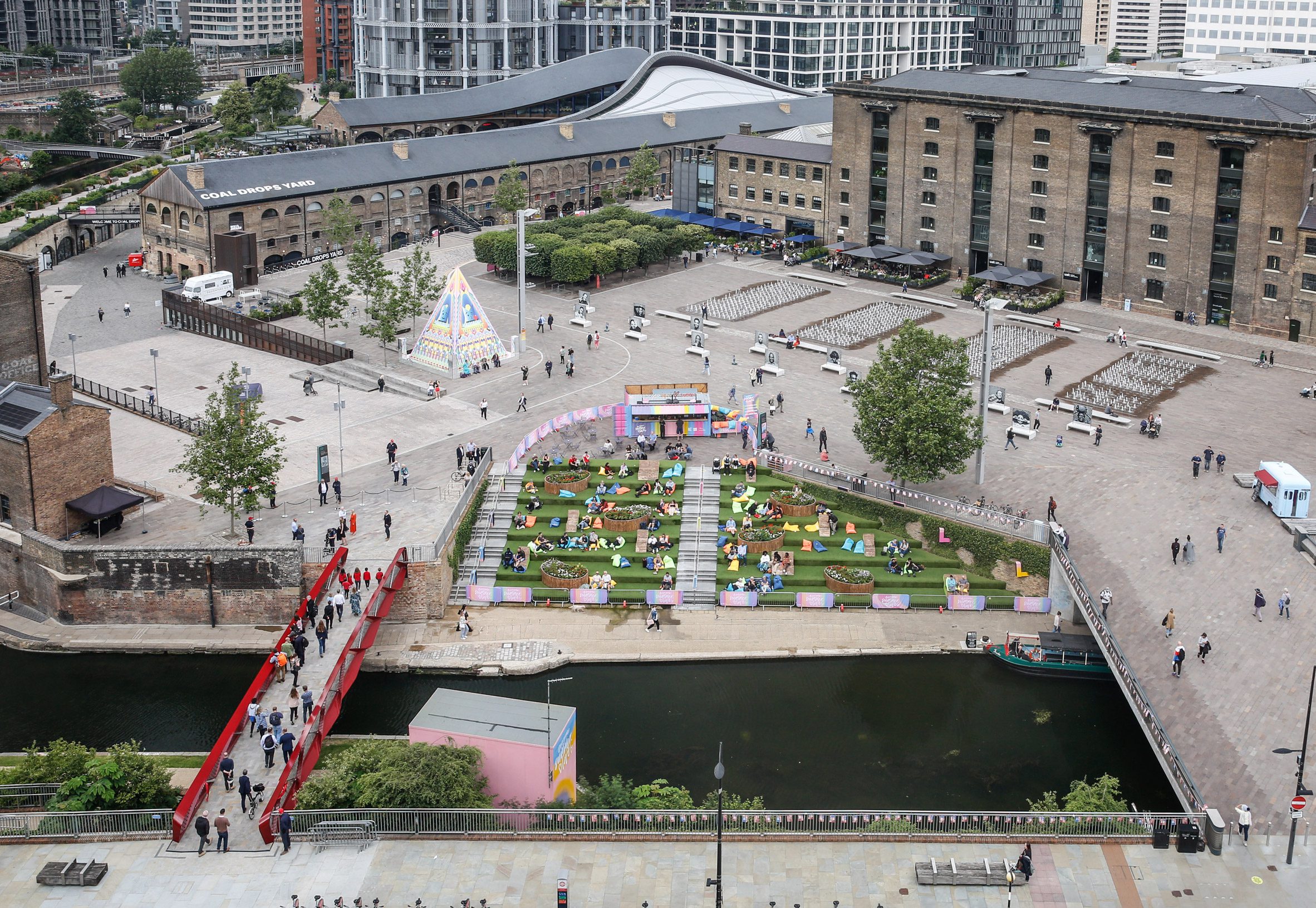
Aerial view of Esperance Bridge and Coal Drops Yard
Esperance Bridge creates a more direct route into Coal Drops Yard

It boasts a folded truss form, designed by Moxon Architects and Arup to reference an old railway bridge installed in this exact location in the early 19th century.

The bridge is one of three river crossings that featured in the original masterplan for the Coal Drops Yard shopping complex, which opened in 2018.

Three years later, it becomes the last of the trio to be installed. The first was the wide road bridge – now also pedestrianised – at the southeast corner of Granary Square, while the second was Somers Town Bridge, a pedestrian crossing heading west towards the Camley Street nature reserve.
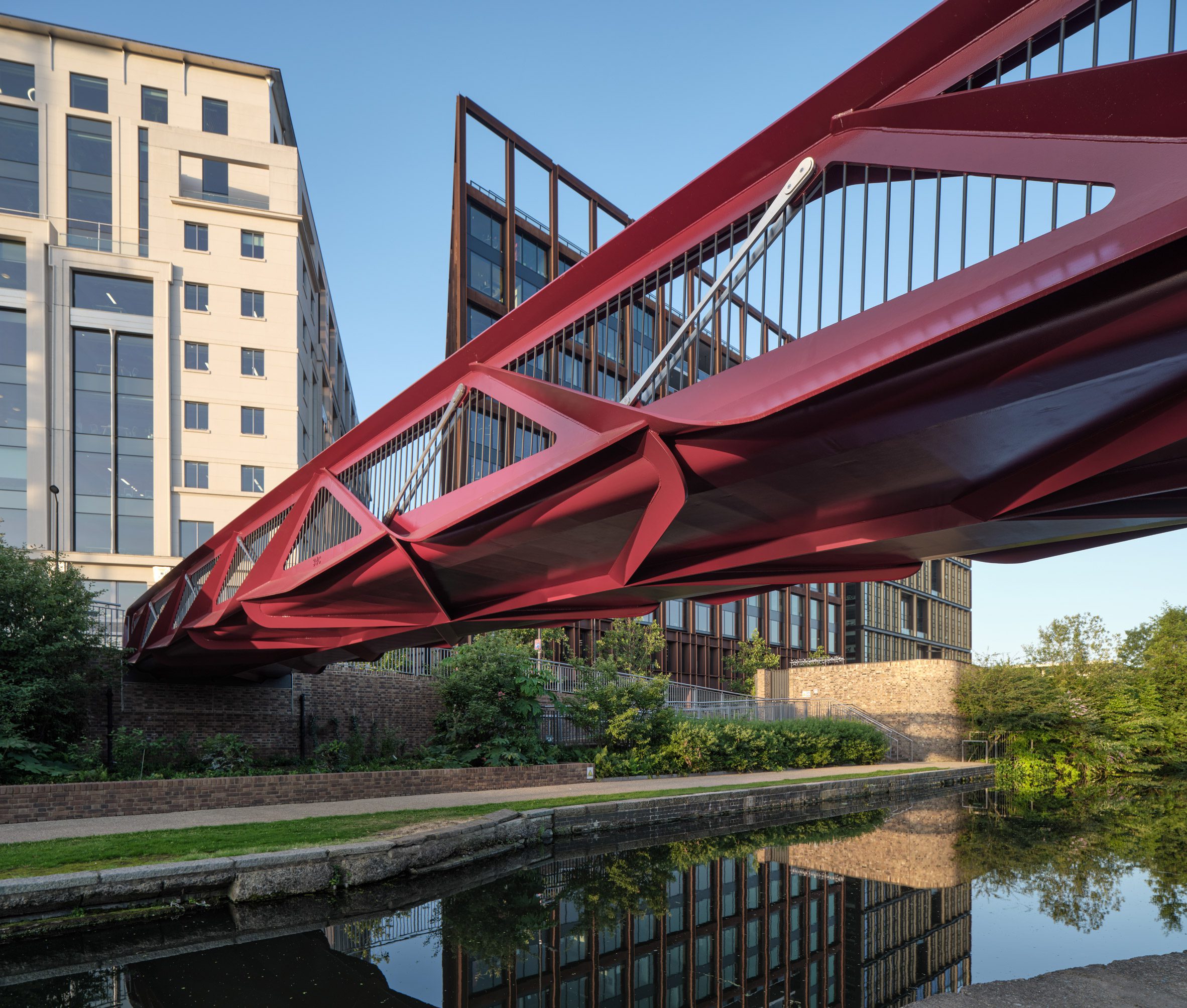
View across water of Esperance Bridge by Moxon Architects and Arup
The bridge features a folded truss form

Robert Evans, CEO of the King's Cross development, described Esperance Bridge as "one of the final pieces of the public realm jigsaw".

"There was bit of debate internally about whether the third bridge would be required," he told Dezeen, "but to my mind, it was always a bit of a no-brainer."
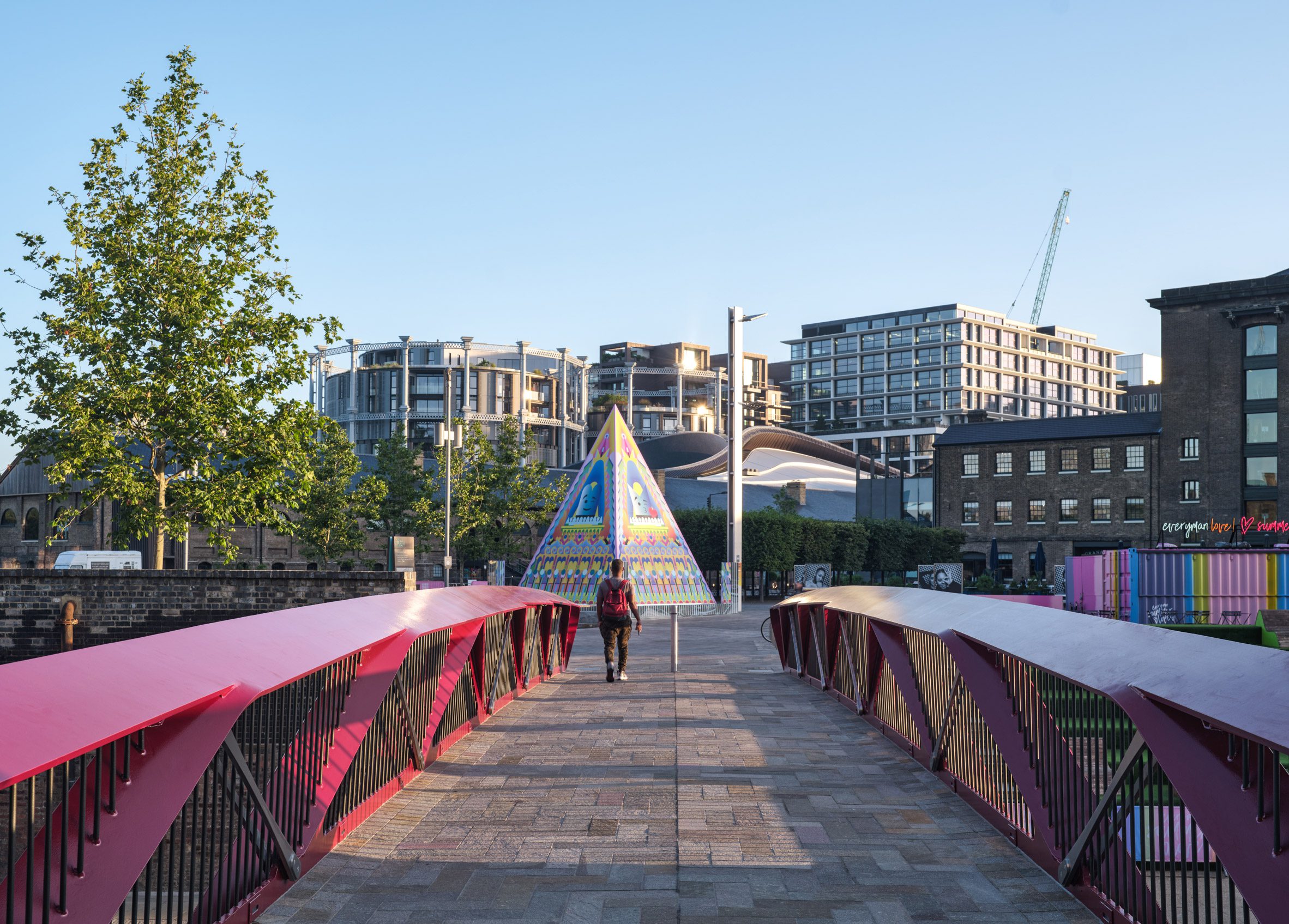
Crossing Esperance Bridge towards Proud Little Pyramid
It is designed as a pedestrian-only crossing

"With areas opening up to the north and west of Coal Drops Yard and new occupiers moving in, there is a really natural desire line to come down to Granary Square and track over a new bridge that leads you down towards the station," he continued.

"It took us a while to get to it, but we're really proud to have done it."
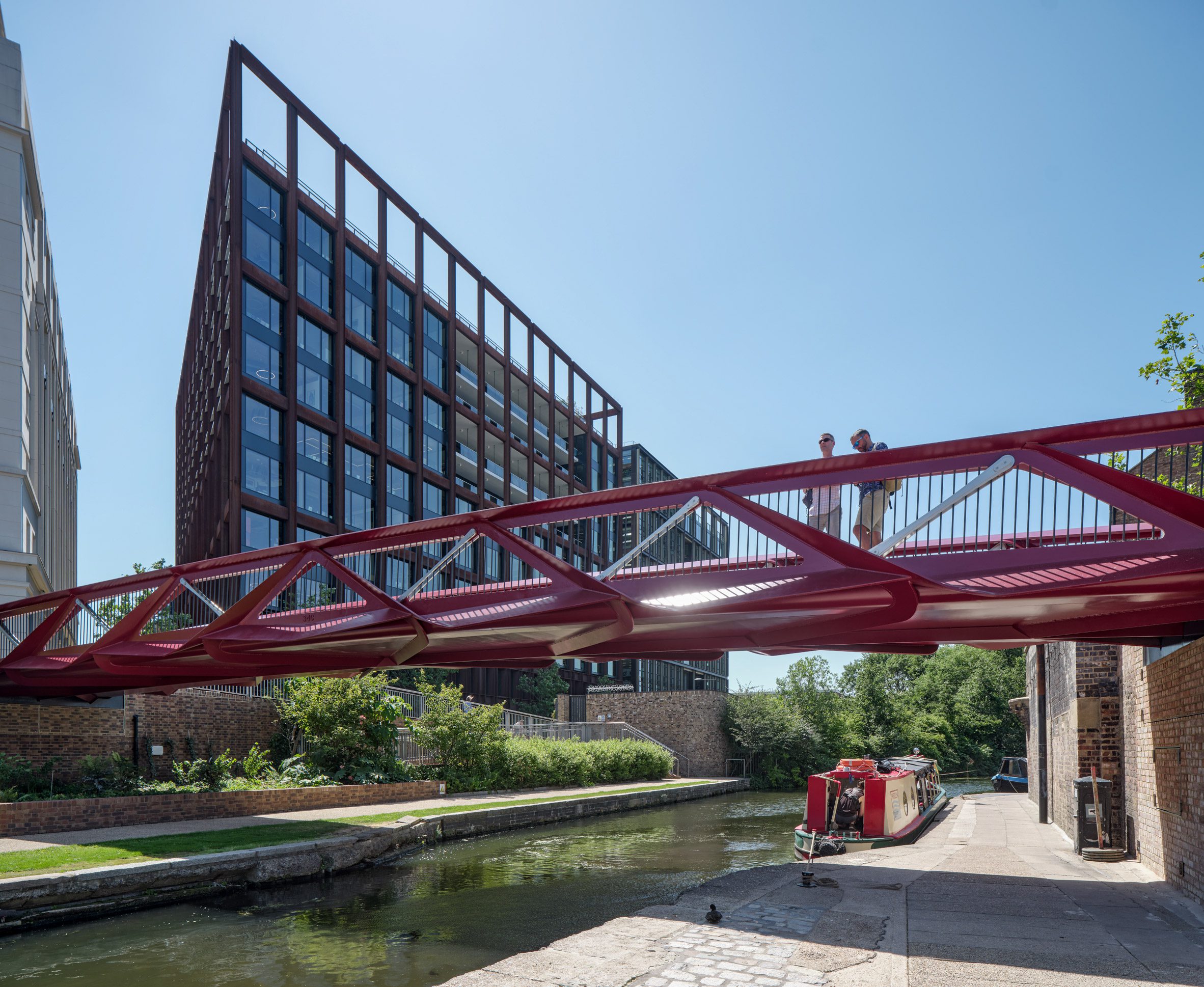
Side view of Esperance Bridge with truss form
The structure is made from carbon steel, painted red

Having previously developed a simple, elegant design for the steel-plate Somers Town Bridge, the Moxon Architects and Arup team wanted to make more of a statement with Esperance Bridge.

The bridge's smooth truss form is created with folded ribbons of carbon steel, a material that gives the structure increased strength.

Manufactured by specialist steelwork fabricator SH Structures, the bridge is painted red to help it stand out. There is also integrated lighting designed by Studio 29.
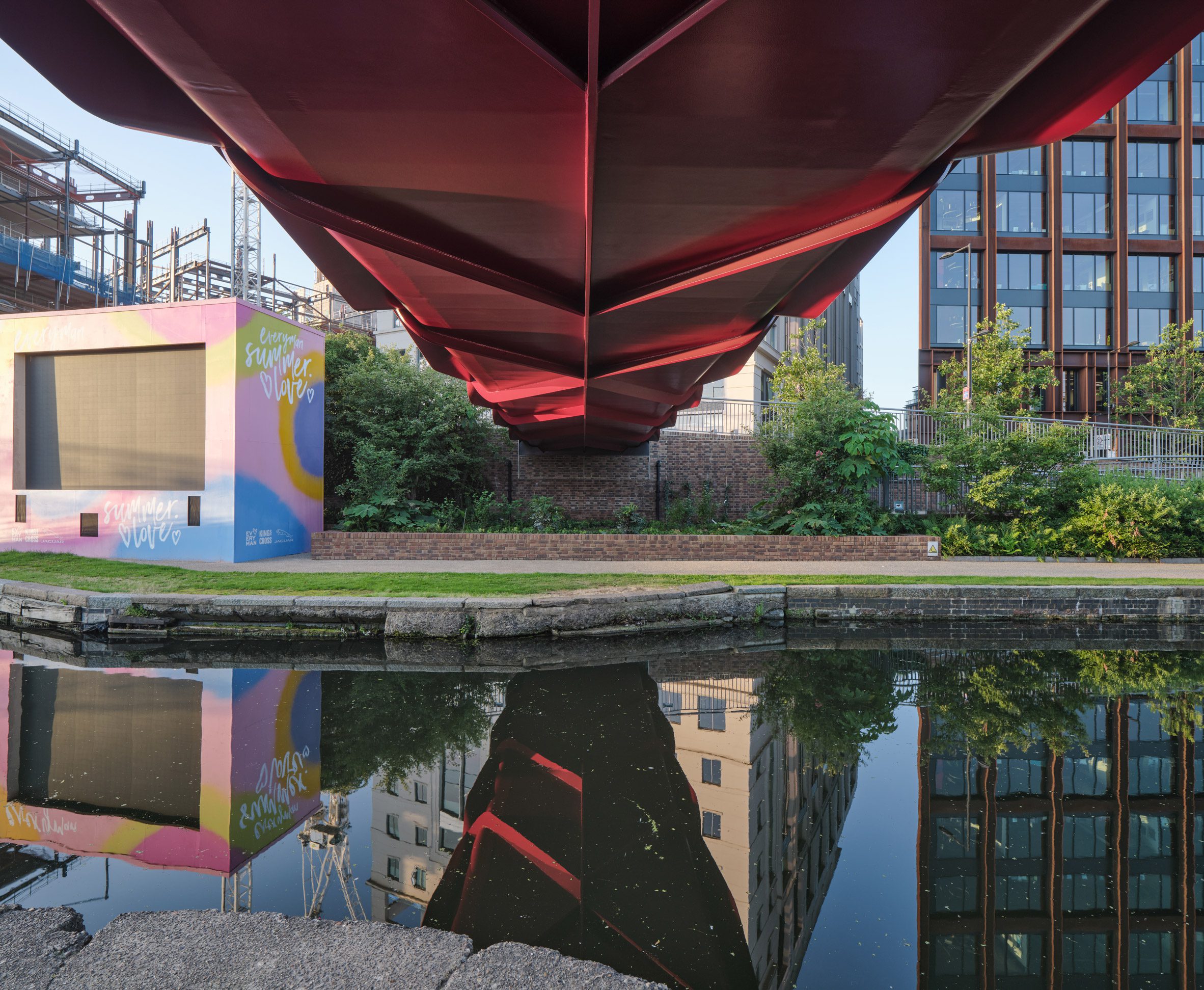
Esperance Bridge underside
The bridge sits in the same position as another that was on the site previously

"Inspired by the area's industrial heritage, the bridge's articulation is expressive and sculptural," said Ben Addy, founder of Moxon Architects.

"We're even making use of the existing remnants of foundations, of the utilitarian crossbridge that was there before," he revealed. "So we're actually recycling structure too."
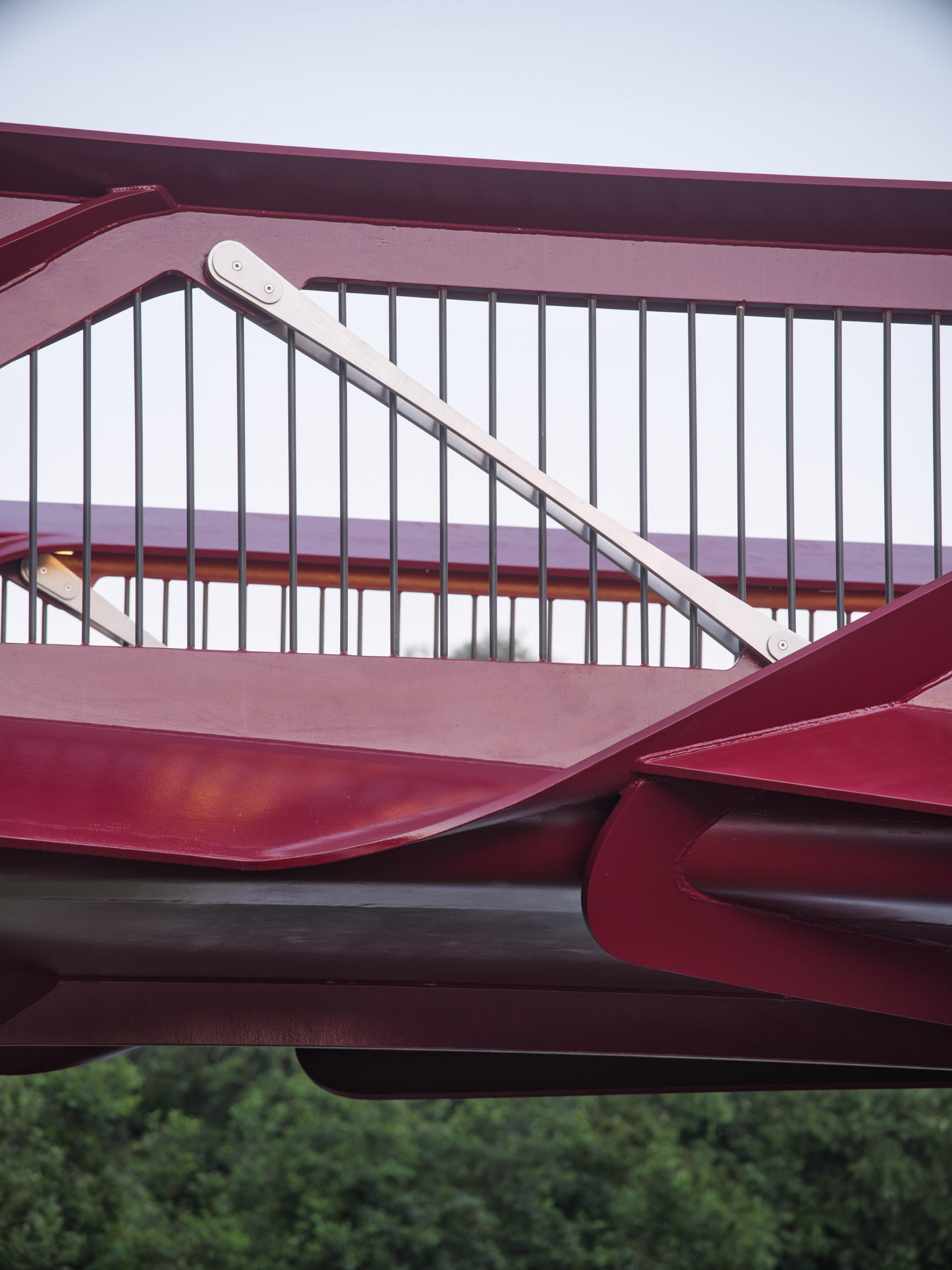
Detail view of Esperance Bridge
It is integrated with lighting designed by Studio 29

Esperance Bridge opened to the public in July, shortly after the unveiling of Adam Nathaniel Furman's Proud Little Pyramid, an installation designed to celebrate the reopening of King's Cross following coronavirus lockdown.

While Covid-19 inevitably had an impact on the businesses in and around Coal Drops Yard, Evans said that the area had not completely suffered in this period. He observed that it became a popular destination for exercise, dog walking and coffee meet-ups during the pandemic.
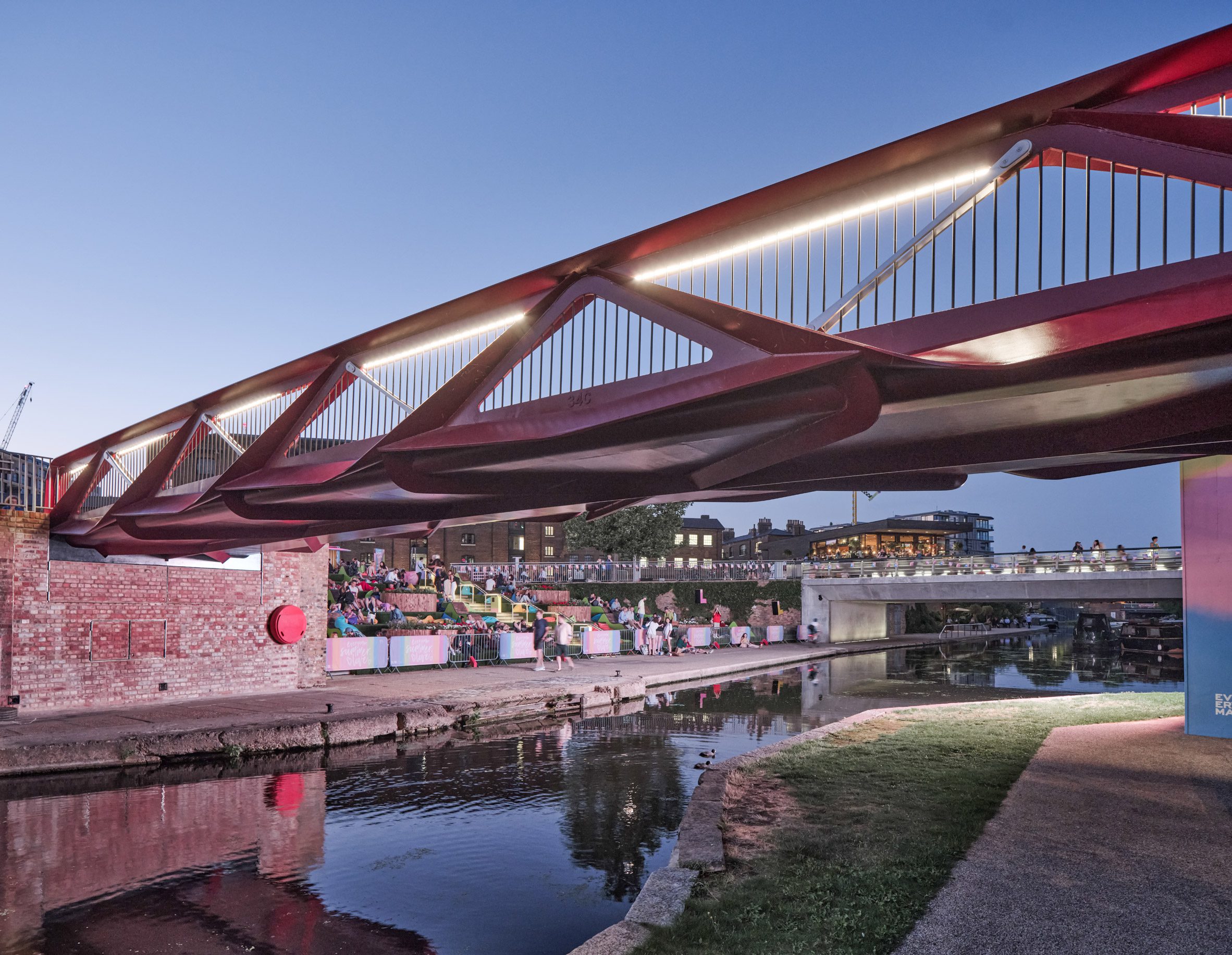
Esperance Bridge night view
Esperance Bridge is one of three river crossings in the Coal Drops Yard area

Evans attributed this success to the quality of the outdoors spaces on offer and hopes to continue to build on it going forward.

"The quality of the public realm has become even more essential post-Covid," he said. "If people are going to be attracted to come back into central London, we need to offer them ease of connection, and variety and choice in the environment."

He believes the bridge will bring more people into Coal Drops Yard and help to improve the overall experience.
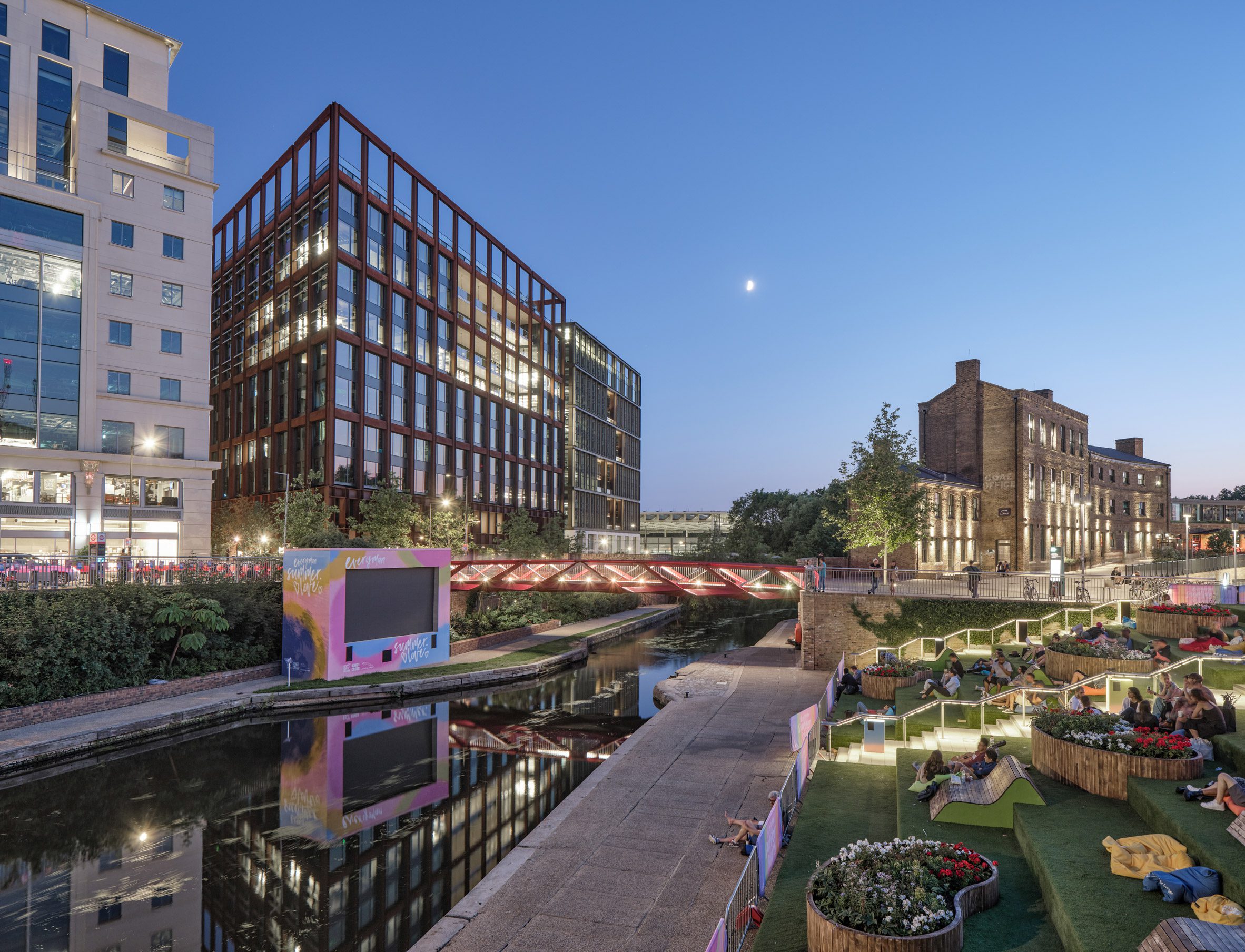
Distant night view of Esperance Bridge
The space beside it hosts outdoor cinema screenings

"It isn't really about how many people use the bridge," he said, "it's about the quality of the experience."

"People like to arrive somewhere where this is more than one route to explore. That's why well-connected places perform better."

Aerial photography is by John Sturrock. All other photography is by Simon Kennedy.

The post Esperance Bridge creates new walking route into London's Coal Drops Yard appeared first on Dezeen.


from Dezeen https://ift.tt/3g90guC

One month left to enter Dezeen's Redesign the World competition with Epic Games

Redesign the World logo

There are just 30 days left to enter our Redesign the World design competition, which calls for new ideas to rethink planet Earth. Enter now before the contest closes for entries on 15 September.

Launched at the end of July in partnership with Epic Games, the Redesign the World competition is looking for radical solutions to ensure our planet remains habitable for many years to come.

The contest is free to enter for anyone over the age of 18 of any profession and from any country in the world.

Redesign the World judges announced

Last week we announced the expert judging panel that will  the competition. The panel comprises White Arkitekter CEO Alexandra Hagen, structural engineer Hanif Kara and speculative architect Liam Young, alongside Belinda Ercan, Twinmotion product marketing manager at Epic Games, and Dezeen founder and editor-in-chief Marcus Fairs.

The 15 best proposals selected by the judges will be published on Dezeen in November during our Dezeen 15 online festival celebrating Dezeen's 15th anniversary.

A top prize of £5,000 will be awarded for first place, £2,500 for second place, £1,000 for third place and £500 each for the 12 remaining finalists selected by the judging panel.

How to enter

Entrants must produce a 3D visualisation of their concepts using architectural visualisation tool Twinmotion, submitting a video animation and still image of their concept, along with up to 500 words of text about their proposal.

Redesign the World is primarily an ideas competition. Judges will be looking for visionary concepts and are less concerned with technical mastery of the Twinmotion software. However, the quality of the execution of the idea will also be considered.

Dezeen hosted an online workshop on how to use Twinmotion to help participants with their entries.

See the full competition brief for how to enter ›

Live Twinmotion talk this week

To coincide with the competition, Dezeen and Epic Games will host a live online panel discussion on Thursday this week, which will explore how visualisation tools such as Twinmotion are transforming architecture.

Moderated by Dezeen editor-in-chief Marcus Fairs, the talk will explore the new possibilities that real-time 3D tools such as Twinmotion, which is powered by the Unreal Engine game engine developed by Epic Games, open up to architects.

Panellists will discuss how access to this new digital technology is transforming the way that architects work and communicate their projects, how video game design and architectural visualisation are merging, and what the future holds for the industry.

The talk takes place at 2:00pm London time and is free to watch online on Dezeen.

The post One month left to enter Dezeen's Redesign the World competition with Epic Games appeared first on Dezeen.


from Dezeen https://ift.tt/3iRIrlA

Snøhetta reimagines long-closed 1930s Norwegian harbour bath Knubben

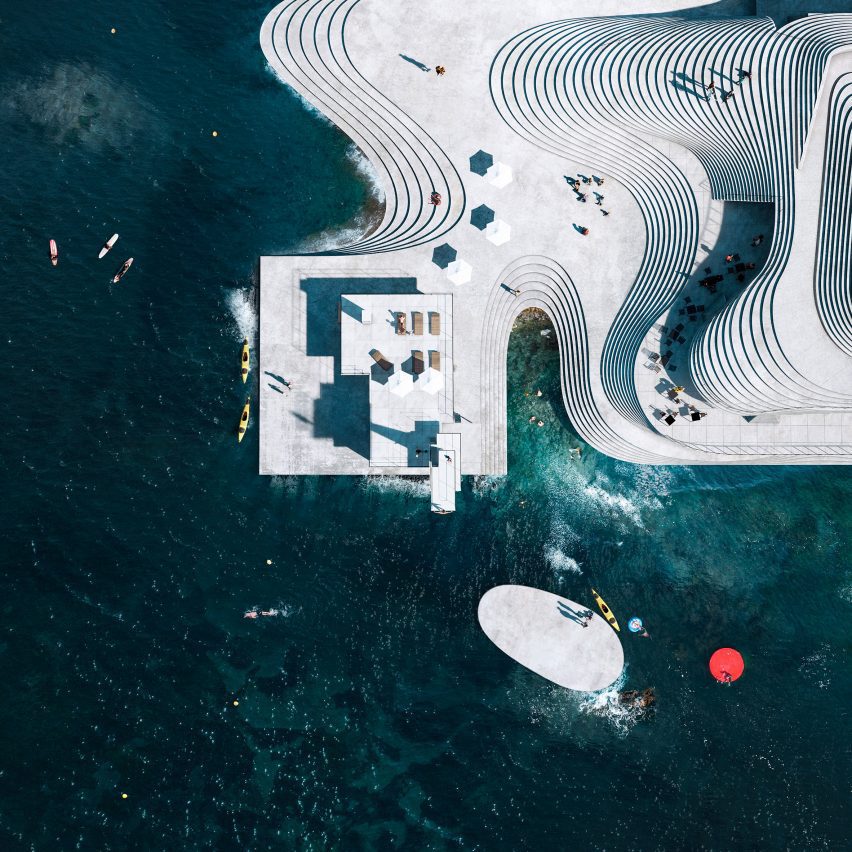
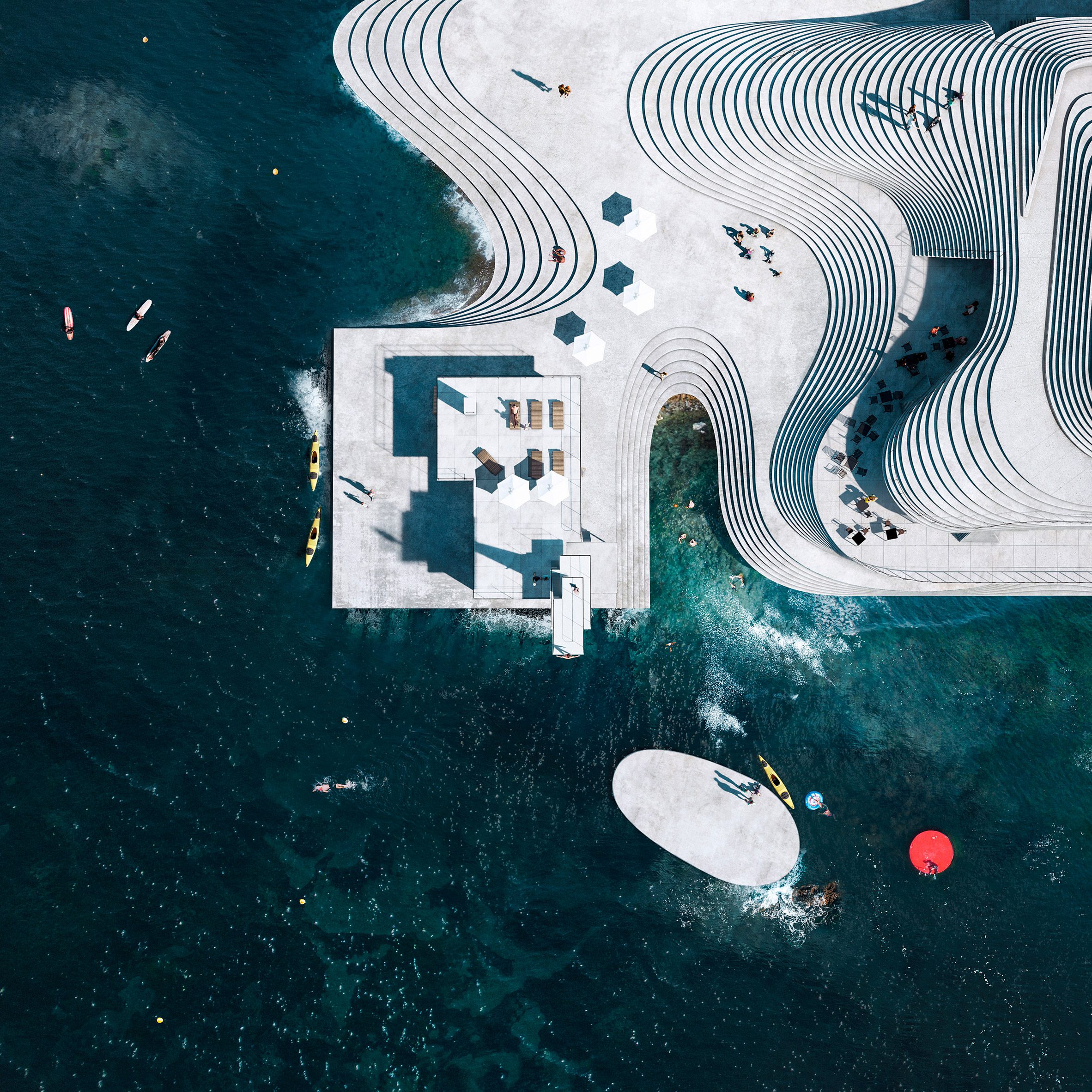
Aerial rendering of topography-like structure of new Knubben harbour bath

Snøhetta has unveiled its plan to revive a traditional harbour bath in the city of Arendal, Norway, with a layered structure that looks like a topographical map of the area.

The Knubben bath, built in 1937 and closed a decade later, will be reimagined as a lively meeting place with multi-use facilities and an appearance that mimics the area's natural rock formations.

Aerial rendering of topography-like structure of new Knubben harbour bath
Snøhetta's structure is built from horizontal layers arranged to look like the contour lines of a map

The bath is situated on a 750-square-metre skerry just outside of Arendal, in the Galtesund strait between the islands of Tromøy and Hisøy.

Its original design was by architect Ketil Ugland and is described by Snøhetta as "one of the clearest examples of functionalistic architecture in Norway" and "a small yet elegant example of the modernist spirit".

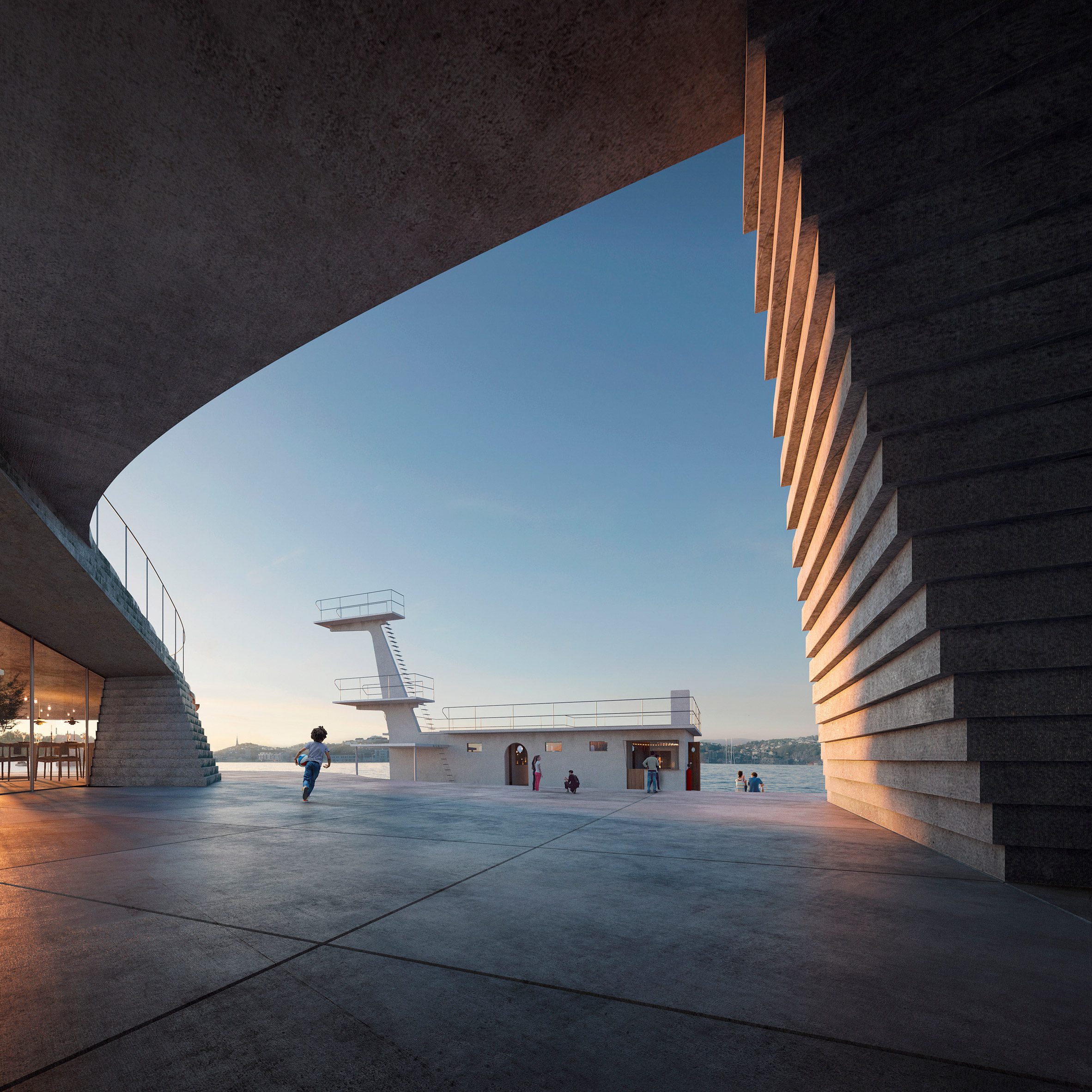
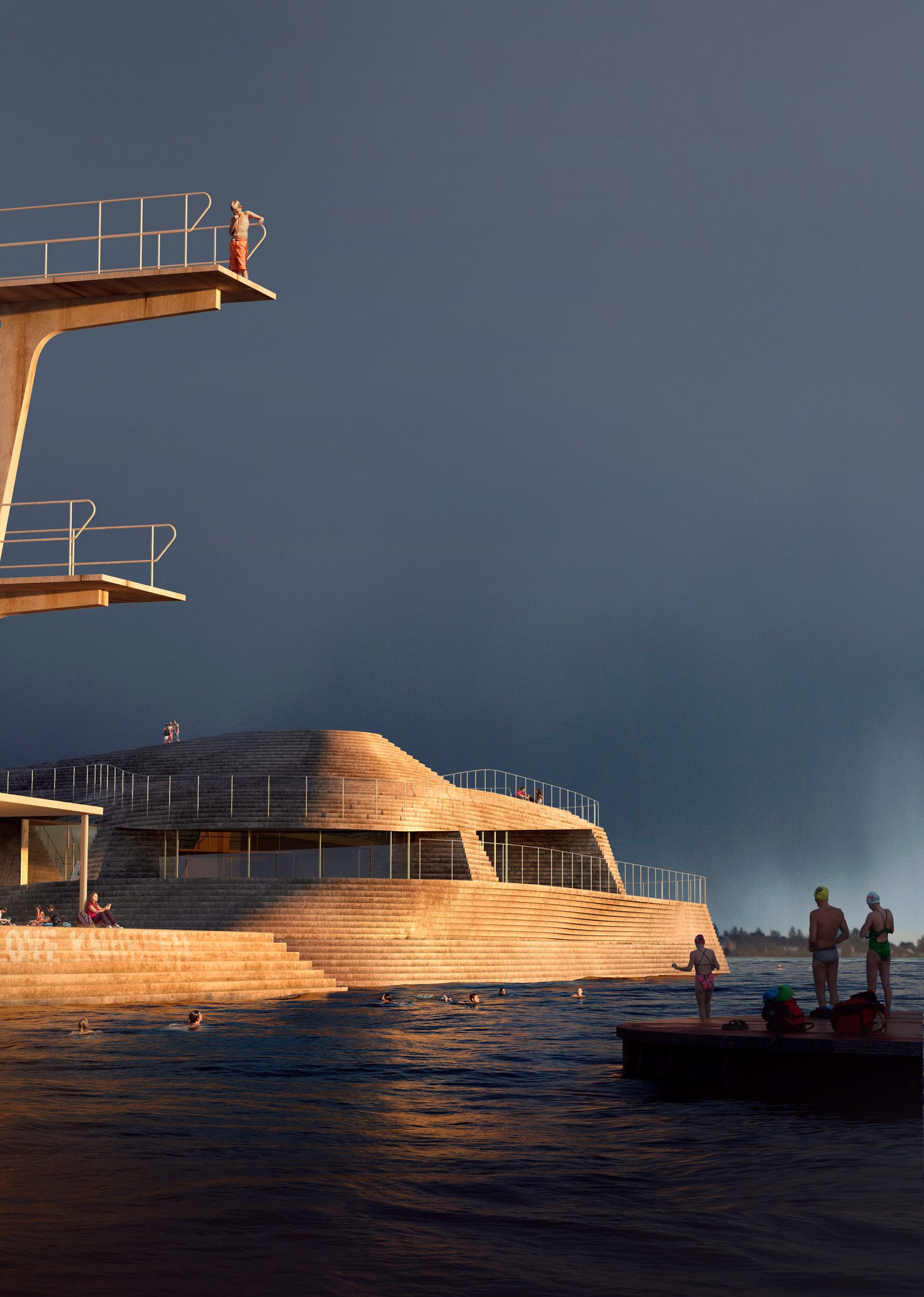
Diving platform framed by walls of new Knubben harbour bath facilities
The new Knubben will include both indoor and outdoor facilities

The Norwegian architecture firm had hoped to restore the facility, but a feasibility study led it to conclude that was not practical, as the site would need major modernisation.

Instead, Snøhetta's proposal tries to honour the location with a new structure inspired by the landscape of the southeastern Norwegian coast and stone shaped by the last glacial period.

Diving platform and facilities at the new Knubben harbour bath at sunset
A new diving platform will replace the one demolished in the 1980s

"In returning the traditional harbour bath to its original glory, we realised that the volumetric response had to speak a different architectural language to honour the proud history of the 1930s bath," Snøhetta project manager Marius Hauland Næss told Dezeen.

"As such, the concept for the addition is a landscape that builds on the existing skerry, which forms the base for the original bath."

The new structure will sit on steel core piles and be built in horizontal layers that look like the contour lines on a map. Due to its coastal location, is likely to be built from concrete.

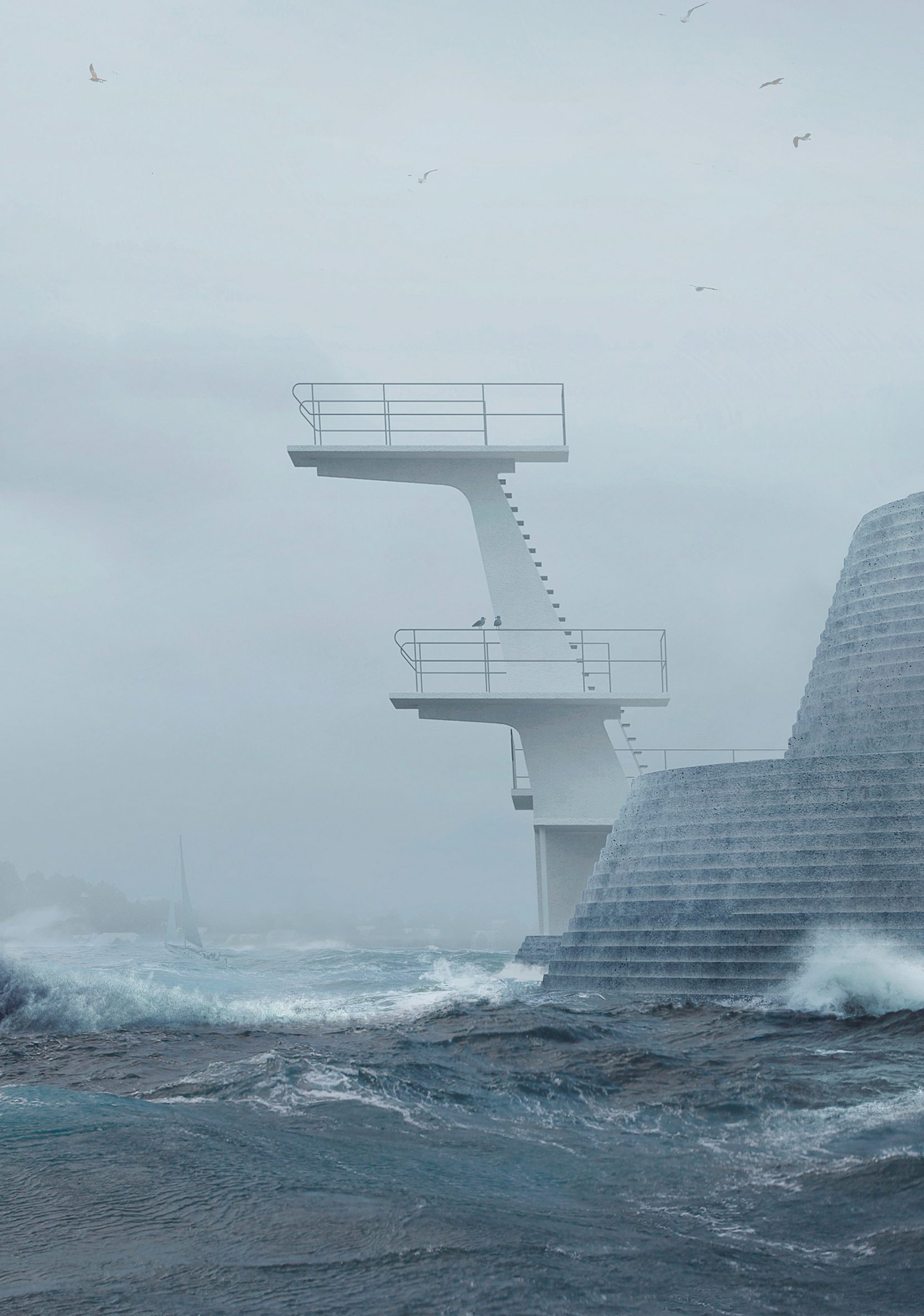
"We have a clear ambition to challenge materials in this project, since the compound sits in a fragile marine environment and finds itself at the mercy of ever-changing, rough weather conditions," said Næss.

Diving platform and facilities at the new Knubben harbour bath at sunset
A new diving platform will replace the one demolished in the 1980s

Snøhetta's plans for Knubben include a new diving platform to replace the one demolished in the 1980s.

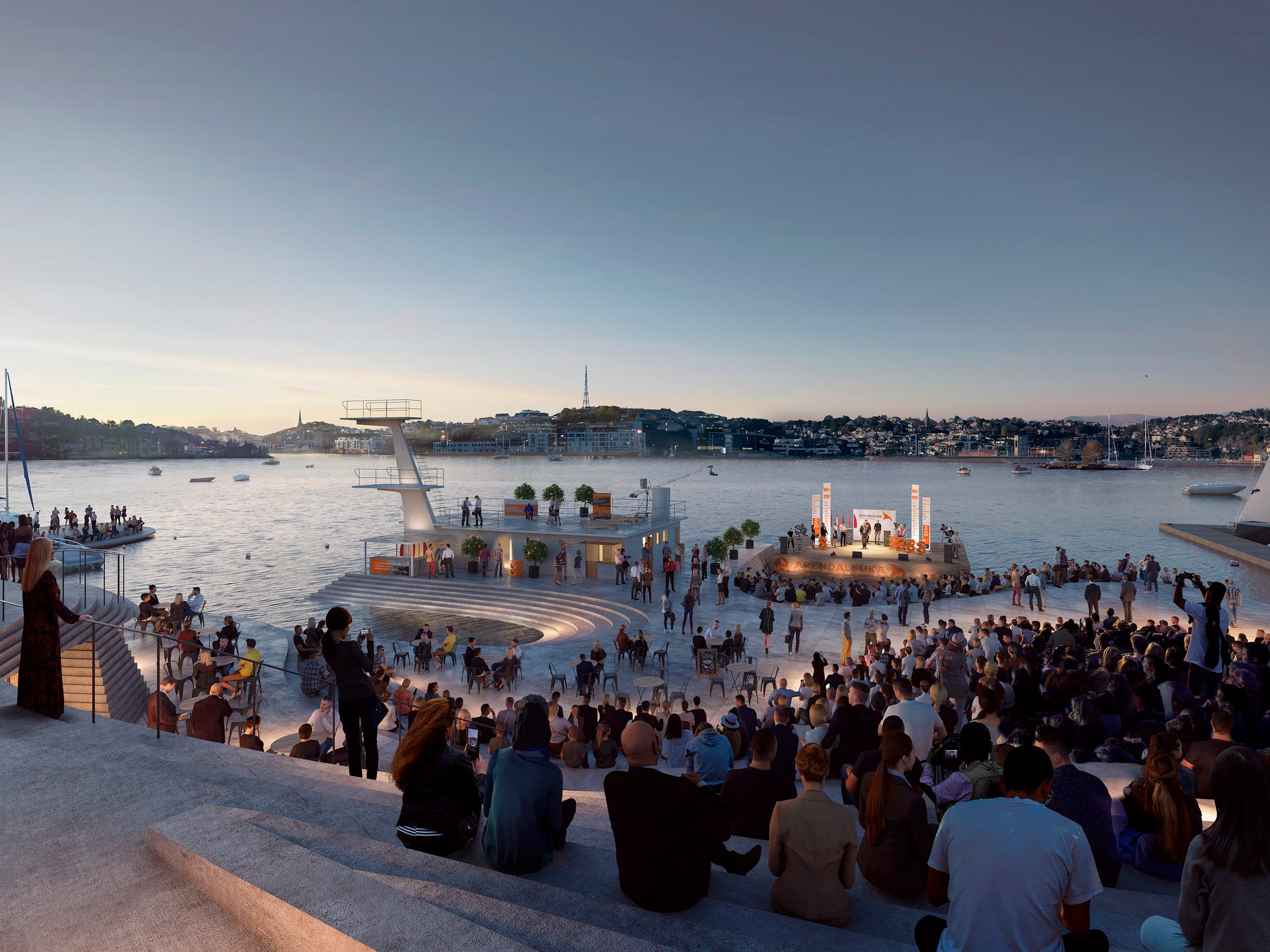
The site will also include an open-air stage and amphitheatre for performances, as well as indoor areas for a restaurant and more intimate concerts.

People sitting on amphitheatre seating watching an open-air performance on the harbour
The site will include an amphitheatre for open-air performances

The original harbour bath boasted a 10-metre diving platform, a children's pool, changing rooms and a kiosk. After its closure, Knubben briefly reopened as a jazz club in the 1960s.

"The facility has the potential to become a hybrid that fluidly combines culture, recreation, marine biology and learning, and a very locally anchored food experience," said Næss.

"As an organism then, the compound works circularly to facilitate sustainable experiences on multiple fronts."

Diving platform and skerry being battered by storms in Arundel harbour
The new design will fit with the landscape of the coastline

The Knubben bath is set to reopen in 2024.

Recent buildings by Snøhetta include the shimmering Le Monde Group Headquarters in Paris and the cloud-like El Paso Children's Museum.

Imagery is by Snøhetta and Aesthetica Studio.

The post Snøhetta reimagines long-closed 1930s Norwegian harbour bath Knubben appeared first on Dezeen.


from Dezeen https://ift.tt/3iPCJRa

Sunday, 15 August 2021

Kyriakos Tsolakis Architects blends resort for athlete rehabilitation into Mykonos hillside

Mykonos Wellness Resort by Kyriakos Tsolakis Architects

Stone excavated on the site was used to build this wellness hotel for athletes on the Greek island of Mykonos, which was designed by London- and Cyprus-based practice Kyriakos Tsolakis Architects.

Located in the heart of the island, the retreat features 12 suites and two public pools as well as outdoor and indoor gyms, all designed to help professional sportspeople rehabilitate during the offseason and on holiday.

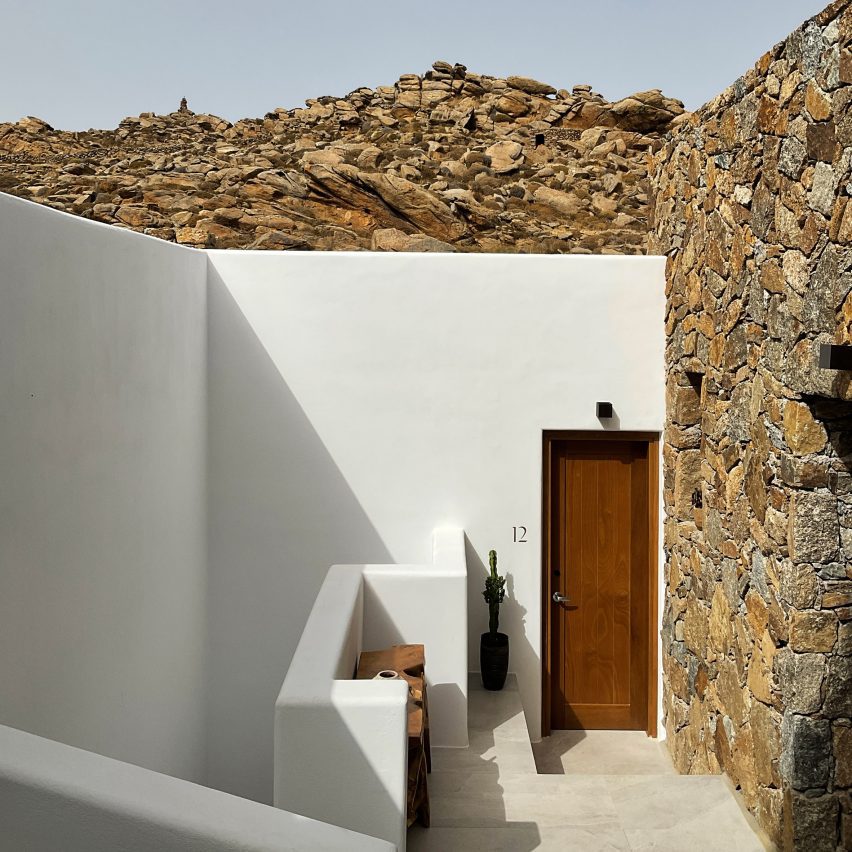
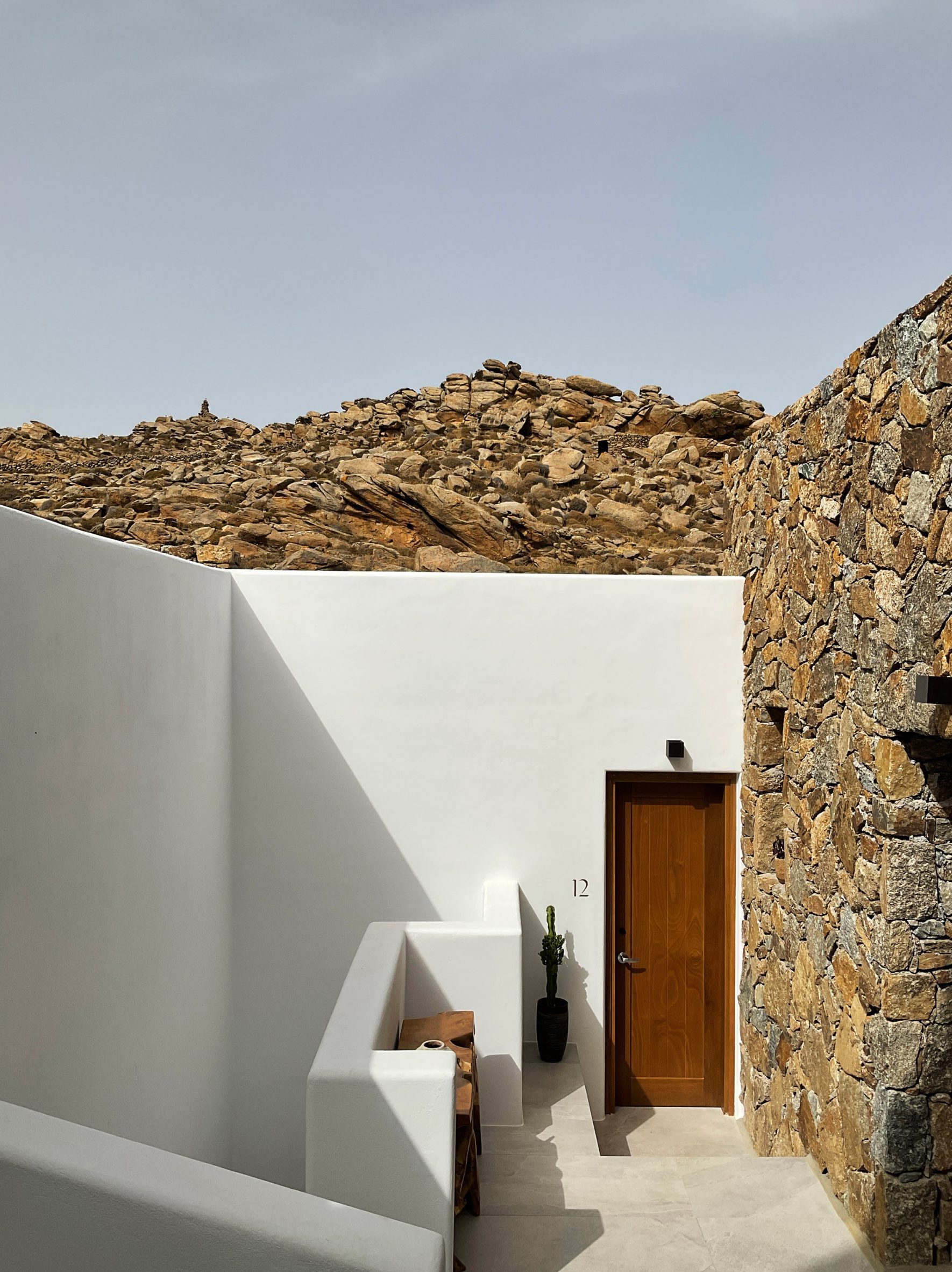
Entrance to Mykonos Wellness Resort with one whitewashed wall and one stone one that blends into the hill
The Mykonos Wellness Resort is built from stones excavated on site (top and above)

"The site is amazing," Kyriakos Tsolakis Architects co-founder Elena Tsolakis told Dezeen.

"You can hear the wind in this valley and pretty much nothing else. The client wanted to capture the sense of this place and the colours of the site while using good quality materials."

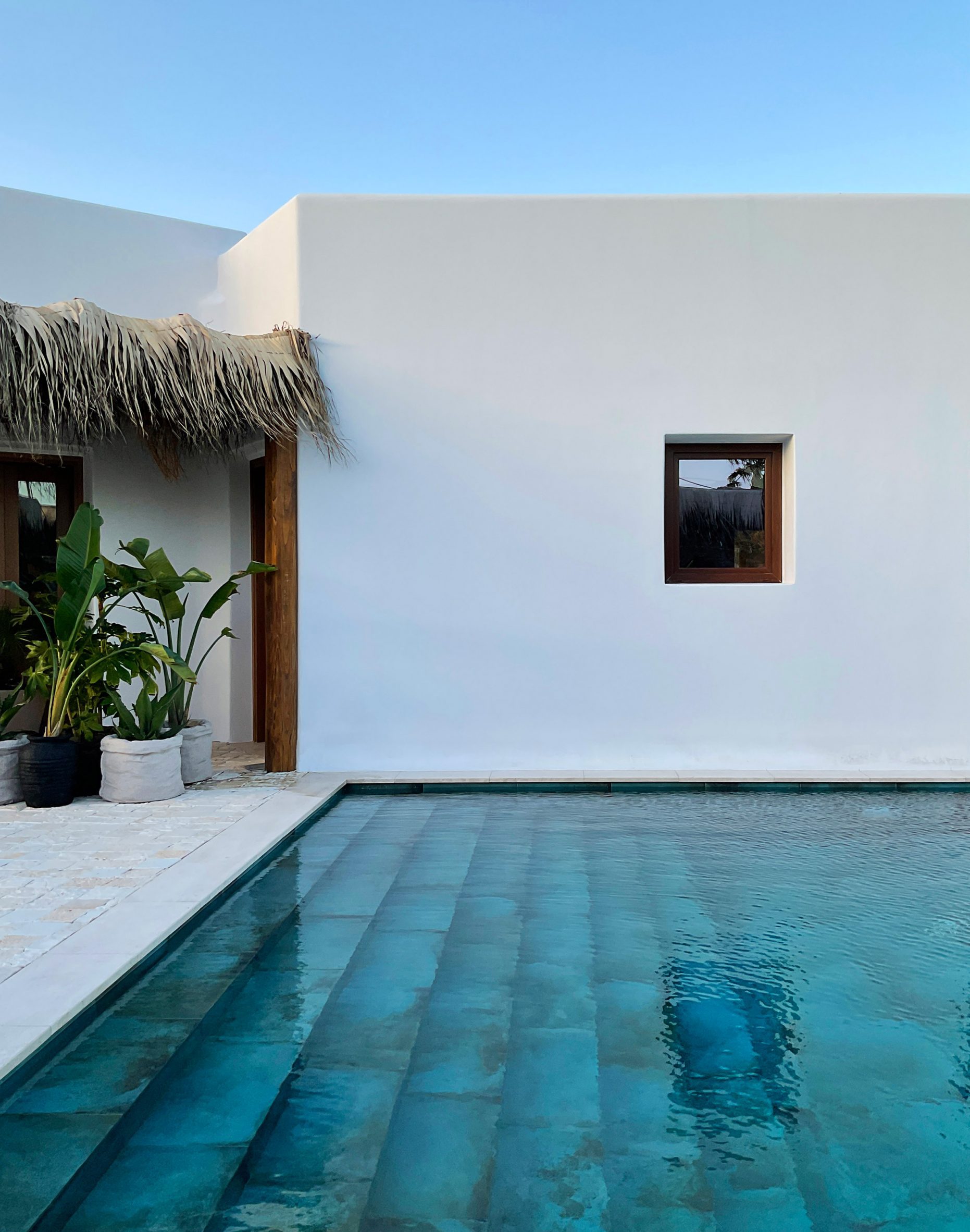
Pool with turqoise tiles in front of whitewashed building by Kyriakos Tsolakis Architects
The resort's upper terrace features traditional whitewashed walls

Arranged over four levels on a quiet, south-facing hillside, the retreat is in a protected zone that offers views out to the sea. A waterway runs along one side of the site while an old shepherd's hut and tall grasses surround the property.

The resort's lower three levels are terraced and embedded into the hillside, with their walls formed from stones that were found during the basement excavations. These were assembled using an unobtrusive technique that reduces the amount of mortar that can be seen from the outside.

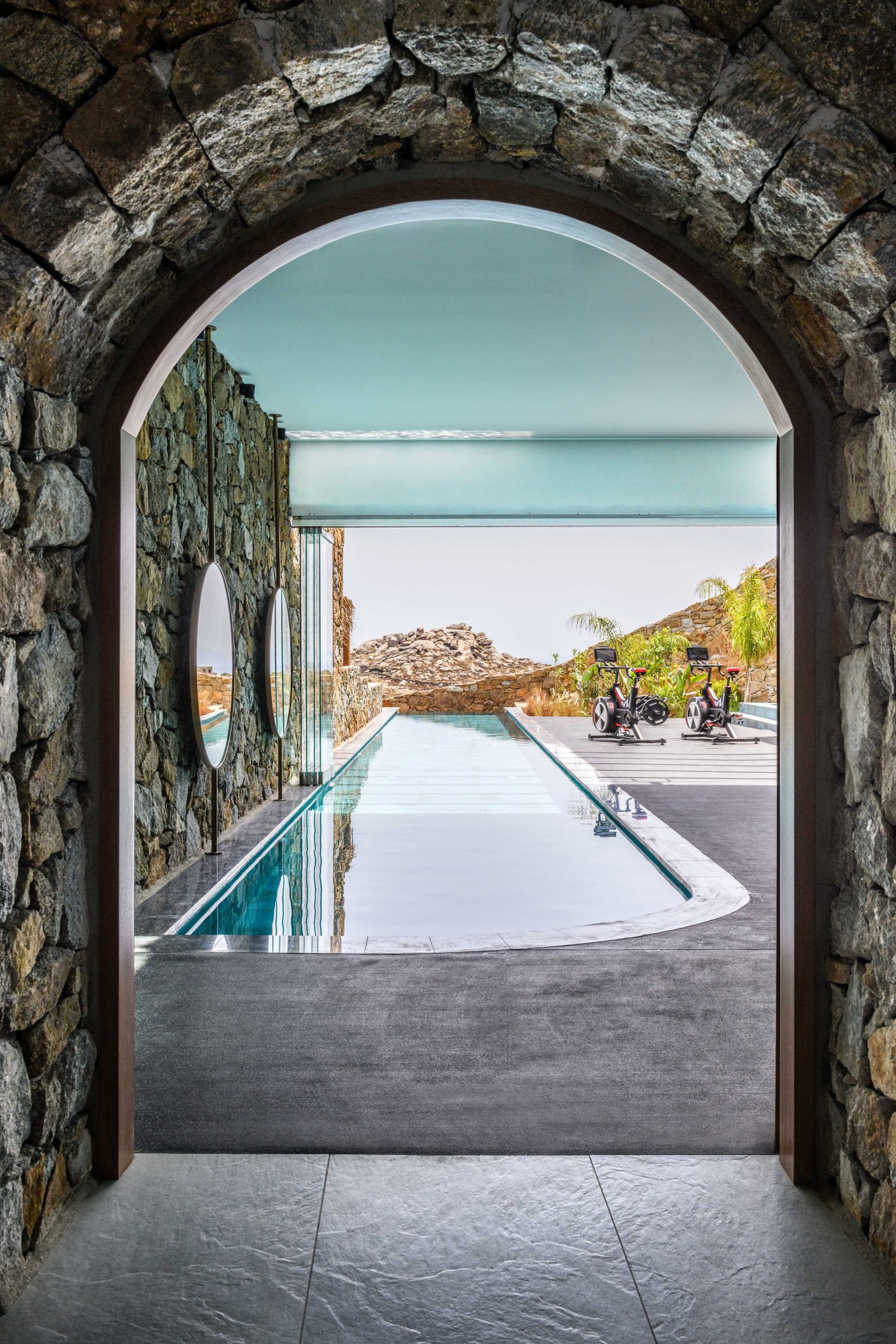
View through stone arch at Mykonos Wellness Resort at exercise bikes next to a pool
Hydrotherapy pools and indoor and outdoor gyms help athletes rehabilitate during the offseason

Meanwhile, the upper terrace of the complex features the whitewashed walls that the Greek islands are known for.

The studio's aim was to create a building that is capable of blending into its natural and vernacular context while withstanding the elements.

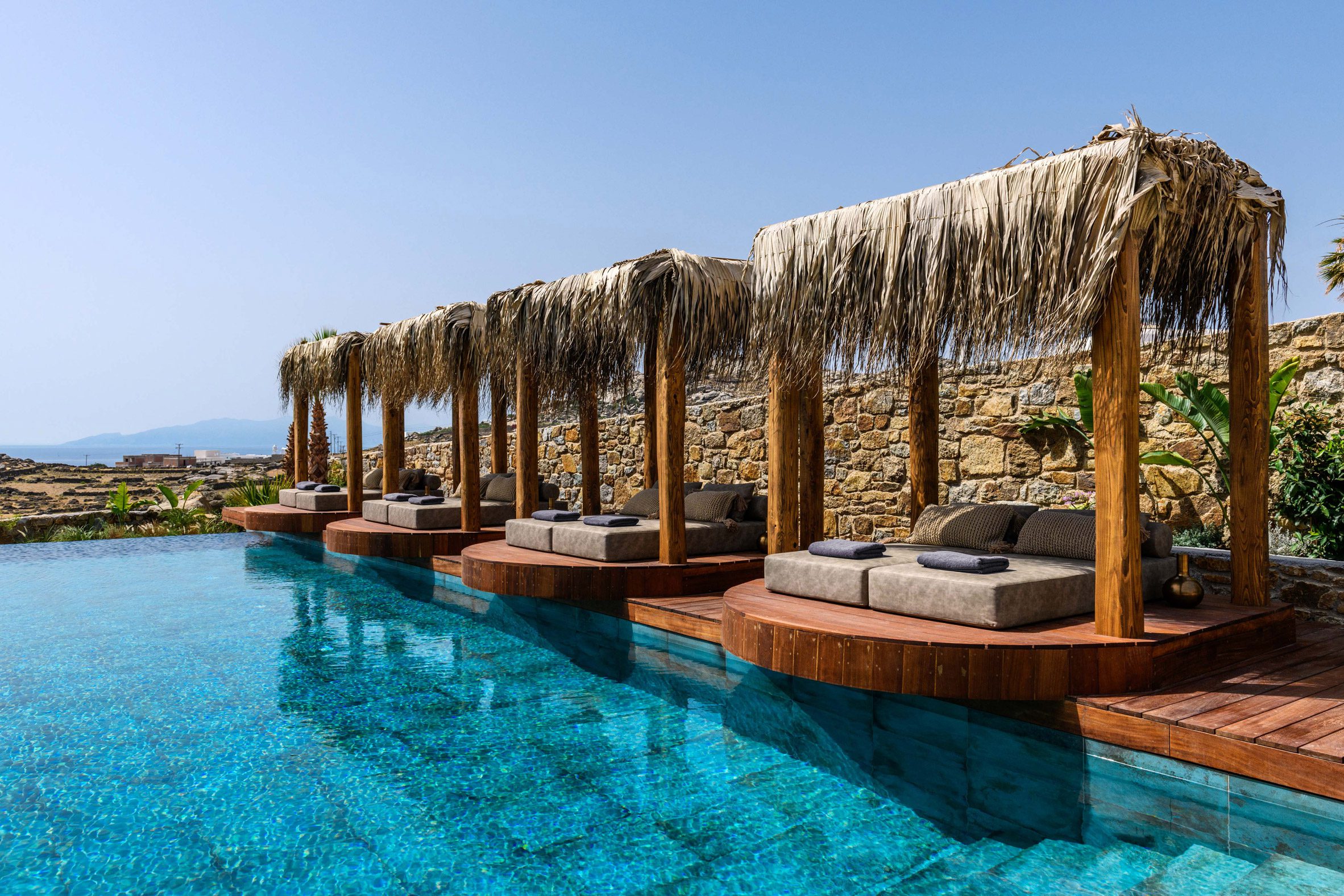
Sunbeds on round wooden platforms next to pool with turquoise tiles in hotel by Kyriakos Tsolakis Architects
Loungers are perched on round timber platforms next to the pool

"Due to the high wind speeds and saline content in the air, the client wanted to minimise maintenance as much as possible," explained Elena Tsolakis, who founded the studio alongside her siblings Nicodemos and Cassandra Tsolakis.

"So we made sure the materials specified were long-lasting and resilient to the harsh winters."

Eight of the hotel's 12 suites are housed on the ground and first floor, where each comes complete with a private garden and turquoise stone pool. The remaining four bedrooms on the upper levels have balconies with far-reaching views, two of which are equipped with jacuzzis.

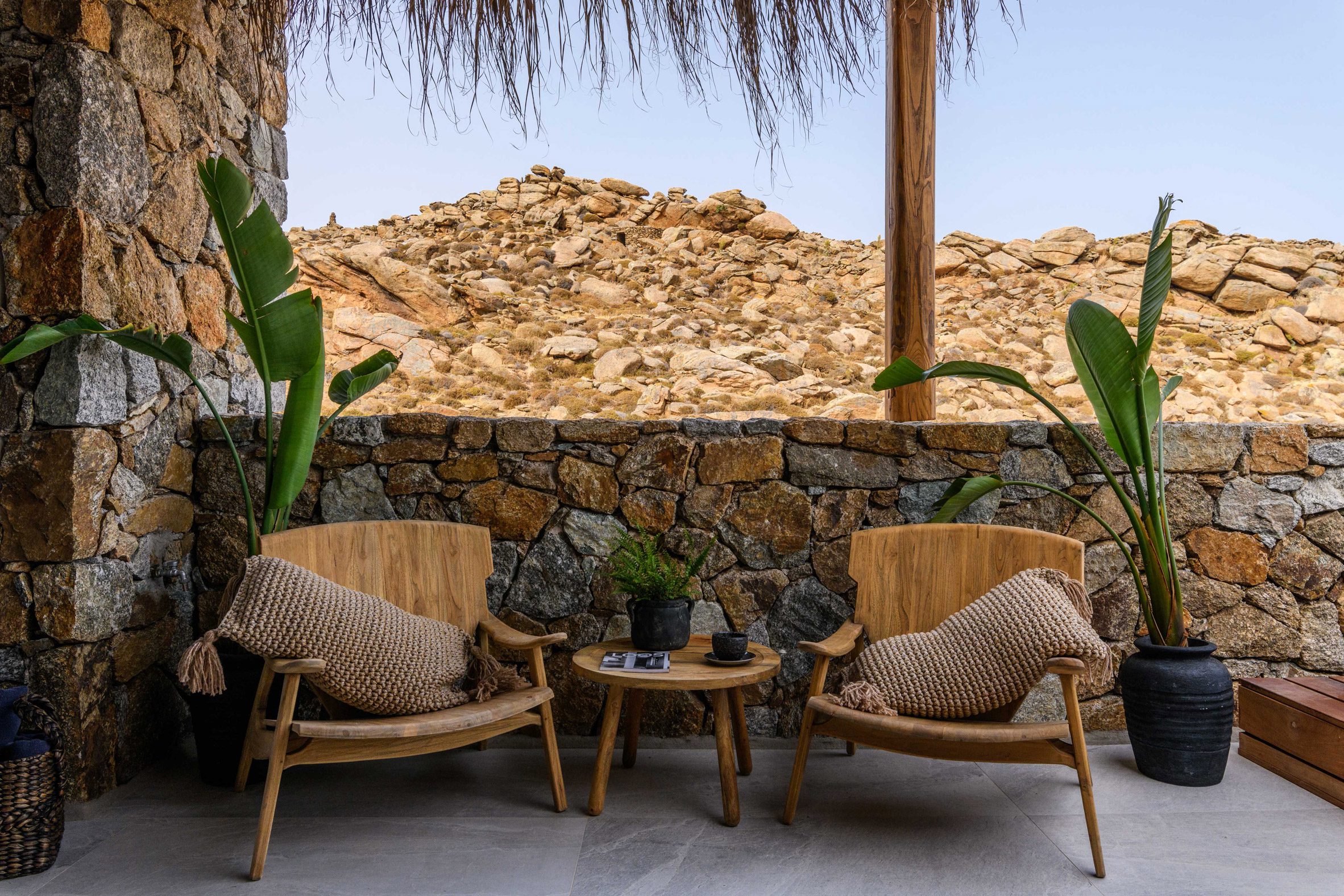
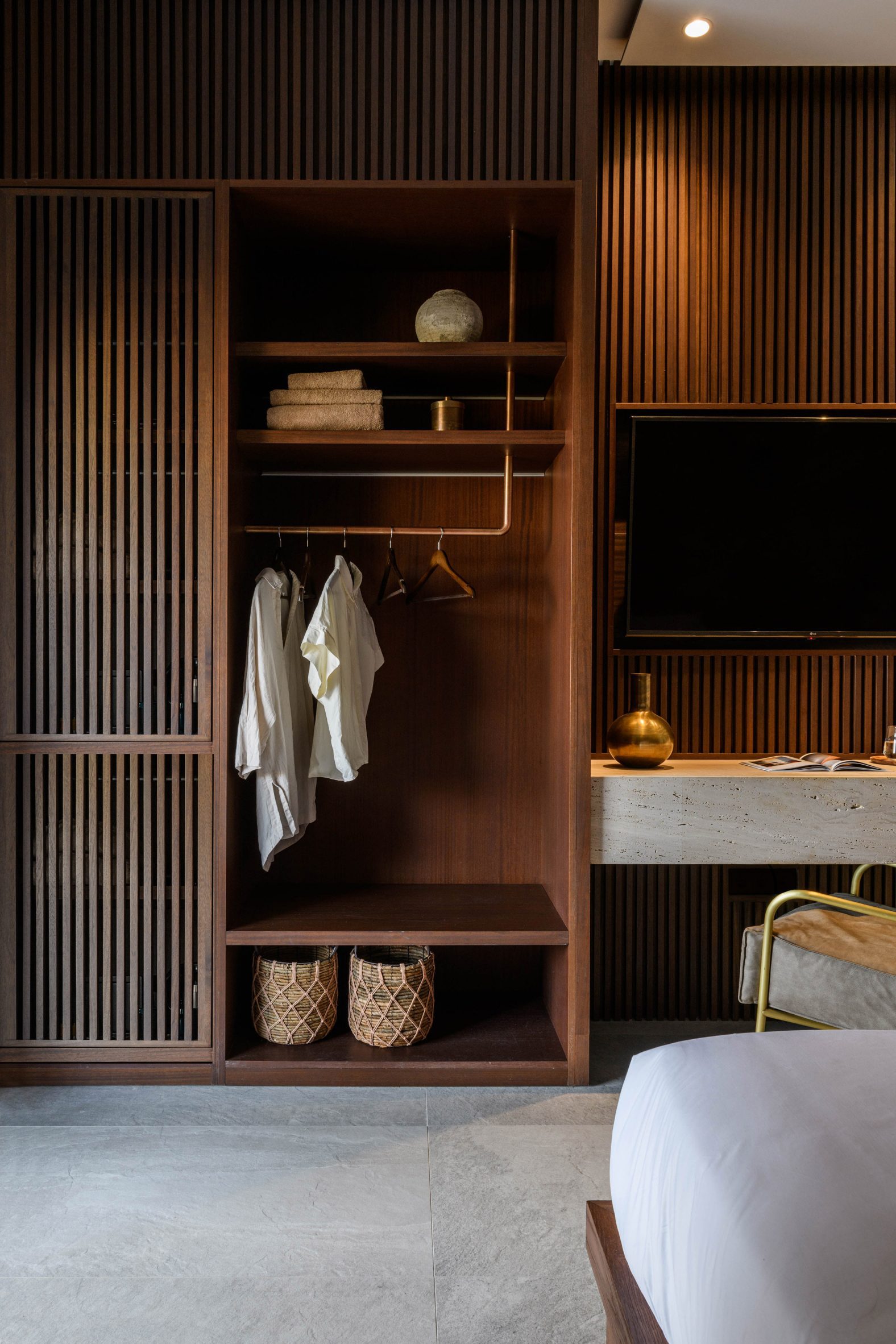
To further enhance the connection to the landscape, the studio used natural materials such as travertine, slate, cobblestone, iroko wood and bronze across the interior, while the ceiling of the reception and lounge area is made from layers of peeled natural willow.

Wooden armchairs in front of stone wall of Mykonos Wellness Resort
Kyriakos Tsolakis Architects used natural materials such as wood to create a calming environment

"The materials we chose give a sense of grounding," Elena Tsolakis explained. "Nothing is shouting for attention. It's as though it's all been here for much longer than it has but with all the comforts that visitors have come to expect."

"These natural materials complement the vibrancy of the turquoise Bali stone pools to create a rich palette of textures and tones within a valley of boulders and undulating hills."

Wood-panelled bedroom with built-in wardrobe in Mykonos Wellness Resort
Wood also features in the guest rooms alongside travertine stone counters

Rehabilitation facilities include state-of-the-art gym equipment across both indoor and outdoor gyms as well as hydrotherapy pools and hot tubs for hydromassages, which involve the use of pressurized water jets to ease sore muscles.

Other projects by the family-run firm include an astronomical research centre perched on top of a Cyprus mountain. Under construction since April and due to be complete by autumn 2022, the observatory will provide NASA with information about celestial phenomena.

Photography is by Andreas Bekas and Kyriakos Tsolakis Architects.

The post Kyriakos Tsolakis Architects blends resort for athlete rehabilitation into Mykonos hillside appeared first on Dezeen.


from Dezeen https://ift.tt/3g6WLoq

Ace Hotel Brooklyn showcases the borough's artistic talent

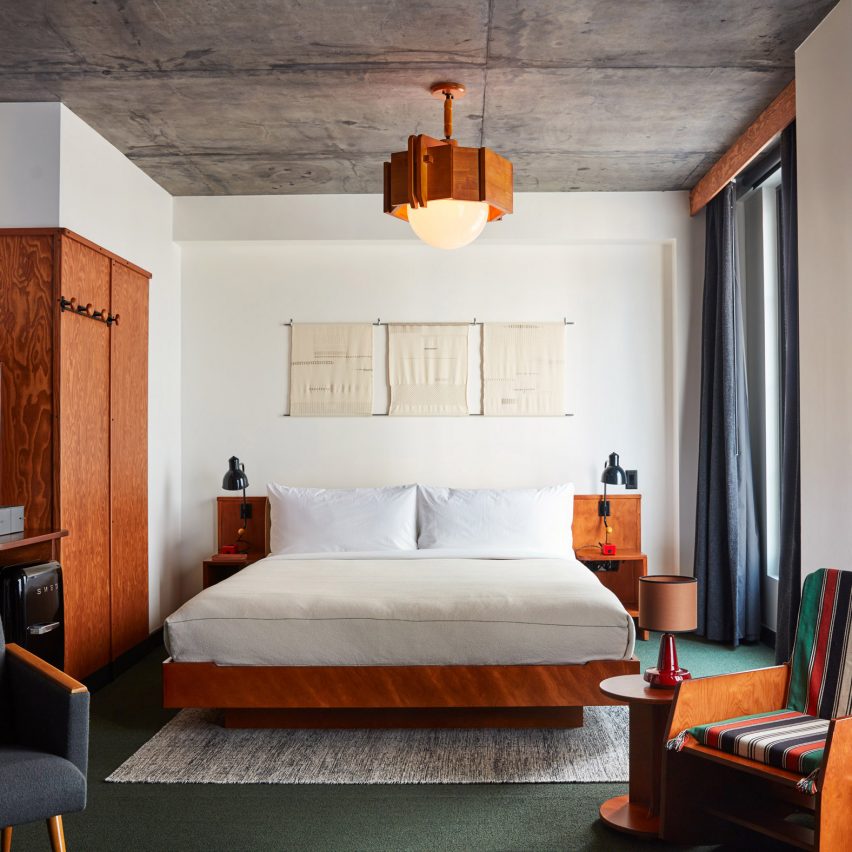
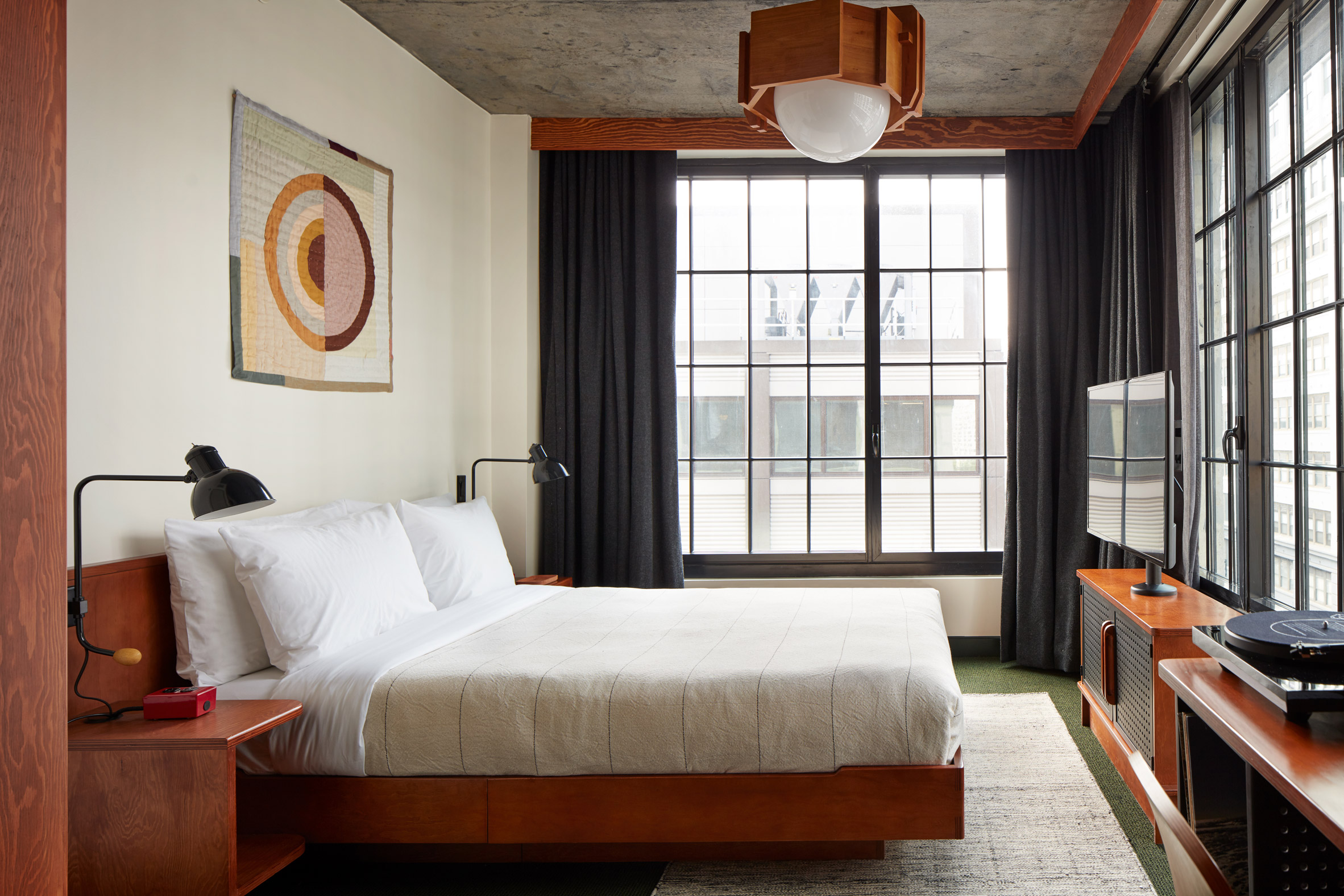
Guestroom at Ace Hotel Brooklyn

The Ace Hotel's newest outpost in Downtown Brooklyn by interior designers Roman and Williams features art in every room, and a public gallery in its lobby with rotating exhibitions.

Located between the neighbourhoods of Fort Greene, Boerum Hill and Downtown Brooklyn, New York City's second Ace Hotel is now open to the public. It is the third collaboration between the hospitality brand and Roman and Williams, after opening hotels in Manhattan and New Orleans.

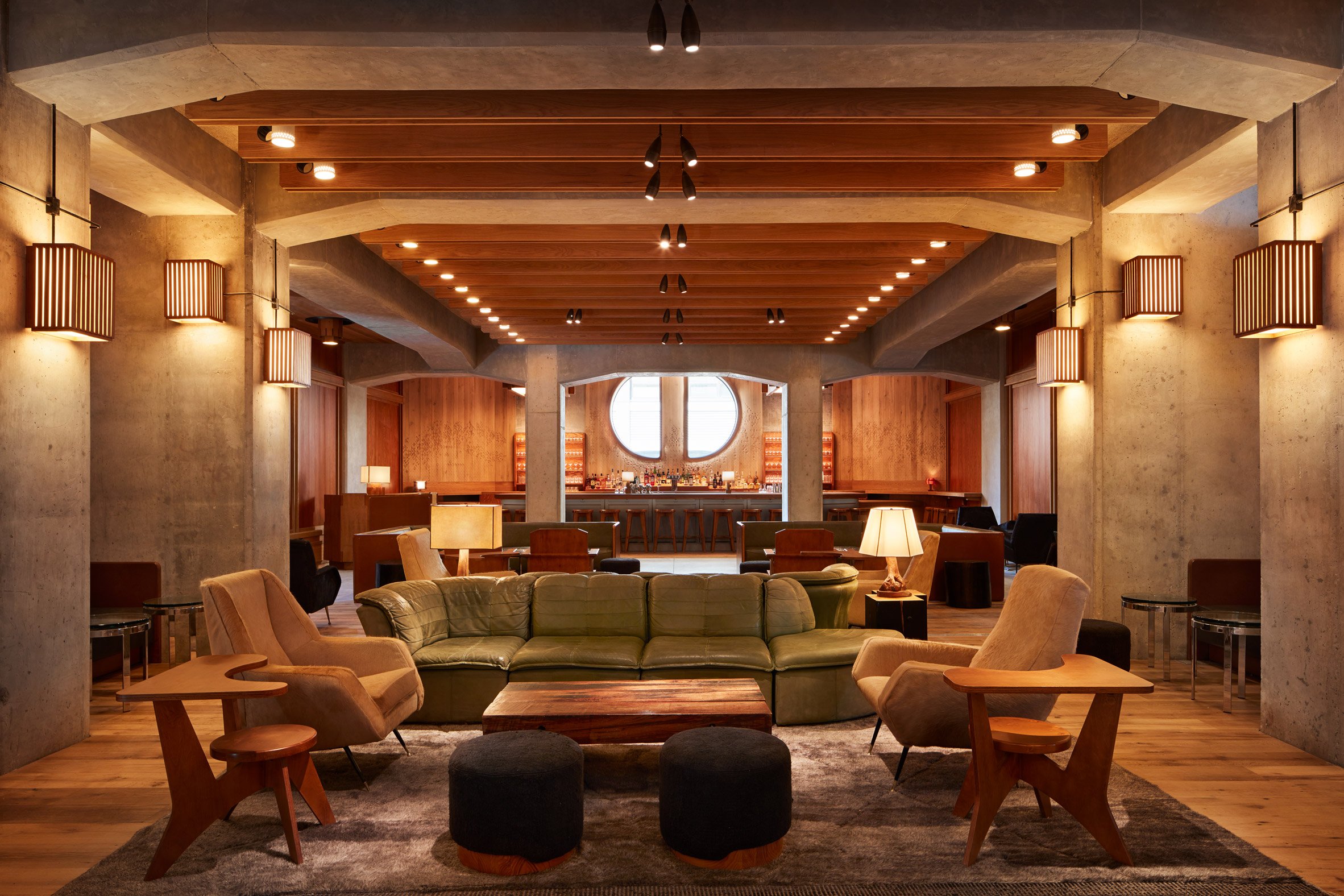
Lounge with wooden ceiling
The hotel was designed with a focus on local artists

The 13-storey concrete-and-glass tower was designed in collaboration with architects Stonehill Taylor. One of Ace Hotel's main goals was to spotlight local artists, providing opportunities for exhibitions in most of the property's 287 guest rooms, as well as in communal areas and on the building's facade.

"We're proud to have filled its spaces with the talents of many collaborators across art, design and culture; it's a testament and tribute to the irrepressible creative energy of the borough," said a statement from Ace Hotel president Brad Wilson.

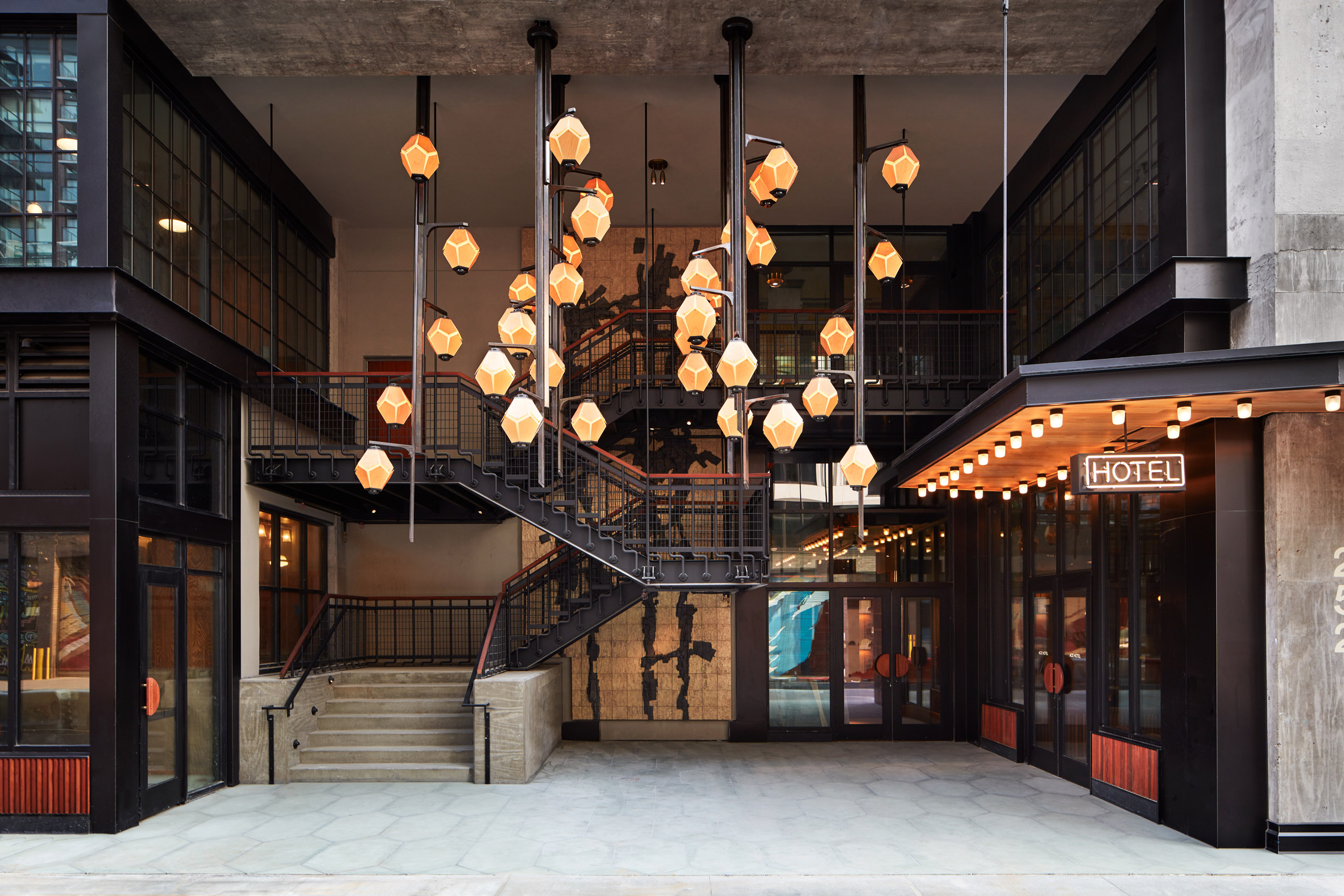
Ace Hotel facade
An installation by Stan Bitters sits at the hotel entrance

At the hotel's covered entrance, visitors are greeted by a double-height ceramic installation by modernist sculptor Stan Bitters. The common areas also feature works of art, including a sculpture in the bar by Verdan Jakšic, as well as a large-scale drawing by Tara Geer.

In addition to offering typical hotel amenities, the Ace Hotel's public area hosts an art gallery. "The Gallery at Ace Hotel Brooklyn will showcase works by artists featured in the guest rooms, starting with a show of textile works by Cynthia Alberto and Weaving Hand in July and August 2021," said a statement from the hotel.

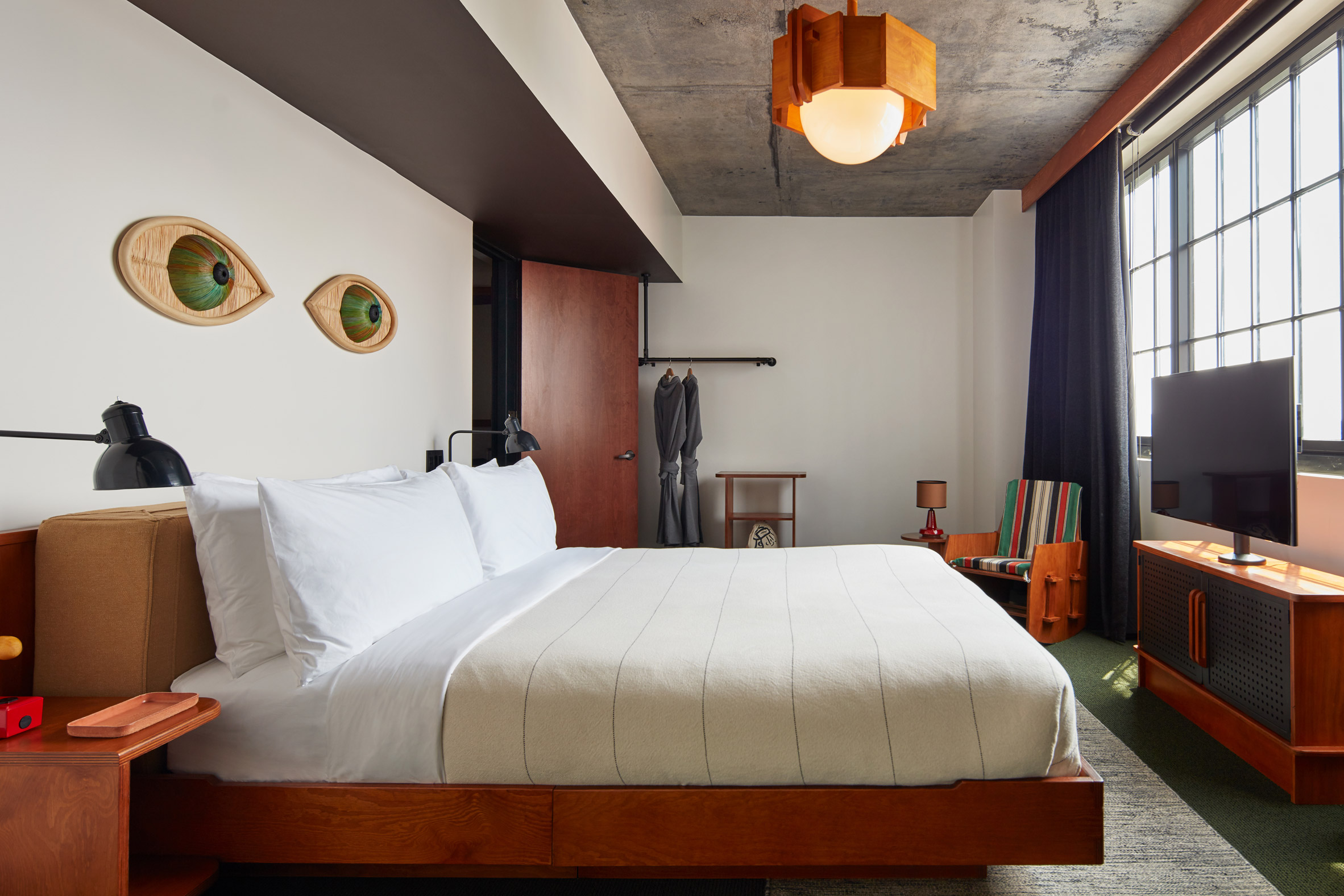
Guest room in Brooklyn hotel
Guestrooms were inspired by Le Cabanon retreat in France

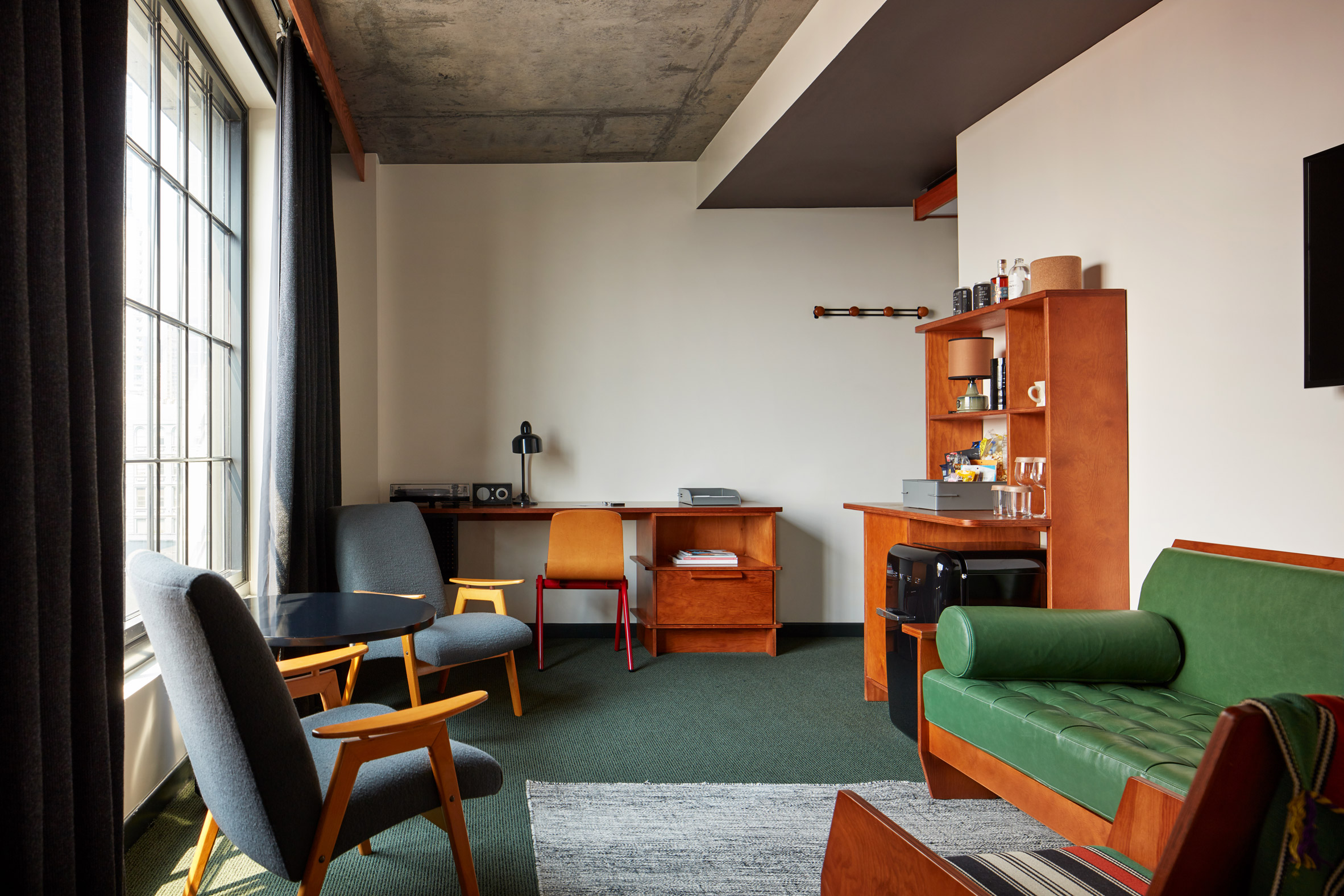
Guest rooms feature colourful selections that contrast the building's neutral concrete tones. The artwork selection and coordination was curated by Niki Tsukamoto, who also is a practising artist.

The design of the rooms themselves was influenced by Le Cabanon, a Mediterranean retreat in the South of France that Le Corbusier used as an escape.

"The guest rooms at Ace Hotel Brooklyn were imagined as cabins of creative refuge: elegant and efficient, with the kind of breathing room that stirs up all sorts of possibilities," said the hotel team.

The rooms feature exposed concrete finishes, simple plywood furnishings, and generous windows that let in plenty of natural light. The bed covers were crafted by Heritage Weavers, a family-owned mill in Maine that has been operating since 1850.

Hotel room designed by Roman and Williams
Rooms feature turntables and acoustic guitars

Other unique items that can be found in the rooms include acoustic guitars by D'Angelico Guitars and turntables by Music Hall. The records were curated by Rough Trade, a famed local store that opened in 1978.

Founded in 1999 in Seattle, Ace Hotel now has 11 locations, most of which are in the US. Chicago and Downtown Los Angeles are among its portfolio.

Hotel room with artworks
Artworks decorate the walls throughout the Ace Hotel in Brooklyn

Downtown Brooklyn is currently seeing a development boom, with projects nearby the hotel including a residential tower by Studio Gang that features a sweeping concrete facade, and a supertall skyscraper by SHoP that has just become the borough's tallest building.

The photography is by Stephen Kent Johnson.

The post Ace Hotel Brooklyn showcases the borough's artistic talent appeared first on Dezeen.


from Dezeen https://ift.tt/3CQFM3d