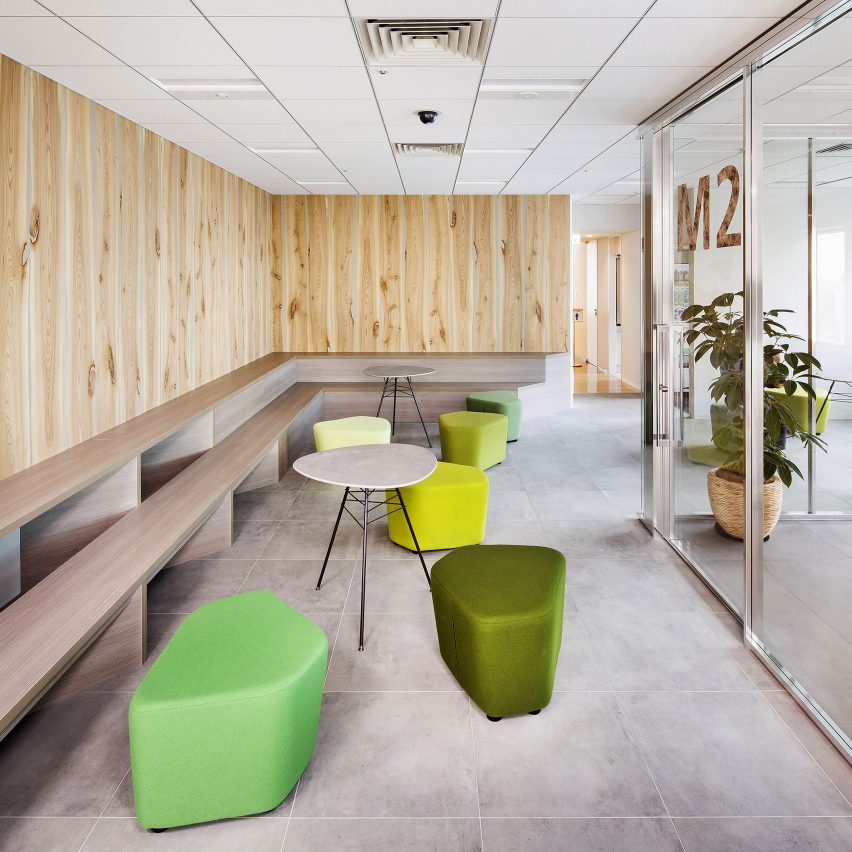
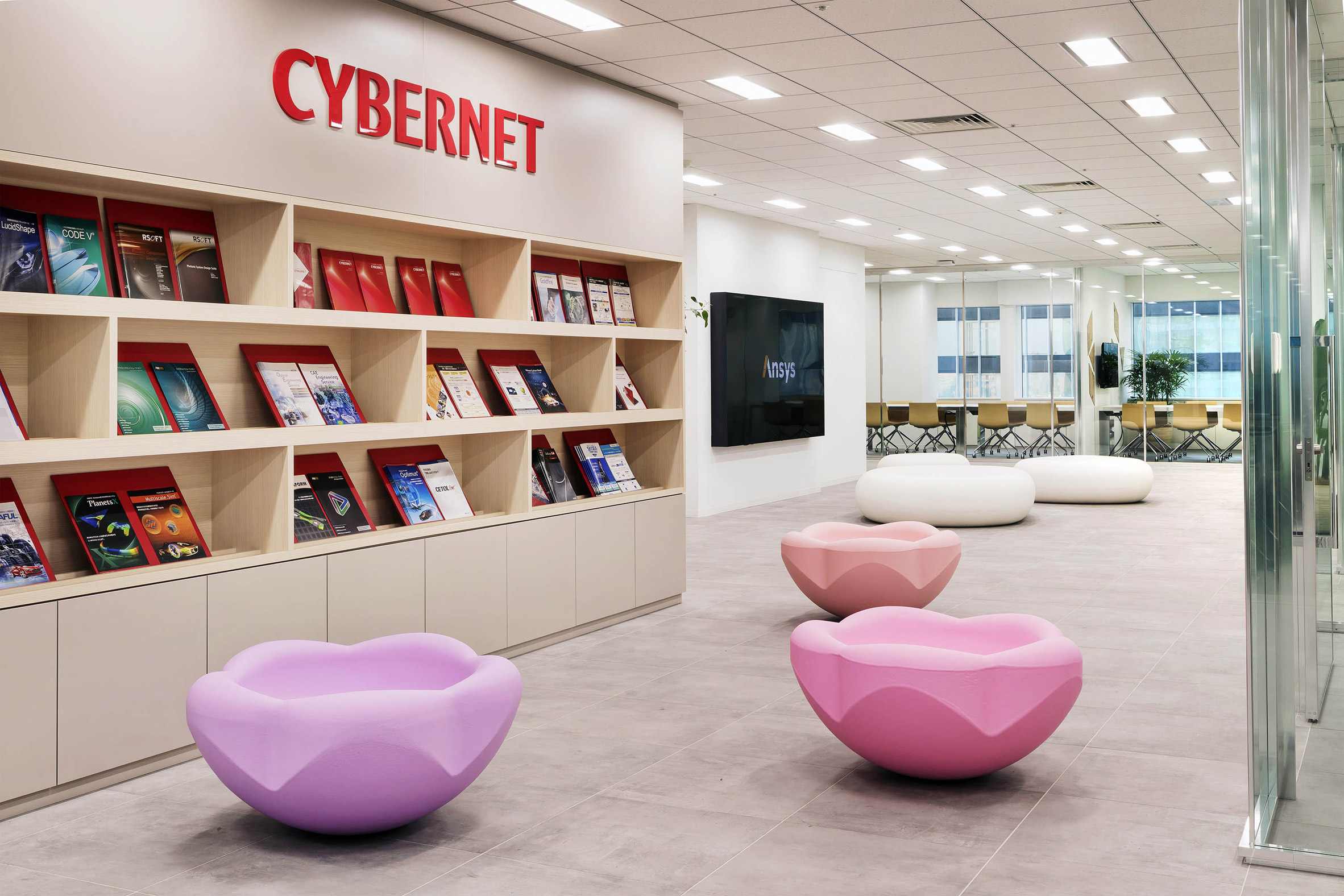
Dezeen promotion: Matteo Belfiore Architecture and Shukoh have used anti-microbial ceramic surfaces by Fiandre Architectural Surfaces across the interior of a new headquarters for a cyber company in Tokyo, Japan.
Fiandre Architectural Surfaces is an Italian surface manufacturer that specialises in creating ceramic surfaces for use in architecture projects.
Matteo Belfiore Architecture and Shukoh used products from Fiandre's Urban Active Surfaces collection to create the headquarters for computer engineering company Cybernet, which has been designed to prioritise the wellbeing of its employees.
Fiandre's Active Surfaces products react with light via a process called photocatalysis, which creates an oxidation reaction that destroys bacteria and viruses.
Fiandre's Urban Active Surfaces feature throughout Cybernet's new headquarters
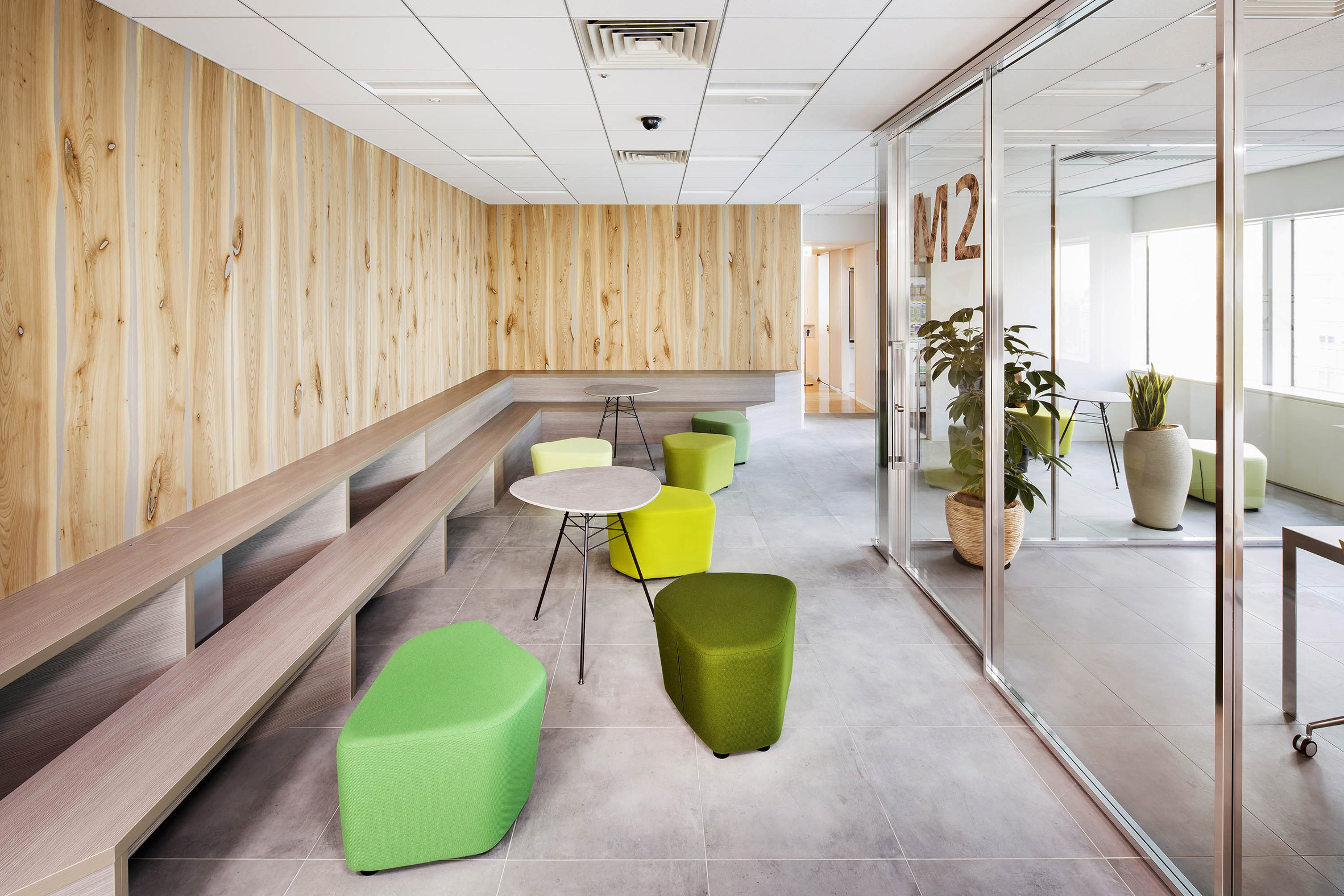
The headquarters is made up of two main areas, a "garden" lobby, which takes cues from Japanese rock gardens, and an office area that is divided into three zones between glass partition walls.
The lobby was designed to welcome visitors and employees to the office and features rock and pebble-shaped seating placed throughout the space.
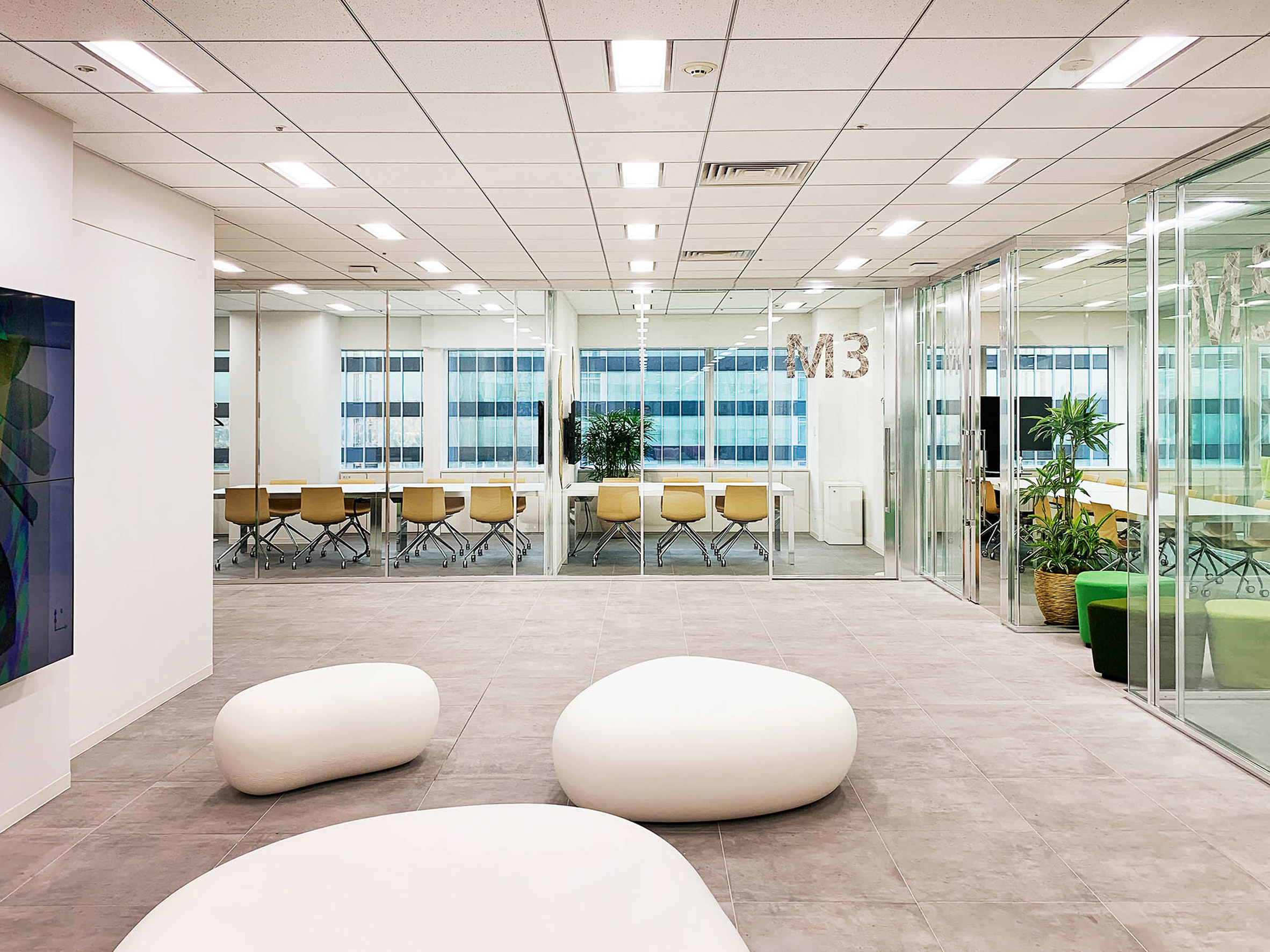
The grey ceramic tiles are used throughout the lobby and surrounding workspaces
Both the office and shared spaces are linked through their use of Fiandre Architectural Surfaces' Urban Active Surfaces photocatalytic ceramic flooring.
The grey ceramic surfaces, which provide ease of upkeep, provide a neutral backdrop for the workspace and are suited for a variety of functions and changes of use.
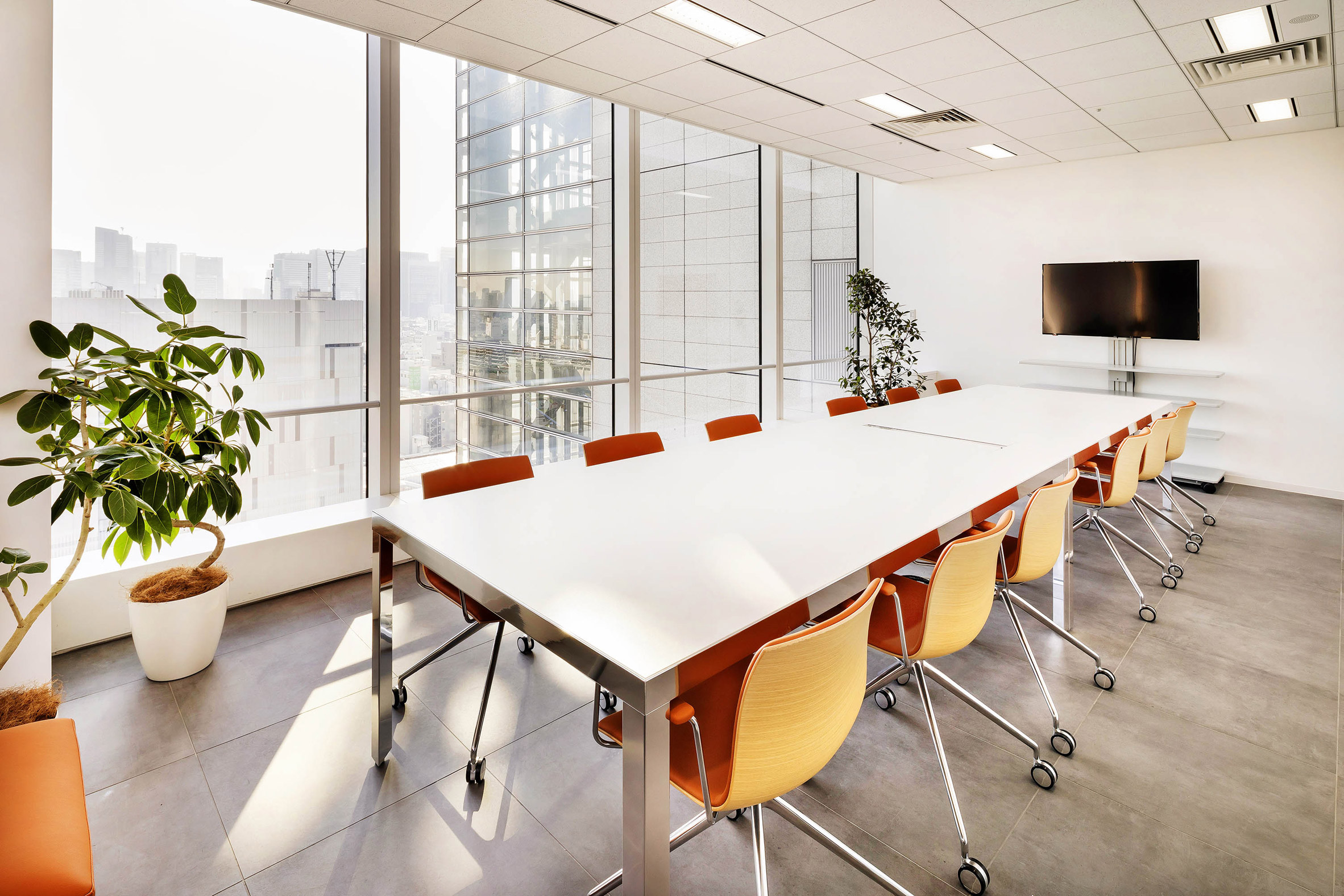
Fiandre's Active Surfaces are also used on the meeting room tabletops
Office areas are divided by transparent partitions that can adapt to a range of furnishings and changes in the function of the spaces.
Tables in the meeting rooms and working areas are also topped with surfaces by Fiandre. Naòs system tables by office design brand Unifor are placed in the partitioned spaces and customised with Uni.Ice Active Surface tops by Fiandre.
The ceramic surfaces also feature in the office's break-out spaces
As well as destroying bacteria, the photocatalytic reaction of Fiandre's Active Surface can also reduce pollution and odours.
Fiandre Architectural Surfaces uses materials that are durable and recyclable and are made from natural raw materials, something which was important when creating the space.
To learn more about Fiandre Architectural Surfaces, visit the brand's website.
All photographs by Lamberto Rubino.
Partnership content
This article was written by Dezeen for Fiandre as part of a partnership. Find out more about Dezeen partnership content here.
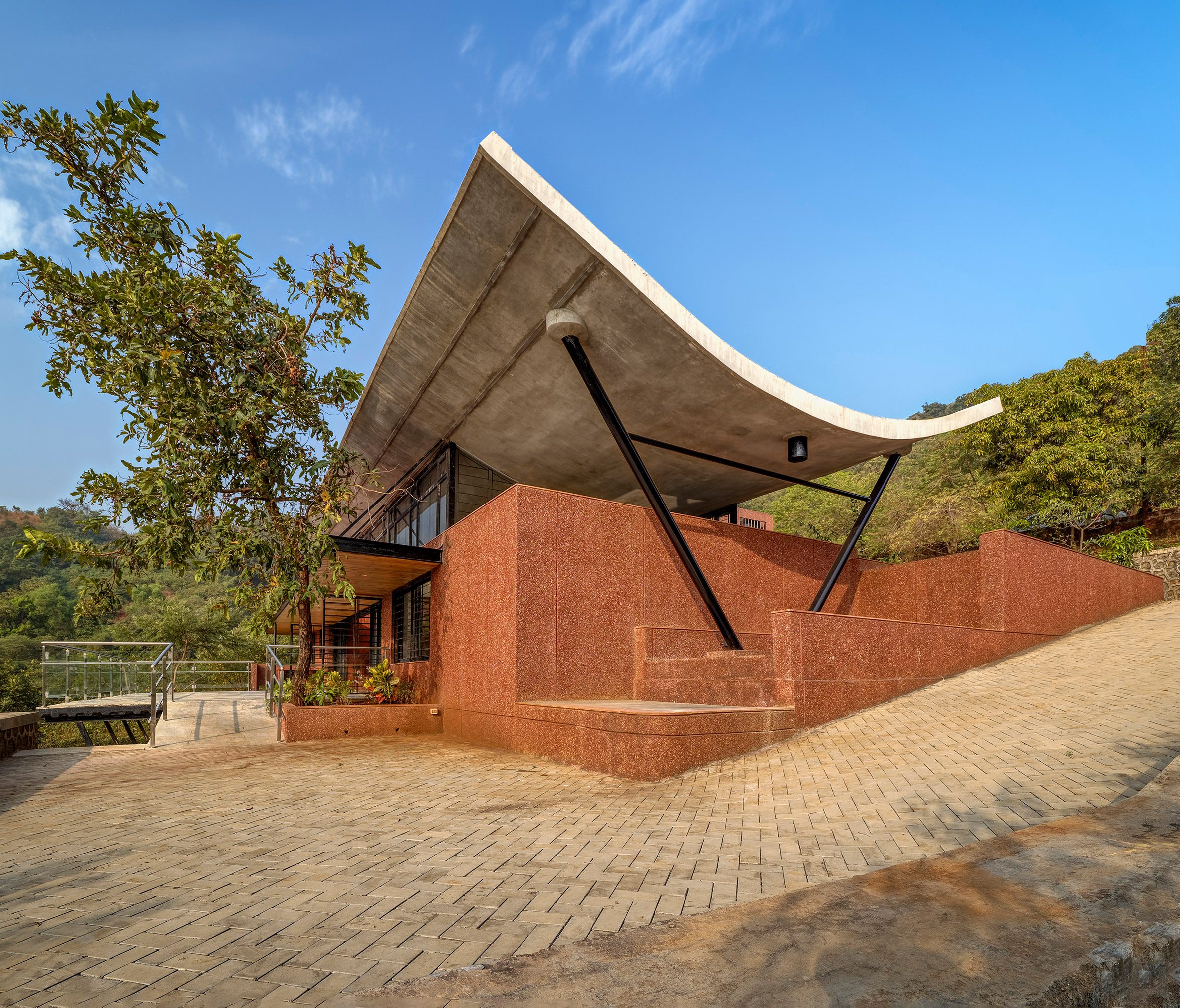
Indian architecture office Red Brick Studio has completed a house in the Western Ghats mountain range featuring a curved roof that is lifted above pigmented-plaster walls.
The Cove House was designed as a retreat for a client who wanted to escape his busy life in the city and enjoy weekends in the mountainous region near Pune.
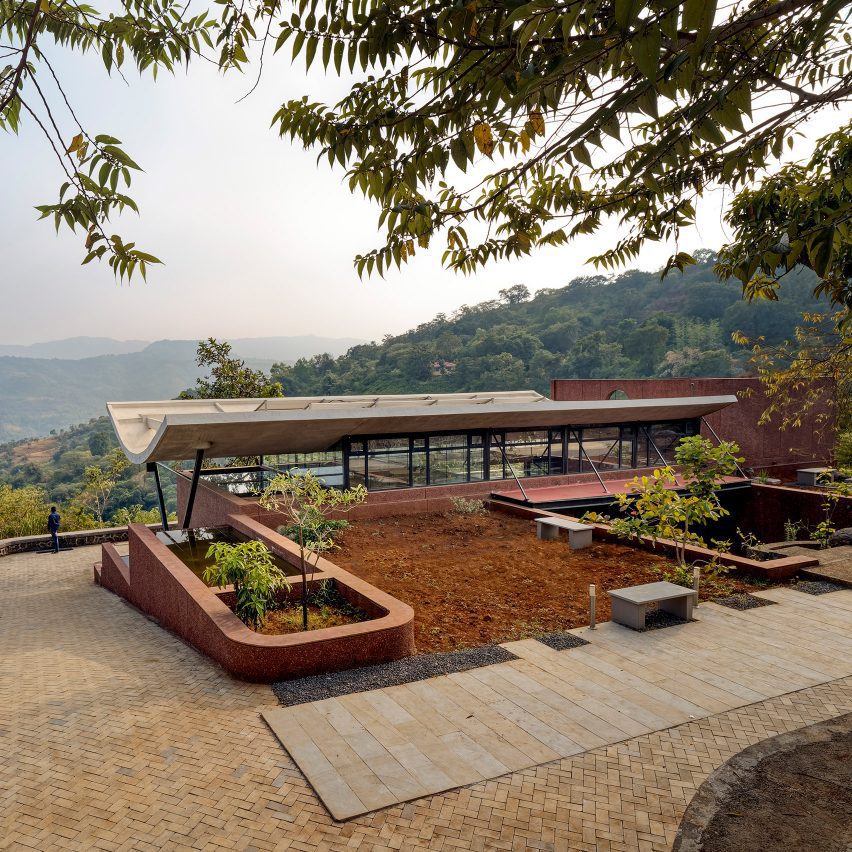
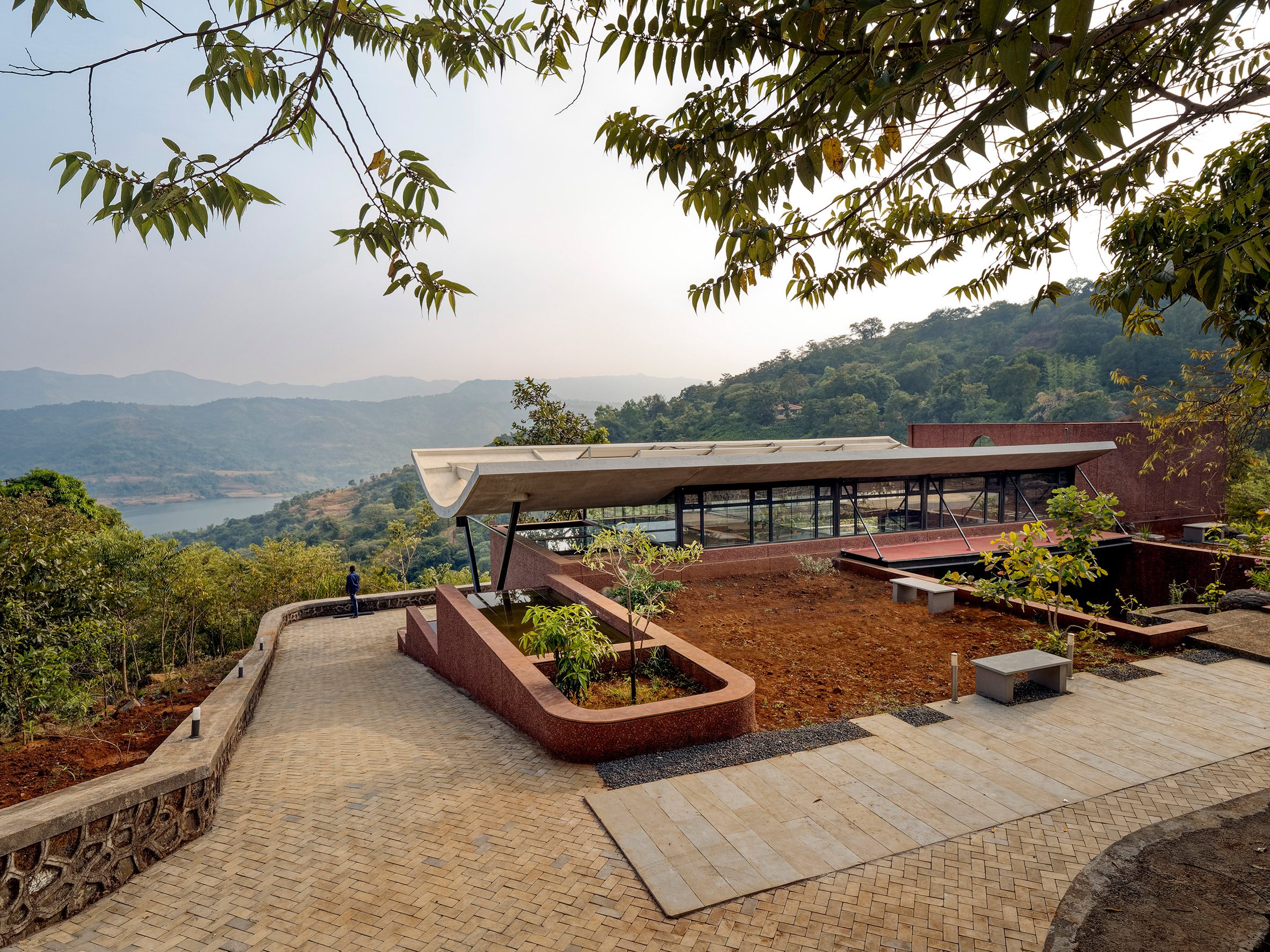
A view of the Western Ghats mountains and valley can be seen from The Cove House
The property is built on a hillside surrounded by dense forest overlooking the nearby Panshet Dam. Red Brick Studio developed a design that utilises the site's slope to partially conceal the building.
"Upon seeing the site and its surrounds, our first response was to create a built form which would try and blend in rather than stand out," the architects claimed.
"Rather than typically using the flat part for construction, we proposed to set the house beyond this zone and use the natural topography of the site to tuck away majority of the house from the view at the entrance."
The architects incorporated the slope of the land into the design
From the entrance level, most of the building is hidden from view down the slope. Walls that emerge from the earth form a solid mass topped with the slender roof that is supported by angled columns.
Between the walls and roof, a row of clerestory windows maintains the view towards the valley through the building and allows plenty of daylight to reach the internal living areas.
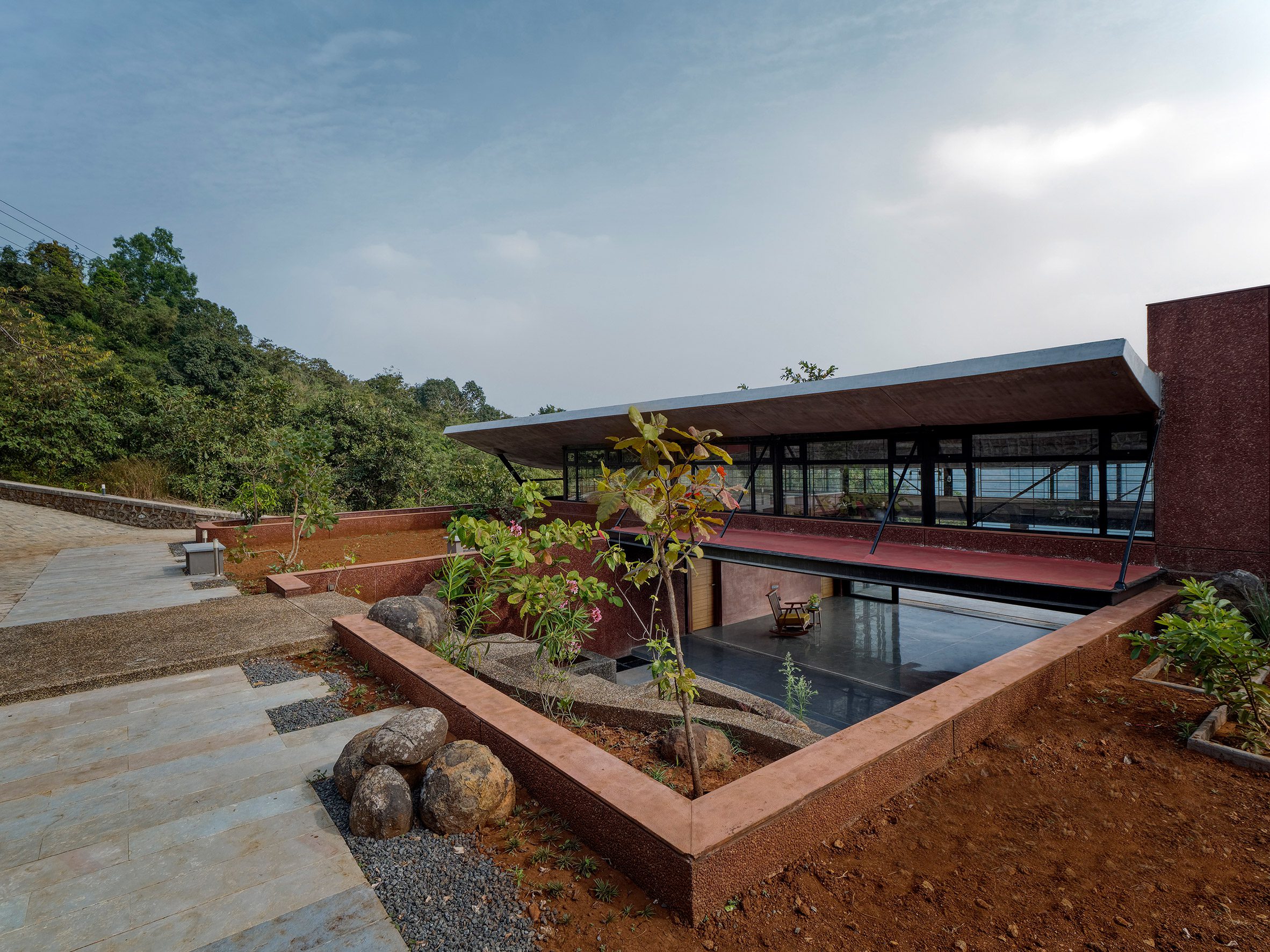
Red pigment was added to the plaster for the exterior of the building
The external walls are finished in a rough plaster made using a red pigment that matches the earthy tones of the surrounding mountains.
The roof form is constructed using reinforced ferro-cement to create a curved form that channels rainwater into a series of ponds, so it can be stored for irrigation in the drier months.
"The approximately 25-metre-long ferro-cement roof is constructed with a structural thickness of just 50 millimetres," the architects pointed out, "making it a very cost effective and sustainable alternative to conventional reinforced cement concrete technology."
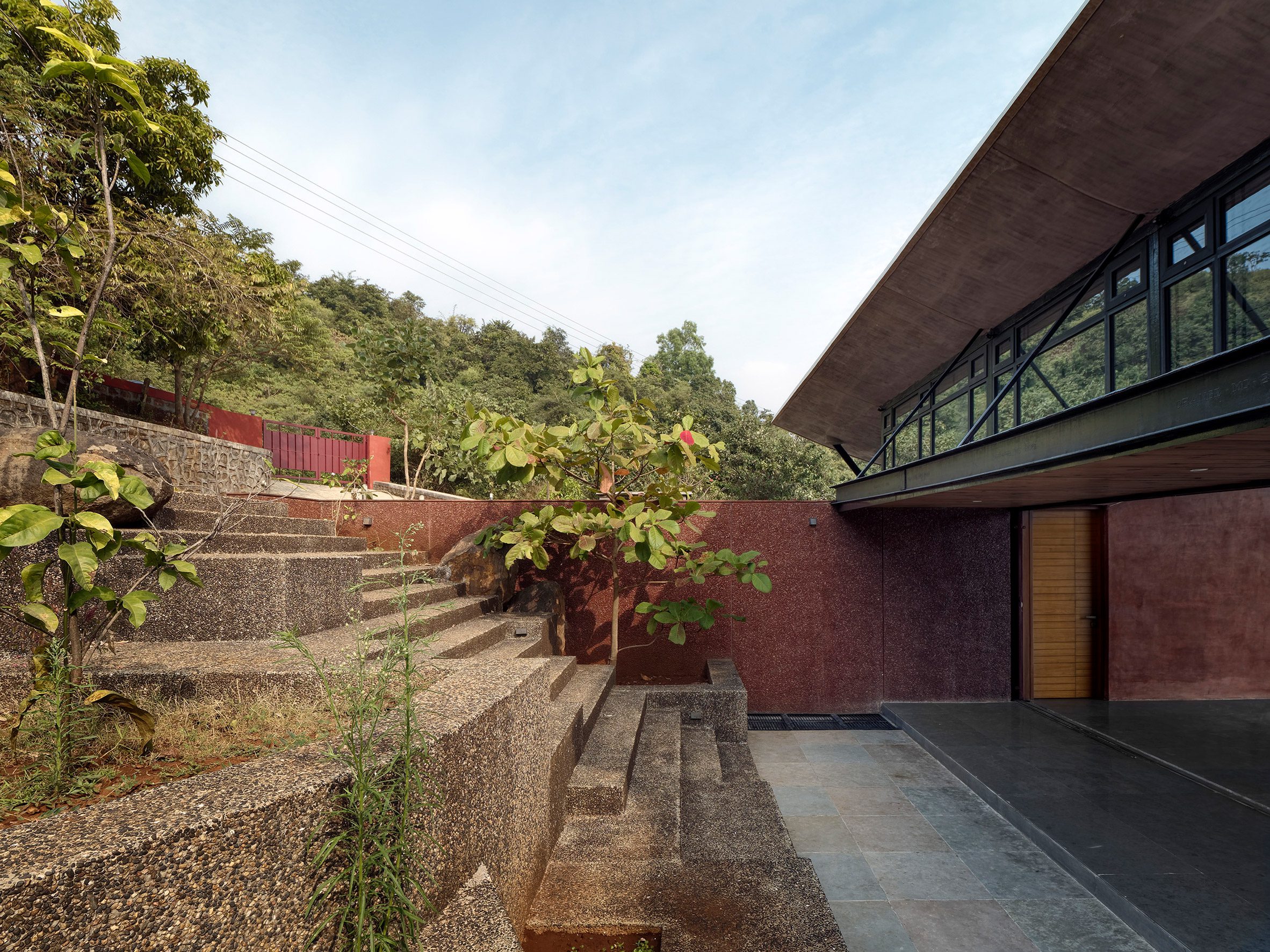
The house is entered via a sunken courtyard featuring stepped planters that contain vegetation and boulders sourced from the site.
The courtyard forms an extension of the main living space, which can be entirely opened up to the outdoors.
Custom-built doors open out onto the terrace
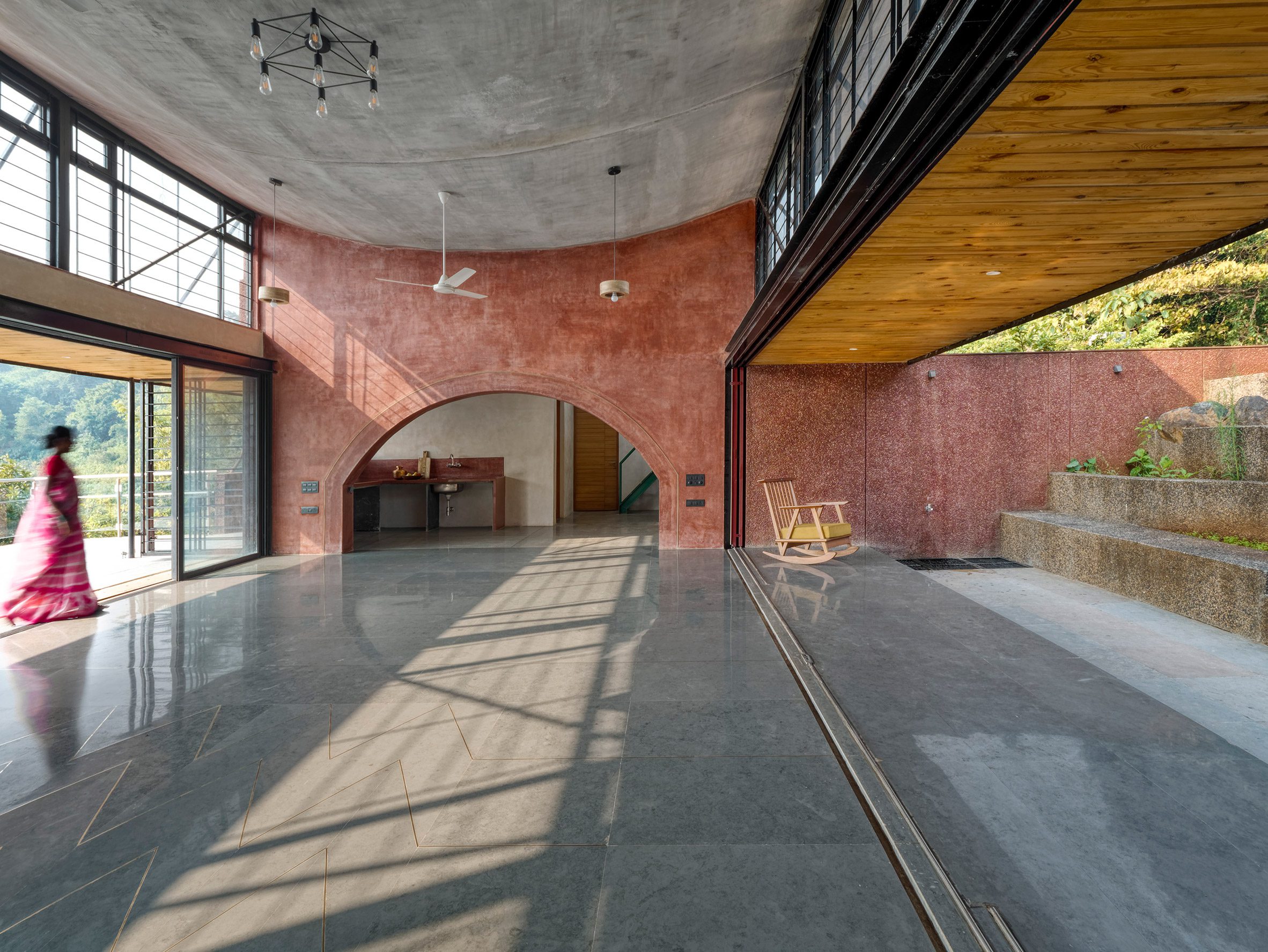
Custom-built doors made from folded sheet metal disappear into cavity walls on either side of the 10-metre-wide room, creating a seamless connection with the courtyard.
The other side of the living area is lined with glass doors that can also be retracted to open the space up to an adjoining terrace with expansive views of the natural surroundings.
The grey stone flooring and wooden doors reflects the natural surroundings
The central social space is flanked on one side by two en-suite bedrooms. An arched opening on the opposite side that mirrors the profile of the curved ceiling provides access to a kitchen, another bedroom and a staircase leading to an enclosed private terrace.
All of the internal walls are finished in polished oxide in white or a range of complementary shades. The green metal staircase, stone flooring and wooden doors all contribute to a palette informed by the natural surroundings.
Human hair can be a tool for measuring the toxicity of a city, according to London-based architects Deborah Lopez and Hadin Charbel.
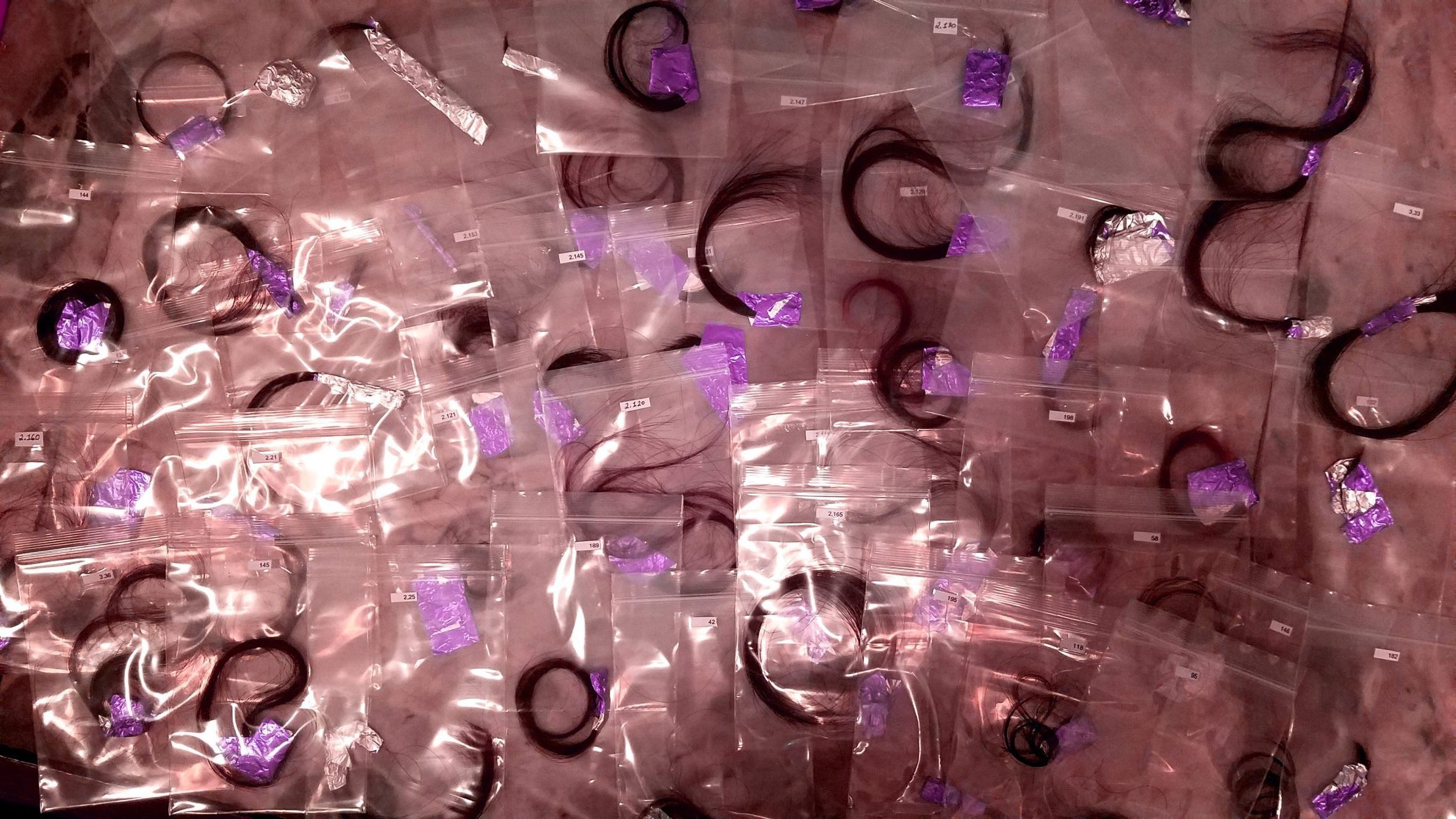
Through their research studio, Pareid, Lopez and Charbel have been analysing hair samples as a way of mapping the levels of pollution across different areas of Bangkok. Samples containing larger quantities of heavy metals indicate higher levels of environmental toxicity.
Pareid has analysed the toxicity of hundreds of hair samples
"Pollution is becoming a gigantic environmental problem," Lopez told Dezeen.
"We were interested in the capacity of the human body to become a sensor to this, to reflect and record the environment where you live, where you breathe, and where you eat and drink."
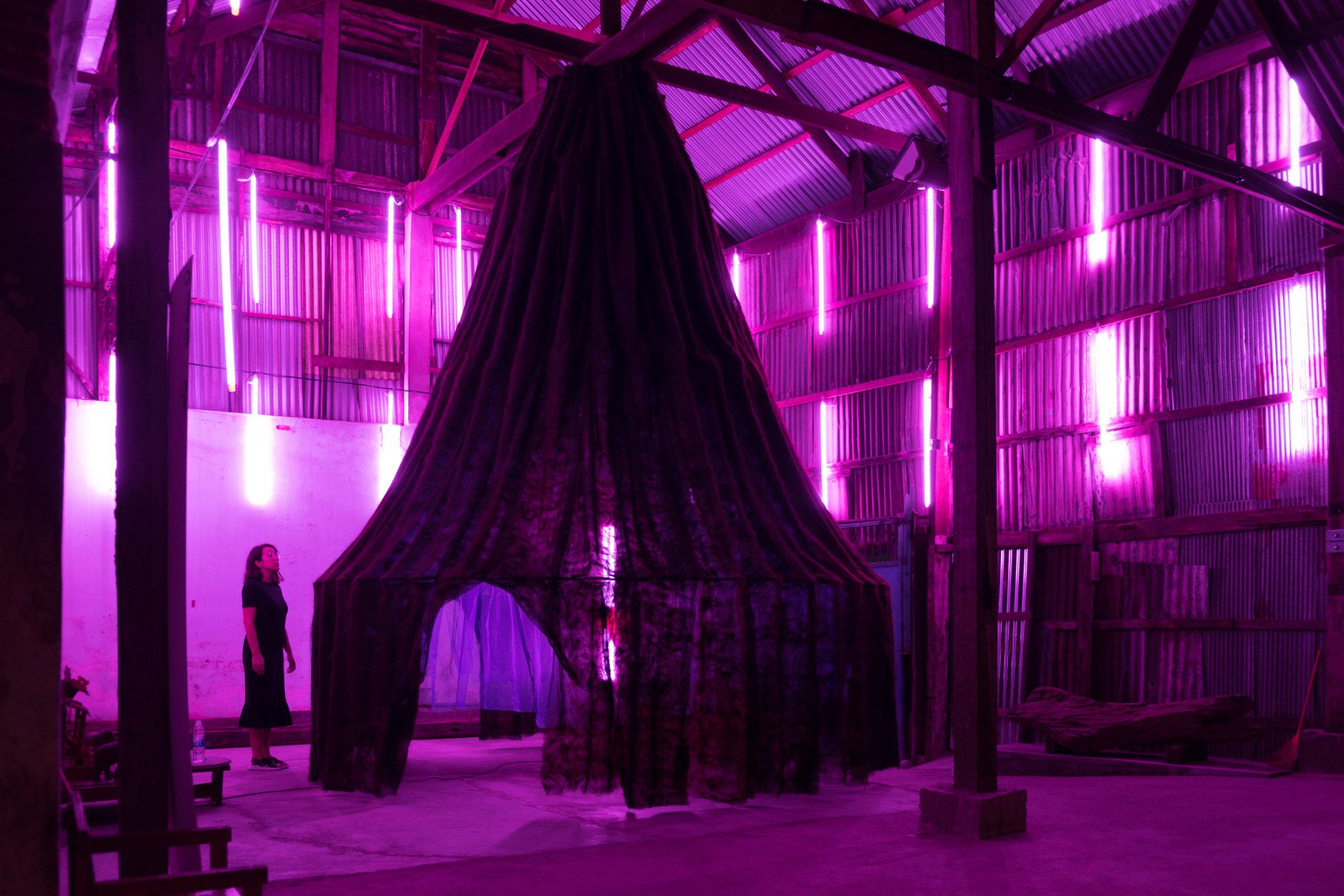
The research began with an installation at Bangkok Design Week in 2019, which functioned as a test station
The project, called Follicle, started out as an investigation into the potential of hair as an architectural material.
Research suggests that around 6.5 million kilos of waste human hair is produced in the UK alone every year, so Lopez and Charbel felt this material could be an untapped resource for sustainable construction.
However, after learning about the presence of heavy metals in hair, the pair realised they could also use the substance as a research tool in cities with dangerously high levels of pollution.
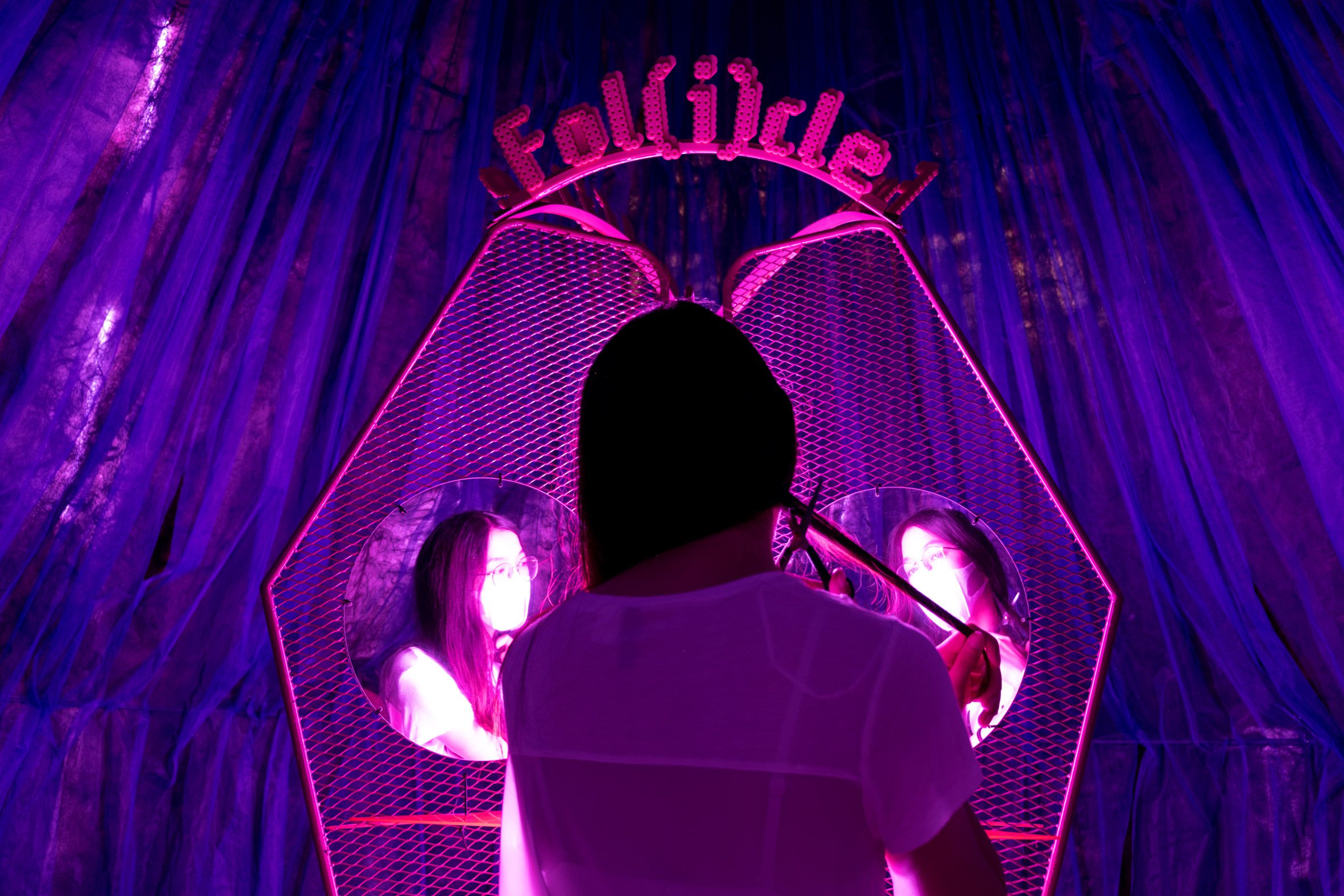
The installation was a space where people could cut off a small amount of hair and submit it for analysis
The architects created an installation at Bangkok Design Week 2019, inviting visitors to voluntarily cut off a small amount of their hair and submit it for analysis, along with details about their day-to-day environment.
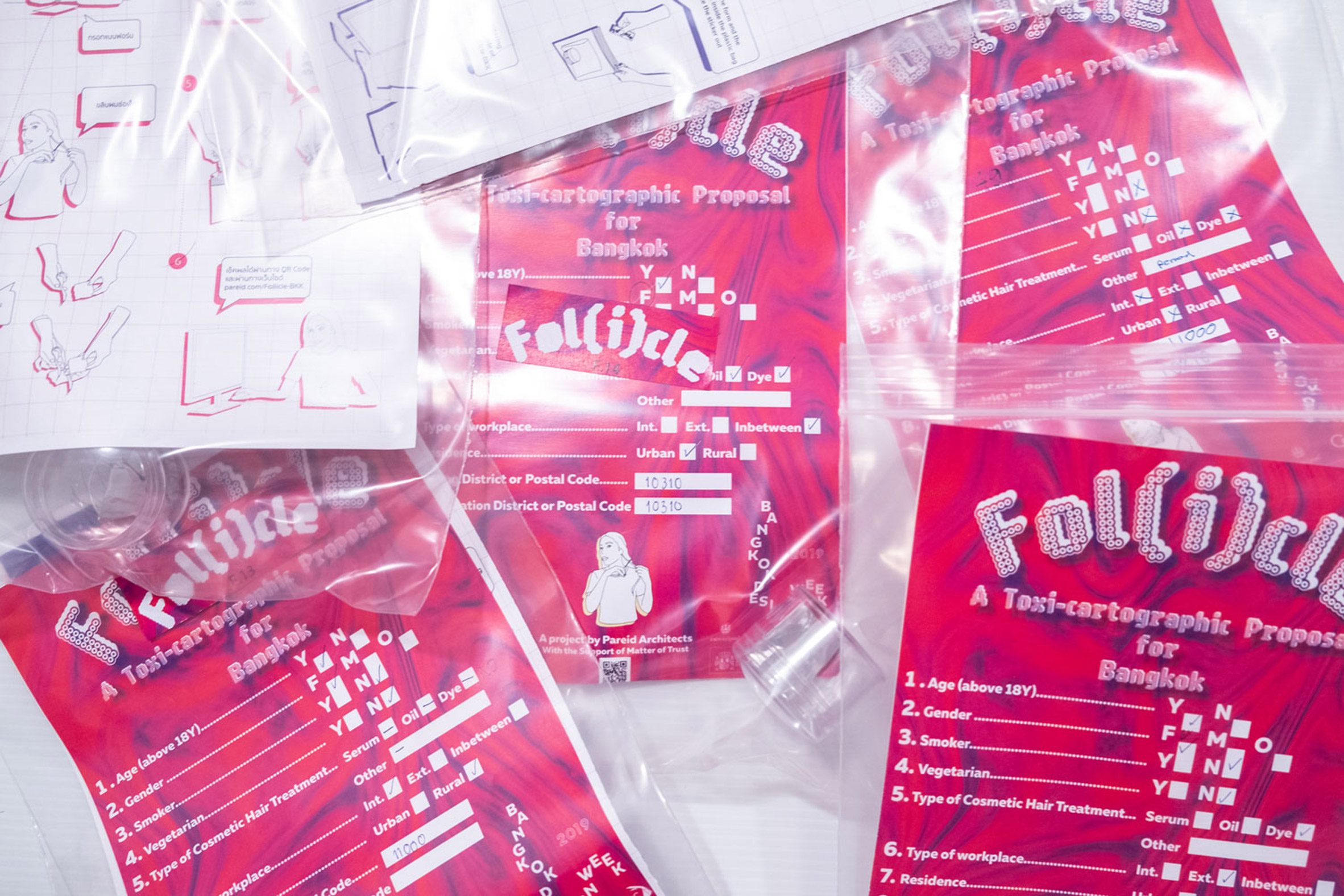
As the hair toxicity is affected by lifestyle choices – smoking and dying your hair both led to increased metal content, for instance – visitors were asked to also provide some anonymous information about themselves.
Participants were anonymous but were asked to provide some details about themselves and their day-to-day environment
Although there was some reluctance, Lopez and Charbel were surprised by how many people were willing to donate their hair. They ended up with hundreds of samples.
The toxicology analysis suffered long delays, as a result of the Covid-19 crisis unfolding at that time, but when they finally received the results they were able to see significant links between certain types of environment and certain metals.
For example, people who lived near major highways were found to have a notably higher volume of arsenic in their hair.
"From that moment we were able to link these two stories together, hair toxicity and pollution in the context of Bangkok," said Charbel.
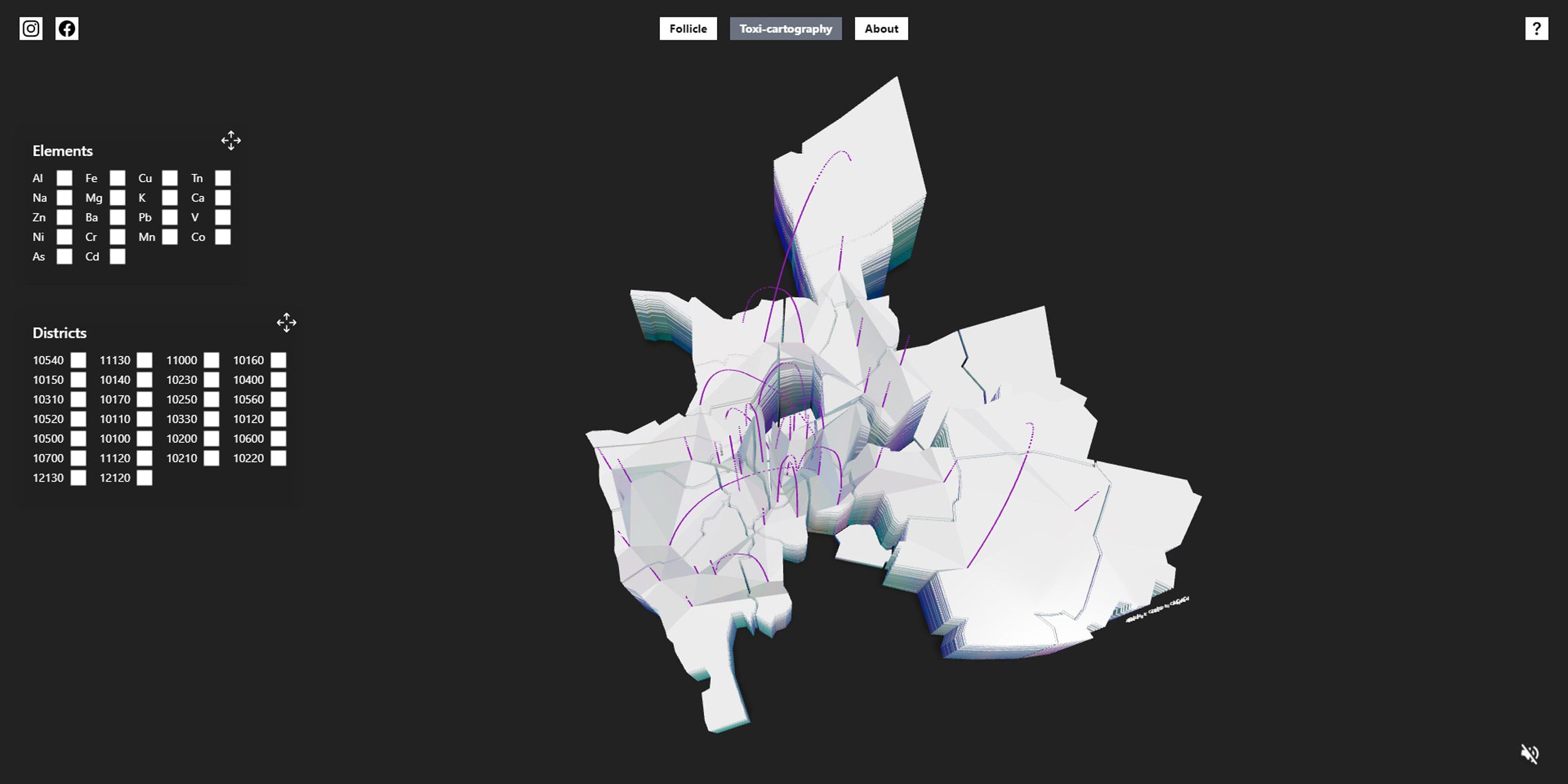
Pareid has used the finding to create a "toxi-cartography" of Bangkok
The architects have been using the information gathered to produce a "toxi-cartography", an interactive 3D map of the city that charts the varying toxicity across different areas. This is available to view on a dedicated website.
The pair are currently presenting their research within the Spanish Pavilion at the Venice Architecture Biennale.
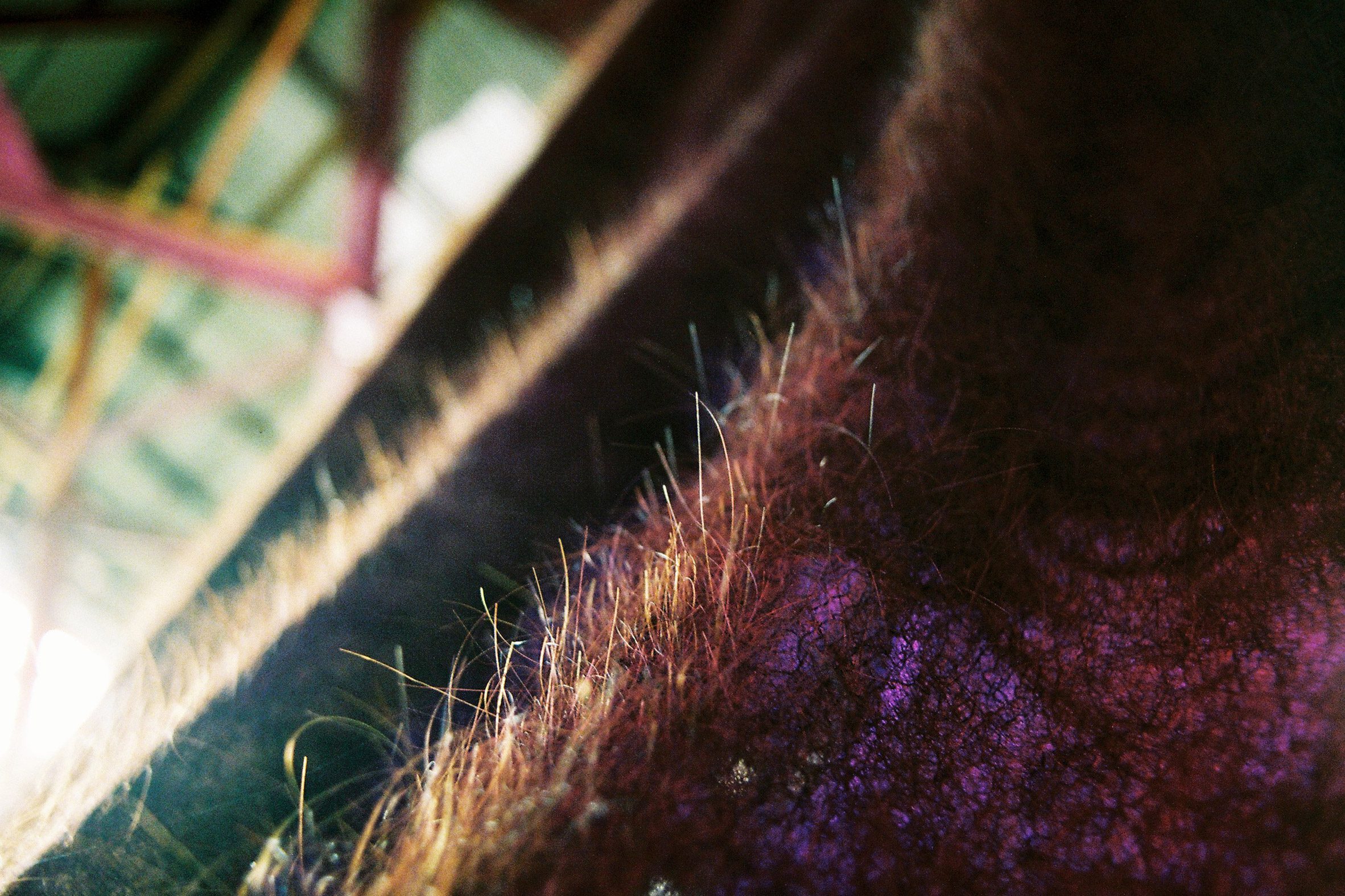
Lopez and Charbel have also developed a hair textile, as a separate part of the project
Going forward, Lopez and Charbel hope to be able to set up test stations in more cities, so that they can start to build up a wider understanding of the links between urban conditions and hair toxicity.
At the same time, the architects are also continuing to explore ways that waste hair can be used in building construction.
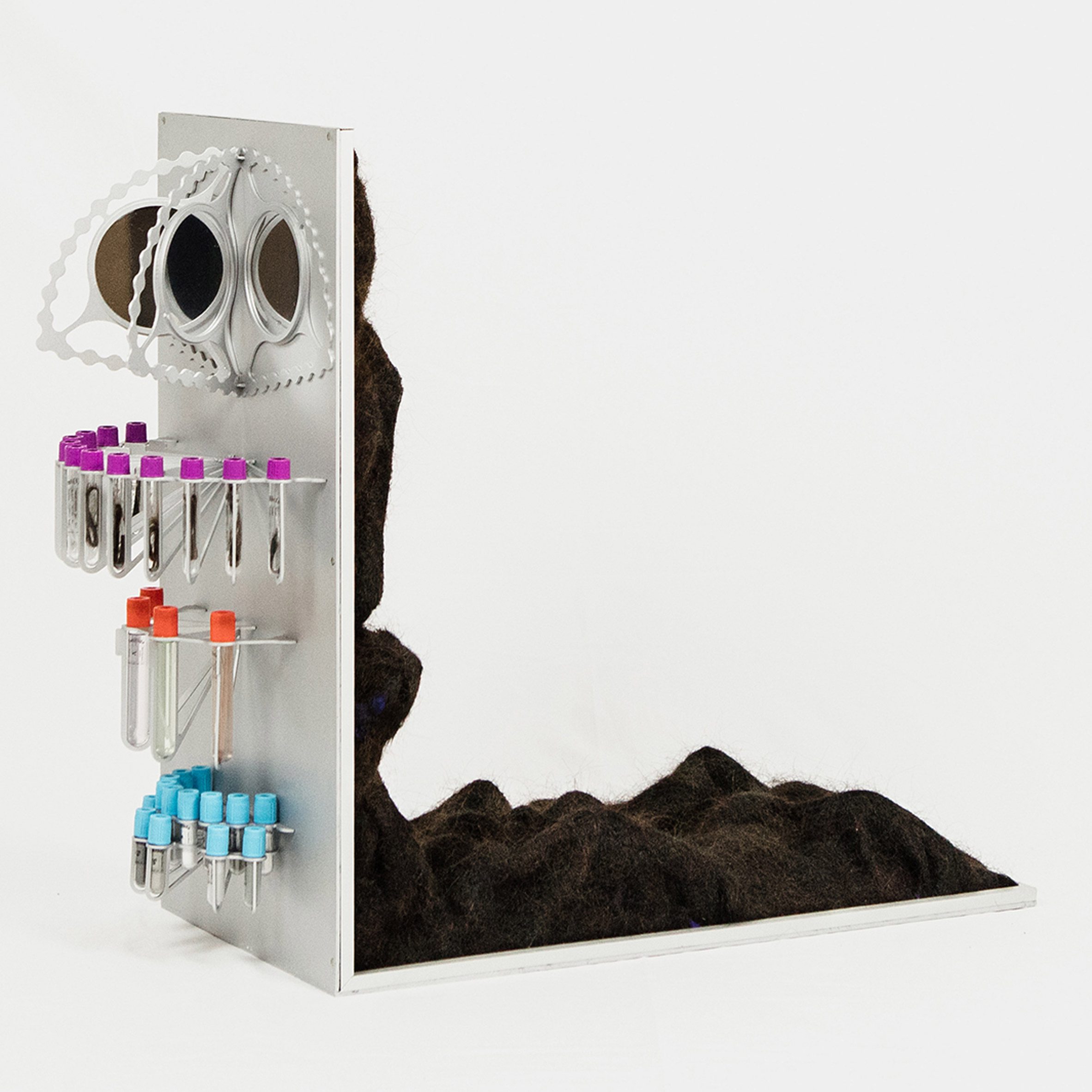
They have used a felting machine to create a hair textile, which has featured in both the Bangkok and Venice installations. Lopez suggests that this felt could be used as an insulating material, or as some kind of acoustic panelling.
An object designed to encapsulate the research is currently on show at the Venice Architecture Biennale
The main obstacle to overcome is the stigma surrounding the cleanliness of hair, Lopez said.
"We find it interesting that we feel comfortable with the hair of non-humans, with animal fur, but we feel so disgusted by our own hair," she stated. "We want to find a way to use this material to create something that people feel attracted to."
Architects: Pareid Architects (Deborah Lopez and Hadin Charbel) Collaborators: Konlawat Meklalit, Noppa-on Plidtookpai, Pitisuda Sukumalchantra, Phatsorn Mutanone. Support: Matter of Trust, Embajada de España en Bangkok, Bangkok Design Week 2019 and TCDC Photography and images Pareid & Visut Innadda Hair analysis: Mery Malandrino, Alberto Salomone, Marco Vincenti (Department of Chemistry - University of Turin, Italy) Website design: Pareid Architects (Déborah Lopez and Hadin Charbel) Website development & Data Visualization: Sherif Tarabishy Sound design: Donnie Brosh
Furniture retailer IKEA is branching out to become a renewable energy supplier with its Strömma subscription service, which is set to bring wind and solar power to Swedish households from September.
Launched in partnership with Svea Solar, the scheme will see the companies purchase electricity on the European power exchange Nord Pool before selling it on without a surcharge in order to reduce the cost to the end-user.
IKEA is already in partnership with Svea Solar for its solar panels, which are sold in 11 markets.
Strömma scheme to be rolled out globally
IKEA says it aims to expand the Strömma scheme globally and create the world's "biggest renewable energy movement", in a bid to cut down the 10 billion tonnes of carbon dioxide equivalent (CO2e) that are generated by lighting, heating and cooling our buildings every year.
"We believe the future of energy is renewable and we want to make electricity from sustainable sources more accessible and affordable for all," explained Jan Gardberg, new retail business manager at IKEA's parent company Ingka Group.
As part of a Strömma subscription, households will pay a fixed monthly fee alongside a variable rate, both of which are as yet undisclosed.
An accompanying app will allow users to track their electricity usage as well as offering those who own IKEA solar panels the option to sell their excess energy back to the grid.
Emissions generated by customers while using IKEA products will also factor into this, according to IKEA Sweden's head of sustainability Jonas Carlehed.
"Our customers' use of our products account for around 20 per cent of IKEA's total climate footprint – from appliances, lighting and electronics such as speakers and so on," he told Reuters.
This was equivalent to 4.7 million tonnes of carbon dioxide equivalent (CO2e) in 2020, making it the second-largest contributor to the company's carbon footprint after the extraction and processing of raw materials for its products.
Solar panels to eventually be offered in all markets
To mitigate the customers' use impact on IKEA's climate footprint, the company hopes to offer solar panels in all of its markets by 2025, as well as eventually introducing the Strömma scheme across the board.
In the UK, climate activist group Architects Climate Action Network (ACAN) recently launched its Households Declare initiative, which hopes to tackle household emissions by lobbying the government to invest in retrofitting the country's existing housing stock.
Equipping buildings with solar panels and better insulation is vital if the country is to meet Paris Agreement goals, ACAN's Sara Edmonds told Dezeen.
"There are 29 million homes in the UK, and these contribute almost 20 per cent of total UK emissions," she said.
"That is a huge chunk of emissions that won't change without large amounts of financial and organisational investment."
Two flats in a Mumbai high-rise were combined to create a "minimal but playful" home for three generations, which local studio The Act of Quad has decorated with multiple spherical and rounded shapes.
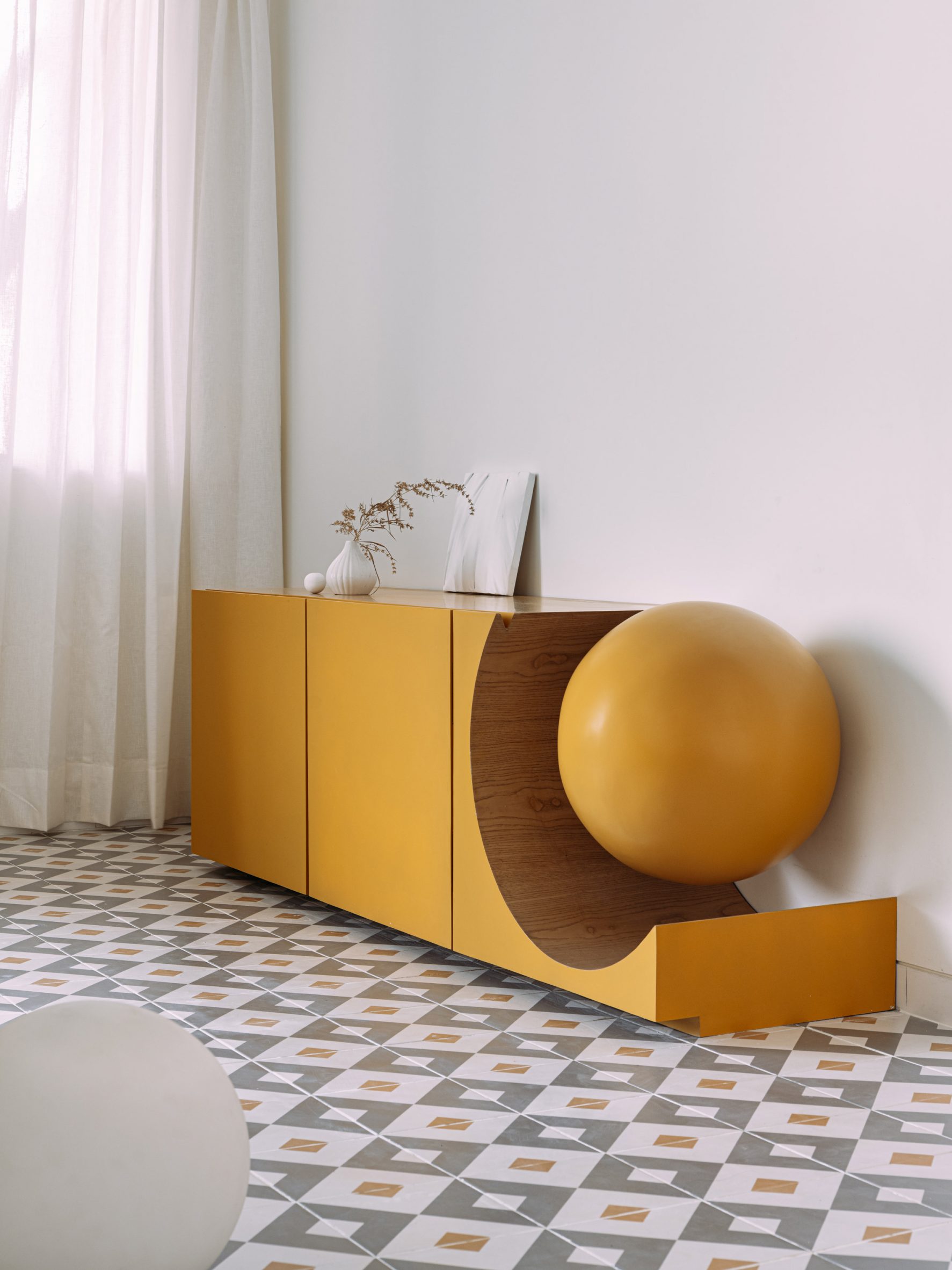
Located in the city's Ghatkopar suburb, the four-bedroom, 325-square metre apartment is dotted with orbs and circles. Some serve a purpose as mirrors or lights, while others are simply decorative wooden sculptures placed on the floor.
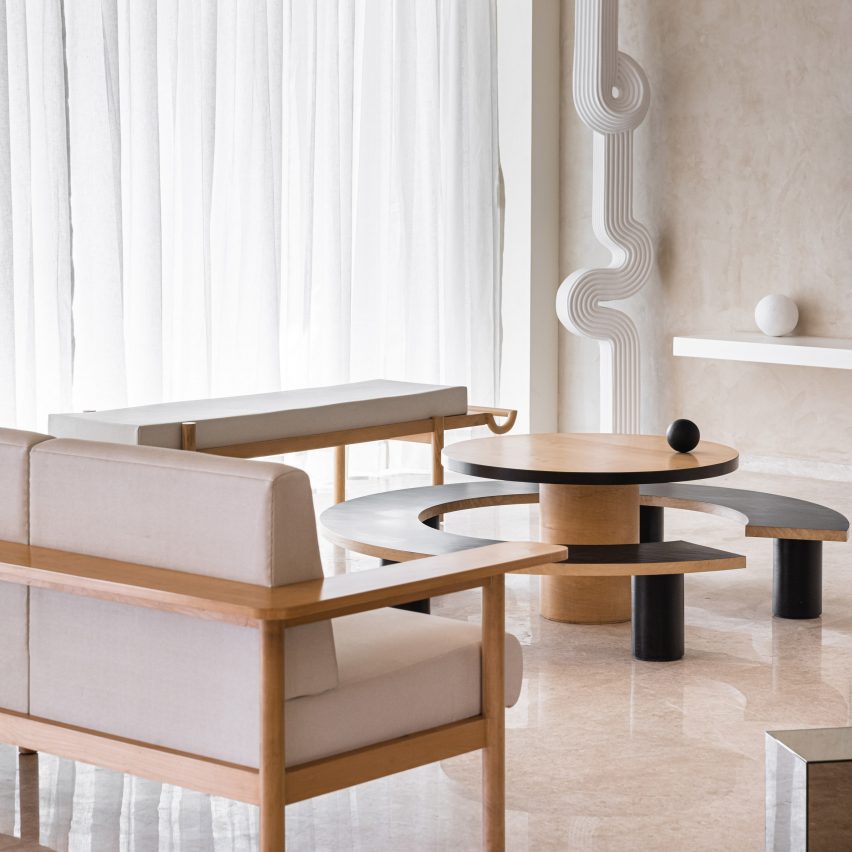
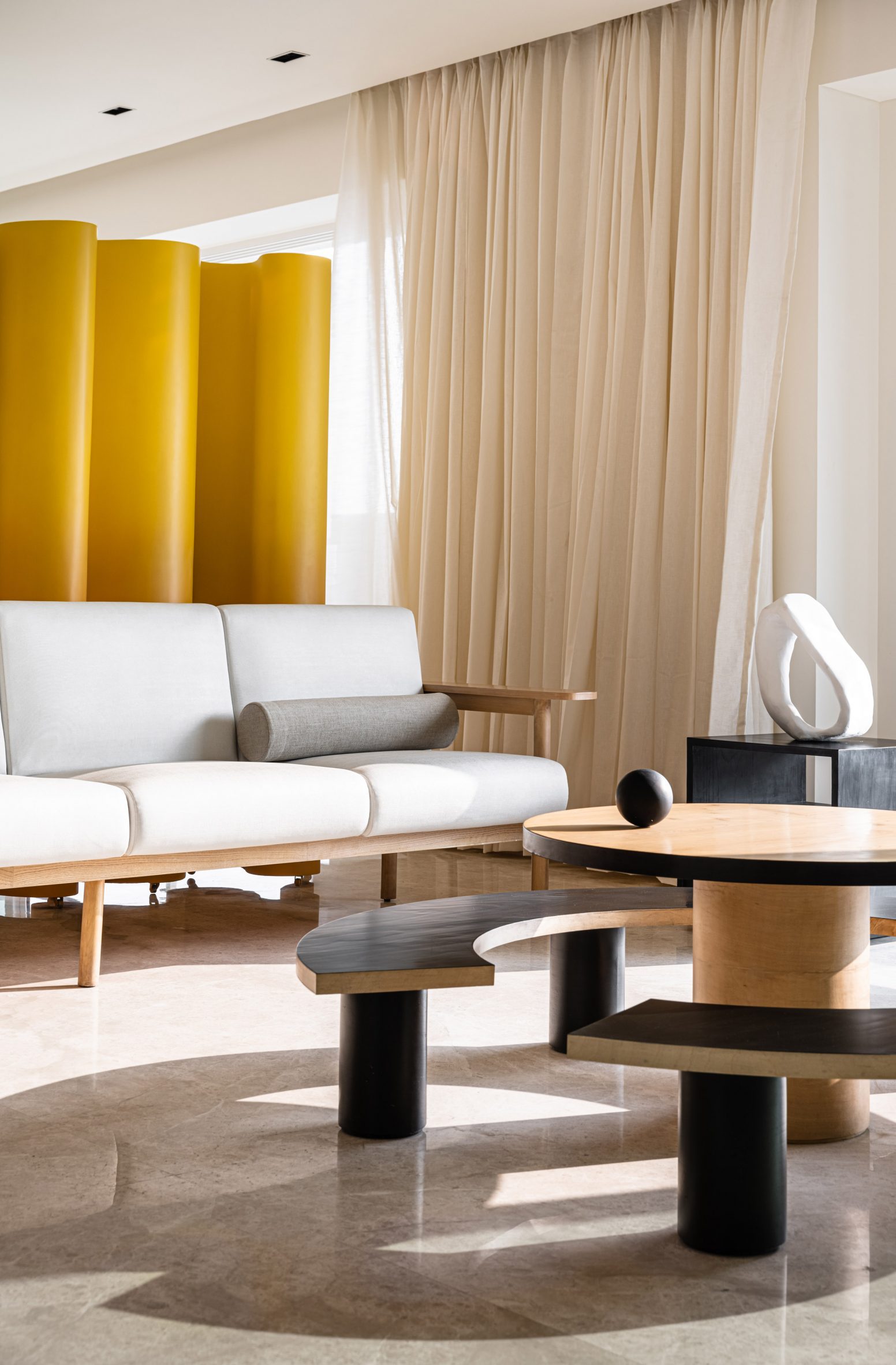
The apartment's neutral palette (above) is punctuated by pops of orange and yellow (top image)
"We tried to soften the severity of the minimalist architecture with smooth outlines and rounded shapes," said Priyanka Itadkar, who co-founded The Act of Quad together with Falguni Bhatia.
"The objective of staging the spheres around the apartment was to generate a storyline from the sphere's perspective as if the orb was tumbling and travelling around the home, discovering every corner and object."
Spherical shapes are integrated into furniture or placed on the floor as sculptures
Geometric, custom-made furniture decorates the open floor plan, punctuating the creamy, neutral interior with bursts of warm orange and yellow.
This game of opposites was designed to consolidate the family's various different tastes into one cohesive whole.
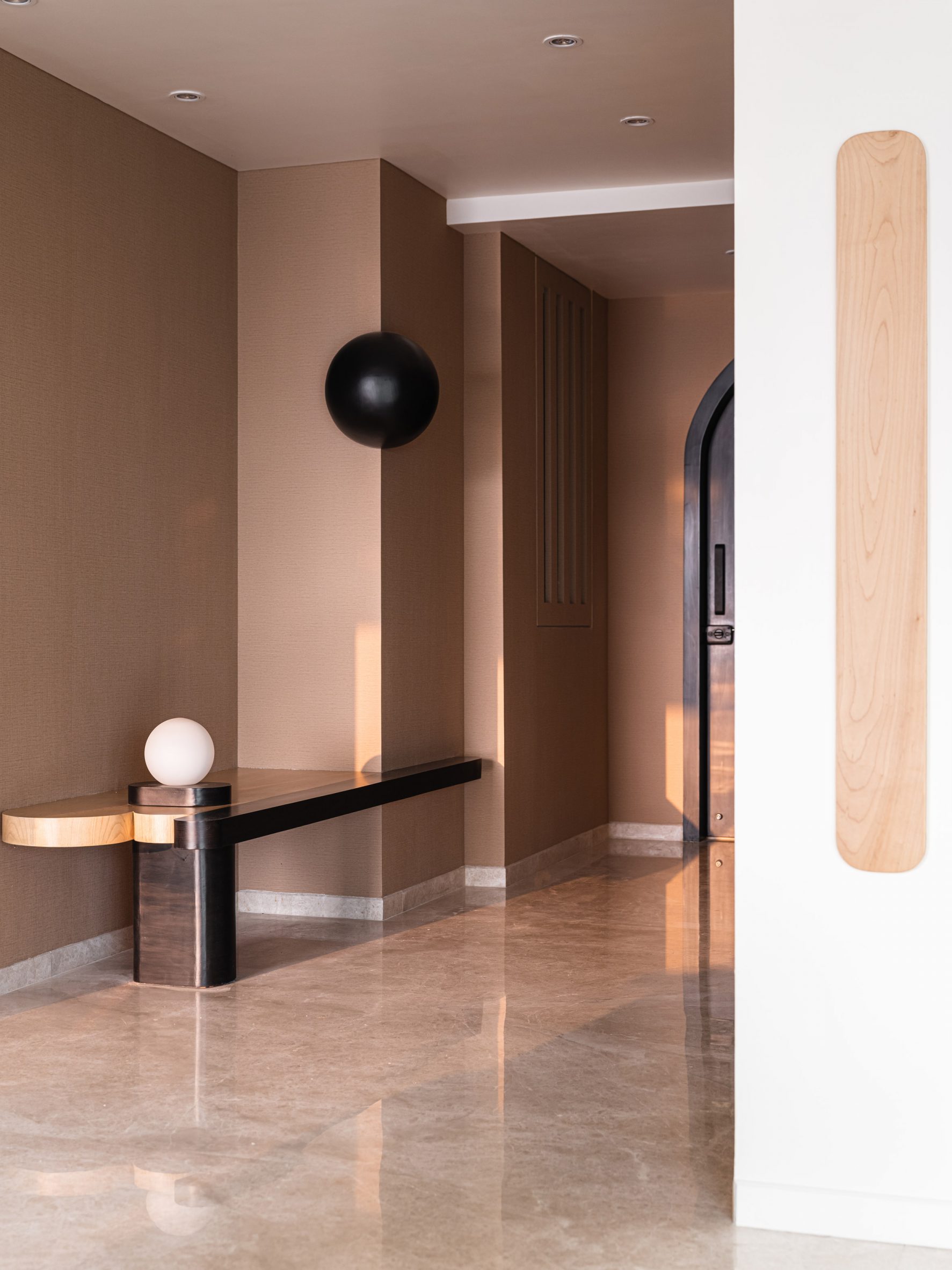
A black orb is mounted to the wall in the foyer
"The grandfather, being a cartoonist, really wanted a playful environment in contrast to the minimal taste of his engineer son," Bhatia told Dezeen.
"The family desired a minimal but playful design, which was the opposite of their current old fashioned and ornamented home, made in the late 1940s."
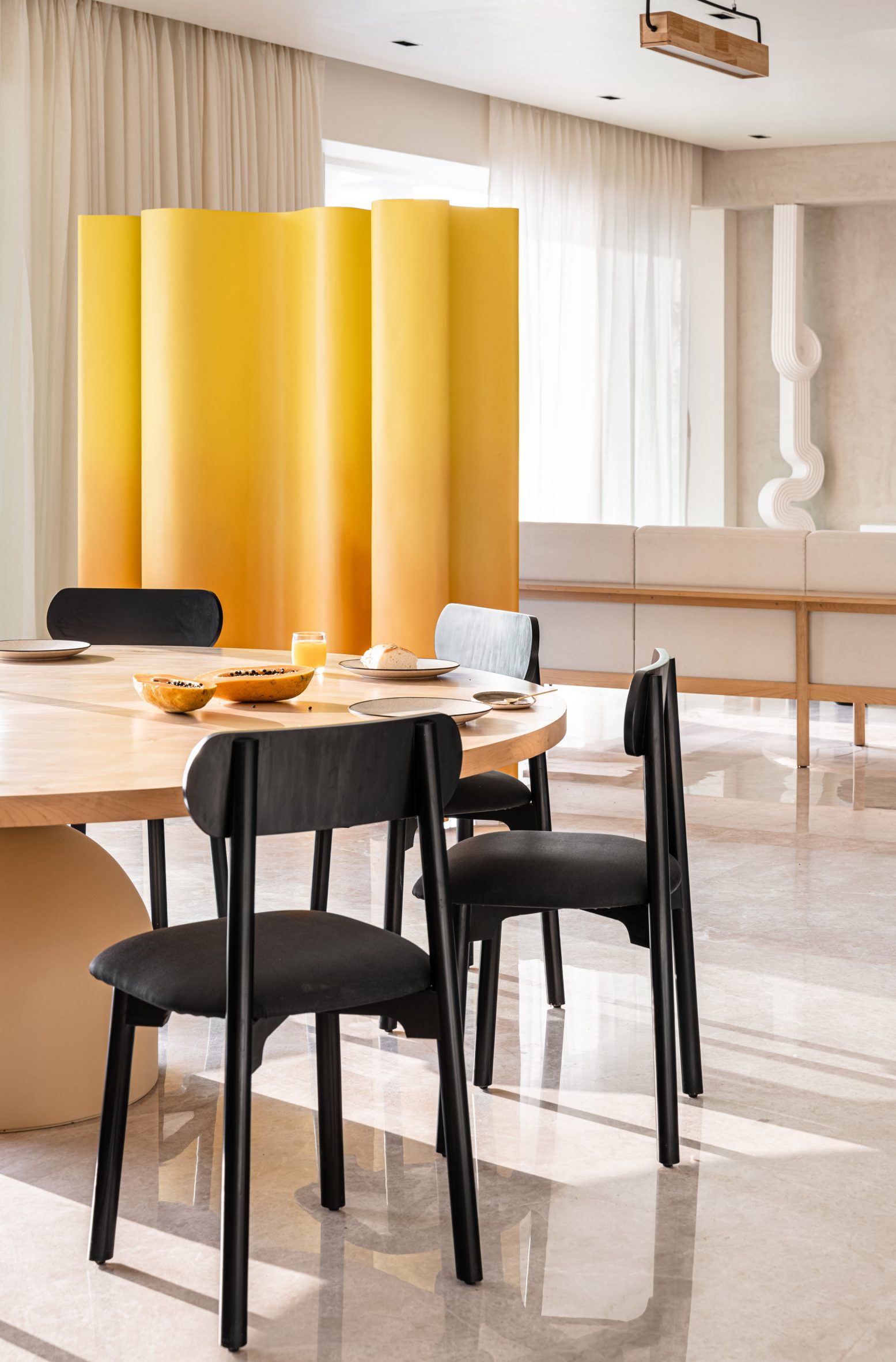
The wooden dining table sits on a hemispherical base
In the entrance hall, a decorative wooden sphere clings to a corner next to the door while underneath, a console table with a contrasting white orb balanced on top wraps itself around the same wall.
The foyer opens up into a large open-plan living and dining room, as well as a kitchen that can be hidden behind sliding partition walls.
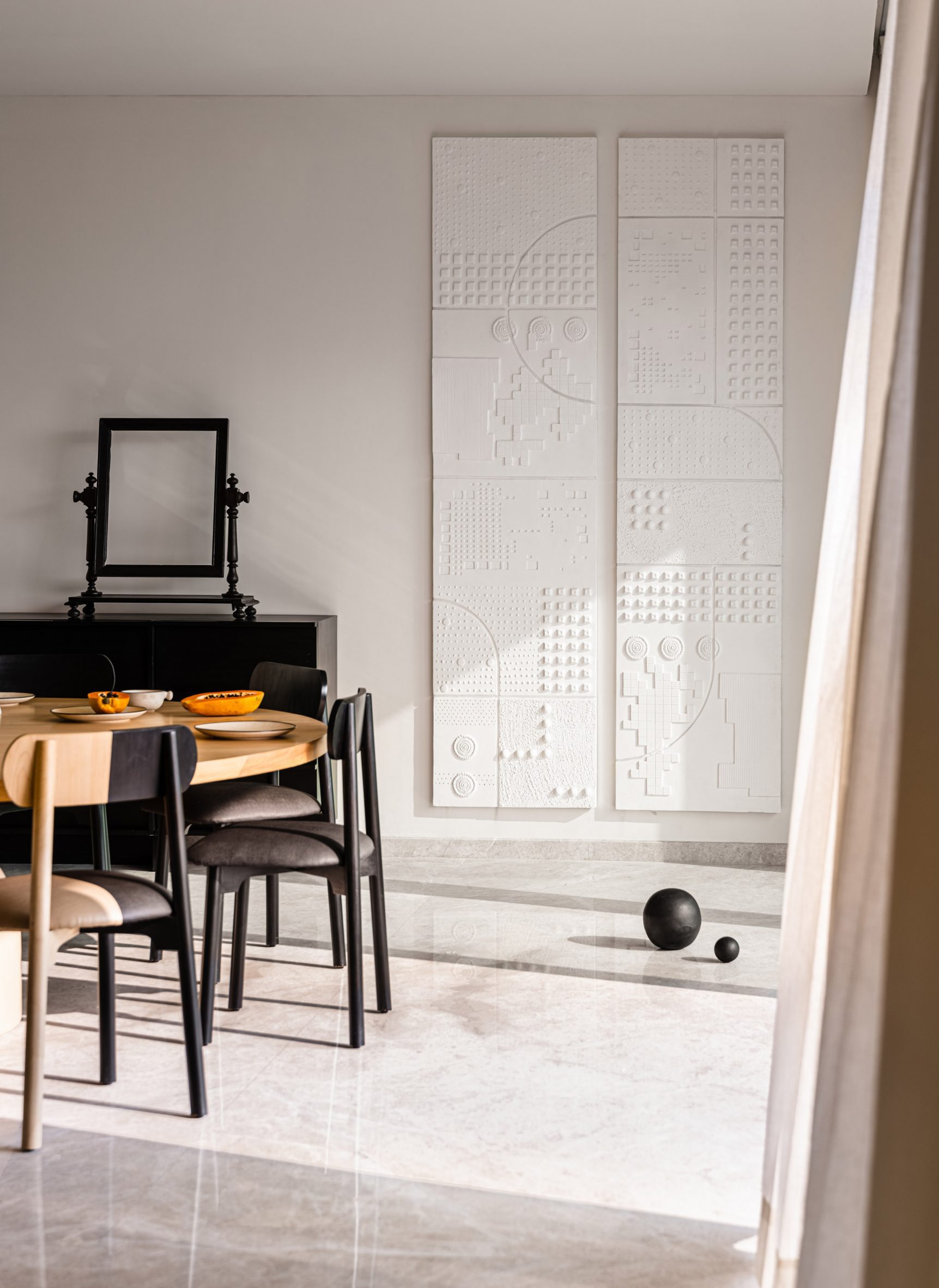
Two gypsum artworks by Vijay Itadkar hang in the dining area
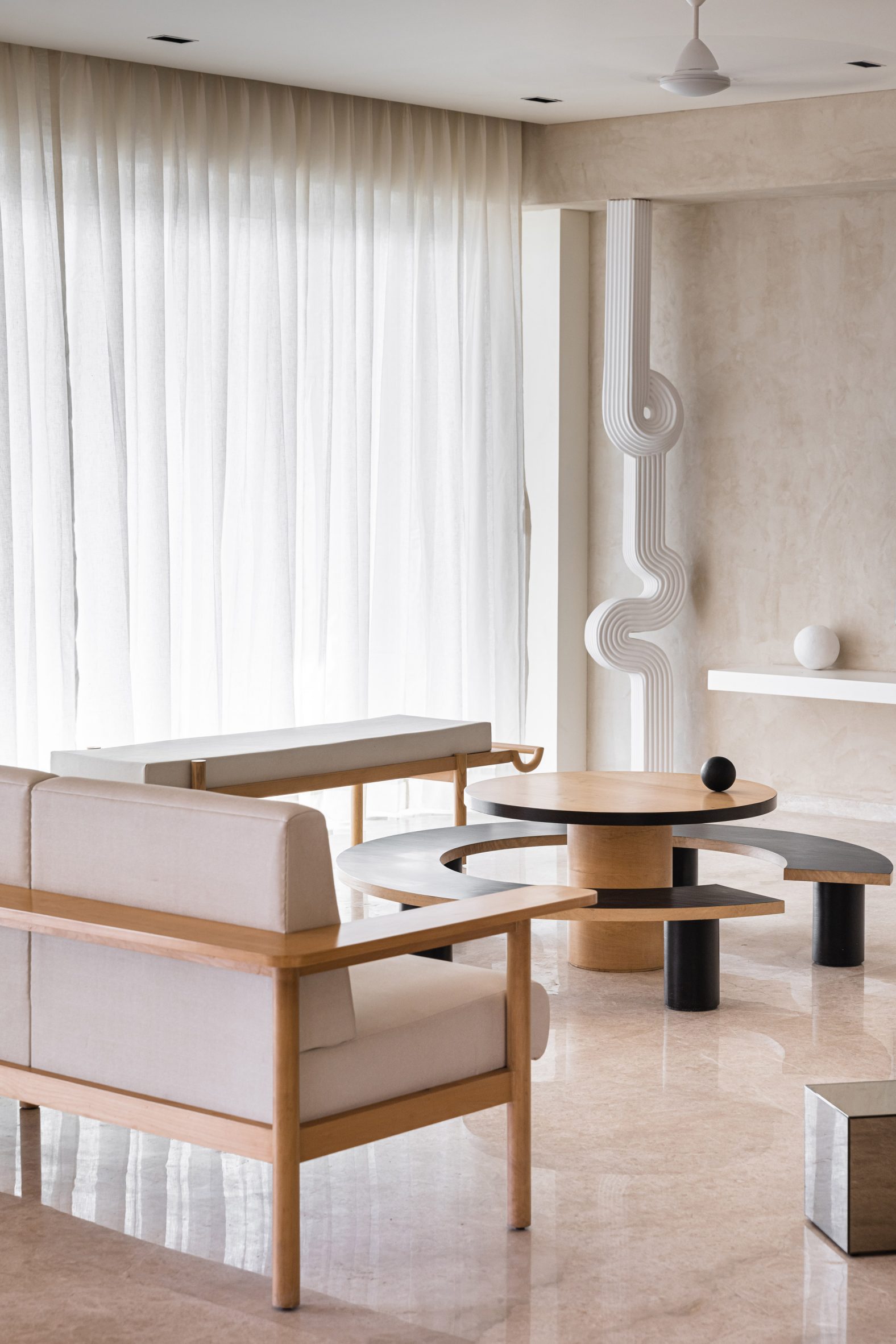
Characterised by its symmetrical set-up, the main room features a round dining table with a hemispherical base on one side and a circular coffee table surrounded by curved benches on the other.
The two areas are divided by a wavy screen in gradient colours that evoke a sunrise.
This same undulating silhouette is picked up in a handmade column, which winds and twists its way from floor to ceiling next to the TV.
From the central communal area, the apartment unfurls in two opposite directions. One wing houses the parents and grandparents, as well as a temple and family room, while the daughter's room occupies the other wing alongside a guest bedroom and study.
A bench encircles the round coffee table in front of the sofa
After itemising all of the family's household items, the studio incorporated plenty of storage into the plan to ensure that everything could be stowed away in its designated place.
The Act of Quad designed and fabricated most of the furniture and artworks in situ, in order to integrate them seamlessly into the architecture.
"We have derived the art from the space to make it feel like it's a part of the space," Bhatia explained.
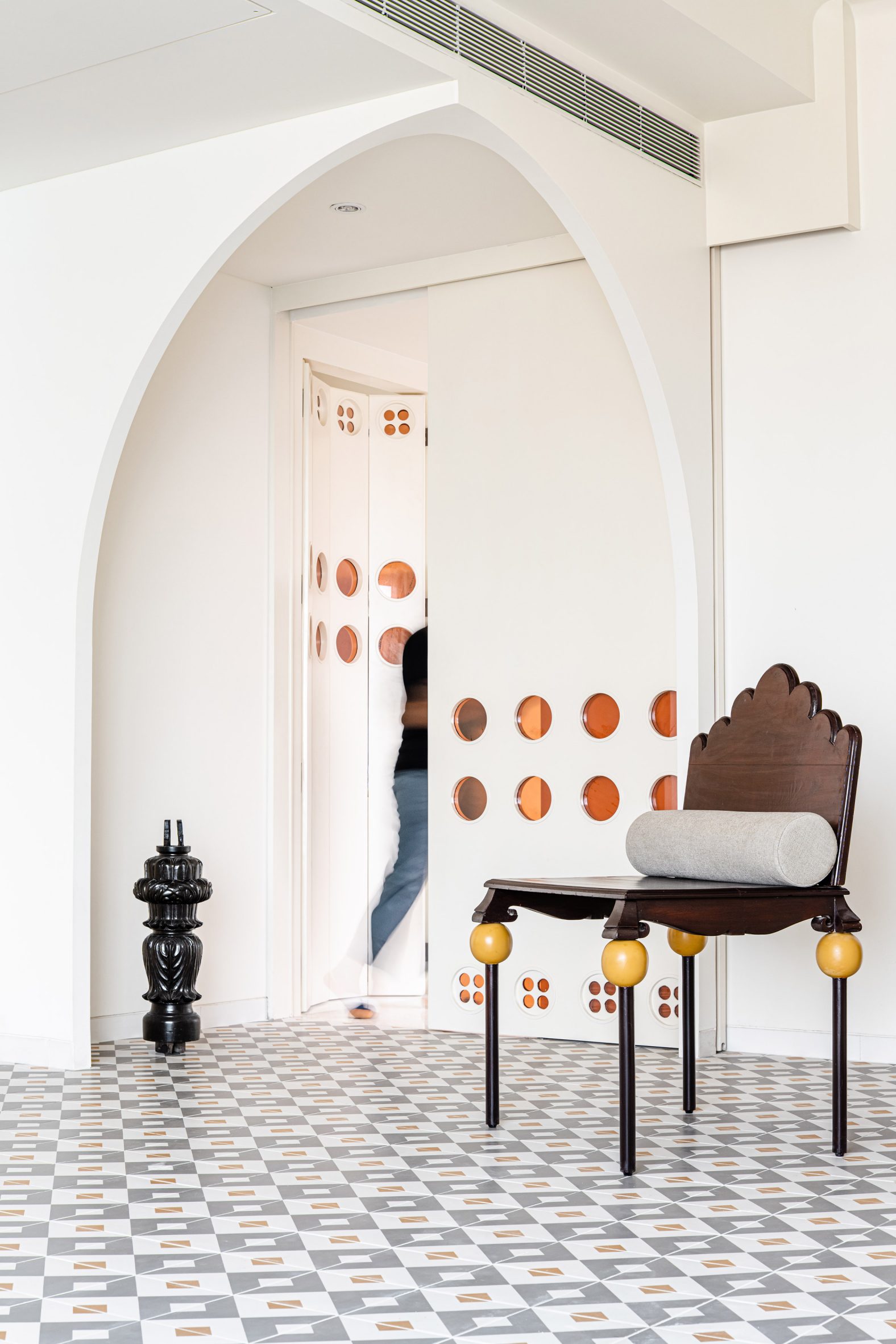
The entrance to the temple is tiled in a colourful mosaic
In addition, a number of intricate woodwork pieces were brought over from the family's old home and refurbished to create a sense of continuity.
Among them is a chair with turned legs and spindles that is housed in the apartment's own temple, known as a mandir.
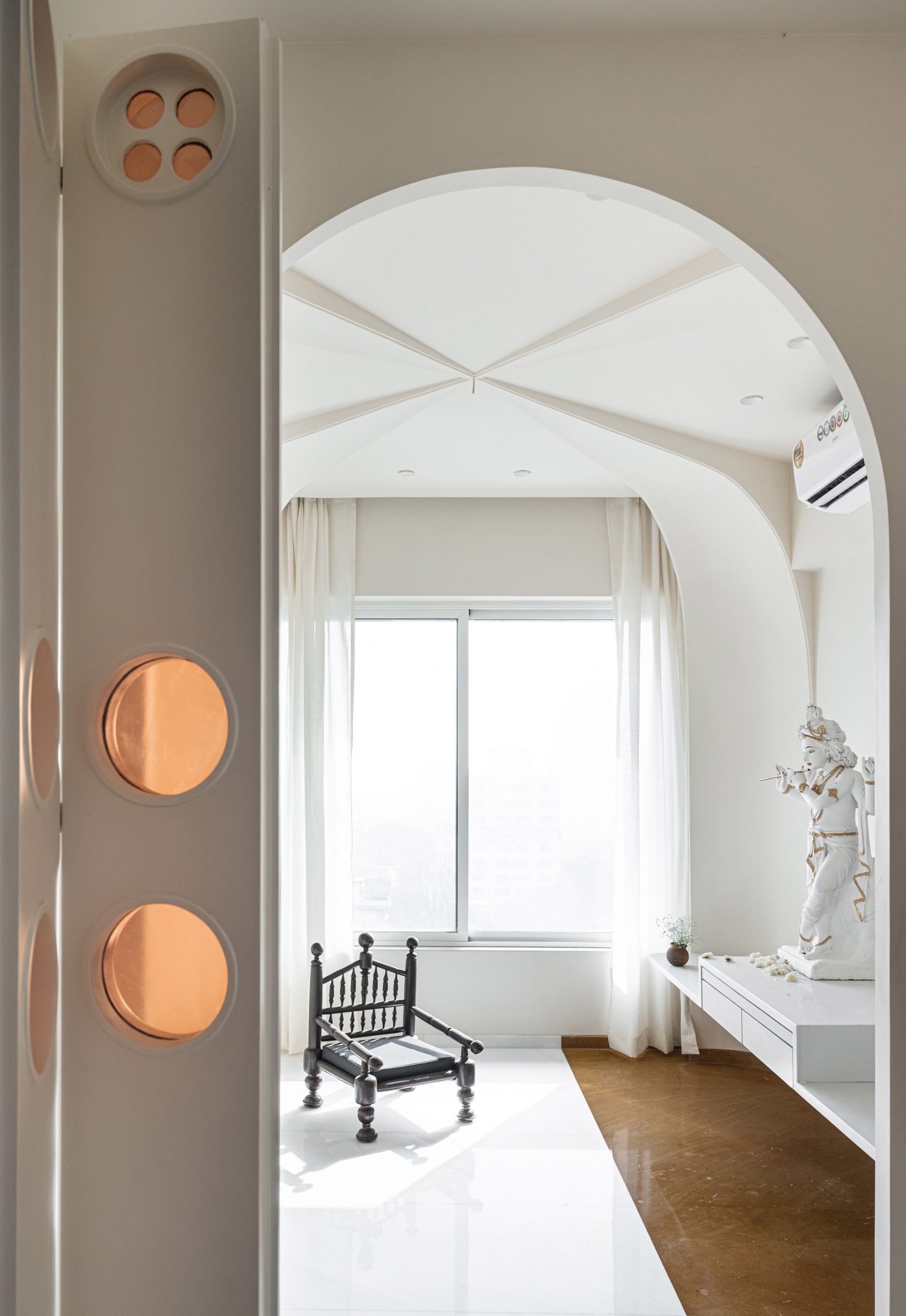
Intersecting white arches help to create a feeling of grandeur in the mandir
Here, a small antechamber leads to the inner shrine, which is crisscrossed by intersecting white arches and houses a statue of Hindu deity Krishna.
Other Indian architects who have brought places for worship into the home include Saket Sethi, who has created a home with an egg-shaped garden temple on the outskirts of Mumbai.