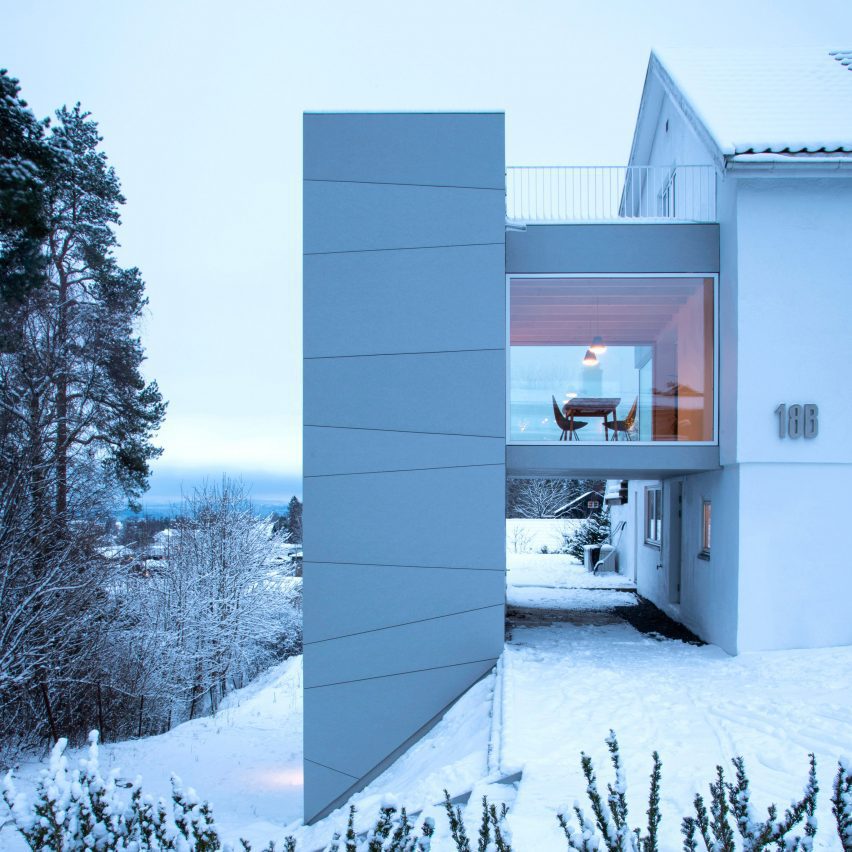
Architecture office Resell+Nicca has added an extension to a semi-detached house in Oslo comprising a tower linked to existing living spaces by a glazed bridge.
Resell+Nicca was approached in 2019 by a couple who had just given birth to their third child and wanted to extend their half of a semi-detached house.
Resell+Nicca has added a tower-like extension to a house in Oslo
The property's site on top of a slope offered good views to the south but presented significant challenges for the construction of the new addition.
Local planning regulations stated that the extension needed to increase the overall amount of usable outdoor space on the plot in order to receive a building permit. This was difficult to achieve while increasing the internal area and negotiating the awkward topography.
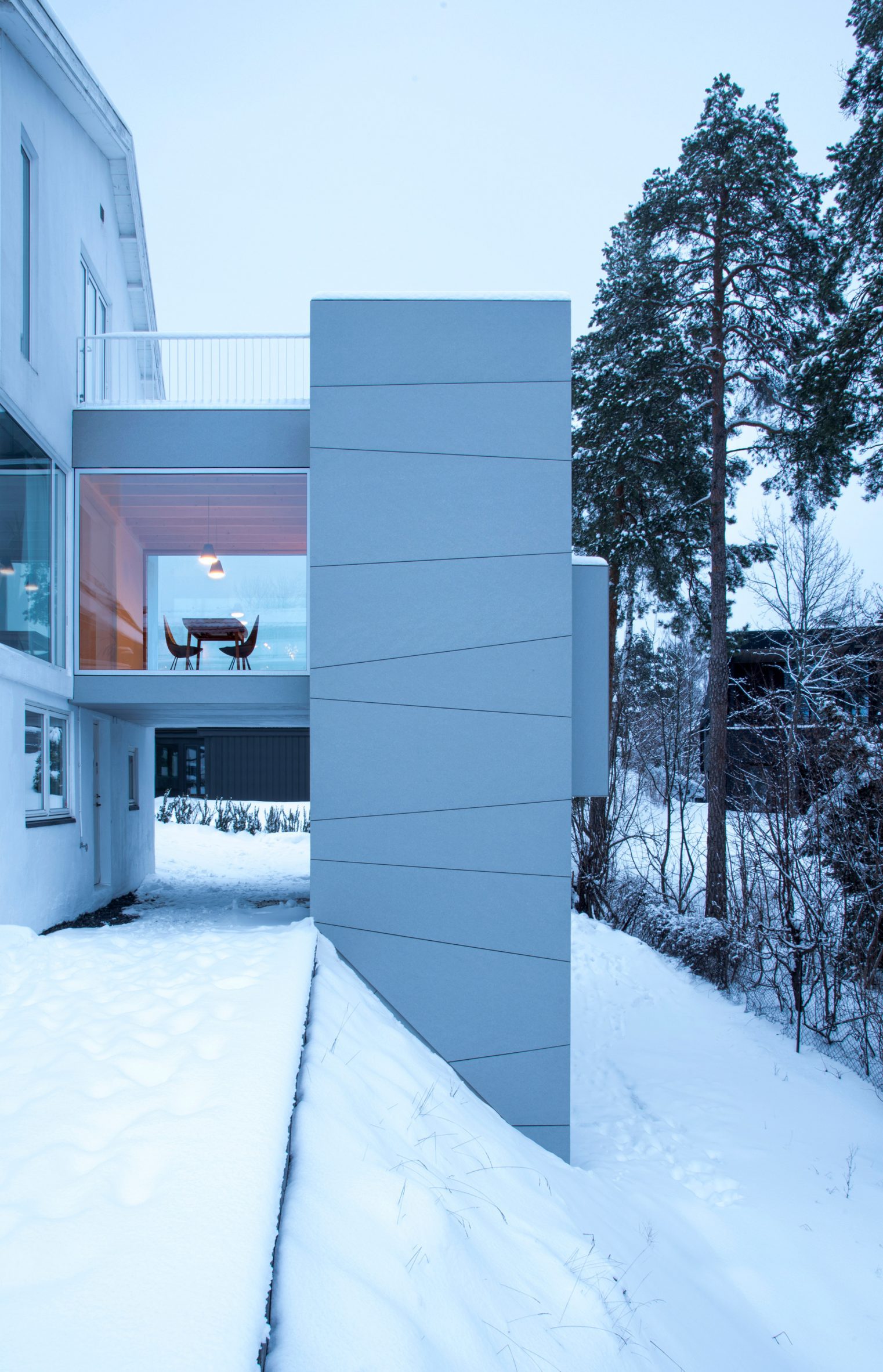
The tower is clad in fibre-cement panels
The architects proposed a tower-like structure positioned on part of the slope that was considered too steep to be included in the existing outdoor space. A roof terrace incorporated on top of the tower provides the necessary additional external living area.
"We wanted the extent of the narrow slope to visually define the width of the extension," said architects Olav Resell and Nicca Gade Christensen, "and we wanted the structure to have a distinct vertical appearance – meaning we had to enhance the perception of 'high and narrow' – without compromising on functional aspects."
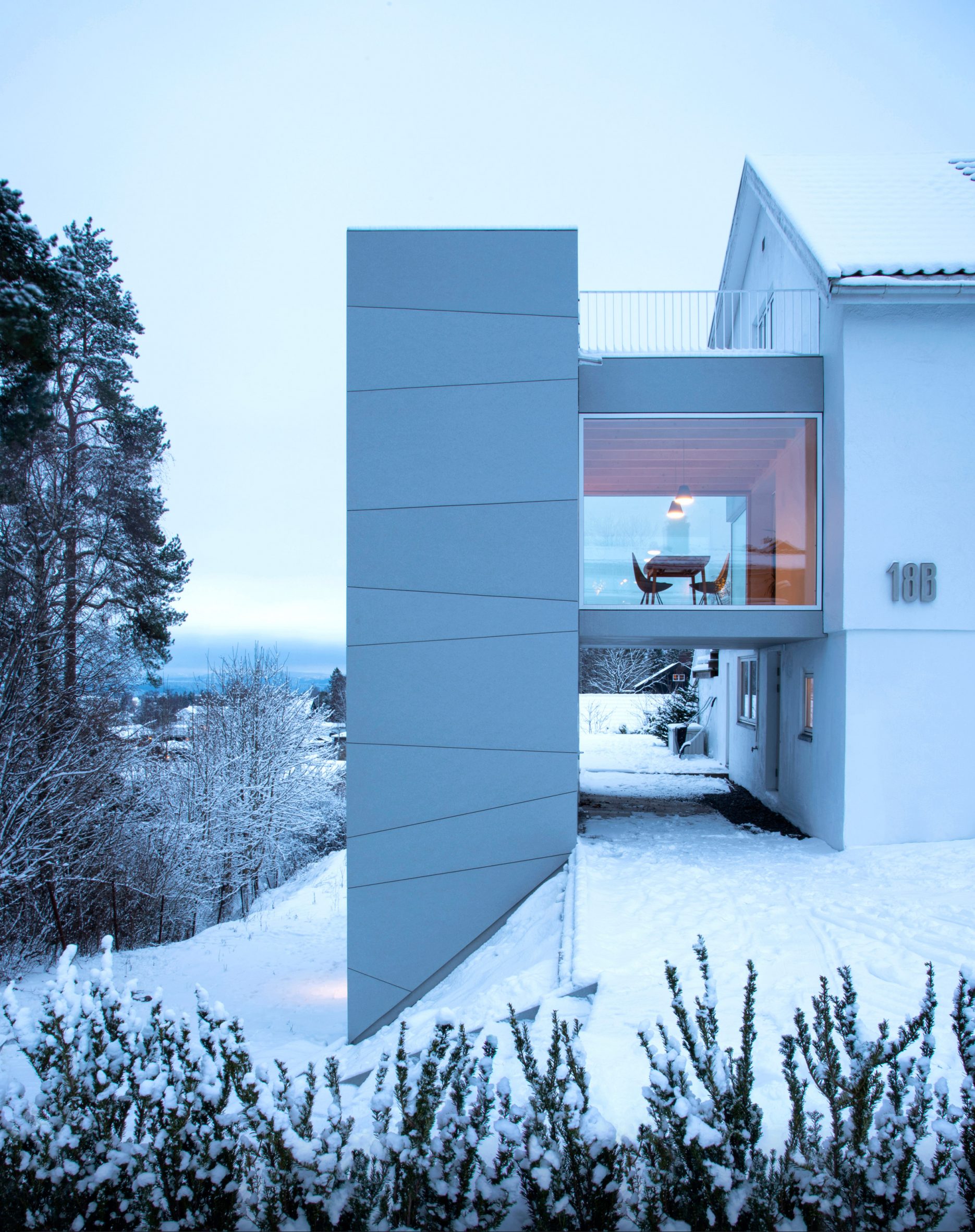
The extension straddles a carport next to the existing house
The new structure extends from the existing building's southeast facade and straddles an open space used to fulfill the clients' request for a carport.
An entrance at the existing grade level provides access to a staircase connecting new living spaces above with a studio apartment on the lower floor.
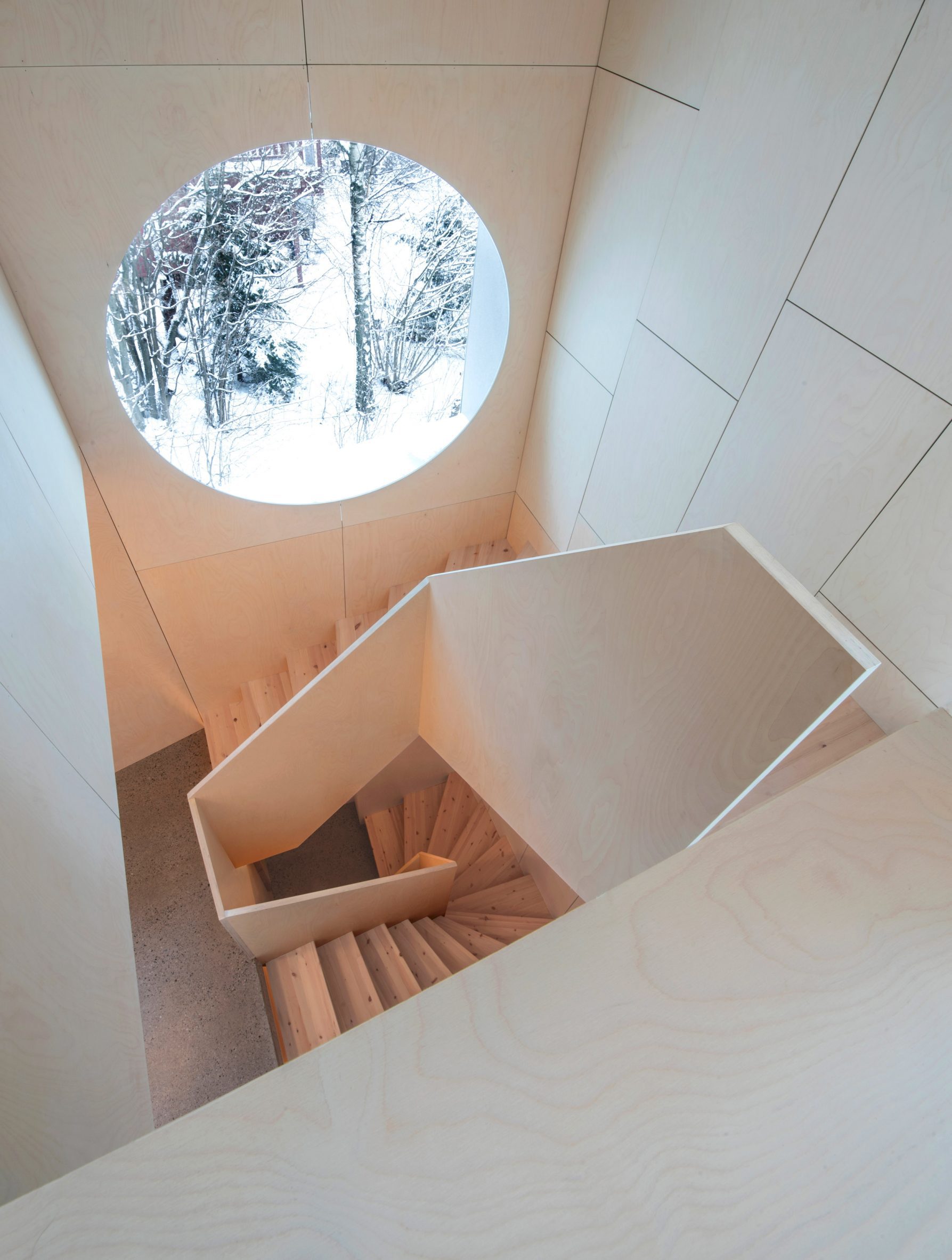
Wood lines the interior surfaces of the tower's staircase
The studio apartment extends beneath the carport and connects with the lower level of the garden, which was previously deemed to be inaccessible.
The tower narrows at both ends but splays outwards on its southeast elevation to maximise the internal floor area and capture views of the nearby pine trees.
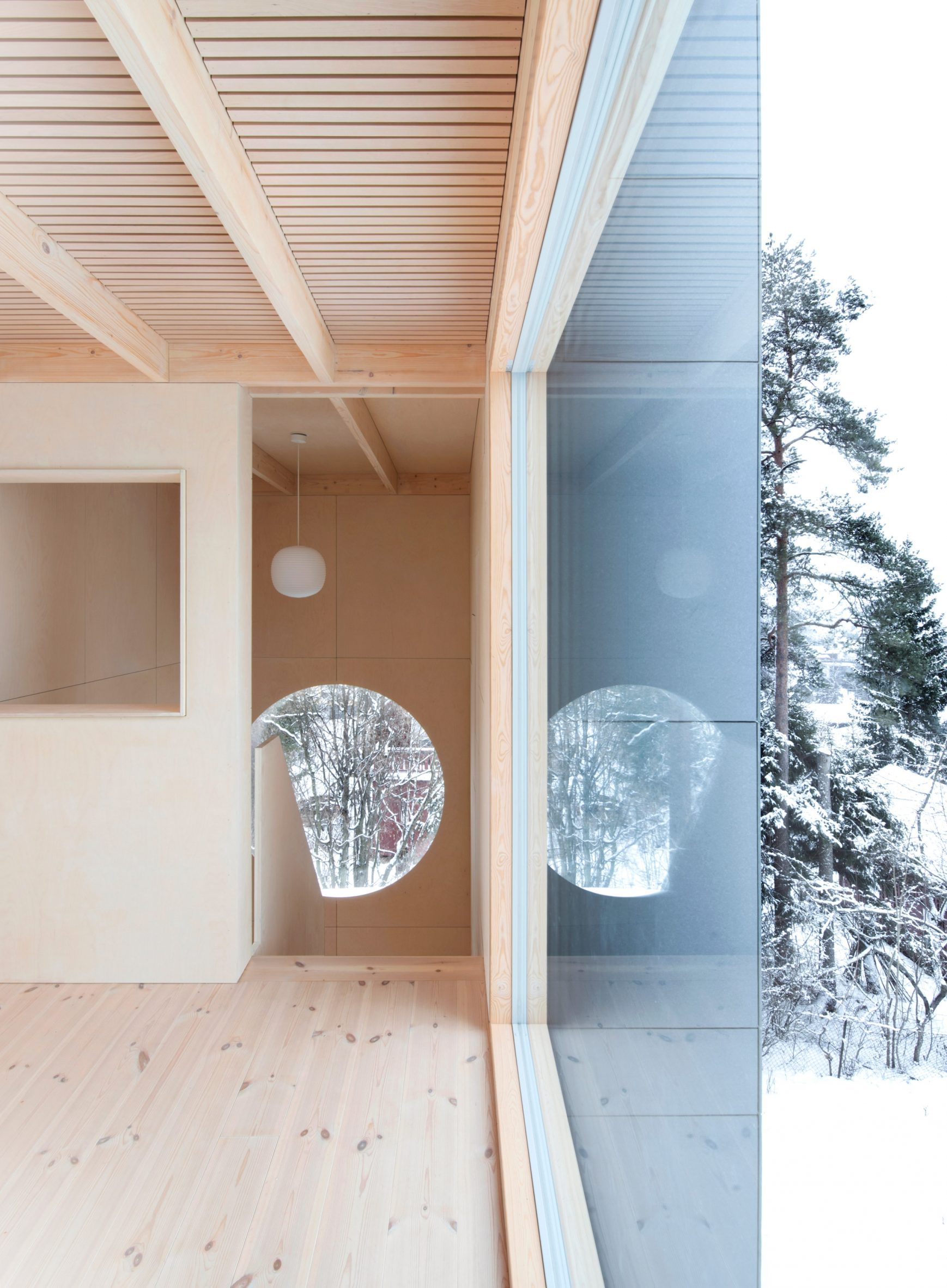
Large windows on both sides of the dining room bring in plenty of light
The structure's verticality is enhanced by extending the external cladding so it rises above the adjoining bridge. The cladding forms a balustrade around the rooftop terrace, while a slender railing on the connecting section emphasises the sense of separation from the main building.
The bridge element contains a new dining room, connected to the living room and kitchen in the existing house. Full-height glazing on either side of the dining area provides views of the surroundings and of the distant Oslo Fjord.
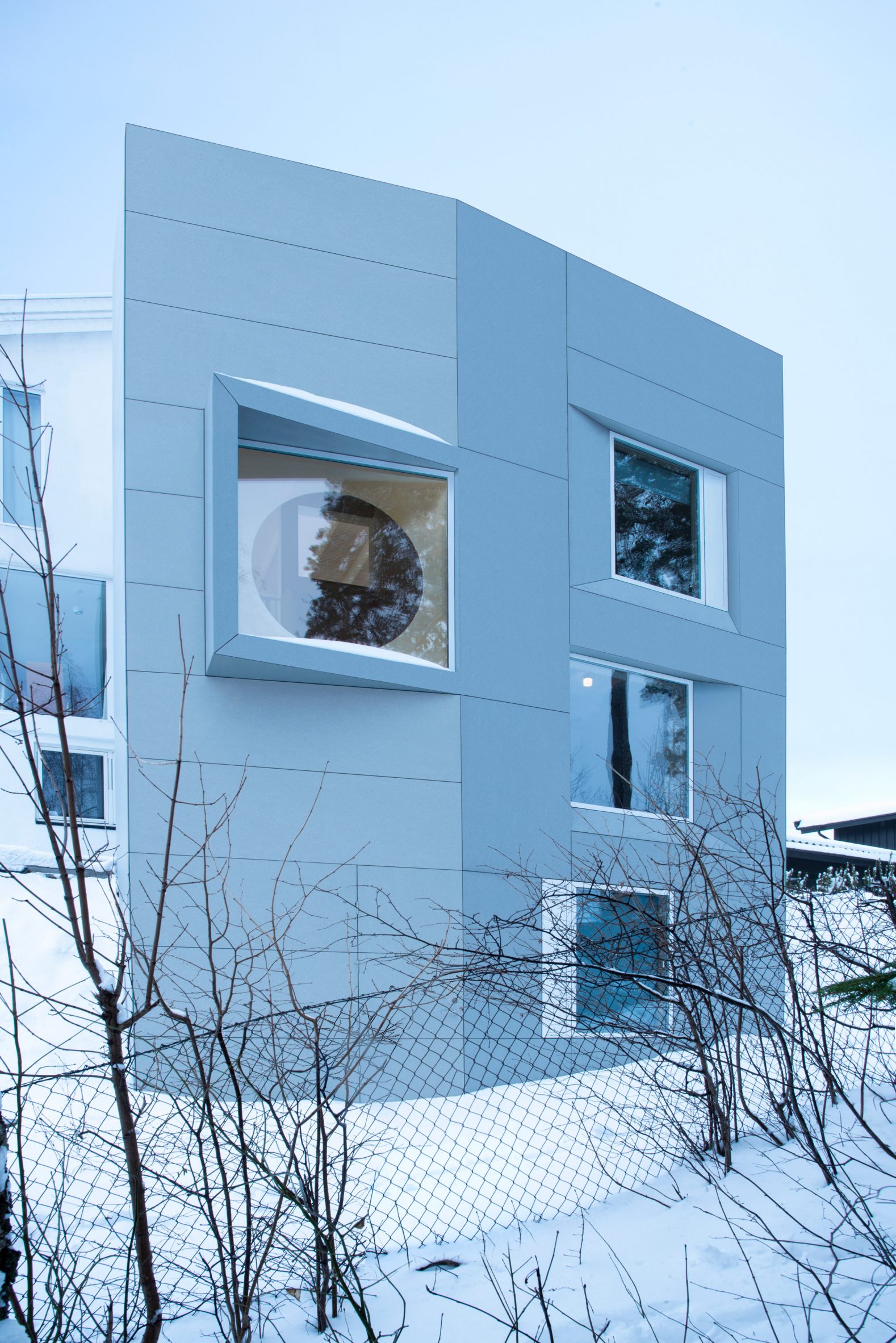
A circular window overlooks a pine forest
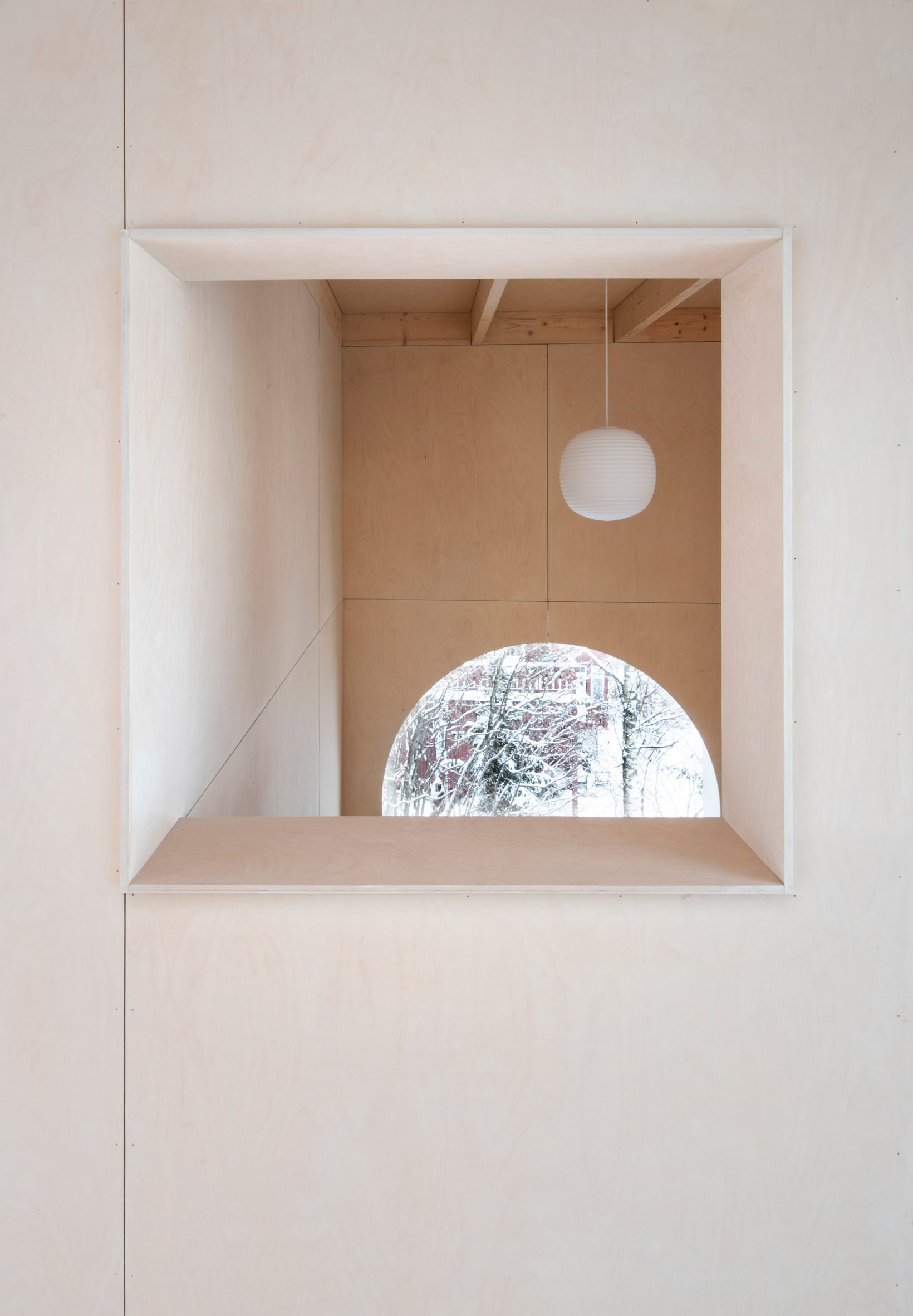
The living spaces extend through the bridge and into the tower, where a guest room and home office are accommodated above the new entrance.
The tower is clad in fibre-cement panels that were chosen because they could be cut precisely and applied to create a matt-finished surface that complements the existing house's slightly rougher mortar walls.
"We wanted a facade material that was able to enhance both the shape of the tower and the details around the windows on the east facade," the architects added.
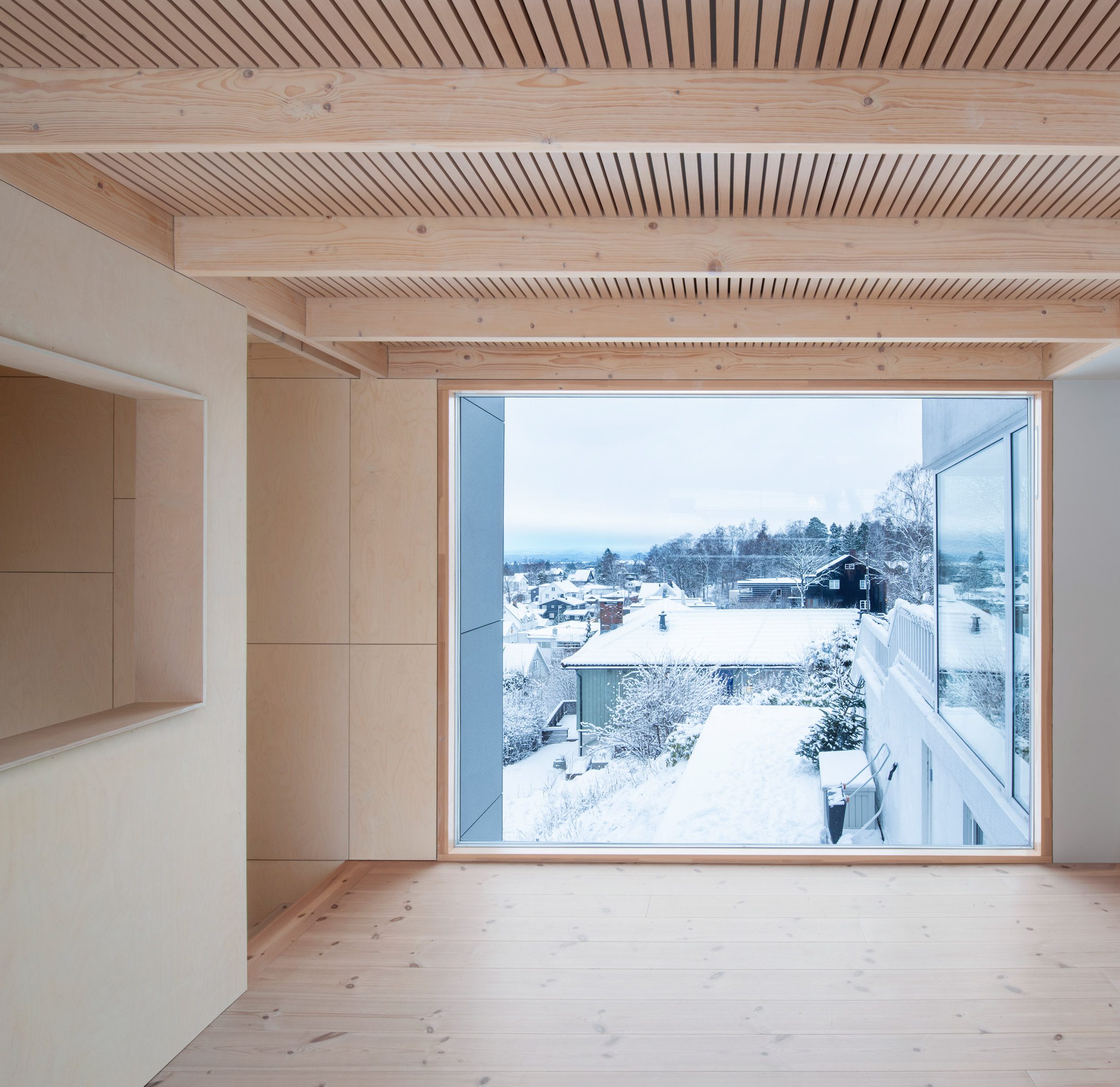
In contrast to the crisp and muted exterior, the interior of the extension features plenty of wood that brings warmth and texture to the living spaces.
Walls and balustrades are built using birch plywood panels
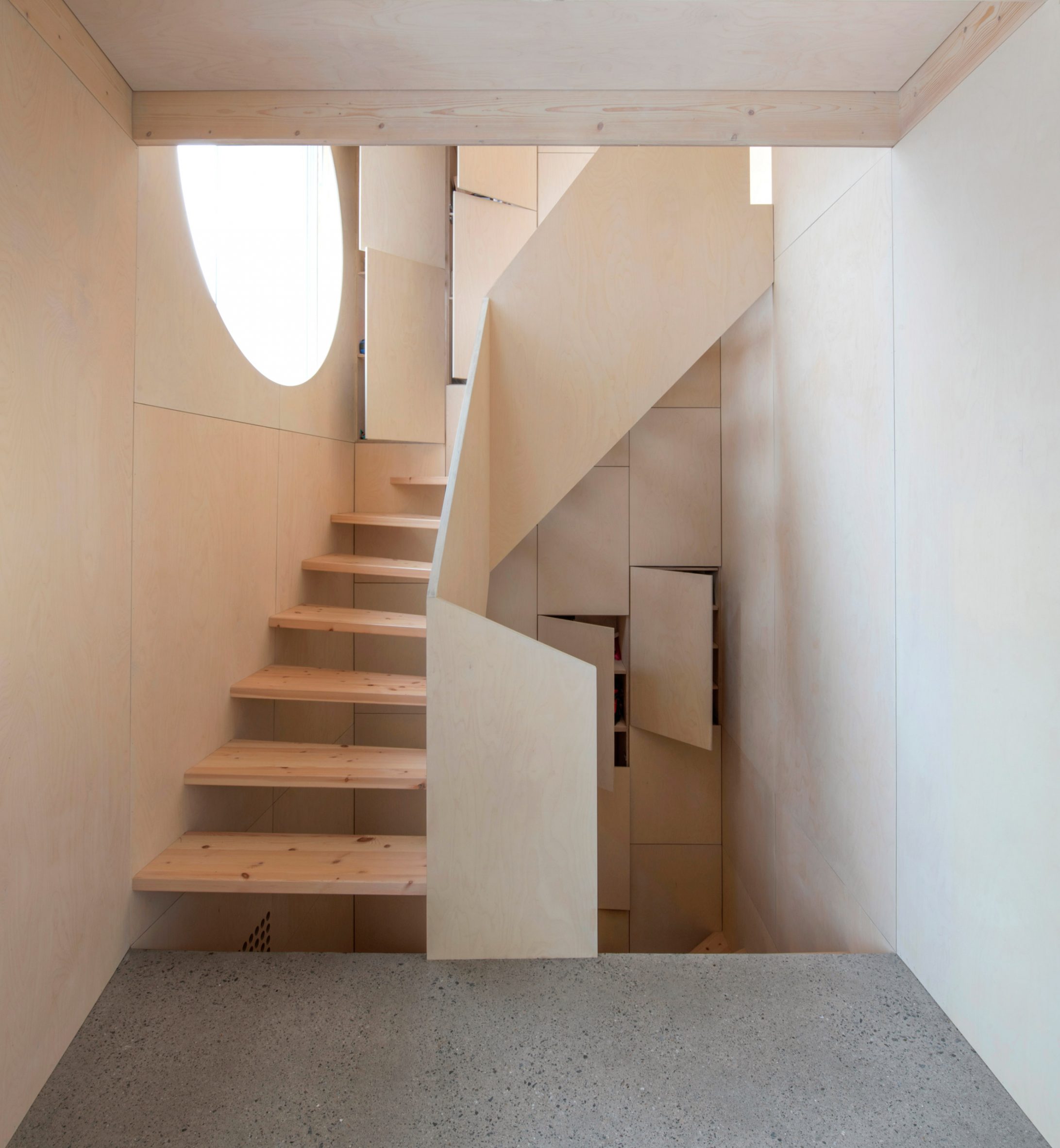
Structural elements made from spruce combine with walls and balustrades built using birch plywood panels. The ceilings are clad in aspen and the doors, floors and windows are made from pine.
The entrance area features a large picture window with a frame that extends at its base to form a bench.
Structural interior elements are made from spruce
The stairs leading to the upper and lower floors are lined with storage, and a circular window on the way to the first floor looks onto the pine forest.
Resell+Nicca is an Oslo-based architecture studio founded in 2015, formerly known as Resell Arkitektur. In 2016, it collaborated with Pir II on the design of the Cabin Ryfylke cabin in Norway, which features a patterned facade composed of slate shingles.
Clusters of buildings enclosed by a tall, white wall form an educational campus for children with disabilities that was designed by Chilean studio Sebastián Irarrázaval Arquitectos.
The Juan Luis Undurraga Integral Stimulation Center is located in Talagante, a town on the outskirts of Santiago.
The Juan Luis Undurraga Integral Stimulation Center is located on the outskirts of Santiago
The school was designed for the care and education of children with a range of disabilities, including autism, Down syndrome and extreme epilepsy. It was commissioned by the Isabel Aninat Echazarreta Foundation, a charity started in 1986.
"Through its initiatives, this institution seeks to contribute to generating positive changes that translate into a better quality of life for the community," said Sebastián Irarrázaval, who leads an eponymous studio in Santiago.
The school is formed from a cluster of buildings, informed by walled citadels
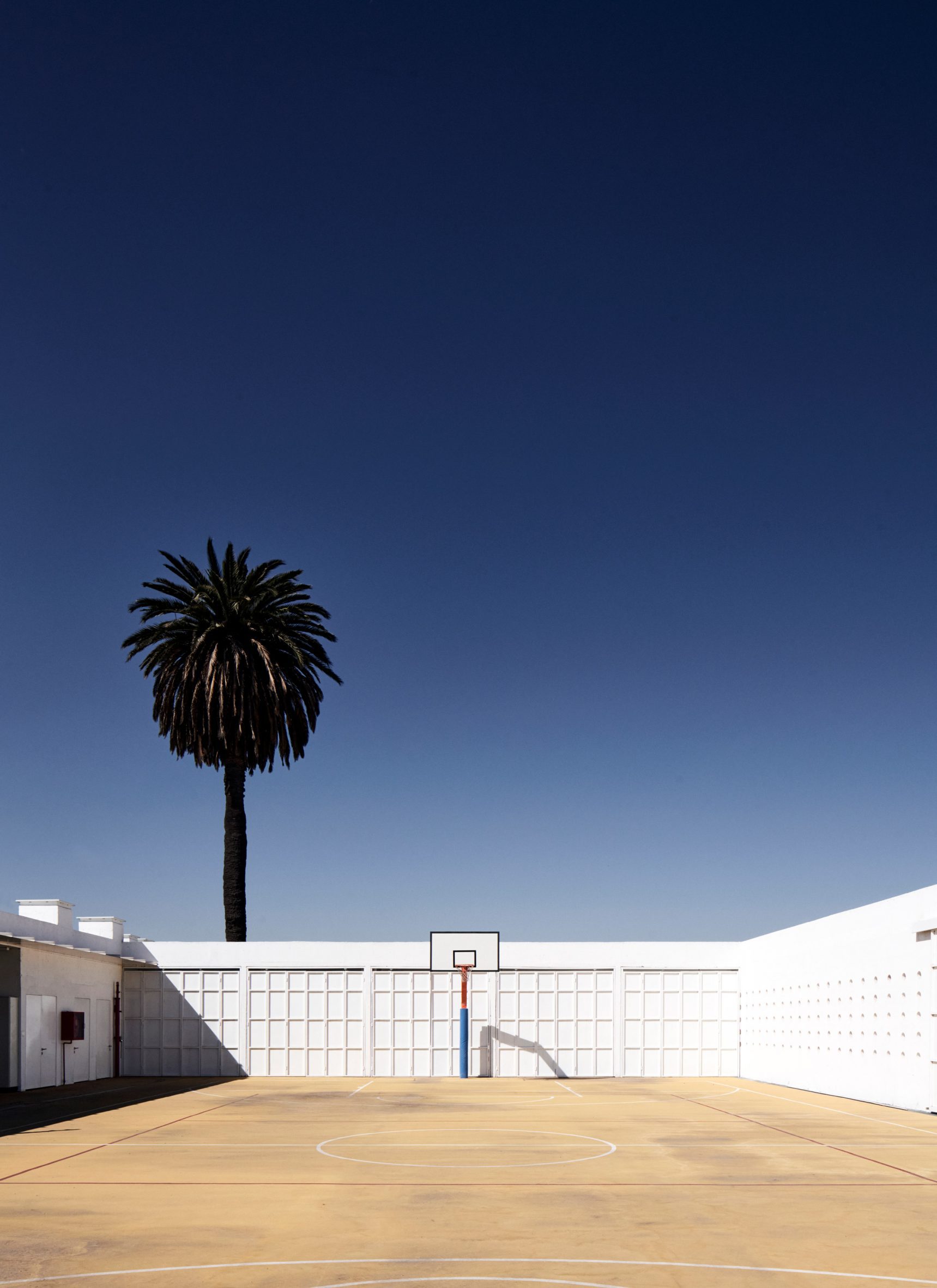
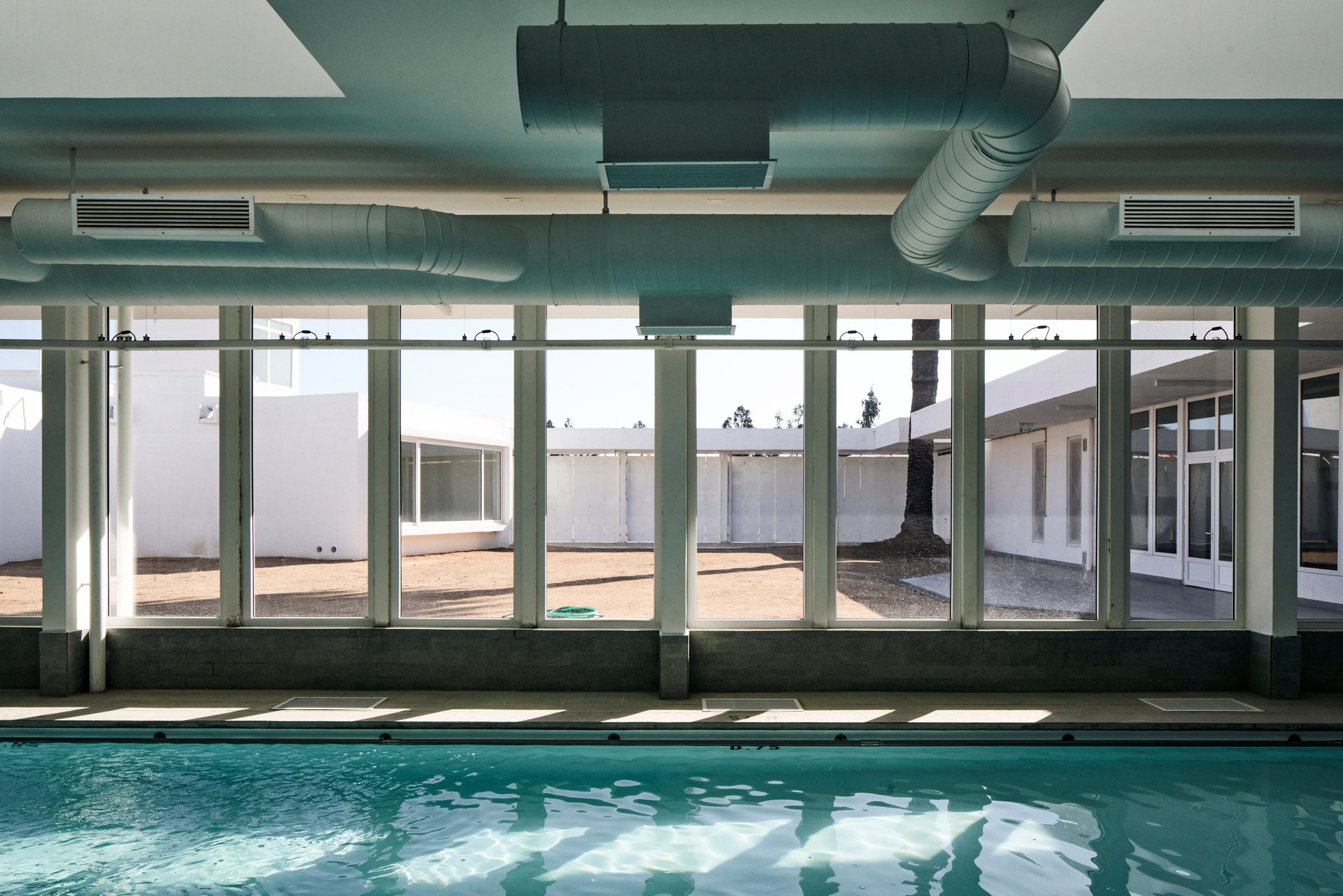
The architect was charged with designing a series of facilities – classrooms, laboratories, a gymnasium, a chapel and a heated swimming pool – for a large, L-shaped site.
While conceiving the campus layout, Irarrázaval drew inspiration from engravings by Eduardo Chillida, the 20th-century Basque artist whose abstract work explored spatial relationships.
Overall, Irarrázaval sought to achieve variation in the campus through three elements: a balance between repetition and difference, an alternation of full and empty spaces, and the treatment of light.
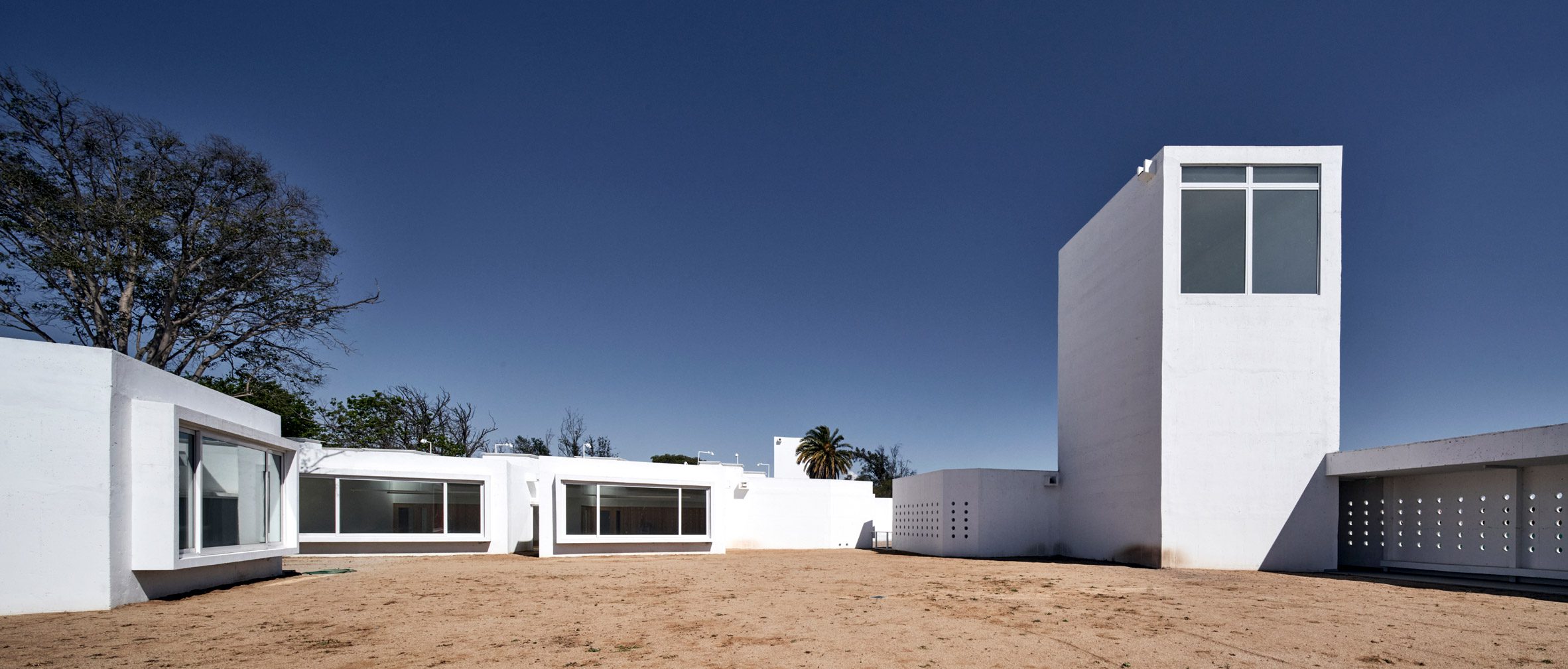
The 3,100-square-metre complex consists of clusters of buildings and patches of open space. To provide a safe and secure environment, the campus is encircled by a tall, white wall.
A variety of facilities for eduction and activity are found across the L-shaped site
"We proposed to accommodate the varied and dissimilar programs in the manner of a walled citadel that would provide children with a protected environment," the architect said.
The complex is laid out in a nonlinear format, resulting in different types of movement. Some of the circulation routes have a labyrinthine quality, while others are more hierarchical and orderly, the architect said.
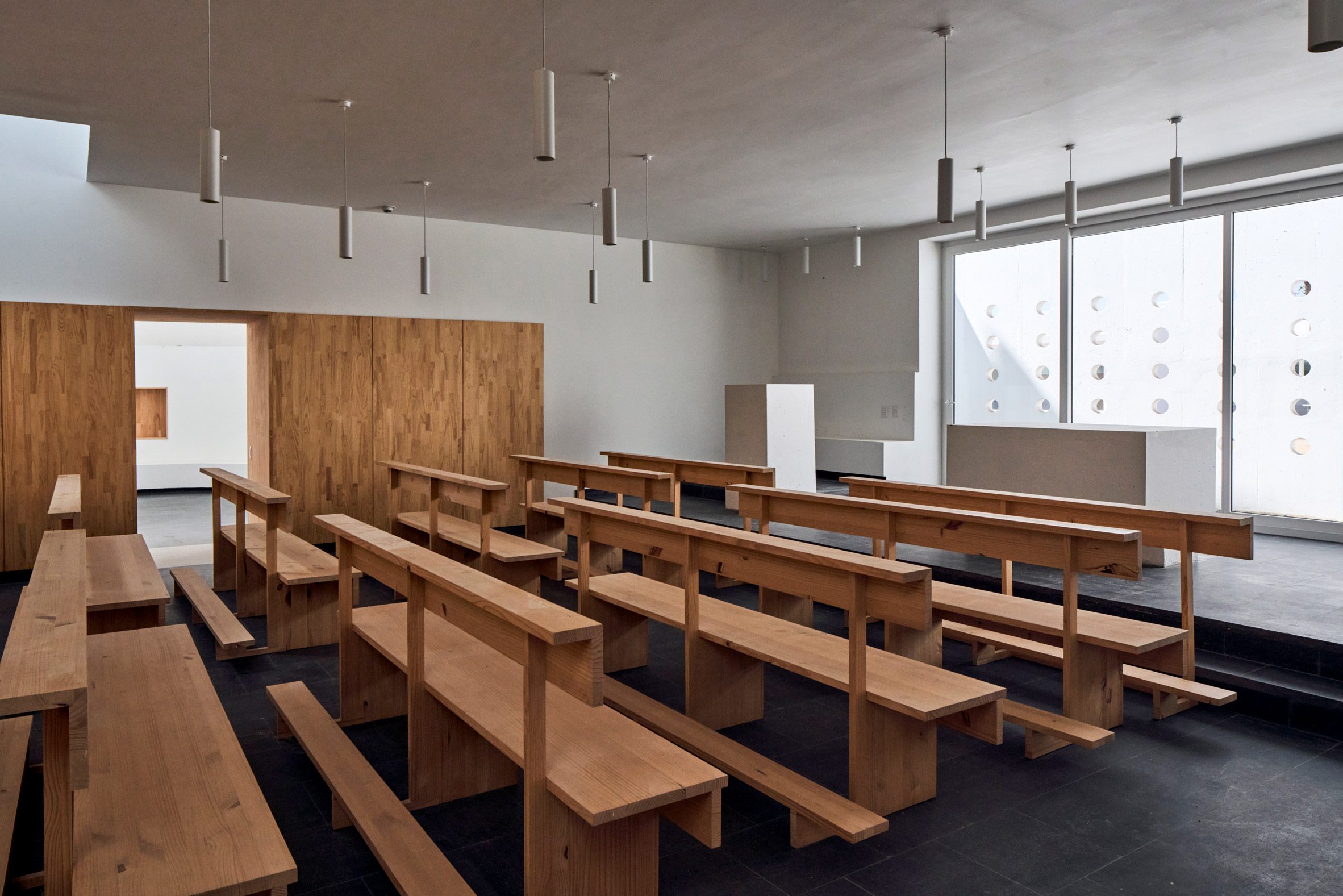
A chapel is also included in the spatial programme
Made of white-painted concrete, the building clusters house different student groups. The buildings designated for children with extreme physical and cognitive challenges are placed closest to the pool.
Inside, rooms feature simple finishes such as white walls, wooden cabinetry and green-tinted concrete flooring. Skylights in rooms and corridors bring in daylight and help create rhythmic interplays of light and shadow.
Children attending the school have access to a heated swimming pool
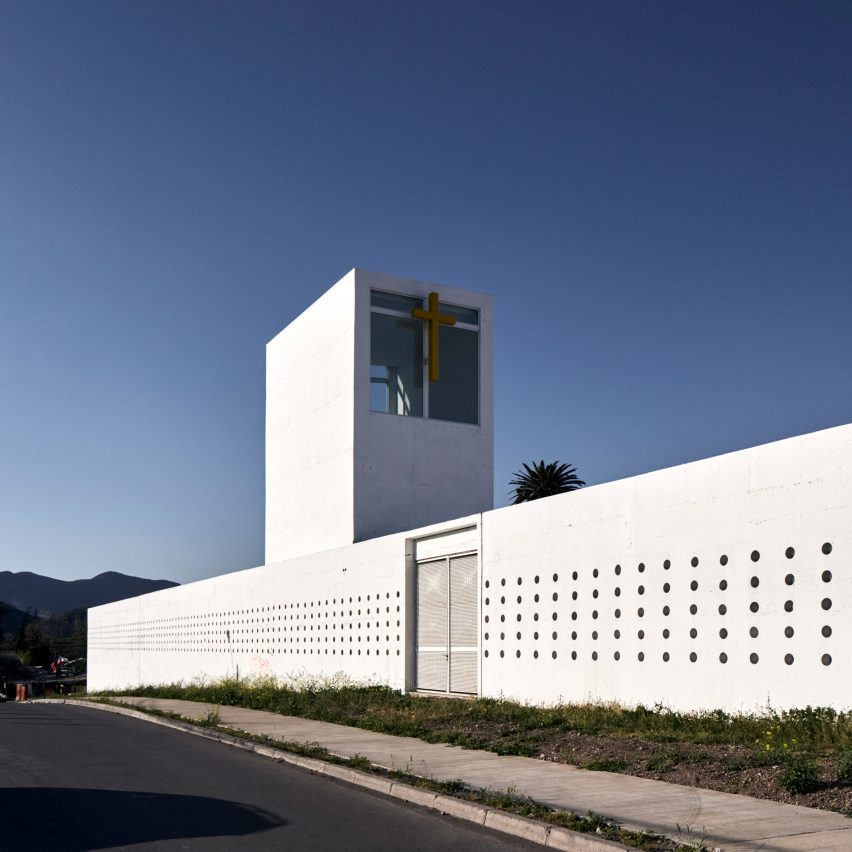
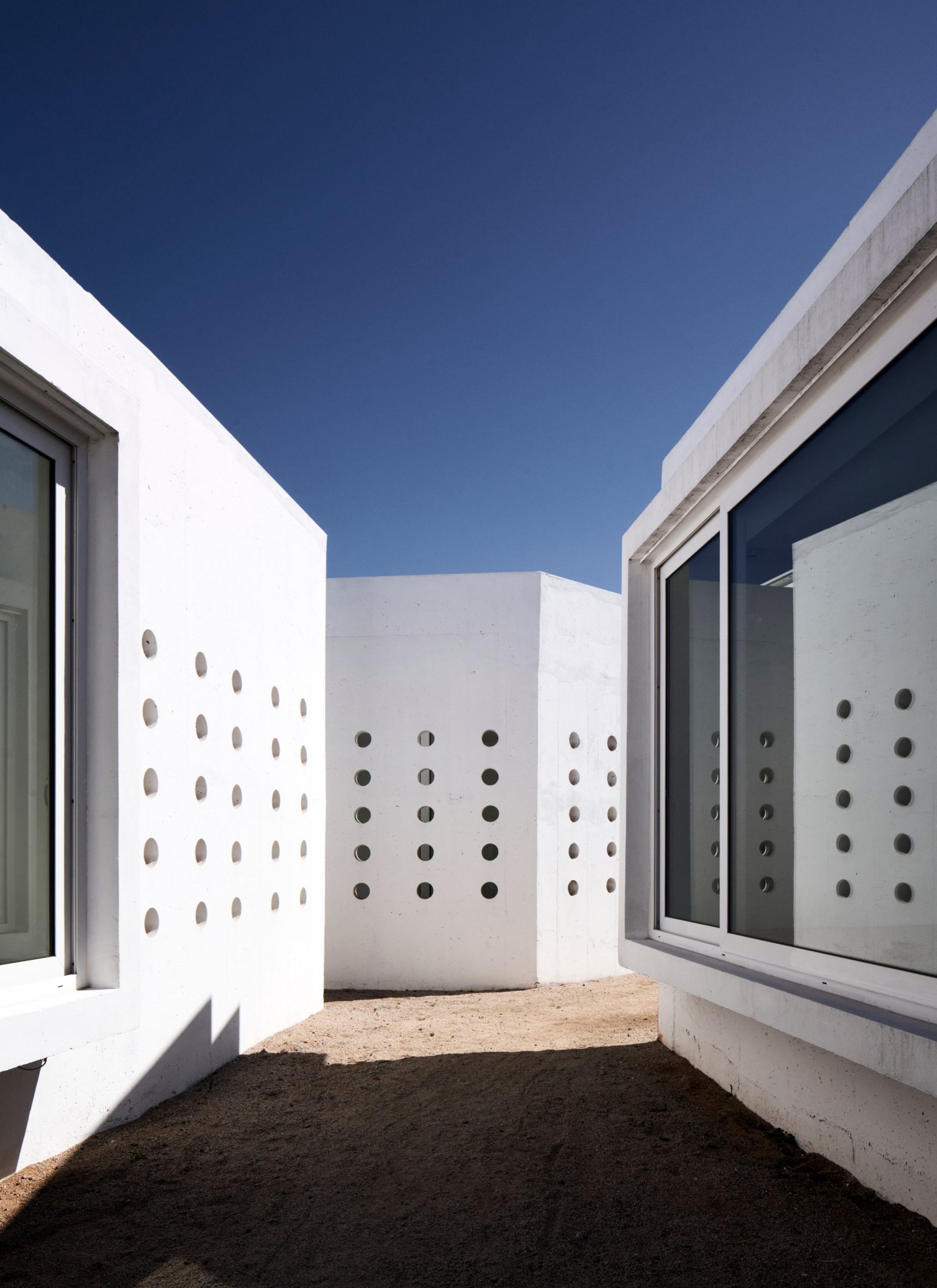
The perimeter wall, which rises several metres, is punctured with small, round holes that produce dotted patterns of light within the complex.
The school has two key entrances, both of which are marked by rectilinear volumes that stretch upward. The main entrance is next to the administration building, while a second entrance is located near the chapel.
"Both places are marked by towers that not only play an active role as visual points of orientation but also symbolise the civil and religious powers that stand behind the foundation," the architect said.
Small round holes that puncture exterior walls produce dotted patterns of light inside
Other educational facilities in Chile include a university innovation centre by Pezo von Ellrichshausen that features curved walls and circular voids, and a renovated school by architects Guillermo Hevia García and Nicolás Urzúa Soler that has large skylights and a glass-walled pavilion.
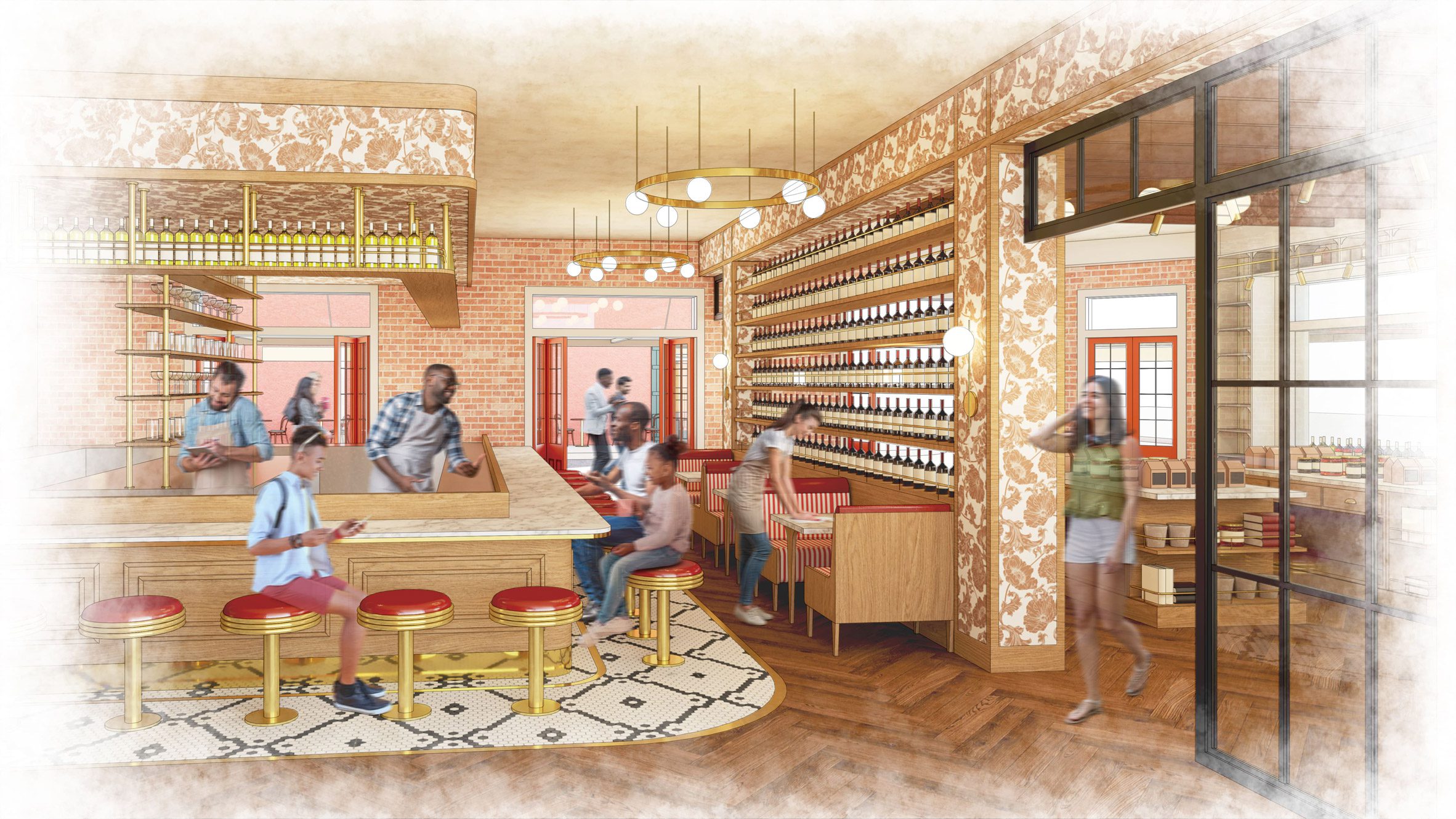
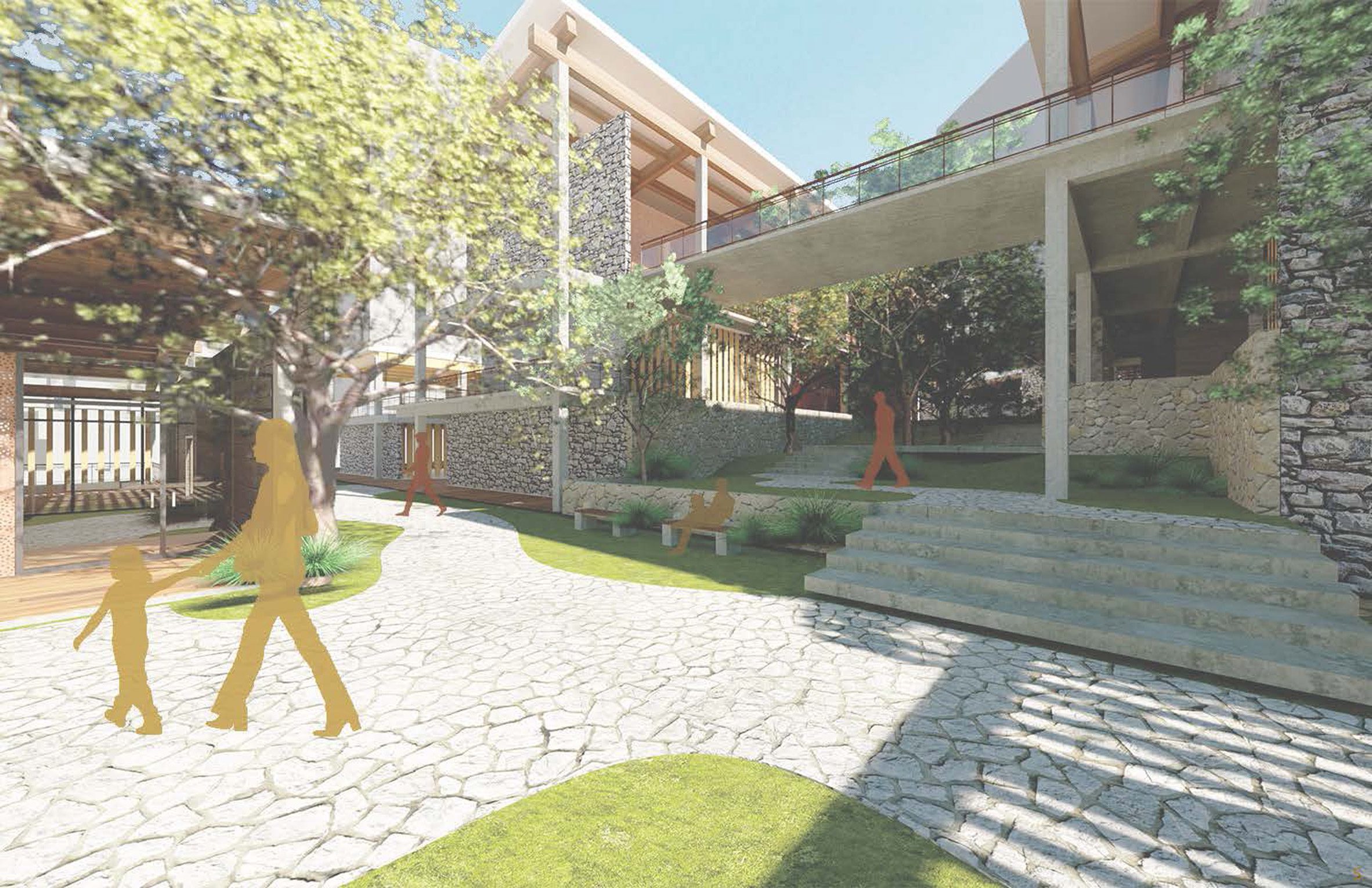
A graphic novel examining Black history and a project focused on tourism and sustainability in New Orleans are included in Dezeen's latest school show from students at Drexel University.
Also included is a housing project designed for the elderly in South Korea and an eco-retreat dedicated to connecting its guests to wildlife.
Drexel University
School:Drexel University, Department of Architecture, Design and Urbanism Courses: B Architecture, BS Interior Design, MS Interior Architecture and MS Design Research Tutors: Professors Mangold, Nicholas, Schade and Temple-West
School statement:
"Drexel University offers the nation's top programmes for experiential learning with dedicated co-op work experiences and a mission of civic engagement.
"The Department of Architecture, Design and Urbanism includes undergraduate programmes in architecture and interior design and graduate programmes in interior architecture, design research and urban strategy.
"Work from our programmes explores qualities of place and considers that our lives are shaped by the spaces we inhabit. At all scales, we respond to the form, light and materials of the world around us, and we actively engage our social and natural environments.
"Through research and design interventions, our work enhances our lives and promotes community."
Integrating Transit, History and the Public Realm: Creating a New Dignified Commons for Centre City Philadelphia by Christopher Hytha
"The underground complexity of downtown Philadelphia amazes me. In the heart of the city, far below the streets, a labyrinth of concourses, rail lines and service tunnels weave together in the service of getting urban dwellers from place to place.
"Unfortunately, the experience of descending to the underground is one of detachment, disorientation and dismay. What if these systems were integrated into the experience of the city? What if natural daylight penetrated into the deepest train platform and views of City Hall oriented visitors upon arrival?
"Picking up on cues from William Penn's plan and Ed Bacon's Penn Centre Vision, my project aims to create a dignified public realm activated by a multimodal transportation hub."
Mitigating the Dangers of Concrete Jungles with Biotecture by Mizuki Davis
"The current segregation of living and non-living systems, especially in our cities, has had devastating effects on both humans and the environment.
"With biotecture, the synthesis of biology and architecture, we can design a brighter future, in which our philosophical understanding of the 'natural environment' incorporates architecture as an integrated constituent."
Student:Mizuki Davis Course: MS Interior Architecture Tutor: Rena Cumby
Azola Eco Retreat by Abby Karle
"The Azola is a self-fertilising plant that creates a healthy environment for itself and the plants around it. This positive regeneration loop is the crux of the design.
"An upscale eco-retreat, connecting guests to the local ecosystem through wildlife, sustainable activities, farm-to-table culinary experiences, and ultimately to themselves and each other. The interior design aims to follow the forms found in nature to create movement and blur the line of interior and exterior."
Student:Abby Karle Course: BS Interior Design Tutor: Sarah Lippmann
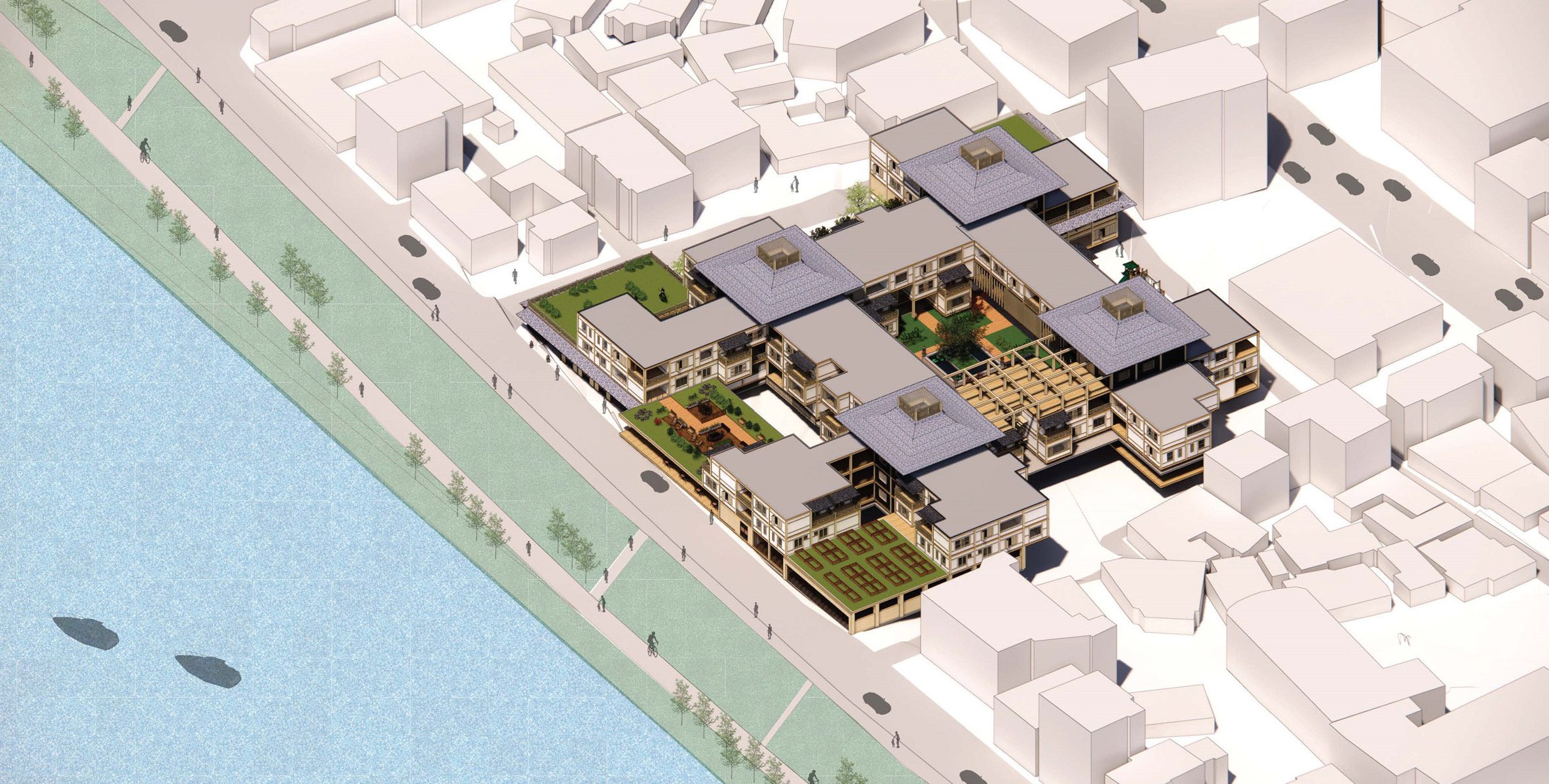
The New Hanok: Aging with Grace, Yang-Pyeong, South Korea by David Jae Hyeok Lim
"Ageing is a natural part of our lives. With rapid modernisation, the ageing population has been forgotten, and resources for this group have been significantly lacking. Instead of dreading this upcoming chapter of our lives, I believe it has the potential to be as joyful and fulfilling as the rest of our lives.
"I propose this housing project for the elderly in South Korea, which has the fastest-growing ageing population in the world, to provide a new prototype which is a housing facility that can provide consolation, growth and opportunity that the older generation deserves.
"Aging can be difficult and a frightening time… but can be made more bearable by a community that provides opportunity. Ageing should not be about staying alive. It should be about finding joy and having the freedom to do better and live better."
Student: David Jae Hyeok Lim Course: B Architecture Tutor: Kelly Vresilovic, AIA
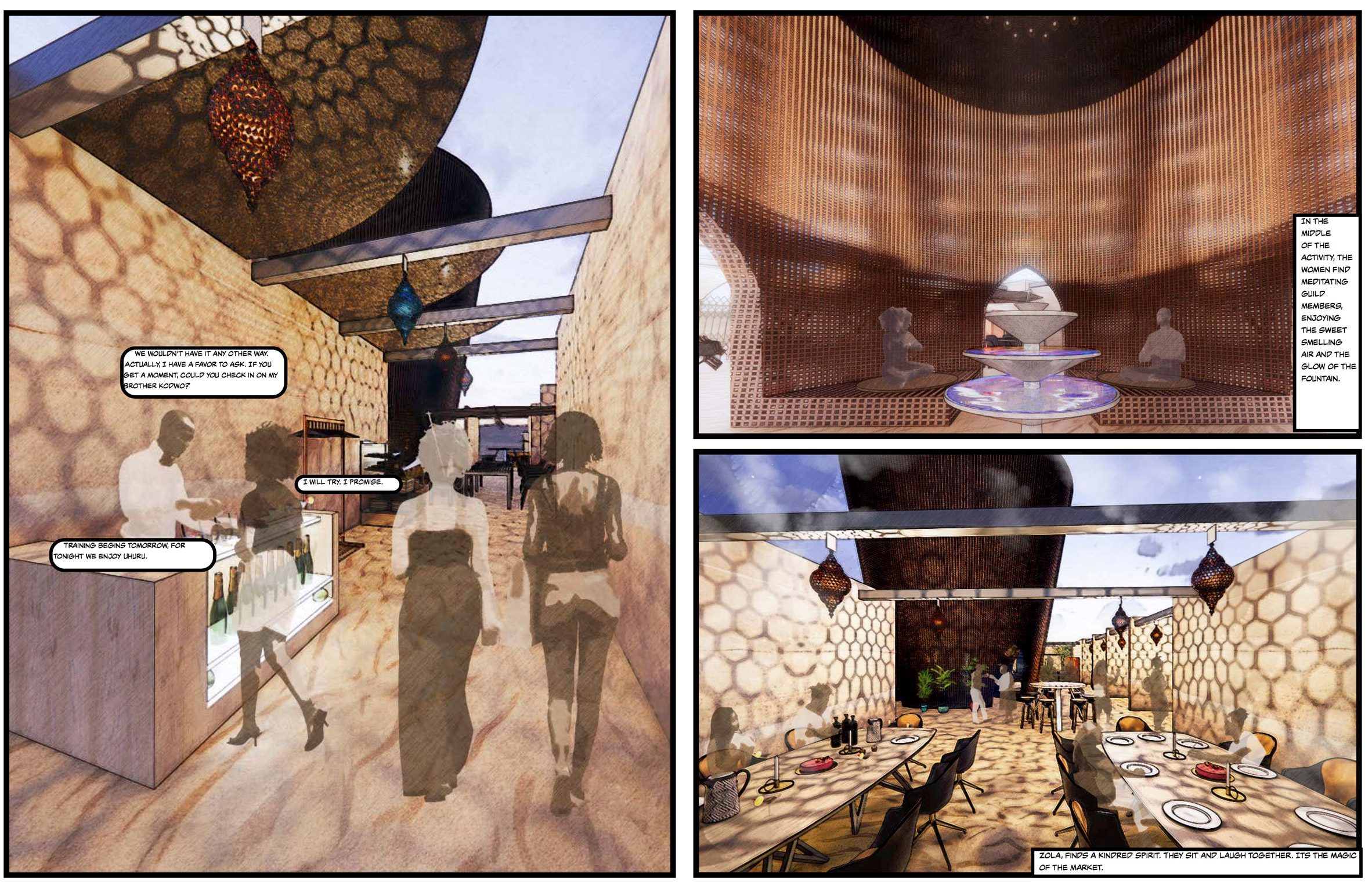
Resistance: Speculative Design Confronts Systemic Trauma of the Black Diaspora by Karla Roberts
"Grounded in Afrofuturism, this thesis explores architectural and interior spaces in a parallel universe using the narrative form of the graphic novel.
"The intent is to highlight the erasure of Black history prior to enslavement, giving space for a positive future unbound by anti-Black hatred. The past, present and future of the Black Diaspora are synthesised utilising history, technology and imaginative outcomes."
Student: Karla Roberts Course: MS Interior Architecture Tutor: Sarah Lippmann
Multicultural Centre by Maryam Abdou
"This multicultural student centre employs fundamental resources for facilitating the transition of international students throughout their college career. The centre creates a safe space that stimulates healing and inclusivity in its design. International students are encouraged to acclimate not only as students at an American university but also to American life and culture.
The design of this centre is devised to boost intercultural and interracial engagement through cultural, artistic, environmental, culinary and academic levels. It aims to strengthen students' connection with their community and nature through building relationships with other international and American students.
"By utilising design methods such as biodesign and biophilia, this multicultural centre will thrive as an exceptional, sustainable space that aspires to connect people from all around the globe and celebrate what makes every one of them special."
Tourism and Sustainability in New Orleans by Rachel Ayella-Silver
"Tourism is unsustainable and must be reconceived as a way to improve the wellbeing of host communities and sustain the social, environmental and economic conditions of destination regions.
"This thesis places New Orleans at the centre, with spaces for community engagement through cooking, service and leisure to create tourist experiences that are authentic and sustainable."
Student:Rachel Ayella-Silver Course: MS Interior Architecture Tutor: Sequoyah Hunter-Cuyjet
Saudades da Natureza: Longing for Nature by Raphaella Pereira
"Within the last decade, Brazil's urban cities have grown exponentially due to the increase of its advanced economy and new technologies. This rapid urbanisation has also caused a rise in mental health and environmental issues within these cities, as their natural forests have been destroyed, thus disrupting the balance of life.
"I am challenging the typical design approach in urban development by proposing a mental wellness centre designed with a focus on biophilic design in Brazil's largest city of São Paulo, otherwise known as 'The Stone Jungle.'
"This model of design is intended to restore the balance of the natural and built environment in our cities, bringing back life into the urban environment of Brazil."
Student: Raphaella Pereira Course: B Architecture Tutor: Richard King, AIA
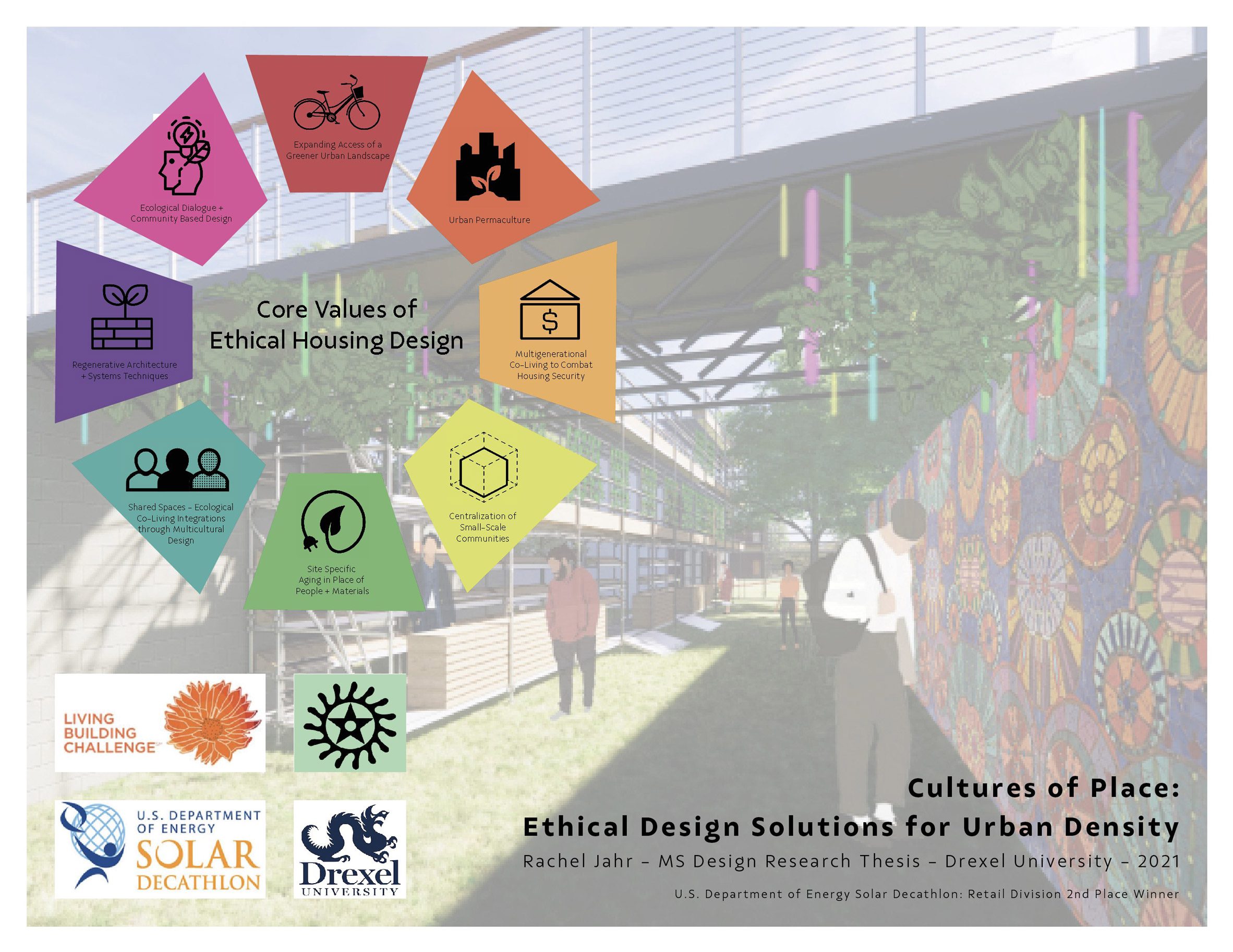
Cultures of Place – Ethical Design Solutions for Urban Density by Rachel Jahr
"Cultures of Place explores the intersection of cultures, places and ecologies. It examines how to combine them through an integrated level of design thinking intentionally.
"This focuses on the shifting perceptions of urban living through permaculture practices and regenerative design techniques. It aims to create solutions considering cultural, economic and green space factors as prominent design issues.
"Permaculture introduced into the urban design fabric is a nonviolent form of civil disobedience – a type of silent anarchy using the interconnectedness between people, other animals, land, water and air with the human dimension battling the social and biophysical conflicts.
"The research outlines the mechanisms related to designing an ecologically friendly urban setting through a place-based approach influenced by the human lived experience as well as technological advancements to close of the knowledge gap about Earth's systems."
Student: Rachel Jahr Course: MS Design Research Tutor: Nicole Koltick
Sondr Art Centre by Lorraine Francisco
"Creating art without limits involves celebrating one's individuality through creativity and imagination. This community centre highlights the importance of the arts through unity and inclusivity with the contrasting elements of chaos and organisation.
"It is with these opportunities in mind that this space embraces natural light, openness and community with the intention of growth, education, and creation as the overall objective."
Student:Lorraine Francisco Course: BS Interior Design Tutor: Frances Temple-West
Partnership content
This school show is a partnership between Dezeen and Drexel University. Find out more about Dezeen partnership content here.
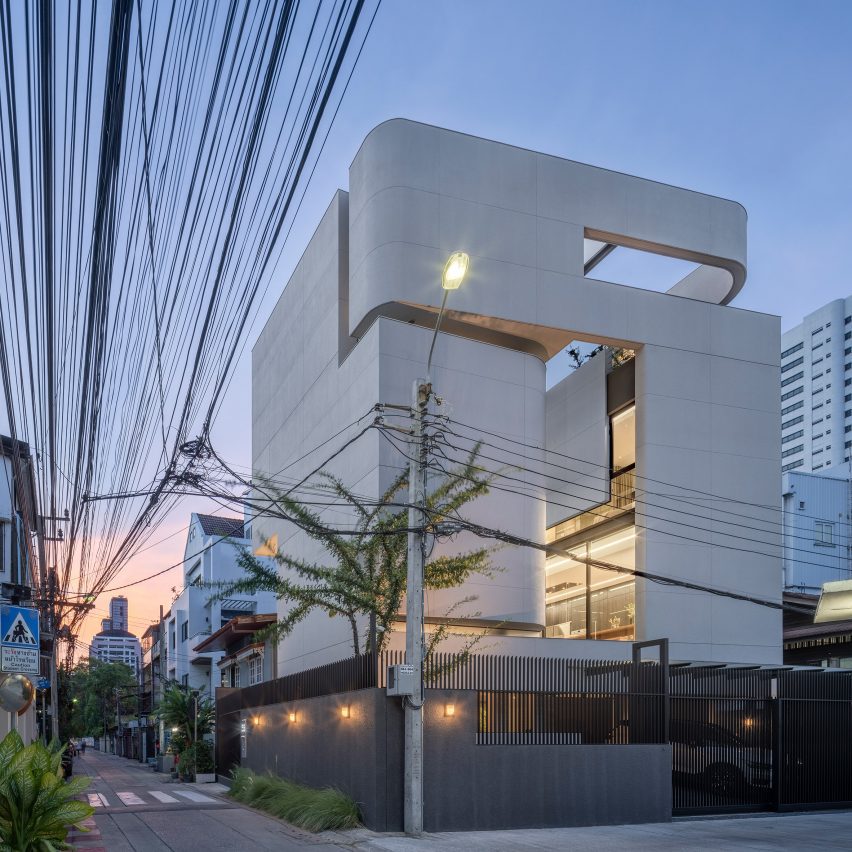
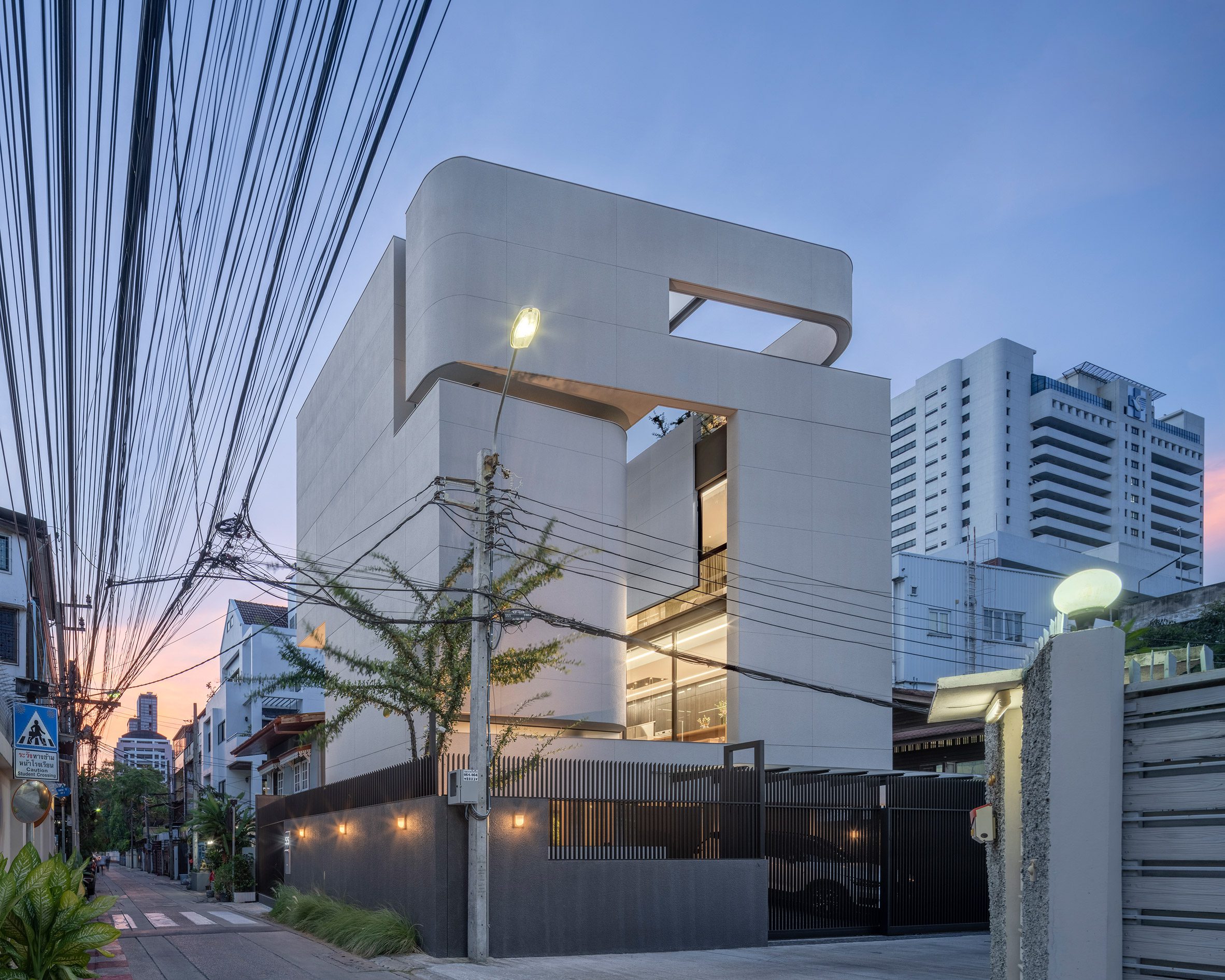
Thai architect Kuanchanok Pakavaleetorn has built her own family home in Bangkok, with a design that prioritises privacy and airflow.
Pakavaleetorn, founder of Kuanchanok Pakavaleetorn Architects, designed 55 Sathorn to make the best of its busy and polluted urban setting.
The house is situated in Bangkok's dense cityscape
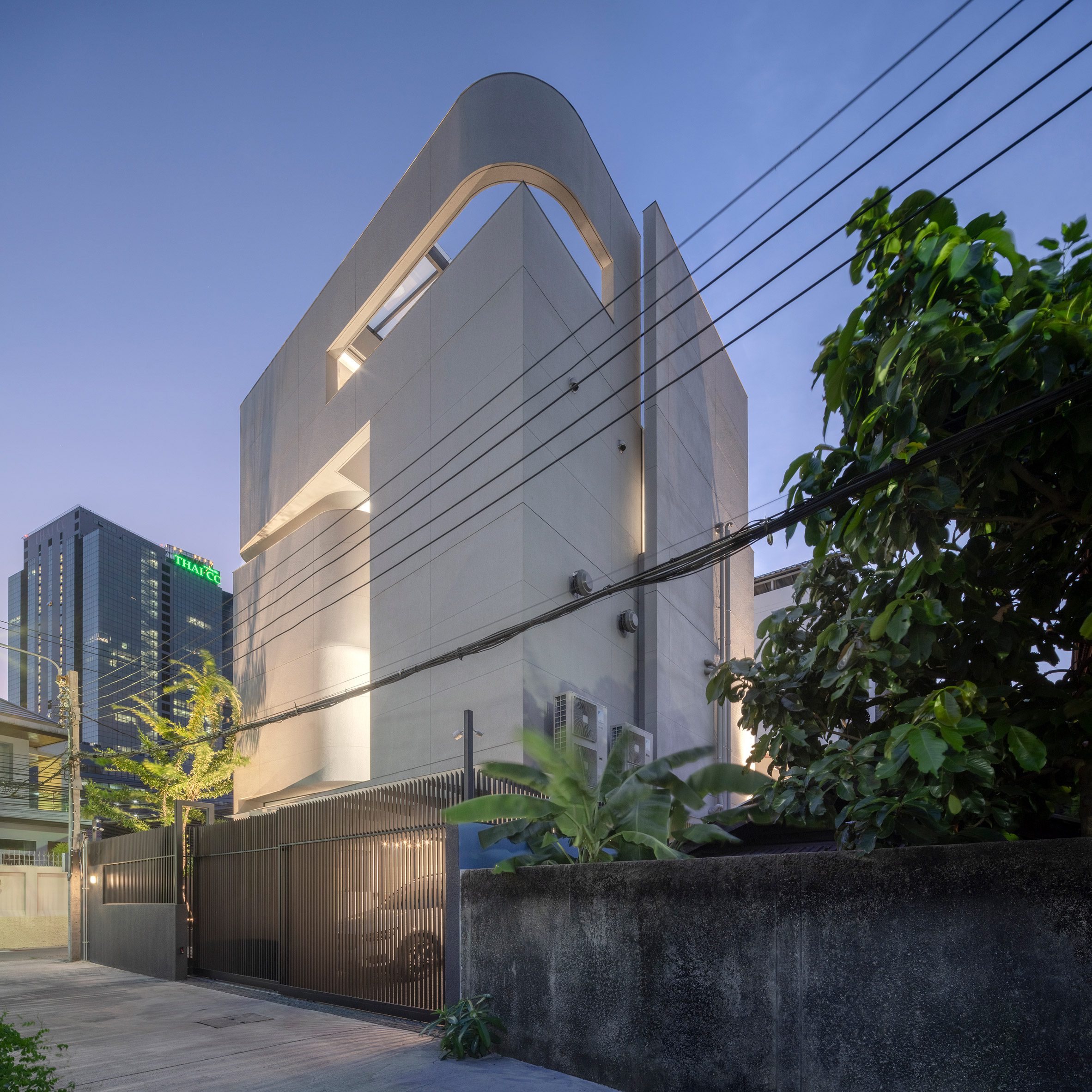
The four-storey-high building is arranged around a large atrium, allowing windows to face inwards rather than outwards. The facade also incorporates sliced openings, strategically placed to encourage the breeze to flow through the building.
"The location is in the very centre of Bangkok; the noise level is very high, and the traffic flow of people and cars is a safety and security concern," explained Pakavaleetorn.
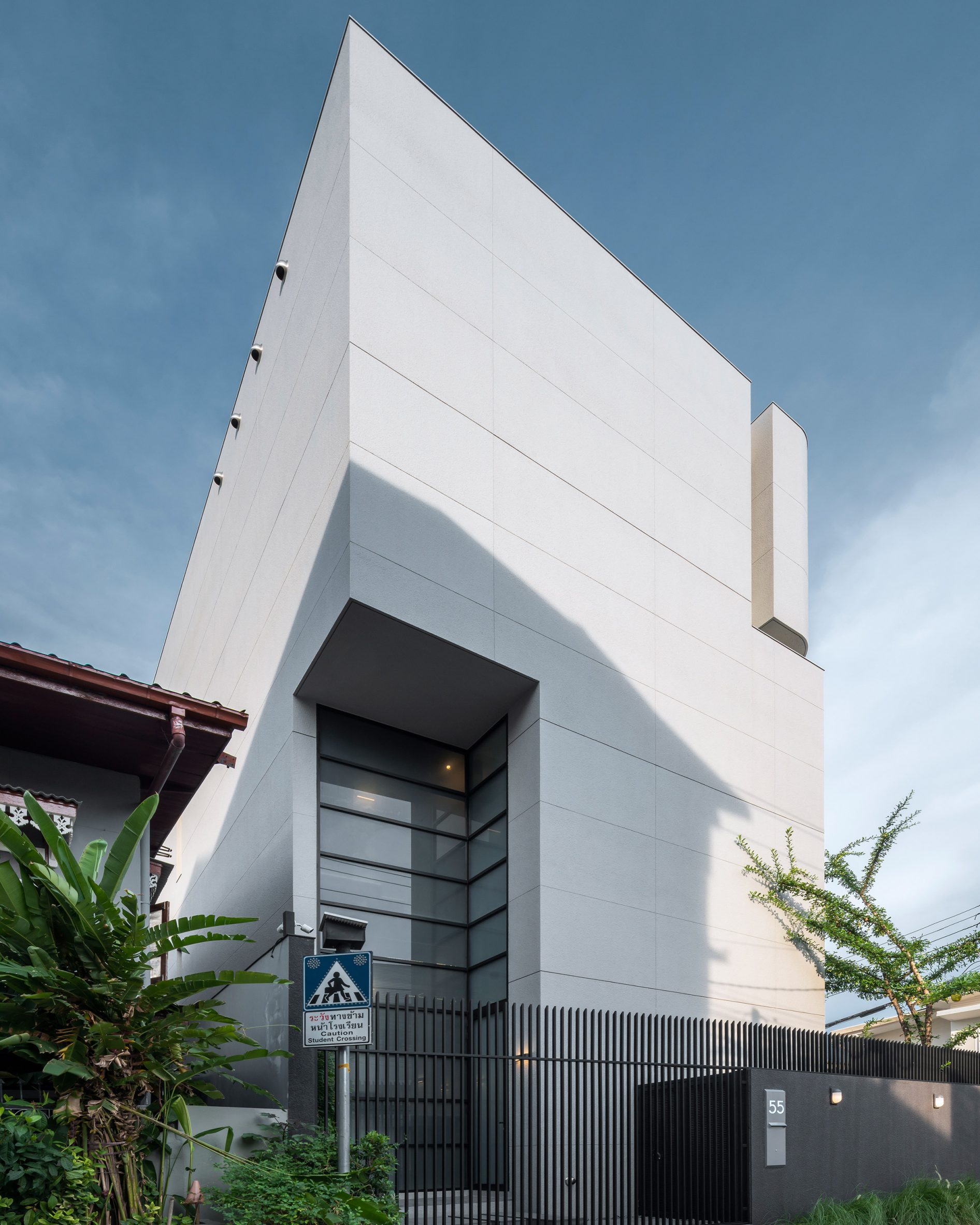
The facade is mostly windowless, but punctured by sliced openings
"So I designed the house to take a defensive fortress-like posture," she told Dezeen.
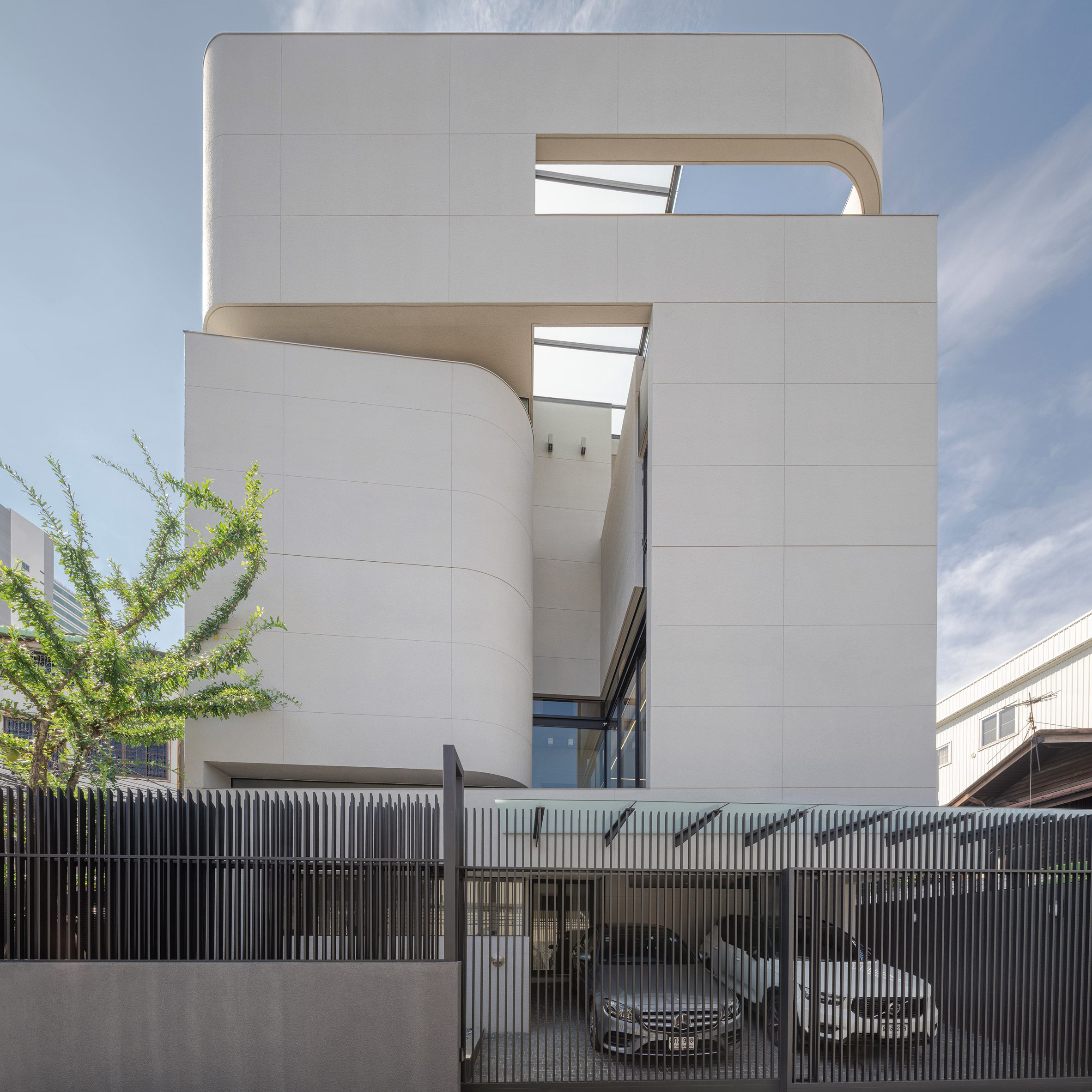
The building is primarily constructed from concrete masonry, which integrates a mix of rectilinear and curving elements. This means that some parts have a more solid aesthetic, while others take the form of smooth ribbons.
The openings are positioned to allow airflow through. central atrium
There are three main openings into this massing: one that slices though the south elevation before cutting round to the west, one that wraps the southeast corner, and one within the roof.
There's also a narrow vertical slit concealed within the eastern facade.
The building is constructed from concrete masonry
Although they appear to be design flourishes, each opening is there for a reason, according to Pakavaleetorn.
"The large openings are positioned precisely to maximise wind flow," she said, "and they frame specific viewing angles."
Large windows positioned within the atrium line up with the openings, to ensure that plenty of natural light can reach the interior.
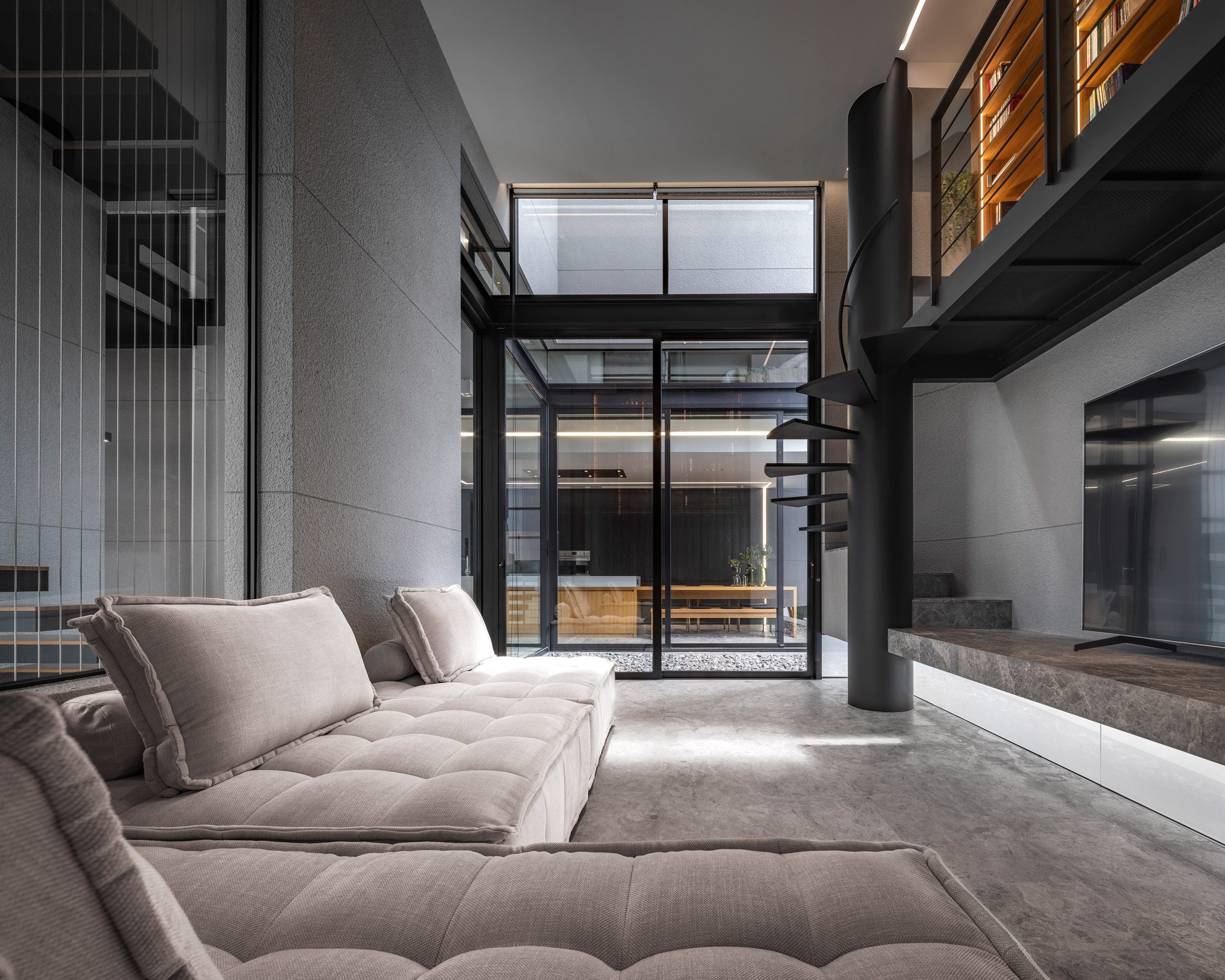
The living room features a mezzanine library
The layout of the 460-square-metre building is generated by the atrium – most floors contain two main rooms, one on each side.
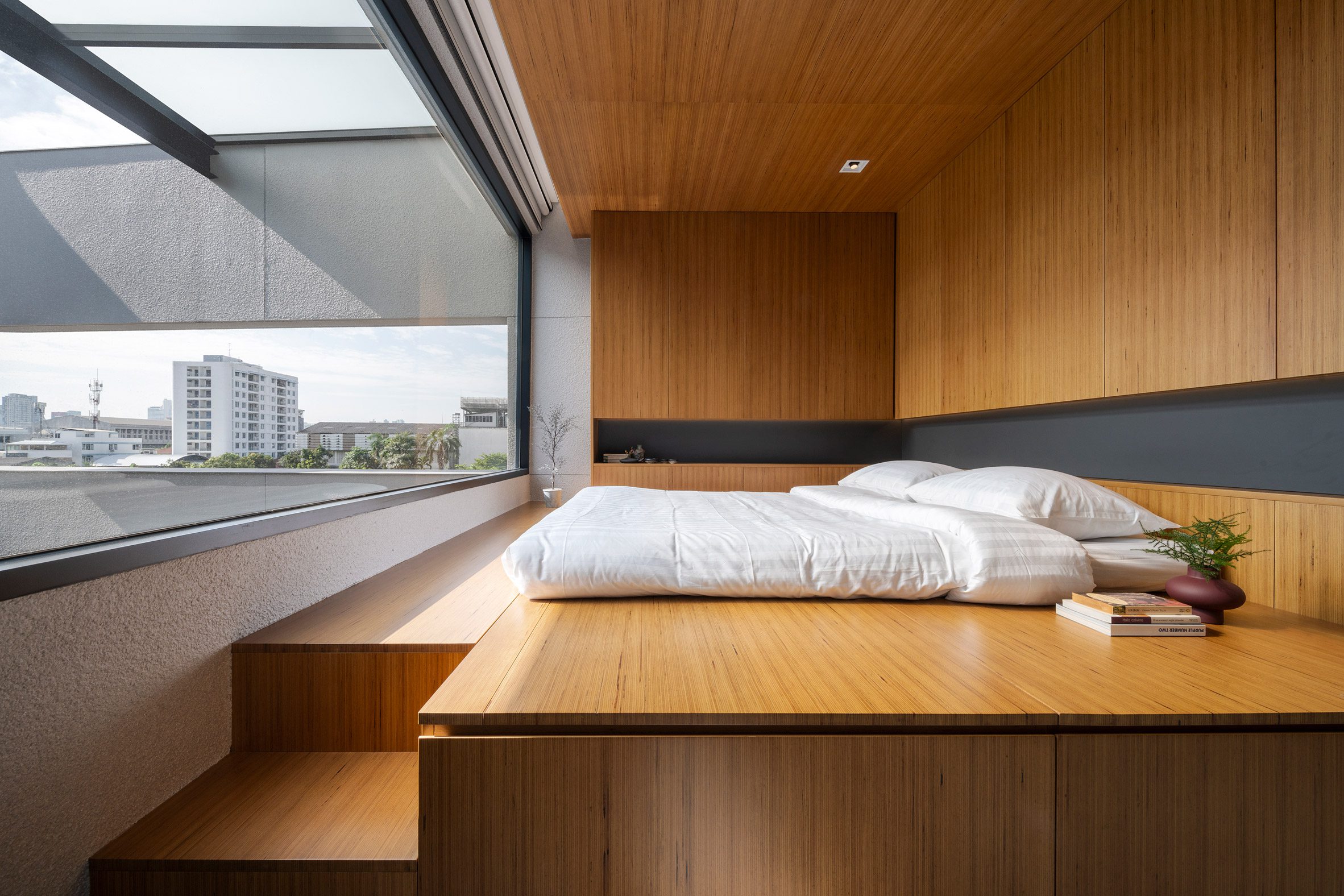
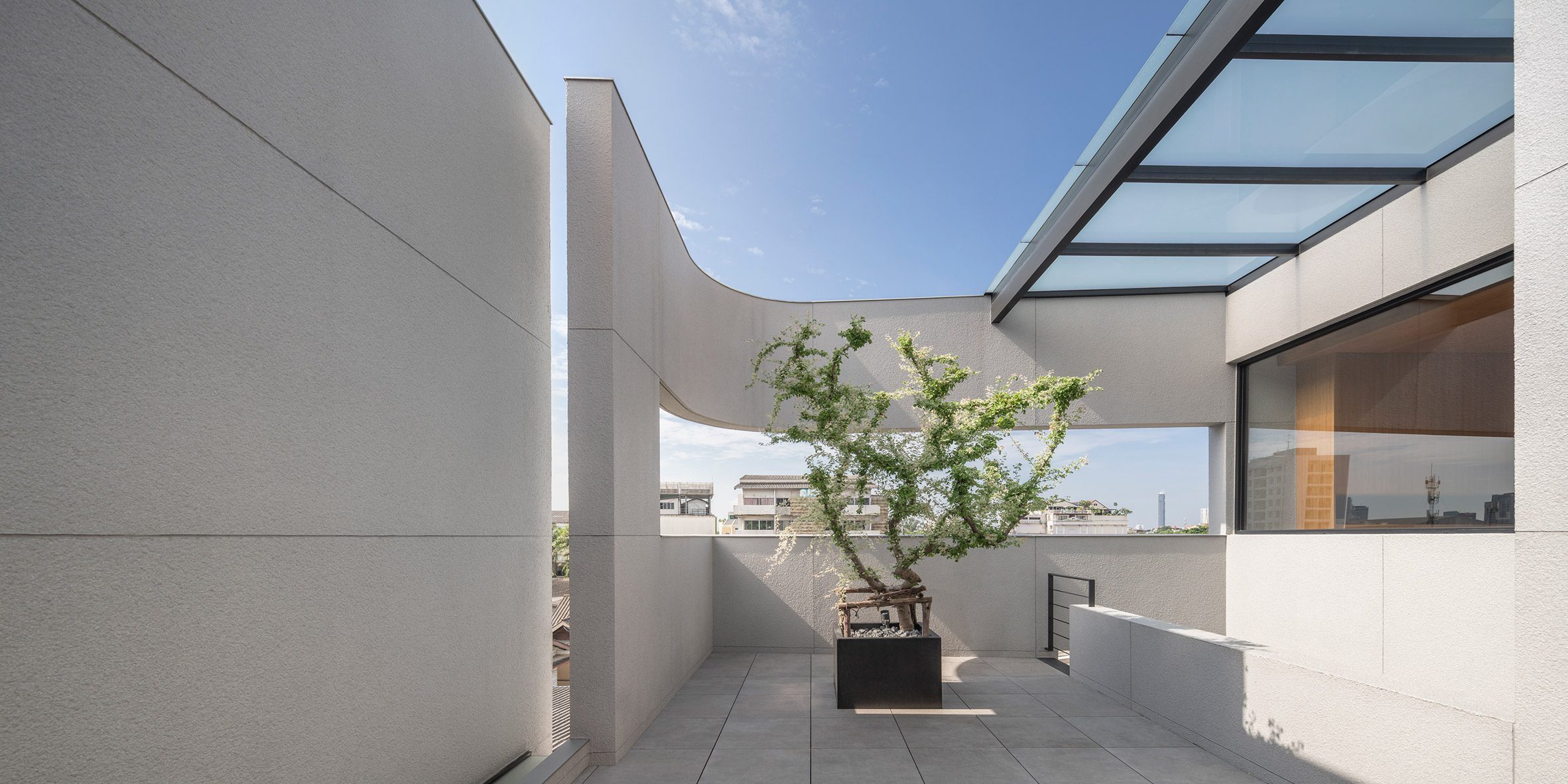
The ground floor contains a home office and gym, while the living room and kitchen are located on the first floor. There are then three bedrooms, located on the second and third floors, and a secluded roof terrace.
Integrated storage allows a minimal aesthetic for the third-floor bedroom
The concrete surfaces are visible inside the house, but have been treated with a textured coating. They are combined with a palette that includes natural wood veneers, stone tiling and various shades of grey.
Other details include black aluminium windows, a mezzanine library accessed via a spiral staircase, and a kitchen with an entire wall of storage.
The top floor also includes a protected roof terrace
Pakavaleetorn currently lives in the house with her husband and one-year-old daughter, but she expects her parents to move in at some point in the future.
The photography is by Wison Tungthunya and Kittipong Bumrungchaokasem.
For our latest lookbook, we have selected ten living spaces from the Dezeen archive that use concrete as a focal design feature.
Concrete, which is typically used as a structural element in buildings rather than for interior design, was used throughout these spaces to create living rooms with interesting textures.
These projects use the robust material in a variety of different ways – for walls and built-in storage solutions, as well as to divide up spaces.
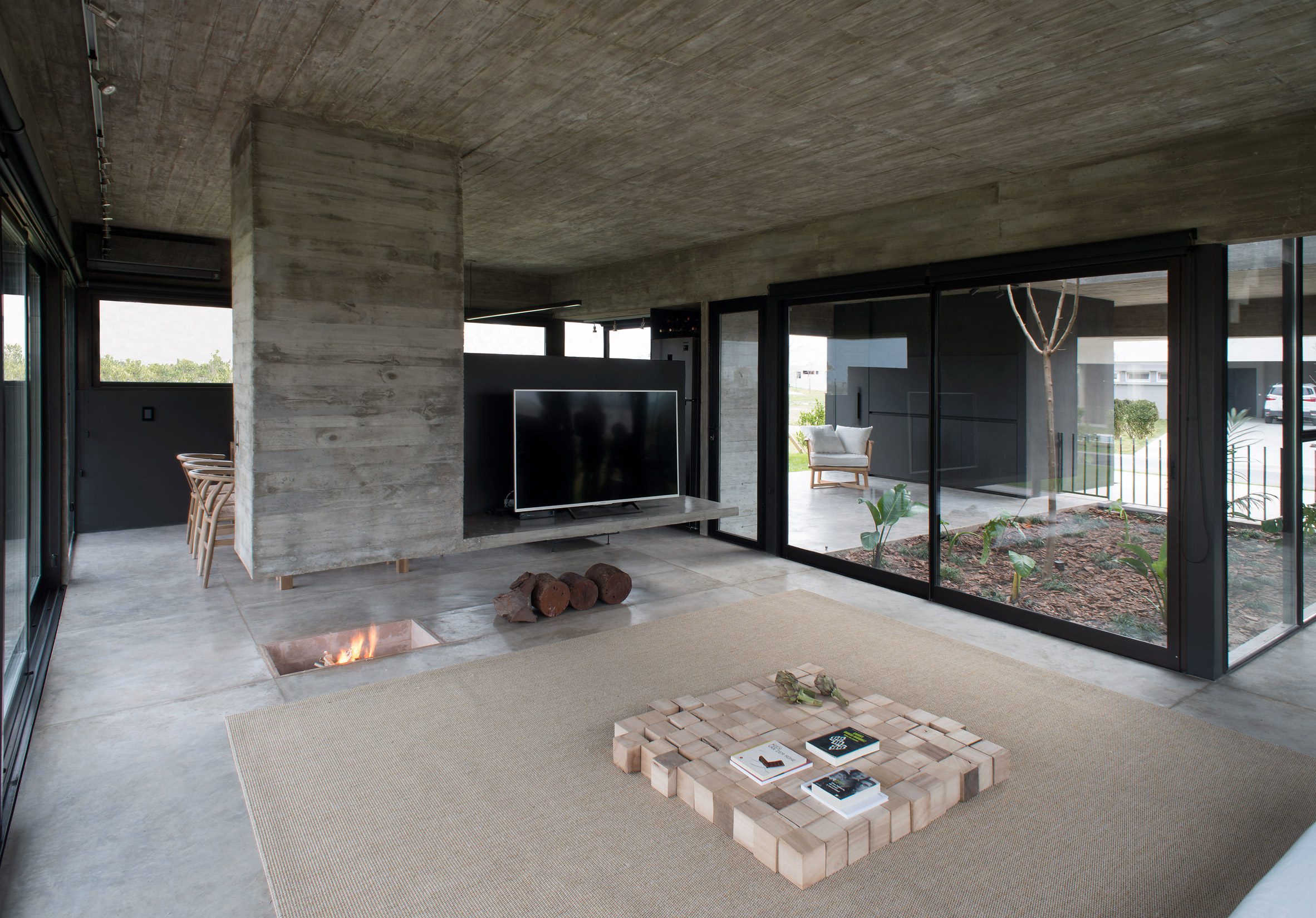
This glass and concrete home in Argentina was built by architects María Belén García Bottazzini and Ekaterina Künzel.
The living space features a broken-plan arrangement that is divided by a board-formed concrete chimney breast that partially separates the living area from a dining space.
A linear concrete surface extends from the bottom of the chimney to form a shelf for the TV.
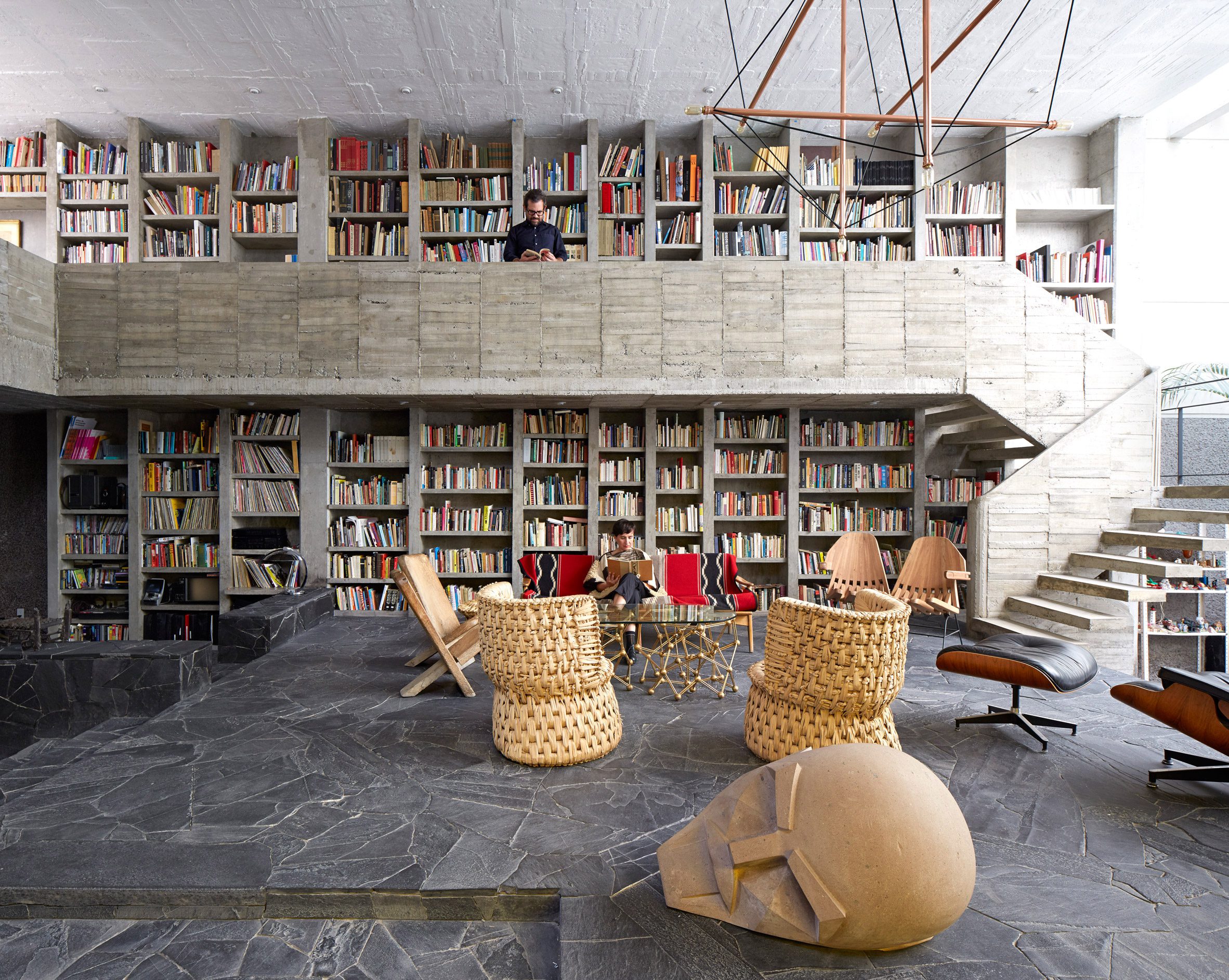
Built using concrete as a primary material, this home in Mexico takes cues from brutalism to use the material in a variety of different coarsenesses.
In the double-height living area, a large concrete bookcase-cum-staircase stretches the height of the space. Floating, cantilevered steps lead up to a raised gallery area that overlooks the living space and provides access to the books on the upper shelves.
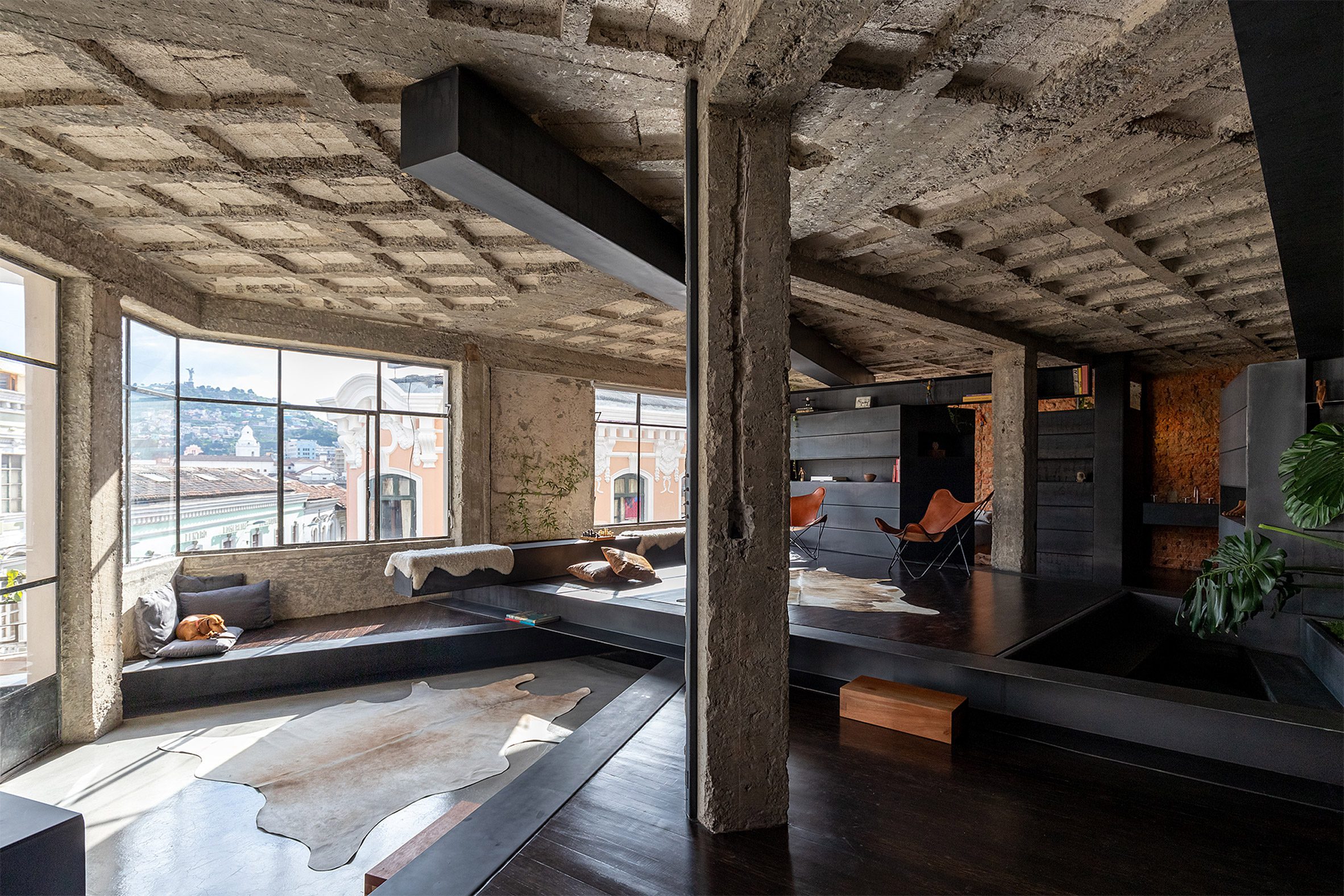
Exposed concrete, steel and brick blanket the interior of this home in Ecuador by architecture studio Jarrín.
The concrete ceiling with relief-style impressions was designed as a focal feature of the space, with large columns extending from the ceiling to the dark wood floors.
The exterior-facing walls of the home were left in unfinished and exposed concrete to give the space an industrial aesthetic.
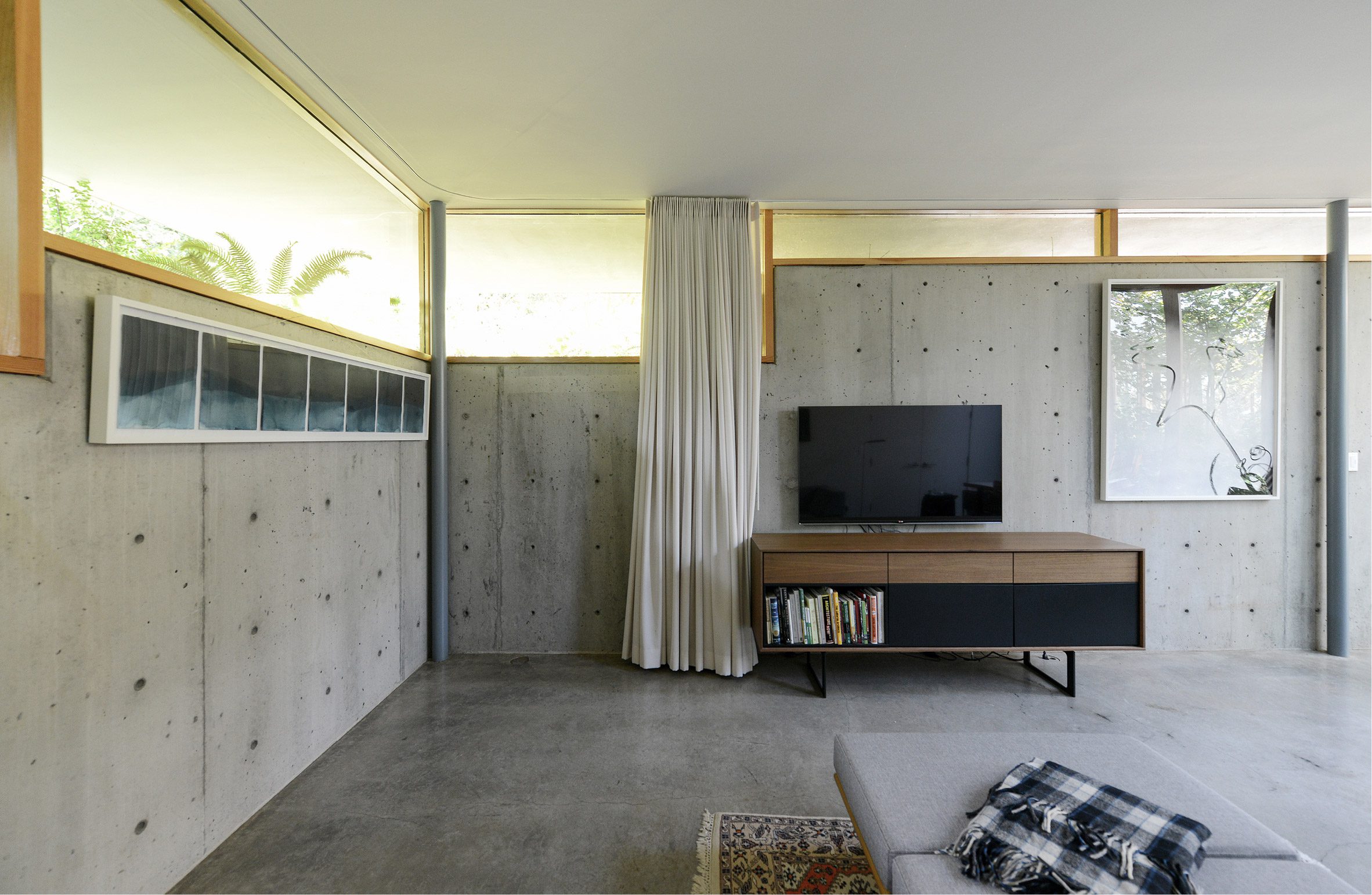
Concrete covers the walls and floors of this Oregon home's interior by No Architecture. It boasts a minimal material palette that is accentuated by sparse furnishings and decorative rugs.
The walls of the home are broken by wood-framed clerestory windows that stagger and form a stepped design across the space.
For UF Haus, which is an abbreviation for "unfinished", SoHo Architektur used materials that could be left in a raw and unfinished state.
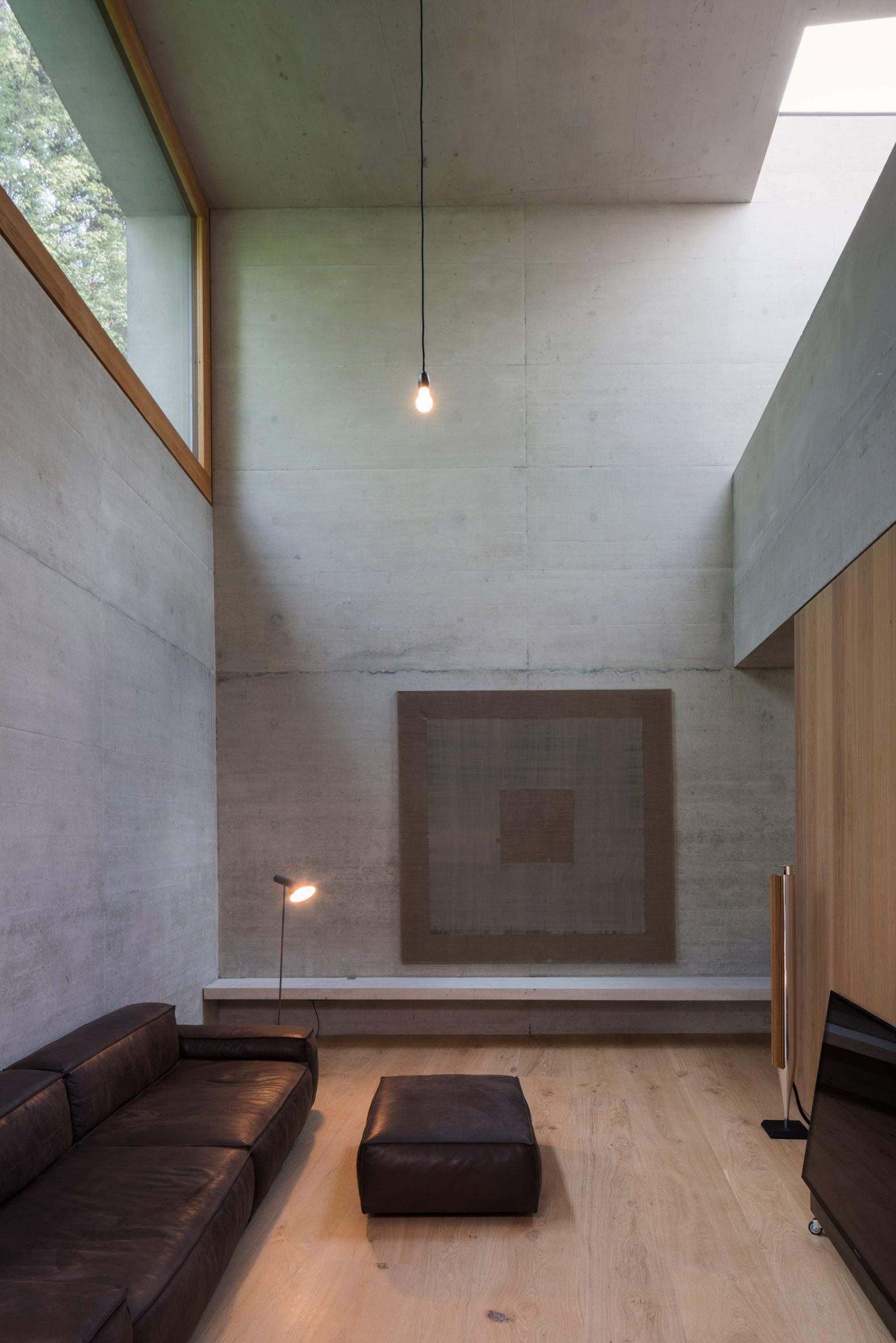
The main living area is located at the rear of the home and forms the core of the building. It was tucked beneath a double-height space that is overlooked by a walkway leading to the bedrooms.
Light grey concrete covers the walls of the space, which also features a long concrete bench that was fitted along a wall.
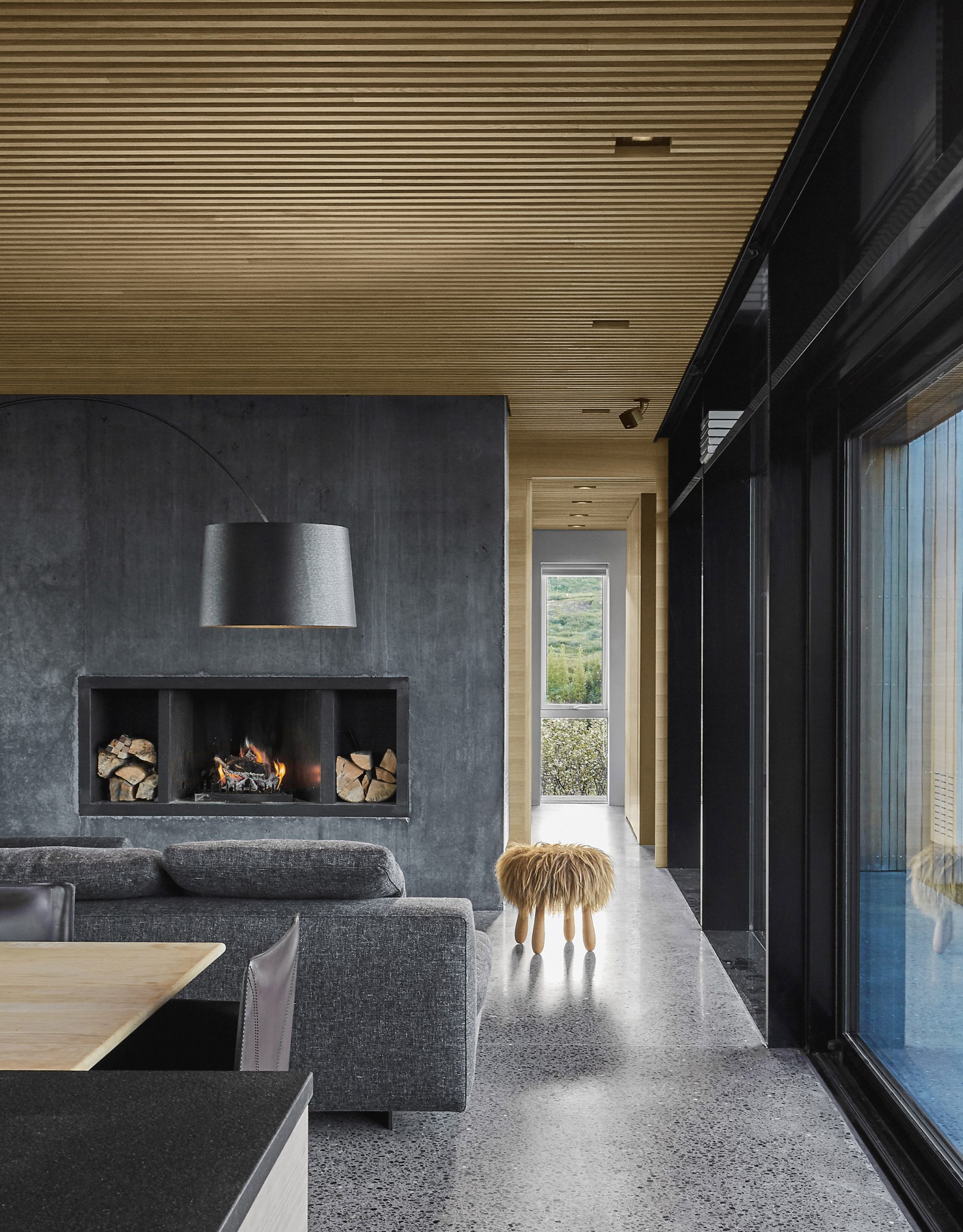
Located on the coast of Iceland, this holiday home has an open plan living arrangement and features a material-palette comprised of concrete, cedar and glass.
The living space was placed at the centre of the home and is framed by a large concrete volume, which divides the sleeping areas from the shared spaces and doubles as a log burning fireplace.
The concrete volume has a dark grey pigment that contrasts with the light, cedar-lined walls and ceilings located across the rest of the home.
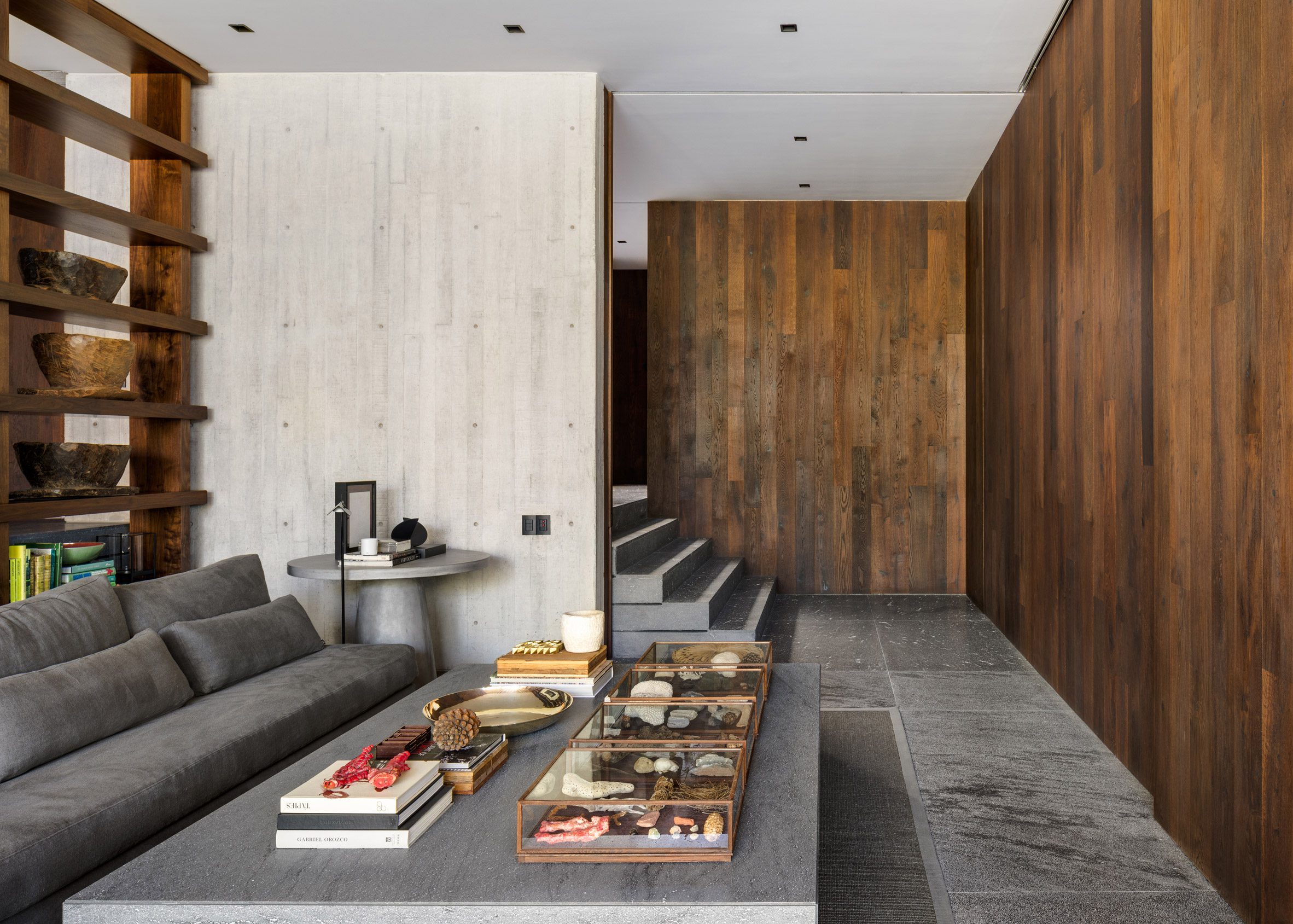
This five-storey home in Mexico, built into a sloping hillside, features a number of staggered spaces that can be accessed by a series of steps and staircases.
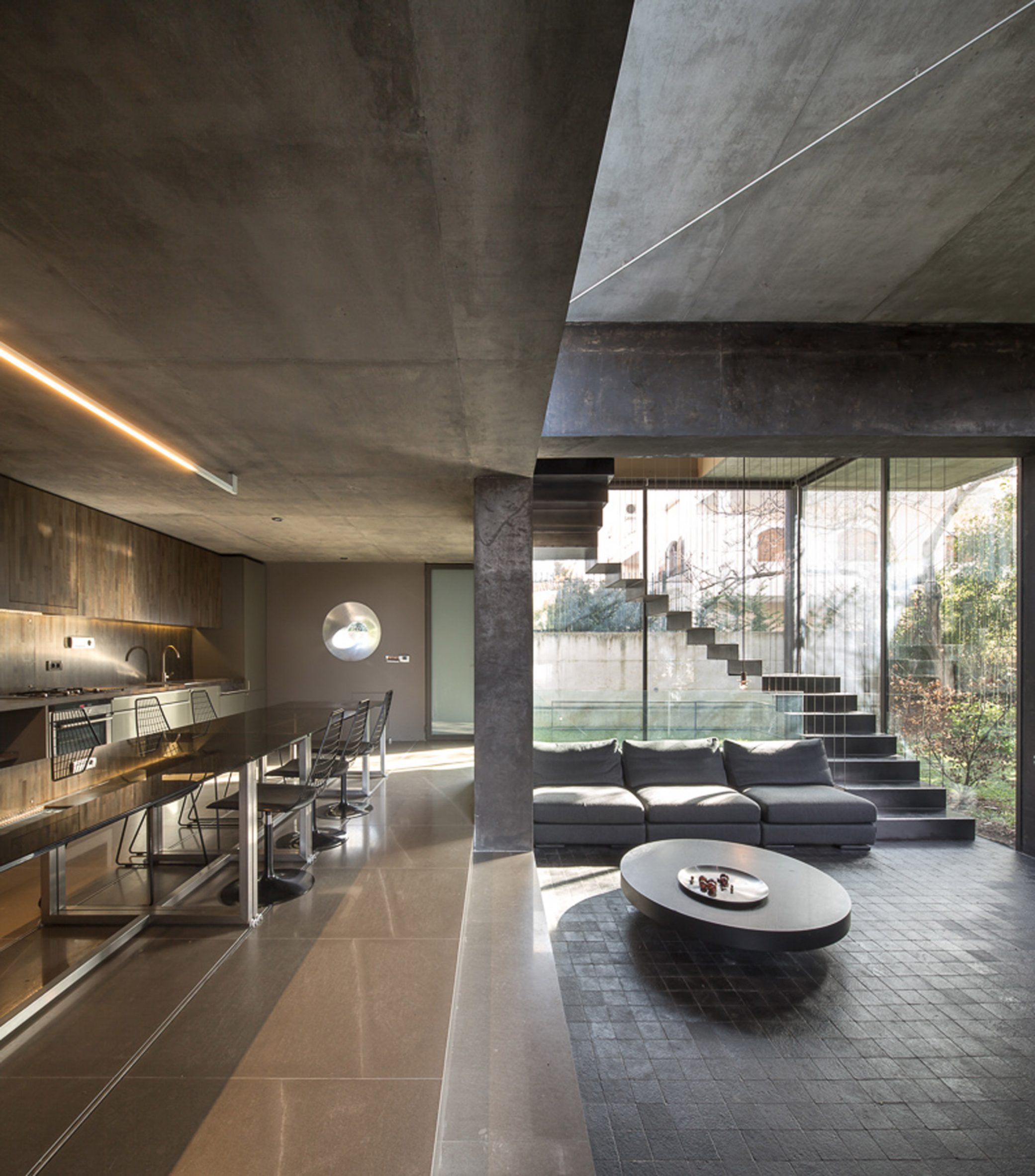
Its living space is marked by a large board-formed concrete wall, which was left exposed and runs through the house to unify the spaces. Stone steps were placed beside the wall and lead down to dark lava-stone floors.
The room's furniture sits low to the ground and has a simple and modular look.
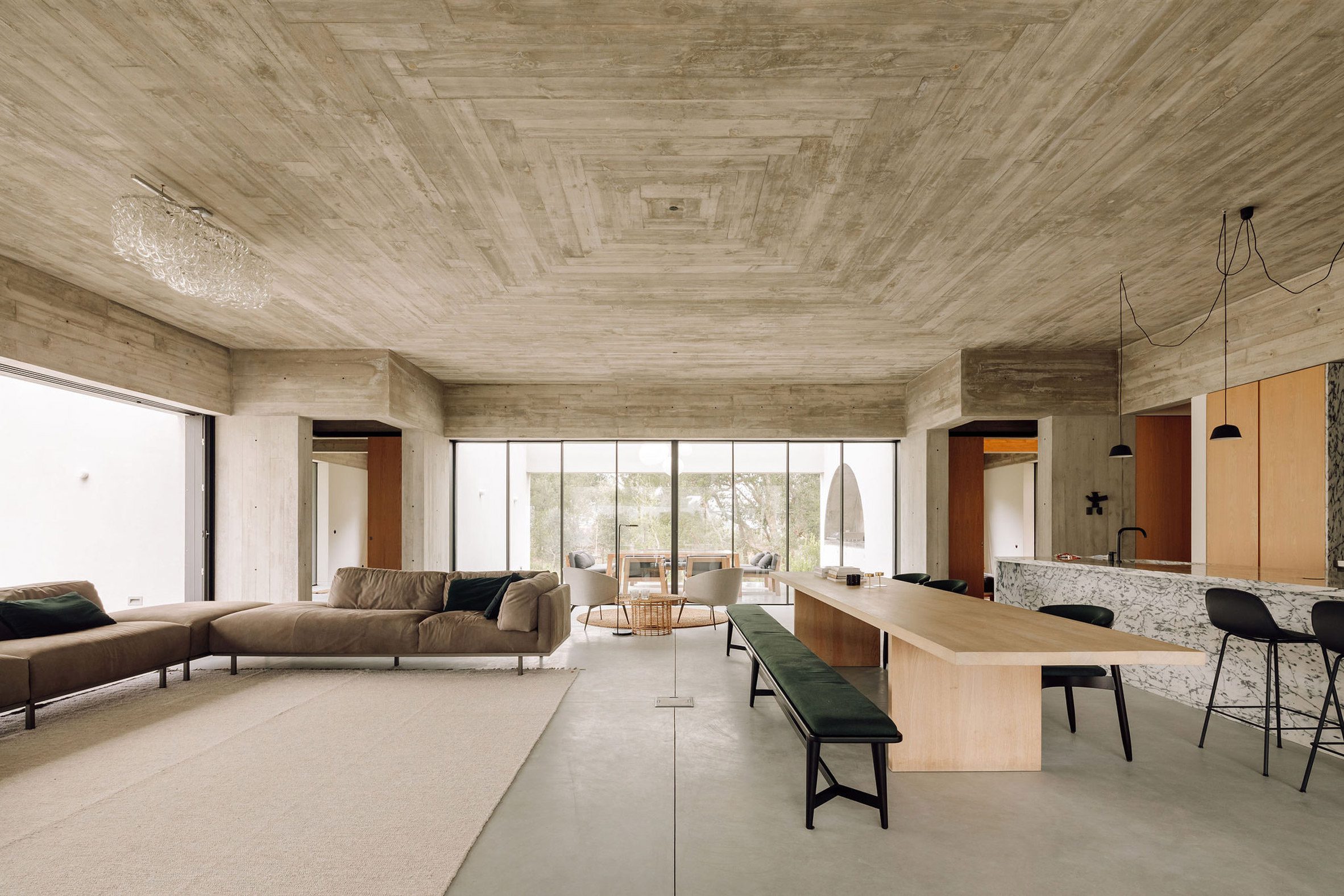
A large communal area forms the main living space at Casa Meco, located in a small Lisbon village in Portugal.
A board-marked ceiling stretches across the communal living space and extends downward to form a concrete trim. Smooth concrete was used across the floors and serves as a neutral backdrop for the elegant furnishings.
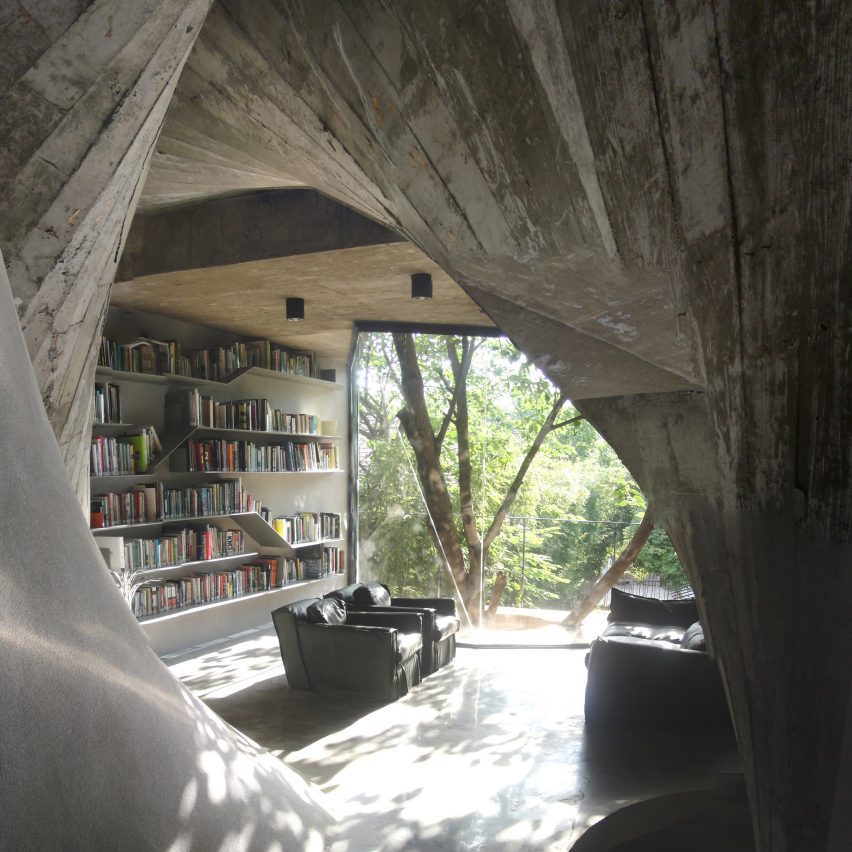
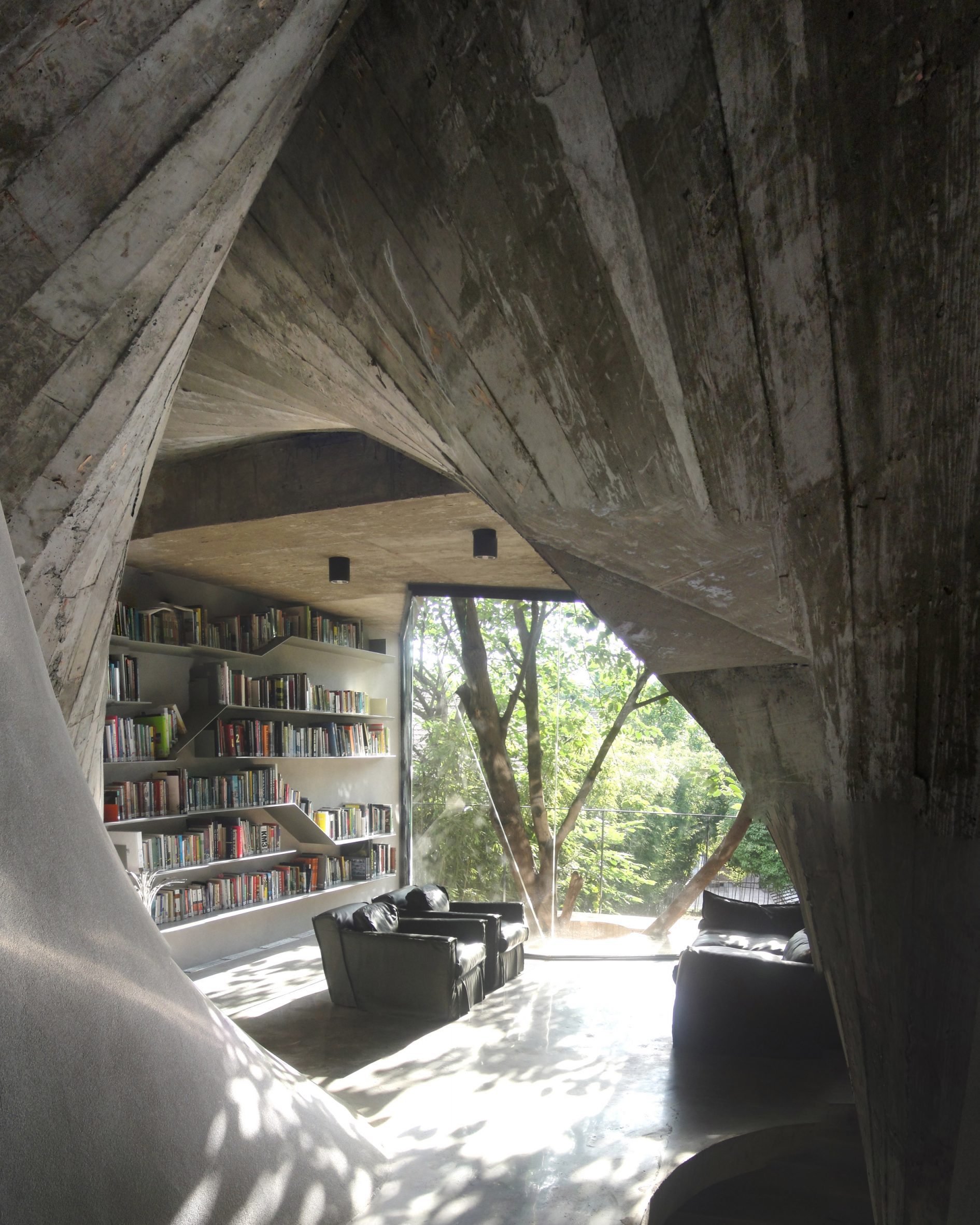
Twisting board-formed concrete walls wrap around the living space of Archi-Union's library and studio.
The contorted concrete walls partly conceal the room and create a cave-like feel. Floor-to-ceiling windows at the front of the space lead out to a terrace and overlook the gardens that surround the site and structure.