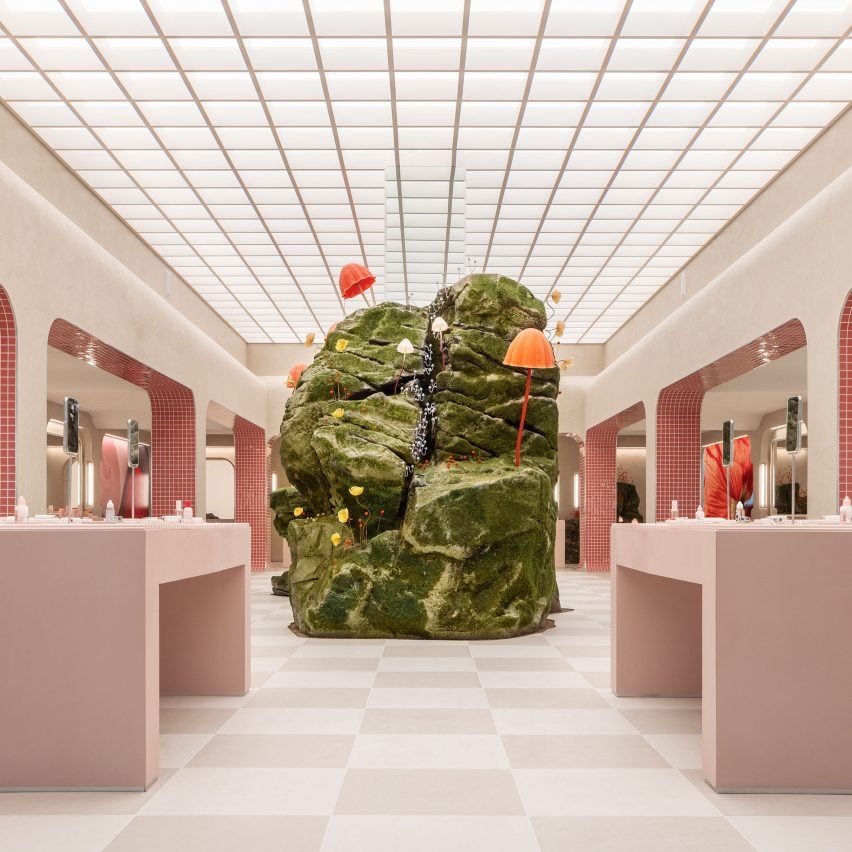
Online beauty brand Glossier has opened a physical store in Seattle where pale-pink furniture surrounds a sculpture sprouting artificial mushrooms.
The design of the recently opened Seattle store was based on a 2019 pop-up in the city, which was situated just four blocks away.
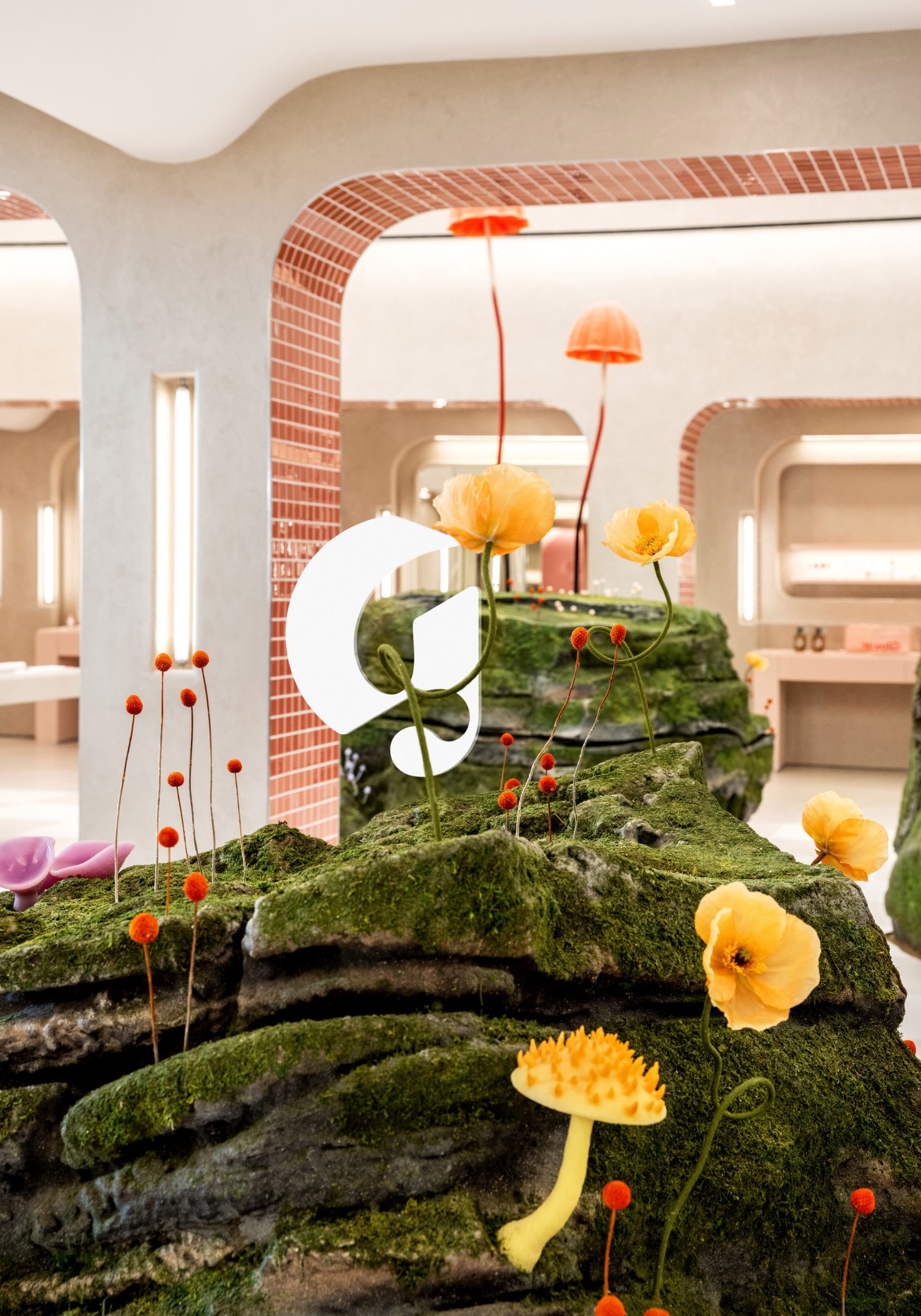
A boulder-like sculpture sprouting mushrooms and flowers sits at the heart of the Glossier Seattle store
Located in the Capitol Hill neighbourhood and designed by Glossier's in-house team, the 6,200-square-foot (576-square-metre) retail space is four times larger than the pop-up and marks the brand's largest physical store to date.
"As a digital-first company, Glossier has had the freedom to be experimental with retail in a way that beauty companies so closely tied to brick and mortar haven't," said the brand.
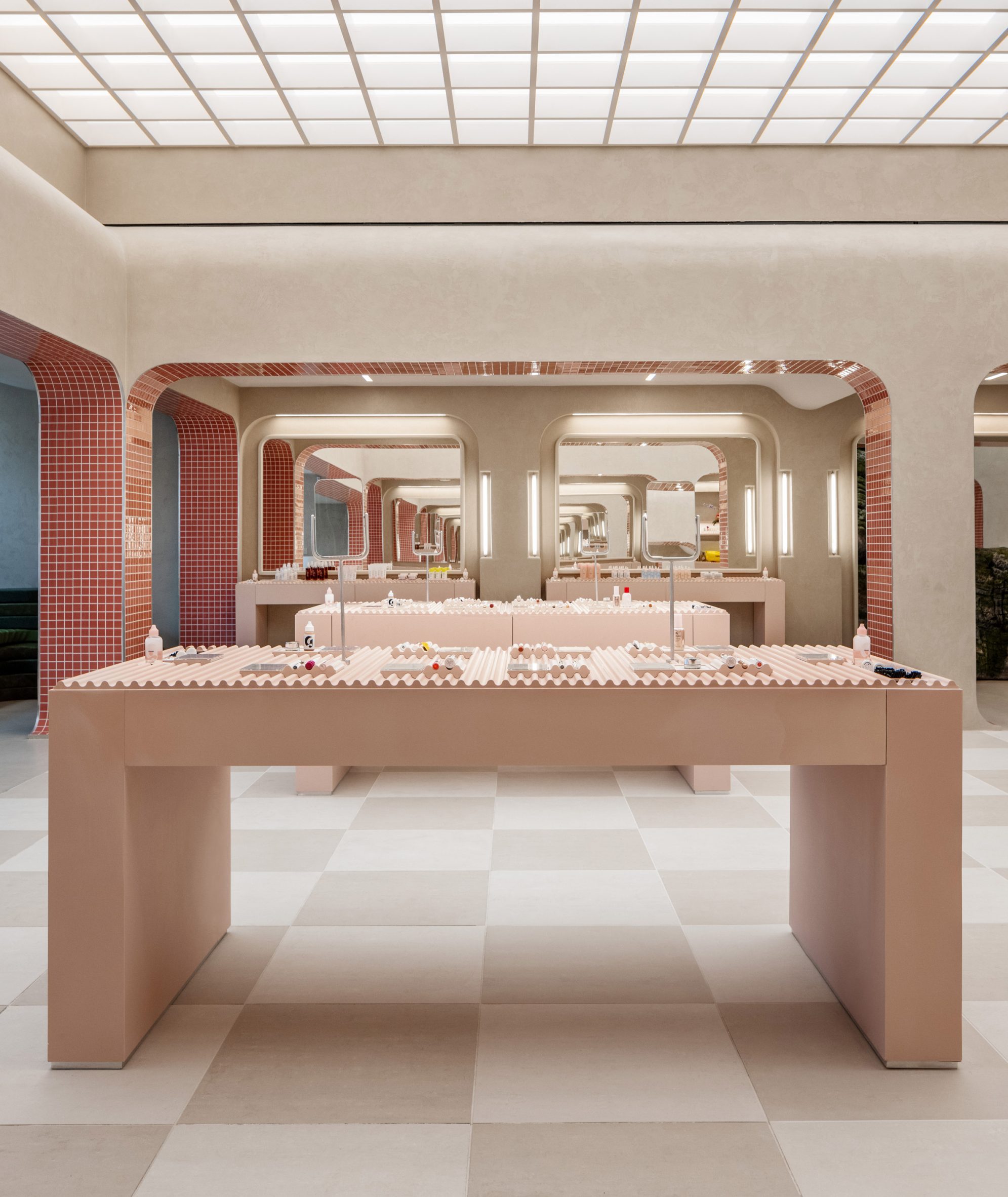
Minimal pale-pink counters are used for displaying products
A large sculpture at the centre of the space is designed to look like a boulder covered in moss and colourful mushrooms, influenced by the flora of the Pacific Northwest region.
This is based on a landscape installation created by designer Lily Kwong for the pop-up, which also featured plant-covered mounds and pink-purple blooms.
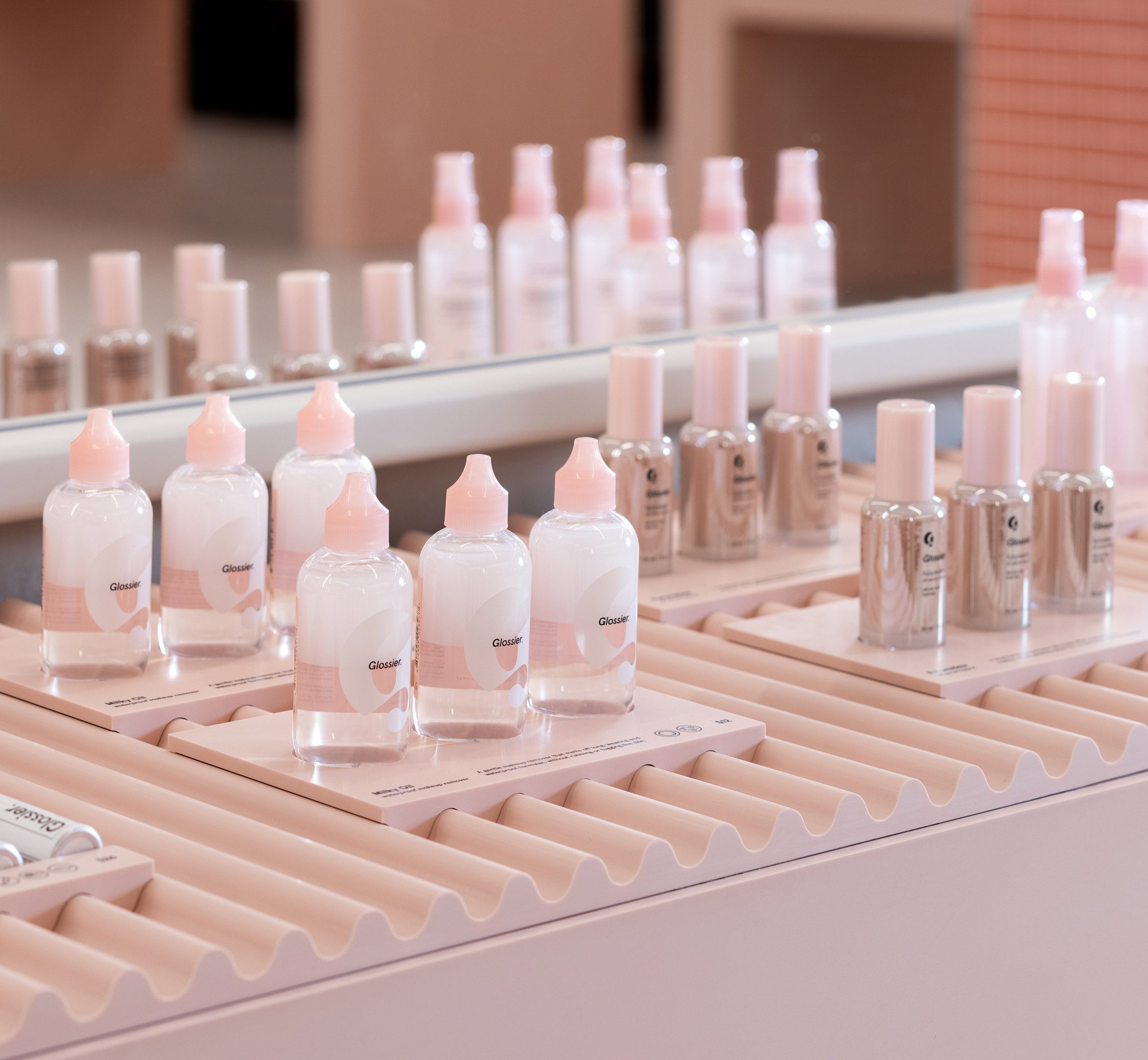
Beauty products are placed upon the rippled countertops
"Fungi have an astonishing ability to grow and thrive in the most unlikely places and we wanted to bring that phenomenon to life in our design concept," said the design team.
"Moss-covered rocks pierce through the store's foundation and gigantic, Willy Wonka-esque mushrooms sprout through the sleek, minimal architecture."
Surrounding the sculpture are pale-pink counters that display Glossier products on rippled surfaces.
Archways with filleted corners and pink-tiled sides divide the central area from the periphery, where more merchandise is placed beside mirrors for testing.
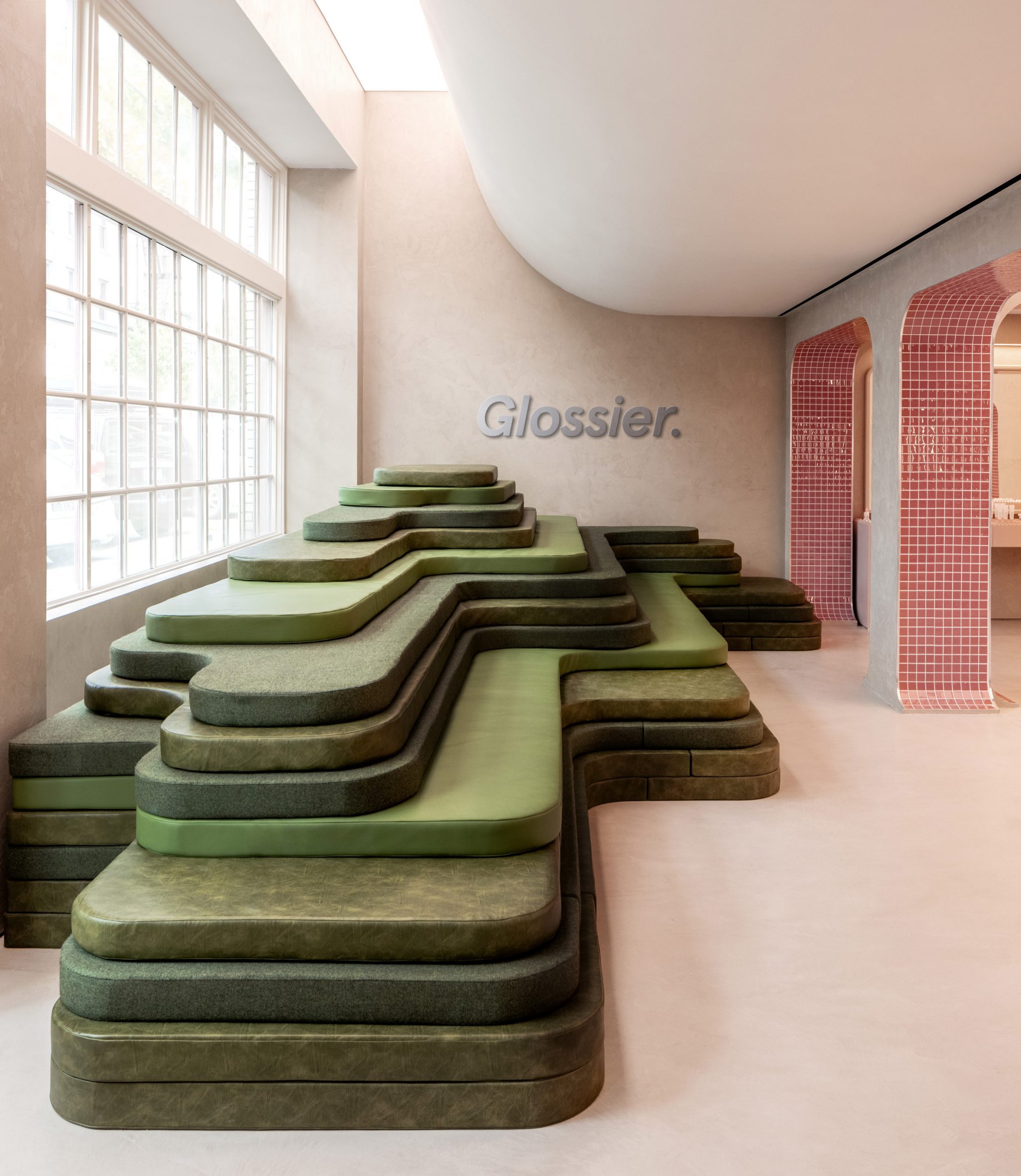
A communal seating area is designed to look like a terraced landscape
Beside the storefront's large windows, the form of a terraced hill is evoked by a stack of flat thin cushions upholstered in various green textiles and leathers.
Walls around the store are finished in a light-toned textured plaster, while a checkerboard of beige and dusty-pink tiles covers the floor.
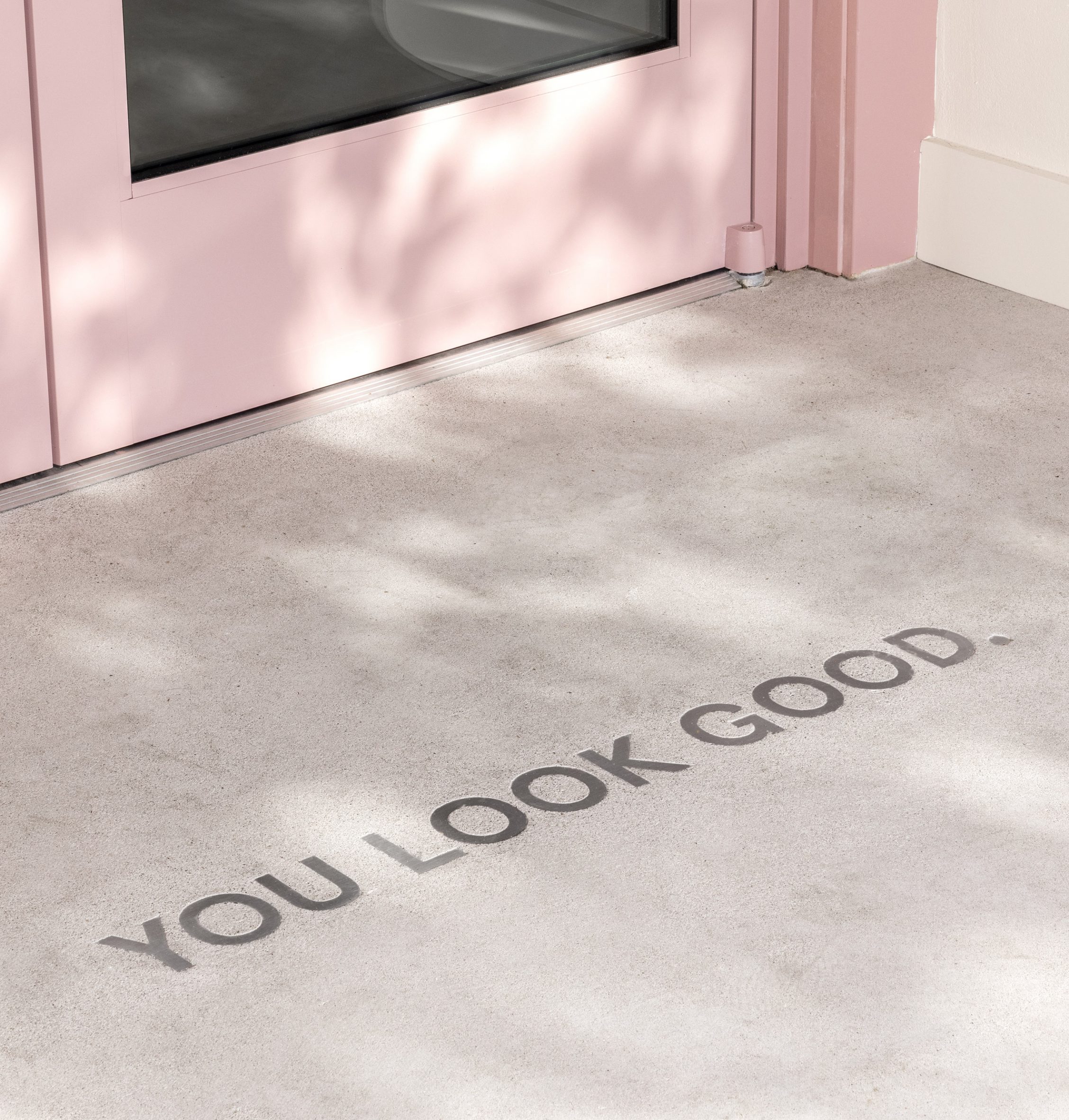
An affirmation welcomes shoppers into the store
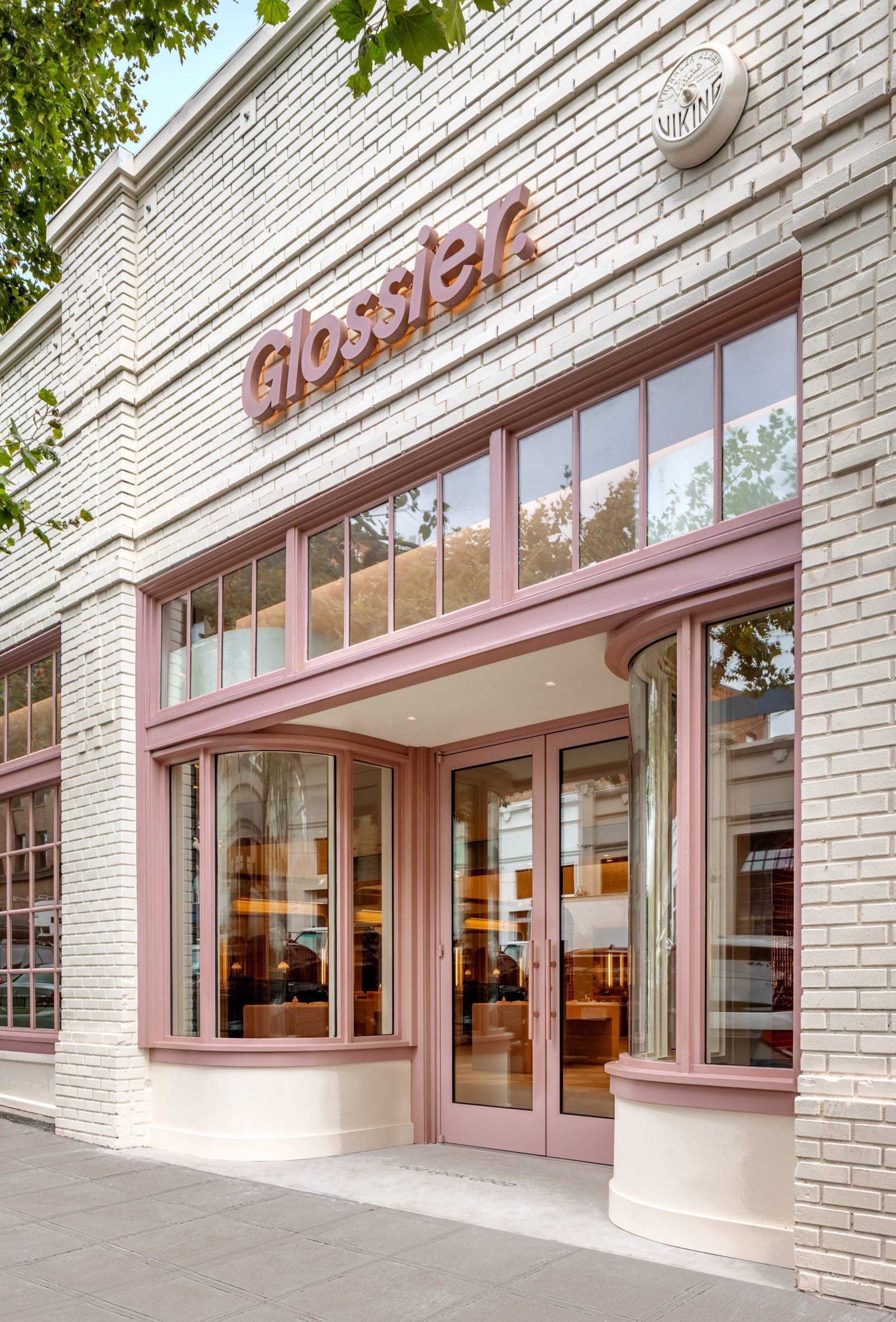
On the exterior, doors and window trims are painted a dark blush hue to match the Glossier logo and contrast the building's cream brickwork.
Glossier was founded in 2012 as an online beauty brand, but since opened several physical retail experiences – although all were closed last year due to safety concerns surrounding the Covid-19 pandemic.
Dark-blush window and door trims contrast the cream-coloured exterior
The Seattle store at 1514 10th Avenue marks the brand's return to physical retail, with outposts in Los Angeles and London both expected to open before the end of 2021.
Toy designer Luca Boscardin has transformed his colourful line drawings of wild animals into abstract life-sized metal versions for a public playground in Amsterdam.
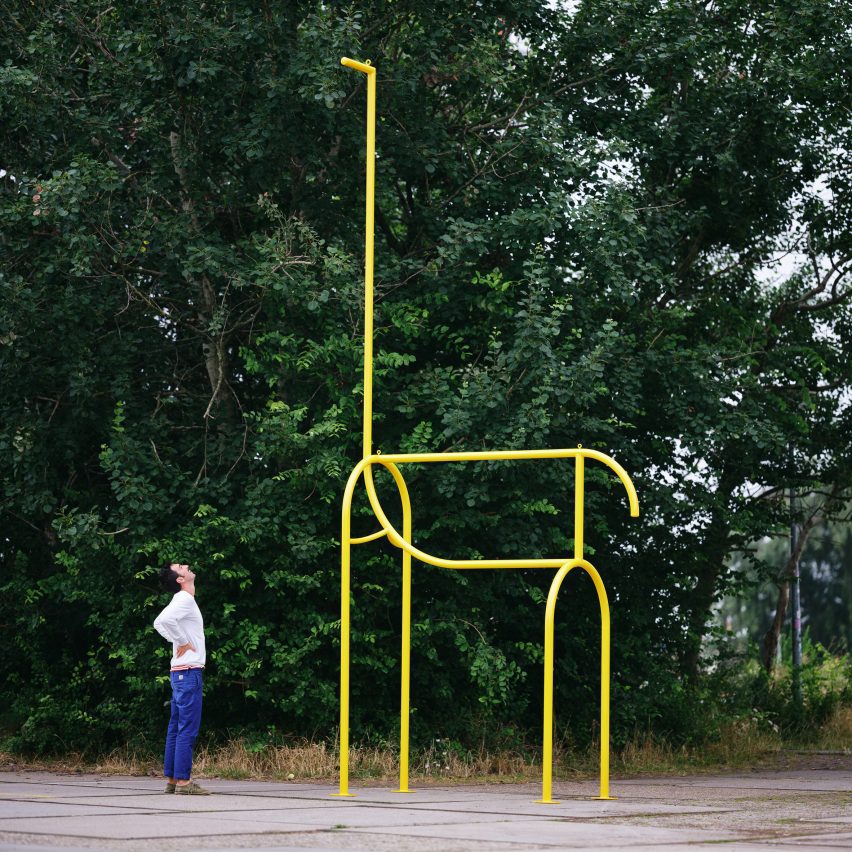
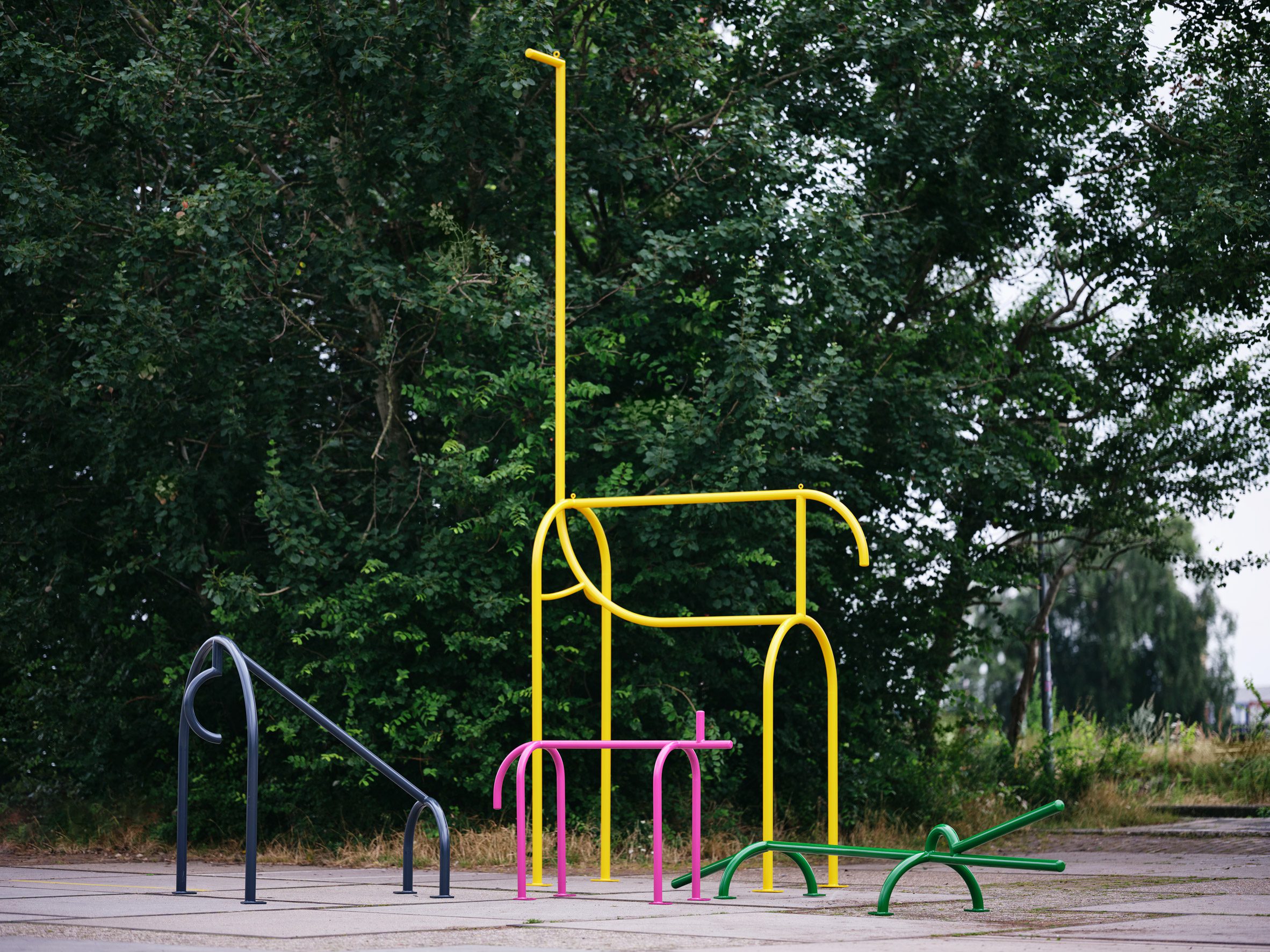
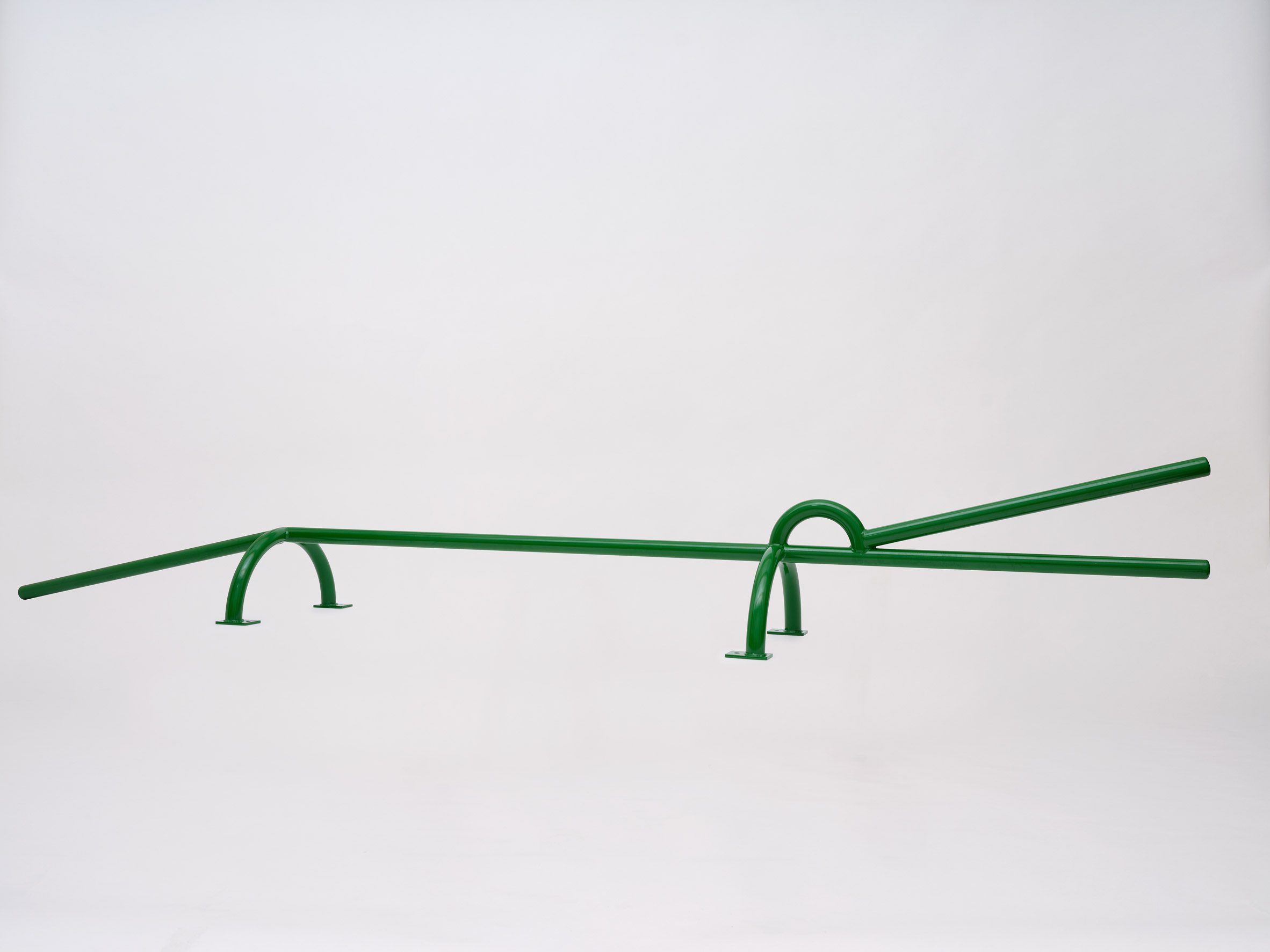
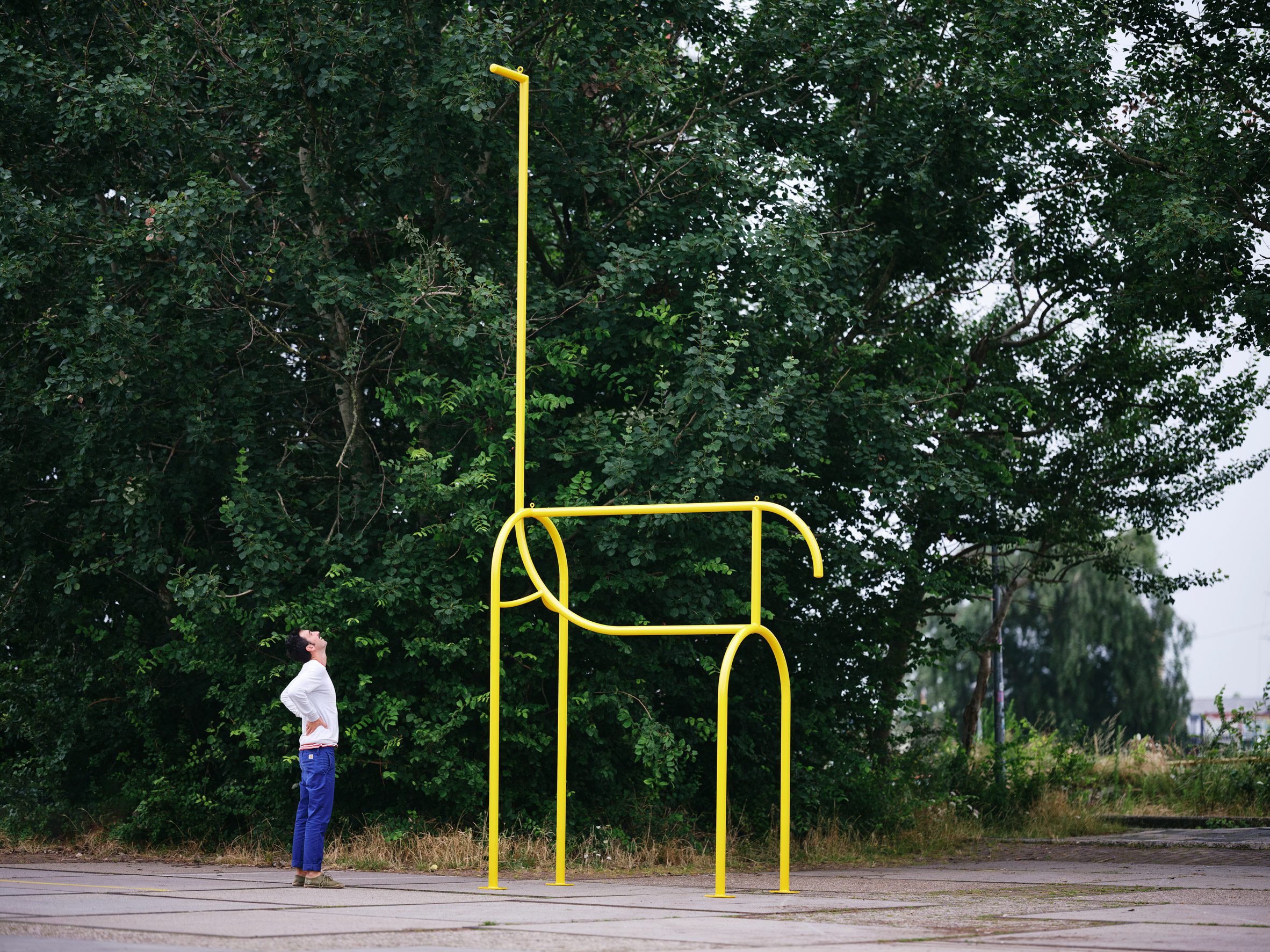
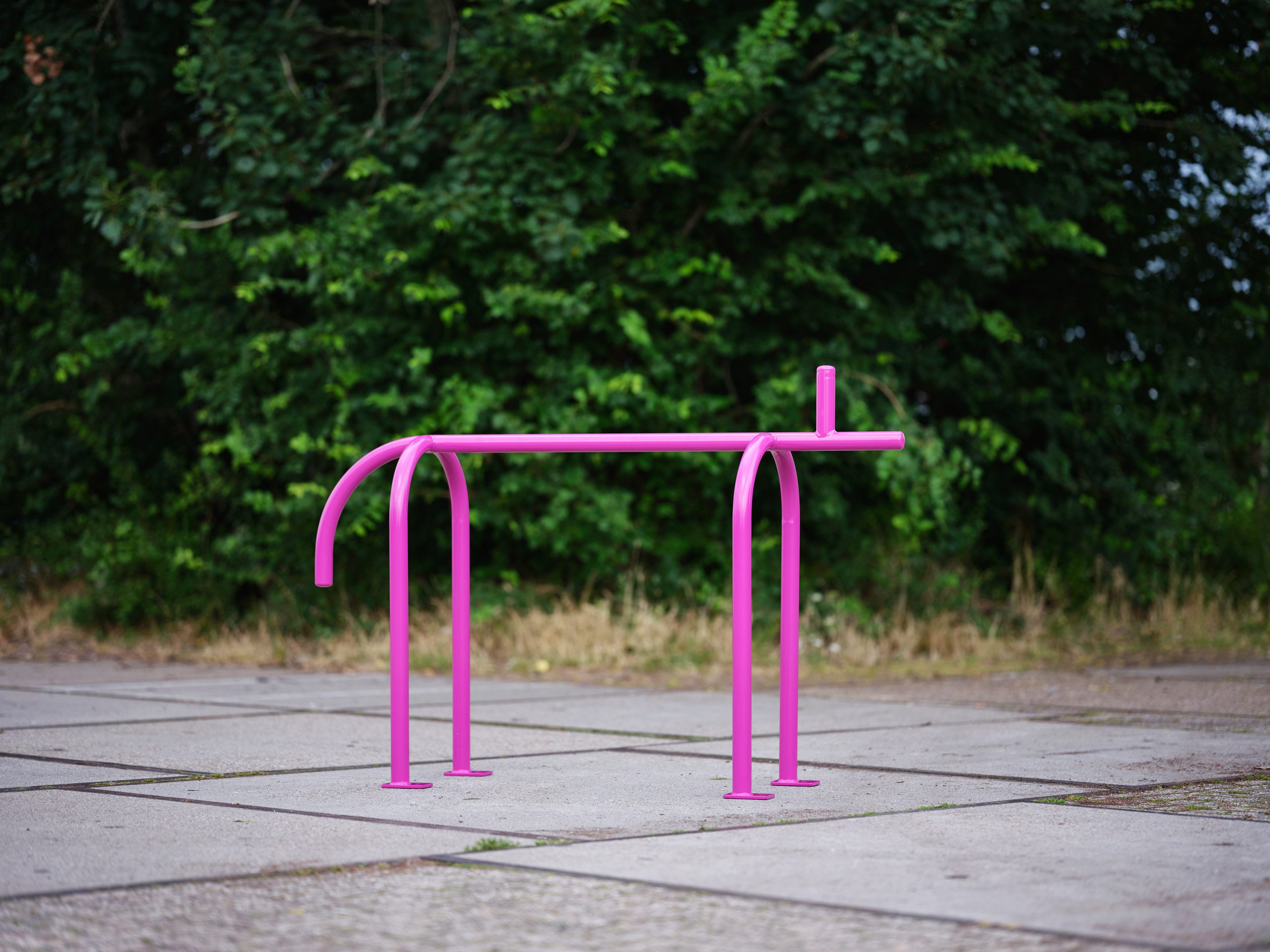
Called Animal Factory, the project includes four sculptures made of steel tubes that are shaped like a giraffe, a crocodile, a gorilla and a wolf.
The playground features life-sized sculptures of wild animals
Each metal sculpture is designed to echo the life-sized proportions of the animal that they represent, and is painted in a single bold colour.
The outdoor playground is located at the city's NDSM Wharf, a former shipyard on the banks of the River IJ that has developed into one of Amsterdam's cultural hotspots.
A few simple lines and the colour green create an abstract crocodile
"The idea behind the project was to create a bridge between fantasy and reality, natural and industrial," Boscardin told Dezeen.
"While from a certain angle the steel constructions do not seem to have specific shapes, when looking from another place the contours of, for example, a gorilla, are clearly visible. In this way, the animals form surprises in the industrial landscape," continued the designer.
Boscardin's project is the winner of the NDSM Open Call, an annual competition that invites creatives to submit a proposal for a public art project to be displayed on the wharf.
Animal Factory aims to be a versatile and interactive installation, which can be used not only as climbing frames for children, but also as an alternative place for adults to exercise or store their bikes.
All of the animals are painted in bright colours, like this yellow giraffe
Boscardin's initial design process began with sketching out a collection of colourful animals in minimal lines, which were then translated into sculptures with the assistance of steel carpenter Iwan Snel.
The toy designer explained that the way children communicate in simple universal signs and their ability to let their imaginations run wild have influenced much of his playful work.
Children and adults alike are invited to interact with the Animal Factory sculptures, including the pink wolf
"All children know that a red car is a Ferrari or a stick in your hand is a sword," said Boscardin, an Italian toy designer and illustrator based in Amsterdam. "In the same way, a few simple and tall yellow lines are a giraffe, and a green animal with a big mouth is a crocodile."
UK producers are trialling new types of cement production methods and testing low-carbon concrete recipes in a bid to eliminate carbon emissions and become a net-zero industry.
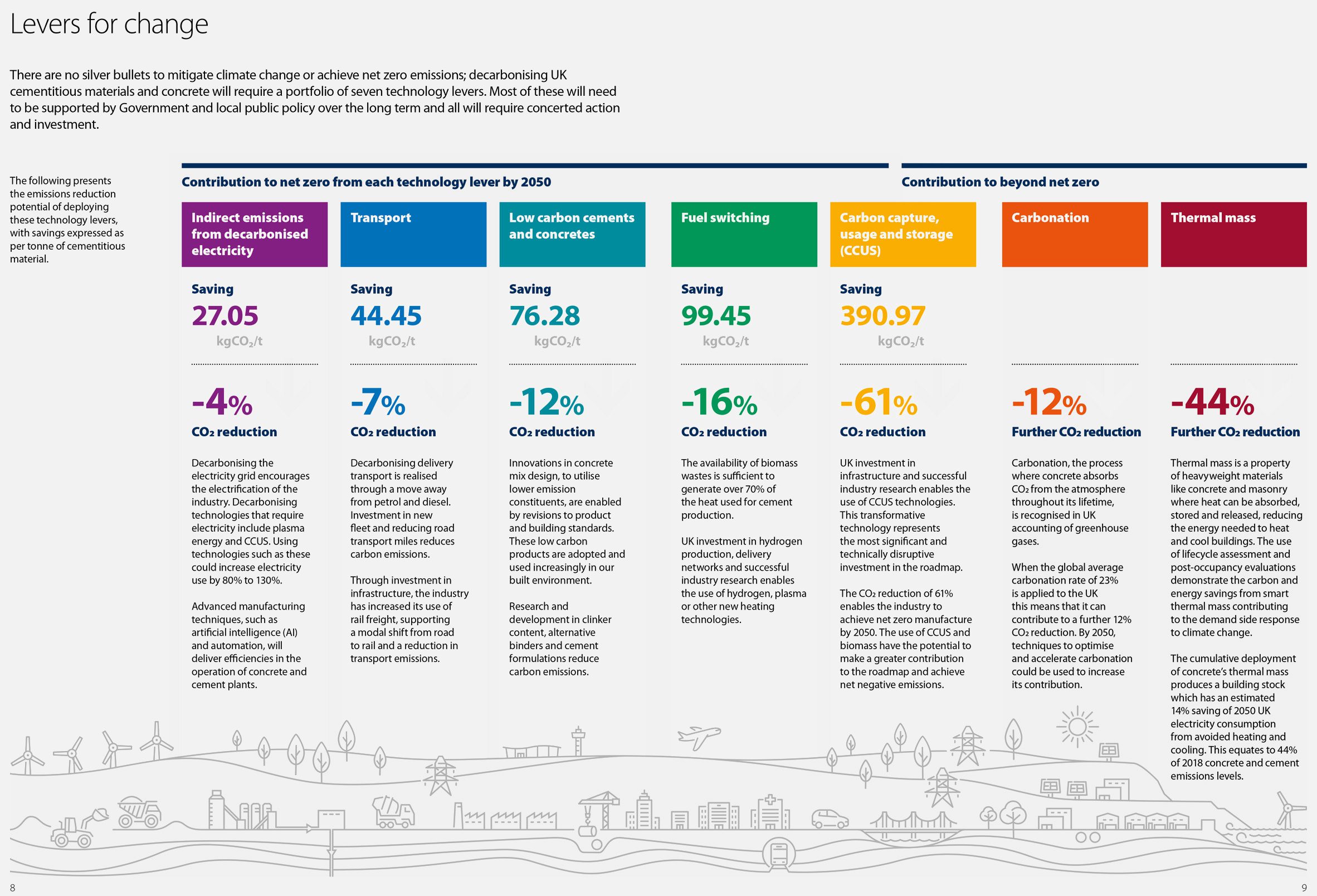
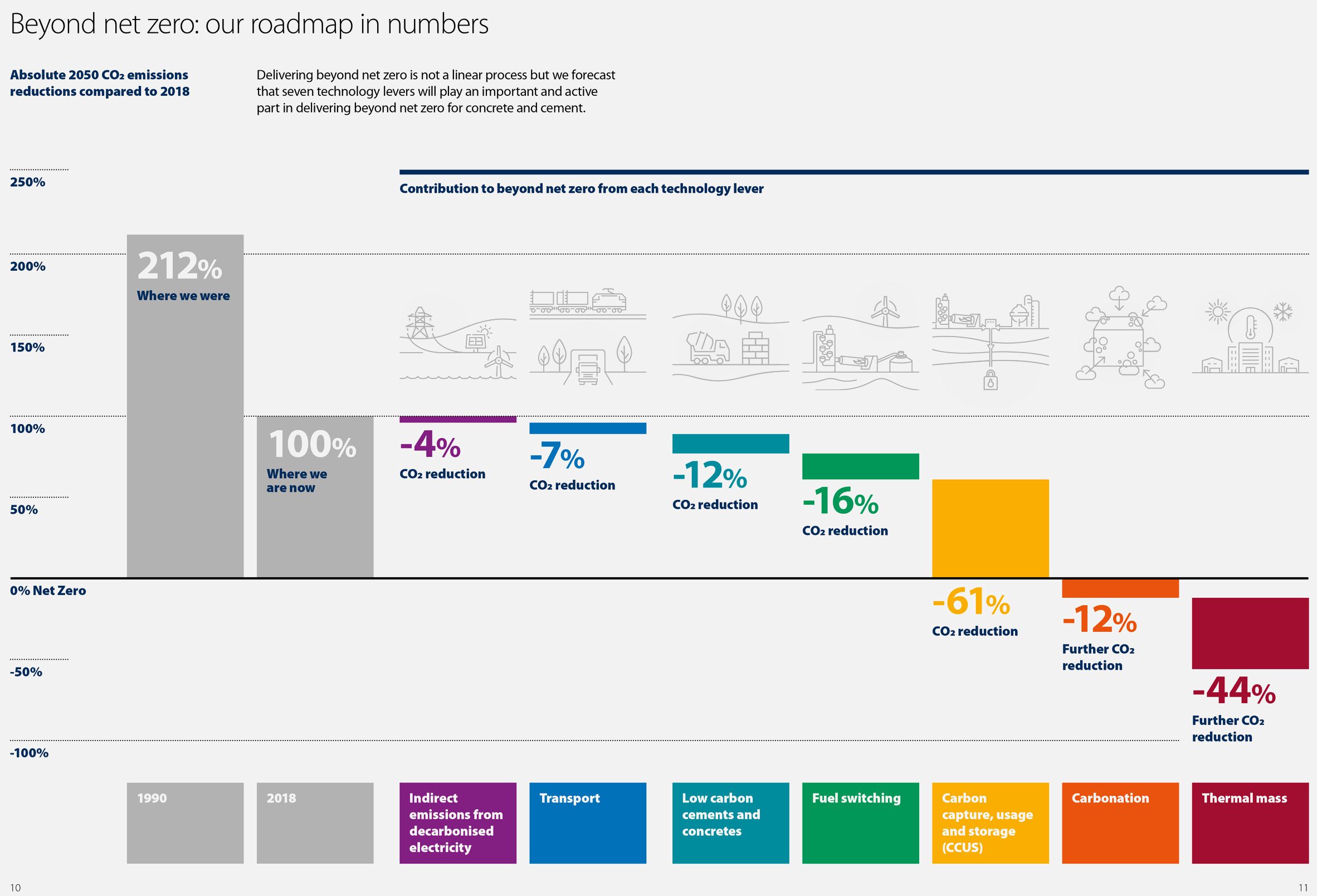
The moves are part of a roadmap that identifies seven ways of decarbonising the industry with the aim of going "beyond net-zero" by 2050.
These include running production plants and supply chains on renewable energy, making use of nascent carbon-capture technologies and taking into account the way concrete and cement structures absorb carbon over their lifetimes.
The industry "can actually go beyond net-zero if we have a fair wind and all the right enablers from governments and the technological development that we hope will occur," said Richard Leese, director of industrial policy at the Mineral Products Association (MPA), which represents the UK's cement industry.
"For our decarbonisation journey, clearly we've got to get the designers and structural engineers to take on board the new products," he added.
Cement is largest industrial source of CO2
The net-zero roadmap comes as the industry faces growing scrutiny over its emissions. A landmark 2018 report by Chatham House found that it is responsible for around eight per cent of global emissions, making it the single-largest industrial source of atmospheric CO2.
The roadmap identifies seven levers to decarbonise the UK cement industry
The document claims the UK industry, which produces 90 million tonnes of cement each year, has "already delivered a 53 per cent reduction in absolute carbon dioxide emissions since 1990."
This has been achieved by moving away from fossil fuels to power production and using "secondary cementitious materials" including industrial byproducts, such as fly ash and ground granulated blast furnace slag, to replace clinker made by burning limestone.
As a result, emissions from the sector today represent 1.5 per cent of all UK emissions rather than the eight-per-cent global average, the MPA claims.
Cement production "needs to be net-zero"
"We've done the low-hanging fruit," said Jenny Burridge, principal structural engineer at the MPA's Concrete Centre in London.
"We need to be net-zero," she added. "In order to get from one and a half per cent of the total to nothing is quite a big thing to have to try and do. So this is going to be the more difficult bit."
As part of the plan, the Hanson Cement plant at Ribblesdale in North Yorkshire is about to trial the use of hydrogen and biomass to power its kilns. The experiment will see the percentage of low-carbon fuels slowly increase up to around 30 per cent of the total fuel mix.
However, the gas used will be "blue" hydrogen, which is extracted from fossil fuels using a process that generates carbon emissions, rather than "green" hydrogen, a zero-carbon fuel that is extracted from water and powered by renewable energy.
A second plant is due to start a trial using electric plasma energy together with biomass.
"Both of these will be world firsts because nobody's truly tried it at commercial scale," said Leese.
Low-carbon cement and renewable energy use could reduce emissions
Switching cement production to renewable energy could reduce the industry's CO2 emissions by 20 per cent, according to the roadmap, while decarbonising transport could save a further seven per cent.
An additional 12 per cent reduction in emissions could come from new types of low-carbon cement. Traditional Portland cement contains clinker made from limestone, which is crushed and burned in a process that generates vast amounts of carbon emissions.
A roadmap shows how the industry can get "beyond net-zero"
The MPA has been trialling low-carbon cements that use alternative materials as clinker and hopes to get concrete certification standards changed so these can be used commercially.
"Test work has been carried out by the Building Research Establishment over the last couple of years," said Leese. "We're writing that up so we can change the concrete standard BS 8500 so those low-carbon cements can be used in the marketplace. So that's hugely important news."
A demonstration project showcasing concrete made from the new cements is due to be unveiled next month.
The biggest potential decarbonising levers are carbon capture and storage (CCS) and carbon capture and utilisation (CCU). These involve capturing CO2 before it reaches the atmosphere and either burying it underground or using it as an ingredient in materials and products.
If fully exploited, this could reduce emissions by 61 per cent, but CCS and CCU technology have a long way to go and costs need to fall dramatically before they are viable.
MPA and UK government working on carbon capture
The MPA is working with the UK government's Department for Business, Energy & Industrial Strategy (BEIS), which is identifying ways of capturing large quantities of CO2 captured from industrial plants and storing it in oil and gas fields beneath the North Sea.
"BEIS is developing the business models that will help to deploy not just the carbon capture at industrial plants but also the CO2 transportation infrastructure, the storage sites and the regulatory models around that," said Leese.
"The UK has got an abundance of potential CO2 storage sites," he added. "We're talking hundreds of millions of tonnes of CO2."
The initiative is similar to Project Longship, Norway's €1.7 billion scheme to bury up to 1.25 billion tonnes of captured CO2 in depleted North Sea fossil reserves.
"I guess they're a bit ahead of us in the deployment of carbon capture but all that knowledge is getting transferred to the UK so we can use it," Leese said.
The sixth decarbonising lever is carbonation, which is the process by which cement and concrete structures absorb atmospheric carbon through their surfaces.
This is something that already happens naturally but its impact has been overlooked, the MPA believes. If this was taken into account, it could knock 12 per cent off UK cement emissions.
"The uptake of CO2 in cement infrastructure (carbonation) offsets about one-half of the carbonate emissions from current cement production," according to the recent IPCC climate report.
"The key chapter in [the IPCC report] recognised concrete carbonation for the first time," Leese told Dezeen. "Now the international accounting needs to be updated to take account of the carbonation of concrete just so they can get the math right."
Concrete could become a carbon sink
The MPA is researching how much carbon is absorbed by different types of concrete and cement and exploring how to develop formulas that could help turn the material into a carbon sink rather than a carbon emitter.
"Concrete absorbs CO2," said Burridge. "We haven't been talking about it very much. But actually, that's one of the things that we're looking at at the moment."
Different types of concrete carbonate at different rates. Reinforced concrete needs to avoid absorbing carbon since carbonation corrodes the steel reinforcements, but products such as non-structural blockwork could be used to store carbon. "Blocks actually carbonate quite quickly," Burridge said.
Crushed concrete has even greater potential since it has a greater surface area that can absorb more CO2, Burridge said.
"There are huge arguments for not knocking a building down," she said. "But if you do knock it down, you should make sure that you crush the concrete up because then the carbonation happens quite quickly."
The crushed concrete can be recycled and used as aggregate, she added.
The Concrete Centre's Jenny Burridge
Cement is traditionally cured by adding water but alternatives are being developed that suck carbon from the atmosphere as part of the curing process.
"There are some types of cement that actually cure by absorbing CO2," Burridge said. "They're not in the mainstream yet but there are people doing work on cements that cure by carbonation."
The final lever in the MPA roadmap is thermal mass, which it claims could lead to an additional 44 per cent reduction in emissions and help make the UK cement sector a net absorber of atmospheric carbon.
The MPA's argument is that concrete's high thermal mass means the material can help regulate interior temperatures, thereby lowering energy use, which means fewer emissions from the energy grid.
UK to decarbonise power grid by 2035
However, the UK's carbon budget commits the nation to decarbonising its power grid by 2035, by which point it must rely on renewable sources and nuclear.
The MPA counters by arguing that reducing the energy needs of buildings will play a vital role in minimising the cost of the energy transition.
"The Committee on Climate Change told the government that the electricity grid needs to be at least twice, if not three times the size of the current electricity grid by 2050," Leese said, referring to the CCC's Sixth Carbon Budget, which was published last year and became legally binding in June.
"So the cost of that infrastructure and the cost of managing the intermittency [balancing fluctuations in power generation with fluctuations in demand] of renewables is huge. And that will no doubt be the biggest cost for society moving towards net-zero."
Net-zero means that a project or organisation makes zero contribution to atmospheric CO2 across its entire value chain. Any emissions that cannot be eliminated must be offset using credible schemes that remove carbon from the atmosphere.
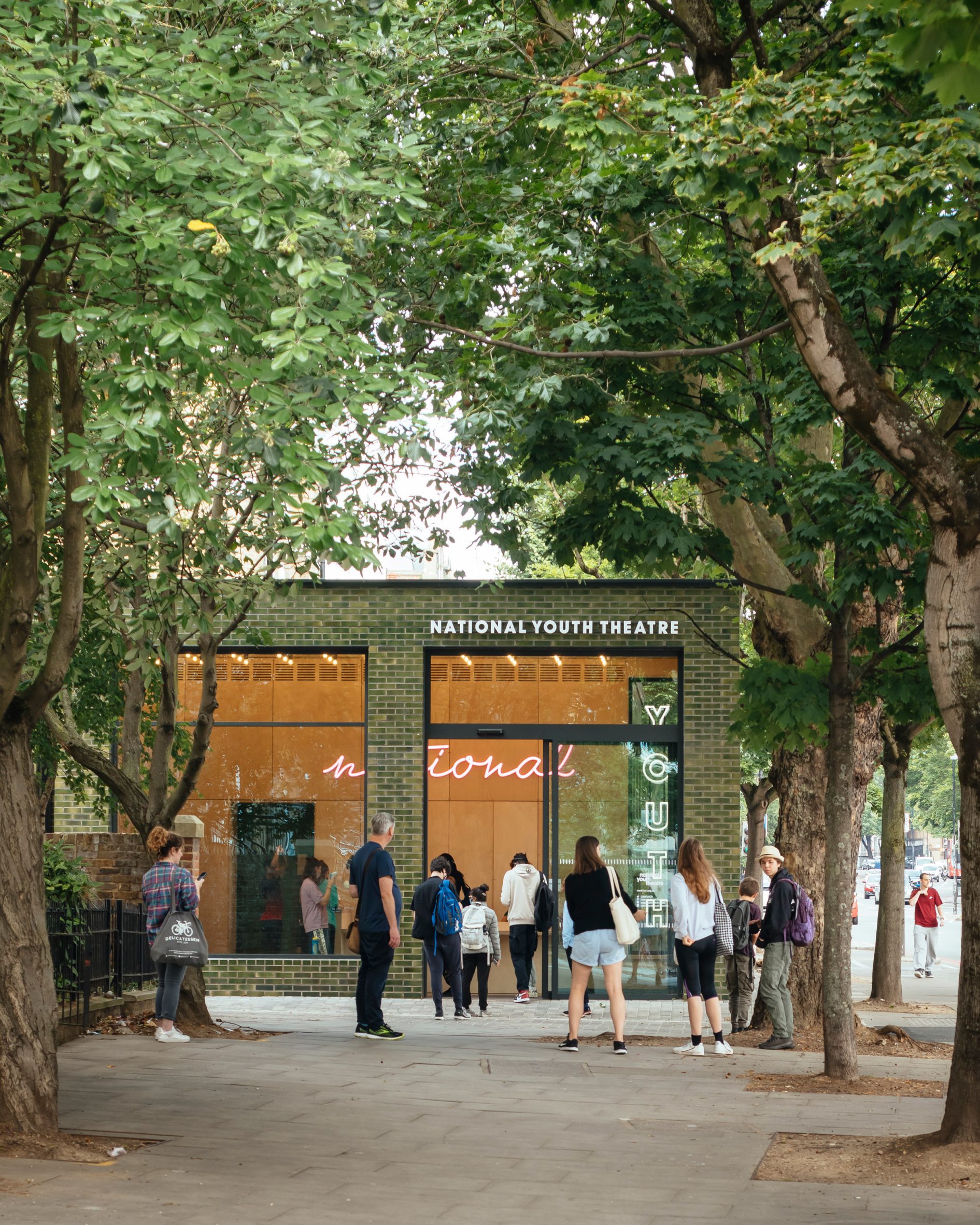
Architecture studio DSDHA has renovated and extended the home of the National Youth Theatre in north London.
The studio revampede the National Youth Theatre's existing premise on Holloway Road to improve its facilities and give the organisation a greater street presence.
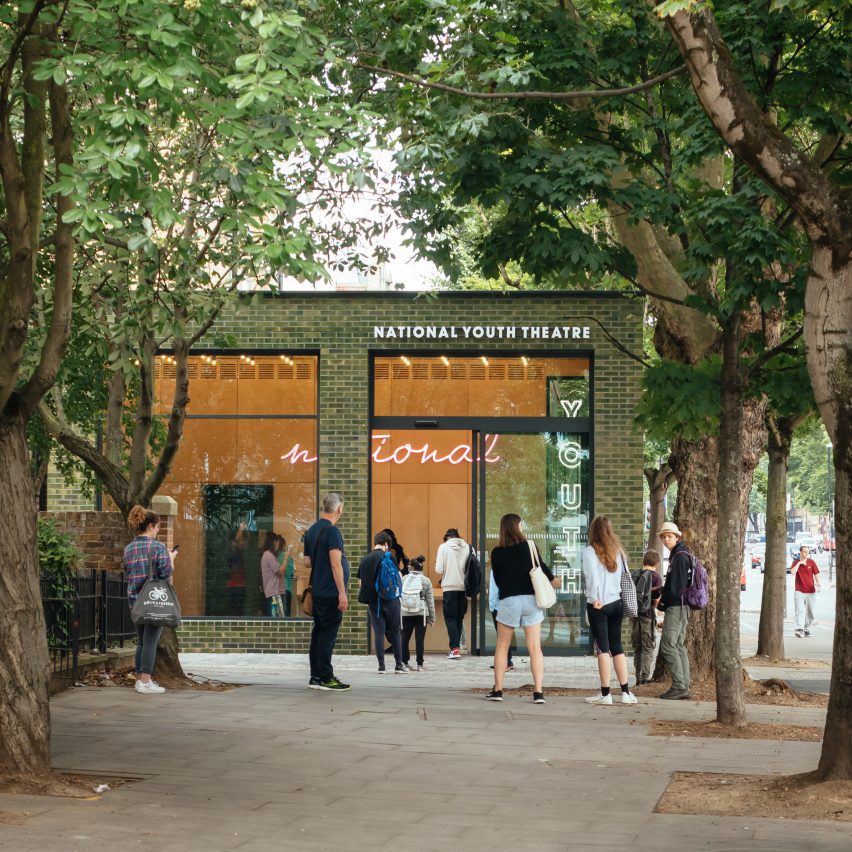
The extension creates an entrance to the National Youth Theatre on Holloway Road
"We aimed to equip the National Youth Theatre with a sustainable future on Holloway Road to celebrate their presence both locally as well as nationally," DSDHA co-founder Deborah Saunt told Dezeen.
"We wanted to create an accessible and inclusive space that would feel welcoming to its members and to provide the charity with the capacity to meet the increasing demand for workshops and training opportunities," she continued.
"As state schools have lessened access to the arts in recent years, its role is more crucial than ever."
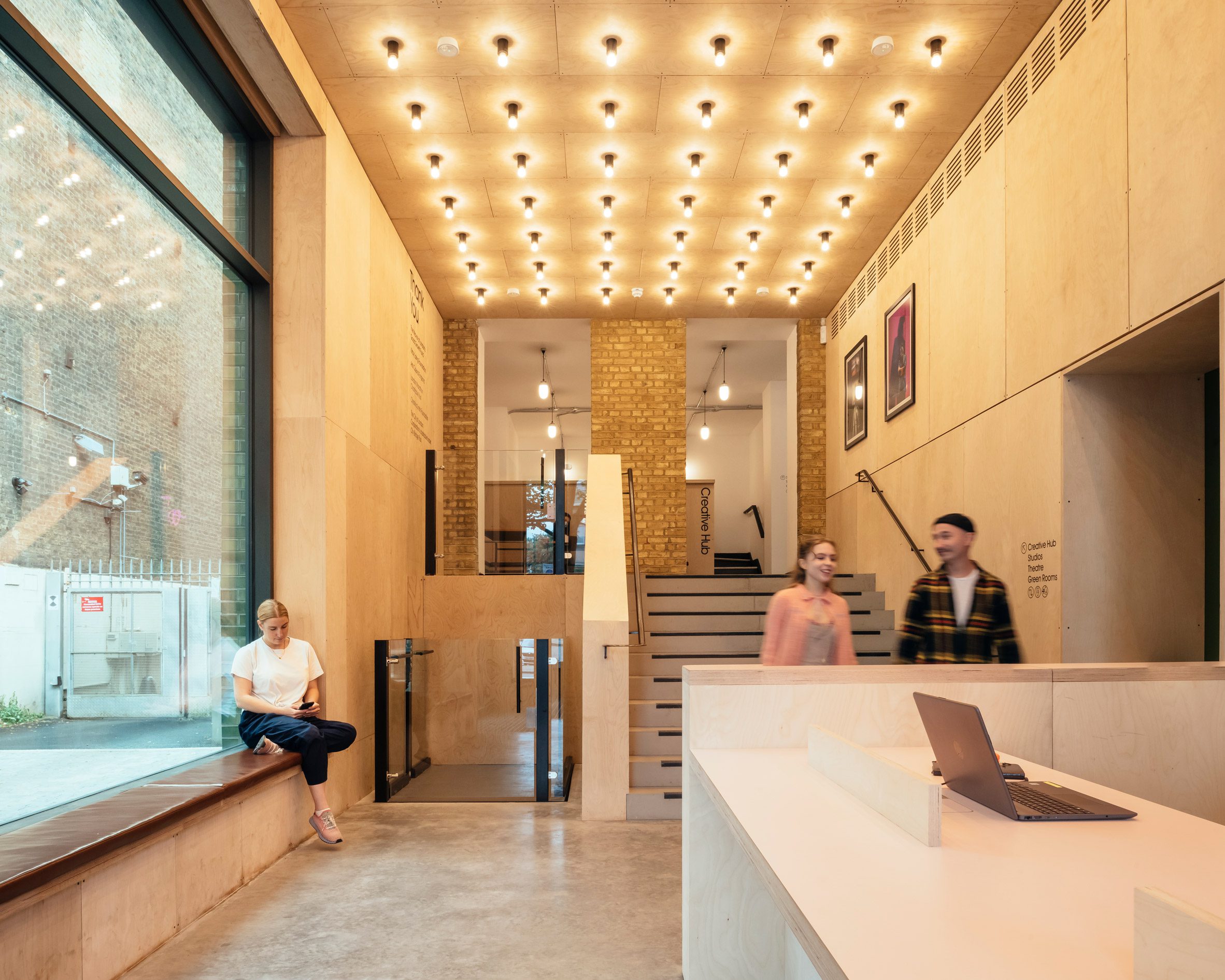
A reception area is contained within the extension
The most visible alteration is the addition of a single-storey extension at the front of the building, on the site of previous car parking spaces.
Clad in green glazed bricks to recall the facades of local pubs, this block contains the building's entrance, which was previously located off the major thoroughfare on a side lane.
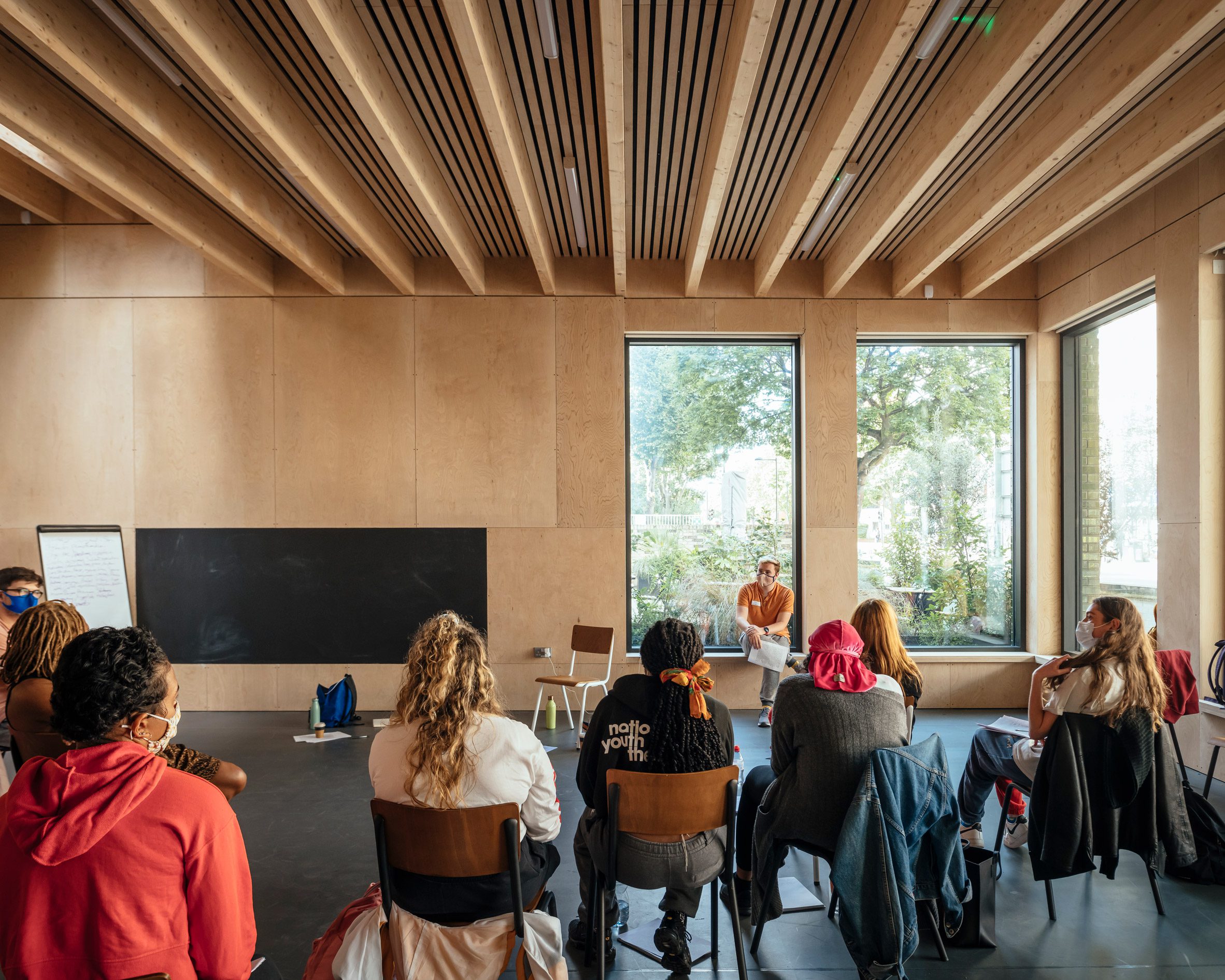
Know as the Green Room, this extension contains the organisation's reception, a members' hub and a community studio space.
A community studio space was also built within the extension
"The introduction of a new pavilion on the street provides a welcoming and truly accessible front door," DSDHA co-founder David Hills told Dezeen.
"Whereas previously visitors had to enter the building via an adjacent alleyway, the new entrance reclaims the former car park facing directly onto busy Holloway Road and instead offers a generous, transparent oasis which dignifies its context and brings with it a much-needed sense of community."
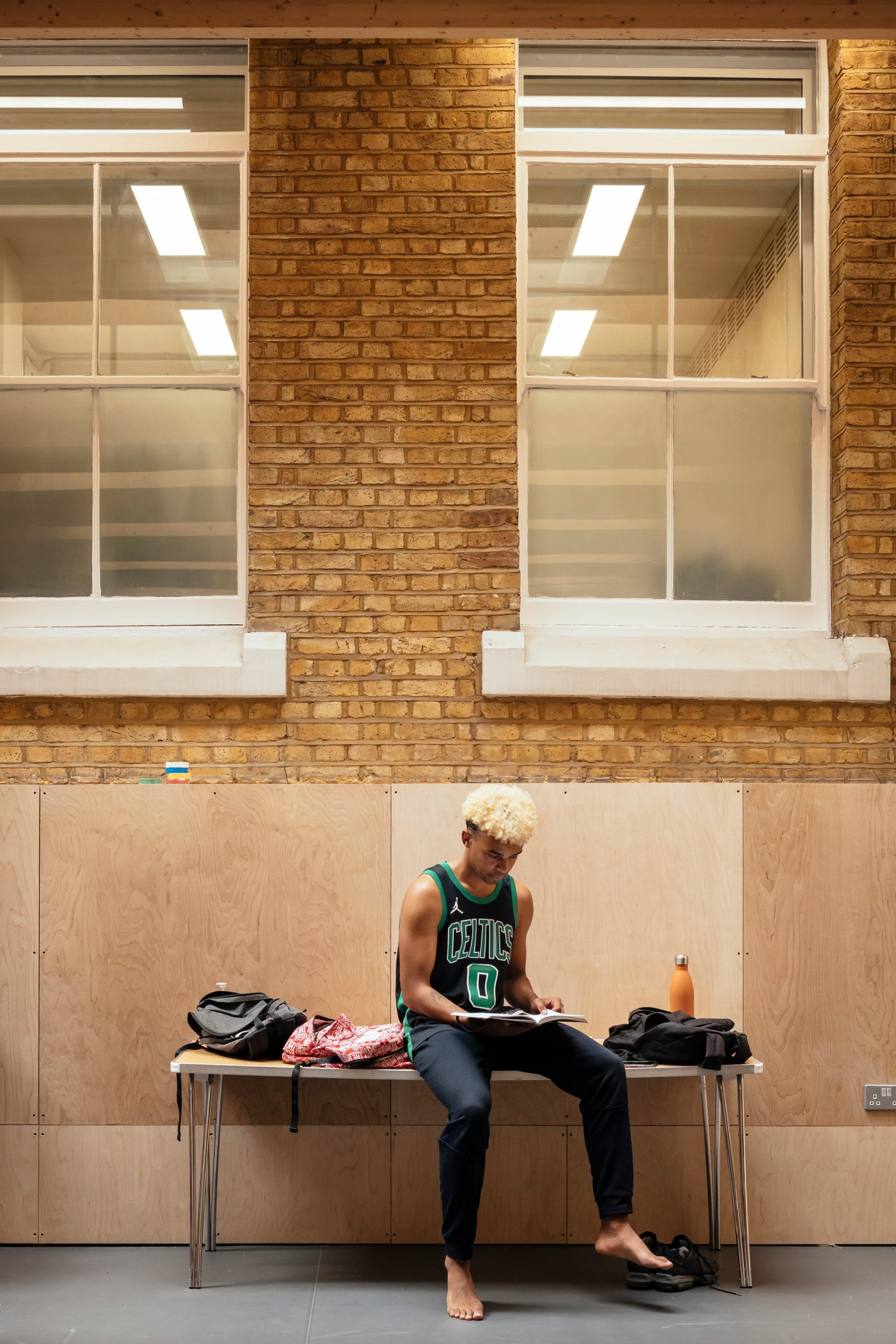
The renovation retains much of the original building
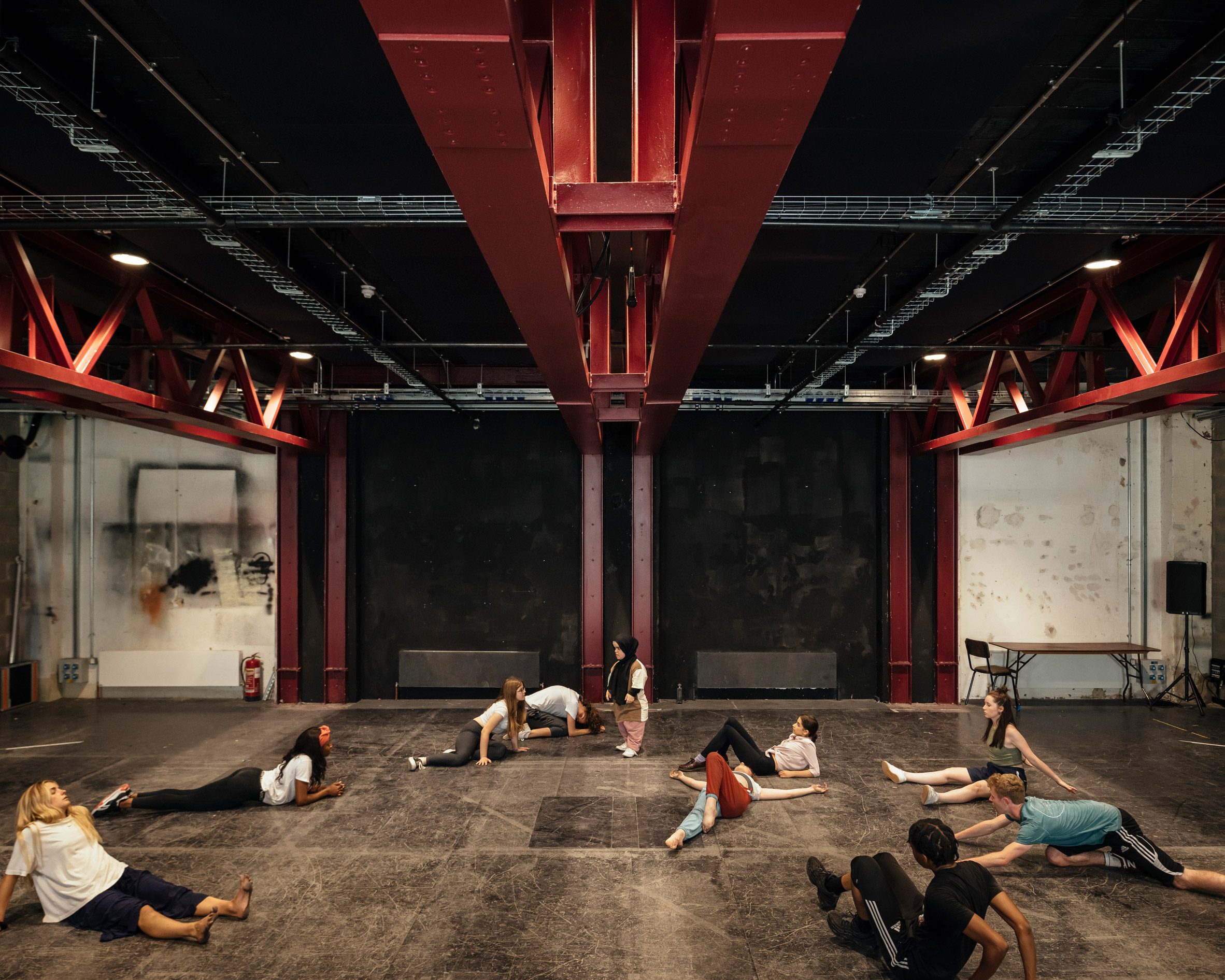
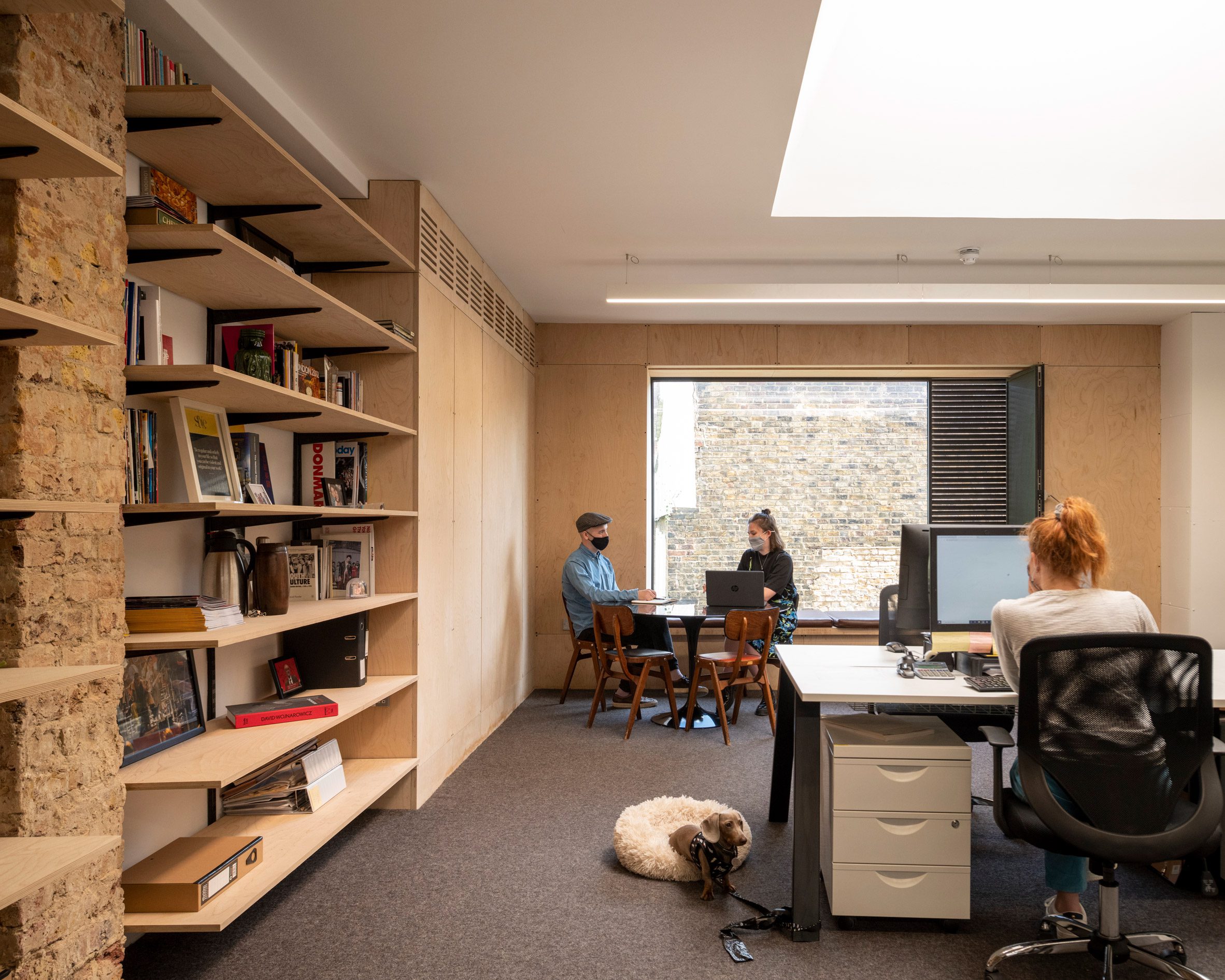
Within the original building, DSDHA relocated staff offices from the ground floor to the second floor to create a series of additional rehearsal spaces.
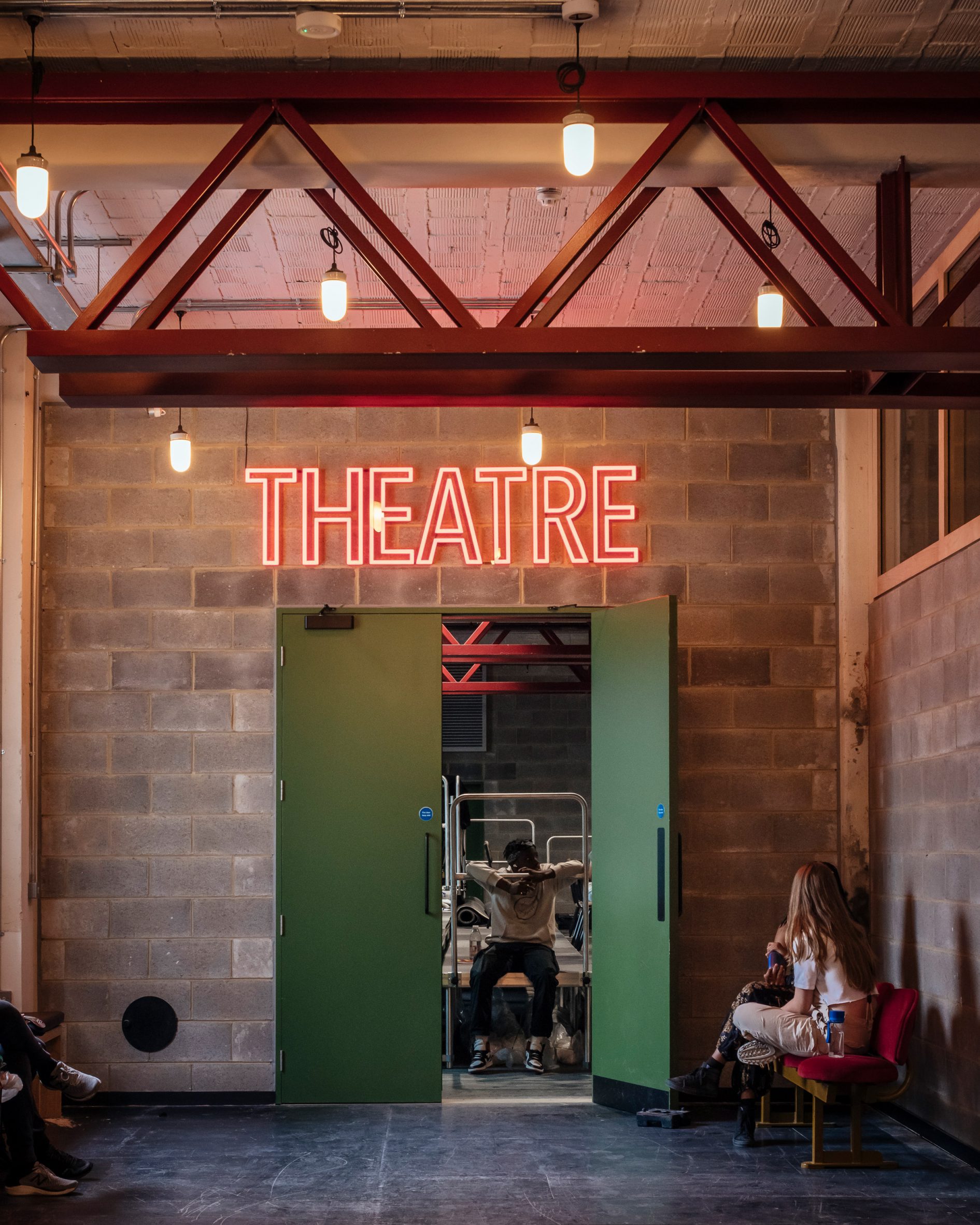
A 250-seat theatre was also created to allow the National Youth Theatre to host large performances on the site for the first time.
Throughout the renovation, the studio consulted with young members of the theatre to determine the design.
These discussions led, in part, to retain much of the original aesthetic of the existing building and the inclusion of numerous spaces for informal gathering.
Numerous rehearsal and performance spaces were created
"Engaging with young people is at the heart of NYT's ethos and operation," explained Hills.
"Workshops revealed the interest in retaining and building on the character of the existing 'as found' fabric of the original structure," he continued.
"Internally, the raw finish of the space provides a neutral backdrop to foreground activities and people."
A theatre for NYT performances was created
Members of the National Youth Theatre also drove the redevelopment's accessible agenda.
"The collaborative process influenced the redesign of spaces to be flexible and accommodating to everyone's needs," continued Hills.
"The decision to include gender-free toilets, as an example, was a result of this engagement."
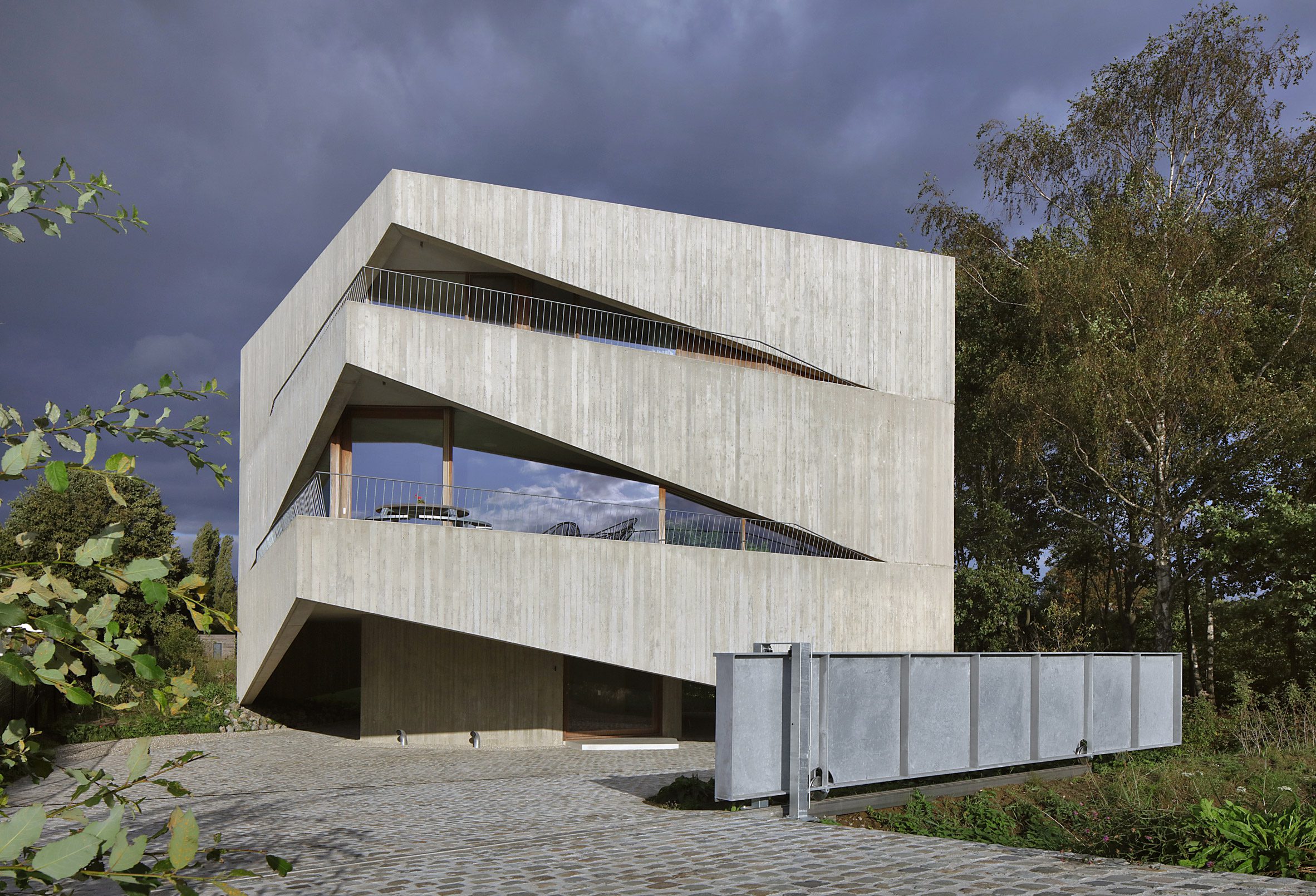
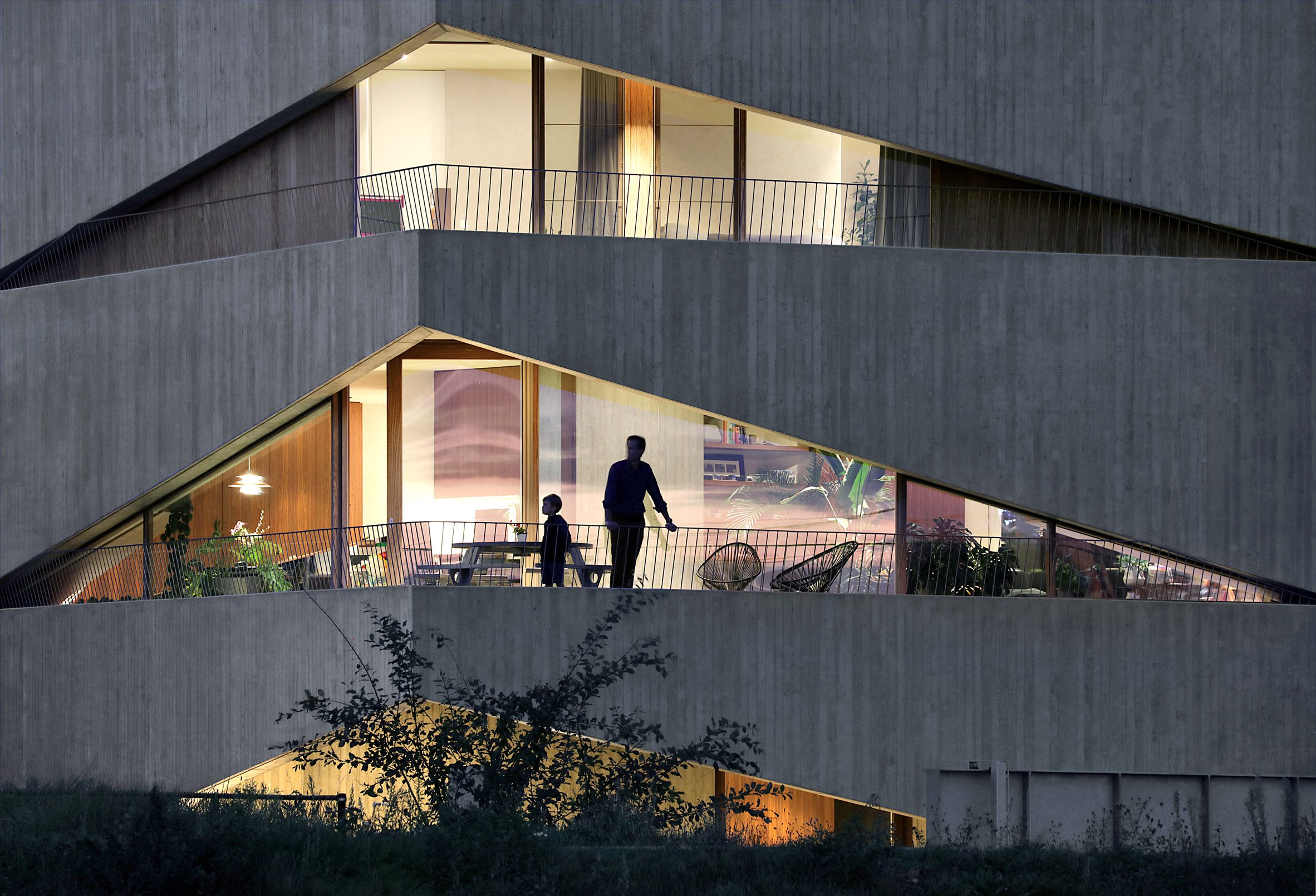
The Ghent-based practice designed House N-DP to provide privacy from passers-by, while also opening out to views of the surrounding fields and the Vaart canal with large angular windows.
Graux & Baeyens designed this concrete house in Belgium
"Each storey is set back in relation to the previous one and has been superimposed at a slightly shifted angle, with the intention of creating privacy and a sense of security for the residence," explained the practice.
"A seemingly random play of concrete canopies opens and closes the facade, creating a pleasing impression of introverted openness."
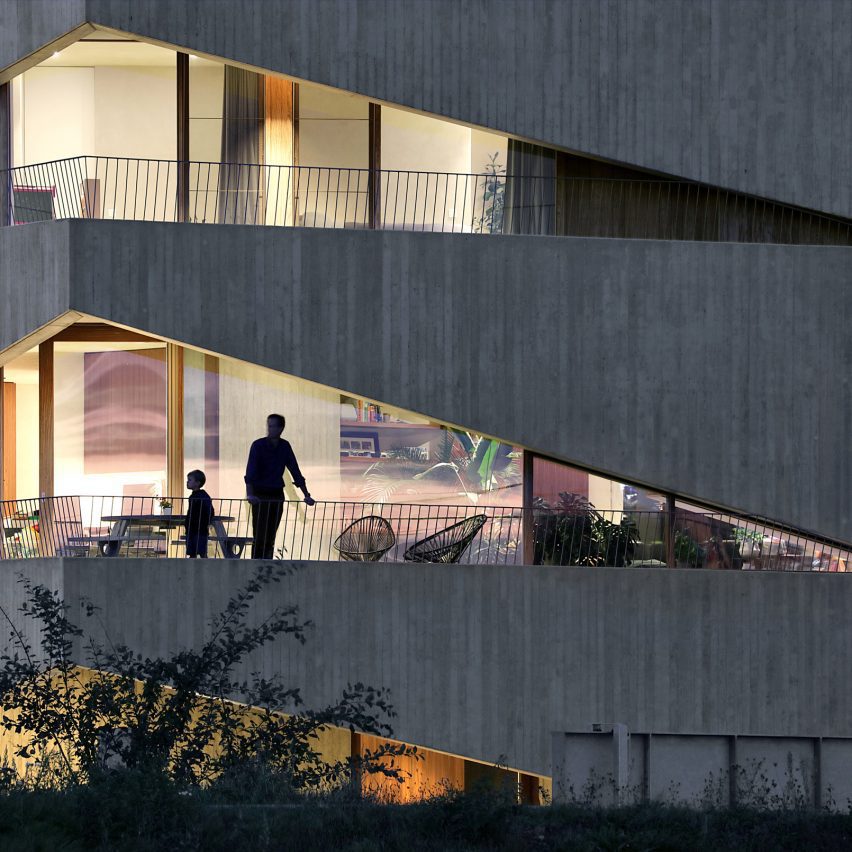
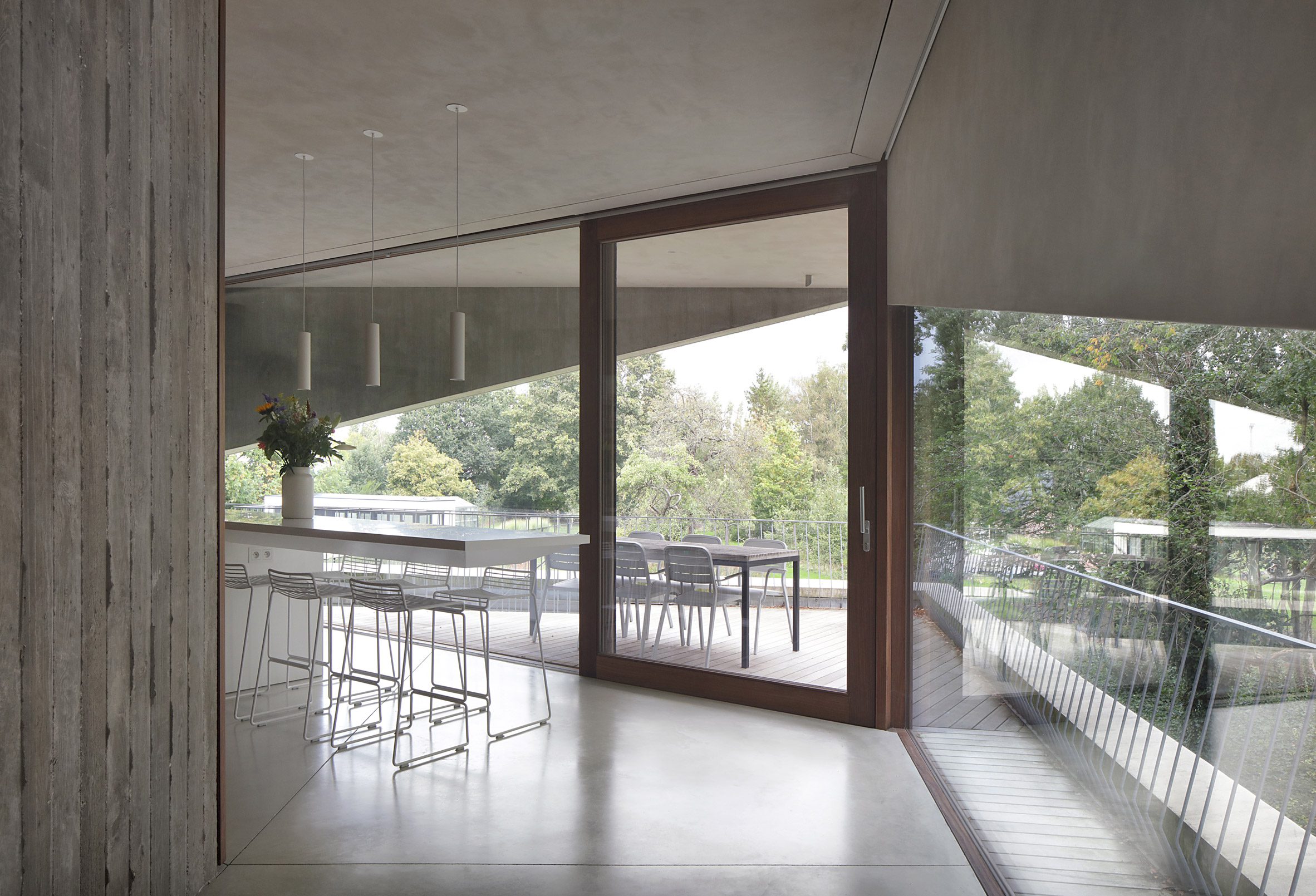
Triangular openings form balconies next to spaces including the kitchen
On the ground floor, a setback concrete core creates an open space for car and bicycle parking beneath the overhang of the floor above. The rough concrete envelope extends downward to conceal the large front door from view.
Alongside a bathroom and cloakroom, this core houses the central staircase that connects the three levels of the home, while an external metal staircase gives direct access to the first-floor terrace.
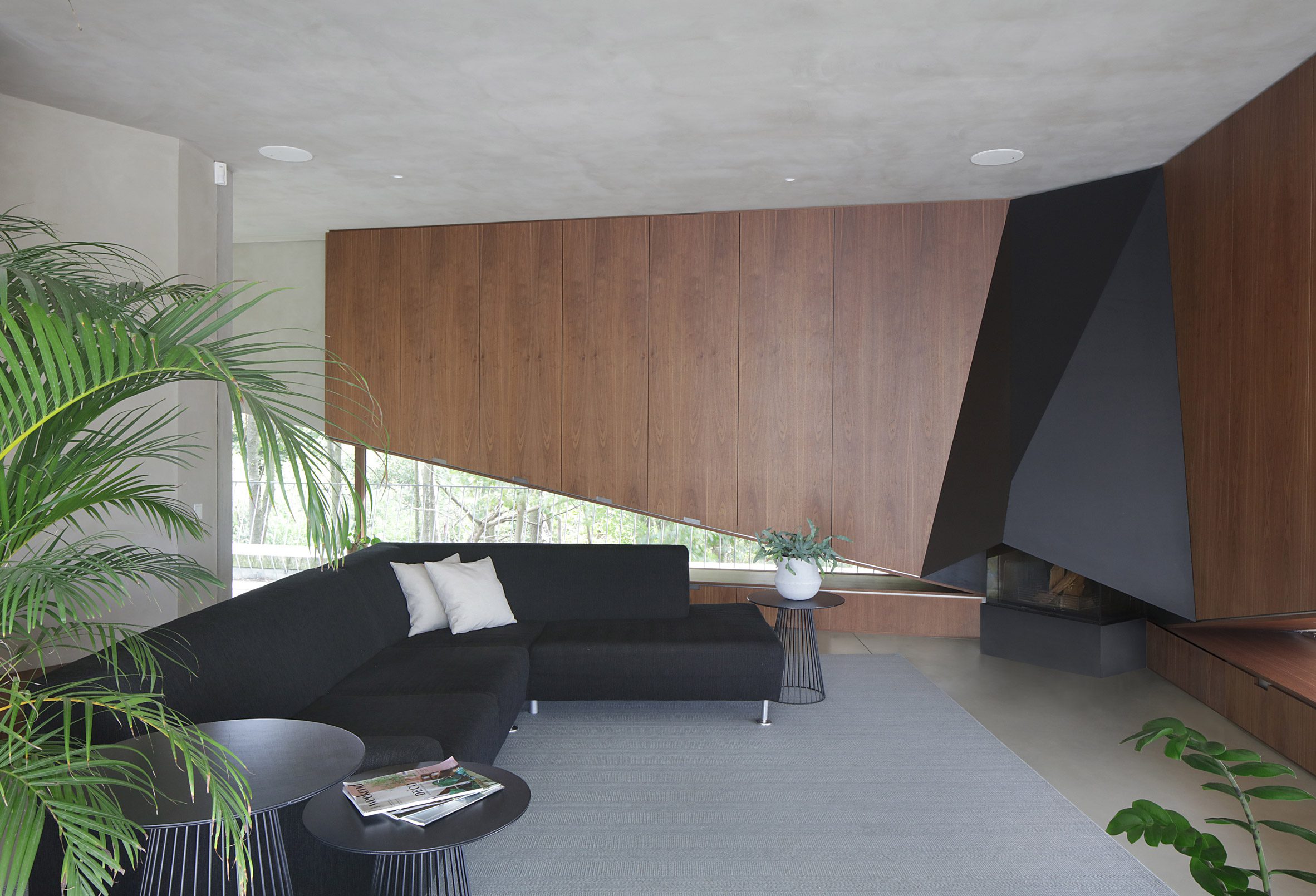
Cosier spaces like the living room are situated at the back of the home
The roughly square plan of the home creates two glazed, open corners and two more introverted corners opposite one another on each floor. Triangular windows create a gradation of views between these contrasting conditions.
On the first floor, a dining space and lounge with a fireplace are tucked into the darker corners, while the kitchen and an additional seating area open out onto bright external terraces.
"The kitchen is bathed in the morning sun, while the living room with adjoining terrace catches the last ray of the sun," said the studio.
Above, the bedrooms take advantage of the bright corners and their terraces, with the bathrooms, study and linen closet tucked into the more "introverted" areas.
The interior finishes are a continuation of the raw concrete and wooden frames visible on the exterior, which is combined with clay plaster in some areas to create a simple, "tranquil" interior.
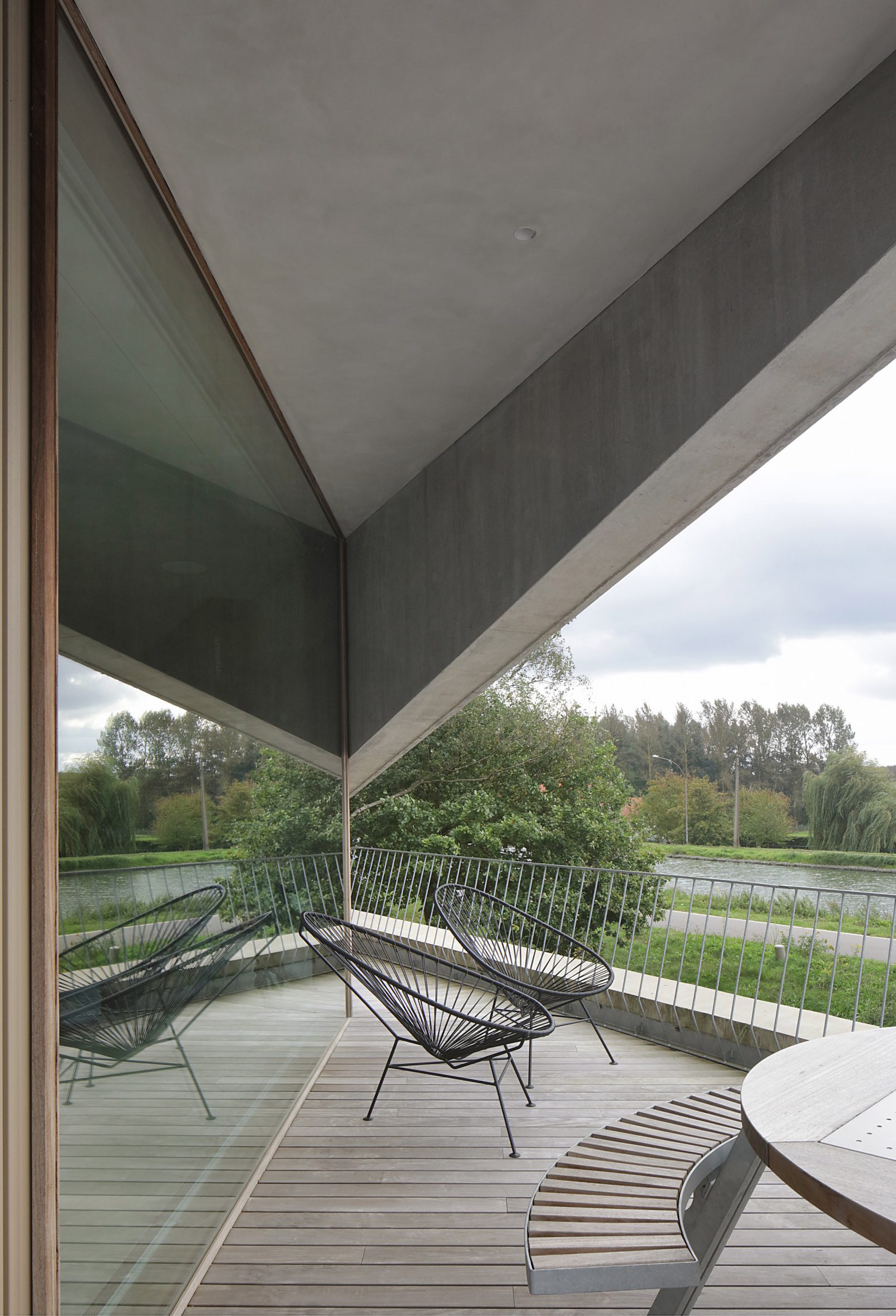
The balconies are sheltered by the concrete envelope
Custom-designed fittings reference the angular form of the building. These include a faceted metal fireplace hood and storage unit that follows the form of the triangular windows, creating areas of window seating beneath sloping cupboards.
The metalwork of the slim steel balustrades and external staircase has also been specially designed for the home, as well as a large gate that wheels along a steel track at the home's entrance.
The slices from the square plan illuminate at night
"We deliberately did not work with modern glass, but with galvanised steel," said the practice. "This aligns the enclosure and the breaches in the facade with the human scale of the residents, in an otherwise imposing building."