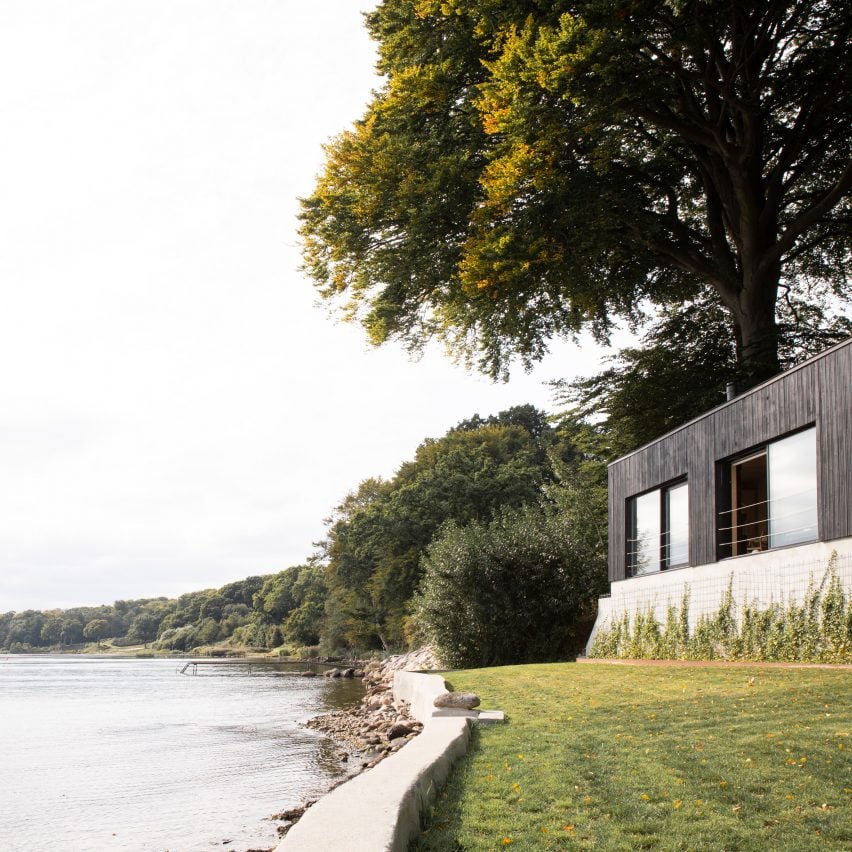
Inviting oak-lined rooms lay behind the black facade of Fjord Boat House, a lakeside holiday home designed by Danish practice Norm Architects.
Fjord Boat House perches on a concrete plinth beside the water and is largely imperceptible from above, thanks to its grass-topped roof.
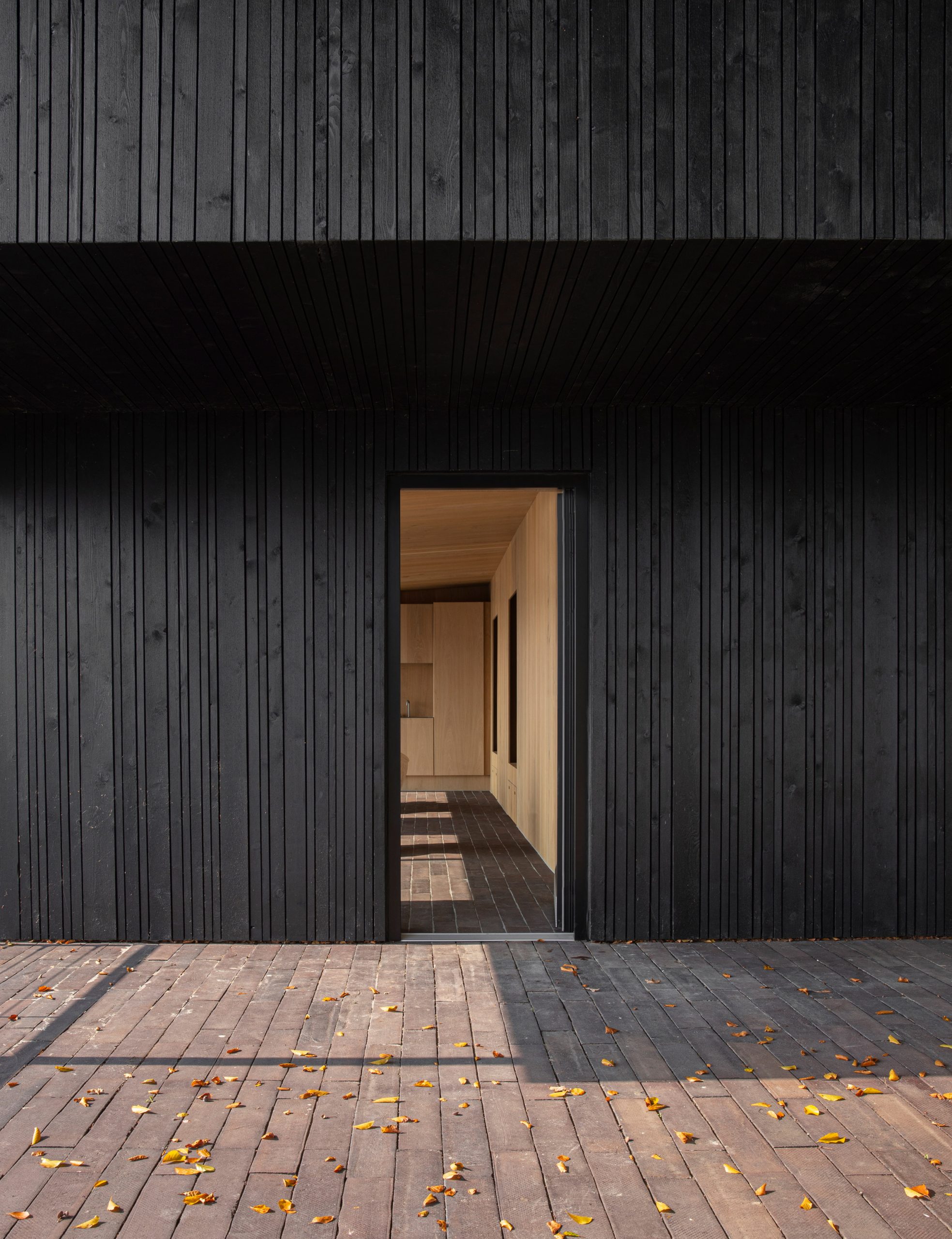
Top image: exterior of Fjord Boat House. Above: black timber beams clad the house's facade
The rest of its exterior is clad with blackened beams of timber, but inside this gives way to a much warmer material palette.
"A refined abundance of warm textures and hues are used throughout, creating a deep sense of cosiness and comfort," said Norm Architects, which is based in Copenhagen.
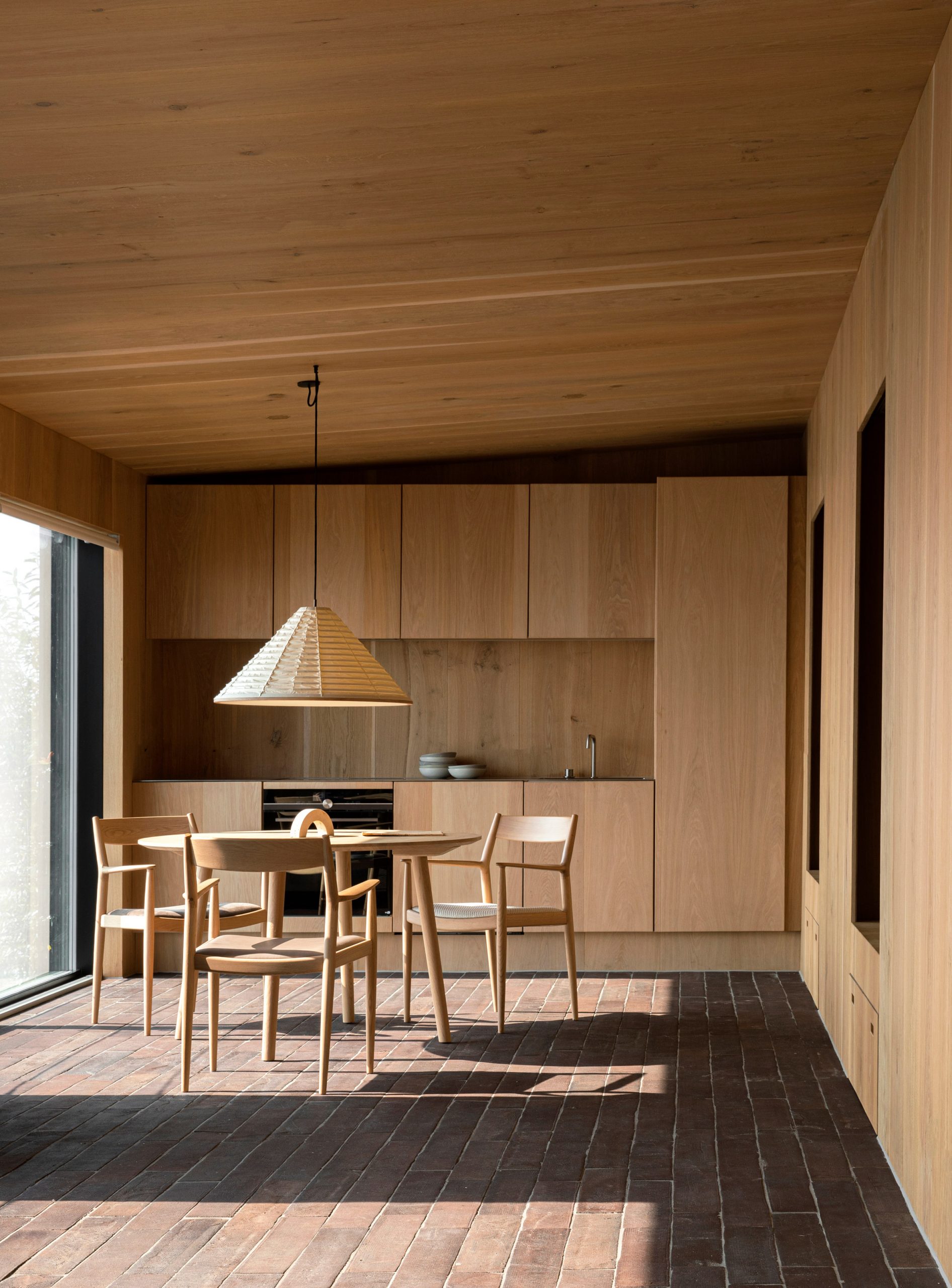
Oak cabinetry and brick floors feature in the kitchen
In the kitchen, oak has been used to craft handleless storage cabinets and the splashback.
Oak also lines the surrounding walls and ceilings, while the floor is inlaid with handmade ceramic bricks.
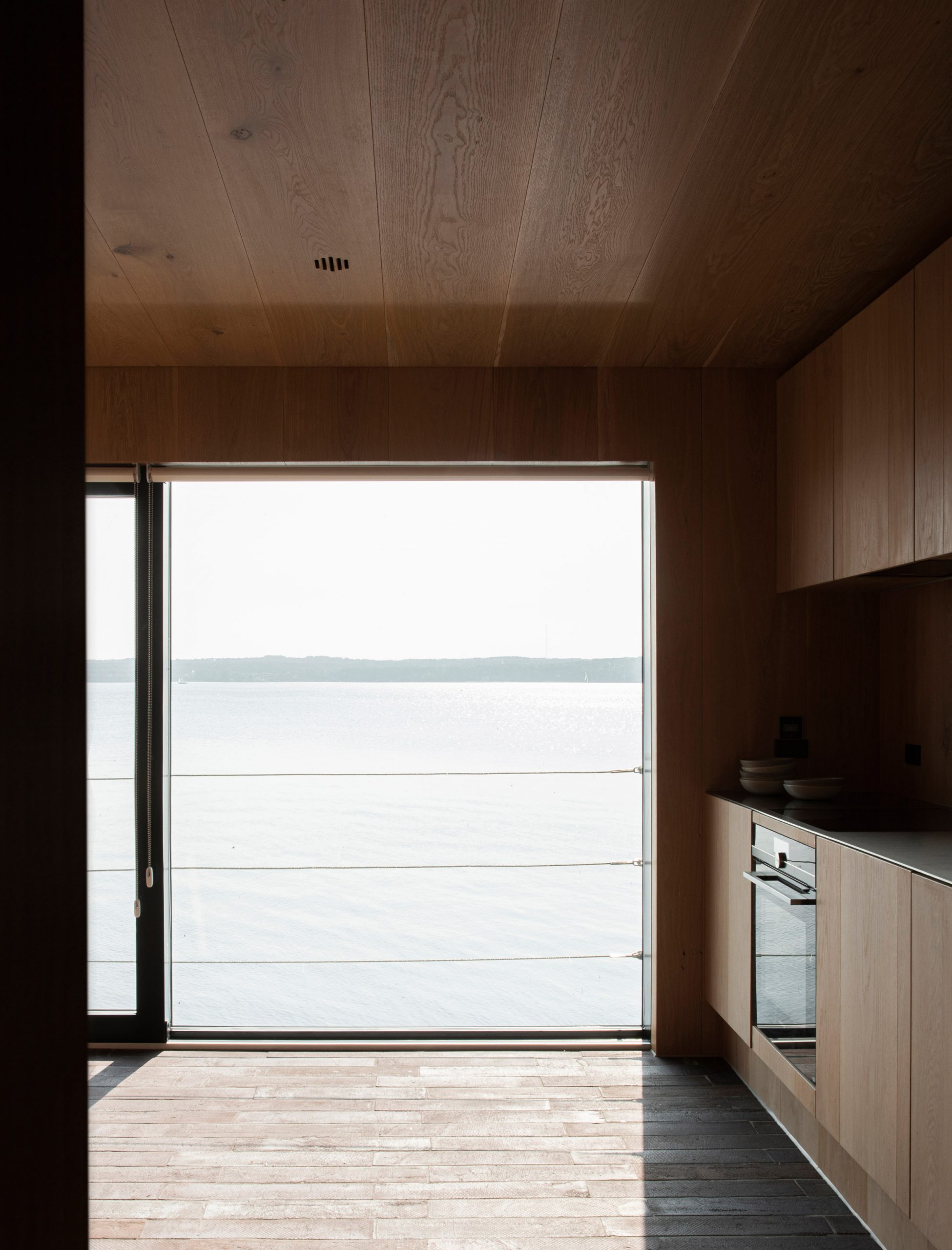
The kitchen has direct views over the lake
A wooden dining table sits beside the kitchen's expansive front window, which overlooks the lake and drifting sailboats.
Above the dining table hangs a large, washi-paper pendant lamp that Norm Architects made in collaboration with Kojima Shouten, a Japanese brand that has specialised in making lanterns since 1789.
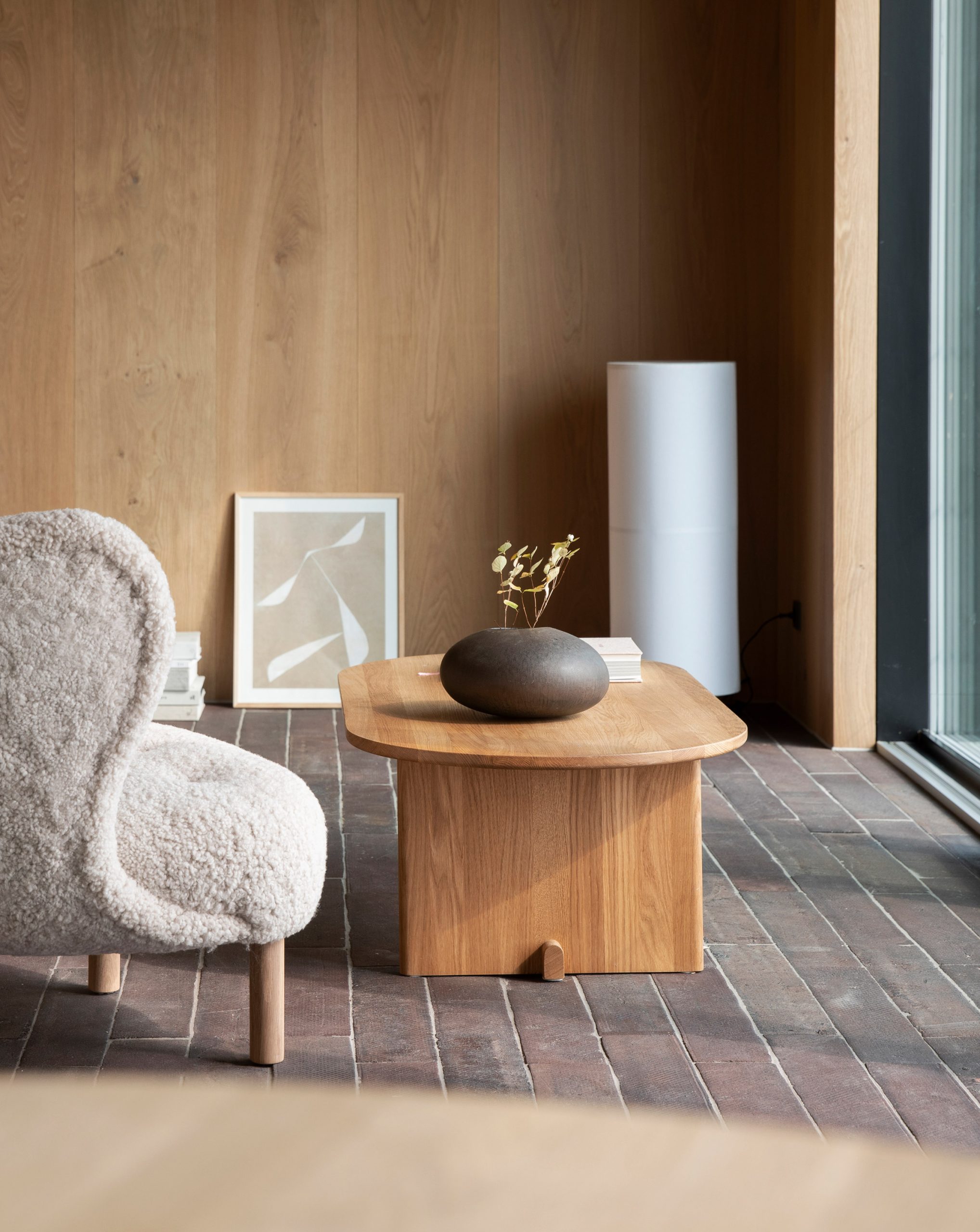
Furniture pieces designed by Norm Architects have been placed in the home's living room
The practice has dressed the house with a couple more furnishings from their own collections.
This includes the Hashira Floor Lamp and the Koku Table, which features a rounded countertop balanced on a slim metal stem on one side and a wooden leg on the other.
"[The table] is a play on balance — between the light and heavy, the transparent and monolithic," explained the practice.
"It is all about creating direction in the base whilst maintaining a symmetry on top, striving for a calm, sculptural expression without losing the obvious functionalities."
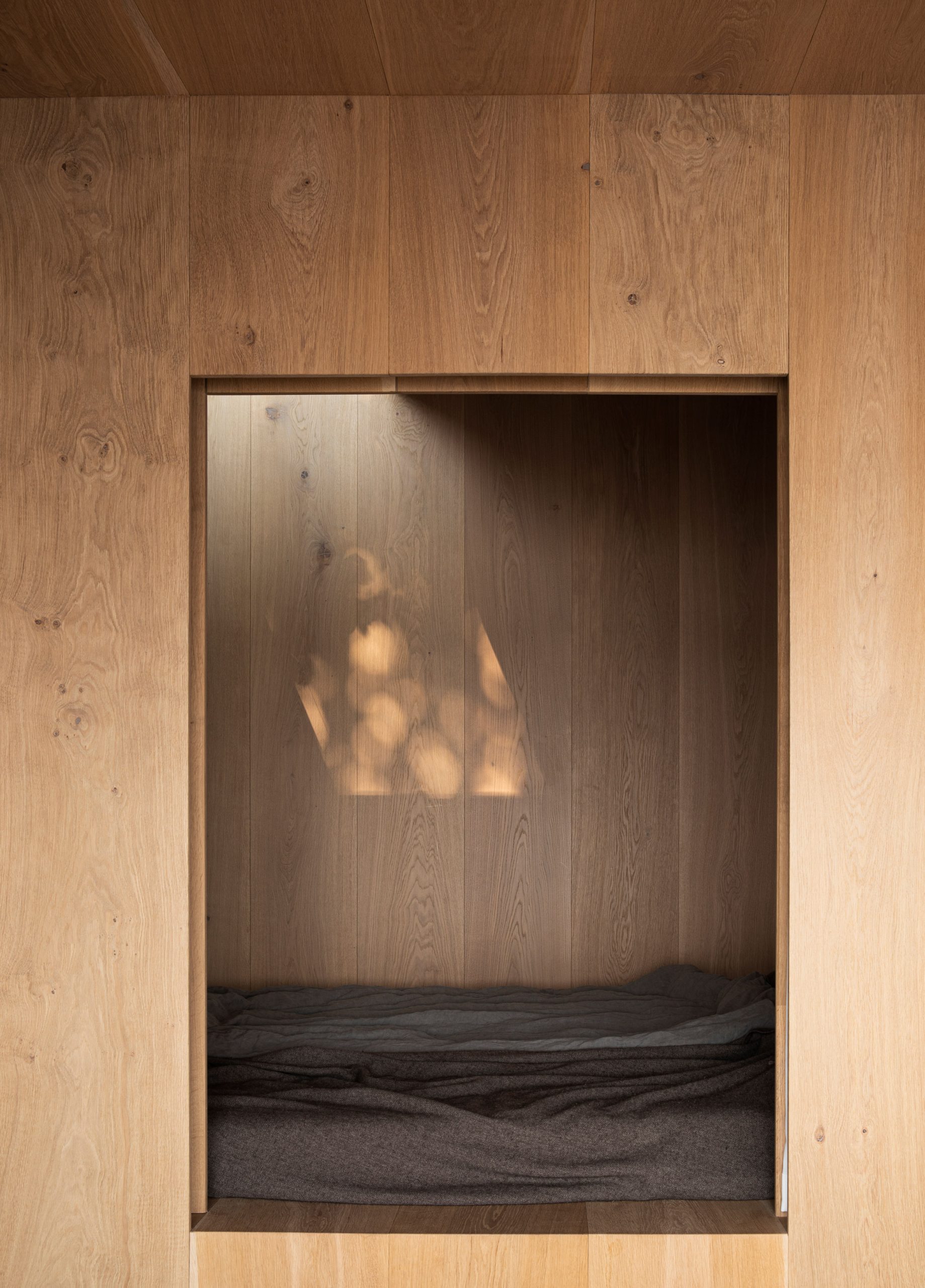
Inhabitants sleep inside snug alcoves
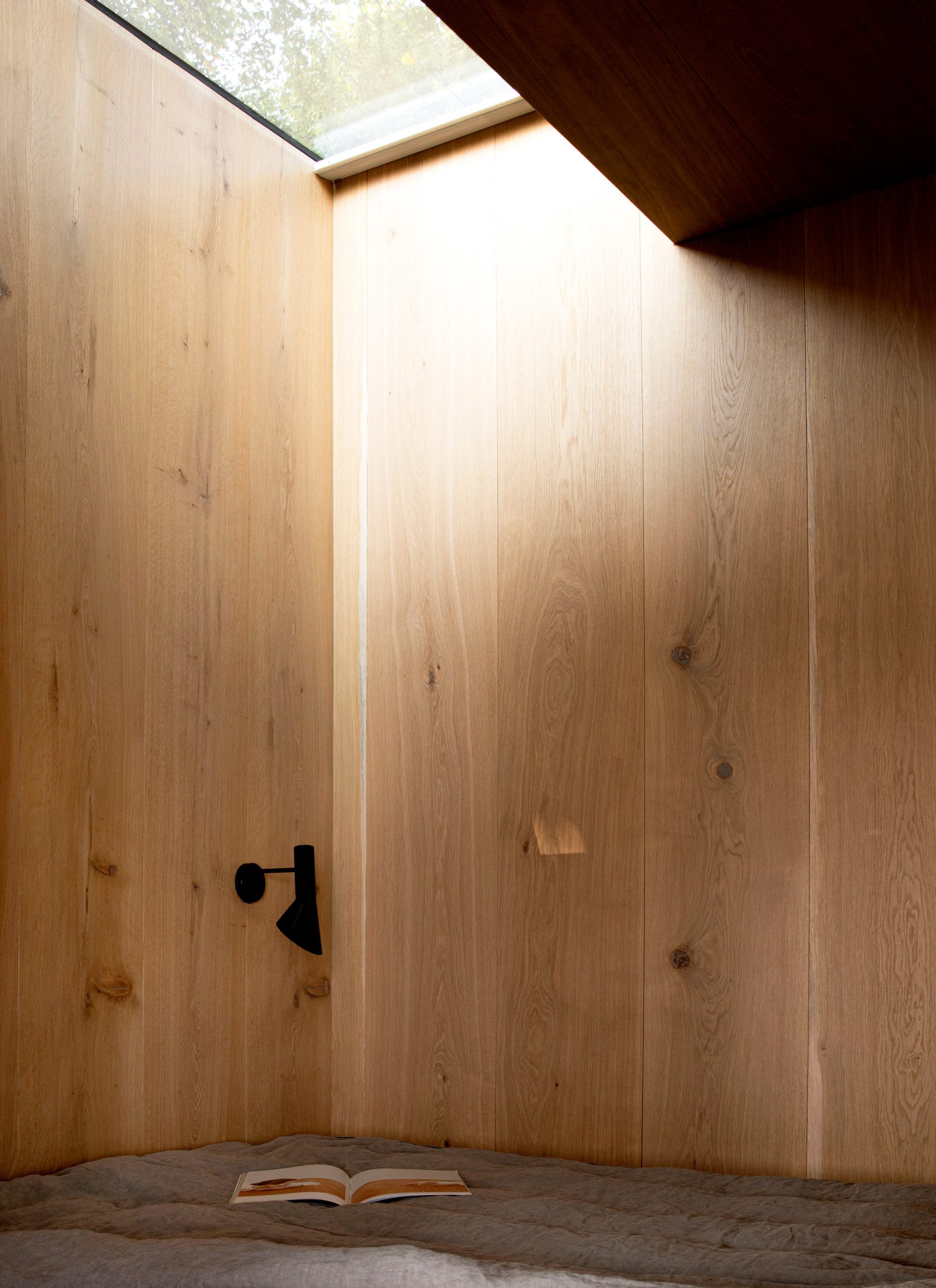
Beyond the home's living area lies two bedrooms, both of which have been created within snug oak-lined alcoves.
Each alcove is topped by a large frameless skylight that allows inhabitants to gaze up at the sky and leafy trees outdoors.
The alcoves are topped by skylights that provide outdoor views
Norm Architects recently created another holiday home just outside of Gothenburg, Sweden. The pine-clad property, which is called Archipelago House, is made up of four pitched volumes that echo the form of traditional boathouses.
Its interior boasts minimal living spaces that take cues from both Scandinavian and Japanese design.
Photography is by Jonas Bjerre-Poulsen of Norm Architects.
Project credits:
Architecture: Norm Architects Lead architects: Peter Eland Contractor: W3 Construction Architect of record: Arkitema
The second instalment of the Dezeen x Miami Design Talks will feature a live conversation with Design Miami's director of global exhibitions Jillian Choi. Watch here from 5pm GMT.
Choi will speak to Dezeen's founder and editor-in-chief Marcus Fairs about the launch of Design Miami/Podium, a selling exhibition curated by Aric Chen that platforms leading galleries alongside independent design studios.
The Podium exhibition, which is themed America(s), features a collection of 141 artefacts from 57 designers that takes a provocative and inclusive look at what it means to be American.
"Power to the People": a Collection of Ten Walking Sticks with Clinched Fists from the 19th and 20th Century
"The timely exhibition calls into question the meaning and understanding of America and its identity through the juxtaposition of important works of design and craft," said Design Miami.
Choi, who worked on the exhibition with Chen, will discuss some of the highlights, which include examples of folk and Native American art and rare mid-twentieth century pieces by designers such as George Nakashima and Paul Evans.
The exhibition will also feature contemporary pieces by international designers including debut work by ceramicist Isaac Scott, ceramics which draw from his photographs of the Black Lives Matter protests in Philadelphia earlier this year.
All of the collectible designs will be available to purchase through Design Miami's new online shop, Design Miami/Shop.
Jillian Choi
Choi is an art and design consultant whose work aims to create connections around the world. She joined Design Miami in January 2020 as director of global exhibitions.
The full programme for the Dezeen x Miami Design Talks collaboration can be found here.
Miami Design District founder and CEO Craig Robins will speak to Dezeen about developing creative communities in an exclusive live interview to kick off our Dezeen x Miami Design Talks collaboration. Watch here from 3pm GMT.
Hosted by Dezeen's editor-in-chief Marcus Fairs, the interview is the first instalment in a series of conversations broadcast on Dezeen as part of Design Miami 2020.
Due to the coronavirus pandemic, this year's Design Miami festival will feature a programme of digital events taking place alongside physical exhibitions and activities located within Miami Design District.
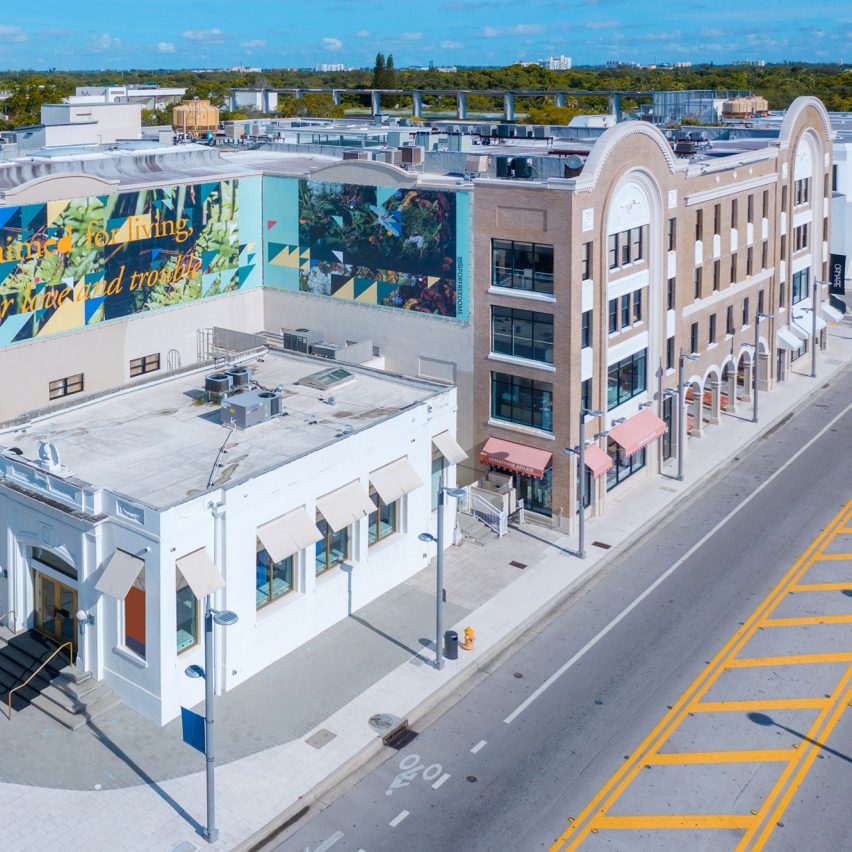
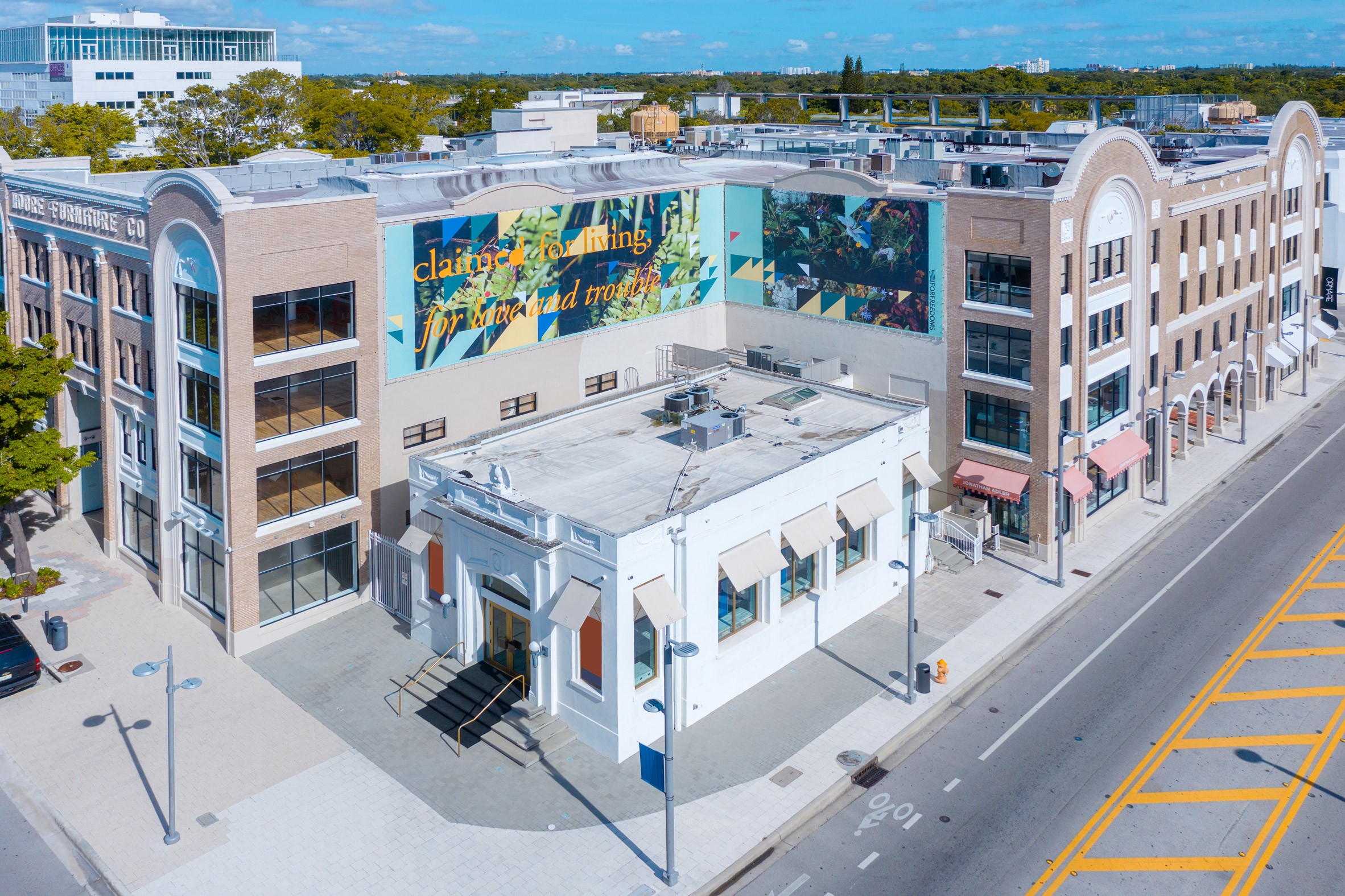
The Moore Building in Miami Design District
In 2000, Robins and his partner L Catterton began acquiring buildings in the then-neglected neighbourhood. The Miami Design District has since been developed into a shopping destination and hub for architecture and the arts.
In 2005, Design Miami launched its inaugural fair at The Moore Building, a former furniture factory in the heart of the district, which was built in the 1920s.
Now, after fifteen years in another location, the festival returns to its original home for its 2020 edition.
Miami Design District owner Craig Robins
Robins is Miami-based entrepreneur, real-estate developer and art collector who develops creative communities that integrate art, design and architecture.
In 1987, Robins founded real-estate development company Dacra, which helped to revitalise Miami's South Beach in the late 1980s and early 1990s by restoring the area's art deco-style landmarks.
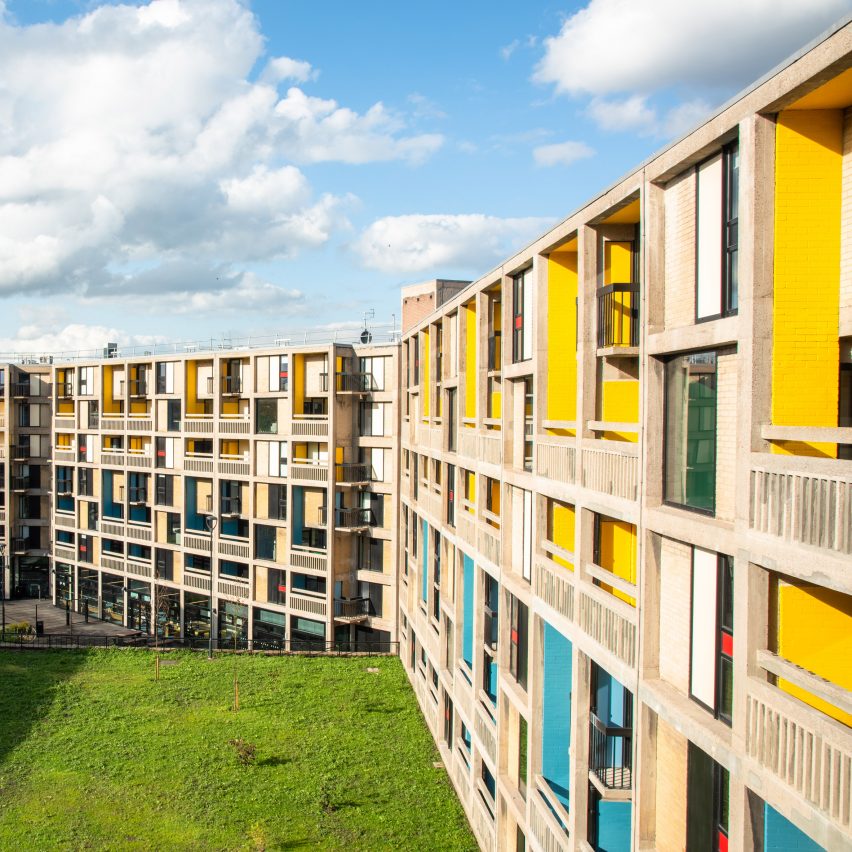
British practice Whittam Cox Architects has completed student housing Béton House, the latest redevelopment phase of the brutalist Park Hill estate in Sheffield, England.
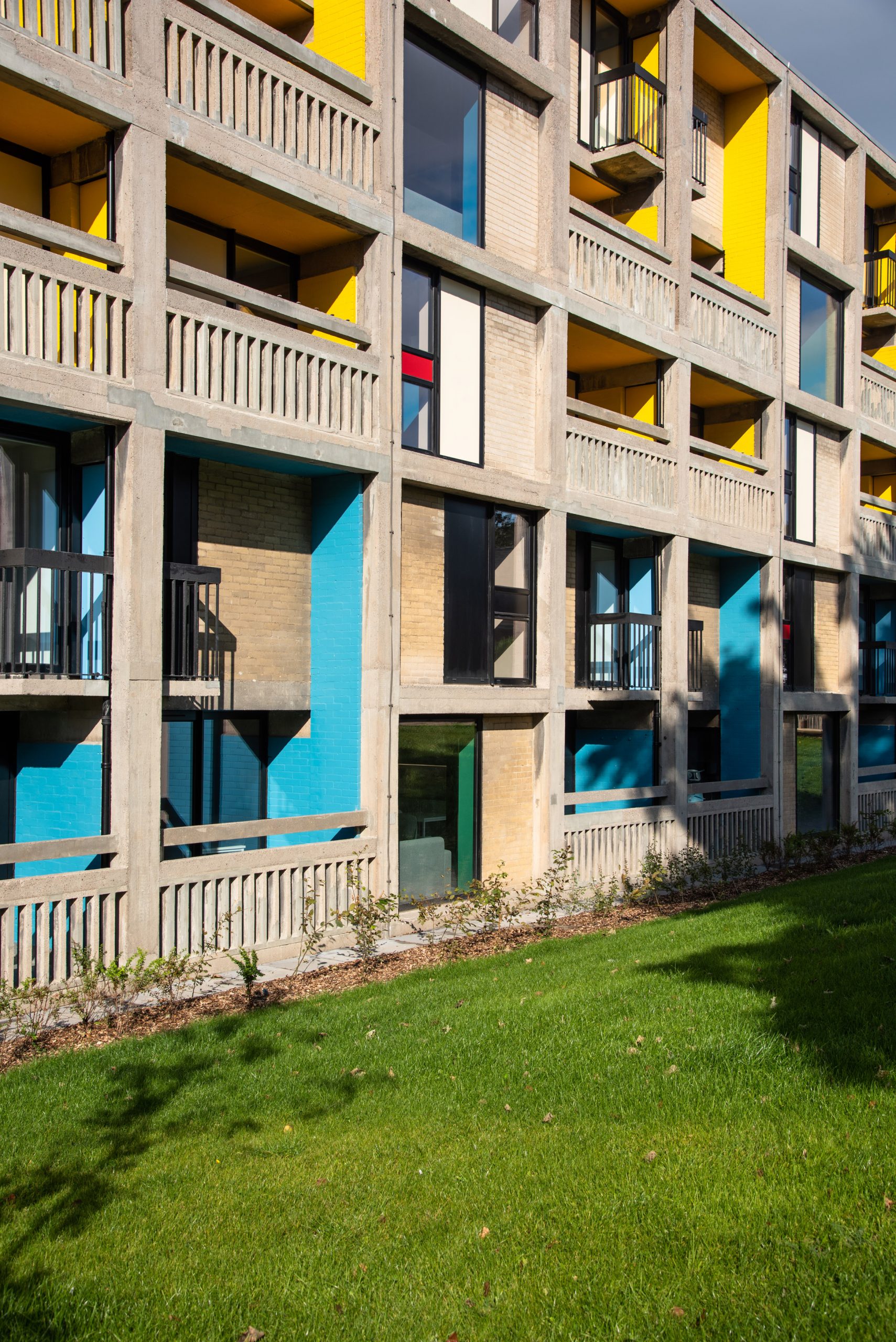
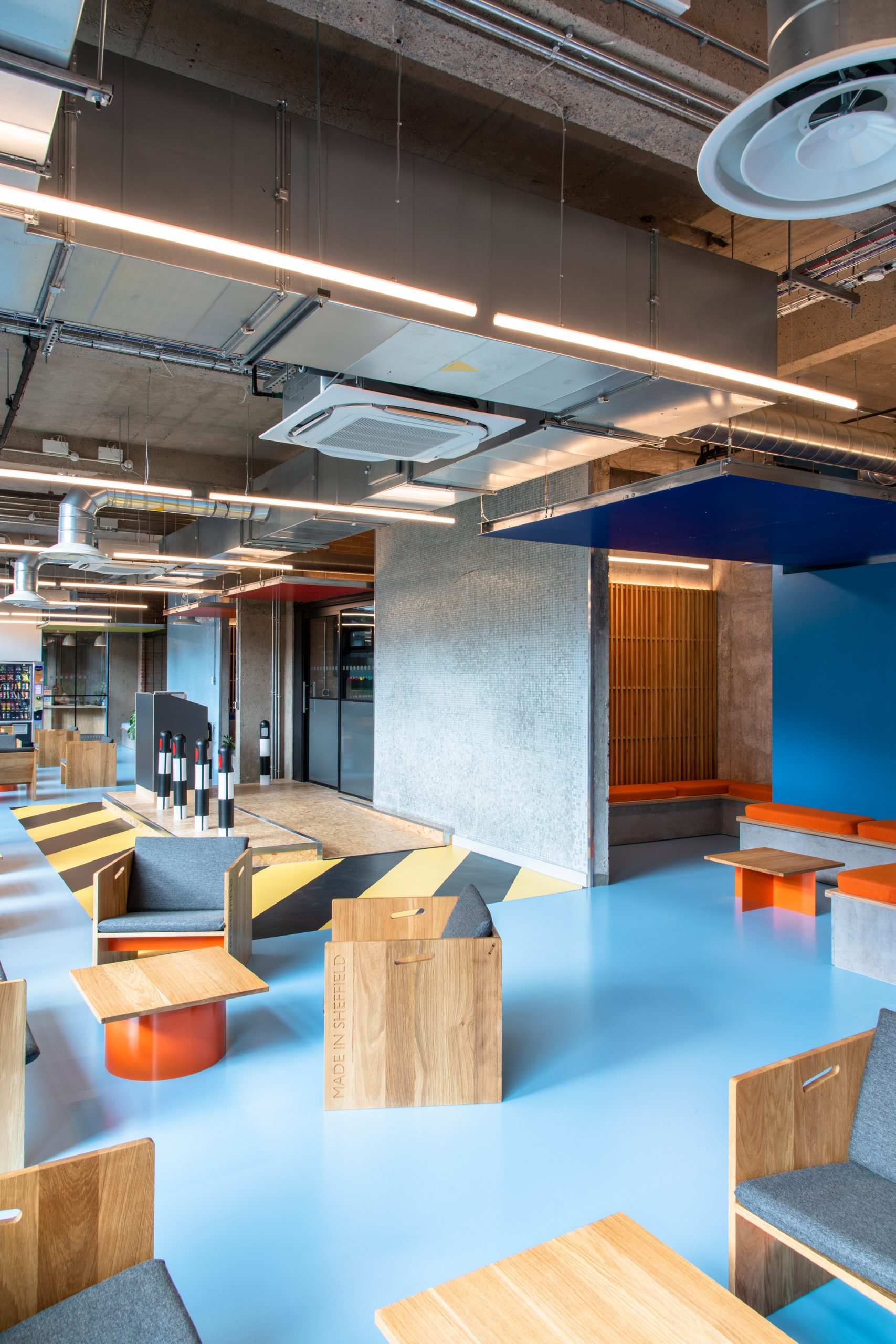
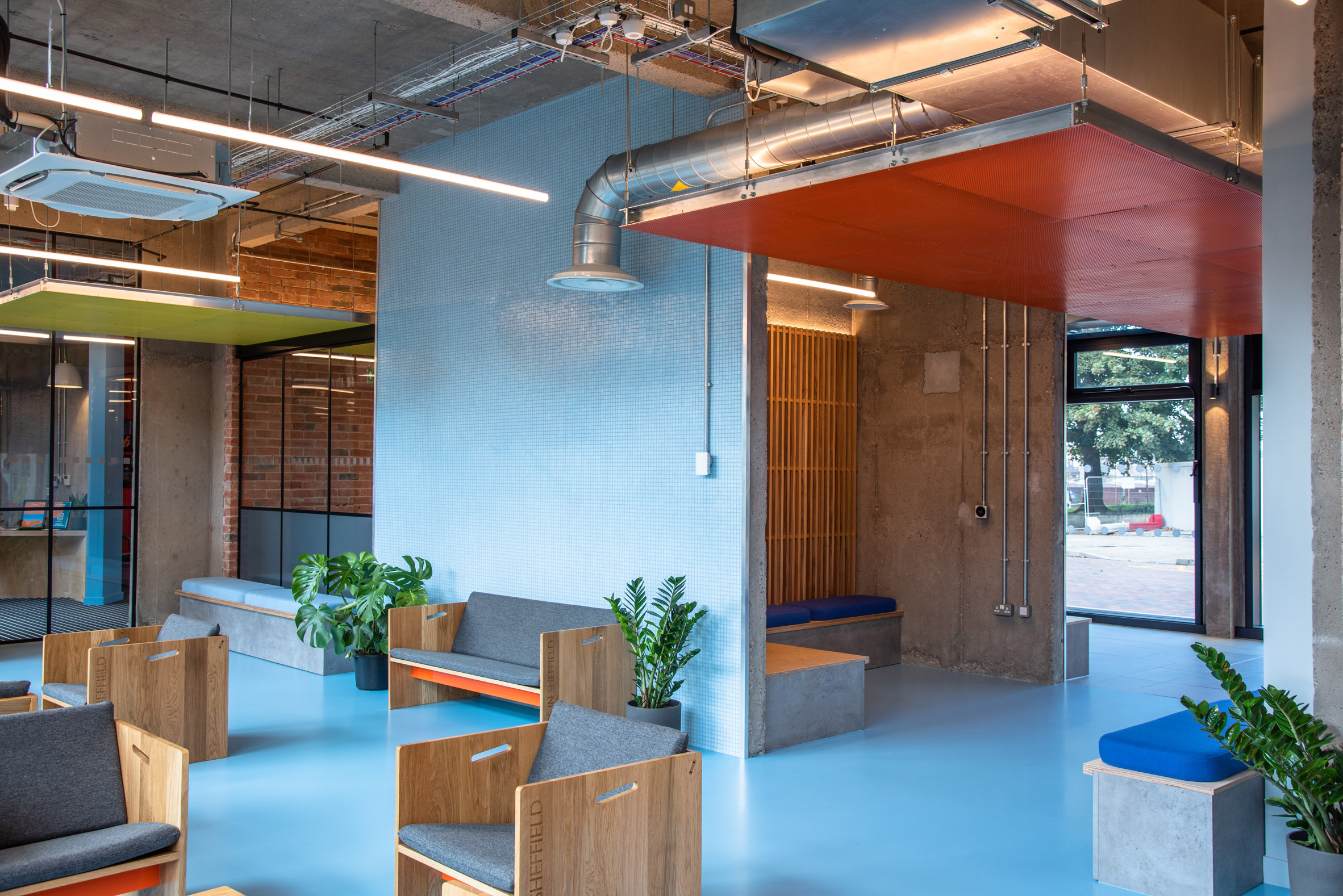
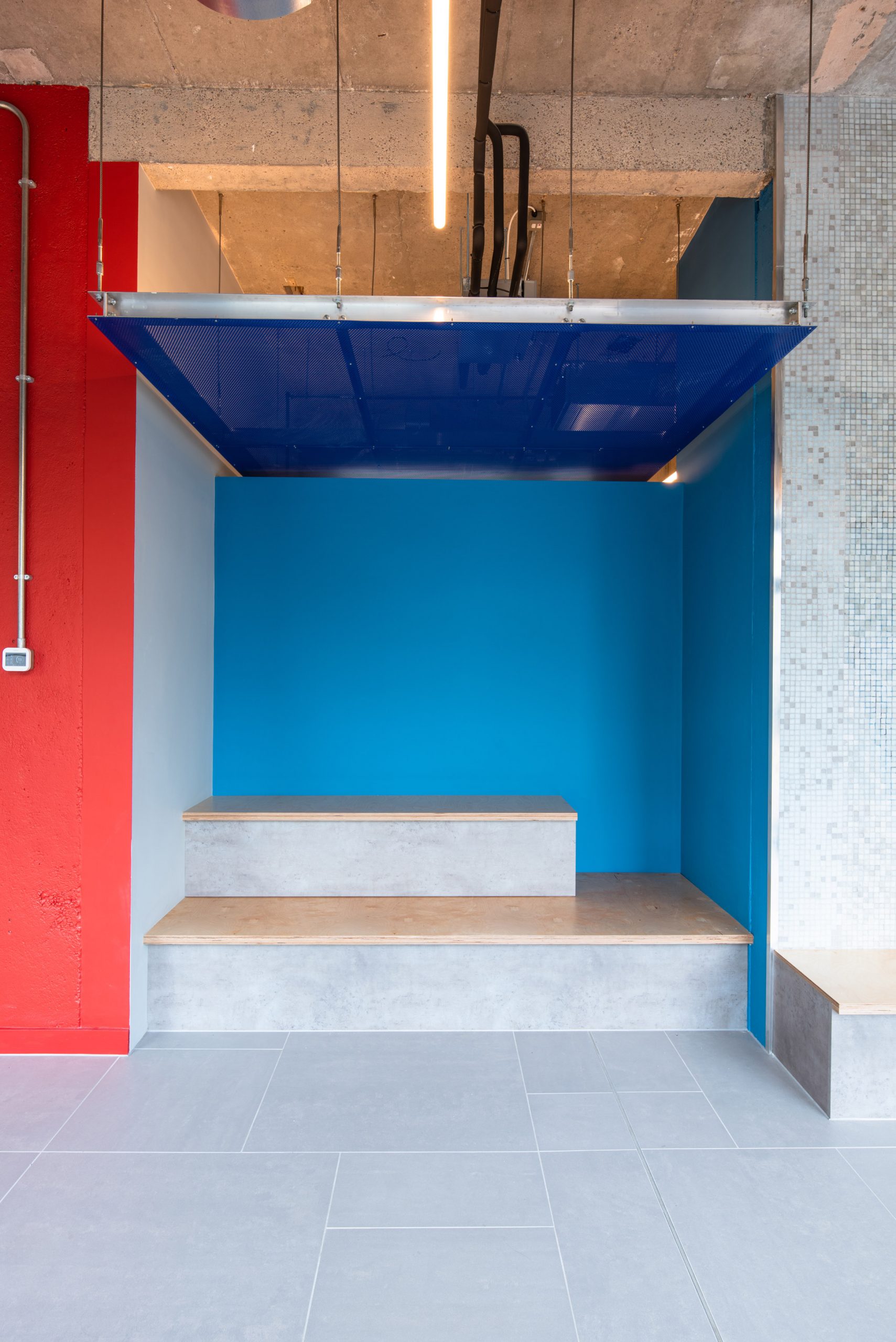
The concrete exterior and interiors have been decorated in a Le Corbusier-informed colour palette.
Top: the estate is Grade II-listed. Above: the blocks have been rechristened Béton House
A derelict ground floor building has been turned into a large communal area with a gym, cinema and a private dining room.
The Grade II*-listed social housing estate built between 1957 and 1961 has been turned into a combination of private homes and student halls of residence by developer Urban Splash.
The concrete was carefully cleaned and restored
Student housing developer Alumno oversaw the transformation of one wing into managed student housing, along with design studios BK Design and Brinkworth.
Built by architects Jack Lynn and Ivor Smith in the brutalist style, the housing blocks are raised up on plinths.
The studio turned the undercroft, originally used to hold public toilets, into communal spaces for students.
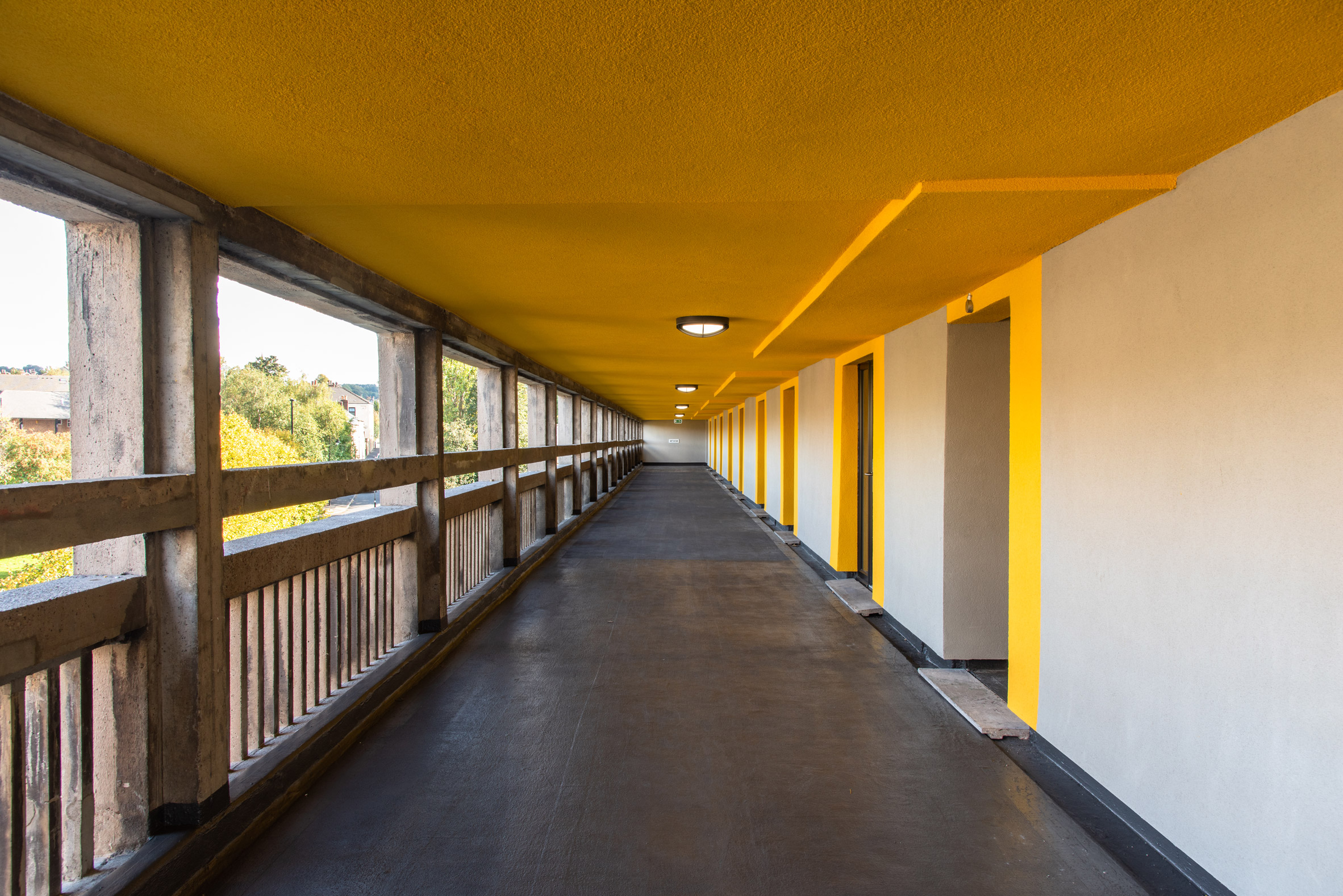
Original "streets in the sky" have been refreshed and repainted
Whittam Cox Architects preserved the concrete shell, cleaning and restoring the outdoor walkways to their original proportions.
"A 'minimal impact' approach was developed which preserved and
restored the surface of the brick and concrete across the building," explained the studio.
The architects used a "wet scraped and clear sealed" approach to cleaning the concrete, rather than power blasting it, to preserve the faint pinkish hue of the stone.
"The texture and colour variation present in the concrete has been preserved. Original mortar pointing has been retained where possible because we felt it was carefully specified to match the original bricks," the studio said.
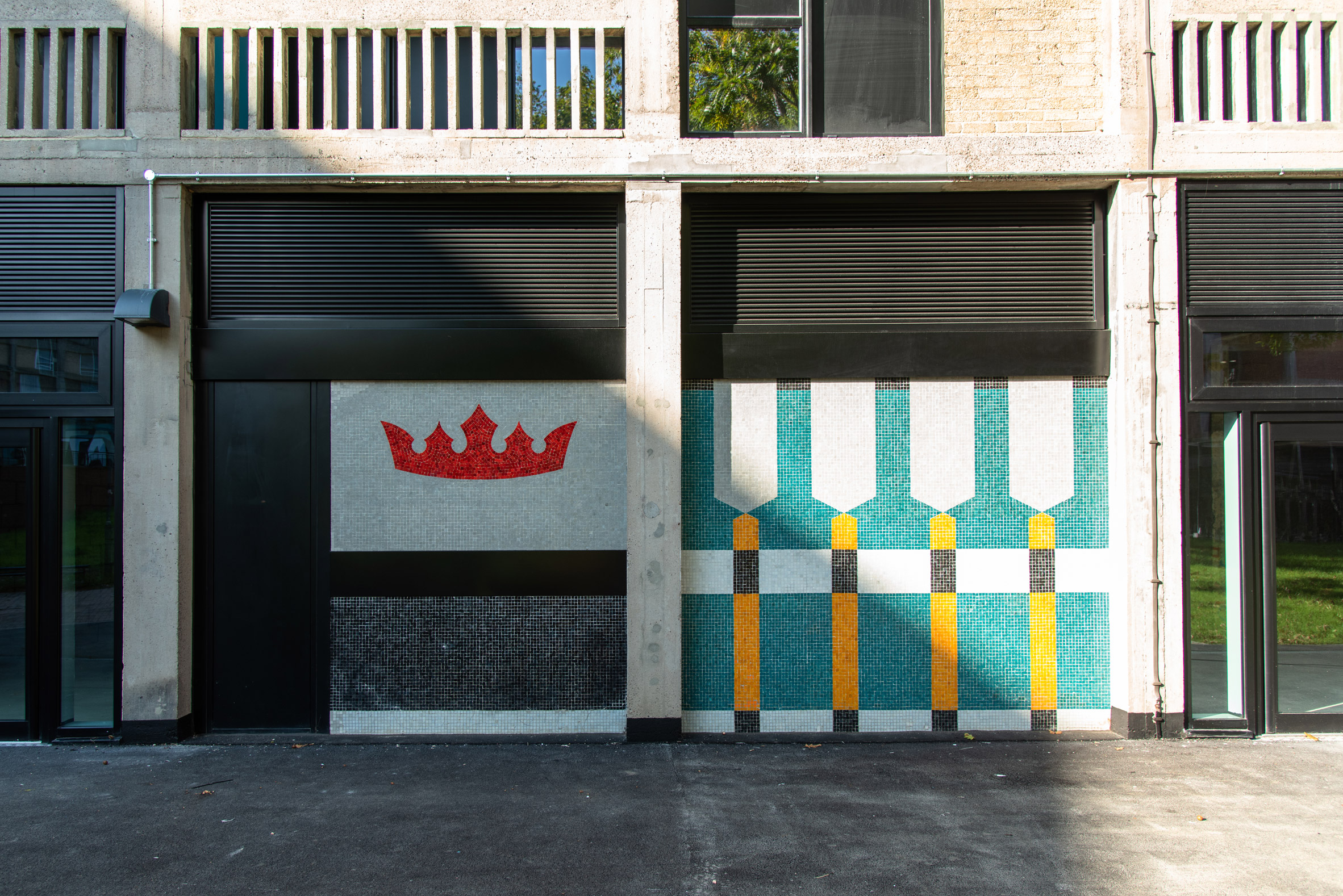
A glass mosaic has been restored and served as colour inspiration
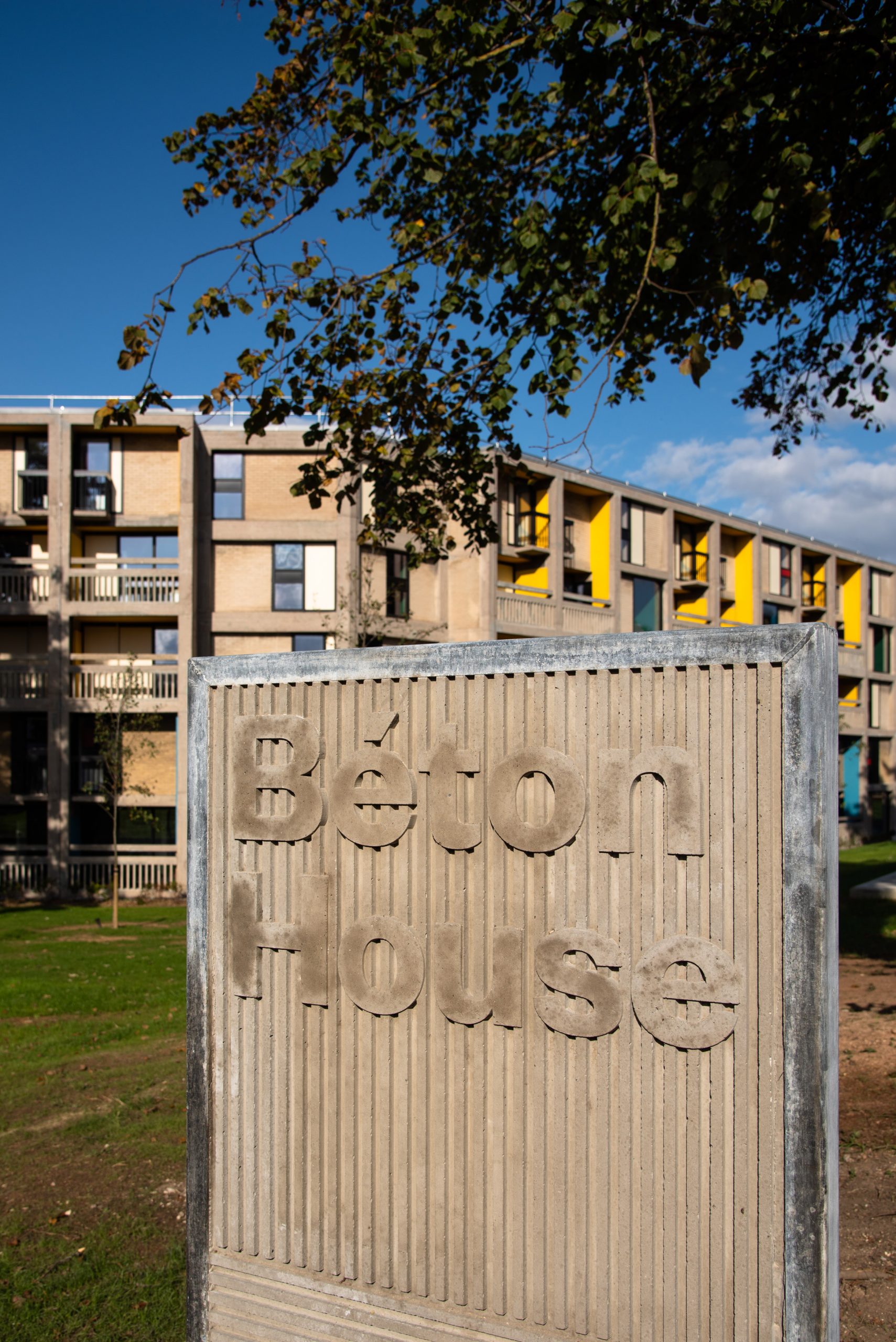
The block was renamed Béton House after the French word for raw concrete – Béton brut – popularised by modernist architecture.
Béton House's colour scheme is a nod to Modernist architect Le Corbusier's Polychromie palettes, mix-and-match sets of colours designed to be harmonious for design.
Burnt orange, bottle green, scarlet, and mustard tones were taken from a mosaic that once adorned the Parkway Tavern, the local pub that served the Park Hill Estate in its heyday.
Park Hill was built in the 1950s and 60s
Covered up at one point, the glass mosaic with its distinctive stripes and red crown is back on display having been painstakingly restored by experts Olicana Mosaics.
Interior designers Tatham Studio used the same colour scheme for the student bedrooms. Furniture is bespoke, along with a selection of original Scandinavian pieces.
The design deliberately reflects the site's history
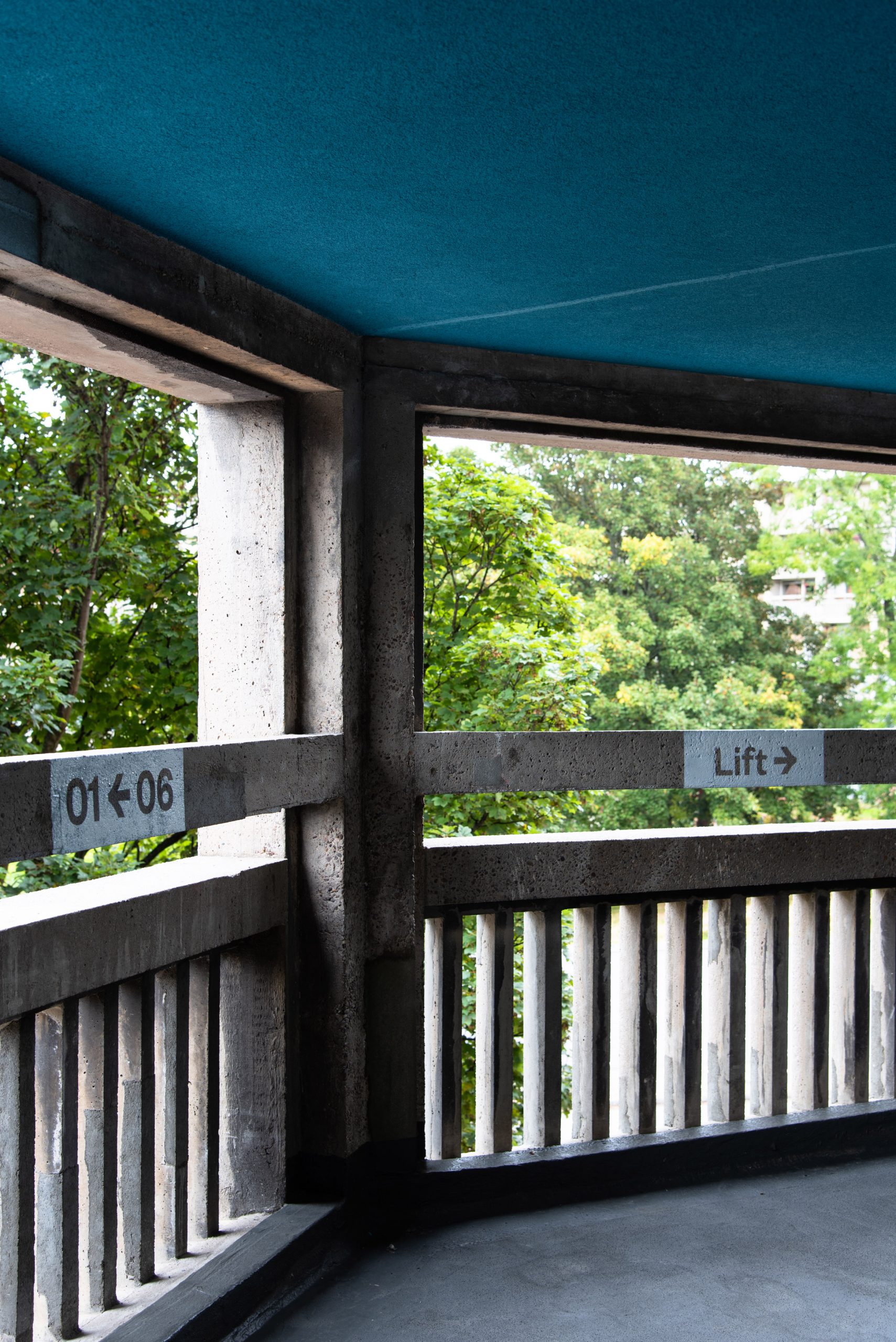
A wayfinding scheme for Béton House was created by Graphic Thought Facility, using the same colour picked out in terrazzo-style aggregate chips in cast concrete signs.
The font used throughout is called Founders Grotesk, a contemporary interpretation of the 20th-century fonts made in the Stephenson Blake foundry across the way from Park Hill.
Colours contrast with the raw concrete
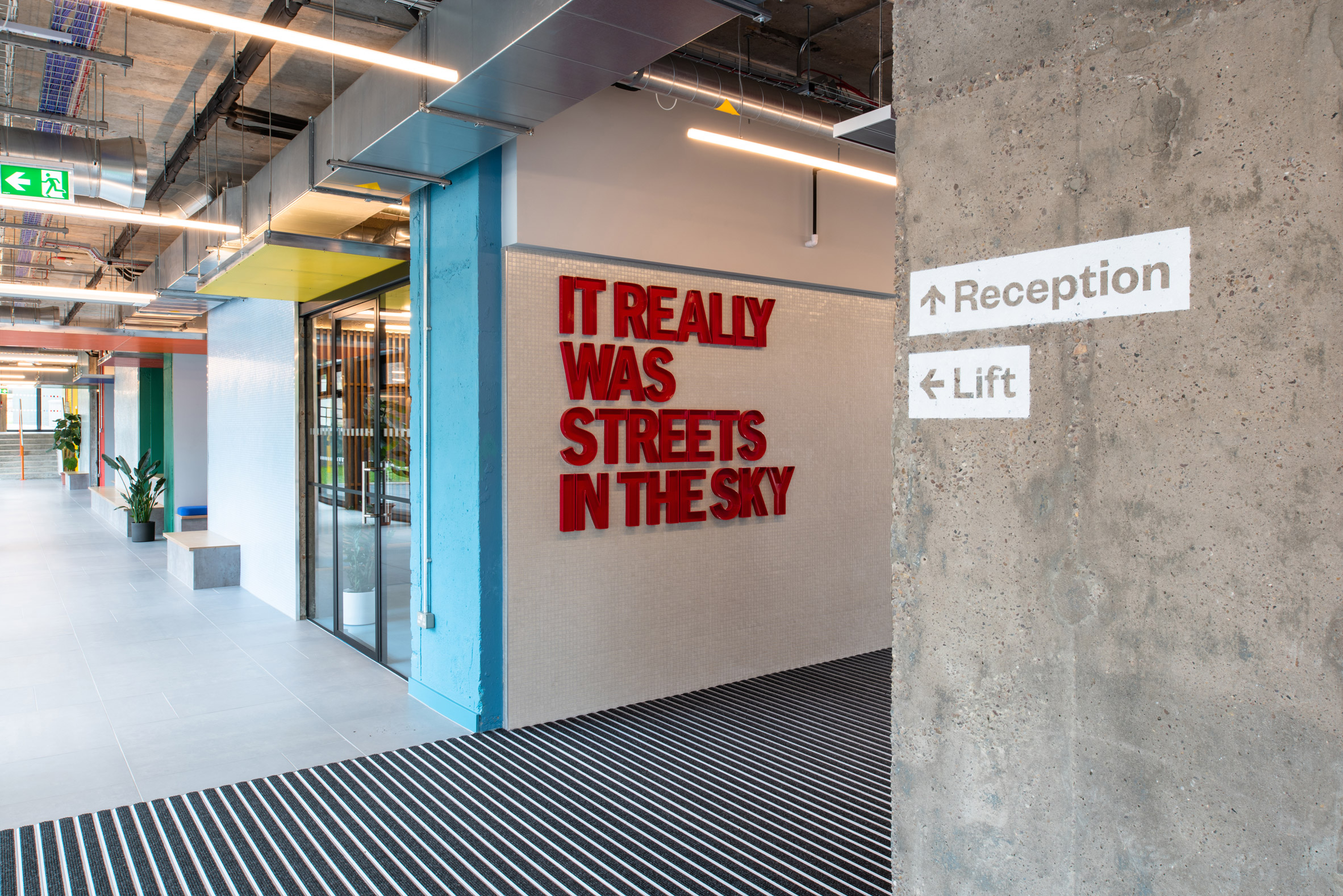
Phrases relating to the history of the Park Hill Estate are picked out in bold graphics on the outdoor corridors.
One, stating "it really was streets in the sky" references Sheffield Council's postwar goal of clearing slums and transferring residents wholesale to new high-rise rows of homes.
Park Hill's architects were influenced by Le Corbusier's mass housing programmes. The elevated pedestrian walkways were designed to be wide enough to drive a milk float down.
A derelict space has been turned into communal facilities
Decades after Park Hill was left to fall into disrepair by the government, Urban Splash stepped in with its private regenerations scheme.
"We've always believed that student housing can be a catalyst for change," said Alumno managing director David Campbell.
"I liked the idea that someone could enter into Park Hill as a student, graduate from university, get a job in Sheffield and then maybe move up into homeownership in Park Hill."
Béton House is part of a multi-stage regeneration project
After government grants were cut, no affordable homes were included in plans for this next phase. Concerns were raised by local residents that a key fob system could lead to segregation between the first phase and the more expensive second.
"We still think the right approach in principle is for it to be spread throughout, but it's not possible to deliver that at this point in time," Urban Splash's regeneration director Mark Latham told Dezeen.
"It's important that it doesn't create a different character or a 'them and us' feel to the two phases. The idea is that everybody is part of the Park Hill community."
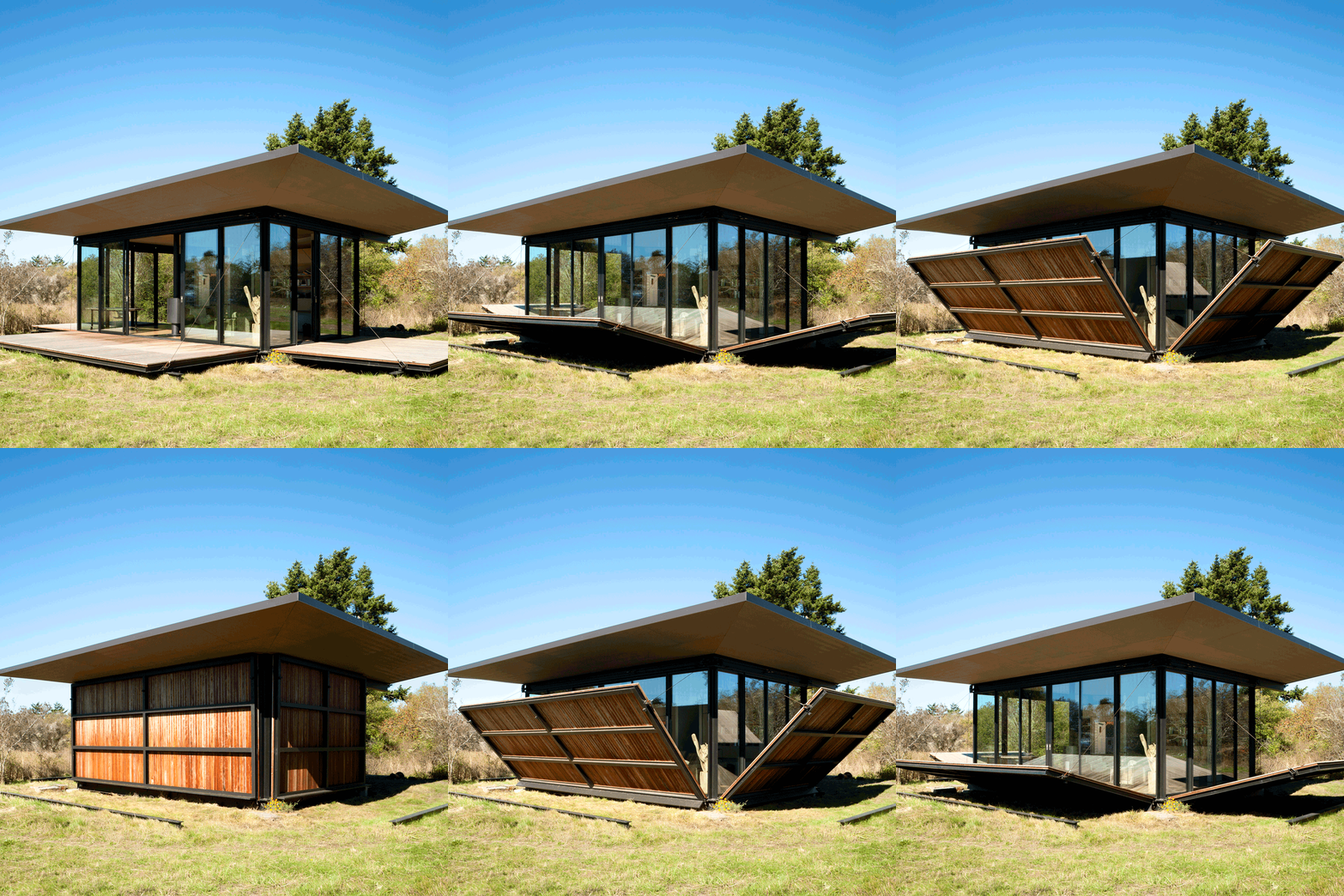
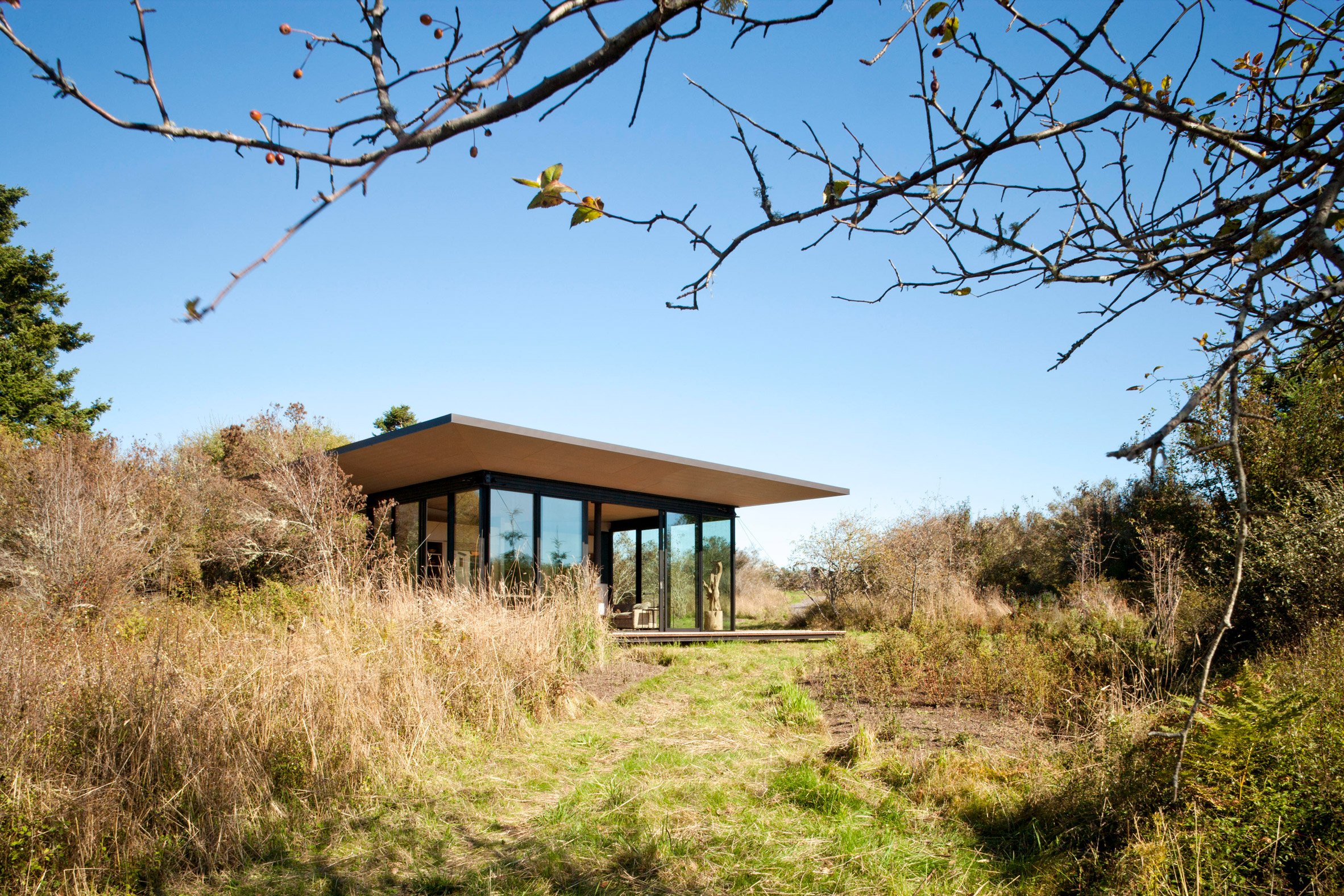
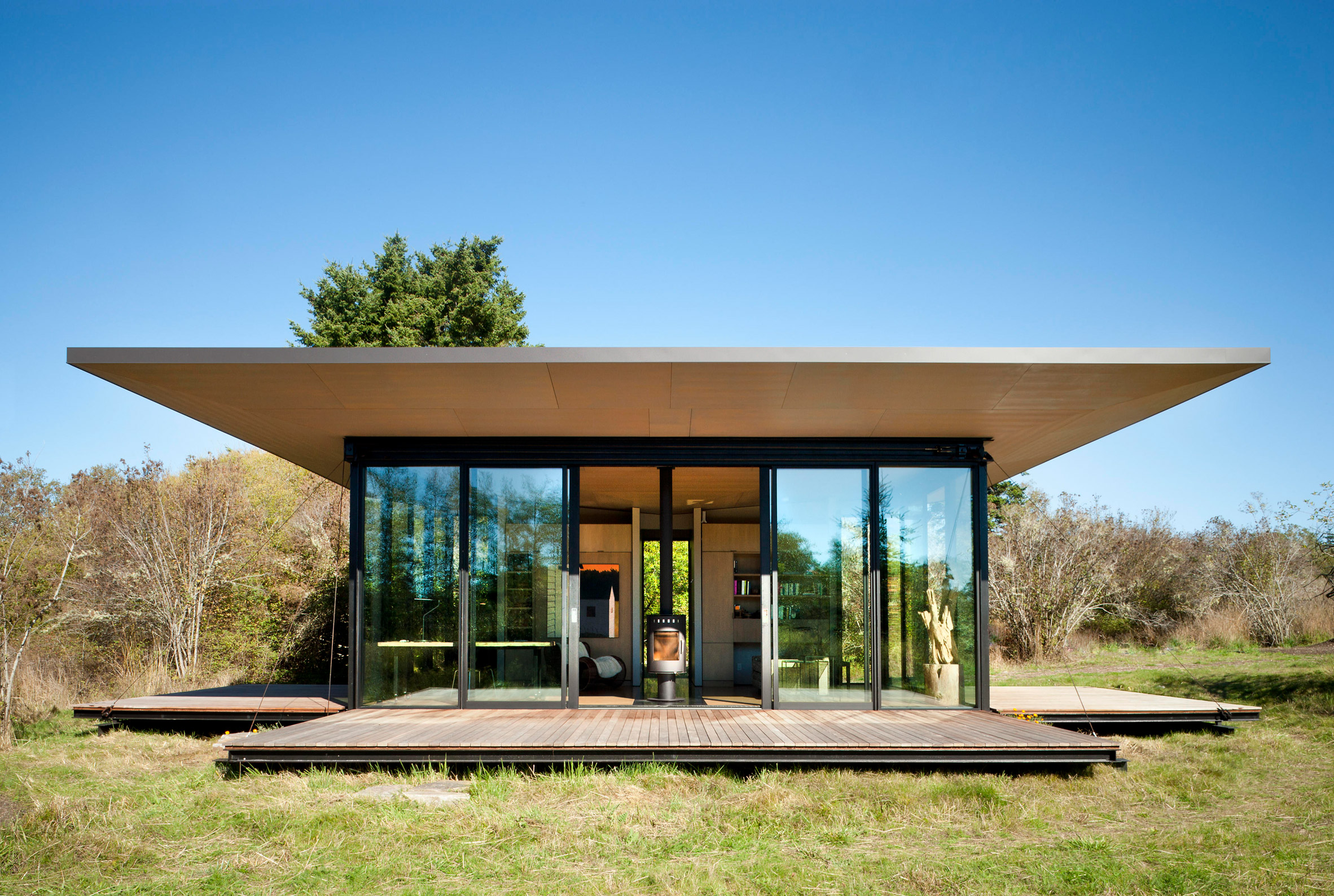
False Bay Writer's Cabin by architecture firm Olson Kundig in the USA has three glass sides surrounded by decks that double as shutters when pulled up like a drawbridge.
This unique feature allows the owners to secure their guest house cabin in San Juan Island, Washington, when not using it as a cosy writer's office.
The cabin doubles as a writing office and a guest room
A system of hydraulic winches and wire rope pulls the decks up to protect the glass walls. Three steel sleepers provide supports for the timber panels to rest upon.
When the decks are down, sliding glass doors open the interior space to the outdoors.
Three shutters can lie flat as outdoor decks
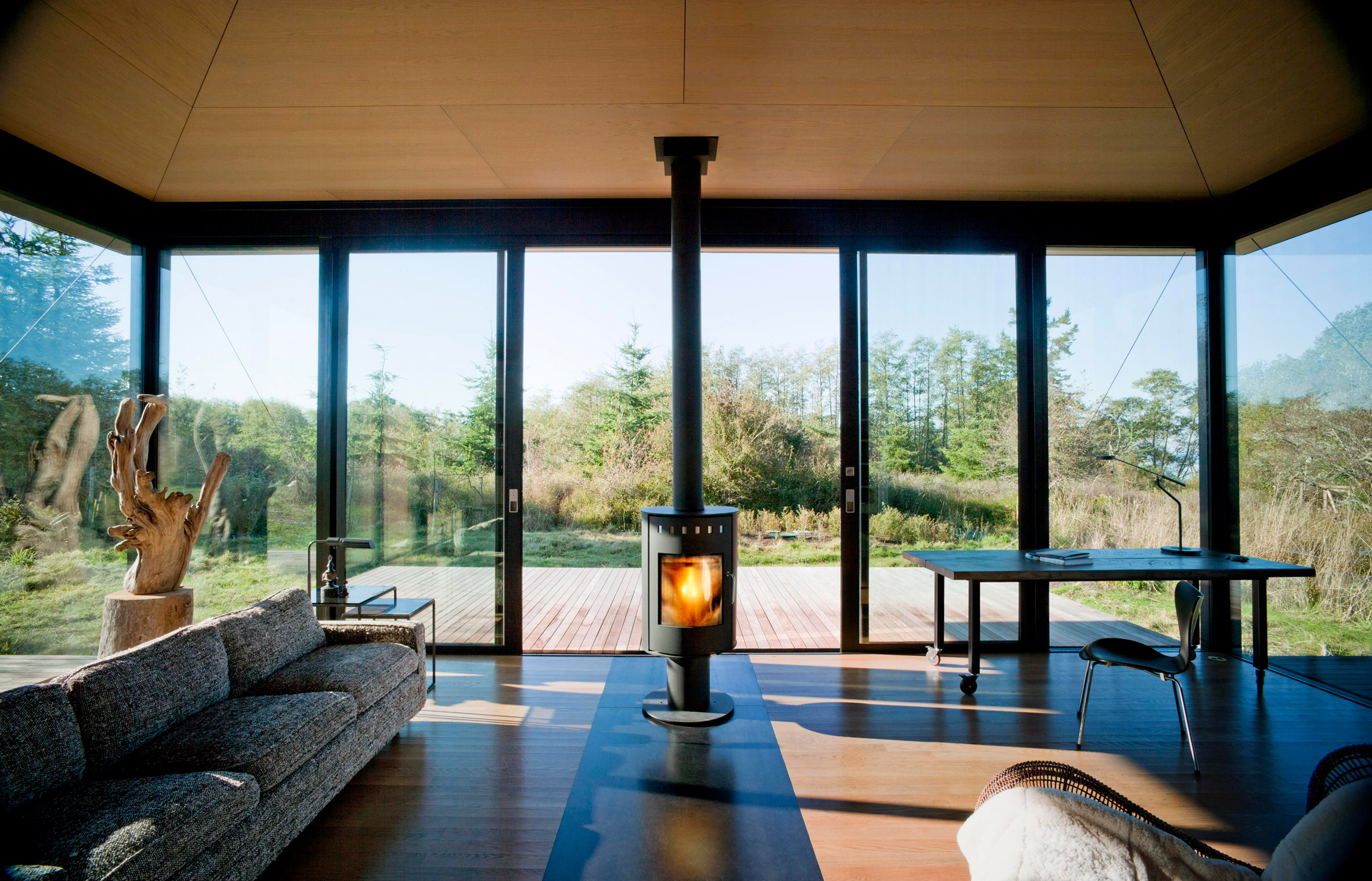
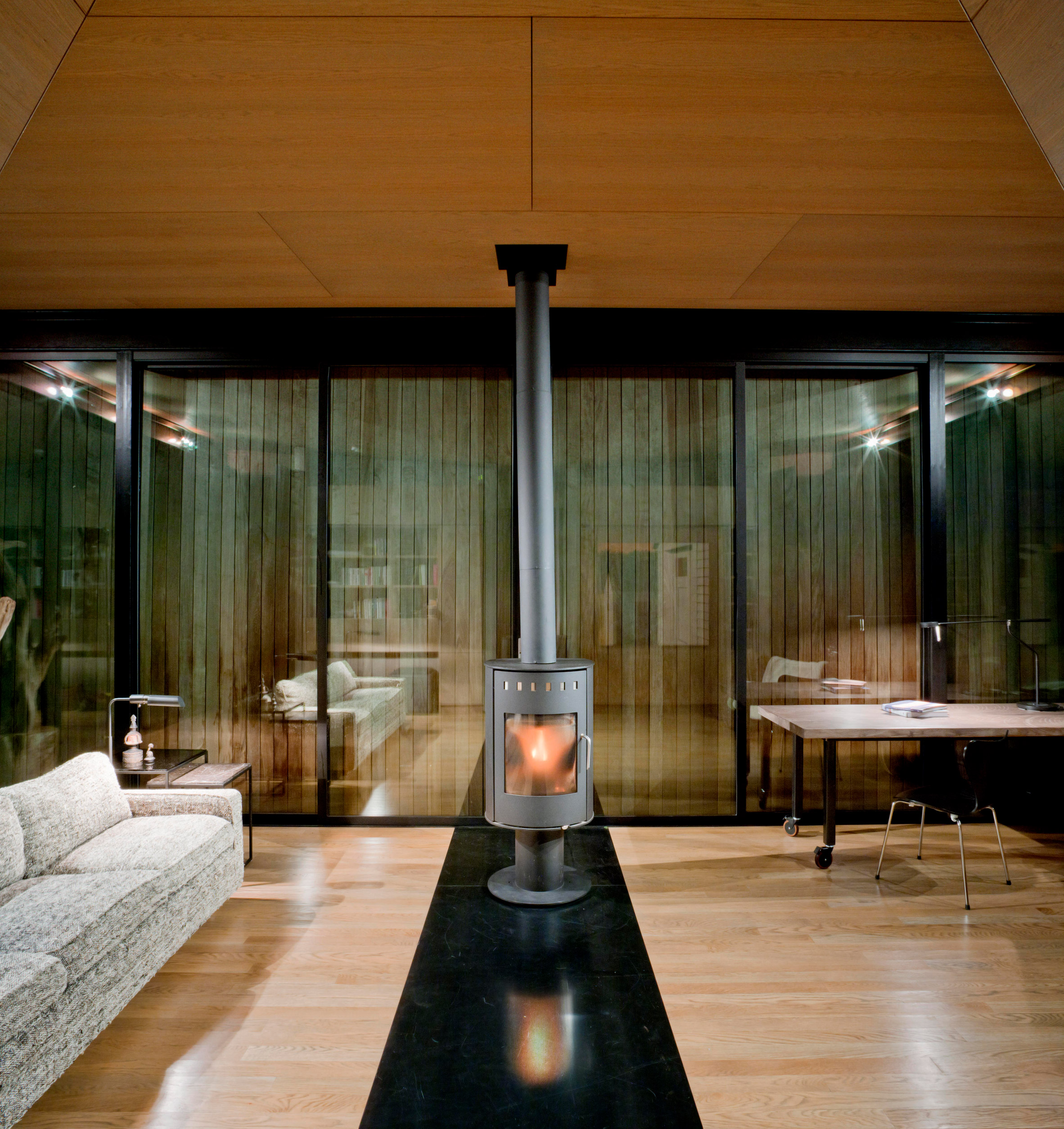
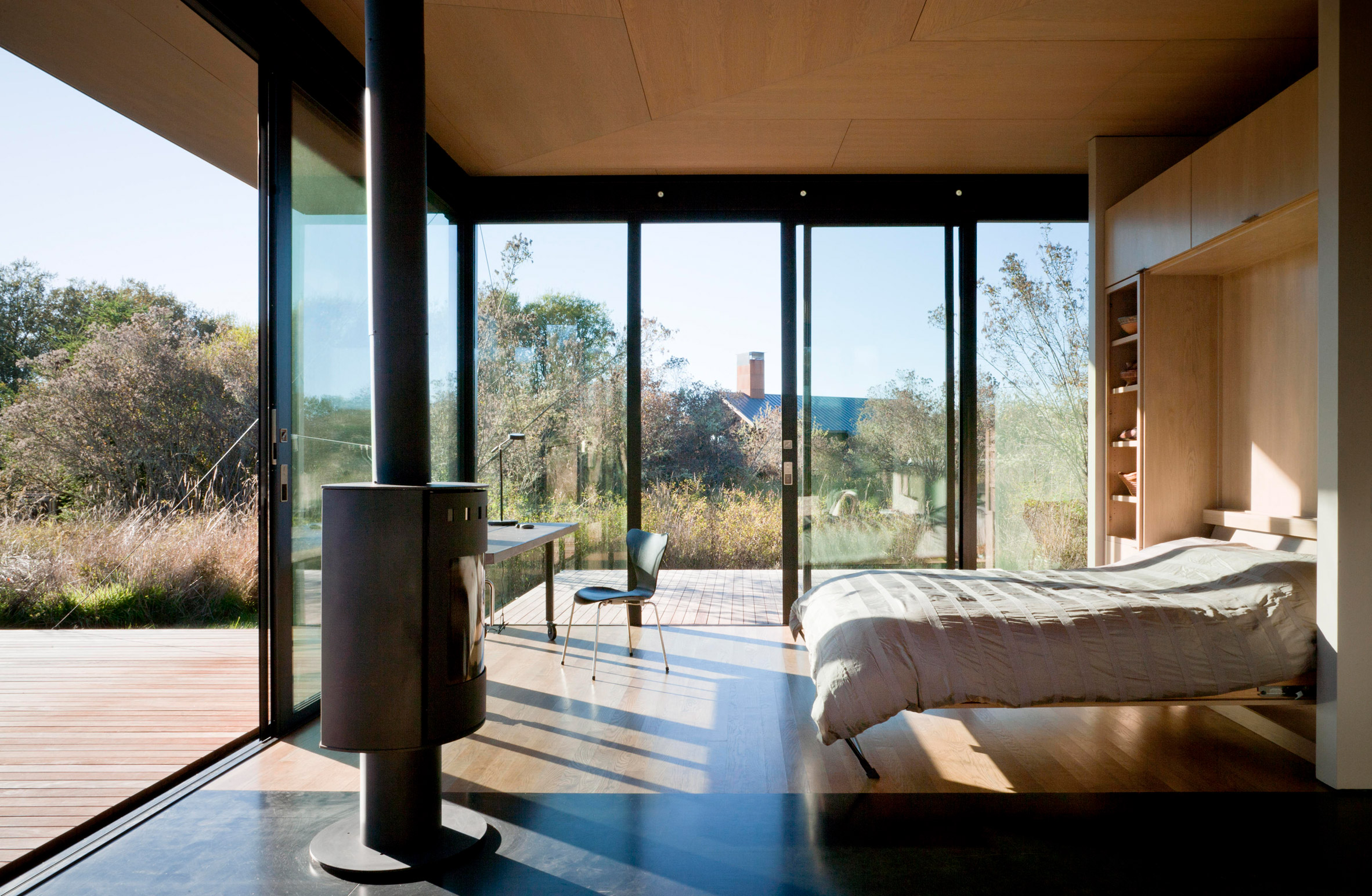
The fireplace in the living area can rotate 180 degrees, facing in towards the sofas for a cosy winter evening or turned out towards the deck to warm those seated outside.
"It is intended to be a shelter of extremes, open or closed," said architect Tom Kundig.
"In order to feel cold, you have to feel hot, in order to feel safe, you have to feel at risk. Contrast is the true measure of a complete experience."
The fireplace can rotate 180 degrees
Inside, the cabin has 500 square feet (46 square metres) of floor space. A single room contains an open plan living area.
The wooden floor is bisected by a panel of blackened steel that runs from the back of the cabin, where there is a small window, to the glazed front. The steel matches the fireplace and the cylindrical chimney that tops it.
The decks can be raised up to form shutters
A Murphy bed folds down from the back wall to transform the space into a guest cottage, with the shutters doubling as curtains.
There is also a small kitchen and a separate bathroom at the back of the cabin. A rack on the exterior's non-glazed wall can hold the cabin owners' kayaks.
A bed folds down to create a guest room
Olson Kundig Architects was founded by Jim Olson in 1967, and the practice is based in Seattle.