Instead of being forced to retreat from the impacts of climate change, humanity could undergo a managed retreat to Planet City, a single, purpose-built metropolis, while carbon removal takes place on a planetary scale, suggests Holly Jean Buck.
We have not evolved a vocabulary for the crisis at hand. Climate change is one feature of it, but only one.
The ecological and social crisis is much deeper. This sounds weak and vague. That is the point. In the centre of this crisis, it is hard to see its contours.
We stab at it with words: structural racism, biodiversity, inequality, habitat loss, settler-colonialism, water insecurity, capitalism, environmental injustice, patriarchy, the housing crisis, nutrient pollution, ocean acidification, primitive accumulation, and so on.
Indeed, it may seem that the way to understand these things is to separate them analytically and understand the relationships between them. Engaging in this breaking-apart, diagramming and modelling of the systems is how we have learned to think. Sciences, both social and biophysical, are doing just this – but it is not working. Another line of approach is needed.
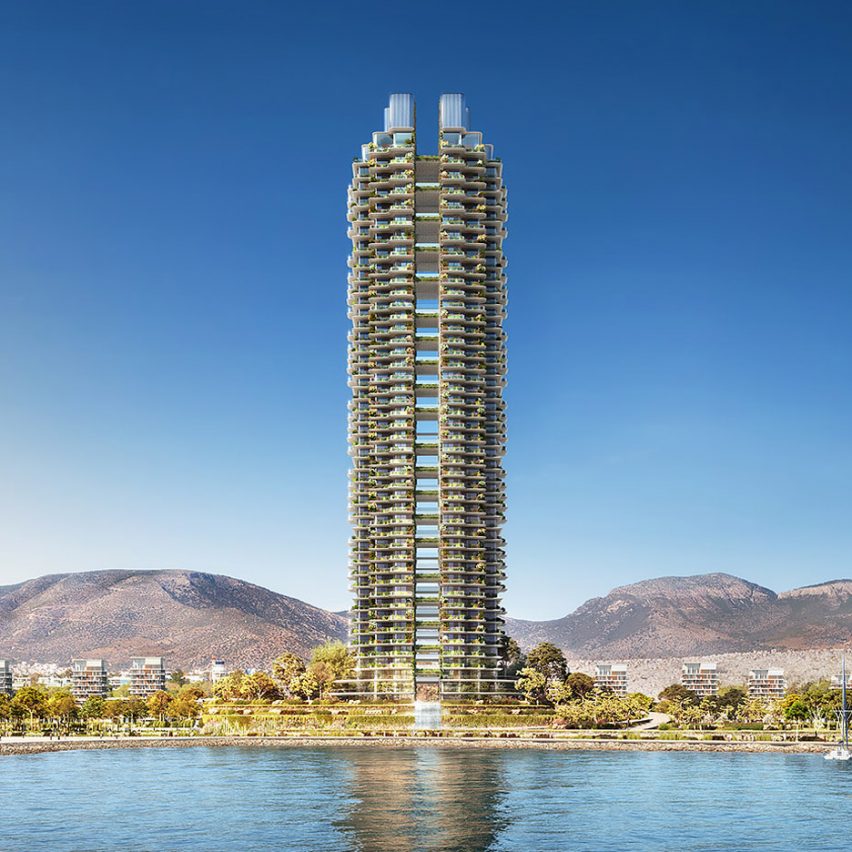
Planet City is an endeavour for such a miasmatic crisis. One single city on earth: the boldness of the idea breaks us out of the halfway language used to sense and diagnose the crisis, and offers a new way to see the work ahead.
1. Managed retreat
During this century, millions will retreat from the places they call home.
We know what will push them away. There is sea-level rise – along the coasts, it begins with "sunny day" or "nuisance" flooding, which encroaches more and more frequently, moving towards intolerable thresholds of "chronic inundation".
Small island states are considering how to relocate their populations. By the end of the century, sea-level rises could force 72 million to 187 million people to move.
There are extreme storms – areas ravaged by hurricanes and floods are developing strategies for being strong or building back better, hurricane-proofing and becoming climate-resilient.
At some point, in some places, it may be infeasible to restore buildings – especially the "severe repetitive loss properties" like the anecdotal home in Mississippi worth $70,000 that has been rebuilt or restored thirty-four times in thirty-two years, for example, at a cost of $663,000 in federal tax dollars.
At some threshold, entire communities may not be able to be rebuilt.
There are wildfires – with whole towns burned, again and again, some communities are beginning to debate whether they should retreat from the wildland-urban interface.
There is water scarcity, both as a result of local droughts and long-term desertification or depletion, and this has been linked to migration in areas like Central America, Syria, the Sahel and eastern and South Africa.
Managed retreat is "the strategic relocation of structures or abandonment of land to manage natural hazard risk'. "Strategic" implies a plan – for structures, for land, but also for people – not as objects to move around, but as part of communities and cultures.
We can watch entire communities and islands disappear, or we can make a plan. Retreat has a military valence, writes sociologist Liz Koslov. But she explains that retreat has a spiritual meaning as well, with "-treat" signifying "to heal". Planet City's retreat could be the latter.
2. Loss and damage
Migration due to environmental crises coincides with the emptying of the countryside due to economic pressures. Any good plan for aiding retreat should look at both of these at once.
Separate out the driver of climate change from rural outmigration and this rural-to-urban migratory story can be told as one of gain. Development economists describe "structural transformation" from agrarian to manufacturing, service and information economies – losses embedded in a story of natural evolution, of progress.
We have heard that half the world's people now live in cities; that they are engines of innovation, etc. "On a planet with vast amounts of space (all of humanity could fit in Texas – each of us with a personal townhouse), we choose cities", crows economist Edward Glaeser in Triumph of the City, declaring that "for the sake of the planet', cities must "be the future'.
Planet City must be able to hold this hope while simultaneously holding loss. The move to the cities can also be told as a story of loss. Rural sociology often finds that people in places like the US and the UK favour small cities and country villages, a preference described by concepts like the "rural mystique"and the "rural idyll'.
There's a note of longing there, a sense that in the transformation from rural to urban, something – community, a balance with nature – has been lost. Is the lost past, present or future? The countryside is already a ghost countryside, configured for extraction and production. Rural non-city spaces are rendered as "operational landscapes', brought into an understanding of urbanisation by the dynamics of capitalist urbanisation, as urban theorist Neil Brenner writes.
With rural regions consigned to the past, rural futures can be constructed as empty. Climate change can compound this: geographer Kasia Paprocki writes about the failure to imagine viable rural futures in Bangladesh as "anticipatory ruination', where agrarian areas are rendered futureless because of climate change.
Planet City emerges against a backdrop of loss and damage – past, present and future. "Loss and damage" within climate policy discourse refers to climate impacts that are irreversible (loss) and harmful (damage). The UN Framework Convention on Climate Change now has a mechanism on loss and damage, acknowledging that adaptation has limits, but also steering away from blame and liability.
While the notion of loss and damage has prompted complex accounting, scholars have also tracked scores of "noneconomic and invisible losses" relating to health, identity, order in the world, biodiversity, cultural heritage, social cohesion, sense of place and human mobility.
The question of managed retreat, or of "human mobility", as per the UN's preferred focus, is not just about where will people go, but how. How do people move to the city, which is to say, how do they leave where they are? Will it be out of despair, or compulsion? What kind of city can begin this way?
Planet City must offer a refuge, but even that will not be enough. Centuries of forced displacement of indigenous peoples inform every idea of managed retreat.
Liz Koslov writes that while this devastating history sets the scene for retreat, particularly since many people live in vulnerable places as the result of displacement or sedentarisation, "this is a history from which retreat should depart", pointing out that "examples of successful community-organized relocation provide retreat a different history and suggest ways it can have a more just, sustainable future".
There's a difference, she says, between government-dictated mass relocation and community-organised and collective movement that is supported by government. We need a language that can speak to this.
Perhaps the only viable vision for Planet City lies in grappling with the losses – not just the losses from climate change, but also the losses and damage from colonialism – and then saying, "Let us retreat while we repair this damage. We enter this city so that future generations may live on this earth."
Some kind of collective decision, inspired by a collective social consciousness. Reparations on a planetary scale for those who have suffered the losses. Memorials in every neighbourhood, woven into the fabric of the city. How to not forget?
The story that is solely about loss is not the right story. Indigenous peoples have been coping with and adapting to loss and damage for centuries. Climate change is only the latest anthropogenic environmental change that indigenous peoples have had to adapt to; as environmental scholar-activist Kyle Powys Whyte writes, they have also had to adapt to forced migration, massive deforestation and degradation of plant and animal life.
To focus exclusively upon loss is to participate in erasing indigenous peoples and the ways they are confronting climate inaction right now, including affirming a "coming indigenous future, a future in which many worlds fit", in the words of the indigenous revolutionary Red Nation. Collective healing, they argue, is a revolutionary concept, which we must take up.
3. Ecological regeneration
Retreating into Planet City and emerging again after some generations may seem akin to going into a spaceship and landing on a new earth. But the task is not about absenting ourselves, as in the vanishing act suggested in Alan Weisman's speculative work The World Without Us.
Weisman's book chronicles how quickly nature would "rid itself of what urbanity has wrought" in New York City: sidewalks would be uprooted within five years, buildings burned within two decades, colonising trees would replace pioneer weeds within two centuries, streets would revert to rivers. Biodiversity would increase with a disappearing act such as this. But to address climate change, an active restoration is needed.
It may or may not be misleading to talk about climate restoration as a goal. Some climate impacts cannot be restored; for example, species that go extinct can't be brought back. Other things are not possible to restore on timescales relevant to humans. Sea-level rise is one.
There are unknowns and complexities around things like how the oceans respond to differing concentrations of greenhouse gases. But there are climate impacts that may in fact be ameliorated by lowering greenhouse gas concentrations, like heatwaves and other extreme weather events. Planet-wide regeneration could result in a safer climate after a few hundred years.
Stabilising the climate would involve drawing down massive amounts of carbon dioxide from the atmosphere. Carbon removal or carbon drawdown is widely recognised as a requirement: the Intergovernmental Panel on Climate Change indicates that to limit warming to 1.5°C, between 100 and 1000 gigatonnes of carbon dioxide must be removed (a gigatonne is one billion tonnes; current emissions are around 50 gigatonnes of CO2 equivalent each year).
Our hope for reaching the climate targets we've set relies not just on slashing emissions, but also on developing the capacity to remove carbon dioxide from the atmosphere at the gigatonne scale.
In theory, once the infrastructure for carbon removal is built, we could also remove more than is needed for the 1.5°C target and lower greenhouse gas concentrations from their future or current level (right now, CO2 is around 415 parts per million), down to 350, or 300, or even a pre-industrial 280. It would not be easy.
One part per million in the atmosphere is about 7.8 gigatonnes of carbon dioxide – and emissions are far more than that, since natural land and ocean sinks take up over half of what's emitted.
But it could arguably be done using a combination of techniques, primarily with geologic carbon capture and storage. These are technologies that emerged from extraction and are not typically considered to be caretaking technologies.
One part of the work involves dismantling, recycling and transmuting old infrastructure premised on carbon form. Imagine teams who venture out from the city, working in remote locations, dissembling, recovering.
A second part of the work: Planet City caretakers can engage in practices that sequester carbon in ecosystems, including agroforestry, afforestation, wetland restoration and soil carbon sequestration, through the practices of regenerative agriculture.
This is a good start, provided it is started before the climate further destabilises; before 2030, natural solutions could sequester 5.6 gigatonnes of carbon per year.15 The carbon flows would be a corollary of broader ecosystem restoration and sustainable food systems.
A third part of the work involves carbon capture and geological injection underground, into rock formations where it can be stored safely for millennia. This is the technology that is most likely to draw down greenhouse gas concentrations at climate-significant scales because while natural sinks like forests and soils will eventually plateau, geological injection systems can continue for long periods of time.
There are a few different designs for this infrastructure. We can imagine that the biological waste from the city is captured and turned into fuel, which is then combusted. The CO2 is separated out, transported and stored.
A restoration-scale carbon removal initiative would likely require direct air capture – machines that scrub carbon dioxide from the air, collecting it for injection underground. These machines need to be powered by clean energy to be carbon negative. Imagine vast solar fields practising agrivoltaics – growing fruits and vegetables in the shade of solar panels – and rows of direct air–capture plants mechanically humming alongside them.
Climate-significant carbon drawdown will be a highly technical project, out of necessity: the scale of the damage requires large-scale industrial approaches. But ecological regeneration does not need to have a technocratic rationality – a technocratic value system – driving it. In fact, an attempt to drive it with a technocratic rationality would not work – the costs and trade-offs are too high. The scope of this project requires a solidarity that emerges from a different place.
4. Land
The extent of transformation from managed retreat depends upon its scale, writes academic A R Siders – household, community, nation – and now, planet? Siders writes in the scientific journal One Earth:
Large-scale managed retreat at a national level would provide an opportunity and incentive to redesign underlying norms and infrastructure. It would require institutional and legal reforms and behavioral changes. Difficult decisions about who pays and who receives support would inspire difficult conversations about past injustices and current inequalities.
Even a sober venue such as this scientific journal can point towards how discussions of managed retreat necessarily lead to the questions of land, property relations and colonialism.
Carbon form itself is a flawed form. Elisa Iturbe, a critic at the Yale School of Architecture, describes carbon form as a spatial and architectural paradigm around carbon-intensive fossil fuels, enmeshing "cultural, economic, and political aspects of social life within an energy-intensive network of space and form".
It is a "significant obstacle to meaningful change in the face of a worsening ecological disaster", far greater than the energy use of buildings and cities. Warehouses, department stores, strip malls, airports, and all the rest – "an increasingly complex network of interlocking carbon forms". From that perspective, time to overcome carbon form, and goodbye to all that – embrace Planet City! The future, again.
However, understanding the spatiality of carbon form is only the beginning of reckoning with control of land. In the United States, for example, white settlers now own 96 per cent of all agricultural lands and 98 per cent of privately owned land.
Settler colonialism is still happening in the US and in places around the world. The Red Nation's vision for restoring our relationship with the land involves "comprehensive land return programs and funding for mass Indigenous-led land restoration projects'.
Rural gentrification presents another challenge. Justin Farrell's Billionaire Wilderness tells the story of the county with the highest income inequality of the United States: Teton County, Wyoming, where the ultra-wealthy have locked up the remaining land in conservation easements, allowing them million-dollar tax deductions.
While the fact that much land is publicly held could pave the way for return of land or redistribution, some of the most remote, grandest landscapes in the western US are controlled by wealthy individuals – and this is one small example from one country.
How are we going to get the billionaires out of these lands that they have come to control? Is there any way besides violence? Conversely, if the billionaires are on board with Planet City, what kind of city will it be?
Taking all of this into account: the path towards Planet City runs through political revolution. The paradox of Planet City is that at the current rate of social change, by the time the need for Planet City has fully dawned, the political and financial capacity to build it may be too far eroded to realise it.
If current trends continue, we'll simply be looking to those six or eight or ten billionaires who own as much as half the world's population, hoping that one of them gets an idea to do something about the earth's systems spinning out of control.
Suppose there was, somehow, through violence or through peaceful transformation, an acceleration of social change – a planetary shift of consciousness, in which a social norm around protecting others emerged that was so strong that people rejected corrupt politicians who harmed public health.
Imagine billionaires decided to devote their land and wealth to supporting collectives led by indigenous peoples to direct a transformation towards climate recovery, through their lands and the resources given back.
Planet City and retreat as de-colonisation? This is a speculation. A city built upon caretaking.
5. After Planet City
Planet City may be more generative if we consider it to be a temporary destination. What if it was a place to retreat to while giving time for carbon removal and regeneration, while actively restoring the climate?
"Temporary" in this situation suggests a long time frame – at least a few centuries of retreat. Planet City would be a collective, voluntary effort of ecological solidarity.
After a multi-generational retreat, it is hard to see where our descendants would go, what they would do. It is possible that after our sojourn together in Planet City, we would rapidly adapt to it, finding the prospect of leaving inconceivable, taboo or unappealing. It is possible that we would also expand outward again, repeating the cycle of accumulation and destructing, having learned nothing.
It is also possible that our descendants might evolve a different social-spatial plan – not carbon form. Perhaps they have spent the generations in Planet City learning to live with one another and with various ecosystems, studying traditional ecological knowledge.
What we can learn from thinking about Planet City is this: retreat does not have to simply equal decline or loss, though these should certainly be acknowledged, felt.
Retreat also offers a chance to pause, centre and move again with a different sense of how to be in the world and with each other. Planet City as process, not destination.
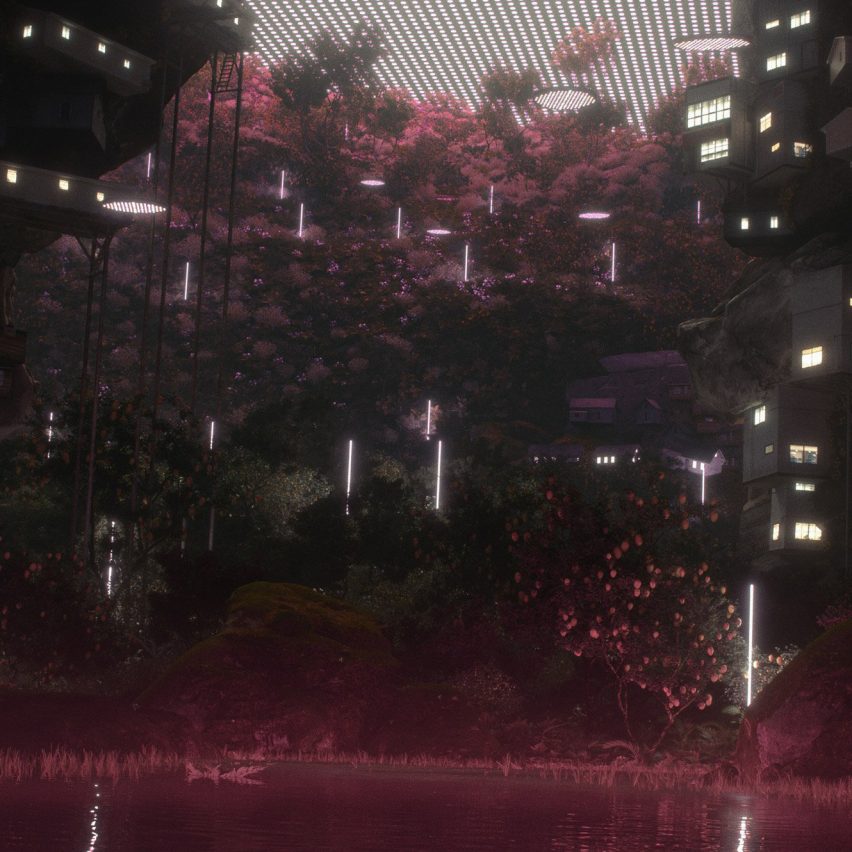
This essay was commissioned by the National Gallery of Victoria, Melbourne and appears in Planet City, a book based on the film of the same name by director and designer Liam Young, set in an imaginary city for 10 billion people who have surrendered the rest of the world to rewilding, carbon sequestration and the return of stolen lands.
The image is a still from the movie showing an indoor mega farm that will feed residents of Planet City.
Holly Jean Buck is a geographer and environmental social scientist, working as an Assistant Professor of Environment and Sustainability at the University at Buffalo in Buffalo, New York. She is the author of After Geoengineering: Climate Tragedy, Repair and Restoration (Verso, 2019), which explores best-case scenarios for carbon dioxide removal, and Ending Fossil Fuels: Why Net Zero Is Not Enough (Verso, 2021), on how to approach fossil fuel phaseout.
Carbon revolution
This article is part of Dezeen's carbon revolution series, which explores how this miracle material could be removed from the atmosphere and put to use on earth. Read all the content at: www.dezeen.com/carbon.
The sky photograph used in the carbon revolution graphic is by Taylor van Riper via Unsplash.
The post "Planet-wide regeneration could result in a safer climate after a few hundred years" appeared first on Dezeen.
from Dezeen https://ift.tt/3xq5loF