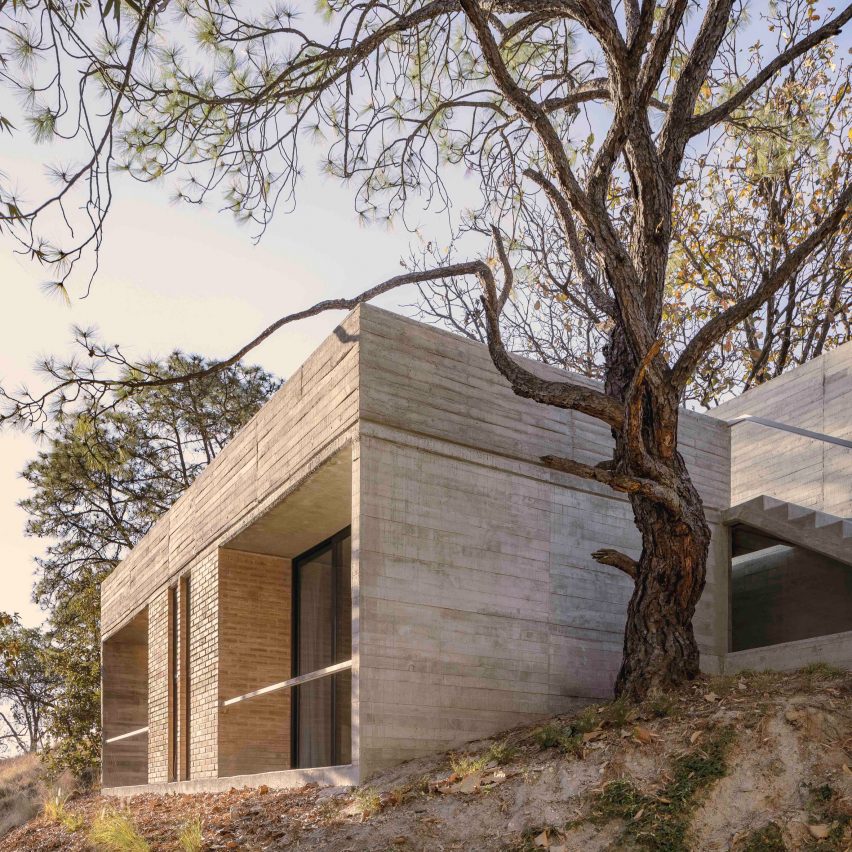
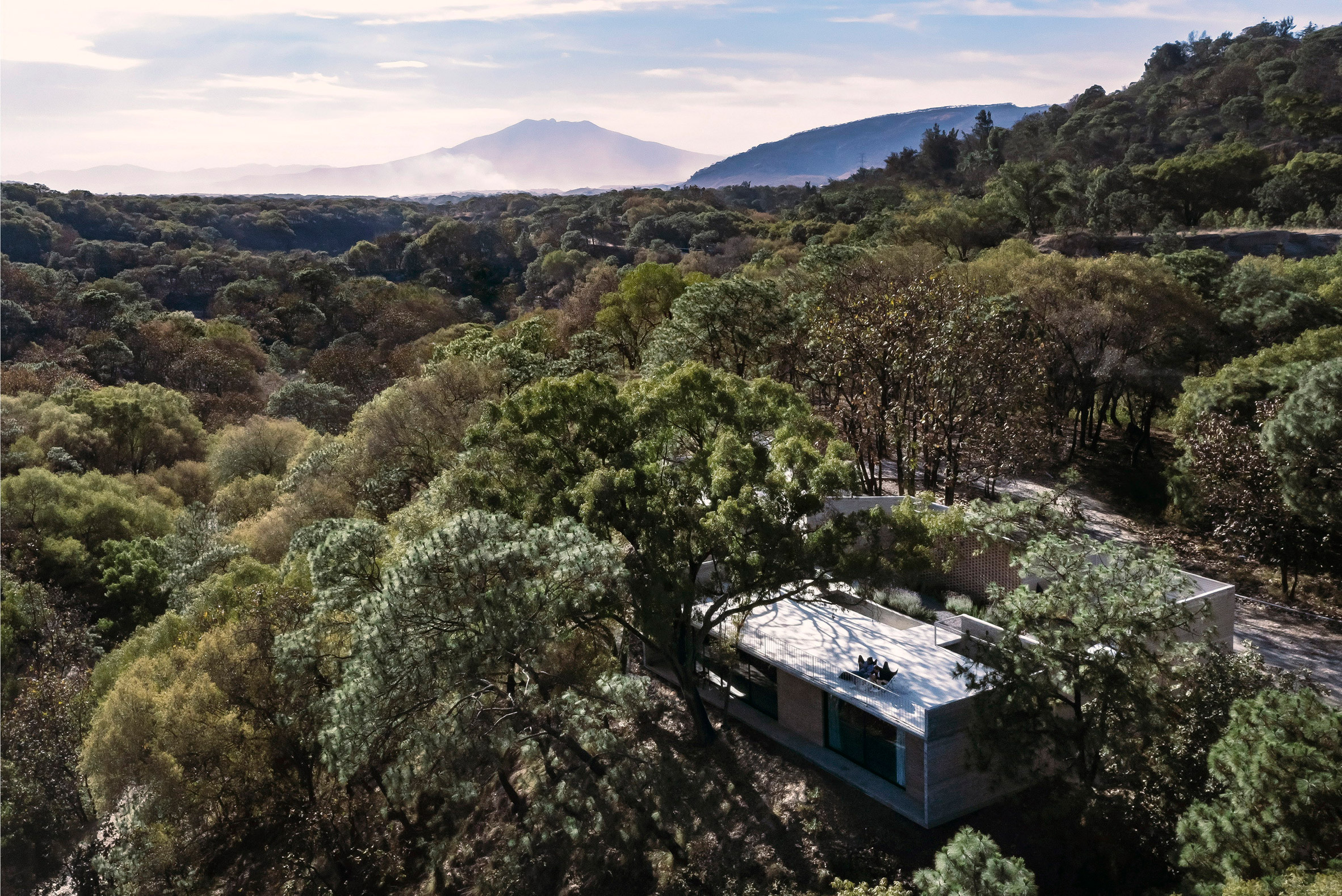
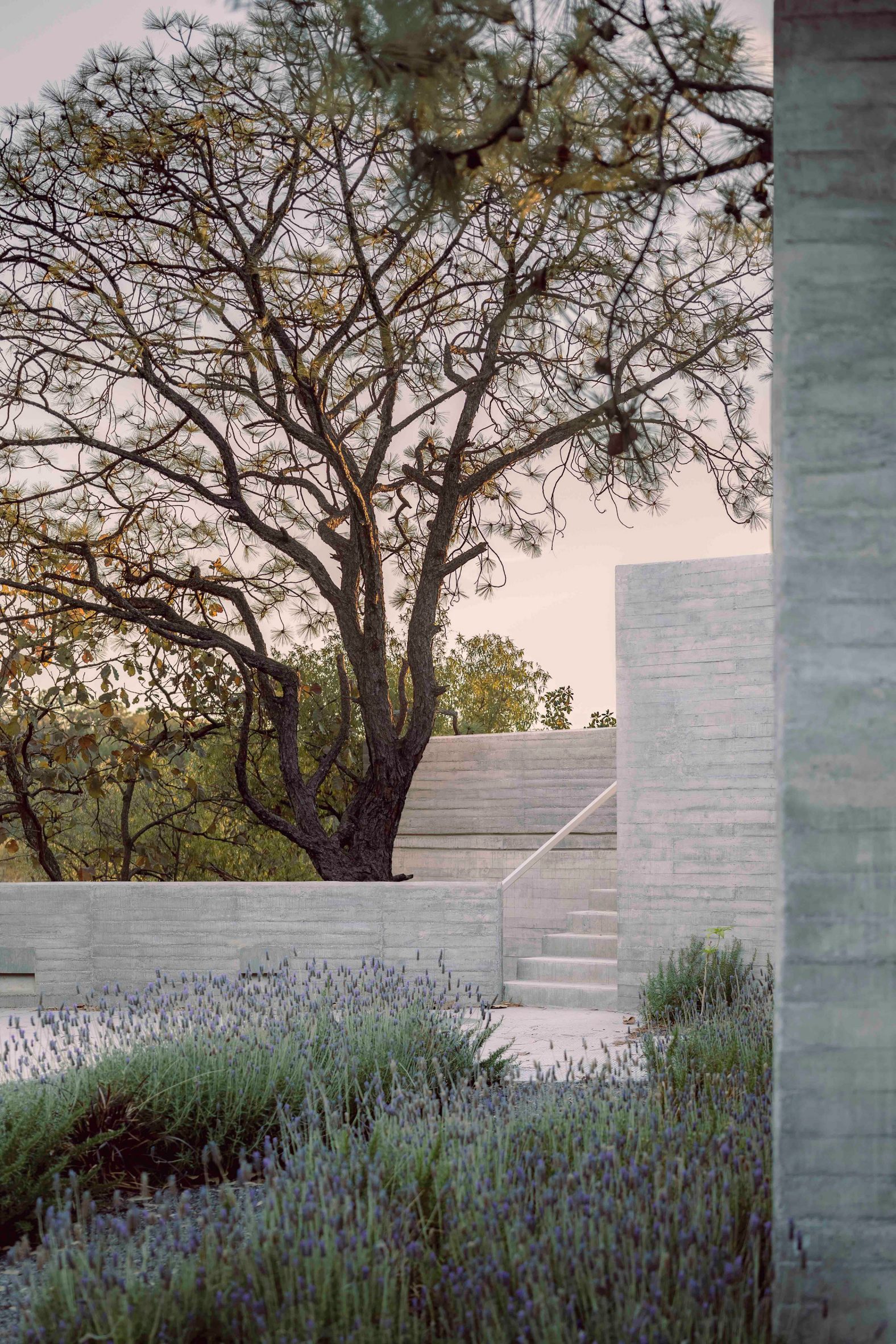
Mexican architect René Pérez Gómez has completed Casa Amapa, a pared-back concrete house nestled in the Primavera forest near Guadalajara in Mexico.
The home has been designed to be a place for reflection and connection with nature, arranged around a series of existing trees to have as little impact on the woodland as possible.
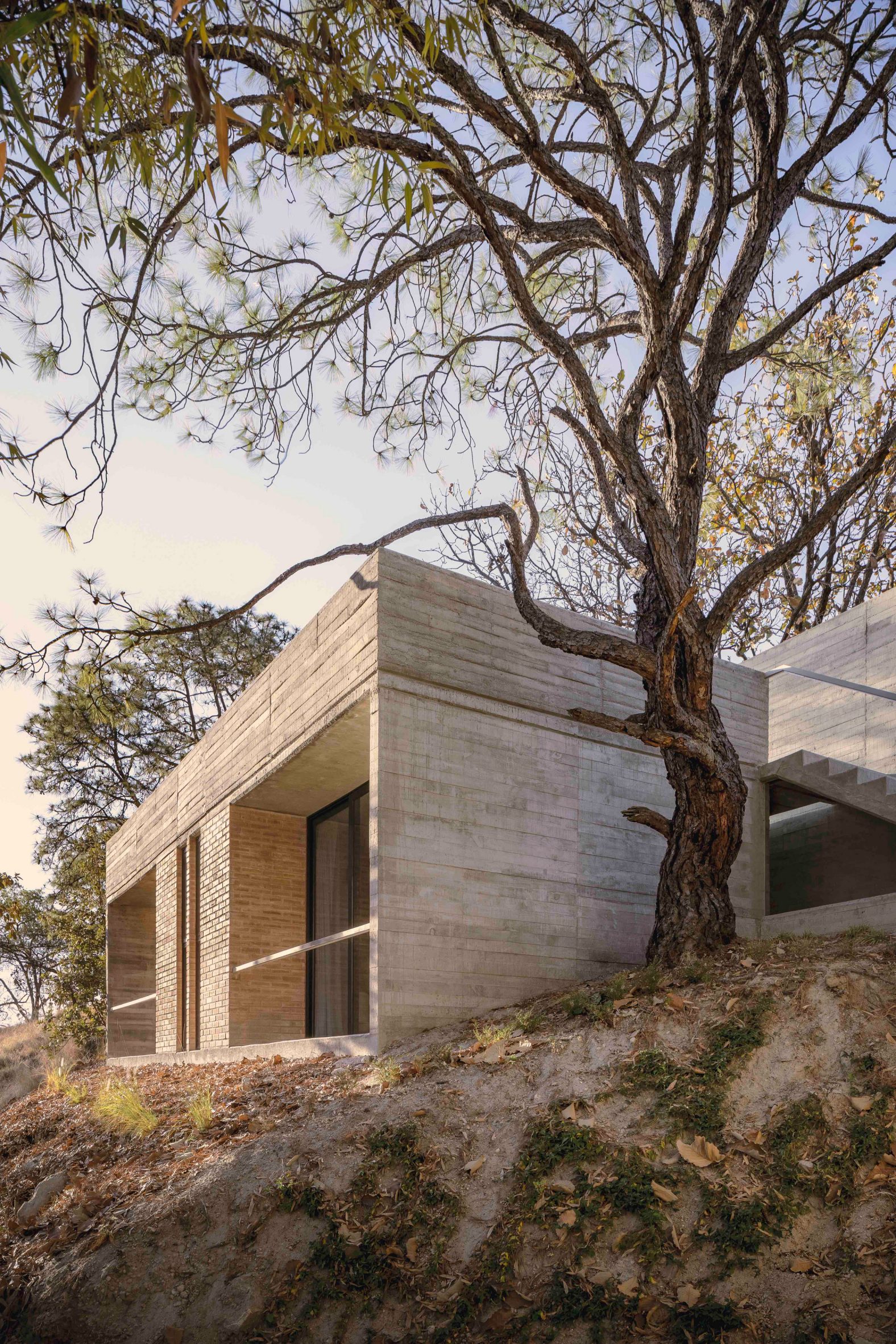
Top: terraces surround the home. Above: the building was built into a hillside
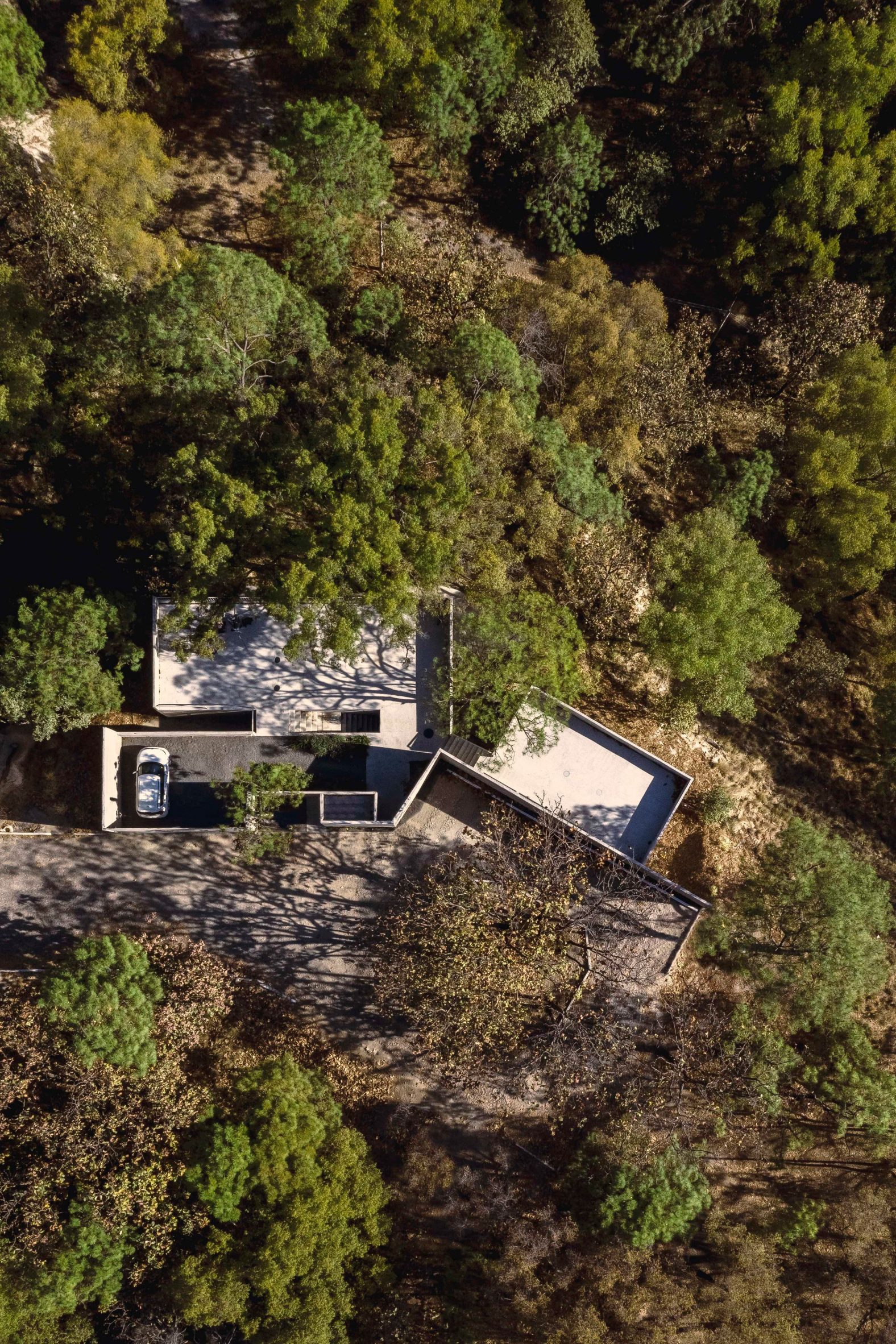
Built into a hillside, the house steps downwards to create two levels: a lower one housing the living spaces and an open upper level of roof terraces, viewing platforms and a small garden.
Oriented to look down the slope, these terraces are shielded from the forest behind by high concrete walls.
The house was built around existing trees
Access is via a doorway that sits behind a perforated brick screen.
"The platforms of the house are sites of coexistence, reflection and connection," said Pérez Gómez.
"Below them, the sanctuary is hidden, with an intimacy that is part of the forest as well."
It was constructed using concrete
Informed by "stereotomic" architecture – meaning spaces formed by cutting and subtracting rather than adding – the board-marked concrete walls of the home are treated as a found object
Guadalajara-based Pérez Gómez said the effect is intended to make it look as though the walls "emerged from the Earth".
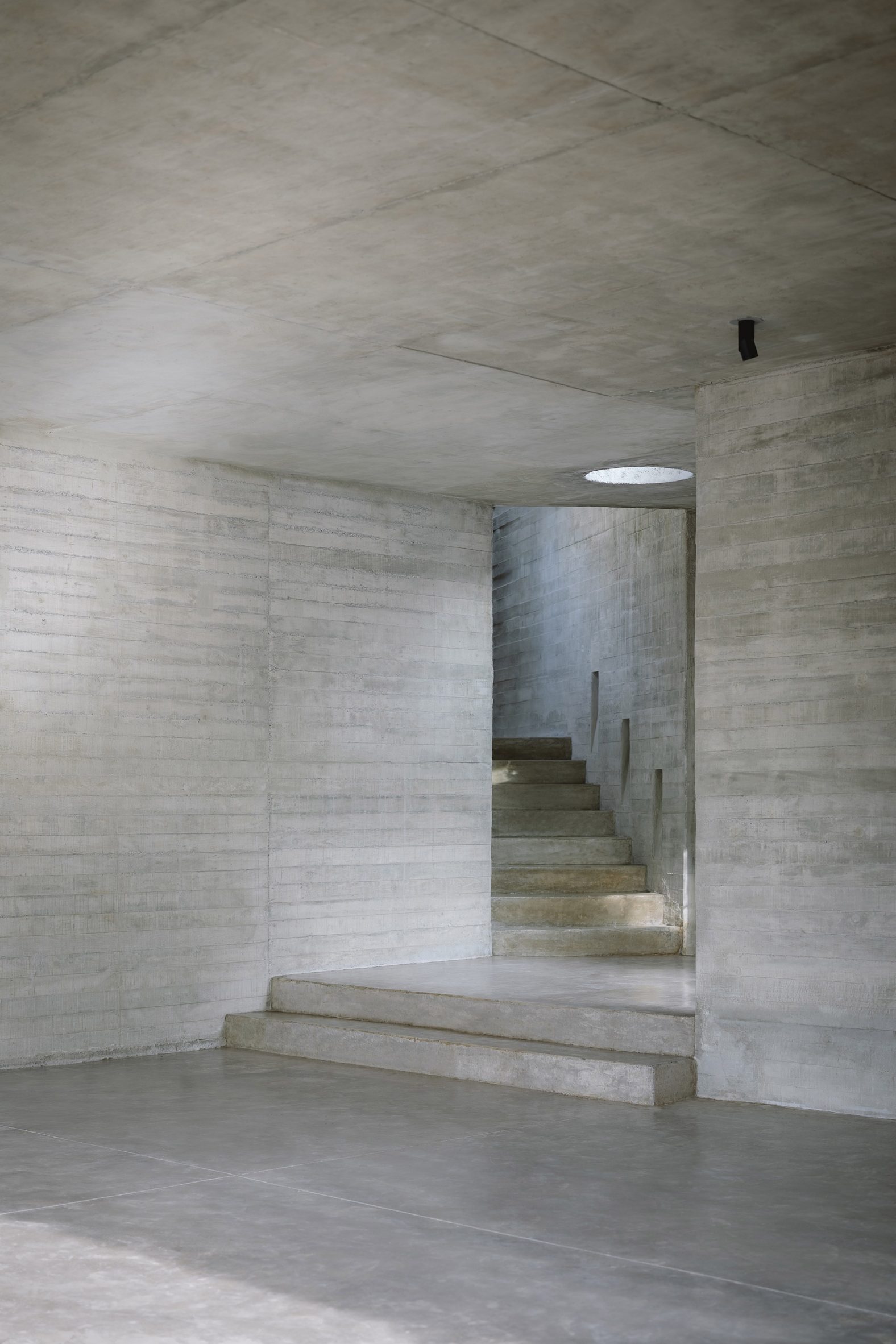
Open staircases connect these terraces to the living level, with a larger wing to the east housing a living, kitchen and dining area and en-suite main bedroom.
Open staircases connect the terraces and living spaces
A smaller wing to the west contains two smaller en-suite bedrooms.
Space for parking has been tucked away behind the concrete walls, and a simple driveway incorporating a cluster of existing trees leads out into the forest.
Treating the concrete form as a carved-out, cave-like space, the living spaces are divided internally by brickwork walls.
The corridor leading down to the bedroom wing frames these two materials opposite one another, illuminated by a thin skylight that runs along its entire length.
The home has a concrete interior
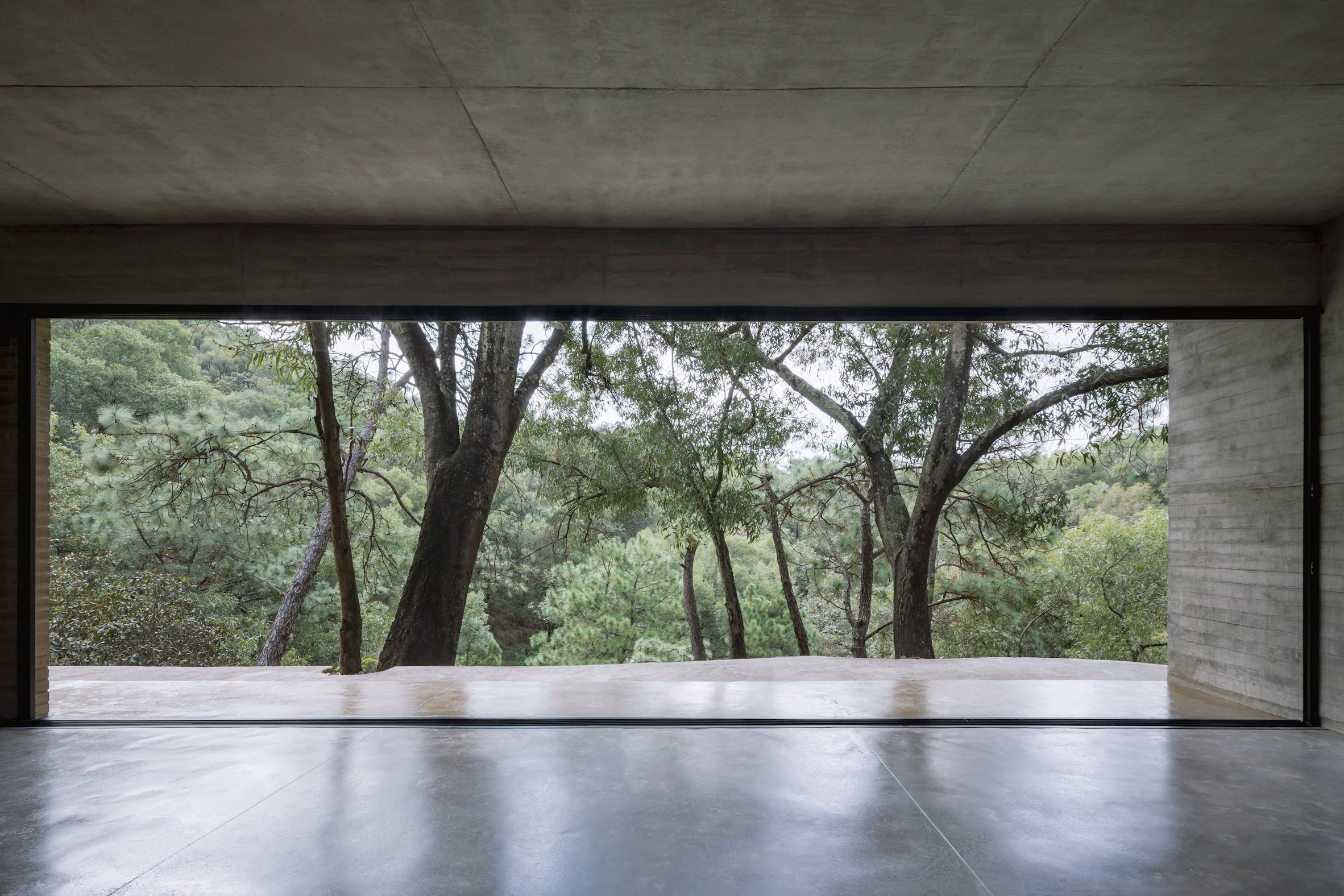
Full-height windows set deep into the concrete forms of the home with thin metal balustrades frame large, uninterrupted views out to the forest.
"Each of the spaces of the house enjoys a frank and different view of the forest, maintaining this connection with the forest at all times," added Pérez Gómez.
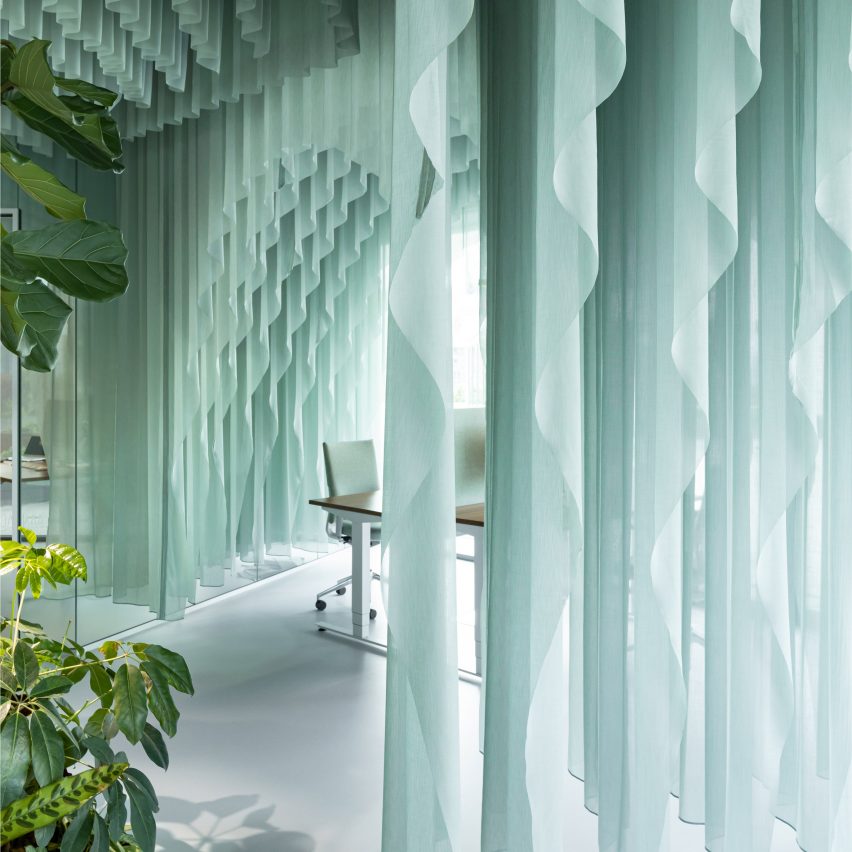
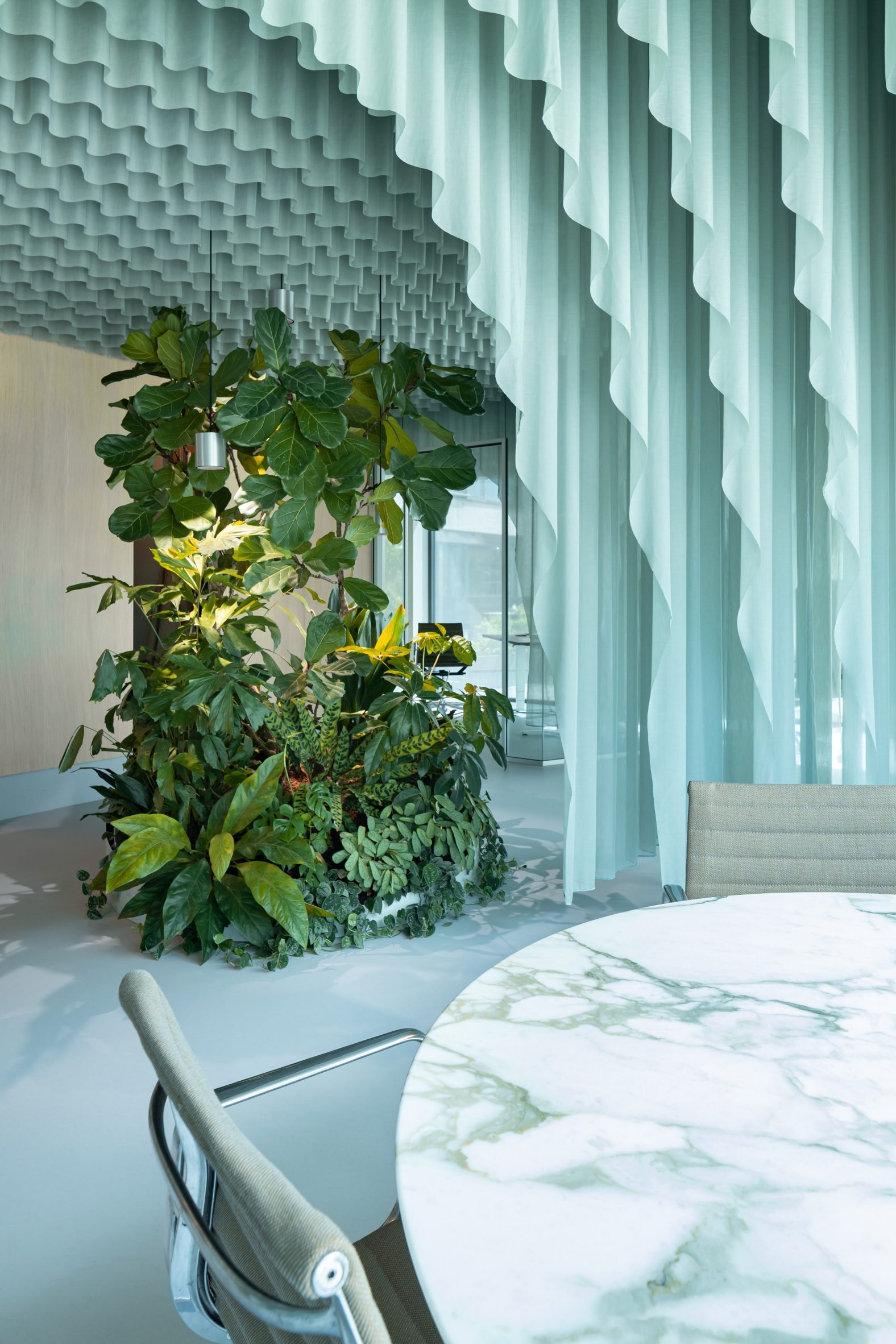
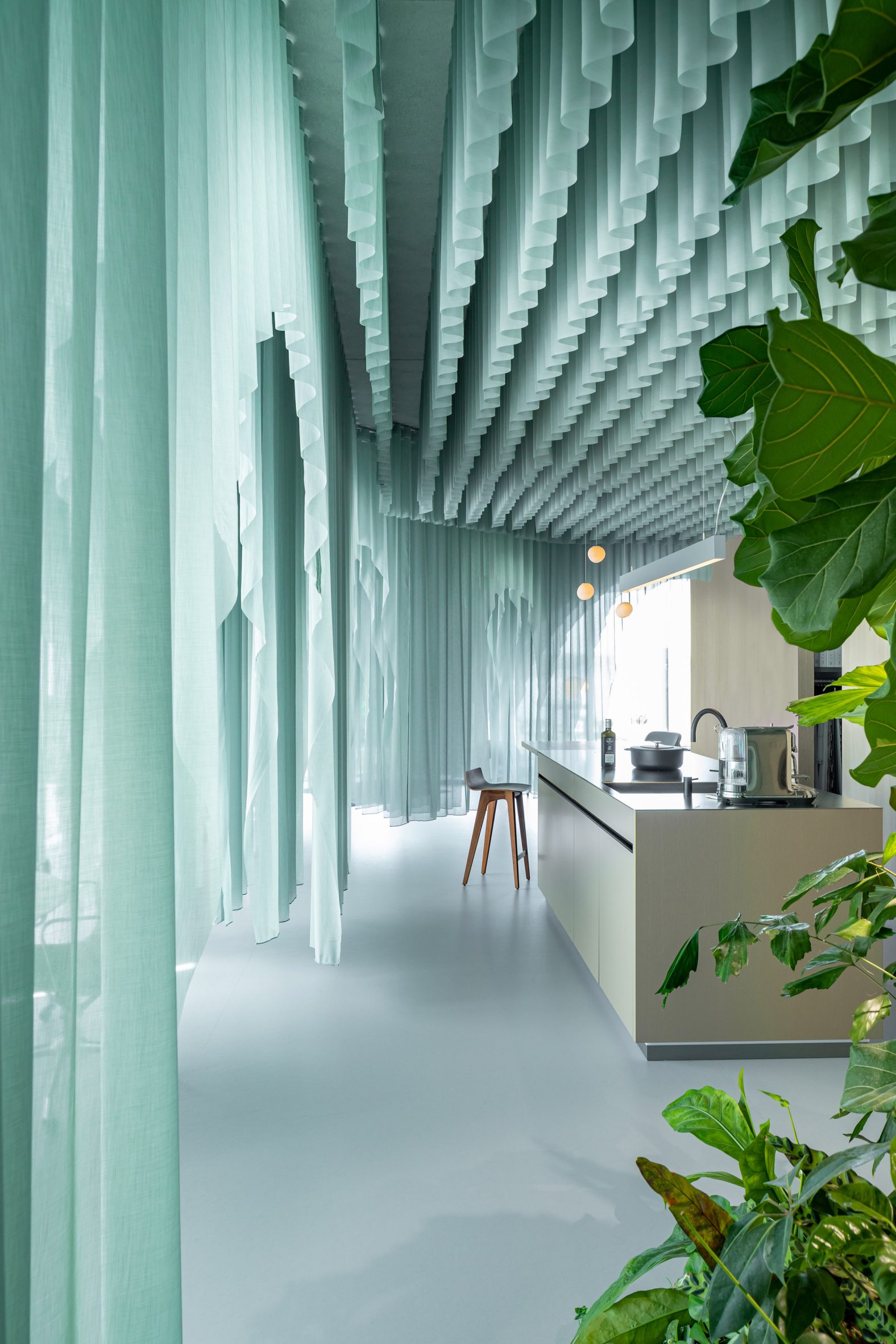
Design studio Beyond Space has created an office interior in Amsterdam that doubles as a showroom using rippling laser-cut fabric to form cave-like spaces for working.
Created for Siersema Interieur, a studio that specialises in fabrics, Beyond Space looked to the nearby IJ-river to inform the design of the office in the Netherlands.
Top: the interior was blanketed in fabric. Above: fabric has an ocean hue
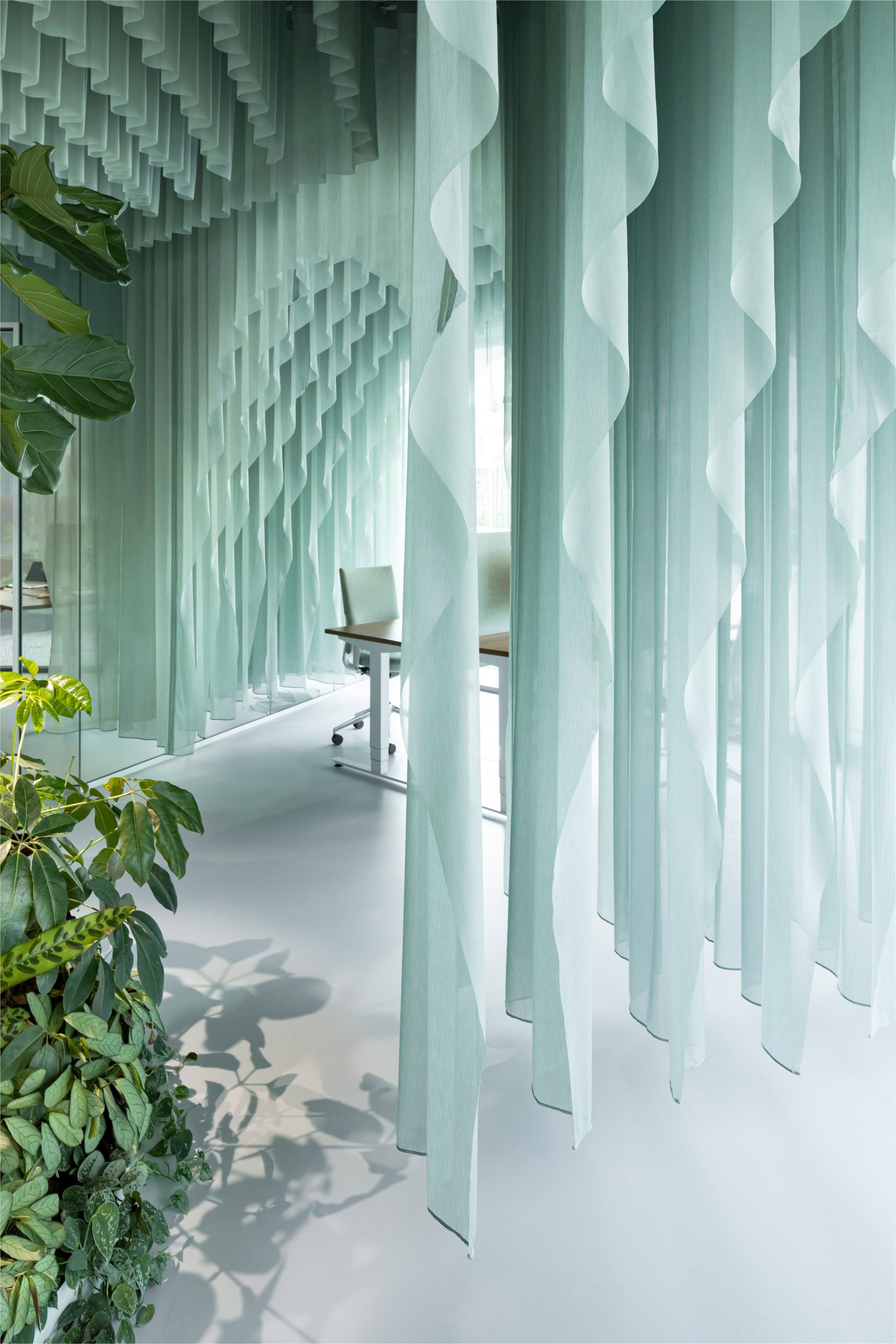
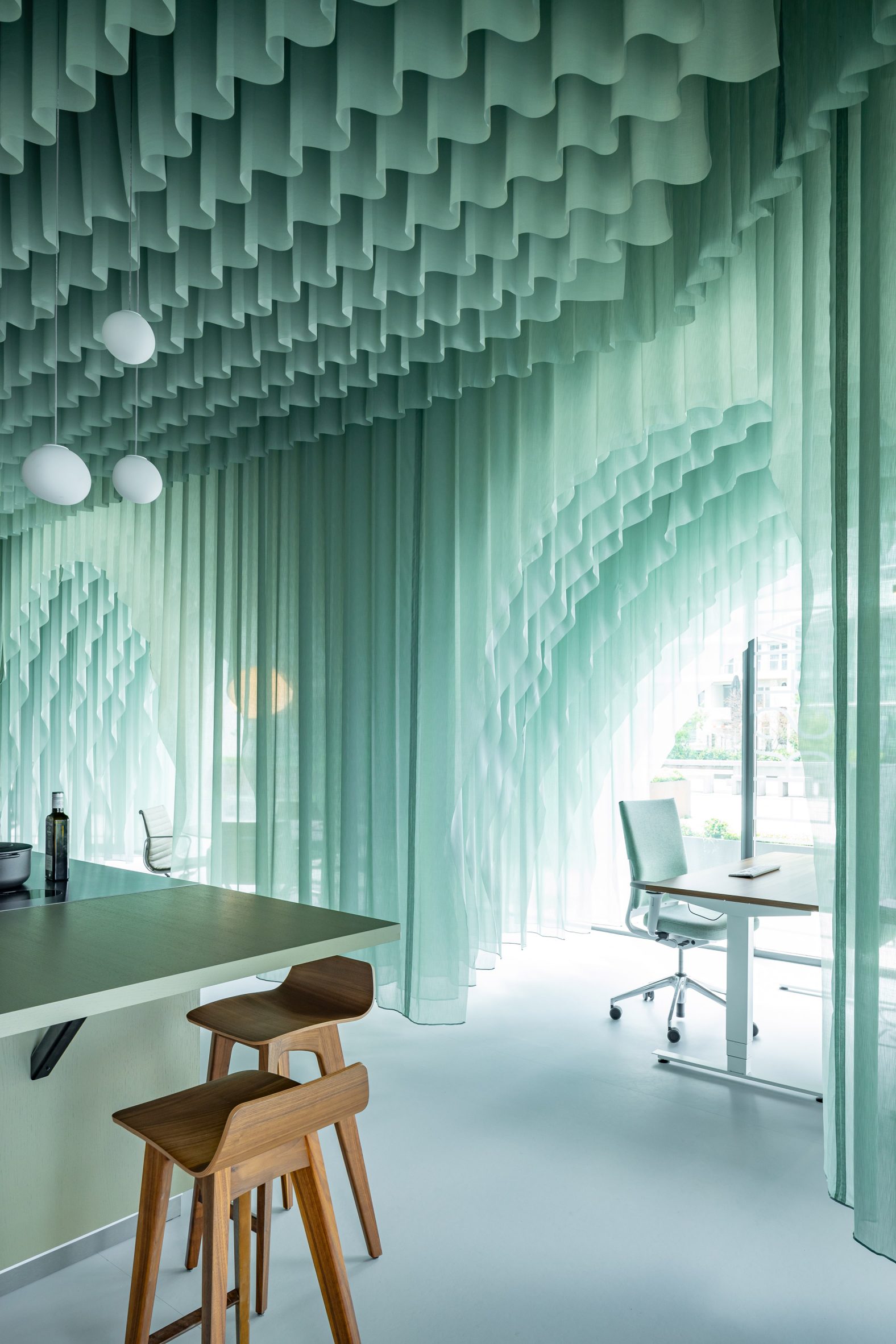
The studio used one kilometre of semi-sheer fabric across the interior to create curtains with a rippling effect that mimics the movement of water.
Layers of fabric in a pale blue-green hue are hung vertically and draped from the room's high ceiling.
The floor has a grey tone
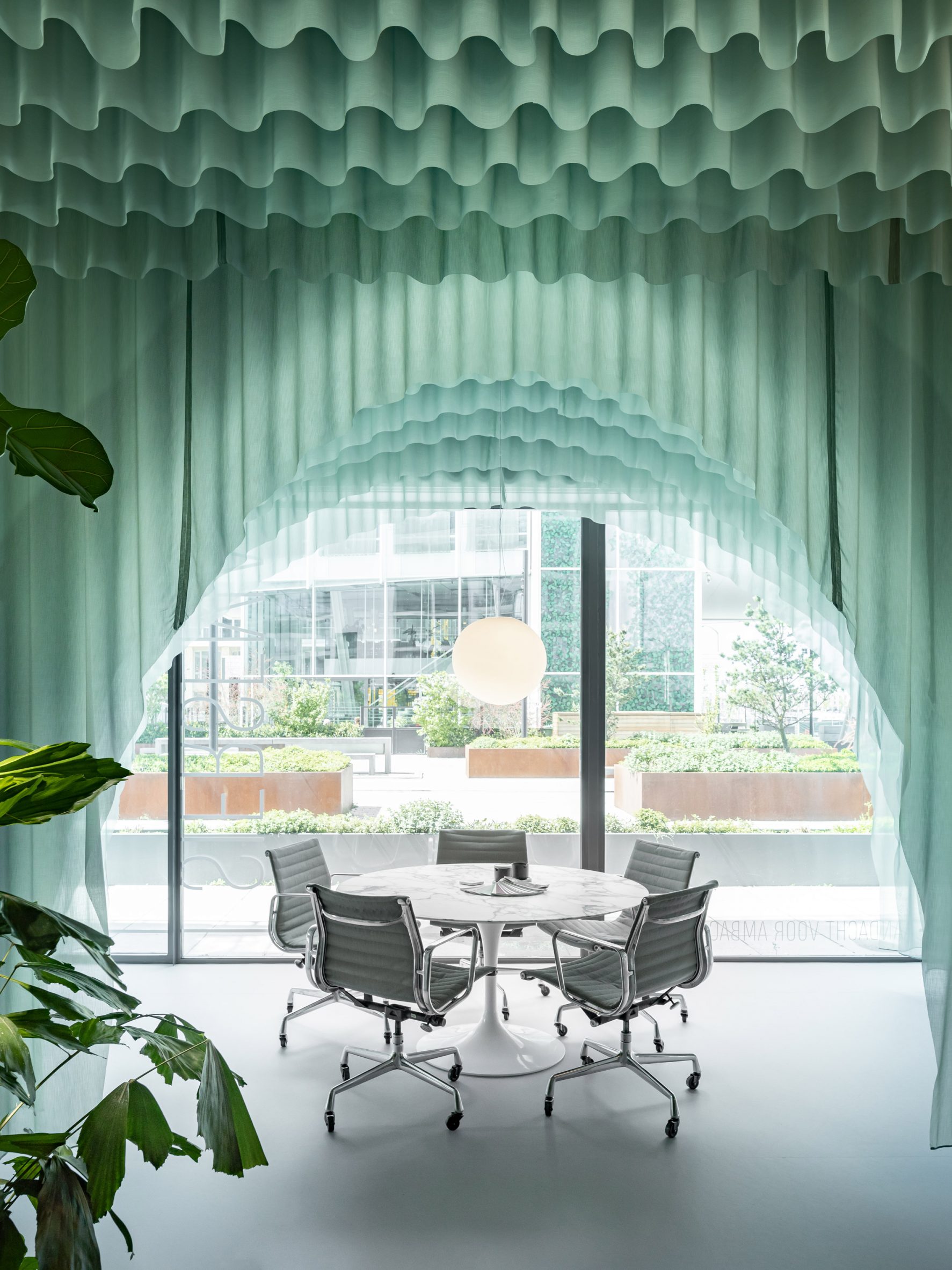
Six spaces are formed out of the multiple layers of fabric, including a collection of workspaces and meeting rooms organised around the edge of the space in order to maximise natural daylight.
The semi-sheer polyester was laser-cut at different lengths and shapes to prevent any potential fraying.
Openings and archways connect the workspaces, and the curtains are cut short around communal areas and left longer in more private zones.
Work spaces work organised along the edges of the office
The fabric was fitted with chord-weights in places to create the desired ripple effect.
"We made dozens of designs to get the proportion between closed and open space exactly right," Beyond Space founders Remi Versteeg and Stijn de Weerdtold Dezeen.
"The rooms had to feel spacious but also like they were carved out of the space, so either too big or too small didn't work."
The sheerness of the polyester allows light to softly filter into the office and create different layers of transparency.
As each curtain is evenly spaced apart, the arrangement provides areas with privacy when viewed from the front and glimpses out to the water and adjoining spaces when viewed from the side.
The fabric was cut short above shared spaces
"Viewed from the front, it lets through light and adds various layers of transparency," said the architects.
"Viewed from the side, it allows for views towards the water in between the curtains, which have space between them."
"The colour of the curtain is light enough to avoid grabbing all the attention, but adds a subtle hue to the space which is reminiscent of water or ice."
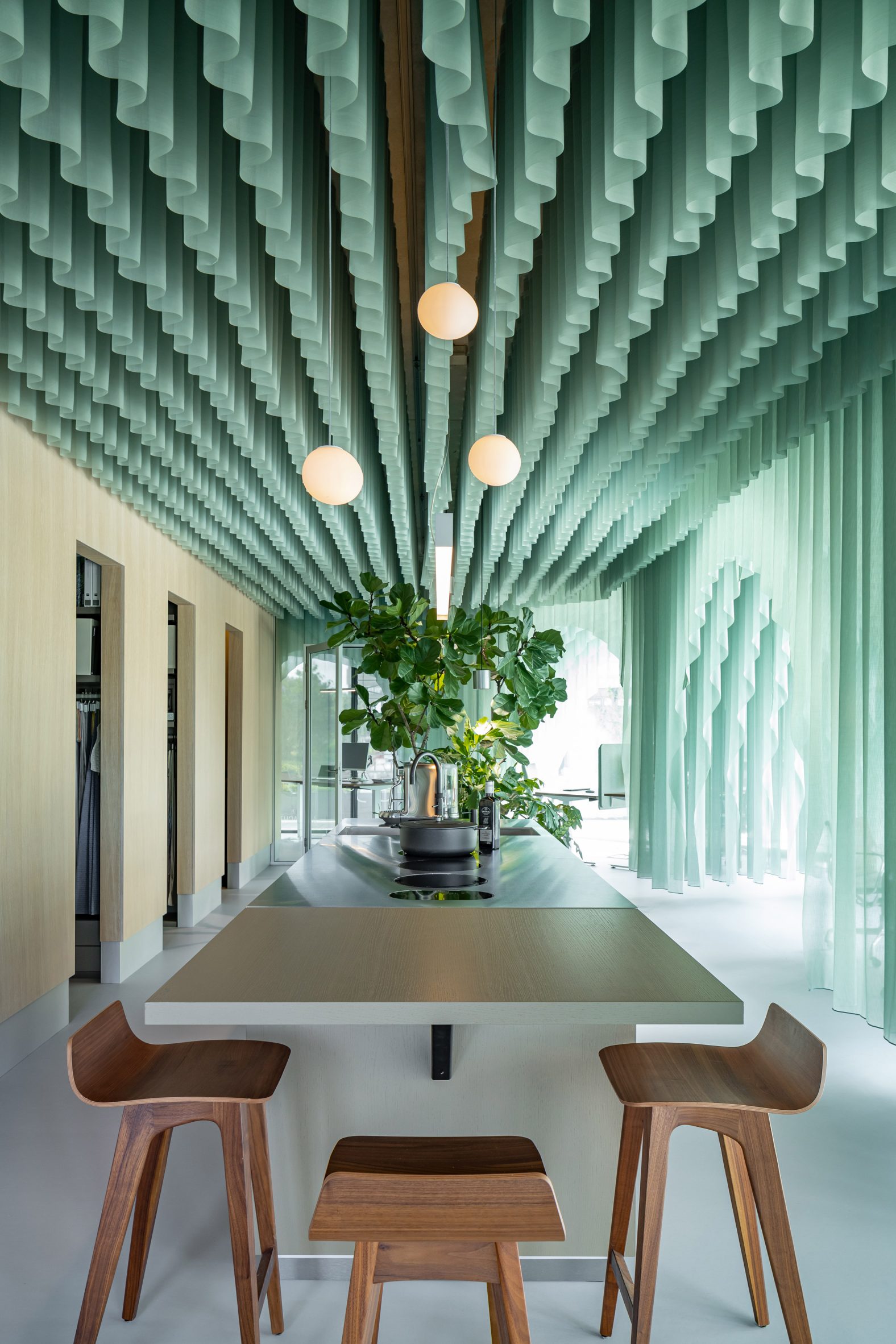
A kitchen was organised at the centre of the space
A kitchen sits at the centre of the office, complete with a kitchen island and high stools. Pendant lights and pot plants decorate the space.
"The kitchen and storage are located in the middle since people spent less time there during the day," they said.
"In the evening, things turn around, and the kitchen transforms into the cosiest place of the office."
Workspaces have views out through large windows
Elsewhere in Amsterdam, the studio created a flexible workspace for a security company using a colourful grid system.
More interesting offices in the city include colourful onyx bars across a hybrid office, store and cafe designed by Anne Claus Interiors for a media company.
City leaders are doing more to eliminate global carbon emissions than national governments, according to Hélène Chartier of international network C40 Cities.
Chartier, whose organisation is coordinating the climate strategies of almost 100 cities around the world, said that politicians have made "very, very little" progress on climate since the 2015 Paris Agreement.
"Cities have been really leaders, especially when the nations were stuck with Trump," said Chartier, who is head of zero-carbon development at C40 Cities.
C40 Cities is a network of megacities addressing climate change
"It was very inspiring to see the US mayors really accelerate their climate action while Trump was withdrawing the US from the Paris Agreement," added Chartier, who previously worked in the office of visionary Paris mayor Anne Hidalgo.
"Without nations, it's going to be not possible [to reach net-zero] but at least mayors can pave the way." The USA has since rejoined the Paris Agreement under new president Joe Biden.
"Sometimes urban areas are more progressive so they feel that they have more operational capacity," she added. "They have more support from their residents to accelerate the transition and help nations to go in the right direction."
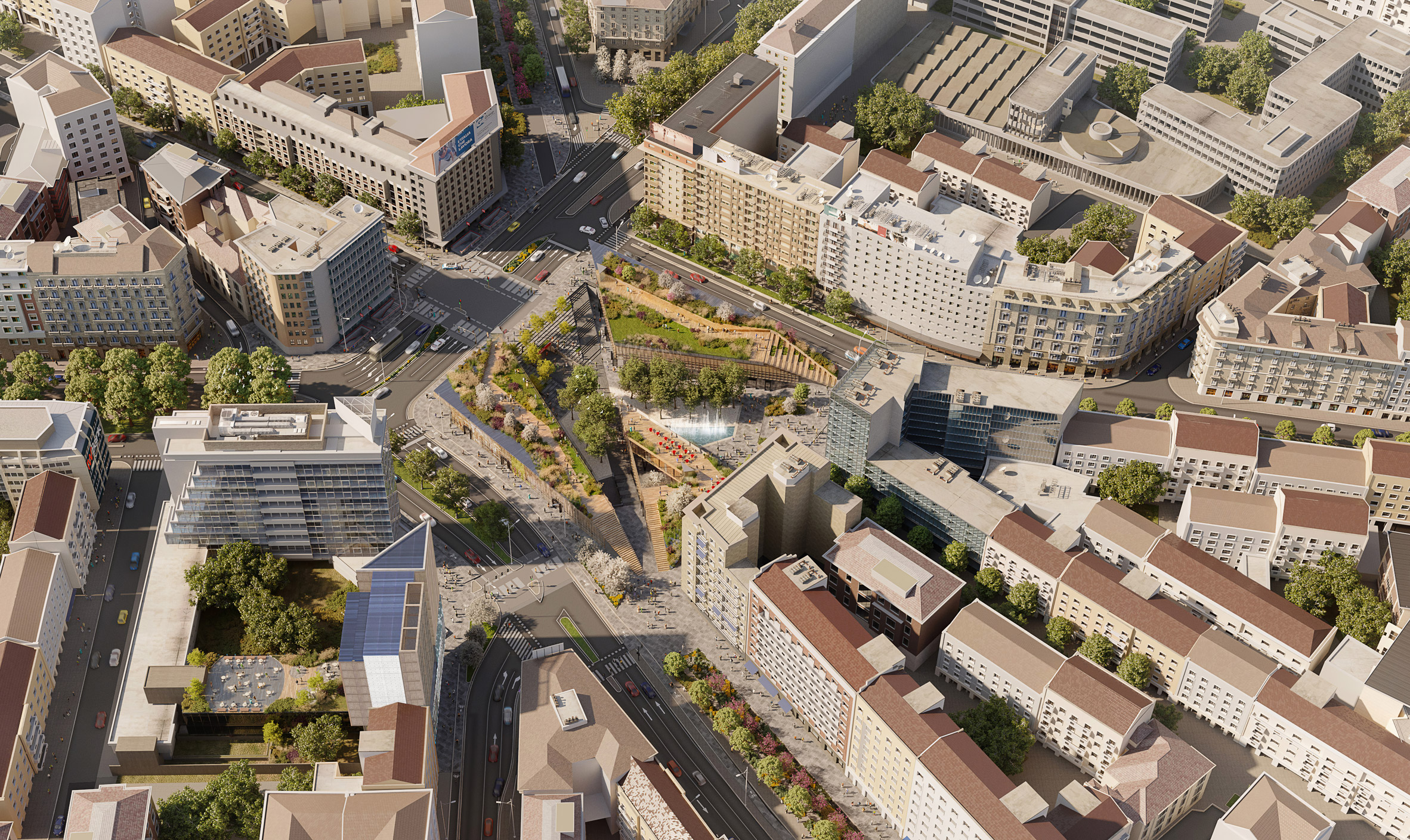
Top image: the Piazzale Loreto development is a Reinventing Cities winner. Above: Hélène Chartier
C40 Cities is "a network of the world's megacities committed to addressing climate change". It now has 97 member cities, which together represent over 700 million people and make up one-quarter of the global economy.
Members, which include London, Shanghai, São Paulo and Lagos, pledge to meet the objectives of the Paris Agreement, which involve halving emissions by 2030 and eliminating them altogether by 2050.
National governments who signed the Paris Agreement will meet in November at the COP26 climate conference in Glasgow to assess progress. But cities are outpacing nations in the race to decarbonise, Chartier said. "All our cities align their strategy to reach net-zero by 2050," she said. "That's their objective."
Among activities coordinated by C40 Cities is the Reinventing Cities competition, which seeks urban developments that strive for net-zero emissions. This means they emit no greenhouse gases into the atmosphere either as embodied carbon during their construction or as operational carbon during their use.
The first tranche of the 49 winning projects from the inaugural competition are about to go on site in cities including Milan, Oslo, Paris and Reykjavik.
Achieving zero emissions in operation at these projects is relatively straightforward since the bulk of energy needs can be provided by renewable sources, Chartier said. However, eliminating embodied emissions generated by materials supply chains and the construction process is "impossible," according to Chartier.
Piazzale Loreto in Milan will turn a traffic hub into a green square
The only way to negate these emissions is via offsetting. "Reaching net-zero on embodied, you cannot do it without offsets," Chartier said. "It's totally impossible. So the question is really to push them to reduce embodied carbon to the maximum and then to offset the last part."
"Each team is really free to develop their own offsetting strategy but the most important thing is to reach net-zero operational emissions, minimise embodied emissions and offset the rest with a good offsetting system."
Opinions on offsetting schemes vary
There is disagreement over what constitutes a "good" offsetting scheme that is compatible with the concept of a net-zero building, for which there is no internationally agreed standard.
The United Nations' Race to Zero campaign defines net-zero as meaning no carbon is added to the atmosphere either directly or indirectly over the entire lifecycle, which includes materials used in a project and emissions caused by customers using a product, service or building.
Where emissions cannot be eliminated, they can be offset. But Race to Zero also states that offsetting schemes must directly capture carbon from the atmosphere, for example via biomass or direct air capture technology. Schemes that reduce or defer emissions, for example by encouraging people to switch to renewable energy or by capturing industrial carbon emissions, do not count.
Winning projects in the Reinventing Cities competition take a variety of approaches to offsetting, although Chartier said that entrants were encouraged to "go for local offsets and not just buy them."
Not all of the approaches are compatible with Race to Zero standards. The Porte de Montreuil project, designed by Atelier Georges, Tatiana Bilbao Estudio, Serie Architects and Bond Society, will be powered by an on-site geothermal power plant and photovoltaics. The L'Innesto project in Milan by Barreca & LA Varra will feature a district heat network.
The next challenge for cities, according to Chartier, is to address emissions generated by people who live in carbon-neutral developments.
"There is one path of emissions that we have to include in the strategy a little bit more," she said. "That is consumption-based emissions." This third category of emissions, after embodied carbon and operational carbon, covers emissions caused by things such as food, transport and consumption of goods.
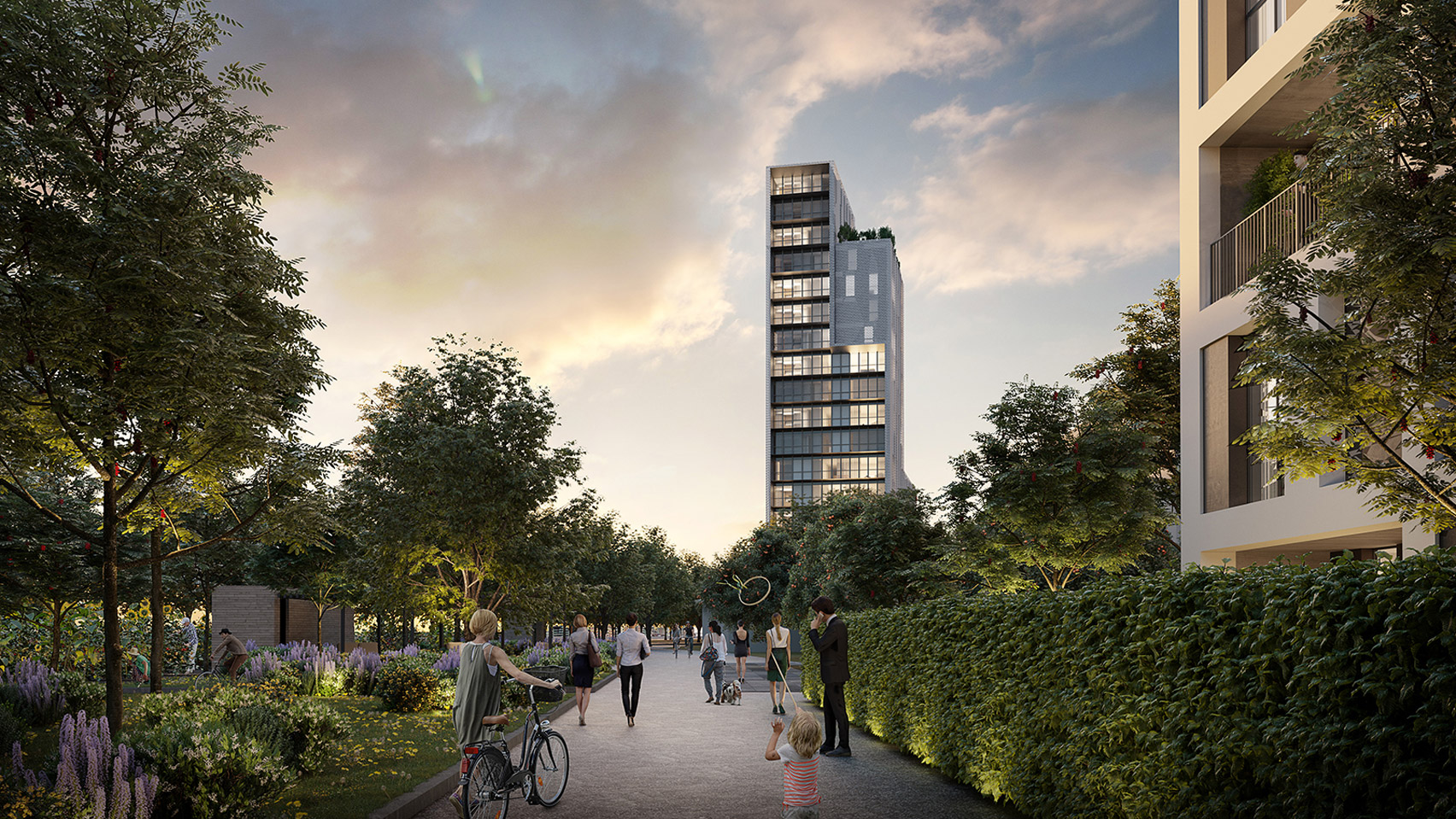
The L'Innesto project by Barreca & LA Varra in Milan will have a heat system powered by renewable sources
While good progress has been made on understanding and tackling embodied and operational carbon, consumption-based emissions have been overlooked, Chartier feels.
Architects have a big role to play in reducing them, she said. "I think architects have a very important role because they don't just build a building," she explained. "They build a place where people will live."
"If you have segregation of waste, if you have composting, if you have a zero-waste restaurant, if you have parking for bikes you will accelerate your transition to net-zero.
"But if you don't provide access to these types of amenities and services, it's going to be very complicated for people. Consumption-based emissions are really something that we need to integrate into our systems and in the way we count emissions."
Despite heel-dragging by politicians, Chartier feels that there is enough momentum among city leaders, businesses and the public to force change. "The good thing is that now everybody – the businesses and the citizens – is ready to make the change," she said. "We just need to help them to make this possible."
Carbon revolution
This article is part of Dezeen's carbon revolution series, which explores how this miracle material could be removed from the atmosphere and put to use on earth. Read all the content at: www.dezeen.com/carbon.
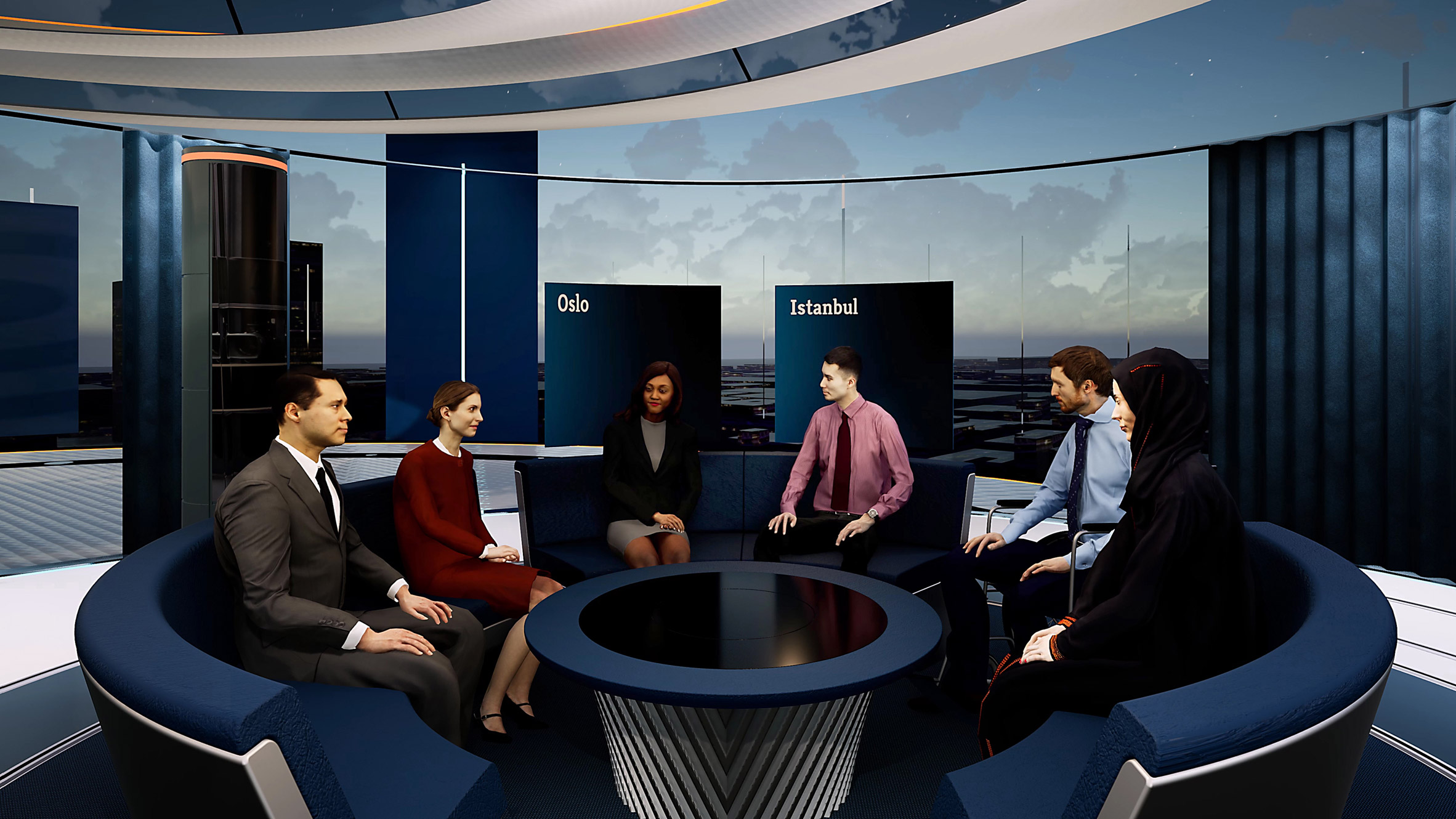
Design consultancy firm Softroom has designed a virtual reality news studio that uses 3D-creation software Unreal Engine to "dissolve the boundaries of the TV studio".
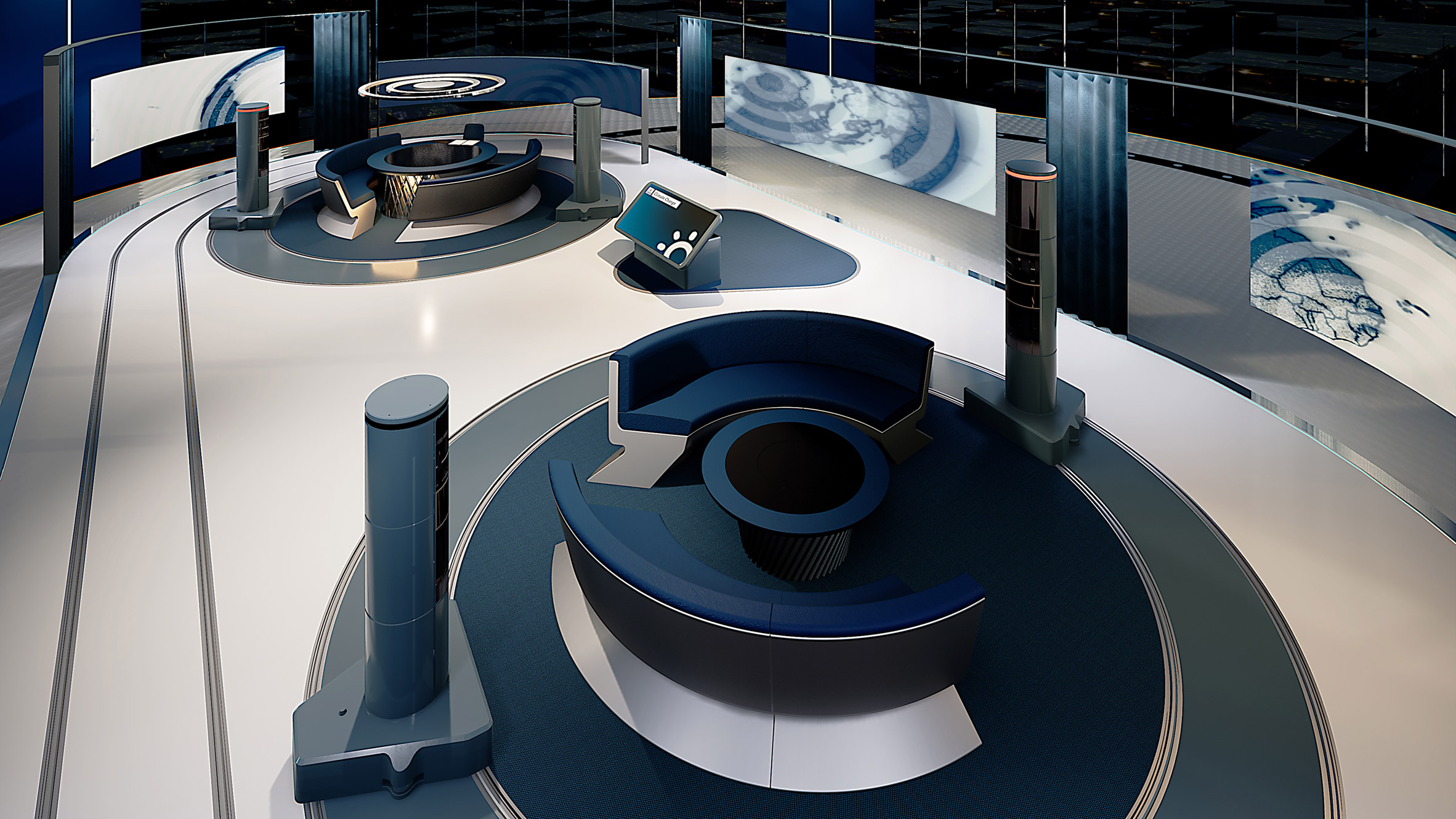
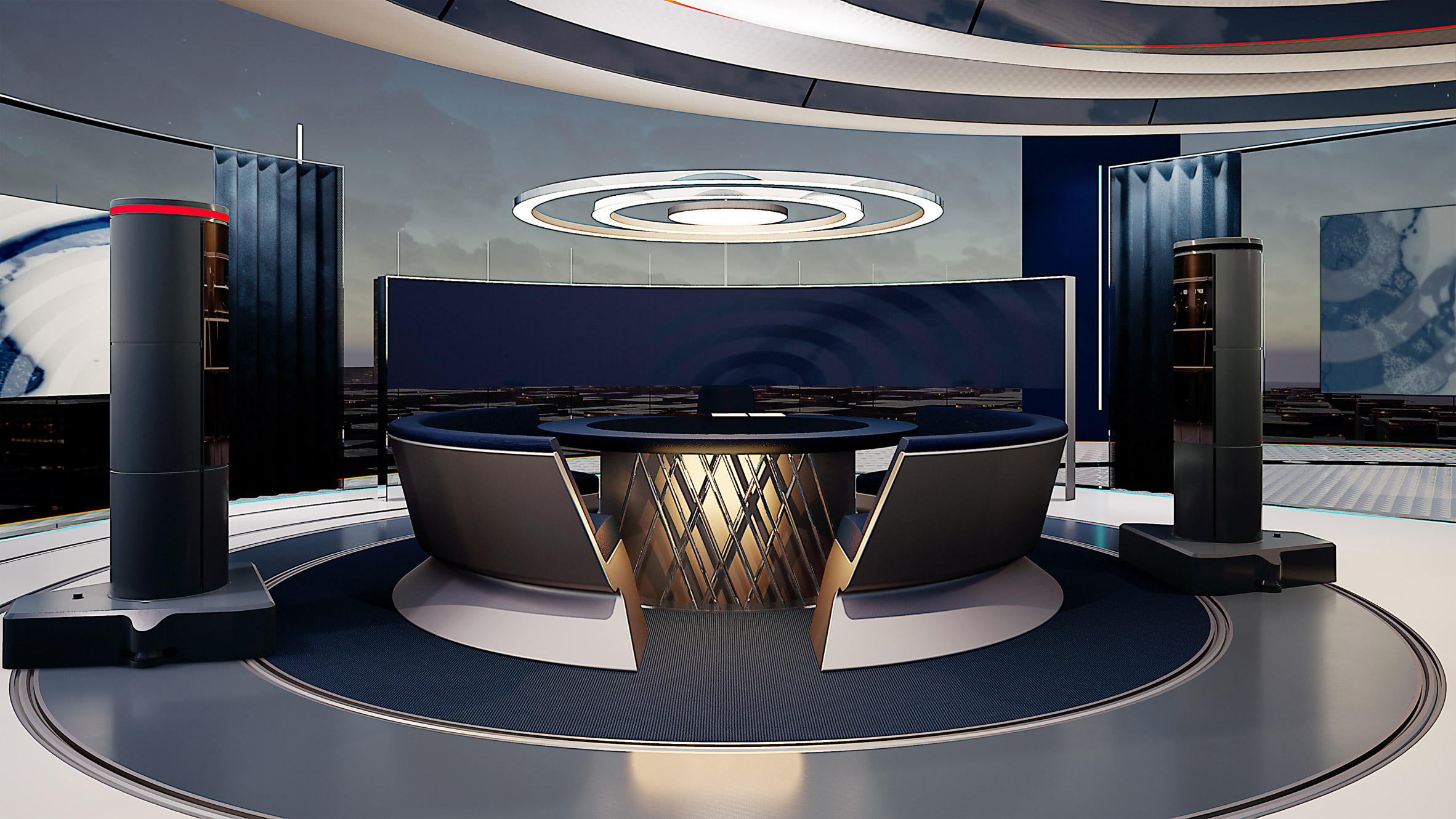
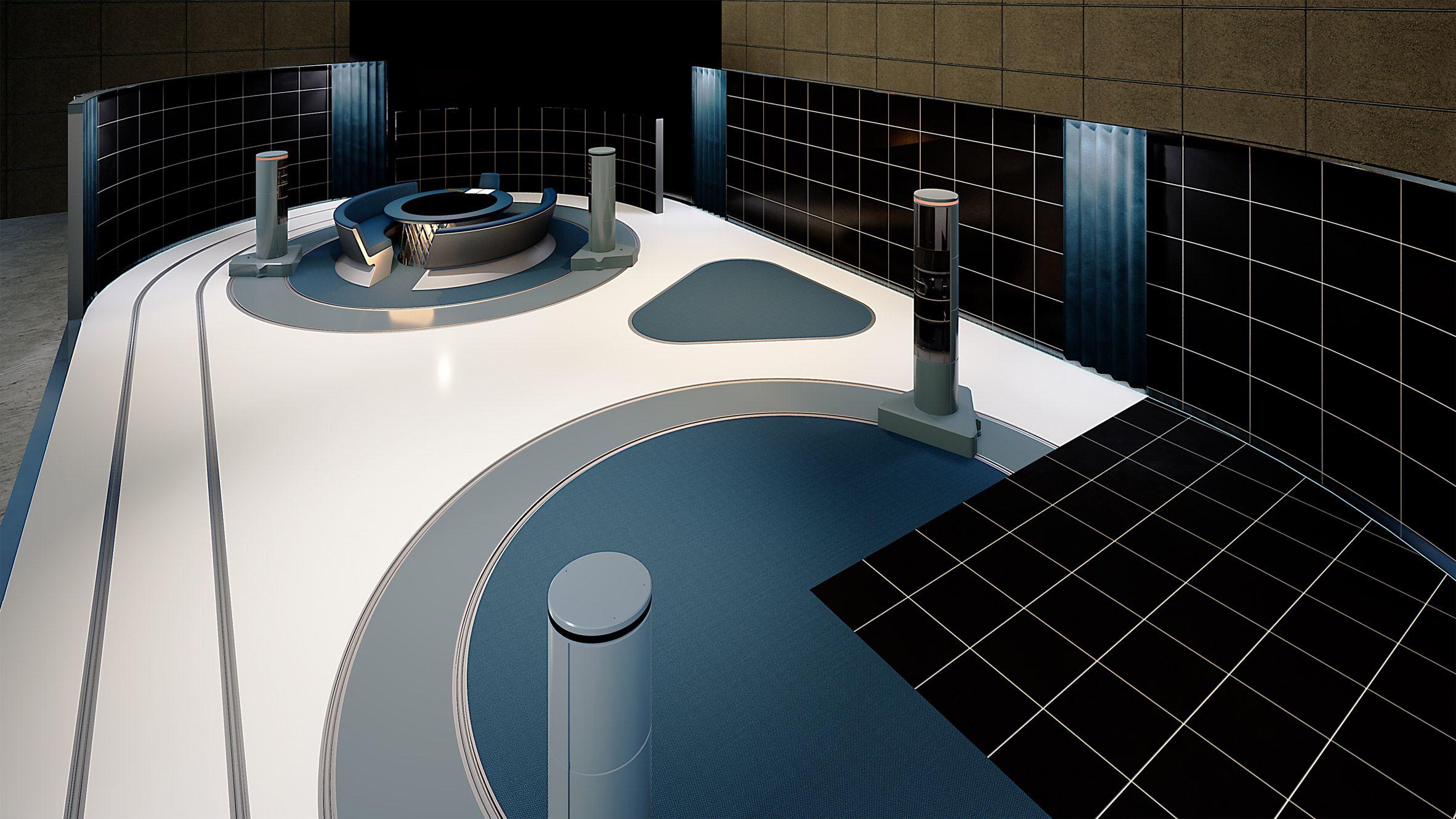
The News Pavilion is a TV studio that combines virtual production technology and real-time filming techniques. A permanent news booth, where presenters and guests can gather around a table, is surrounded by LED screens and other augmented reality technology.
Top: the News Pavilion is a windowless virtual studio. Above: regional newsreaders can join the table virtually
Softroom worked with the video game developer Epic Games to devise the concept, which was created using Epic Games' Unreal Engine display software. This generates the virtual environment in real-time.
"We wanted to explore what new opportunities for storytelling are possible, as well as creating a dynamic but sympathetic setting for the day's news, one that matches the sense of immediacy and importance of the subject matter," Softroom founder Oliver Salway told Dezeen.
The concept of The News Pavilion was borne from the Covid-19 pandemic
The idea for The News Pavilion came about during the Covid-19 pandemic.
"The whole issue of teleporting-in remote guests sprang from conversations about what the legacy of lockdown might be, now that we're all so much more accustomed to video-conferencing," Salway explained.
"Thanks to Covid-19, it's ok now for a news show to have someone interviewed via their webcam, but we felt that there might be better ways to bring in remote contributors given the resources of a TV station."
The video walls of the pavilion display the news in real time
The designers adopted augmented reality techniques more commonly found in film to explore these possibilities.
"We wanted to see what we could bring to TV design with an outsider's perspective," said Salway.
"A lot of physical TV set design just doesn't look like anything you'd credibly see in the 'real world'. It's trapped in a sort of debased art-deco pastiche – a bit like a 1980s cruise liner."
Cameras around the edge of the studio film the news in live time
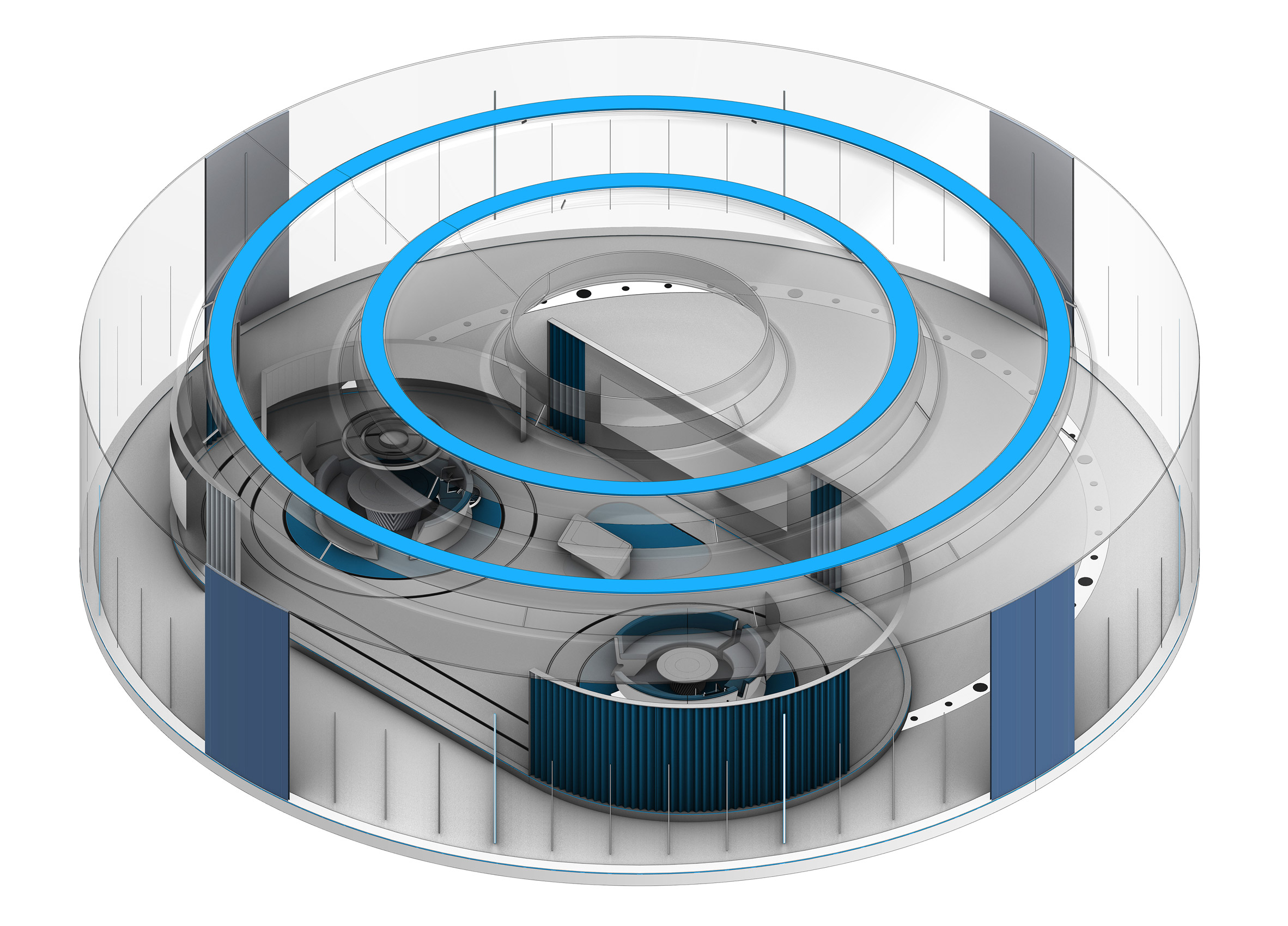
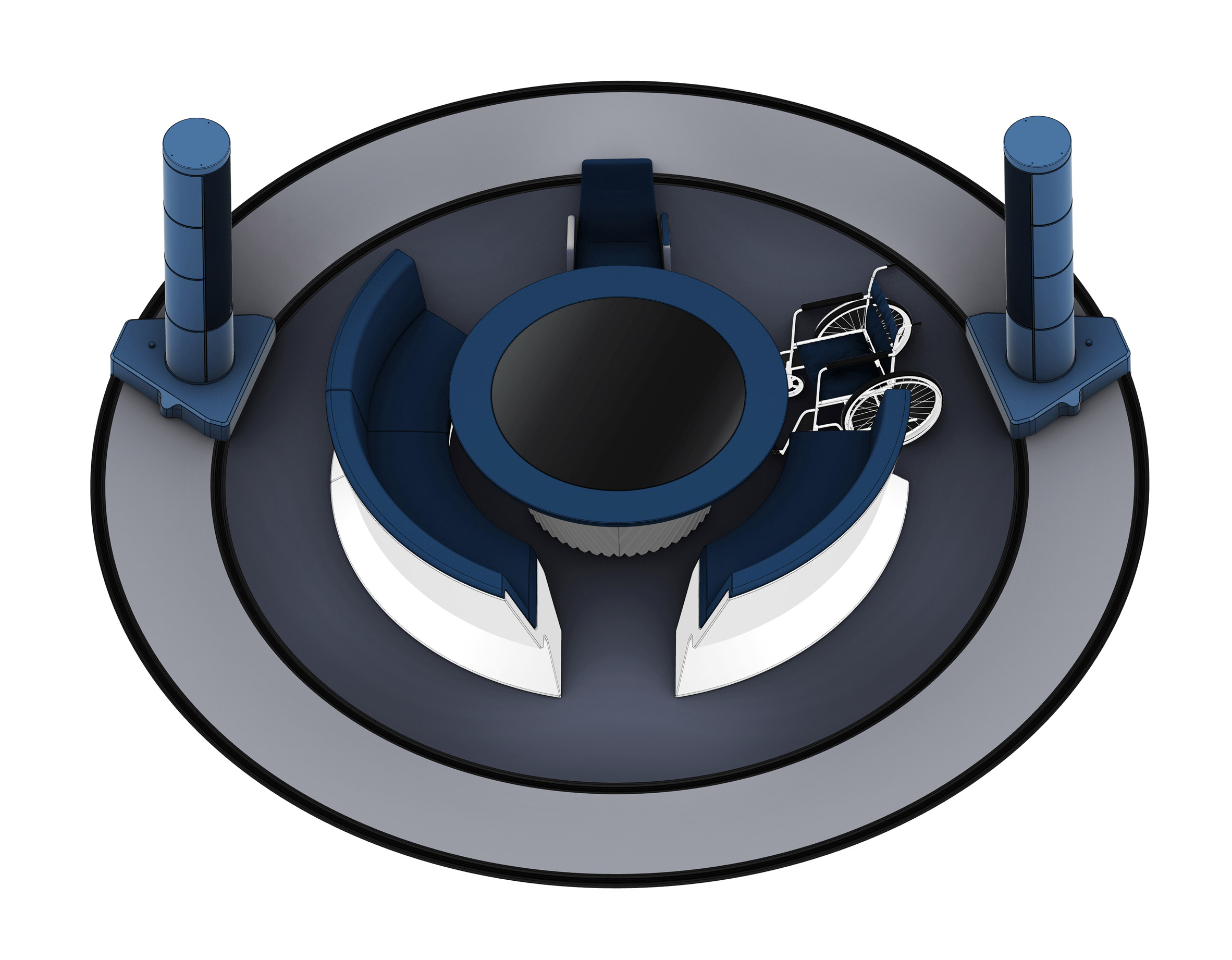
On the left side of The News Pavilion is a news booth area where the presenter can physically sit at a desk. This section of the studio is the only permanent part of the design.
A pavilion with video walls encloses the studio, "extending the boundaries of the real studio". Cameras on wireless tracks film the newsreaders in live time and the video output is displayed live onto the LED walls.
"A wrap around LED enables the physical set design to be digitally enhanced and extended, offering great flexibility in terms of graphic appearance and scale," Salway said.
"The LED display walls are linked in real-time to the movements of the camera, the whole extended space moves in totally convincing synchronisation with the changing viewpoint."
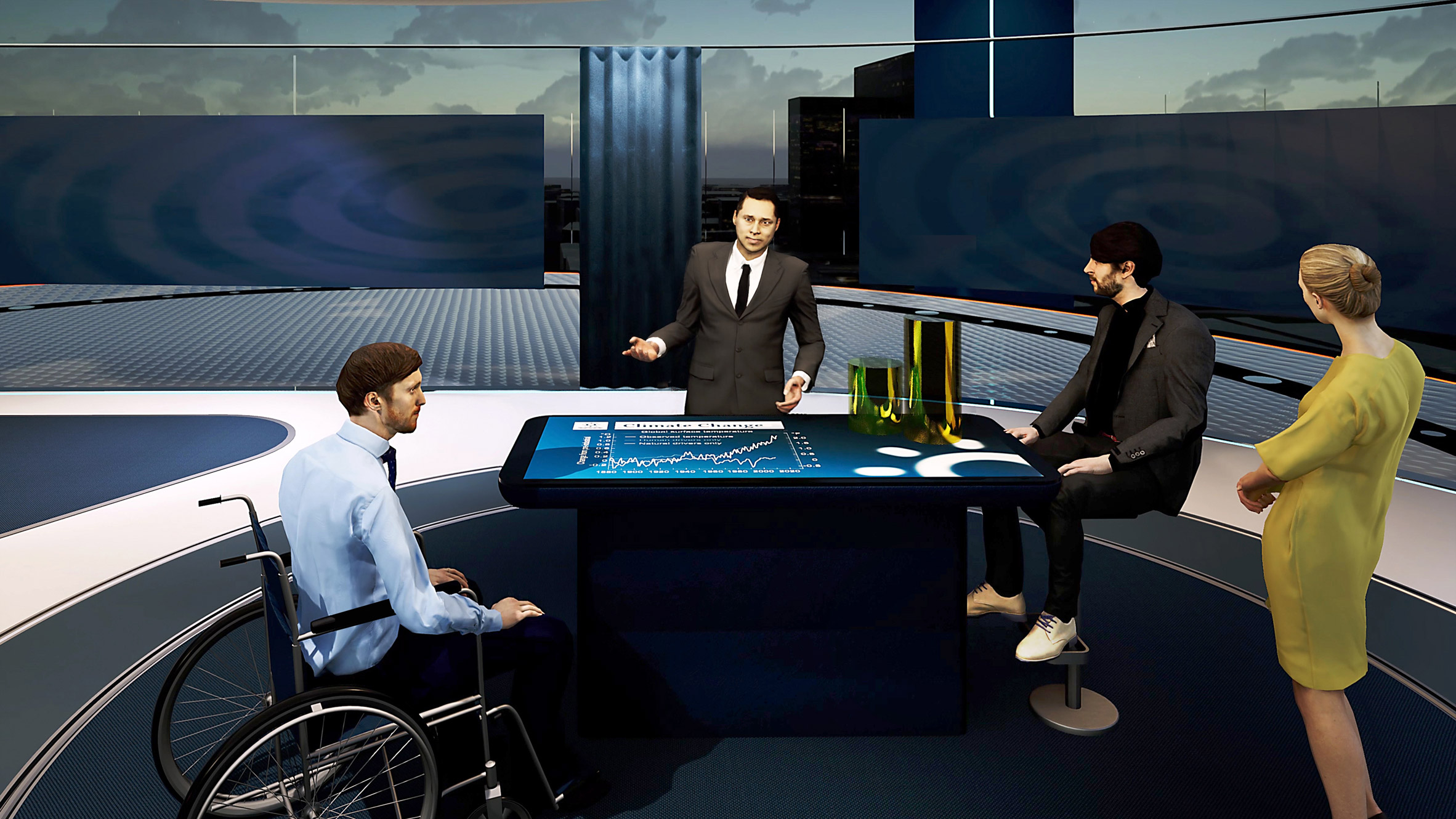
The News Pavilion allows presenters to interact with the virtual environment
According to Salway, this means that newsreaders are more comfortable in the studio as they no longer have the "disorientating green screen," which showcases images to people watching at home but which can't be seen by the newsreaders themselves.
Instead, The News Room lets the presenters experience the final visuals.
"People in the studio see pretty much the final composited effect that the audience at home does," he said.
"So you can get much more natural ‘performances' from the presenters and guests in the studio, and they are able to interact with their environment, and with overlays of data, in much more fluid ways."
Softroom wanted to bring something new to TV design with The Virtual News Pavilion
Alongside giving newsreaders more storytelling techniques at their disposal, Softroom wanted to ensure that regional or remote newsreaders were given the same visibility as in-studio newsreaders.
To do so, they "digitally extract" them from their off-site location and virtually place them into The News Pavilion.
The real-time video screening helps presenters feel more comfortable in the virtual environment
"Thanks to the magic of virtual production, the remote guests are overlaid in the correct position in real-time on the video walls inside the studio," said Salway.
"So the hosts can interact much more naturally with them, and maintain an all-important sight-line to them," he continued.
"It was a reaction to feeling that studio guests and people on video link-ups are always a bit disadvantaged compared to the hosts."
The Covid-19 pandemic has prompted other designers to turn to virtual architecture and design. In November 2020, architecture studio Space Popular created Punto de Inflexión, a venue for the first-ever virtual reality architecture conference.
Project credits:
Core Graphics Technology: Epic Games, Unreal Engine Virtual Production: Pixotope: The Future Group Virtual Production: ZeroDensity XR Production: Disguise Camera Robotics: Electric Friends LED Panels: Alfalite LED XR Stage: White Light Virtual Set Construction: Moov Virtual Set Construction: Strand Set Construction: Scott Fleary Cost Consultancy: PT Projects Strategy Consultant: Isaac Pinnock
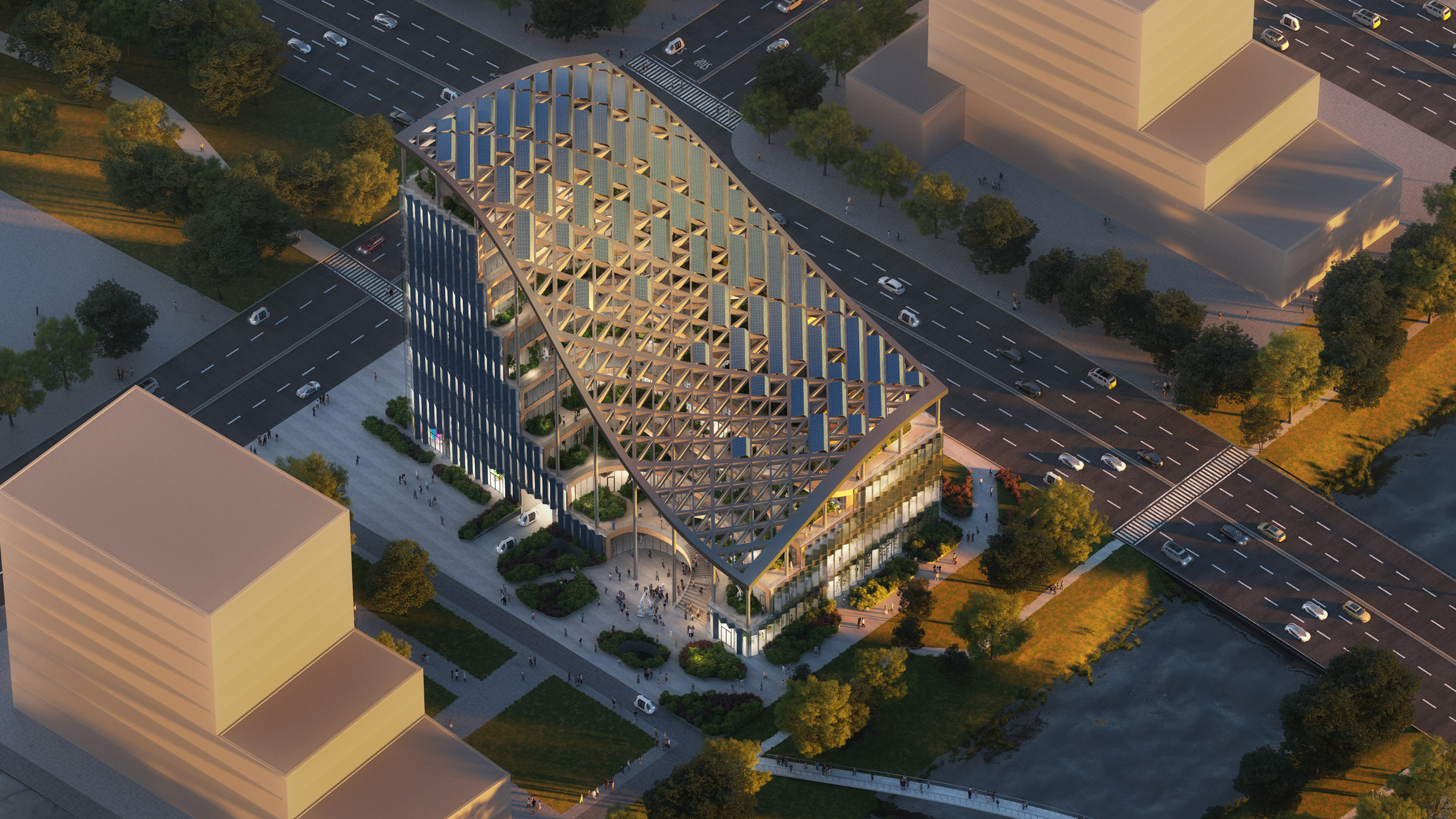
Dutch architecture studio MVRDV has released designs for a terraced office block clad in solar panels for Chinese agriculture development company Lankuaikei Agriculture Development.
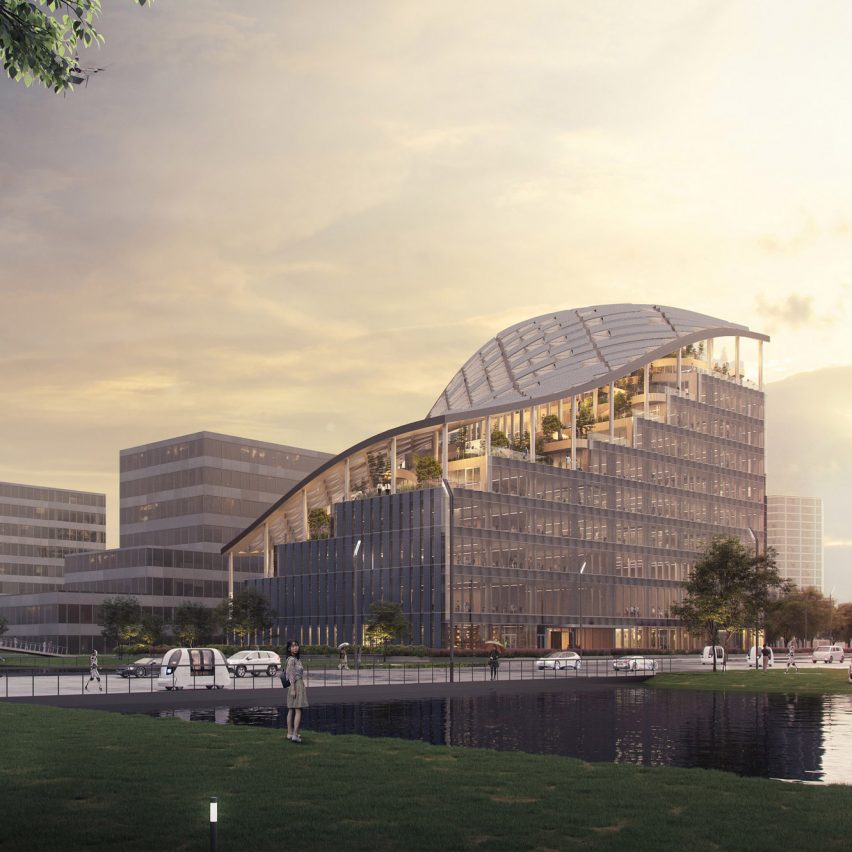
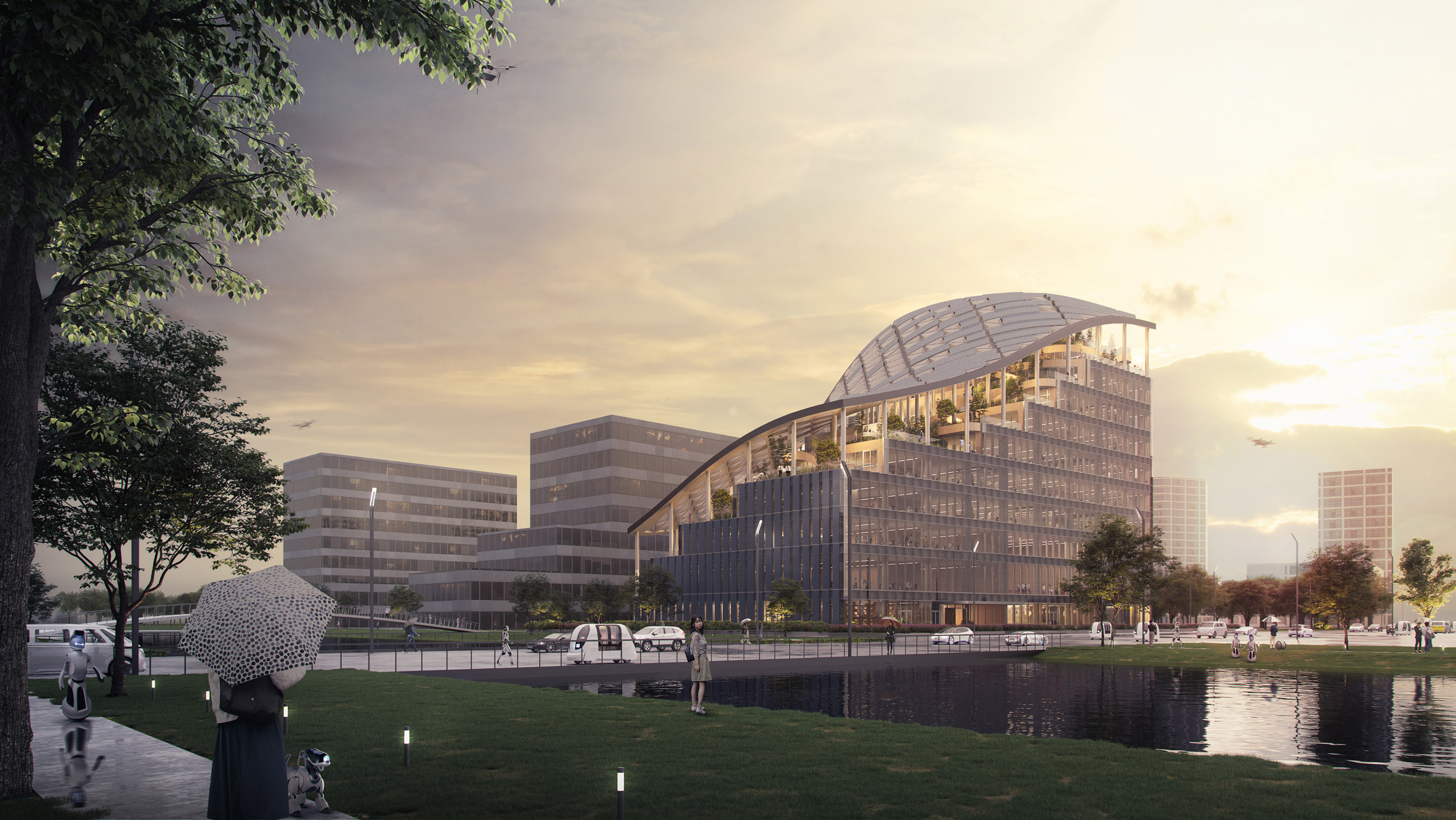
Located lakeside in Lingang New Town, Shanghai, the building will feature a "technological" roof that will follow the shape of its 11 stepped storeys.
The northern part of the roof is permeable to filter the sunlight but let the rain through, while the southern part of the roof holds solar panels. Solar panels and glass also clad the facade, in a pleated arrangement that was designed to protect workers from harsh sunlight.
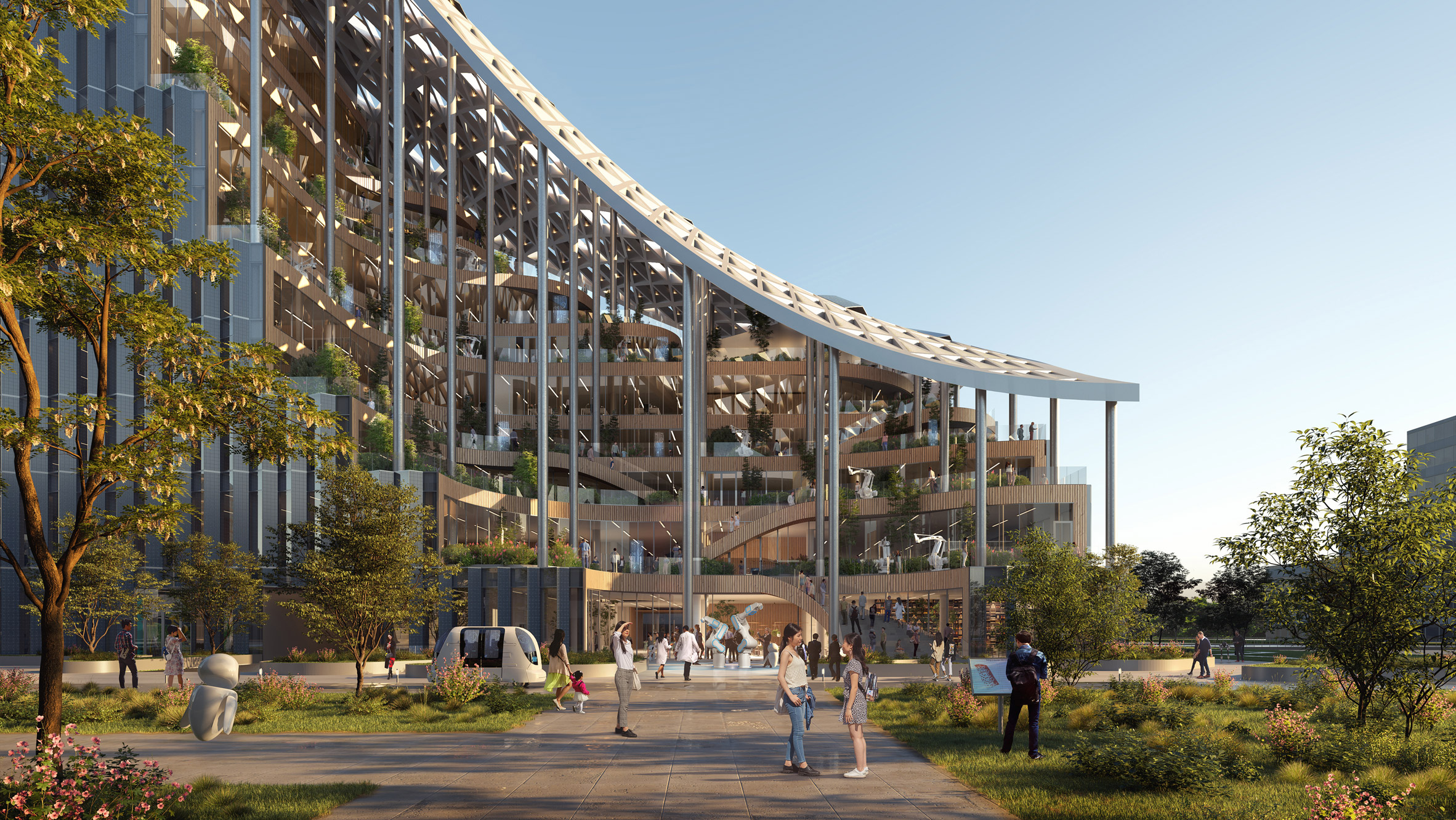
Above: the roof follows the shape of the terraces. Top image: the building opens up towards the water
Beneath the curved roof, the 6,000 square-metre upper levels will hold Lankuaikei Agriculture Development's (LAD) headquarters, while the lower levels will house 9,000 square metres of labs and co-working offices.
The first and second floors will have an auditorium and exhibition space, while the ground floor will be used for retail.
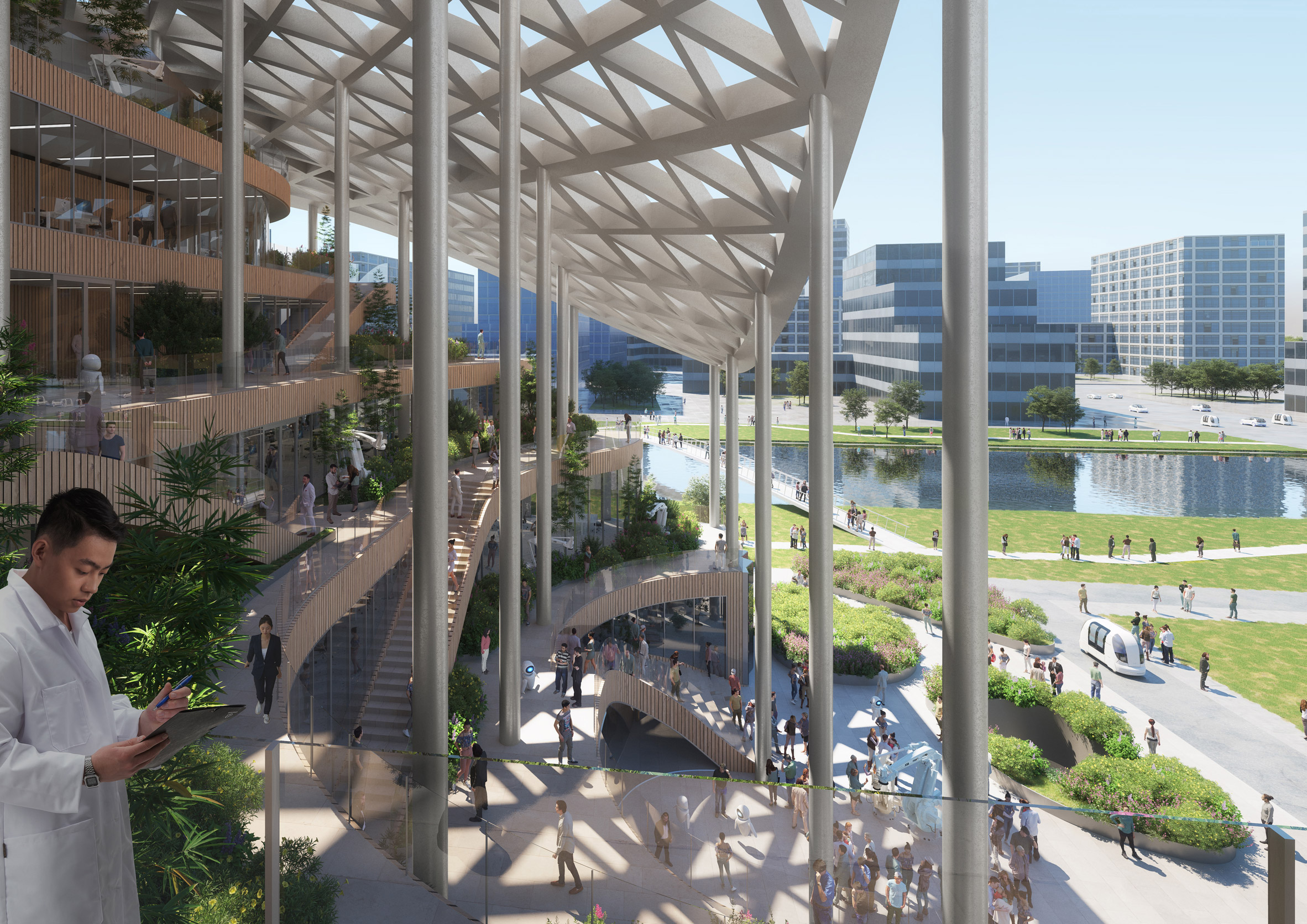
Visitors and office workers can take a meandering route all along the stepped terraces to reach the top of the building, from which the wood-and-greenery clad storeys step down to a courtyard.
A walkway runs along the terraces to the top of the building
MVRDV aimed to incorporate sustainability throughout the project by using both high-tech and low-tech solutions, including photovoltaics and natural shading from the curved roof. The terraced design will also help create natural ventilation.
The headquarters were designed as a "sustainability machine," the studio said. It claims that through material selection and life-cycle analysis, the building will have 40 per cent less embodied carbon than a typical comparable design.
MVRDV did not reveal whether the remaining emissions would be offset, as is demanded by buildings that reach net-zero standards.
The design aimed to incorporate sustainability throughout
The solar panels will also make the LAD headquarters "almost" energy-neutral in operation, according to MVRDV.
"Working with LAD has been an exciting experience; this HQ building shows architecture in perfect alignment with a company’s mission," MVRDV founding partner Jacob van Rijs said.
"Incorporating sustainability into every surface of a building is an interesting challenge for an architect, and it’s one that as a design team we embraced whole-heartedly," he added.
Trees and plants will fill the terraces
Rainwater collected from the terraces will be used for the building's toilets, while trees and greenery planted on them will create a canopy that aids air filtration.
"MVRDV's mission is to make cities and landscapes sustainable and future-proof," said LAD president Weihua Dong.
"LAD's mission and vision are to empower rural revitalization and food safety in China with LAD knowledge, to explore the mysteries of nature, to protect human health with science and technology. In this cooperation project, we are looking forward to seeing an 'agricultural oasis' combining the missions of both companies."
The project is targeting a three-star China Green Building Standard, the country's highest standard for sustainable building.
Photovoltaic panels, also known as solar panels, have been used in the design of a number of recent buildings that are carbon-negative or regenerative. Among these are Snøhetta's carbon-negative Powerhouse Telemark office in Norway, which has a photovoltaic canopy that will generate 256,000 kilowatts of energy each year.
The Kendeda Building at Georgia Tech university, a regenerative building that creates more resources than it uses, is topped by a solar-panel covered canopy that generates enough power to exceed the energy needs of the building.
Images are courtesy of MVRDV.
Project credits:
Architect: MVRDV Founding partner in charge: Jacob van Rijs Partner: Frans de Witte Design team: Fedor Bron, Fouad Addou, Li Li, Aneta Rymsza, Nicolas Garin Odriozola, Alberto Canton, Anna Brockhoff Director MVRDV Asia: Steven Smit Sustainability consultant: Peter Mensinga Visualisations: Antonio Luca Coco, Luca Piattelli, Angelo La Delfa, Luana La Martina Copyright: MVRDV 2021 – (Winy Maas, Jacob van Rijs, Nathalie de Vries, Frans de Witte, Fokke Moerel, Wenchian Shi, Jan Knikker) Co-architect: ECADI Energy consultant: Buro Happold