Saturday, 28 August 2021

Salvaged wood wraps Surf House in Santa Cruz by Feldman Architecture

Surf House by Feldman Architecture

American firm Feldman Architecture has created a cypress-clad, beachfront dwelling that is meant to balance "high design and a casual Californian aesthetic".

Perched on a bluff overlooking the Pacific Ocean, Surf House is located in the central California city of Santa Cruz. The 417-square-metre dwelling serves as a weekend getaway for a San Francisco Bay Area family with strong ties to the coastal town.

Feldman Architecture designed the project
The home overlooks the Pacific Ocean in Santa Cruz

The clients charged San Francisco's Feldman Architecture with designing a home that embraced the landscape and adhered to a geologic setback requirement.

They also wanted the dwelling to be sensitive to the feel and scale of the surrounding neighbourhood, which features unassuming structures.

The house is in Santa Cruz
Salvaged wood wraps the exterior of Surf House

"The clients were well-versed on the nuances of the site and dreamt of a home that fit naturally and sustainably into its beachy, eclectic locale," said the architects.

For the long property with a ragged ocean-facing edge, the team conceived three structures.

Surf House has panoramic ocean views
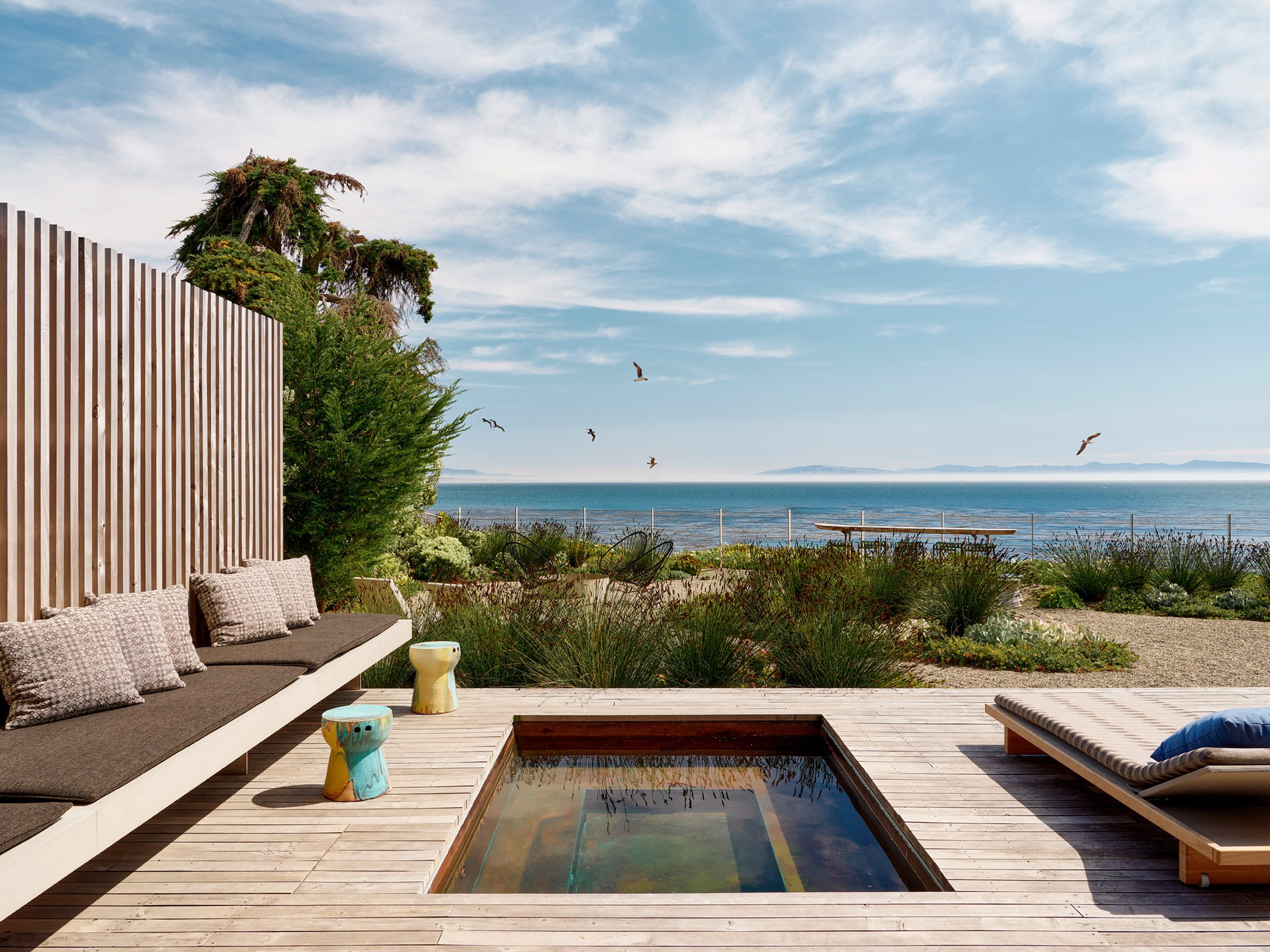
A wooden deck provides ocean views

The main dwelling, which rises two levels, is set nearest to the coast. In the rear, a wooden deck provides an opportunity for indoor-outdoor living and a chance to take in the ocean air.

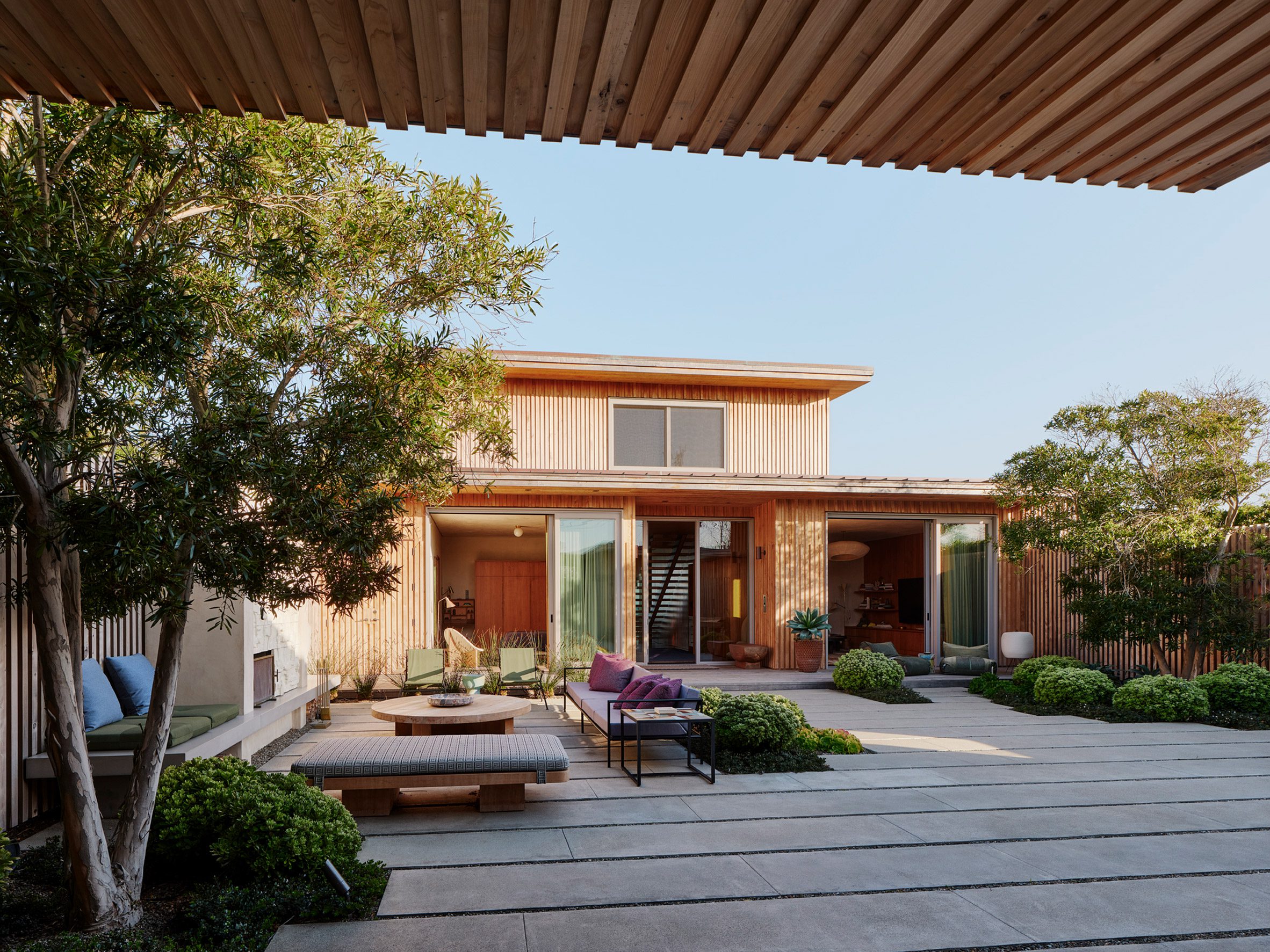
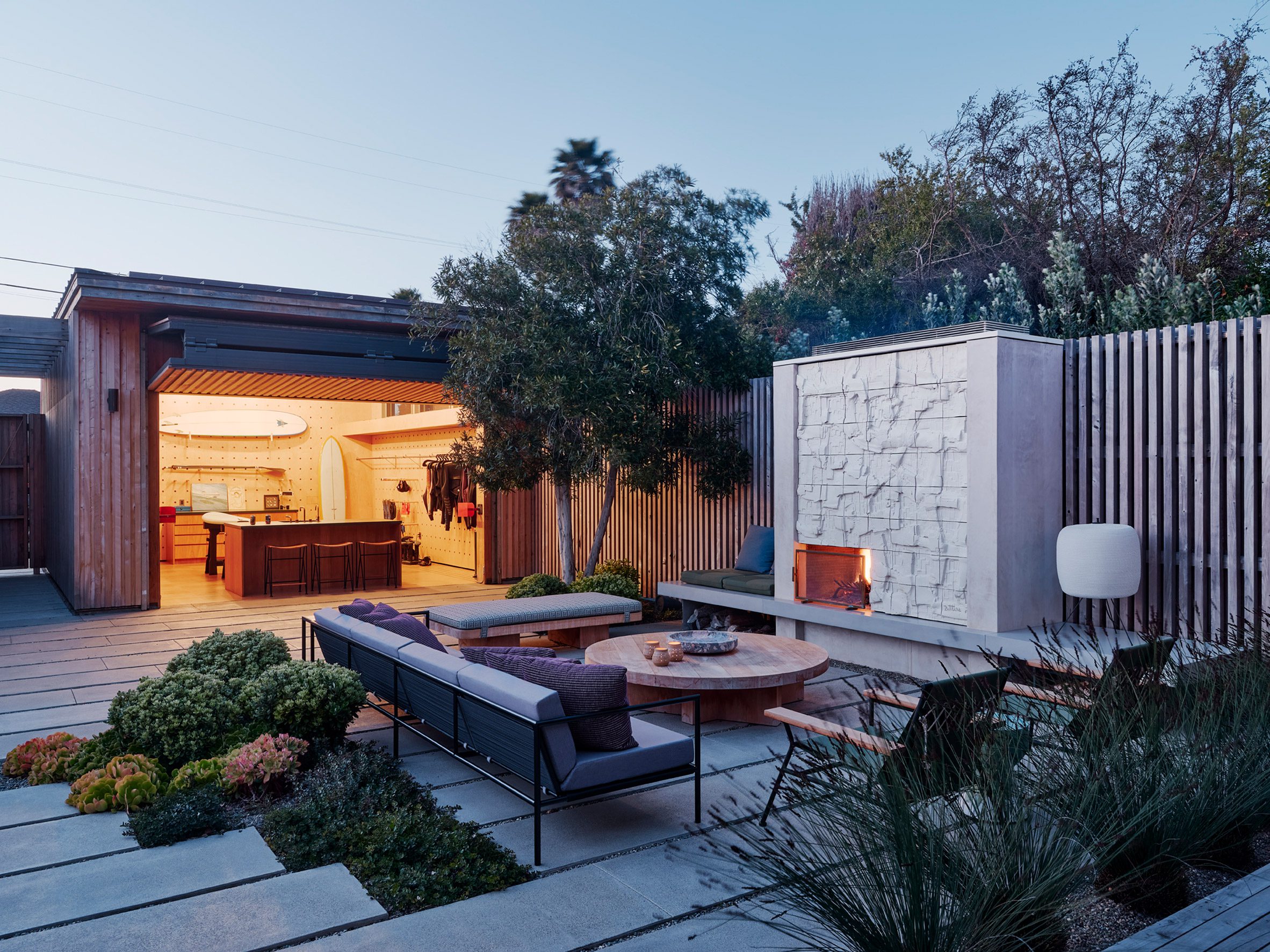
The front portion of the property has a courtyard with two structures – a garage and a building for storing surf gear called the board room.

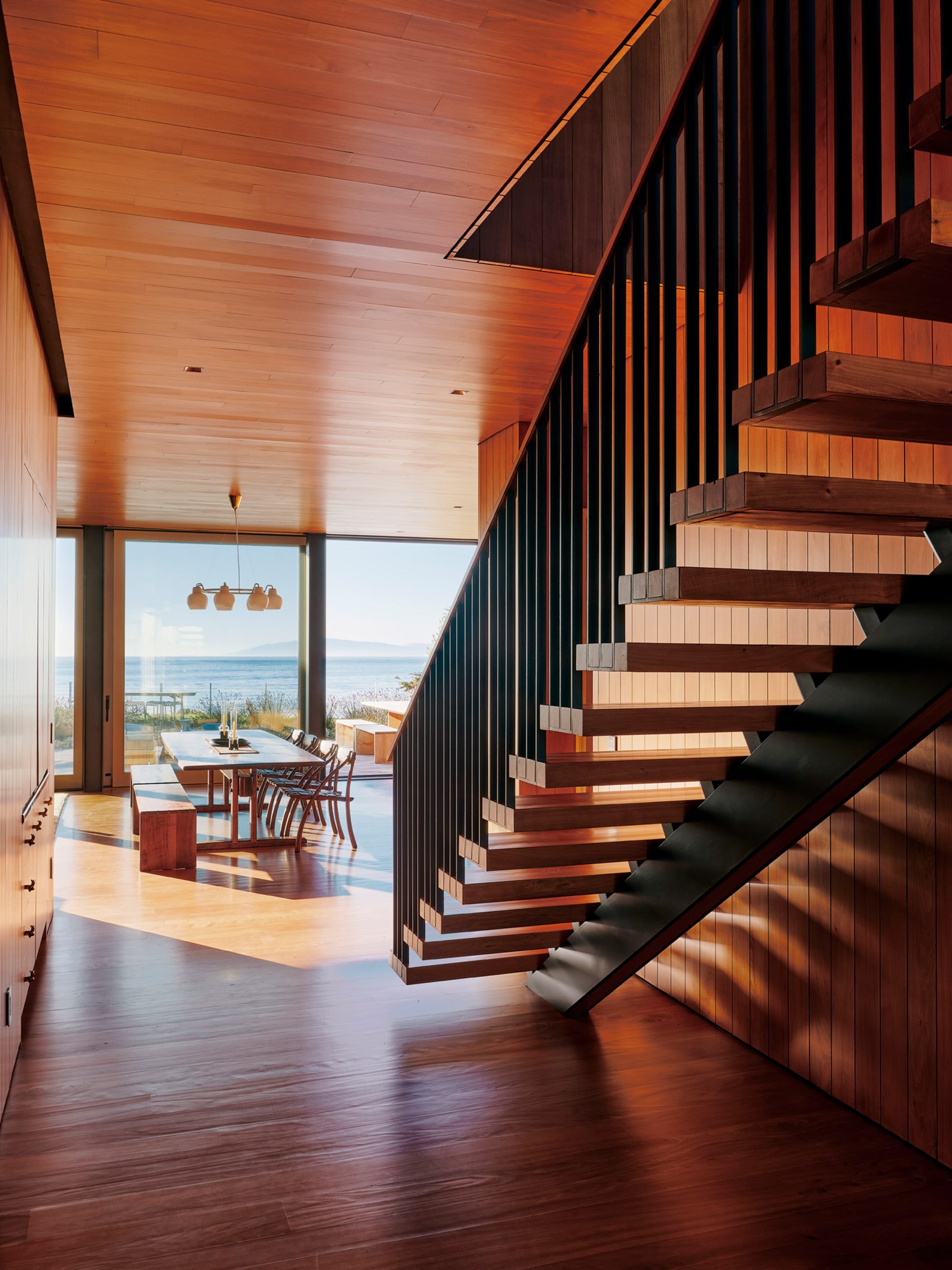
The public zone has doors to the outside deck area
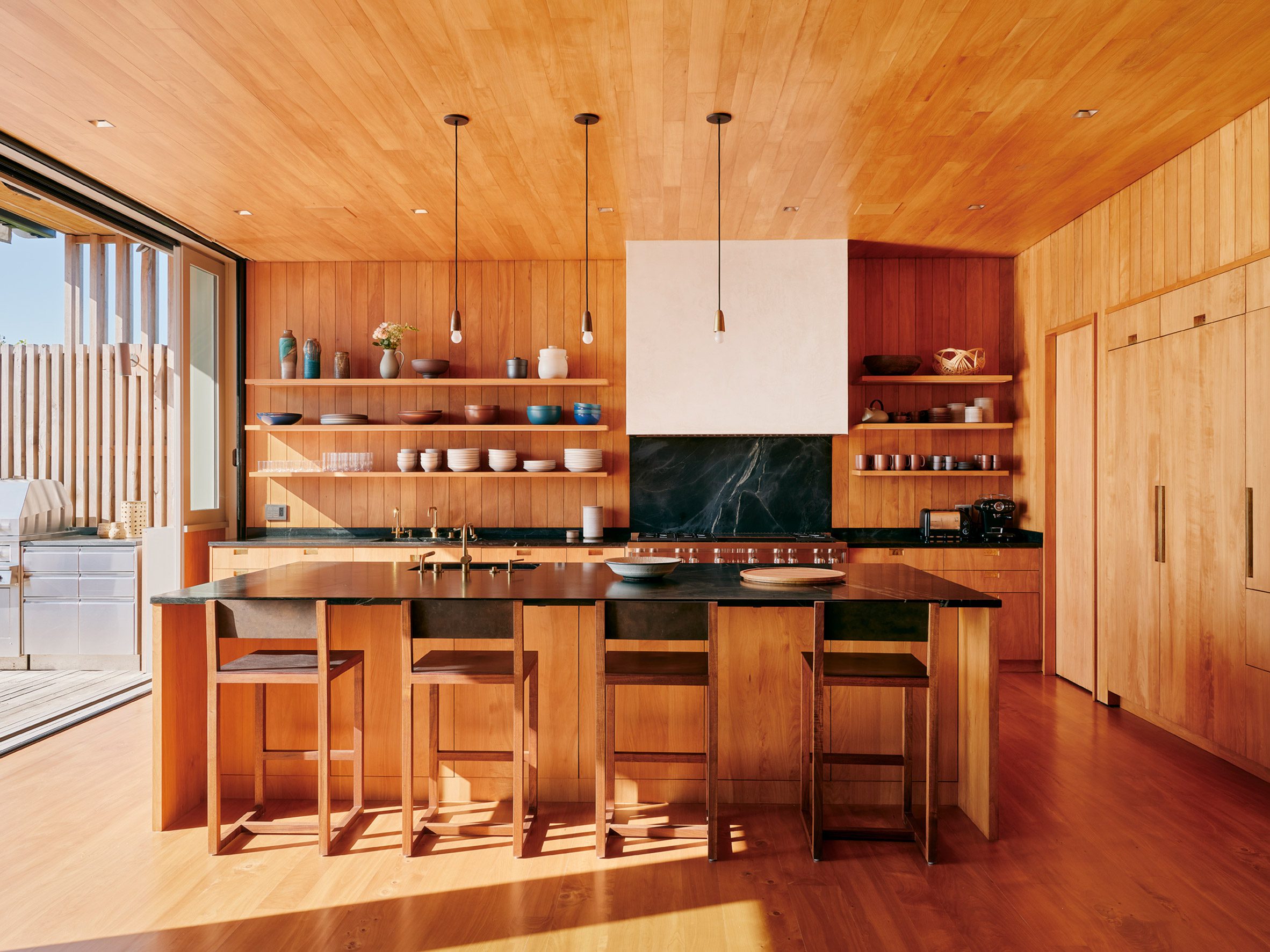
The kitchen also features largely wooden elements

Protected from coastal winds, the courtyard serves as a warm, light-filled cloister throughout the year.

For the home's exterior cladding, the architects enlisted the help of a California sawyer, Evan Shivley of Arborica, who specialises in locally sourced, reclaimed timber.

The team chose to wrap the home in board-and-batten siding made of cypress. The same material was used abundantly indoors.

"Monterey cypress – a robust, resilient, regal wood – is accustomed to the site's coastal California climate and when left unfinished, weathers to a sophisticated grey," the team said. "The wood also, therefore, quickly becomes a focal point of the home's design."

Wood also dominates interior spaces
Glazed doors separate inside spaces from outside

Within the main dwelling, the ground level holds the public zone and a guest bedroom. Glazed, sliding doors help eliminate the boundary between inside and out.

"Large sweeping doors open to connect the living space to the spacious back deck, which is fitted with an in-ground hot tub and outdoor kitchen perfect for entertaining visiting family and friends," the team said.

Throughout the dwelling, rooms are adorned with earthy materials and contemporary decor
Commune Design oversaw the home's interiors

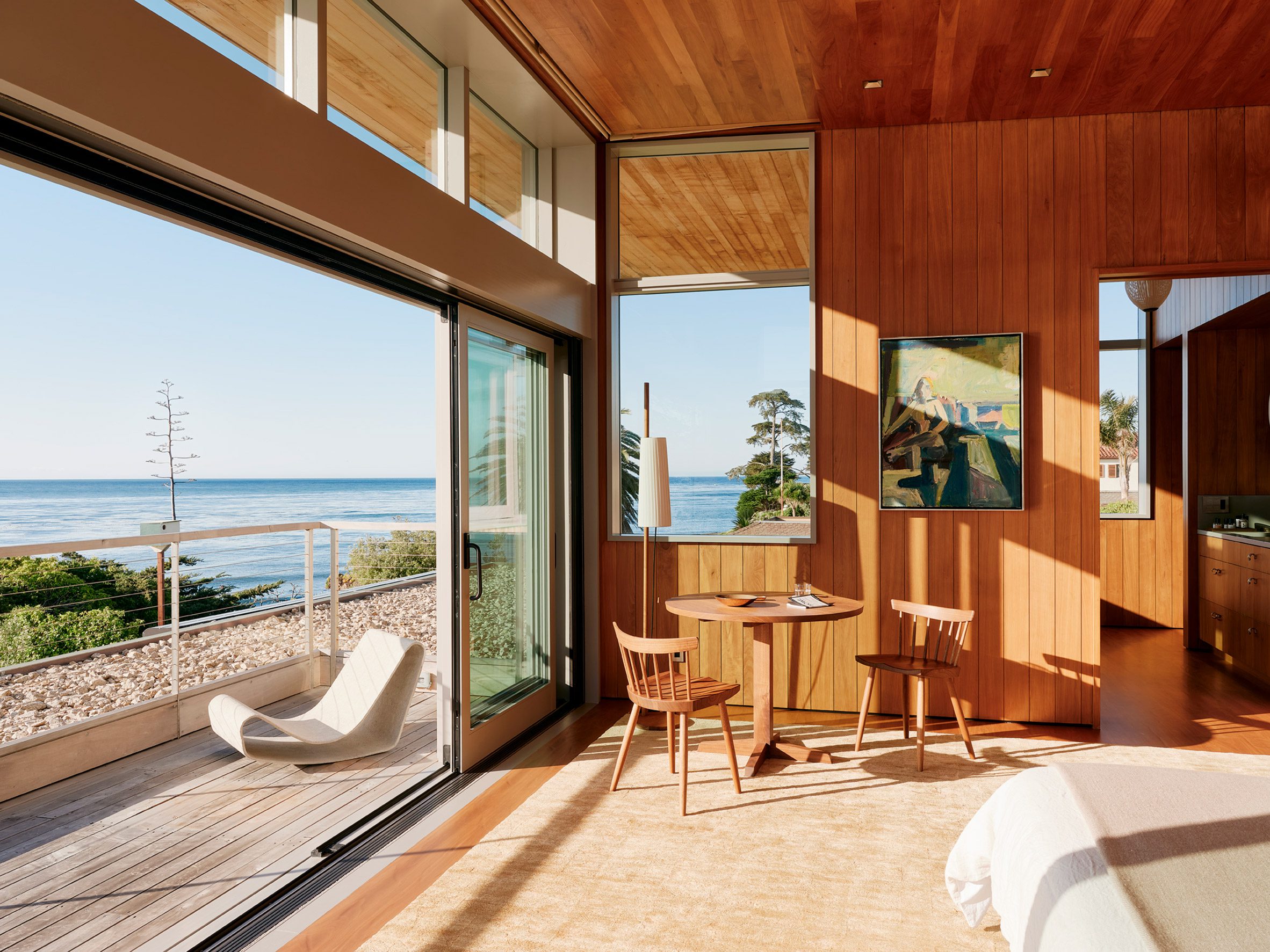
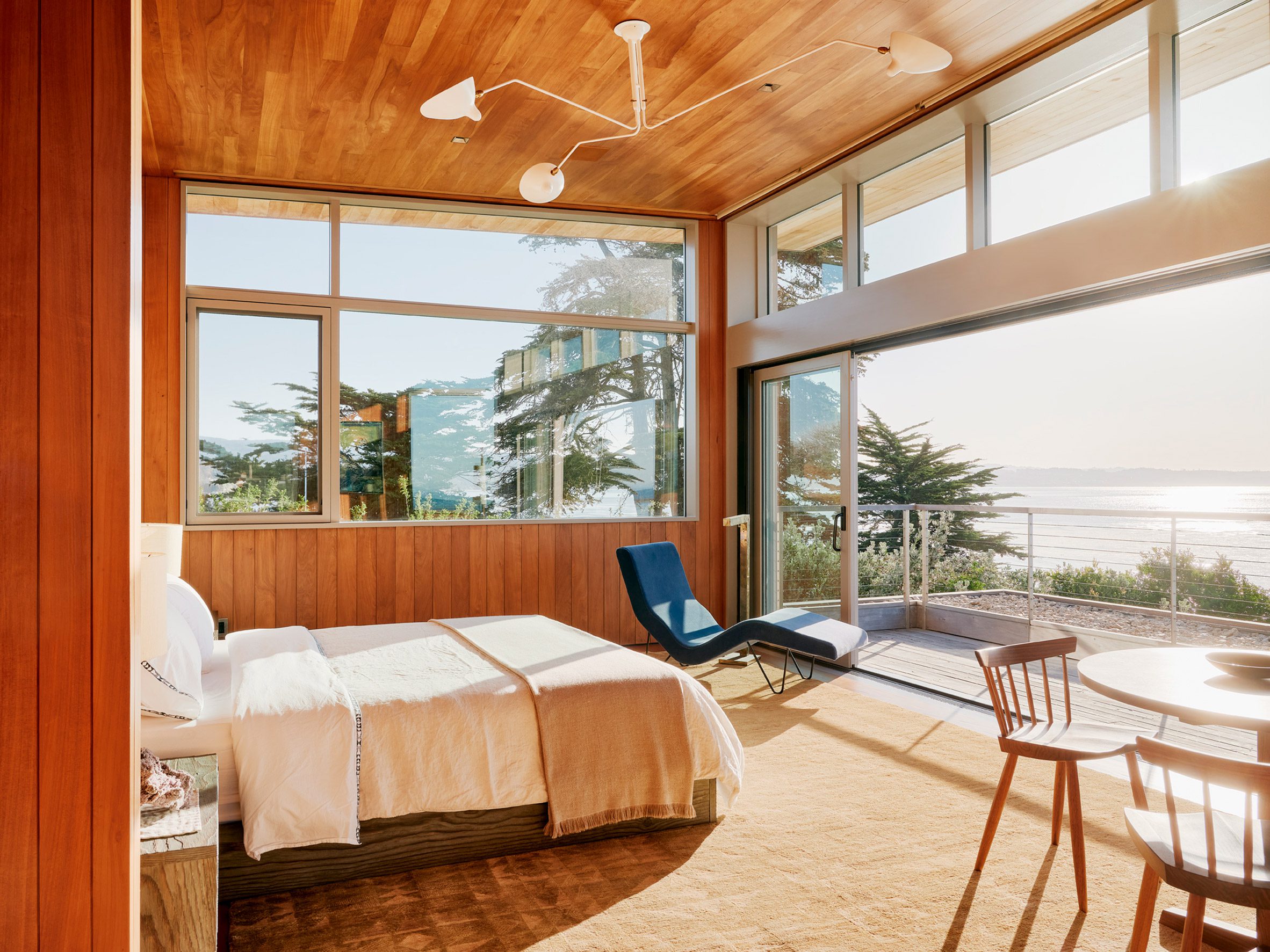
Upstairs, one finds a master suite, an additional bedroom and an office. Windows are carefully placed to provide framed views and to bring shades of blue and green into the home, which has a neutral colour palette.

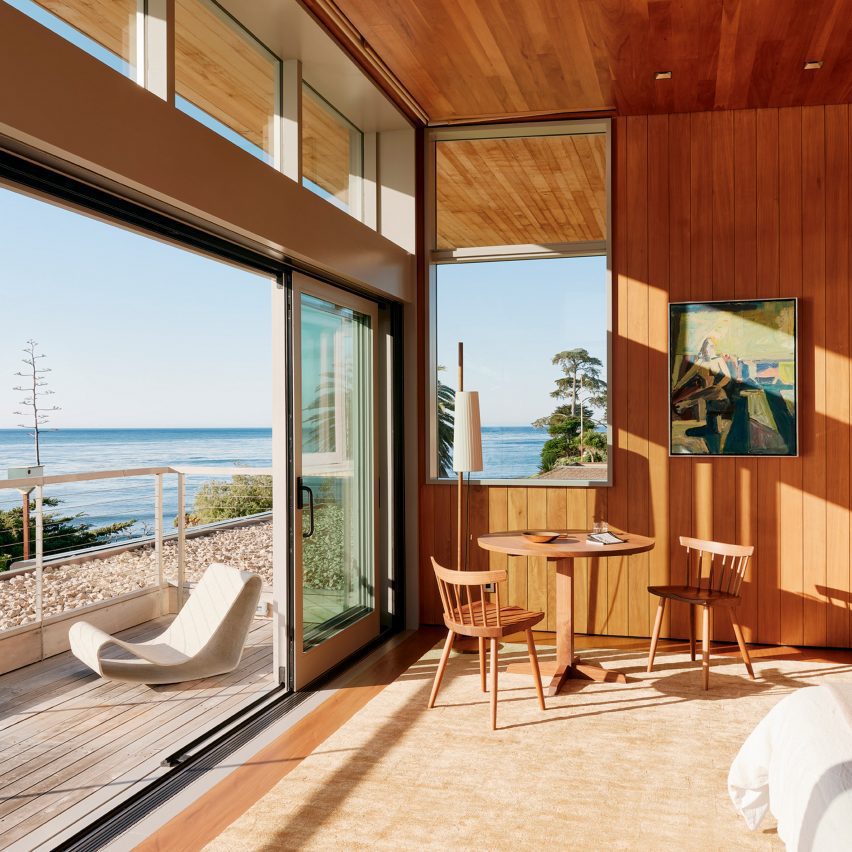
"The master bedroom features floor-to-ceiling glass walls facing the waves, opening onto a private balcony with views of surfers below," the team said.

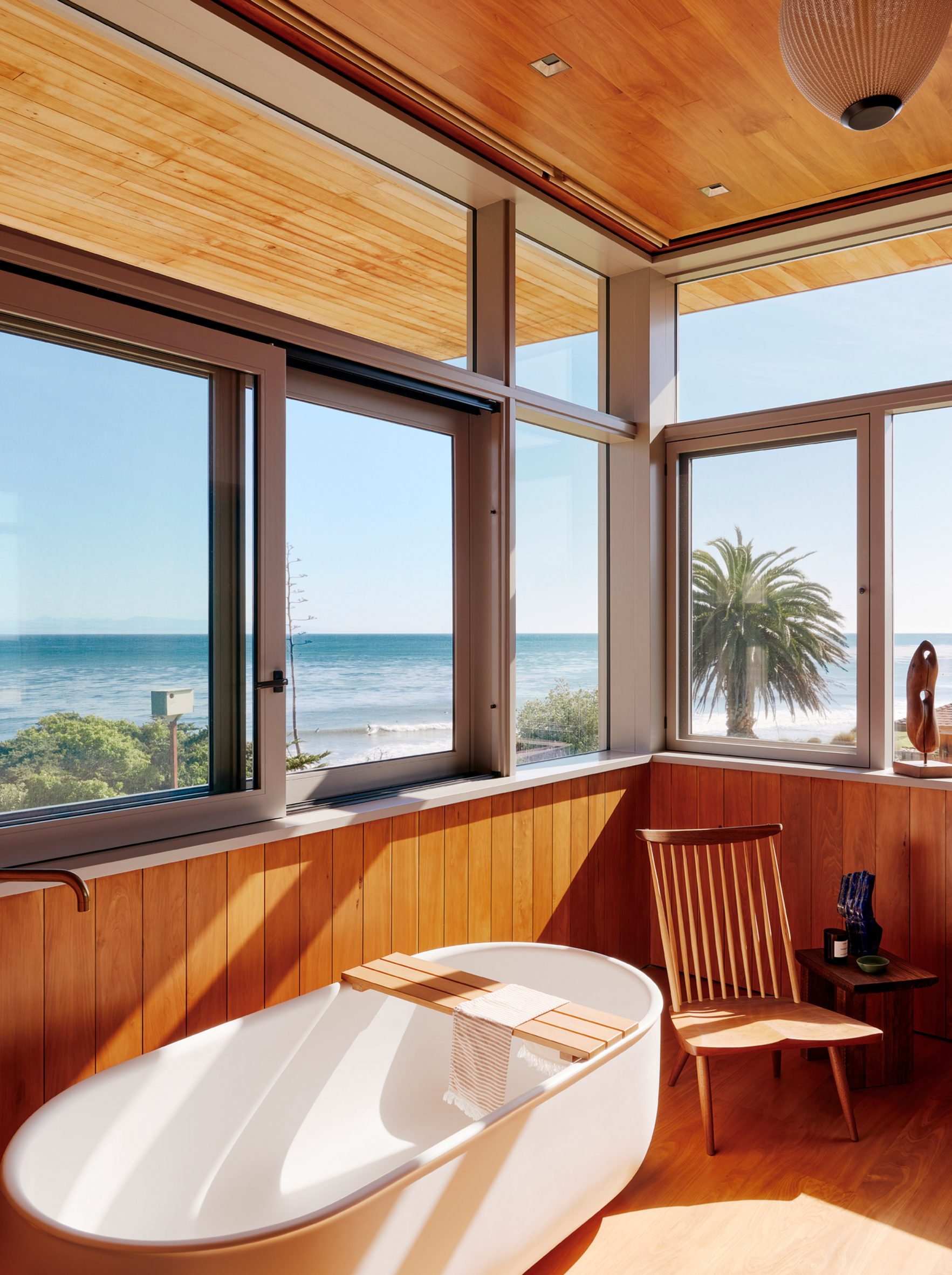
A bathroom in Surf House
Some rooms have panoramic ocean views

Throughout the dwelling, rooms are adorned with earthy materials and contemporary decor. LA firm Commune Design oversaw the interiors.

"Surf House finds the perfect balance between high design and a casual Californian aesthetic, creating magic on an already magical site," the team said.

A garage stores surf gear at the front of Surf House
A garage stores surf gear at the front of the house

Founded in 2003, Feldman Architecture has designed numerous residential projects in California and beyond. Others include a pair of backyard pavilions for a Silicon Valley residence and a San Francisco home with tiered gardens and a triangular loft.

The photography is by Joe Fletcher.


Project credits:

Architecture: Feldman Architecture
Landscape architect: Ground Studio Landscape Architecture
Interior design: Commune Design
Contractor: RJL Construction Sawyer, Arborica
Art consultant: Allison Harding

The post Salvaged wood wraps Surf House in Santa Cruz by Feldman Architecture appeared first on Dezeen.


from Dezeen https://ift.tt/3mHwYr8

Ravensbourne University London spotlights eight student architecture projects

A dog-friendly shelter for homeless people and a community building for local foraging is included in Dezeen's latest school show by Ravensbourne University London.

Also included is a model-making workshop for socially excluded youth in Peckham Rye and a community farmer's market where people can grow their own vegetables.


Ravensbourne University London

School: Ravensbourne University London
Courses: BA(Hons) Architecture, BA(Hons) Interior Design Environment Architectures and BA(Hons) Urban Landscape Architecture
Tutors: Alberto Villanueva, Felicity Atekpe, Hwei-Fan Liang, Darren Stacey, Andrew Ó'Murchú, Hannah Fothergill, Matthew Lucraft, Stefano Paiocchi and Giulliana Giorgi

School statement:

"The Department of Architecture at Ravensbourne University London is an exciting creative community focused on educating architects who will imagine and shape the future. We challenge our students to offer solutions to transform communities with a social and sustainable approach. Our students learn through engagement with industry-relevant topics together within and across courses, providing the skills and opportunities they need to kick-start their careers.

"Architecture at Ravensbourne offers a unique interdisciplinary approach where our students enjoy a rich experience in Architecture, Interior Architecture and Urban Landscape, but also benefit from collaborating with Film, Animation, Product Design or Fashion students. It is a unique range of courses to prepare our students for creative industries.

"This year our students have engaged with bringing innovative and creative proposals to the area of Rye Lane in Peckham. With a local community as diverse as our students, the area has gone from being relatively low-rent to becoming one of the frontiers of gentrification in London. New arts and experimental adaptive reuse projects mix in with an established vibrant commercial street life.

"Our students have explored topics including urban food production and multicultural markets, alternative youth and care centres, models for living on and near high streets and new materials and future burial traditions. To showcase their work, we have built a virtual gallery."
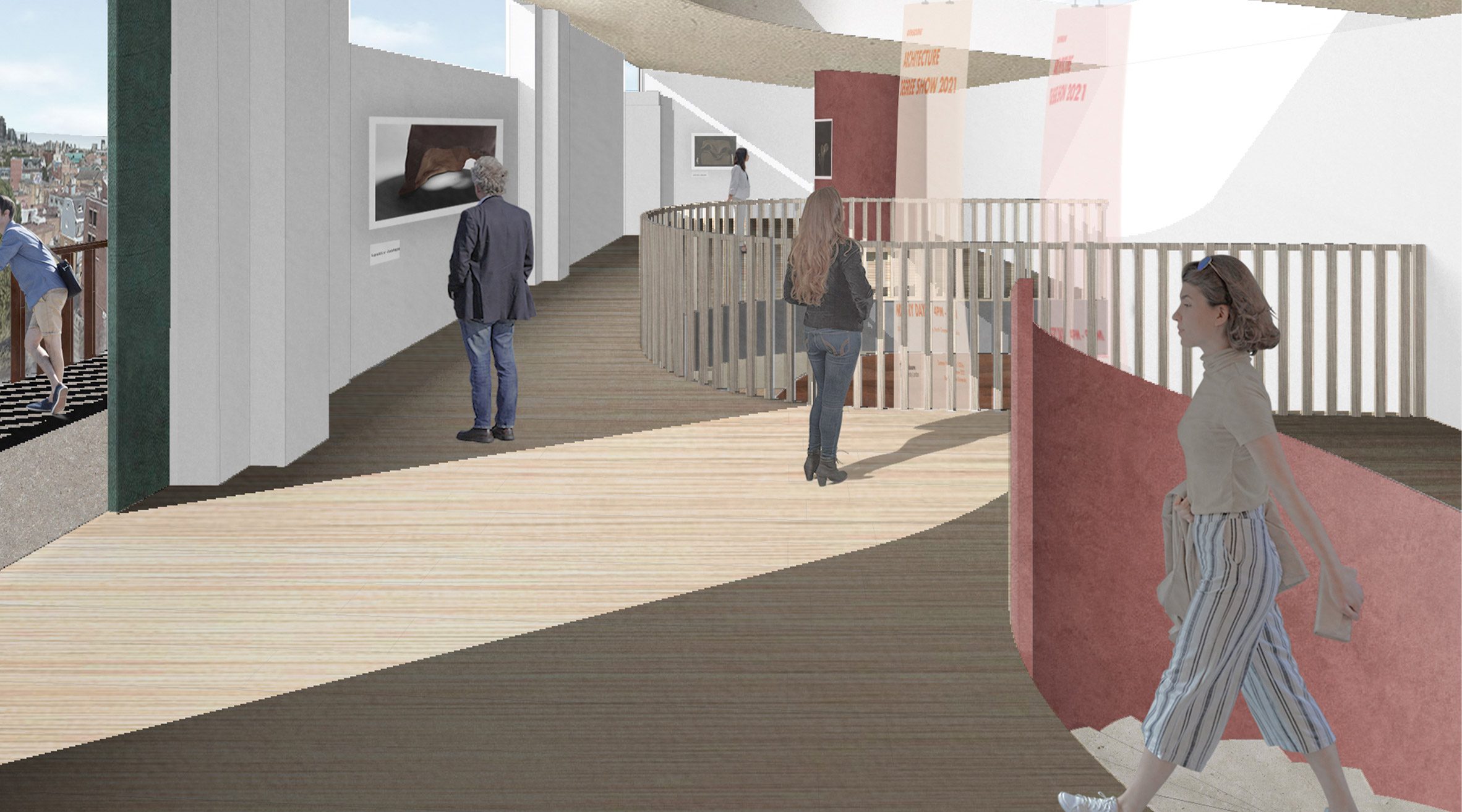

A visualisation of an art gallery in Peckham

Beyond Boundaries by Lovely Javier

"In keeping with Peckham and Southwark's celebrated artistic culture, this project aims to cultivate this by creating spaces that will showcase local artists' work as well as inspire future creative generations.

"The project aims to offer safety and connectivity to the wider community of Peckham by blurring the boundaries between private and public realms whilst questioning the notion of being supervised. The multi-purpose space consists of an art gallery, a workshop space, a reading/ sensory room and a cafe."

Student: Lovely Javier
Course:
BA(Hons) Interior Design Environment Architectures
Instagram: javitecture
Tutors:
Matthew Lucraft, Hwei-Fan Liang and Darren Stacey
Email:
javierlovelyjayne[at]gmail.com
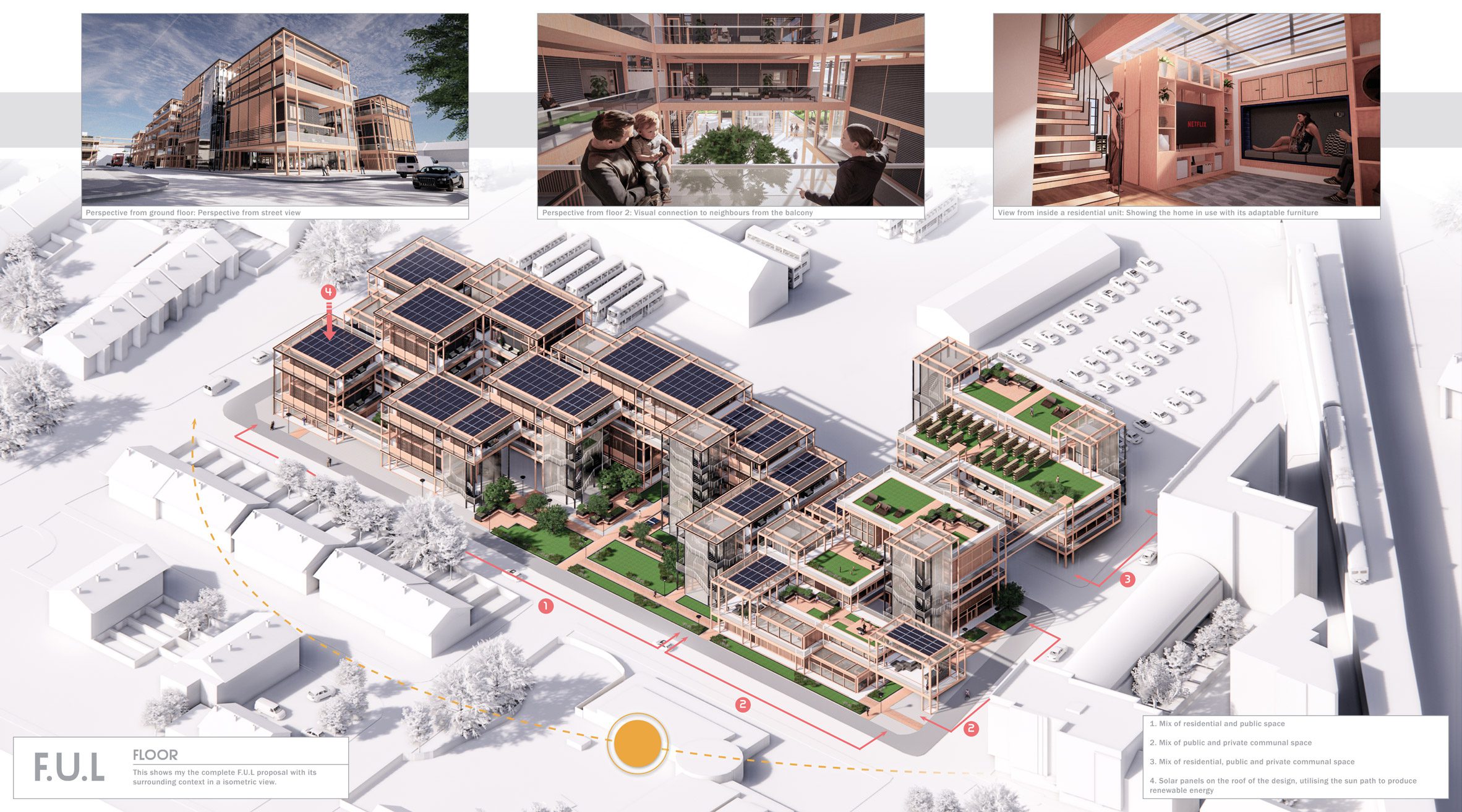

A model of a space for flexible urban living

Flexible Urban Living (FUL) by Edgar Maciulis

"Flexible Urban Living is a schematic proposal that aims to tackle some of the many challenges faced within cities all over the world, starting with Peckham. It has become evident that unless we rethink how we design our built environment, our cities will continue to be unsustainable and unaffordable. The FUL envision providing high-quality, affordable homes that work alongside growing families.

"Within a framework that merges livable homes with private and public shared communal spaces. The FUL living experience uses modular prefabricated homes with adaptable furniture that allows you to customise your living space to suit you, moving away from the one size fits all layout typically seen throughout housing development.

"The FUL building system is designed in a way to suit any site whilst also providing a much faster way of construction. Utilising timber prefabrication and flat-pack methods that are used to construct its communal and living spaces. Ensuring a more sustainable and CO2-reducing way of building."

Student: Edgar Maciulis
Course:
BA(Hons) Architecture
Instagram: _em.architects_
Tutors: Alberto Villanueva, Hwei-Fan Liang and Darren Stacey
Email:
emac.architecture[at]gmail.com
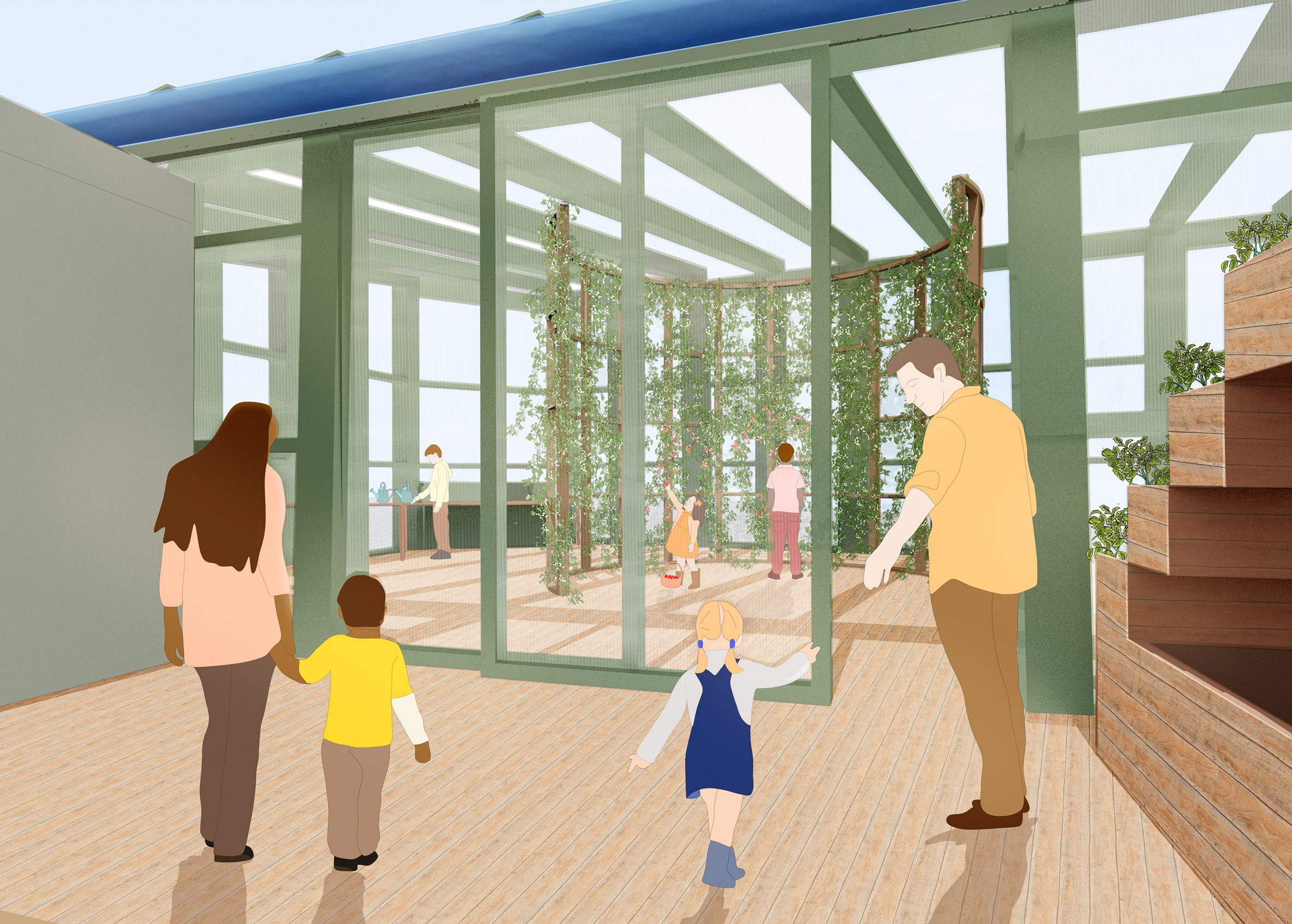

A visualisation of a family learning to grow their food

Grow, Share, Educate by Nikita Morar

"Grow, Share, Educate is a fantastic opportunity offering numerous benefits to the London Borough of Southwark Council. The project will redevelop 117- 125 Peckham Rye Lane.

"Over three floors, it will provide a community hub consisting of four concepts; a space to grow fruit and vegetables, an open space for the community (which can be used as a farmer's market), an education hub and a meeting space for social activities. All four elements will bring the community together and strengthen community ties."

Student: Nikita Morar
Course:
BA(Hons) Interior Design Environment Architectures
Tutors:
Matthew Lucraft, Hwei-Fan Liang and Darren Stacey
Email:
nikitamorar[at]hotmail.co.uk
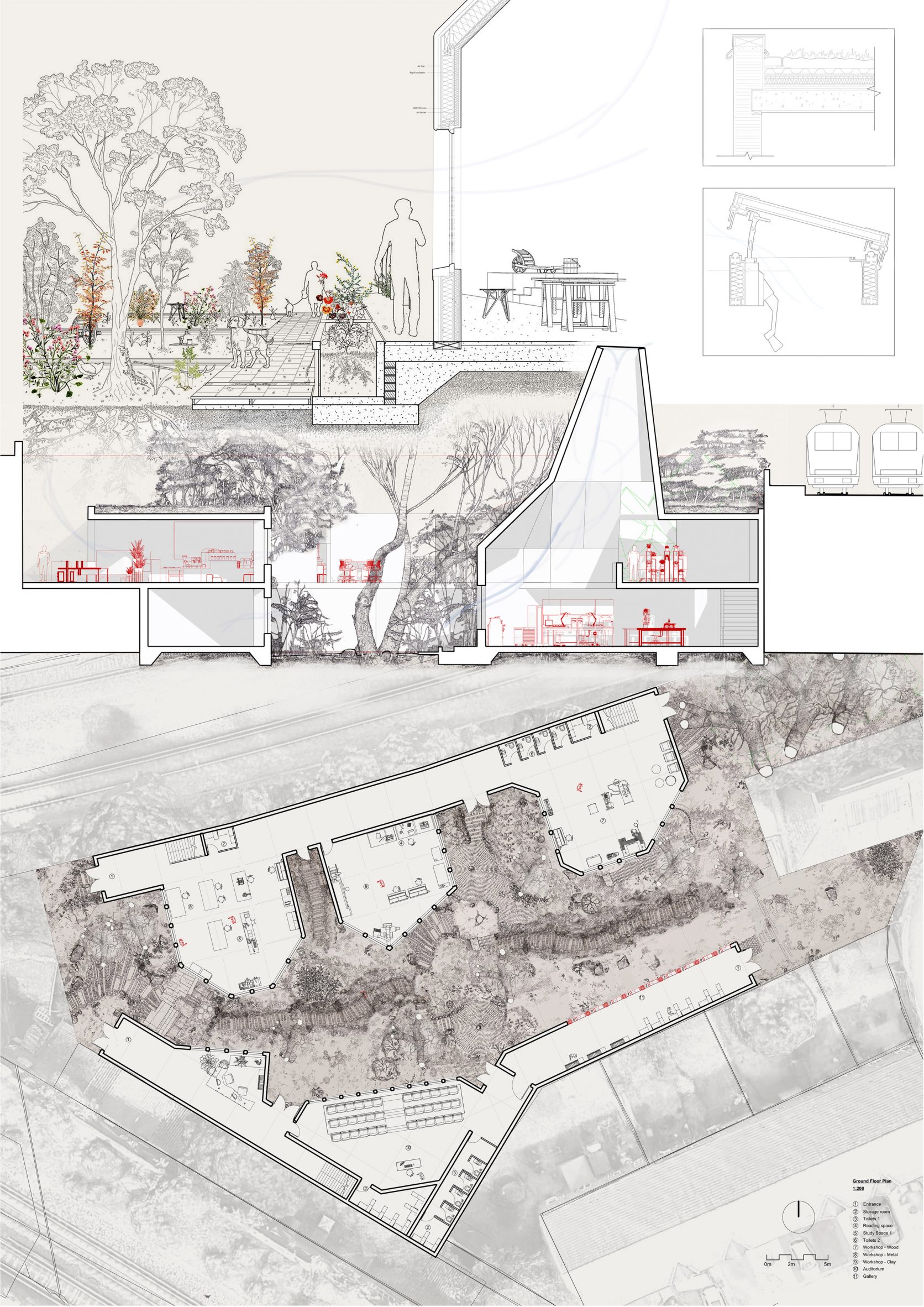

A visualisation of a model making workshop

Made in Peckham by Omar Safdari

"My project proposal consists of model making workshop spaces given to the socially excluded youth in Peckham Rye. The design shows the complexity of site topography and vegetation, socio-cultural collaboration and a variety of sustainable strategies and design."

Student: Omar Safdari
Course:
BA(Hons) Architecture
Tutors:
Felicity Atekpe, Hwei-Fan Liang and Darren Stacey
Email:
rashid.safdari[at]gmail.com
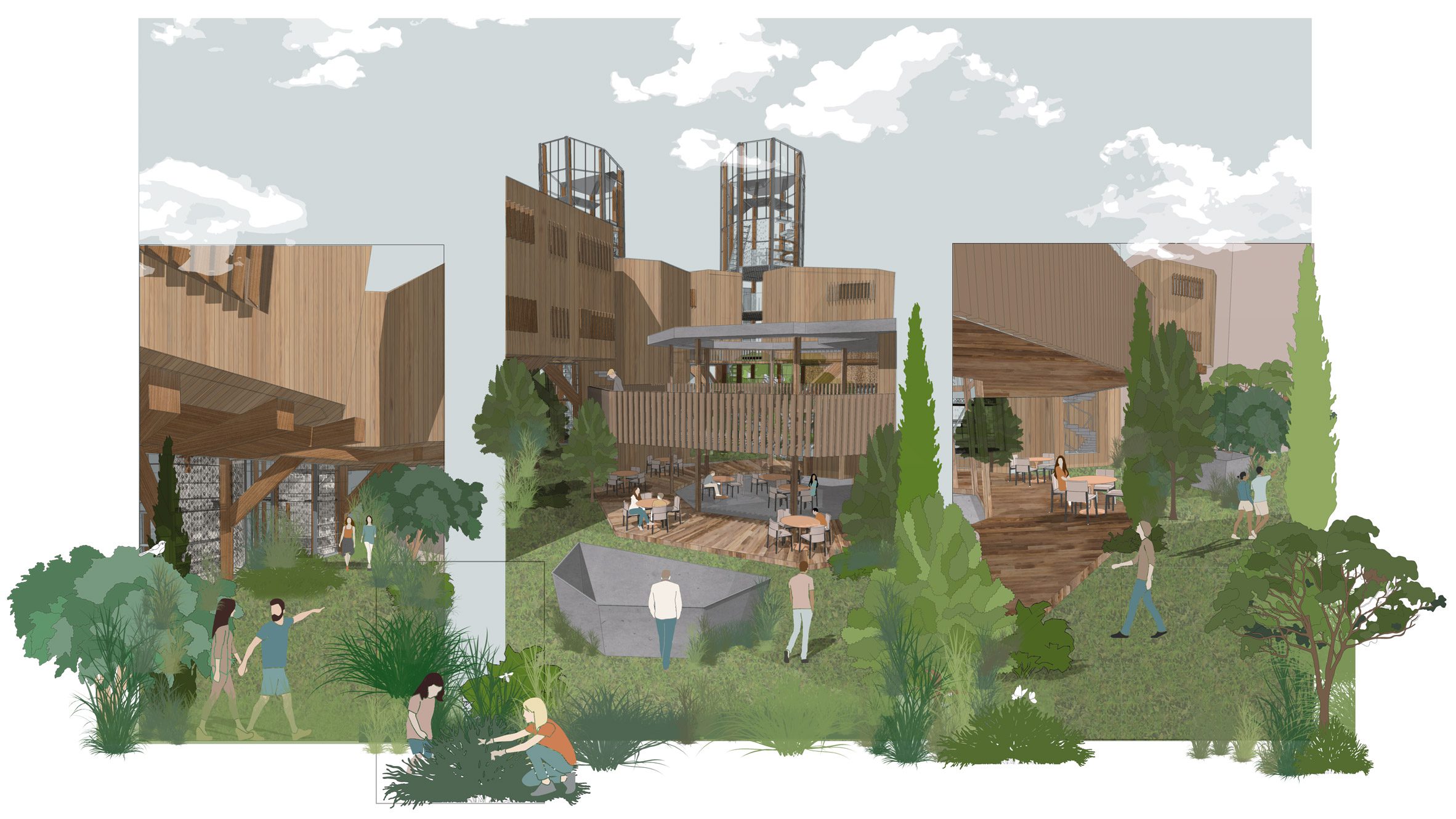

A community centre where people can forage food


Radical Food Landscapes – The Urban Living Experiment by Reesha Sudra

"Radical Food Landscapes acts as a social living experiment to test whether this idea could be a viable and sustainable way of living in the city. This entails residents living on-site and being actively involved in the upkeep of growing produce.

"The building programme consists of foraging, growing and living, where the ultimate goal is to promote the city's ideology as a place for production rather than just consumption.

"The project proposes a new way of growing and tests the urban realm to see how we can move forward to increase food security in all parts of the world."

Student: Reesha Sudra
Course:
BA(Hons) Architecture
Tutors:
Andrew Ó'Murchú, Hwei-Fan Liang and Darren Stacey
Email:
reeshasudra81[at]gmail.com
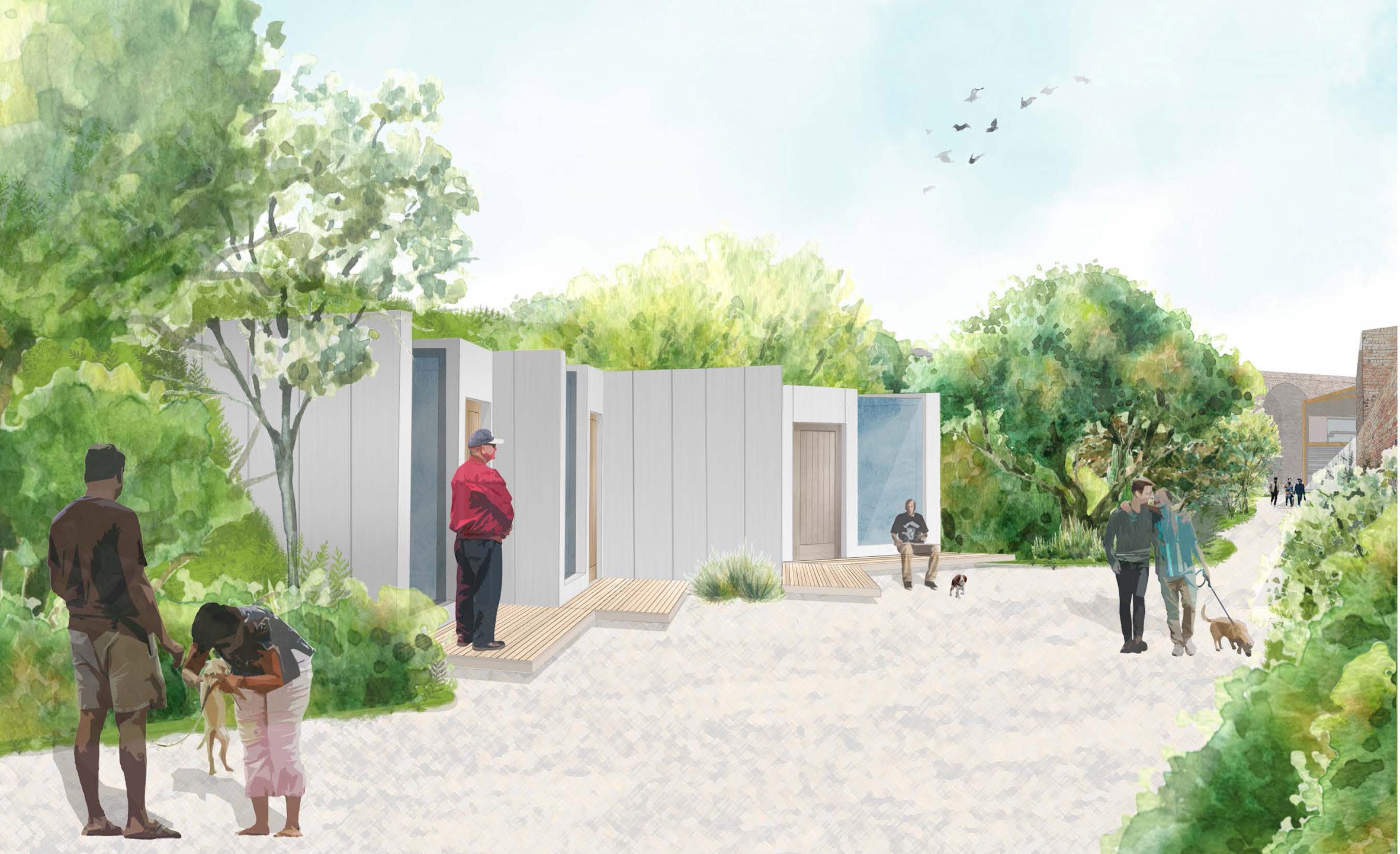

A dog friendly shelter for homeless people

Copeland Shelter and Animal Clinic by Alex Moran

"This project is a dog-friendly homeless shelter focused on cohabitation and dog-friendly design to address the issue of homeless people giving up their dog in order to find a safe place to sleep.

"Through the use of a high street vet clinic, individual room pods, main support building and the linear public landscape, the project caters for the needs of the dog and the human, providing spaces for privacy, socialisation and interaction, and a new park for the wider community."

Student: Alex Moran
Course:
BA (Hons) Architecture
Tutors:
Hannah Fothergill, Hwei-Fan Liang and Darren Stacey
Email:
Alex.m23[at]live.co.uk
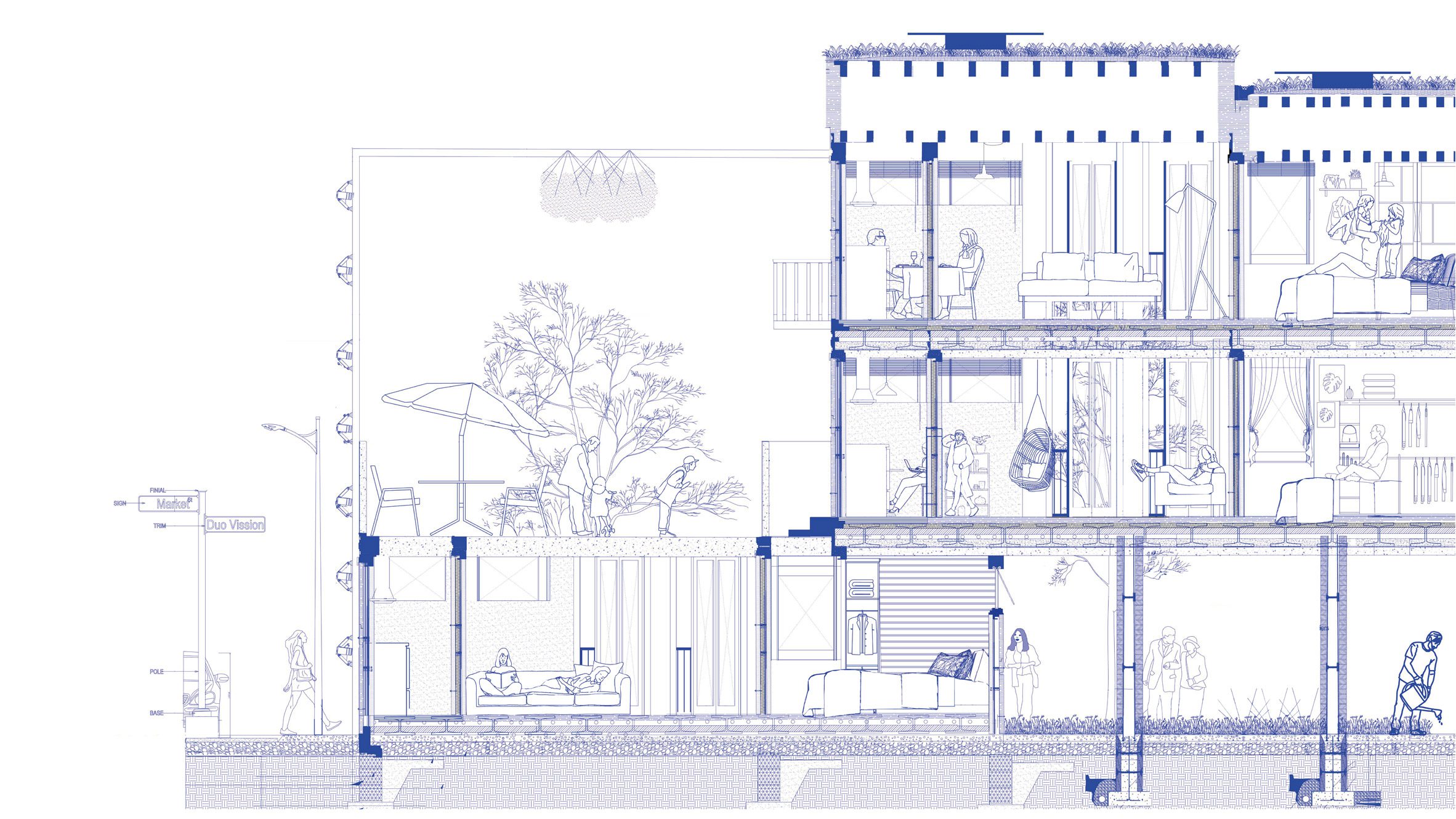

An illustration of a centre designed to help people's mental health

Duo Vision Care Shelter by Sara Md

"The Duo Vision Care Shelter was carefully designed as a home-like temporary accommodation. It consists of a public communal garden that is filled with greenery, leading the users to the public shared swimming pool and private rooftop garden, which is only dedicated to the residence of the care shelter.

"These programmes integrated within the shelter was proposed to keep the young teenagers out of the conflict in Peckham. Hence, it will help bring tranquillity and restore positive mental health."

Student: Sara Md
Course: BA(Hons) Architecture
Tutors:
Stefano Paiocchi, Hwei-Fan Liang and Darren Stacey
Email:
hello[at]saramd.com
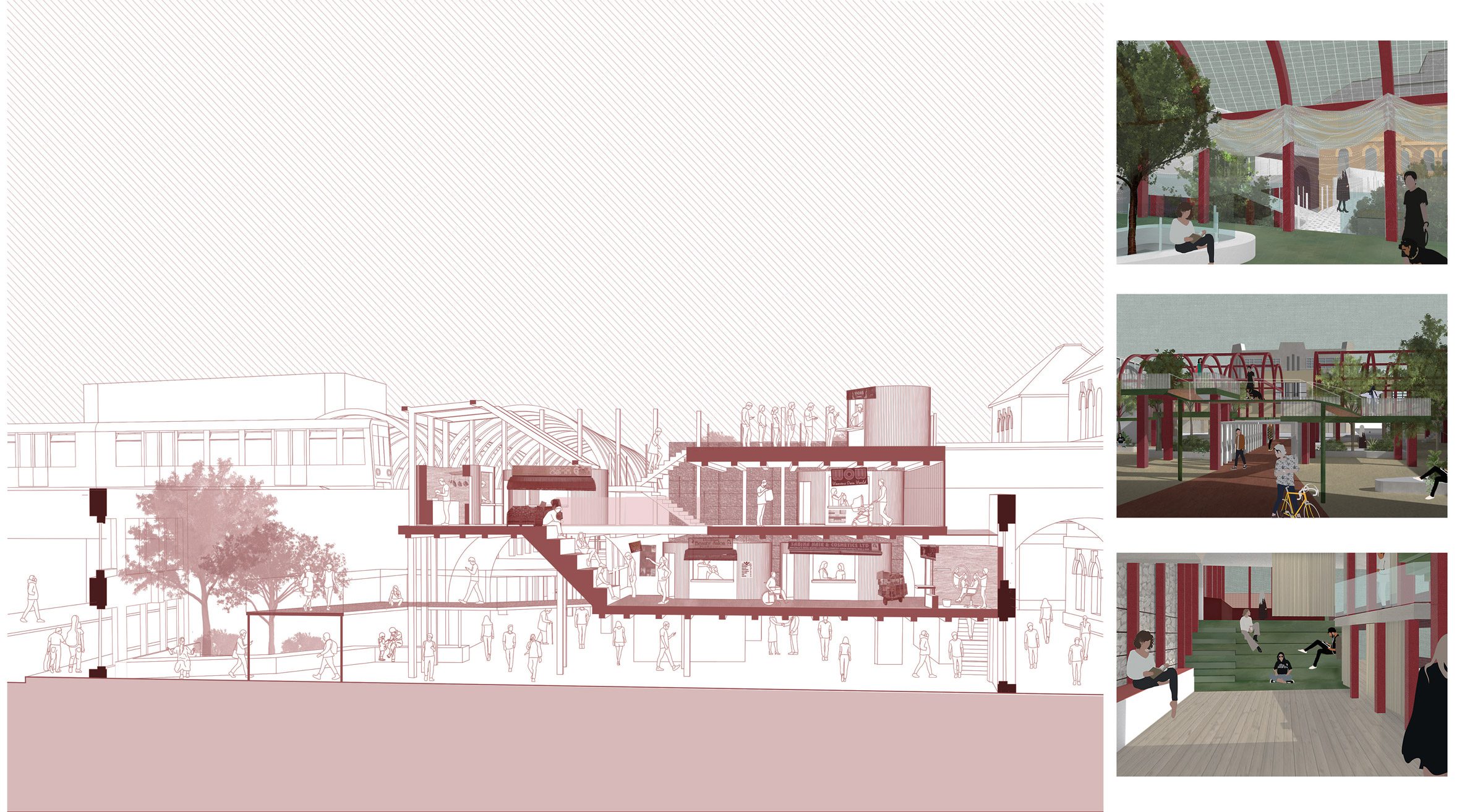

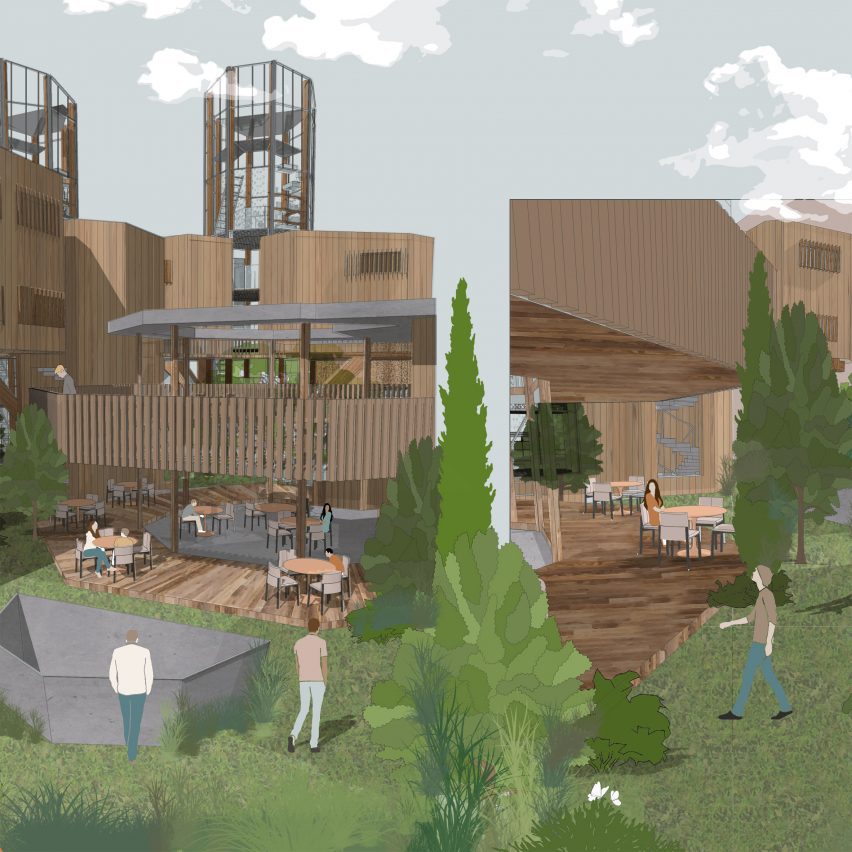
An architectural visualisation

Elevating Communities by Isobel Clancy

"It seems impossible to name a Central London location where gentrification does not occur, and Peckham is no exception. This project aims to create a central community hub for both the existing diverse micro-communities of Peckham and those who relocate along with new development.

"Peckham Rye Square consists of elevated public space, market space and community spaces for Peckham locals to exchange skills, conversations and meals. Whilst creating permeable access to the busy Peckham Rye station at street level."

Student: Isobel Clancy
Course: BA(Hons) Interior Design Environment Architectures
Tutors: Matthew Lucraft, Felicity Atekpe, Hwei-Fan Liang and Darren Stacey
Email: issyclancy96[at]gmail.com


Partnership content

This school show is a partnership between Dezeen and Ravensbourne University London. Find out more about Dezeen partnership content here

The post Ravensbourne University London spotlights eight student architecture projects appeared first on Dezeen.


from Dezeen https://ift.tt/2Ya33xz
Triangular-patterned canopy shelters stalls at modernised Portuguese marketplace

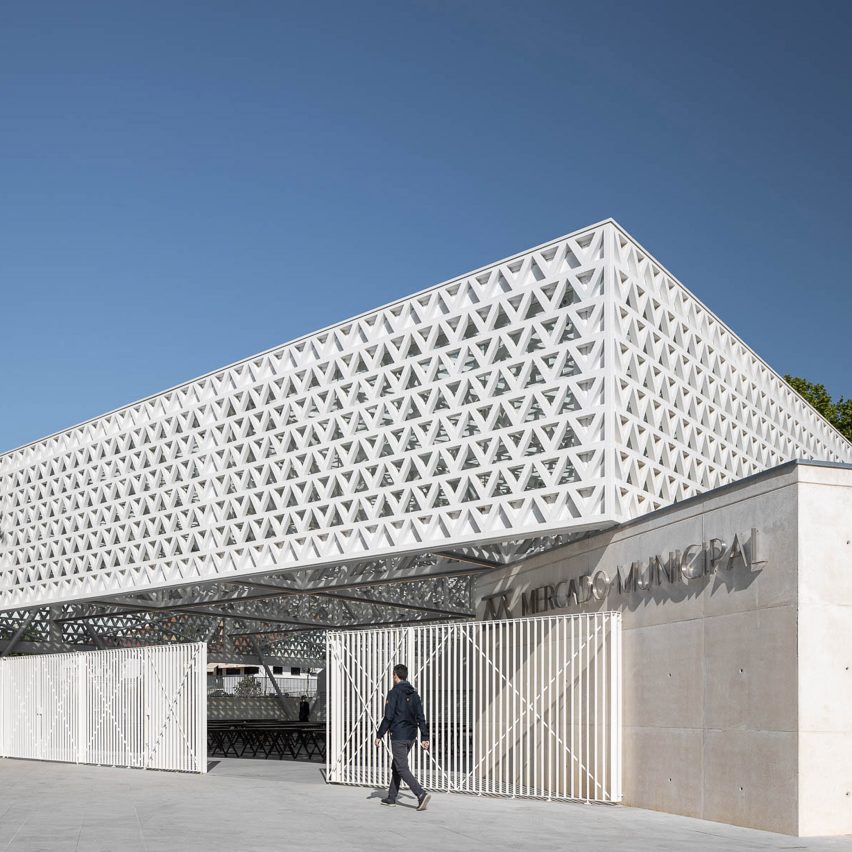
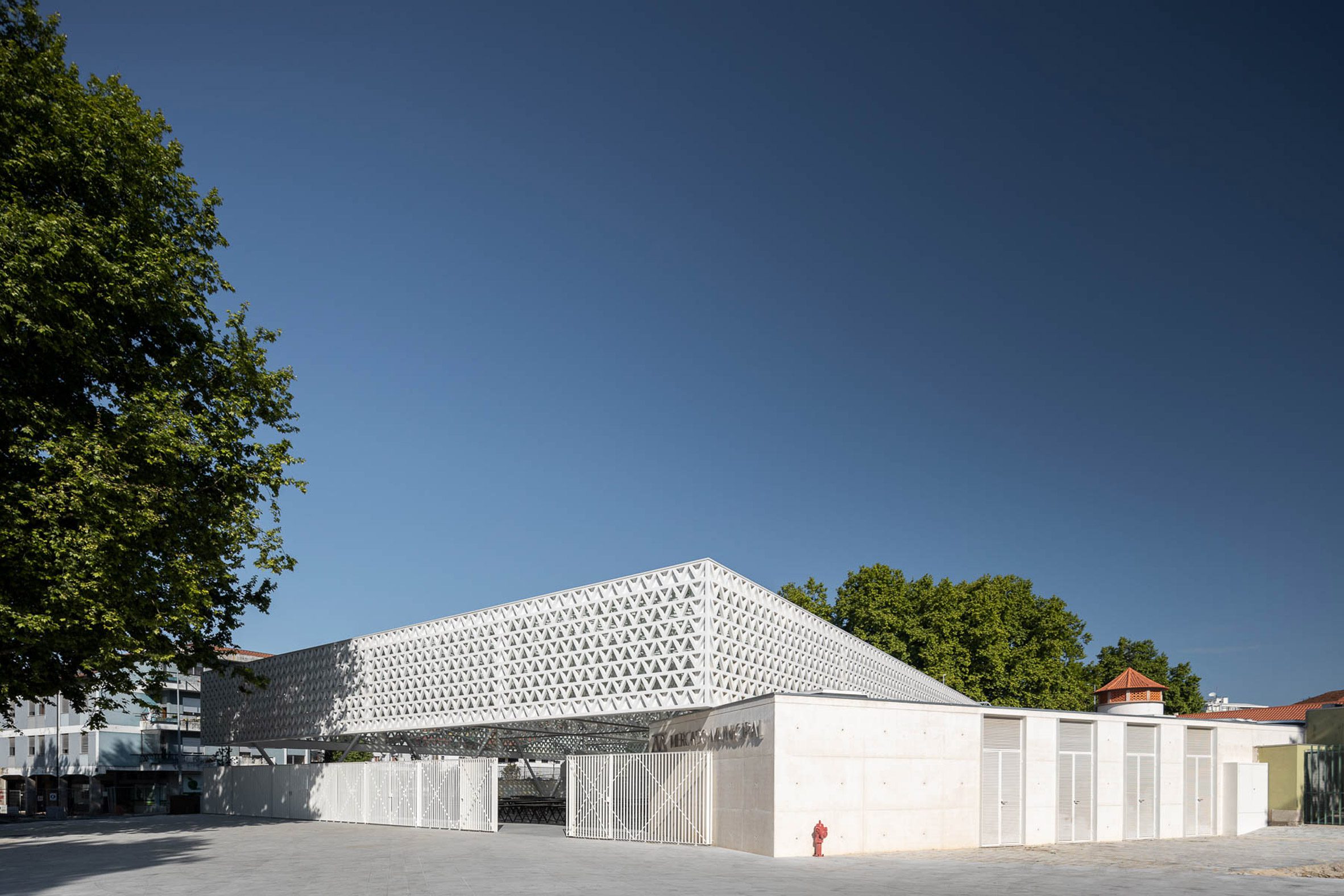
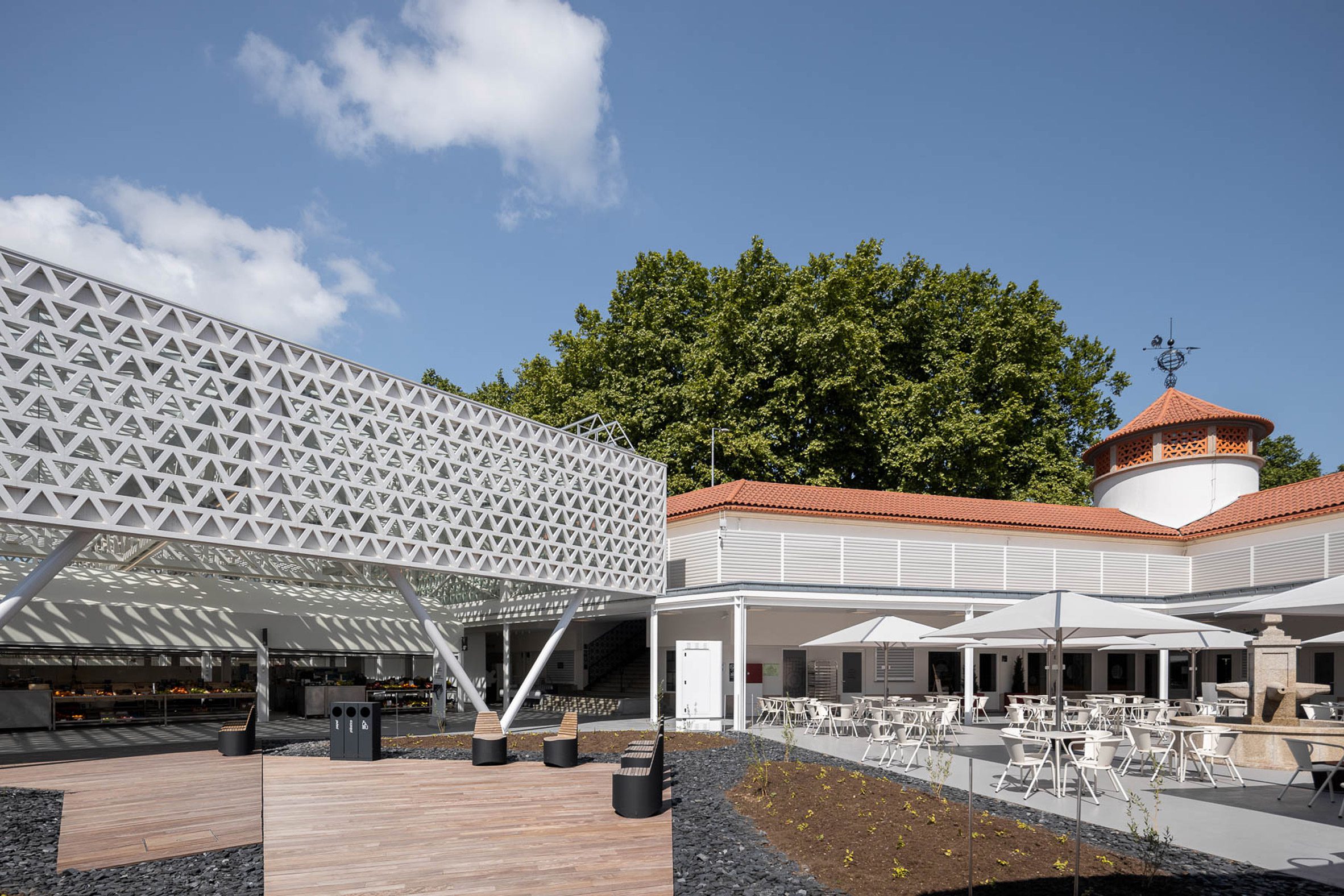
Architect Rui Mendes Ribeiro has covered the marketplace in the Portuguese town of Vila Nova de Famalicão with a perforated canopy that shades the market square. 

The town council's architecture department led by Ribeiro oversaw the modernisation of the traditional market, which had become outdated and was no longer attracting shoppers to its stalls.

Top: Above: the market and its buildings were renovated and repurposed

The main intervention was the addition of a covered area to ensure the market can operate in all weather conditions and at all times of the year.

Some buildings from town's original marketplace, designed in 1948 by architect Júlio José de Brito in a style known as Portuguese Suave, were also renovated and repurposing some of the existing buildings on the site.

The market is covered by a canopy
The market was wrapped in geometric triangular tiles

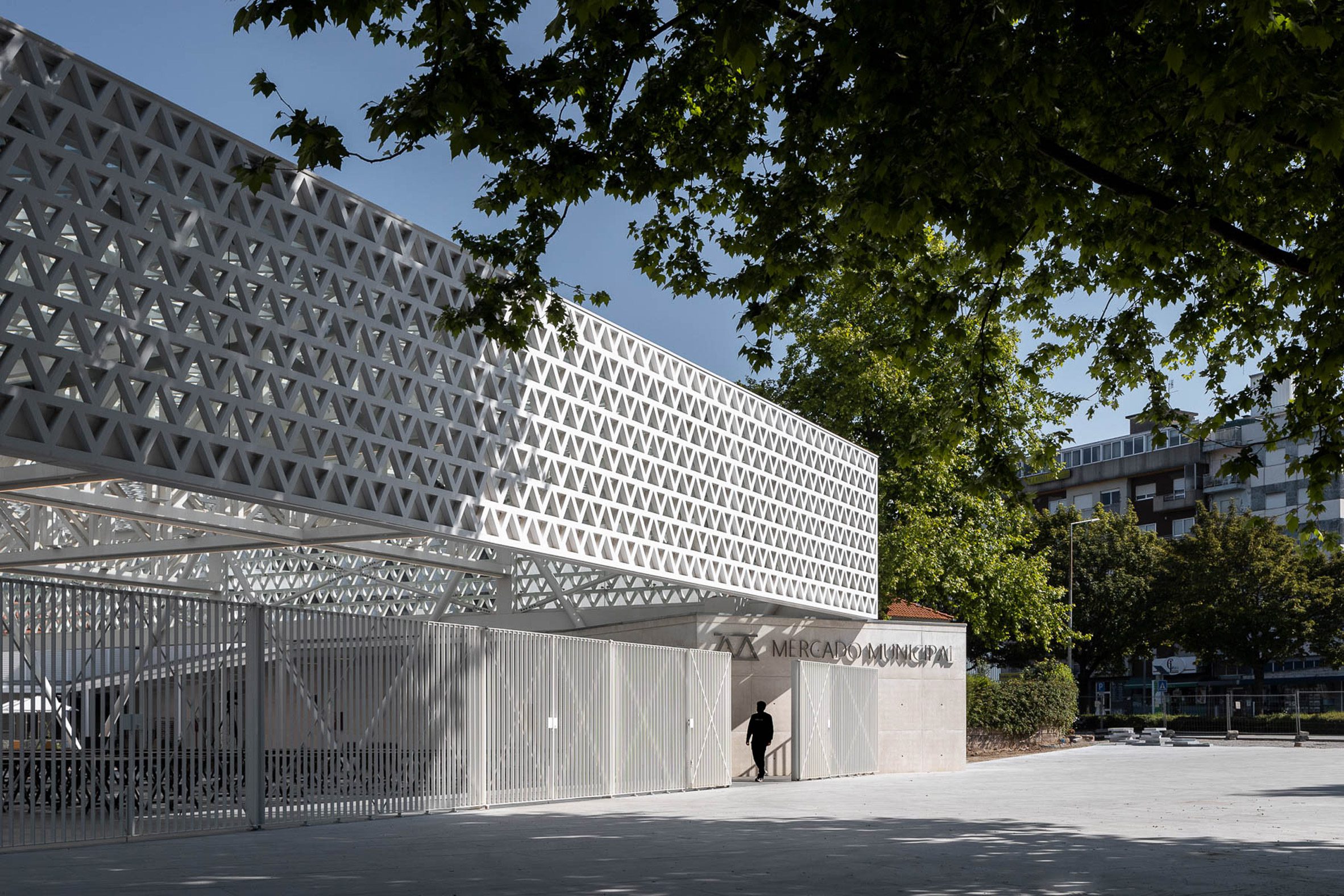
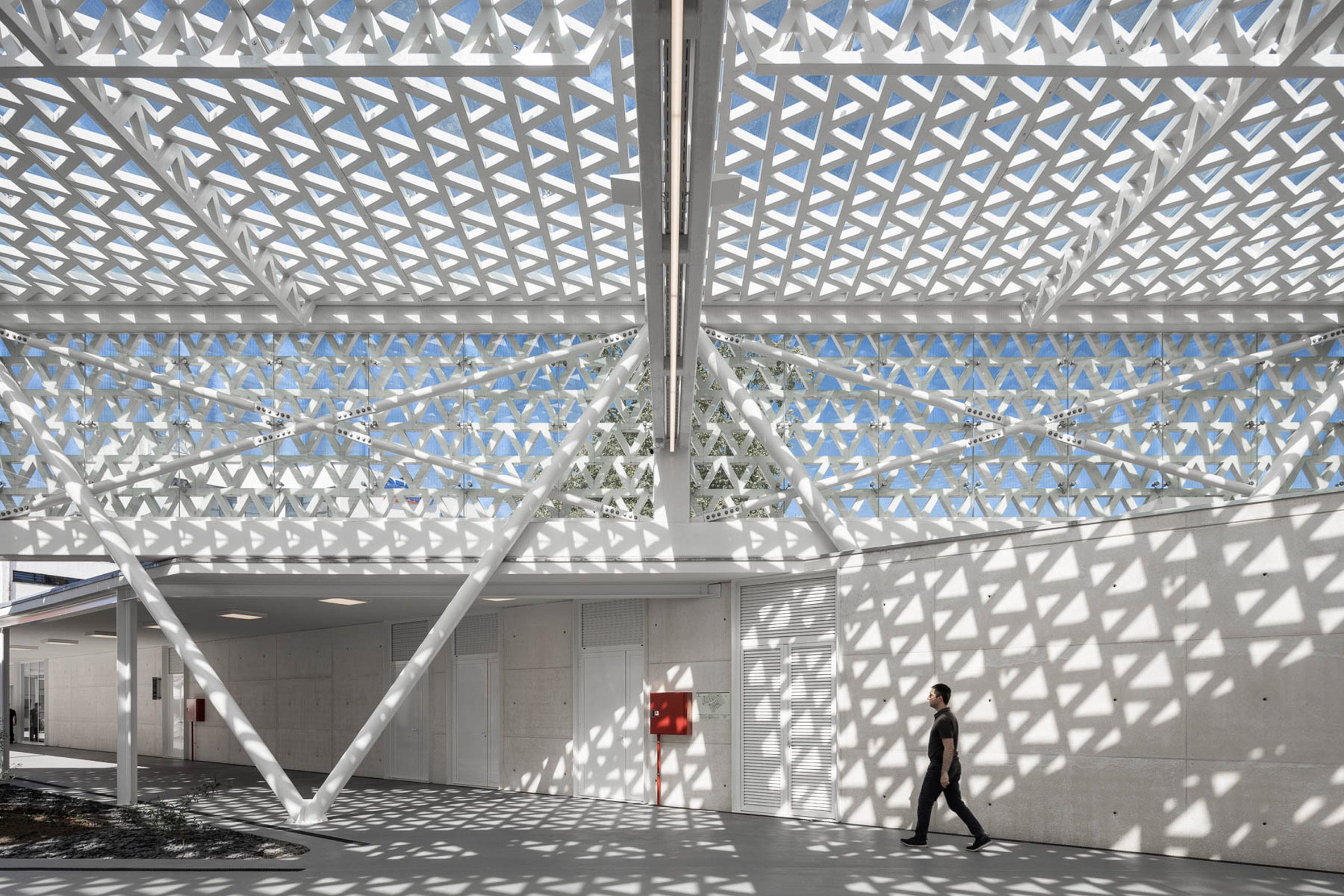
The metal canopy's triangular pattern was informed by the original market building, which includes a ring of openings incorporating screens made from tiles arranged in a geometric pattern.

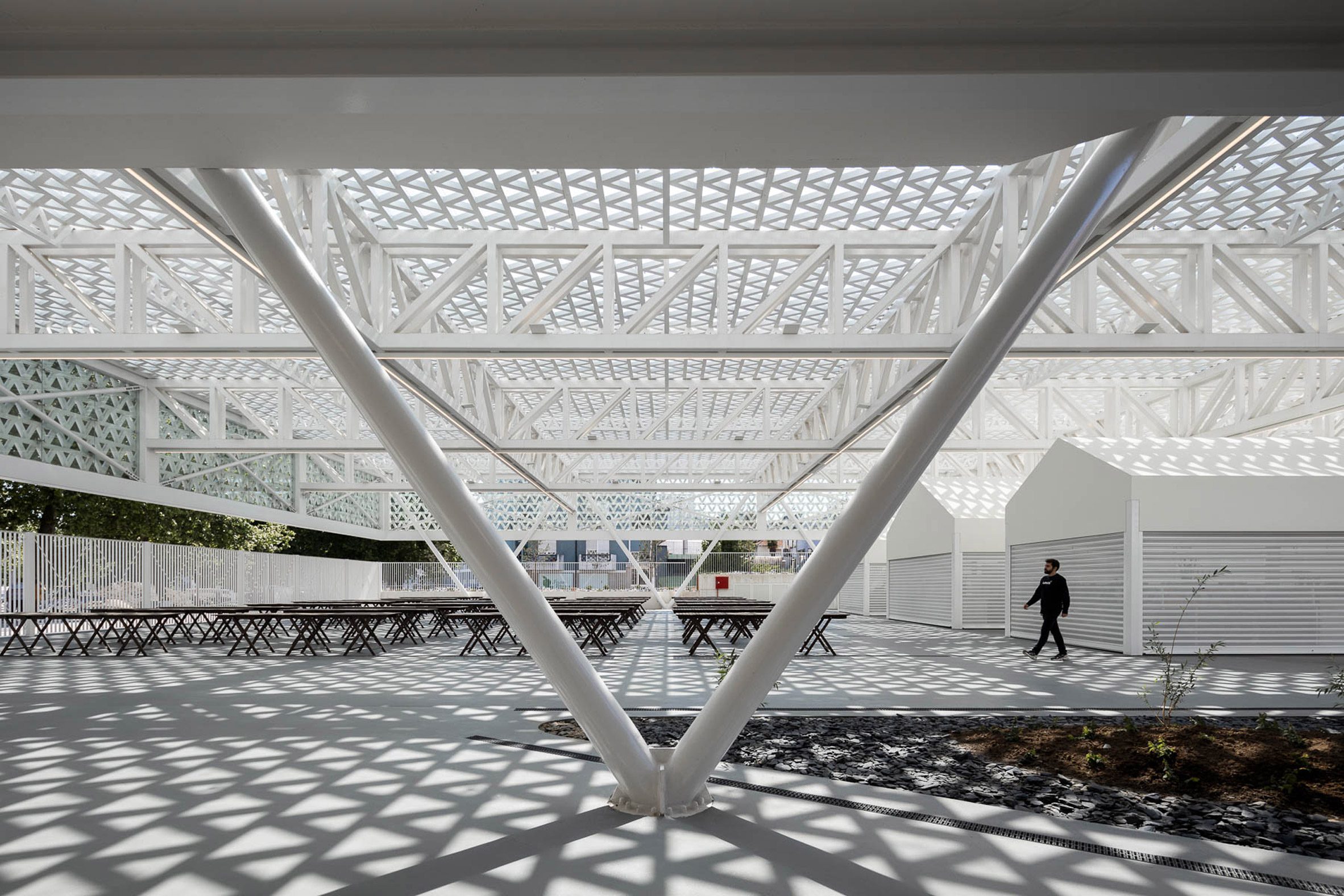
A framework comprising angled pillars and trusses supports the canopy, which is topped with glass panels that allow sunlight to penetrate through it.

municipal market famalicao is adjoined to an old building
An existing structure was updated and renovated

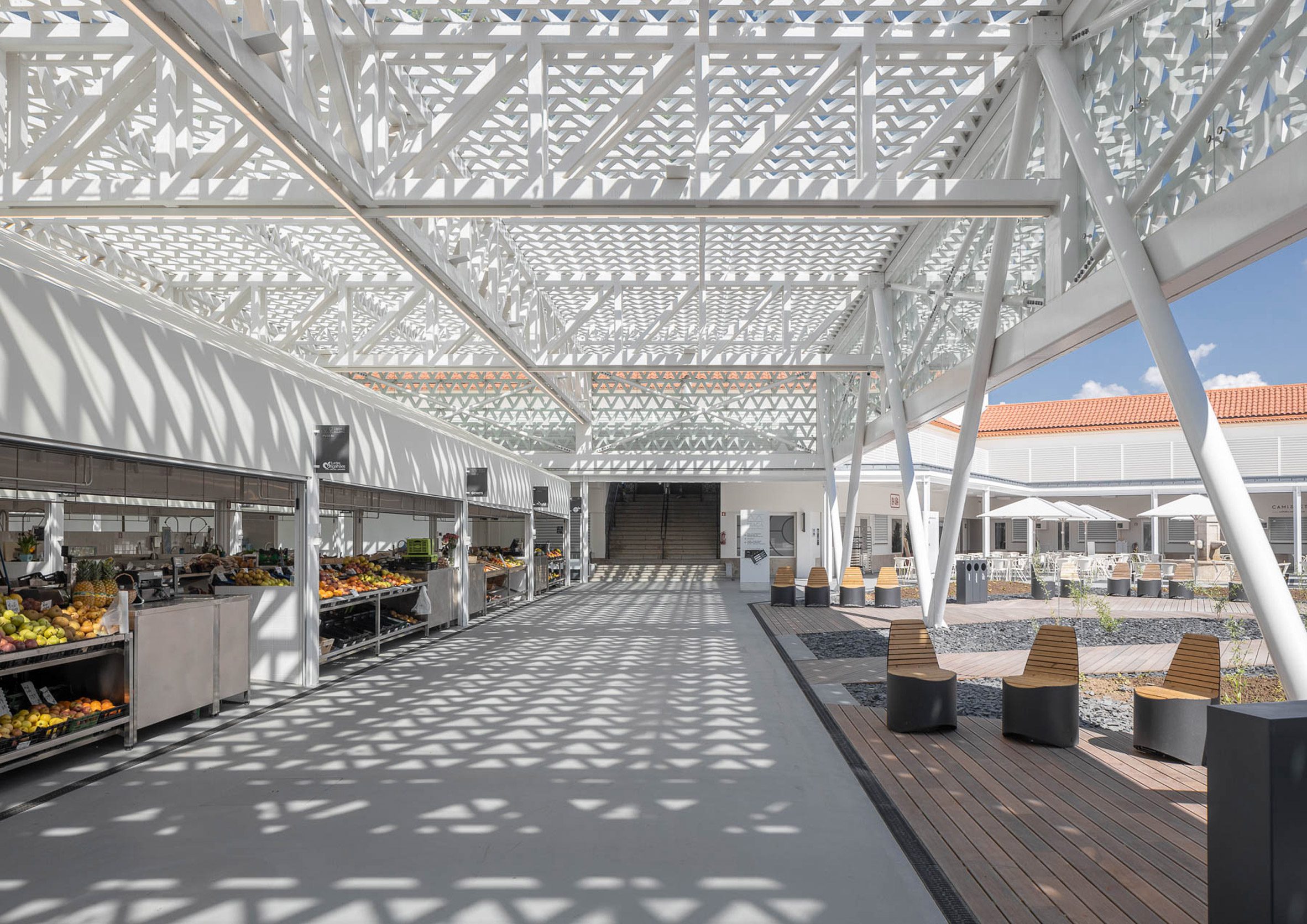
This design casts patterns of light and shadow on the surfaces below.

The triangular motif is also used for the market's branding, including a sign at the new entrance.

The courtyard can be reached through the original buildings to the north or from the public square to the west.

Stairs descend from these entrances to the courtyard, which is positioned at a slightly lower level.

Triangular shadows are cast across the interior of the municipal market famalicao
Light filters through the geometric tiles

Within the covered area are new stalls for vendors including butchers, fishmongers and florists. The stalls take the form of gabled volumes featuring shutters that can be lowered to protect their contents when the market is closed.

The structure also forms a new urban frontage facing the adjacent Avenida Marechal de Albuquerque, with an entrance incorporated on one corner of the site.

municipal market famalicao has large covered seating areas
Trusses support the canopy

An existing structure lining one side of the courtyard was retained and upgraded to accommodate a series of commercial premises that face towards the courtyard.

An extended roof forms a sheltered passage outside these establishments which connects with an open-air landscaped garden featuring decking and casual seating for visitors.

The interior meets a decked courtyard
Market stalls look out to the courtyard

Alongside the stalls and retail units, the market includes spaces for events like cooking demonstrations. Cafes and restaurants can also operate from permanent premises connected to covered outdoor terraces.

The municipality hopes the project will revitalise the neighbourhood by creating the feeling of a lively plaza where people will gather and spend time, rather than just passing through to pick up their groceries.

aerial view of municipal market famalicao
The covered market stands alongside the original buildings

Other markets include a trapezoidal roofed structure which was designed by Colectivo C733 and is located in northern Mexico.

HW-Studio also built a white volumed food market in place of an abandoned food warehouse between two existing stone buildings.

Photography is by Ivo Tavares Studio.

The post Triangular-patterned canopy shelters stalls at modernised Portuguese marketplace appeared first on Dezeen.


from Dezeen https://ift.tt/38iovSC

Ten welcoming living rooms featuring wooden elements and panelling

Living rooms with wood lookbook

In our latest lookbook, we celebrate the versatility of wood with ten living rooms featuring walnut panelling, timber beams and wooden window frames.

A wide variety of wood types were used for these projects, which showcase everything from lightly coloured cedar cabinetry to dramatic vintage wall panelling.

The material complements most furniture and design styles, and adding wooden elements to a living room can be an efficient way to create warm, welcoming interiors.

This is the latest roundup in our Dezeen Lookbooks series that provide visual inspiration for designers and design enthusiasts. Previous lookbooks include mezzanines, art-filled homes and bold interiors that make use of colour theory.


Malibu Surf Shack by Kelly Wearstler

Malibu Surf Shack, US, by Kelly Wearstler

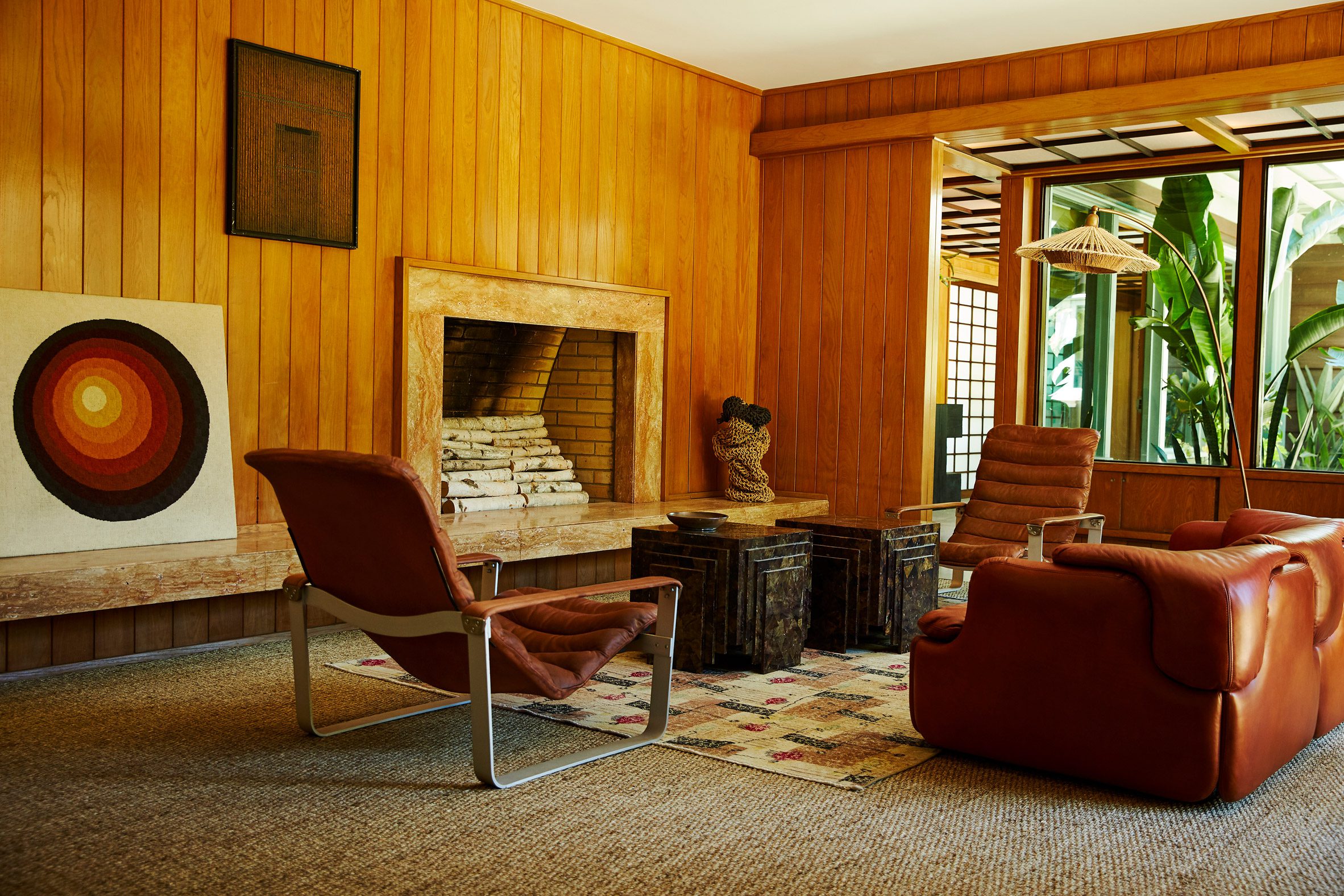
Interior designer Kelly Wearstler revamped Malibu Surf Shack as a bohemian retreat within a 1950s beachfront cottage in southern California.

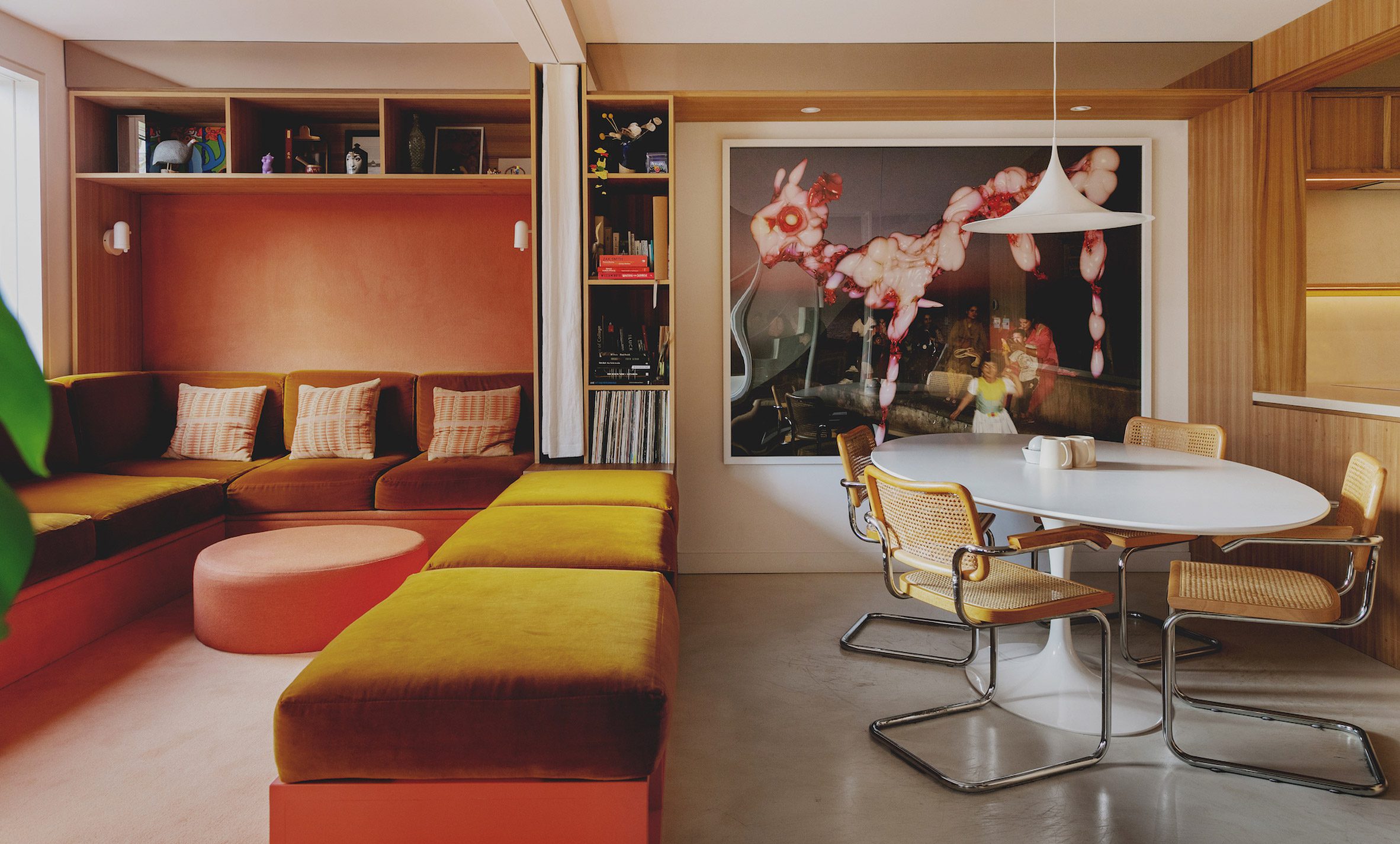
The Broad Beach holiday home features a living room that maintains its original wood-panelling, which blends perfectly with the colour of its furniture. Vintage pieces, including Danish mid-century chairs, are mixed with contemporary elements.

Find out more about Malibu Surf Shack ›


Dawnridge House by Field Architecture

Dawnridge House, US, by Field Architecture

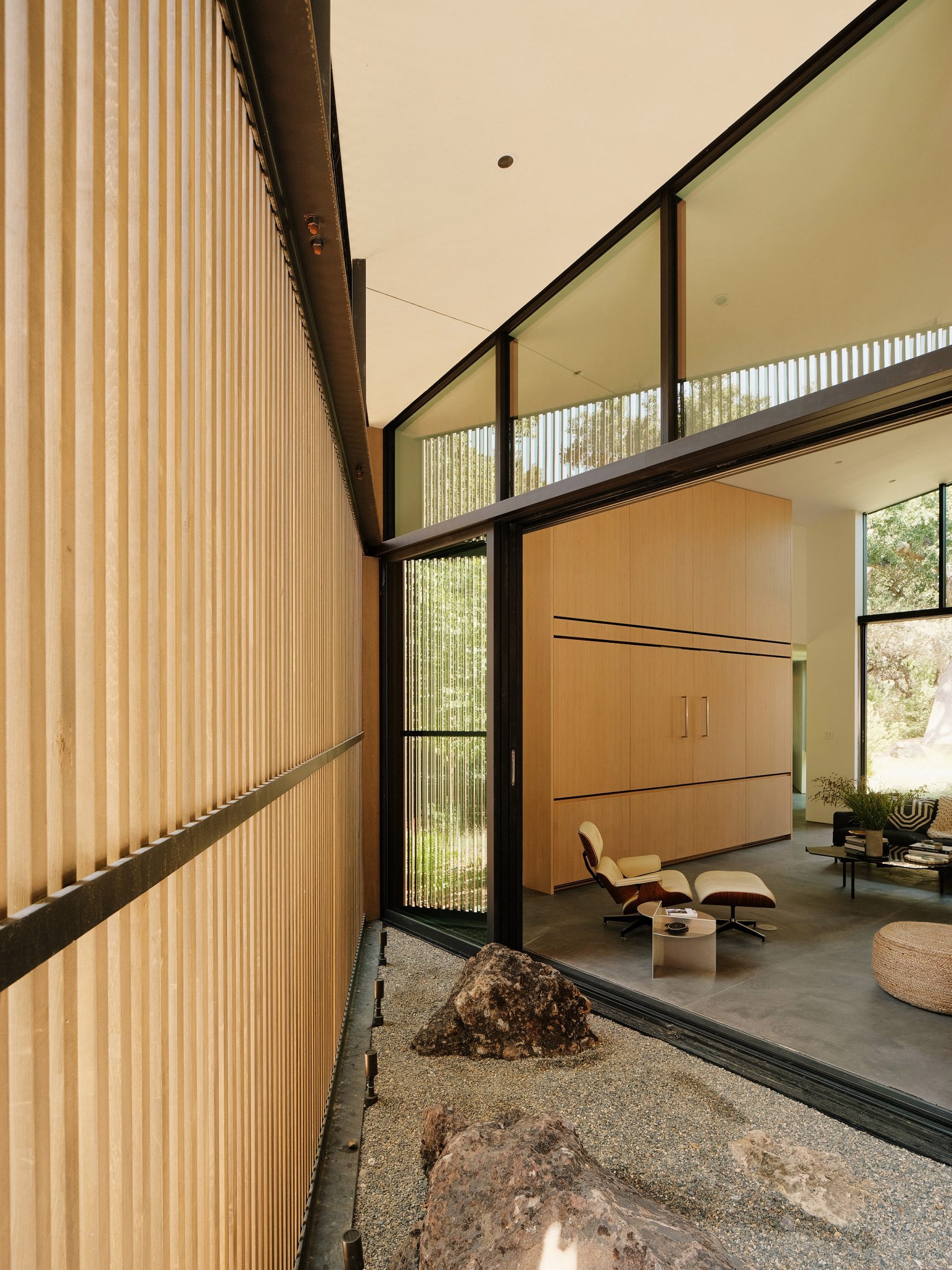
Dawnridge House in California's Silicon Valley was designed around a giant oak tree that splits the house in two, and features interior elements that reflect this wooden theme.

Designed by architecture office Field Architecture, the home's living room has large wooden cabinets that match the slatted cedar walls lining the triangular courtyard that the room opens out onto.

Find out more about Dawnbridge House ›


This lookbook features living rooms with wood

Holiday home, Iceland, by KRADS

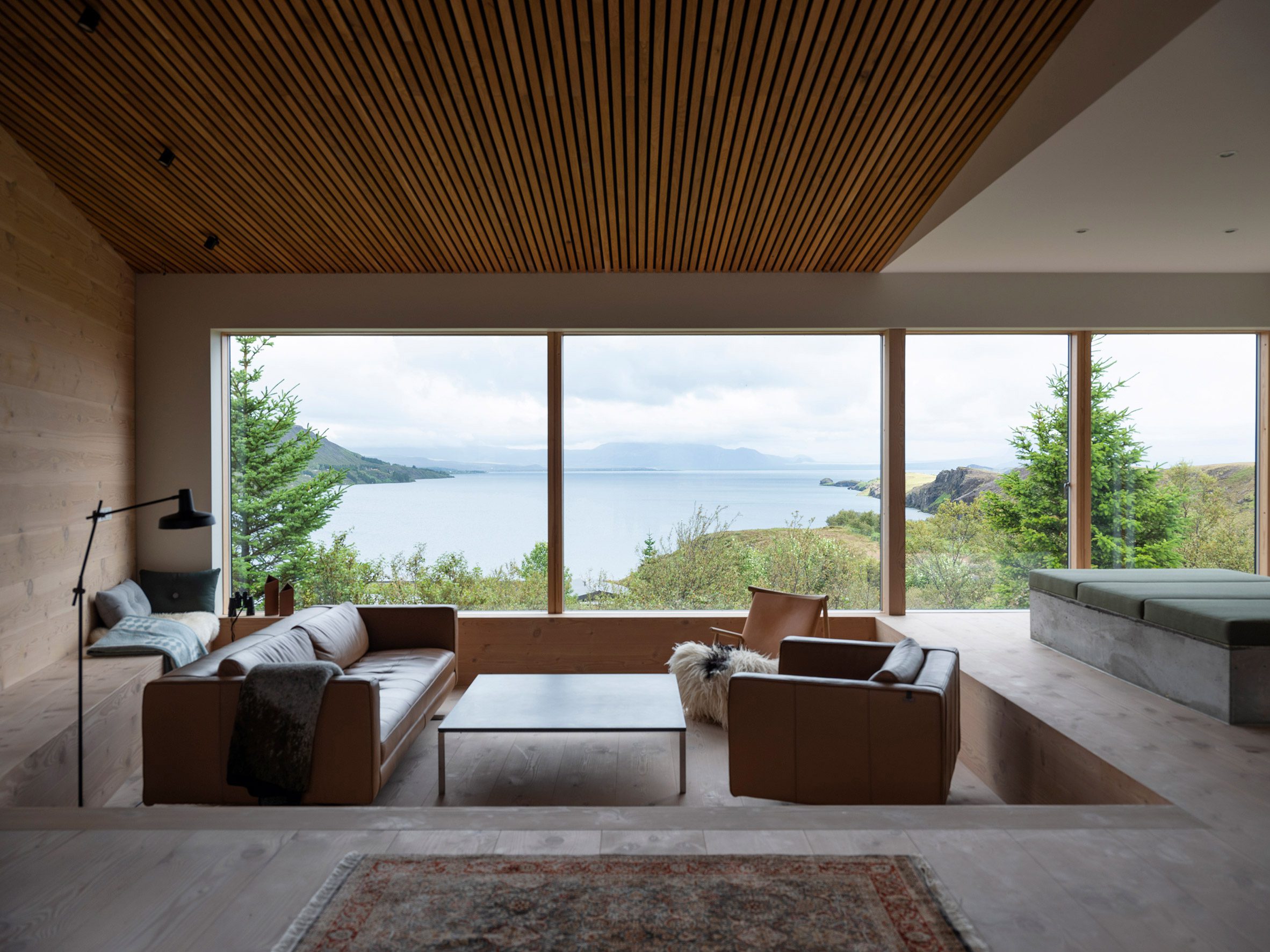
Scandinavian studio KRADS added a wooden living room to a holiday home by Lake Thingvallavatn in Iceland that echoes the property's blackened-timber cladding.

The room features a sunken lounge area surrounded by a raised built-in wooden floor. This provides additional blocky seating on which visitors can sit and enjoy the panoramic views across the lake.

Find out more about this Icelandic holiday home ›


Slatted shutters line the living room windows in this Australian house

Breezeway House, Australia, by David Boyle Architect

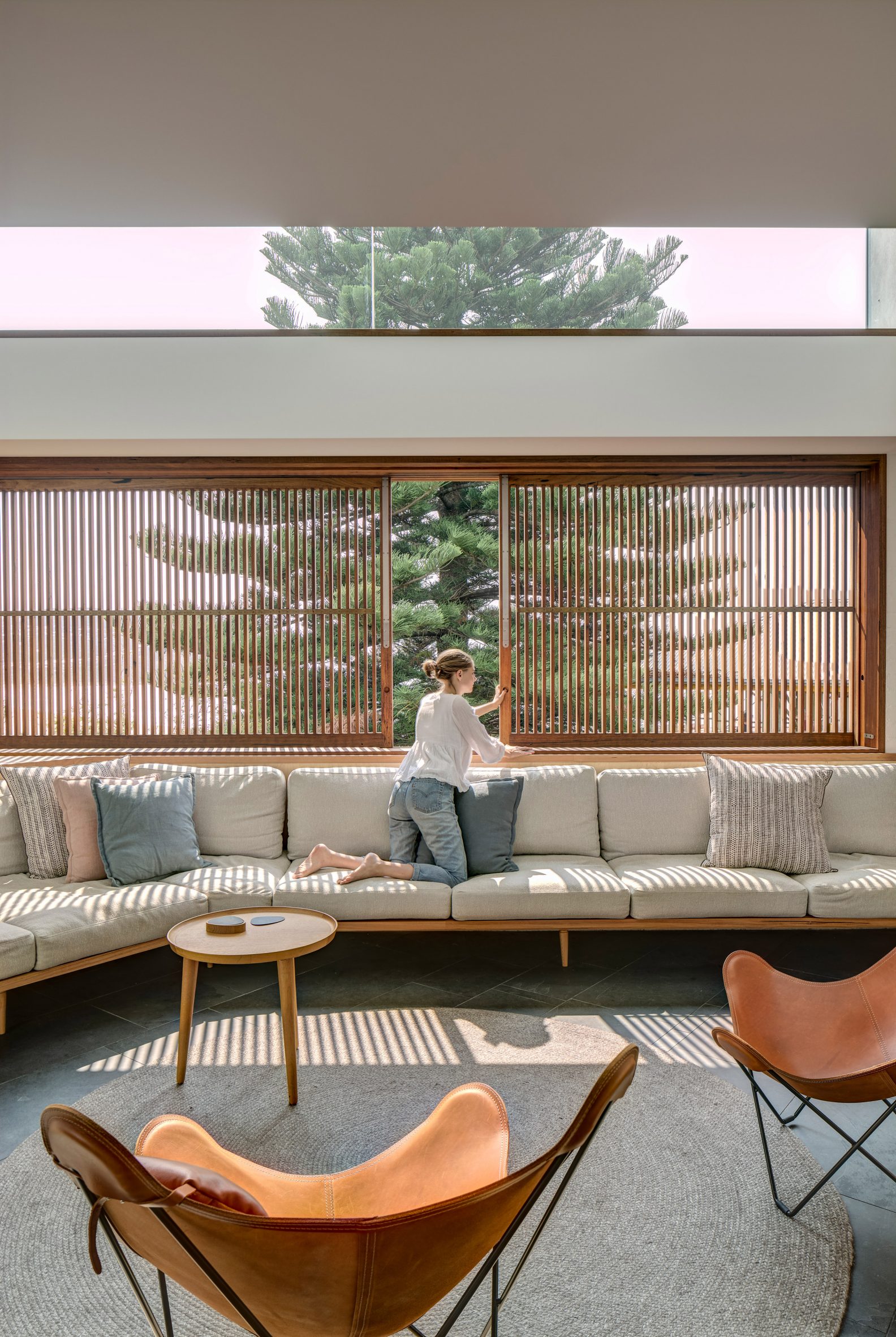
Located in Macmasters Beach, a coastal suburb north of Sydney, Breezeway House by Australian studio David Boyle Architect has a timber walkway that runs along its southern side and matches the wooden slatted shutters that slide across the living room's windows.

Breezeway House's living room, unusually placed on the house's upper rather than lower level, has been decorated with furniture that complements the wooden shutters. Brown leather butterfly chairs pick up the hues of the shutters, as do a low wooden sofa and table.

Find out more about Breezeway House ›


Gallery apartment by BC Arquitetos

Gallery apartment, Brazil, by BC Arquitetos

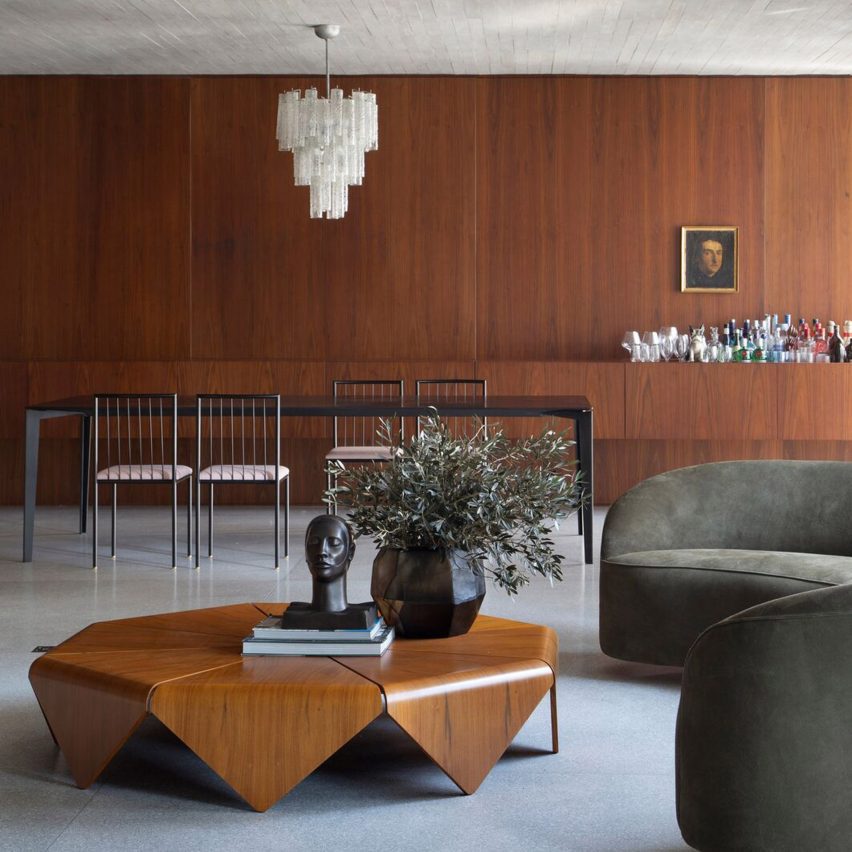
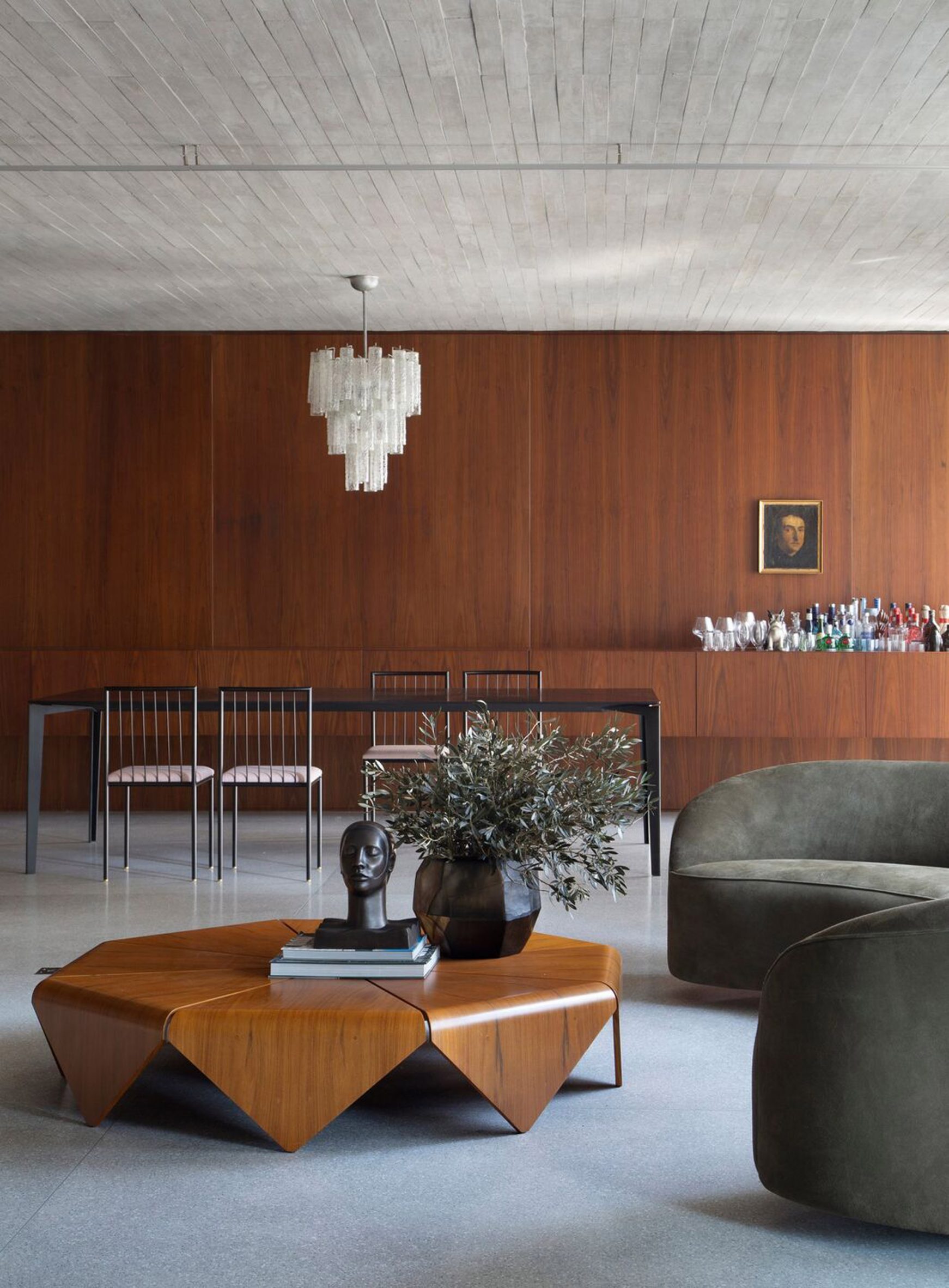
Walnut panelling creates a soothing backdrop for this São Paulo apartment by Brazilian studio BC Arquitetos that houses a collection of mid-20th century art.

Wrapped entirely in dark walnut, the apartment's wooden theme is continued in the living room with designer Jorge Zalzupon's wooden coffee table Petala, which resembles an upside-down flower. A curved grey sofa adds a contrasting soft shape to the room's more angular furniture pieces.

Find out more about this gallery apartment ›


This Australian barn-like house has a gabled wooden roof

The Barn, Australia, by Paul Uhlmann Architects

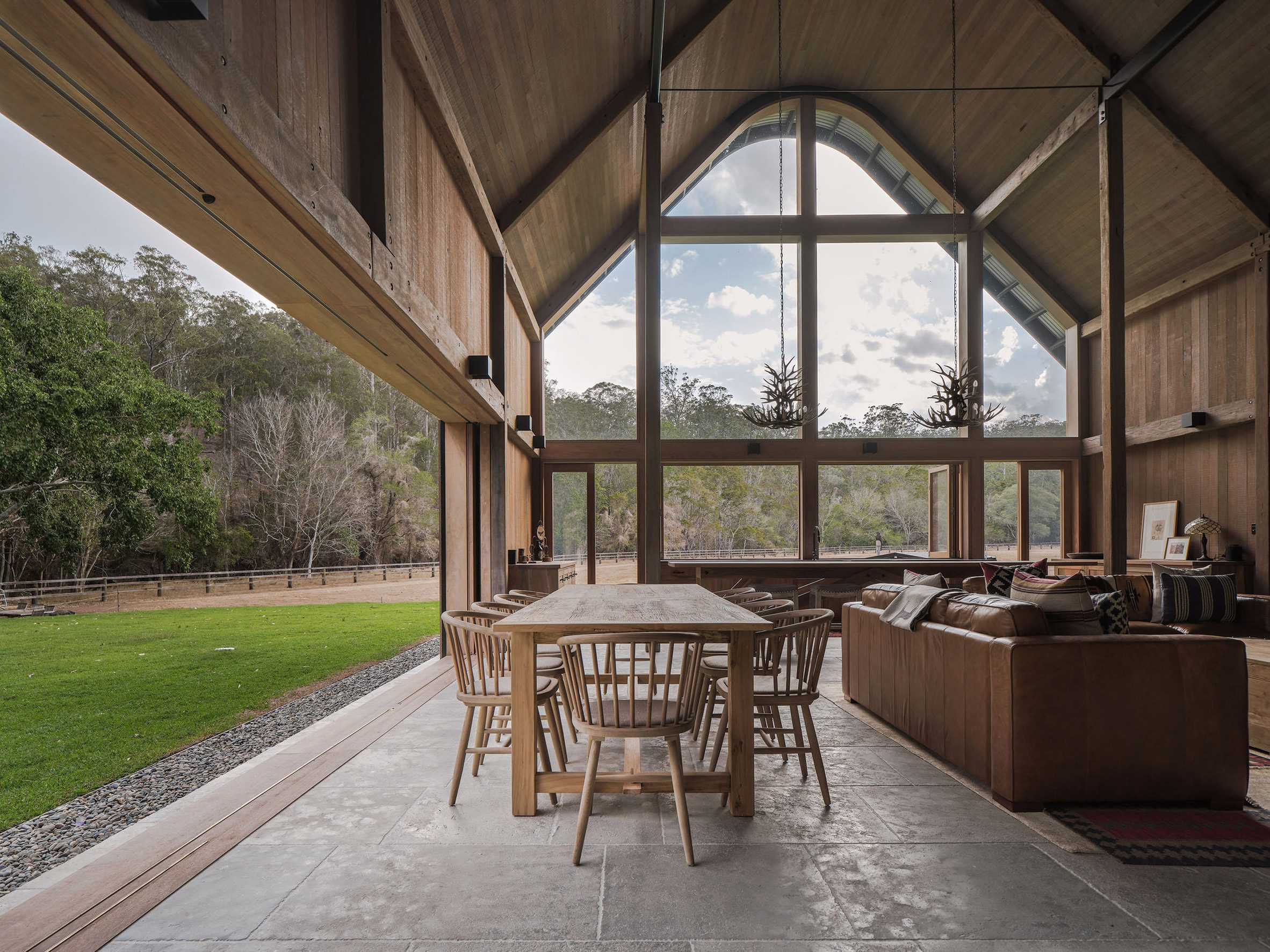
Australian office Paul Uhlmann Architects added sliding wooden screens to the living room of this barn-like holiday home in Brisbane, aptly named The Barn.

A wooden farmhouse table and chairs blend with the living space's gabled wooden roof. Wooden leather sofas match the natural wood-colour of the beams and walls in the room, which can be completely opened up to the exterior.

Find out more about The Barn ›


Muskoka cottage by Ali Budd Interiors has wooden window frames

Muskoka cottage, Canada, by Ali Budd Interiors

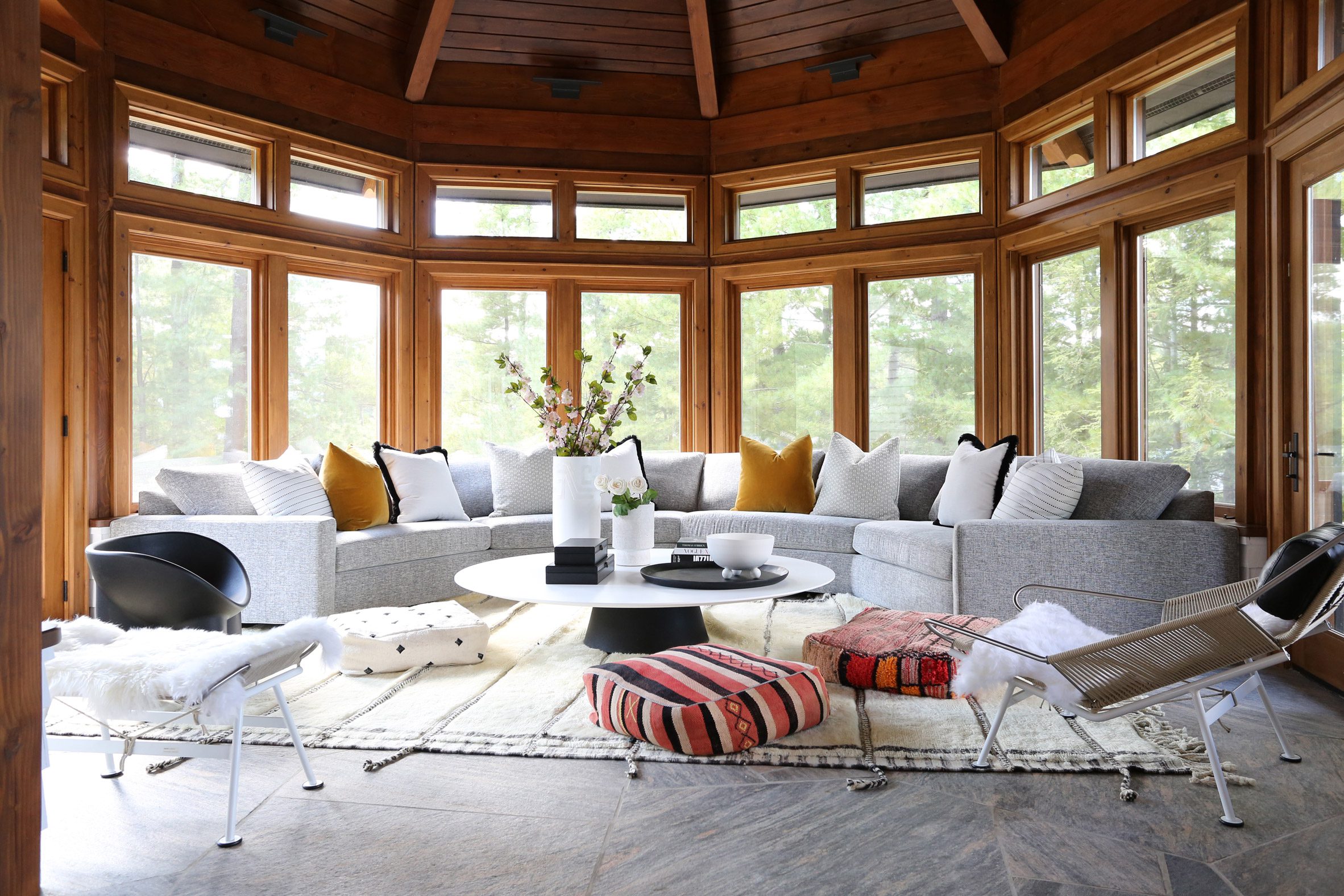
A sunroom with cosy wooden window frames provides panoramic views of the Muskoka district in this Ontario holiday cottage, which Toronto firm Ali Budd Interiors transformed from a dated wooden log cabin.

Called the Muskoka room, the living space features curved wooden walls. A custom-made grey sofa sits next to a coffee table by Garcia Group and vintage rugs and Moroccan poufs from Mellah Rugs decorate the floor.

Find out more about the Muskoka cottage ›


London-based studio Cottrell and Vermeulen Architecture added wooden cabinetry to this living room

London house, England, by Cottrell and Vermeulen Architecture

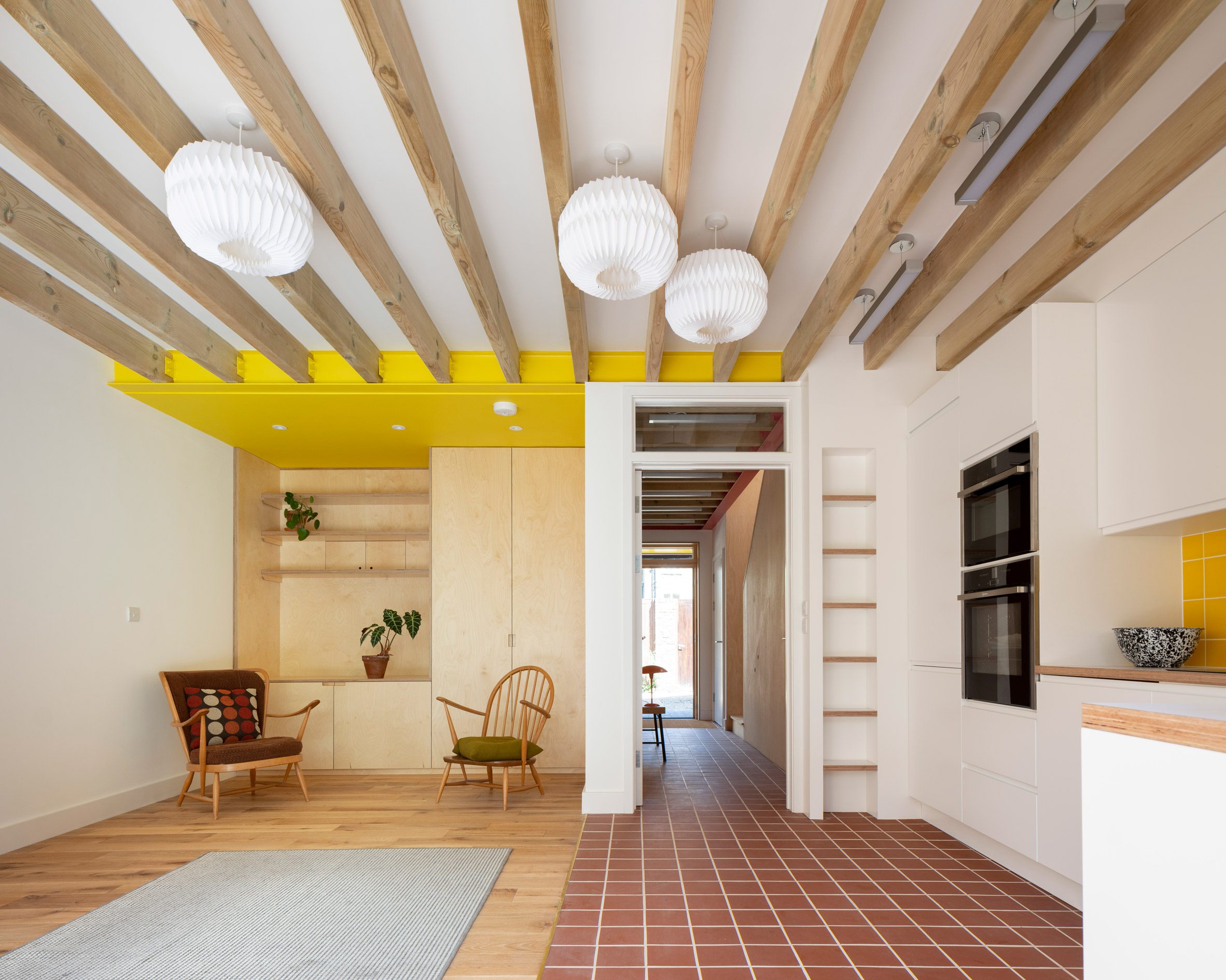
London-based studio Cottrell and Vermeulen Architecture chose a combination of bricks and timber for the interiors of this two-storey house in the south of the city, which features chunky wooden beams in the living room.

The room's light timber floors and cabinetry contrast with burgundy tiles in the kitchen that sits directly next to it, as the two spaces are merged together without the presence of a partitioning wall.

Find out more about this two-storey house ›


Wooden shutters flank this living room

La Extraviada, Mexico, by Em-Estudio

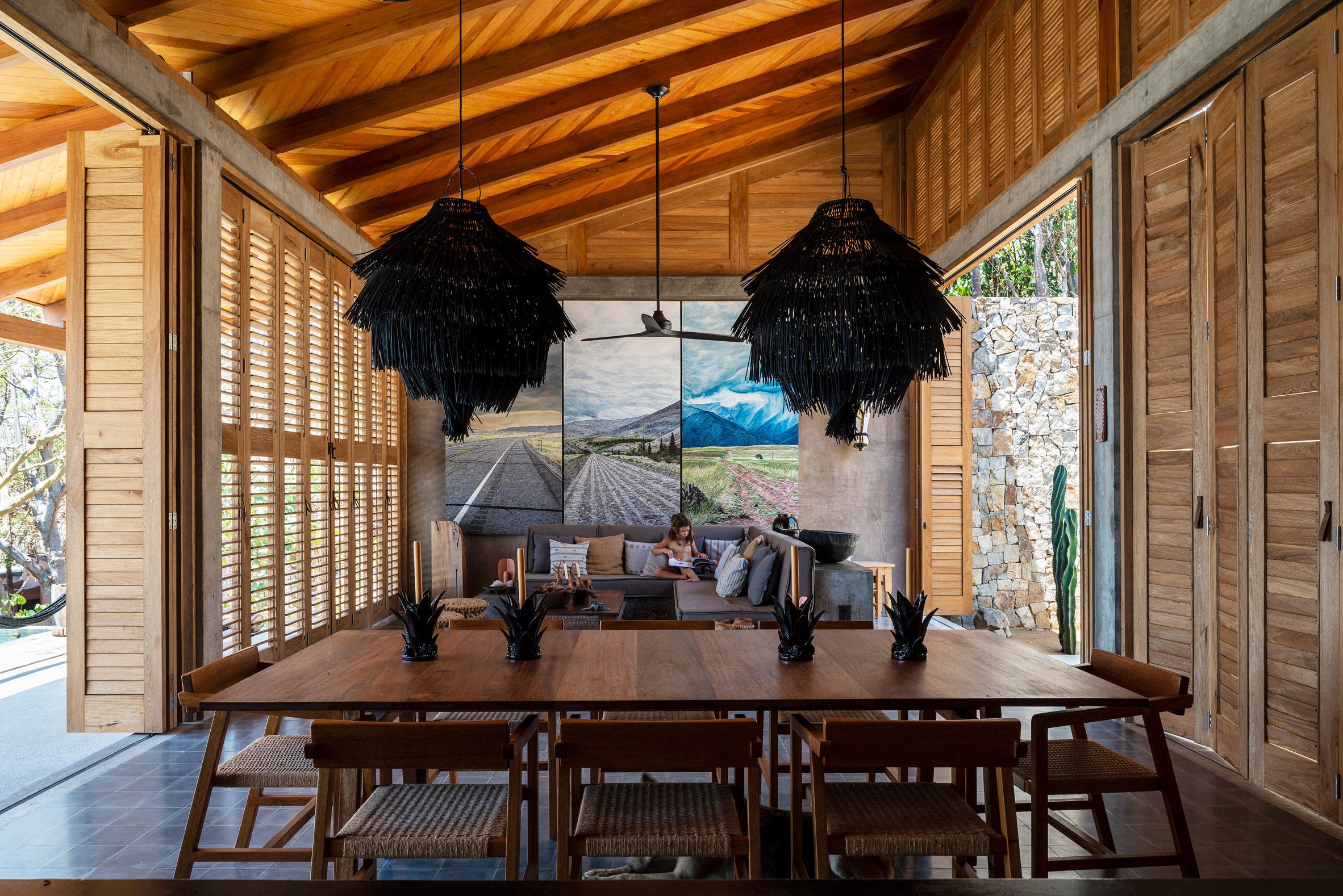
The living room of this Oaxacan holiday home is flanked by delicate wooden floor-to-ceiling shutters designed to protect against the harsh sun and keep the space cool.

Designed by Mexico City-based architecture firm Em-Estudio, the home's living room doubles as a dining space, and features a bright landscape painting that provides a colourful contrast to the dark wooden furniture.

Find out more about La Extraviada ›


The Loghaven Artist Residency

The Loghaven Artist Residency, US, by Sanders Pace Architecture

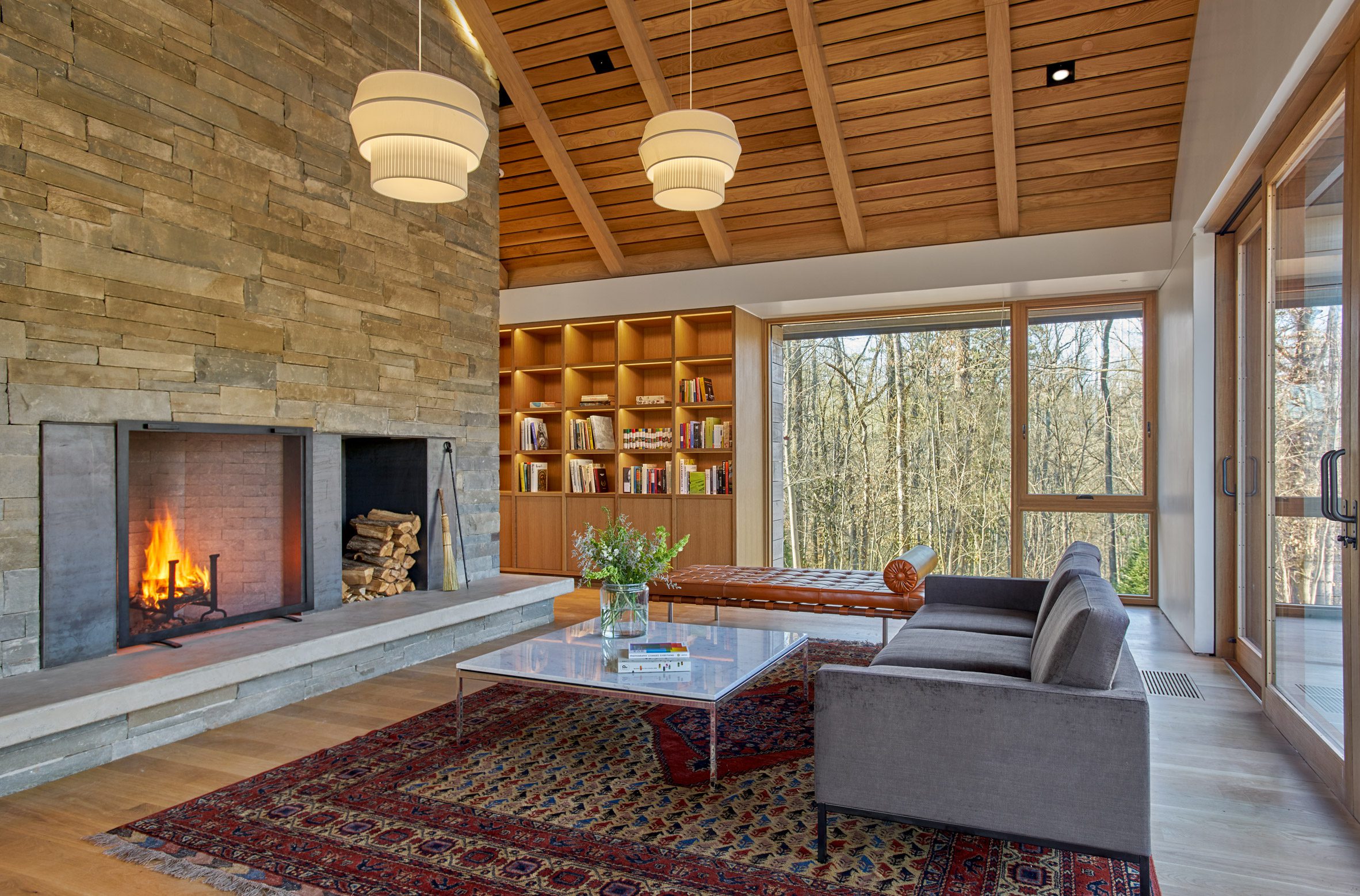
Made up of new buildings and historic log cabins, the Loghaven Artist Residency by Sanders Pace Architecture in Tennessee includes a living room in one of its buildings with paneled wooden ceilings that complement surrounding views of the woods.

A fireplace set against a stone wall and a large patterned rug contrast with the wooden elements and add to the welcoming feel of the cabin's living space. The luxurious tan colour of the room's Barcelona daybed by Ludwig Mies van der Rohe makes it blend in with the wooden floor and ceiling.

Find out more about The Loghaven Artist Residency ›


This is the latest in our series of lookbooks providing curated visual inspiration from Dezeen's image archive. For more inspiration see previous lookbooks showcasing concrete living rooms, spa-like bathrooms and terrazzo kitchens.

The post Ten welcoming living rooms featuring wooden elements and panelling appeared first on Dezeen.


from Dezeen https://ift.tt/2Y6AlNV

This week Bjarke Ingels launched a home design company

This week on Dezeen, Danish architect Bjarke Ingels co-founded a residential design company that aims to create a range of modular homes.

Named Nabr, the company intends to create a large variety of affordable houses using modular elements.

"Our homes have only gotten more and more expensive, and arguably at a lower and lower quality," explained Ingels.

"There's very little choice. Ninety-nine per cent of all homes are the same, but all people are actually different. There's a huge potential to reimagine this entire process, from end to end."

BIG power plant
Amager Bakke operator has "no plans to close down" ski slope on roof of BIG power plant

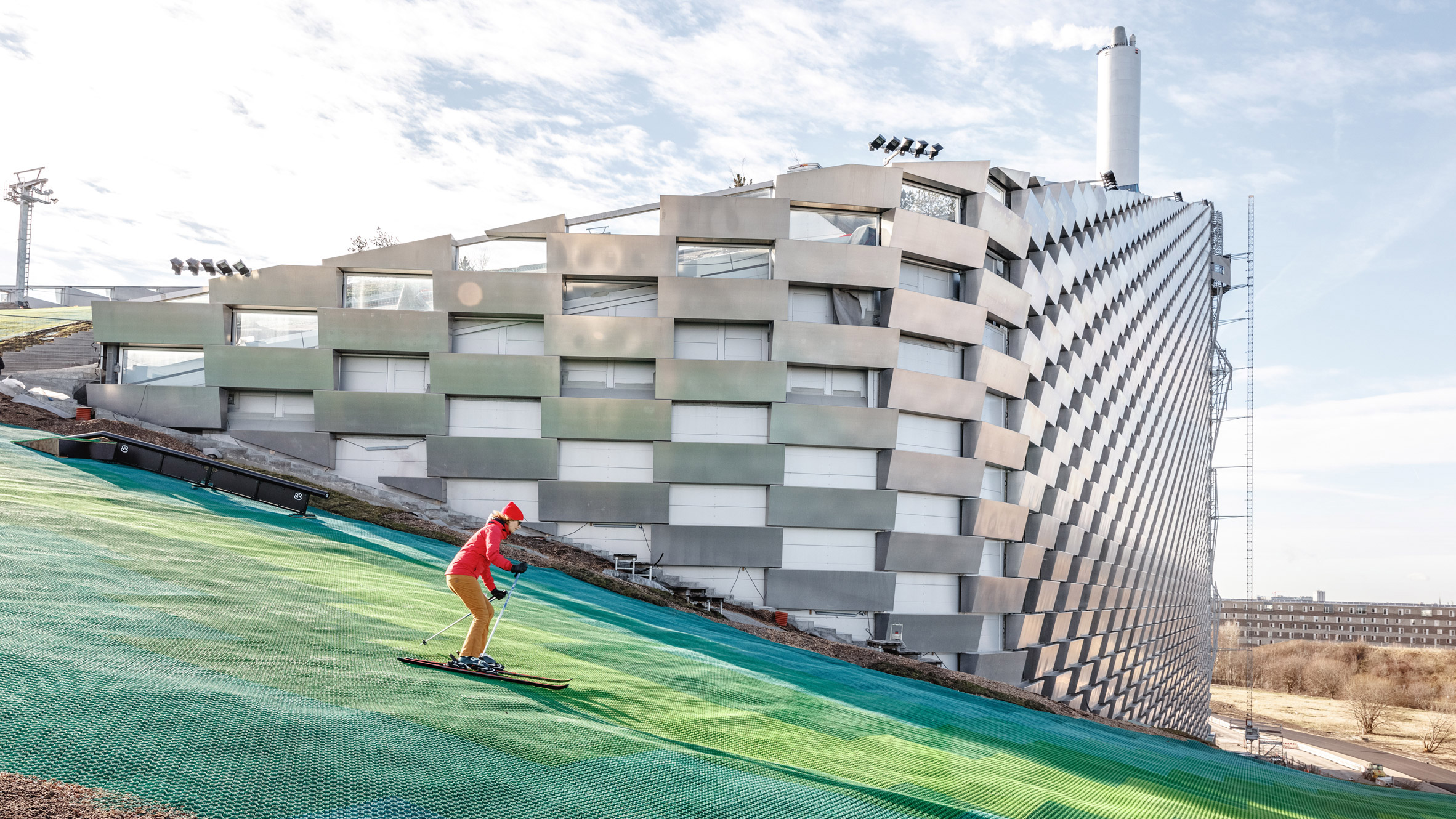
Bjarke Ingels' studio BIG was also in the news this week after reports in the Danish press suggested that its Copenhill ski slope may need to close.

However, although the artificial skiing surface is deteriorating faster than expected, the slope's operator dismissed claims that it is under threat of closure.

Taizhou Contemporary Art Museum by Atelier Deshaus
Concrete construction "offsets around one half" of emissions caused by cement industry says IPCC

We reported that according to the latest IPCC climate report, half of the carbon emissions from cement production are later reabsorbed by the material when it is used to construct buildings.

The role of cement as a carbon sink has been missed, according to Jenny Burridge, principal structural engineer at The Concrete Centre in London.

Giant floating wind farm
Wind Catching Systems designs giant floating wind farm with 117 turbines

In a bid to make wind farms more energy-efficient, Wind Catching Systems revealed its design for a floating, offshore wind power generator that would contain more than a hundred rotors stacked vertically.

According to the company, the Windcatcher could produce renewable energy for 80,000 homes.

Architectural viewpoints roundup
Ten impressive architectural viewpoints designed to stand out

Following the BIG's helical Marsk Tower opening and the controversial Marble Arch Mound we took a look at 10 impressive lookouts from Dezeen's archive.

These include a gravity-defying staircase and a frame-shaped viewpoint in Dubai.

1970s-style makeover of London townhouse
Studio Hagen Hall completes 1970s-style makeover of London townhouse

Popular projects this week included a family home in Bangkok, a retreat in the Catskill Mountains with 24 elevated cabins and a 1970s-style makeover of London townhouse.

Our lookbooks this week focused on living rooms that use concrete and minimalist bedrooms.

This week on Dezeen is our regular roundup of the week's top news stories. Subscribe to our newsletters to be sure you don't miss anything.

The post This week Bjarke Ingels launched a home design company appeared first on Dezeen.


from Dezeen https://ift.tt/2WxG3rq